When I evaluate a micro USB cable manufacturer, I know that a low quotation can hide the real problem: unsuitable specifications, unstable quality, or costly returns. Buyers may focus on price because the product looks simple. I recommend defining the application first, then checking materials, testing, delivery, customization, and supplier cooperation before comparing offers.
Quick Answer
- I recommend choosing a Micro USB Cable manufacturer that can match the cable to your device, charging requirement, data-transfer need, length, market, and order volume.
- I would not select a supplier only because it claims to be a factory or offers the lowest unit price.
- I would request a clear specification sheet, samples, test evidence, certification documents where relevant, packaging details, MOQ, lead time, and after-sales terms.
- I would compare repeat-order consistency, communication, production control, and customization capability alongside the product quotation.
- I would approve a supplier only after I verify the sample and confirm that the purchase order describes the product precisely.
The right micro USB cable manufacturer is the supplier that can consistently produce a suitable cable at an acceptable total cost. I recommend that buyers first define the application, including connector type, length, charging and data requirements, materials, packaging, target market, and order volume. They should then compare samples, documentation, production controls, MOQ, lead time, customization, and after-sales support rather than choosing the cheapest quotation alone.
A Micro USB cable can look identical to another cable while performing differently in daily use.[1] The connector may fit, but the cable may not meet the buyer’s expected current, data function, bending resistance, or retail presentation.[2] In my export work, I have found that many quotation problems begin because the buyer and supplier are using different definitions of “standard cable.”
Why Does the Micro USB Cable Manufacturer Matter?
A buyer who treats every Micro USB cable as a commodity may receive an attractive price but an unsuitable product. That can create complaints, marketplace returns, negative reviews, and emergency replacement orders. I have seen that a short specification discussion often reveals a completely different requirement from the original “send me your cheapest cable” request.
A quotation is not a product specification
- Basic charging for older consumer devices
- Charging and data transfer
- Power banks or accessories
- Retail blister packaging
- E-commerce multipacks
- Promotional distribution
- A high-use environment such as a service center or rental business
A cable for occasional household use does not necessarily need the same construction as a cable sold as a replacement accessory. A cable placed in a European retail chain may also require different packaging, labeling, documentation, and quality controls from a cable shipped in bulk to a wholesaler.
The real cost includes more than the unit price[3]
- Higher defect rates.
- More customer service work.
- Product returns and refunds.
- Repacking or relabeling.
- Delayed retail launches.
- Replacement shipments.
- Mixed specifications between batches.
| Evaluation point | Low-price quotation risk | Better buying approach |
|---|---|---|
| Cable construction | The specification may be unclear | Confirm conductor, jacket, strain relief, and connector details |
| Charging function | “Fast charging” may have no defined test basis | State the intended charging use and request supporting evidence |
| Data function | The cable may be charging-only[5] | Confirm whether data transfer is required |
| Repeat orders | The second batch may differ | Approve a controlled sample and retain the agreed specification |
| Packaging | Retail packaging may not match the target channel | Confirm artwork, labels, quantity, and packing method |
| Delivery | The quoted lead time may exclude busy periods | Ask for production and shipping assumptions |
My practical first step
I usually ask the buyer to send the information that will influence the product, not just the requested quantity. A useful inquiry includes the device or accessory type, cable length, preferred color, estimated annual volume, target market, packaging, and required delivery date.
If the buyer does not know the technical requirement, I would rather clarify it before quoting. A qualified engineer or product professional should review application-specific requirements when the cable will be used in a safety-sensitive, industrial, medical, or otherwise specialized environment.
What Should I Ask a Micro USB Cable Manufacturer Before Ordering?
Many sourcing mistakes happen because buyers ask broad questions such as “What is your best price?” I recommend using a structured inquiry. A good inquiry helps me compare suppliers on the same basis and shows which supplier answers carefully instead of making broad promises.
Product questions
- Is the cable intended for charging only, or for charging and data transfer?
- What lengths and colors are available?
- What conductor and jacket materials are used?
- How are the connectors and strain-relief areas constructed?
- What product specifications can the supplier provide in writing?
- Can the supplier provide samples from normal production?
- What testing does the supplier perform before shipment?
- Can the supplier support custom logo, color, packaging, or cable length?
- What is the MOQ for standard and customized versions?
- Which specifications remain fixed for repeat orders?
The supplier’s answer should be specific enough for two parties to understand the same product. “Good quality” is not a measurable specification. I prefer wording that identifies a material, dimension, test condition, packaging method, or acceptance standard.
Supplier questions
- How long has the company handled this product category?
- Does it manufacture the product, coordinate production, or trade from several sources?
- Which processes are performed in-house?
- Which processes are outsourced?
- Who controls incoming materials and finished-goods inspection?
- How does the company manage nonconforming goods?
- What happens if a repeat order does not match the approved sample?
- Can it provide a realistic production schedule during peak periods?
- Who will handle technical questions after the order?
A trading company is not automatically a poor supplier. A capable trading company may manage suitable factories, quality checks, export documents, and communication effectively. However, I would still ask for transparency about the supply chain and the controls applied to the order.
Answers that need verification
| Supplier statement | What I would verify |
|---|---|
| “Factory direct” | Business registration, facility information, process ownership, and production evidence |
| “Fast charging” | Defined electrical requirements, test conditions, and compatibility limitations |
| “100% tested” | Test scope, sampling method, records, and treatment of failed units |
| “Certified product” | Certificate number, issuing organization, product model, validity, and applicable market |
| “High durability” | Test method, cycle count, sample size, and acceptance criteria |
| “Same quality as a major brand” | Objective specifications and independent evidence, not a comparison claim |
| “In stock” | Actual quantity, batch date, specification, and whether the stock is reserved |
I treat certifications as documents to verify, not as automatic proof that every shipment will be perfect. Buyers should check the relevant authority, certification body, product model, scope, and validity. They should also ask whether the document applies to the cable itself, its packaging, a related product, or only the manufacturer’s management system.
A simple inquiry template
Please quote a Micro USB cable for [device or application]. Required length: [length]. Required function: [charging only / charging and data]. Target quantity: [quantity]. Market: [country or region]. Packaging: [bulk / bag / retail box / blister]. Please include available materials, connector construction, MOQ, sample cost, production lead time, inspection method, customization options, and relevant product documentation.
How Should I Evaluate Micro USB Cable Quality?
A sample can tell me whether a cable looks and functions as expected, but a sample alone cannot prove long-term batch consistency.[6] I evaluate the product through a combination of specification review, sample inspection, documented testing, and production follow-up.
Connector construction
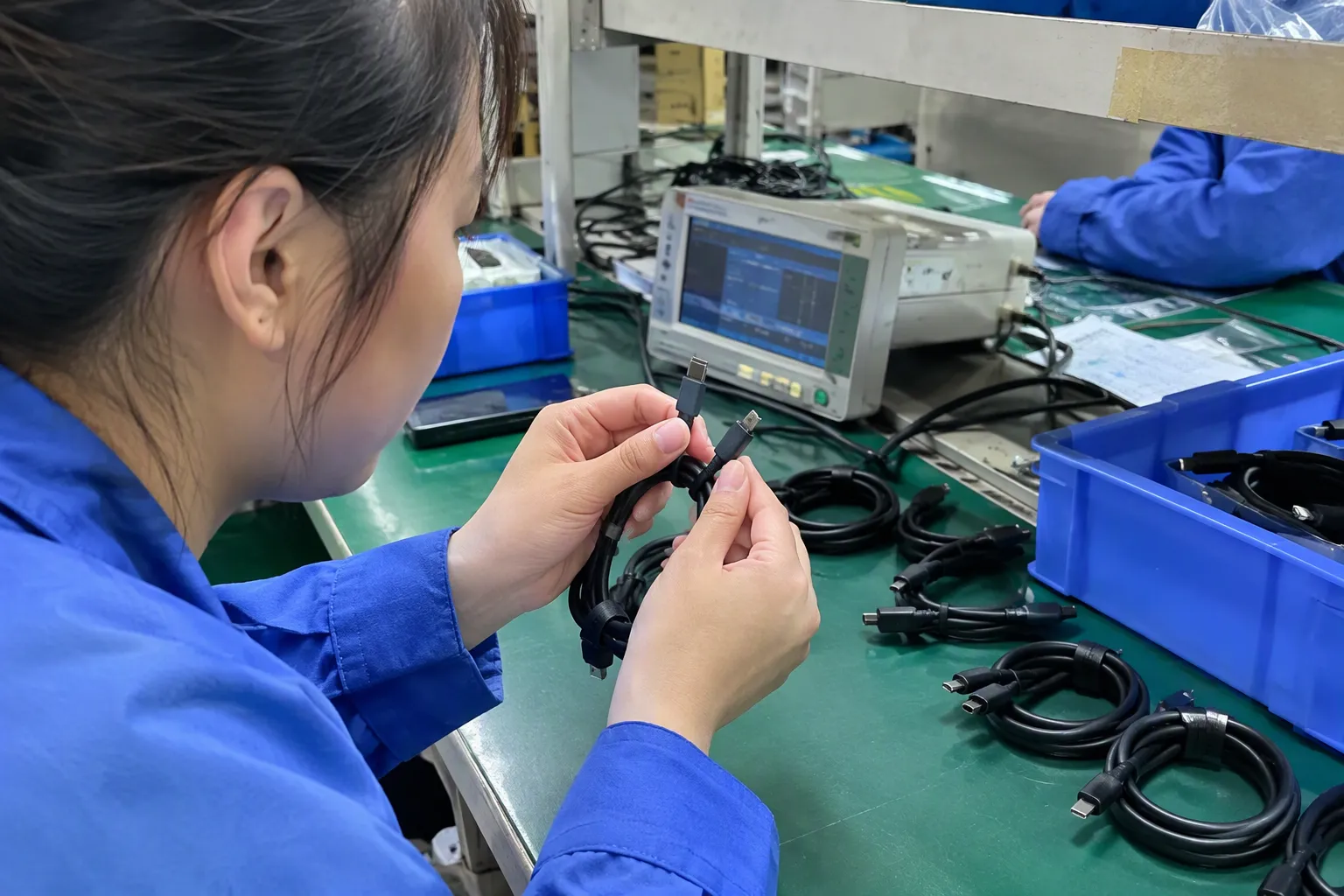
The Micro USB plug should fit the intended port correctly and should not feel excessively loose or difficult to insert. I check the housing, metal shell, contact area, molding, and transition from connector to cable. These areas often receive repeated handling, so poor construction can lead to intermittent connection or mechanical damage.[7]
I do not claim that a visual inspection proves durability. I use it as an initial screening step. If the application involves frequent plugging and unplugging, I ask the supplier what mechanical tests it performs and request the relevant records or test method.
Cable materials and flexibility
| Feature | PVC cable[8] | Braided cable |
|---|---|---|
| Typical appearance | Smooth and simple | Textile-covered or textured |
| Cost position | Often more economical | Often higher, depending on construction |
| Flexibility | Depends on formulation and diameter | Depends on inner cable and braid design |
| Retail positioning | Basic or value product | Premium or giftable product |
| Inspection focus | Jacket finish, flexibility, molding | Braid consistency, end transitions, fraying |
| Best decision basis | Application and target price | Application, appearance, and handling expectations |
I check whether the cable is too stiff, too thin, or inconsistent between samples. I also examine the strain relief at both ends. A heavy connector housing combined with a weak cable transition can increase stress during everyday use.
Charging and data claims
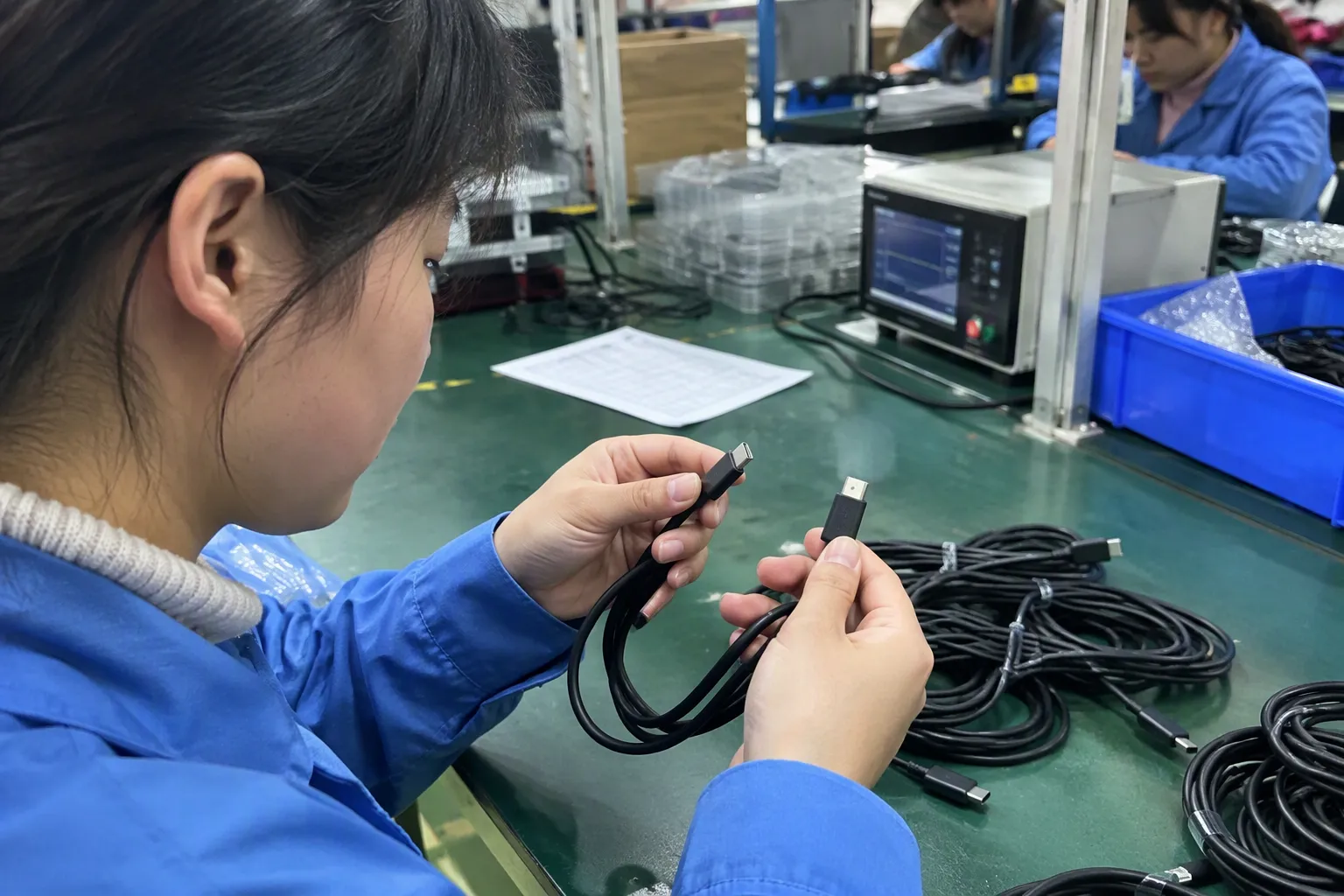
I avoid treating a printed charging claim as proof of performance. Charging results can depend on the device, charger, power-management system, cable construction, length, and other conditions.[4] The buyer should define the intended use and request test information that corresponds to that use.
- Whether data transfer is required.
- Which devices or systems will be used for checking.
- Whether the cable is designed as charging-only or dual-purpose.
- Which test method the supplier uses.
- Whether the data claim applies to every production batch.
When the product will be marketed with a technical performance claim, I recommend qualified technical review and evidence that supports the exact claim. I would not copy a supplier’s marketing phrase directly onto a product listing without checking it.
Sample inspection checklist
- Confirm connector type and fit.
- Measure cable length using an agreed method.
- Check color and surface finish.
- Inspect molding and strain relief.
- Look for exposed wires, gaps, burrs, or loose parts.
- Test charging with representative devices and chargers.
- Test data transfer if the product requires it.
- Check packaging quantity and labeling.
- Photograph the approved sample.
- Record the exact model, date, and specification version.
A buyer should keep an approved reference sample when possible. The purchase order should refer to the sample and include the main specifications. If the supplier changes a material, mold, connector, or packaging method, I recommend requiring written approval before mass production.
How Do I Compare Micro USB Cable Manufacturers for Repeat Orders?
A supplier can produce an acceptable sample and still perform poorly on delivery, communication, or repeat orders. I evaluate the whole cooperation process because B2B buyers need predictable replenishment, not only one successful shipment.
Compare suppliers with the same scorecard
| Category | Questions to score |
|---|---|
| Product suitability | Does the proposed cable match the actual use case? |
| Quality control | Are inspection steps and records clear? |
| Documentation | Are product and certification documents relevant and verifiable? |
| Price | Is the quotation competitive after packaging and logistics assumptions? |
| MOQ | Does the MOQ fit the expected sales volume? |
| Lead time | Can the supplier support the required launch and replenishment schedule? |
| Customization | Can the supplier manage logo, color, packaging, and labeling accurately? |
| Communication | Does the supplier answer directly and record changes clearly? |
| After-sales | Is there a defined process for complaints and corrective action? |
| Supply continuity | Can the supplier manage material or component changes? |
I often give greater weight to product suitability and consistency than to a small unit-price difference. A retailer with frequent replenishment may value a stable 10-day or 20-day production plan more than a lower initial offer with uncertain availability. The actual lead time must be confirmed for the specific product, season, and quantity.
MOQ and customization
MOQ is not only a factory requirement. It also affects the buyer’s inventory risk. A custom color or retail package may require a minimum order because the supplier must purchase packaging materials or arrange a special production run.
- Standard product MOQ.
- Logo printing MOQ.
- Custom color MOQ.
- Custom packaging MOQ.
- Mixed-model order rules.
- Sample and tooling charges.
- Reorder MOQ after the first production run.
This separation helps an e-commerce seller compare a standard product with a customized product fairly. It also prevents a buyer from assuming that a small sample order can be repeated under the same commercial terms.
Lead time and production planning
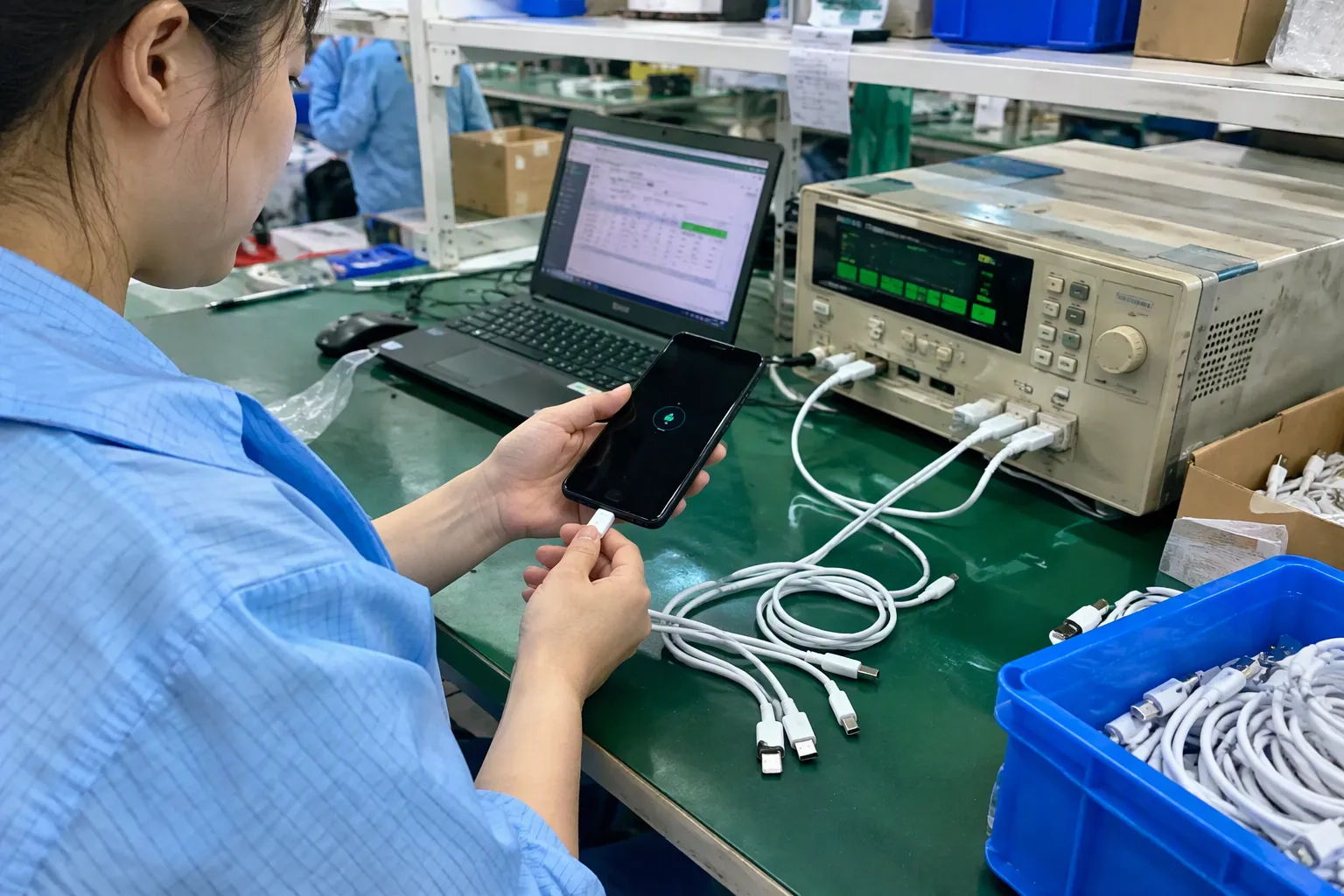
I ask whether the stated lead time starts after payment, artwork approval, sample approval, or material confirmation. I also ask whether the supplier includes inspection and packing in the lead time.
- Artwork or specification confirmation.
- Material and component preparation.
- Cable assembly.
- Connector molding or assembly.
- In-process inspection.
- Finished-goods testing.
- Packaging.
- Final inspection.
- Shipment preparation.
If the supplier cannot explain where time is used, I treat the lead-time figure as provisional. I also ask about the effect of public holidays, peak seasons, material shortages, and changes to the order.
After-sales handling
A responsible supplier should have a practical process for complaints. I want to know what evidence the buyer must provide, how the supplier identifies the affected batch, and how corrective action is agreed.
- Defect photos or videos.
- Sample return.
- Batch and carton information.
- Quantity affected.
- Comparison with the approved sample.
- Root-cause review.
- Replacement, credit, sorting, or another agreed solution.
I avoid promising a universal defect rate or replacement policy because these terms depend on the contract and inspection agreement. Buyers should write the acceptance criteria and remedy terms into the purchase documents.
What Documents and Compliance Checks Should I Review?
European and North American buyers often need more than a product sample. They may need documents for internal purchasing, customs, marketplace compliance, retailer onboarding, packaging review, or customer questions. The exact requirements depend on the product, destination, claims, and sales channel.
Start with the destination market
I ask the buyer where the cable will be sold and how it will be presented. A bulk cable supplied to a business customer may have different labeling and documentation expectations from a branded retail pack sold directly to consumers.
The buyer should confirm requirements with a qualified compliance professional or the relevant authority. I do not treat a supplier’s general statement such as “we have all certifications” as a complete compliance review.
- USB Implementers Forum for official USB-related information and program resources.
- European Commission product safety information for general European product-safety context.
- European Commission Access2Markets for customs and market-access information.
- U.S. Consumer Product Safety Commission for relevant U.S. consumer-product safety resources.
These sources do not replace application-specific legal advice. They help buyers begin the verification process with authoritative information rather than relying on copied supplier marketing text.
Documents I may request
- Product specification sheet.
- Material information.
- Test reports relevant to the claimed function.
- Declaration or compliance documents where applicable.
- Packaging and label artwork.
- Business registration details.
- Quality-management documentation.
- Inspection records.
- Certificate information that identifies the product model and scope.
- Shipping and carton information.
A certificate must be checked for issuer, model, date, scope, and validity. I also check whether the document belongs to the actual supplier and product under discussion. A factory-management certificate does not automatically certify the performance of every cable manufactured there.
Keep claims accurate
I recommend using cautious product language. For example, “Micro USB charging and data cable, 1 m, black” is clearer than “ultra-fast universal cable” when the supporting evidence is limited.
The product page should not imply compatibility with every device unless the buyer has a defensible basis for that statement. Older devices, chargers, operating systems, and port conditions can produce different results. Buyers should also consider trademark and compatibility wording before publishing listings.
Contract documents matter
- Product model.
- Connector type.
- Length and tolerance.
- Color.
- Main materials.
- Function.
- Packaging.
- Logo and artwork version.
- Quantity.
- Inspection method.
- Shipping marks.
- Agreed delivery date.
- Complaint and remedy process.
How Can I Build a Safer Supplier-Selection Process?
I do not recommend choosing a Micro USB cable manufacturer after reading one quotation or one online profile. I prefer a staged process that removes uncertainty before the buyer commits to a large order.
Stage 1: Define the application
I first record the product use case, target users, sales channel, quantity, and market. I identify whether the cable is a basic accessory, replacement product, bundled item, promotional item, or retail product.
At this stage, I also decide which points are essential and which are flexible. For example, the buyer may require a specific length but accept either PVC or braided construction. Another buyer may care more about retail appearance than the lowest possible cost.
Stage 2: Screen potential suppliers
I compare several suppliers using the same inquiry. I review how quickly and accurately each supplier responds. A fast response is useful, but a careful response is more valuable when the product requirement is complicated.
- Clear answers instead of unsupported superlatives.
- Consistent terminology.
- Realistic MOQ and lead time.
- Willingness to clarify unknown requirements.
- Relevant samples.
- Transparent customization conditions.
- A named person responsible for follow-up.
Stage 3: Approve samples
I order samples that represent the proposed production version. If the buyer needs custom packaging, I request a packaging sample or artwork proof. If the cable must support a particular use, I test it with representative equipment.
Stage 4: Confirm production controls
Before a larger order, I ask how the approved sample will be used as a production reference. I ask whether the supplier performs incoming-material inspection, in-process checks, finished-goods testing, and pre-shipment inspection.
Stage 5: Start with a controlled order
A first order should be large enough to test the supplier’s process but manageable for the buyer’s inventory risk. The right quantity depends on the sales channel and demand forecast. I do not recommend an artificial universal order size.
- A written pre-production confirmation.
- A retained approved sample.
- A defined inspection plan.
- Carton and packaging checks.
- Random finished-goods inspection.
- A post-delivery review.
Stage 6: Review the first shipment
After delivery, I compare the goods with the approved sample and purchase order. I review not only defects but also communication, packing accuracy, shipping documents, and response time.
The first shipment gives the buyer information about repeat-order risk. A supplier that handles a small problem honestly may be easier to develop than a supplier that hides or dismisses it.
A practical decision rule
Frequently Asked Questions
How do I find a reliable Micro USB cable manufacturer?
I recommend using a structured inquiry, comparing several suppliers, checking their product and business information, ordering samples, and reviewing relevant documentation. I would also confirm MOQ, lead time, customization, inspection, and complaint handling before placing a larger order.
Is a factory always better than a trading company?
No. A factory may offer direct production control, but a trading company may provide useful sourcing, export, packaging, and communication support. I evaluate the supplier’s actual control over the order, transparency, quality process, and after-sales responsibility instead of relying on the label “factory.”
What specifications should I include in a Micro USB cable inquiry?
I would include connector type, cable length, charging or data-transfer function, color, construction preference, packaging, target market, quantity, customization, delivery date, and required documents. I would also state the device or application so the supplier can identify compatibility questions.
Can a Micro USB cable support fast charging?
A Micro USB cable may be suitable for a particular charging application, but I would not rely on the phrase “fast charging” without a defined requirement and supporting evidence. Results can depend on the device, charger, cable design, and test conditions. Buyers should verify the exact claim for their use case.
How can I reduce quality differences between repeat orders?
I recommend keeping an approved sample, attaching a detailed specification to each order, confirming any material or design changes in writing, and using an agreed inspection process. Buyers should record batch information and address deviations promptly instead of waiting until several shipments have been completed.
Conclusion
Choosing a Micro USB cable manufacturer requires more than comparing unit prices. I recommend starting with the actual device and sales application, then checking connector construction, materials, charging and data requirements, packaging, documentation, MOQ, lead time, quality control, and after-sales support. Samples and certificates require verification, and application-specific decisions may require qualified professional review. If you are planning a repeat order, send me your target market, quantity, specifications, packaging needs, and delivery schedule so I can help you prepare a clearer sourcing inquiry.
Sources
- Modeling an ESD Gun Discharge to a USB Cable", Technical specifications and comparative measurements support the distinction between a cable's outward appearance and its electrical or signaling performance, because internal construction and connector characteristics can vary while the external form remains similar
- USB Cable Quality Standards: Testing, Certifications ... - OSKO", USB specifications and cable-test standards indicate that connector compatibility is only one attribute; current-carrying capability, signaling performance, and mechanical endurance are assessed through separate requirements or tests
- (PDF) A taxonomy of total cost of ownership models", Quality-cost and total-cost-of-ownership literature classifies returns, complaints, rework, replacement, and disruption as costs that can arise beyond the initial purchase price
- Build Better Devices: USB Power Delivery Explained", USB power-delivery documentation and electrical analyses explain that cable resistance and system-level negotiation can affect voltage, current, and delivered charging power across different device and charger combinations
- USB-A to Micro USB Data Blocker Charge-Only Cable", USB connector and cable documentation distinguishes power conductors from the data conductors required for USB communication, supporting the possibility that a cable can provide charging without data transfer
- Statistical Process Control (SPC) in Injection Molding", Statistical quality-control principles distinguish product acceptance from evidence of continuing process capability; a single approved sample therefore does not by itself demonstrate consistency across later production batches
- Bending Fatigue Response of Grouted Stay Cables (0-1401-1)", Cable-reliability research and flexing standards identify repeated bending and stress concentration at cable-to-connector transitions as mechanisms that can produce conductor fatigue, intermittent contact, or mechanical failure
- Experimental Study on Flammability and Flame Spread ... - PMC", Materials studies can support differences in mechanical behavior and surface construction between PVC-jacketed and textile-braided cable assemblies, while the table's cost and retail-positioning statements remain market-specific interpretations