Bulk USB Cable purchasing becomes difficult when a low quotation hides unclear connector, power, data, packaging, or quality details. I have seen buyers focus on unit price first and then revise an order after discovering that the cable does not match the target devices. I use a more reliable approach: define the application, confirm the specification, and then compare suppliers.
Quick Answer
The best Bulk USB Cable is not always the cheapest option. I recommend that buyers first confirm the connector combination, charging purpose, data function, supported power, length, packaging, and target devices. After that, I compare samples, production controls, MOQ, lead time, inspection terms, and after-sales support. This process helps retailers and distributors reduce compatibility complaints, returns, and unsellable inventory.
- Match the cable to the devices and tasks before requesting a final quotation.
- Separate charging claims from data-transfer claims.
- Confirm specifications in writing on the quotation, sample, and purchase order.
- Treat sample approval as one control step, not a guarantee of every bulk batch.
- Compare total commercial risk, not only the lowest unit price.
For European and American retailers, wholesalers, chain stores, and e-commerce sellers, USB cables are familiar products with surprisingly complex purchasing risks. A cable may look correct while still creating problems at the point of sale. In the following sections, I explain how I evaluate bulk cable opportunities from a procurement and supply-chain perspective.
SMAYS: Bulk Cable
A bulk cable order can look simple because the product is small, common, and easy to compare. However, unclear specifications can create inventory that is difficult to sell. I usually begin by asking what the buyer’s customers will connect, how they will use the cable, and what promise the packaging will make.
A SMAYS bulk cable order should begin with a written product definition. That definition should identify the connector on each end, charging or data purpose, supported power information, length, construction, packaging, target devices, order quantity, and inspection expectations. Buyers can then compare quotations on an equal basis instead of comparing incomplete product names.
Why the product name is not enough
- Whether the cable is USB-A to USB-C or USB-C to USB-C.
- Whether it is intended mainly for charging or also for data transfer.
- Which charger and device combinations have been checked.
- What power capability is documented.
- Whether the cable includes any identification component required by the intended application[2].
- Which length, jacket material, color, connector housing, and packaging apply.
- Whether the stated performance is based on supplier documentation, third-party testing, or a marketing description.
The commercial risk of a vague order
A buyer may accept a low price and later discover that the product is unsuitable for the intended shelf position. For example, a retailer may need a USB-C to USB-C cable for newer wall chargers, while the ordered stock uses USB-A on the charger side. The cable may function in some situations, but it will not serve the planned customer need.
I have handled customer communication where connector details or power expectations needed clarification before production. In my experience, early clarification is easier than changing a bulk order after materials have been purchased. I therefore recommend a product specification sheet, even for a relatively low-value accessory.
| Item | Example of information to confirm |
|---|---|
| Connector combination | USB-A to USB-C, USB-C to USB-C, or another defined combination |
| Main use | Charging only, charging plus data, or a clearly limited application |
| Length | Exact finished length and measurement method |
| Power claim | Documented capability and applicable conditions |
| Data claim | Whether data transfer is supported and what evidence exists |
| Exterior | Jacket, color, connector housing, strain relief |
| Packaging | Bulk pack, polybag, retail box, barcode, language requirements |
| Quality control | Sample standard, inspection method, acceptable defect criteria |
| Commercial terms | MOQ, lead time, payment, shipping terms, after-sales process |
Which Bulk USB Cable Specifications Should I Confirm?
Many cable problems begin when buyers choose a connector based on trend or price instead of the actual device portfolio. I ask buyers to list their principal devices, chargers, and customer use cases before selecting SKU combinations. This step also helps prevent an excessive number of slow-moving variations.
Buyers should confirm connector type, charging function, data function, power requirements, length, physical construction, and packaging before ordering a Bulk USB Cable. The final choice should match the devices sold by the buyer and the claims that the buyer plans to make in its sales channel.
Connector selection
| Cable combination | Typical purchasing question |
|---|---|
| USB-A to USB-C | Does the customer mainly use older USB-A chargers or car chargers? |
| USB-C to USB-C | Does the customer use USB-C wall chargers, laptops, tablets, or newer phones? |
| USB-A to Micro-USB | Is there still a defined installed base of compatible devices? |
| USB-C to Lightning | Does the target device portfolio require this connection, and are all product claims documented? |
I avoid describing one connector as universally better. A USB-C to USB-C cable may be appropriate for a buyer with modern USB-C chargers, but it may be less useful for customers who still own USB-A power adapters. A Micro-USB cable may have declining demand in some categories, yet it can remain relevant for selected accessories and installed devices.
Charging and data are separate buying decisions
- Is charging the main commercial purpose?
- Does the product need to transfer files or synchronize devices?
- Which devices and operating environments have been checked?
- Is the stated performance supported by current product documentation?
- Does the packaging describe the capability accurately?
Length and construction affect the sale
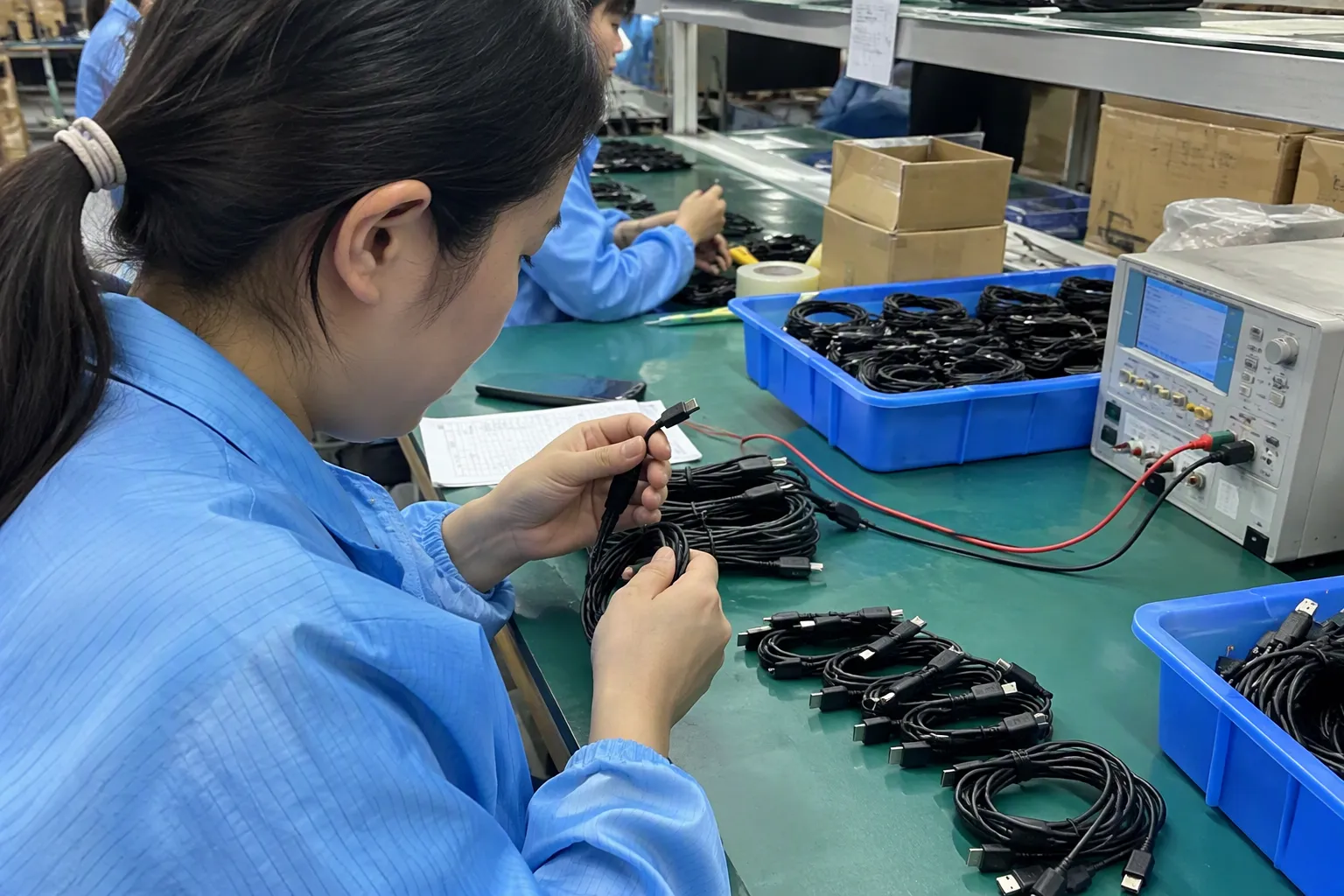
Length is not only a factory detail. A short cable may suit a power bank or desktop setup, while a longer cable may be useful beside a bed, in a vehicle, or in a retail convenience display. A longer design can also affect handling, packaging volume, resistance, and customer expectations.[3] I ask buyers to confirm the finished length and tolerance rather than relying on a general product photo.
Jacket materials and connector housings also influence the product position. A soft outer jacket may support a different retail message from a standard PVC-style construction. Braided designs can look more premium, but appearance does not automatically prove better electrical performance or longer service life.[4] I treat material claims as specifications that need supplier documentation and, where appropriate, testing.
Power claims need conditions
- The supplier’s current technical data sheet.
- The tested or documented power conditions.
- Any relevant identification or compatibility information.
- Evidence that the production version matches the approved sample.
- Clear packaging language that does not overpromise.
How Do I Compare Bulk USB Cable Suppliers?
A supplier can offer an attractive price while leaving important commercial questions unanswered. I compare suppliers by looking at product clarity, communication, production control, inspection cooperation, documentation, and replenishment ability. I also check whether the supplier can support the buyer’s expected packaging and customization process.
I compare Bulk USB Cable suppliers using a balanced scorecard rather than price alone. The scorecard should include specification accuracy, sample management, quality consistency, MOQ, lead time, packaging, documentation, inspection access, communication, and after-sales handling. A supplier that reduces avoidable risk may offer better total value even with a higher unit price.
A practical supplier scorecard
| Evaluation area | Questions I would ask |
|---|---|
| Product fit | Can the supplier match the required connector, length, and use case? |
| Technical clarity | Are charging and data claims documented separately? |
| Sample control | Is the sample identified and retained as a reference? |
| Production | Does the supplier explain how incoming materials and finished goods are checked? |
| Packaging | Can the supplier meet barcode, language, carton, and retail requirements? |
| MOQ | Does the MOQ fit the buyer’s launch quantity and demand forecast? |
| Lead time | Does the quoted time include material preparation and packaging? |
| Inspection | Can the buyer or an appointed inspector check the order before shipment? |
| Replenishment | Can the supplier repeat the same specification for the next order? |
| After-sales | Is there a defined process for complaints, evidence, replacement, or credit review? |
Certification documents require verification
My company supplies 3C products to European and American markets, and customers often ask about certifications and compliance documents. I treat these documents seriously, but I do not treat a logo or certificate image as automatic proof that every cable is suitable for every destination.[8]
- The document identifies the correct supplier and product.
- The model, construction, and rating match the offered cable.
- The issuing body and document status can be verified.
- The document applies to the destination market and intended claim.
- The current production version has not changed from the assessed version.
For European-market products, buyers may consult official European Commission information, including the Access2Markets portal, for applicable trade and product requirements. For relevant electrical and electronic product compliance questions, I recommend reviewing current official guidance and obtaining professional advice. For the United States, buyers should check the requirements of the intended product category, retailer, state, and federal agencies rather than relying on a generic certificate.
Communication is part of supplier quality
I recommend keeping one approved specification file, one marked sample, and one packaging reference. When a buyer changes a connector, label, color, or cable length, the revision should receive a new reference. This method helps the factory, buyer, warehouse, and inspection party work from the same information.
What Should I Check During Bulk USB Cable Sampling?
A sample is valuable because it makes an abstract quotation tangible. However, a sample is only useful when I connect it to a defined approval process. I check the physical product, packaging, labeling, and intended use, then I record what the bulk shipment must reproduce.
For a Bulk USB Cable sample, buyers should confirm physical construction, connector fit, charging and data functions, length, labeling, packaging, and visible workmanship. They should document the approved version and agree how production will be checked. Sample approval reduces uncertainty, but it does not guarantee that every later batch will be identical.[5]
My sample approval checklist
Physical and visual checks
- Connector combination and housing shape.
- Finished length and approximate tolerance.
- Jacket appearance, color, and visible damage.
- Strain relief and connection between cable and housing.
- Surface marks, loose braid, exposed conductor, or uneven molding.
- Label, logo, model number, and packaging artwork.
- Carton quantity and barcode information.
Functional checks
What I record after approval
- A signed or otherwise identified sample.
- Product photographs from several angles.
- The final specification sheet.
- The packaging artwork and label file.
- The supplier quotation and revision history.
- Any supporting technical documents.
- The agreed inspection standard.
- The target shipment quantity and carton details.
Why approval is not a guarantee
Production involves materials, operators, equipment, and packaging steps. A factory can produce a good sample and still experience variation in a later batch. That possibility does not mean the supplier is unsuitable. It means the buyer needs controls that continue after sampling.
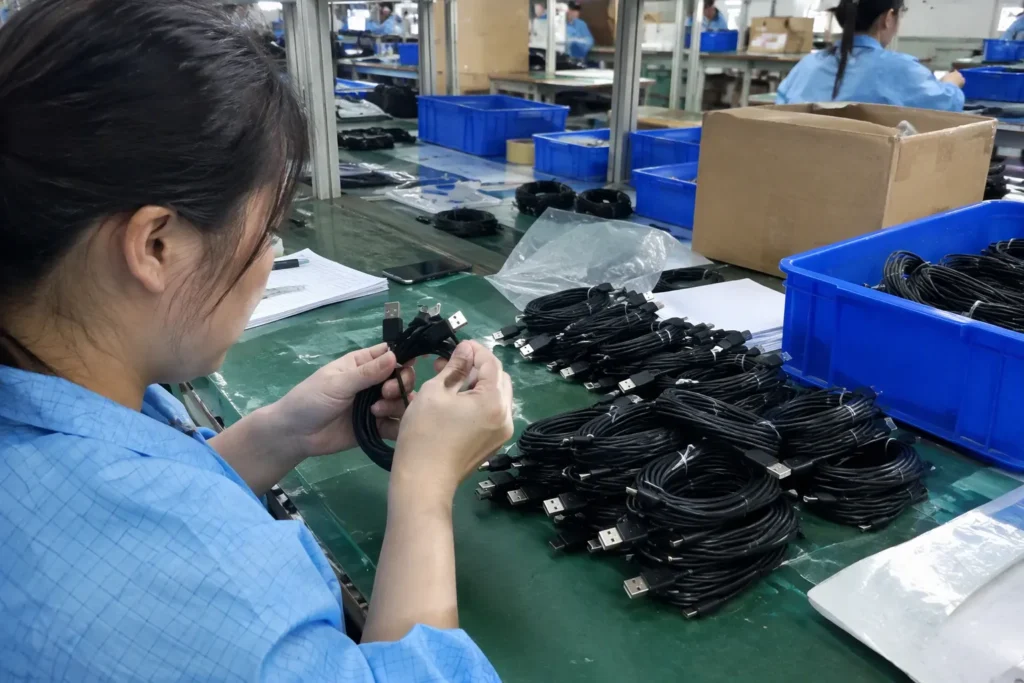
I have found that customers get better results when they discuss bulk inspection before the purchase order rather than after a complaint. The inspection may cover quantity, packaging, visual workmanship, connector configuration, labeling, and agreed functional checks. The depth of inspection should reflect the product claim, order value, buyer’s risk, and destination requirements.
For high-volume or customized orders, I recommend that buyers consider an independent inspection agency or qualified technical evaluator. A procurement professional can help define commercial acceptance criteria, while an engineer or testing laboratory may be needed for application-specific electrical questions.
How Can I Control Quality in a Bulk USB Cable Shipment?
Quality control should continue from quotation to replenishment.[6] I divide it into incoming-material control, production checks, finished-goods inspection, packaging review, and complaint analysis. This approach helps me identify whether a problem came from specification, manufacturing, handling, or customer expectation.
Bulk USB Cable quality control should use multiple checkpoints rather than one final visual inspection. Buyers should define the approved sample, critical specifications, visible defect criteria, functional checks, packaging requirements, and corrective-action process before production. Qualified inspectors or laboratories should evaluate claims that require specialized equipment.
Five useful checkpoints
1. Specification review before production
2. Material and component confirmation
The supplier should confirm that the production materials match the approved version. This may include the cable jacket, connector housing, terminals, packaging, and any relevant internal component. The buyer should ask how substitutions are controlled.
3. In-process checks
4. Finished-goods inspection
5. After-sales feedback
Defining critical defects
- Wrong connector combination.
- Missing or incorrect retail label.
- Damaged connector housing.
- Exposed conductor or unsafe visible construction.
- Cable length outside the agreed specification.
- Packaging for a different model.
- A documented function that is absent in the supplied version.
The acceptable quality limit, sampling plan, and defect classifications should be agreed by the buyer and supplier.[7] The appropriate method depends on the order and product risk. A qualified inspection provider can help the buyer create a suitable plan.
How Do MOQ, Lead Time, and Packaging Affect Bulk USB Cable Profit?
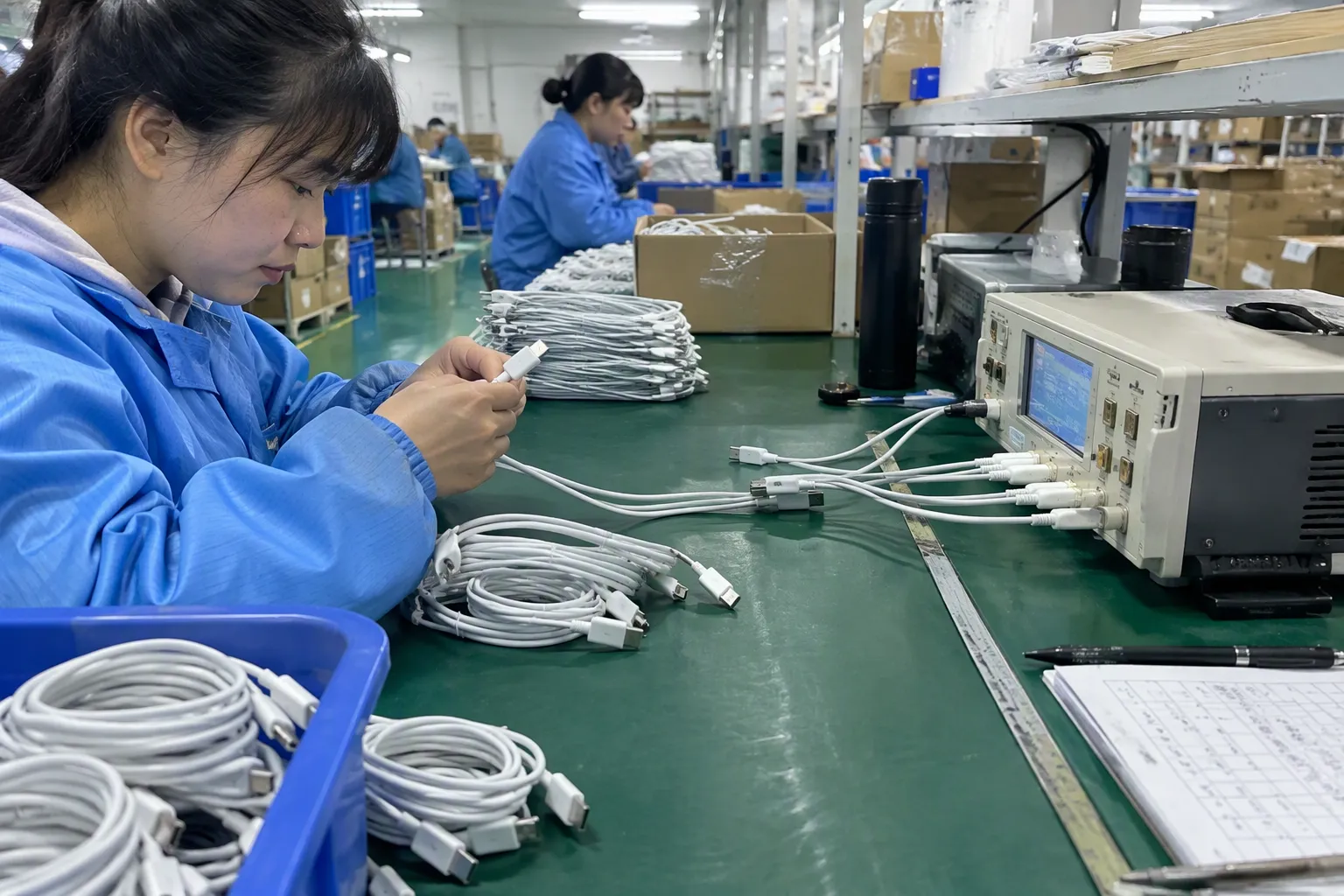
MOQ, lead time, and packaging affect Bulk USB Cable profitability because they determine cash commitment, launch flexibility, inventory speed, and retail readiness. I compare the landed cost and stock risk of each SKU, then negotiate a product mix and replenishment plan that fits the buyer’s real sales forecast.
MOQ is a demand-planning issue
- How many units can the buyer sell during the expected replenishment period?
- Which SKU has proven demand?
- Which connector is required by the buyer’s key accounts?
- Can the buyer test a new SKU with a smaller launch quantity?
- Will customized packaging create leftover stock if the design changes?
Lead time includes more than factory production
| Stage | Planning question |
|---|---|
| Artwork | When must the final file be approved? |
| Materials | Are connectors, jackets, labels, and boxes available? |
| Production | How many working days are planned? |
| Inspection | When can inspection take place? |
| Rework | What happens if the inspection finds a problem? |
| Dispatch | When will cartons be ready for collection? |
| Transport | What transit time and shipping terms apply? |
Packaging supports the sales channel
Bulk polybags, neutral cartons, branded retail boxes, counter displays, and e-commerce-ready packaging serve different buyers. A chain store may need barcode and shelf information. A wholesaler may prefer simpler packing and lower packaging cost. An online seller may need packaging that reduces damage and supports parcel shipping.
- Cost per unit.
- Minimum packaging quantity.
- Required languages and markings.
- Barcode and product identification.
- Protection during transport.
- Ease of warehouse handling.
- Retail presentation.
- Packaging waste and destination-market expectations.
How Do I Reduce Returns and Unsellable Bulk USB Cable Inventory?
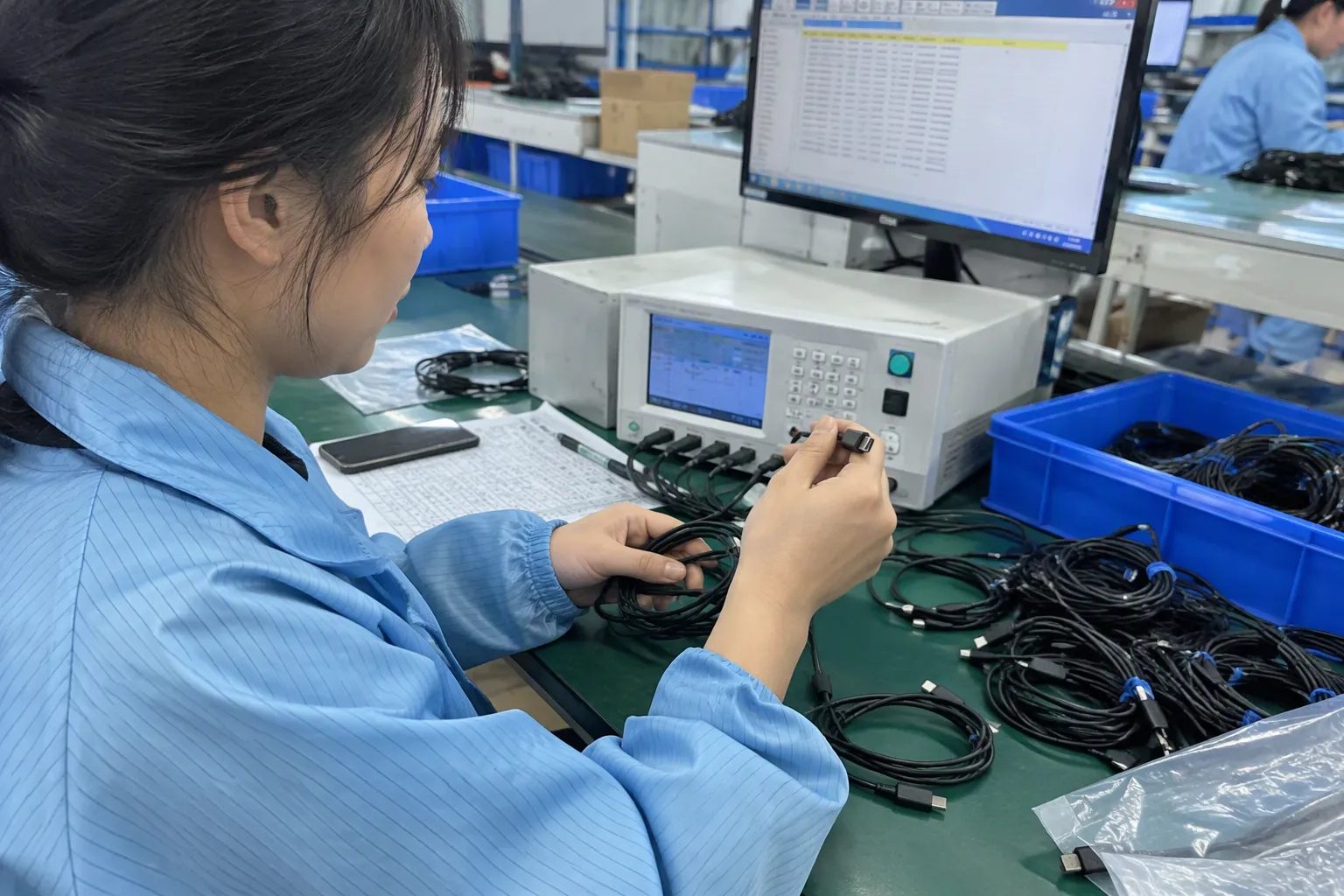
Returns often come from a gap between what the buyer expects and what the product actually supports. I reduce this gap by matching the product to the listing, packaging, sales staff, and customer devices. Clear communication at the purchasing stage usually costs less than correcting thousands of units later.
Buyers can reduce Bulk USB Cable returns by matching each SKU to a defined device group, separating charging from data claims, using accurate product listings, confirming compatibility, and tracking complaints by model. They should avoid broad promises that the supplier cannot support with current documentation or testing evidence.
Build a SKU matrix
| Target customer need | Cable SKU | Charger side | Device side | Main function | Packaging message |
|---|---|---|---|---|---|
| Older household charger | Defined combination | Confirmed | Confirmed | Charging or both | Accurate use statement |
| Modern USB-C charger | Defined combination | Confirmed | Confirmed | Charging or both | Documented capability |
| Laptop or tablet user | Defined combination | Confirmed | Confirmed | Device-specific | Application limits |
| Accessory replacement | Defined combination | Confirmed | Confirmed | Charging or data | Compatibility notes |
Use customer language carefully
Better wording identifies the intended use and limitations. The final wording should follow the product documentation and applicable advertising requirements. If the buyer wants a specific technical or performance statement, I recommend professional review before publication.
Handle complaints as supply-chain evidence
- Order and batch information.
- Cable model and connector combination.
- Device and charger used.
- Whether the issue concerns charging, data, fit, or physical damage.
- Photos or video where useful.
- Quantity affected.
- Packaging and label details.
This information does not prove the root cause on its own. It gives the supplier and buyer a starting point. I then compare the complaint with retained samples, inspection records, and other reports. A repeated complaint across one batch may require a different response from an isolated compatibility issue.
How Should I Choose a SMAYS Bulk USB Cable Supplier?
Supplier selection should reflect the buyer’s market, sales channel, and replenishment plan. I look for a partner that can communicate accurately, manage revisions, support inspection, and maintain product consistency. I also consider whether the supplier can support a growing account without forcing unsuitable SKUs.
I choose a SMAYS Bulk USB Cable supplier by reviewing product fit, documentation, manufacturing communication, quality controls, MOQ, delivery planning, customization capability, and after-sales cooperation. I ask for a sample and a written quotation, then I verify the details before placing a commercial order.
Questions I would ask before ordering
- Which connector combinations are available for the intended devices?
- Which cables support charging, data transfer, or both?
- What technical documents support the stated claims?
- What is the MOQ for each specification and packaging option?
- What is the normal production lead time after sample approval?
- How does the supplier control material substitutions?
- Can the buyer arrange a pre-shipment inspection?
- What information does the supplier need for private-label packaging?
- How are defective units documented and handled?
- Can the supplier support repeat orders with the same specification?
Why the lowest price can be expensive
I do not claim that a higher price automatically means better quality. I claim that price must be evaluated with specification clarity, controls, and commercial support. The right comparison is the expected total cost and risk for the buyer’s sales channel.
A practical order sequence
- Define the device and customer use case.
- Select the connector and intended function.
- Request a complete quotation.
- Review technical documents and certification information.
- Approve a clearly identified sample.
- Confirm packaging and product claims.
- Agree on inspection and defect handling.
- Place the purchase order with all revisions attached.
- Follow production progress.
- Inspect, document, and review the shipment before replenishment.
Frequently Asked Questions
Is a Bulk USB Cable suitable for both charging and data transfer?
Some cables are designed for both functions, while others are mainly intended for charging. I recommend confirming the function in the technical documentation and checking it with the intended devices. I do not treat the phrase “data cable” as proof of a particular transfer speed.
Does a USB-C cable always support fast charging?
No. Charging performance depends on the charger, device, cable design, charging protocol, and applicable conditions.[1] I recommend checking the complete system and using only documented claims. Buyers should obtain qualified technical evaluation before printing specific power or speed promises on packaging.
Should I order several lengths and colors?
I would order multiple lengths or colors only when the sales forecast supports them. Different variations can improve shelf choice, but they also divide inventory and may increase MOQ. I first identify the strongest device use cases and then add variations according to demand.
Can sample approval guarantee bulk-order quality?
No. Sample approval establishes a reference, but it does not guarantee that every bulk unit will match it. I recommend written specifications, material and production controls, pre-shipment inspection, retained samples, and a defined process for handling differences.
What information should I send when requesting a quotation?
I would send the connector combination, intended use, charging or data requirements, length, color, construction preference, packaging, estimated quantity, destination market, target delivery date, and customization needs. This information helps suppliers quote the same product instead of making different assumptions.
Conclusion
A successful Bulk USB Cable purchase starts with compatibility and commercial clarity, not the lowest unit price. I recommend matching the cable to the buyer’s devices, separating charging claims from data claims, documenting the approved sample, and planning quality control before production. MOQ, packaging, lead time, technical documents, and after-sales support also affect the real cost. With 15 years of export experience in 3C products, I help European and American retailers, wholesalers, and e-commerce sellers compare suitable cable specifications and supplier terms. Contact SMAYS to discuss your target devices, quantity, packaging, and customization requirements before requesting a quotation.
Sources
- USB Charger (USB Power Delivery)", USB Type-C and USB Power Delivery specifications describe charging capability as a negotiated system function involving the power source, sink, cable, and defined operating conditions
- Overview of E-Marker in a USB Type-C Cable", USB Type-C specifications define electronically marked cables as cables containing circuitry that communicates relevant cable characteristics to connected equipment in supported applications
- Trezor Device Disconnected: USB Suspend and Logs", For a given conductor construction, increasing cable length increases electrical resistance and can increase voltage drop; longer products also require additional physical material and packaging space
- 7 CFR § 1755.870 - RUS specification for terminating cables.", Cable reliability depends on conductor design, insulation and jacket materials, connector construction, strain relief, and use conditions; an external braided covering alone is not a sufficient basis for inferring electrical performance or service life
- Checking the Net Contents of Packaged Goods", Quality-control practice treats an approved sample as a reference for conformity, while continued production inspection and process control are needed because sampling a product or approving one specimen cannot establish conformity of every subsequent unit
- 1C. Quality Assurance vs. Quality Control", Quality-management frameworks generally require organizations to define product requirements, control production processes, verify outputs, and use feedback or corrective action to maintain conformity over repeated production
- Single Sample Acceptance Plan", Acceptance-sampling standards such as ISO 2859-1 provide procedures for sampling inspection by attributes and require defined acceptance criteria, while contractual parties specify the applicable quality levels and defect categories
- CE marking – obtaining the certificate, EU requirements", Official conformity-assessment guidance indicates that a marking or certificate must be connected to the applicable product, requirements, assessment route, and responsible documentation; its presence alone does not establish suitability for every market or application