USB Cable selection can look simple until I ask what the cable must actually do. A USB-C connector may fit a modern device, but it does not automatically provide high-speed data or high-power charging.[1] If I leave those details unclear, I may face revised quotations, changed samples, customer complaints, or costly returns. A structured buying brief reduces that risk.
Quick Answer
- I start with the device task, not the connector shape.
- I define charging power, data performance, length, construction, and compatibility requirements.
- I separate verified specifications from broad claims such as “fast charging” or “high quality.”
- I confirm MOQ, lead time, packaging, customization, and after-sales expectations before comparing prices.
- I ask suppliers for relevant documents and verification materials, then arrange suitable sample checks.
For USB Cable selection, I recommend that OEM and private label buyers first define the target devices, charging and data requirements, cable length, construction, packaging, and sales environment. Buyers should then compare suppliers against the same written specification instead of choosing by connector type, headline wattage, or unit price alone.
I have handled USB cable inquiries from European and North American customers for many years. In my experience, the most difficult part is often not finding a supplier. It is translating a general request into specifications that a factory can quote, produce, test, and pack consistently. The sections below explain how I approach that process.
How Should USB Cable Selection Begin with the Device Task?
Many buyers begin with “I need a USB-C cable.” That description is useful, but it is not enough for procurement. The same connector may be used for charging a phone, transferring files, connecting a monitor, powering a small accessory, or supplying a laptop.[2] Each task can require a different cable design and verification scope.
I begin by writing down the devices and the customer expectation. This step prevents a familiar connector from hiding important differences in performance, construction, and cost.
Define the use before defining the product
- Which devices will customers connect?
- Will the cable mainly charge, transfer data, connect peripherals, or perform more than one task?
- What charging equipment will customers use?
- What data performance does the application require?
- What cable length and flexibility suit the use environment?
- Will customers use the cable occasionally at home or repeatedly in a retail, office, vehicle, or travel setting?
A phone charging cable sold as an impulse purchase has a different commercial role from a cable bundled with a premium charger. A wholesale importer may need a broadly compatible everyday product, while a computer accessory retailer may need clearer data-performance positioning.
USB-C does not define the whole cable
USB-C describes a connector and interface format.[3] It does not, by itself, confirm a particular charging capability, data speed, video function, cable construction, or universal compatibility. I therefore avoid using “USB-C” as the complete product specification.
| Procurement point | Possible difference |
|---|---|
| Charging capability | The cables may support different declared power levels or require different identification and testing |
| Data function | One cable may be intended mainly for charging while another targets higher-speed data transfer |
| Video use | A connector shape alone does not prove support for a particular display application[4] |
| Internal construction | Conductors, shielding, insulation, strain relief, and braiding may differ |
| Length | Longer designs may need separate performance evaluation for the intended task[7] |
| Market position | Basic, mid-range, and premium products may use different materials and packaging |
A short example from inquiry work
I often receive requests that combine “USB-C,” “fast charging,” and “durable” in one sentence. I do not reject the request, but I ask follow-up questions. I need to know whether the customer wants a charging-only cable, a charging and data cable, a cable for a particular charger ecosystem, or a retail product with a specific performance claim.
That clarification can change the connector combination, internal design, testing request, packaging copy, and quotation. It is better to resolve those points before a sample is made.
Which Charging and Data Specifications Should Buyers Put in the Brief?
Vague performance language creates uncertainty for both the buyer and the supplier. I replace words such as “fast,” “strong,” and “universal” with measurable or clearly testable requirements wherever possible. I also record what the supplier must demonstrate and what the packaging may claim.
Separate charging expectations from data expectations
- Required connector-to-connector configuration
- Intended charging equipment and device category
- Target charging capability, subject to application and verification
- Whether the cable must support data transfer
- Target data performance, if relevant
- Whether display or other special functions are required
- Maximum cable length
- Preferred flexibility and handling characteristics
- Required testing or sample evaluation method
I avoid writing “maximum speed” unless the buyer can define what that means in the target system. A cable may be connected to equipment that limits performance. The charger, device, protocol, power source, software, and cable can all affect the result.[5] Supplier confirmation should therefore describe the tested scope rather than promise an unlimited outcome.
Record the performance claim and evidence separately
| Buyer requirement | Evidence or confirmation needed |
|---|---|
| Cable supports the intended charging application | Supplier specification, sample evaluation, and applicable test information |
| Cable supports the required data function | Stated data specification and a suitable test under the relevant setup |
| Cable uses the agreed connector configuration | Sample inspection and production specification |
| Cable has the agreed length | Dimensional check against the tolerance |
| Cable carries retail claims | Packaging artwork review and supporting verification scope |
| Cable meets the agreed construction | Bill of materials or controlled product description, where available |
Be careful with “fast charging”
“Fast charging” is a commercial phrase, not a complete purchasing specification.[6] I ask the supplier to state the conditions behind the claim. Those conditions may include a particular charger, device, protocol, cable length, and test method. I also ask whether the claim applies to the cable alone or to the complete charging system.
I do not recommend printing a broad performance claim on packaging until the buyer has reviewed the wording and supporting evidence. A retailer may face customer dissatisfaction if the cable does not produce the expected result with every charger or device.
Consider cable construction without assuming durability
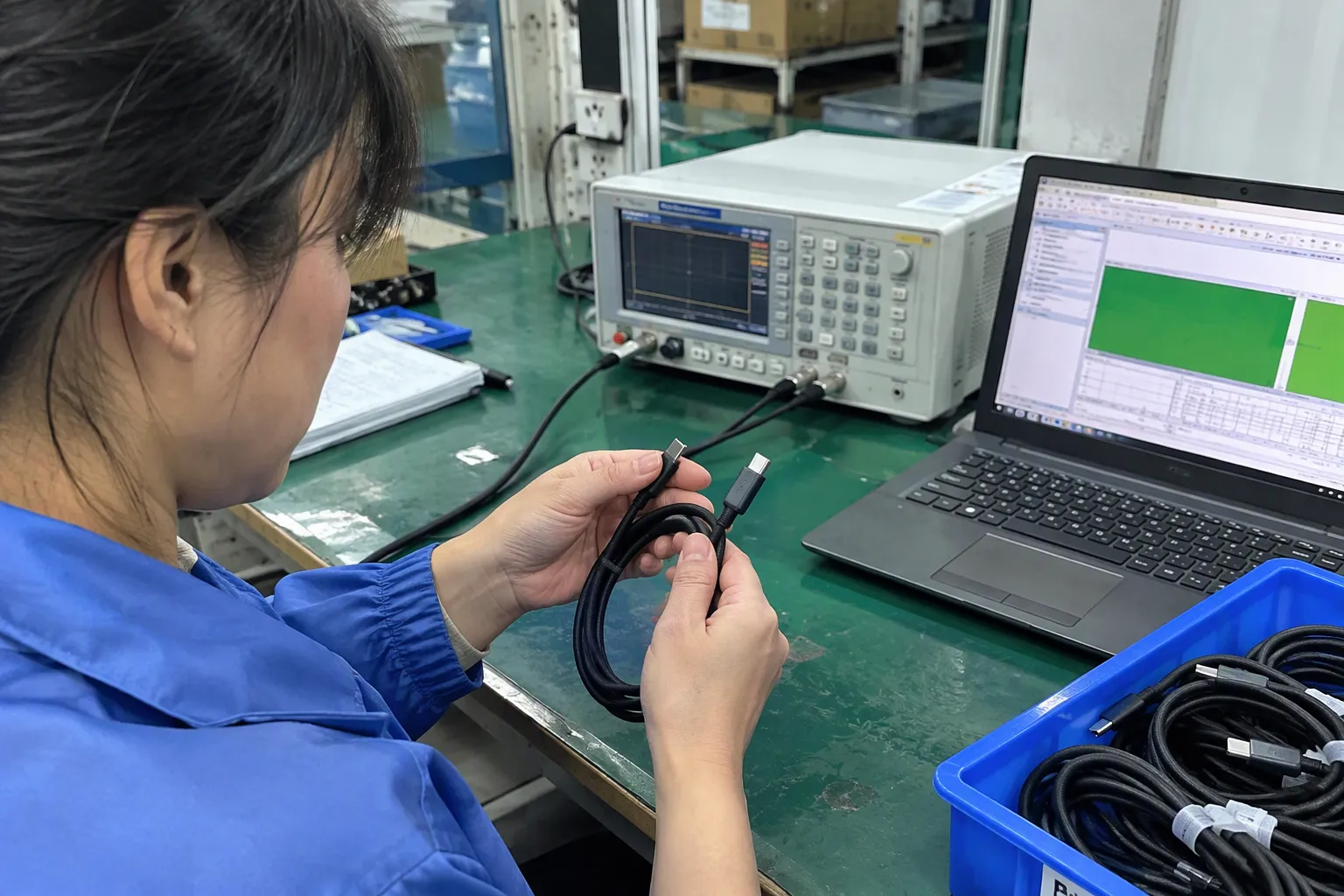
Buyers should specify the construction they want, but they should not assume that a braided jacket, metal shell, or thicker appearance proves long service life. I normally review:
- Conductor and insulation description
- Outer jacket material
- Shielding requirements
- Connector shell and housing construction
- Strain-relief design
- Bending or other durability tests requested by the buyer
- Plug and unplug expectations
- Packaging protection during transport
A factory may offer a standard design, a modified design, or a fully customized design. Each choice can affect MOQ, price, sampling time, and production control.
Use authoritative references carefully
For a technical brief, I encourage buyers to consult official information from bodies such as the USB Implementers Forum and relevant device or charger manufacturers. These sources help clarify terminology and program information. They do not remove the need to confirm the exact product configuration and supplier evidence.
How Can Private Label Buyers Control Customization and Quality Risk?
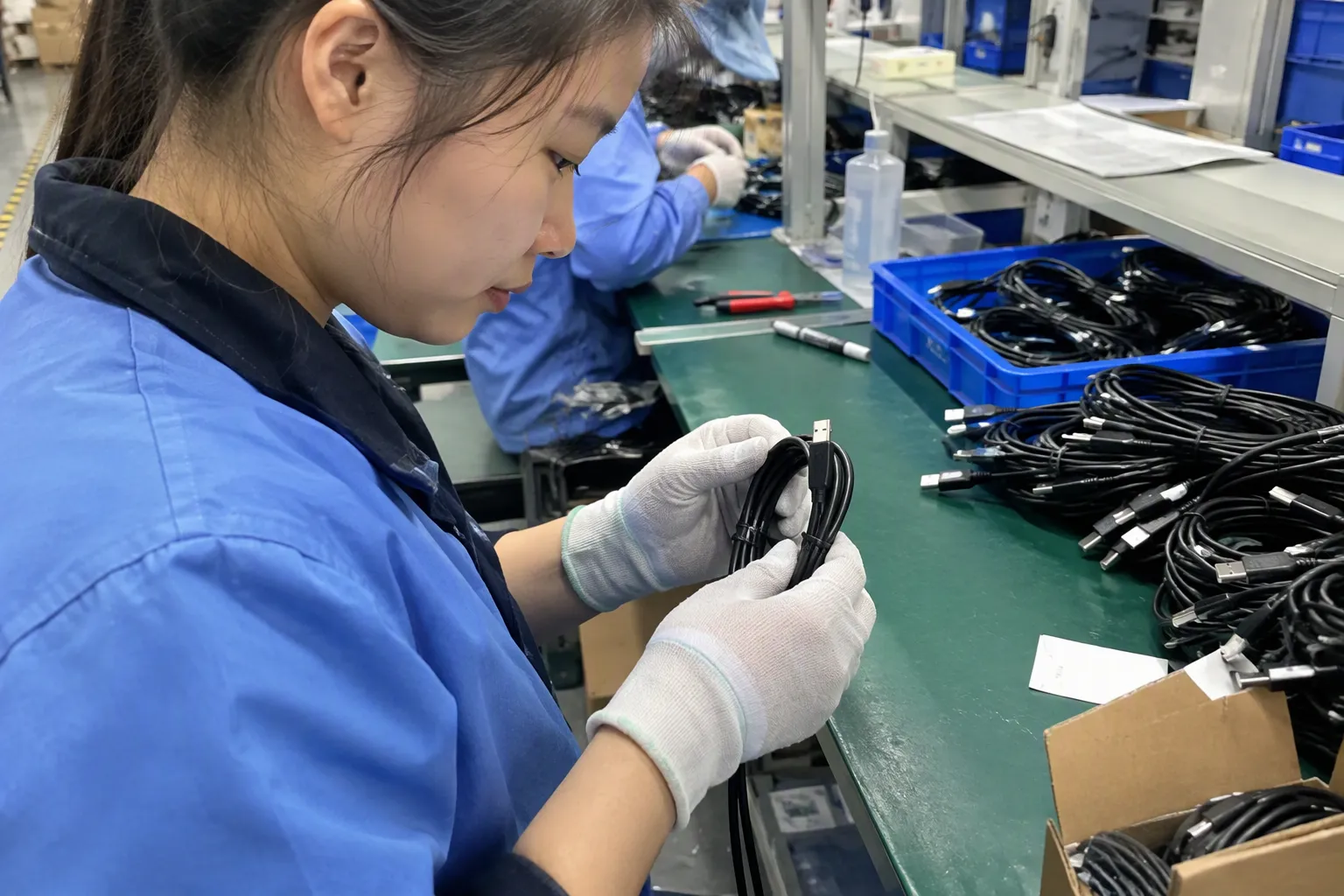
Private label buyers often focus on logos, colors, and packaging first because those elements are visible to customers. I understand that priority, but product control begins earlier. The buyer must control the technical identity of the cable as well as its appearance.[8]
Cable Selection Private Label Buyers Need a Written Product Identity
- Connector combination
- Intended use
- Charging and data requirements
- Length and dimensional tolerance
- Outer material and color
- Connector housing design
- Logo location and method
- Packaging type and barcode requirements
- Included accessories, if any
- Required documents and inspection records
- Approved sample reference
Choose the right customization level
| Level | Typical scope | Commercial effect |
|---|---|---|
| Basic private label | Logo, label, bag, box, or color adjustment | Lower development risk and often simpler MOQ |
| Product customization | Housing, jacket, mold detail, cable construction, or special finish | Higher tooling, sampling, and approval requirements |
| Full OEM development | New design or specialized application requirements | Greater development time, technical review, and validation needs |
The best choice depends on the buyer’s sales plan. A new e-commerce seller may begin with a controlled standard product and distinctive packaging. A chain store may need retail exclusivity, custom colors, compliance files, or a packaging system across several SKUs.
I remind buyers that a custom appearance does not automatically make the internal product unique. If the application requires a particular performance or construction, that requirement must appear in the written specification.
Approve a golden sample carefully
- Connector type and appearance
- Cable length and usable length definition
- Markings and logo position
- Jacket material, color, and finish
- Flexibility and handling
- Charging and data function under the intended setup
- Packaging dimensions and printed information
- Accessories and quantity per package
The buyer should identify which characteristics are critical and which have acceptable tolerances. “Same as sample” is weaker than a sample supported by a specification sheet, approved artwork, and defined inspection points.
Manage changes after approval
Production changes can create problems when the buyer and supplier do not have a change-control process. A factory may suggest a substitute material, connector component, packaging insert, or production location. The supplier should notify the buyer before a change that affects the agreed product.
I do not assume every change is harmful. Some changes may improve availability or reduce delay. However, the buyer should review the effect on performance, appearance, documents, and customer claims before approval.
Documents are evidence, not a substitute for evaluation
Our company works with products that are supplied with certification or test documentation relevant to the market and product scope. I always tell buyers to verify the document issuer, product model, report scope, date, and relationship to the offered SKU. A document for a different model does not automatically prove that the purchased cable has the same status.
Buyers should also check applicable market requirements with qualified professionals or competent testing bodies. Requirements can depend on the product design, packaging claims, accessories, destination market, and sales channel.
How Should Buyers Compare USB Cable Suppliers and Quotations?
A quotation is useful only when the compared products are genuinely comparable. I have seen buyers compare two unit prices even though the suppliers used different assumptions about length, construction, packaging, performance, or order quantity.
Send the same brief to every supplier
- Product type and connector configuration
- Target devices and use case
- Charging and data requirements
- Length and tolerance
- Materials or construction preferences
- Color and branding
- Packaging requirements
- Target order quantity and expected repeat orders
- Destination market
- Required documents or verification materials
- Sample requirements
- Target delivery window
Compare the commercial variables
| Factor | Questions I ask |
|---|---|
| Unit price | What exact specification and packaging does the price include? |
| MOQ | Is the MOQ per color, connector type, packaging design, or total order? |
| Sampling | Is the sample free, refundable, or made with a development charge? |
| Lead time | Does the quoted time start after payment, artwork approval, or sample approval? |
| Packaging | Does the price include printing, inserts, barcodes, and carton marks? |
| Quality control | What inspection stages and records are available? |
| Documents | Which documents apply to this exact model and destination market? |
| After-sales | How are shortages, defects, or specification deviations handled? |
| Repeat orders | Can the supplier maintain the approved construction and packaging? |
Review supplier communication as part of the evaluation
- Clear answers to technical questions
- Consistent terminology across quotation and sample
- Willingness to identify assumptions
- Realistic lead-time explanations
- Prompt notification of problems
- A clear process for artwork and sample approval
- Evidence that the supplier understands the destination market
Communication alone cannot prove manufacturing quality. However, unclear communication increases the chance that an ambiguous requirement will become a production problem.
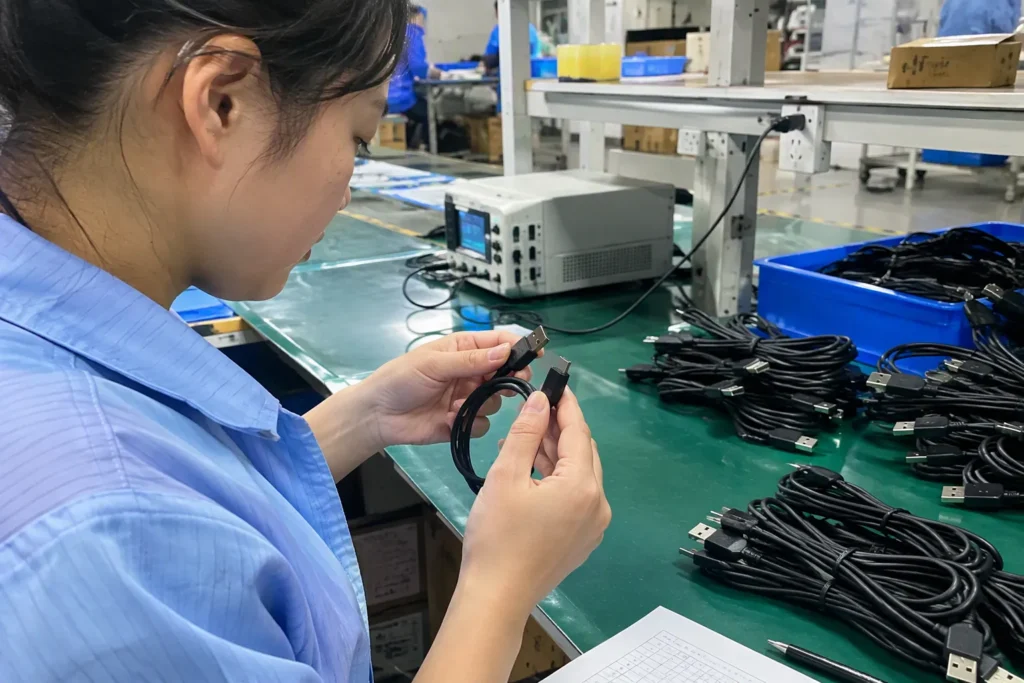
Consider production control
- Incoming connector and material quality
- Production assembly
- Soldering or termination processes, where applicable
- Electrical and functional checks
- Appearance inspection
- Packing quantity and labeling
- Carton protection and shipment preparation
I do not claim that a supplier performs a specific test unless the supplier confirms it and provides relevant records. I also distinguish between a factory’s internal inspection and an independent pre-shipment inspection.
Use samples intelligently
- One standard sample for visual review
- One sample for charging and data evaluation
- One packaging sample for artwork and dimensions
- A revised sample after changes
The buyer should keep the approved sample or record its characteristics in a controlled document. If the order is large or the product is important to the brand, an independent inspection may be appropriate.
How Do MOQ, Lead Time, and Price Affect the Real Buying Decision?
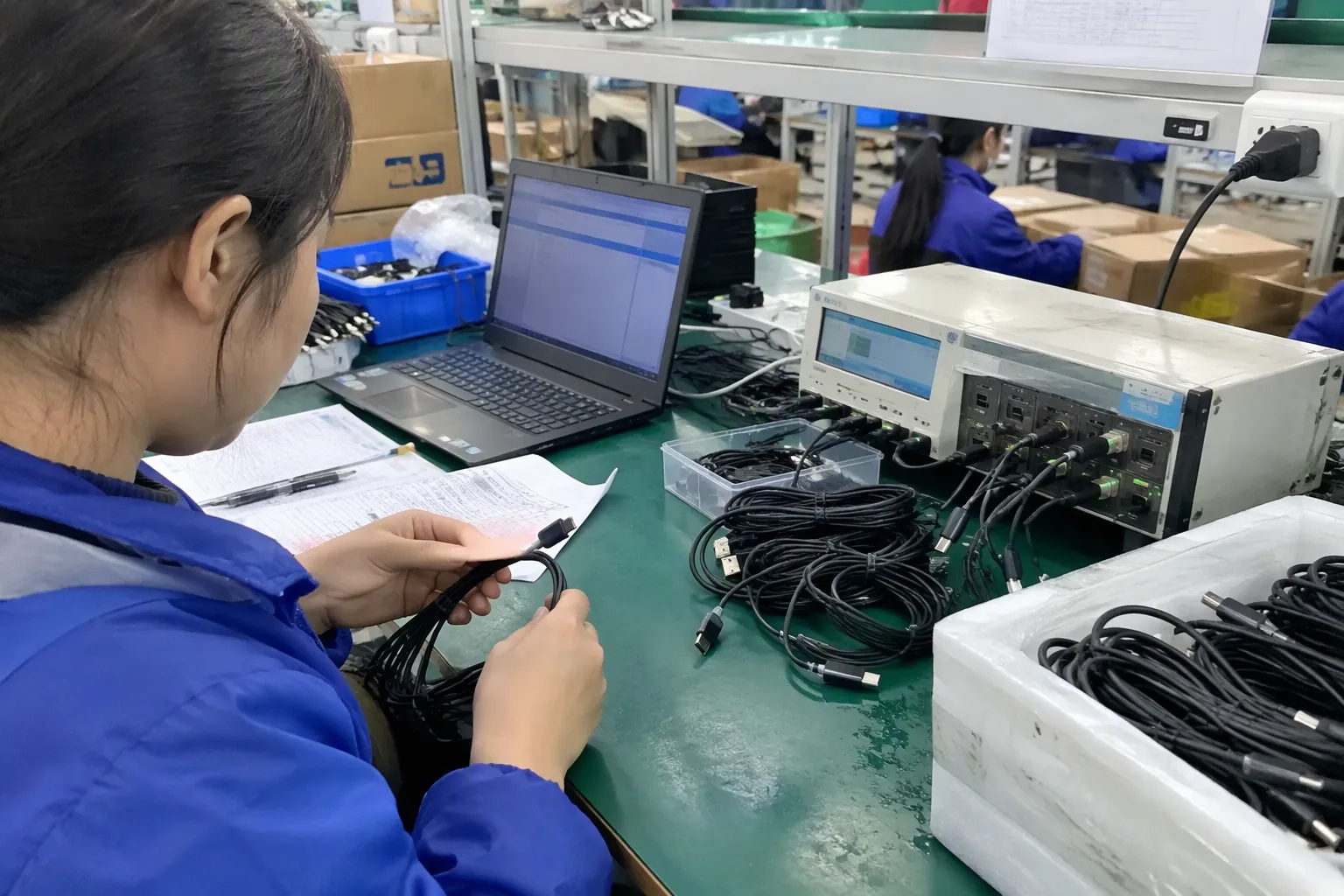
Price is important, but I treat it as one part of total procurement risk. A low unit price can become expensive if unclear specifications create repeated samples, delayed artwork, revised quotations, customer complaints, or unsellable inventory.
MOQ is connected to customization
The supplier should state whether MOQ applies per SKU, color, packaging design, or combined order. I also ask whether the supplier can support a pilot order before a larger production run.
Lead time needs a starting point
A supplier may have stock for a standard cable but need more time for custom packaging or production. The buyer should request separate timing for sampling, tooling, packaging, and mass production.
Total procurement cost includes more than the unit price
This is not a financial formula for every order. It is a useful reminder that a small saving per unit may not compensate for a failed launch or a delayed retail promotion.
An anonymized inquiry pattern
In supplier communication, I have handled cases where a buyer initially requested a low-price cable with custom packaging. After the supplier clarified the required charging claim and packaging information, the quotation changed. The change did not necessarily indicate poor faith. The original request had not defined the internal product requirements or the evidence needed for the claim.
I prefer to surface that difference early. The buyer can then decide whether to use a simpler product, adjust the claim, increase the budget, or change the launch plan.
Plan for repeat orders
- Approved sample number
- Product specification revision
- Packaging artwork revision
- Permitted material substitutions
- Quality acceptance criteria
- Order quantity and delivery window
- Process for handling deviations
A repeat order should not depend entirely on memory or informal messages. A controlled reference reduces misunderstanding when staff, materials, or production schedules change.
What Should Buyers Verify Before Placing a USB Cable Order?
The final review is where I convert a promising quotation into a controlled purchase decision. I do not try to verify every possible feature. I verify the features that matter to the intended use, market, and customer promise.
Technical verification checklist
- Connector configuration
- Intended device applications
- Charging requirement and claim wording
- Data requirement and claim wording
- Cable length and tolerance
- Construction and appearance
- Logo and branding details
- Packaging contents and language
- Approved sample reference
- Inspection or testing scope
- Required documents and their model scope
If the buyer needs application-specific evaluation, I recommend involving a qualified engineer, testing laboratory, or other competent professional. Supplier advice is valuable, but it should not replace independent technical judgment where the application carries safety, regulatory, or performance consequences.
Commercial verification checklist
- Quantity and SKU breakdown
- MOQ rules
- Unit price basis
- Tooling or development fees
- Payment terms
- Production lead time
- Shipping terms
- Carton details
- Warranty or defect-handling process
- Replacement or credit procedure
- Communication contact for production issues
I ask the supplier to identify exclusions. For example, the quoted price may exclude a custom mold, special testing, retail packaging, or a particular inspection service.
Document verification checklist
- The product model or description matches the ordered cable.
- The document issuer can be identified.
- The test or certification scope is clear.
- The date and revision are available.
- The destination market and intended claim are appropriate.
- The document does not cover only a different component or product family.
- The supplier can explain how the document relates to production.
I do not present certifications as a universal guarantee. Buyers should verify current market requirements and obtain professional advice for their own product and sales route.
Pre-shipment review
- Quantity
- Packaging and labeling
- Appearance
- Dimensions
- Connector configuration
- Sample comparison
- Basic functional checks within the agreed scope
- Carton condition
An inspection cannot prove every long-term performance characteristic. It can, however, identify some visible and measurable deviations before the goods leave the factory.
A practical decision rule
I select the supplier that offers the best fit between technical clarity, product consistency, communication, commercial terms, and verification support. I do not automatically select the supplier with the lowest price or the most impressive specification.
The right decision depends on the buyer’s channel. A discount retailer, specialty electronics store, e-commerce seller, and chain importer may reasonably choose different cable specifications and packaging strategies.
What Inquiry Brief Can OEM and Private Label Buyers Use?
A structured inquiry brief makes supplier communication faster and more accurate. I use the following format as a starting point. Buyers can adapt it to their product category and destination market.
Product and application
- Product name:
- Target device categories:
- Main use: charging, data, peripheral connection, or combined use
- Connector configuration:
- Intended sales channel:
- Destination markets:
Performance requirements
- Charging expectation:
- Data requirement:
- Special function, such as display use, if applicable:
- Maximum length:
- Required compatibility information:
- Test or verification scope:
Construction and appearance
- Cable length and tolerance:
- Outer jacket preference:
- Connector housing:
- Color:
- Flexibility or handling preference:
- Branding method:
- Artwork reference:
Commercial requirements
- Initial quantity:
- Expected repeat-order quantity:
- MOQ preference:
- Target launch date:
- Required sample date:
- Packaging type:
- Barcode and carton marking:
- Shipping destination:
- After-sales expectation:
Supplier documents
- Product specification:
- Material or construction information:
- Applicable test reports:
- Certification information, if relevant:
- Inspection records:
- Factory or supplier profile:
- Document verification requirements:
I recommend sending this brief to several qualified suppliers without changing the core requirements. The buyer can then compare responses fairly. If a supplier proposes an alternative, I ask the supplier to mark the differences clearly rather than silently quoting another product.
Frequently Asked Questions
Does USB-C automatically mean a cable supports fast charging?
No. USB-C identifies the connector format, but it does not alone confirm charging capability, data performance, display support, or construction. I ask suppliers to state the intended function, applicable conditions, and verification scope for the exact cable model.
Should I buy the cheapest USB cable for a private label launch?
I would not make that decision from unit price alone. I compare the complete specification, sample quality, MOQ, packaging, lead time, document scope, inspection options, and after-sales process. A cheaper cable can create higher costs if unclear requirements lead to complaints or unsellable stock.
What information should I send when requesting a USB cable quotation?
I send the connector configuration, device use, charging and data requirements, length, construction preferences, packaging, branding, quantity, destination market, lead time, and document needs. I also state which claims must be supported before they appear on packaging.
Is a braided USB cable always more durable?
No. A braided jacket may affect appearance and handling, but it does not by itself prove long-term durability. I ask for the construction details and any relevant test method or result. I also evaluate strain relief, connector assembly, and the intended usage pattern.
Do I need a sample before placing a private label order?
I strongly recommend a sample, especially when the buyer is changing the cable, packaging, branding, or performance claims. The approved sample should be linked to a written specification and artwork. For larger orders, the buyer may also consider pre-shipment inspection.
Conclusion
USB cable selection works best when I treat it as a procurement exercise rather than a connector search. I begin with the device task, define charging and data expectations, control private label changes, and compare suppliers against the same written brief. I also review MOQ, lead time, documents, samples, and after-sales terms before approving an order. My Shenzhen-based 3C trading team has 15 years of export experience, and I can help European and North American retailers, wholesalers, and e-commerce sellers turn their USB cable requirements into a clear sourcing brief and suitable supplier inquiry.
Sources
- Cables and Connectors", The USB Implementers Forum specifies the USB Type-C connector as a physical interface whose supported data rates and power functions depend on the applicable USB technology, configuration, and cable capabilities
- A Primer on USB Type-C and Power Delivery Applications ...", Technical documentation from the USB Implementers Forum and related standards bodies describes USB Type-C systems as supporting multiple application classes, including power, USB data, and alternate display modes
- Universal Serial Bus Type-C Cable and Connector ...", USB Type-C is defined as a reversible connector and interface specification; the connector designation alone does not identify a unique USB protocol version or performance level
- What is USB-C DisplayPort (DP Alt Mode) and Why it Matters", USB Type-C display output generally depends on support for a relevant alternate mode and compatible device and cable implementation; the connector geometry alone is insufficient evidence of video functionality
- Determination of Tensile Characteristics and Electrical ... - PMC", USB Power Delivery documentation and charging-system research describe charging as a negotiated, system-level process in which source, sink, protocol, cable characteristics, and operating conditions influence the delivered power
- Charger Types and Speeds", Technical literature on mobile-device charging treats “fast charging” as a comparative or marketing description whose practical meaning depends on the device, charger, protocol, battery state, and test conditions rather than as one universal power rating
- USB-3 and USB-C Special Considerations", Electrical engineering literature indicates that increased cable length can raise conductor resistance and transmission-line losses, making application-specific testing relevant for power delivery and high-speed data links
- Part 46 - Quality Assurance", Public-sector procurement guidance commonly requires product specifications, measurable acceptance criteria, and documented supplier controls so that delivered goods can be compared with the approved requirement
Related reading: