Quick Answer
QR vs ACF chargers can be difficult to compare when buyers only see a wattage claim and a unit quotation. That approach can create problems later, such as weak margins, inconsistent production, unclear efficiency claims, or a charger that does not fit the intended shelf position. We recommend starting with the commercial brief, then evaluating the complete power design.
QR vs ACF chargers are not universally better or worse than each other. Their efficiency, cost, thermal behavior, and supply feasibility depend on the target power range, load conditions, component selection, safety requirements, PCB and enclosure design, production controls, and the intended retail position. Buyers should compare documented performance under stated conditions, not rely on topology labels alone.
When we receive charger inquiries from European and US buyers, the first question is often, “Should we choose QR or ACF?” In our experience, that question becomes much more useful after we understand the target retail price, power claim, customer profile, certification needs, and expected order volume.
QR vs. ACF is not a universal “which is more efficient” contest
QR vs ACF chargers should be evaluated as complete product designs, not as a simple efficiency ranking. QR, or quasi-resonant flyback, and ACF, or active-clamp flyback[1], can both support competitive charger designs when they are matched to the required wattage, operating conditions, components, thermal limits, and commercial goals.
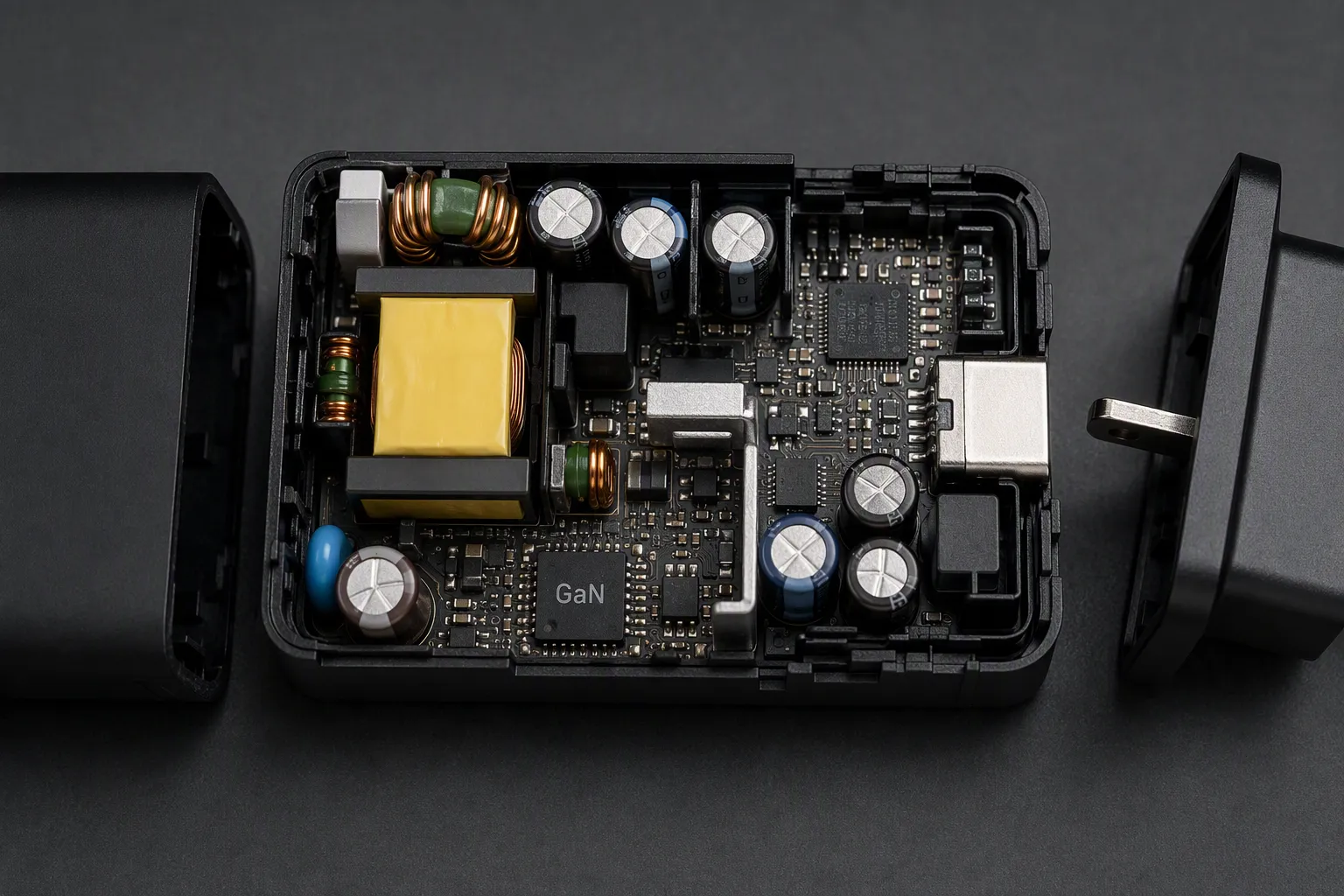
A charger buyer can lose time by treating topology as the first and only decision. A better approach is to define what the finished charger must achieve in the market. We see this often during quotation discussions: one buyer requests the lowest possible cost, while another needs a premium-looking 65W charger for a branded retail channel. Even if both products use a similar USB-C port configuration, they may require very different design choices.
Start with the product brief, not the circuit label
In our work as a Shenzhen 3C export trading company, we usually encourage buyers to clarify the commercial brief before comparing QR and ACF charger proposals. This helps suppliers identify whether the requested design is realistic for the price point and channel.
A useful charger brief should include:
- Target power level, such as 20W, 30W, 45W, 65W, or higher.
- Port configuration, including USB-C only, USB-A plus USB-C, or multiple USB-C ports.
- Target shelf price in the destination market.
- Target purchase price and expected margin.
- Sales channel, such as an online marketplace, electronics chain, grocery wholesaler, or private-label retail program.
- Appearance expectations, including size, color, finish, packaging, and branding.
- Required certification documents for the intended market.
- Expected annual volume and initial MOQ.
- Warranty, after-sales, and replacement expectations.
- Delivery timing and replenishment requirements.
This information changes the technical and sourcing conversation. A compact charger for a premium consumer electronics chain may need stronger thermal planning, more demanding cosmetic controls, a more complete documentation package, and tighter consistency management than an entry-level online product. The final unit cost is therefore shaped by much more than QR or ACF.
We do not treat a charger topology as a shortcut for product quality. We treat it as one part of a finished design that must support a buyer’s commercial plan.
What QR and ACF actually describe
QR and ACF are broad descriptions of flyback power-supply approaches. They are relevant to charger designers because they can influence switching behavior, component stress, electromagnetic interference management, thermal design, and the practical route to a certain power range[2].
However, a buyer should avoid turning that general fact into a universal claim.
A QR charger design may be appropriate for many compact charging products, depending on the intended wattage and design requirements. An ACF charger design may offer design advantages in certain higher-performance or higher-power applications, depending on the controller, transformer, switching devices, clamp arrangement, layout, and thermal approach.
Neither description tells a buyer enough by itself.
For procurement purposes, the more useful question is:
“Can this supplier demonstrate that this complete charger design meets our required performance, safety, consistency, and price objectives under defined conditions?”
That question leads to better supplier discussions than asking whether QR is “more efficient” or whether ACF is “always premium.”
Efficiency is a design-specific result
Efficiency is important because it affects heat, user experience, energy loss, component stress, and product positioning.[3] It is also a common marketing point. Still, we recommend treating efficiency claims carefully.
A supplier may quote an efficiency figure from a particular test setup. That figure may depend on:
- Input voltage and frequency.
- Output voltage and current.
- Full-load, partial-load, or no-load conditions.
- Single-port versus multi-port operation.
- Ambient temperature.
- Charger orientation and airflow.
- Cable loss and test method.
- USB Power Delivery negotiation state.
- The selected controller, transformer, MOSFETs, capacitors, rectification approach, and PCB layout.
For that reason, a broad statement such as “ACF is more efficient” or “QR is more efficient” does not give a retail buyer enough information to make a purchasing decision.
Questions to ask about charger efficiency
When we help buyers compare charger quotations, we suggest asking suppliers for test information that clearly states the conditions. Buyers do not need to become power-electronics engineers. They do need a disciplined review process.
Ask for the following:
-
Rated output test conditions
Confirm the input voltage, output profile, load level, and number of active ports. -
Efficiency test report or product specification
Ask the supplier to identify the stated test method and test environment. Buyers should verify whether the report applies to the exact model being quoted. -
No-load or standby consumption information[4]
This can matter for market access requirements and retailer expectations. Buyers should verify applicable rules for their destination market. -
Temperature-rise information
Ask what test conditions were used, including ambient temperature, duration, load, and measurement locations. -
Protection-function documentation
Buyers should request information on over-current, over-voltage, short-circuit, and over-temperature protections[5] where applicable to the design. -
Production consistency plan
Ask how the supplier controls critical incoming materials, in-process testing, aging, final inspection, and traceability.
A supplier who can provide clear answers may be easier to work with than a supplier who only repeats a topology claim.
Why the same wattage does not mean the same charger
Two chargers may both claim 65W, yet their real market suitability can differ significantly.[6] One may be designed for a cost-sensitive online listing. Another may be intended for a branded retail program where compact size, premium materials, packaging presentation, certification documentation, and lower downstream complaint risk are important.
The wattage label does not show[7]:
- The actual supported charging profiles.
- Whether the charger can sustain its rated output under defined conditions.
- Whether multiple ports share power in a way that suits the buyer’s intended use.
- The quality level of the cable supplied in the box, if any.
- The component configuration.
- The quality-control process.
- The standard of the plastic housing, pins, printing, and packaging.
- The level of after-sales support offered by the supplier.
This is why we advise buyers to compare quotations line by line. A lower quotation may reflect a different package of materials, testing, documentation, packaging, order volume, or service scope. It should not automatically be interpreted as proof that one topology is cheaper.
Cost is a finished-product decision
A charger’s quoted price is not attributable to one topology or one component. We have seen buyers focus heavily on one visible technical term while overlooking the larger cost structure of the finished product.
The total cost of a charger may be affected by:
| Cost Area | Questions Buyers Should Ask |
|---|---|
| Core electronics | Which controller, transformer, capacitors, switching devices, and protection components are specified? |
| USB-C and protocol functions | Which charging protocols are supported, and is the port configuration the same across quotations? |
| Mechanical design | Does the product use a standard housing or a custom compact enclosure? |
| Thermal solution | What design measures support thermal management, and what evidence is available? |
| Certification work | Which documents are available for the exact model, and which market requirements still need buyer verification? |
| Production controls | What aging, functional testing, inspection, and traceability procedures are included? |
| Packaging | Is the price based on bulk packing, retail box, custom artwork, inserts, or labels? |
| Order volume | Does the quotation reflect the buyer’s actual MOQ and forecast volume? |
| Supply-chain stability | Are approved alternatives controlled if a component becomes unavailable? |
| Service scope | Does the supplier include spare units, warranty handling, or customized support? |
For example, a buyer may compare two 45W USB-C chargers and find a meaningful price gap. The gap may involve port configuration, product dimensions, components, certifications, packaging, factory process, or quotation assumptions. It may also relate to order quantity or lead time. Without a complete specification comparison, it is not responsible to say that QR or ACF caused the difference.
Component choices matter, but buyers should avoid oversimplification
Component configuration can influence design performance and cost. Still, we recommend avoiding a purchasing decision based on one named component alone.
A charger design includes an interdependent system. The transformer, controller, capacitors, PCB layout, insulation system, housing, connector design, and assembly process all matter.[8] If a supplier changes one item to solve a cost or availability issue, that change may affect other parts of the design.
For a buyer, the key issue is not whether every component is from a particular brand or whether one circuit concept sounds more advanced. The key issue is whether the supplier has a controlled and documented configuration.
Useful questions include:
- Is there a bill of materials or controlled component list for the quoted model?
- Are component substitutions allowed without buyer approval?
- Which items are considered safety-critical or performance-critical?
- Does the supplier perform incoming inspection on key materials?
- Is there a process for engineering changes?
- Can the supplier explain how model revisions are identified?
- Is the approved sample aligned with the mass-production configuration?
These questions are especially important for private-label buyers. A sample may look acceptable, but consistent future production requires controlled materials and clear change management.
QR vs ACF chargers in different product positions
We find it helpful to discuss QR vs ACF chargers in terms of product positioning rather than declaring one option technically superior. The following table is not an engineering rulebook. It is a procurement framework that helps retail teams organize their conversations with suppliers.
| Product Position | Typical Buyer Priority | QR vs ACF Charger Discussion |
|---|---|---|
| Entry-level charging accessory | Competitive cost, basic reliability, clear compatibility | Ask whether the proposed design supports the required output and compliance documents within the target cost. |
| Mid-range USB-C fast charger | Balance of size, charging claims, quality perception, and price | Compare complete samples, test documentation, thermal evidence, and user-facing charging profiles. |
| Premium GaN charger | Compact dimensions, modern positioning, strong packaging, branded experience | Review the full design package, including thermal strategy, material controls, certifications, and production consistency. |
| Multi-port desktop or travel charger | Power-sharing behavior, port labeling, user experience, safety | Focus on output allocation, simultaneous-load behavior, instructions, and defined test conditions. |
| Retail chain private label | Repeat supply, documentation, packaging consistency, complaint control | Evaluate factory systems, change-control procedures, inspection plans, and long-term supply capability. |
A supplier may propose QR for one project and ACF for another. That does not mean the supplier is inconsistent. It may mean the supplier is matching available platforms and design paths to different commercial requirements. Buyers should ask why a particular solution has been proposed and what trade-offs it creates.
How we would structure a supplier comparison
When we receive a charger inquiry, we believe the fastest route to a useful quotation is a structured comparison. We recommend that buyers send the same brief to each qualified supplier, then review the responses against consistent criteria.
A practical supplier comparison can include the following stages.
1. Confirm the market and product claim
Define the destination market, plug type, charger wattage, port count, charging protocols, packaging language, and intended retail category. This prevents suppliers from quoting different products under the same broad label.
For example, “65W GaN charger” is not a complete request. A more workable request might specify:
- One USB-C port or two USB-C ports.
- Required output profiles.
- EU, UK, or US plug version.
- Retail box or bulk packaging.
- Required documents for the intended market.
- Target quantity and launch date.
- Branding and color requirements.
2. Request model-specific documents
Buyers should ask for documents linked to the actual proposed model wherever possible. A supplier may have general company certificates or reports for related products, but those documents may not apply to the exact charger under review.
We recommend verifying:
- Product test reports.
- Certification documents where required.
- Declaration or compliance documentation where applicable.
- Product specification sheet.
- Packaging and labeling artwork.
- Factory quality-control overview.
- Warranty and after-sales terms.
Professional compliance review is advisable for market-specific decisions. Retailers and importers should confirm their own legal and regulatory responsibilities before placing an order.
3. Compare samples against the brief
A physical sample gives buyers a better basis for evaluating finish, size, port feel, printing, packaging, and general usability. It should not be treated as laboratory proof of long-term reliability. However, it can help identify obvious mismatches before production discussions go further.
During sample review, buyers can check:
- Housing fit and surface finish.
- Plug construction and stability.
- Port alignment and insertion feel.
- Logo and rating-label clarity.
- Packaging condition.
- Included cable specification, if applicable.
- Output labeling and power-sharing instructions.
- General consistency across several samples.
4. Ask about production controls
A competitive sample is only the beginning. For a retail program, we would also ask how the supplier manages repeated production.
Relevant questions include:
- What functional tests are performed on each unit?
- Is aging included, and if so, what is the defined process?
- How does the factory handle failed units?
- Are key materials traceable by batch?
- What inspection level applies before shipment?
- How are customer complaints analyzed and closed?
- What happens if a critical component becomes unavailable?
These questions may feel operational, but they directly affect downstream risk. A charger that is inexpensive at purchase can become expensive if returns, retailer penalties, or replacement requests increase later.
Avoid “premium” claims without evidence
Some suppliers may describe ACF chargers as premium, advanced, or more efficient. Others may position QR designs as proven, stable, or cost-effective. Those descriptions may be useful starting points, but they are not enough for a purchase decision.
We suggest that buyers ask suppliers to support claims with model-specific documentation and clear conditions. If a supplier presents an efficiency figure, request the test conditions. If a supplier says a design runs cooler, request the relevant temperature-rise information and test setup. If a supplier claims a component configuration improves reliability, ask what production and verification evidence supports that statement.
This does not require buyers to challenge every engineering statement. It simply creates a more professional sourcing process.
A practical decision checklist for retail buyers

Before choosing between QR vs ACF chargers, we recommend reviewing this checklist internally:
- Does the charger fit our planned retail price and margin?
- Does the stated wattage match the needs of our target customer?
- Are the charging protocols and port-sharing rules clear?
- Does the proposed physical design fit our channel positioning?
- Are the supplier’s claimed performance figures tied to stated test conditions?
- Are required certification and compliance documents available for review?
- Does the quotation include the packaging, plug type, cable, and customization we expect?
- Can the supplier support our MOQ, lead time, and replenishment plan?
- Is there a clear quality-control and change-management process?
- Have we compared the same product specification across suppliers?
If the answer to several of these questions is unclear, the buyer may not yet be ready to choose a topology. The next step should be to improve the product brief and supplier documentation request.
Frequently Asked Questions
Is ACF always more efficient than QR in chargers?
No. ACF is not automatically more efficient than QR across every charger power range or load condition. Actual efficiency depends on the complete design, selected components, operating point, thermal conditions, PCB layout, and test method. Buyers should request model-specific reports with clearly stated test conditions.
Is a QR charger always cheaper than an ACF charger?
No. A charger quotation reflects the full bill of materials, port configuration, power rating, packaging, certification work, order volume, manufacturing controls, and supplier capability. A price difference should not be attributed to QR or ACF alone without comparing complete product specifications.
What should I ask a charger supplier before requesting a quotation?
We recommend sharing the target wattage, port configuration, plug type, destination market, target retail price, expected order quantity, packaging requirements, customization needs, and required documents. This gives suppliers enough information to propose a charger design that fits your commercial plan.
How can I verify charger efficiency claims?
Ask the supplier for a product specification or test report that states input voltage, output voltage, load condition, ambient temperature, port configuration, and test method. Buyers should confirm that the documentation applies to the exact model and should use qualified evaluation for application-specific decisions.
Does charger topology determine product quality?
No. Topology is only one part of charger quality. Product quality also depends on component control, thermal design, safety design, PCB layout, enclosure construction, assembly process, functional testing, aging, inspection, and the supplier’s ability to maintain consistency across production batches.
Conclusion
QR vs ACF chargers should not be treated as a simple contest over efficiency or cost. For retail and wholesale buyers, the better decision starts with the finished product: target power range, shelf price, margin, channel, documentation, production consistency, and supply feasibility. We recommend comparing supplier proposals using the same commercial brief and requesting model-specific evidence under stated conditions. If you are sourcing USB chargers, GaN chargers, cables, TWS earbuds, or smart accessories for European or US markets, we can help you structure a clearer product inquiry and supplier comparison.
Sources
- Gain Ultra-high Power Density for 100-W USB ...", Technical power-electronics references define quasi-resonant flyback converters as flyback converters operated around switching-node resonances and active-clamp flyback converters as flyback circuits using an active clamp to manage switch voltage and recover leakage energy
- 3. ACTIVE-CLAMP FLYBACK AS AN ISOLATED PFC ...", Studies of quasi-resonant and active-clamp flyback converters report that their switching and clamp arrangements can alter switching losses, device-voltage stress, leakage-energy treatment, and electromagnetic-emission behavior, with outcomes dependent on the implementation
- Waste Heat Recovery Basics | Department of Energy", External power-supply efficiency guidance explains that power-conversion losses consume energy and are dissipated as heat, making measured efficiency relevant to thermal and energy-performance assessment
- External Power Supplies", EU ecodesign and U.S. energy-conservation rules for external power supplies include efficiency and, for covered product categories, no-load-power provisions, making documented standby consumption relevant to compliance review
- IEC 62368-1: Ask the Engineers, Question-and-Answer Page", Product-safety standards and conformity-assessment guidance for information and communication technology equipment evaluate safeguards against electrical, thermal, and fire hazards; protective functions such as over-current, short-circuit, over-voltage, and over-temperature response may therefore be relevant design evidence
- USB Charger (USB Power Delivery)", USB Power Delivery specifications describe charging capability through advertised source power data objects and negotiated voltage-current contracts, so a single maximum-wattage label does not by itself identify all supported output profiles or simultaneous-port behavior
- CPSC Labeling Requirements Overview", USB-C power-delivery documentation distinguishes advertised and negotiated source capabilities from a simple maximum-power statement, while product labels do not themselves document component selection, production controls, or long-term reliability
- IEC 60950-1:2005", Power-electronics design references describe switched-mode power supplies as integrated systems in which magnetics, control circuitry, printed-circuit layout, insulation, thermal paths, and mechanical construction jointly affect electrical performance, electromagnetic compatibility, and safety