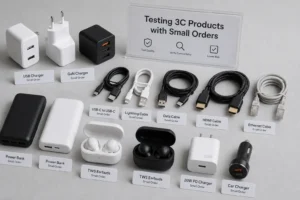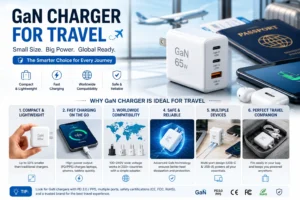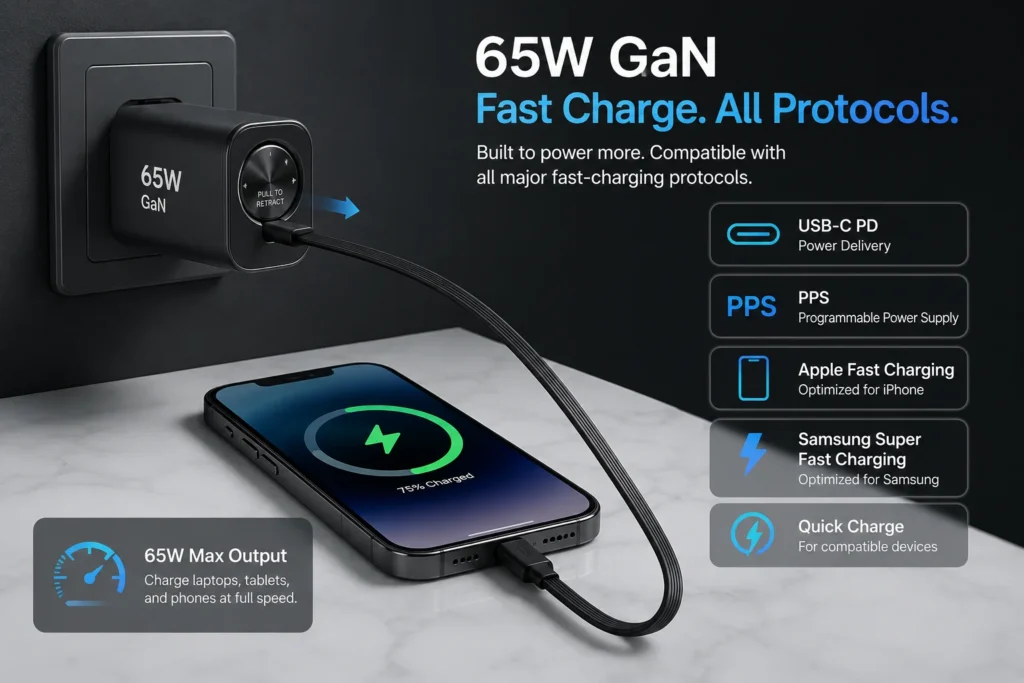
I see many buyers like the idea, but they fear returns. A neat charger can still create complaints if the real output is unclear.
A 65W GaN charger with a retractable cable can charge many phones, tablets, and light USB-C laptops.1 Buyers should check the built-in cable rating, PD/PPS support, shared power rules, safety certification, and cable durability before placing bulk orders.
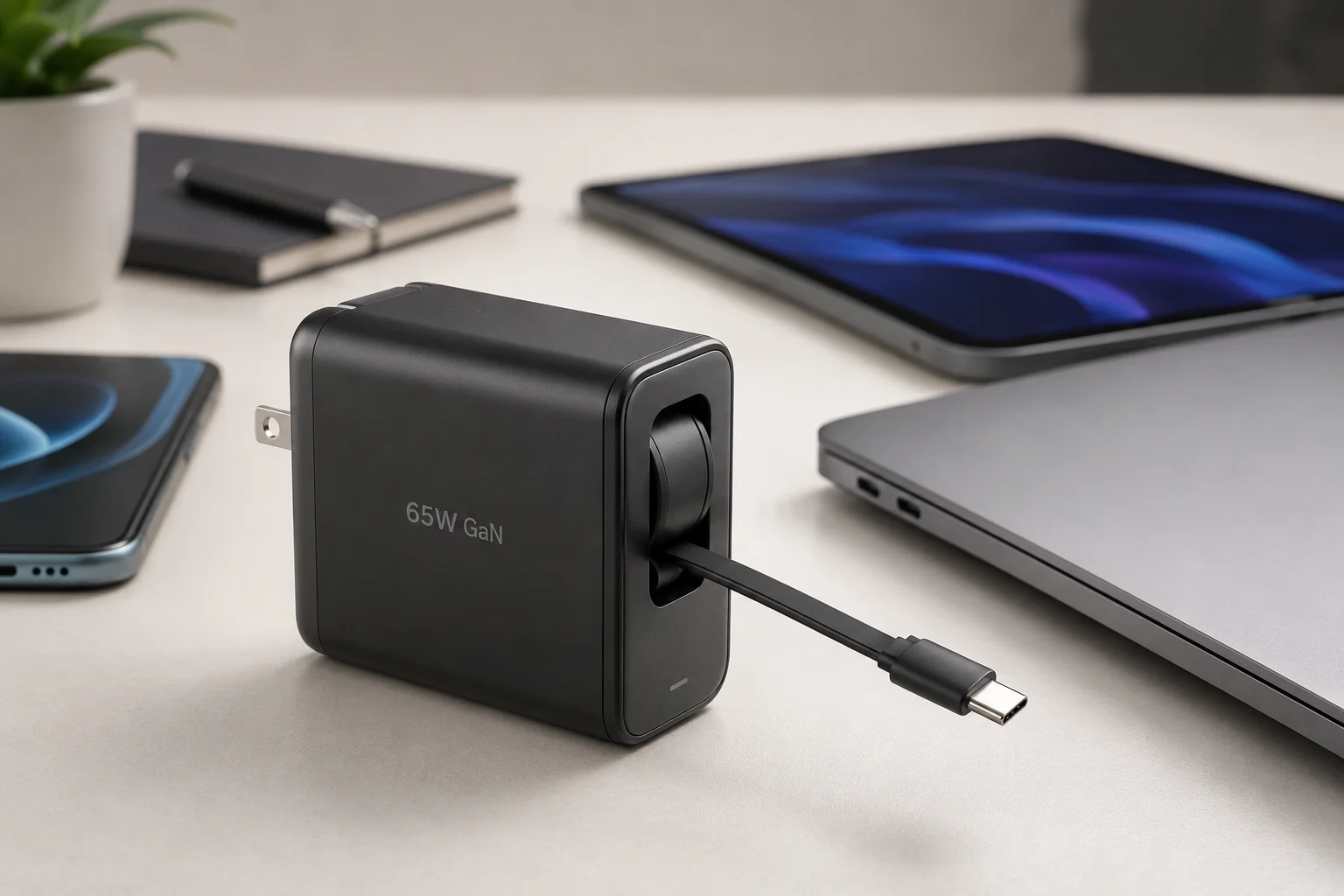
I often discuss this product with European and North American retailers, online sellers, and wholesalers. I see one clear pattern. Buyers do not only ask, “Is it 65W?” They ask, “Will my customers understand it, use it correctly, and keep it without complaints?” A 65W GaN charger with a retractable USB-C cable looks simple. It can sit in a travel electronics section, a phone accessory shelf, or a private-label charging range. Yet the real value depends on power sharing, protocol support, plug version, certification, cable life, and packaging claims. I treat it as a channel product, not only as a charger.
1. What Is a 65W GaN Charger With a Retractable Cable?
I often see buyers focus on the retractable cable first. That is normal, but the inner charging design still decides the user experience.
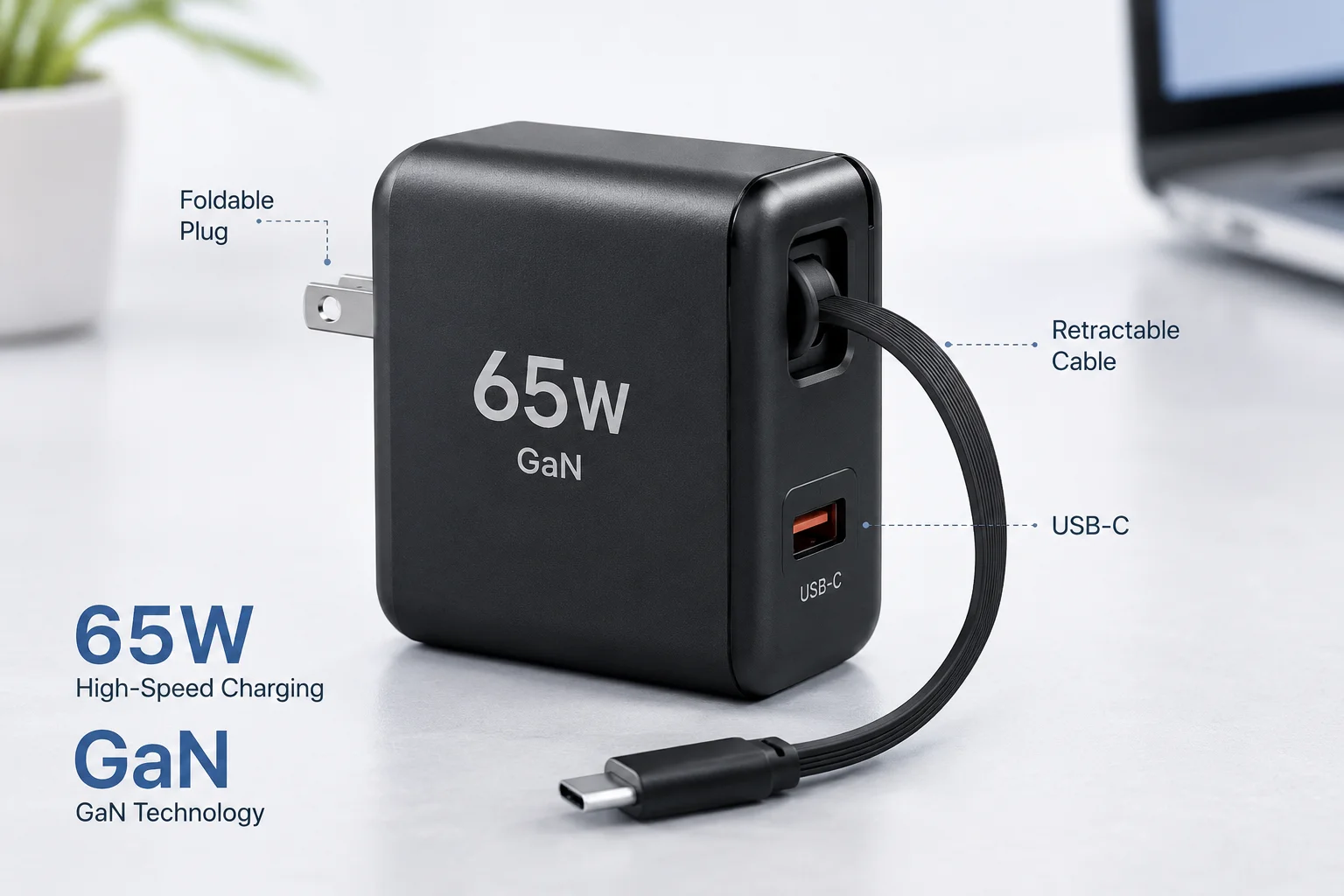
A 65W GaN charger with a retractable cable is a compact wall charger that has GaN power technology, USB-C fast charging, and a built-in pull-out USB-C cable. Some models also add USB-C or USB-A ports for extra devices.
Core structure I check first
I usually explain this product as a charger body plus a built-in USB-C cable plus optional extra ports. The headline number is usually up to 65W, subject to actual product configuration. GaN technology helps make the charger smaller than many older silicon designs2, but I never say GaN means no heat. Any fast charger still needs good temperature control and safe materials.3
The retractable cable reduces the need to carry a separate cable. This is the main selling point for travel and office use. The buyer still needs to confirm the cable’s maximum output and supported protocol. A charger body may support 65W, but the built-in cable must also be rated for that use4.
| Item I check | Why it matters for buyers |
|---|---|
| 65W maximum output | It shows the top charging task the charger may handle |
| Built-in USB-C cable | It creates convenience and also creates a durability risk |
| USB-C PD support | It helps laptops, tablets, and phones negotiate power |
| Extra USB-C or USB-A ports | It gives more sales value and more power-sharing questions |
| Compact wall design | It supports travel, retail shelf display, and gift use |
2. Which Devices Can a 65W GaN Charger Power?
I see many listings say “for all devices,” but I avoid that claim. Customers judge the product by real devices, not by broad words.
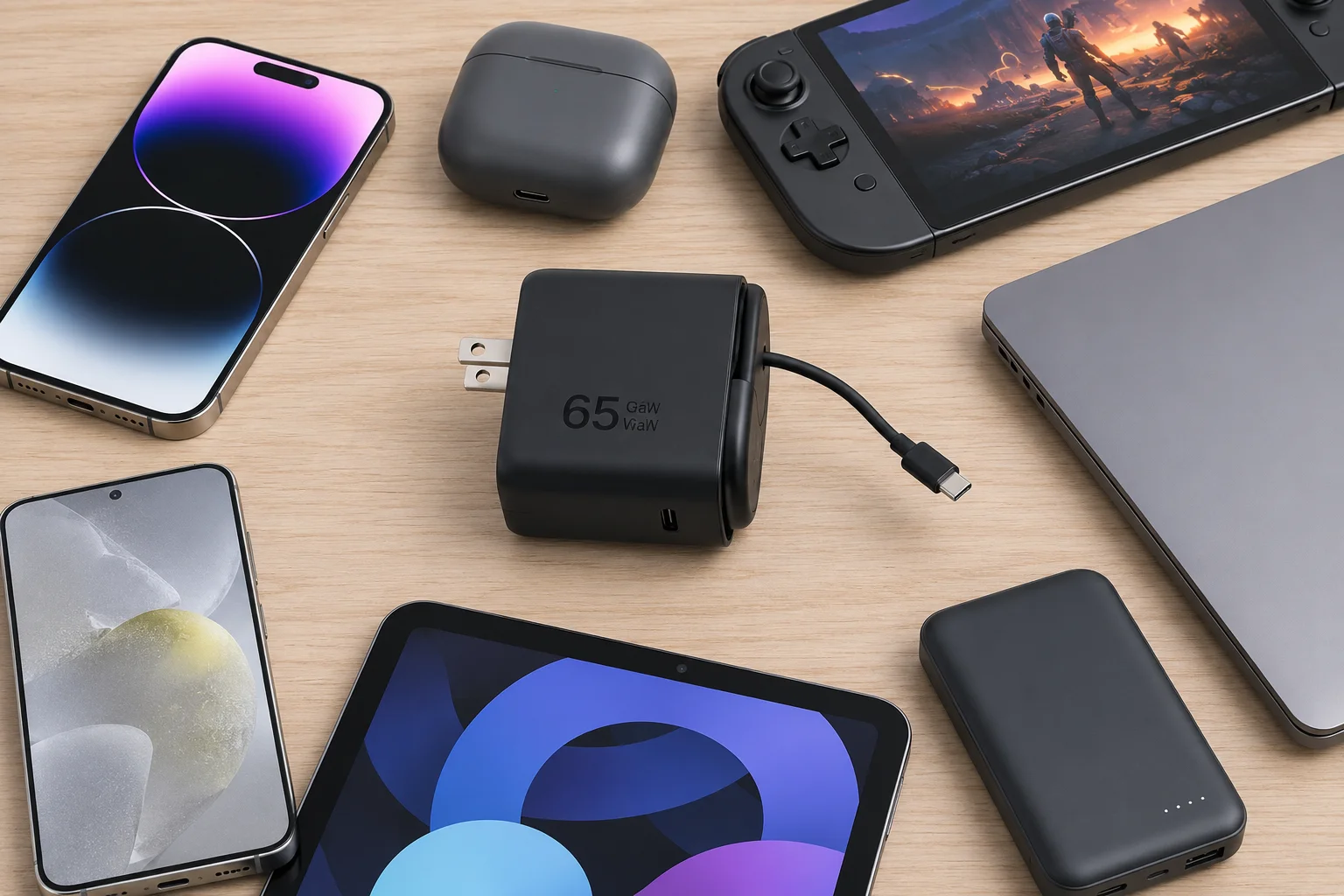
A 65W GaN charger can power iPhones, Samsung Galaxy phones, Google Pixel phones, tablets, MacBook Air models, USB-C ultrabooks, handheld gaming devices, power banks, and earbuds, if the protocol and cable rating match the device.
Device use cases I explain to buyers
I prefer to talk in device groups. A phone usually needs far less than 65W.5 A tablet may need medium power. A MacBook Air or USB-C ultrabook may use much of the available output. A power bank may draw high input if it supports it. Earbuds need only low power, but they still need safe power negotiation.
Actual charging speed depends on the device’s maximum input, the charging protocol, and the built-in cable rating. I often remind e-commerce sellers that a phone will not charge at 65W just because the charger can supply 65W. The phone decides its own input limit.6
| Device type | Typical buyer concern | My practical note |
|---|---|---|
| iPhone | Fast charging claim | I check PD support and correct USB-C cable output |
| Samsung Galaxy | PPS support | I check whether Super Fast Charging can be supported |
| Google Pixel | Stable PD/PPS behavior | I avoid overclaiming speed without model checks |
| iPad or Android tablet | Medium power demand | I check if shared output reduces speed |
| MacBook Air or ultrabook | 45W to 65W need | I confirm single-port or cable maximum output |
| Earbuds | Low power charging | I focus on safety and stable low-current charging |
3. Why Choose a Built-In Retractable USB-C Cable?
I see the retractable cable close many sales. I also see it become the first complaint point when the mechanism feels weak.
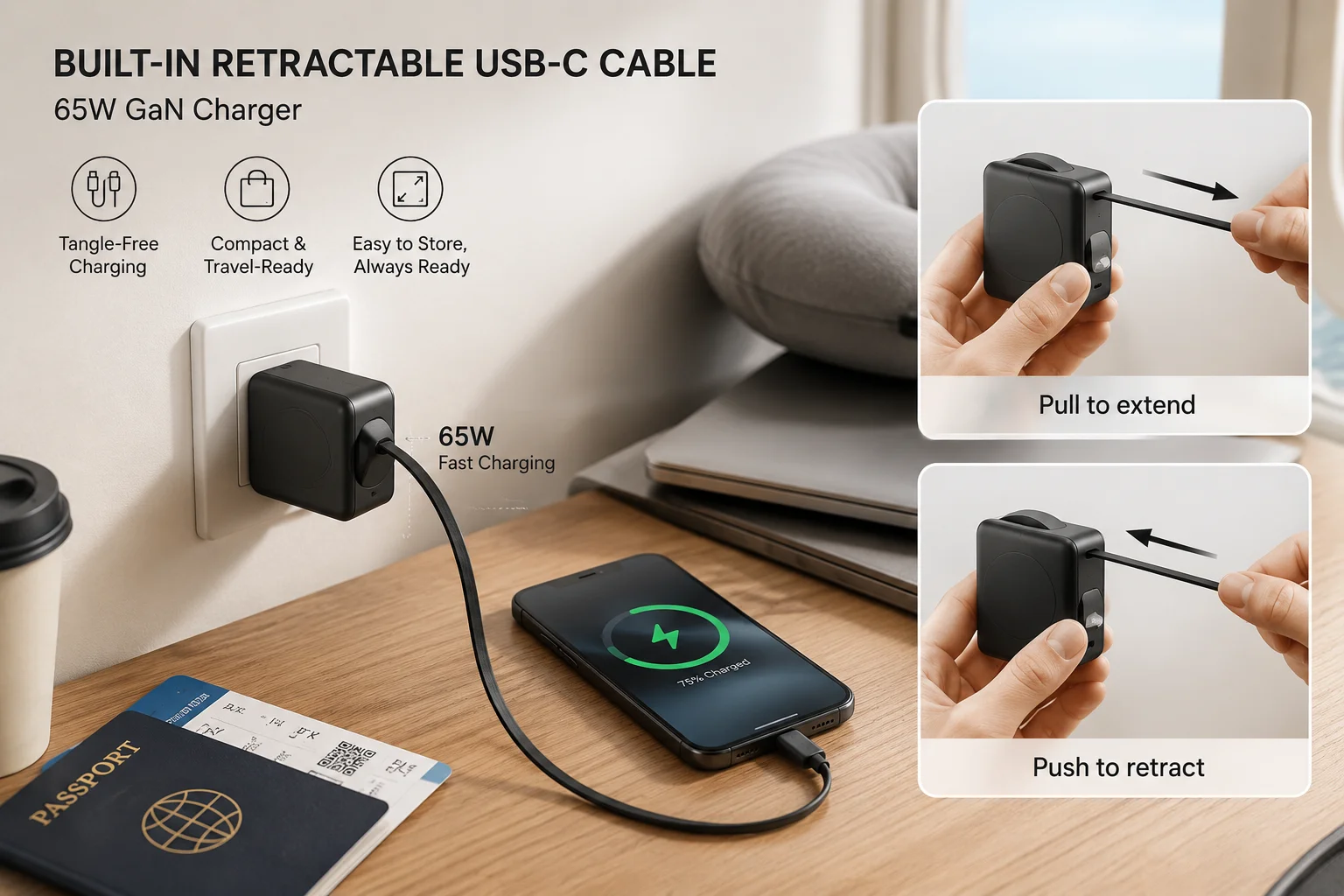
A built-in retractable USB-C cable removes the need for a separate cable, reduces clutter, saves bag space, speeds setup, lowers the chance of forgetting a cable, and gives users adjustable cable length.
Convenience and risk in one feature
The retractable cable is easy to sell because customers understand it in one second. A buyer can show the benefit on packaging or in a product video. The user pulls the cable, plugs in the phone or laptop, and starts charging. This is useful in airports, hotels, offices, classrooms, and shared desks.
The same feature also needs more careful procurement. I always ask about cable length, pull feel, return smoothness, bend life, and connector strength. A stiff return can feel cheap. A weak cable can cause after-sales issues. A short cable may not match desk use. A long cable may make the reel structure harder to manage.
| Advantage | Buyer value | Risk to check |
|---|---|---|
| No separate cable | Easier travel use | Built-in cable must be durable |
| Less clutter | Cleaner desktop | Cable must retract smoothly |
| Faster setup | Better user experience | Connector must handle repeated use |
| Adjustable length | More flexible placement | Cable should not jam easily |
| Lower chance of forgetting cable | Strong retail message | Replacement is not as easy as a loose cable |
4. Is 65W Enough for a Phone, Tablet and Laptop?
I often see buyers treat 65W as one fixed promise. I explain it as a task budget, not a magic number.
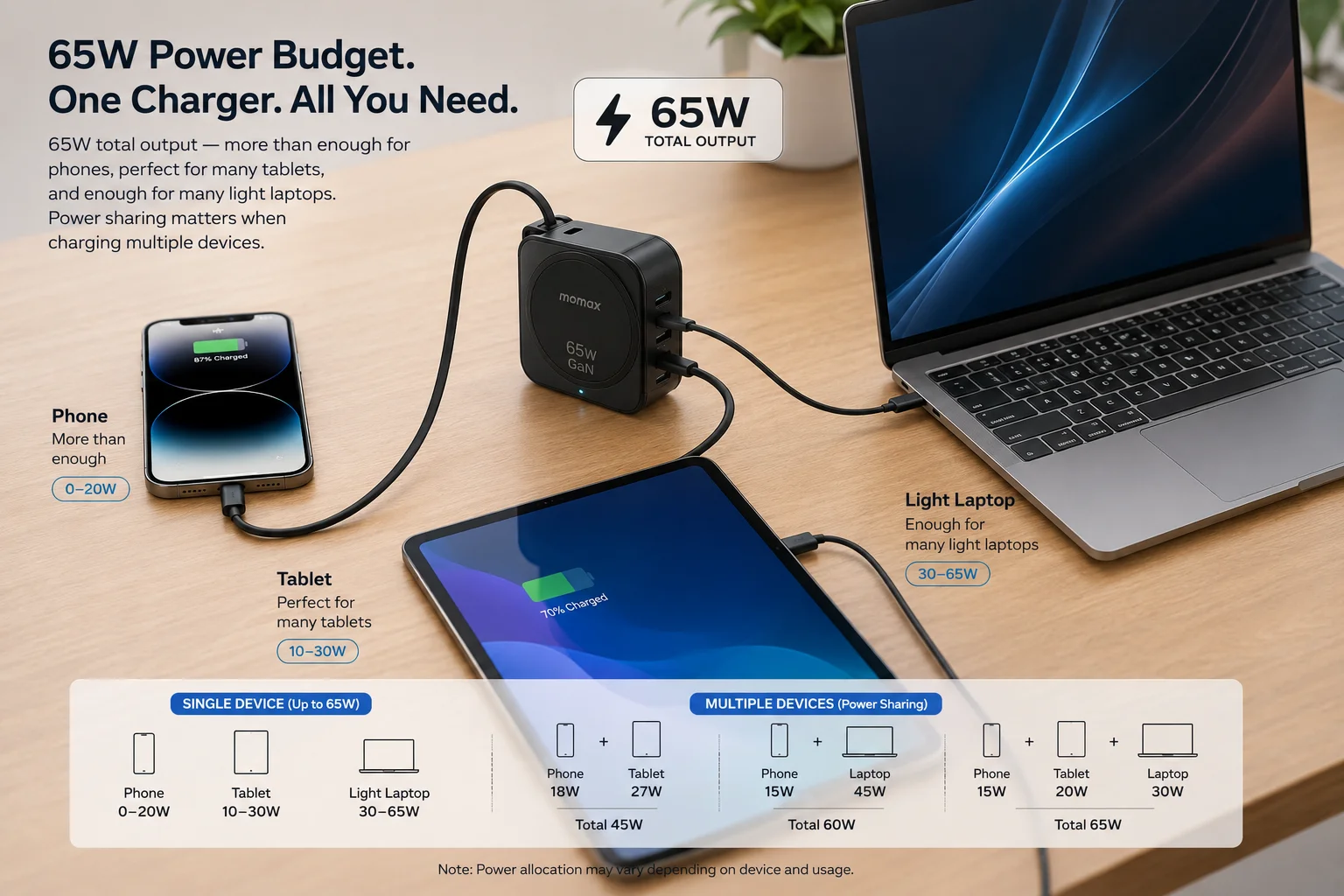
65W is more than enough for most phones, suitable for many tablets, and enough for many MacBook Air or USB-C ultrabook models.7 It may be limited when users charge several high-power devices at the same time.
Power distribution I ask buyers to confirm
The key question is not only “65W or not.” The key question is “65W where?” A charger may offer 65W through the built-in cable when one device is connected. If the user also connects a phone through an extra port, the charger may split the output.8 The laptop may drop to 45W, 30W, or another level, subject to design.
This point matters for retail packaging and online listings. If the listing says “charge laptop and phone at full speed,” the buyer may face bad reviews. I prefer clear wording like “up to 65W single-device output” if that matches the model. For multi-device charging, I ask for the shared-output table from the supplier.
| Use case | Is 65W enough? | What I check |
|---|---|---|
| Phone only | Yes, for most models | Phone input limit and PD/PPS support |
| Phone plus tablet | Often suitable | Shared output rules |
| MacBook Air or ultrabook | Often suitable | Laptop watt need and cable max output |
| Laptop plus phone | Depends | Power split after both connect |
| Several high-power devices | Often not enough | A 100W or higher model may fit better |
5. Does It Support USB-C PD, PPS and Fast Charging?
I see some buyers trust the word “GaN” too much. I always tell them that GaN is not the same as protocol support.
A 65W GaN charger should be checked for USB-C Power Delivery, USB PD PPS9, Apple fast charging, Samsung Super Fast Charging, Qualcomm Quick Charge where needed, and any device-specific protocol claims.
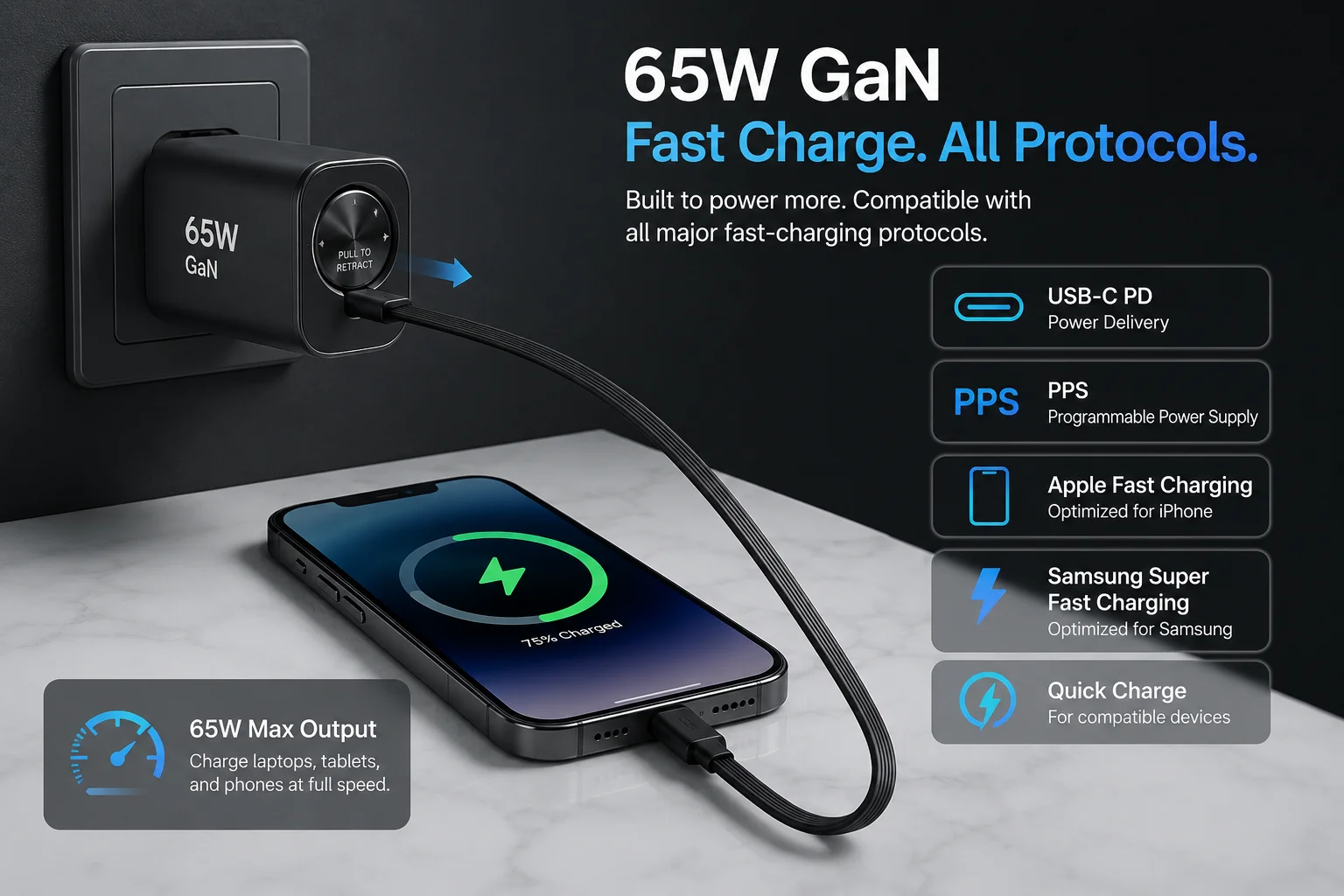
Protocol claims I prefer to verify
Fast charging depends on communication between the charger, cable, and device.10 The charger must offer the correct voltage and current levels. The device must request the right level. The cable must support the needed current. This is why I do not judge a product only by “65W” or “GaN.”
For e-commerce sellers, protocol wording must be careful. “Supports Samsung Super Fast Charging” can create high customer expectations. If PPS support is missing or limited, complaints may appear quickly. For retailers, packaging must match the real specification. For importers, the protocol list should be checked before bulk purchase, not after goods arrive.
| Protocol or claim | Why I care | Buyer action |
|---|---|---|
| USB-C PD | Common for phones, tablets, laptops | Check voltage and current profiles |
| USB PD PPS | Important for many Samsung models | Confirm PPS range before claim |
| Apple fast charging | Important for iPhone buyers | Use correct PD wording |
| Qualcomm Quick Charge | Still relevant for some devices | Check port support |
| Brand-specific protocol | May affect speed claims | Avoid broad claims without proof |
| Cable output rating | It affects real performance | Confirm built-in cable specification |
6. Retractable Cable vs Detachable USB-C Cable
I do not see one design as always better. I see two different sales positions with different after-sales risks.
A retractable cable charger is more convenient for travel and storage, while a detachable cable charger is easier to replace and more flexible. A model with an extra USB-C port can give a useful backup charging option.
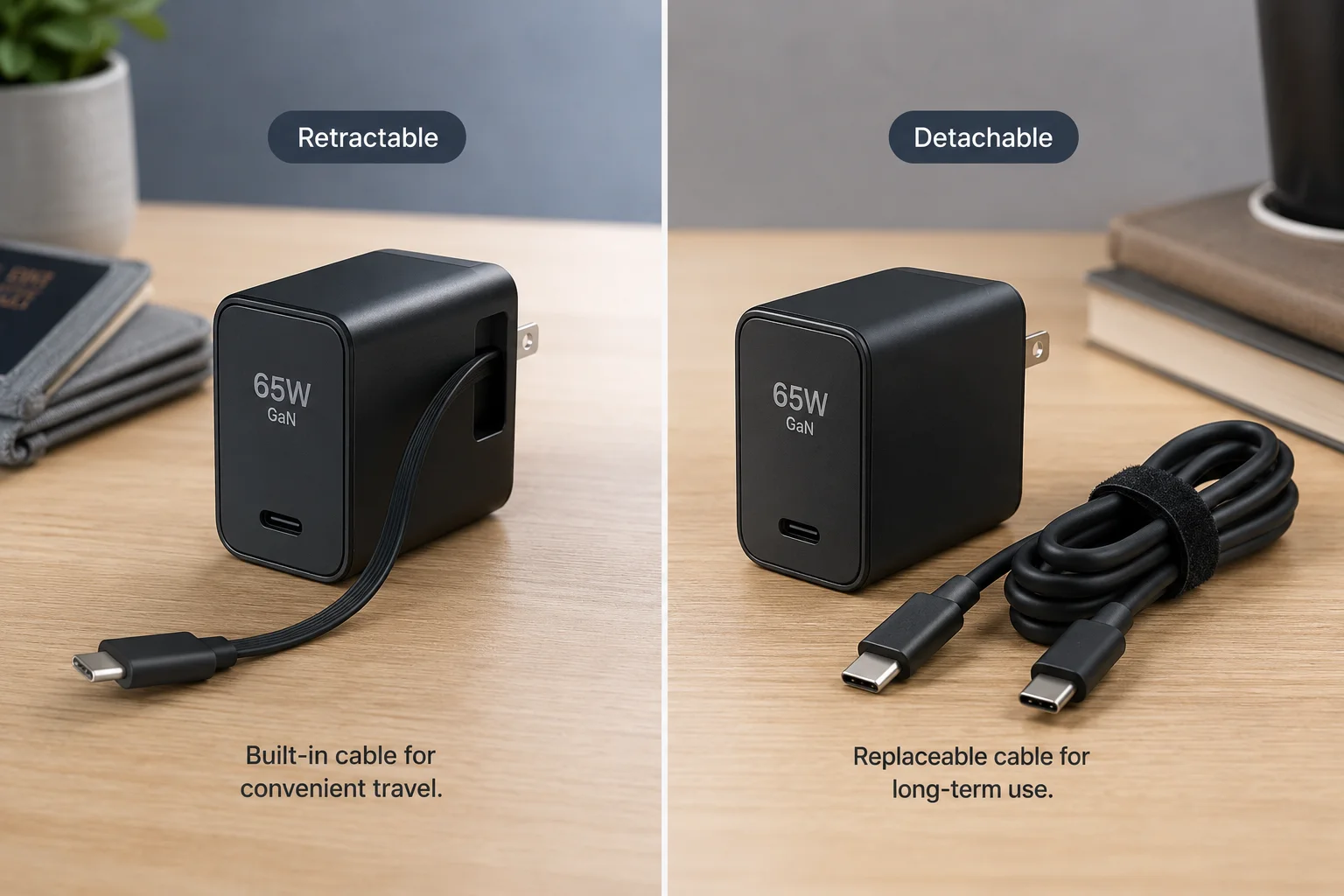
Design choice by channel and user habit
A retractable charger is easier to understand in retail. The user sees one product and one cable. It looks ready for travel. It also makes a strong gift item because it feels complete. A detachable cable design is more flexible because users can change cable length, cable type, or damaged cables more easily.
For wholesalers, this difference affects after-sales planning. If the built-in cable fails, repair or replacement is usually harder than replacing a loose USB-C cable.11 For online sellers, the listing should show cable length, how to pull it, and whether extra ports can be used when the built-in cable is not needed. I like models that include an additional USB-C port because they give users another charging path.
| Factor | Retractable cable | Detachable cable |
|---|---|---|
| Travel convenience | Strong | Medium |
| Cable storage | Very clean | Depends on user |
| Cable replacement | Harder | Easier |
| Product size | May be slightly larger | Often simpler |
| Repairability | Lower | Higher |
| Cable length choice | Limited by design | More flexible |
| Long-term durability | Depends on reel quality | Depends on cable quality |
| Charging flexibility | Good if extra ports exist | Strong with different cables |
7. How to Choose a Safe and Durable 65W Retractable GaN Charger
I do not treat safety files as a final detail. I treat them as part of the product offer, especially for Europe and North America.
Buyers should check built-in cable output, cable length, retraction mechanism, PD/PPS support, shared-output rules, protection design, temperature control, flame-resistant housing, safety certification, plug stability, and warranty terms.
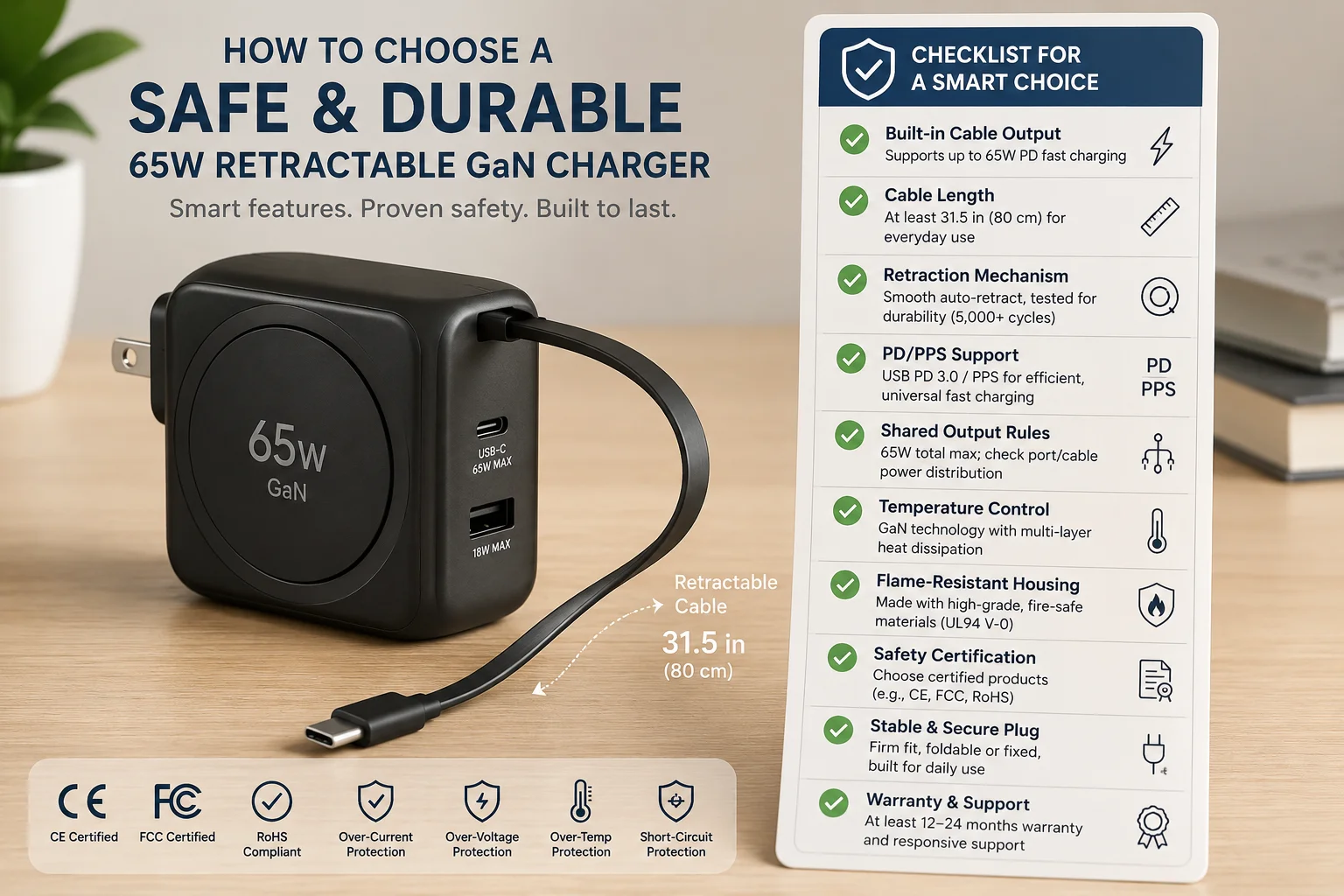
Procurement checklist I use before bulk orders
A good sample is not enough for bulk purchase. I ask buyers to check single-device output and shared-output specifications. I also ask them to test the retractable cable many times because the cable is the main moving part. The pull force should feel stable. The return should be smooth. The cable should not twist badly. The connector should not loosen too quickly.
For Europe and North America, plug type and certification matter.12 Labeling and packaging claims must match the sales region. I do not suggest using one vague version for every market. A UK plug, EU plug, and US plug may need different planning. For private-label projects, artwork, manual text, and safety marks should be checked before production.
| Check point | Why it matters |
|---|---|
| Built-in cable maximum output | It decides the real 65W experience |
| Retraction mechanism | It affects daily use and returns |
| PD and PPS support | It affects fast charging compatibility |
| Shared-output table | It prevents wrong listing claims |
| Overcurrent and overvoltage protection | It supports safe charging behavior |
| Short-circuit protection | It reduces risk in abnormal use |
| Temperature management | It matters for compact GaN designs |
| Flame-resistant enclosure | It supports safety expectations |
| Safety certification | It supports market entry and buyer trust |
| Plug stability | It affects wall use and customer confidence |
| Warranty terms | It affects after-sales cost planning |
8. Who Should Buy a 65W GaN Charger With a Retractable Cable?
I see this product fit buyers who sell convenience, travel, and clean setup. I do not see it fit every price-only channel.
A 65W GaN charger with a retractable cable fits business travelers, digital nomads, students, phone-and-laptop users, MacBook Air users, retailers, gift suppliers, importers, and private-label brands that need an all-in-one charging product.
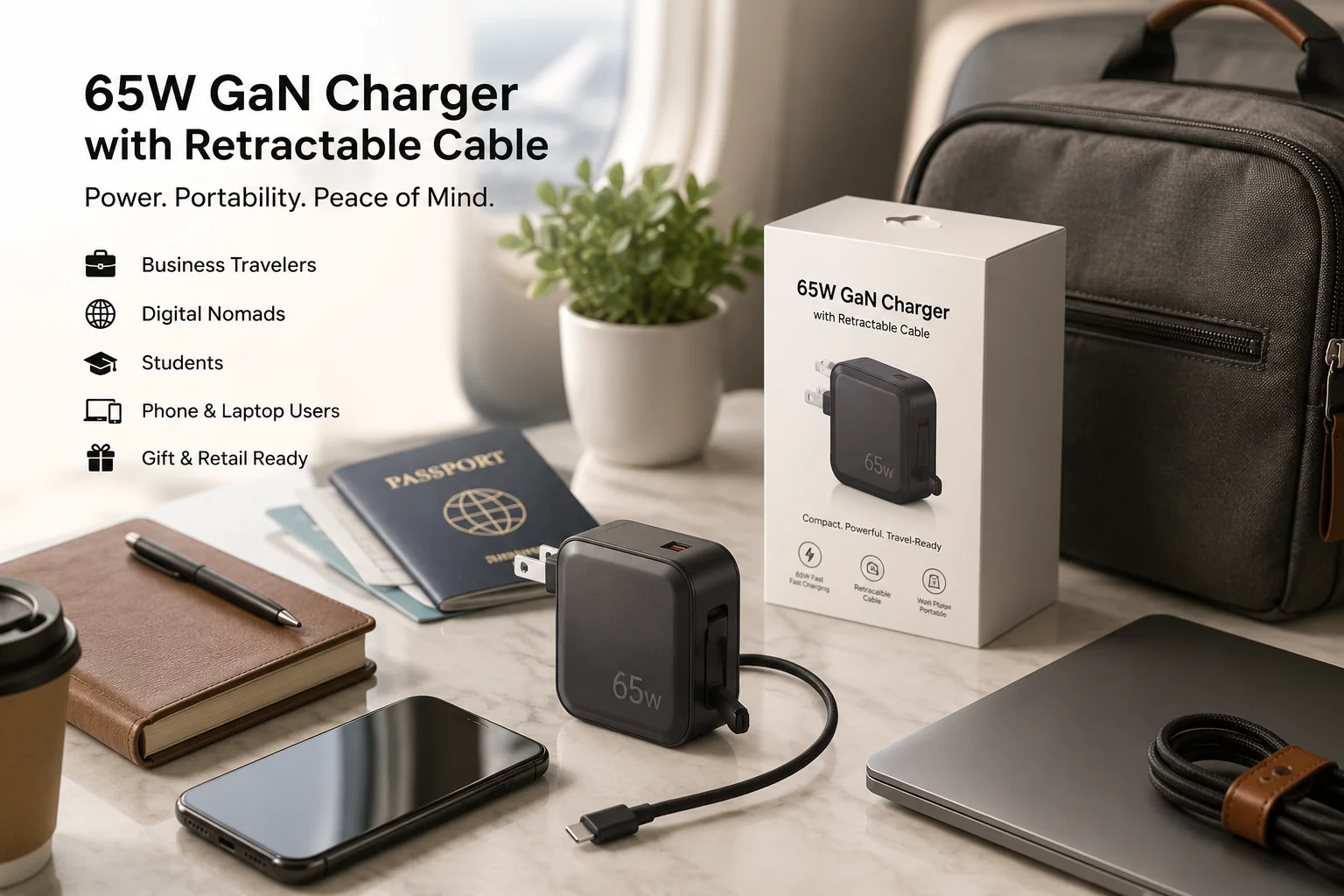
Channel fit I see in real buyer talks
Business travelers like the product because they carry fewer things. Students like it because desks and bags become less messy. MacBook Air users may like it if the output fits their model. Corporate gift suppliers may like it because the product feels modern and useful. Retailers may place it in travel electronics, phone accessories, or laptop accessories.
For e-commerce sellers, the product needs accurate photos and honest claims. A video showing the retractable cable can help reduce confusion. For chain stores, packaging must explain output and device use in simple language. For wholesalers, MOQ, delivery time, color, branding, and packaging should be discussed by project, not assumed. For importers, I always suggest checking market version, certification, and after-sales policy before price negotiation goes too far.
| Buyer type | Why it may fit | Main risk to control |
|---|---|---|
| Business traveler channel | Strong travel use case | Cable durability |
| Student market | Clean desk and bag use | Price band |
| Phone and laptop users | One charger for several devices | Power sharing |
| Retailers | Easy shelf story | Packaging accuracy |
| E-commerce sellers | Strong demo value | Negative reviews from overclaims |
| Corporate gift suppliers | Useful and modern gift | Branding and compliance |
| Importers | All-in-one product for new range | Certification and batch consistency |
| Private-label brands | Clear product difference | QC and after-sales planning |
Conclusion
I see this charger as a strong all-in-one product when buyers verify power, protocols, certification, and retractable cable durability before resale.
"USB hardware - Wikipedia", https://en.wikipedia.org/wiki/USB_hardware. USB-IF materials on USB Power Delivery describe USB-C charging as a negotiated power system for a range of mobile and computing devices, supporting the general claim that one properly rated 65 W charger can serve phones, tablets, and some notebooks; this does not verify every device model or the retractable cable's rating. Evidence role: general_support; source type: institution. Supports: USB-C Power Delivery is designed for negotiated power delivery across devices such as phones, tablets, and notebook computers, making the compatibility claim plausible when ratings and protocols match.. Scope note: Contextual support only; the source would not test the specific charger or all listed device models. ↩
"GaN-Based High-Efficiency, High-Density, High-Frequency Battery ...", https://vtechworks.lib.vt.edu/items/314dcc4d-ccb6-4118-bcb7-eebae36dd3b6. Research literature on GaN power devices reports high-frequency operation and high power density relative to conventional silicon devices, which supports the statement that GaN can help reduce charger size; final product size still depends on topology, thermal design, and enclosure choices. Evidence role: mechanism; source type: research. Supports: GaN devices can operate at high switching frequencies and support high power density, which can reduce passive component size and overall charger volume.. Scope note: The source would support the underlying mechanism, not the dimensions of the specific charger in the article. ↩
"Electrical Overheating | CPSC.gov", https://www.cpsc.gov/recall-hazards/electrical-overheating. Safety standards for audio/video and information-technology power equipment, such as IEC/UL 62368-1, address thermal and fire-related hazards in power supplies, supporting the statement that fast chargers need temperature control and safe materials; certification to a standard must be verified for the specific product. Evidence role: expert_consensus; source type: institution. Supports: Electrical safety standards for power supplies address thermal hazards, enclosure materials, and fire protection, supporting the need for temperature control and safe materials.. Scope note: Contextual support; standards explain safety requirements but do not prove that a given charger complies. ↩
"USB-C - Wikipedia", https://en.wikipedia.org/wiki/USB-C. USB-IF documentation for USB Type-C and USB Power Delivery defines cable current capabilities and the role of cable identification for higher-current operation, supporting the statement that a built-in cable must be rated for the claimed output; this does not confirm the rating of any particular retractable cable. Evidence role: definition; source type: institution. Supports: USB-C cables have defined current capabilities, and higher-current operation requires appropriate cable support, so a built-in cable must match the advertised charging output.. Scope note: Directly supports the principle, but product-specific verification requires the charger's test report or specification. ↩
"Fast charge your iPhone - Apple Support", https://support.apple.com/en-us/102574. Official support pages from major smartphone manufacturers describe fast-charging requirements for many current phones at power levels below 65 W, supporting the general statement that phones usually need less than a 65 W charger can supply; individual gaming or specialty phones may differ. Evidence role: general_support; source type: other. Supports: Representative smartphone manufacturers specify fast-charging power levels below or around 20 W, 25 W, or 45 W for many models, which is below 65 W.. Scope note: Representative rather than exhaustive; it would not cover every smartphone model. ↩
"The Basics of USB Power Delivery Negotiations | Acroname", https://acroname.com/blog/basics-usb-power-delivery-negotiations?srsltid=AfmBOoozRz_-yVhceQjUzPxmye-GO2xSmXXyQR19Olds1-MrYkpTs-f2. USB Power Delivery specifications describe a source-and-sink negotiation process in which the connected device requests compatible voltage and current levels, supporting the statement that a phone determines its own input limit rather than drawing the charger's maximum rating automatically. Evidence role: mechanism; source type: institution. Supports: USB Power Delivery uses negotiation between the power source and sink, with the device requesting compatible power profiles.. ↩
"Use a power adapter with your Mac", https://support.apple.com/en-us/109509. Representative device documentation, including official power-adapter ratings for lightweight notebooks and mobile devices, shows many such products charging with adapters at or below the 65 W class, supporting the article's general sufficiency claim; this does not establish compatibility for every ultrabook or tablet. Evidence role: general_support; source type: other. Supports: Representative phone, tablet, and lightweight laptop specifications use charging adapters within or below the 65 W class, supporting the claim for many devices.. Scope note: Contextual and model-dependent; some laptops and tablets require higher power or proprietary behavior. ↩
"Hear me out... a multiport USB-C charger that's not dumb - YouTube",
. Technical discussions of multi-port USB-C Power Delivery chargers describe power allocation across ports from a finite total output budget, supporting the statement that adding a second device can reduce the power available to the first; the exact split is determined by the charger's controller and firmware. Evidence role: mechanism; source type: research. Supports: A charger has a finite total power budget, and multi-port controller designs allocate that budget among connected ports.. Scope note: Contextual support; the specific split must come from the product's own output table. ↩"USB Charger (USB Power Delivery) - USB-IF", https://www.usb.org/usb-charger-pd. USB Power Delivery documentation defines Programmable Power Supply as a mode that permits finer voltage and current adjustments than fixed power profiles, supporting the article's emphasis on checking PPS support for fast-charging compatibility; actual fast-charge behavior remains device-specific. Evidence role: definition; source type: institution. Supports: USB PD PPS allows more granular voltage and current adjustment than fixed PD profiles, which is relevant to fast-charging compatibility claims.. Scope note: Defines PPS and its relevance but does not prove support for any named phone model. ↩
"USB Charger (USB Power Delivery) - USB-IF", https://www.usb.org/usb-charger-pd. USB-IF materials explain that USB Power Delivery relies on protocol negotiation between the source and sink and can use cable capability information for higher-current operation, supporting the statement that fast charging depends on communication among charger, cable, and device. Evidence role: mechanism; source type: institution. Supports: USB-C Power Delivery uses communication and negotiation, including cable capability information where relevant, before supplying higher power levels.. ↩
"[PDF] Nixing the Fix: An FTC Report to Congress on Repair Restrictions", https://www.ftc.gov/system/files/documents/reports/nixing-fix-ftc-report-congress-repair-restrictions/nixing_the_fix_report_final_5521_630pm-508_002.pdf. Government repairability policy materials identify modularity and replaceable parts as factors that can make consumer electronics easier to repair, supporting the statement that a detachable USB-C cable is usually easier to replace than an integrated retractable cable; the repair difficulty of a specific charger depends on its construction. Evidence role: general_support; source type: government. Supports: Repairability guidance and policy discussions identify replaceable parts and modular design as factors that make repair easier, supporting the comparison between detachable and built-in cables.. Scope note: Contextual support; it does not assess this exact product design. ↩
"Electromagnetic Compatibility Division | Federal Communications ...", https://www.fcc.gov/engineering-technology/electromagnetic-compatibility-division. European Commission compliance materials for electrical equipment and North American safety and electromagnetic-compatibility frameworks show that power adapters are subject to regional requirements, supporting the statement that plug type and certification matter for Europe and North America; exact obligations vary by product design and sales jurisdiction. Evidence role: historical_context; source type: government. Supports: European and North American markets apply different plug, electrical safety, EMC, and labeling requirements to power adapters and chargers.. Scope note: Contextual regulatory support; compliance must be confirmed against the specific charger, plug version, and target market. ↩