Many buyers hear “GaN” and expect magic. I see the problem when wrong chargers create slow charging, returns, and unhappy customers.
A GaN charger uses gallium nitride power components to support smaller and more efficient charger designs.1 It can deliver high power in a compact body, but real charging speed still depends on wattage, charging protocols, cable rating, device limits, and port power sharing.2
I have handled GaN charger inquiries from European and American buyers for many years. I often hear the same questions. Does GaN mean faster charging? Is 100W always better than 65W? Can one charger support phones, tablets, and laptops? I do not treat GaN as only a technology word. I treat it as a product selection decision. If you choose the right SKU, your customers feel the value. If you choose the wrong SKU, your store may face complaints, slow-moving stock, and after-sales pressure.
What Is a GaN Charger and How Does It Work?
Many buyers see GaN on packaging and feel safe. I see risk when the label hides weak specs, poor cables, or wrong protocols.
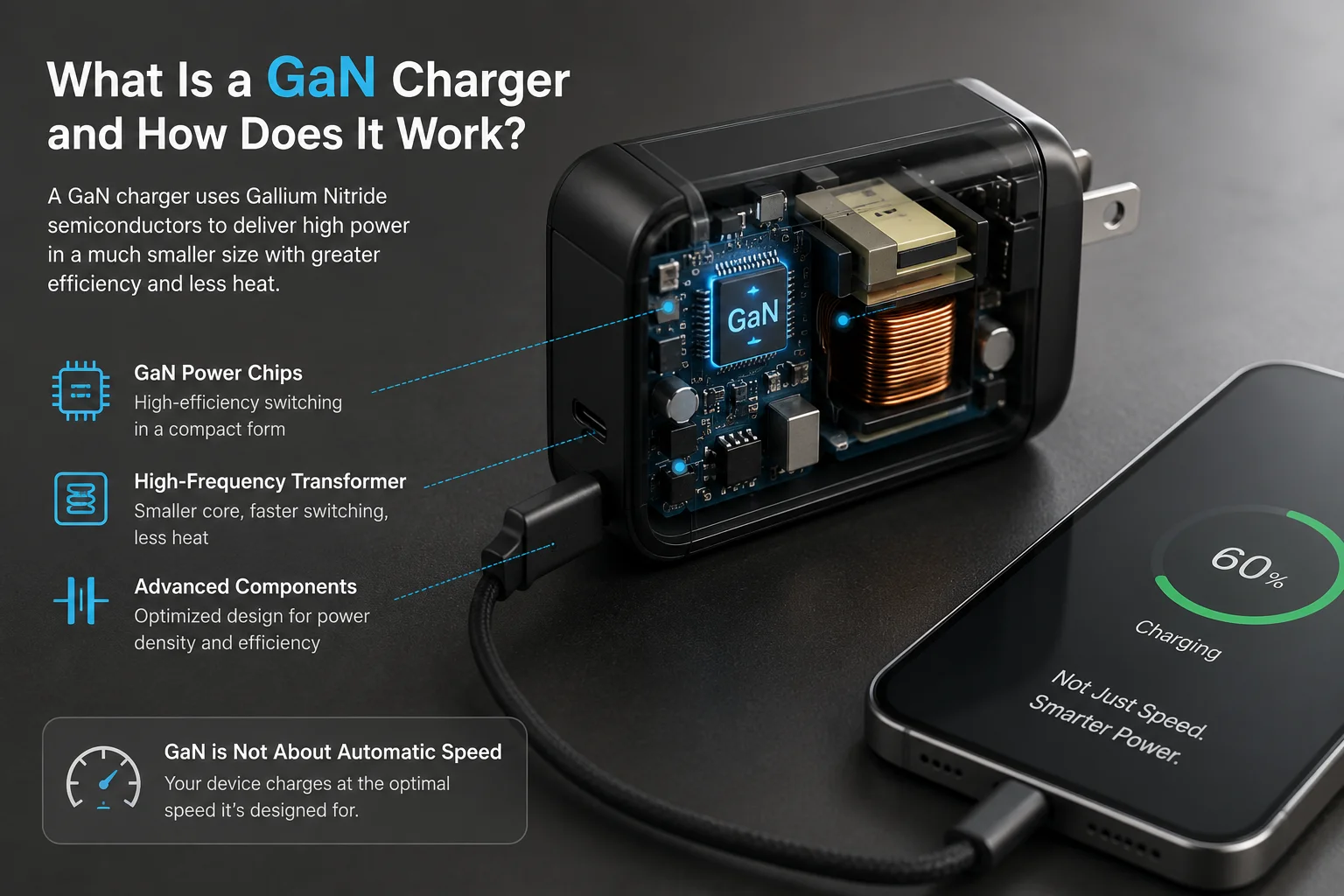
A GaN charger uses gallium nitride in power-conversion parts. I use it to explain compact high-power designs, not automatic charging speed. The final speed depends on the device, wattage, protocol, cable, battery state, and port use.
I separate GaN material from fast-charging performance
GaN stands for gallium nitride. In charger products, GaN is used in power-conversion components. It can support efficient high-frequency switching.3 This helps the charger use smaller internal parts and still deliver high output. It also helps manufacturers design smaller high-power chargers.
I always explain one important point to buyers. GaN technology is not the same thing as a fast-charging protocol.4 GaN is about the charger hardware design. Fast charging also needs USB-C Power Delivery, PPS, QC, or other protocol support. It also needs a device that accepts that power.
| What I check | What it means for buyers |
|---|---|
| GaN material | I see it as a design advantage for compact high-power chargers. |
| Output wattage | I match it with phones, tablets, laptops, or multi-device use. |
| PD or PPS support | I check it when buyers need broad fast-charging compatibility. |
| Cable rating | I do not ignore it because a weak cable limits charging. |
| Device limit | I remind buyers that the phone or laptop controls the maximum intake. |
In my export work, I have seen buyers choose a GaN charger only because it looks modern. I prefer to ask what devices their customers will charge first.
Why Are GaN Chargers More Compact?
Small chargers look easy to sell. I still worry when compact size becomes the only goal and heat control gets ignored.
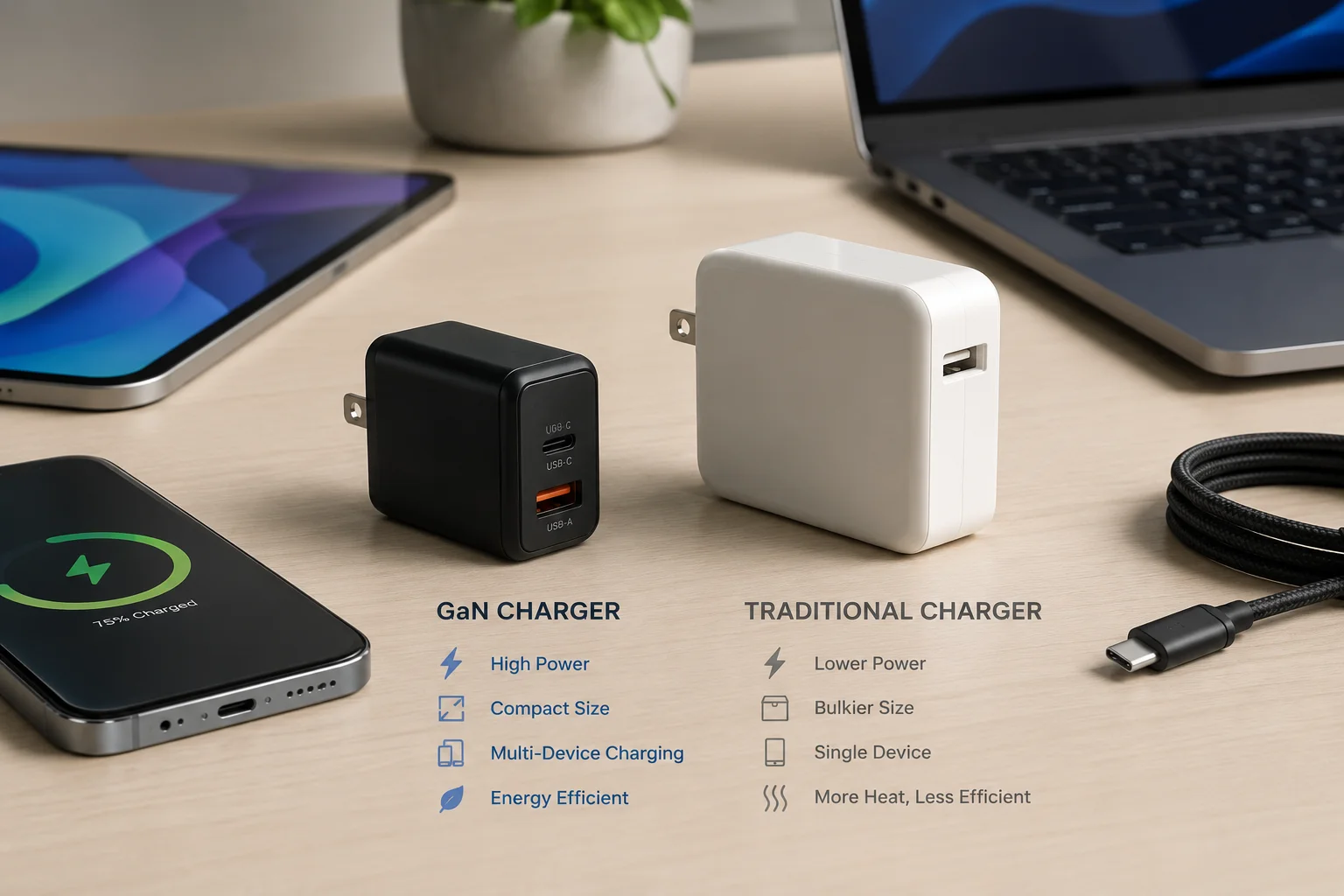
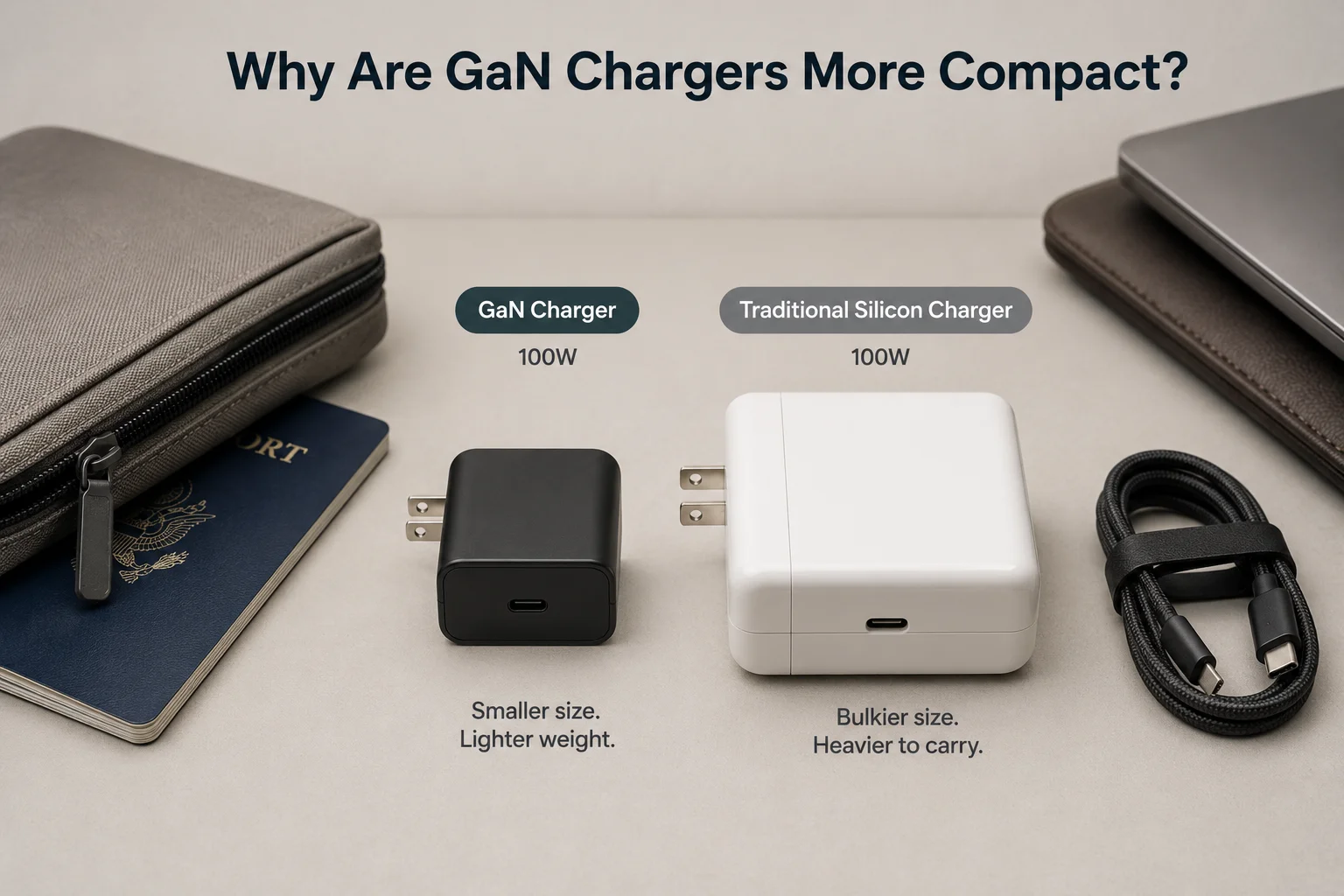
GaN chargers are more compact because GaN can support higher power density, smaller components, compact transformer design, and lower space needs for heat management.5 This allows higher output from a smaller charger body.
I compare size with heat and structure, not size alone
GaN chargers can be smaller because the internal power design can work more efficiently. The charger can use smaller power-conversion parts. The transformer design can also be more compact. Less internal space may be needed for heat control when the design is done well. This is why a 65W GaN charger can often be much smaller than an older silicon-based 65W charger.6
Still, I do not tell buyers to chase the smallest shell every time. A very small body must still handle heat. It must have stable housing material, a safe plug design, and good batch consistency. For retail and wholesale channels, a charger that looks tiny but runs too hot can damage customer trust.
| Power level | Traditional silicon charger feel | GaN charger feel |
|---|---|---|
| 30W | I often see a medium wall charger body. | I often see a very compact travel size. |
| 65W | I often see a larger adapter body. | I often see a pocket-size multi-port body. |
| 100W | I often see a bulky laptop-style adapter. | I often see a smaller desktop or wall charger body. |
I treat compact size as one selling point. I do not treat it as the full quality standard.
How Much Power Can a GaN Charger Deliver?
High wattage looks attractive on a shelf. I see trouble when the port output does not match the buyer’s real customer use.
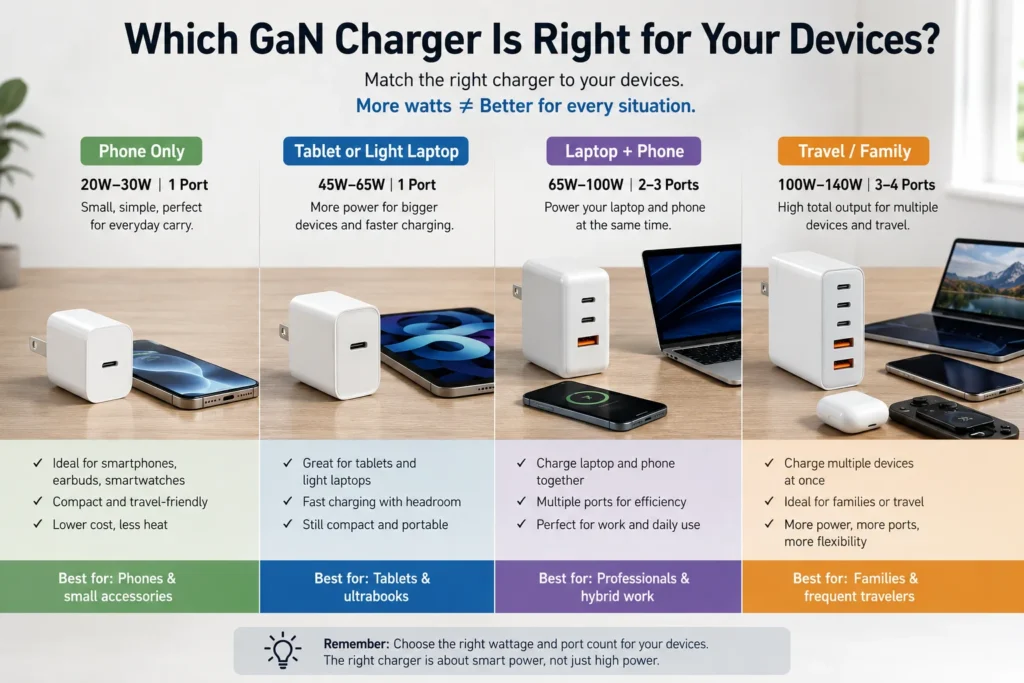
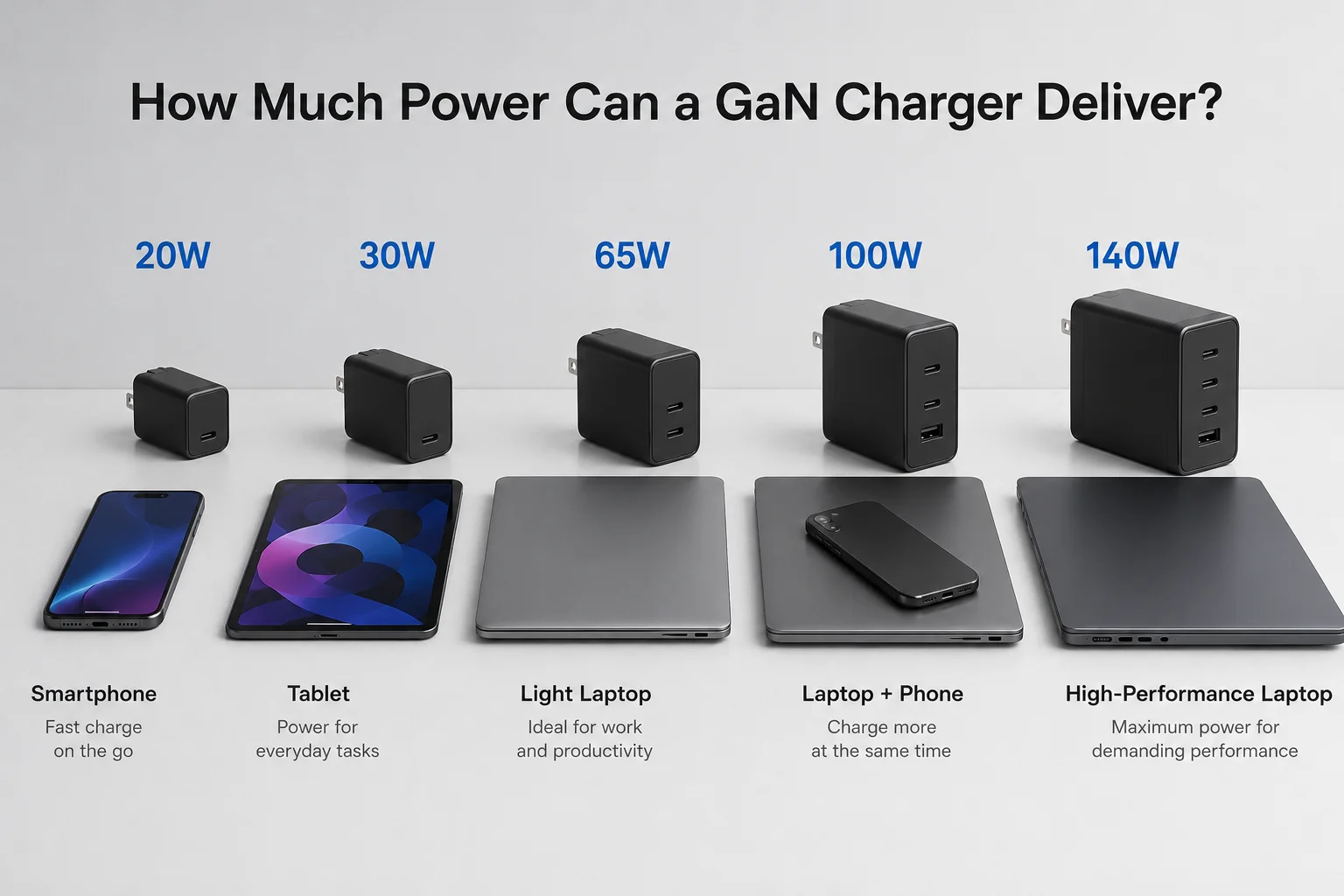
GaN chargers commonly range from 20W to 140W and above. I match 20W–30W with phones, 45W–65W with tablets and light laptops, 100W with laptops and multi-device use, and 140W+ with high-power devices.
I choose wattage by device type and channel demand
When I quote GaN chargers, I do not start with the highest wattage. I start with the device list. A phone accessories retailer may sell many 20W, 30W, or 35W models. A chain store with tablets and laptops may need 45W, 65W, and 100W models. A business travel or office channel may need 100W or 140W multi-port chargers.
Buyers also need to read the difference between total output and single-port output. A charger may say 100W total. It may give 100W only from one USB-C port when used alone. When two or three devices are plugged in, it may split power across ports.7
| Power range I recommend | Best fit I usually see |
|---|---|
| 20W–30W | I use this for phones, earbuds, and small mobile devices. |
| 45W | I use this for flagship phones, tablets, and some thin laptops. |
| 65W | I use this for phones, tablets, and MacBook Air type users. |
| 100W | I use this for laptops and several devices at the same time. |
| 140W+ | I use this for high-power laptops and professional devices. |
This is important for B2B buyers. A wrong wattage mix can create slow inventory turnover. A good wattage range can cover more customers with fewer SKUs.
Do GaN Chargers Charge Devices Faster?
Many customers expect every GaN charger to be faster. I see complaints when sales copy promises more than the device can accept.
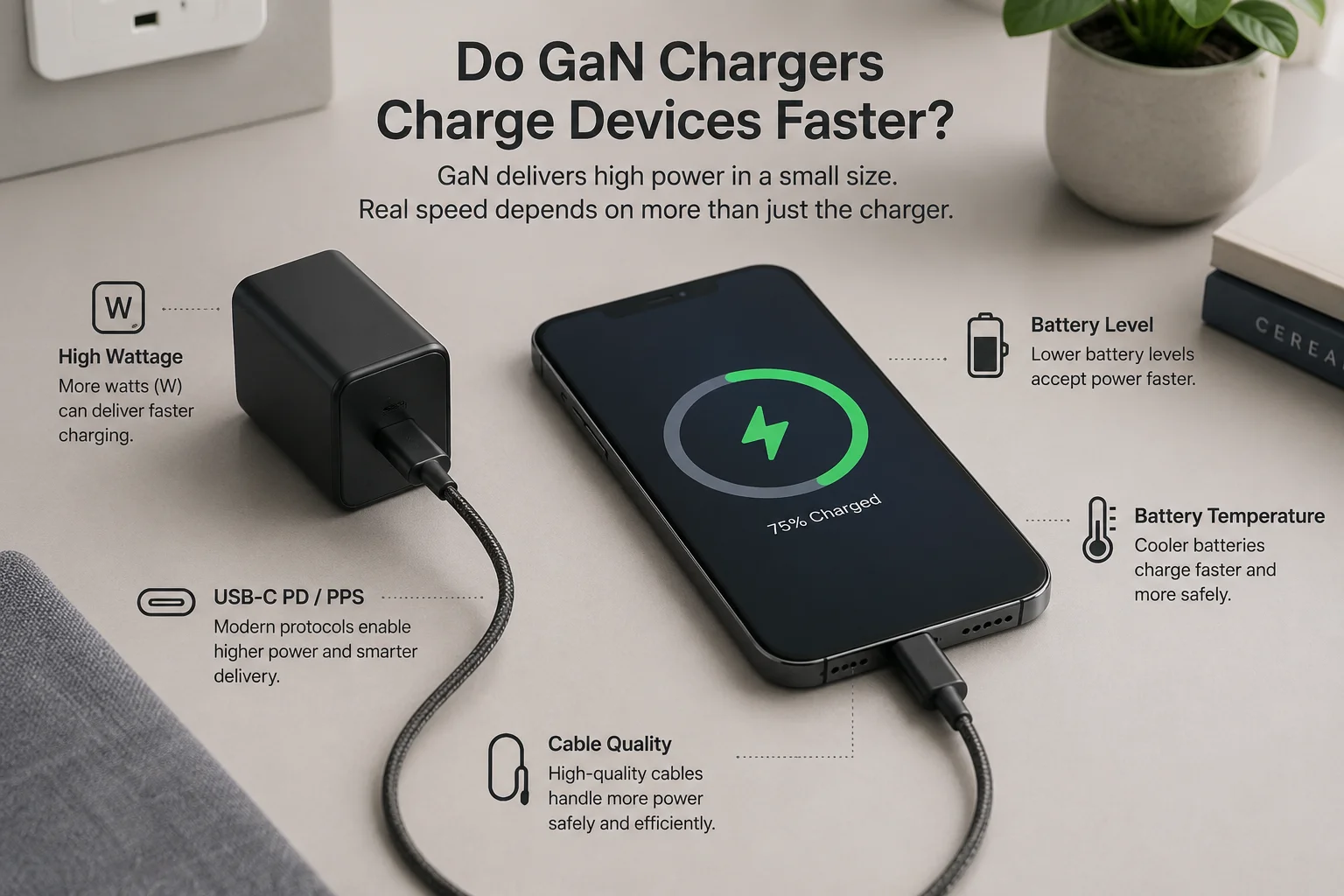
A GaN charger can provide high power in a smaller body, but it does not always charge faster. Charging speed depends on device wattage limits, USB-C PD, PPS, proprietary protocols, cable rating, battery temperature, and battery level.
I explain charging speed as a full system
I avoid saying “any GaN charger is faster than any normal charger.” That sentence is too simple and too risky. A 30W GaN charger may charge a phone quickly if the phone supports that input. A 100W GaN charger may not charge the same phone faster if the phone only accepts 27W or 30W. The device sets a ceiling.
USB-C Power Delivery is also important. PPS matters for some phones because it allows more flexible voltage and current adjustment.8 Some brands use proprietary fast-charging protocols. If the charger does not support that protocol, the device may charge at a lower speed. The cable also matters. A cable without the right rating can limit the output.9
| Factor I check | Why I check it |
|---|---|
| Device maximum wattage | I need to know the real power the device can take. |
| USB-C PD support | I use it for broad phone, tablet, and laptop compatibility. |
| PPS support | I check it for certain phone models and market needs. |
| Proprietary protocol | I check it when buyers serve brand-specific users. |
| USB-C cable rating | I know a weak cable can limit charging speed. |
| Battery temperature | I know hot batteries may slow charging for safety. |
| Current battery level | I know many devices slow down near higher battery levels.10 |
For retail packaging, I prefer clear claims. I would rather write “supports up to 65W PD fast charging” than promise a fixed charging time for every device.
Why Are Multi-Port GaN Chargers Useful?
Single-port chargers are simple. I see more buyers choose multi-port models because their customers carry more than one device every day.
Multi-port GaN chargers are useful because they can charge phones, tablets, laptops, and accessories together. They can replace several adapters, save desk space, reduce travel load, and support families, offices, hotels, and business trips.
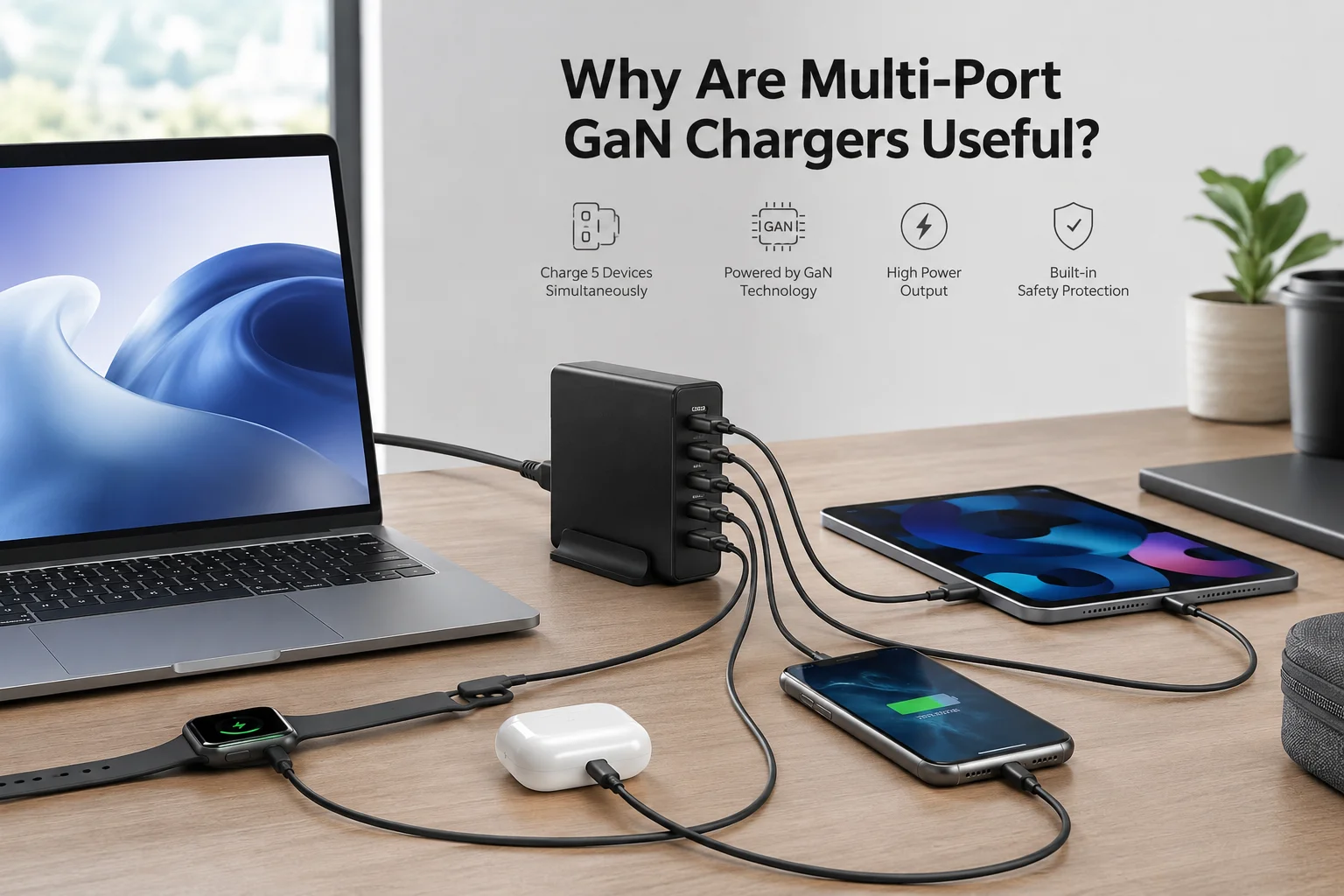
I sell multi-port value through real use cases
Multi-port GaN chargers are strong SKUs for many European and American channels. A customer may charge a phone and tablet at night. A traveler may charge a laptop and phone in a hotel room. A family may share one charger in the kitchen or living room. An office user may want one compact charger for a laptop, phone, and earbuds.
Still, multi-port chargers need clear explanation. When one device is plugged in, one port may give the maximum output. When two or three devices are plugged in, the charger may reallocate power. Some models pause for a moment when a new device is connected because the charger renegotiates power. Customers may see this as a problem if the packaging does not explain it.
| Use case I see | Suitable charger direction |
|---|---|
| Phone and tablet together | I often suggest 45W–65W dual USB-C. |
| Laptop and phone | I often suggest 65W–100W with clear port rules. |
| Family shared charging | I often suggest 3-port or 4-port models. |
| Business travel | I often suggest compact 65W–100W models. |
| Hotel and office use | I often suggest stable multi-port designs with good heat control. |
For B2B buyers, port layout matters as much as wattage. A good port mix can make a charger easier to explain and easier to sell.
Are GaN Chargers Better for Travel?
Travel buyers like compact products. I still check plug type, voltage input, and port needs before I call a charger travel-friendly.
GaN chargers are often better for travel because they are smaller, lighter, and can offer multiple ports. Many models support wide-voltage input, foldable or replaceable plugs, and charging for phones, tablets, and laptops.
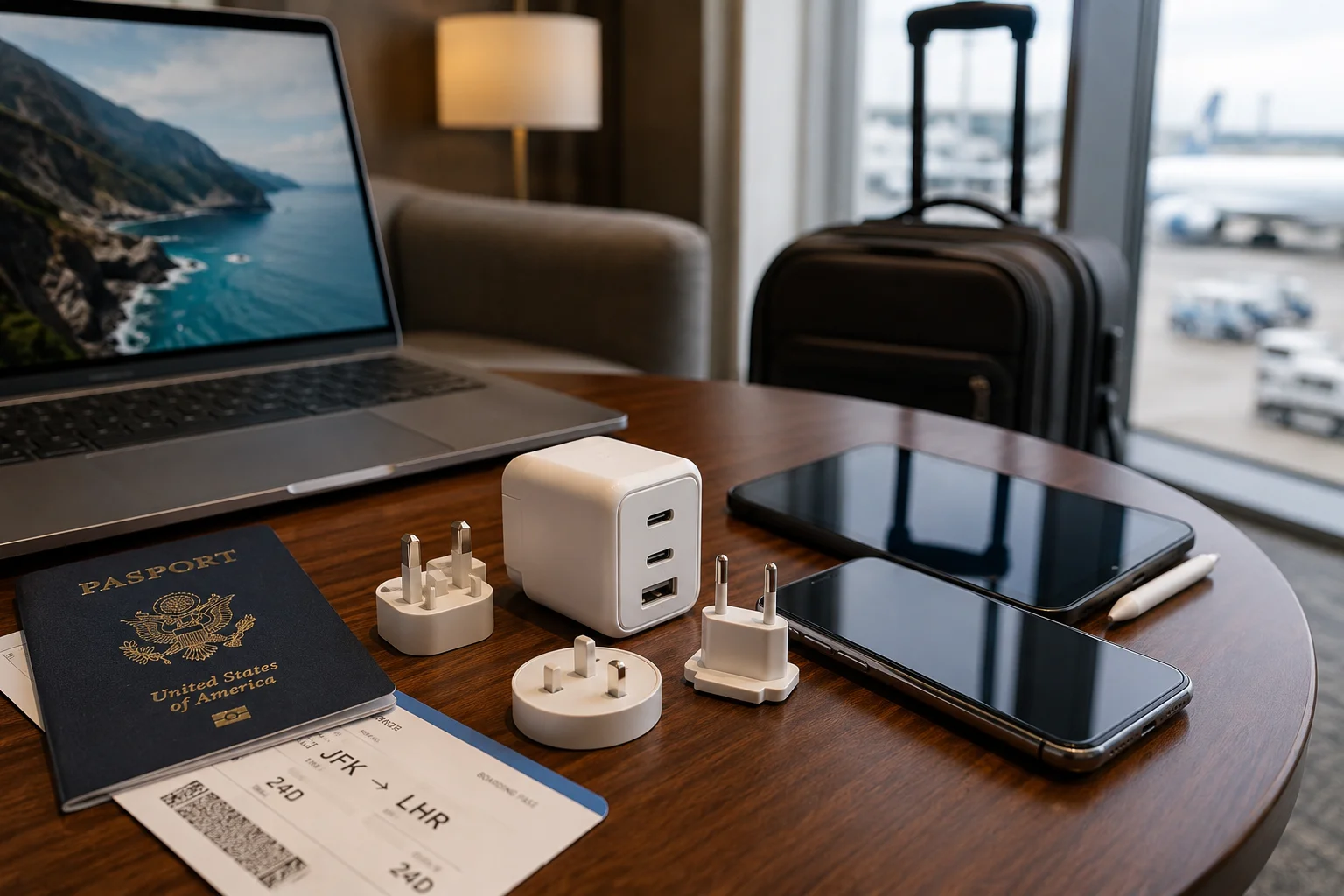
I look at travel fit by country, plug, and voltage
GaN chargers can be very suitable for travel. A smaller body reduces bag weight. A multi-port layout reduces the need to carry several adapters. Foldable plugs are useful for the US market. Replaceable plugs can help buyers cover the EU, UK, US, and AU markets with fewer product families. Wide-voltage input, such as 100–240V, is also important for international use.11
I also remind buyers about one common misunderstanding. An international plug converter does not always convert voltage. It may only change the plug shape.12 The charger itself must support the local input voltage. This matters for customer safety and after-sales claims.
| Travel feature I check | Why it matters |
|---|---|
| Small size | I know travelers want less weight and less bulk. |
| Foldable plug | I see it work well for US wall charger SKUs. |
| Replaceable plug | I use it for multi-country selling plans. |
| Wide-voltage input | I check it for international travel use. |
| Multiple ports | I know it helps replace several adapters. |
| Device compatibility | I match phones, tablets, and laptops before shipment. |
For importers, travel chargers also need correct certification and market labels. I always confirm the target country before I suggest a plug version.
How to Choose a Safe and Reliable GaN Charger?
A low price can look good at first. I see the real cost later when safety, heat, or certification problems appear.
I choose a safe GaN charger by checking output wattage, PD and PPS support, port power rules, recognized certifications, protection functions, temperature control, manufacturer information, warranty terms, and compatible cables.
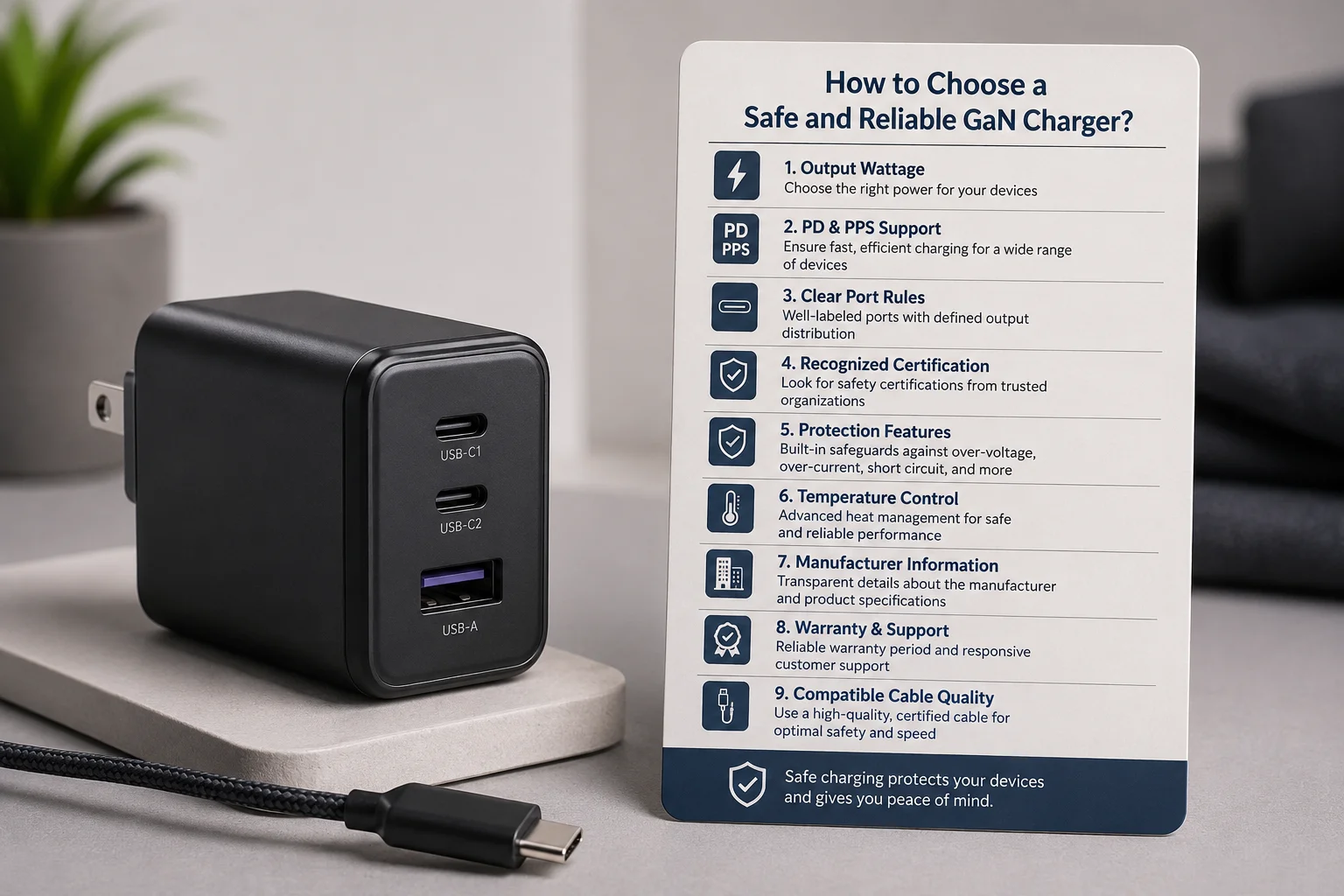
I do not judge quality by the GaN logo alone
A “GaN” mark does not prove safety. I check the full product file. For Europe, buyers often ask about CE, RoHS, and other market-related requirements. For the US, buyers may ask about ETL, FCC, or other needed approvals. Requirements can vary by product, plug type, market, and buyer channel. I always confirm them per SKU before I treat the product as ready for shipment.
Protection functions are also important. I check overcurrent protection, overvoltage protection, short-circuit protection, and temperature control. I also check housing quality, plug firmness, batch consistency, packaging information, and warranty policy. A charger may look good in photos, but B2B buyers need stable repeat orders.
| Checkpoint I use | What I want to confirm |
|---|---|
| Required wattage | I match the charger with the device group. |
| USB-C PD | I confirm broad fast-charging support. |
| PPS | I confirm it when target devices need it. |
| Single-port output | I check the real maximum per port. |
| Shared output | I check power distribution with several devices. |
| Safety certification | I confirm market needs per SKU. |
| Protection design | I check overcurrent, overvoltage, short circuit, and temperature control. |
| Manufacturer details | I prefer clear company and product information. |
| Warranty and return policy | I reduce after-sales uncertainty. |
| USB-C cable | I match cable rating with charger output. |
For retailers and wholesalers, the safest choice is often not the cheapest charger. It is the charger that creates fewer returns and more repeat orders.
Which GaN Charger Is Right for Your Devices?
The biggest SKU mistake is buying for the label, not for the user. I always start with the device and selling channel.
The right GaN charger is the model that matches your device power needs, charging protocols, port count, safety requirements, plug type, and channel position. The highest wattage model is not always the best model.
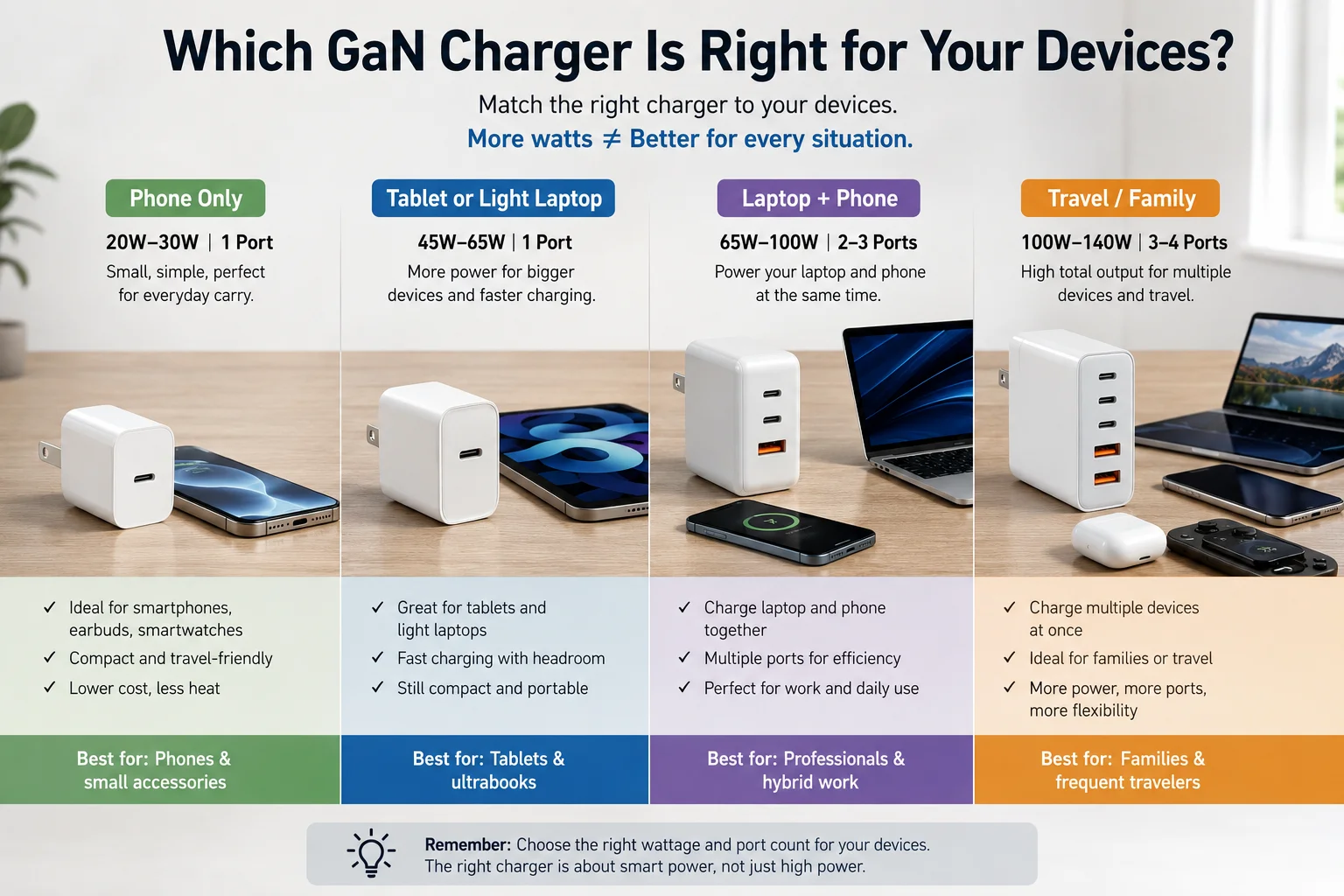
I build the product range from customer use
When a buyer asks me which GaN charger to source, I ask a simple question first. What will your customers charge? If the answer is one phone, I may suggest a compact 20W–30W GaN charger. If the answer is two phones, I may suggest a 40W–65W dual USB-C charger. If the answer is phone and tablet, I often look at 45W–65W. If the answer is phone and laptop, I usually move to 65W–100W. If the answer is several devices, I look at 100W+ multi-port models.
For high-power laptops, I check 140W USB-C PD 3.1 support. For international travel, I check wide-voltage input and suitable plug support. For chain stores and importers, I also discuss MOQ, lead time, private label packaging, retail box design, barcode needs, and after-sales rules.
| Customer need I hear | Charger direction I suggest |
|---|---|
| One phone | I suggest a compact 20W–30W GaN charger. |
| Two phones | I suggest a 40W–65W dual USB-C charger. |
| Phone and tablet | I suggest a 45W–65W charger. |
| Phone and laptop | I suggest a 65W–100W charger. |
| Multiple devices | I suggest a 100W+ multi-port charger. |
| High-power laptop | I suggest a 140W USB-C PD 3.1 charger. |
| International travel | I suggest a compact wide-voltage charger with suitable plug support. |
I also think about shelf position. A small 30W charger can be a volume SKU. A 65W dual-port model can be a mainstream upgrade SKU. A 100W or 140W charger can be a premium SKU. This range helps buyers cover more customers without buying too many slow-moving items.
Conclusion
I choose GaN chargers by device fit, protocol support, port design, certification, and safety, because the best SKU is the one customers can trust.
"GaN-Based High-Efficiency, High-Density, High-Frequency Battery ...", https://vtechworks.lib.vt.edu/items/314dcc4d-ccb6-4118-bcb7-eebae36dd3b6. A review of GaN power devices supports that gallium nitride semiconductors can enable higher-frequency, higher-efficiency power conversion and higher power density, which provides the engineering basis for smaller charger designs. Evidence role: mechanism; source type: paper. Supports: A source should explain that GaN power devices have material and switching characteristics that can improve efficiency and power density in power converters.. ↩
"USB Charger (USB Power Delivery) - USB-IF", https://www.usb.org/usb-charger-pd. USB Power Delivery documentation describes charging as a negotiated interaction among the source, sink, and cable capabilities, supporting the point that wattage, protocol support, device limits, and cable rating can constrain actual charging speed; it does not by itself evaluate every multi-port charger design. Evidence role: mechanism; source type: institution. Supports: A source should show that USB-C charging power is negotiated among the power source, sink device, and cable, and that available power can depend on supported profiles and cable capability.. Scope note: The source would support the charging mechanism generally, but not the behavior of every specific charger SKU. ↩
"GaN vs. Silicon in High-Frequency Power Transistors - Stanford", http://large.stanford.edu/courses/2025/ph240/jahan2/. Peer-reviewed literature on GaN power transistors supports that their device properties allow efficient high-frequency switching in power converters, which is one reason they are used in compact power supplies. Evidence role: mechanism; source type: paper. Supports: A source should document that GaN power transistors can operate efficiently at higher switching frequencies than many silicon devices in power-converter contexts.. ↩
"USB hardware - Wikipedia", https://en.wikipedia.org/wiki/USB_hardware. USB-IF materials define USB Power Delivery as a protocol for negotiating voltage and current between devices, supporting the distinction between GaN as a power-semiconductor technology and USB-PD or PPS as charging protocols. Evidence role: definition; source type: institution. Supports: A source should define USB Power Delivery or PPS as communication/power-negotiation protocols, distinct from the semiconductor material used in the adapter.. ↩
"High-Frequency Oriented Design of Gallium-Nitride (GaN ...", https://vtechworks.lib.vt.edu/bitstream/handle/10919/85054/Sun_B_D_2018.pdf?isAllowed=y&sequence=1. Engineering studies of GaN power converters report that higher switching frequencies and lower switching losses can reduce passive-component size and increase power density, supporting the technical basis for more compact charger designs. Evidence role: mechanism; source type: paper. Supports: A source should support the link between GaN devices, higher switching frequency, improved efficiency, power density, and reduced component size.. ↩
"[PDF] High-Frequency Oriented Design of Gallium-Nitride (GaN) Based ...", https://vtechworks.lib.vt.edu/bitstream/handle/10919/85054/Sun_B_D_2018.pdf?isAllowed=y&sequence=1. Research comparing GaN and silicon power-converter designs supports that GaN can achieve higher power density, which makes a smaller 65W adapter technically plausible; however, actual size also depends on topology, enclosure, thermal design, and safety margins. Evidence role: general_support; source type: research. Supports: A source should show that GaN-based power adapters or converters can achieve higher power density than silicon-based designs, making smaller adapters possible at a given wattage.. Scope note: The evidence would support the general comparison, not prove that every 65W GaN charger is smaller than every older silicon-based 65W charger. ↩
"Hear me out... a multiport USB-C charger that's not dumb - YouTube",
. USB Power Delivery documentation supports that power is negotiated between each source port and connected sink, providing the basis for different single-port and shared-port output limits in multi-port chargers; product-specific allocation still depends on the charger controller design. Evidence role: mechanism; source type: institution. Supports: A source should explain that USB-C PD power is negotiated per connection and that available power can be allocated differently across ports in a multi-port power source.. Scope note: The source supports the mechanism of per-port negotiation but does not specify the power-sharing table for any particular charger model. ↩"Continuously variable voltage power supplies that use USB-PD as ...", https://www.reddit.com/r/UsbCHardware/comments/1ow7oii/continuously_variable_voltage_power_supplies_that/. USB Power Delivery materials describe Programmable Power Supply as a mode that permits the sink to request adjusted voltage and current from the source, supporting the article's statement that PPS can matter for phones requiring flexible charging profiles. Evidence role: definition; source type: institution. Supports: A source should define PPS as part of USB Power Delivery that enables programmable voltage and current adjustments.. ↩
"USB-C", https://en.wikipedia.org/wiki/USB-C. USB Type-C and USB Power Delivery documentation supports that cable current rating and electronic marking affect allowable power levels, so an underrrated cable can prevent a charger from delivering its advertised maximum output. Evidence role: mechanism; source type: institution. Supports: A source should show that USB-C cables have current and power ratings and that higher-current operation requires appropriately rated or electronically marked cables.. ↩
"Battery charging using constant current - Reddit", https://www.reddit.com/r/batteries/comments/174h36s/battery_charging_using_constant_current/. Educational battery-engineering resources describe lithium-ion charging as a constant-current/constant-voltage process in which charge current tapers near full charge, supporting the statement that many devices slow charging at higher battery levels. Evidence role: mechanism; source type: education. Supports: A source should explain that lithium-ion charging typically uses a constant-current phase followed by a constant-voltage phase in which current tapers as state of charge rises.. ↩
"Mains electricity by country - Wikipedia", https://en.wikipedia.org/wiki/Mains_electricity_by_country. International electrical-reference materials show that national mains voltages vary, commonly around 100–120V or 220–240V, supporting the practical importance of 100–240V input ratings for travel chargers. Evidence role: general_support; source type: institution. Supports: A source should document that mains voltage varies internationally and that devices must be compatible with the local supply voltage.. ↩
"Adapter voltage question : r/travel - Reddit", https://www.reddit.com/r/travel/comments/1cqk6gz/adapter_voltage_question/. Government travel-safety guidance notes that plug adapters may only change the physical plug interface and do not necessarily convert voltage, supporting the article's warning to verify the charger's input-voltage rating. Evidence role: general_support; source type: government. Supports: A source should state that plug adapters are not necessarily voltage converters and that travelers must check device input voltage compatibility.. ↩