Many buyers hear “GaN charger” and feel pressure. The market moves fast. A wrong charger SKU can create returns, slow sales, and unhappy customers.
GaN chargers are often better when buyers need high power, small size, and multi-device charging. Silicon chargers still make sense for basic low-power use. The real choice depends on wattage, protocols, port layout, certification, price, and supplier reliability.
I have seen this question many times in B2B buying discussions. A customer asks if GaN is always better than silicon. My answer is usually simple. GaN is a strong upgrade path, but it is not magic. A good GaN charger must still have the right PD, PPS, QC support, safe thermal design, stable components, and market-ready certification.
1. What Is the Difference Between GaN and Silicon Chargers?
Many buyers compare the shell size first. That can mislead them. The real difference starts inside the charger, not outside the plastic case.
GaN chargers use gallium nitride power components. Traditional chargers usually use silicon components.1 Both convert wall power into safe output power for phones, tablets, and laptops. The main difference is switching performance, power density, and circuit design.
GaN is a power conversion technology
GaN stands for gallium nitride. It is a semiconductor material used in power conversion. Silicon has been used for many years in traditional charger designs. Both materials help a charger convert AC wall power into DC power that a device can use.
I often remind customers that GaN is not a fast charging protocol.2 GaN does not replace USB-C PD, PPS, QC, or brand-specific charging rules. A charger can use GaN components and still lack the right protocol for a target device.
| Item | GaN Charger | Silicon Charger |
|---|---|---|
| Main power material | Gallium nitride | Silicon |
| Common strength | Compact high-power design | Mature and cost-friendly design |
| Best fit | Premium, travel, multi-device, laptop charging | Basic phone charging and low-cost SKUs |
| Protocol meaning | Still needs PD, PPS, QC support | Still needs PD, PPS, QC support |
| Buyer risk | Quality varies by manufacturer | Size may grow at higher wattage |
The material is only one part
A finished charger is not only a chip. It includes transformers, capacitors, controllers, PCBA design, thermal structure, shell material, port layout, and firmware rules. In our export work from Shenzhen, I see that serious buyers ask for more than “Is it GaN?” They ask for certification, MOQ, lead time, packaging, warranty, and real port power distribution.
2. Why Are GaN Chargers Smaller and Lighter?
A large charger can hurt shelf appeal. It also hurts travel use. Customers now expect laptop-level charging from a smaller adapter.
GaN devices can work at higher switching frequencies.3 This can allow smaller transformers, more compact parts, and higher power density.4 Under the same wattage, a well-designed GaN charger can often be smaller and lighter than a traditional silicon charger.5
Higher switching frequency matters
A charger must convert power many times per second. When the power components can switch faster, the surrounding parts can often be smaller. This is one reason GaN chargers can reduce volume. It does not mean every small charger is good. It means good design has more room to become compact.
For buyers, the fair comparison is simple. Compare a 65W GaN charger with a 65W silicon charger. Do not compare a 65W GaN charger with a 20W silicon charger. That comparison tells you very little.
| Same Power Level | Typical GaN Advantage | Buyer Meaning |
|---|---|---|
| 30W | Smaller size possible | Better for phone and tablet upgrade SKUs |
| 45W | More compact body possible | Useful for tablets and small laptops |
| 65W | Strong size benefit | Very common for phone, tablet, and laptop bundles |
| 100W+ | Space saving can matter more | Needs stronger thermal and safety checks |
Smaller is not only about looks
A smaller charger reduces shipping weight and saves retail space. It also fits better in travel bags. Many ecommerce sellers like this because product photos can show one charger powering a phone, tablet, and laptop. That story is easy for customers to understand.
I have seen 65W multi-port GaN chargers become a practical sweet spot for many retail and ecommerce customers. They are not the cheapest products. They offer a clear upgrade story. They can replace several separate adapters when the power distribution is designed well.
3. Are GaN Chargers More Efficient Than Silicon Chargers?
Wasted energy becomes heat. Heat can create customer worry. It can also increase the pressure on charger design and after-sales handling.
GaN technology can support lower switching losses and better energy efficiency, especially at higher power levels.6 Final efficiency still depends on circuit design, component quality, output power, and real use conditions.7
Efficiency is a system result
GaN can help reduce some power conversion loss. This is one reason it is attractive in compact high-power chargers. Lower loss means less wasted electrical energy. It can also help the charger manage heat in a smaller shell.
I avoid saying “GaN is always more efficient” because that is too simple. A poor GaN design can perform worse than a strong silicon design. A charger is a full system. The controller, transformer, capacitor choice, PCB layout, safety spacing, and firmware all matter.
| Factor | Why It Matters |
|---|---|
| GaN power component | Can reduce some switching losses |
| Circuit design | Controls how stable and efficient conversion is |
| Component quality | Affects long-term performance and reliability |
| Output wattage | Higher power creates more heat pressure |
| Port usage | Multi-port charging changes power load |
| Environment | Hot rooms and long charging time affect temperature |
Buyer value depends on the SKU
For a basic 5V low-power charger, the efficiency difference may not justify a higher selling price. For a 65W or 100W charger, the value becomes easier to explain. Customers can get high output in a compact size. Retailers can position it as a premium travel or work setup product.
In our customer discussions, I often see buyers care less about the semiconductor word itself. They care about whether the charger can pass market certification, support common devices, reduce returns, and match their price band. Efficiency helps, but it must connect to the final product experience.
4. Do GaN Chargers Produce Less Heat?
Customers often touch a charger and worry when it feels warm. If the seller promised “never hot,” the after-sales problem becomes worse.
Good GaN chargers can reduce part of the energy loss and improve heat management. They can still become warm. Temperature depends on output wattage, connected devices, efficiency, enclosure size, ambient temperature, thermal design, and charging time.
Warm does not always mean unsafe
All chargers produce some heat during power conversion.8 A warm charger is not automatically unsafe. The real question is whether the temperature is controlled within the design and certification limits. This should be verified by product testing, certification, and supplier specifications.
I suggest buyers avoid extreme marketing words. “Never gets hot” is risky. “Improved heat management” is safer and more accurate. “Potentially lower energy loss” is also better than a hard claim that may fail in real use.
| Heat Factor | Practical Example |
|---|---|
| Output wattage | A 100W charger usually faces more heat pressure than a 20W charger |
| Connected devices | Charging a laptop and phone together increases load |
| Efficiency | Less wasted power can reduce heat pressure |
| Enclosure size | Very small shells have less space to spread heat |
| Ambient temperature | Summer storage and hot rooms matter |
| Thermal design | Internal layout and materials affect heat flow |
| Charging duration | Long high-power charging creates more heat |
B2B buyers should check the full design
A compact GaN charger can look very attractive. It can also become a return risk if the supplier cuts corners. I like to review the wattage rating, port layout, plug type, shell material, certification plan, and heat performance description before I suggest a model to a customer.
For Europe and the US, buyers should pay close attention to CE, UKCA, FCC, ETL, UL-related expectations, RoHS, and other market needs based on the sales channel. Certification needs can change by country and buyer type. A good supplier should explain what the product has and what it does not have.
5. Are GaN Chargers Actually Faster?
Many shoppers think GaN means faster charging. That belief can create wrong product pages, wrong claims, and more customer questions.
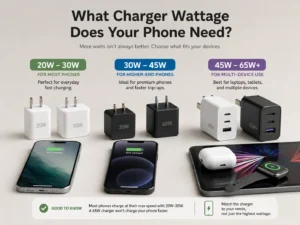
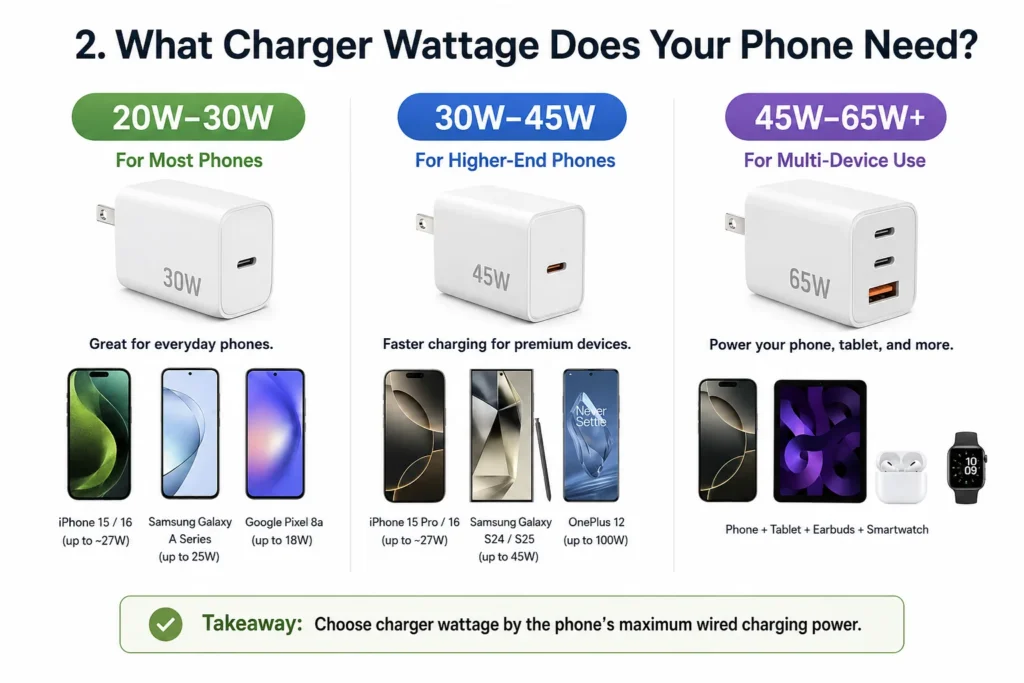
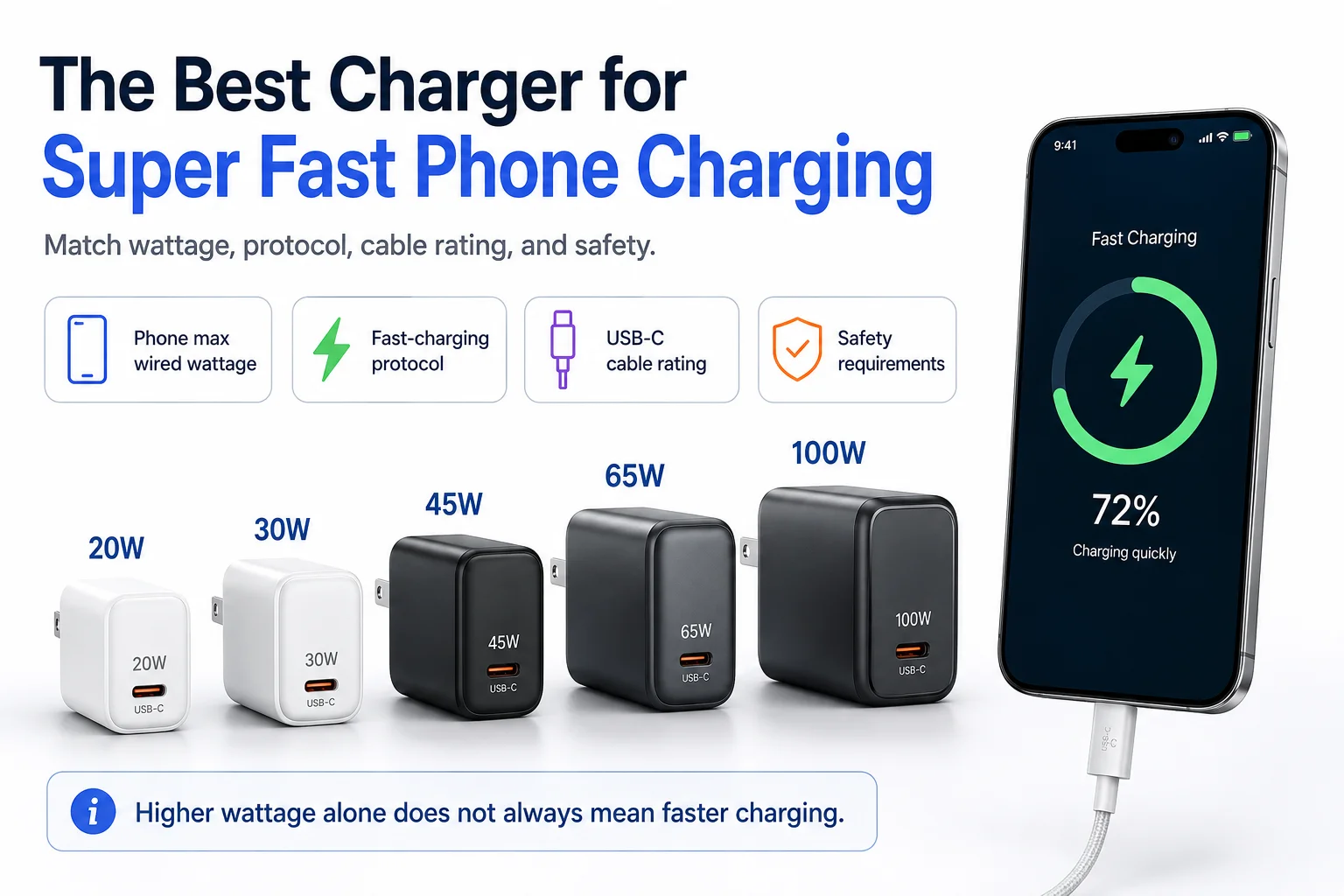
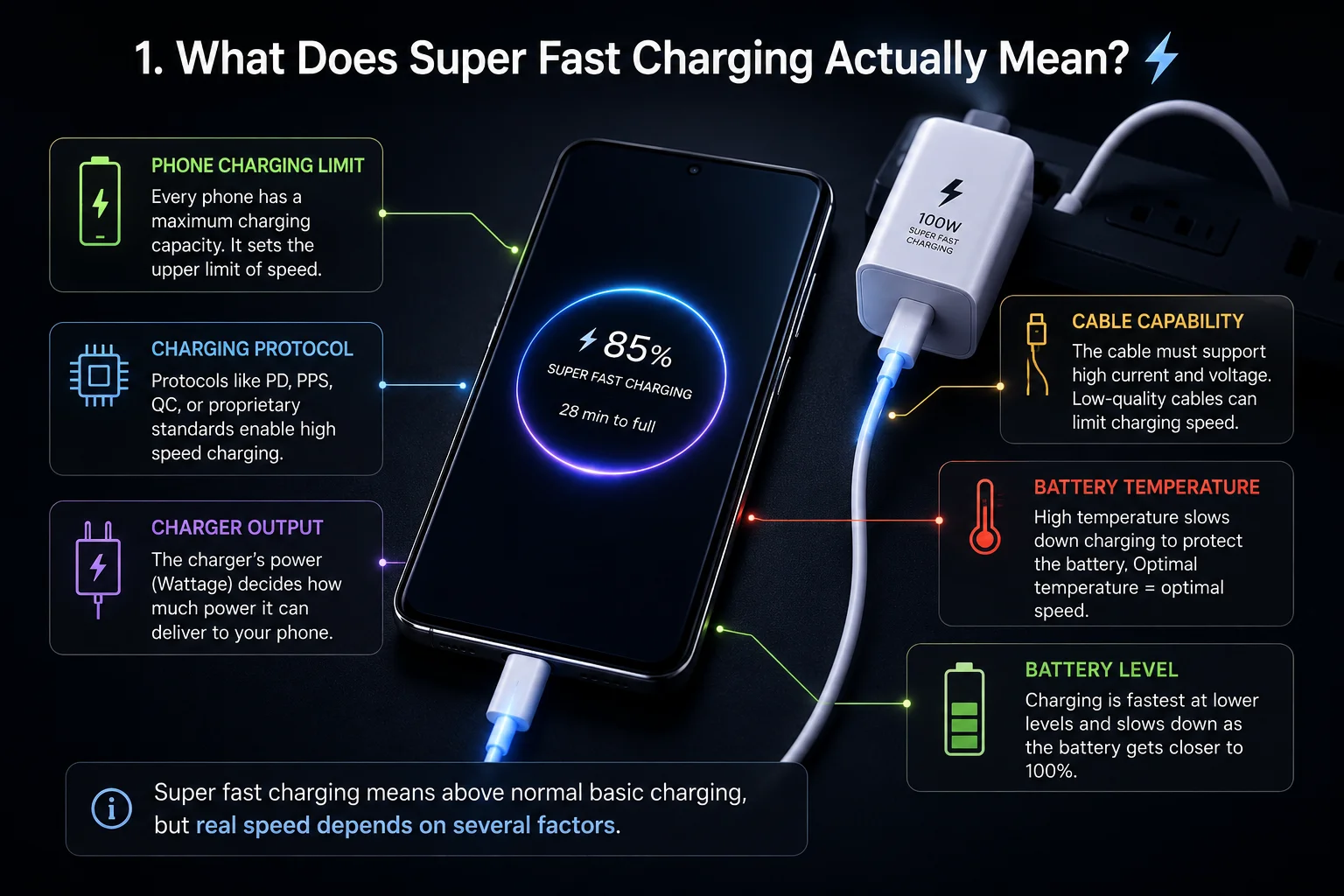
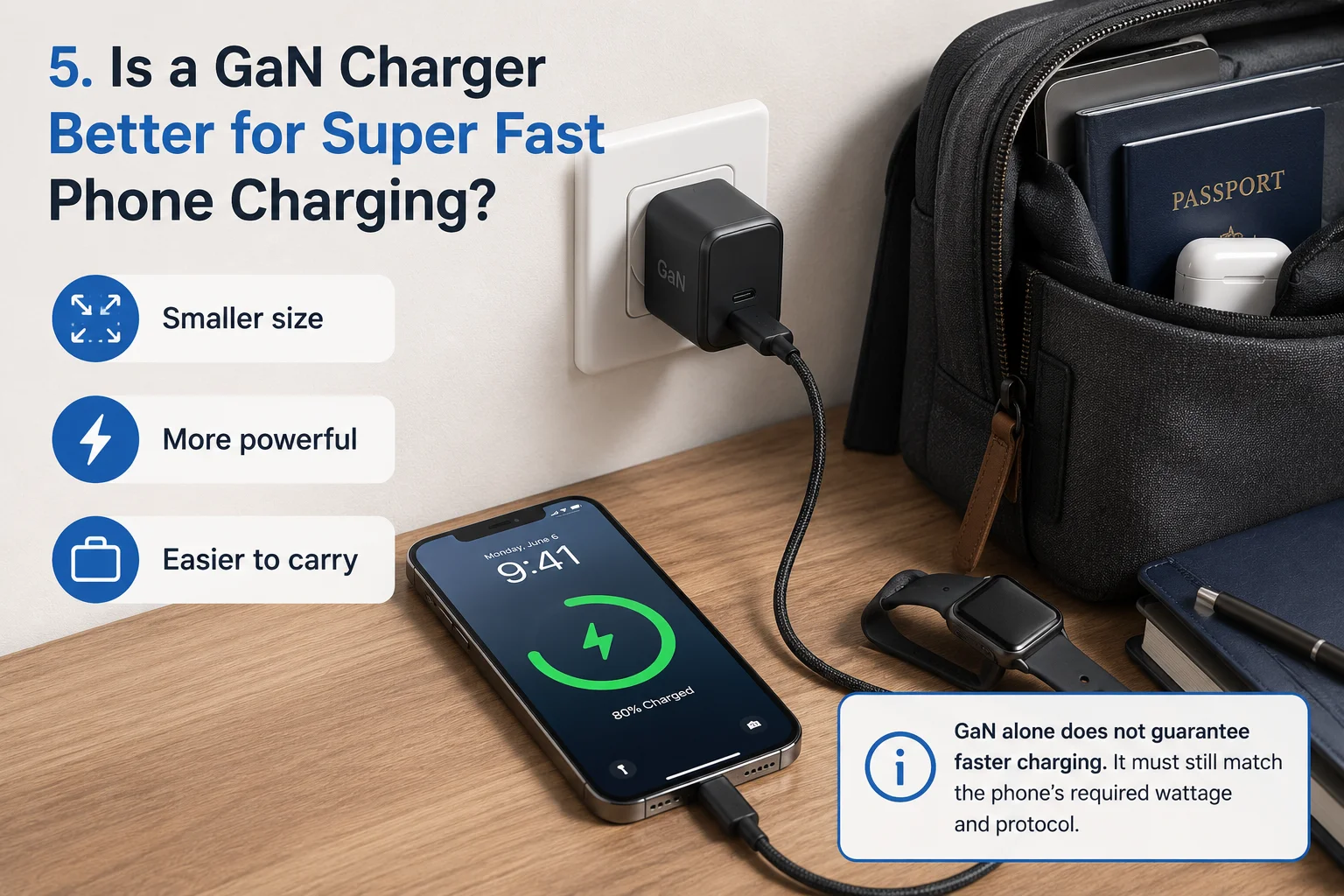
GaN chargers can provide higher power from a smaller body. Charging speed still depends on the device limit, charger wattage, USB-C PD, PPS, cable capability, battery temperature, charge level, and supported protocols.
GaN does not break device limits
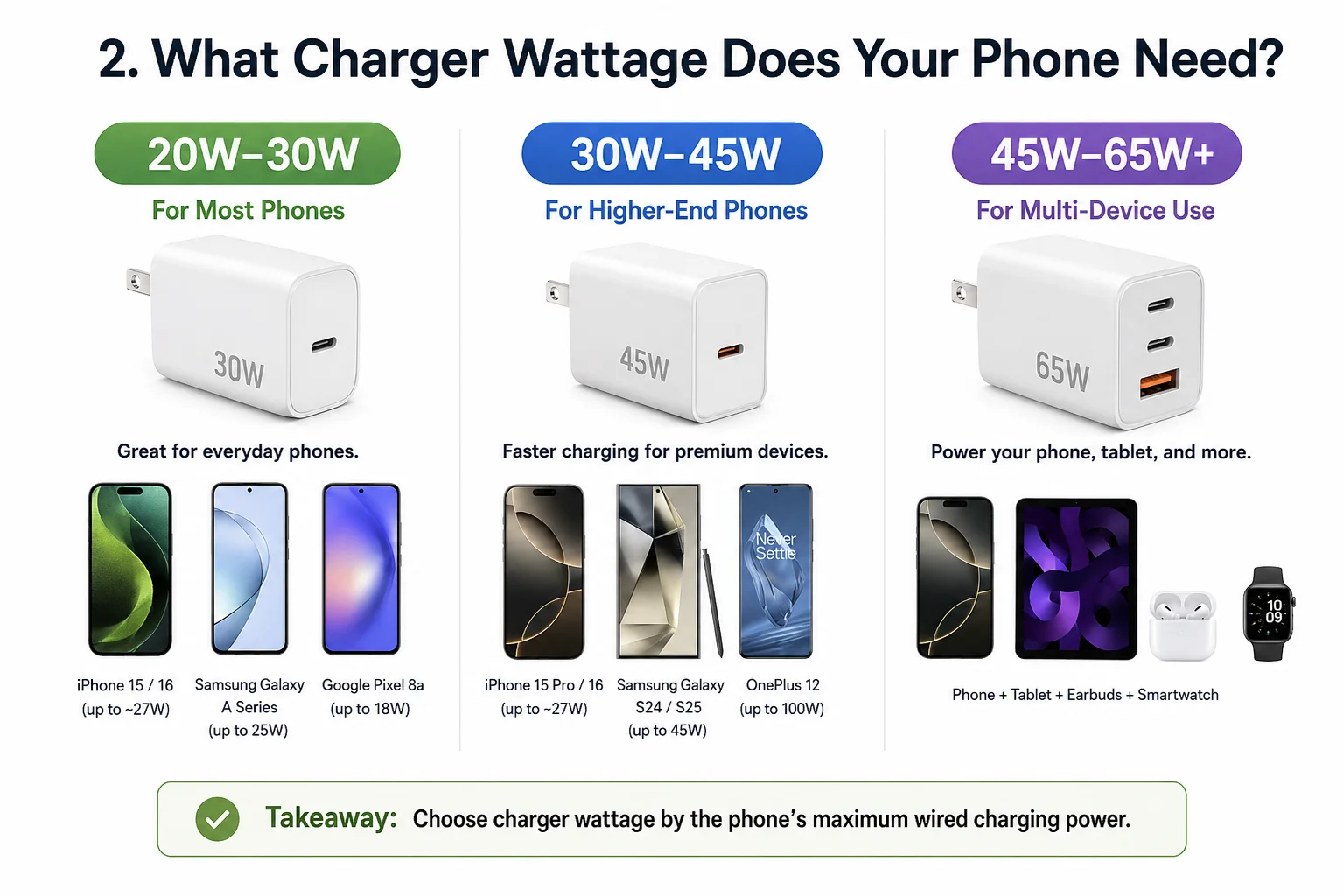
A phone or laptop has its own maximum charging power. If a phone supports 25W, a 65W GaN charger will not force it to charge at 65W. The device and charger negotiate a safe power level.9 The cable also matters.
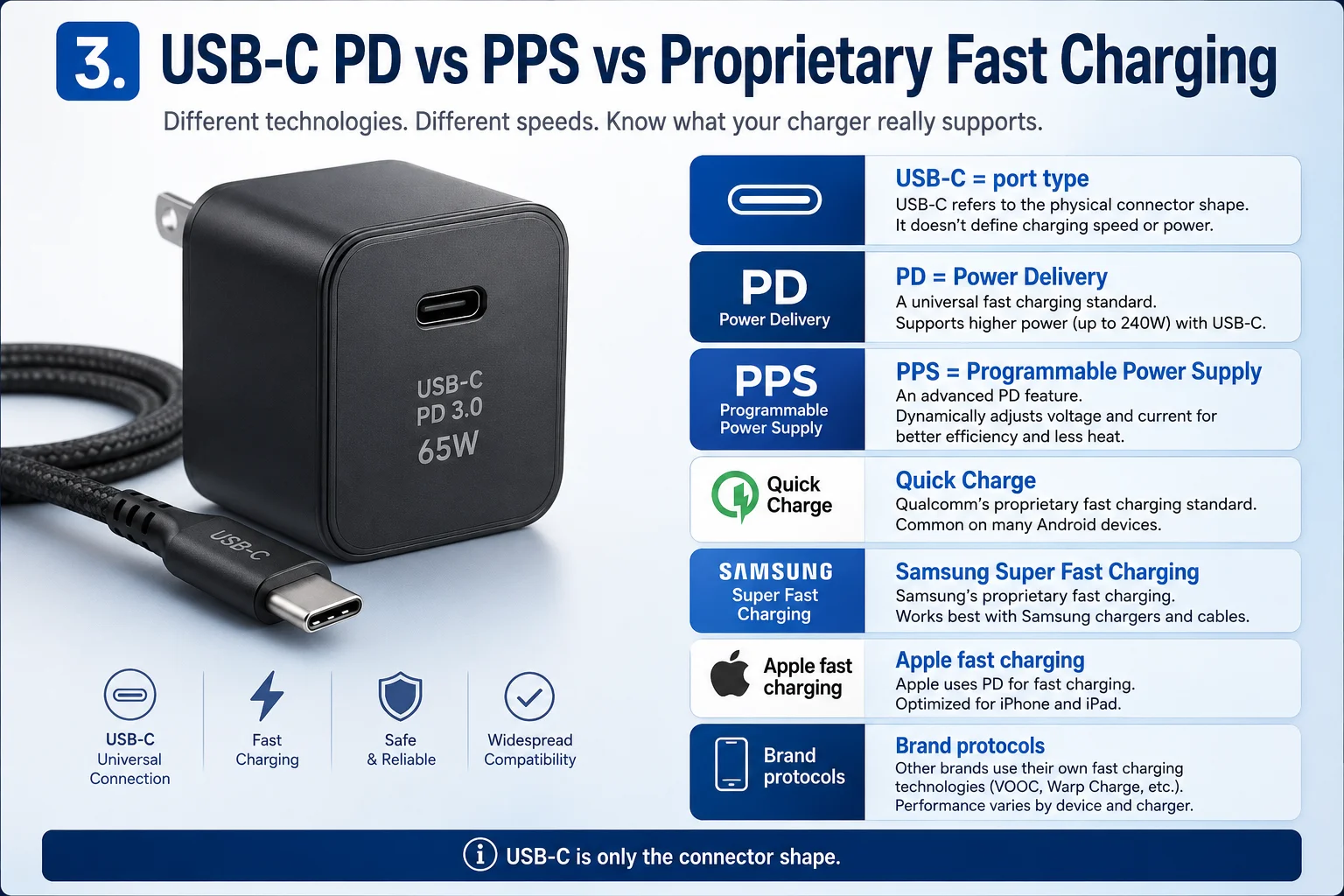
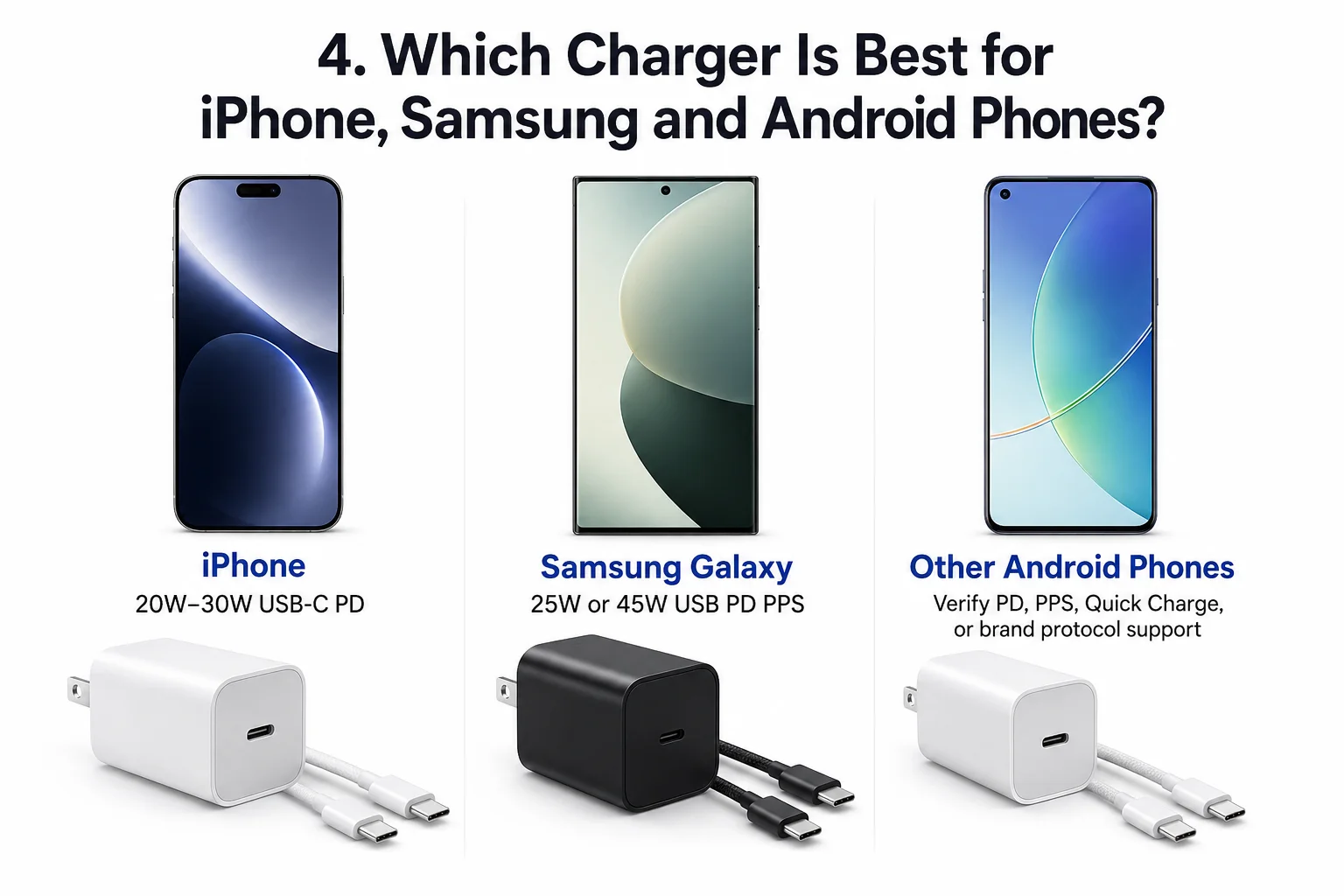
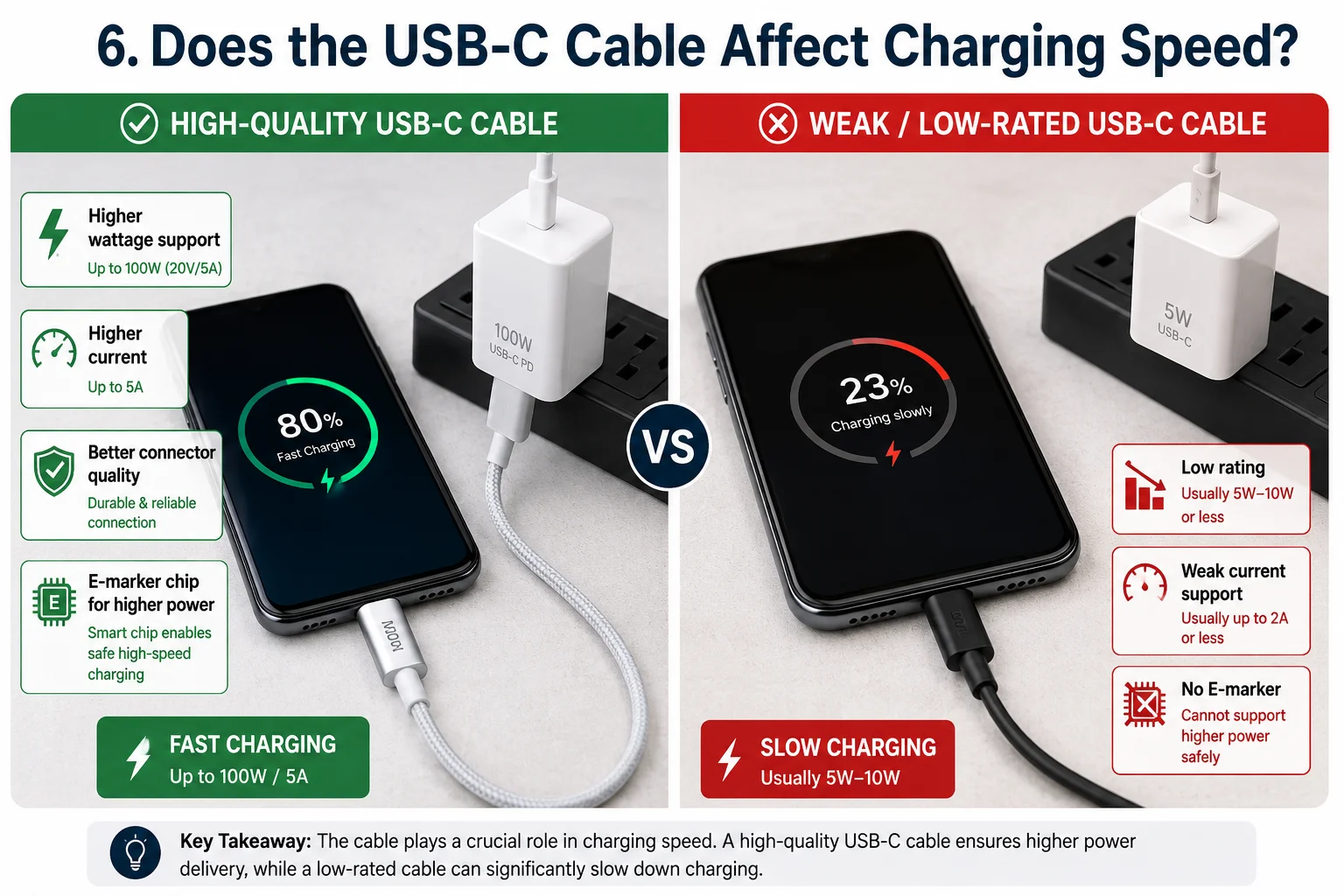
USB-C Power Delivery is important for many laptops, tablets, and phones. PPS is important for some phones that need more flexible voltage control.10 QC and other protocols may matter for certain Android devices and older accessories. A charger can be GaN and still fail to support the protocol that your customers need.
| Charging Factor | What Buyers Should Check |
|---|---|
| Device charging limit | Maximum wattage accepted by the device |
| Charger output wattage | Power available per port and total output |
| USB-C PD support | Important for many modern devices |
| PPS compatibility | Important for some fast-charging phones |
| Proprietary protocols | Needed for certain brands or models |
| Cable capability | Cable must support the required current and power11 |
| Battery status | Speed changes when battery is hot or nearly full |
Faster charging needs a matching set
I often tell ecommerce sellers to show realistic compatibility information. A simple “65W fast charger” title is not enough. The listing should explain which port gives 65W, whether that happens with one device only, and what happens when two or three ports are used at the same time.
For B2B selection, the best charger is not always the one with the highest wattage on the box. The best charger is the one that matches the most common devices in the buyer’s market, with clear claims and low return risk. This is especially important for chain stores and wholesalers because one unclear claim can create many support tickets.
6. Why Are GaN Chargers Better for Multiple Devices?
Modern customers carry more devices than before. A phone charger alone is not enough for many desks, travel bags, and home offices.
GaN technology is useful in multi-port high-power chargers because it can support higher total output in a compact body. It works well for phones, tablets, laptops, and accessories when power distribution is clear.
Multi-port charging is where GaN often shines
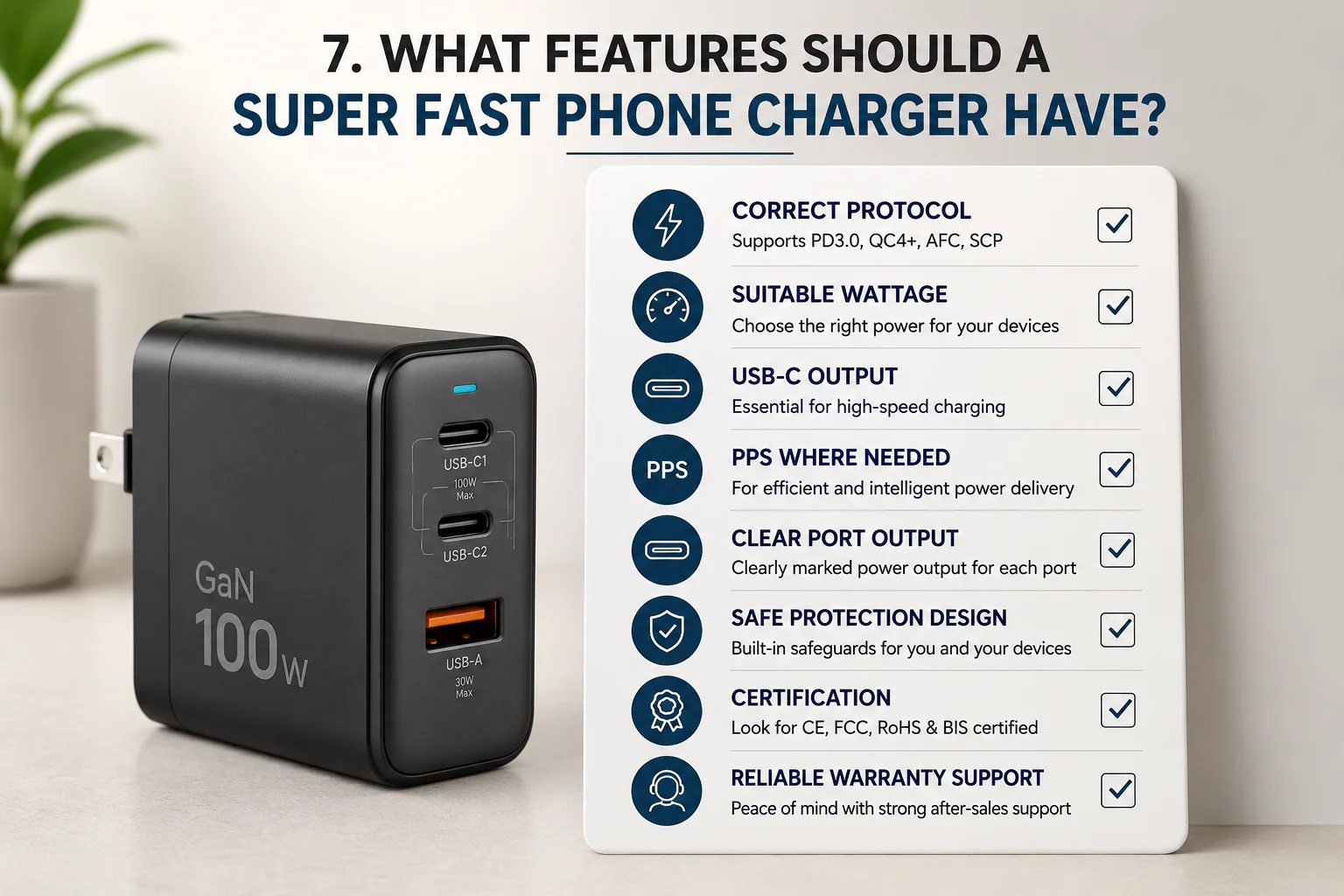
A common GaN charger may include two USB-C ports, or two USB-C ports plus one USB-A port. This layout can serve a laptop, phone, and earbuds at the same time. The compact body makes the product easy to sell as a travel and desk organization solution.
The key detail is power distribution. A box may say “65W total output.” That does not mean every port gives 65W at the same time.12 One USB-C port may give 65W when used alone. It may drop to 45W when a second port is used. The USB-A port may share power with one USB-C port.
| Port Use Case | What the Buyer Must Know |
|---|---|
| One USB-C device | Maximum single-port output |
| Two USB-C devices | Split between C1 and C2 |
| USB-C plus USB-A | Whether USB-A reduces USB-C power |
| Three devices | Total split and priority rules |
| Laptop plus phone | Whether laptop still gets enough power |
| Travel use | Plug type, size, and cable bundle |
Power rules should be easy to explain
For retail and ecommerce, a good power table on the package or listing helps reduce confusion. It should show the output for each port combination. It should not hide the real split behind a big total wattage number.
In our export work, multi-port GaN models often get strong interest from buyers who sell to office users, travelers, students, and remote workers. The value is clear. One charger can replace two or three adapters. The risk is also clear. If the power rules are confusing, customers may think the product is defective when it is only following its designed distribution logic.
7. Are There Any Disadvantages to GaN Chargers?
A trendy label can hide real product risk. If a buyer trusts only the word “GaN,” they may miss cost, safety, and compatibility issues.
GaN chargers can cost more than silicon chargers. Quality varies by manufacturer. Some models have complex power rules, no cable, limited protocol support, warm operation, or weak certification. “GaN” does not replace safety testing and after-sales support.
GaN has limits in real buying
The first issue is price. GaN chargers usually sit above basic silicon chargers. This is not always a problem. It becomes a problem when the target customer only wants the lowest price for simple phone charging.
The second issue is quality difference. Two chargers may both say GaN and 65W. One may use better components and clearer power rules. The other may have weak thermal design, poor packaging, or unclear certification. The finished product matters more than the material name.
| Possible Disadvantage | Buyer Action |
|---|---|
| Higher purchase price | Match it with premium positioning |
| Manufacturer quality gap | Check supplier history and samples |
| Complex power distribution | Ask for a clear power table |
| No cable included | Decide bundle or no-bundle strategy |
| Protocol gaps | Confirm PD, PPS, QC, and target device needs |
| Small body warmth | Review thermal design and claims |
| Uncertified products | Avoid safety and channel risk |
Certification and support are part of the product
For importers and chain buyers, certification is not a small detail. It affects market access, platform approval, customs questions, and retailer confidence. A low-cost uncertified charger can create much higher cost later.
After-sales support also matters. If a customer reports slow charging, the reason may be cable quality, device limit, port selection, or protocol mismatch. A good supplier should help explain these points and provide stable batches. I prefer to work with suppliers that can provide clear specifications, consistent packaging, and realistic lead times. This helps buyers avoid returns and slow-moving stock.
8. Should You Buy a GaN or Silicon Charger?
A wrong charger choice can lock cash in slow inventory. A good choice can create a clear upgrade SKU with better customer value.
Choose GaN for travel, laptops, multiple devices, and high power in a small size. Choose a basic silicon charger for simple low-power charging. Always compare protocol support, certification, warranty, seller reliability, and wattage match.
Match the charger to the selling scenario
If your customer only needs a basic phone charger at a low price, silicon may still be a smart choice. It is mature, cost-friendly, and easy to position. If your customer wants one compact charger for a phone, tablet, and laptop, GaN is usually easier to sell as an upgrade.
For many European and US retail and ecommerce SKUs, I see strong value around 65W GaN multi-port chargers. They are small enough for travel. They are powerful enough for many laptops and tablets. They also have a clear story for product photos and online listings.
| Buying Scenario | Better Direction |
|---|---|
| Low-cost phone charging | Basic silicon charger |
| Travel charger | GaN charger |
| Laptop and phone charging | GaN charger |
| Premium ecommerce SKU | GaN charger |
| Simple accessory bundle | Silicon or entry-level GaN |
| Multi-device desk setup | Multi-port GaN charger |
| Strict price competition | Compare silicon and GaN cost carefully |
Check the details before you choose
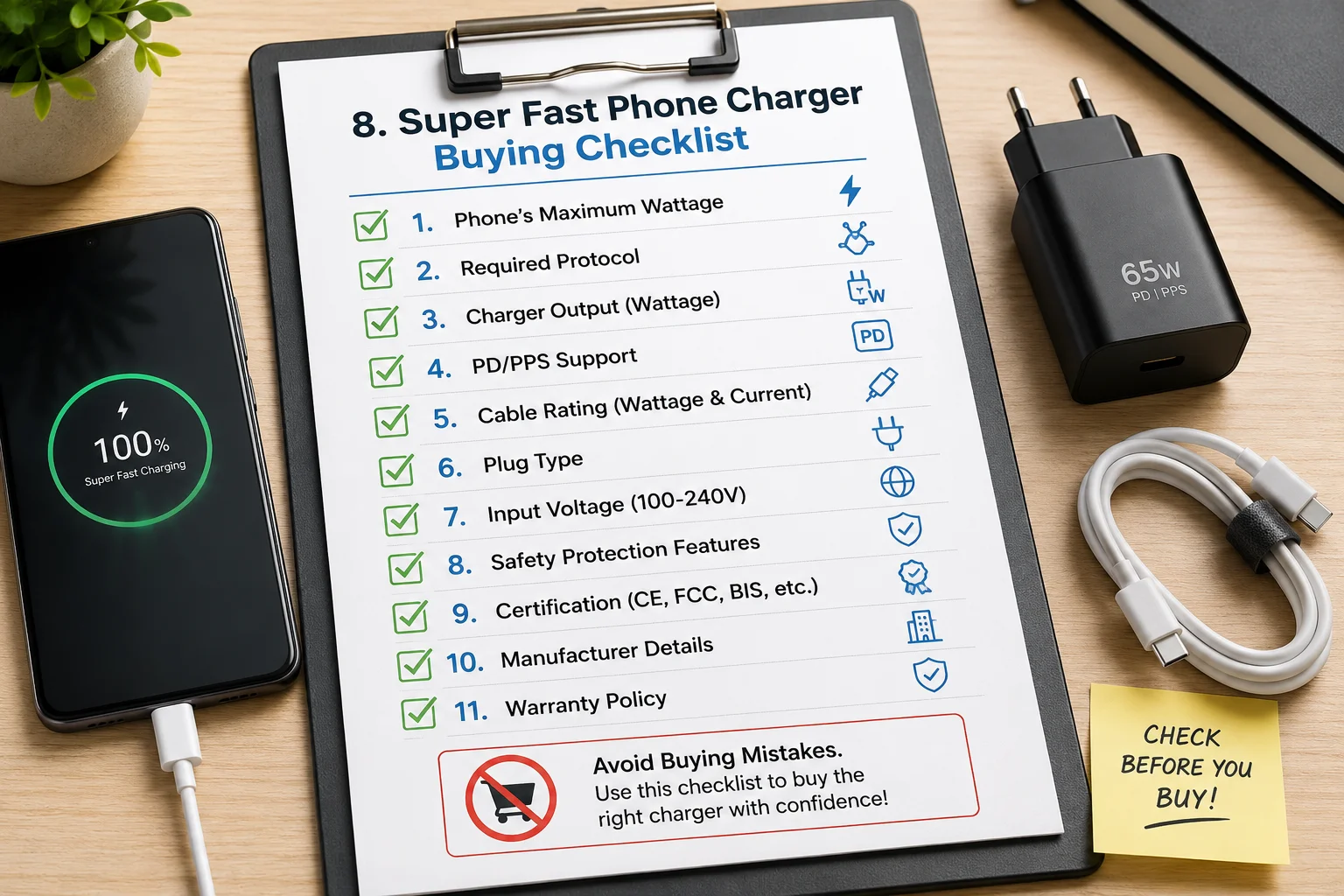
I would not choose a charger by material alone. I would first list the target devices, target price, sales channel, certification needs, and package plan. I would then compare wattage, port layout, PD/PPS/QC support, cable needs, plug type, MOQ, lead time, and warranty terms.
A good GaN charger can be better in size, power density, and multi-device use. A good silicon charger can still be better for basic low-power categories. The final answer depends on market fit.
If you are building a charger line, I suggest starting with the real use case. Ask what your customers charge every day. Ask if they need laptop power. Ask if they want travel size. Ask what certification your sales channel requires. Then choose the material and model after those answers are clear.
Conclusion
Quality GaN chargers are strong for compact high-power use, but design matters more than the GaN label. Ask us to match wattage, ports, and certifications.
"Indium gallium nitride - Wikipedia", https://en.wikipedia.org/wiki/Indium_gallium_nitride. A technical review of wide-bandgap power electronics identifies gallium nitride as a semiconductor material used for power conversion devices and discusses its comparison with conventional silicon devices. Evidence role: definition; source type: paper. Supports: A source should explain that gallium nitride is used as a wide-bandgap semiconductor in power electronics and contrast it with silicon power devices.. Scope note: This supports the material distinction at the component-technology level; it does not verify the internal design of any specific charger SKU. ↩
"USB hardware - Wikipedia", https://en.wikipedia.org/wiki/USB_hardware. USB-IF materials describe USB Power Delivery as a specification for power negotiation over USB connections, supporting the distinction between charging protocols and the semiconductor material used inside a power adapter. Evidence role: definition; source type: institution. Supports: A source should define USB Power Delivery as a charging/power negotiation specification, distinct from semiconductor materials such as GaN.. Scope note: The source would define USB-PD directly and only contextualize GaN by contrast; it would not assess every proprietary fast-charging protocol. ↩
"GaN (on Si)-Based High Voltage and High Switching Frequency ...", https://www.academia.edu/125044523/GaN_on_Si_Based_High_Voltage_and_High_Switching_Frequency_Lateral_Power_Semiconductor_Device. Peer-reviewed power-electronics literature reports that GaN power devices can support high-frequency switching because of their material and device characteristics, which is one basis for their use in compact power converters. Evidence role: mechanism; source type: paper. Supports: A peer-reviewed source should explain the high-speed switching characteristics of GaN power devices compared with silicon devices.. Scope note: The evidence supports the device-level mechanism; actual operating frequency in a charger depends on its circuit topology and controller design. ↩
"High-frequency Power Conversion for Medium Voltage Power ...", https://vtechworks.lib.vt.edu/items/cf5fdf47-67c1-4d0d-89b7-5ad9761764b9. Power-electronics teaching and review materials explain that higher switching frequencies can reduce the required size of magnetic components, helping increase converter power density when losses and thermal design are controlled. Evidence role: mechanism; source type: education. Supports: A source should explain that increasing switching frequency in switch-mode power supplies can reduce magnetic component size and contribute to higher power density.. Scope note: This is a general converter-design principle and does not prove that every GaN charger will be smaller. ↩
"Making the new silicon | MIT Energy Initiative", https://energy.mit.edu/news/making-the-new-silicon/. Reviews of GaN power electronics associate GaN devices with higher power-density converter designs, providing technical support for the possibility of smaller adapters at comparable power ratings. Evidence role: general_support; source type: paper. Supports: A source should support that GaN power devices enable higher power-density power supplies, making smaller form factors feasible at comparable output power.. Scope note: The support is contextual because finished charger size also depends on enclosure, thermal limits, safety spacing, and manufacturer design choices. ↩
"Power Conversion: Silicon Versus Wide-Bandgap Semiconductors", http://large.stanford.edu/courses/2024/ph240/kim1/. Peer-reviewed reviews of GaN power devices describe reduced switching losses and high-frequency capability as reasons GaN can improve converter efficiency in appropriate designs. Evidence role: mechanism; source type: paper. Supports: A source should explain that GaN devices can reduce switching losses compared with conventional silicon devices in suitable converter designs.. Scope note: The evidence supports potential efficiency advantages, not a guarantee that a particular commercial charger outperforms a silicon alternative. ↩
"External Power Supplies - Department of Energy", https://www.energy.gov/cmei/buildings/external-power-supplies. Government test procedures for external power supplies measure efficiency under defined loading conditions, illustrating that adapter efficiency is a system-level result affected by load and design parameters. Evidence role: general_support; source type: government. Supports: A source should show that external power supply efficiency varies by operating condition, load, and design rather than by one component alone.. Scope note: This supports the need for measured system efficiency; it does not isolate the contribution of GaN devices. ↩
"Switched-mode power supply - Wikipedia", https://en.wikipedia.org/wiki/Switched-mode_power_supply. Educational power-electronics sources explain that non-ideal power conversion produces losses, and those losses are dissipated as heat in the power supply. Evidence role: mechanism; source type: education. Supports: A source should explain that power conversion losses are dissipated as heat in power supplies.. Scope note: This supports the general heat mechanism and does not establish safe surface-temperature limits for any specific charger. ↩
"[PDF] USB PD Power Negotiations - Texas Instruments", https://www.ti.com/lit/an/slva842/slva842.pdf. USB-IF documentation describes USB Power Delivery as a negotiated power system in which source and sink capabilities are exchanged to select supported power levels. Evidence role: mechanism; source type: institution. Supports: A source should describe USB Power Delivery negotiation between a power source and sink to establish supported voltage/current levels.. Scope note: This directly supports USB-PD behavior; non-USB-PD proprietary charging schemes may use different negotiation methods. ↩
"What is the difference between PD and PPS? : r/UsbCHardware", https://www.reddit.com/r/UsbCHardware/comments/12k2063/what_is_the_difference_between_pd_and_pps/. USB Power Delivery documentation defines Programmable Power Supply as a mode that permits finer adjustment of voltage and current, which explains its relevance for devices designed to use PPS-based fast charging. Evidence role: definition; source type: institution. Supports: A source should define PPS as part of USB Power Delivery that permits programmable voltage/current adjustments.. Scope note: The source supports the technical function of PPS; device-by-device PPS requirements require separate manufacturer specifications. ↩
"Do USB-C to USB-C cables need an emarker chip to ... - Reddit", https://www.reddit.com/r/UsbCHardware/comments/13j0gev/do_usbc_to_usbc_cables_need_an_emarker_chip_to/. USB-IF materials on USB Type-C and USB Power Delivery specify cable current and power-rating requirements, supporting the need to match the cable to the intended charging power. Evidence role: mechanism; source type: institution. Supports: A source should explain USB-C cable current/power ratings and the role of electronically marked cables for higher current.. Scope note: This supports standards-based USB-C charging; cable quality and counterfeit labeling remain separate verification issues. ↩
"500W USB C Fast Charger Block, Multi-port USB Charging Station ...", https://www.amazon.com/Charger-Charging-Station-Multiple-Compatible/dp/B0DLK2XXMF. USB Power Delivery documentation describes source power capabilities as negotiated values, which supports the need to distinguish total adapter rating from the power available on each port or port combination. Evidence role: general_support; source type: institution. Supports: A source should support that power supplies and USB-PD sources declare capabilities and that available power can be allocated differently across outputs.. Scope note: The source supports the negotiation and capability framework; the exact 65 W split is product-specific and must come from the charger's specification sheet. ↩