Many buyers ask for “the best GaN charger,” then face returns, bad reviews, and slow-moving stock because the wattage does not match real use.
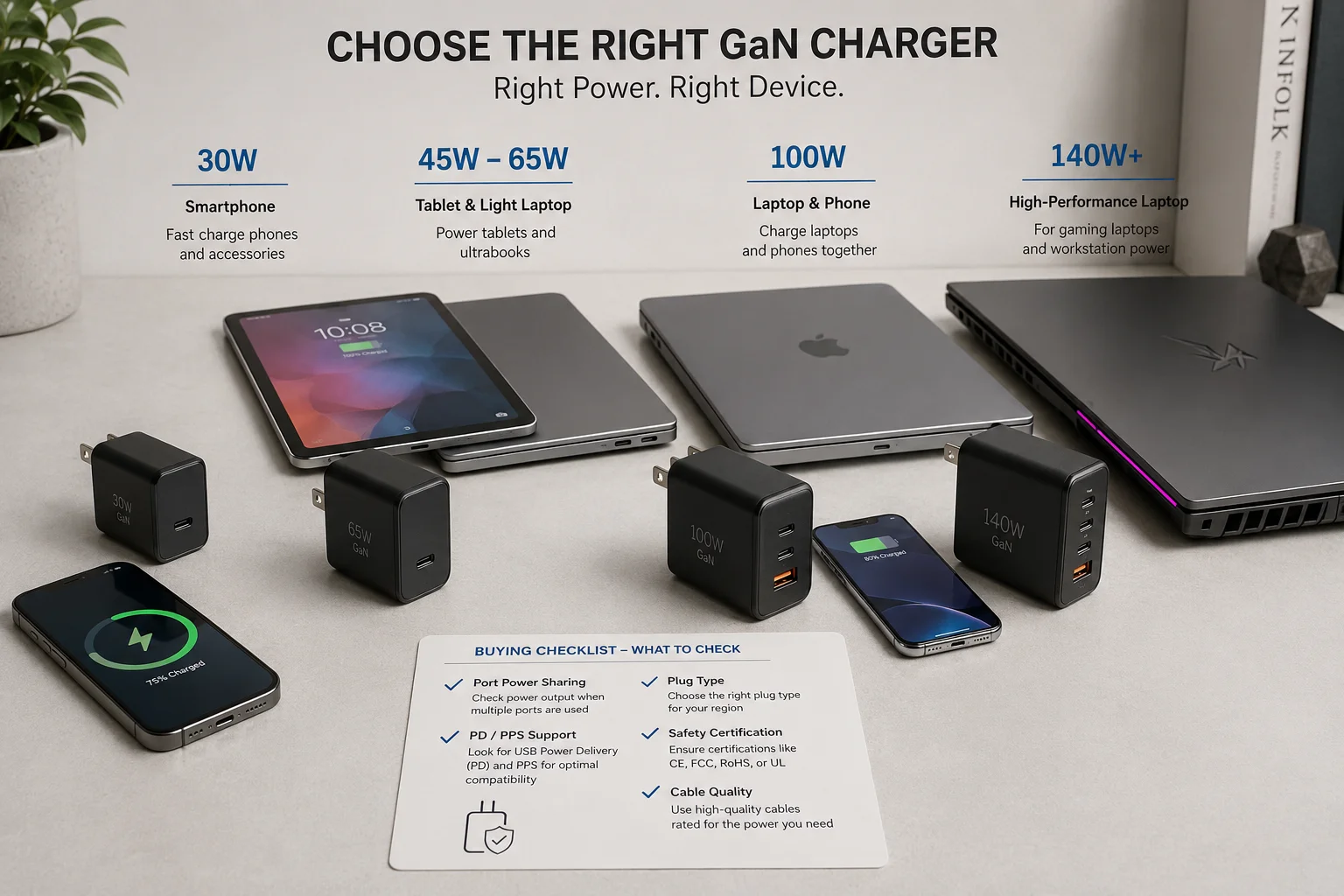
I recommend choosing GaN chargers by device mix and use case. Use 30W for phones, 45W–65W for tablets and light laptops, 100W for laptops and several devices, and 140W+ for high-performance laptops. Always check port power sharing, PD/PPS support, plug type, safety certification, and cable quality.
I have handled many GaN charger inquiries from European and American buyers. Some buyers want one hot model. Some buyers want a full SKU plan for retail shelves or online stores. I usually ask one question first. What devices will your customers charge every day? If we answer that question clearly, the charger choice becomes much easier.
1. What Type of GaN Charger Do You Actually Need?
Many buyers start with wattage, but that can cause a mismatch. A 100W charger is not always better for a phone user.
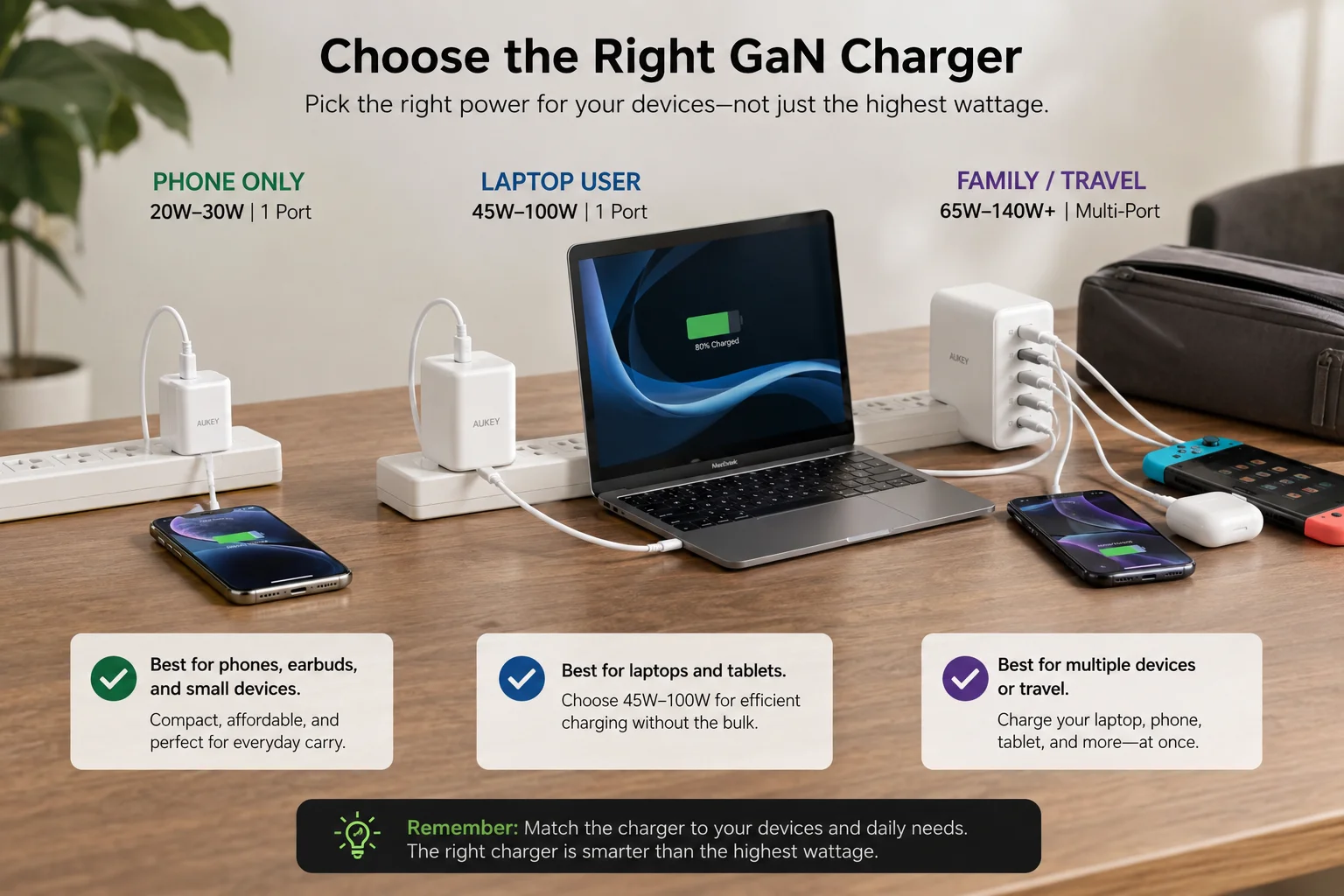
I first divide GaN charger demand by use case. Phone-only users need small power. Laptop users need stable high output. Family and travel users need more ports and better power sharing.
I do not treat GaN as a magic word. I treat it as a design choice. GaN can help a charger become smaller at the same power level.1 It can also help brands build compact multi-port chargers. But the real buying decision still depends on devices, ports, plug standards, certification, heat control, and price.
In buyer inquiries, I often see one common problem. The buyer asks for 65W or 100W, but the target customer only charges phones. In that case, the buyer pays for power that the end user may never use. I also see the opposite problem. Some buyers choose a small charger for laptop users. That can create slow charging, complaints, and returns.
| Use case | Practical wattage range | Main buyer focus |
|---|---|---|
| Phone-only charging | 20W–30W | Small size, price, PD/PPS |
| Phone and tablet charging | 30W–45W | Stable output, compact body |
| Laptop charging | 65W–100W | Single-port max output |
| Multiple-device charging | 65W–140W | Shared power rules |
| International travel | 45W–100W | Wide voltage, plug options |
| Home and office use | 65W–100W | Multi-port convenience |
| Family charging | 100W+ | More ports, safe heat control |
| Business travel | 65W–140W | Compact size, laptop support |
I suggest one simple process. I first confirm the devices. I then confirm the number of ports. I then confirm the highest power needed by one device. After that, I check the plug type, certification, packaging, MOQ, lead time, and after-sales risk. This process is more useful than chasing the highest wattage.
2. Best 30W GaN Chargers for Phones and Tablets?
Some buyers ignore 30W models because they look simple. That can be a mistake when the market needs affordable daily charging.
A 30W GaN charger is best for phones, small tablets, earbuds, and power banks. It fits iPhone, Samsung Galaxy, Google Pixel, iPad, and many USB-C accessories when PD or PPS support is correct.
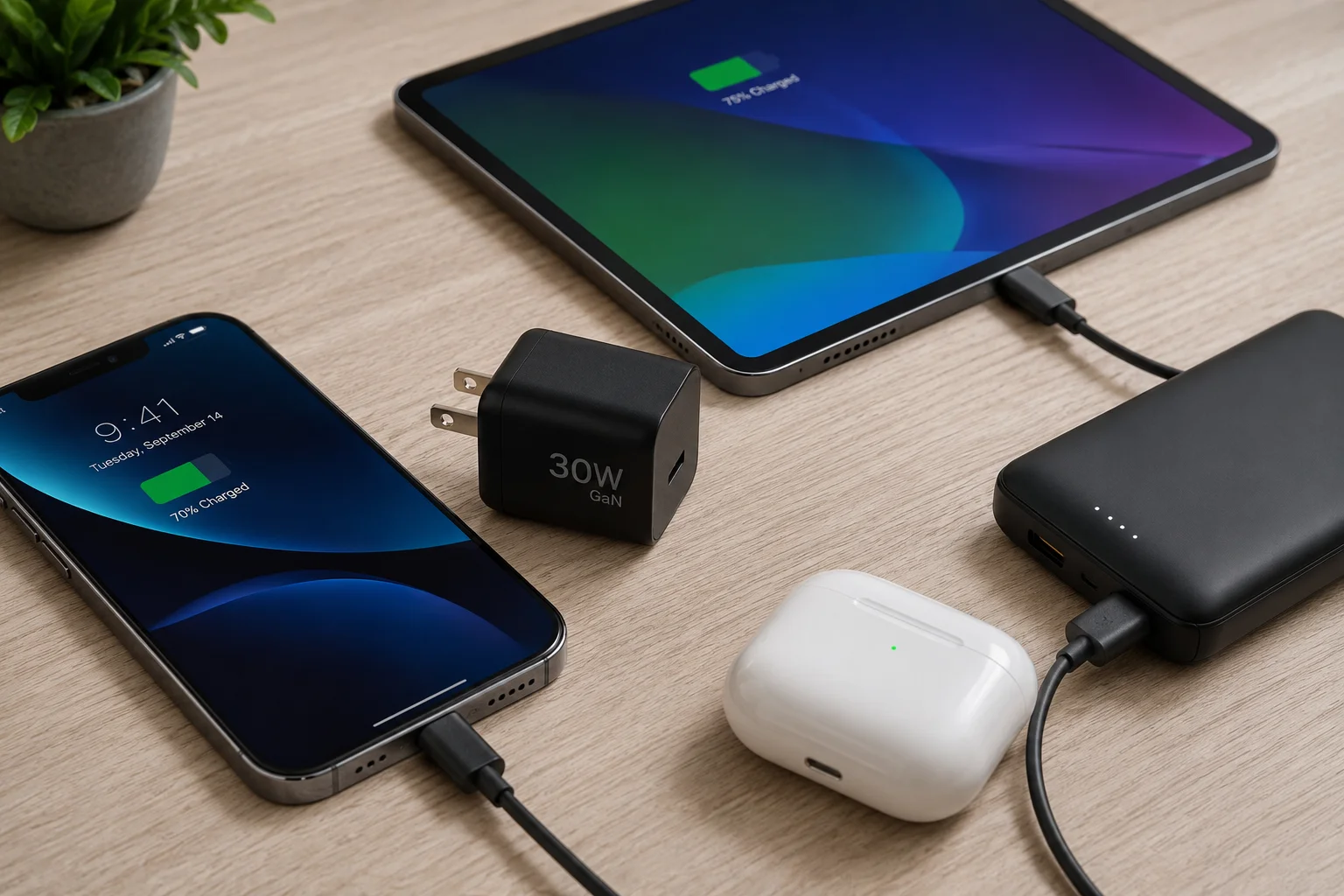
I see 30W GaN chargers as the safe daily seller in many markets. They are small. They are easy to explain. They usually have a friendly price. They also fit the current trend because many phone brands no longer include chargers in the box.2 For retail and ecommerce customers, this creates steady demand.
But I do not choose a 30W charger only by size. I check protocol support first. USB-C PD matters because many iPhone and iPad users expect fast charging through USB-C.3 PPS matters for many Samsung Galaxy users because it can help the phone use better fast-charging behavior.4 I also check temperature control, because small chargers still need a good internal design.
| 30W feature | Why I check it | Business impact |
|---|---|---|
| USB-C PD support | It supports common fast charging | Fewer compatibility complaints |
| PPS compatibility | It helps many Samsung phones | Better Android user experience |
| Foldable plug | It helps travel and storage | Better shelf and online appeal |
| Small body size | It fits daily carry | Easier to market as compact |
| Temperature control | It supports safer daily use | Lower after-sales risk |
| Cable inclusion | It affects final price | Clearer bundle planning |
For B2B buyers, 30W is also useful for volume. It can work as an entry SKU, a bundle item, or a promotion item. I often suggest 30W single-port chargers for phone-focused channels, supermarket chains, convenience stores, and online sellers who need a clear low-risk model. If the target market includes older USB-A cable users, I may also suggest a USB-C plus USB-A version. But I always ask the buyer to keep the message simple. A 30W charger should be sold as compact daily fast charging, not as a laptop charger.
3. Best 45W and 65W GaN Chargers for Everyday Use?
Many users own more than one device now. A small phone charger may work, but it may not cover tablets, laptops, and travel.
I see 45W and 65W GaN chargers as the best everyday range.5 They can charge fast smartphones, tablets, MacBook Air, light USB-C laptops, handheld gaming devices, and two devices in many cases.
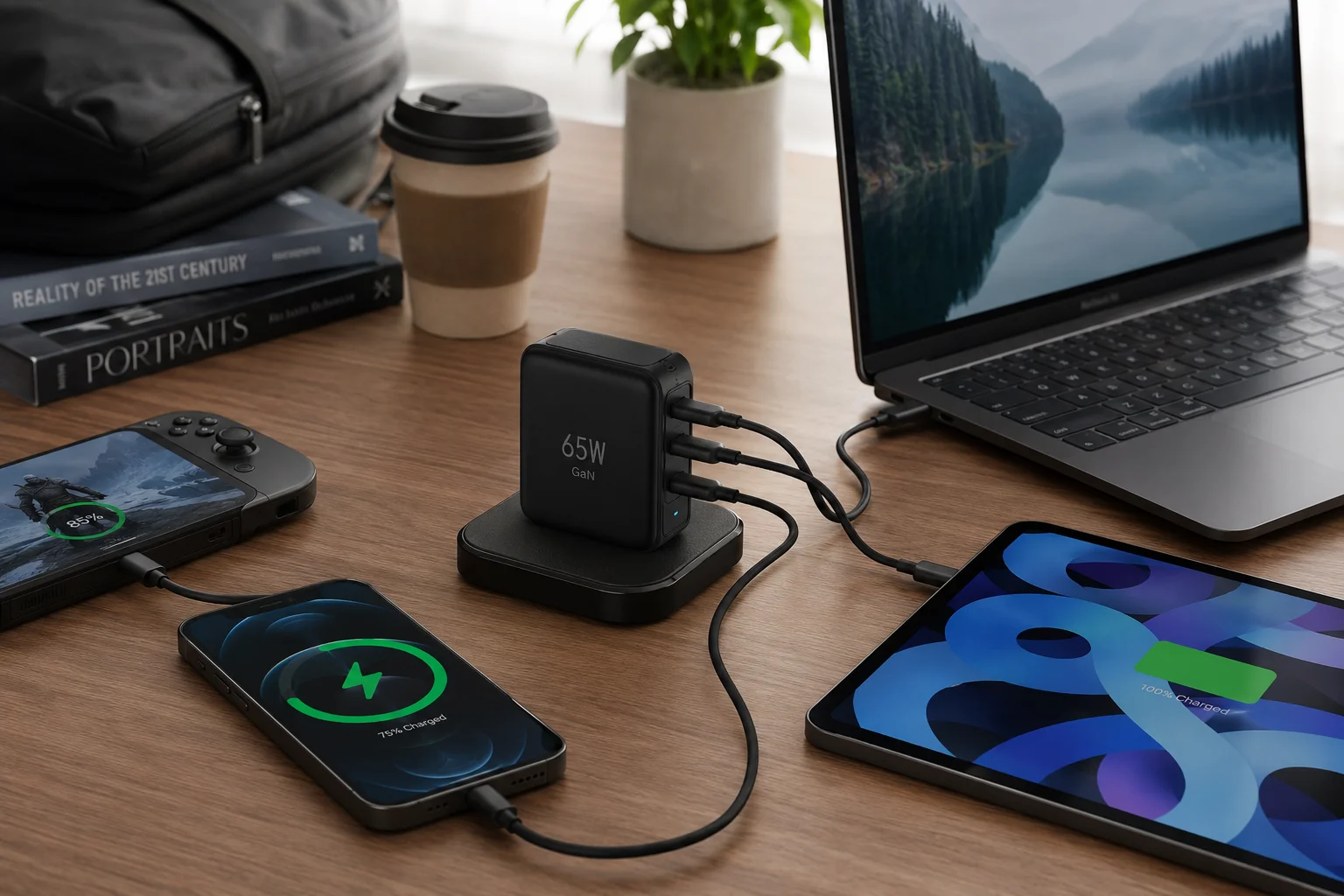
I usually recommend 45W and 65W models when a buyer wants one SKU with broad appeal. These chargers are still compact, but they can serve more devices than 30W. A 45W charger fits many tablets and some lighter laptops. A 65W charger is even more flexible. It can charge a MacBook Air, many Windows ultrabooks, and one phone at the same time if the port design is good.
The key point is power behavior. A 65W charger may give 65W from one USB-C port when only one device is connected. But when two devices are connected, the charger may split power as 45W plus 20W, or 30W plus 30W, or another plan.6 This detail affects real user satisfaction.
| Model type | Single-port use | Two-device use | Good target customer |
|---|---|---|---|
| 45W single USB-C | Phone, tablet, some laptops | Not suitable | Tablet users, travel users |
| 45W dual-port | Phone plus earbuds or phone | Limited power split | Budget multi-device users |
| 65W single USB-C | Light laptop or tablet | Not suitable | Laptop users who want compact size |
| 65W dual-port | Laptop plus phone | Depends on split rule | Business travelers and students |
In retail and ecommerce, 65W dual-port models often perform well because customers understand the value quickly. They can replace a laptop charger and phone charger in one small product. But I also remind buyers not to overpromise. If the product page says “65W fast charging for two devices,” the customer may think each port gives 65W at the same time. That is not true for most compact chargers. Clear power distribution tables in packaging and online listings reduce disputes.
4. Best 100W and 140W GaN Chargers for Laptops and Multiple Devices?
High-wattage chargers look impressive, but they also create higher expectations. A wrong listing can lead to expensive returns and angry laptop users.
I recommend 100W and 140W GaN chargers for MacBook Pro, Windows laptops, laptop-plus-phone setups, creator equipment, and family devices. Buyers must check port limits, shared output, PD 3.1, cable needs, heat control, and port priority.
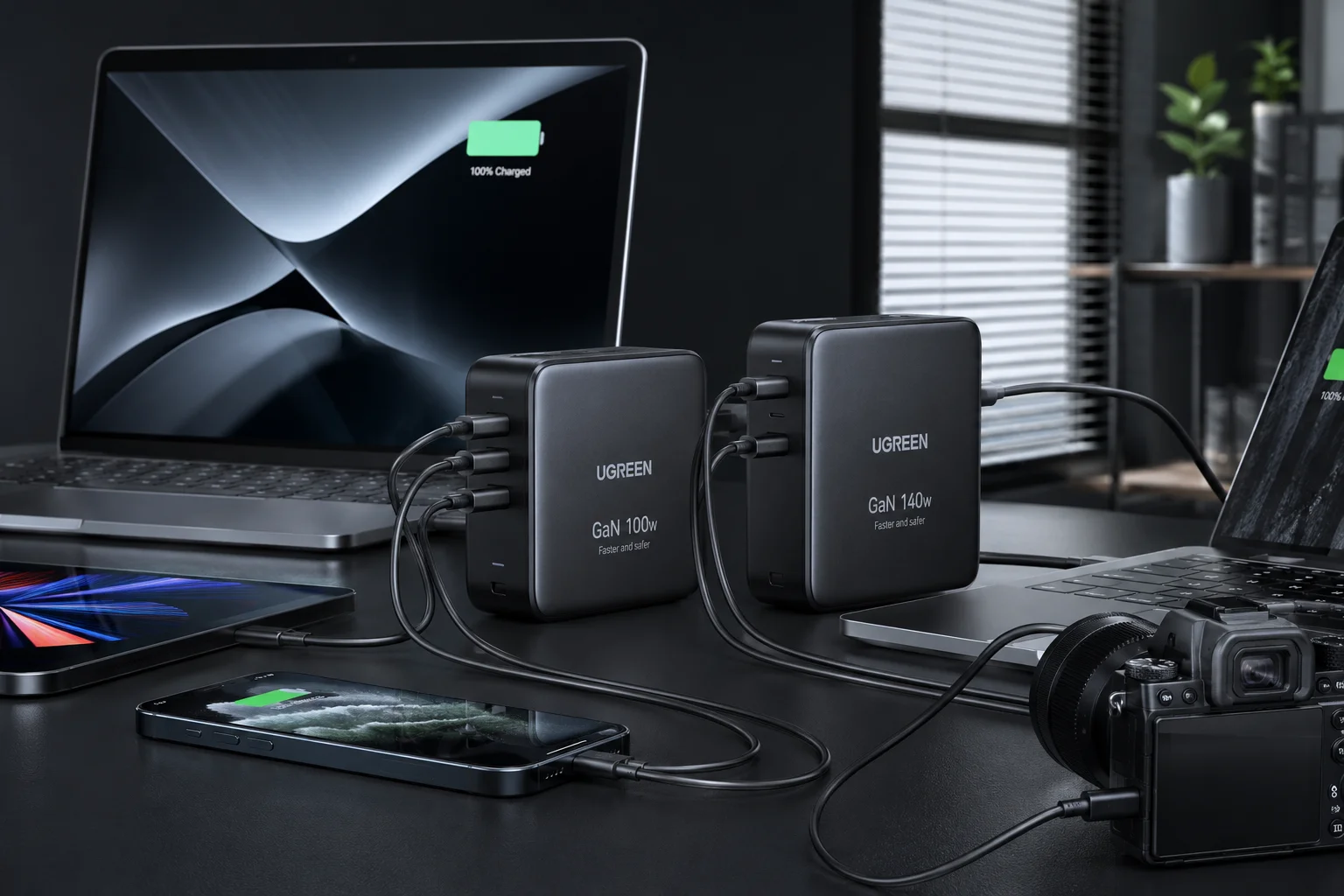
I treat 100W and 140W chargers as serious products. They are not only “bigger phone chargers.” They serve laptop users, business travelers, creators, and households with many devices. These users notice charging speed. They also notice heat, cable quality, and port behavior. A poor match can cause complaints that are harder to solve than phone charger complaints.
For 100W models, I check if one USB-C port can deliver the full 100W when used alone. I also check what happens when a laptop, phone, and tablet are connected together. For 140W models, I check PD 3.1 support because many 140W charging cases need the newer power range.7 I also check whether the cable supports the required current. A low-quality cable can make a high-wattage charger look weak.8
| High-power feature | What I check | Why it matters |
|---|---|---|
| Maximum output per port | 100W or 140W from one USB-C | Laptop charging depends on it |
| Total shared output | Total power across all ports | Multi-device use depends on it |
| USB-C PD 3.1 support | Needed for some 140W use | Avoids wrong product claims |
| E-marker cable | Needed for high current cables | Prevents slow or unsafe charging |
| Heat management | Body heat during heavy use | Reduces customer concern |
| Port priority | Which port gets power first | Avoids confusing user experience |
For B2B buyers, I suggest high-wattage chargers only when the customer base needs them. A MacBook Pro user may value 100W or 140W. A phone-only customer will not. High-wattage models also cost more, need stronger packaging, and may require clearer instructions. If the buyer sells on Amazon or to chain retailers, the listing and user manual must show power distribution in a simple way. This helps reduce “not as described” feedback.
5. Best Multi-Port GaN Chargers for Travel and Families?
Multi-port chargers look easy to sell, but many complaints come from unclear power sharing. Total wattage alone does not tell the full story.
I recommend multi-port GaN chargers for couples, business travelers, families, hotels, and offices. Buyers should check the real output under each port combination, not only the total advertised wattage.
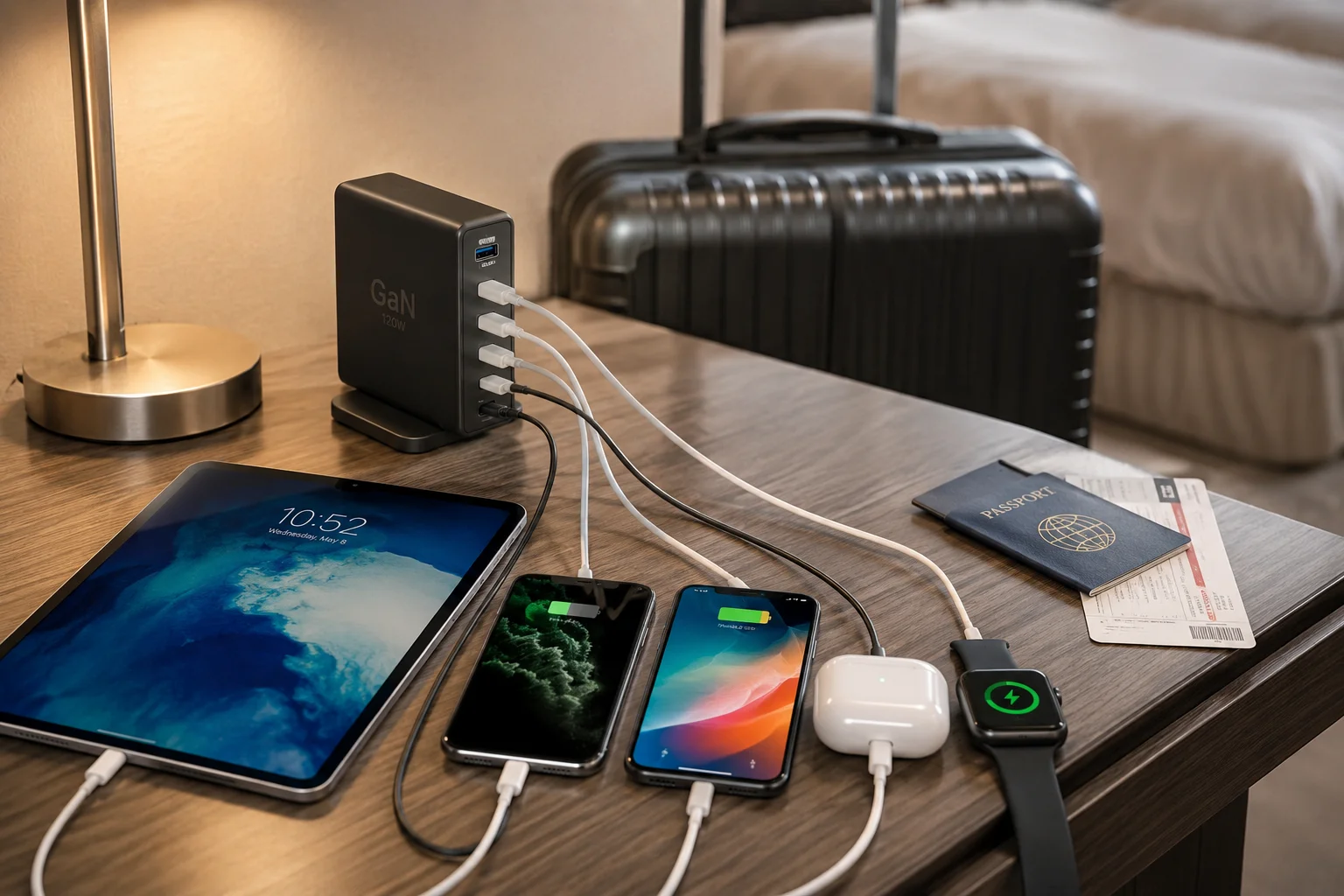
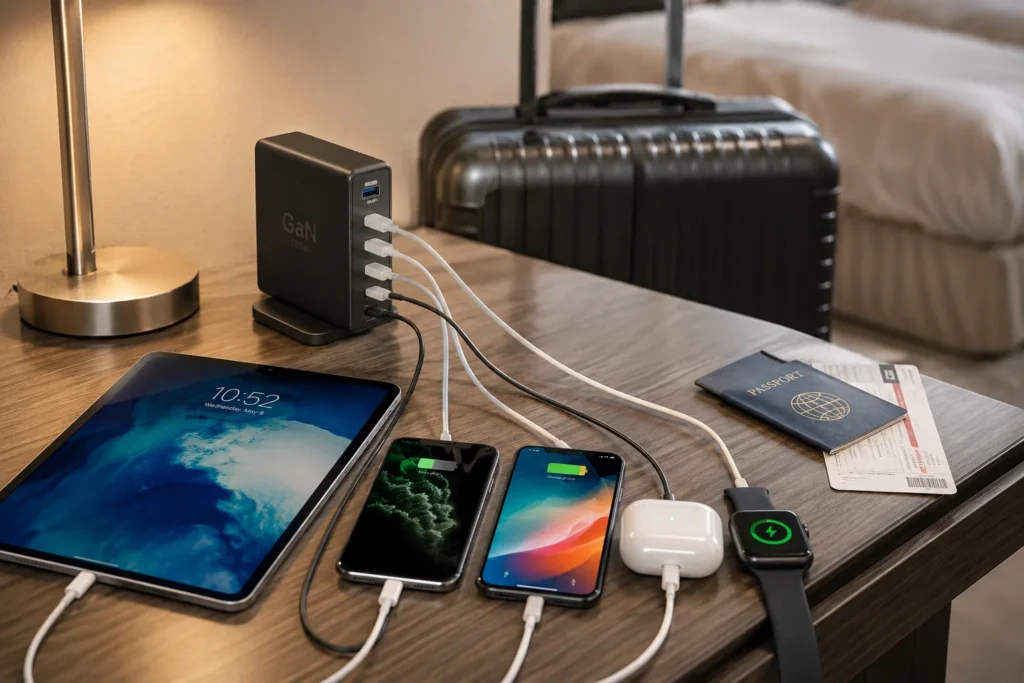
Multi-port GaN chargers are popular because modern users carry many devices. A couple may need two USB-C ports. A family may need three or four ports. A business traveler may need to charge a laptop, phone, earbuds, and power bank at the hotel. A desktop charger can also work well in an office because it reduces messy plugs.
But I always slow down when buyers ask for multi-port models. The reason is simple. A charger may advertise 100W total output, but the user may not get 100W on the laptop when other devices are connected. The charger may reduce the laptop port to 65W, 45W, or lower. This can be normal, but the customer must know it before buying.
| Multi-port layout | Good use case | Risk to explain clearly |
|---|---|---|
| 2 USB-C ports | Couples, two phones, laptop plus phone | Shared output may reduce speed |
| USB-C + USB-A | Older cables and mixed devices | USB-A may support lower power |
| 3-port charger | Business travel | Port priority can confuse users |
| 4-port charger | Families and shared desks | Total power must be enough |
| Desktop charger | Hotels and offices | Cable length and stability matter |
For travel, I check wide-voltage input such as 100–240V.9 I also check plug type. US, EU, UK, and AU plugs matter for different markets. Some buyers prefer replaceable plugs. Some buyers prefer fixed plugs because they feel more stable. For family use, I look at safety certification and heat protection more carefully because the charger may work for many hours.10 For wholesale buyers, I also ask about packaging size, barcode, instruction language, and warranty process. These points look small, but they affect real resale risk.
6. Which GaN Charger Features Matter Most?
A low price can look attractive at first. But missing features can turn one good order into months of after-sales work.
I check USB-C PD, PPS, port count, total wattage, single-port max output, dynamic power distribution, wide-voltage input, plug design, safety certification, heat protection, warranty, and seller reliability before I recommend a GaN charger.
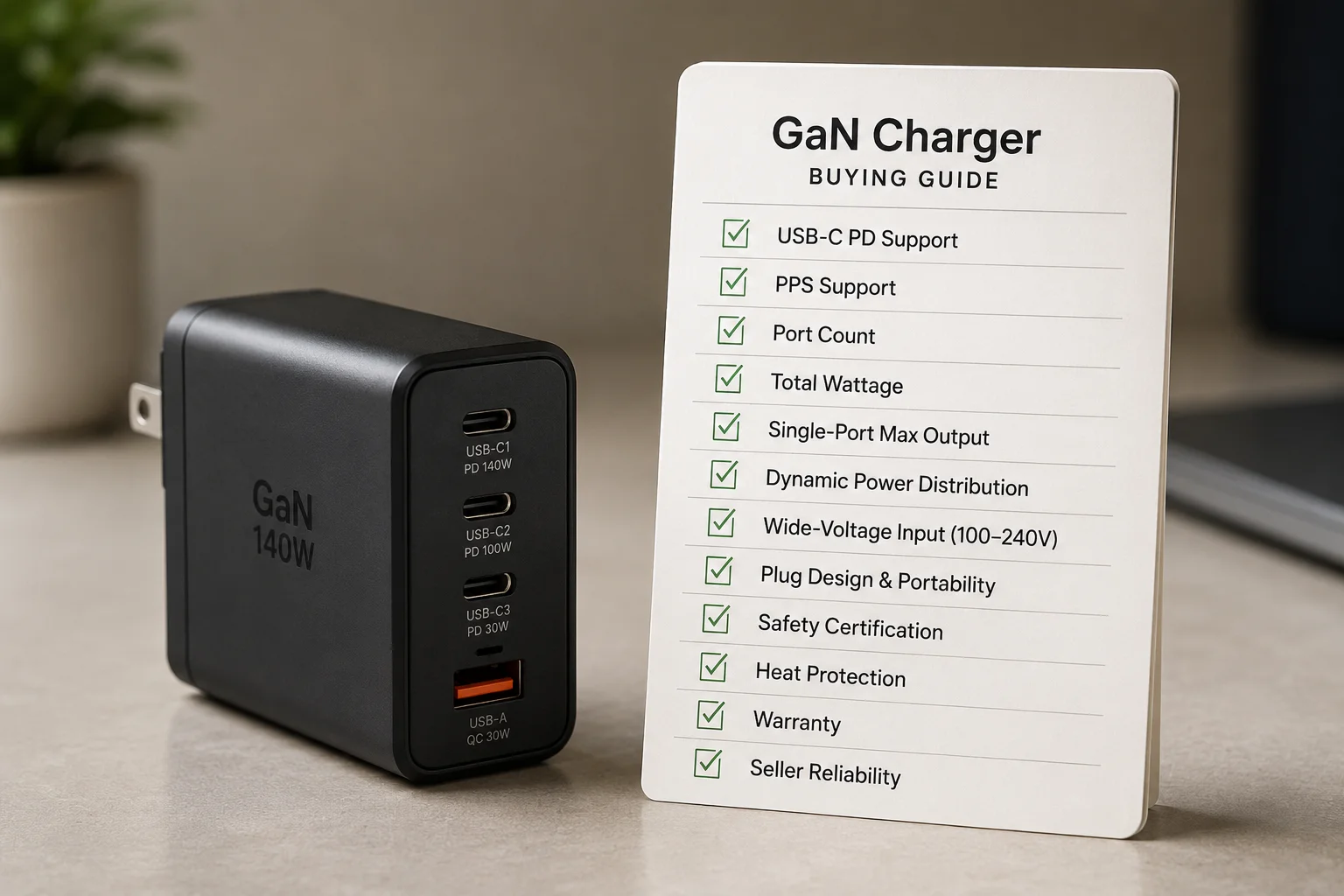
I use a simple feature checklist when I discuss GaN chargers with retailers and importers. I do this because every feature has a selling impact. USB-C PD is important because many mainstream phones, tablets, and laptops use it. PPS is important for some Android fast-charging users. Port count matters because it changes the use case. But more ports are not always better if the power split is weak.
Total output wattage is only one number. I also need to know the single-port maximum output. This tells me whether the charger can really support a laptop. Dynamic power distribution matters because some chargers adjust output based on connected devices. This can be helpful, but it must be explained well.
| Feature | Simple meaning | Buyer impact |
|---|---|---|
| USB-C Power Delivery | Common USB-C fast charging protocol | Better mainstream compatibility |
| PPS support | Adjustable voltage support for some phones | Better Samsung and Android appeal |
| Number of ports | How many devices can connect | Defines the selling scenario |
| Total output wattage | Total power across ports | Helps position the product |
| Single-port maximum output | Highest output from one port | Key for laptop users |
| Dynamic power distribution | Power changes by device mix | Needs clear user instructions |
| Wide-voltage input | Works in many countries | Useful for travel and export |
| Foldable or replaceable plugs | Easier travel or market matching | Better regional SKU planning |
| Safety certifications | Market access and buyer trust | Reduces compliance risk |
| Overheating protection | Helps manage heavy use | Reduces after-sales concern |
| Warranty and seller reliability | Support after sale | Protects long-term business |
For European and American markets, I also pay attention to certification and plug standards. Buyers may ask for CE, UKCA, FCC, ETL, UL-related requirements, or other documents depending on market and channel.11 I do not claim one document solves all legal duties. I always tell buyers to confirm their market requirement with their own compliance team or local consultant. From a trading point of view, clear documents, stable production, and reliable after-sales support are part of the product value.
7. What Should You Avoid When Buying a GaN Charger?
Most buying mistakes do not come from lack of options. They come from reading the product headline and ignoring the details.
I avoid chargers with unclear power distribution, weak certification support, poor cable quality, vague manufacturer details, and unrealistic wattage claims. I also avoid buying power levels that customers cannot use or that laptops cannot rely on.
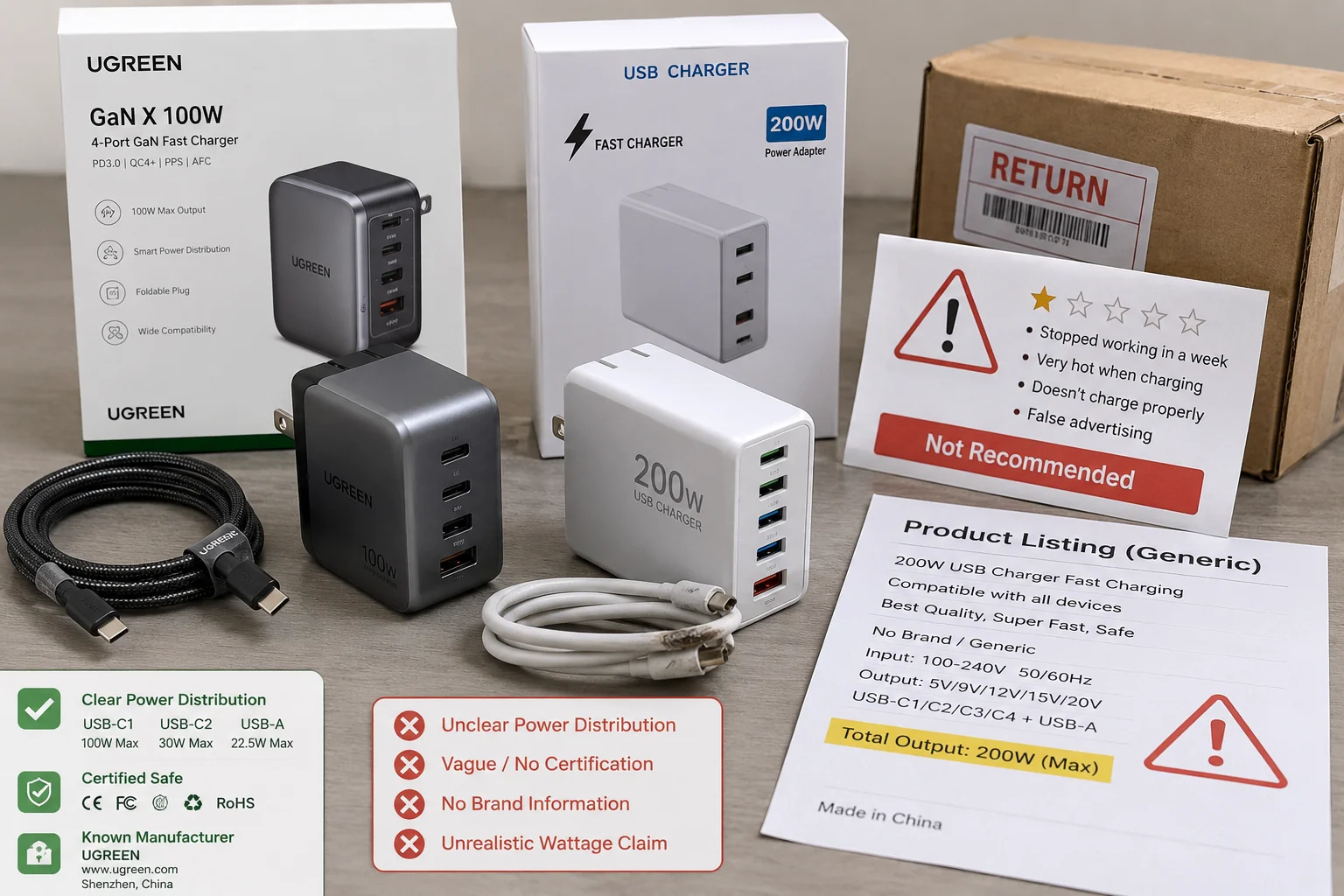
The first mistake is buying only by advertised wattage. A 100W label does not explain what each port can deliver. A customer may plug in a laptop and phone, then find that the laptop charges slower than expected. This creates bad reviews even if the charger is working normally.
The second mistake is ignoring shared power output. Multi-port chargers need a clear output table. I prefer product pages and packaging that show each port combination. This small detail can prevent many disputes.
The third mistake is choosing uncertified or unclear products. Low-cost chargers may look attractive, but they can create market-entry risk for importers and retailers.12 If the seller cannot provide clear company details, test reports, packaging information, and warranty terms, I become careful.
| Mistake | Why it causes problems | Better action |
|---|---|---|
| Buying only by wattage | The headline hides port behavior | Check output by port combination |
| Ignoring shared output | Users expect full power from each port | Show power split clearly |
| Choosing uncertified products | Market risk may increase | Ask for documents early |
| Using poor USB-C cables | Charging speed may drop | Use rated cables |
| Assuming every port gives full power | Most multi-port chargers share power | Explain real output |
| Confusing plug adapters with voltage converters | Travel users may misunderstand use | Check voltage input |
| Buying with unclear manufacturer details | After-sales support may be weak | Verify supplier background |
| Choosing too little power for laptops | Laptop users may complain | Match laptop charging needs |
| Paying for unused wattage | Inventory cost rises | Match customer devices |
I also warn buyers about cables. A high-power charger needs a suitable USB-C cable, especially for 100W and 140W use. If the bundle includes a poor cable, the customer may blame the charger. If the bundle has no cable, the product page should say which cable the user needs. This is important for ecommerce sellers because customers may not understand the difference.
Another mistake is confusing plug adapters with voltage converters. Many GaN chargers support wide-voltage input, but buyers still need to check the label. A plug shape adapter only changes the plug shape. It does not automatically change voltage capability. Clear travel instructions help reduce misuse.
8. GaN Charger Recommendations by Use Case?
A product list is useful, but a buying plan is more useful. Retailers and wholesalers need the right mix, not just one model.
I recommend 30W for one phone, 40W–65W dual USB-C for two phones, 65W dual-port for phone and laptop, 100W–140W for MacBook Pro, wide-voltage multi-port for travel, and 100W+ three-port or four-port chargers for families.
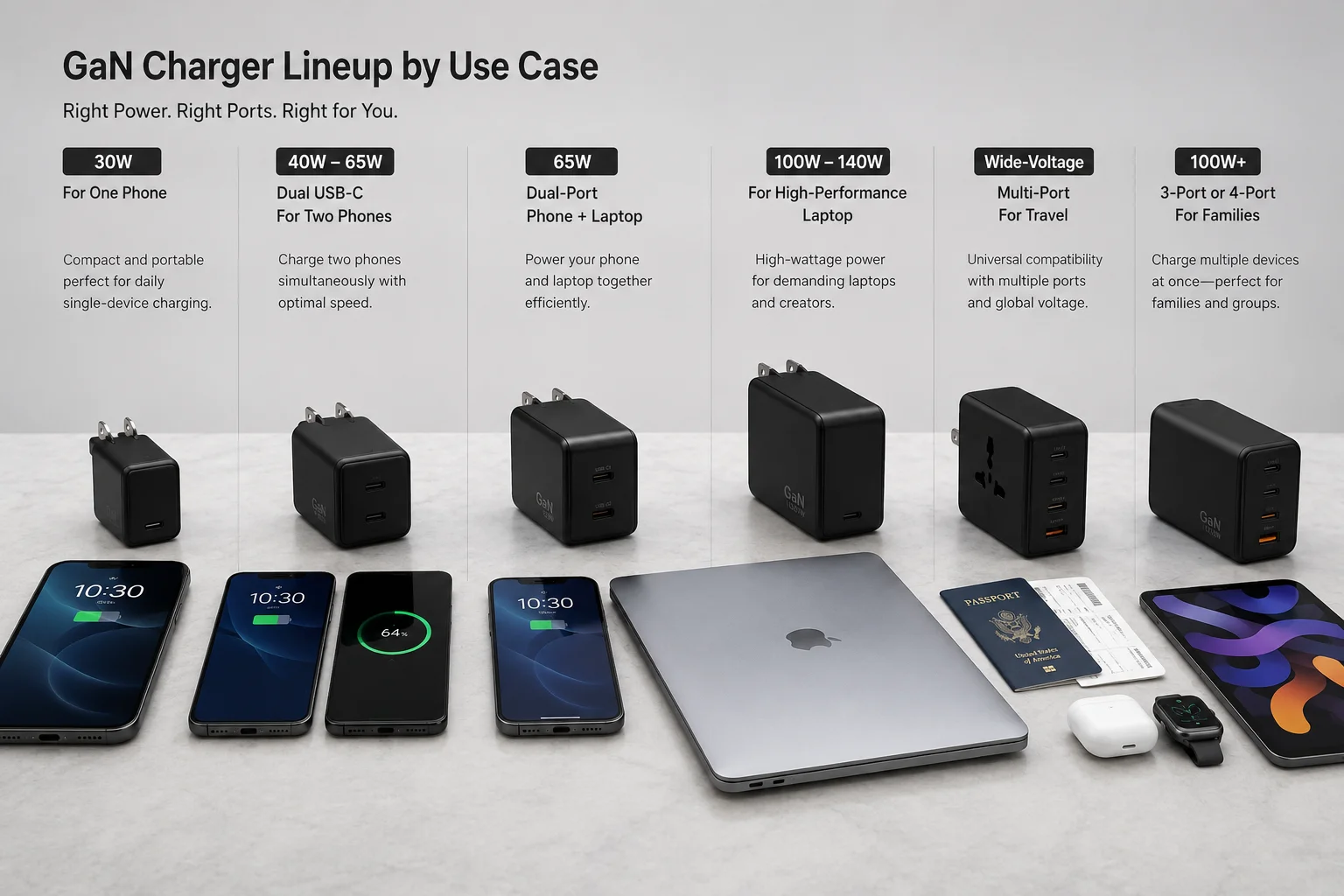
When I build a GaN charger plan for buyers, I think in terms of shelves, listings, and customer groups. A retailer may need one entry model, one mainstream model, and one premium model. A wholesaler may need several plug options. An ecommerce seller may need a strong hero SKU with clear pictures and power tables. A chain store may care more about packaging, barcode, warranty, and stable delivery.
For one phone, I choose a compact 30W single-port charger. It is simple and easy to sell. For two phones, I choose a 40W–65W dual USB-C charger. It fits couples and shared use. For phone and laptop users, I usually choose a 65W dual-port charger. It gives a good balance between size and function.
| Buying scenario | My recommended direction | Why I choose it |
|---|---|---|
| Best for one phone | Compact 30W single-port charger | Low cost and easy daily use |
| Best for two phones | 40W–65W dual USB-C charger | Good for couples and families |
| Best for phone and laptop | 65W dual-port charger | Strong everyday balance |
| Best for MacBook Pro | 100W–140W charger | Better high-power laptop support |
| Best for international travel | Wide-voltage multi-port charger | Fits mixed devices and regions |
| Best for families | 100W+ three-port or four-port charger | More ports and shared charging |
| Best for wholesale buyers | Certified models with stable production and plug options | Lower resale and supply risk |
For wholesale buyers, I recommend thinking beyond the charger body. I check certification, plug type, package design, MOQ, lead time, color options, logo printing, cable bundle, and after-sales rules. I also consider inventory risk. A full range may include 30W, 65W, 100W, and 140W+ models, but the order quantity should match the customer base. If the market is mainly phone users, I would not push too many 140W units. If the market serves laptop users and business travelers, I would give more space to 65W and 100W models.
As a Shenzhen 3C trading company, we often help buyers turn a general request into a practical product plan. The goal is not to buy the charger with the largest number on the box. The goal is to choose models that customers understand, use correctly, and buy again.
Conclusion
I choose GaN chargers by device, wattage, port behavior, certification, and resale risk. The best charger is the one that fits the real user.
"GaN-Based High-Efficiency, High-Density, High-Frequency Battery ...", https://vtechworks.lib.vt.edu/items/314dcc4d-ccb6-4118-bcb7-eebae36dd3b6. A peer-reviewed power-electronics source should be cited to show that GaN devices can operate at high switching frequencies with favorable efficiency characteristics, enabling higher power density in AC-DC converters; this supports the size claim at the design level but does not prove that every GaN charger is smaller. Evidence role: mechanism; source type: paper. Supports: GaN devices can improve power-converter power density and efficiency, which can support smaller charger form factors.. Scope note: The source would support the engineering mechanism, not the dimensions of any particular commercial charger. ↩
"When did Samsung stop giving out wall chargers? - Reddit", https://www.reddit.com/r/samsung/comments/pdpjei/when_did_samsung_stop_giving_out_wall_chargers/. A government or institutional source discussing charger unbundling and electronic-waste policy should be cited to document that selling mobile devices without included chargers has become a recognized industry practice; this contextualizes demand for standalone chargers but does not quantify demand for this specific product category. Evidence role: historical_context; source type: government. Supports: Regulatory or institutional material should confirm that chargers are increasingly sold separately or that unbundling chargers from devices has become a recognized market practice.. Scope note: The source may document the trend or policy context rather than provide brand-by-brand sales data. ↩
"About iPhone charge speeds - Apple Support", https://support.apple.com/en-us/120619. Apple support documentation should be cited to show that supported iPhone and iPad models can fast charge when used with compatible USB-C power adapters and cables; this supports the compatibility point but does not establish that all iPhone or iPad users require fast charging. Evidence role: general_support; source type: other. Supports: Apple support documentation or USB-IF material should show that USB-C power adapters are used for fast charging supported iPhone and iPad models.. Scope note: The source would apply only to supported Apple models and compatible cables or adapters. ↩
"USB Charger (USB Power Delivery) - USB-IF", https://www.usb.org/usb-charger-pd. USB-IF and device-manufacturer documentation should be cited to show that USB Power Delivery PPS provides programmable voltage/current negotiation and is used by compatible Samsung Galaxy fast-charging implementations; this supports the protocol relevance but does not mean every Galaxy model benefits equally. Evidence role: mechanism; source type: institution. Supports: USB-IF documentation should explain PPS as an adjustable-voltage mode, and Samsung documentation should connect PPS-compatible USB-PD chargers with Galaxy fast charging.. Scope note: Support varies by Galaxy model, charger rating, cable, and regional device specification. ↩
"Laptop is only rated for a max input of 65W over USB-C, but it draws ...", https://www.reddit.com/r/UsbCHardware/comments/1c20gl7/laptop_is_only_rated_for_a_max_input_of_65w_over/. USB-IF power-delivery documentation and representative device specifications should be cited to show that 45W and 65W are common USB-C charging levels for tablets and lightweight laptops; this contextualizes the recommendation but does not prove that the range is objectively best for all users. Evidence role: general_support; source type: institution. Supports: USB-IF and device specification sources should show that 45W and 65W fall within common USB-C PD charging ranges for tablets and lightweight laptops.. Scope note: The evidence would support broad suitability, not a universal ranking. ↩
"What's the best multi-port charger for charging multiple devices ...", https://www.reddit.com/r/UsbCHardware/comments/1k6vuw0/whats_the_best_multiport_charger_for_charging/. USB Power Delivery technical documentation should be cited to explain that USB-C power sources advertise negotiated power capabilities and that multi-port implementations may allocate a shared power budget across connected devices; this supports the mechanism but not the exact 45W/20W or 30W/30W examples for every charger. Evidence role: mechanism; source type: institution. Supports: USB Power Delivery documentation should support the idea that chargers advertise available power capabilities and that output can change depending on connected devices and port allocation.. Scope note: Exact split rules are product-specific and must be verified from each charger’s specification. ↩
"Two years on from the USB PD 3.1 EPR annoucement ... - Reddit", https://www.reddit.com/r/UsbCHardware/comments/13vv4he/two_years_on_from_the_usb_pd_31_epr_annoucement/. USB-IF documentation on USB Power Delivery 3.1 should be cited to show that the Extended Power Range specification supports power levels above 100W, including 140W-class operation; this directly supports the protocol requirement but not compatibility with every 140W device. Evidence role: definition; source type: institution. Supports: USB-IF documentation should show that USB PD 3.1 introduced Extended Power Range levels above 100W, covering 140W-class charging.. Scope note: Device, charger, and cable must all support the required PD 3.1/EPR mode. ↩
"Identifying USB-C E-Mark Cables - Satechi", https://satechi.com/blogs/news/identifying-usb-c-e-mark-cables?srsltid=AfmBOorB6BgMioQvG-52vq-8g-16rOvrpMk_tM8YiqYIto0kCPTo0qk8. USB-IF Type-C and Power Delivery documentation should be cited to show that high-current USB-C charging depends on cable rating and, for higher current levels, electronically marked cables; this supports the claim that an inadequate cable can reduce apparent charger performance. Evidence role: mechanism; source type: institution. Supports: USB-IF documentation should show that USB-C cables have current-rating requirements and that high-current operation requires appropriate marked cables.. Scope note: The source explains protocol and cable limits, not all possible causes of slow charging. ↩
"Mains electricity by country - Wikipedia", https://en.wikipedia.org/wiki/Mains_electricity_by_country. A government travel-advice source should be cited to show that mains voltage differs across countries and that travelers should verify whether an electronic device is rated for the local voltage, such as a 100–240V input range; this supports the travel-check rationale but not the safety of any specific charger. Evidence role: general_support; source type: government. Supports: A government travel-advice or electrical-standards source should show that mains voltage varies by country and that devices must be rated for the destination voltage.. Scope note: Voltage rating alone does not address plug shape, certification, or product quality. ↩
"Electrical Overheating | CPSC.gov", https://www.cpsc.gov/recall-hazards/electrical-overheating. A consumer-safety agency or recognized standards body should be cited to show that AC power adapters and chargers can pose overheating or fire risks when poorly designed or misused, and that safety testing/certification addresses such hazards; this supports the safety rationale but does not prove family use is uniquely risky. Evidence role: general_support; source type: government. Supports: Consumer-safety or standards sources should support that chargers can present overheating or fire risks and that certified products and thermal protection are relevant safety considerations.. Scope note: The evidence would address charger safety generally rather than quantify risk by household type. ↩
"Equipment Authorization – RF Device | Federal Communications ...", https://www.fcc.gov/oet/ea/rfdevice. Government compliance guidance should be cited to show that electrical and electronic products are subject to different conformity-marking or authorization regimes in the EU, UK, and United States; this supports the market-dependent compliance point but does not determine which exact documents a specific charger must carry. Evidence role: general_support; source type: government. Supports: Government guidance should show that CE, UKCA, and FCC requirements apply in different jurisdictions and that importers or sellers may need documentation for market access.. Scope note: Specific obligations depend on product design, jurisdiction, importer role, and sales channel. ↩
"Retailers: Product Safety and Your Responsibilities | CPSC.gov", https://www.cpsc.gov/es/Business--Manufacturing/Business-Education/Business-Guidance/Retailers-Product-Safety-and-Your-Responsibilities. Government product-compliance guidance should be cited to show that importers and distributors of electrical products may be responsible for safety, conformity documentation, and market-surveillance obligations; this supports the market-entry risk claim but does not show that all low-cost chargers are noncompliant. Evidence role: general_support; source type: government. Supports: Government product-compliance guidance should show that importers and distributors have legal responsibilities for product safety and conformity documentation.. Scope note: Price alone is not proof of noncompliance; documentation and testing determine the risk. ↩