A bad travel charger can slow your day, heat up in a hotel room, or risk your laptop. I have seen buyers regret cheap choices.
I buy the best travel GaN charger by matching wattage, ports, plug type, safety certification, and seller reliability to my travel devices. I do not chase one “best” model. I check real output, warranty, and safety details before I pay.
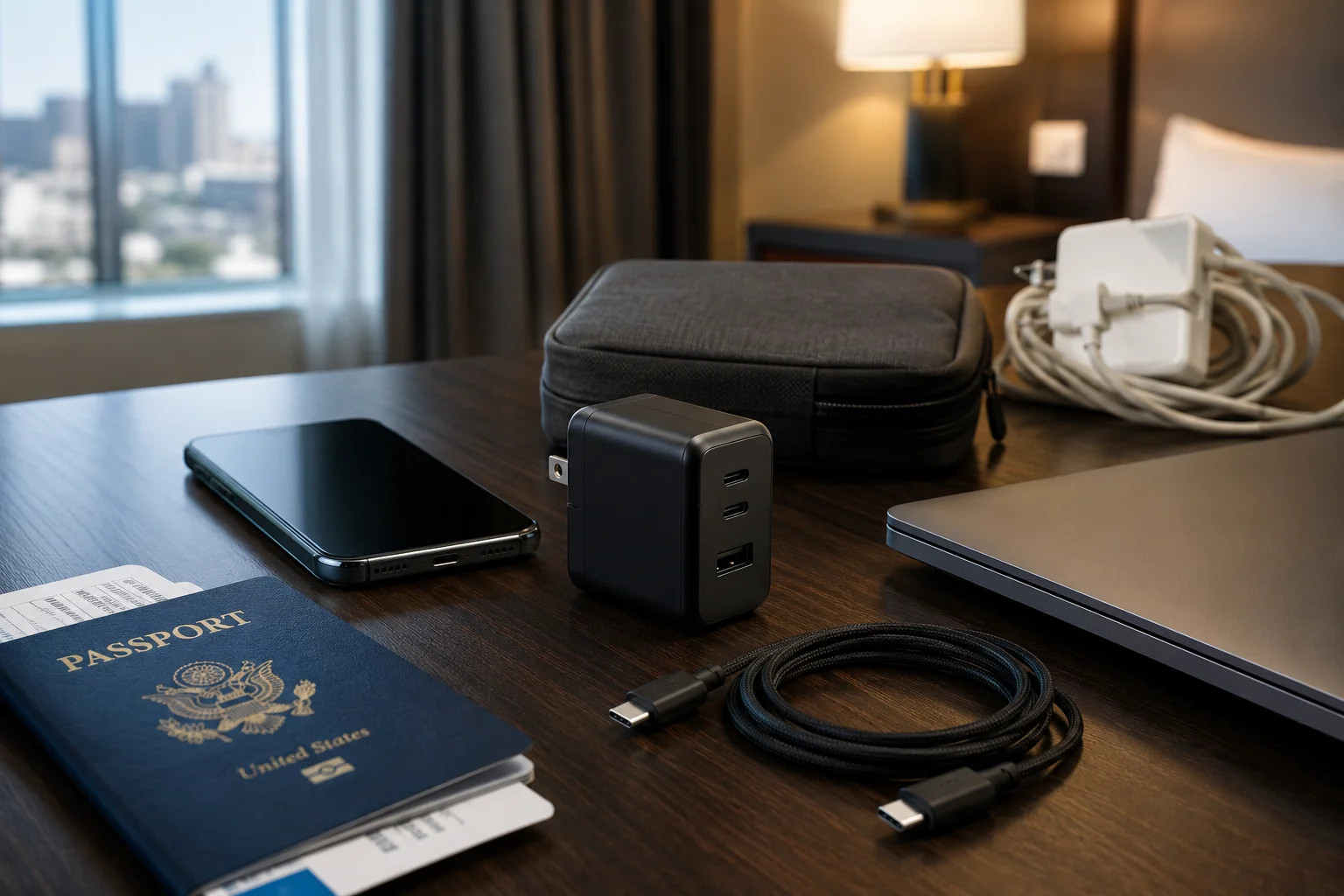
I have worked with 3C products for many years, and I see the same problem again and again. Many chargers look the same online. Many sellers show high wattage, nice photos, and low prices. I do not start with the brand name. I start with my device list, my destination, and my safety risk. If you buy this way, you will avoid most bad choices.
What Makes a GaN Charger Suitable for Travel?
A charger can be powerful and still be poor for travel. I have seen bulky models fill a bag and block wall sockets.
I consider a GaN charger suitable for travel when it is compact, supports USB-C PD, works with wide voltage, has safe protection, and can power phones, tablets, and laptops with stable output1. Foldable or interchangeable plugs also matter.
I check the travel features first
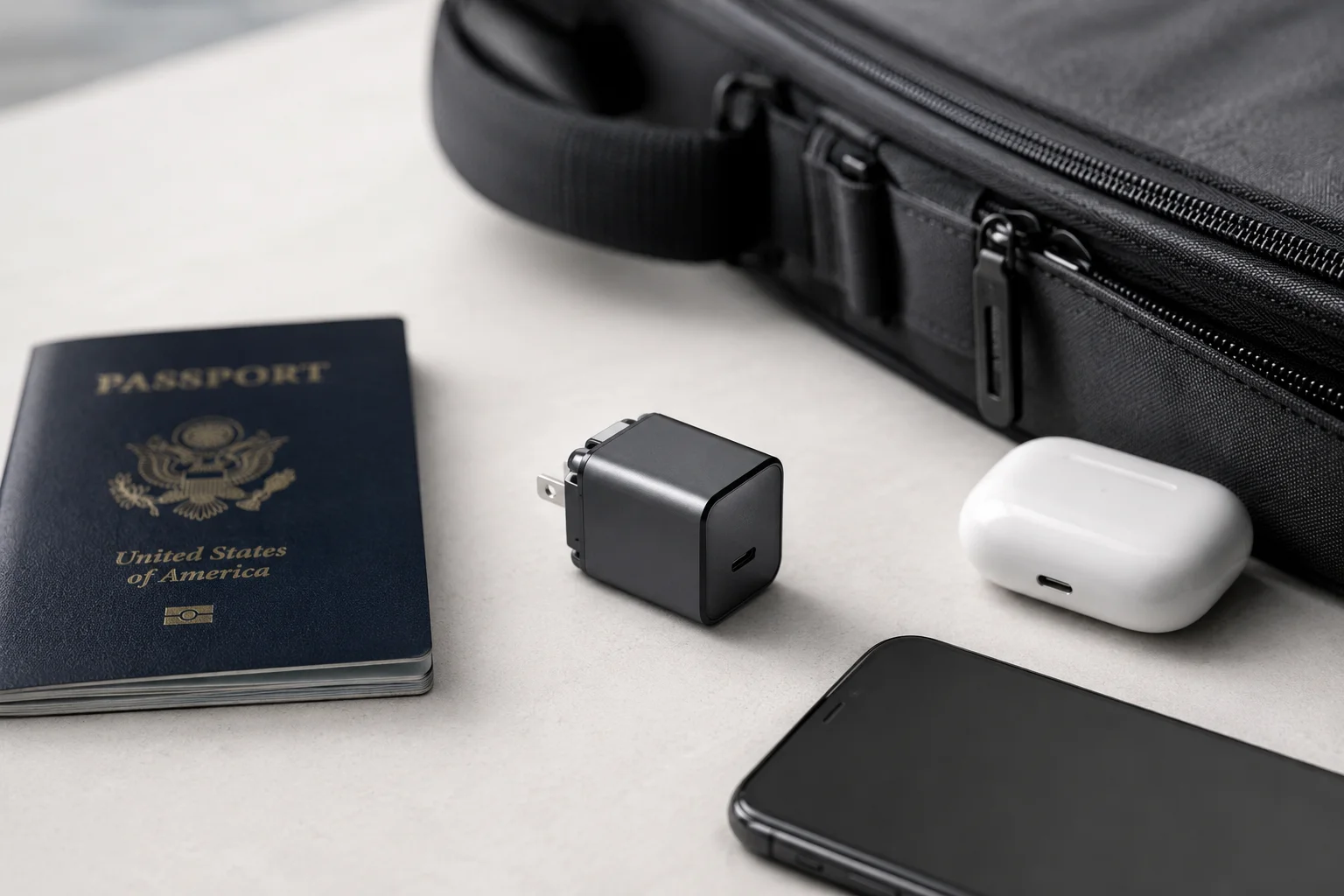
When I evaluate chargers for retail clients, I do not look only at the largest number on the box. I first hold the charger in my hand. I check its weight, plug design, port layout, and heat control. A travel charger needs to move with me. It should fit in a backpack pocket. It should not fall out of loose hotel sockets. It should not cover the next socket on a power strip.
I also check the input range. A good travel charger should support 100–240V input2. This lets me use it in Europe, the United States, and many other regions. I still need the correct plug shape, but I do not need a voltage converter for most modern USB chargers.3
I compare travel features this way
| Feature I check | Why I care during travel |
|---|---|
| Compact body | I save bag space and reduce weight |
| Foldable plug | I protect the plug inside my bag |
| Interchangeable plugs | I use one charger in more countries |
| Multiple USB-C ports | I charge phone and laptop together |
| USB-C PD support4 | I get fast and stable charging |
| Wide input voltage | I use it in many regions safely |
| Smart power distribution | I avoid weak charging when ports are full |
| Heat and voltage protection | I protect expensive devices |
I see one common mistake. Many buyers choose the smallest charger with the highest wattage. I do not trust that alone. Small size is good, but heat must be controlled. A charger that gets too hot during long laptop charging is not a good travel partner.
Where Can You Buy a Reliable Travel GaN Charger?
Cheap listings are easy to find, but reliable chargers take more checking. I have seen buyers lose money because the seller disappeared after delivery.
I buy reliable travel GaN chargers from official brand websites, authorized electronics retailers, major marketplaces with trusted sellers, airport stores, mobile accessory shops, wholesale suppliers, or OEM manufacturers. I always check seller reputation, certification, warranty, and plug version.
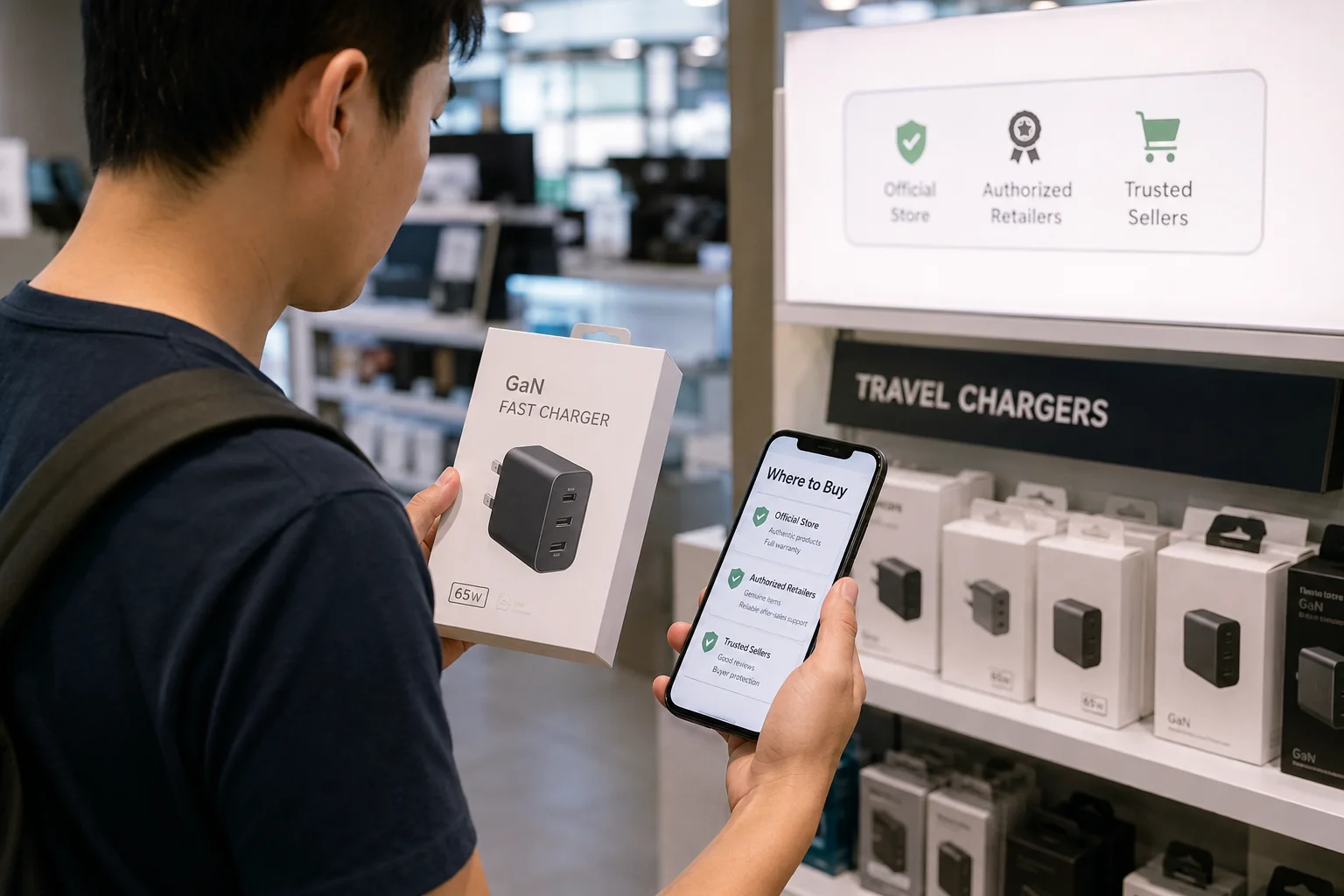
I focus on the seller, not only the store
I do not believe that one platform is always safe and another platform is always risky. A good seller can be on Amazon, a brand website, or a B2B sourcing platform. A weak seller can also appear anywhere. I check how clearly the seller shows product details. I look for model number, input voltage, port output, certification marks, warranty terms, and return rules.
For B2B buyers, I also check factory background, export experience, plug options, packaging support, and MOQ. In our Shenzhen 3C work, we often help customers compare models that look almost the same. The difference is usually inside the details. One supplier can provide test reports and stable production. Another supplier can only provide nice photos.
I compare buying channels this way
| Buying channel I use | Main benefit | Main risk I check |
|---|---|---|
| Official brand website | Clear warranty and original stock | Higher price |
| Authorized retailer | Better after-sales support | Limited models |
| Major marketplace | Many choices and reviews | Mixed seller quality |
| Airport store | Quick emergency purchase | High price and few specs |
| Mobile accessory shop | Easy local support | Unknown certification |
| Wholesale supplier | Better bulk price | Need stronger inspection |
| OEM manufacturer | Custom plug, logo, package | Need quality control process |
I never compare price alone. I ask simple questions. Does the seller show the exact plug version? Does the charger have CE, FCC, UL, or RoHS where needed? Does the warranty cover failure? Can I return it if the plug or output is wrong? These questions save more money than a small discount.
What Wattage GaN Charger Is Best for Travel?
Too little wattage wastes time, but too much wattage adds size and cost. I often see travelers buy more power than they really need.
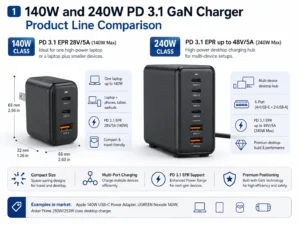
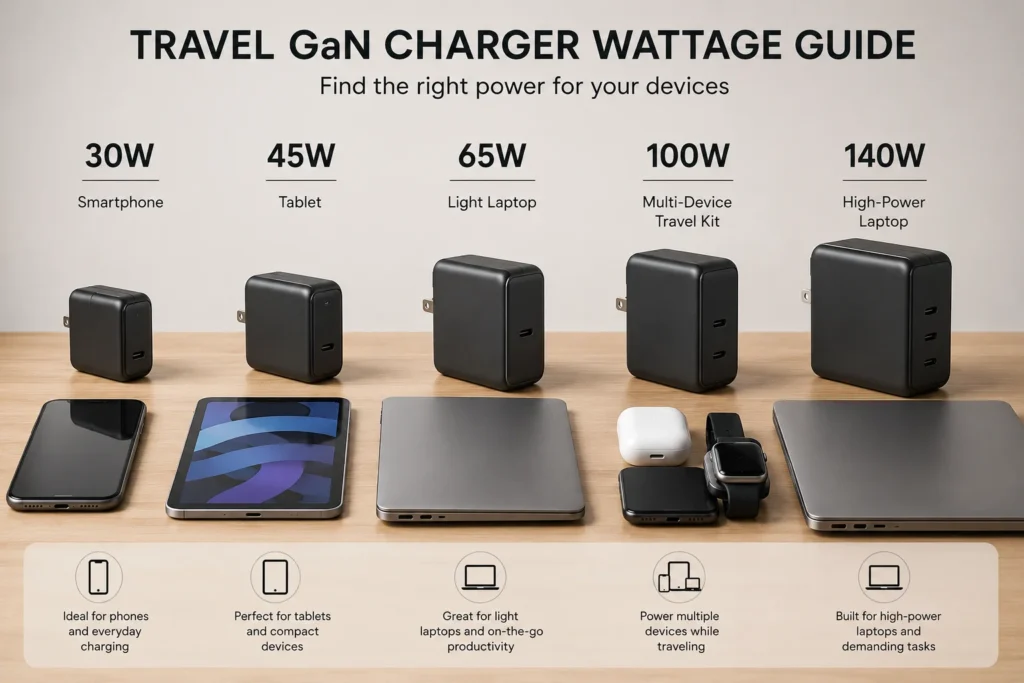
I choose travel charger wattage by my highest-power device and my charging habits. I use 30W for phones, 45W for tablets and light laptops, 65W for most travel kits, 100W for multi-device setups, and 140W for high-power laptops5.
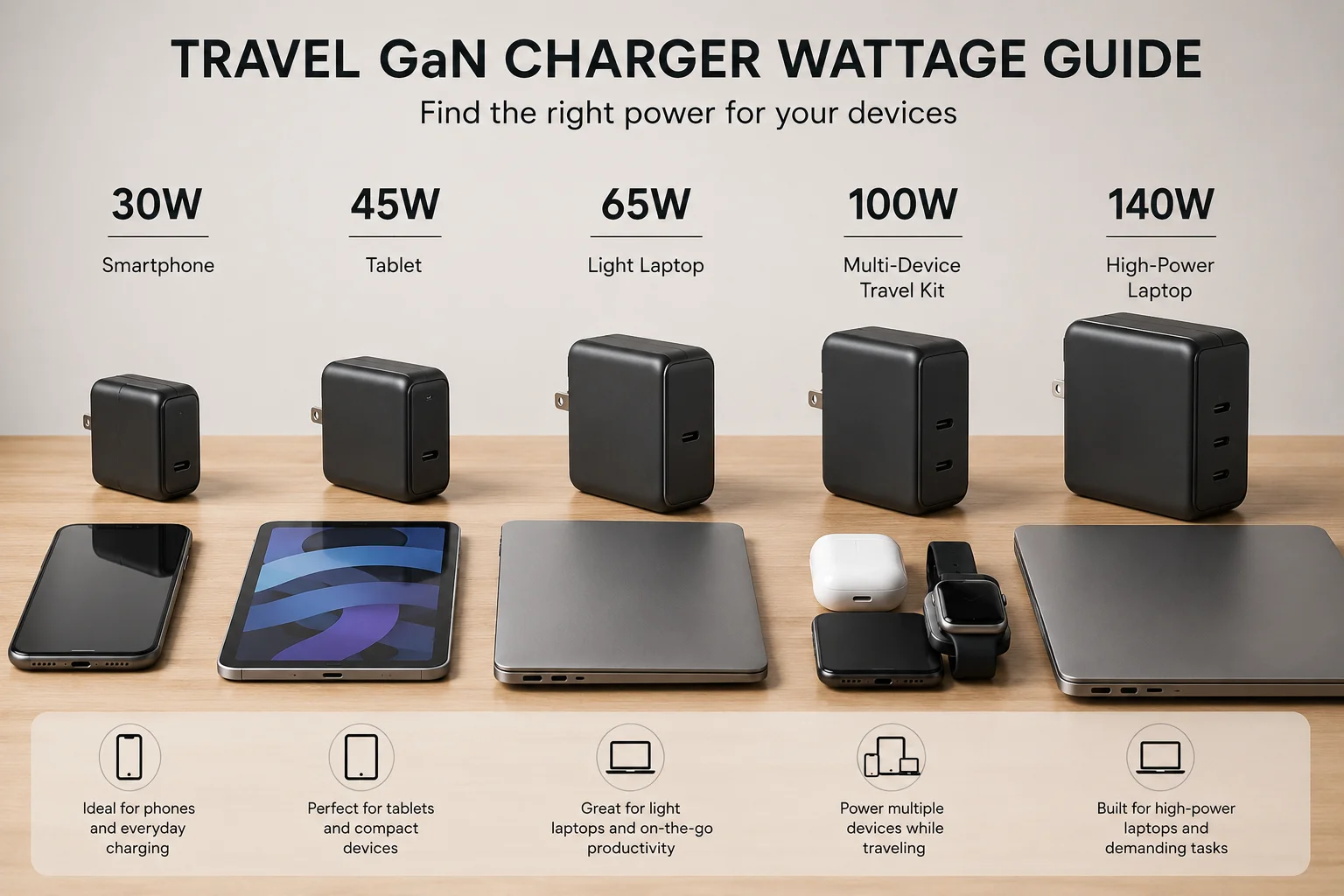
I match wattage to my real device kit
I do not choose wattage by the largest number online. I write down what I travel with. If I only carry a phone, earbuds, and a watch, a 30W charger is enough. If I carry an iPad or a thin laptop, I move to 45W or 65W. If I carry a MacBook Air, phone, tablet, and power bank, I usually prefer 65W with two or three ports. It gives me a good balance between size and power.
For business travel, I often see 65W become the practical sweet spot6. It can charge many phones fast. It can charge tablets well. It can also charge many ultrabooks. A 100W charger is useful if I charge a laptop and phone at the same time often. A 140W charger is more special. I use it when a high-performance laptop needs strong power, or when two people share one charger.
I use this wattage table
| Wattage I choose | Best for | My travel note |
|---|---|---|
| 30W | Phone, earbuds, small devices | Smallest and lightest choice |
| 45W | Phone, tablet, some thin laptops | Good for simple work trips |
| 65W | Phone, tablet, MacBook Air, ultrabooks | Best balance for most travelers |
| 100W | Laptop plus several devices | Good for heavy users |
| 140W | High-power laptop or shared travel kit | More power, more size |
I also check power distribution. A charger may say 100W, but one USB-C port may give 65W when another port is in use. This detail matters more than the front label. I always read the multi-port output chart before buying.
Should You Choose a Universal Travel Adapter With GaN Charging?
A travel adapter looks useful, but it may not replace a good charger. I have seen people confuse plug conversion with voltage conversion.
I choose a standalone GaN wall charger when I want smaller size and strong output. I choose a universal travel adapter with GaN charging when I need plug support for many countries. I remember that plug conversion does not mean voltage conversion7.
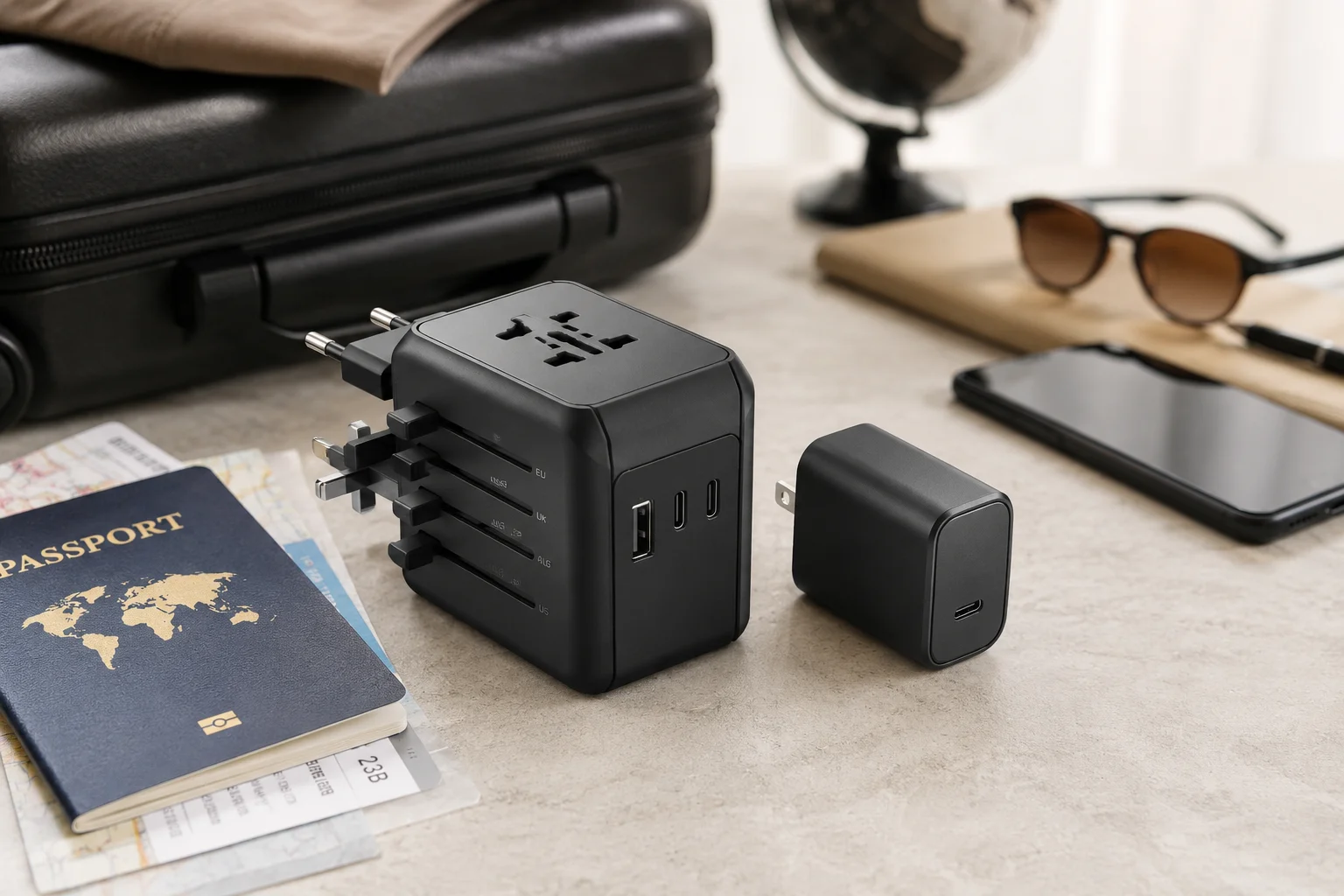
I separate plug use from charging power
A standalone GaN wall charger is often better for daily travel if I already have the right plug. It is usually smaller. It may deliver stronger USB-C output. It may also have better heat control because the design is simpler. I like this option for one or two regions, such as the United States and Europe.
A universal travel adapter with built-in GaN charging is useful when I visit many countries in one trip. It can fit US, EU, UK, and AU sockets in many cases. It can reduce the number of items in my bag. But I check the details carefully. Some travel adapters have lower USB-C output than standalone chargers. Some have no grounding support.8 Some have fuses that are hard to replace.
I compare both options this way
| Factor I check | Standalone GaN charger | Universal adapter with GaN |
|---|---|---|
| Supported countries | Depends on plug version | Usually wider support |
| Plug compatibility | Fixed or interchangeable | Built-in sliding plugs |
| Maximum output | Often higher | Sometimes lower |
| Number of ports | Often 2 to 4 ports | Often 3 to 5 ports |
| Grounding support | Depends on model | Must check carefully |
| Replaceable fuse | Usually not needed | Important for adapter use |
| Size and weight | Usually smaller | Usually larger |
| Best use | Daily charger | Multi-country travel |
I remind customers of one point many times. A plug adapter only changes plug shape. It does not always change voltage. Most modern GaN chargers support 100–240V, so they handle voltage by themselves. But devices like hair dryers may not. I do not mix these ideas.
How Many Ports Does a Travel Charger Need?
Too few ports create cable fights. Too many ports can make output weaker. I see this problem with families and business travelers often.
I choose one USB-C port for solo phone travel, two USB-C ports for couples, two USB-C plus one USB-A for mixed devices, and three or four ports for families or business users. I always check real output when all ports work together.
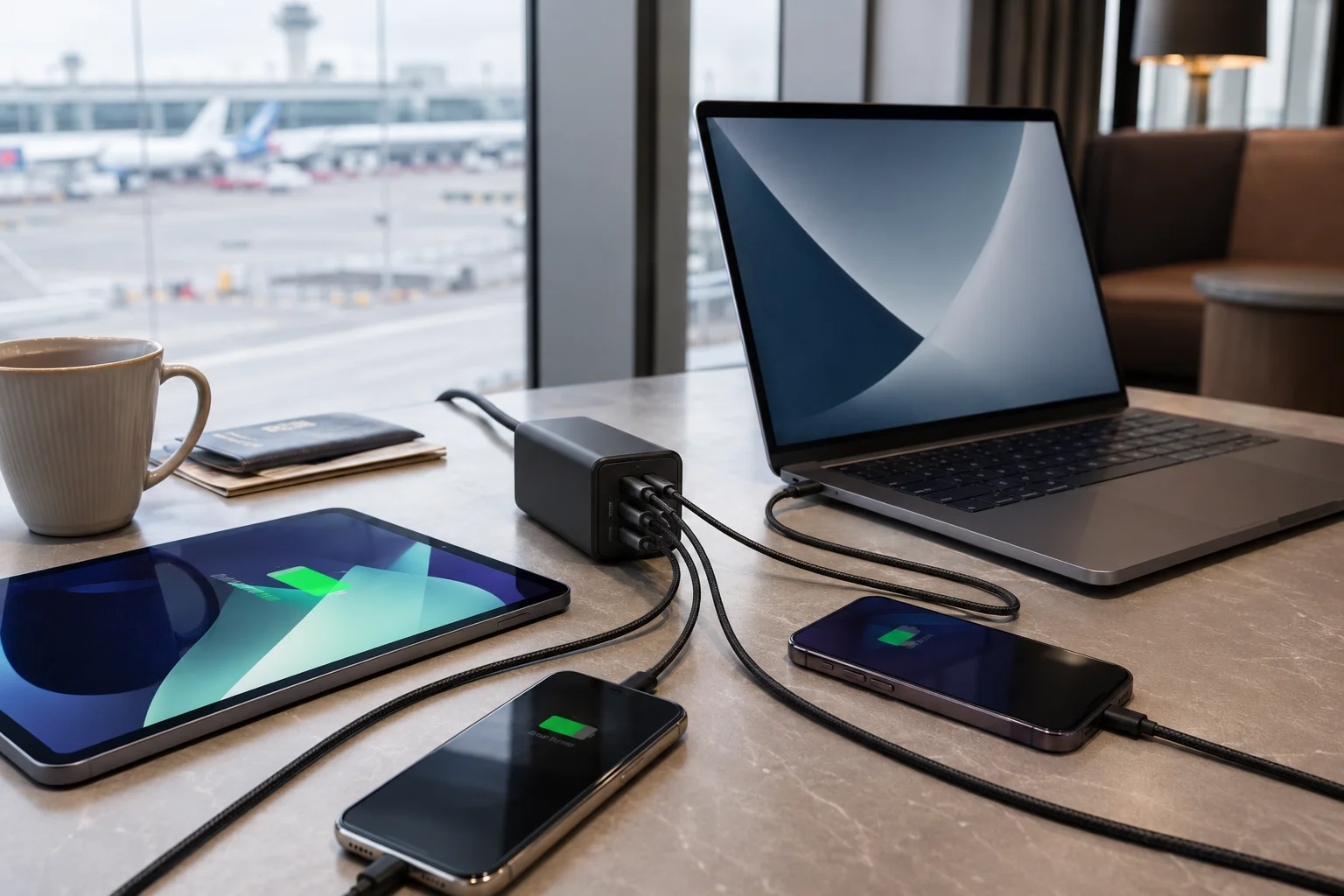
I count devices before I count ports
I always count what I charge at night. A solo traveler may only need one USB-C port. A couple may need two USB-C ports for two phones. A business traveler may need a laptop, phone, earbuds, watch, and power bank. In that case, three or four ports become useful.
I also check the cables I already own. Many new devices use USB-C to USB-C. Some older accessories still use USB-A. A charger with two USB-C ports and one USB-A port can be very practical. It supports new and older devices without extra adapters. For B2B retail buyers, this port mix often sells well because customers have mixed device habits.
I use this port guide
| User type I see | Port setup I suggest | My reason |
|---|---|---|
| Solo phone traveler | 1 USB-C | Simple and light |
| Couple | 2 USB-C | Two phones charge together |
| Mixed device user | 2 USB-C + 1 USB-A | New and old cables both work |
| Family traveler | 3 or 4 ports | More devices at night |
| Business traveler | 3 or 4 ports | Laptop, phone, power bank, watch |
I do not trust port count alone. I check output rules. A charger may offer 65W on one USB-C port when used alone. When two ports are used, it may split as 45W plus 20W. When three ports are used, it may split again. This is normal, but the seller must show it clearly. If I cannot find the power-sharing chart, I see that as a warning sign.
How to Check Whether a GaN Travel Charger Is Safe?
A low price can hide real risk. I have seen products with unclear labels, weak housing, and no real after-sales support.
I check safety by confirming recognized certifications, USB-C PD and PPS support, wide input voltage, heat protection, short-circuit protection, overcurrent protection, fire-resistant housing, clear manufacturer details, warranty terms, and authentic product verification.
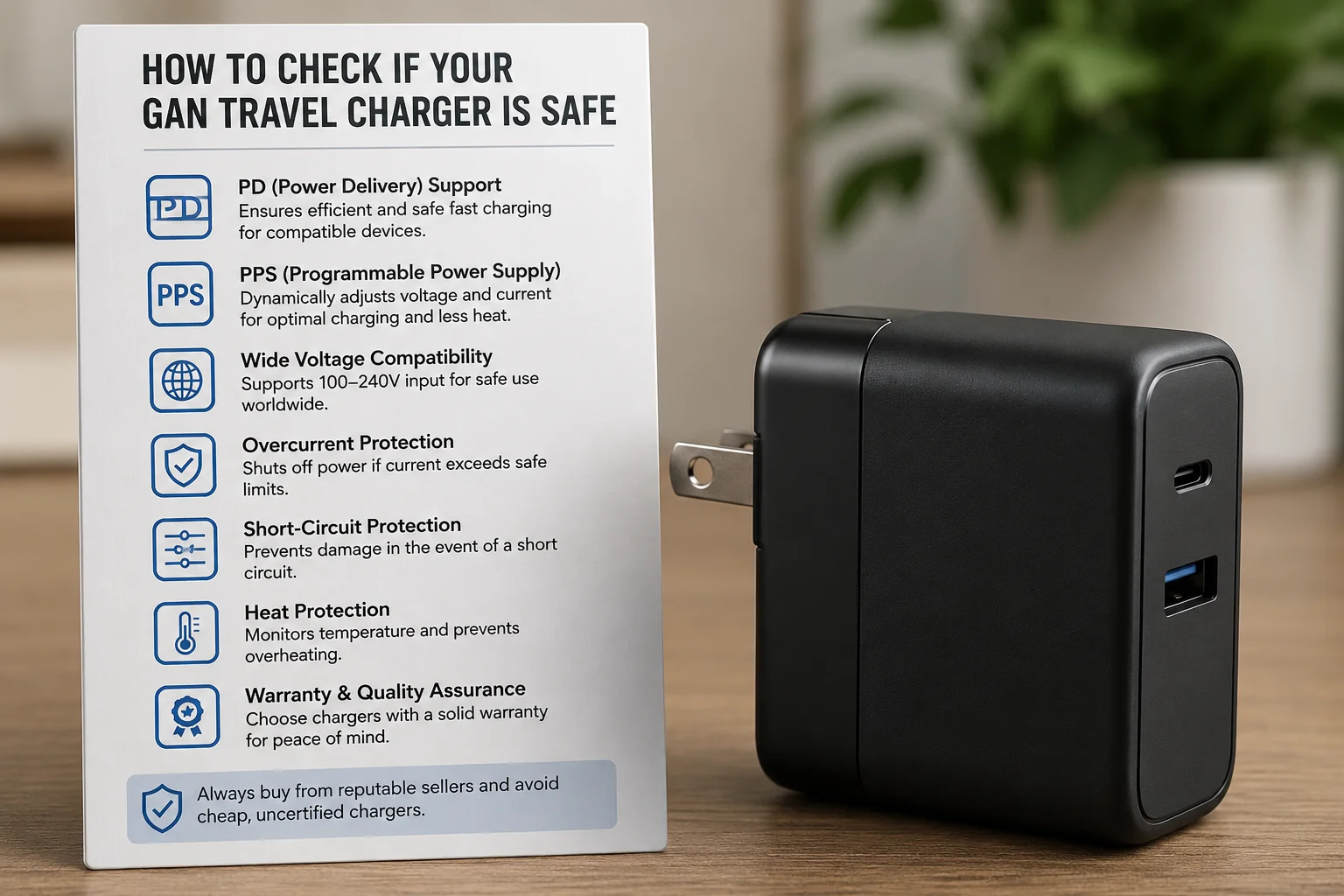
I treat safety as the first cost
When we evaluate chargers for retail partners, safety certification is not a bonus. It is the basic entry point. For the US market, I look for marks such as UL or ETL when relevant, and FCC for electromagnetic compliance. For Europe, I check CE and RoHS. CE means the product claims to meet EU safety, health, and environmental requirements.9 RoHS means restricted harmful substances are controlled.10 FCC means the product should not create harmful electronic interference.11
I also know that marks can be copied. I look for a real model number, matching documents, clear factory or brand information, and traceable test reports. If a seller only shows a logo image and cannot provide more detail, I stay careful.
I use this safety checklist
| Safety item I check | What it means for me |
|---|---|
| UL, ETL, CE, FCC, RoHS | I can see a safety and market compliance path |
| USB-C PD and PPS | I get better fast charging for modern devices |
| 100–240V input | I can use it across many countries |
| Temperature protection | I reduce overheating risk |
| Short-circuit protection | I protect charger and device |
| Overcurrent protection | I avoid too much current |
| Overvoltage protection | I reduce damage risk |
| Fire-resistant housing | I get better safety margin |
| Warranty and return policy | I have support after purchase |
I avoid products with no clear model number, no manufacturer name, no test information, and no service channel. A very cheap charger can become expensive if it damages a laptop. I would rather pay a little more for clear proof and real support.
Which Devices Can One Travel GaN Charger Power?
Many travelers carry five devices but buy a charger for only one phone. I see that choice create slow charging and more clutter.
One travel GaN charger can power iPhone, Android phones, tablets, MacBook Air, ultrabooks, Apple Watch, earbuds, cameras, power banks, and handheld gaming devices when wattage, ports, cables, and protocols match those devices.
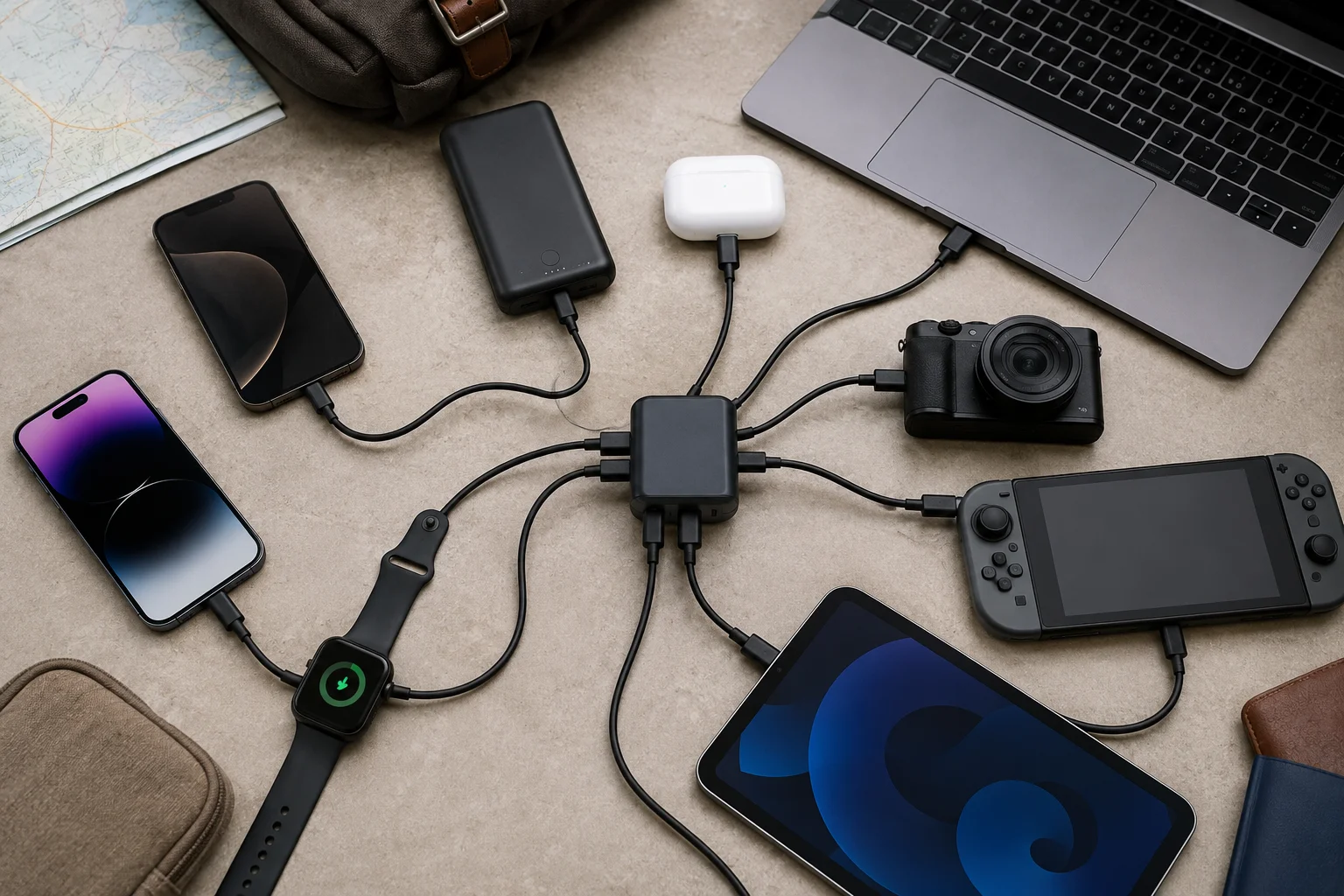
I choose by the highest-power device
I always start with the device that needs the most power. If I travel with a laptop, the laptop decides my charger level. My phone does not decide it. A phone may be fine with 20W or 30W, but a laptop may need 45W, 65W, or more. If I choose only for my phone, my laptop may charge too slowly, or it may not charge well during use.
A good travel GaN charger can replace several old adapters. It can charge an iPhone, Android phone, iPad, Android tablet, MacBook Air, earbuds, smartwatch, camera, power bank, and even a handheld gaming device. But I must match protocols and cables. For example, USB-C PD helps laptops and tablets charge faster. PPS helps some Android phones get better fast charging performance.12
I map devices like this
| Device I carry | Power level I usually consider | My buying note |
|---|---|---|
| iPhone or Android phone | 20W to 45W | Check PD or PPS support |
| iPad or Android tablet | 30W to 45W | Use good USB-C cable |
| MacBook Air | 45W to 65W | 65W is often practical |
| Ultrabook | 45W to 100W | Check laptop requirement |
| Apple Watch | Low power | May need special cable |
| Wireless earbuds | Low power | USB-A may still help |
| Camera | Varies | Check USB charging support |
| Power bank | 18W to 65W | Higher input saves time |
| Handheld gaming device | 30W to 65W | Check PD need |
I also check cable ratings. A 100W charger does not give 100W through a weak cable. For high-power charging, I use a certified USB-C cable that supports the needed wattage. This small detail prevents many complaints.
Travel GaN Charger Buying Checklist?
A charger listing can look complete but still miss key facts. I have seen buyers skip one small detail and receive the wrong plug.
Before I buy a travel GaN charger, I check required wattage, port type, destination plug, wide-voltage input, charging protocols, simultaneous output, size, cable needs, safety certification, seller authorization, warranty, return policy, adapter need, and replacement plug options.
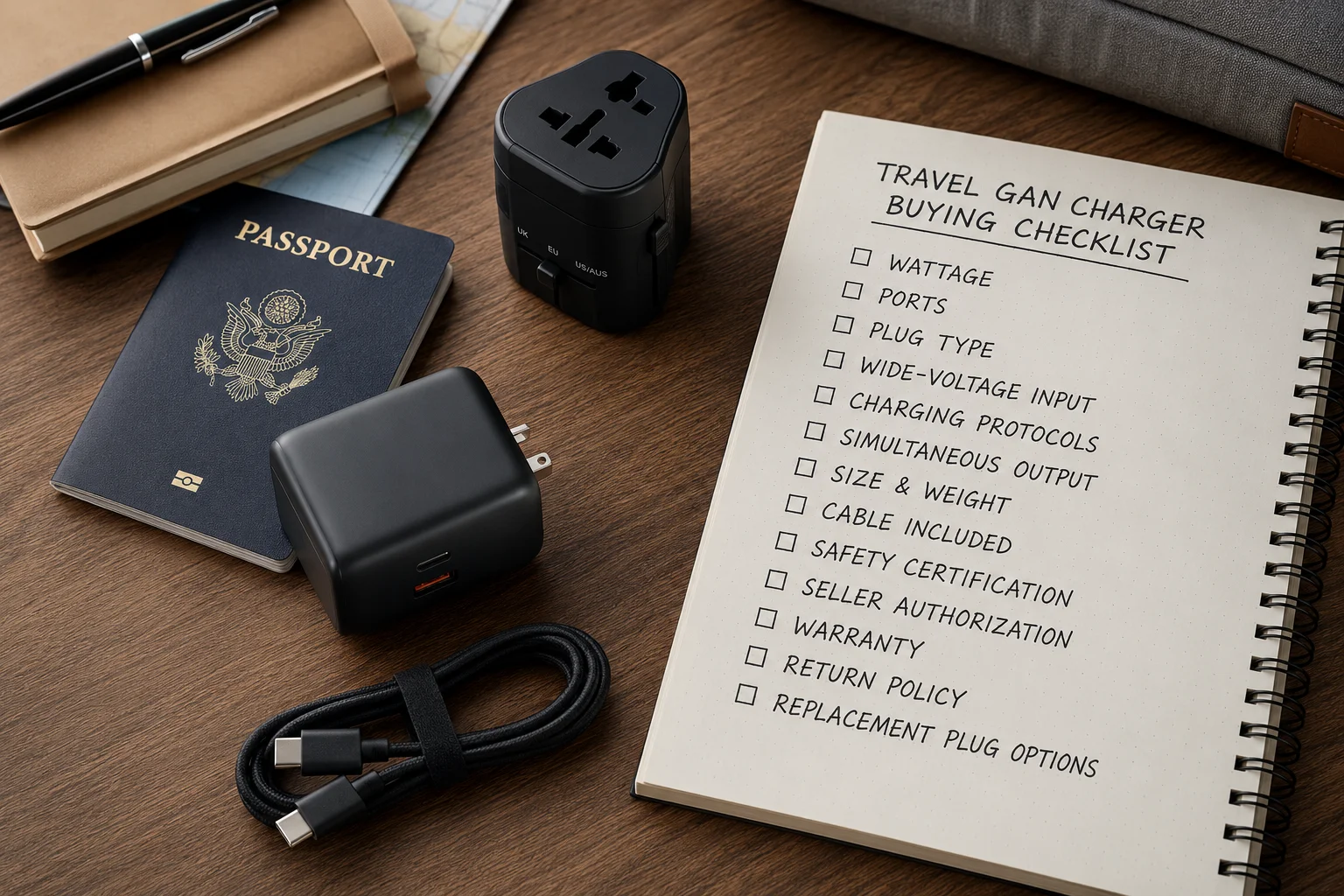
I use a checklist before payment
I like checklists because they slow down emotional buying. A good product page can make any charger look perfect. A checklist brings me back to my real travel needs. I first write down my devices. Then I mark the highest power need. Then I choose the port mix. After that, I check destination plug type and voltage input.
For retail and wholesale buyers, I add more checks. I ask whether the seller is authorized. I ask whether the product has stable supply. I ask whether the packaging can show correct certification and plug version. I also ask about warranty handling. A charger is not only a product. It is also a service promise after the customer starts using it.
I follow this buying checklist
| Item I check | Question I ask myself |
|---|---|
| Required wattage | Can it power my highest-power device? |
| Number and type of ports | Can I charge my travel kit together? |
| Destination plug type | Does it fit the wall socket where I go? |
| Wide-voltage input | Does it support 100–240V? |
| Charging protocols | Does it support PD, PPS, or needed standards? |
| Simultaneous output | What happens when all ports are used? |
| Size and weight | Will I carry it every day? |
| Cable requirements | Do I need a 60W, 100W, or 240W cable? |
| Safety certification | Are the marks real and matched to the model? |
| Seller authorization | Is the seller trustworthy? |
| Warranty coverage | What happens if it fails? |
| Return policy | Can I return the wrong version? |
| Travel adapter need | Do I need plug conversion? |
| Replacement plug availability | Can I replace lost plug heads? |
I believe the “best” charger is not the one with the loudest claim. It is the one that fits my trip, protects my devices, and comes from a seller I can trust.
Conclusion
I buy travel GaN chargers by matching real needs, verified safety, clear output, correct plugs, and reliable sellers instead of chasing one universal “best” model.
"USB hardware - Wikipedia", https://en.wikipedia.org/wiki/USB_hardware. USB-IF and power-supply safety materials describe USB-C Power Delivery as a negotiated power protocol for multiple device classes and identify wide input voltage and protection functions as relevant design characteristics for external chargers; this supports the checklist as a standards-based framework rather than proving that every GaN charger with these features is travel-suitable. Evidence role: general_support; source type: institution. Supports: A standards or technical source should support that USB-C Power Delivery enables negotiated charging for varied devices, while wide-voltage input and protective circuitry are common requirements for internationally usable external power supplies.. Scope note: The support is contextual because travel suitability also depends on plug geometry, local regulations, product quality, and manufacturer implementation. ↩
"Mains electricity by country - Wikipedia", https://en.wikipedia.org/wiki/Mains_electricity_by_country. International mains-voltage references, such as IEC country plug and voltage tables, document that national supplies commonly fall within the 100–240 V range, supporting the use of that input rating as a marker of broad travel compatibility. Evidence role: definition; source type: institution. Supports: An international electrical reference should show that countries use different nominal voltages and that equipment labeled for 100–240V covers the common low-voltage mains ranges used internationally.. Scope note: This does not confirm that a specific charger is safe or legally certified in every destination. ↩
"220V to 110V Voltage Converter, TESSAN Universal ...", https://www.amazon.com/Converter-TESSAN-Universal-Converters-International/dp/B0D53QY5SD. Government travel guidance commonly distinguishes plug adapters from voltage converters and notes that dual-voltage electronics labeled 100–240 V can operate on common foreign mains supplies without a separate converter. Evidence role: general_support; source type: government. Supports: A government travel-safety source should explain that dual-voltage devices labeled 100–240V generally do not need voltage conversion, although they may need a plug adapter.. Scope note: The claim applies only to chargers correctly labeled for wide input voltage and does not extend to single-voltage appliances. ↩
"USB Charger (USB Power Delivery) - USB-IF", https://www.usb.org/usb-charger-pd. The USB-IF USB Power Delivery specification describes negotiated voltage and current levels over USB-C, supporting the article's treatment of USB-C PD as a relevant standard for higher-power charging across device categories. Evidence role: mechanism; source type: institution. Supports: A USB-IF source should support that USB Power Delivery enables devices and chargers to negotiate voltage and current levels over USB-C, allowing higher-power charging than basic USB.. Scope note: USB-C PD support does not guarantee maximum charging speed for every device because manufacturers may impose device-specific limits. ↩
"USB Charger (USB Power Delivery) - USB-IF", https://www.usb.org/usb-charger-pd. The USB Power Delivery 3.1 Extended Power Range specification includes higher fixed-voltage modes, including a 28 V class that supports up to 140 W at 5 A, supporting the classification of 140 W chargers as appropriate for some high-power laptops. Evidence role: mechanism; source type: institution. Supports: A USB-IF source should support that USB PD 3.1 Extended Power Range includes voltage-current combinations capable of 140W charging.. Scope note: The source would establish capability under the standard, not compatibility with any particular laptop model. ↩
"External Power Supplies | ENERGY STAR", https://www.energystar.gov/products/spec/external_power_supplies_spec_pd. Technical literature on notebook power supplies and USB-C charging commonly places many portable computers in the 45–65 W adapter range, providing contextual support for describing 65 W as a practical travel compromise. Evidence role: general_support; source type: paper. Supports: A paper or technical report should show that many thin laptops and notebooks use external power supplies in the 45W to 65W range, making 65W a plausible travel compromise.. Scope note: This would not directly prove traveler preference or that 65 W is sufficient for all laptops. ↩
"Adapter voltage question : r/travel - Reddit", https://www.reddit.com/r/travel/comments/1cqk6gz/adapter_voltage_question/. Government and electrical-safety travel guidance distinguishes plug adapters, which change the physical interface to the outlet, from voltage converters, which alter supply voltage, supporting the statement that plug conversion is not voltage conversion. Evidence role: definition; source type: government. Supports: A travel-safety source should explain that plug adapters and voltage converters perform different functions.. Scope note: Some combination devices may include both functions, so the distinction must be checked at the product level. ↩
"grounding, NRTL approval, and suitable circuit connection.", http://www.osha.gov/laws-regs/standardinterpretations/2000-06-12. Electrical-safety guidance notes that plug adapters vary in construction and may not preserve protective-earth continuity, supporting the caution that grounding support should be verified for universal travel adapters. Evidence role: general_support; source type: institution. Supports: An electrical-safety institution should support that travel adapters vary in whether they maintain protective earth or grounding connections.. Scope note: This is a general safety caution and does not identify which specific adapter models lack grounding. ↩
"European Union - CE Marking and EU Standards | Privacy Shield", https://www.privacyshield.gov/ps/article?id=European-Union-Trade-Standards. European Commission guidance explains that CE marking indicates a manufacturer's declaration that a product conforms to applicable EU safety, health, and environmental protection requirements, supporting the article's definition of CE marking. Evidence role: definition; source type: government. Supports: An official EU source should state that CE marking indicates conformity with applicable EU requirements and is generally the manufacturer's declaration.. Scope note: CE marking is not, by itself, proof that a charger has been independently tested by a third-party laboratory. ↩
"RoHS - Wikipedia", https://en.wikipedia.org/wiki/RoHS. The EU RoHS Directive restricts specified hazardous substances in electrical and electronic equipment, supporting the article's statement that RoHS compliance concerns control of restricted harmful substances. Evidence role: definition; source type: government. Supports: An official EU source should define RoHS as restricting specified hazardous substances in electrical and electronic equipment.. Scope note: RoHS addresses material restrictions and does not by itself establish electrical safety or charging performance. ↩
"47 CFR Part 15 -- Radio Frequency Devices", https://www.ecfr.gov/current/title-47/chapter-I/subchapter-A/part-15. FCC equipment-authorization and Part 15 materials describe limits intended to control radio-frequency emissions and harmful interference from electronic devices, supporting the article's explanation of FCC compliance for chargers. Evidence role: definition; source type: government. Supports: An FCC source should support that applicable FCC rules limit radio-frequency emissions and harmful interference from electronic devices.. Scope note: FCC compliance concerns electromagnetic interference and does not directly certify electrical safety against overheating or shock. ↩
"What is Programmable Power Supply (PPS) Fast Charging? - Belkin", https://www.belkin.com/support-article/?articleNum=318878. USB Power Delivery Programmable Power Supply allows finer adjustment of voltage and current during charging, supporting the claim that PPS can improve fast-charging behavior for devices designed to use it. Evidence role: mechanism; source type: institution. Supports: A USB-IF or technical source should explain that PPS allows programmable voltage and current adjustments, which supported devices can use for optimized charging.. Scope note: The benefit is device-dependent and does not apply to Android phones that lack PPS support or impose proprietary charging limits. ↩