An electronics aging test helps buyers spot products that may fail soon after shipment. Early defects can lead to returns, negative reviews, warranty costs, and lost retailer confidence.1 A structured 4–8 hour testing process cannot guarantee zero failures, but it can reveal some unstable units before they reach your market.
An electronics aging test is a controlled period of continuous powered operation, usually lasting 4–8 hours for many consumer electronics products2. It helps manufacturers identify early functional instability, overheating, charging faults, intermittent failures, and assembly abnormalities. Its value depends on the product, test conditions, testing coverage, and how the factory handles failed units afterward.
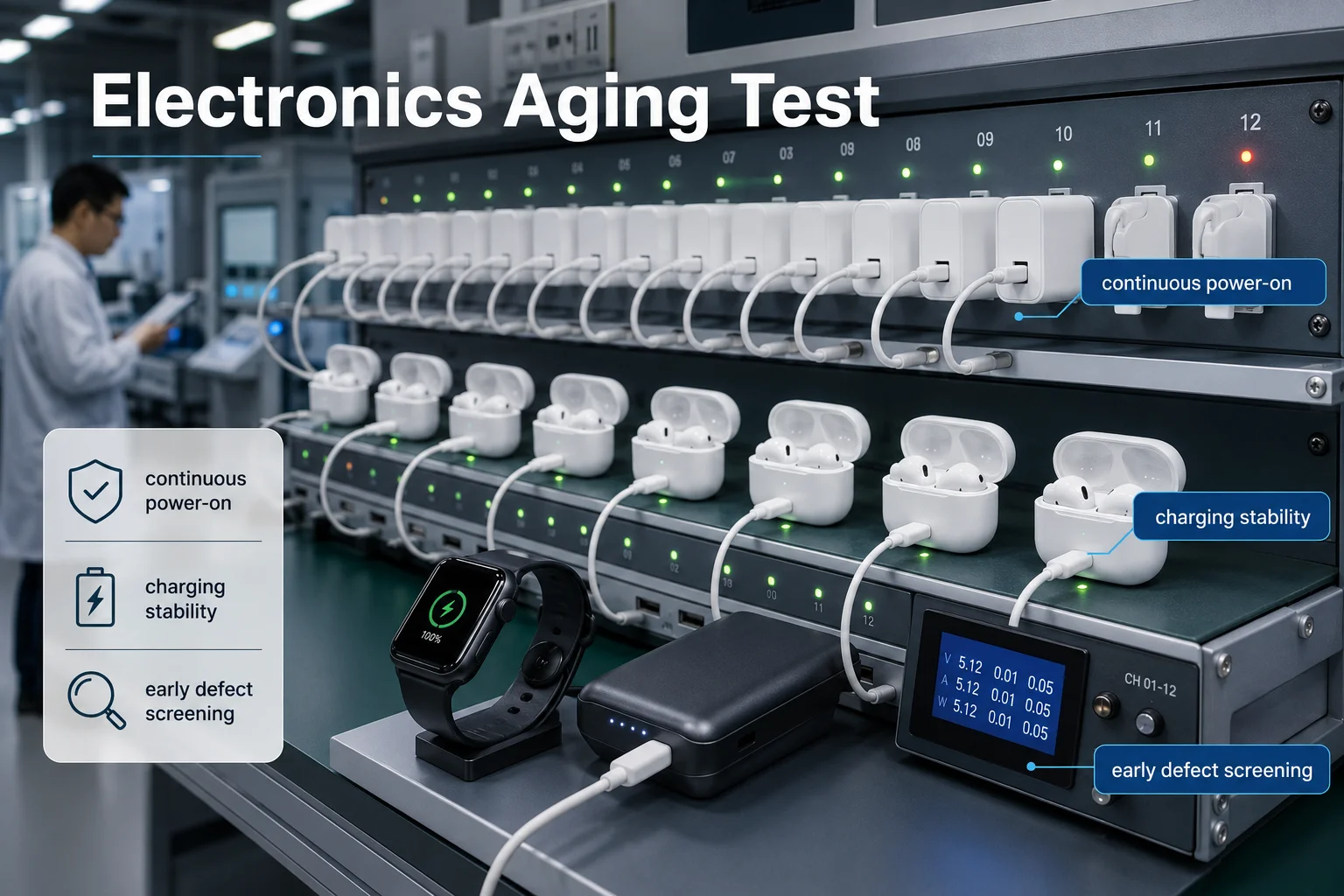
For importers and private-label brands, the important question is not simply, “Does the supplier do aging?” The better question is: What does the supplier test, for how long, under what load, and what happens when a unit fails? That is where meaningful electronics quality control begins.
What Is an Electronics Aging Test for Buyers?
An electronics aging test can sound like a technical factory term, yet it matters directly to your return rate. A product may pass a quick functional check and still become unstable after several hours of use. This creates a costly gap between factory approval and real customer use.
An electronics aging test, also called burn-in testing electronics in some factories, keeps a product powered and operating for a defined time. The process is designed to screen for some early-life faults3 that may appear under continuous use, charging, load, or heat.
Aging testing is not the same as a quick power-on check
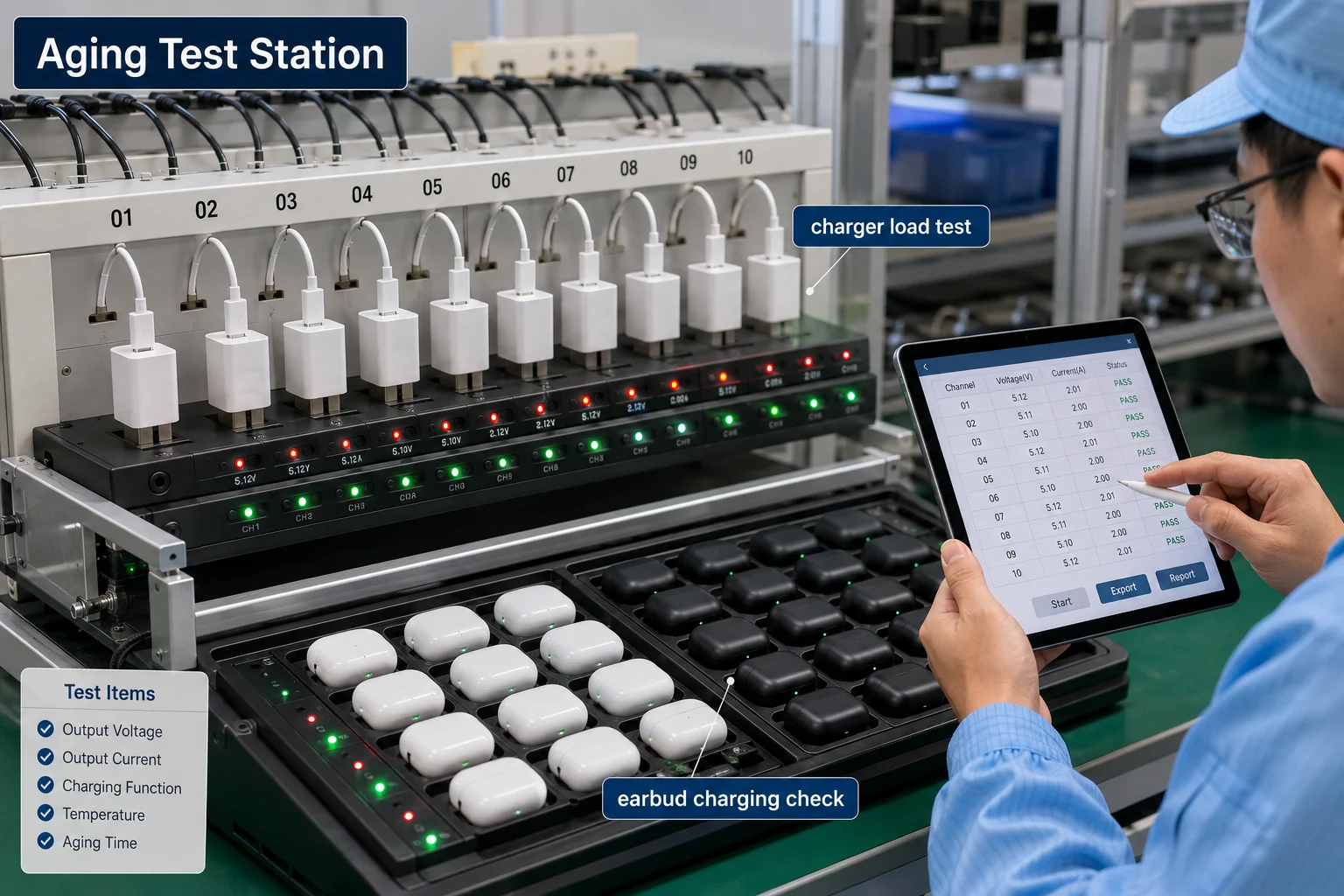
A functional test often confirms that a product turns on and performs basic actions. For example, a charger may show output voltage, or a TWS earbud may pair with a phone. However, these checks may take only seconds or minutes.
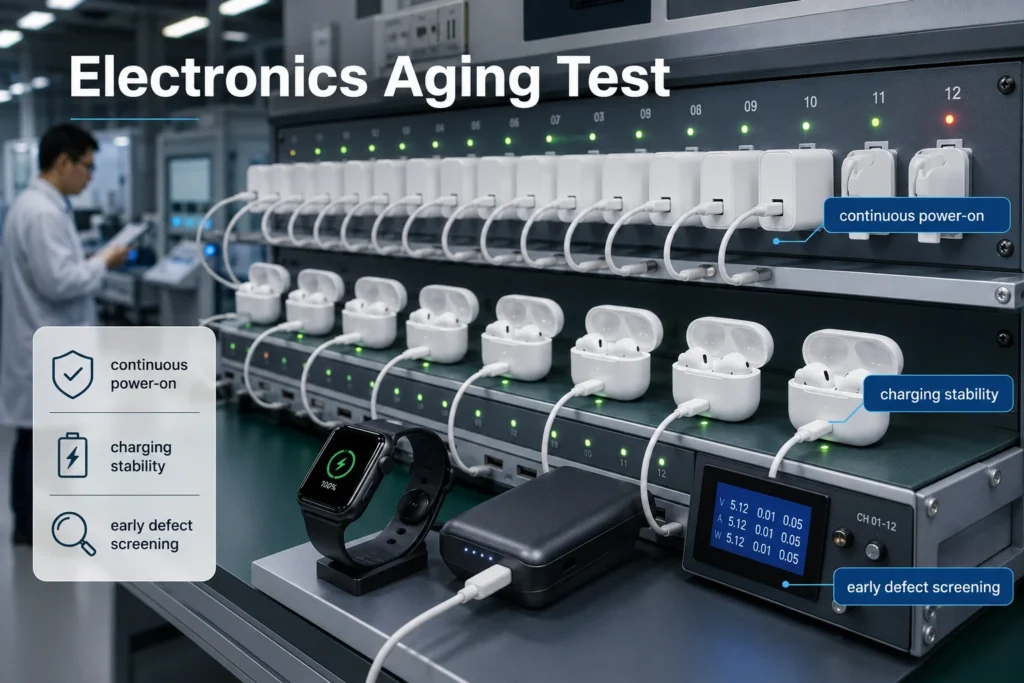
An aging test in manufacturing extends the observation period. During this time, the product stays powered, charges, discharges, plays audio, transmits data, or operates under a defined load.
At our Shenzhen factory, we commonly see that short checks and continuous-run checks serve different purposes. A unit can look normal at the beginning but show an issue later, such as:
- Unstable charging output after warming up
- Intermittent Bluetooth connection
- One earbud losing battery faster than the other
- Abnormal heat from a charger housing
- A cable that disconnects when current load changes
- A loose solder point that causes occasional failure
Products commonly included in aging tests
The right plan varies by product category. Typical products include:
| Product type | Common operating condition during testing |
|---|---|
| USB chargers | Continuous output under a defined load |
| GaN chargers | Load testing across relevant ports and power profiles |
| TWS earbuds | Charging, pairing, audio playback, and battery checks |
| Smart watches | Charging, screen operation, connection, and basic functions |
| USB cables | Current flow, data transmission, and connector checks |
| Power banks | Charge/discharge functions and output stability |
An electronics aging test does not replace safety certification, compliance testing, or long-term reliability research. It is one practical layer in a broader quality-control system.
Why Does an Electronics Aging Test Catch Infant Mortality Failures?
A new product can fail early because of weak components, unstable assembly, poor soldering, or inconsistent materials. These early problems are often called “infant mortality” failures.4 They can damage a buyer’s brand because customers experience them soon after purchase.
An electronics aging test can catch some infant mortality failures by keeping products active long enough for heat, load, charging cycles, and repeated operation to expose instability. It does not find every defect, but it can screen out units that fail during controlled operation.
Why continuous operation matters
Many electronic defects are not visible when a product is cold or newly powered on. Continuous use changes conditions inside the product. Components warm up. Current flows for longer periods. Batteries charge and discharge. Wireless devices reconnect repeatedly.
These conditions can expose faults that a visual inspection cannot see.
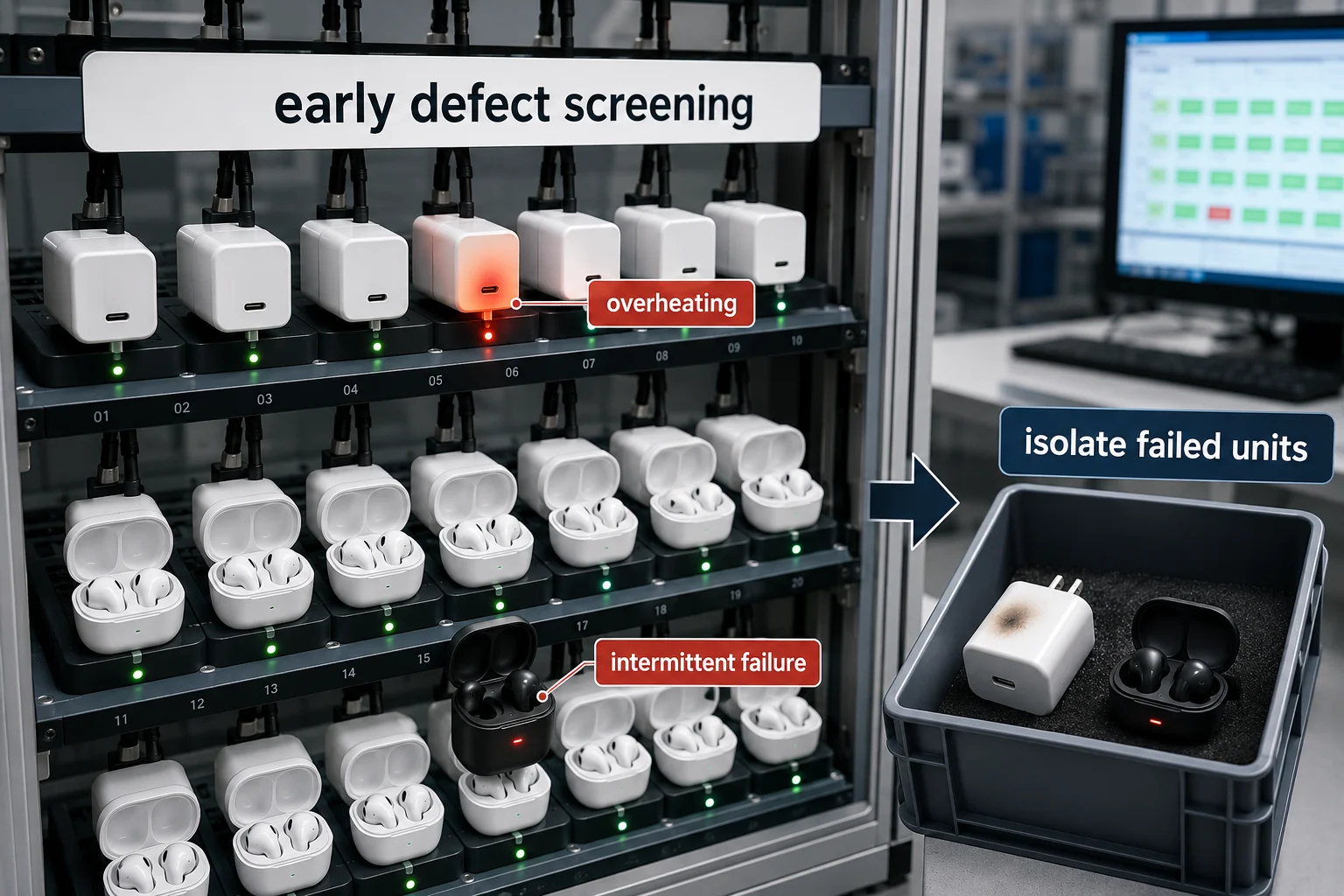
For a charger aging test, we may monitor whether the unit maintains stable charging performance while operating under an appropriate load. If a unit becomes unusually hot, disconnects, produces unstable output, or stops functioning, the team can isolate it before packing.
For TWS earbuds testing, the process may include charging the case, pairing earbuds, checking playback, and observing battery behavior. A short pairing test alone may not reveal a charging-contact issue or an intermittent connection problem.
What aging testing can realistically reveal
A well-designed process may identify:
-
Intermittent faults
A device may work, stop, and work again. These issues are difficult to catch during a one-minute test. -
Abnormal heat generation
Heat can reveal assembly problems or performance instability. The factory must define what “abnormal” means for each product. -
Charging and battery issues
Products may show incomplete charging, unstable battery indication, or uneven performance between paired devices. -
Weak solder joints or connections
A connection may fail after warm-up, movement, or ongoing electrical load. -
Assembly-related problems
Misaligned charging pins, loose parts, and poorly seated components may become visible during operation.
Still, buyers should keep expectations realistic. Aging testing does not prove that every unit will last for years. It only improves the chance of finding certain early problems under the selected test conditions.
How Long Should an Electronics Aging Test Last?
Buyers often ask us whether four hours is enough or whether eight hours is required. The honest answer is that there is no universal number. A suitable electronics aging test duration depends on the product’s main function, power level, battery design, load condition, and expected use.
A 4–8 hour electronics aging test is a common production window for many chargers, earbuds, and small consumer electronics.5 The right duration should be based on the product and test objective, not treated as a fixed quality standard for every SKU.

A practical guide to testing duration
The table below shows how factories may think about duration. It is not a universal standard or a substitute for product-specific validation.
| Product | Common focus | Possible aging-test approach |
|---|---|---|
| USB wall charger | Output stability and heat | Continuous loaded operation for several hours |
| GaN charger | Multi-port behavior and temperature | Defined loads across relevant ports |
| TWS earbuds | Charging, playback, pairing | Repeated operating and charging checks |
| Smart watch | Basic operation and charging | Powered operation plus function checks |
| Power bank | Charge/discharge behavior | Controlled cycle and output monitoring |
| USB cable | Current and data stability | Defined electrical and connection testing |
More hours do not automatically mean better quality
A 12-hour or 24-hour claim may sound impressive. However, hour count alone does not tell you whether a test has value. A long test with no real load, poor fixture contact, no temperature observation, and no post-test inspection may provide limited screening value.6
We encourage buyers to ask these questions instead:
- Is the test performed under realistic operating conditions?
- Does the factory apply a load to chargers and power products?
- Are all key functions included?
- Is testing 100% of the batch or only sampled?
- Does the team inspect products after aging?
- Does the factory record and analyze failures?
A shorter, well-controlled test can be more useful than a longer test with weak coverage.
How Does Kingfuji Run an Electronics Aging Test Process?
A factory can only benefit from an electronics aging test when it connects to a clear control loop. Products need to be checked before testing, operated under defined conditions, inspected afterward, and separated if abnormalities appear. Simply leaving cartons powered for several hours is not enough.
At Kingfuji, our electronics aging test process focuses on controlled power-on operation, relevant functional or load checks, observation of abnormal conditions, post-test verification, and isolation of failed units for review or rework. The exact plan changes by product category and customer requirements.
A practical aging-test workflow
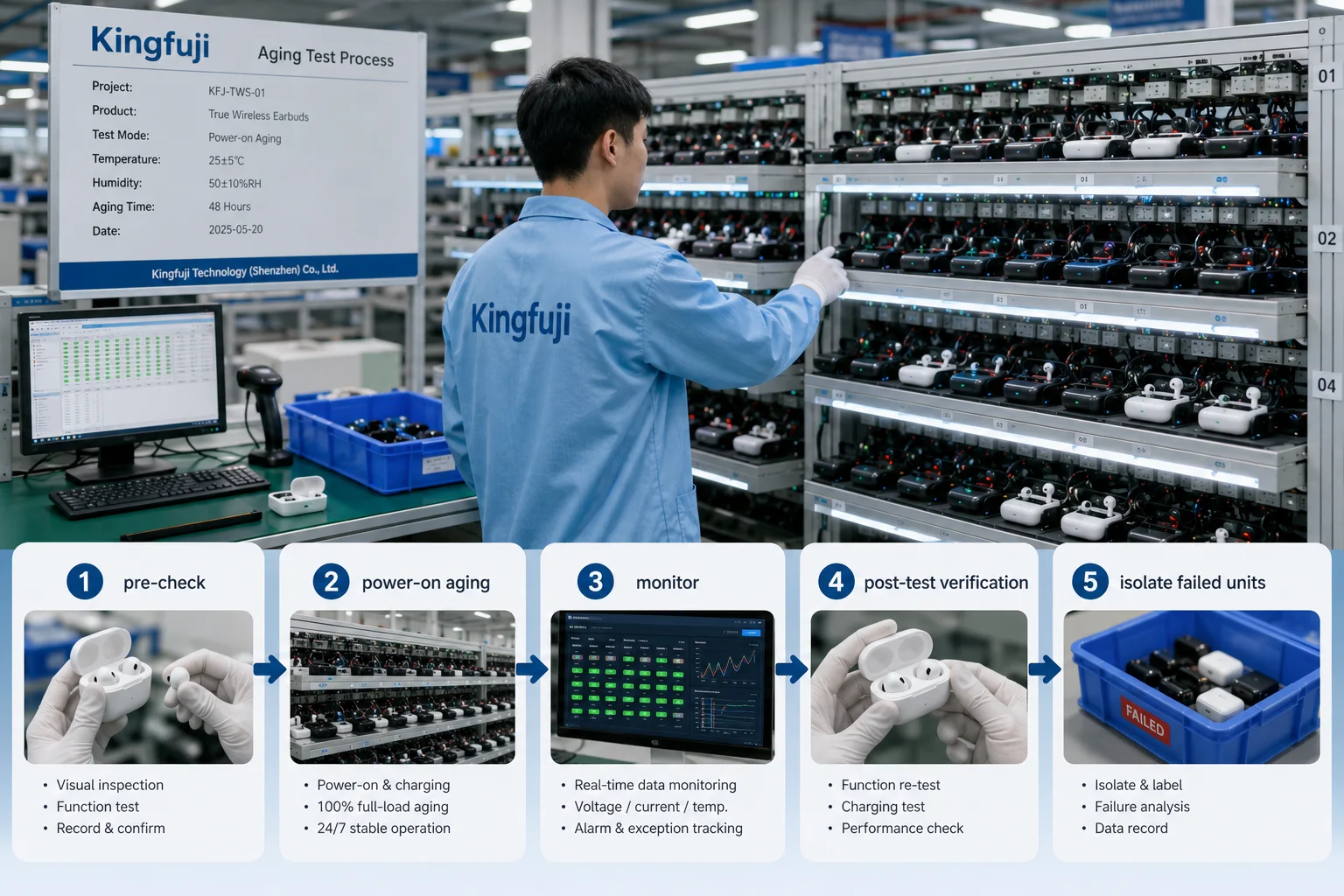
Based on our experience in outgoing QC and production support, a typical process follows these steps:
-
Pre-test inspection
Our team confirms the unit is assembled correctly and can enter the test station. We check basic appearance, connectors, and key functions. -
Power-on and fixture connection
The product is connected to the relevant power source, load device, charging fixture, or test setup. -
Continuous operation
The unit runs for the defined time. For example, chargers may supply a controlled load, while earbuds may charge and operate through selected functions. -
Temperature and behavior observation
Our operators watch for obvious abnormal heat, shutdowns, unstable output, charging failure, or inconsistent indicators. -
Post-test functional verification
The team checks whether the unit still performs the required functions after aging. -
Defect isolation and handling
Failed units are marked and separated. The team can rework, retest, or investigate the issue depending on the defect type.
Why the post-test step matters
The final check is often where buyers gain confidence. A product that survives several hours but shows a failed port, weak audio, unstable battery indication, or cosmetic damage afterward should not move directly to packing.
A meaningful aging process is not only about running products. It is about identifying anomalies and preventing those units from entering the shipment.
For OEM electronics manufacturing, we can also align the process with buyer requirements, including logo versions, plug types, packaging configurations, and agreed AQL inspection procedures.
How Do Temperature, Load Testing, and Data Logging Improve Electronics Aging Tests?
A product operates differently when it carries a real electrical load or reaches normal working temperature. This is why a stronger electronics aging test includes more than a timer. The test conditions should reflect how the product is expected to operate in the market.
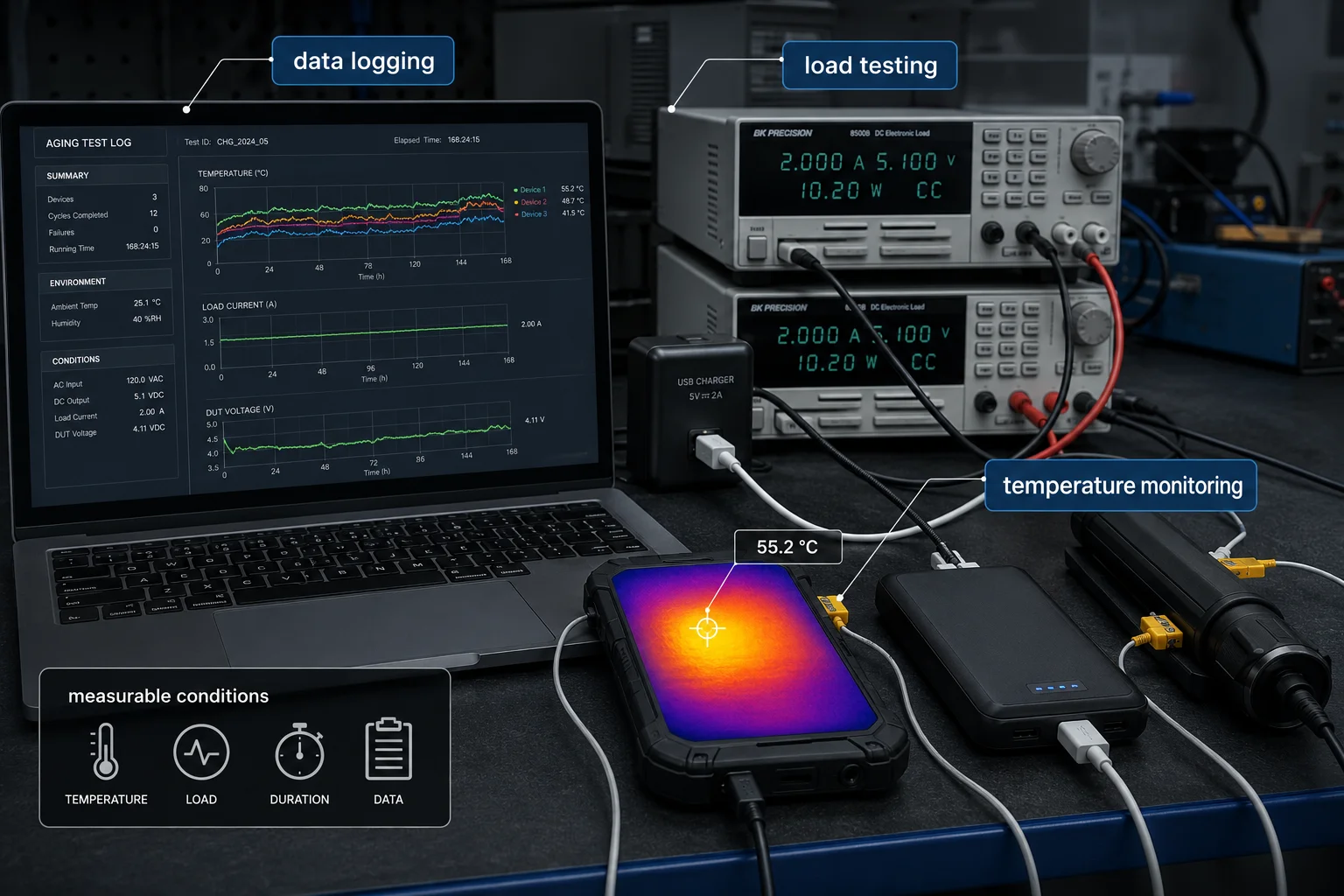
Temperature monitoring, load testing, charge-discharge checks, and data logging make an electronics aging test more meaningful because they create measurable conditions.7 These controls help factories identify unusual behavior and support better follow-up when an issue appears.
Load testing for chargers and power products
A charger without a connected load may appear normal. However, a charger’s real purpose is to deliver power to a device. A charger aging test should therefore consider output behavior under an appropriate defined load.
For USB-C charger quality control, this can include checking relevant output modes and ports based on the product specification. Multi-port chargers need extra attention because performance may change when more than one port is active.
Temperature observation
Every electronic product generates some heat during operation. The concern is not “any warmth.” The concern is unexpected or abnormal temperature behavior compared with the defined product condition.
Temperature checks can help operators identify units that:
- Become unusually hot during use
- Shut down after warming up
- Show unstable charging output
- Have inconsistent performance between units
- Display abnormal battery or indicator behavior
Data logging creates traceability
Not every factory needs laboratory-level data for every low-cost accessory. However, basic records add discipline to electronics quality control. Useful records may include:
- Test date and production batch
- Product model and color version
- Test duration
- Fixture or load condition
- Quantity tested
- Quantity passed and isolated
- Defect description
- Rework and retest result
For larger orders, these records can help a buyer and supplier discuss quality issues using facts rather than assumptions. They also make it easier to compare performance between production batches.
Electronics Aging Test vs Functional Test vs Final Inspection: What Is the Difference?
Some buyers assume that a final inspection includes everything. In reality, functional testing, aging testing, and final inspection each answer different questions. A reliable supplier should use them together rather than presenting one step as a replacement for all others.
An electronics aging test checks stability during continuous operation, while a functional test confirms basic performance and final inspection verifies shipment readiness.8 Each process catches different risks, and none should be treated as a complete replacement for the others.
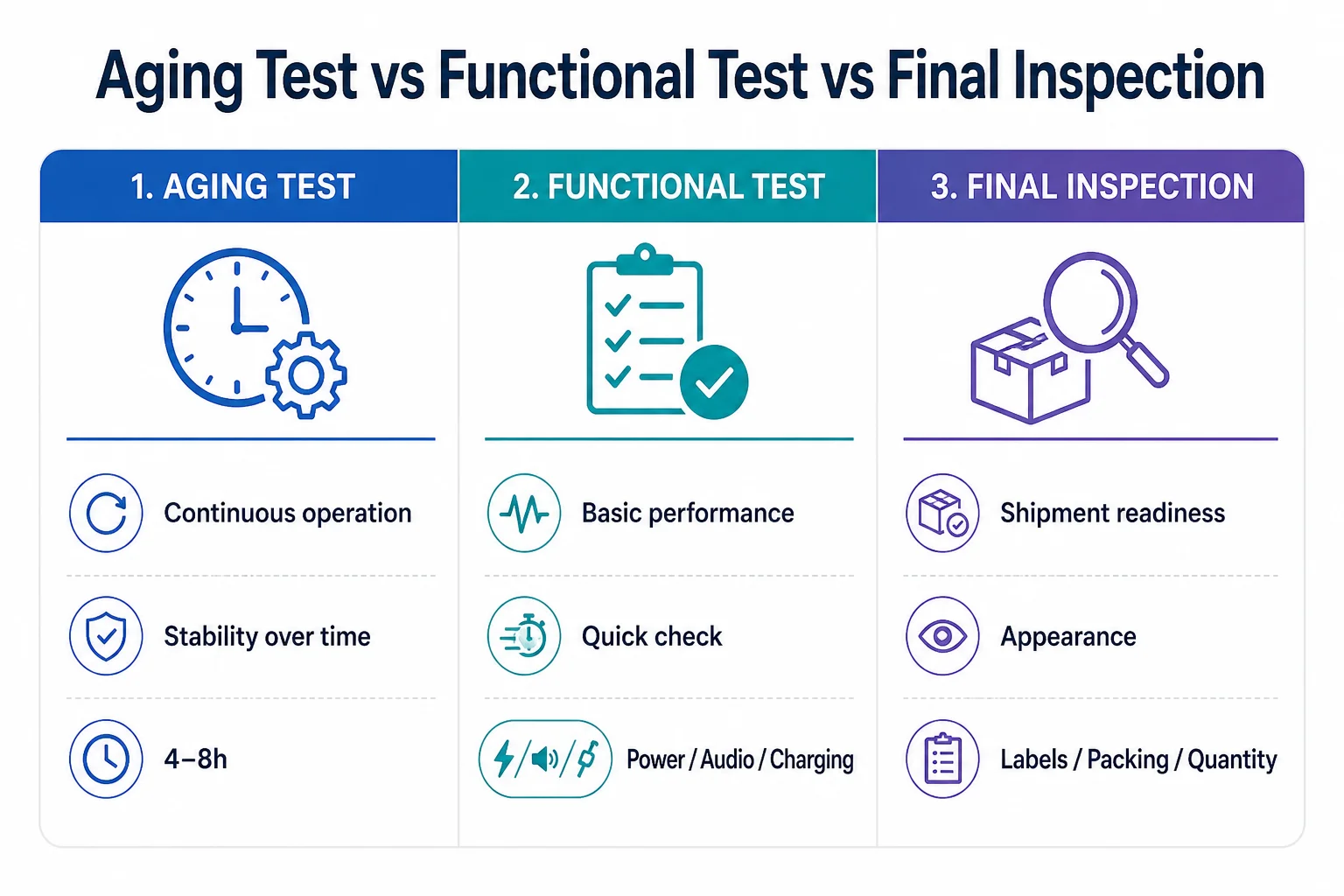
| Process | Main purpose | Typical timing | Problems it may find | Suitable for 100% checking? |
|---|---|---|---|---|
| Functional test | Confirm key functions work | During or after assembly | No power, no charging, no pairing, failed port | Often yes |
| Electronics aging test | Screen for early instability under operation | After assembly, before packing | Heat issues, intermittent faults, charging instability | Often yes for selected products; depends on capacity |
| Final inspection | Confirm appearance, quantity, packing, and agreed specifications | Before shipment | Cosmetic issues, wrong accessories, labeling errors, packing defects | Usually sample-based, but can include 100% elements |
Why buyers need all three layers
A charger may pass final appearance inspection but fail after operating under load. An earbud may pass a basic audio test but show charging inconsistency after a longer run. A product may pass aging but still have the wrong barcode or missing user manual.
This is why the best quality plan is layered:
- Incoming material control reduces component and packaging risks.
- In-process checks catch assembly errors early.
- Functional tests confirm basic operation.
- Aging tests screen for selected early-life defects.
- Final inspection confirms the order is packed correctly.
When we discuss a project with buyers, we recommend defining which checks are critical for that product instead of relying on a generic “QC passed” statement.
What Happens When Suppliers Skip Electronics Aging Testing?
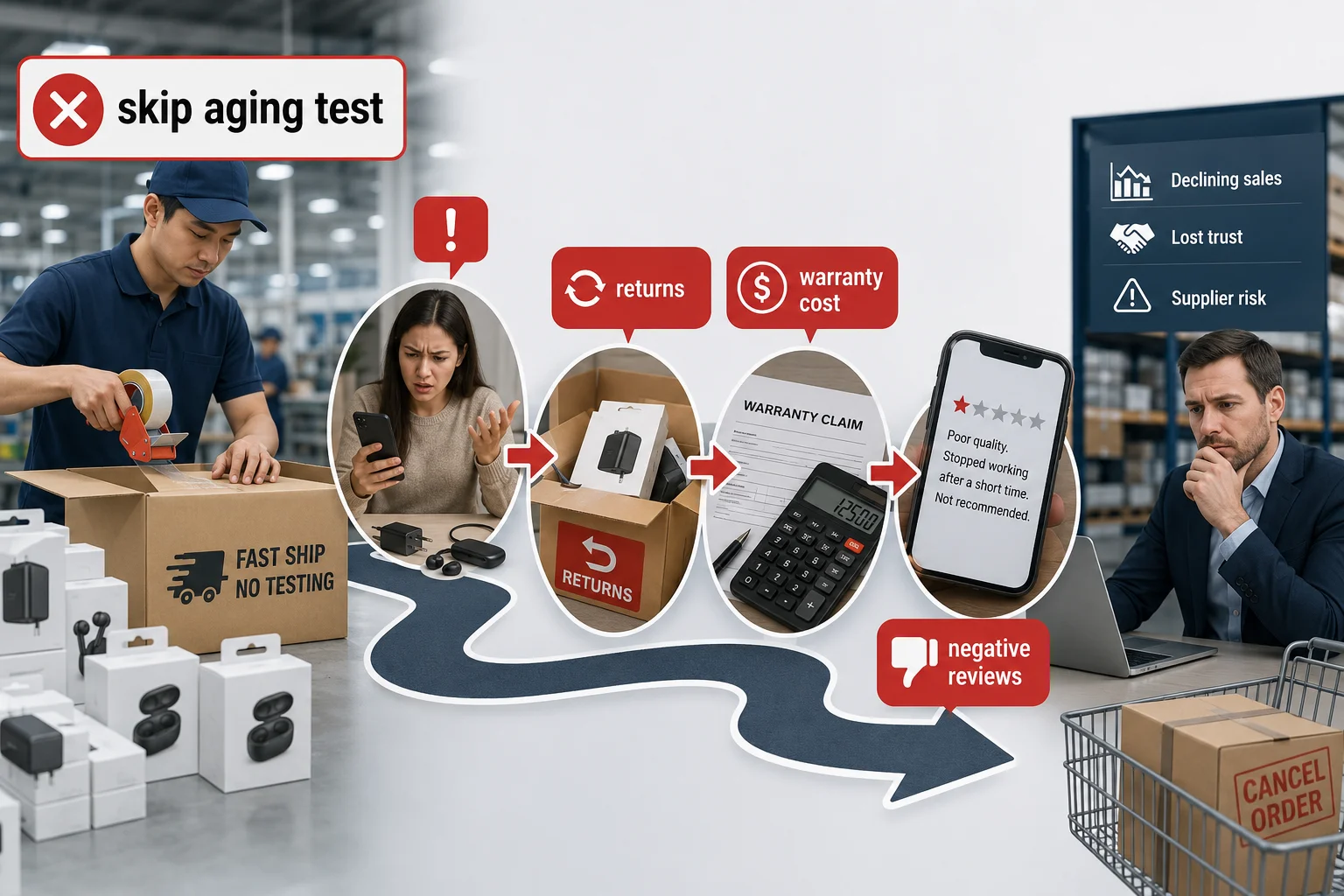
When suppliers skip an electronics aging test, they may still ship products that appear fine during a fast check. The issue is that some unstable units only show problems after continuous operation, charging, heating, or repeated connection. Those units can then become your customer-service problem.
Skipping electronics aging testing can increase the chance that early functional failures reach the market9, especially for chargers, earbuds, batteries, and connected devices. The risk depends on product complexity, component quality, production control, and the strength of other inspections.
The commercial cost can exceed the factory saving
A supplier may save time, labor, and fixture capacity by shortening or skipping aging. However, importers should look at the full cost of quality:
- Marketplace returns and refunds
- Negative product reviews
- Replacement shipments
- Customer support workload
- Retailer chargebacks
- Lost repeat orders
- Damage to a private-label brand
For an e-commerce seller, even a small number of early failures can affect listing ratings. For a chain retailer, inconsistent batches can create a larger operational issue because products may already be distributed across many locations.
The real risk is weak control, not only no aging
Aging testing alone is not magic. A supplier can run products for hours and still ship poor-quality goods if incoming components are inconsistent, the test setup is weak, or failed units are not properly isolated.
The bigger warning sign is a factory that cannot clearly explain its process. If a supplier says, “We test everything,” but cannot explain the duration, load, coverage, records, or defect handling, buyers should investigate further.
Does an Electronics Aging Test Damage Product Lifespan?
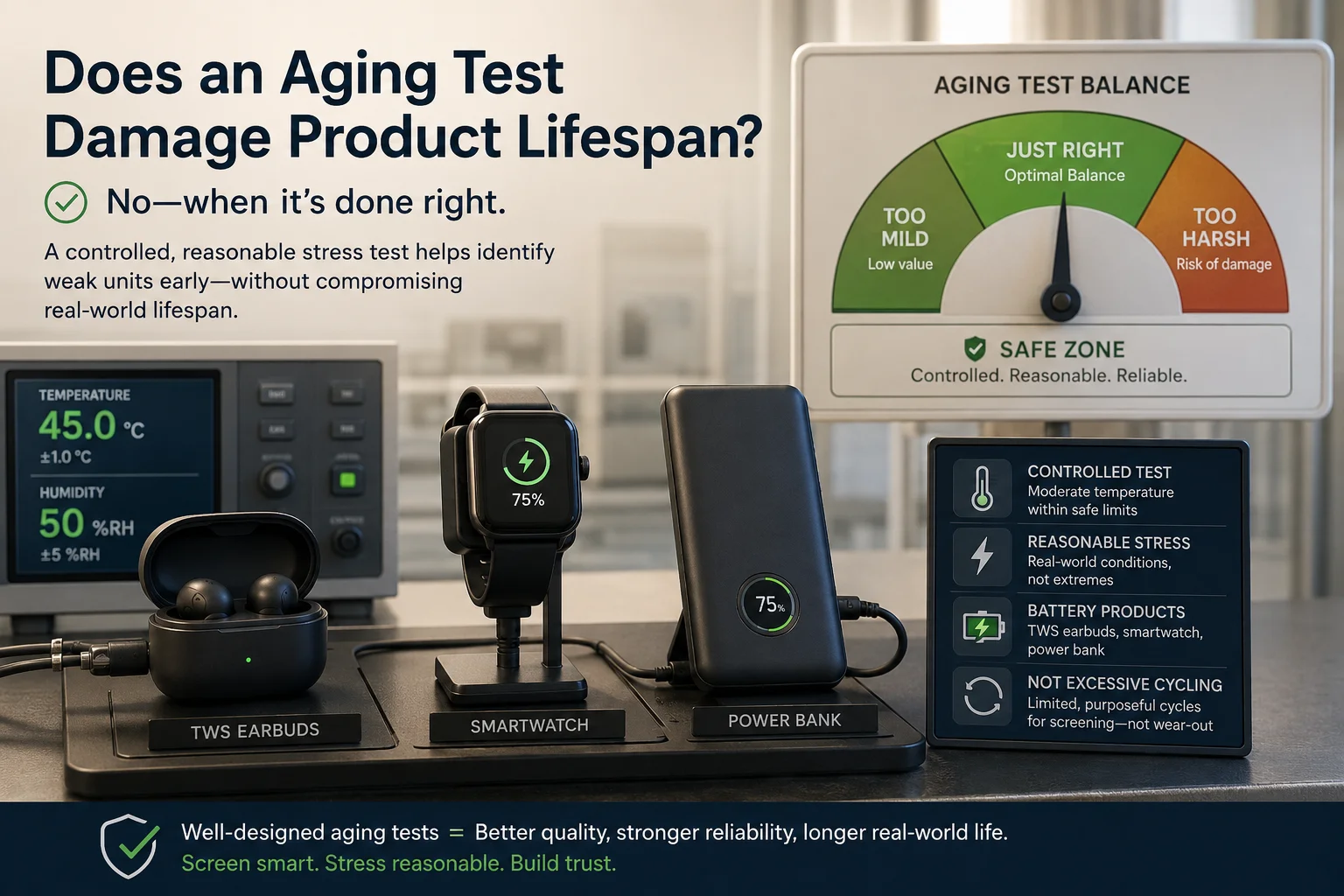
This is a fair question, especially for battery products, TWS earbuds, smart watches, and power banks. Buyers do not want a factory test to consume a meaningful part of the product’s usable life. A properly planned test should balance screening value with reasonable product handling.
A properly controlled electronics aging test is not intended to materially reduce a product’s normal lifespan.10 However, test conditions must match the product, especially for battery-powered devices, because excessive heat, unsuitable charging conditions, or unnecessary cycling can create avoidable stress.
The key issue is test design
A few hours of controlled operation is different from abusive testing. For example, a charger can operate under a defined load without being pushed outside its intended specification. An earbud can be charged, paired, and checked without repeating excessive battery cycles.
Factories should avoid treating every product identically. Battery products need particular care because battery performance depends on charging conditions, temperature, storage, and cycle history.11
What buyers should ask
Ask your supplier:
- What is the voltage, current, and load condition?
- Does the test stay within the product’s rated specification?
- How many charge-discharge cycles are included?
- Is temperature monitored or controlled?
- Does the factory conduct a post-test battery and function check?
- Are battery-powered units tested fully or sampled?
In our view, the best approach is practical and product-specific. The aim is to screen for early abnormalities without creating unnecessary stress that does not reflect intended use.
How Can You Verify a Supplier’s Electronics Aging Test Capability?
A supplier’s claim is easy to make. A credible electronics aging test capability is easier to verify when you ask detailed, practical questions. Buyers should focus on test coverage, conditions, records, and corrective action—not only on photos of racks full of products.
To verify an electronics aging test capability, buyers should review the test equipment, duration, product coverage, load conditions, sampling or 100% testing rate, records, post-test checks, and failed-unit handling process. A supplier should be able to explain each point clearly.
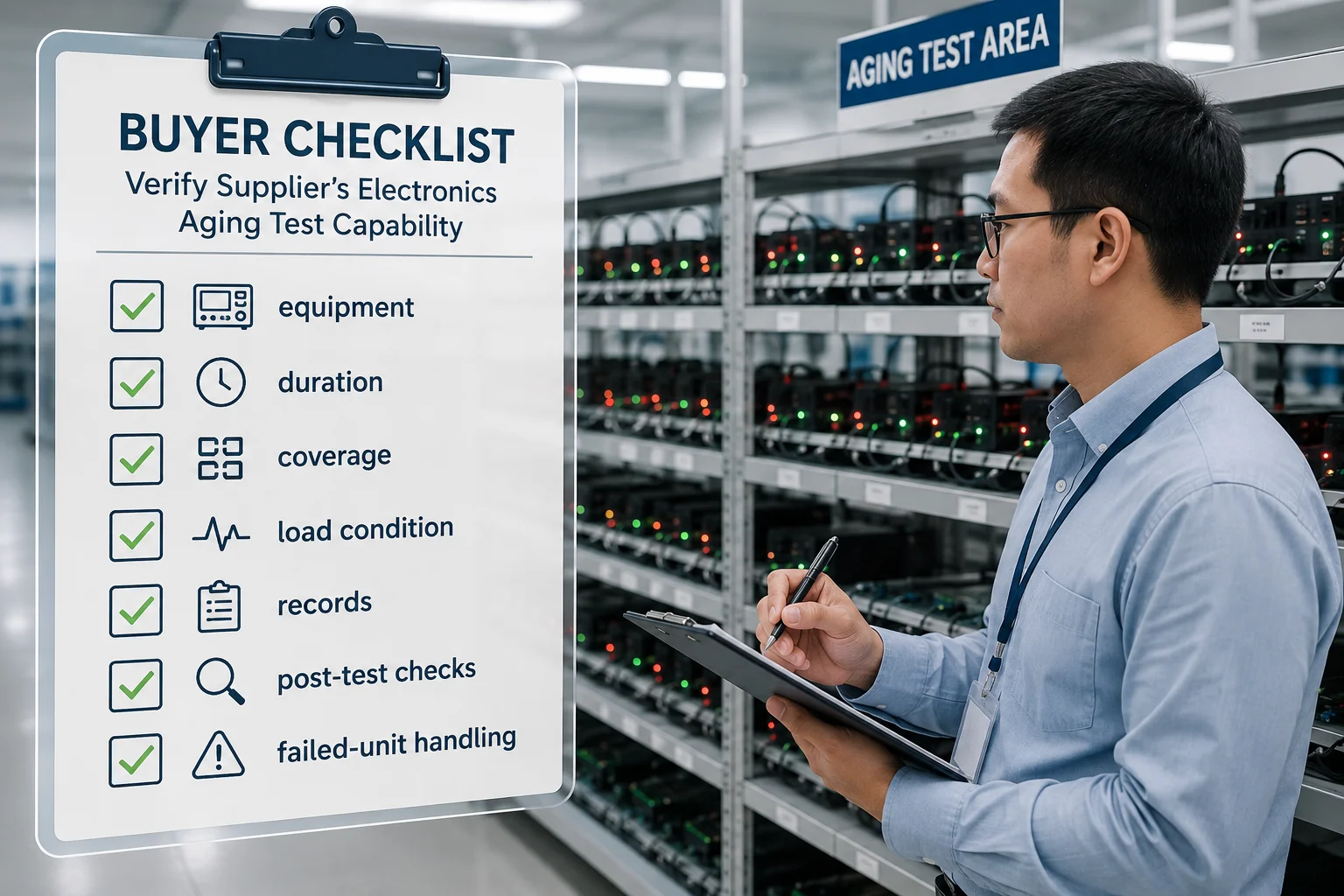
Supplier verification checklist
Use this checklist before placing a new order or scaling an existing SKU:
- Ask for the test plan. What functions run during the test?
- Confirm test duration. Is it 4 hours, 8 hours, or another defined period?
- Check coverage. Is the process 100% testing, random sampling, or only pre-shipment sampling?
- Review fixtures and loads. Are chargers tested with suitable loads? Are earbuds tested with charging and pairing functions?
- Ask about records. Can the supplier provide batch-level test records or QC reports?
- Understand failure handling. Are failed units isolated, repaired, retested, and tracked?
- Confirm post-test inspection. Does the team check key functions after aging?
- Align testing with your market. Consider plug types, USB-C protocols, packaging, labeling, and relevant compliance requirements.
- Request pre-shipment inspection options. You may use your own inspector, a third party, or an agreed factory QC report.
At Kingfuji, we work with European and North American buyers on USB cables, chargers, GaN charging heads, TWS earbuds, smart watches, and related OEM products. We can discuss a practical 100% aging-test workflow where it is appropriate for the product and order requirements.
Frequently Asked Questions
Is 4 hours enough for an electronics aging test?
Four hours can be a useful screening period for some products, but it is not a universal standard. The right duration depends on the product type, key functions, power load, battery design, and intended use. Buyers should evaluate the complete test plan, not just the hour count.
Is an electronics aging test the same as burn-in testing?
The terms are often used similarly in consumer electronics manufacturing. Both describe operating products for a defined period to identify some early failures. However, the exact conditions, duration, temperature, load, and product coverage can vary significantly between factories and product categories.
Should every charger receive a charger aging test?
For many charger projects, 100% charger aging test coverage can provide stronger early-failure screening than sampling alone.12 However, the best approach depends on order size, product complexity, factory capacity, agreed quality requirements, and the test conditions applied to each unit.
Can aging testing guarantee zero product returns?
No. Aging testing cannot guarantee zero returns or prove long-term product reliability. It can help screen for some early functional issues before shipment. Return performance also depends on component quality, assembly control, shipping, customer use, and after-sales handling.
What documents should I request from an electronics supplier?
Buyers should request product specifications, relevant certification documents, inspection standards, test plans, QC reports, packaging details, and defect-handling procedures. For private-label projects, buyers should also confirm logo artwork, labeling, manuals, barcodes, MOQ, lead time, and warranty expectations.
Conclusion
An electronics aging test is a practical quality-control step for reducing the chance that some early-life faults reach your customers. A 4–8 hour window can work well for many chargers, earbuds, and consumer electronics, but it is not a one-size-fits-all standard. Buyers should examine the test conditions, coverage, post-test inspection, and defect-handling loop. If you are sourcing OEM 3C products from China, contact Kingfuji to discuss a testing and QC plan that fits your product, market, MOQ, and delivery target.
SIO Tags: electronics aging test, electronics quality control, charger aging test, TWS earbuds testing, USB-C charger quality control, OEM electronics manufacturing, electronics product inspection, China electronics supplier
"Consumer Product Portability - as Related to Warranty", https://nvlpubs.nist.gov/nistpubs/Legacy/IR/nbsir76-1092.pdf. Research on product quality and warranty outcomes documents that early failures can generate return and service costs and can adversely affect customer satisfaction and firms' reputational outcomes. Evidence role: general_support; source type: research. Supports: The relationship between product-quality failures, warranty and return costs, customer dissatisfaction, and business performance.. Scope note: The magnitude of these effects varies by product category, sales channel, warranty terms, and the severity of the defect. ↩
"Burn-In - Integration and Test > Thermal Testing - S3VI - NASA", https://s3vi.ndc.nasa.gov/ssri-kb/topics/47/. Reliability-screening literature describes burn-in duration as a test-plan parameter selected according to the product, failure mechanisms, stress conditions, and screening objective rather than as a universal fixed interval. Evidence role: general_support; source type: research. Supports: Typical burn-in or operational-screening durations used for relevant categories of electronic equipment and the product-specific basis for selecting a duration.. Scope note: This support may not establish that 4–8 hours is common across all consumer-electronics factories or product types. ↩
"NEPP ETW 2015: Burn-in of Microcircuits", https://nepp.nasa.gov/workshops/etw2015/talks/25%20-%20Thu/1440%20-%20Burn-In%20of%20Microcircuits.pdf. Reliability-engineering literature explains that burn-in screening operates equipment under defined conditions to identify some latent defects that would otherwise contribute to early-life failure. Evidence role: mechanism; source type: paper. Supports: Burn-in and related screening methods are used to precipitate or detect certain latent defects associated with early-life failures in electronic equipment.. Scope note: Screening effectiveness depends on whether the applied stresses activate the relevant defect mechanisms; it cannot detect every defect. ↩
"Bathtub curve", https://en.wikipedia.org/wiki/Bathtub_curve. In reliability engineering, “infant mortality” refers to the early-life period in which failures may occur at a comparatively elevated rate before the product enters its normal-use phase. Evidence role: definition; source type: encyclopedia. Supports: The reliability-engineering meaning of infant mortality as an elevated failure rate during the early portion of a product's operating life.. ↩
"Burn-In - Integration and Test > Thermal Testing - S3VI - NASA", https://s3vi.ndc.nasa.gov/ssri-kb/topics/47/. Published test procedures for small electronic products can document the operational duration selected for a particular device and test objective, illustrating that duration is determined by the applicable specification and risk analysis. Evidence role: general_support; source type: other. Supports: Documented production or validation test procedures showing operational-screening durations for chargers, earbuds, or comparable small electronic devices.. Scope note: Procedures for individual products or organizations are contextual examples and do not constitute a universal standard for all chargers or earbuds. ↩
"Screening Electronic Components", https://www.fda.gov/inspections-compliance-enforcement-and-criminal-investigations/inspection-guides/screening-electronic-components. Reliability-screening guidance indicates that test effectiveness depends on applying relevant and controlled stresses, maintaining valid test interfaces, and verifying performance before and after exposure. Evidence role: mechanism; source type: paper. Supports: The validity of electronic reliability screening depends on controlled, representative stresses, sound test connections, and verification of test outcomes.. Scope note: The relative importance of load, temperature monitoring, fixture quality, and post-test inspection differs by device design and failure mechanism. ↩
"IEC TEST REPORT FORM TEMPLATE", https://www.eac.gov/sites/default/files/voting_system/files/Safety_Test_Report_ClearCast_only.pdf. Testing and quality-management standards emphasize defining test conditions, recording results, and maintaining traceability so that measured performance and nonconformities can be evaluated and investigated. Evidence role: general_support; source type: institution. Supports: The role of defined test parameters, measurement records, and traceability in evaluating electronic-product performance and investigating nonconformities.. Scope note: Standards support disciplined measurement and records but do not by themselves prove that a particular aging-test configuration will detect a particular defect. ↩
"Burn-In - Integration and Test > Thermal Testing - S3VI - NASA", https://s3vi.ndc.nasa.gov/ssri-kb/topics/47/. Quality-assurance references distinguish functional testing, operational or reliability screening, and inspection as complementary activities that assess different aspects of product conformity and performance. Evidence role: definition; source type: institution. Supports: The distinct roles of testing, inspection, and verification activities in manufacturing quality assurance.. Scope note: Terminology and process sequencing may differ among manufacturers and product-specific quality systems. ↩
"Alternative Test Methods for Electronic Parts - S3VI", https://s3vi.ndc.nasa.gov/ssri-kb/static/resources/Alternative%20Tests%20Overview%20(2).pdf. Studies of burn-in and environmental stress screening report that appropriately designed screening can identify some latent-defect units before shipment and may reduce field exposure to the failure mechanisms addressed by the test. Evidence role: mechanism; source type: paper. Supports: Reliability-screening methods can remove or identify some units with latent defects before field deployment, thereby reducing exposure to relevant early-life failure modes.. Scope note: The effect cannot be inferred for every product, because it depends on defect prevalence, stress selection, test coverage, and corrective-action effectiveness. ↩
"Field-Aging Test Bed for Behind-the-Meter PV + Energy ...", https://docs.nrel.gov/docs/fy19osti/74003.pdf. Battery-aging research shows that degradation is affected by temperature, state of charge, charge-discharge cycling, and other operating stresses; therefore, controlled testing within specified conditions can limit avoidable additional stress. Evidence role: mechanism; source type: research. Supports: Battery and electronic-product aging is influenced by temperature, charge conditions, depth of cycling, and duration of electrical stress.. Scope note: This evidence does not establish that any specific aging-test duration has no material lifetime effect for every battery chemistry, device design, or test protocol. ↩
"FY2007 NREL Energy Storage R&D Progress Report", https://docs.nrel.gov/docs/fy08osti/42716.pdf. Battery research finds that rechargeable-cell capacity retention, resistance growth, and usable performance are affected by temperature exposure, charging conditions, storage conditions, and cumulative cycling history. Evidence role: mechanism; source type: research. Supports: The effects of charging protocols, temperature, storage state, and cycling history on rechargeable-battery degradation and performance.. Scope note: The size and direction of particular effects vary with cell chemistry, cell design, state of charge, and operating profile. ↩
"6.2.2. What kinds of Lot Acceptance Sampling Plans (LASPs ...", https://www.itl.nist.gov/div898/handbook/pmc/section2/pmc22.htm. Statistical quality-control guidance distinguishes acceptance sampling from 100% inspection: testing every unit provides complete inspection coverage for defects detectable by the test, whereas sampling estimates or controls lot quality from a subset. Evidence role: general_support; source type: government. Supports: The difference between unit-by-unit inspection and acceptance sampling, including the greater unit coverage provided by 100% inspection.. Scope note: Complete coverage only improves detection for defects that the applied test can reliably reveal; it does not ensure defect-free output. ↩