Wearable health tech is no longer just about counting steps, but many buyers still struggle to separate useful health features from long sensor lists and vague AI claims. That confusion can create expensive sourcing mistakes, high return rates, and difficult customer-service questions. I believe the best opportunity is to match the right wearable to a real user habit, price point, and retail position.
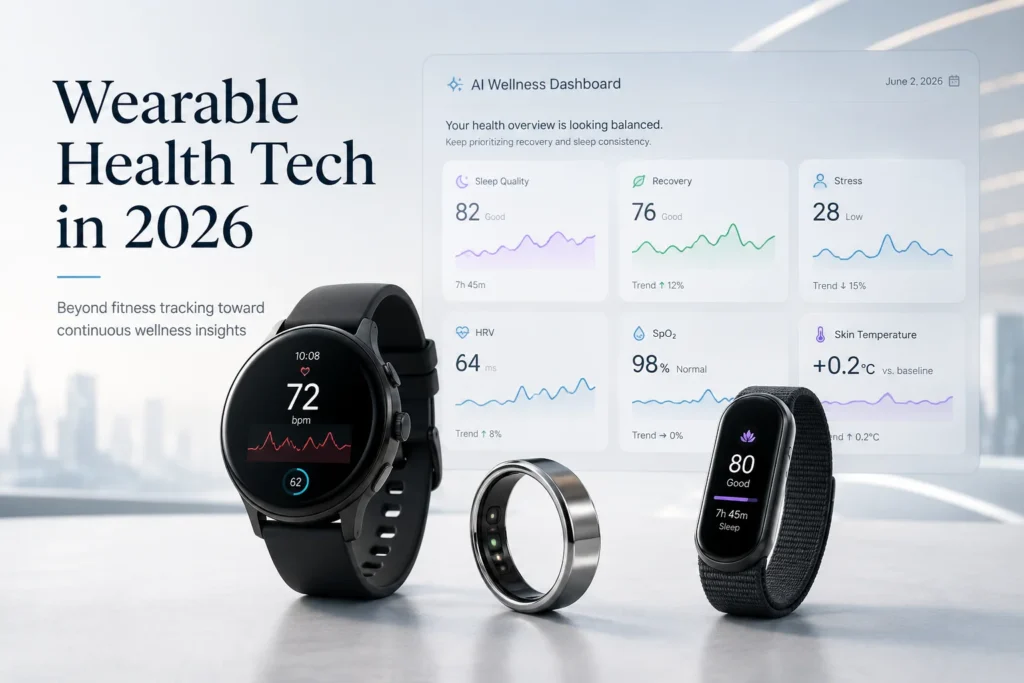
Wearable health tech in 2026 is moving beyond basic fitness tracking toward continuous wellness trends, including sleep quality, recovery, stress indicators, heart-rate variability, SpO₂, temperature trends, and AI-generated summaries. Smartwatches, smart rings, and fitness trackers each serve different users. Retailers should prioritize credible functions, clear app experiences, compliant claims, comfort, battery life, and reliable after-sales support rather than simply choosing the device with the most sensors.
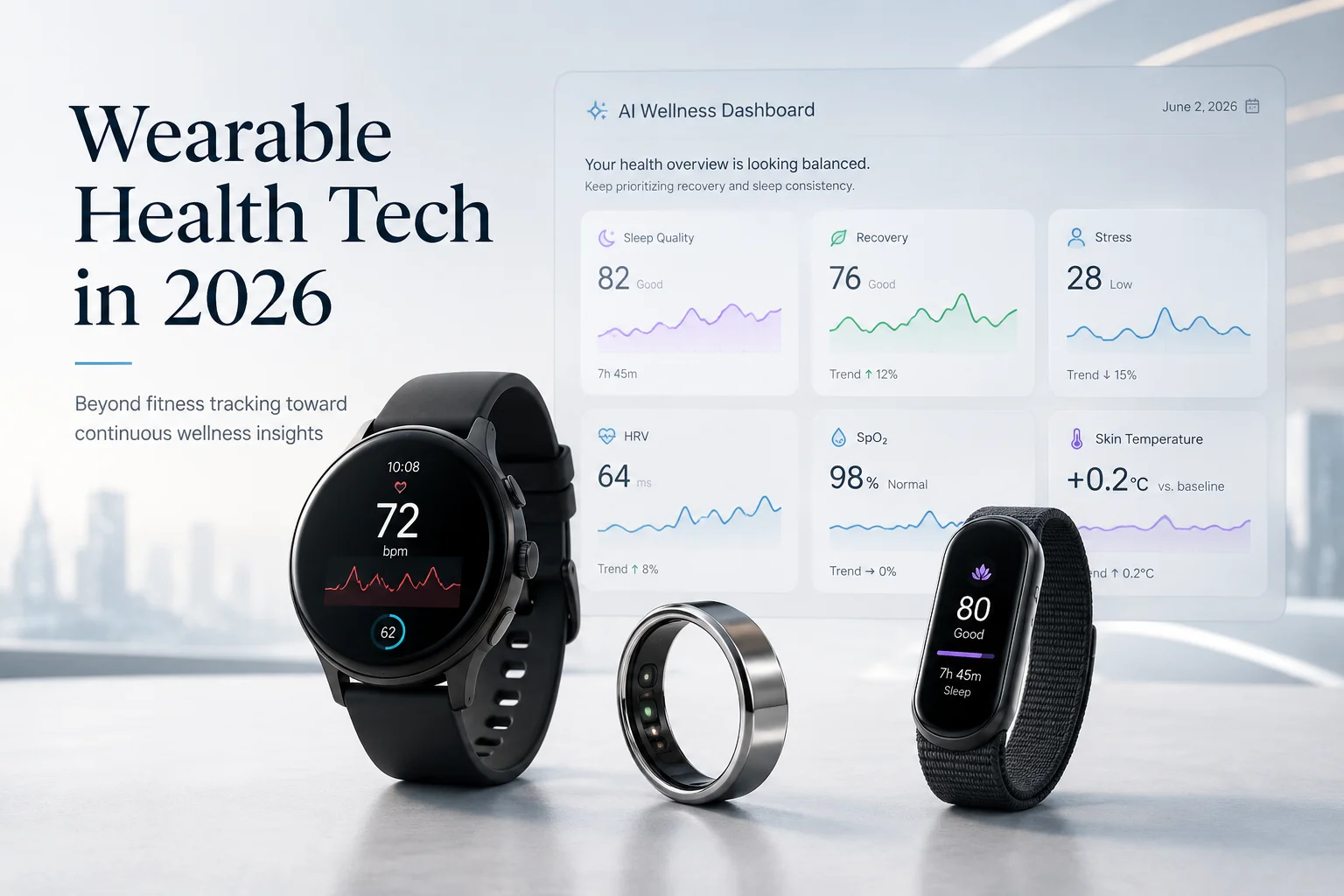
I have seen this shift in many conversations with European and American buyers. They are not only asking, “What sensors does it have?” They are also asking, “Will users understand it, wear it daily, and trust the results?” Those questions matter much more when building a scalable wearable category.
Quick Answer: Where Is Wearable Health Tech Going?
Wearable health tech can feel crowded because almost every new product promises more data. Buyers may worry that basic activity trackers are becoming outdated, while advanced devices may seem too complex or costly. The real challenge is choosing features that consumers will actually use.
Wearable technology is shifting from step counting toward multi-sensor wellness monitoring. Modern devices can combine heart rate, HRV, sleep patterns, respiratory trends, skin temperature, and activity data to provide stress, recovery, and sleep insights.1 These products should be positioned as wellness tools that show trends, not as medical diagnostic devices.
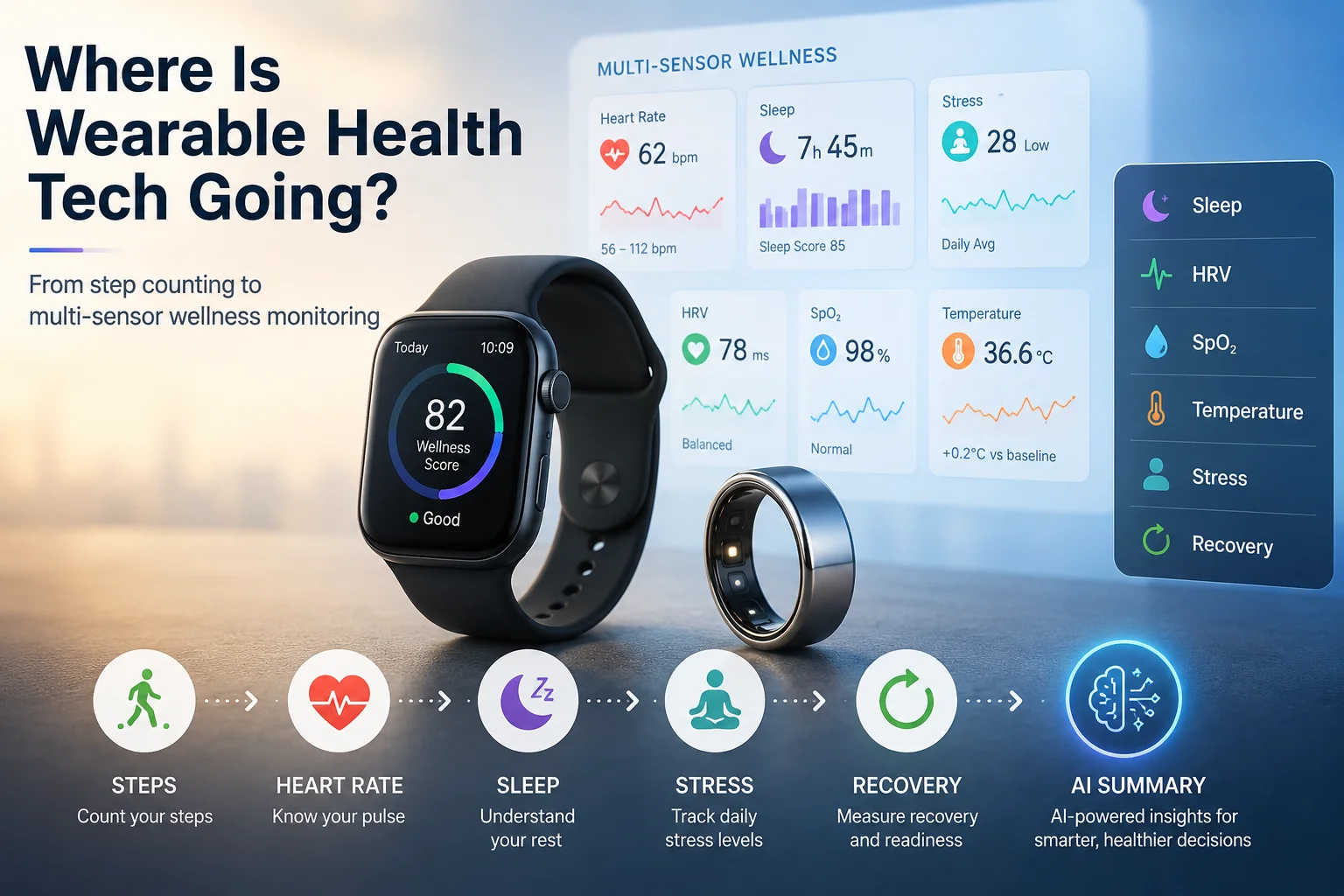
From my export experience, the strongest products usually make one daily use case easy to understand. A runner may want recovery guidance. An office worker may care about sleep and stress patterns. A frequent traveler may value comfort, battery life, and jet-lag-related sleep trends.
The opportunity is not simply to add every possible health metric. It is to build a product story around a clear customer.
What buyers should prioritize
Before selecting a model, I recommend asking:
- Who will wear it every day?
- When will they check the data?
- Which one or two health insights matter most to them?
- Can the companion app explain those insights clearly?
- Will the product claims create customer-service risk?
For example, a smart ring may work well for sleep-focused users who dislike wearing a watch at night. An advanced smartwatch may fit users who want notifications, sports modes, GPS, and on-screen feedback. A lower-cost fitness tracker can still sell well when it offers reliable essentials and a familiar user experience.
In 2026, I expect buyers to focus more on useful interpretation than raw data. A screen full of charts may impress at first, but most consumers want simple answers such as: “Was my sleep regular?” “Am I recovering well after training?” or “Has my resting heart-rate trend changed?” The products that answer those questions clearly will have better long-term retail potential.
What Is Wearable Health Technology?
Wearable health tech covers electronic devices worn on the body that collect health-related or activity-related signals and turn them into understandable wellness information. Buyers can face confusing product descriptions, especially when suppliers use similar names for very different products.
Wearable health technology includes smartwatches, smart rings, fitness bands, ear-worn devices, and connected sensors. These devices use components such as optical heart-rate sensors, accelerometers, gyroscopes, temperature sensors, and sometimes EDA sensors to track activity and wellness trends. They are generally designed for consumer monitoring, not clinical diagnosis.2
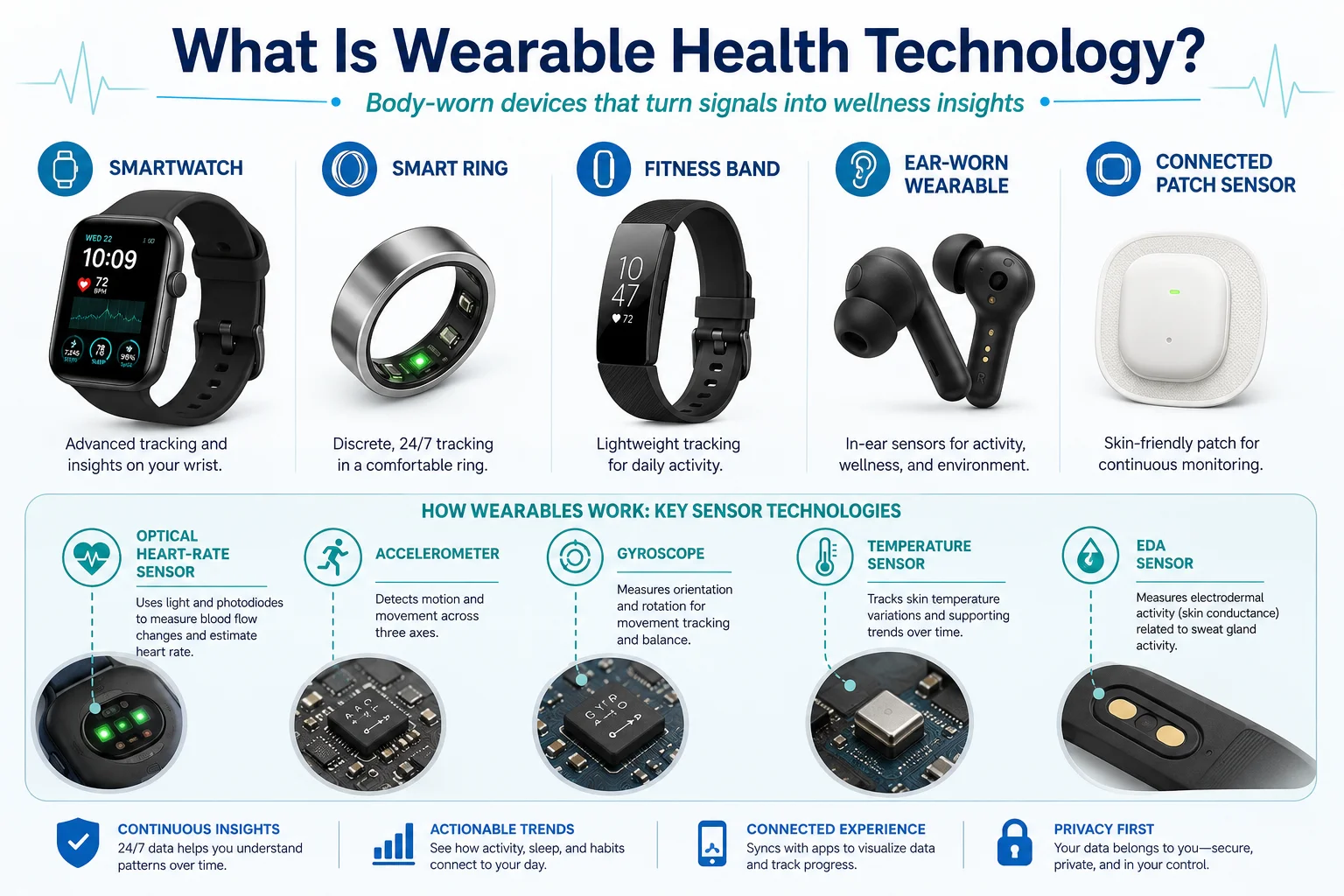
At our Shenzhen production side, I see that the hardware is only one part of the product. The complete wearable experience includes the device, firmware, mobile application, charging system, packaging, instruction manual, data handling process, and after-sales workflow.
How wearable devices collect information
Most consumer wearable health devices use a mix of sensor data:
| Sensor or data source | Common use in consumer wearables |
|---|---|
| PPG optical sensor | Heart rate, resting heart rate, HRV estimates, SpO₂ estimates |
| Accelerometer | Steps, movement, sleep timing, exercise detection |
| Gyroscope | Motion patterns and activity recognition |
| Skin temperature sensor | Temperature trend monitoring |
| EDA sensor | Stress-related physiological response estimates |
| GPS | Route, pace, distance, and outdoor sports tracking |
The device records signals, while the app applies algorithms to identify patterns.3 For example, reduced movement plus nighttime timing may suggest sleep. Heart rate and movement may help classify exercise intensity. A recovery score may combine sleep, HRV trends, resting heart rate, and recent activity.
However, I always tell buyers that data collection does not automatically equal meaningful insight. Wear position, skin contact, movement, charging habits, firmware quality, and app logic all affect the user experience.4 A good product needs sensible sensor placement, stable Bluetooth connectivity, intuitive screens, and transparent explanations.
A retailer should also distinguish between a feature that is technically available and a feature that is commercially ready. If a function is difficult to explain in a product listing, customers may misunderstand it. That can increase negative reviews even when the hardware itself works as designed.
How Has Wearable Health Tech Moved Beyond Fitness Tracking?
Wearable health tech once focused mainly on steps, calorie estimates, and basic heart-rate readings. Those features remain important, but they are now common. Buyers need a clearer reason for customers to upgrade, especially in competitive online marketplaces.
Modern wearable health devices increasingly offer sleep-stage estimates, respiratory trends, blood-oxygen estimates, HRV trends, stress scores, temperature trends, and recovery guidance.5 These features can help users notice patterns in daily wellness, training load, rest, and routines. They should not be marketed as disease detection or treatment.
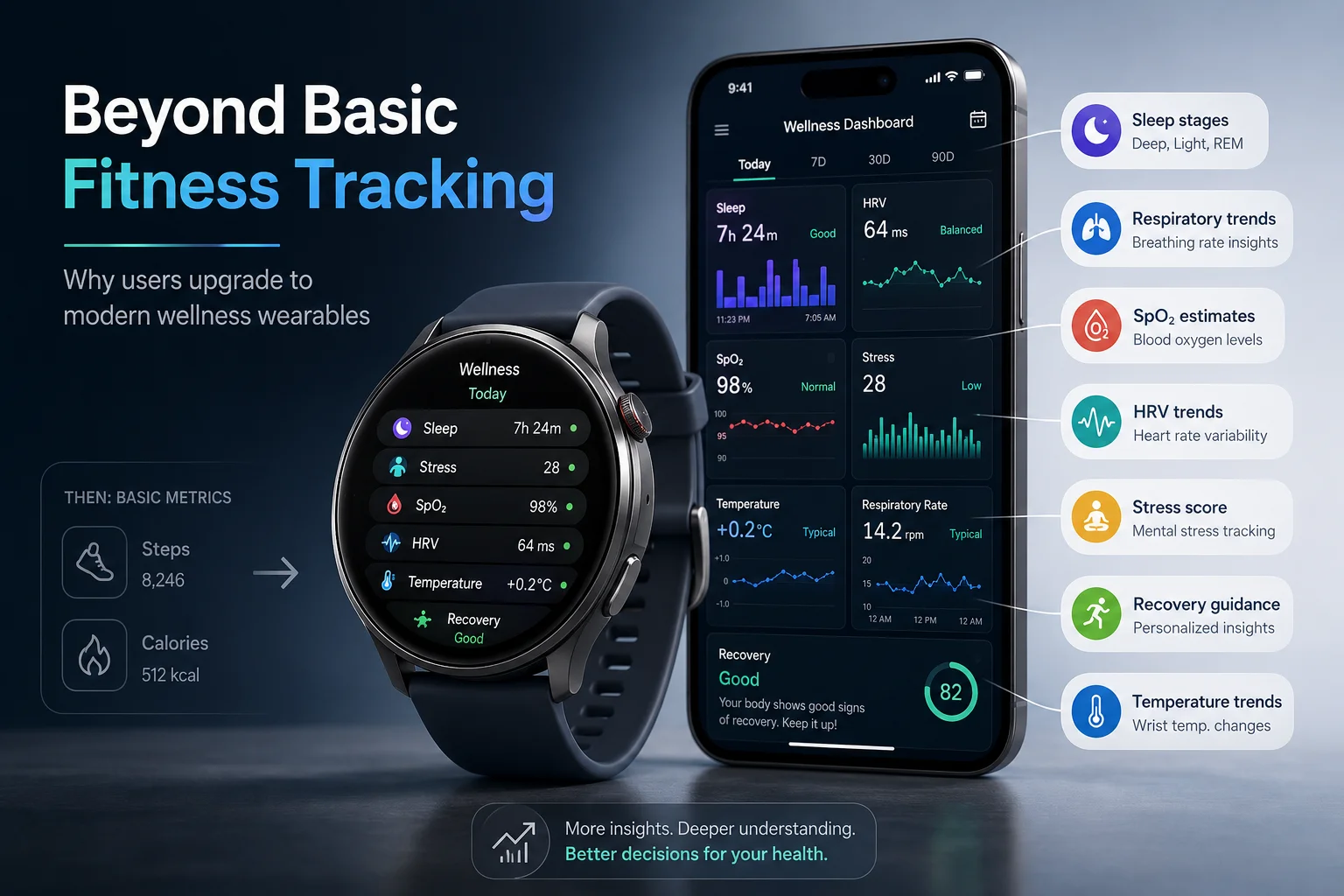
The move toward advanced monitoring is driven by a simple consumer behavior: people want context. A user may accept that they slept for seven hours, but they may also want to know whether their sleep schedule was consistent, whether they woke frequently, or whether their overnight heart-rate trend changed.
The new layer: trends, not isolated numbers
A single measurement rarely tells the whole story.6 The more useful consumer experience is often a trend over days or weeks.
For example:
- Heart rate: A daily resting heart-rate trend can be easier to understand than one isolated reading.
- HRV: A trend may support recovery and readiness discussions, especially for sports users.
- Sleep: Sleep duration, timing consistency, interruptions, and sleep-stage estimates can support better routines.
- SpO₂: This feature is often used for general wellness observation, but buyers must avoid overstating what it can prove.
- Temperature trends: These may help users observe changes from their personal baseline.
- Stress indicators: These often combine heart-rate patterns, HRV, EDA, activity, and context.
I have noticed that many buyers initially request every available sensor. After reviewing samples, they often narrow the project to the functions that match their market. A chain retailer may prefer an easy-to-use smartwatch with broad appeal. A sports brand may want deeper recovery dashboards. A fashion-oriented e-commerce seller may prefer a slim smart ring with a strong sleep story.
That is why I recommend building the feature set around the user journey. A device should give users a reason to wear it in the morning, during work, during exercise, and at night. If the product only looks impressive on a specification sheet, it may not generate repeat interest after purchase.
Non-Invasive Glucose Monitoring: Is It Ready for Wholesale?
Non-invasive glucose monitoring attracts strong attention because it sounds like a major breakthrough. However, it also creates one of the highest risks for retailers, importers, and online sellers. Overpromising in this area can quickly damage brand trust.
At present, buyers should treat glucose-related wearable claims with caution. A consumer wearable should not be promoted as measuring blood glucose unless the product has appropriate evidence, regulatory authorization where required, and clear documentation for the intended market.7 General wellness data is not a substitute for glucose testing or medical advice.
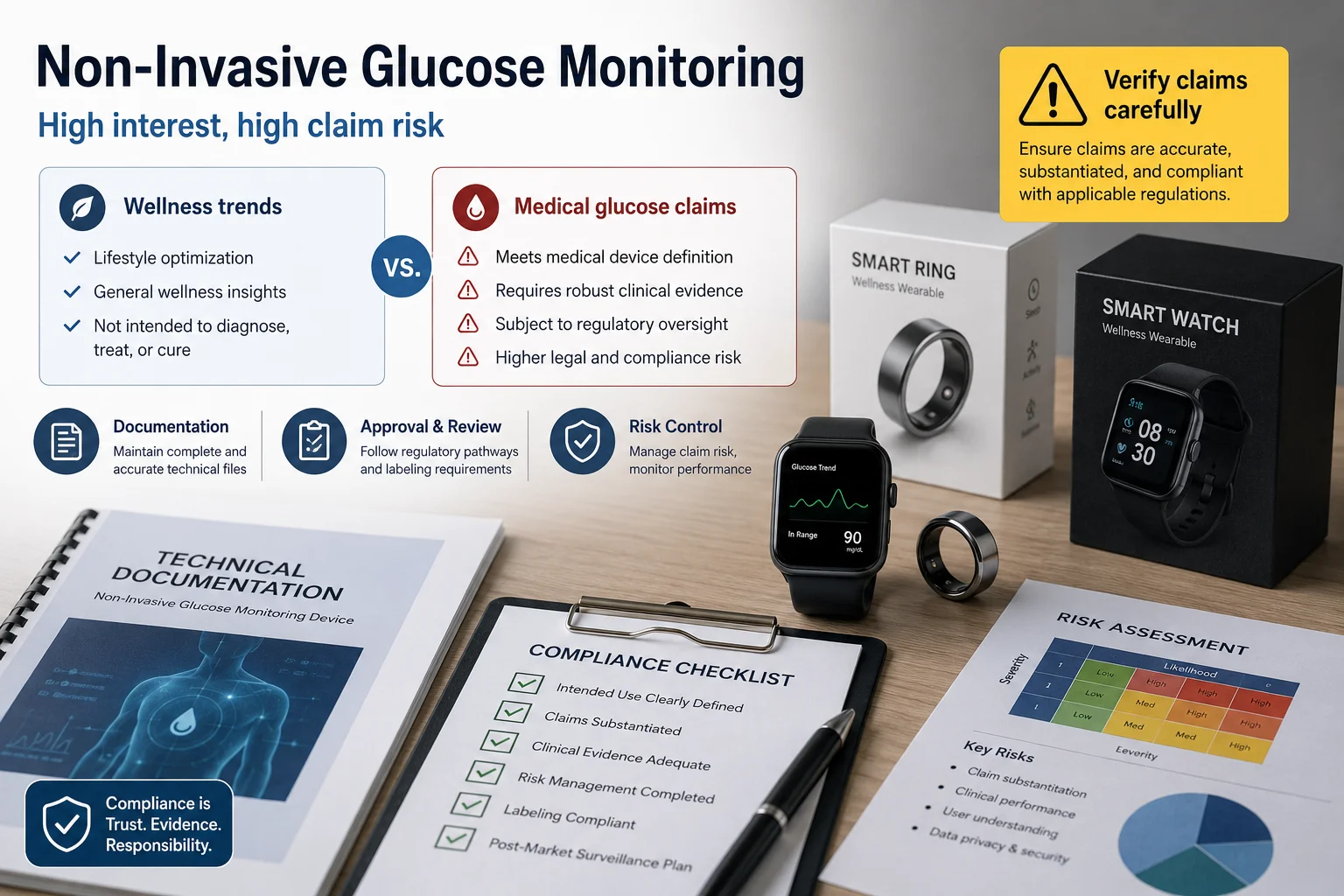
I frequently receive questions about “blood sugar smartwatches.” My first response is always practical: ask what the device actually measures, how it measures it, what claim is being made, and which documents support that claim. A colorful app screen is not proof of measurement accuracy.
Why this category needs extra caution
Glucose measurement is technically difficult because blood glucose is not a simple external signal. Optical sensors can observe certain skin and blood-flow-related signals, but turning those signals into reliable glucose values is a very different challenge.8
Wholesale buyers should verify:
- The exact intended use stated by the supplier.
- Whether the product provides a direct value, an estimate, or only a wellness-related trend.
- The testing method and documentation behind any accuracy statement.
- The target-market regulatory requirements.
- The product listing language used by distributors and resellers.
- The after-sales plan for customer questions and refund requests.
I advise buyers not to use language such as “diagnoses diabetes,” “replaces blood testing,” or “prevents disease” for ordinary consumer wellness wearables.
A safer commercial route may be to focus on validated mainstream features such as heart rate, sleep, activity, recovery trends, and stress-related wellness insights. These categories still offer strong demand without creating the same level of claim risk.
For brands that want to explore glucose-related innovation, I recommend a roadmap approach. Start with research, documentation review, controlled market positioning, and legal guidance for each destination market. This is not a category where unit price should be the main decision factor.
How Is AI Health Monitoring Turning Data into Insights?
Wearable health tech generates large amounts of data, but raw numbers can overwhelm users. Buyers may add AI labels because the term is popular, yet an unclear AI experience can create more confusion than value.
AI health monitoring can combine multiple wearable signals to create personalized summaries, sleep suggestions, recovery scores, stress alerts, and long-term trend reports. The best consumer-facing AI explains patterns in plain language and acknowledges that its insights are informational wellness guidance, not diagnosis or treatment.
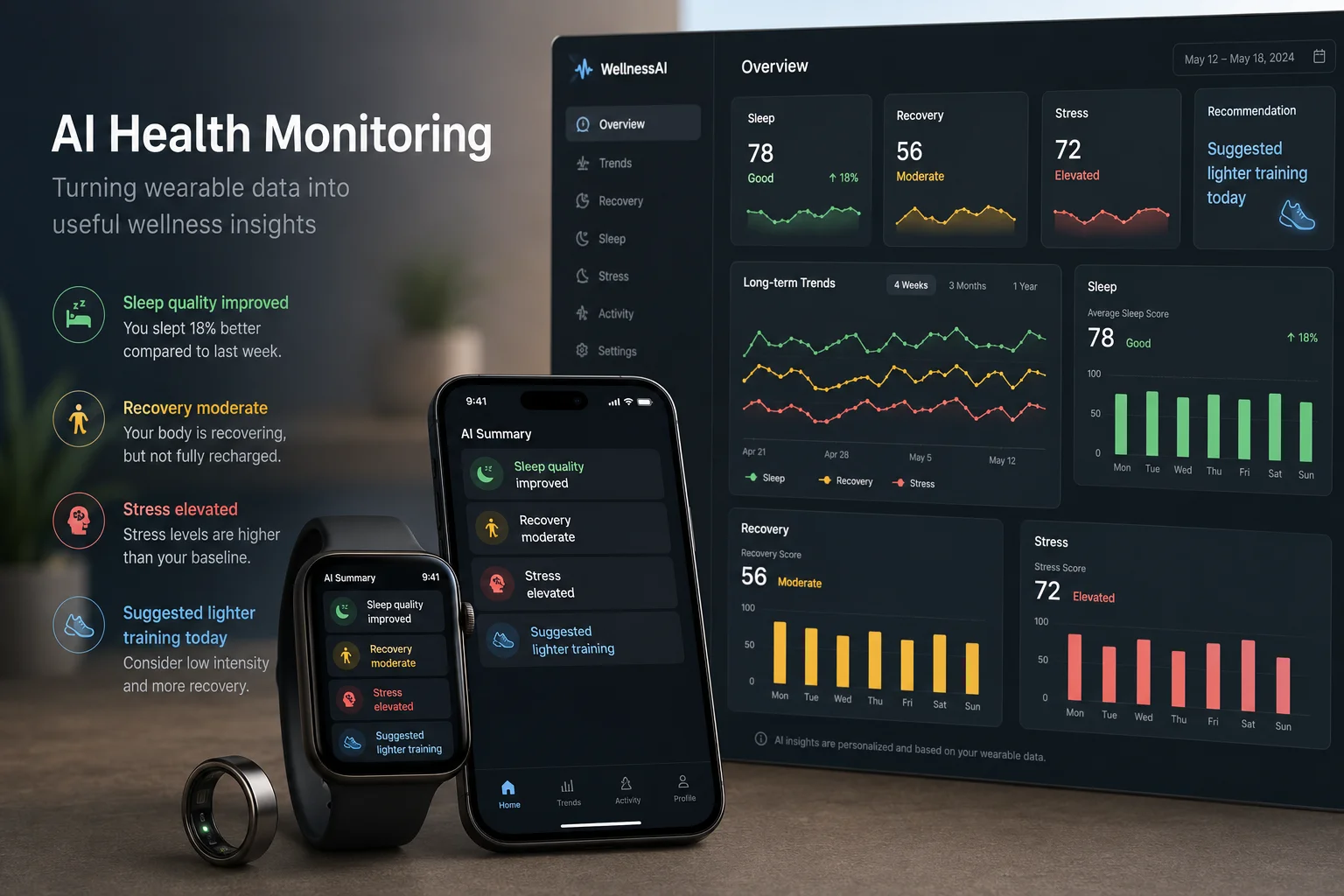
In my view, AI should make the app simpler, not more complicated. If a consumer has to study five charts to understand a recommendation, the feature may not deliver commercial value.
What useful wearable AI looks like
A well-designed AI health monitoring experience may do the following:
- Compare a user’s current data with their personal historical baseline.
- Highlight changes in sleep timing or recovery trends.
- Summarize weekly activity patterns.
- Suggest a lighter training day after poor sleep or unusual fatigue indicators.
- Explain stress-related patterns in simple, non-alarming language.
- Turn many metrics into one clear daily or weekly summary.
The important word is personalized. A high resting heart rate may be normal for one person and unusual for another. AI systems can become more helpful when they focus on individual trends rather than presenting universal “good” or “bad” judgments.
However, retailers should ask careful questions about AI claims. Is the feature running on the device, in the cloud, or through the mobile app? Which languages does it support? Does it require a subscription? What happens when data is missing? Is the explanation easy for a first-time user to understand?
For an OEM health smartwatch project, I also recommend reviewing the app interface before confirming hardware. A premium watch with a weak app can feel like a low-value product. Meanwhile, a well-designed app can make a mid-range wearable much more competitive.
Data privacy matters as well. European buyers, in particular, often ask where data is processed, what user permissions are collected, and whether the app’s privacy policy is appropriate for their sales channel. These are important commercial questions, not just technical details.
What Is EDA and How Does Wearable Health Tech Track Stress?
Wearable health tech often includes stress monitoring, but consumers may not understand how those scores are created. If retailers use simplistic language, customers may assume that a watch or ring can identify the exact cause of stress, which is not realistic.
EDA, or electrodermal activity, measures changes in the skin’s electrical conductance that can be associated with sweat-gland activity.9 Wearables may combine EDA with heart rate, HRV, skin temperature, movement, and sleep data to estimate stress or recovery patterns.10 These estimates are wellness indicators, not mental-health diagnoses.
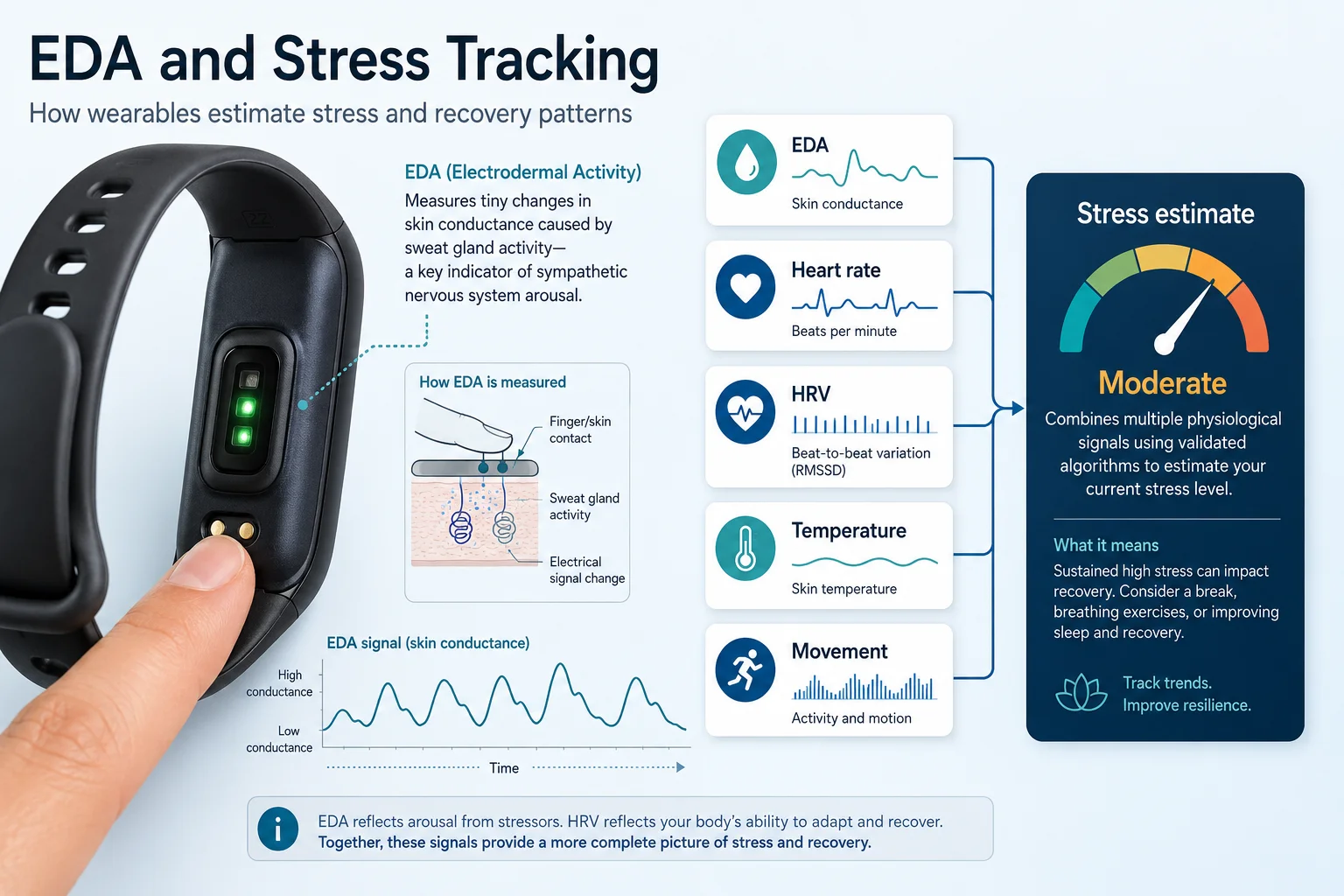
Stress is personal and context-dependent. A high-intensity workout, a busy commute, caffeine, poor sleep, or an important meeting may affect physiological signals. That is why a stress score should be interpreted as a prompt for reflection, not as a definitive answer.
Signals commonly used for stress estimates
| Signal | How it may contribute |
|---|---|
| HRV trend | May reflect changes in autonomic nervous system activity |
| Heart rate | Can show elevated physiological activity |
| EDA | May detect skin conductance changes linked to arousal |
| Skin temperature | Can add context to personal baseline changes |
| Movement data | Helps separate exercise from sedentary periods |
| Sleep data | Helps explain fatigue and recovery patterns |
For sourcing, sensor quality and wearing comfort are especially important. An EDA sensor cannot perform consistently if contact with the skin is poor. A ring that rotates too easily or a watch strap that users wear loosely can affect readings. This is why physical design and fit testing matter as much as the feature list.
I recommend that brands use plain language in listings: “stress trend,” “daily wellness score,” or “guided breathing reminder” are generally clearer than dramatic promises. A useful product can encourage users to pause, breathe, rest, or recognize patterns. It should not claim to diagnose anxiety, depression, burnout, or any medical condition.
Wearable Health Tech Comparison: Smart Rings, Smartwatches, and Fitness Trackers?
Buyers often ask whether smart rings will replace smartwatches. I do not see them as direct replacements. Each form factor solves a different problem, and each creates different sourcing, pricing, and customer-support considerations.
Smart rings are often best for discreet, screen-free sleep and wellness tracking. Advanced health smartwatches offer richer interaction, sports functions, and notifications. Fitness trackers remain accessible, lightweight options for everyday activity monitoring. The right category depends on comfort, user behavior, target price, and expected feature depth.
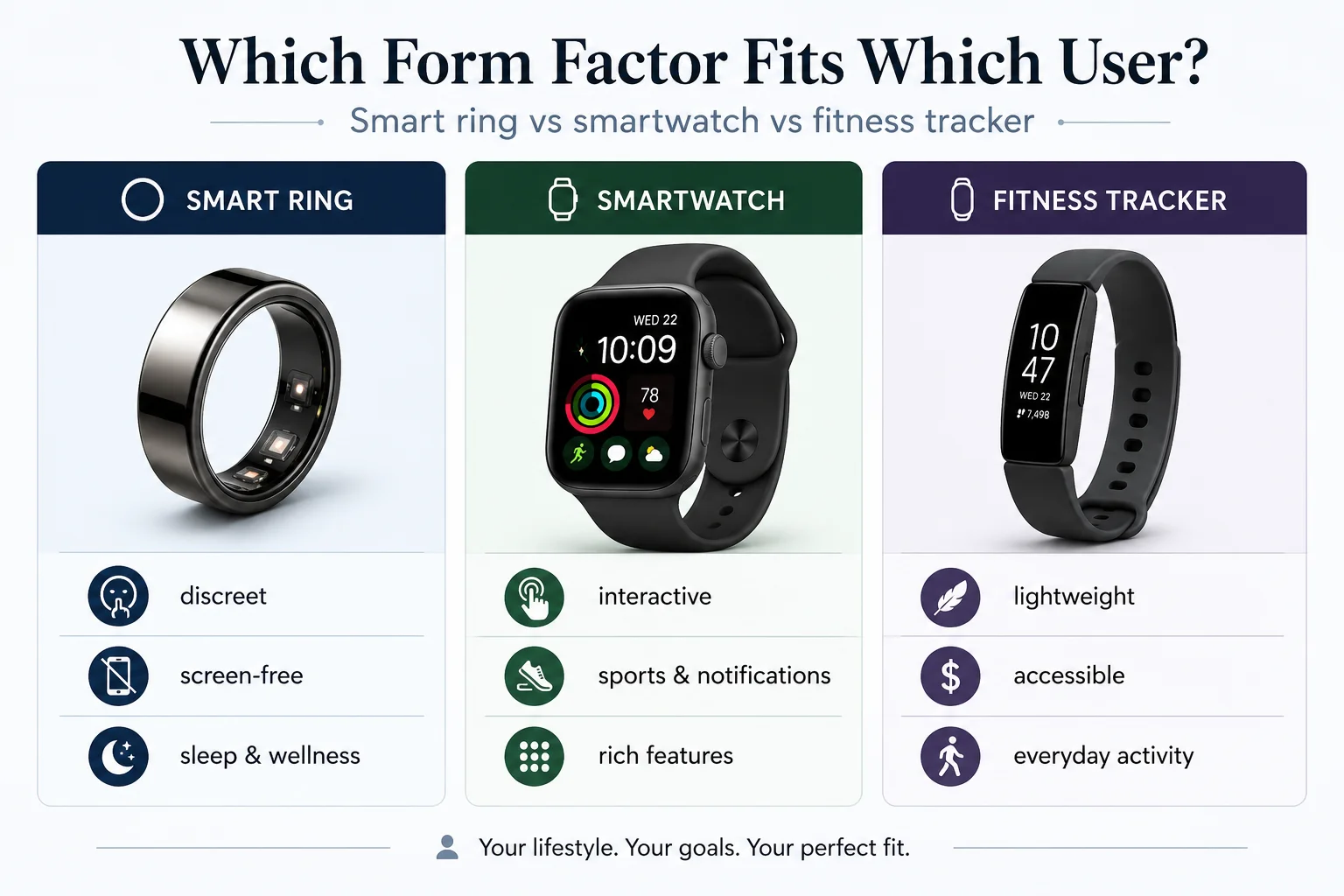
| Feature | Smart Rings | Advanced Health Smartwatches | Fitness Trackers |
|---|---|---|---|
| Typical sensors | Heart rate, SpO₂, temperature, motion | Broad multi-sensor sets, GPS on some models | Core heart rate and motion sensors |
| Battery life | Often several days | Usually 1–10 days depending on display and GPS | Often 5–14 days |
| Screen experience | Usually no screen | Full display and notifications | Small display or simple interface |
| Comfort for sleep | Often strong if sizing is correct | Depends on case size and strap | Usually light and comfortable |
| Best users | Sleep, recovery, discreet wellness users | Active users, connected lifestyle users | Value-focused everyday users |
| Customization | Finish, logo, packaging, app branding | Case, strap, UI, logo, packaging, app | Strap, logo, packaging, selected UI |
| MOQ considerations | Often higher due to sizing and tooling needs | Depends on chipset, display, and customization | Often more flexible for standard models |
| Wholesale opportunity | Premium and fashion-wellness niches | Broad retail and branded OEM programs | Mass-market and promotional channels |
Smart ring sizing is a major operational issue. Buyers need to consider sample sizing kits, ring-size forecasting, exchanges, and inventory planning. I have seen projects where a beautiful ring design created avoidable returns because the size-selection process was not clear enough.
Smartwatches bring more opportunities for customization. Brands can choose straps, watch faces, packaging, languages, app branding, and selected firmware functions. However, larger screens and more functions can mean more battery-management expectations.
Fitness trackers remain relevant because they are easy to understand and cost-effective. For many wholesale wearable technology customers, a dependable tracker with good battery life and clear health basics may outperform a premium product with a confusing value proposition.
Medical-Grade Wearables vs Consumer Wellness Devices?
Wearable health tech is often marketed with health-focused language, which can blur the line between consumer wellness products and medical devices. This confusion can create compliance issues and customer disappointment, especially when products are sold across different markets.
Medical-grade wearables are intended for specific medical purposes and may require formal regulatory pathways, clinical evaluation, and controlled claims.11 Consumer wellness devices typically support general activity, sleep, fitness, and lifestyle monitoring. Certification documents for electronics do not automatically prove medical accuracy or clinical effectiveness.12
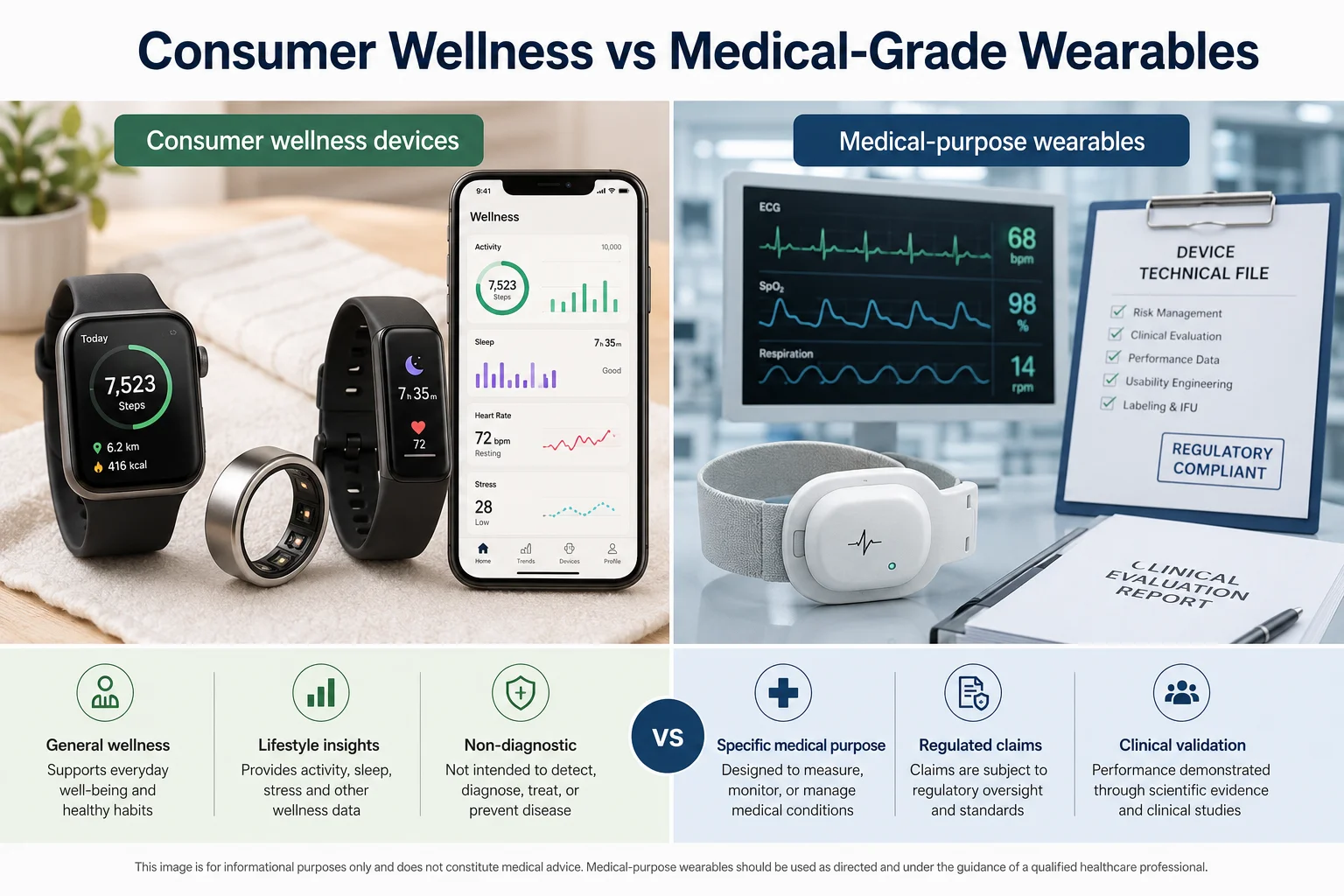
For retailers, the most important issue is usually intended use. What does the product say it is designed to do? Does the packaging, manual, product page, or advertisement imply diagnosis, treatment, or disease prevention?
Key differences buyers should understand
| Area | Consumer wellness wearable | Medical-oriented wearable |
|---|---|---|
| Main purpose | Lifestyle, fitness, and wellness trends | Specific medical intended use |
| Typical claims | Activity, sleep, heart-rate trends, wellness insights | Claims tied to authorized medical use |
| Data interpretation | Informational and trend-based | May support clinical workflows under defined conditions |
| Testing needs | Product quality, safety, performance, market compliance | May require additional clinical and regulatory evidence |
| Marketing risk | Moderate if claims are clear | High if claims exceed authorization |
I always recommend that buyers review product copy as carefully as they review samples. A product may be suitable for a consumer wellness category, but a reseller can create risk by adding unsupported words such as “medical,” “diagnostic,” or “disease detection.”
For Europe and the United States, requirements can depend on the exact product function, intended use, distribution model, and marketing language. Buyers should consult qualified regulatory and legal specialists for their specific products and markets. From a manufacturing perspective, we can provide relevant product documentation and testing support, but each importer still needs to confirm the final compliance route.
What Wholesale and OEM Opportunities Exist in Wearable Health Tech?
Wearable health tech offers strong product-development opportunities, but broad market demand does not mean every wearable should target every user. Buyers can lose focus when they try to sell one model to athletes, seniors, fashion consumers, and corporate wellness programs at the same time.
The best wholesale wearable technology opportunities come from focused product positioning. Promising segments include advanced health smartwatches, smart rings, sleep tracking devices, women’s wellness-focused products, elderly-care support devices, sports recovery wearables, and branded companion-app programs.
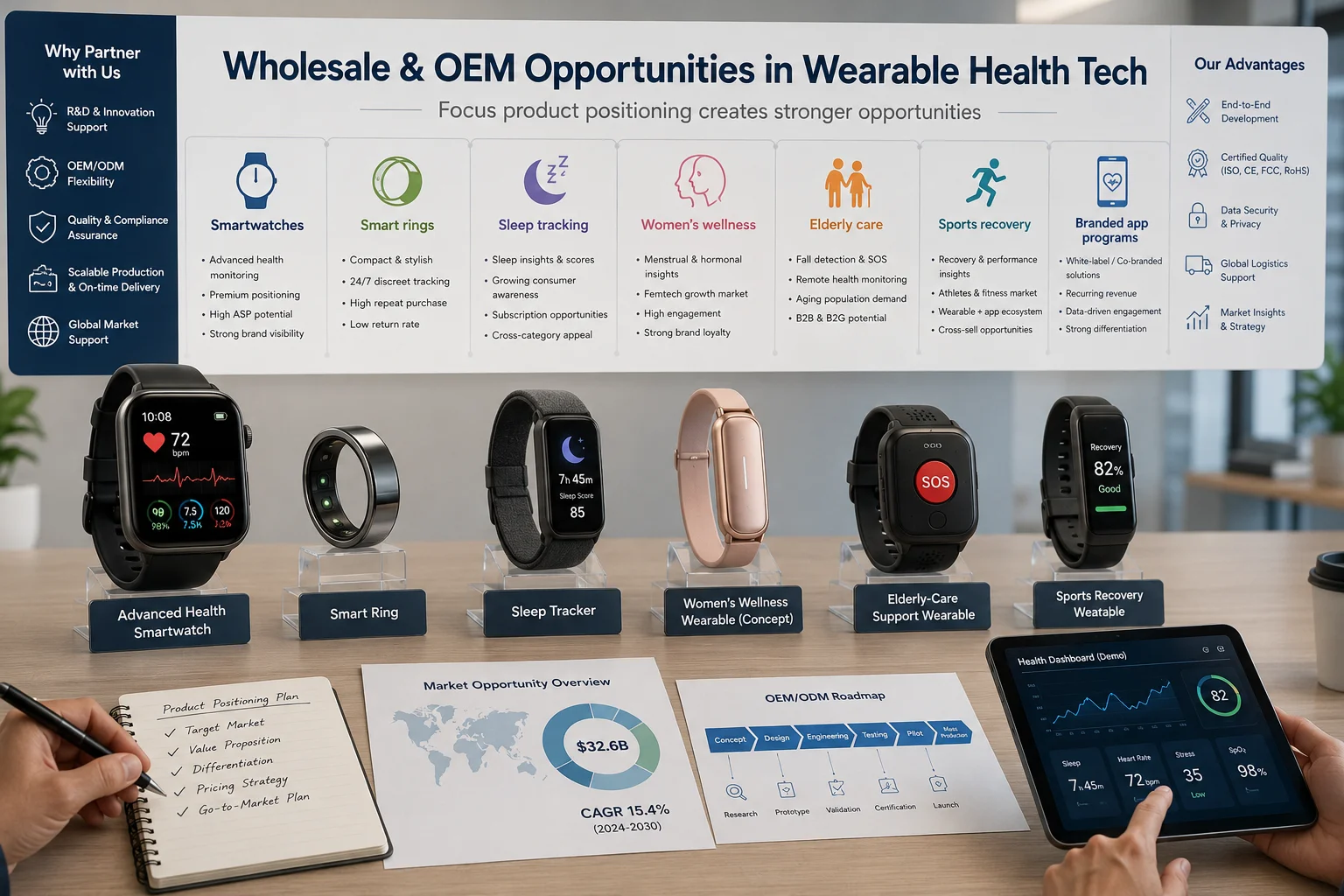
At Kingfuji Tech, we see buyers succeed when they build a complete offer rather than only sourcing a device. That offer may include packaging, a clear product story, retail displays, app instructions, replacement straps, warranty terms, and customer-service FAQs.
Practical opportunities for 2026
- Sleep and recovery: Smart rings and lightweight watches can support users who care about overnight comfort and regular sleep habits.
- Women’s wellness: Temperature trend features and cycle-related app functions may fit this segment when positioned carefully and responsibly.
- Active aging: Large-screen watches, SOS functions, medication reminders, and simple interfaces can be useful for senior-focused product ranges.
- Corporate wellness: Branded wearables can support activity challenges and employee engagement programs.
- Sports recovery: Advanced health smartwatches can appeal to runners, gym users, and amateur athletes who want training and rest trends.
- Fashion wellness: Slim watches and rings can attract consumers who want discreet tracking without a sporty appearance.
- Private-label e-commerce: OEM smartwatch manufacturer programs can include logos, packaging, watch faces, manuals, and selected app customization.
In my experience, the best OEM projects begin with a defined retail channel. A chain store may need simple packaging and stable replenishment. An Amazon seller may need clear differentiation, strong images, practical manuals, and a plan for reviews. A specialist sports retailer may need deeper feature education.
MOQ, delivery time, customization scope, and software ownership should be discussed early. A custom watch face is very different from a fully branded companion app. Buyers should confirm each deliverable before tooling or mass production begins.
How Can Buyers Source Future-Ready Wearable Health Tech?
Wearable health tech can look similar from the outside, but the real differences appear during testing, app use, certification review, and after-sales support. Buyers who focus only on factory price may later face battery complaints, unstable connections, unclear claims, or weak user reviews.
To source future-ready wearable health products, buyers should evaluate sensor quality, algorithms, mobile apps, privacy practices, battery performance, certifications, testing, customization options, and after-sales processes. A reliable supplier should help buyers define realistic claims and select a product that fits their channel and customer expectations.
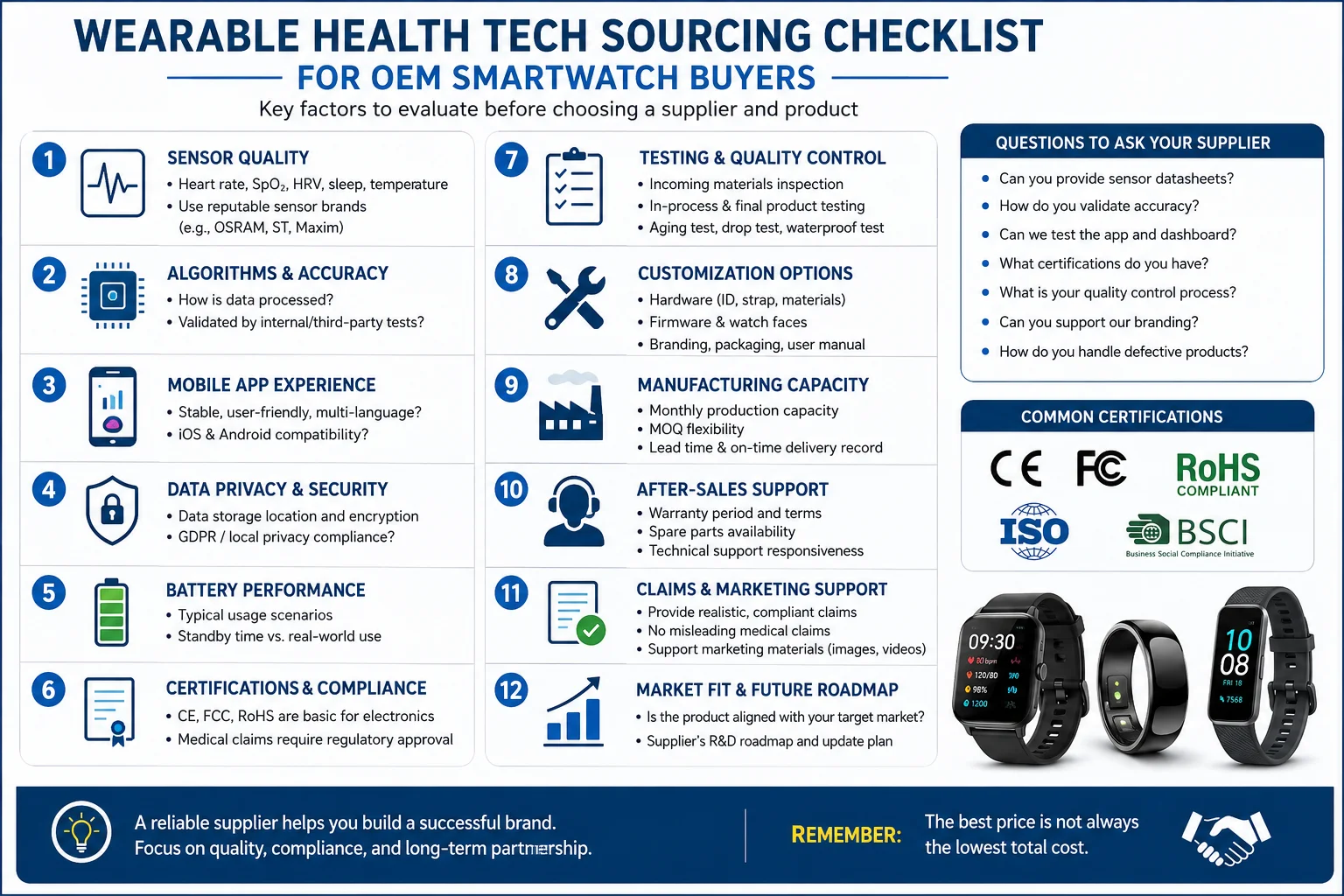
I recommend a structured sourcing checklist before confirming an order.
My practical sourcing checklist
- Request working samples. Test them during sleep, office work, workouts, and charging cycles.
- Review sensor specifications. Ask which sensors are included and what functions they support.
- Evaluate the app. Check language quality, onboarding, data dashboards, notifications, privacy policy, and update process.
- Confirm claim language. Make sure product pages, packaging, and manuals use responsible wellness wording.
- Verify documents. Review applicable certifications and test reports for the target market.
- Test battery claims. Confirm battery performance under realistic settings, including display brightness and continuous monitoring.
- Check Bluetooth stability. Connection issues are a common cause of negative reviews.
- Define customization clearly. Confirm logo placement, packaging, watch faces, firmware, app branding, and MOQ.
- Plan after-sales support. Prepare FAQs, warranty rules, replacement policies, and troubleshooting content.
- Confirm production controls. Ask about incoming inspection, aging tests, functional checks, and final quality inspection.
A strong supplier relationship should reduce uncertainty, not add it. At our factory, we prefer to discuss target users, sales channels, product claims, and after-sales expectations before we recommend a model. This approach helps buyers avoid paying for features that do not fit their market.
Frequently Asked Questions
Are smart rings more accurate than smartwatches?
Smart rings are not automatically more accurate than smartwatches. Their close finger contact can be useful for certain overnight measurements, but accuracy depends on sensor design, fit, algorithms, activity conditions, and user behavior. Buyers should test samples in real wearing scenarios before making performance claims.
Can an AI health smartwatch diagnose health conditions?
No. An AI health smartwatch should be positioned as a consumer wellness device unless it has a specific authorized medical intended use. AI can summarize trends, sleep patterns, activity, and recovery indicators, but it should not be advertised as diagnosing, treating, or preventing disease.
What is the best wearable health device for sleep tracking?
A smart ring may be attractive for users who prefer screen-free, lightweight overnight wear. A smartwatch can also work well when users want sleep data plus daytime notifications and sports functions. The best choice depends on comfort, charging habits, budget, and app experience.
What should I ask an OEM smartwatch manufacturer?
I recommend asking about sensor specifications, app ownership, supported languages, battery tests, certifications, quality-control procedures, customization options, MOQ, lead time, warranty support, and the permitted marketing language for health-related features.
Is EDA stress tracking reliable for every user?
EDA-based stress tracking can provide useful wellness trends, but it is affected by skin contact, movement, exercise, temperature, and individual physiology. It should be presented as an estimate of physiological response or stress trend, not as a definitive assessment of emotional or mental health.
Conclusion
Wearable health tech in 2026 will reward brands that choose clarity over hype. Smartwatches, smart rings, and fitness trackers each have a place when they match a specific user, use case, and price level. I believe the strongest products will combine stable sensors, comfortable design, understandable AI health insights, responsible claims, and dependable after-sales support. If you are planning a wholesale or OEM wearable project, contact Kingfuji Tech to request our wearable innovation roadmap, sample recommendations, and customization options.
"A guide to consumer-grade wearables in cardiovascular ...", https://pmc.ncbi.nlm.nih.gov/articles/PMC12404996/. Reviews of wearable sensing describe the use of physiological and motion data, including heart rate variability, for algorithmic estimation of sleep, stress, and recovery-related states in consumer and research settings. Evidence role: general_support; source type: paper. Supports: That wearable systems can integrate physiological and motion signals, including heart rate variability and activity data, to estimate sleep, stress, and recovery-related measures.. Scope note: Capabilities and accuracy vary by device, algorithm, population, and use condition. ↩
"General Wellness: Policy for Low Risk Devices - Guidance", https://www.fda.gov/regulatory-information/search-fda-guidance-documents/general-wellness-policy-low-risk-devices. Regulatory guidance distinguishes low-risk general-wellness products from medical devices by intended use; products intended to diagnose, cure, mitigate, prevent, or treat disease are subject to a different regulatory framework. Evidence role: definition; source type: government. Supports: That products intended only to encourage a healthy lifestyle or provide general wellness information are distinguished from devices intended for diagnosis or treatment.. Scope note: A device’s status depends on its specific intended use, claims, functions, and applicable jurisdiction. ↩
"Wearable Sensors and Artificial Intelligence for Sleep Apnea ... - PMC", https://pmc.ncbi.nlm.nih.gov/articles/PMC12089203/. Wearable-monitoring research explains that raw sensor streams are processed with signal-processing and classification algorithms to infer activity, sleep, and other health-related patterns. Evidence role: mechanism; source type: research. Supports: That wearable sensors generate raw physiological and motion data that are processed by algorithms to infer activities, sleep, and related health patterns.. Scope note: Algorithmic inferences are estimates and can be affected by sensor noise, placement, and the reference method used for validation. ↩
"A Review of Wearable Multi-Wavelength ...", https://pubmed.ncbi.nlm.nih.gov/34669577/. Validation literature on wearable sensing identifies device placement, skin contact, movement-related artifacts, and signal-processing methods as important determinants of data quality and measurement performance. Evidence role: mechanism; source type: paper. Supports: That wearable optical and motion-sensing performance can be affected by device placement, skin contact, motion artifacts, and signal-processing methods.. Scope note: This evidence addresses measurement performance more directly than broader issues such as charging behavior or app usability. ↩
"Wearable Sleep Technology in Clinical and Research Settings - PMC", https://pmc.ncbi.nlm.nih.gov/articles/PMC6579636/. Recent reviews of wearable health monitoring document consumer and research devices that estimate sleep and cardiorespiratory measures and derive metrics such as oxygen saturation, heart-rate variability, skin-temperature trends, and stress-related indicators. Evidence role: general_support; source type: paper. Supports: That wearable devices are used to estimate sleep, cardiorespiratory measures, oxygen saturation, heart-rate variability, temperature-related measures, and stress-related indicators.. Scope note: Feature availability and analytical validity differ substantially among products and do not establish clinical utility. ↩
"Analysing longitudinal wearable physical activity data using non ...", https://pmc.ncbi.nlm.nih.gov/articles/PMC12220009/. Digital-biomarker research emphasizes longitudinal measurement and comparison with an individual baseline because many physiological measures show substantial within-person and between-person variation. Evidence role: general_support; source type: paper. Supports: That repeated measurements and individual baselines can be more informative than isolated physiological observations when interpreting wearable data.. Scope note: Trend interpretation can improve context but does not by itself establish the cause or clinical significance of a change. ↩
"Do Not Use Smartwatches or Smart Rings to Measure Blood Glucose ...", https://www.fda.gov/medical-devices/safety-communications/do-not-use-smartwatches-or-smart-rings-measure-blood-glucose-levels-fda-safety-communication. The U.S. Food and Drug Administration warns that it has not authorized smartwatches or smart rings to measure or estimate blood glucose levels without piercing the skin and advises against relying on such devices for glucose monitoring. Evidence role: expert_consensus; source type: government. Supports: That consumers should not use unapproved smartwatches or smart rings claiming to measure blood glucose without piercing the skin, and that such claims can create health risks.. Scope note: Regulatory authorization requirements and product classifications must also be assessed under the laws of each target market. ↩
"Non-Invasive Blood Glucose Monitoring Technology: A Review", https://pmc.ncbi.nlm.nih.gov/articles/PMC7731259/. Reviews of non-invasive optical glucose sensing report that deriving reliable glucose concentrations from optical signals remains challenging because of physiological variability, tissue interference, calibration requirements, and accuracy limitations. Evidence role: mechanism; source type: paper. Supports: That optical approaches to non-invasive glucose monitoring face significant physiological, calibration, signal-interference, and accuracy challenges.. Scope note: Research progress in this field does not validate any particular consumer wearable or establish regulatory authorization. ↩
"Electrodermal Activity Analysis at Different Body Locations - PMC", https://pmc.ncbi.nlm.nih.gov/articles/PMC11946426/. Electrodermal activity refers to variation in the skin’s electrical conductance, commonly linked to activity of eccrine sweat glands and autonomic arousal. Evidence role: definition; source type: encyclopedia. Supports: That electrodermal activity, also called skin conductance, reflects changes in the electrical properties of the skin associated with sweat-gland activity.. Scope note: EDA is a nonspecific physiological signal and cannot identify the psychological cause of arousal on its own. ↩
"Beyond EDA: A Systematic Review of Multimodal Sympathetic Nervous ...", https://pmc.ncbi.nlm.nih.gov/articles/PMC12987280/. Multimodal wearable-stress research commonly combines electrodermal activity with cardiovascular and motion signals, and sometimes skin temperature, to improve estimation of physiological arousal or stress-related states. Evidence role: mechanism; source type: paper. Supports: That research systems estimate stress-related states by combining electrodermal, cardiovascular, temperature, and motion signals.. Scope note: Such models estimate physiological patterns rather than diagnosing stress disorders or determining an individual’s specific source of stress. ↩
"General Wellness: Policy for Low Risk Devices - Guidance", https://www.fda.gov/regulatory-information/search-fda-guidance-documents/general-wellness-policy-low-risk-devices. Medical-device frameworks classify products according to their intended medical purpose and require manufacturers to substantiate safety and performance through the applicable regulatory and clinical-evaluation processes. Evidence role: definition; source type: institution. Supports: That medical-device regulation is tied to intended medical purpose and includes conformity-assessment or regulatory requirements, including clinical evaluation under applicable frameworks.. Scope note: The precise pathway depends on the jurisdiction, device classification, risk profile, and claims. ↩
"Clinical Evidence Supporting US Food and Drug Administration ... - PMC", https://pmc.ncbi.nlm.nih.gov/articles/PMC7551221/. Regulatory guidance treats evidence of medical-device safety and performance, including clinical evaluation where applicable, as distinct from general electrical-safety or electromagnetic-compatibility compliance documentation. Evidence role: general_support; source type: government. Supports: That medical-device conformity assessment requires evidence related to safety and performance, and that general product compliance documentation is not equivalent to clinical evidence for a medical claim.. Scope note: The documentation required for a particular product depends on its classification, intended use, and the market in which it is placed. ↩