Electronics tariff codes can feel confusing when we import chargers, USB cables, TWS earbuds, or smart wearables from China. A simple product name often hides important technical differences, which can create duty surprises, customs delays, or incorrect landed-cost estimates. We help buyers prepare clearer product facts before they ask a broker to confirm classification.
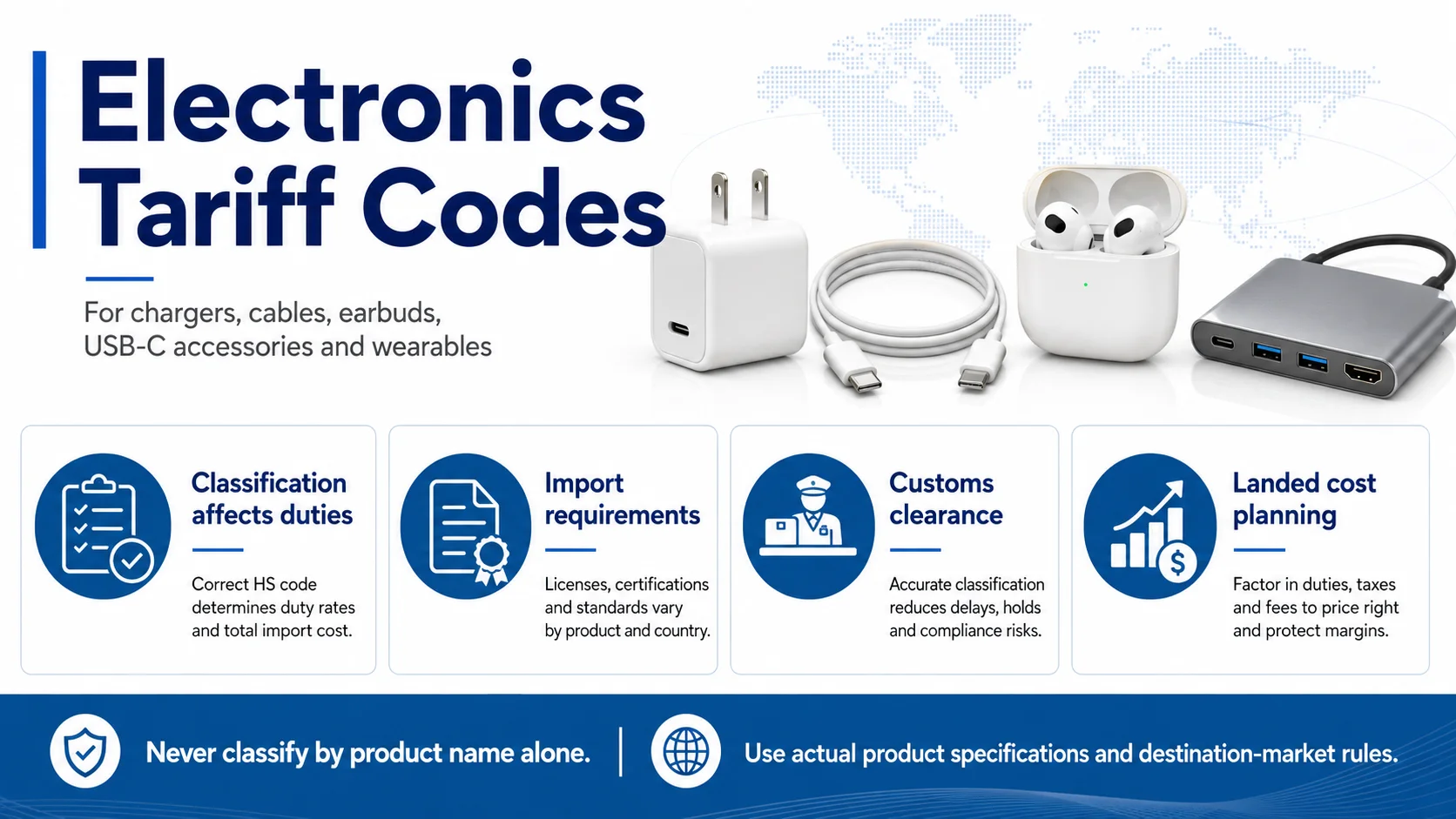
Electronics tariff codes are HS- or country-specific HTS-based classifications used to determine customs treatment, duty rates, and import requirements. Importers should never select a code from a product name alone. The final classification depends on the product’s actual function, specifications, components, configuration, destination market, and current customs rules.1
For more than 15 years, we have exported 3C accessories from Shenzhen to U.S. and European buyers. We have learned that the best starting point is not “What is the code?” It is “What exactly does this product do, and how is it built?”
Quick Answer: How Do Electronics Tariff Codes Work?
When buyers need electronics tariff codes, they often need a quick number for a quote or landed-cost spreadsheet. The risk is that a broad product label, such as “USB charger,” may describe several technically different products.
HS codes are internationally harmonized product categories, while HTS codes are country-specific tariff classifications built on the HS system.2 Importers should use product specifications, broker review, official tariff databases, and—when needed—binding rulings to confirm the final code before shipment.
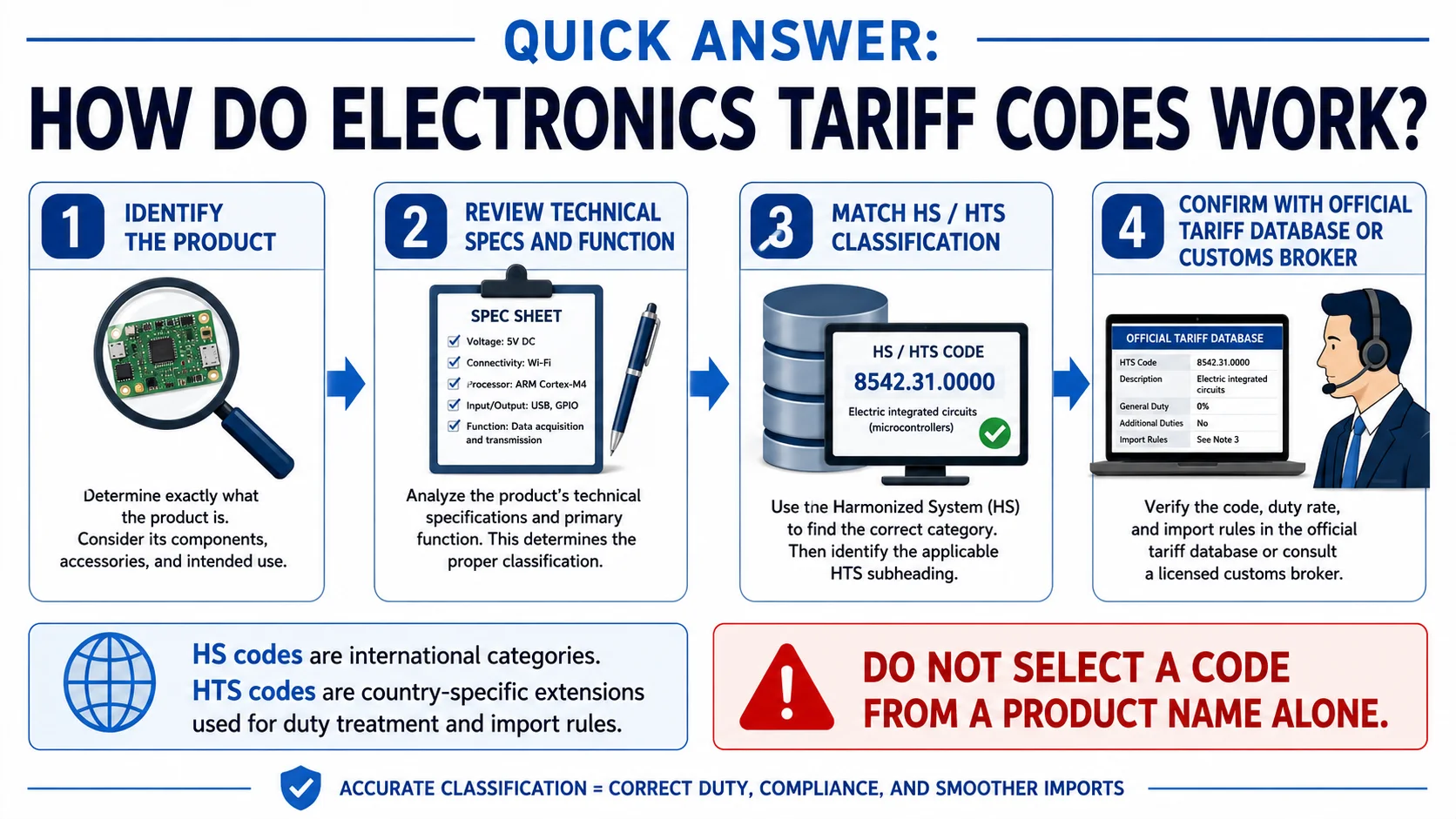
We recommend treating any supplier-provided number as a suggested code or reference classification, not a final customs declaration. Our role is to provide clear product information. The importer and its customs broker must confirm the applicable HTSUS code, duty rate, and any temporary additional tariff measures.
Start With the Product Facts
When a buyer asks us for a charger tariff code, we first request the facts that a broker will likely need:
- Input and output voltage, current, and total wattage
- Number and type of ports, such as USB-A or USB-C
- Whether the item converts AC power to DC power
- Whether the item includes a cable, battery, display, wireless charging coil, or data function
- Product photos, packaging details, and user manual
- Whether it ships as a retail set or as a standalone product
I have seen buyers send a message saying only, “Please give me the HTS code for this charger.” The useful next step is not a guess. We ask whether it is a 20W USB-C wall charger, a multi-port desktop charger, a wireless charging stand, or a battery-powered power bank. Those differences can affect the classification review.
What Are HS Codes and HTS Codes?
Many importers hear “HS code” and “HTS code” used as if they mean the same thing. That can cause trouble when a buyer sources in China but sells in the United States, United Kingdom, or European Union.
The Harmonized System, or HS system, provides a common international framework for classifying traded goods.3 A national tariff schedule, such as the U.S. Harmonized Tariff Schedule (HTSUS), adds country-specific digits, duty treatment, notes, and statistical requirements.4
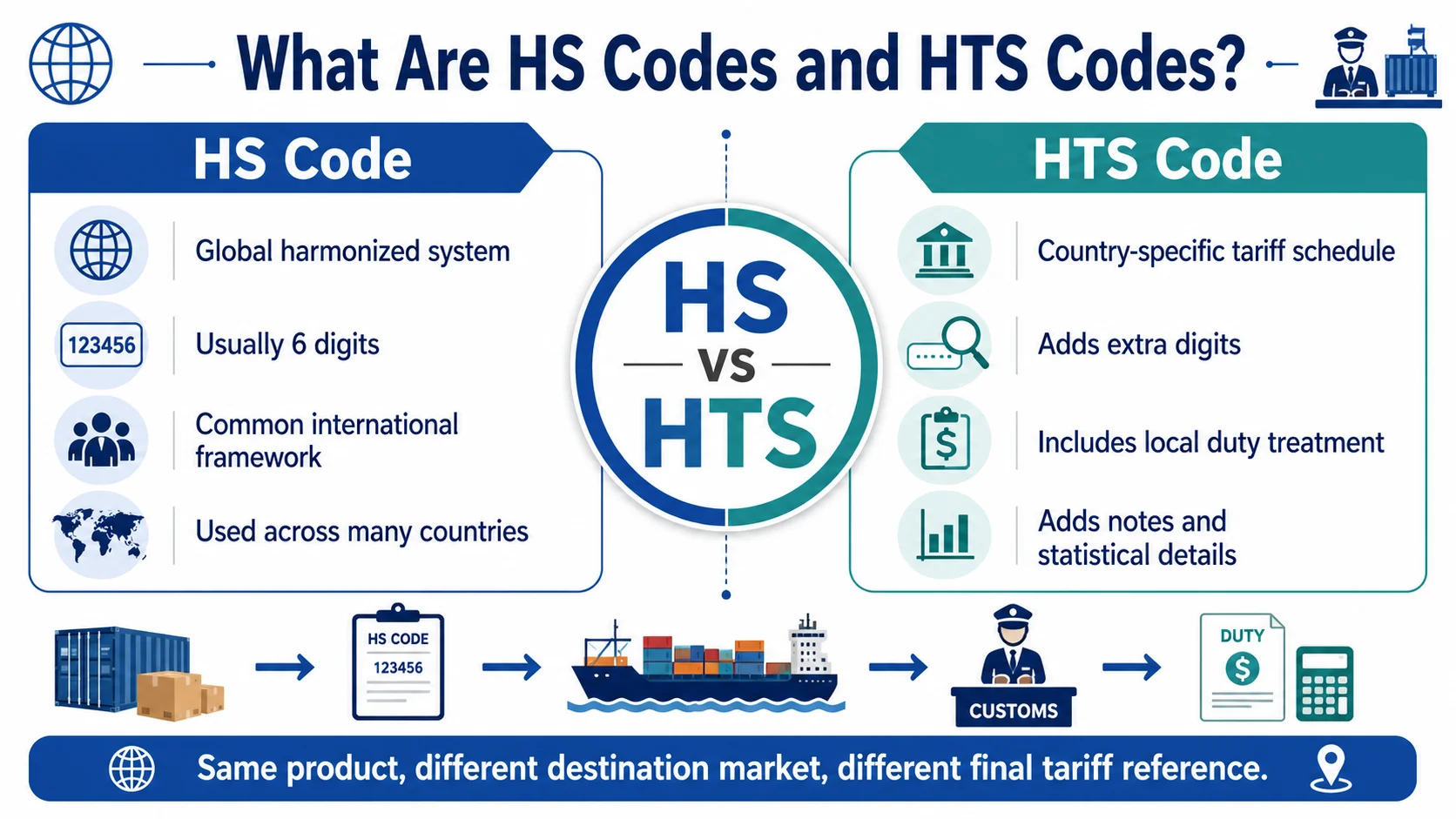
We use HS-based references when preparing export documents, but U.S. importers should not assume that an export declaration number is identical to the final U.S. HTSUS classification. The same principle applies in Europe and the UK, where local tariff schedules, VAT rules, and import procedures can differ.
HS Versus HTS: A Practical Difference
The first digits of a code commonly follow the global HS structure. Countries then add more digits or local requirements. This means a supplier can help identify the likely product family, while the importer’s broker confirms the full import classification.
| Term | What It Means | Why It Matters |
|---|---|---|
| HS code | International classification framework | Supports global trade descriptions |
| HTSUS code | U.S. tariff classification | Used for U.S. customs entries and duty assessment |
| EU CN/TARIC code | European classification system | Supports EU customs, duty, and VAT processes |
| UK tariff code | UK-specific tariff schedule | Used for imports into Great Britain |
We encourage buyers to check the current official tariff database for the importing country. Tariff schedules and additional duty measures can change. A code used on a past shipment may need review when the product design, origin, destination, or trade policy changes.
Common Electronics Tariff Code Categories for 3C Accessories?
A 3C product catalog can contain many familiar names, but customs reviews physical goods and technical functions rather than marketing terms. Similar products may fall into different reference classification paths.
Common electronics tariff code categories may involve insulated conductors, static converters, audio equipment, data-processing accessories, transmission devices, batteries, or wearable electronic devices. The right category depends on what the individual product actually does.
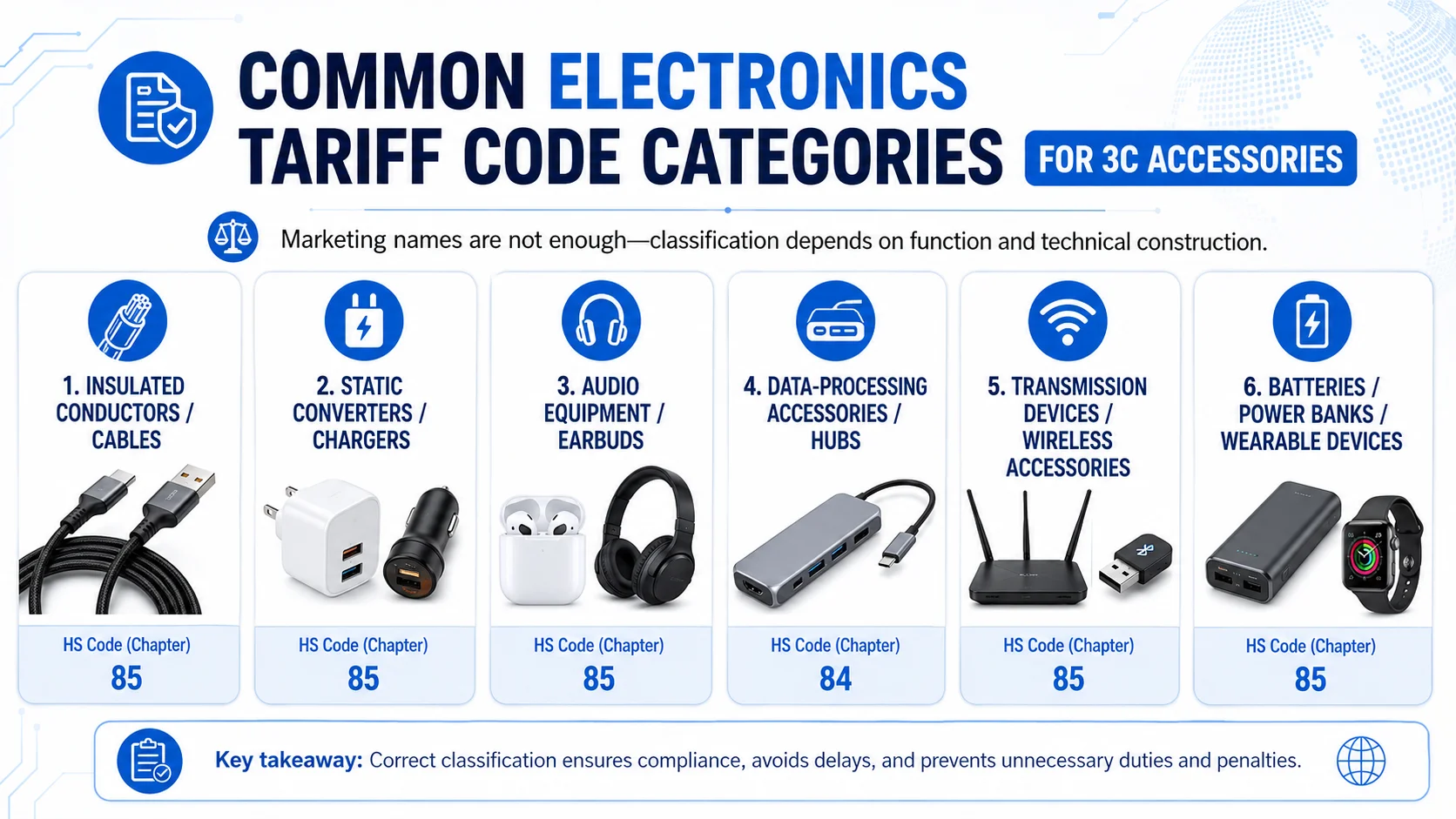
We often help buyers organize products into practical groups before broker review:
- USB cables: data cable, charging cable, connector type, shielding, length, and whether active electronics are included
- Wall chargers: AC-to-DC conversion, wattage, port count, and charging protocols
- Power banks: lithium battery capacity, output ports, wireless charging features, and included cable
- TWS earbuds: Bluetooth capability, microphones, charging case, and audio functions
- Smartwatches: communications functions, fitness sensors, GPS, cellular capability, and display
- USB-C hubs: HDMI, Ethernet, SD card reader, USB data ports, power delivery pass-through, and controller chips
Product Names Are Only a Starting Point
A “USB-C accessory” can be a simple cable, a charger, a dock, a hub, an adapter, or a combination product. Each version may require a different customs analysis.
For example, a USB-C hub with HDMI, Ethernet, card readers, and several USB ports is not merely “a cable.” A broker may need to assess the interfaces, internal circuitry, primary function, and relevant legal notes. Likewise, a TWS earbud set includes both earbuds and a charging case, but the classification analysis may focus on the set’s essential character and how it is presented for retail sale.5
We provide specification sheets, product photos, packaging details, and test reports where available. These documents help buyers avoid describing a product too broadly on an invoice.
How Does Customs Classify Cables, Chargers, Earbuds, and Wearables?
Buyers may assume that customs looks at the item’s retail category first. In reality, customs classification can turn on function, construction, components, connectivity, and intended use.
Customs generally classifies 3C accessories by their objective characteristics at importation6, including their power-conversion role, wireless functions, connectors, battery content, data capability, and principal use. Product labels alone do not determine the final classification.7
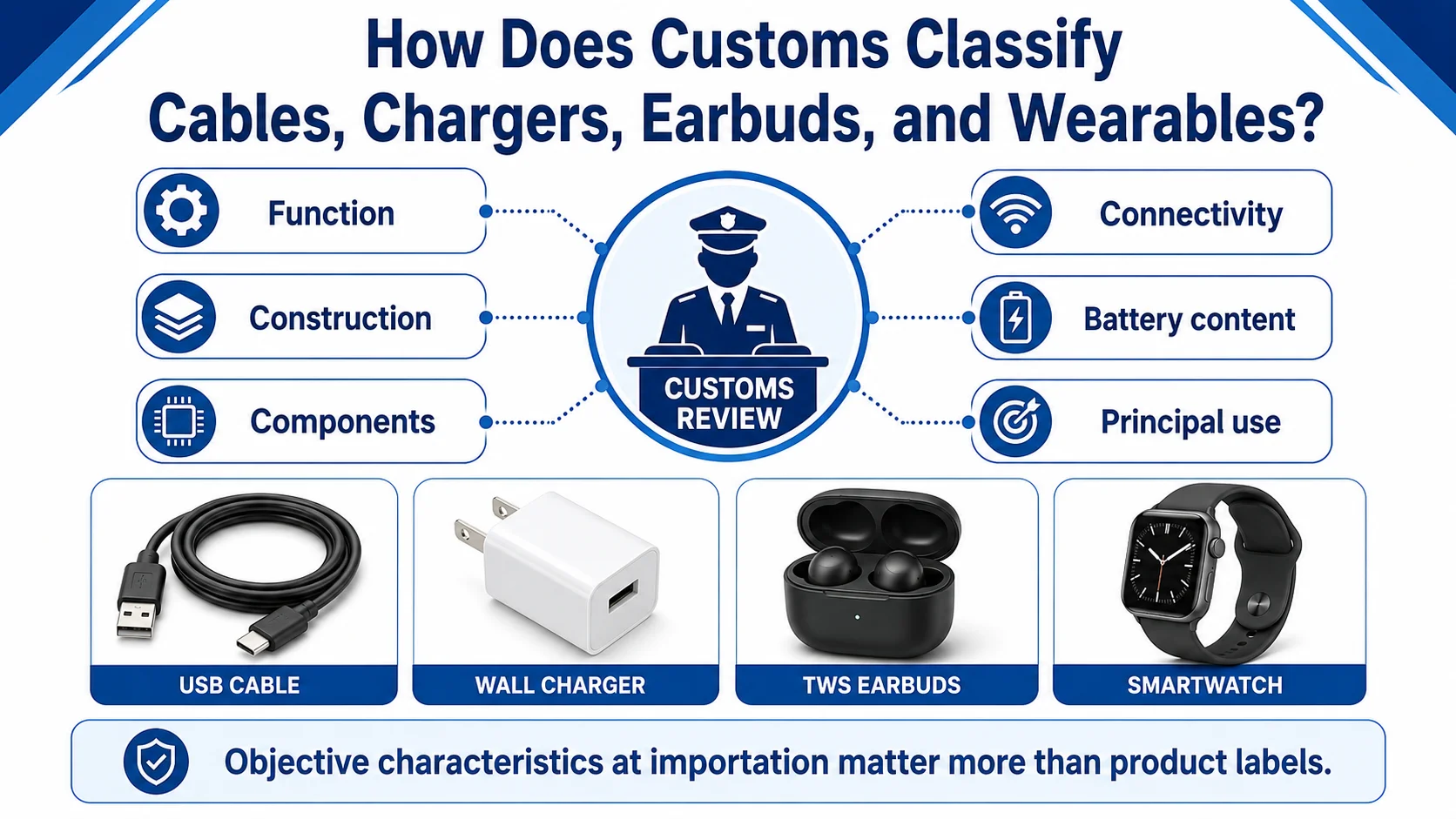
We advise buyers to build a product file before goods leave China. A good file makes broker communication faster and reduces back-and-forth after arrival.
Important Classification Factors
For a cable, customs may need to know:
- Does it carry power only, data only, or both?
- Does it contain connectors fitted at both ends?
- Does it contain a chip, active signal converter, or other electronics?
- Is it an HDMI cable, USB cable, network cable, or audio cable?
For a charger or power adapter, buyers should document:
- AC input range
- DC output range
- Maximum rated wattage
- Charging protocols, such as PD or QC
- Number and type of outputs
- Whether the product has an integrated battery or wireless charging function
For TWS earbuds and smartwatches, we recommend including wireless protocol information, microphones, speakers, sensors, display details, and whether cellular or GPS functions are present.
We do not present ourselves as a customs authority. We help turn incomplete product descriptions into a specification package that an importer and broker can review with confidence.
TWS Earbud, Charger, and USB Cable HS Code Questions?
Searches such as “TWS earbuds HS code,” “charger HS code,” and “USB cable tariff code” are understandable. Buyers need a fast way to estimate landed cost. Still, a generic online number can be incomplete or outdated.
TWS earbud, charger, USB cable, and power bank classifications require product-specific review. Buyers should verify each final code based on the item’s functions, technical data, retail presentation, destination country, and current customs guidance.
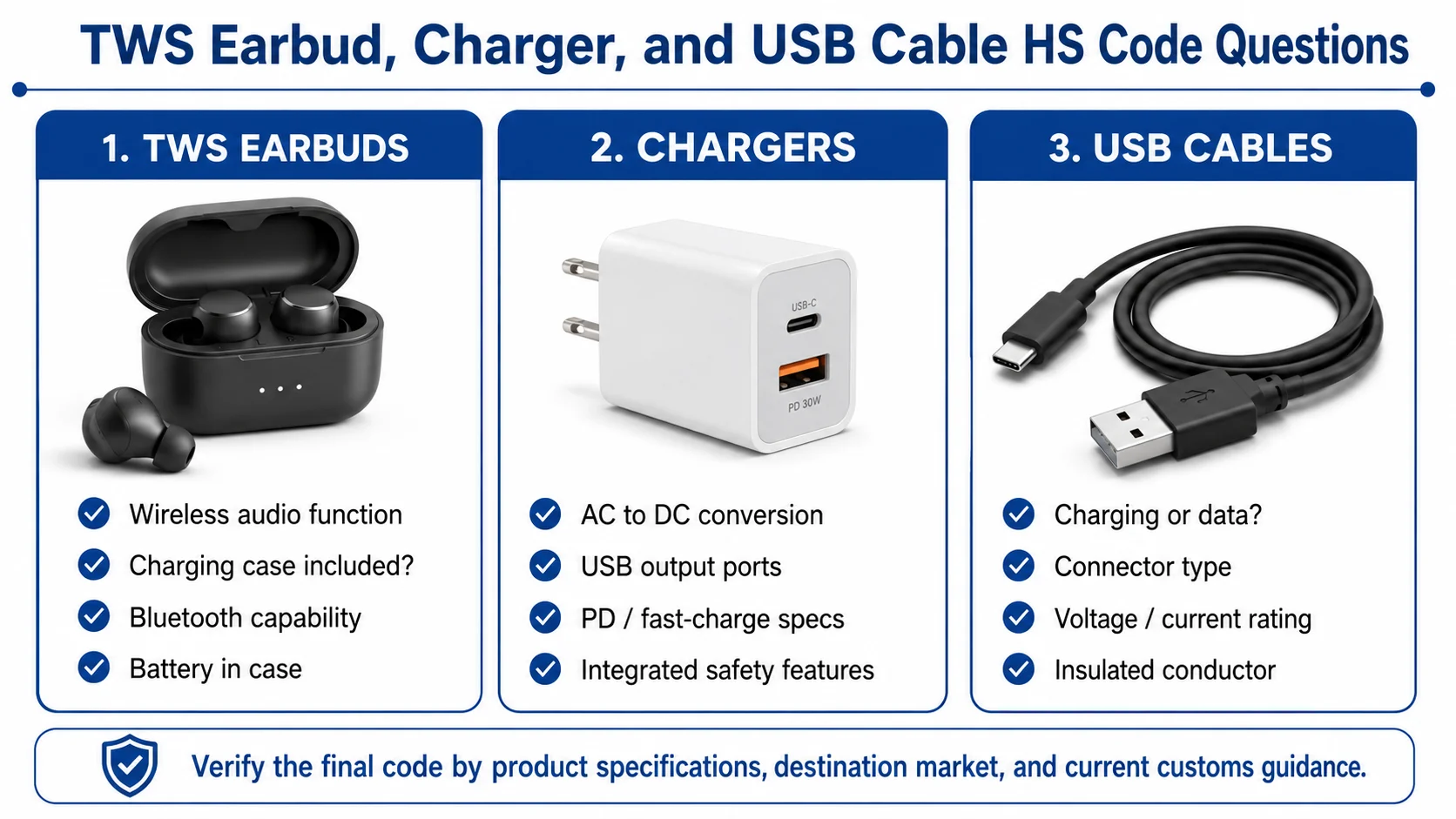
A common question is whether a TWS earbud and its charging case should be considered separately. The answer depends on how the product is imported, packed, and evaluated under the destination country’s rules. A retail set may require analysis as a set, while separately imported accessories may need separate treatment.
Common Buyer Questions We Receive
| Buyer Question | Information We Request |
|---|---|
| What is the TWS earbuds HS code? | Bluetooth details, charging case, microphone, audio features, retail packaging |
| What is the charger tariff code? | AC/DC conversion details, output specs, ports, wattage, wireless functions |
| What is the USB cable tariff code? | Connector types, power/data use, active chips, cable construction |
| How is a power bank classified? | Battery chemistry, mAh/Wh rating, output ports, wireless charging feature |
| Can I use one code for a retail kit? | Full packing list, contents, presentation, and each component’s role |
We also suggest that buyers avoid copying a competitor’s invoice description without checking the actual product. Two USB-C cables may look almost identical but differ in data-transfer capability, embedded electronics, or connector construction. Those facts can matter more than the product photo.
Do GaN and Silicon Chargers Use Different Tariff Codes?
GaN charging technology is now common in compact high-wattage adapters. Some buyers assume that gallium nitride automatically creates a different classification from a traditional silicon charger.
GaN and silicon chargers do not automatically use different tariff codes simply because their semiconductor material differs.8 Customs classification generally focuses more on the finished product’s primary function, construction, specifications, and relevant tariff language than on marketing claims about charging technology.
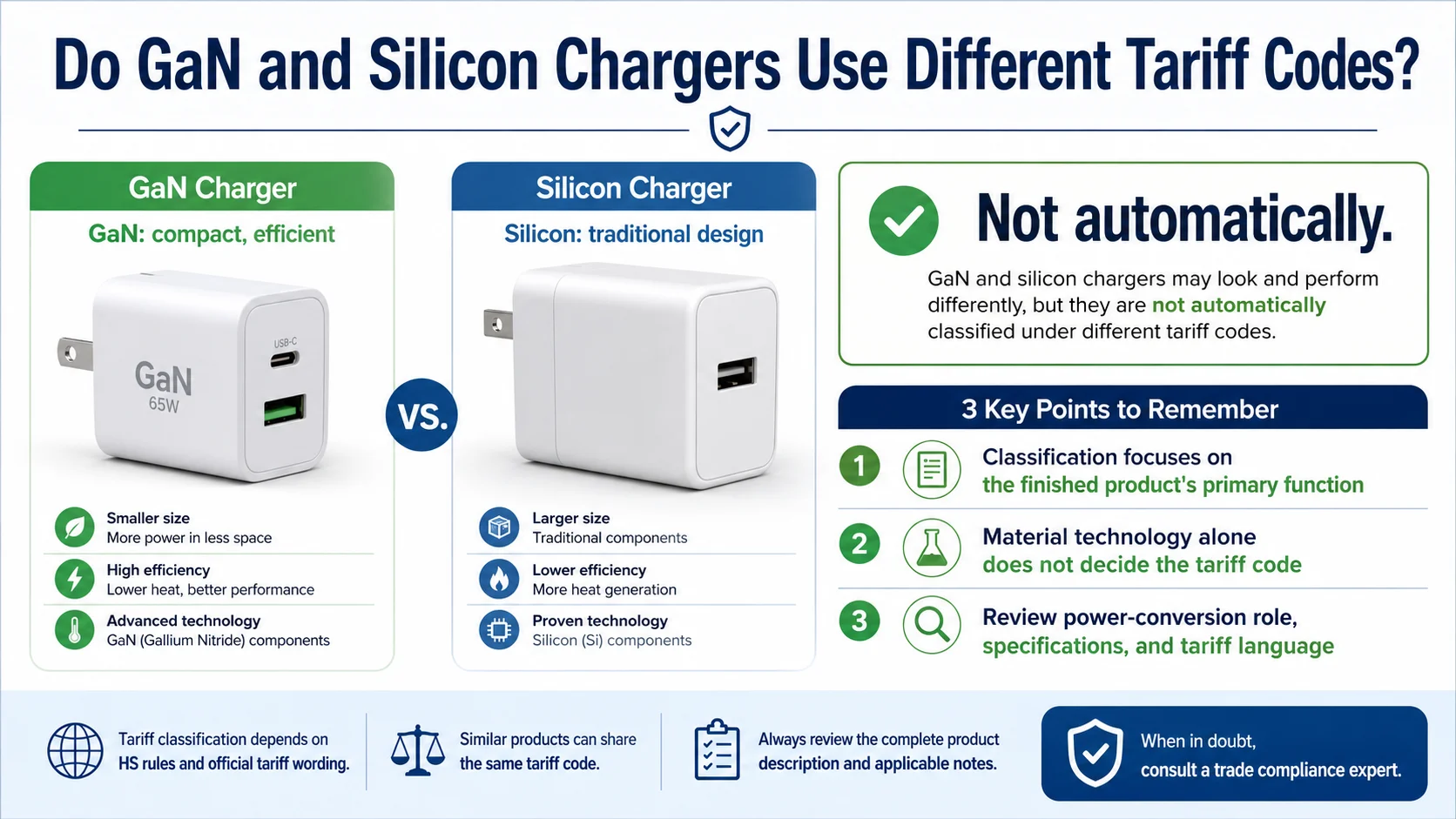
A GaN charger is usually marketed for benefits such as smaller size, improved power density, and high-output USB-C charging. Those are meaningful commercial features. However, they do not replace the need to identify the product’s actual electrical role.
What We Include in a GaN Charger Specification Package
For GaN charger buyers, we can prepare or share information such as:
- Rated AC input
- USB-C and USB-A output profiles
- Total output wattage
- Single-port and multi-port output tables
- PD, PPS, QC, or other charging protocol support
- Plug type for the destination market
- Product dimensions and weight
- Safety certifications available for the specific model
- Packaging configuration and country of origin details
A 65W GaN charger with three ports may need more detailed review than a basic single-port adapter because the output structure and product configuration are more complex. Still, we should not assume a different result based only on “GaN” printed on the package.
Our practical approach is simple: we describe the charger accurately and let the importer’s broker confirm the classification under current official rules.
How Are USB-C Hubs and Multifunction Devices Classified?
USB-C hubs are among the most complex 3C accessories for customs review. A single compact device can include USB data ports, HDMI output, Ethernet, PD charging pass-through, SD card readers, and audio interfaces.
USB-C hubs and multifunction devices may require closer classification review because they combine several functions.9 Importers should identify the product’s principal function, interface capabilities, internal components, and intended use before selecting a reference classification.
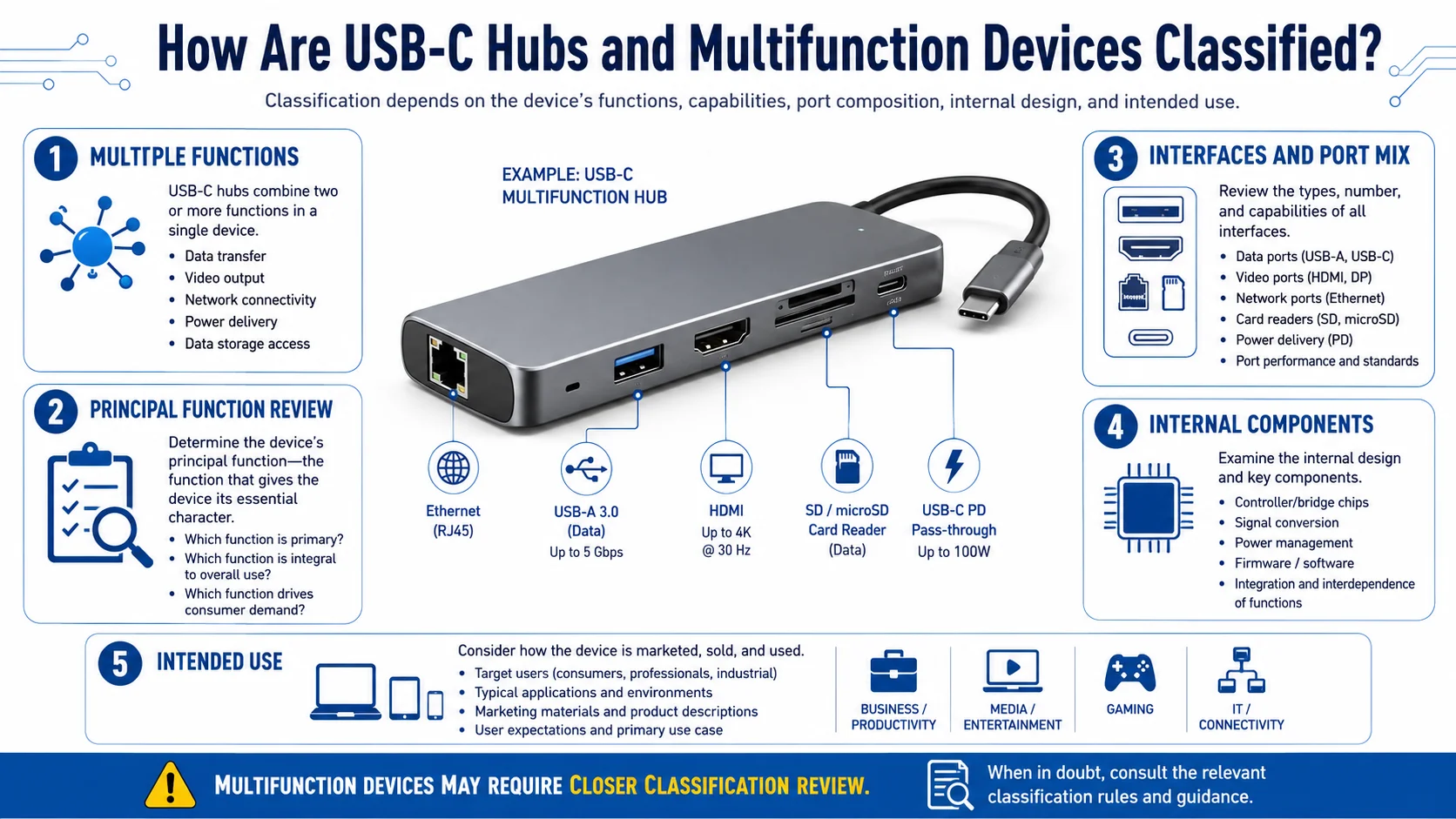
A product page may call an item a “7-in-1 USB-C hub,” but that does not tell a broker enough. We recommend sharing the user manual and a complete interface list. If the hub contains an Ethernet controller, HDMI conversion chip, card-reader function, and data-transfer ports, those details should be visible in the supporting documents.
USB-C Hub Review Checklist
We ask buyers to confirm:
- Host connection: Is the input USB-C, Thunderbolt-compatible, or another interface?
- Video output: Does it support HDMI, DisplayPort, VGA, or multiple displays?
- Network function: Does it include Ethernet or wireless connectivity?
- Data function: How many USB ports are included, and what standards do they support?
- Card-reader function: Does it accept SD, microSD, or both?
- Power function: Does it only pass through power, or does it perform power conversion?
- Primary use: Is it mainly a port expander, display adapter, network adapter, or docking device?
Some multifunction products require a more detailed review than straightforward chargers or cables. When a buyer plans a large-volume import, we may suggest asking a broker whether an official ruling request is appropriate.
Common 3C Accessories and Their HTS Classification Factors?
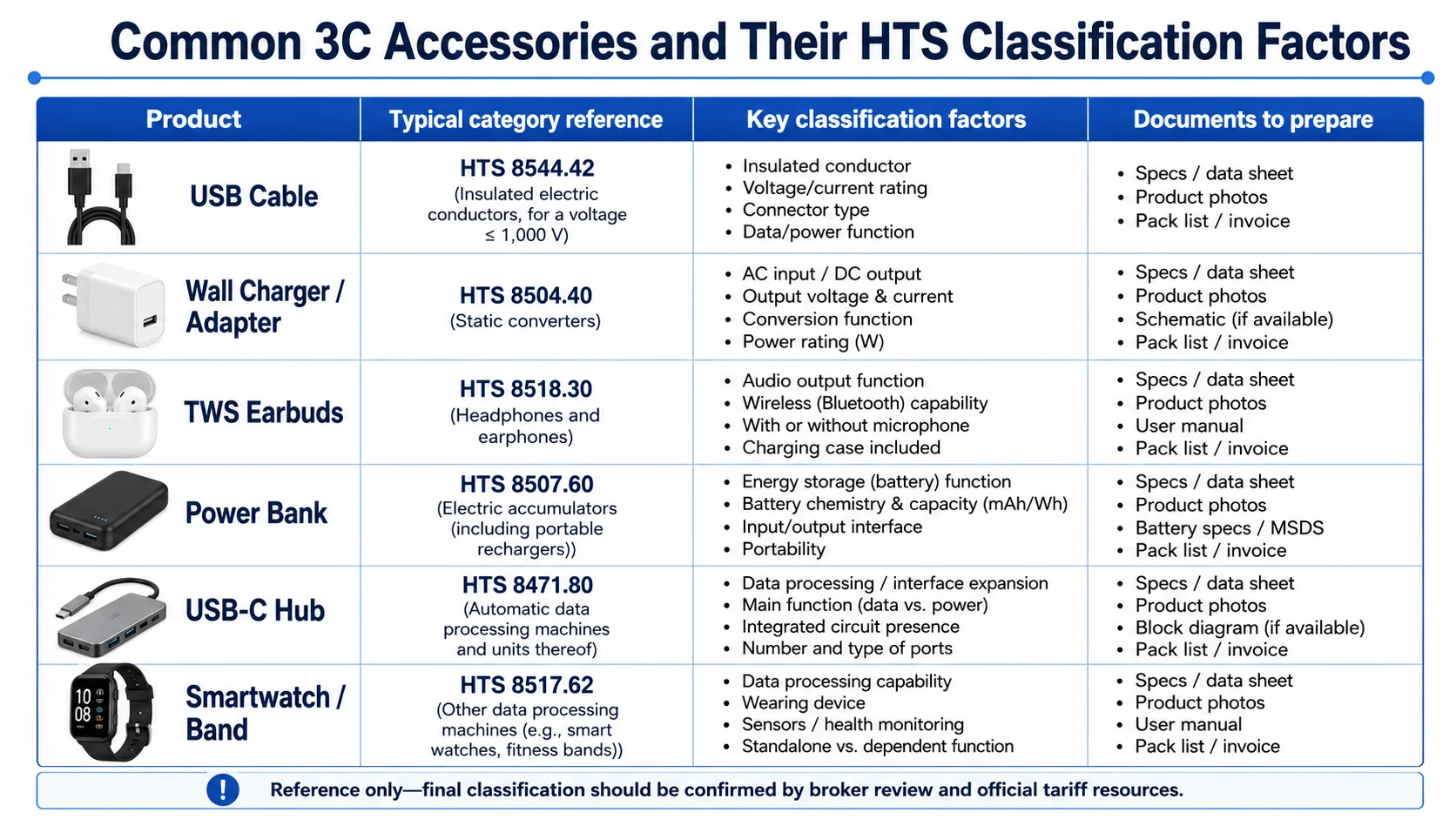
Importers often want a quick comparison before requesting a broker review. The table below does not assign universal HTSUS codes. Instead, it shows the facts that normally matter when preparing a reference classification.
The best electronics tariff code reference depends on each product’s technical facts and destination market. Importers should use a comparison checklist to collect documents before asking a broker to confirm the final HTS classification.
| Product Type | Primary Function to Document | Key Details | Useful Documents | Common Risk | When to Consider a Ruling |
|---|---|---|---|---|---|
| USB cable | Power/data transmission | Connectors, active chip, shielding, data capability | Spec sheet, connector photos | Calling all cables identical | Active or multifunction cable |
| Wall charger | Power conversion | Input/output, wattage, ports, protocols | Rating label, manual | Missing AC/DC details | High-value or unusual design |
| GaN charger | Power conversion | Same as charger plus product construction | Output table, product photos | Assuming GaN decides the code | Multi-port, high-power models |
| Power bank | Battery-powered charging | Battery chemistry, Wh, outputs, wireless coil | Battery specs, UN38.3 documents | Confusing it with a wall charger | Hybrid power products |
| TWS earbuds | Wireless audio | Bluetooth, microphones, case, retail set | Manual, packaging, photos | Ignoring charging case/set rules | Unusual communication features |
| Smartwatch | Wearable electronic function | Sensors, cellular, GPS, communication | Full feature sheet | Using “watch” as the only description | Cellular or multifunction models |
| USB-C hub | Connectivity expansion | HDMI, Ethernet, USB, card reader, PD | Interface map, manual | Missing principal-function analysis | Complex docks and hubs |
We find that this table is most useful when it becomes part of a buyer’s sourcing workflow. The buyer can send us the model number, destination market, and requested shipping terms. We can then provide the available product materials in a cleaner format for broker review.
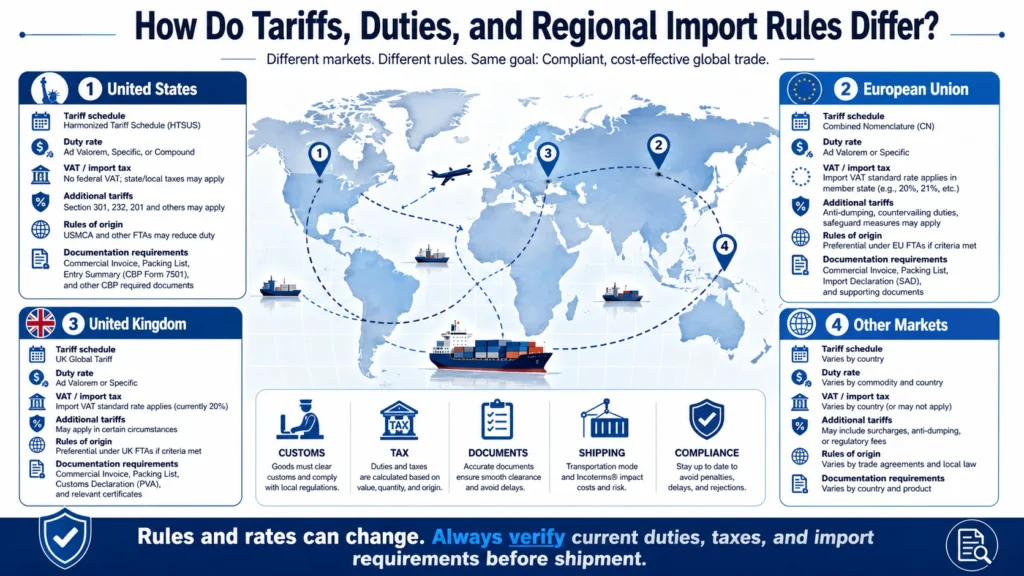
How Do Tariffs, Duties, and Regional Import Rules Differ?
A correct product classification is only one part of landed cost. Duty rates, additional tariffs, VAT, import taxes, exemptions, and compliance requirements can vary by country and can change over time.10
Electronics tariff codes may lead to different duty and tax outcomes in the United States, European Union, United Kingdom, and other markets. Importers must verify current duty rates, additional tariff applicability, VAT, thresholds, origin rules, and documentation requirements for their destination.
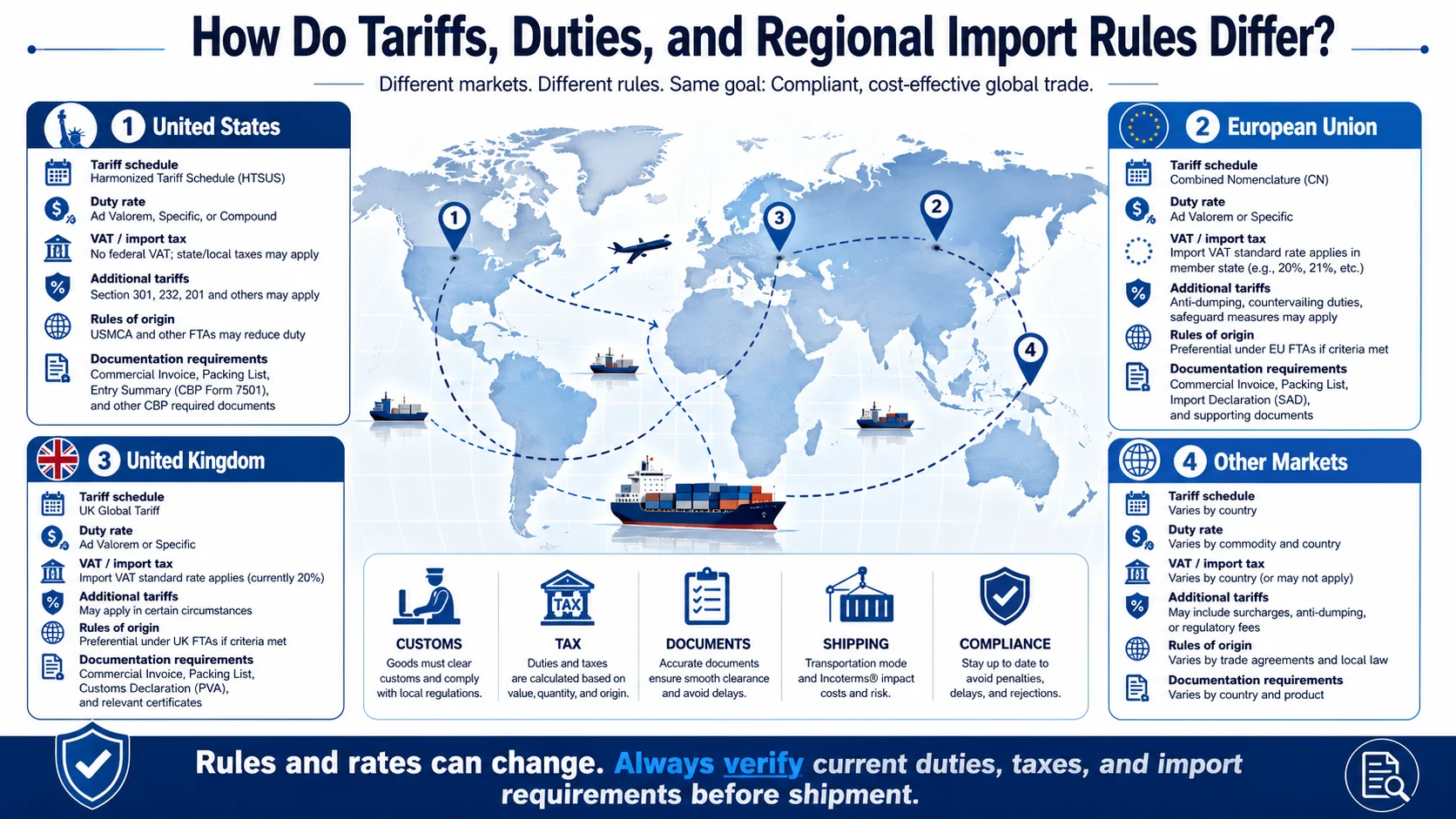
For U.S. buyers importing electronics from China, the final landed cost may include the regular HTSUS duty rate plus any applicable additional measures in force at the time of entry.11 These policies can change, so we do not quote a permanent duty percentage based on a product name.
Regional Points to Check
| Market | Key Issues to Verify |
|---|---|
| United States | HTSUS code, country of origin, current additional tariffs, entry requirements |
| European Union | CN/TARIC classification, customs duty, import VAT, CE-related product obligations |
| United Kingdom | UK tariff classification, import VAT, product compliance and labeling |
| Canada | Canadian tariff treatment, GST/HST, origin documentation |
| Australia | Tariff treatment, GST, electrical compliance requirements |
We also remind buyers that customs classification and product compliance are related but separate topics. For example, CE, FCC, RoHS, UKCA, UL-related testing, or battery transport documentation may be commercially essential, but they do not automatically establish the final customs code.
How Can You Confirm an Electronics HTS Code Before Shipping?
Waiting until cargo arrives to clarify a product’s classification can create avoidable pressure. A better process starts during sampling or purchase-order approval, especially for new models and multifunction accessories.
To confirm electronics tariff codes before shipping, importers should collect detailed specifications, review the current official tariff schedule, consult a qualified customs broker, and consider a binding ruling for complex or high-volume products.12 Suppliers can support the process with accurate reference documents.
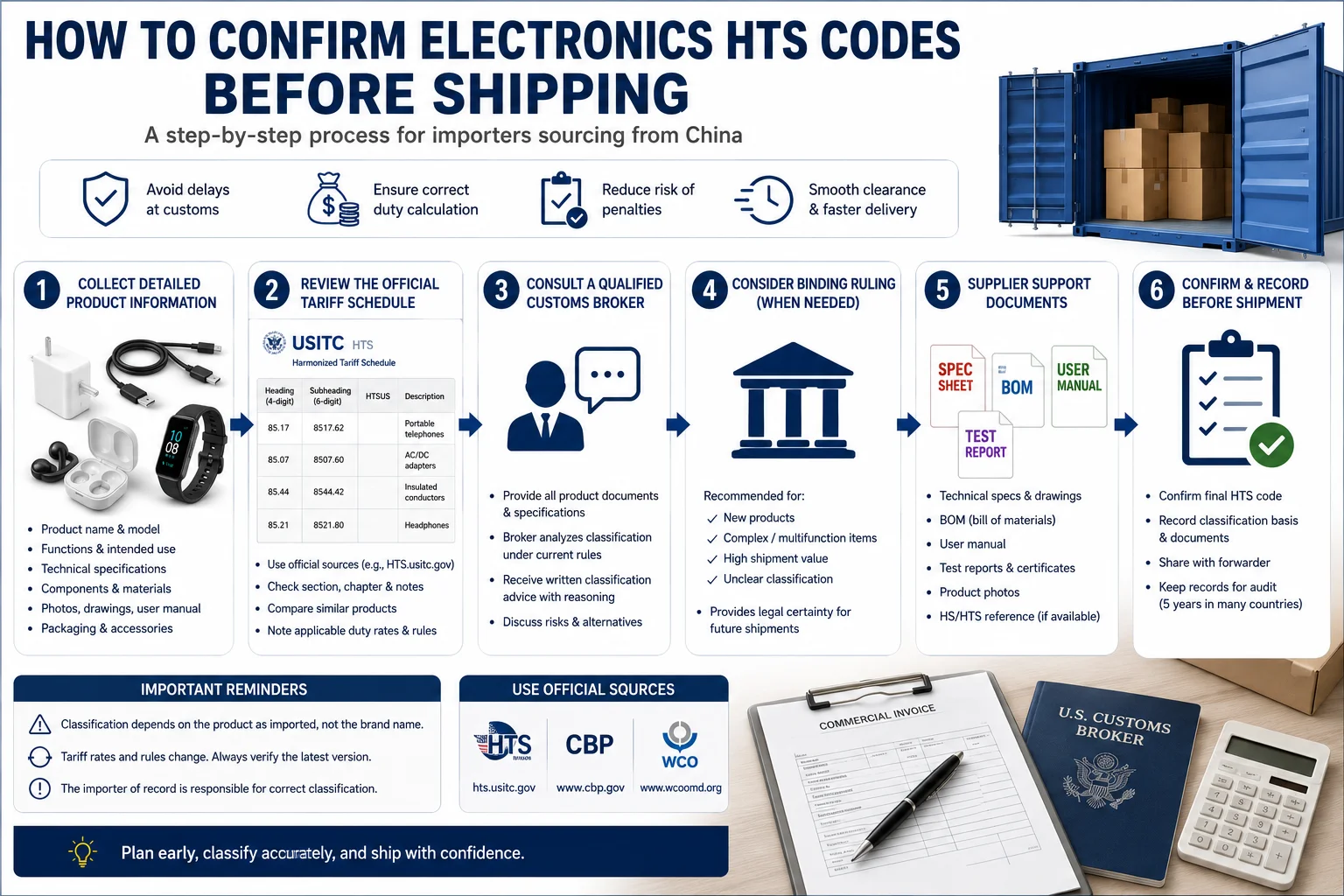
We recommend this practical workflow:
- Define the exact SKU. Do not classify a whole product family under one description if features differ.
- Collect technical details. Include manuals, rating labels, interface diagrams, product photos, and packaging.
- Confirm country of origin. Origin rules can affect tariff treatment.
- Check current official sources. Use the importing country’s tariff database, not only old online listings.
- Ask a customs broker for confirmation. The importer should provide the broker with the complete product file.
- Consider a binding ruling. This can be valuable for complex, high-volume, or recurring imports.
- Keep records. Save broker correspondence, specifications, invoices, and classification support documents.
At Kingfuji Tech, we can provide a suggested HTS code reference list alongside model-specific specifications for chargers, USB cables, GaN adapters, TWS earbuds, smartwatches, and USB-C accessories. We clearly label this information as reference support, not final legal or customs advice.
Frequently Asked Questions
What is the difference between an HS code and an HTS code?
An HS code follows the international Harmonized System used to classify traded goods. An HTS code is a country-specific tariff classification based on that structure. U.S. importers generally need the full HTSUS classification for customs entry and duty assessment.
Can I use my supplier’s electronics tariff code for U.S. customs?
You can use a supplier’s suggested code as a reference point, but you should not treat it as final. The importer remains responsible for confirming the correct HTSUS classification with a customs broker and current official U.S. guidance.
Does every USB cable use the same tariff code?
No. USB cable tariff code analysis can depend on connector types, power and data capability, active electronics, conversion functions, and construction. Similar-looking cables can require different classification reviews, so buyers should provide complete specifications.
Does a GaN charger have a special HS code?
GaN technology alone does not automatically determine classification. Customs generally focuses on the finished charger’s primary function, power-conversion role, rated input and output, ports, construction, and relevant tariff provisions. A broker should verify the final code.
Should TWS earbuds and their charging case be classified together?
It depends on how the products are imported and presented for retail sale, as well as the applicable customs rules. Buyers should provide packaging photos, product manuals, and component details so a broker can review whether set considerations apply.
Conclusion
Electronics tariff codes are not a simple product-name search. A charger, cable, TWS earbud, smartwatch, power bank, or USB-C hub needs a classification review based on its actual specifications and functions. We help importers prepare accurate model-level documents, but the final HTSUS code, duty rate, and tariff treatment must be confirmed with a customs broker and current official guidance. Contact Kingfuji Tech to request our suggested HTS code reference list and product specification package for your next 3C accessories order.
"Tariff Classification", https://www.cbp.gov/sites/default/files/documents/icp017r2_3.pdf. U.S. Customs and Border Protection classification guidance and rulings apply the Harmonized Tariff Schedule to merchandise as imported, using the product's objectively verifiable characteristics and the applicable legal provisions. Evidence role: mechanism; source type: government. Supports: Customs classification is determined by the legal tariff text and the imported merchandise's relevant characteristics.. Scope note: The precise factors and result depend on the tariff schedule and facts of the individual import. ↩
"Harmonized System (HS) Codes", https://www.trade.gov/harmonized-system-hs-codes. The World Customs Organization explains that the Harmonized System is an internationally standardized goods nomenclature, while importing administrations use national tariff schedules that can add further subdivisions for tariff and statistical purposes. Evidence role: definition; source type: institution. Supports: The WCO's Harmonized System is the international product nomenclature, and national tariff schedules may extend its six-digit headings and subheadings.. ↩
"WCO, Nomenclature Overview", https://www.wcoomd.org/en/topics/nomenclature/overview.aspx. The World Customs Organization describes the Harmonized Commodity Description and Coding System as the international nomenclature used by customs authorities to classify traded products. Evidence role: definition; source type: institution. Supports: The Harmonized System is an international multipurpose nomenclature used to classify goods in trade.. ↩
"Harmonized Tariff Schedule", https://hts.usitc.gov/. The U.S. International Trade Commission publishes the HTSUS with legal notes, tariff provisions, duty-rate columns, and statistical reporting subdivisions used in U.S. import administration. Evidence role: definition; source type: government. Supports: The official HTSUS contains tariff provisions, legal notes, duty-rate columns, and statistical annotations used for U.S. imports.. ↩
"Tariff Classification", https://www.cbp.gov/sites/default/files/documents/icp017r2_3.pdf. General Rule of Interpretation 3(b) provides that qualifying goods put up in sets for retail sale are classified as if consisting of the material or component that gives them their essential character. Evidence role: mechanism; source type: institution. Supports: General Rule of Interpretation 3(b) addresses goods put up in sets for retail sale and classification according to the component giving the set its essential character when applicable.. Scope note: Whether earbuds and a charging case qualify as a set, and what gives the set essential character, requires product- and jurisdiction-specific analysis. ↩
"Tariff Classification", https://www.cbp.gov/sites/default/files/documents/icp017r2_3.pdf. Customs classification practice evaluates merchandise in its condition as imported, applying the tariff provisions to the article's objectively identifiable characteristics rather than to a seller's product label alone. Evidence role: expert_consensus; source type: government. Supports: U.S. tariff classification analysis commonly considers merchandise in its condition as imported and its objectively identifiable characteristics.. Scope note: Specific headings may also require analysis of legal notes, intended use, or other criteria prescribed by the tariff schedule. ↩
"Marking of Country of Origin on U.S. Imports", https://www.cbp.gov/trade/rulings/informed-compliance-publications/marking-country-origin-us-imports. Customs classification applies the terms of the tariff schedule and its legal interpretive rules to the imported article; commercial descriptions may be informative but are not, by themselves, determinative. Evidence role: general_support; source type: government. Supports: Tariff classification is determined under tariff terms and legal rules rather than solely by commercial descriptions.. Scope note: A product description can still be relevant when it accurately reflects characteristics required by a particular tariff provision. ↩
"N253967: The tariff classification of USB static converters from China", https://rulings.cbp.gov/ruling/N253967. The HTSUS classifies electrical static converters by the terms of the relevant tariff provisions and applicable legal notes; semiconductor material alone is not stated as a standalone classification rule for finished chargers. Evidence role: mechanism; source type: government. Supports: Finished electrical converters are classified under applicable tariff language and product characteristics, rather than by a general rule based solely on semiconductor substrate material.. Scope note: This does not establish the classification of any particular GaN charger, which depends on its complete construction and the current tariff text. ↩
"The tariff classification of USB Hubs from China - CROSS Ruling", https://rulings.cbp.gov/ruling/N301143. Harmonized System interpretive rules provide methods for classifying composite goods and machines performing multiple functions, including classification by the function that is principal when the relevant legal conditions are met. Evidence role: mechanism; source type: institution. Supports: The HS contains interpretive provisions for composite goods and machines designed to perform multiple complementary or alternative functions.. Scope note: Not every multifunction hub is classified by the same method; the applicable chapter notes and device architecture may control. ↩
"Tariff Schedules | United States Trade Representative", https://ustr.gov/issue-areas/industry-manufacturing/industrial-tariffs/tariff-schedules. The World Trade Organization maintains members' tariff information by customs territory, while customs administrations such as the European Commission publish tariff databases containing applicable measures that are updated as rules change. Evidence role: general_support; source type: institution. Supports: Customs tariff measures are administered through jurisdiction-specific schedules and databases that can be amended or updated.. Scope note: The source does not determine the charge on a specific shipment, which also depends on classification, origin, value, and import circumstances. ↩
"How to Navigate the Section 301 Tariff Process", https://ustr.gov/issue-areas/enforcement/section-301-investigations/search. The Office of the United States Trade Representative and U.S. Customs and Border Protection identify Section 301 measures under which specified products of China may incur additional duties in addition to otherwise applicable customs duties. Evidence role: historical_context; source type: government. Supports: Certain products of China have been subject to additional duties under U.S. Section 301 measures in addition to ordinary customs duties.. Scope note: Applicability depends on the current measure, HTSUS classification, country of origin, exclusions, and date of entry. ↩
"Binding Ruling Program - help.CBP.gov", https://www.help.cbp.gov/s/article/Article-1106. U.S. Customs and Border Protection states that it may issue binding rulings, including tariff-classification rulings, for prospective import transactions when an interested party submits the required facts and documentation. Evidence role: general_support; source type: government. Supports: CBP issues binding rulings on prospective transactions, including tariff classification, upon written request.. Scope note: A ruling is binding only under its stated facts and conditions and may not govern materially different products or transactions. ↩