Struggling with TWS earbuds that get too many complaints? You're not alone. Many buyers find that what looks good on paper quickly turns into customer returns and headaches.
The best way to compare OEM TWS earbuds is to look past marketing specs. You should focus on the chipset for stability, test the actual battery life yourself, and verify call quality in noisy environments. These real-world factors, not just listed features, determine customer satisfaction and repeat sales.
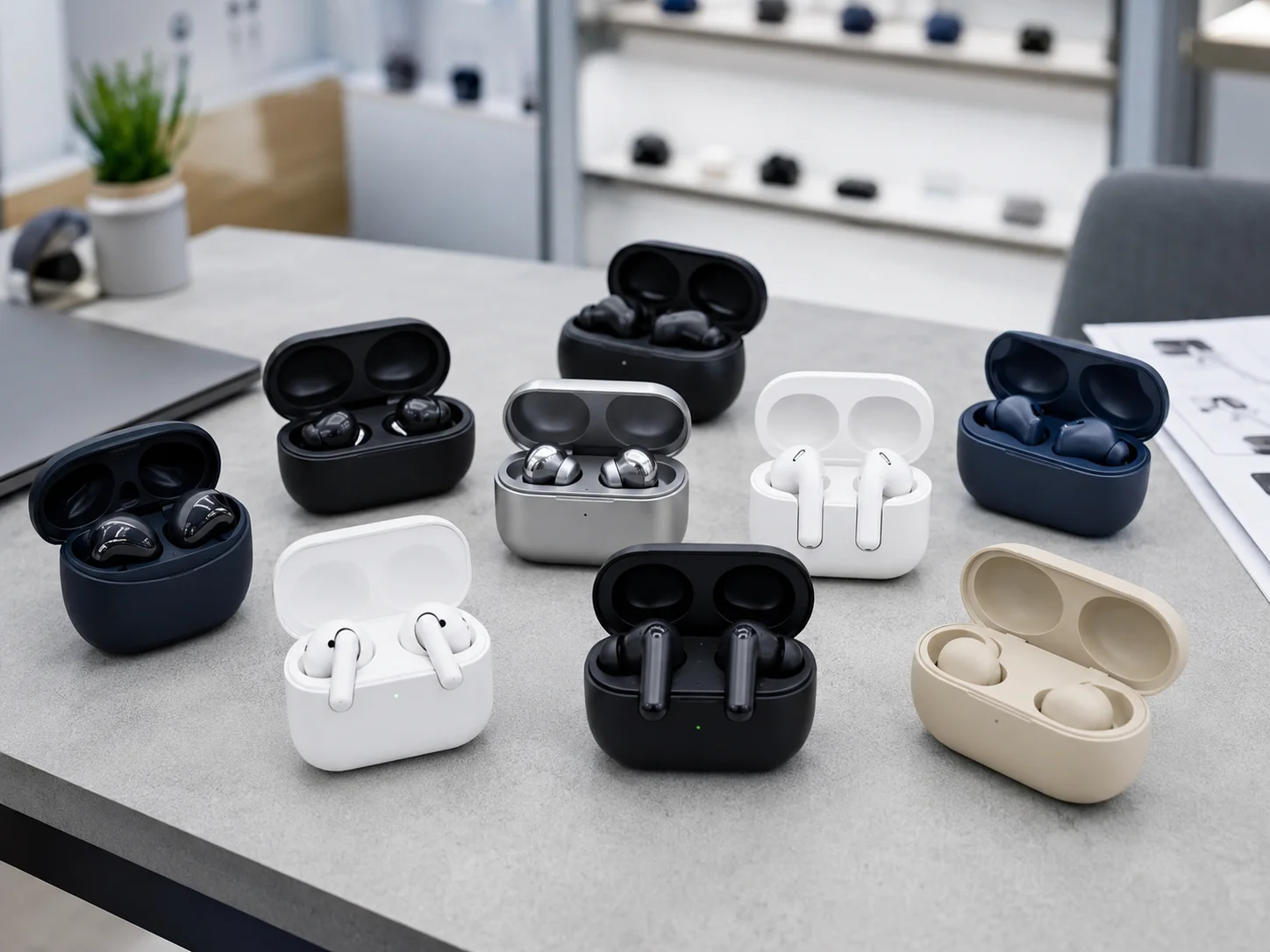
For over 15 years, my company has been exporting consumer electronics from Shenzhen. I've talked to hundreds of buyers, and I've seen the same pattern with TWS earbuds. They seem more profitable than cables or chargers, with better branding potential. But they are also far more complex. A single weak link—be it the chip, battery, mic, or fit—can ruin the entire product experience. Many new buyers ask me, "What's your best price for AirPods-style earbuds?" or "Can you put my logo on this?" Those questions are a start, but experienced importers know to dig deeper. This guide is based on the real questions and problems my clients face every day. My goal is to help you move beyond the spec sheet and make a sourcing decision that builds your business, not just your inventory.
1. What Does OEM Mean for TWS Earbuds Buyers?
Confused about whether to go with wholesale, private label, or full OEM? It's a common problem, but choosing the wrong path can tie up your capital and delay your success.
OEM for TWS earbuds means you co-develop a unique product, which requires a high MOQ and technical input. It's different from Private Label (branding an existing product) or Wholesale (selling a standard product). Your choice depends on your business scale and risk tolerance, not just your branding ambitions.

Many buyers come to me wanting to create their own brand from day one. I usually advise them to slow down. The real question isn't just about branding; it's about business risk. The best sourcing model for you depends on where your business is today. I always frame it as a three-step journey.
Step 1: Wholesale (Standard Stock)
This is the smartest place to start, especially if you're new to TWS earbuds.
- Why it works: You get a low MOQ, fast shipping, and minimal risk. It’s the perfect way to test your market. You can find out which designs, features, and price points your customers actually want, instead of guessing. You could test a few different models at once: an AirPods-style basic model, one with an LED display case, and maybe a budget gaming earbud.
- The lesson: Let your sales data tell you what's popular. Market feedback is always more accurate than your own predictions.
Step 2: Private Label
Once you have a model that sells consistently, it's time for private label.
- What it involves: This is more than just printing a logo. It’s about creating a brand experience. You can customize the packaging, user manual, charging case print, and even color combinations. This builds brand recognition and encourages repeat purchases.
- The strategy: The key is to graduate from selling "a cheap Bluetooth earbud" to selling your brand of earbud. But be careful. Don't invest heavily in custom packaging until you've proven the product's stability and sales velocity.
Step 3: OEM/ODM
This is for mature businesses with stable sales channels and a clear vision.
- The commitment: OEM/ODM means true customization—from the external mold and internal structure to the chipset, battery capacity, and app functionality. The advantage is a truly unique product that competitors can't easily copy.
- The reality: This path requires a high MOQ, a long development cycle, significant financial investment, and deep involvement in testing and certification. If you don't know your market inside and out, OEM is a very risky first step.
The safest path I've seen successful clients take is always the same: Wholesale to test ➔ Private Label to build a brand ➔ OEM to differentiate. It may seem slower, but it protects your cash flow and builds a sustainable business.
2. Which Features Matter Most When Comparing OEM TWS Models?
Are you getting lost in a sea of technical specs? Suppliers often highlight dozens of features, but only a handful truly determine whether a customer will be happy with their purchase.
Appearance sells the first time, but stability, real battery life, and call quality decide if a customer buys again. These are the features that matter most, as they directly impact user experience and lead to fewer complaints.
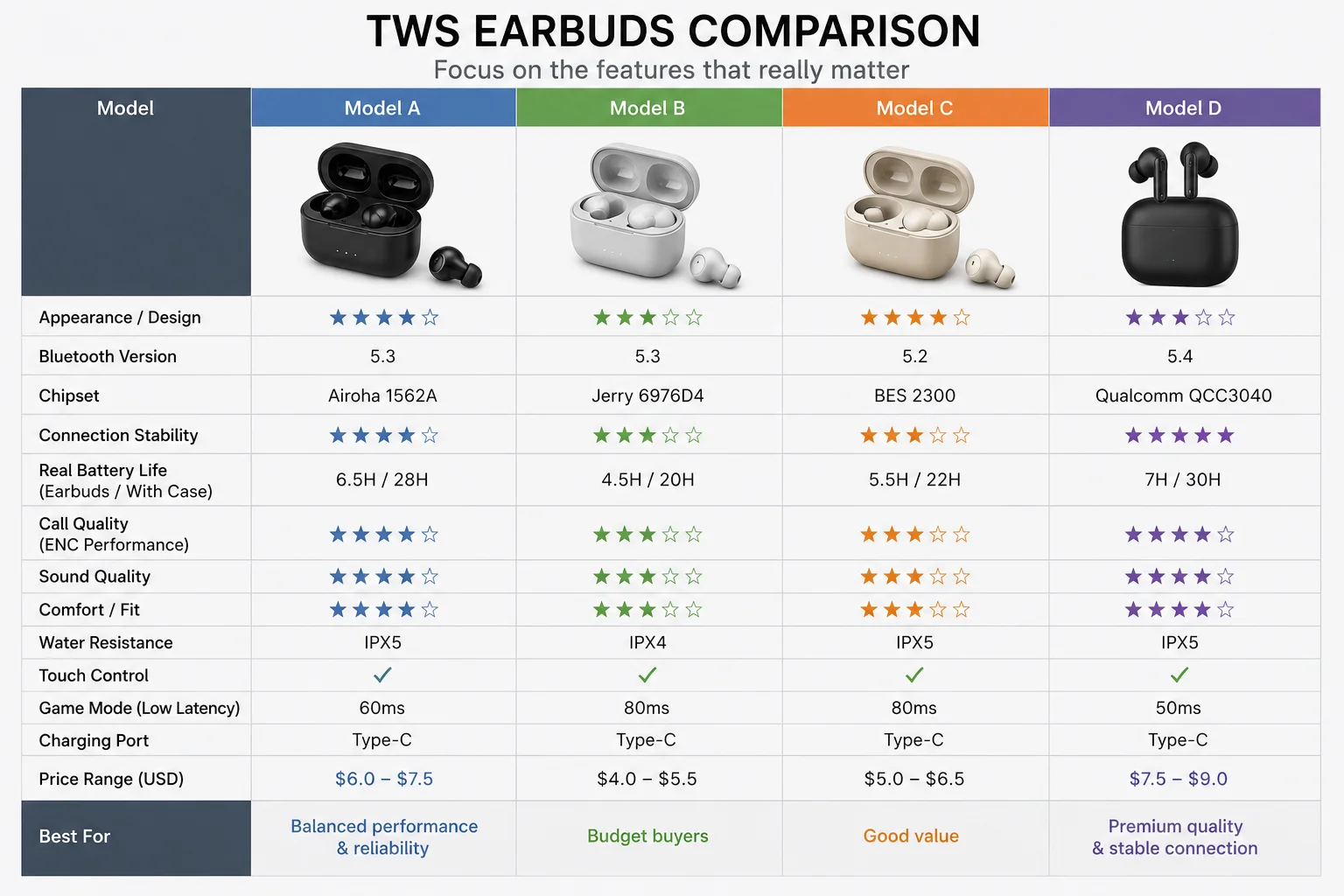
When we develop a new TWS model or select one for a client, we focus on the core pillars of user experience. After 15 years in this business, I've learned that you can't build a good product on a weak foundation. Here are the features that I tell my clients to scrutinize before placing any order.
| Feature Area | What to Look For | Why It Matters |
|---|---|---|
| Appearance & Packaging | Is the design appealing? Does the packaging look professional and protect the product? Is the finish high-quality or does it feel cheap? | This is the first impression. In a retail store, a customer won't even pick up a product that looks cheap. Good design and packaging create perceived value and justify a higher price point. |
| Chipset & Stability | What Bluetooth chip is used (e.g., JL, Bluetrum, Qualcomm)? How stable is the connection? Is there noticeable audio lag with videos or games? | This is the engine of the earbud. A cheap chip leads to constant disconnects, pairing problems, and left/right ear sync issues. This is the #1 source of technical complaints and returns. |
| Real Battery Life | What is the earbud battery capacity (mAh)? What is the charging case capacity? What is the actual single playtime at 70% volume? | Many suppliers quote the total life with the case, which is misleading. If the box says 6 hours but it dies in 3, the customer feels cheated. This discrepancy severely damages brand trust. |
| Sound & Call Quality | Does it sound good for music? More importantly, how is the microphone quality for phone calls in a noisy environment? | Many buyers only test music playback. That's a huge mistake. People use TWS for calls, meetings, and voice chats. If the other person can't hear them clearly, the product is a failure. |
| Comfort & Fit | How much does a single earbud weigh? Is the in-ear design comfortable for long periods? Does it stay in during light activity like walking? | An earbud can have the best features in the world, but if it's painful to wear or falls out easily, no one will use it. This is highly subjective, so it's important to test samples with different people. |
Don't get distracted by a long list of minor features. If a supplier can't deliver on these five core areas, the product is fundamentally flawed. Focus your questions and your testing here, and you'll avoid the majority of problems that other buyers face.
3. How to Compare Real Battery Life, Not Just Claimed Battery Specs?
Is the "30-hour battery life" advertised on the box a reality or a marketing trick? Many buyers get burned by trusting the spec sheet instead of doing their own tests.
To compare real battery life, ignore the total playtime advertised on the box. Instead, confirm the specific battery capacity (in mAh) of both the earbuds and the case, and then perform your own real-world test to measure single-use playtime at a consistent volume.
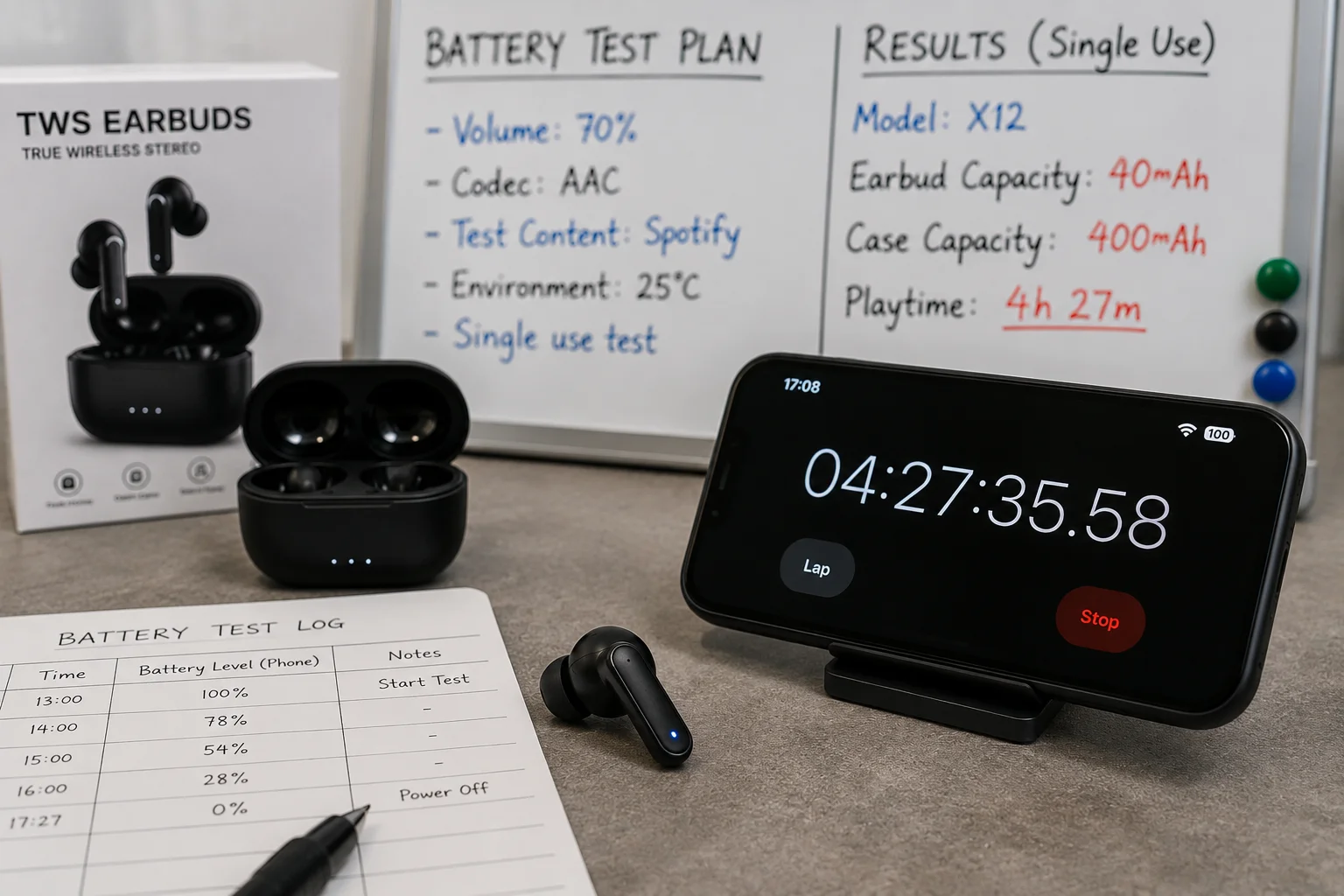
Battery life is one of the easiest places for a factory to cut corners and one of the most common reasons for customer complaints. A customer who expects 6 hours of playtime but only gets 3 feels lied to. This is a quick way to get negative reviews and kill repeat business. Over the years, I've developed a simple but effective checklist to verify battery claims before placing a bulk order.
First, you need to ask your supplier for the right numbers. Don't accept vague answers.
- Earbud Battery Capacity: Ask for the capacity of a single earbud in mAh.
- Charging Case Capacity: Ask for the capacity of the case battery in mAh.
- Single Playtime: Ask for the estimated continuous playtime from a full charge, and specify the volume level for this test (e.g., "at 70% volume").
- Charging Time: How long does it take to fully charge the earbuds and the case?
Once you have these numbers on paper, the real work begins. You must test the sample yourself.
- The Continuous Play Test: Fully charge the earbuds and case. Connect the earbuds to your phone, set the volume to a consistent level (I recommend 70%), and play a continuous audio track. Start a stopwatch and see how long they last until the first earbud dies. Does it match the supplier's claim?
- The Recharge Test: Once the earbuds are dead, put them back in the fully charged case. How many full recharges can you get from the case before it's empty?
- The Standby Test: Fully charge everything and let it sit for 3-5 days. Check the battery levels. A significant drop in power indicates poor quality batteries or circuitry that drains power even when idle.
- The Consistency Test: During the continuous play test, do both earbuds drain power at a similar rate? If one dies much faster than the other, it points to poor quality control.
This process takes time, but it's not optional. It’s the only way to know if the product you sell will live up to the promises on its packaging. A cheap earbud often uses a lower-grade battery. It might perform well for a week, but its capacity will degrade quickly. Investing in a model with a reliable battery is an investment in your brand's reputation.
4. Why Bluetooth Stability and Chipset Quality Affect Complaints?
Have you ever sold a product that results in a flood of complaints like "only one side works" or "it keeps disconnecting"? This is a classic sign of a poor quality Bluetooth chipset.
Bluetooth stability is the foundation of a TWS earbud. A low-quality chipset causes constant user frustration with pairing issues, audio lag, and random disconnects. These problems are not fixable by the user and directly lead to high rates of returns and negative reviews.
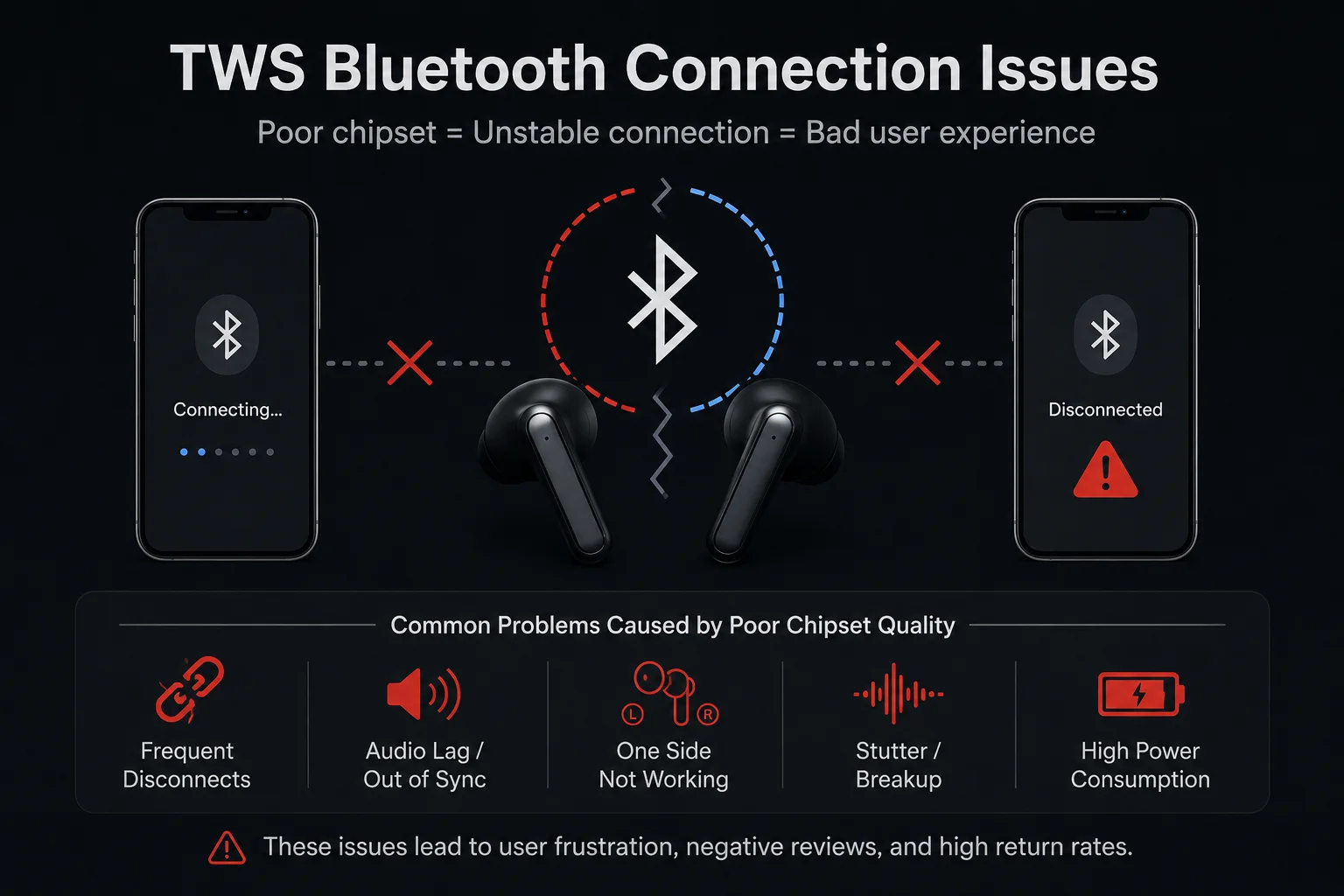
In all my years of exporting electronics, I can tell you that for TWS earbuds, the single biggest point of failure is the Bluetooth connection. It's the engine of the device. If the engine is bad, the whole car is useless, no matter how nice the seats are. Many new buyers make the mistake of just looking at the Bluetooth version number, like "5.3" or "5.4". While a newer version is generally better, it's not the whole story. The quality of the underlying chipset solution and the skill of the engineers who implemented it are far more important.
Here are the common complaints I hear from clients whose previous suppliers used cheap chipsets:
- Pairing Problems: The earbuds are difficult to pair for the first time or don't automatically reconnect to the device.
- Sync Issues: The left and right earbuds lose sync, causing a weird echo effect or one side to drop out completely.
- Constant Disconnects: The audio cuts out, even when the phone is just a few feet away in their pocket.
- High Latency: There's a noticeable delay between the video on screen and the audio in the ears, making gaming and watching movies impossible.
- Limited Range: The user can't walk to the other side of the room without the connection breaking up.
When you're sourcing, you must ask the right question: "What chipset solution are you using?" Different chipsets (like those from JL, Bluetrum, or Qualcomm) have different performance levels and costs. A good supplier will be transparent about this. Then, you must test the sample rigorously with multiple phones (both iOS and Android) to check for these exact stability issues. A slightly higher price for a product with a proven, reliable chipset is one of the best investments you can make. It will save you a fortune in returns, customer service time, and damage to your brand's reputation.
5. How Call Quality, Sound Quality, and Comfort Influence Repeat Orders?
Do you find that your TWS earbuds sell once but customers never come back for more? The problem might not be a major defect, but a combination of small annoyances in daily use.
Excellent sound for music, clear call quality for conversations, and a comfortable fit for all-day wear are what turn a one-time purchase into a loyal customer. These "quality of life" features, often overlooked in budget models, are the key drivers of positive reviews and repeat orders.
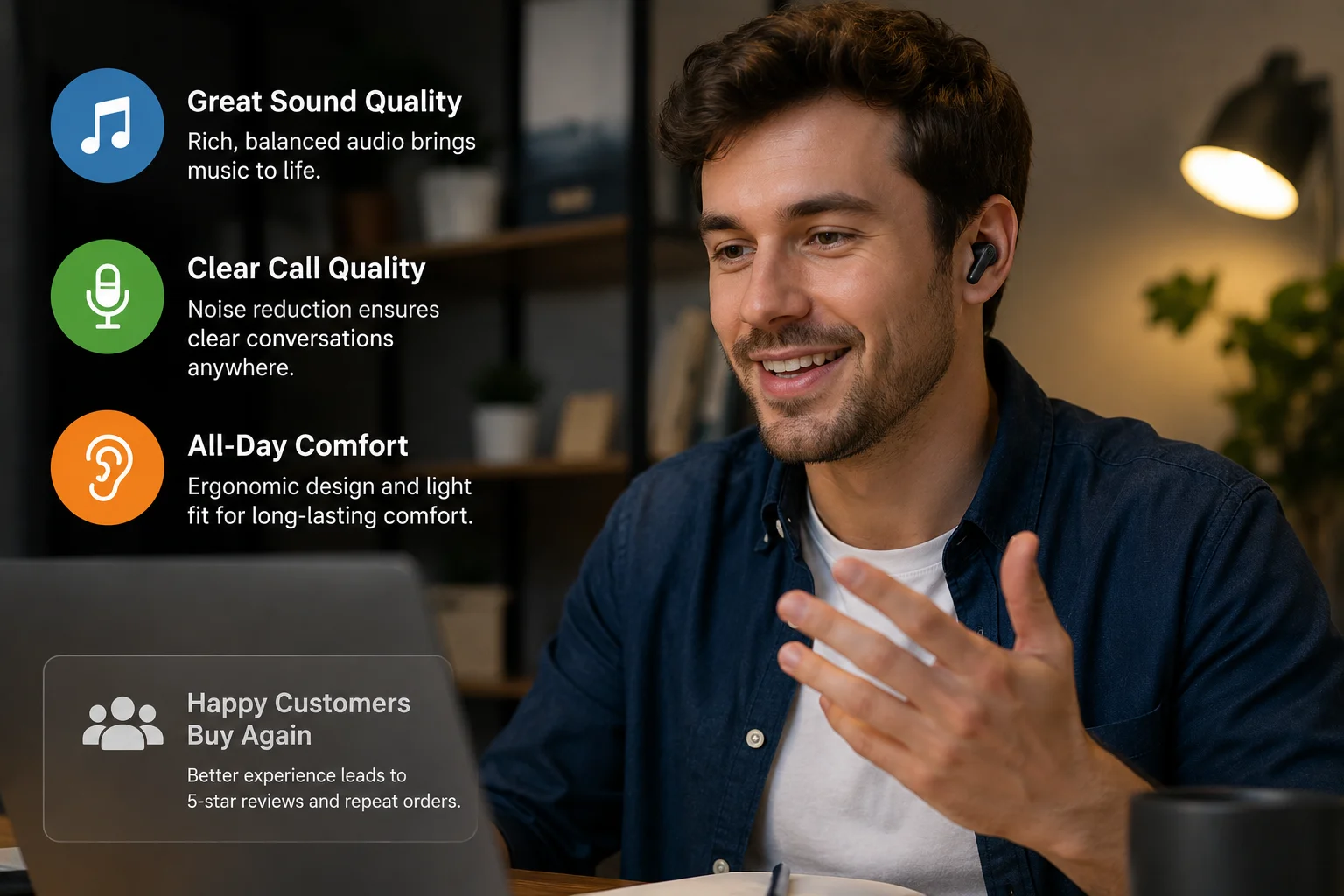
When a customer first buys a pair of TWS earbuds, they are often attracted by the appearance and price. But whether they love or hate the product is decided in the days and weeks that follow. In my experience, three factors are the hidden differentiators that build long-term success.
Call Quality: The Forgotten Feature
This is the biggest blind spot for most buyers. They test the music, and it sounds okay, so they approve the sample. Big mistake. Your customers will use these for phone calls, Zoom meetings, and WhatsApp voice chats. If their voice sounds distant, muffled, or full of background noise, the earbuds are failing at a core task.
- Real-world test: Don't just test in a quiet office. Make a call while walking down a busy street or in a noisy café. Have the person on the other end tell you honestly how you sound. If they say, "It sounds like you're in a tunnel," you have a problem.
Sound Quality: Beyond "Good Enough"
For budget earbuds, you don't need audiophile-grade sound. But you must avoid common pitfalls that make the audio experience unpleasant.
- What to listen for: Is the bass muddy and overwhelming? Is the treble harsh and painful at high volumes? Is there a noticeable "hiss" or static noise when no music is playing? These issues scream "cheap" to the end user. The goal is a balanced sound that's easy to listen to.
Comfort: The All-Day Test
A feature-packed earbud is useless if it's painful to wear. Comfort is highly subjective, but there are common design flaws to watch out for.
- Key factors: How much does each earbud weigh? Does the design create a painful pressure point inside the ear after 30 minutes? Does it feel secure, or are you constantly worried it will fall out? Try to have several different people test the fit of your samples. A product that's too heavy or has a poorly angled nozzle will never get a good review from someone who wants to wear it for more than a few minutes.
These three elements—call quality, sound quality, and comfort—are where many manufacturers cut corners to lower the price. But they are precisely the things that create a positive user experience and make a customer recommend your brand to a friend. Focusing on these details is how you build a reputation for quality and secure those valuable repeat orders.
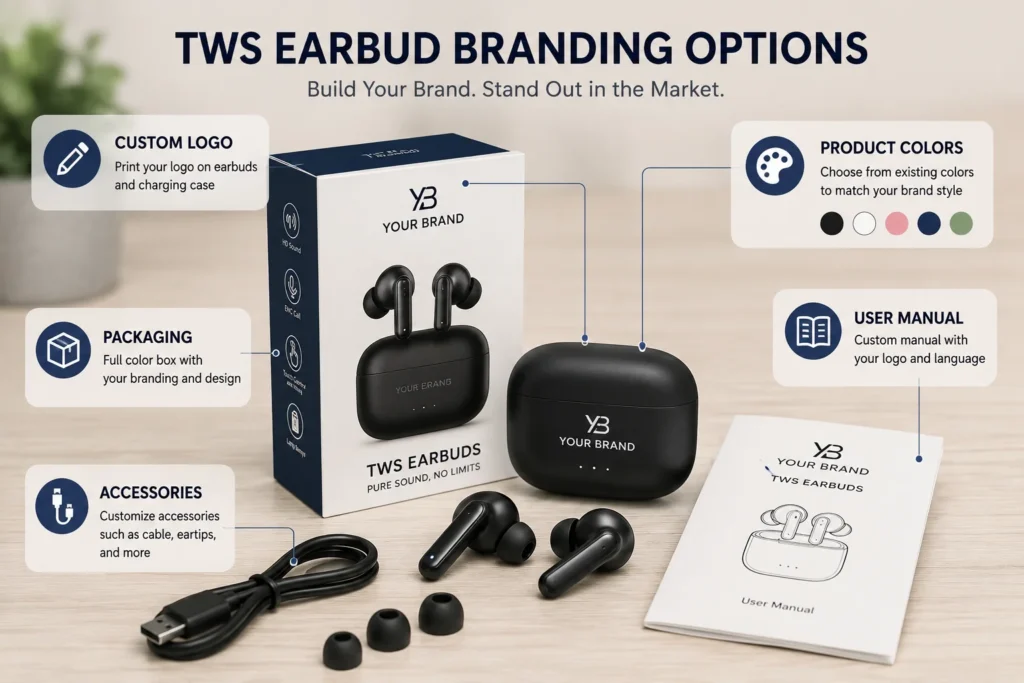
6. What Branding Options Can You Customize: Logo, Packaging, Colors, and Manual?
Are you ready to move beyond selling generic products and start building your own brand? Private labeling is the first step, but many buyers don't realize how much they can customize without investing in new molds.
For TWS earbuds, you can customize the logo on the product and case, the entire color box packaging, the user manual, product colors, and even the included accessories. This allows you to create a distinct brand identity with a relatively low MOQ and investment.
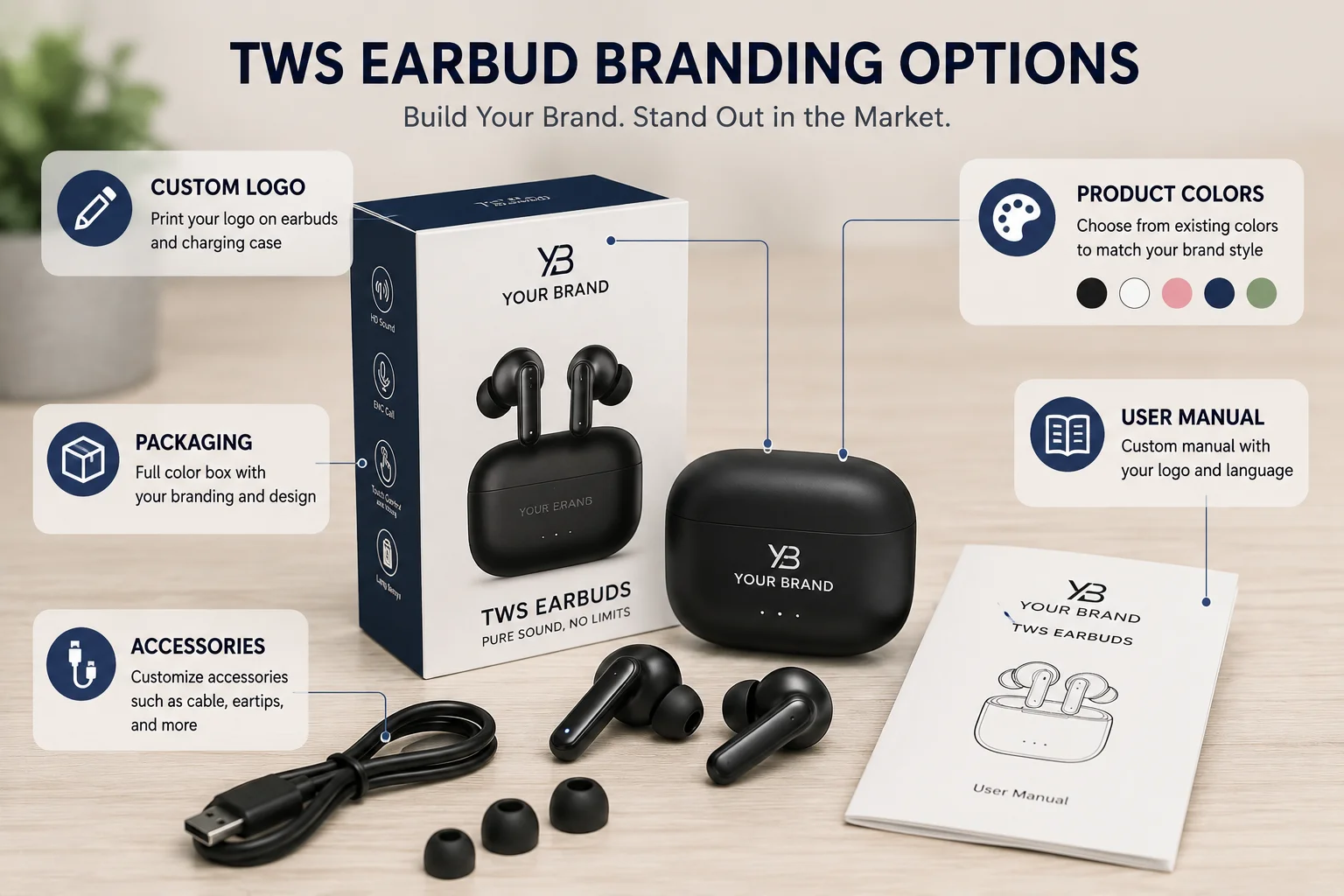
When a client tells me they have a stable-selling TWS model, my next question is always, "Are you ready to build your brand around it?" Private labeling is the most effective way to do this. It separates your product from all the generic look-alikes on the market and gives customers a name to remember. The goal is to make the entire product experience feel uniquely yours, from the moment they see the box to the day they need to read the manual. Based on what we do for our clients, here are the most common and impactful branding customizations you can request.
| Customization Option | Why It's Important | Typical Considerations |
|---|---|---|
| Logo Printing | This is the most basic form of branding. Your logo on the earbuds and the charging case is a constant reminder of your brand. | MOQ is usually low. Ensure the printing method is durable (e.g., silk screen, laser engraving) and won't rub off with use. |
| Custom Color Box | The packaging is your silent salesman on a retail shelf. A well-designed box with clear features and strong branding can dramatically increase sales. | You will need to provide the design file (artwork). The MOQ for custom packaging is often higher than for the product itself, so confirm this with your supplier. |
| User Manual | A clear, well-written manual in the local language of your target market shows professionalism and reduces customer service questions. | Don't rely on the factory's default English manual, which is often poorly translated. Invest in professional translation and design. |
| Product Colors (Pantone Matching) | Want to offer your earbuds in your specific brand colors? Many factories can produce the plastic shells in custom Pantone colors. | This usually requires a higher MOQ than standard colors (black/white) because the factory has to mix a new batch of plastic. |
| Custom Accessories | You can create a unique bundle by customizing the accessories. This could include a branded charging cable, different colored ear tips, or a small carrying pouch. | This adds value and can be a point of differentiation. Confirm if these accessories will be sourced by the main factory or a third party. |
Starting with these private label options is a powerful, low-risk way to establish your brand. It gives you control over the customer's perception of your product without the massive financial and time commitment of a full OEM/ODM project. Once customers start recognizing and asking for your brand by name, you know you're on the right track.
7. What MOQ, Lead Time, and Sample Testing Should Buyers Confirm?
Are you ready to place your first wholesale order for TWS earbuds? Before you send the deposit, a final confirmation on key details can be the difference between a smooth process and a costly mistake.
Before any TWS earbud order, you must confirm the final MOQ for your specific customization, the production lead time after payment, and the warranty policy. Most importantly, you must get a binding promise that the bulk order will use the exact same components as the approved sample.
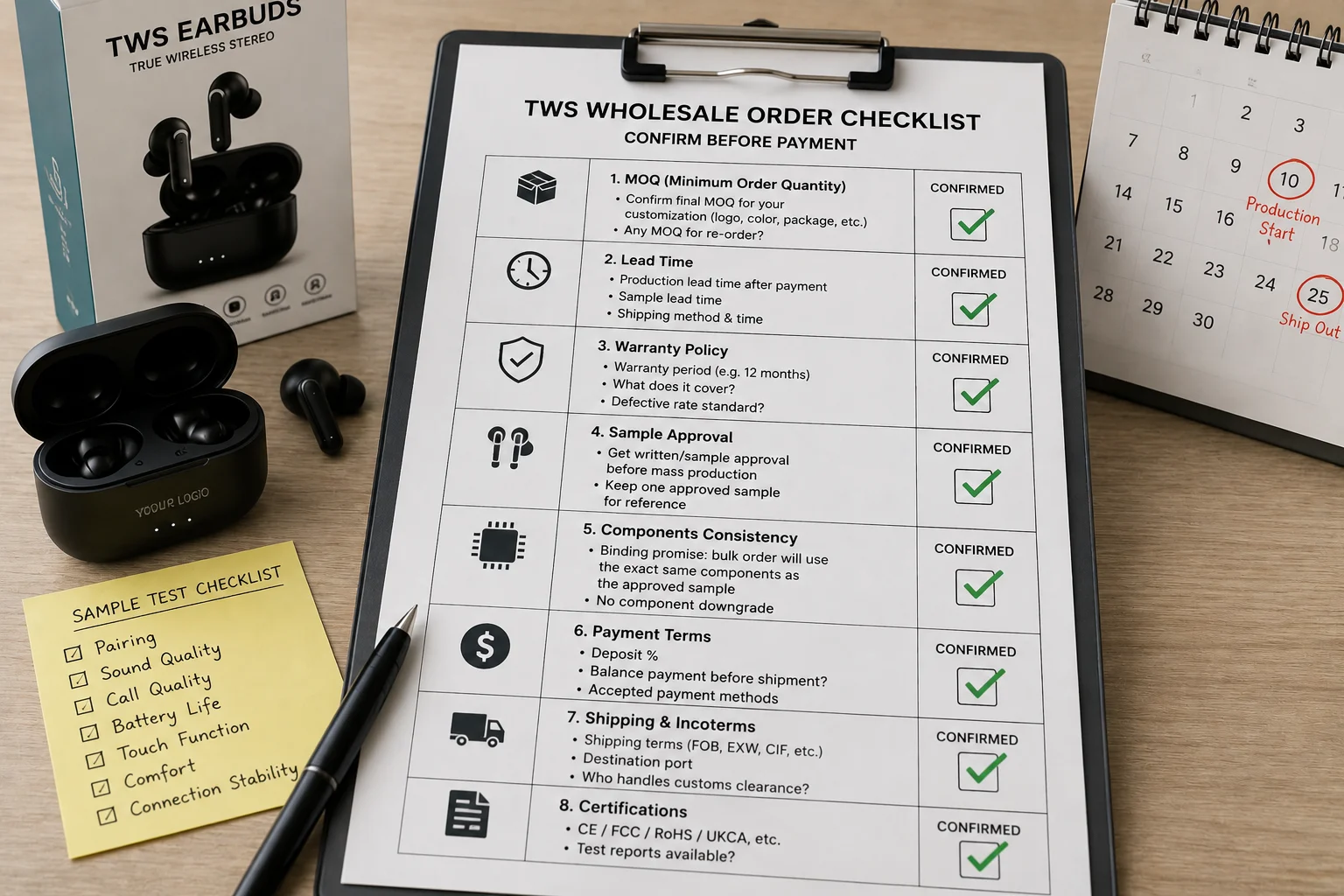
TWS earbuds are far more complex than simple accessories like USB cables. They have more potential points of failure, which means the risk of a bad batch is higher. As an exporter, I've seen buyers get into trouble by not being specific enough before an order. Here is the final checklist I go through with my clients to ensure there are no surprises. This is about creating a clear, written record of expectations.
1. Confirm MOQ and Lead Time
Don't assume the standard MOQ applies to your order, especially if you have custom requests.
- Questions to ask:
- "What is the final MOQ for the product with my custom logo and packaging?"
- "What is the production lead time, starting from the day you receive my payment and final artwork?"
- "Does the lead time change if I order a custom color?"
2. Confirm All Components and Specs
This is the most critical step. "Sample switching," where the bulk order uses cheaper parts than the approved sample, is a real risk.
- What to get in writing:
- "Please confirm the bulk order will use the same chipset solution as the sample."
- "Please confirm the same battery model and capacity (for both earbuds and case)."
- "Please confirm the same speaker driver and microphone model."
- A reliable supplier will have no problem putting this in the Proforma Invoice (PI).
3. Confirm Testing and QC
Your sample testing is not enough. You need to know how the factory ensures quality across thousands of units.
- Questions to ask:
- "What is your standard factory defect rate for this model?"
- "Can you provide a mass production sample for approval before shipping the full order?"
- "Can you send photos or a video of my products being tested on the production line?"
4. Confirm Warranty and After-Sales Support
No TWS earbud is perfect. A good partner isn't one who says "no problems," but one who has a clear plan for when problems happen.
- Questions to ask:
- "What is your warranty period?"
- "How do you handle defective units? Do I need to ship them back?"
- "Can you provide a small number of spare units (e.g., 1%) with the order?"
Treating this checklist as a mandatory part of your ordering process will protect your investment and help you build a relationship with your supplier based on clarity and trust, not just a low price.
8. Final Advice: Choose Proven Hardware Before Custom Branding?
Should you jump straight into creating a unique, custom-branded TWS earbud? As an exporter who sees both successes and failures, my advice is almost always the same: not yet.
Your top priority should be to find a TWS earbud with stable, proven hardware first. Test the market with a standard model to validate its quality and sales potential before you invest a single dollar in custom branding or packaging.
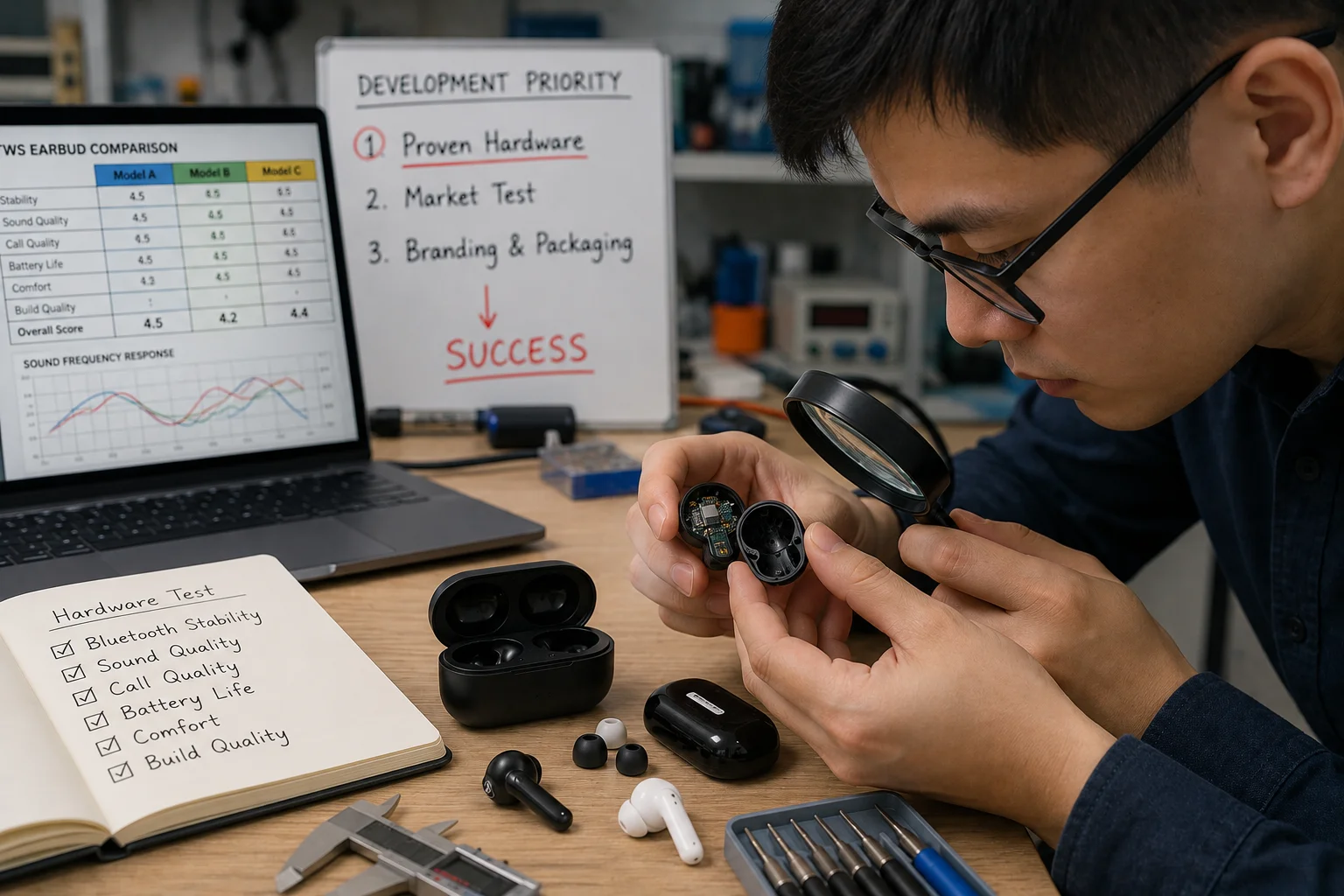
From my personal view, the TWS earbud category is full of opportunity. The profit margins and branding potential are much higher than for basic accessories. A good-looking, reliable model at the right price can become a long-term bestseller for your business. However, it's also a category filled with traps for new buyers. The product is not just hardware. It's a delicate mix of a Bluetooth connection, battery performance, audio tuning, microphone clarity, software, and physical comfort. If any one of these elements is weak, the customer feels it immediately.
Therefore, when you are sourcing, you absolutely cannot focus only on the appearance and the price. The real test of a good TWS earbud, and a good supplier, comes down to these simple, practical questions:
- Is the connection stable?
- Is the battery life real?
- Is the call quality clear?
- Is it comfortable to wear?
- Is the bulk production as good as the sample?
- How will you handle after-sales issues?
- Does the packaging look good enough to sell?
- Will my customers come back to buy more?
There is absolutely a market for cheap earbuds, but "cheap" cannot mean "junk." There is also a market for mid-range models, but their features must be genuine. And there's great profit in high-end models, but they must deliver a premium experience.
If you are just starting, my strongest recommendation is to resist the urge to design your own model or even do complex private labeling. Start by finding a few mature, off-the-shelf models from a reliable supplier. Use real sales data from your own market to find out which price point moves, which design customers prefer, and which features get the fewest complaints.
Once you have that data and a stable-selling product, then you can confidently invest in private labeling. Once you have a deep understanding of your market and significant volume, then it's time to consider OEM/ODM. This step-by-step approach is slower, but it's the most reliable way to build a profitable TWS earbud business without betting everything on an unproven product. The real money isn't in a single, cheap, one-time sale; it's in finding a stable product that keeps your customers happy and makes them want to buy from you again and again.
Conclusion
Ultimately, success in the TWS market comes from prioritizing stable hardware and real-world performance over flashy specs. Test first, then brand, to build a lasting and profitable product line.