Struggling with earbud complaints about battery and connection? A new technology, LE Audio, promises to fix these. But what does it mean for your business and product choices?
Bluetooth LE Audio is the next generation of wireless audio technology1. It offers better sound quality with much less power, more stable connections, and new features like Auracast. This directly impacts your product's real-world battery life and user satisfaction, leading to fewer returns.
I've been in the electronics export business in Shenzhen for over 15 years. Every day, I talk to buyers like you from Europe and the US. I see the same problems again and again. A hot product like TWS earbuds brings in customers, but it can also bring a lot of headaches if the quality isn't right. Now, a new technology is here, and it's important we talk about it. We will not talk like engineers. We will talk about what this means for your business, your customers, and your future orders. This is about making smarter decisions to grow your business and avoid problems down the road.
What Is Bluetooth LE Audio and Why Should Buyers Care?
Are you confused by new tech terms like LE Audio? You worry it is just marketing hype that will not help you sell more products.
LE Audio is a new standard that improves wireless sound. Buyers should care because it directly solves major customer complaints. These include short battery life, unstable connections, and average audio quality, leading to fewer returns and better reviews2.
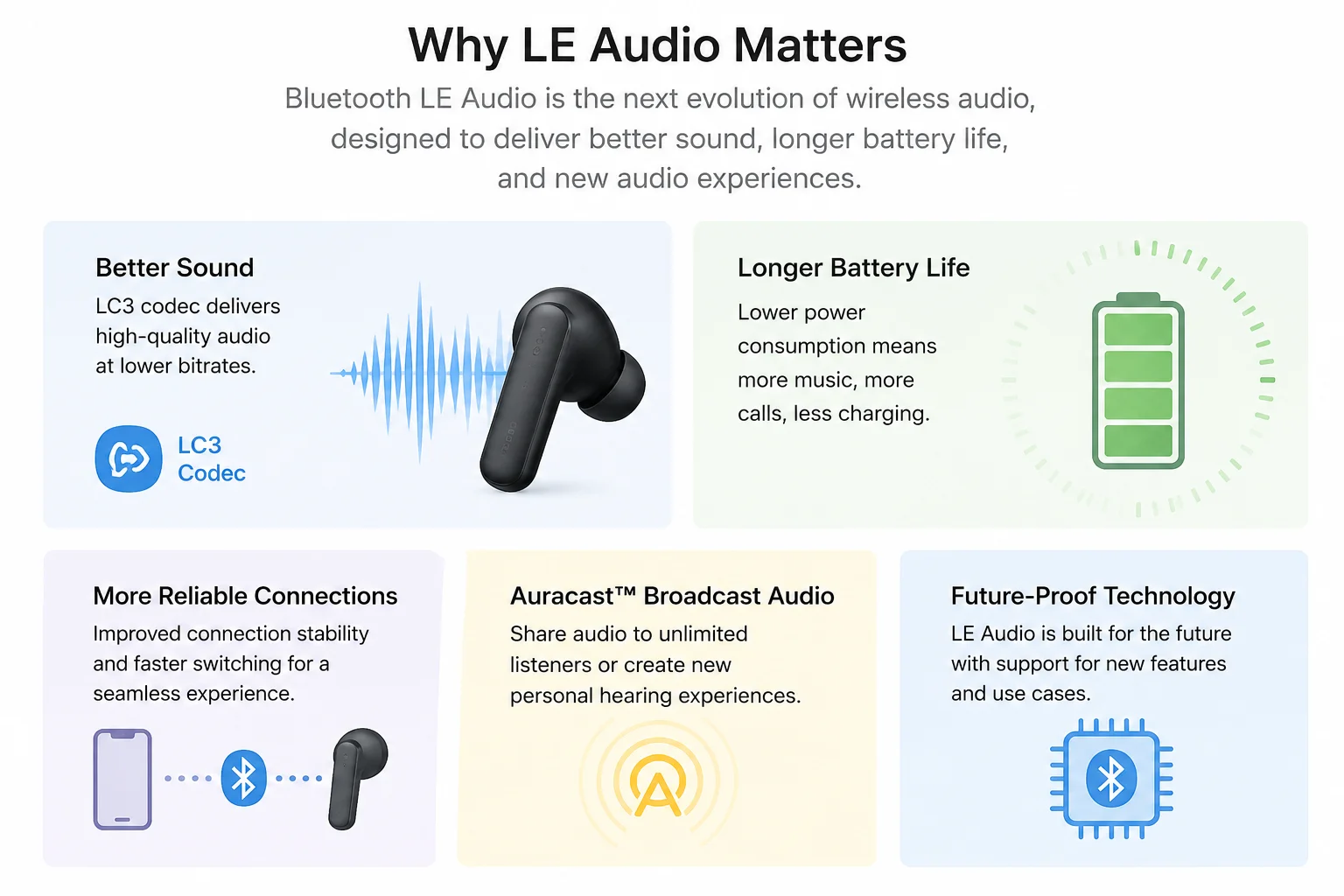
For many years, the earbuds we sold used what we now call "Classic Audio." It worked, but it had problems. I am sure you have seen the customer complaints: "The connection dropped," "Only one earbud is working," or "The battery died too fast." These are not just user issues; they are business issues that lead to returns and bad reviews.
Bluetooth LE Audio is a completely new way to send sound. It is not just a small update. It was built from the ground up to be more efficient and flexible. For a buyer, you do not need to know the deep engineering details. You just need to know it delivers three key things that your customers will notice:
- A new, more efficient codec (LC3).
- Longer battery life.
- New capabilities like Auracast broadcast audio.
Think of it this way. You are not just buying a new feature. You are buying a solution to the most common problems that cost you money and damage your brand's reputation.
| Feature | Classic Audio | Bluetooth LE Audio | Why It Matters for Your Business |
|---|---|---|---|
| Foundation | Built on older, power-hungry tech | Built on the modern, efficient LE radio | Lower power use means better battery life, a top selling point. |
| Standard Codec | SBC (Mandatory, basic quality) | LC3 (Mandatory, high quality) | Better out-of-the-box sound without needing expensive licensed codecs. |
| Connectivity | One device to one or two devices | One device to many, or many to many | Opens new markets with features like Auracast. |
How Does LE Audio Improve Battery Life for Earbuds?
Are your customers constantly complaining that their earbuds die too fast? This leads to bad reviews and high return rates for you.
LE Audio uses the highly efficient LC3 codec, which delivers high-quality audio at a much lower data rate3. This means the radio transmits for less time, drastically reducing power consumption and extending the earbud's single-use playtime.
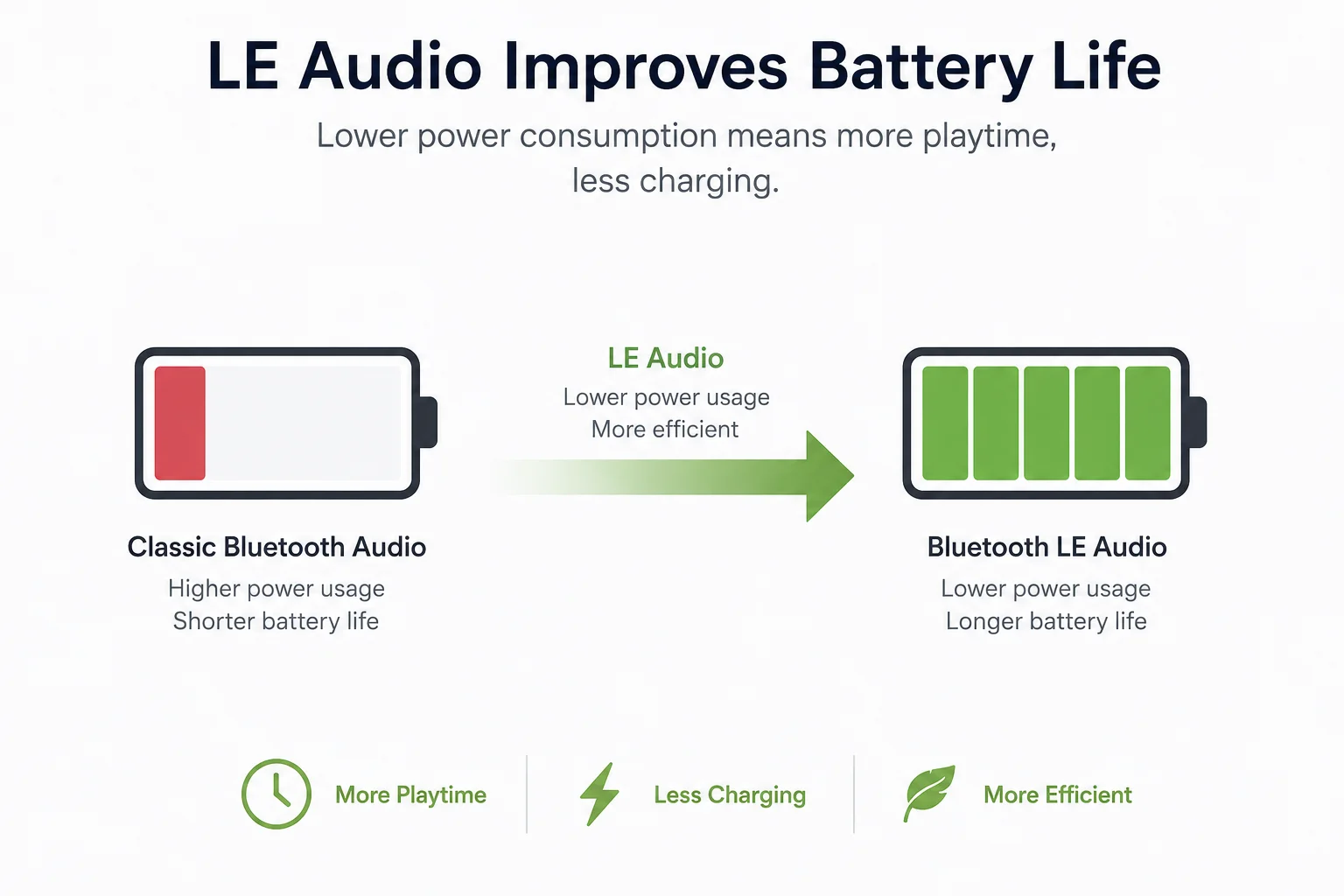
A common question we get from buyers is, "Is the battery life real or just a number on the box?" With old technology, it was very easy to exaggerate. But LE Audio helps us deliver on our promises. The magic here is the new LC3 codec.
Imagine you have to send a package. The old SBC codec was like using a very big box for a small item. It was wasteful. The radio had to work hard and for a long time to send this big, inefficient package of data. This used a lot of power.
The new LC3 codec is like a smart packer. It can put the same high-quality item (the audio) into a much smaller, more efficient box. Sending this smaller box is faster and requires much less energy from the radio.
What does this mean in the real world? An earbud that used to last 4 hours might now last 6 or 7 hours, using the same size battery4. This is not a small improvement. For a customer who uses their earbuds all day, this is a huge benefit. For you as a seller, it becomes a powerful and honest marketing message. You can confidently sell a product that meets or exceeds customer expectations for battery life.
Why Does Better Connection Stability Matter for Daily Use?
Do you get returns for earbuds that drop connection or won't pair properly? These technical issues can ruin a brand's reputation very quickly.
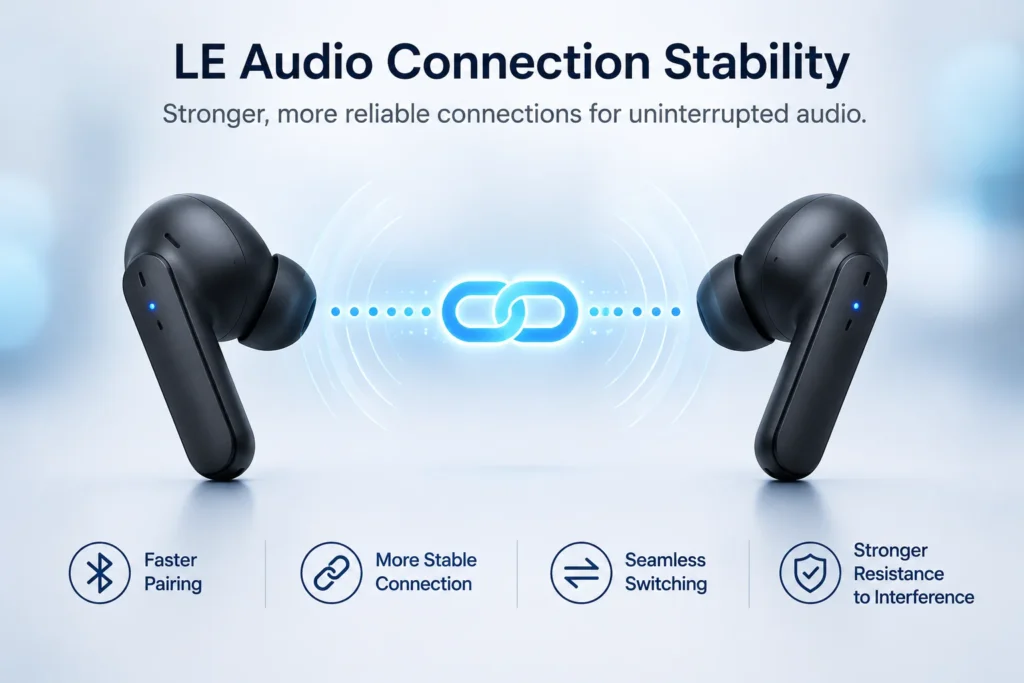
LE Audio provides more robust connections, especially in crowded radio environments like offices or public transport. For your customers, this means fewer frustrating dropouts, easier pairing, and a more reliable product, which protects your brand.
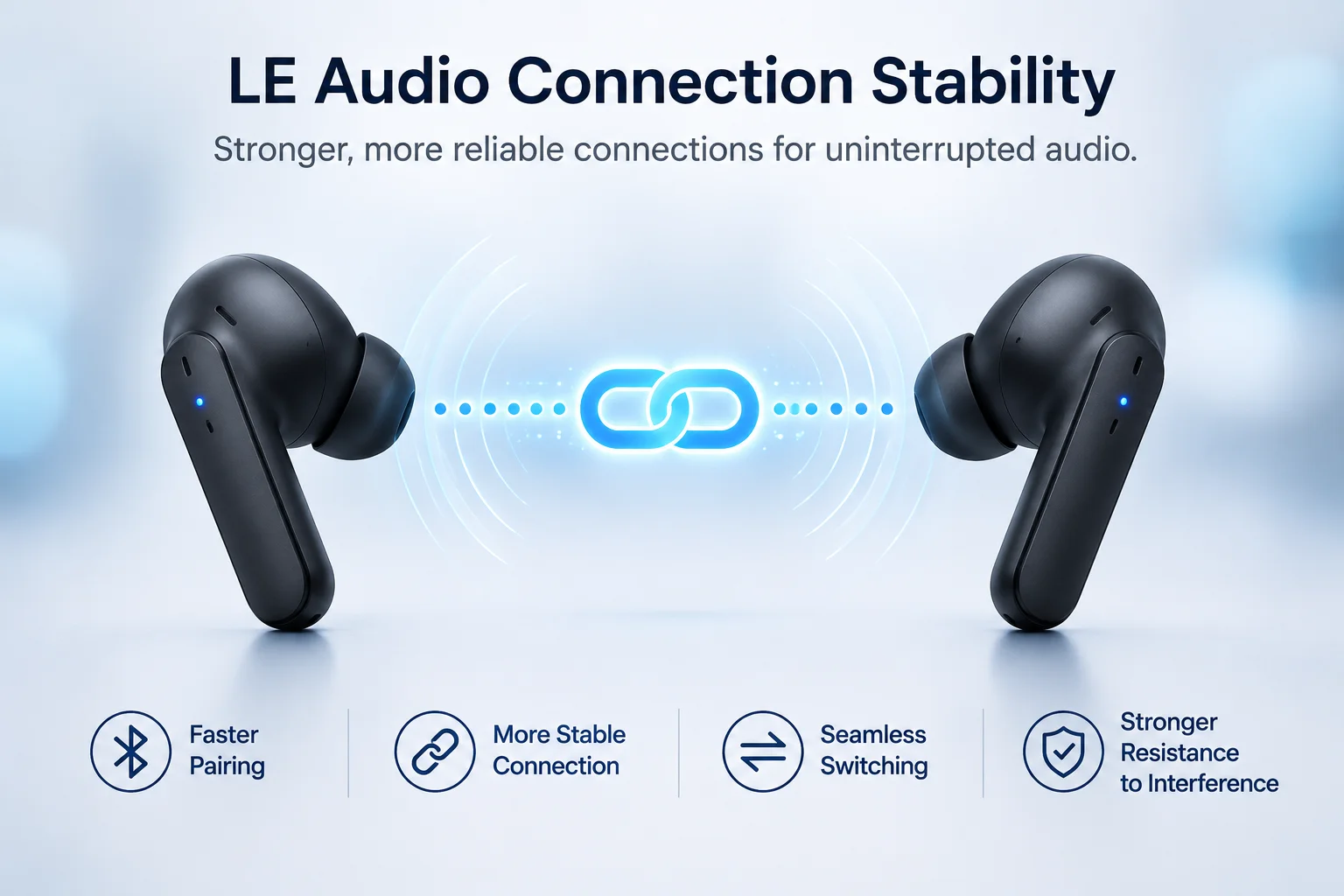
One of the biggest headaches for TWS earbud sellers is connection trouble. I have heard it all from my clients' customers: "Only one earbud connected," "The sound stutters when I walk outside," or "They keep disconnecting from my phone." This is a nightmare for customer support.
LE Audio introduces a new technology called Isochronous Channels. You do not need to remember the name. Just remember what it does. With old earbuds, the phone would often send the signal to one earbud (the primary), and that earbud would then send the signal to the other one (the secondary)5. This primary-secondary link was a common point of failure. If you blocked the primary earbud, the secondary one would lose sound.
With LE Audio, the phone sends a perfectly synchronized signal to both earbuds at the same time6. Each earbud gets its own direct, stable connection. This makes the entire system much more robust.
For your customer, this means:
- The earbuds just work, every time.
- They can use either the left or right earbud independently without any issues.
- The connection is strong even in a busy place with many other Bluetooth devices, like a gym or an airport.
For your business, this means fewer product returns, happier customers, and a better brand image. You are selling a product that is reliable, and reliability builds trust.
How Does the LC3 Codec Change Sound Quality Expectations?
Are you worried that "low energy" also means "low quality" sound? You do not want to offer a product that sounds worse than what is already on the market.
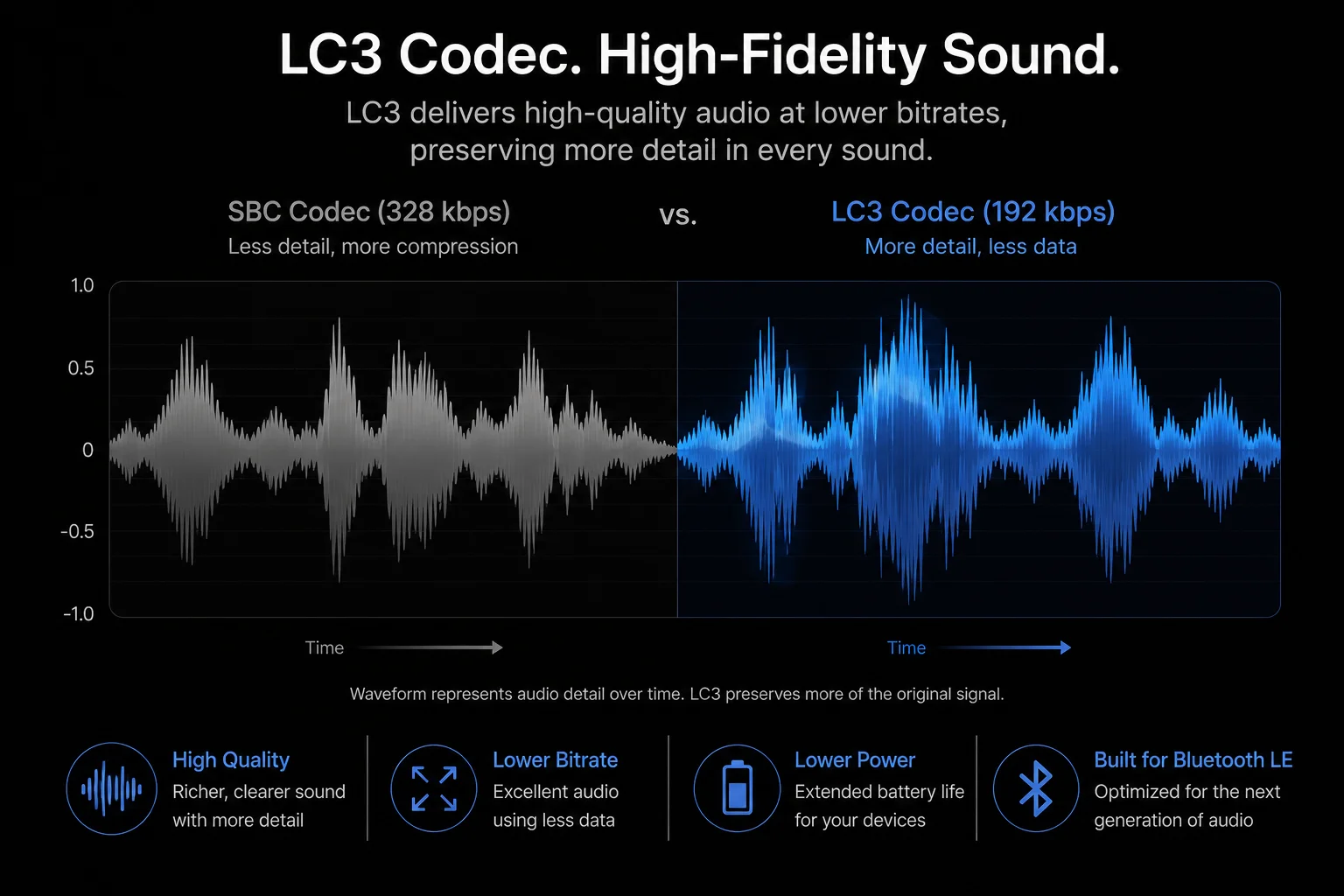
The LC3 codec is a game-changer. It delivers noticeably better audio quality than the standard SBC codec, even at lower bitrates. This means you can offer great-sounding earbuds without sacrificing battery life, a huge competitive advantage.
For a long time in the TWS world, we had a difficult choice. We could offer great battery life or great sound quality, but it was hard to have both. To get better sound, we needed to use codecs like aptX or LDAC, which used more power. Basic earbuds were stuck with the standard SBC codec, which was... okay. Not great, just okay. It often made music sound flat or muffled.
The new LC3 codec, which is mandatory for all LE Audio certified products%%%FOOTNOTE_REF7%%%, changes everything. It is incredibly flexible and efficient. [Technical tests show](https://en.wikipedia.org/wiki/LC3(codec))8 that LC3 can deliver sound quality that feels better than SBC, even while using about half the data.
This gives us, the manufacturers and you, the buyers, a powerful choice:
- Prioritize Quality: We can use a similar data rate as old SBC and deliver a huge improvement in audio clarity, detail, and richness.
- Prioritize Battery: We can cut the data rate in half, get similar audio quality to old SBC, and dramatically increase the battery life.
Most products will land somewhere in the middle, offering a clear boost in both sound quality and battery life. Finally, you no longer have to compromise. You can offer your customers earbuds that sound great and last all day. This moves "good sound" from a premium, expensive feature to a standard expectation.
Why Could Auracast Create New Use Cases?
Are you looking for the next big feature to differentiate your products? Selling the same old TWS earbuds is getting harder every day.
Auracast lets one audio source, like a TV in a gym or an airport announcement, broadcast to an unlimited number of LE Audio earbuds9. This opens up brand new public and shared listening experiences for your customers.
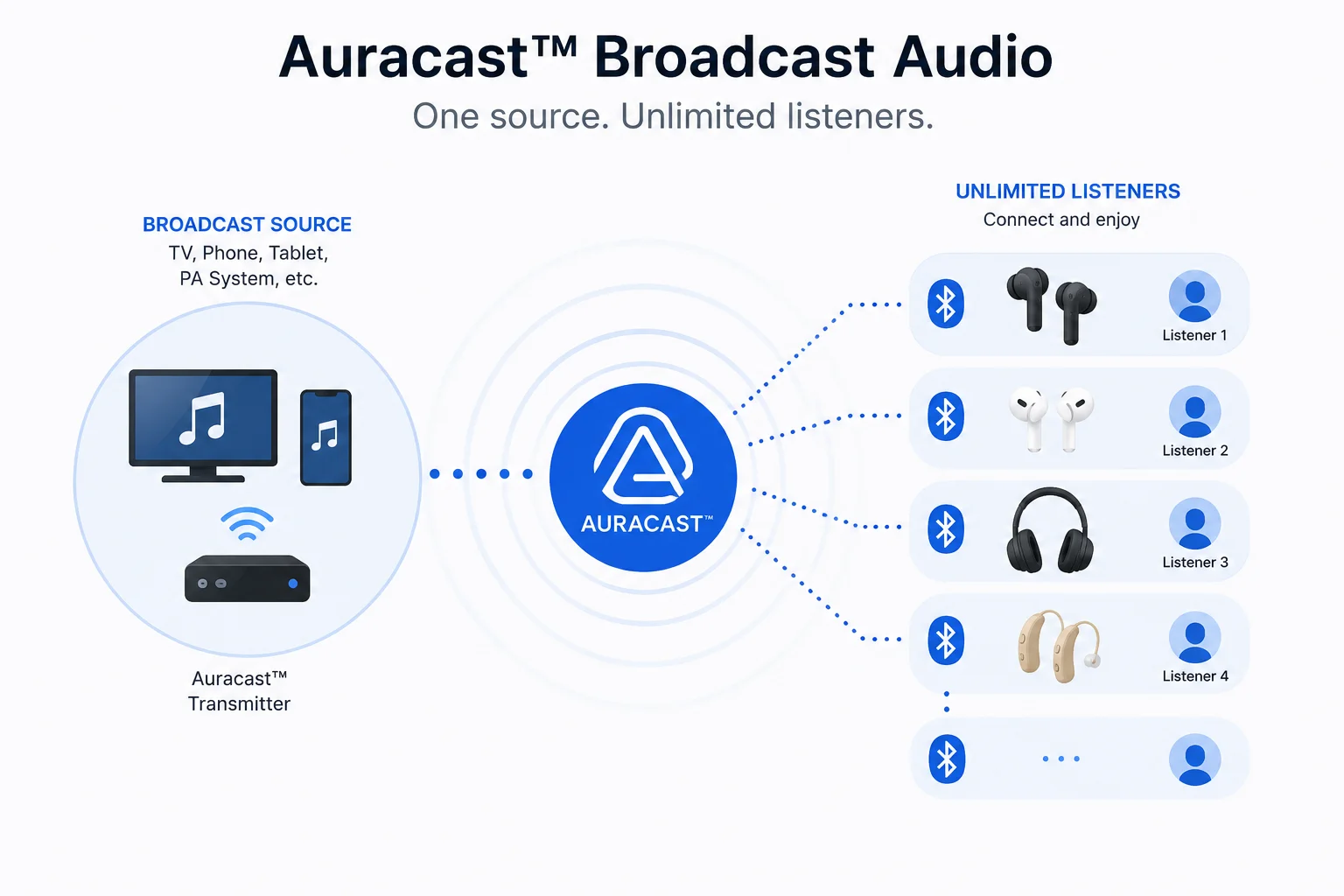
This is the most forward-looking part of LE Audio, and for smart buyers, it's a huge opportunity. Auracast is a totally new way to use wireless audio. Think of it like a personal radio station. An Auracast transmitter can broadcast audio, and anyone with compatible earbuds can choose to listen in.
This is not just a theory; it will create real-world applications and new sales channels. Imagine these scenarios:
- Airports: Passengers can listen to gate announcements or flight information for their specific flight directly in their earbuds, instead of trying to hear over the crowd.
- Gyms: All the silent TVs on the walls can broadcast their audio. Members can choose which TV to listen to while on the treadmill.
- Museums & Tours: A tour guide can speak into a microphone, and everyone in the group can hear them perfectly in their own earbuds, even in a noisy place.
- Conferences: Organizers can offer simultaneous translation in multiple languages. Attendees just select the language channel they want to hear.
As a product seller, this is exciting. At first, you can market Auracast as a "future-proof" feature. Soon, you could be selling your branded earbuds directly to businesses like gyms, conference centers, and museums. It creates entirely new B2B markets for a consumer product.
Which Buyer Segments Will Care About LE Audio First?
You have a limited budget for new products. You need to know which of your customers will actually pay more for LE Audio right now.
Initially, tech enthusiasts and buyers for premium electronics retailers will care the most. They seek the latest features. However, as the tech becomes standard, even mass-market wholesalers will need it to avoid selling "outdated" products.
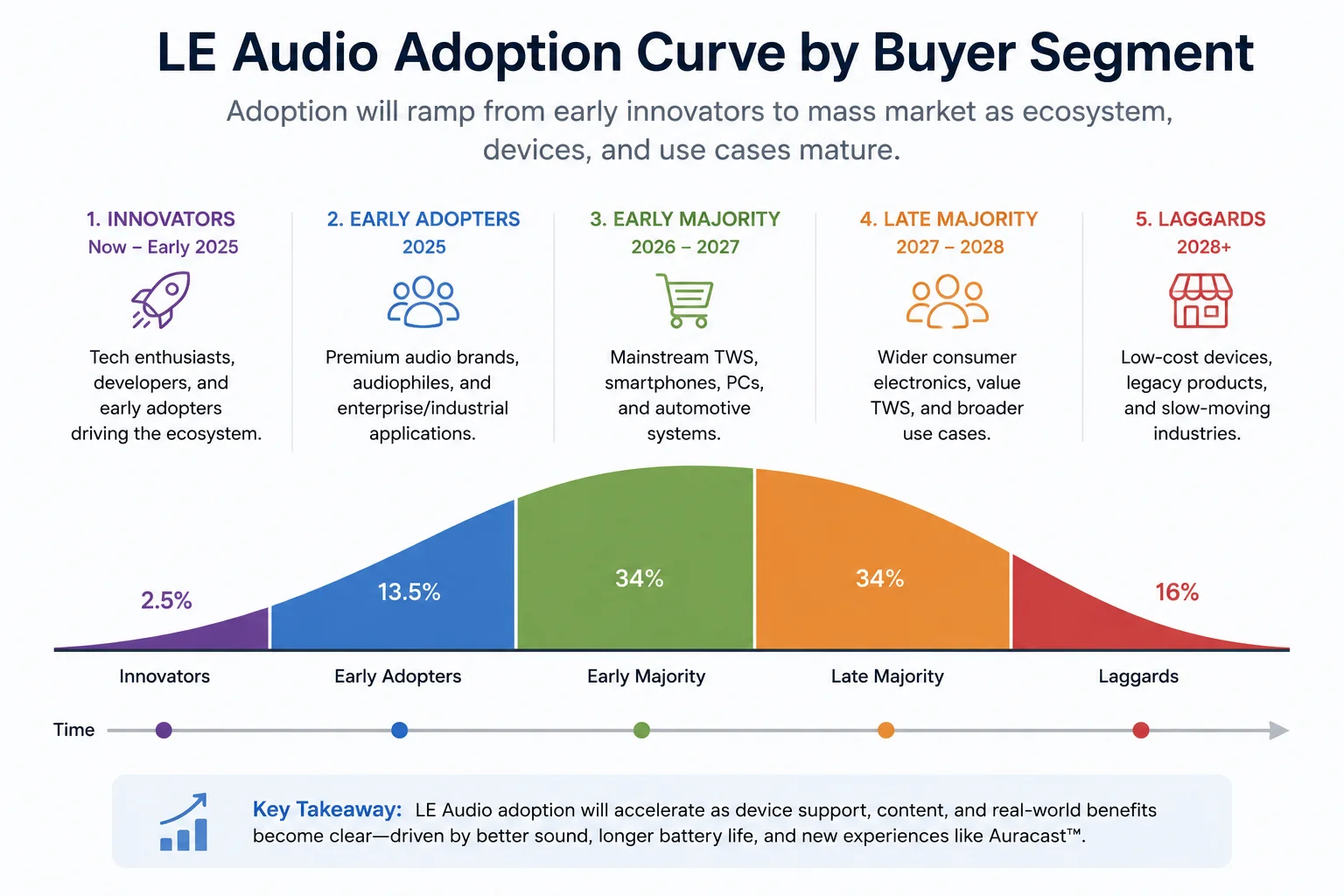
In my experience, not all new technology is for every buyer on day one. The right strategy depends on who your customers are. Here is how I see the market breaking down for LE Audio.
-
E-commerce Sellers & Brand Builders: You should be very interested in LE Audio right now. The benefits of better battery life and sound quality are powerful marketing messages. You can use these features to justify a higher price point and build a brand known for quality and innovation. This is a perfect opportunity for a private label strategy, where you can differentiate your product without designing it from scratch.
-
Premium Electronics Retailers: Your customers expect the latest and greatest. For you, carrying LE Audio products is not an option; it's a necessity. Soon, not having LE Audio earbuds on your shelf will be like not having 4K TVs. You need to be an early adopter to maintain your premium image.
-
Mass-Market Wholesalers & Retailers: Your game is about volume and price. For you, the answer is "not yet, but soon." Right now, the cost for LE Audio chipsets is still a bit higher10. You can continue to sell Classic Audio products that hit your price targets. But you must watch this space. In 12-18 months, as prices fall, LE Audio will become the new baseline.11 Your job is to prepare for that transition so you are not left with a warehouse full of "old" technology.
What Specs to Check Before Selecting LE Audio Earbuds?
You are ready to source LE Audio earbuds, but what do you ask the supplier? You need to avoid being fooled by misleading marketing terms.
Do not just look for "LE Audio" on the box. Confirm the Bluetooth version (5.2+), explicit LC3 codec support, and test the actual battery life and connection stability. Always ask for production samples, not just engineering prototypes.
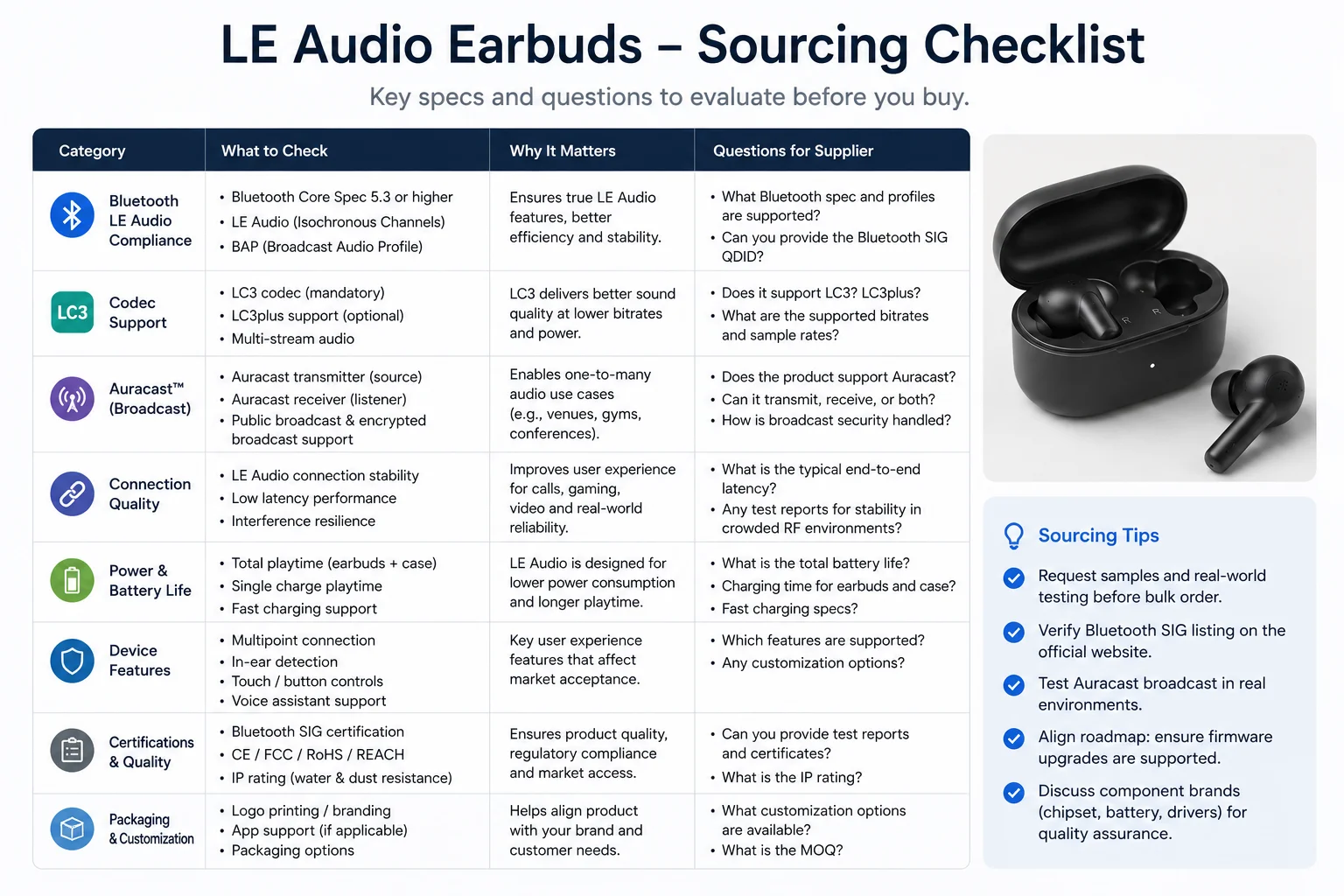
Whenever new technology comes out, there is a lot of confusion. Some factories might cut corners. As a buyer, you need to be specific and ask the right questions. This is even more important for earbuds than for simple cables or chargers. A bad earbud order is a very expensive problem.
I always tell my clients to confirm these details before placing a wholesale order for LE Audio products. Do not just trust the spec sheet.
| What to Check | What to Ask Your Supplier | Why It's Important |
|---|---|---|
| Bluetooth Version | "Is the Bluetooth version 5.2, 5.3, or higher?" | LE Audio requires Bluetooth 5.2 or newer12. Anything less cannot support it. |
| Codec Support | "Does the firmware use the LC3 codec by default?" | Some chips are capable of LC3, but the factory might not have enabled it to save costs. |
| Real Battery Life | "What is the single playtime at 70% volume with LE Audio active?" | Get real numbers, not just the total time with the charging case. Then, test it yourself. |
| Connectivity | "Is this true LE Audio with Isochronous Channels?" | This confirms you are getting the new, more stable connection technology. |
| Auracast Feature | "Is Auracast functionality fully implemented and tested?" | If they claim it has Auracast, ask for a demonstration or test video. |
| Compatibility | "Have you tested it with the latest Android and iOS phones?" | The earbuds are only half of the equation. They need to work with the phones in the market. |
| Sample Type | "Is this a production sample or an engineering sample?" | An engineering sample might be perfect, but the mass production version could use cheaper parts. |
Always test the samples yourself in real-world conditions. Use them for calls, listen to music on a busy street, and check the battery.
When Are LE Audio Earbuds Worth Adding to Your Product Line?
Is now the right time to invest in LE Audio, or should you wait? Making the wrong move could leave you with unsold inventory.
Add them now if you are building a brand or selling to premium markets. For mass-market wholesale, you can wait until prices drop, but start planning now. The transition is happening, and you do not want to be left behind.
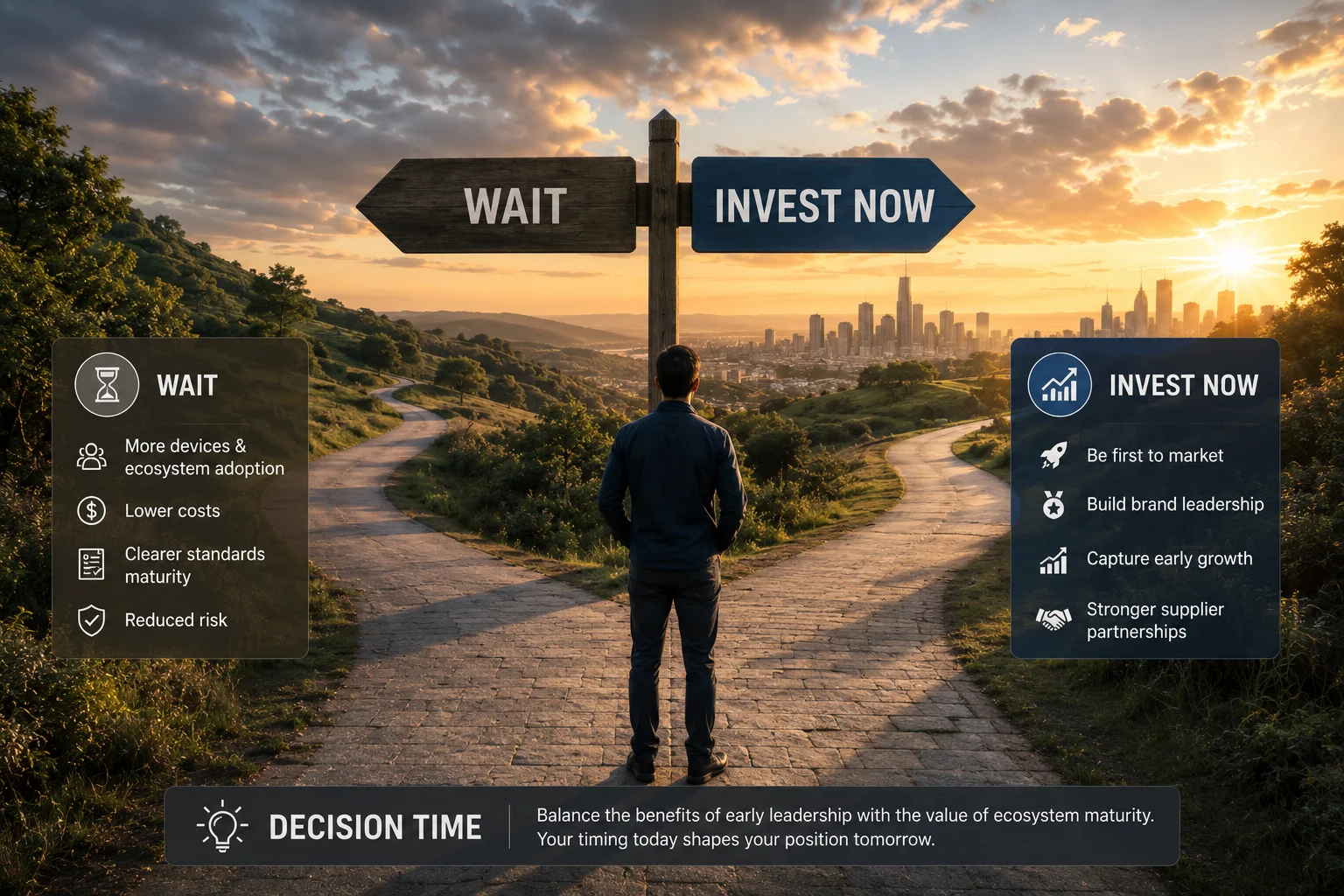
The final question is always about business risk. When should you put your money down? It's not about which model is "best," but which risk your business can afford. Here is how I advise my clients based on their business model.
-
If you use a Wholesale model: Your strength is low risk and market testing. For you, it is probably wise to wait a little longer. Let the early adopters find the bugs. Wait until a clear "winner" chipset emerges that is stable, reliable, and cheap. Your role is to sell proven technology at scale, not to beta test new hardware for the market. Start asking your suppliers about their LE Audio roadmaps now, but you do not need to place a big order today.
-
If you use a Private Label model: This is your sweet spot. Now is the perfect time to act. You can work with us to find a reliable, existing LE Audio earbud that has been fully tested. We then help you create your own brand packaging and logo. You can use the benefits—"All-Day Battery," "Crystal-Clear Sound," "Unbreakable Connection"—as your key selling points to stand out from the crowd. The risk is in marketing, but the product itself is solid.
-
If you use an OEM model: You are in the business of creating something unique. For you, LE Audio is a new set of tools. The risk is high, as OEM requires a large investment in R&D, tooling, and time. But the reward is a truly unique product that nobody else has. You could co-develop a specialized device, like earbuds optimized for gaming with ultra-low latency, or a dedicated Auracast receiver for public venues. This is for scaled businesses with technical staff and a clear vision.
Conclusion
LE Audio is not just another feature; it is a fundamental upgrade that solves real customer problems. Understanding it helps you avoid risk and make smarter sourcing decisions for your business's future.
"LE Audio | Bluetooth® Technology Website", https://www.bluetooth.com/learn-about-bluetooth/feature-enhancements/le-audio/. Provides an official definition of Bluetooth LE Audio from the Bluetooth SIG, outlining its key architectural goals such as lower power consumption, higher quality audio, and the introduction of new features like broadcast audio. Evidence role: definition; source type: institution. Supports: That LE Audio is a new Bluetooth standard designed to improve power efficiency, audio quality, and add new capabilities like Auracast compared to Classic Audio.. ↩
"How is Amazon's return policy? : r/Earbuds - Reddit", https://www.reddit.com/r/Earbuds/comments/wuxoxg/how_is_amazons_return_policy/. Supports the underlying premise by identifying battery life and connectivity issues as primary sources of customer complaints and product returns for wireless audio devices. Evidence role: general_support; source type: research. Supports: That battery life, connection stability, and audio quality are major drivers of customer satisfaction and common reasons for returns in the wireless earbud market.. Scope note: The source would support the existence of the problem (complaints about older technology) rather than directly proving that LE Audio has already led to fewer returns, as the technology is still being adopted. ↩
"LC3 (codec) - Wikipedia", https://en.wikipedia.org/wiki/LC3_(codec). Provides technical analysis and listening test results demonstrating that the LC3 codec offers superior audio quality at lower data rates compared to the legacy SBC codec. Evidence role: mechanism; source type: paper. Supports: That the LC3 codec is designed to provide higher perceived audio quality than the SBC codec at the same bitrate, or similar quality at a significantly lower bitrate.. ↩
"What Is Bluetooth LE Audio and How Does It Improve Wireless ...", https://avantree.com/blogs/knowledge/what-is-bluetooth-le-audio-and-how-does-it-improve-wireless-sound?srsltid=AfmBOoqq-GWSDk7qyBxJQJsu0tqcD3icu04uz3xU5tfllegM5cFKUXvY. Presents data from simulations or hardware testing that quantifies the potential battery life extension in typical use cases when using LE Audio compared to Classic Audio. Evidence role: statistic; source type: research. Supports: That the power efficiency of LE Audio and the LC3 codec can lead to significant increases in battery life for devices like TWS earbuds.. Scope note: The exact improvement depends on the battery size, chipset, and usage patterns, so the source provides a range of potential gains rather than a single fixed number. ↩
"Bluetooth - Wikipedia", https://en.wikipedia.org/wiki/Bluetooth. Explains the connection topology of early TWS earbuds, which often involved a primary earbud relaying the audio signal to a secondary earbud, a method that could introduce latency and instability. Evidence role: historical_context; source type: other. Supports: That early True Wireless Stereo (TWS) implementations often used a relay system where one earbud received the full stereo signal and forwarded one channel to the other earbud.. ↩
"LE Isochronous Channels - Technical Documentation", https://docs.nordicsemi.com/bundle/ncs-3.0.2/page/nrfxlib/softdevice_controller/doc/isochronous_channels.html. Describes the function of LE Isochronous Channels, which enable Multi-Stream Audio, allowing a source to transmit synchronized audio streams directly to both left and right earbuds simultaneously. Evidence role: mechanism; source type: institution. Supports: That LE Audio's Multi-Stream Audio feature, using Isochronous Channels, allows a source device to transmit multiple, independent, synchronized audio streams to one or more sink devices, such as two separate earbuds.. ↩
"Bluetooth LE Audio FAQs | Bluetooth® Technology Website", https://www.bluetooth.com/media/le-audio/le-audio-faqs/. Confirms that according to the Bluetooth SIG specifications, support for the LC3 codec is mandatory for any device seeking to be certified as compliant with LE Audio. Evidence role: general_support; source type: institution. Supports: That the LC3 codec is a mandatory feature for all products certified for Bluetooth LE Audio.. ↩
"LC3 (codec) - Wikipedia", https://en.wikipedia.org/wiki/LC3_(codec). Cites formal listening test data from organizations like Fraunhofer IIS which demonstrates that the LC3 codec achieves higher perceived audio quality than the SBC codec, particularly at lower bitrates. Evidence role: expert_consensus; source type: research. Supports: That formal listening tests have shown that LC3 provides higher perceived audio quality than SBC, especially at a 50% lower bit rate.. ↩
"Auracast - How it works | Bluetooth® Technology Website", https://www.bluetooth.com/auracast/how-it-works/. Defines Auracast™ broadcast audio as a capability of LE Audio that allows a source device to broadcast one or more audio streams to an unlimited number of in-range sink devices. Evidence role: definition; source type: institution. Supports: That Auracast is a broadcast audio feature of LE Audio that enables a source to transmit to a large, unconstrained number of nearby receivers.. Scope note: While theoretically unlimited, the practical number of simultaneous receivers may be influenced by the physical environment and radio interference. ↩
"Is LE Audio Better Than Classic Audio? - SAPULO", https://sapulo.com/le-audio-vs-classic-audio/. Provides market analysis indicating that System-on-Chips (SoCs) with full LE Audio support initially carry a price premium over older Classic Audio chipsets, though this cost is expected to decrease with wider adoption and economies of scale. Evidence role: general_support; source type: other. Supports: That chipsets supporting the newest Bluetooth standards, like LE Audio, typically have a higher unit cost upon introduction compared to mature, high-volume chipsets for older standards.. Scope note: Specific pricing is proprietary and changes rapidly; the source would support the general trend rather than providing exact figures. ↩
"Bluetooth LE Audio Market Research Report 2033", https://marketintelo.com/report/bluetooth-le-audio-market. Provides a market forecast report projecting the adoption curve for LE Audio in consumer electronics, indicating a timeline for when the technology is expected to transition from a premium feature to a mass-market standard. Evidence role: general_support; source type: research. Supports: That industry analysts expect LE Audio to see widespread adoption and become a standard feature in mainstream audio products within the next 1-2 years.. Scope note: This is a forecast and subject to change based on market dynamics, but it supports the author's timeline as a reasonable expectation within the industry. ↩
"Bluetooth LE Audio FAQs | Bluetooth® Technology Website", https://www.bluetooth.com/media/le-audio/le-audio-faqs/. Confirms that Bluetooth Core Specification version 5.2 is the first version to include the foundational features required for LE Audio, such as LE Isochronous Channels. Evidence role: definition; source type: institution. Supports: That the core features of LE Audio, such as Isochronous Channels, were introduced in version 5.2 of the Bluetooth Core Specification.. ↩