Sourcing ANC earbuds feels like a gamble. You see impressive specs, but fear customer complaints about poor performance. Choosing the wrong supplier can cost you money and your brand's reputation.
To find a reliable ANC earbuds manufacturer, first compare the real-world ANC performance, not just the specs. Verify the noise reduction depth (in dB), call quality in noisy environments, and actual battery life with ANC turned on. These factors directly impact customer satisfaction and returns.
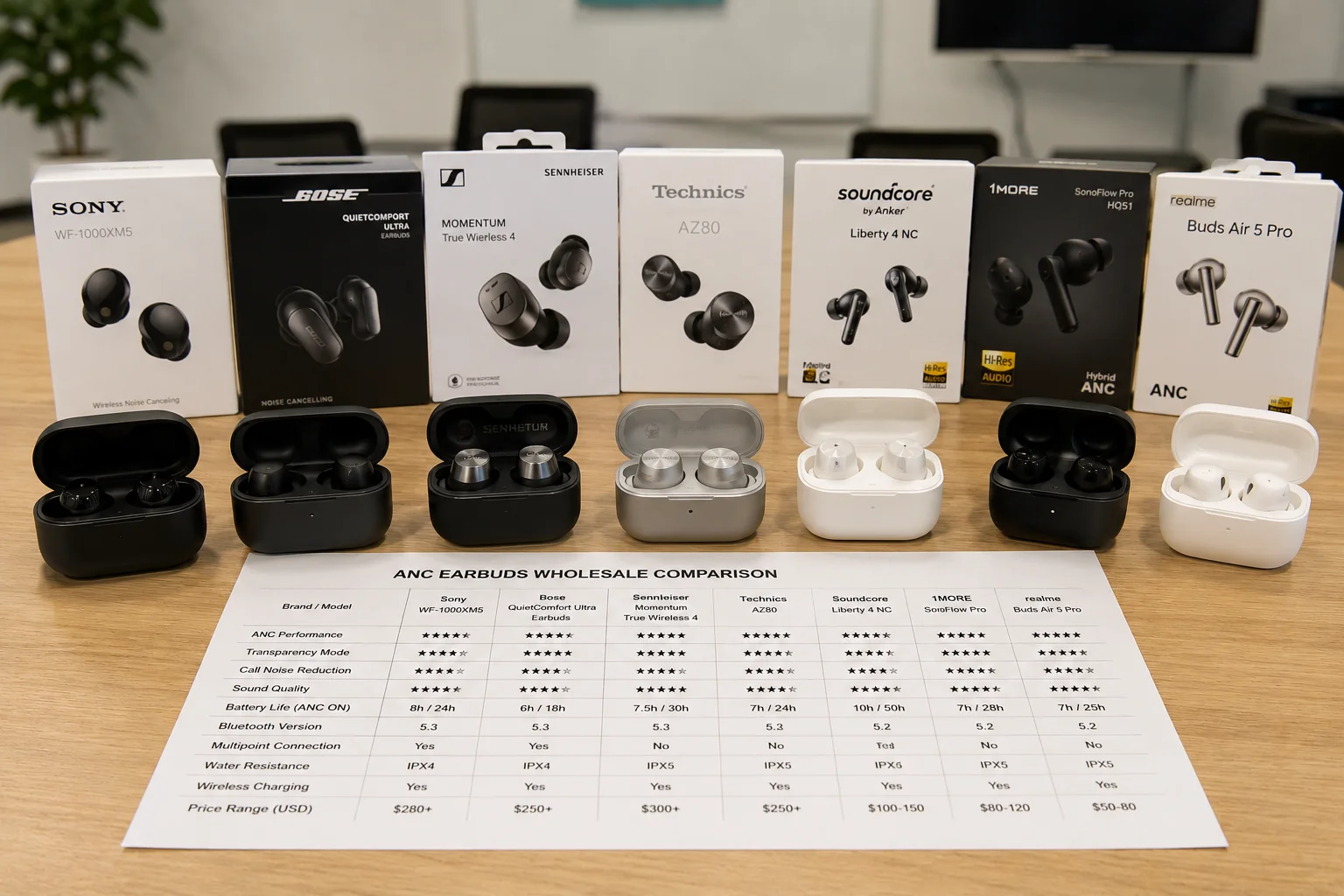
I've been in the electronics export business for over 15 years. Every day, I talk to buyers from Europe and the US. A common question I get is, "What's your best price for ANC earbuds?" While price is important, I always steer them toward a different conversation. The real profit in TWS earbuds isn't from the first sale; it's from repeat business and low return rates. That comes from getting the product details right from the start. Let's break down what you should really be comparing to secure a product that sells well and keeps customers happy.
What ANC Performance Level Should Wholesale Buyers Compare First?
Struggling to tell if a supplier's ANC claims are real? You worry that the "ANC" on the box is just a marketing trick, leading to disappointed customers and negative reviews.
Focus on the noise reduction depth, measured in decibels (dB). A good entry-level ANC is around -25dB, while premium models reach -35dB to -45dB.1 Ask your manufacturer for this specific number and a test report. This is a much better indicator than vague terms like "strong noise reduction."
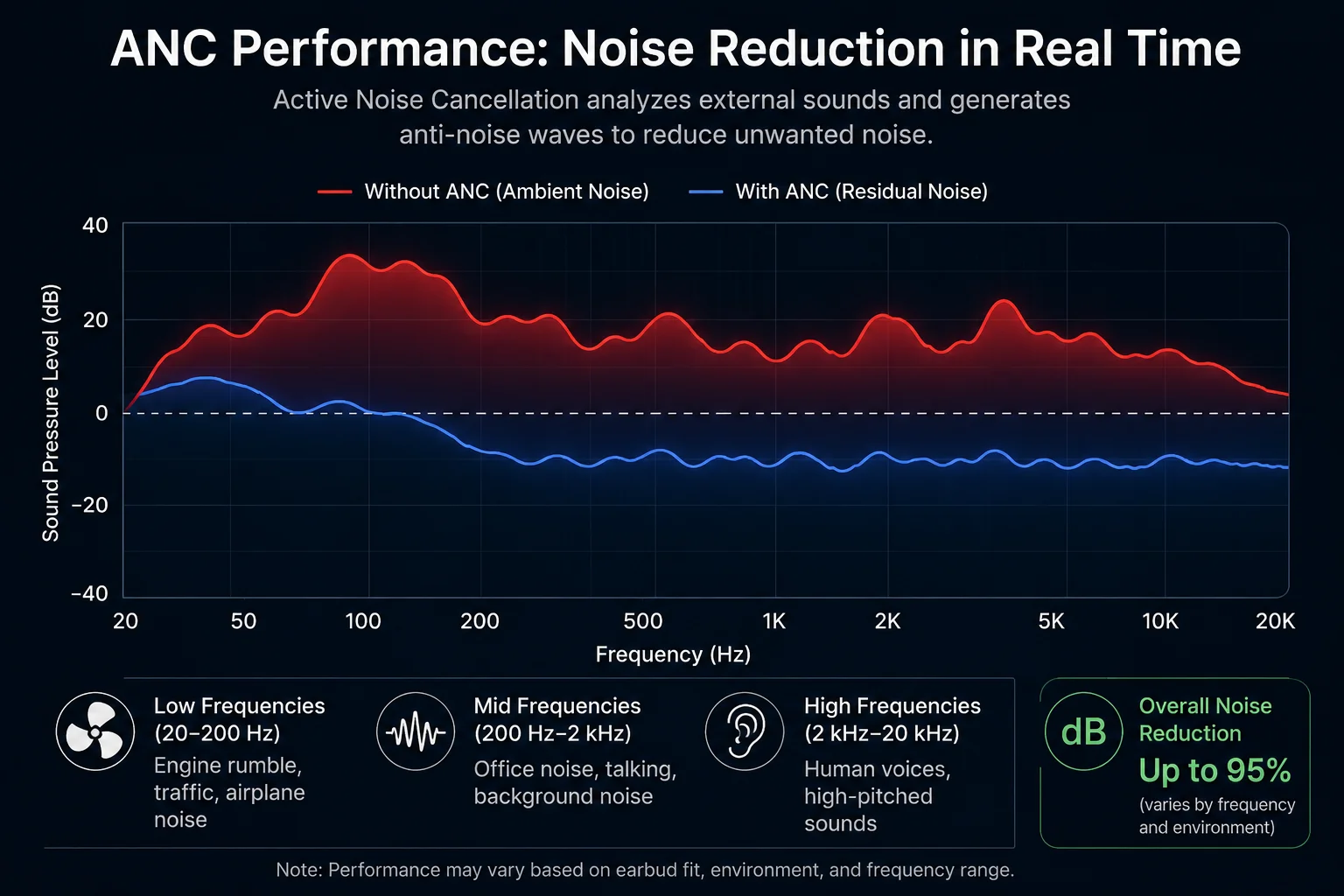
In my experience, Active Noise Cancellation (ANC) is the most frequently exaggerated feature. Many low-cost suppliers will market earbuds with ENC (Environmental Noise Cancellation for calls) as if they have ANC. They are not the same thing. ANC uses microphones to cancel out background noise for the wearer, creating an immersive listening experience. ENC only cleans up your voice for the person on the other end of a call.2
When a client asks me about ANC, I tell them to ask for the specs in decibels. Here's a simple breakdown I use:
ANC Performance Tiers
| ANC Level | Noise Reduction Depth | Best For |
|---|---|---|
| Entry-Level ANC | -20dB to -25dB | Reducing office chatter, air conditioner hum. Good for price-sensitive markets. |
| Mid-Range ANC | -28dB to -35dB | Blocking out city traffic, cafe noise. A solid choice for e-commerce brands. |
| Premium ANC | -38dB to -45dB+ | Significantly reducing airplane engine noise, subway rumble. For high-end retail. |
Don't just trust the number on the spec sheet. Ask for a test video or, even better, test the samples yourself. A reliable manufacturer will be transparent about their ANC capabilities. If they can't give you a straight answer on the dB level, that's a major red flag.
How Strong Is Noise Reduction in Real Daily Use?
You see a -40dB spec on a sample, but how do you know if it works in the real world? An earbud that works in a quiet office might fail completely on a noisy street.
You must test samples in various real-life environments. Take them on a busy street, in a crowded cafe, and on public transport. A good ANC earbud should noticeably reduce consistent, low-frequency sounds like engine rumble or air conditioning, not just make things slightly quieter.3
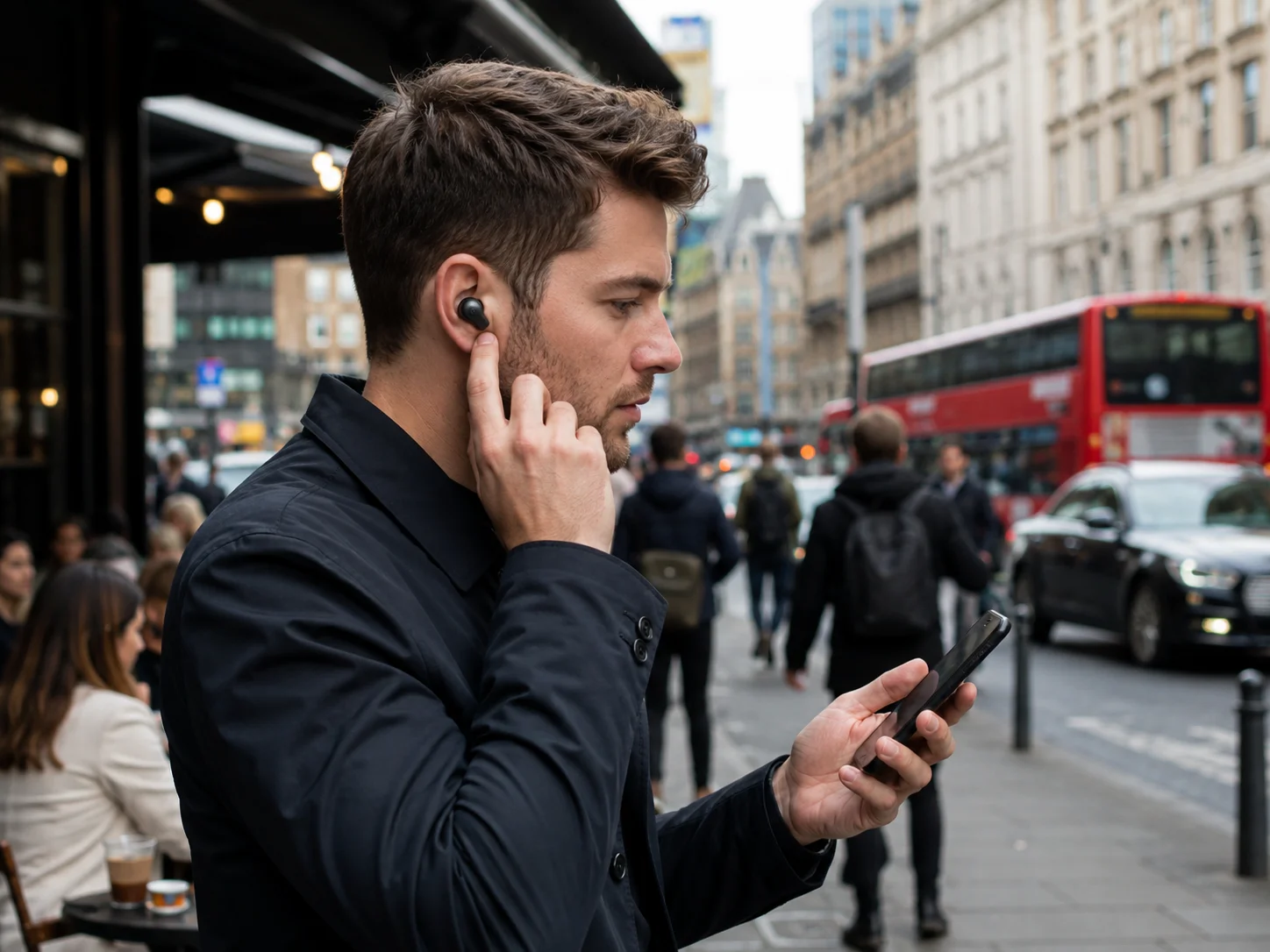
A spec sheet doesn't tell the whole story. The true test of ANC is how it performs in the environments your customers actually use them in. I had a client from Germany who was excited about a sample with a claimed -42dB ANC. It tested well in his office. But when he took it on the train, he said it barely made a difference. The problem wasn't that the spec was a lie, but that the ANC chip and algorithm were poorly tuned for complex, changing noises.
Here’s how I advise my clients to conduct a real-world test:
A Simple 3-Step Real-World ANC Test
- The Cafe Test:
- Goal: Check performance against mid-frequency noise.
- Action: Go to a busy coffee shop. Put the earbuds in without playing music. The background chatter and clatter of dishes should become a dull, distant murmur. A good ANC will make the environment feel much calmer.
- The Transit Test:
- Goal: Check performance against low-frequency noise.
- Action: Wear them on a bus, train, or in a car. The deep rumble of the engine should be significantly reduced. This is the classic use case for ANC and where good performance is most obvious.
- The Wind Test:
- Goal: Check for wind noise interference.
- Action: Walk outside on a moderately windy day. Poorly designed ANC microphones can pick up wind and create a "whooshing" sound that's worse than the wind itself.4
If an earbud passes these three tests, you can be much more confident that its real-world performance will satisfy your customers.
Does the Earbud Support Transparency Mode?
Your customers want to hear their music, but they also need to hear airport announcements or order a coffee. Earbuds without a good transparency mode force them to constantly take them out.
Confirm if the earbuds have a high-quality Transparency Mode (sometimes called Ambient Mode). This feature uses the external microphones to let outside sound in, allowing users to stay aware of their surroundings without pausing their audio.5 It's a key feature for usability and a sign of a better product.
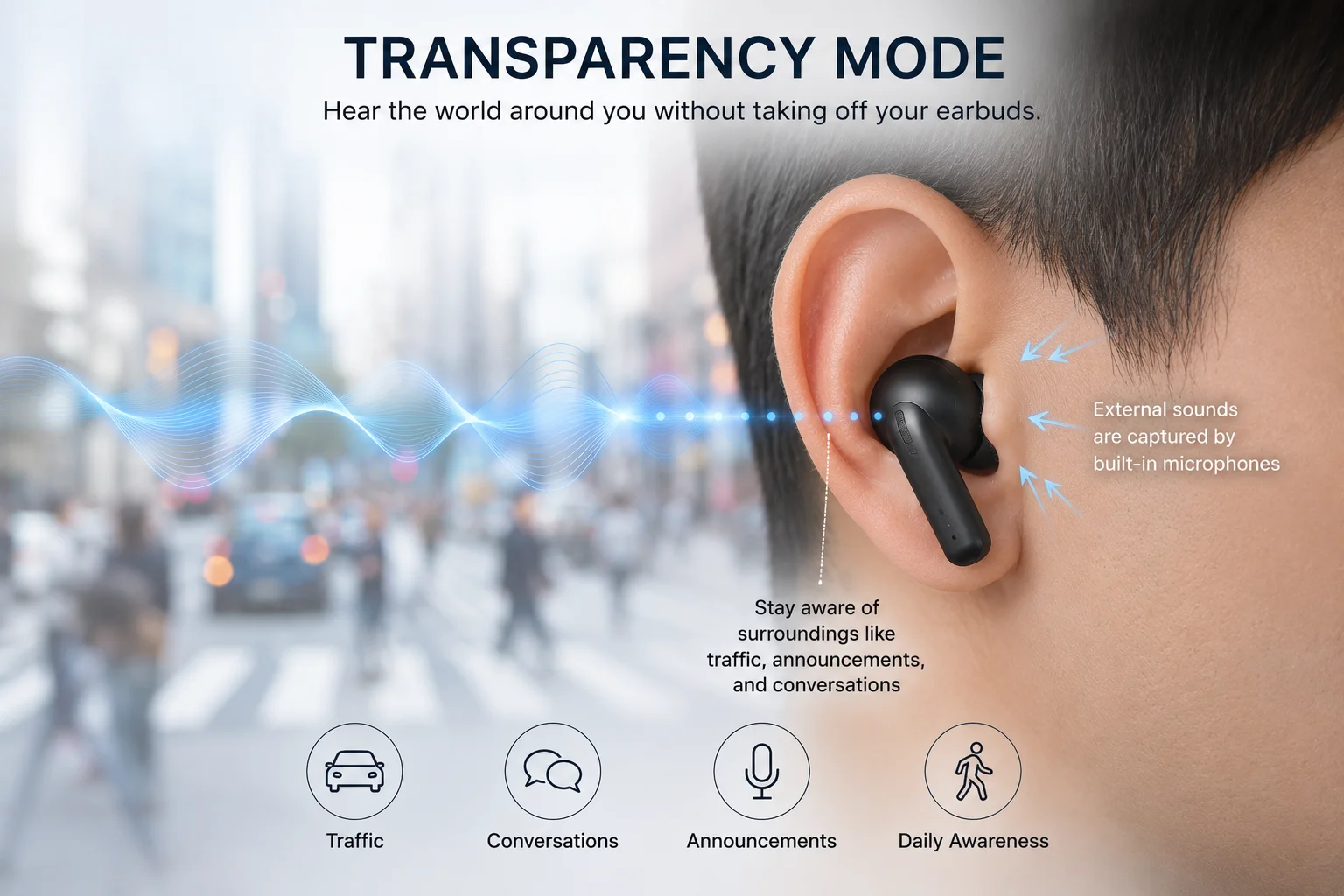
Transparency Mode is no longer just a nice-to-have feature; for many users, it's a necessity. It turns a simple listening device into a tool for navigating the world. When I discuss product features with buyers, I frame Transparency Mode as a major usability and safety upgrade. It's what separates a cheap earbud from a truly convenient one.
However, not all Transparency Modes are created equal. Here’s what to look for:
Differentiating Good vs. Bad Transparency Mode
- Natural Sound: A good Transparency Mode should make you feel like you aren't wearing earbuds at all. The sound should be natural and clear.
- No Hiss: A bad one will have an audible electronic hiss or a "robotic" quality to the sound. Voices might sound tinny or distorted.
- Low Latency: When someone speaks, you should hear it instantly. Any noticeable delay makes conversation feel unnatural and disorienting.
When you get samples, don't just check if the feature exists. Activate it and have a conversation. Walk around your office. Does it feel natural? Or does it sound like you're listening through a cheap microphone? A high-quality Transparency Mode shows that the manufacturer has invested in better microphones and processing, which is often a good sign for the overall quality of the product. It’s a detail that customers notice and appreciate.
How Good Is Call Noise Reduction?
Your customer buys earbuds to listen to music, but then uses them for a work call. The person on the other end complains, "I can't hear you! It's too noisy!"
You must differentiate between ANC (for the wearer) and call noise reduction (for the listener). Ask the manufacturer specifically about their ENC (Environmental Noise Cancellation) or cVc (Clear Voice Capture) technology.6 The best way to verify is to make test calls from a noisy environment.
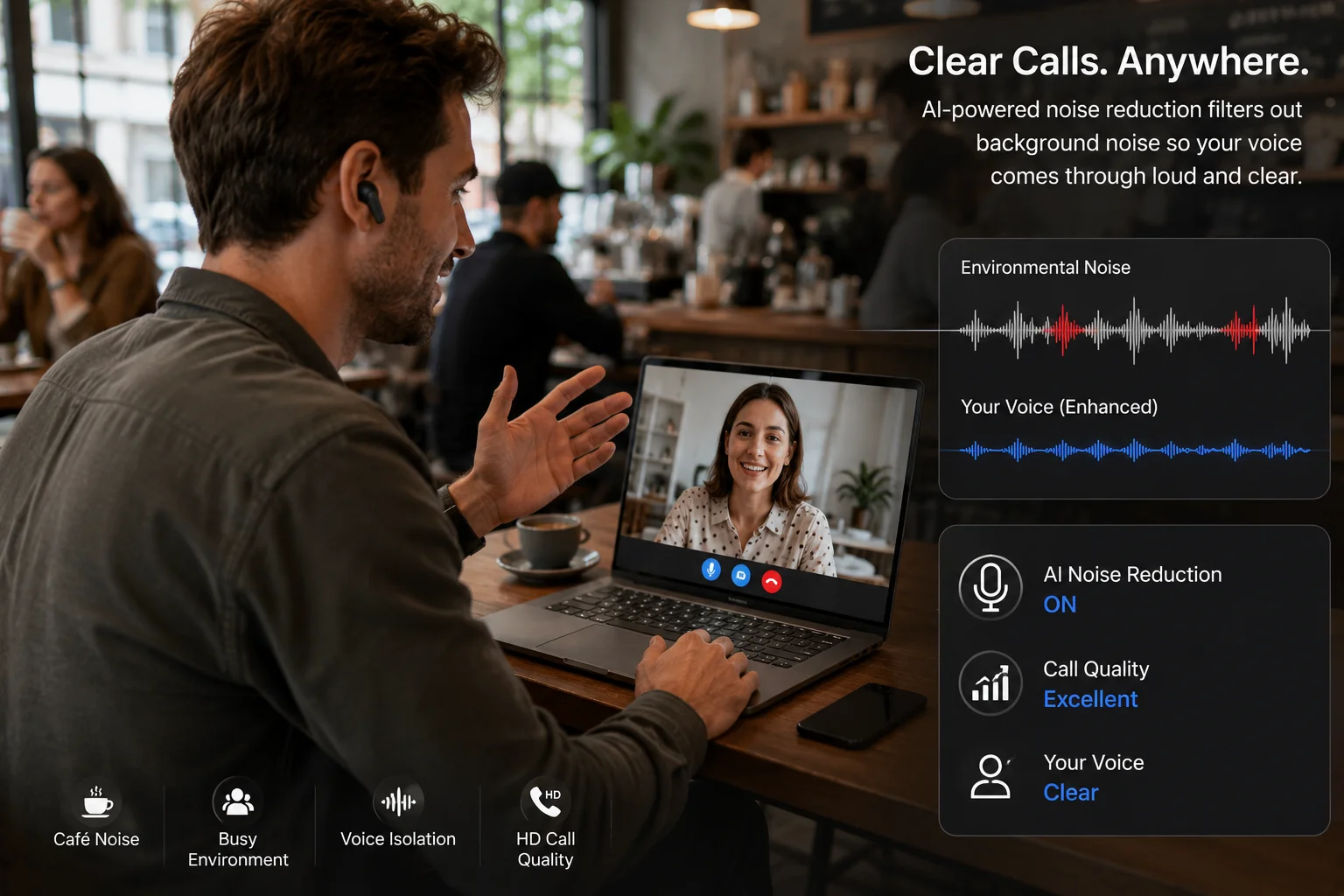
This is one of the biggest pitfalls I see new buyers fall into. They test the music quality, check the ANC, and assume calls will be fine. But call quality depends on a completely different system. It relies on the microphones and a noise-canceling algorithm to isolate your voice from background noise so the other person can hear you clearly.
Many low-cost TWS earbuds save money on microphones. The result? They sound great when you're in a quiet room, but the moment you step outside, your voice becomes a garbled mess for the listener.
Here is what I tell my clients to check:
Key Call Quality Factors
| Feature | What to Ask/Check | Why It Matters |
|---|---|---|
| Microphone Count | "How many microphones are in each earbud?" | More mics (e.g., 2-3 per earbud) allow for better beamforming, which helps isolate your voice from ambient sound.7 |
| Noise Reduction Tech | "Do you use ENC, or Qualcomm cVc?" | These are specific algorithms designed to suppress background noise during calls. A manufacturer should know which one they use. |
| Real-World Test | Make a WhatsApp call from a noisy street. | Have a colleague on the other end rate your voice clarity from 1 to 5. Is your voice clear, or is it distant and full of background noise? |
I always have my team test call quality by calling from next to a busy road in Shenzhen. If the person in our quiet office can hear them clearly, the ENC is good. If not, we know the product isn't ready for clients who value call performance.
What Chipset and Bluetooth Version Does the Manufacturer Use?
You're worried about earbuds that constantly disconnect or have terrible lag when watching videos. These issues lead to frustrated customers and are almost impossible to fix after purchase.
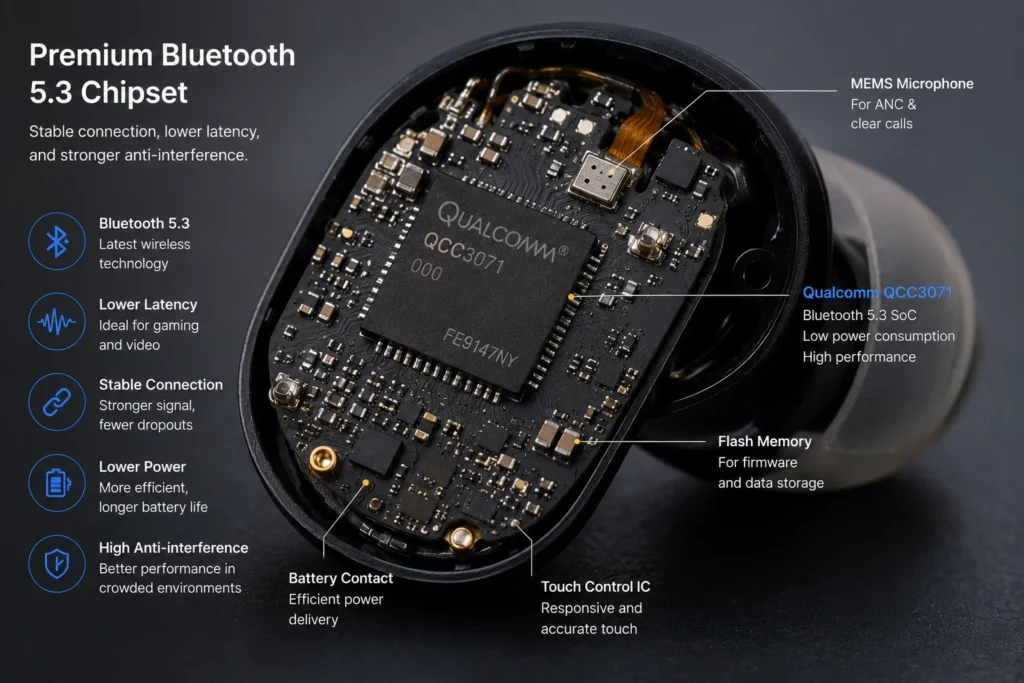
Ask the manufacturer for the specific Bluetooth chipset model, not just the Bluetooth version. Reliable chipsets from brands like Qualcomm, Airoha, or Bestechnic (BES) offer better stability and connectivity. The chipset is far more important than just having the latest Bluetooth version number (e.g., 5.3 vs 5.4).8
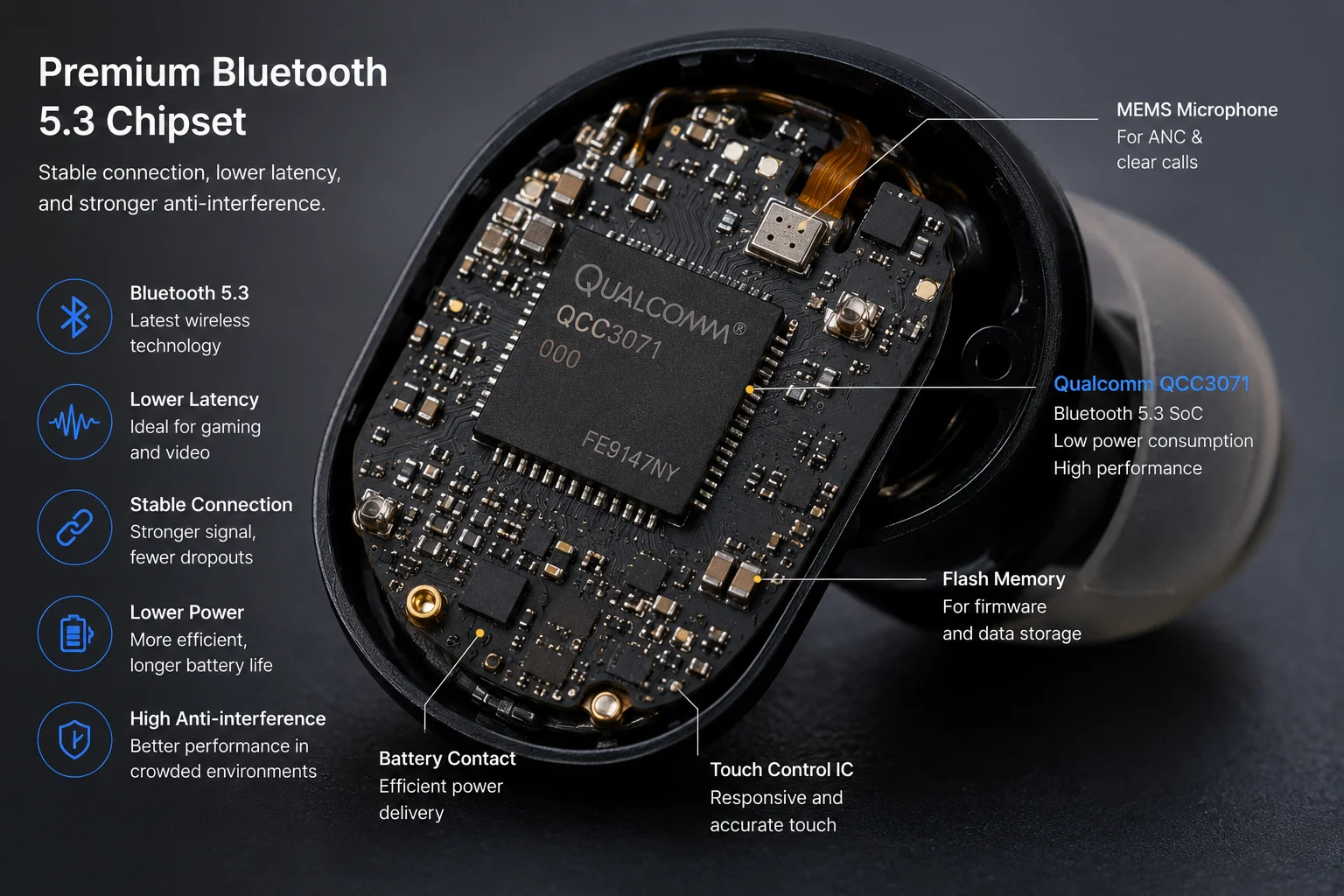
A common mistake buyers make is getting fixated on the Bluetooth version. They'll ask, "Is it Bluetooth 5.3?" While a newer version is generally better, the quality of the chipset is the true heart of the earbud. It's like the engine in a car. A cheap, poorly tuned engine in a shiny car will still perform badly.
After 15 years in this business, I know that connection stability is the #1 cause of TWS earbud returns9. It's not the sound, not the battery—it's the frustration of one earbud disconnecting or pairing failures.
I always guide my clients to focus on the chipset solution:
Common TWS Chipset Tiers
- Premium Tier (e.g., Qualcomm QCC series): Known for excellent stability, low latency (with aptX), and robust features like cVc call noise cancellation. Ideal for high-end products where performance is critical.
- Mid-Range Tier (e.g., Airoha, Bestechnic - BES): This is the sweet spot for many wholesalers. These chipsets offer a great balance of performance, stability, and cost. They are reliable and support features like good ANC and low-latency gaming modes. Airoha is particularly strong in the ANC space.
- Entry-Level Tier (e.g., JL - Jerry): These are the most common chipsets in low-cost earbuds. While they have improved, they are more prone to connection drops and higher latency. They are suitable for promotional items or very price-driven markets, but you must set expectations accordingly.
When a manufacturer proudly tells you their chipset model, it's a good sign. If they are evasive or just say "the latest Bluetooth," be cautious.
How Long Is Battery Life With ANC On?
The packaging says "30 hours playtime," but your customer complains the earbuds die in 3 hours. Misleading battery claims are a fast way to destroy trust and get a flood of returns.
Always ask for two separate battery life specs: playtime with ANC off and playtime with ANC on. ANC can reduce single-charge battery life by 30-50%.10 A good manufacturer will provide both numbers. For example, 6 hours (ANC off) and 4 hours (ANC on).
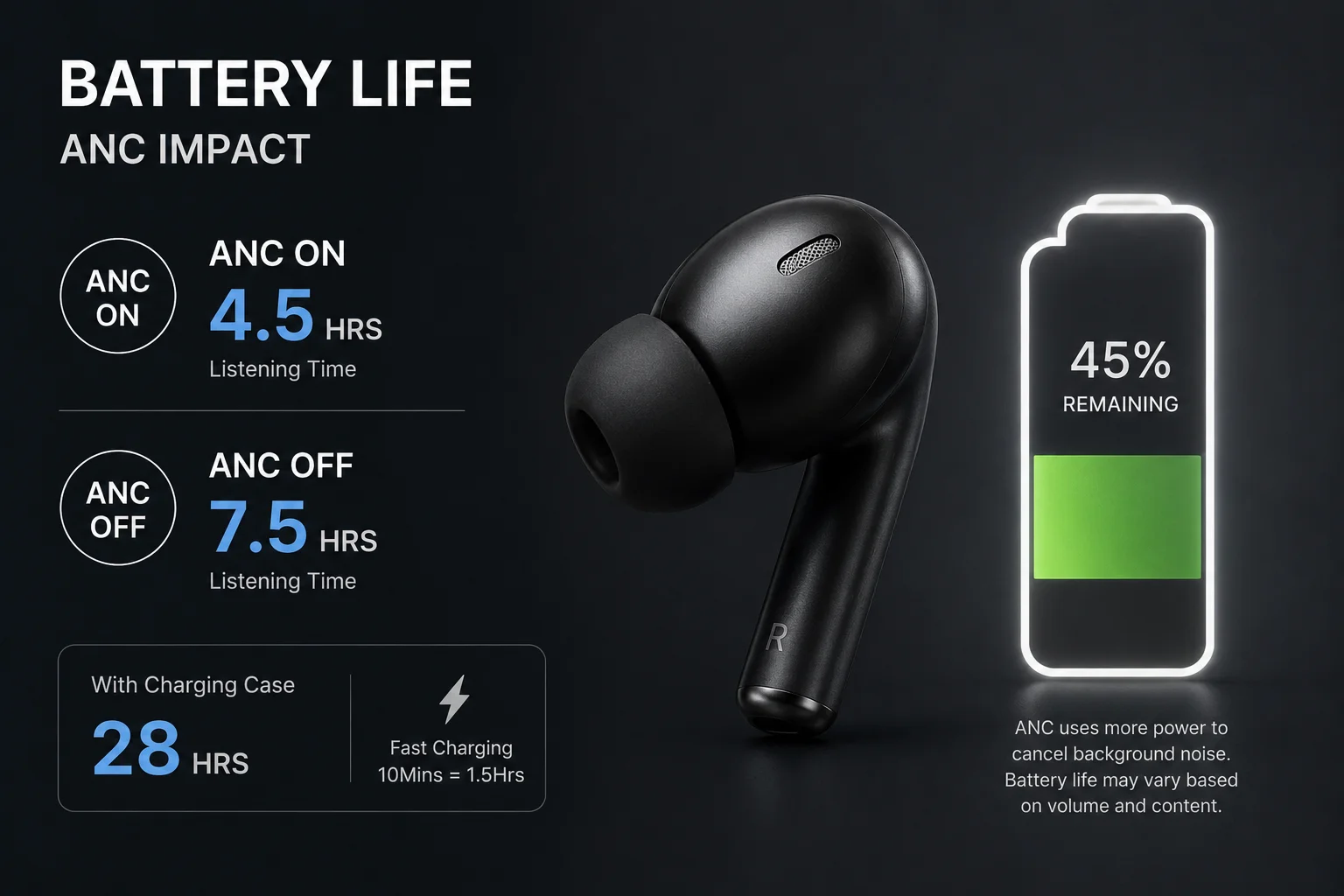
Battery life is the second most common area where marketing claims don't match reality. The big "30 hours" printed on the box almost always refers to the total time including recharges from the case. The number that really matters to the user is the single playtime on one charge.
And with ANC earbuds, this gets even more complex. The ANC feature requires constant power to run its microphones and processor, which significantly drains the battery. I had a client who ordered 2,000 units based on a "7-hour playtime" spec. They didn't realize this was with ANC off. Their customers, who bought them for the ANC, were getting just over 4 hours and felt cheated.
Here’s the checklist I give my buyers to get the real story on battery:
Battery Life Verification Checklist
| Question to Ask | What a Good Answer Looks Like | Why It's Important |
|---|---|---|
| What is the single playtime with ANC on? | "Around 4.5 hours at 70% volume." | This is the most important real-world spec for an ANC earbud user. |
| What is the earbud battery capacity (mAh)? | "40mAh in each earbud." | Gives you a technical basis for the playtime claims. A tiny battery can't deliver long playtime. |
| What is the charging case capacity (mAh)? | "400mAh. It can recharge the earbuds 4 times." | This confirms the "total playtime" and tells you how useful the case is. |
| How long does it take to fully charge? | "1.5 hours for the earbuds, 2 hours for the case." | Manages user expectations for charging. |
Always test this yourself. Charge the sample to 100%, turn on ANC, play music at 70% volume, and time how long it lasts. Don't take the supplier's word for it.
Can the Manufacturer Support OEM/ODM Branding?
You want to build your own brand, not just sell a generic product. But you're unsure if you should start with a simple logo or a fully custom design. It's a big decision.
Yes, most manufacturers support branding, but you should choose the right path for your business stage. Start with Private Label (logo, packaging) on a proven stock model to test the market. Only move to full OEM/ODM (custom mold, features) once you have stable sales and clear market feedback.
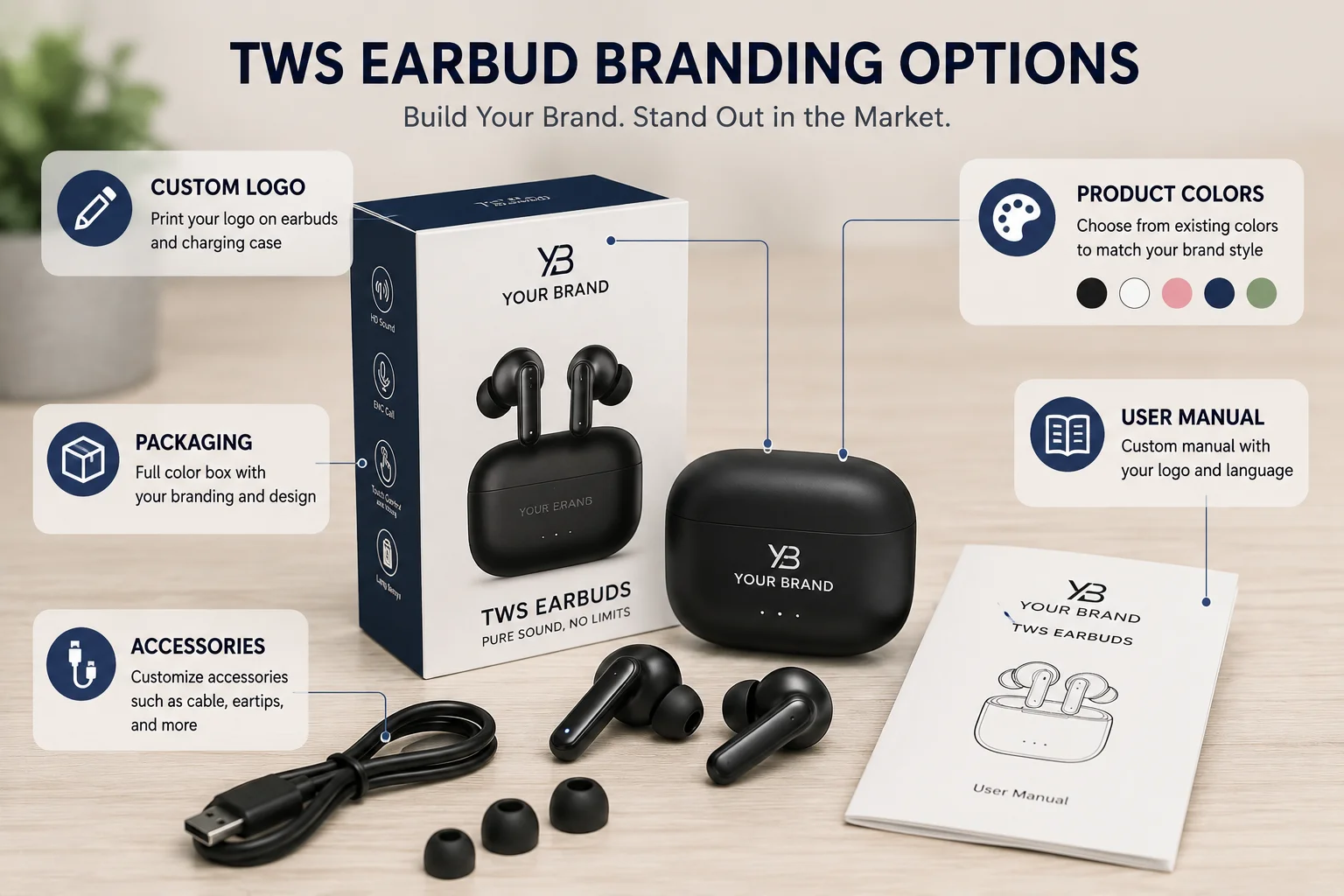
"Can you put my logo on it?" is one of the first questions I get. The answer is always yes, but I advise caution. Jumping into full customization too early is a common and costly mistake. Based on hundreds of conversations with buyers, I've developed a simple framework to guide this decision. It's not about which option is "best," but which one is right for you now.
The 3-Step Sourcing Path
- Stage 1: Wholesale (Standard Stock)
- Who it's for: New sellers, or those testing a new market.
- What you do: Buy the manufacturer's existing, proven models with their standard packaging.
- Why: Lowest MOQ, fastest delivery, and minimal risk. You can quickly find out what styles and price points your customers prefer without investing heavily in inventory that might not sell.
- Stage 2: Private Label
- Who it's for: Sellers with some proven sales data.
- What you do: Choose a successful stock model and add your brand identity. This usually includes: printing your logo on the earbuds and case, designing your own retail box, and creating a custom user manual.
- Why: It builds brand recognition and customer loyalty without the high cost and risk of developing a new product from scratch. MOQ is higher than stock, but still manageable.
- Stage 3: OEM / ODM
- Who it's for: Established brands with high volume and specific product needs.
- What you do: You co-develop a unique product. This can involve a new industrial design (mold), custom firmware, specific chipsets or drivers, and a unique app.
- Why: Creates a truly unique product that competitors can't easily copy. However, it requires a large investment in tooling (molds can cost $10,000+11), a very high MOQ, and a long development timeline.
My advice is always to walk before you run. Use wholesale to learn, private label to build, and OEM to dominate.
What MOQ, Lead Time, Warranty, and Defect Rate Should Buyers Confirm?
You've found a product you like, but you're nervous about placing the order. What if the quality of the bulk order doesn't match the sample? What happens if units are defective?
Before placing any order, get written confirmation on these four points: MOQ, Lead Time, Warranty Policy, and expected Defect Rate. A professional supplier will have clear, ready answers for each. Vague responses are a major warning sign that you will face problems later.
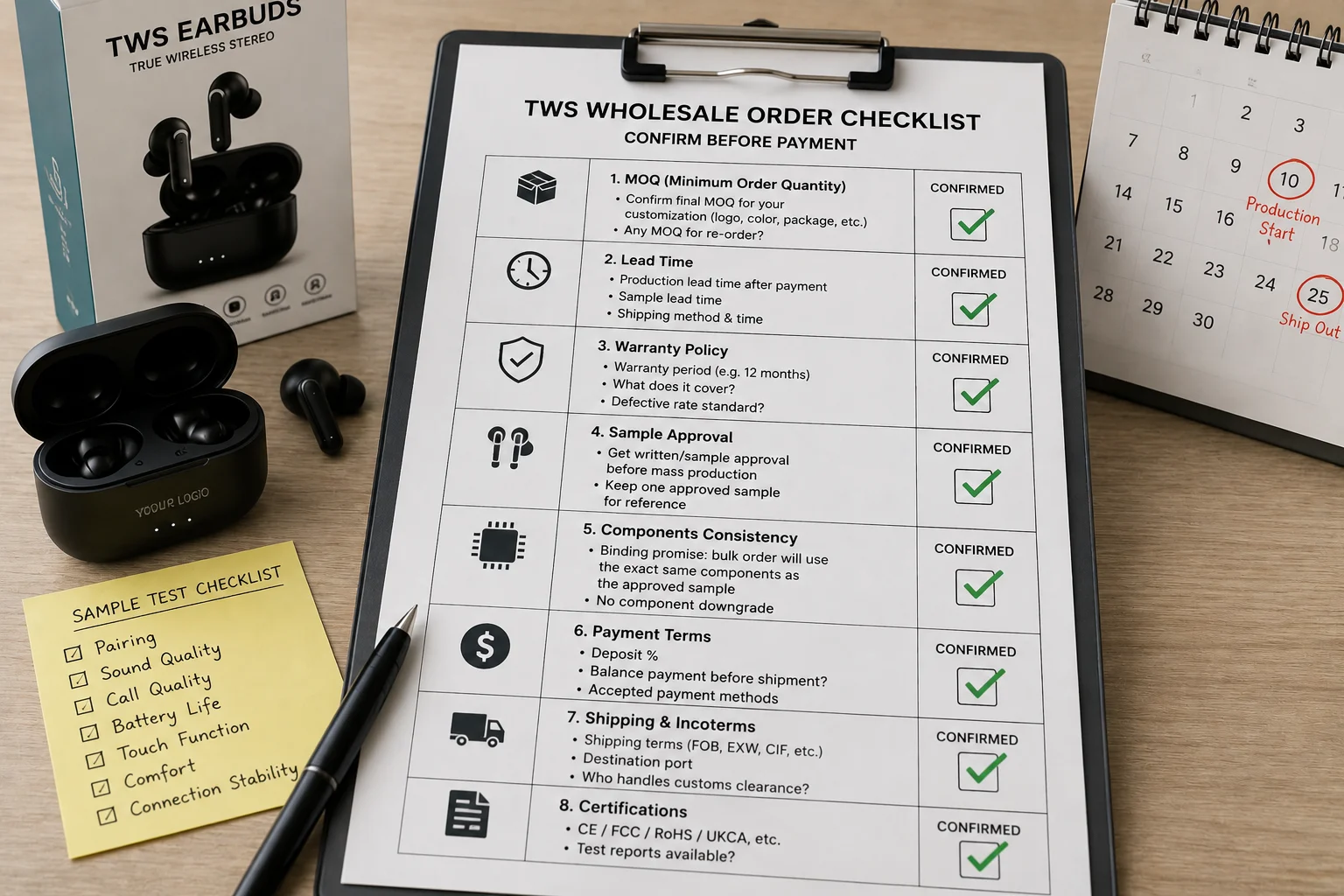
The final step before sending money is to confirm the business terms. This is where you protect yourself from future headaches. A perfect sample means nothing if the bulk production is sloppy and the supplier won't support you when things go wrong. TWS earbuds are complex products; a zero-defect rate is impossible. A good partner isn't one who promises "no problems," but one who has a clear plan for when problems happen.
Here is a table outlining what you need to confirm. I suggest sending this as an email to your potential supplier to get everything in writing.
Pre-Order Confirmation Checklist
| Topic | What to Ask | A Good Supplier's Answer Might Be... |
|---|---|---|
| MOQ | "What is the MOQ for a standard order and for a private label order?" | "1000 pcs for standard. 2000 pcs for custom packaging and logo printing." |
| Lead Time | "What is the production lead time for my order of [X] units after I confirm the sample?" | "For 2000 units, our lead time is 25-30 days." |
| Warranty | "What is your warranty policy? How do you handle defective units?" | "We offer a 12-month warranty. For defects, we can provide spare units in your next order or offer a credit." |
| Defect Rate | "What is your typical defect rate for this model? Will you ensure the bulk order uses the same components as the sample?" | "Our internal quality control aims for under 1%.12 Yes, we guarantee the chipset, battery, and driver will be identical to the approved sample." |
Getting these details locked in before you pay is crucial. It sets clear expectations for both sides and provides a record to refer back to if any issues arise. Any hesitation from the supplier to answer these questions is a signal to think twice about moving forward.
Conclusion
Finding the right ANC earbuds manufacturer is about more than specs and price. It's about finding a partner who is transparent, reliable, and understands what makes a product successful long-term.
"Active noise control - Wikipedia", https://en.wikipedia.org/wiki/Active_noise_control. A source can confirm the typical decibel reduction ranges for consumer-grade ANC headphones, noting that higher negative dB values correspond to greater noise cancellation. For example, product testing from technical review sites often shows premium models achieving noise reduction in the -30dB to -45dB range for low-frequency sounds. Evidence role: statistic; source type: research. Supports: The source should provide context on how ANC performance is measured in decibels and what different dB reduction levels mean for the user experience, ideally corroborating the stated ranges for different performance tiers.. Scope note: Specific dB values can vary based on the frequency of the noise being measured and the testing methodology used. ↩
"ANC and ENC: Which is better - YouTube",
. A technical source can explain that Active Noise Cancellation (ANC) uses a microphone and speaker to create an anti-phase sound wave to cancel ambient noise for the wearer, whereas Environmental Noise Cancellation (ENC) uses one or more microphones to differentiate the speaker's voice from background noise, suppressing the latter to improve call clarity for the person on the other end of the line. Evidence role: definition; source type: encyclopedia. Supports: The source should define both Active Noise Cancellation (ANC) and Environmental Noise Cancellation (ENC), explaining that ANC is designed to cancel ambient sound for the user, while ENC is designed to isolate the user's voice from background noise for clearer phone calls.. ↩"Engineering Healthy Silence: Using Noise-Cancelling Headphones ...", https://illumin.usc.edu/engineering-healthy-silence-using-noise-cancelling-headphones-to-block-harmful-sound/. A source from an academic or engineering institution can explain that active noise cancellation works by creating a sound wave with the same amplitude but an inverted phase to the original sound. This method is most effective for low-frequency sound waves (below 1000 Hz) which have longer wavelengths, making them easier for the device's processor to predict and cancel in real-time. Evidence role: mechanism; source type: education. Supports: The source should explain the physical principles of active noise cancellation, detailing why it is more effective at canceling low-frequency, continuous sounds than high-frequency, transient sounds.. ↩
"Experimental Investigation of a Tubular Front Cavity for Wind Noise ...", https://pmc.ncbi.nlm.nih.gov/articles/PMC13029217/. A technical source can explain that wind blowing across the external microphone port of an ANC system creates pressure fluctuations (turbulence) that the system interprets as a low-frequency sound, causing it to generate an incorrect anti-noise signal which is perceived by the user as a 'whooshing' or buffeting sound. Evidence role: mechanism; source type: research. Supports: The source should explain the technical reasons why wind creates noise in ANC headphones, particularly those using external (feedforward) microphones.. ↩
"The concept of "Transparency Mode" is weird... : r/headphones", https://www.reddit.com/r/headphones/comments/u3ezqd/the_concept_of_transparency_mode_is_weird/. A source can confirm that Transparency Mode, also known as Ambient Mode, is a feature in noise-cancelling headphones that uses built-in microphones to pick up external sounds and play them through the speakers, allowing the user to hear their surroundings without removing the earbuds. Evidence role: definition; source type: encyclopedia. Supports: The source should define 'Transparency Mode' or 'Ambient Mode' in the context of headphones and earbuds.. ↩
"Noise Cancellation: Guidance on CVC, ANC, and Qualcomm cVc", https://cleeraudio.com/full-guide-on-cvc-anc-and-qualcomm-cvc-noise-cancellation-technology/. A technical source can explain that Clear Voice Capture (cVc) is a suite of algorithms developed by Qualcomm, typically integrated into their Bluetooth chipsets, designed to reduce background noise and echo for the far-end listener during voice calls. Evidence role: definition; source type: other. Supports: The source should define Qualcomm's cVc (Clear Voice Capture) technology and its purpose in improving call quality.. Scope note: While Qualcomm's own documentation is the primary source, a neutral third-party tech site's explanation would also be suitable. ↩
"Beamforming - Wikipedia", https://en.wikipedia.org/wiki/Beamforming. A source on audio signal processing can explain that beamforming uses an array of two or more microphones to spatially filter sound. By analyzing the time differences of a sound arriving at each microphone, the system can amplify sounds coming from a specific direction (the user's mouth) while attenuating sounds from other directions (ambient noise). Evidence role: mechanism; source type: paper. Supports: The source should explain the principle of beamforming using microphone arrays for audio applications.. ↩
"Complete Bluetooth Versions Guide: From 1.0 to 6.2 - MOKO Smart", https://www.mokosmart.com/guide-on-different-bluetooth-versions/. A technical article can clarify that while the Bluetooth version (e.g., 5.2, 5.3) defines the features and protocols available, the chipset (SoC) is responsible for the actual implementation, including antenna design, power management, and processing efficiency. A high-quality chipset can provide a more stable connection and better performance even on a slightly older Bluetooth version compared to a low-quality chipset on the newest version. Evidence role: mechanism; source type: education. Supports: The source should explain the respective roles of the Bluetooth chipset (SoC) and the Bluetooth standard version in determining an earbud's performance.. ↩
"Troubleshooting TWS Earbuds and Headphones: Expert Tips", https://cleeraudio.com/troubleshooting-tws-earbuds-and-headphones-expert-tips-to-fix-common-user-issues/. A market research report or consumer electronics survey can provide data on the primary drivers of customer dissatisfaction and returns for TWS earbuds, often citing Bluetooth connectivity, pairing issues, and audio dropouts as leading complaints. Evidence role: statistic; source type: research. Supports: The source should provide data or analysis on the reasons for consumer returns of True Wireless Stereo (TWS) earbuds, ideally ranking connectivity issues relative to other problems like battery life or sound quality.. Scope note: The exact ranking of issues may vary by report, region, and price segment, but sources generally support connectivity as a major pain point. ↩
"Would a pair of noise-cancelling headphones drain faster in ... - Reddit", https://www.reddit.com/r/askscience/comments/1i2ry11/would_a_pair_of_noisecancelling_headphones_drain/. Data from independent product testing by technology review websites consistently shows that activating ANC significantly reduces battery life. The exact percentage varies by model, but reductions in the 30-50% range are commonly reported for a single charge. Evidence role: statistic; source type: research. Supports: The source should provide data from testing that compares the battery life of earbuds with ANC turned on versus with ANC turned off.. Scope note: The exact impact on battery life is dependent on the specific earbud model, its battery capacity, and the efficiency of its ANC chipset. ↩
"How to Estimate Injection Molding Cost? - Formlabs", https://formlabs.com/blog/injection-molding-cost/. A source from the manufacturing or industrial design industry can confirm that the cost for creating a new injection mold for a consumer electronic product, like an earbud casing, can range from several thousand to tens of thousands of dollars, with figures over $10,000 being common for high-precision, multi-cavity molds made from hardened steel. Evidence role: statistic; source type: institution. Supports: The source should provide typical cost ranges for creating steel injection molds used in the mass production of consumer electronics.. Scope note: Costs can vary widely based on the complexity of the part, the material used for the mold, labor costs in the manufacturing region, and the required production volume. ↩
"Acceptable Quality Level, AQL Sampling Chart and Calculator - QIMA", https://www.qima.com/aql-acceptable-quality-limit. A source discussing manufacturing quality standards, such as ISO 2859-1 which defines the Acceptable Quality Limit (AQL), can provide context. For consumer electronics, an AQL of 1.0% to 2.5% for major defects is often considered a standard level of stringency, meaning a buyer would accept a batch if a sample inspection finds fewer than that percentage of defective units. Therefore, a supplier aiming for an internal defect rate under 1% is aligned with professional quality control practices. Evidence role: general_support; source type: government. Supports: The source should explain the concept of Acceptable Quality Limits (AQL) and provide examples of standard levels used in the consumer goods industry.. Scope note: AQL is a statistical sampling standard, not a guarantee that the total defect rate in a batch is below a certain percentage. ↩