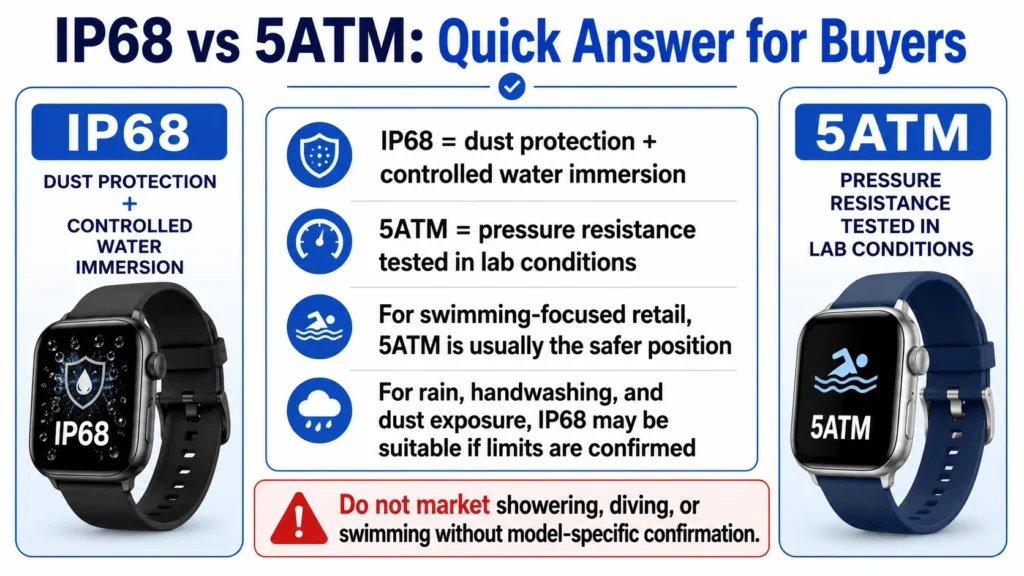
IP68 vs 5ATM is one of the most confusing smartwatch specification questions for retailers and importers. A wrong claim can lead to unhappy customers, returns, and warranty disputes. The practical answer is simple: buyers should match the rating to the intended activity, then verify the exact model’s documented limits.
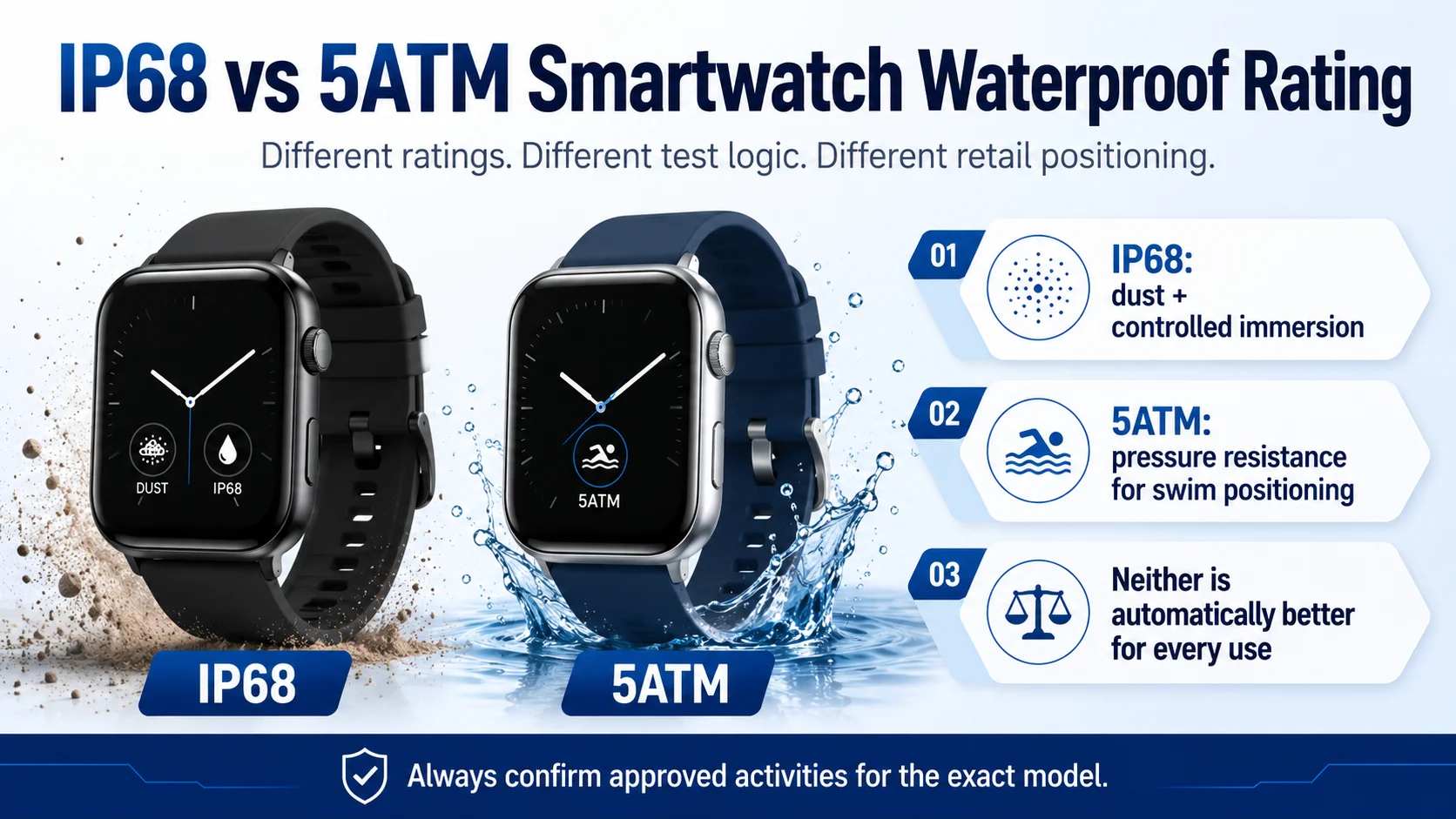
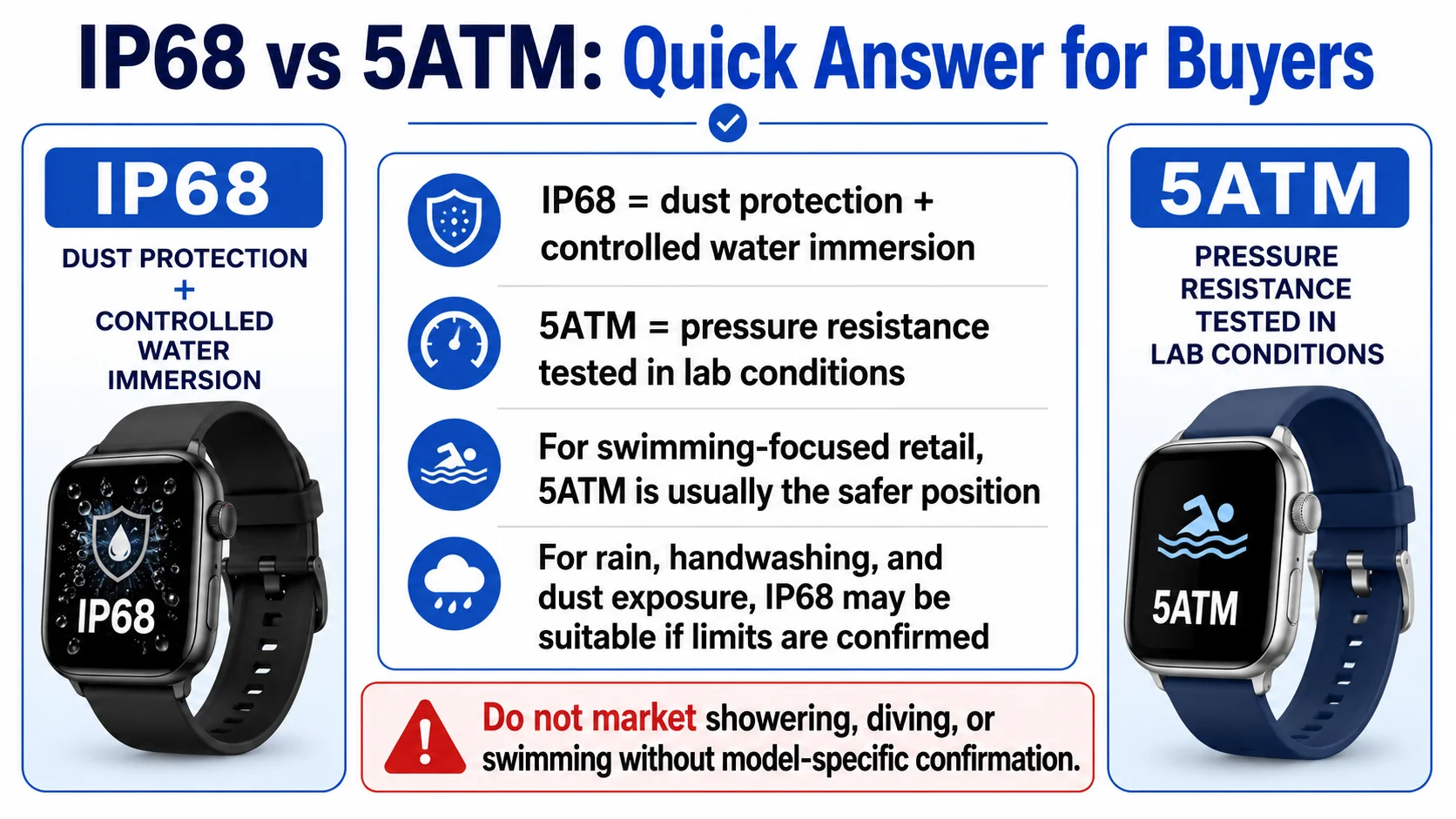
IP68 and 5ATM measure different forms of smartwatch water resistance, so neither is automatically “better” in every situation. IP68 usually covers dust protection and controlled water immersion, while 5ATM indicates resistance to pressure equivalent to 50 meters under laboratory conditions. For swimming-focused products, a documented 5ATM smartwatch is usually the safer retail position. For daily rain, handwashing, and dust exposure, an IP68 smartwatch may be suitable if the supplier confirms its use limits.
In our 15 years of exporting 3C products from Shenzhen, I have seen many European and US buyers focus on the number first. However, the real question is not “Which number is bigger?” The real question is: What will your end customer actually do while wearing the watch?
IP68 vs 5ATM: What Is the Quick Answer for Buyers?
Many buyers need a fast answer because product listings, packaging, and sales training must stay clear. Confusing IP68 with 5ATM can create risky marketing claims, especially when a watch is sold as a swimming smartwatch.
IP68 vs 5ATM is not a direct numerical comparison. IP68 mainly describes protection against dust and controlled water immersion under defined conditions, while 5ATM describes pressure resistance tested under laboratory conditions. A supplier should confirm the specific model’s permitted activities before you market it for swimming, showering, diving, or water sports.
For B2B buyers, I recommend separating your product selection into practical use cases:
- Daily-use smartwatch: rain, sweat, handwashing, occasional splashes
- Fitness smartwatch: gym sessions, outdoor running, sweat, light rain
- Swimming smartwatch: pool use and water-based fitness, subject to the model’s documentation
- Outdoor smartwatch: stronger focus on dust, rain, outdoor activity, and rugged positioning
An IP68 rating can be attractive for an entry-level or mid-range smartwatch because it signals strong dust protection and water resistance under controlled conditions. Still, this does not automatically mean the watch is suitable for regular pool swimming.
A 5ATM smartwatch is often a better fit when retailers want to sell a product with swimming as a core feature. Even then, I advise buyers to check whether the documentation specifically permits pool swimming, open-water swimming, diving, or only surface-level water activity.
A rating is not a marketing shortcut. It is a test-based claim with limits.
For retail listings, use wording that matches the supplier’s specification sheet. If the documents say “suitable for swimming,” use that wording. If they only state “IP68 water resistant,” avoid adding unsupported claims such as “safe for diving” or “safe for hot showers.”
What Does IP68 Mean on a Smartwatch?
An IP68 smartwatch can look like the strongest option because “68” sounds impressive. However, buyers can make mistakes when they assume every IP68 product has identical immersion limits.
IP68 means the smartwatch has an IP protection rating: “6” indicates complete dust protection, while “8” indicates protection against water immersion beyond the conditions covered by IPX7. The manufacturer must define the exact immersion depth, duration, and test conditions for the specific model.1
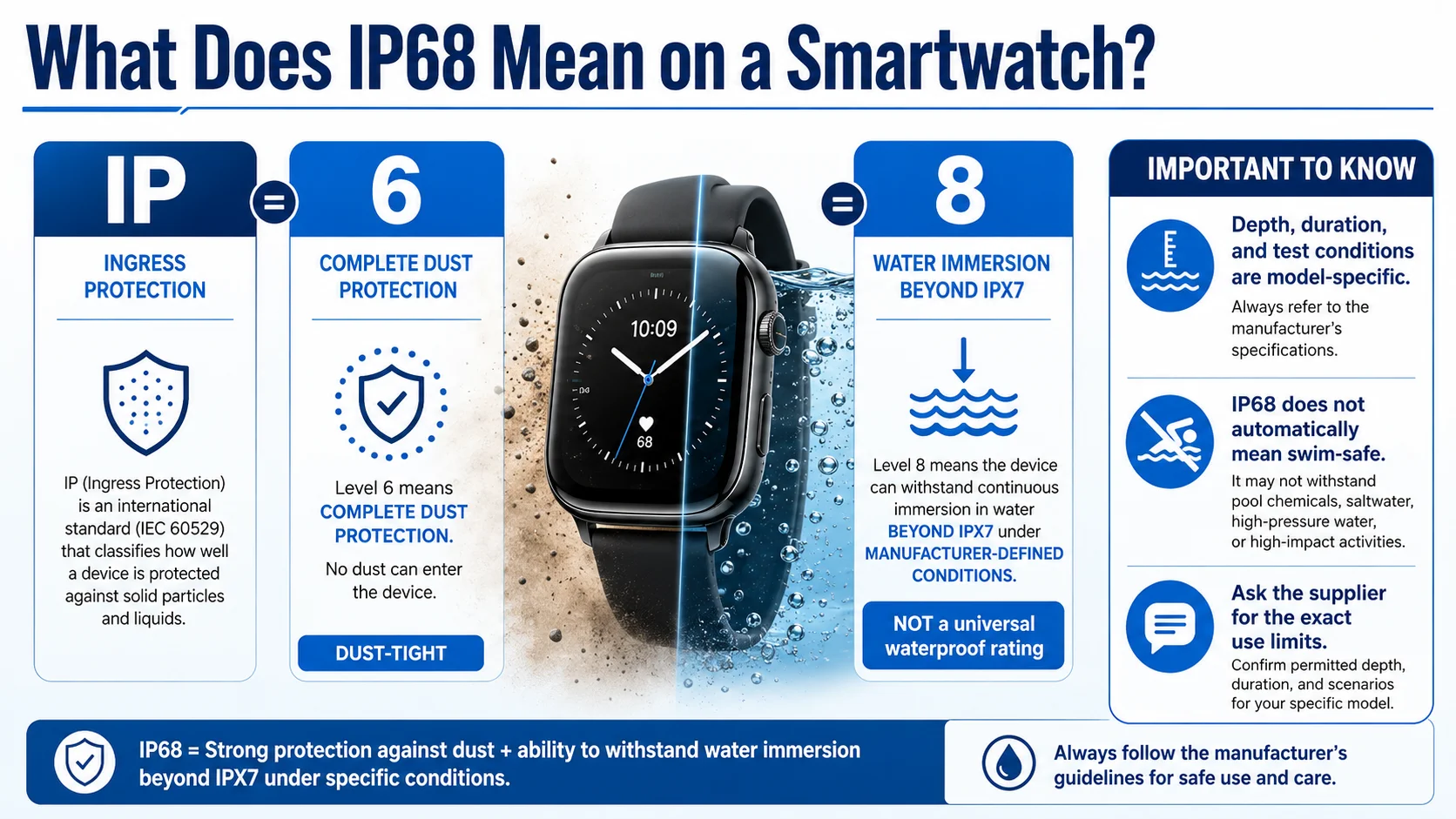
The letters “IP” stand for Ingress Protection. This system is commonly used to describe how well a device resists entry by solids and liquids.
Understanding the two IP68 digits
| Rating Element | Meaning |
|---|---|
| IP | Ingress Protection |
| 6 | Dust-tight protection |
| 8 | Protection against water immersion under manufacturer-defined conditions |
The key detail is that the “8” does not always mean the same test depth or duration across all products. One manufacturer may define IP68 testing at 1.5 meters for 30 minutes. Another may state a different controlled condition.2 Therefore, a buyer should request the exact documentation for the exact watch model.
In my conversations with overseas buyers, I often explain that IP68 is useful for positioning a smartwatch as suitable for everyday exposure. This may include sweat, rain, splashes, and handwashing when the manual allows it. Yet IP68 alone does not automatically support claims for competitive swimming, diving, surfing, high-pressure water, or long periods underwater.
Buyers should also consider that water resistance can change over time. Seals, buttons, speaker openings, charging contacts, adhesives, and watch housing joints may be affected by impacts, aging, repairs, or extreme temperatures.
Before placing an order, ask the supplier:
- What exact standard and test conditions support the IP68 claim?
- How deep was the watch immersed?
- How long did the immersion test last?
- Does the user manual permit swimming?
- What water-related exclusions appear in the warranty terms?
What Does 5ATM Mean on a Smartwatch?
A 5ATM smartwatch is often promoted for swimming, but some sellers overstate what that label means. This can expose retailers to unnecessary after-sales risk if customers interpret 5ATM as a guarantee for every water activity.
5ATM means a smartwatch has been tested to withstand pressure equivalent to five atmospheres, often described as 50 meters of static water pressure in laboratory conditions.3 It is commonly associated with swimming and surface water activities, but buyers should still confirm the model’s approved use cases.
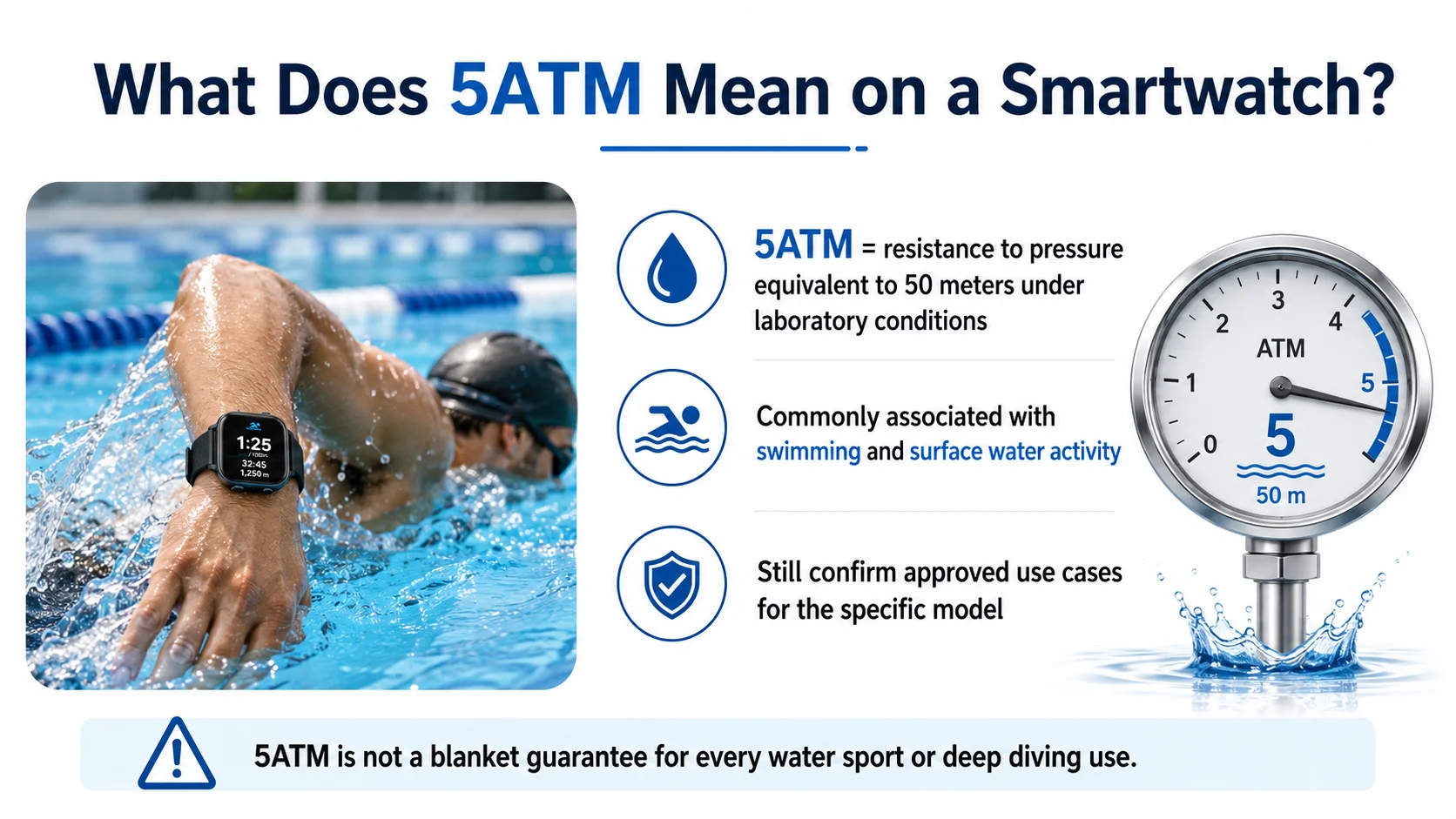
ATM stands for atmospheres, a pressure measurement. A 5ATM rating is not the same as saying a user can safely dive to a real depth of 50 meters.4 Real-world water exposure includes movement, waves, water impact, temperature changes, and pressure spikes.
For most consumer smartwatch ranges, 5ATM supports a more credible swim-focused product position than IP68 alone, provided the supplier’s product documentation says the watch is suitable for swimming.
What 5ATM may support
Depending on the exact model and documentation, a 5ATM smartwatch may be positioned for:
- Pool swimming
- Surface swimming
- Sweat and rain
- Handwashing
- Shallow-water activity
- General fitness use around water
What buyers should not assume
A 5ATM label does not automatically mean the watch is suitable for:
- Scuba diving
- High-speed water sports
- Hot showers
- Sauna use
- Hot tubs
- Pressurized water jets
- Repeated jumping into water
I usually tell buyers to think about the retail promise, not only the rating. If your target customer is a casual fitness user who wants swim tracking, a documented 5ATM swimming smartwatch can be a strong option. If your customers need diving functions, you need a product designed and documented for that specific application.
IP68 vs 5ATM: What Is the Real Difference?
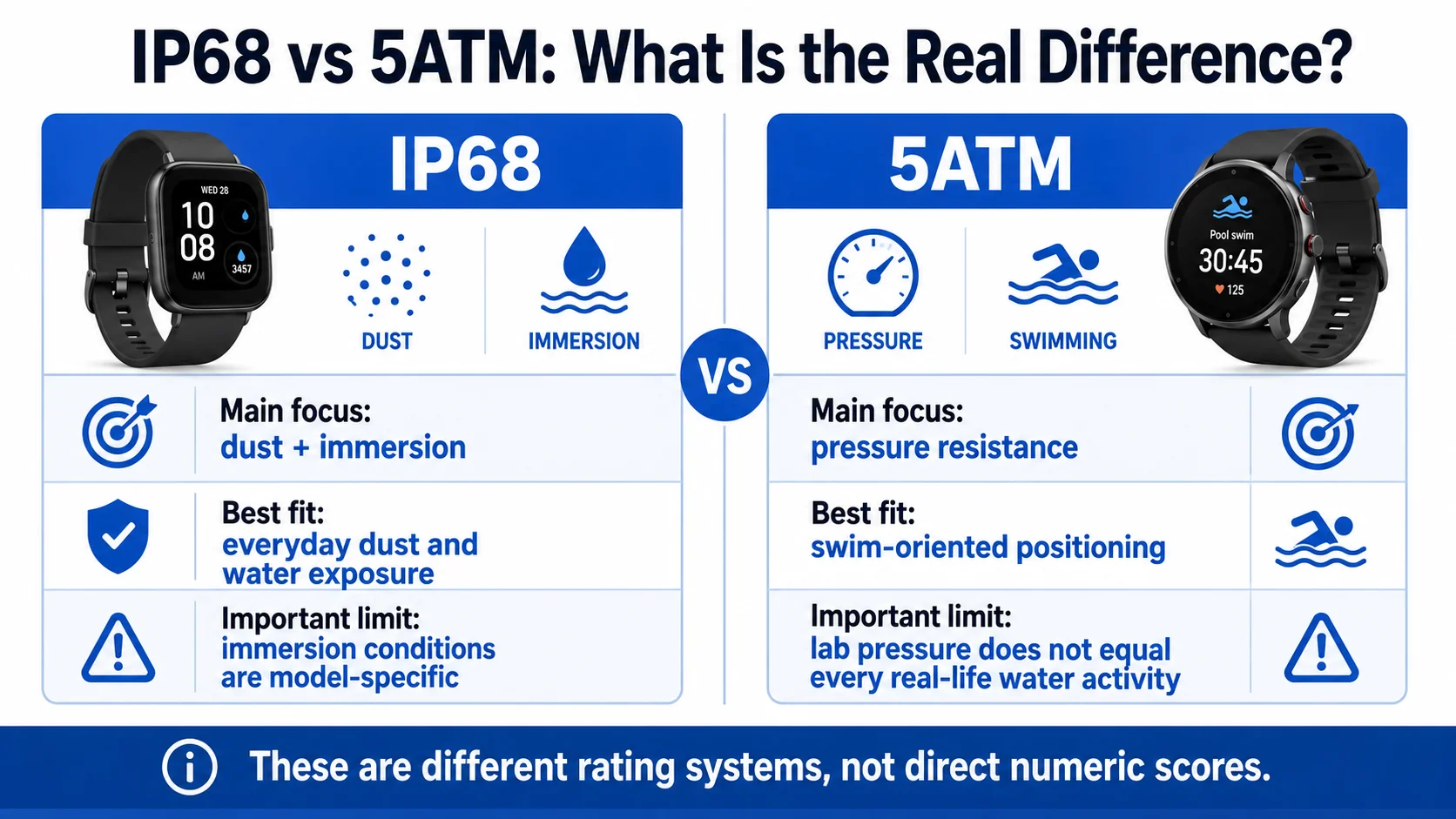
The biggest problem with IP68 vs 5ATM is that buyers often treat them as competing scores. They are not measured on one shared scale, and they were created to describe different protection concepts.
The real difference between IP68 and 5ATM is the testing focus. IP68 emphasizes dust protection and controlled water immersion, while 5ATM emphasizes resistance to water pressure under laboratory testing.5 A 5ATM rating is generally more relevant for swimming positioning, while IP68 is often relevant for daily protection and dust resistance.
The following table provides a practical purchasing comparison.
| Feature | IP68 Smartwatch | 5ATM Smartwatch |
|---|---|---|
| Main test focus | Dust and water ingress | Pressure resistance |
| Dust protection | Yes, “6” means dust-tight | Not defined by ATM alone |
| Water test type | Controlled immersion | Static pressure test |
| Swimming claim | Must be confirmed by supplier | Often more suitable, but must be confirmed |
| Rain and sweat | Usually suitable within documentation | Usually suitable within documentation |
| Diving claim | Not automatic | Not automatic |
| Best product position | Daily wear, fitness, outdoor use | Swimming, fitness, active lifestyle |
The smart buying decision depends on your customer group. A discount retailer may prioritize an IP68 smartwatch with a competitive price, stable quality, and clear everyday-use instructions. A sports retailer may need a 5ATM smartwatch with swim modes, lap tracking, and a more specific swimming claim.
Some products carry both IP68 and 5ATM. This can be useful because the watch combines dust protection information with pressure-resistance information.6 Still, buyers should not assume that IP68 + 5ATM means unlimited water resistance.
For every model, match these documents before you confirm an order:
- Product specification sheet
- Test report or certification record
- Packaging artwork
- User manual
- Online product listing
- Warranty policy
Why Does Dynamic Water Pressure Matter for Smartwatches?
Many customers believe that a watch safe at a certain static pressure will be safe in every water situation. In reality, moving water and fast arm movements can create different stresses around seals and openings.
Dynamic water pressure matters because swimming strokes, diving into water, waves, water jets, and fast movement can create pressure spikes beyond simple static immersion.7 This is why a smartwatch water resistance rating should be interpreted according to the manufacturer’s approved activities, not only its headline number.
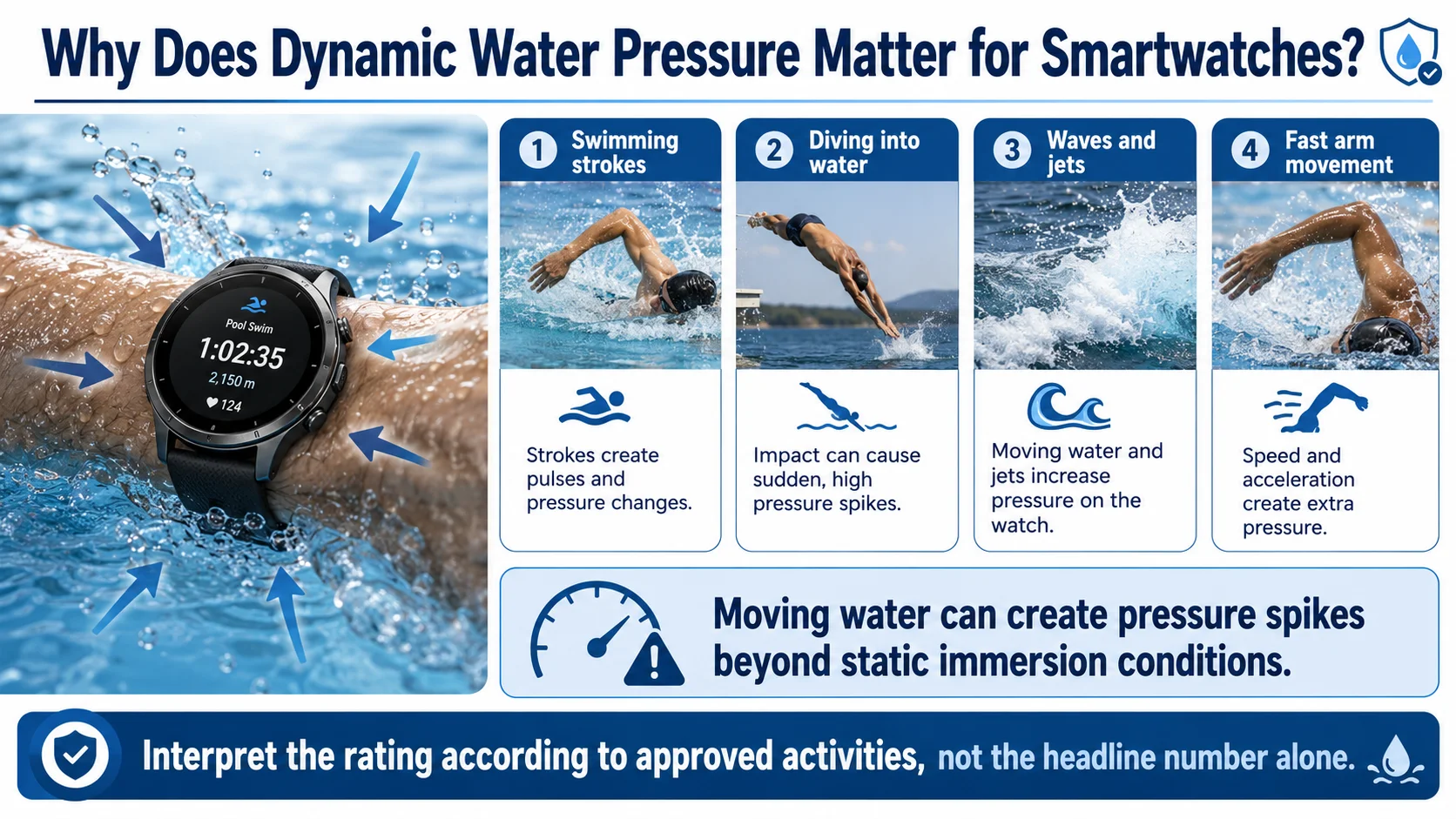
Static testing means the device is tested under stable, controlled conditions. The water is not moving aggressively, and the test pressure is carefully managed. Real life is less predictable.
For example, a user may move their arm quickly during freestyle swimming. Another user may jump from a pool edge. Someone may rinse a watch directly under a powerful faucet. These situations can put different forces on the case, microphone openings, speaker mesh, buttons, and seals.
Common sources of dynamic pressure
- Fast swimming strokes
- Diving or jumping into water
- Waves at the beach
- Water slides
- Jet skis and boating
- High-pressure shower heads
- Faucet spray directly against the watch
- Pressurized cleaning equipment
This is why we should avoid broad wording such as “fully waterproof for all water activities.” For wholesale and OEM smartwatch projects, accurate wording protects both the seller and the factory relationship.
A practical product listing can say:
“Water resistance is tested under controlled laboratory conditions. Please follow the user manual and avoid hot water, high-pressure water, diving, and activities not specifically approved for this model.”
This wording is clearer than making broad promises. It also helps customer service teams explain the product’s intended limits after purchase.
Can You Shower or Swim with an IP68 Smartwatch?
This question creates many returns because customers often use the same watch for rain, showering, swimming, and hot tubs. These activities are not equal, even if they all involve water.
An IP68 smartwatch may be suitable for rain, sweat, splashes, and controlled immersion, but it should not be marketed as swim-safe unless the manufacturer specifically confirms swimming use.8 Showering is also risky because soap, shampoo, heat, and water pressure can affect seals and water resistance.9
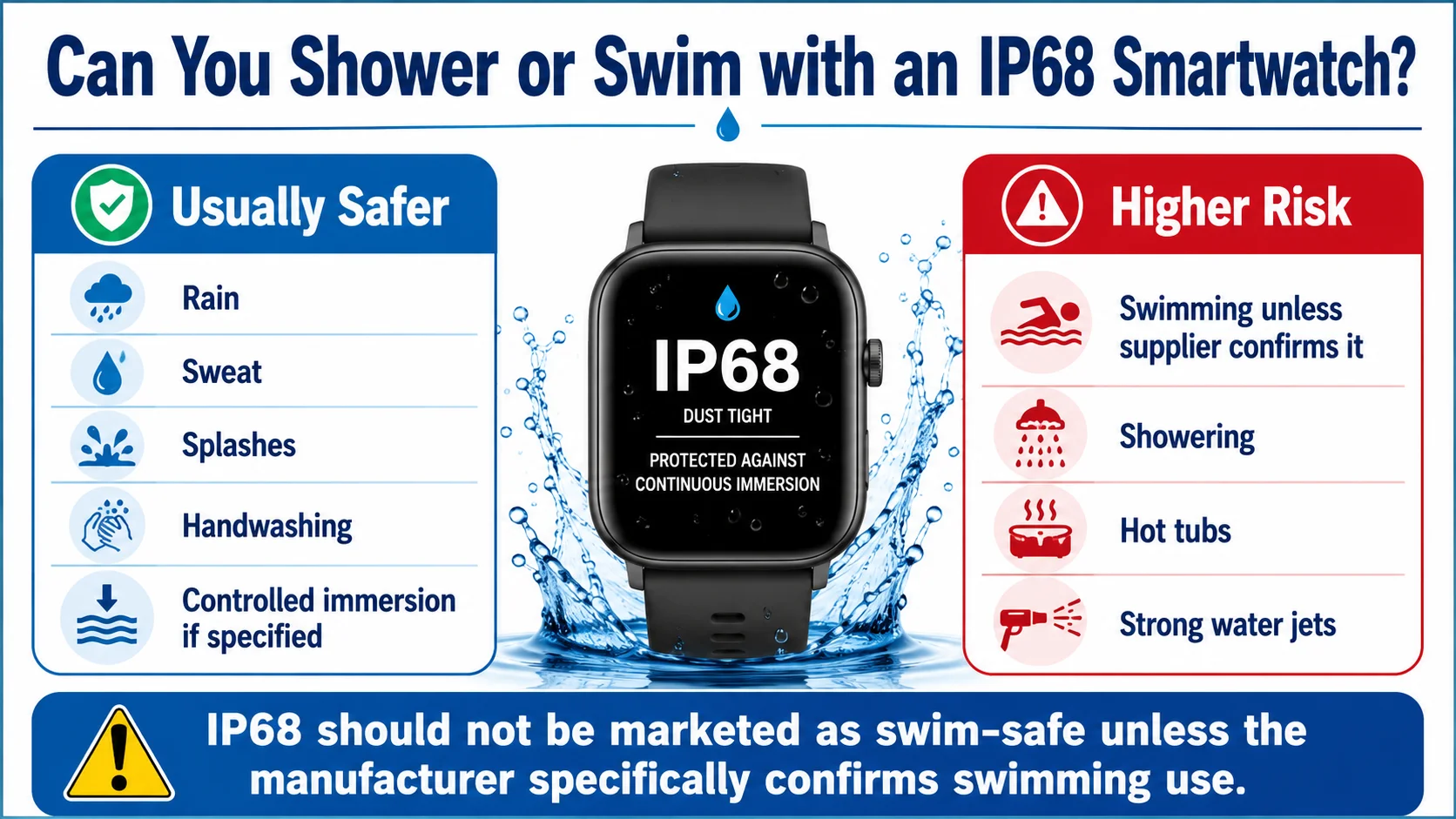
For swimming, retailers should check more than the IP68 label. Ask whether the watch has a swimming mode, whether pool swimming is listed in the manual, and whether the supplier supports that use in writing.
For showering, I recommend cautious advice even with a 5ATM smartwatch. Warm water can affect materials. Soap, shampoo, body wash, and conditioner can leave residues around seals and speaker holes. High-pressure water can also be more demanding than a calm pool.
Practical guidance for customer-facing instructions
| Activity | IP68 Only | 5ATM Only | Best Retail Advice |
|---|---|---|---|
| Rain | Usually acceptable | Usually acceptable | Check manual |
| Handwashing | Usually acceptable | Usually acceptable | Avoid direct high-pressure spray |
| Pool swimming | Confirm first | Often suitable if documented | Follow model instructions |
| Showering | Not recommended | Usually not recommended | Avoid hot water and soap |
| Sauna or steam room | Not recommended | Not recommended | Avoid completely |
| Diving | Not recommended | Not automatic | Use a dive-rated product |
A good seller does not rely on assumptions. If you sell a watch for swimming, put the approved swimming use on the listing and include the restrictions in the manual. This reduces confusion and helps customers choose the correct model.
Why Are Steam, Hot Water, and Sauna Use Risky?
Heat can make a smartwatch more vulnerable than cool water. Customers may think a shower is harmless because it is not deep water, but heat and steam create different risks.
Steam, hot water, and sauna use are risky because heat and rapid temperature changes can affect seals, adhesives, gaskets, and internal pressure.10 Steam can also condense into moisture, so a smartwatch water resistance rating should not be treated as approval for hot showers, steam rooms, or saunas.
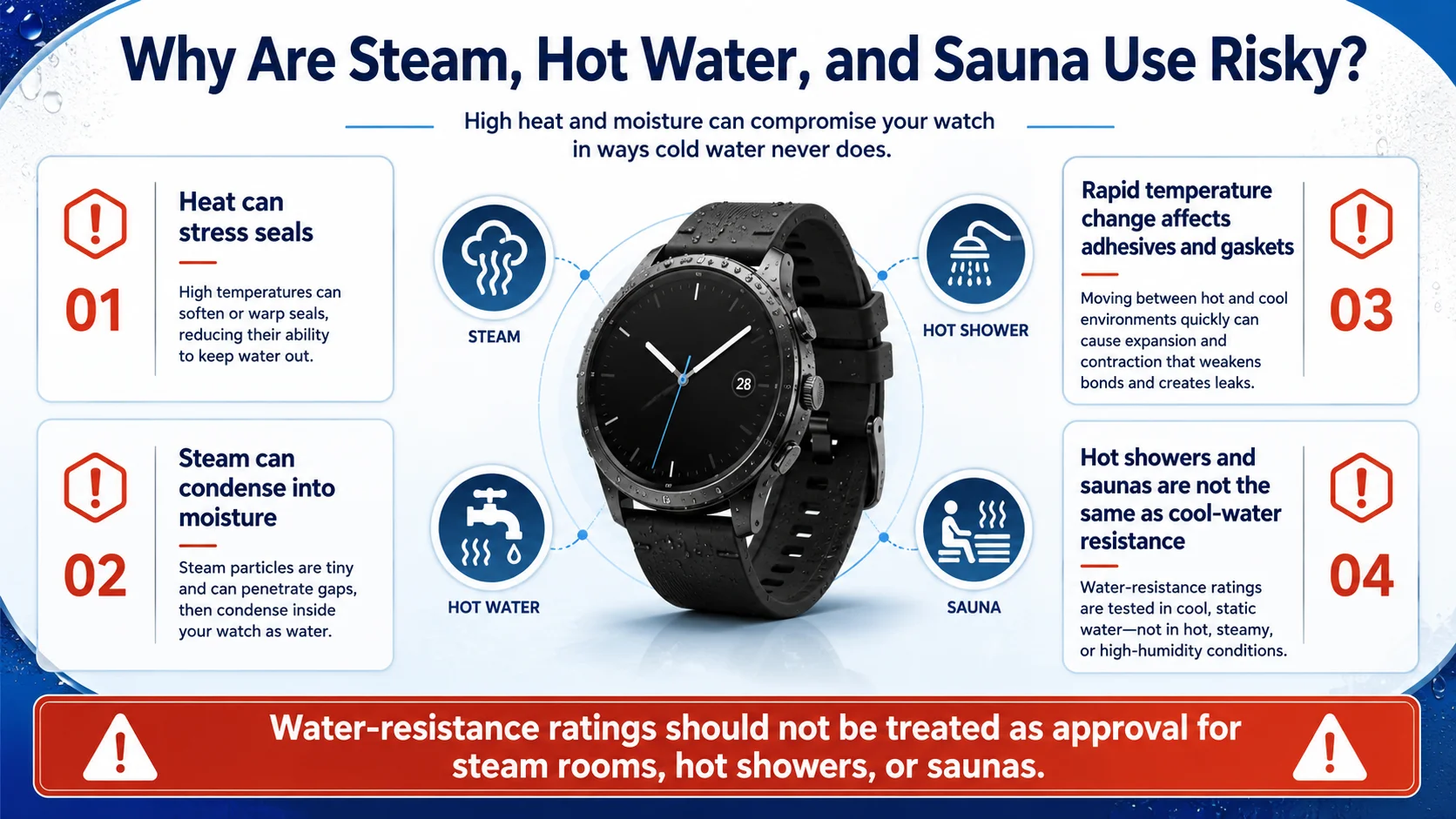
Water resistance relies on small components working together. These can include rubber gaskets, adhesive bonds, case joints, buttons, sensor covers, microphone membranes, and speaker mesh. High heat can cause materials to expand or change shape. Then, when the watch cools quickly, pressure differences may create conditions that allow moisture to enter.
Steam is especially difficult because it consists of tiny water particles. When warm steam reaches a cooler smartwatch surface, it can condense.11 If a seal is worn, damaged, or imperfect, condensation can become a risk.
Retailers should clearly advise customers to avoid:
- Hot showers
- Hot tubs
- Saunas
- Steam rooms
- Thermal baths
- Direct hot-water rinsing
- Leaving the watch in extreme heat
I have found that simple instructions reduce arguments later. A customer may not read a long warranty policy, but they will understand: “Do not wear the smartwatch in a sauna, steam room, or hot shower.”
For OEM smartwatch projects, buyers can also request icon-based warnings in the manual or packaging. Clear symbols improve usability across European and US markets where multiple languages may be needed.
IP68 vs 5ATM vs IP68 + 5ATM: Which Option Fits Your Market?
Buyers need a simple comparison when choosing models for different sales channels. Price, feature set, target customer, and warranty exposure all matter alongside the smartwatch waterproof rating.
IP68 vs 5ATM vs IP68 + 5ATM should be compared by intended use, documentation, and product positioning. IP68 is useful for dust and everyday water exposure, 5ATM is commonly better for swim-focused positioning, and IP68 + 5ATM can provide broader documented protection when the supplier supports both claims.
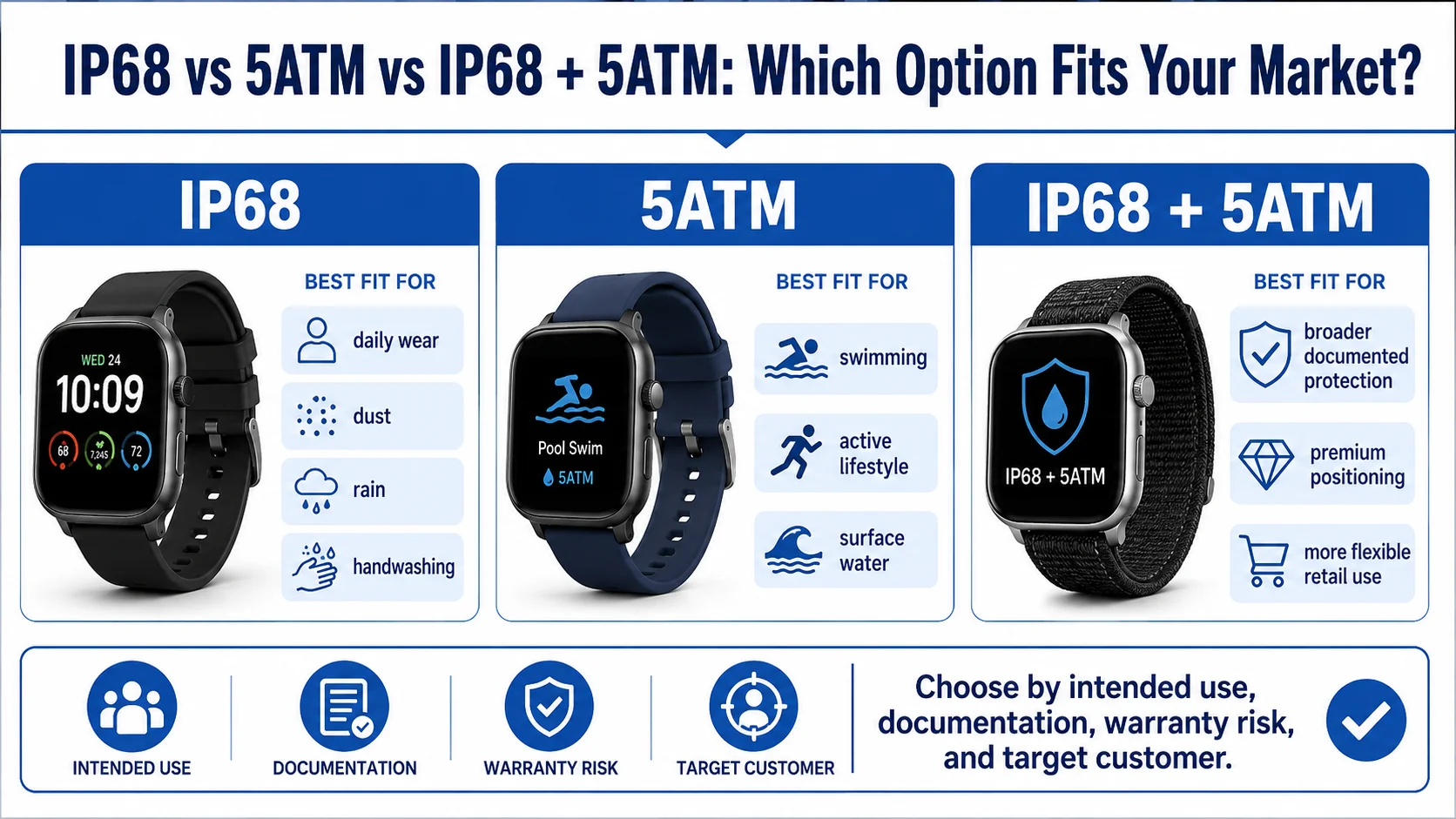
| Factor | IP68 | 5ATM | IP68 + 5ATM |
|---|---|---|---|
| Test standard | IP ingress protection | Pressure resistance | Both rating approaches |
| Dust resistance | Yes | Not defined by ATM | Yes |
| Controlled immersion | Yes | May be tested differently | Yes |
| Swimming suitability | Confirm model documents | Often suitable if documented | Often strongest positioning if documented |
| Shower suitability | Not recommended | Usually not recommended | Usually not recommended |
| Sports positioning | Daily fitness and outdoor use | Swimming and fitness | Higher-spec active lifestyle |
| Test verification needed | IP test conditions | Pressure test documentation | Both documents |
| Ideal customers | Value retailers, general e-commerce | Sports retailers, swim-focused sellers | Premium retailers and branded OEM projects |
A combined IP68 + 5ATM claim can be attractive for a higher-value smartwatch range. However, it also increases the importance of consistent testing, accurate labeling, and correct after-sales instructions.
For example, a retailer selling an affordable fashion smartwatch may not need a 5ATM model if swimming is not part of the core message. In contrast, a sports-chain buyer may want 5ATM, swim tracking, a stronger strap, and documented pool-use support.
The best option is the one that fits your channel. Do not pay for a higher rating if it does not support your sales strategy. At the same time, do not use an entry-level IP68 model for a swim-focused campaign unless the supplier clearly supports that claim.
How Is Smartwatch Waterproof Testing Performed?
Buyers often see a rating on a specification sheet but do not know what verification should look like. This creates uncertainty during sourcing, especially when comparing factories or OEM proposals.
Smartwatch waterproof testing may include air-pressure testing, controlled water immersion, pressure chamber testing, seal inspection, and post-test functional checks. The exact test method depends on the rating, the model design, and the applicable standard, so buyers should request documents for the specific product.12
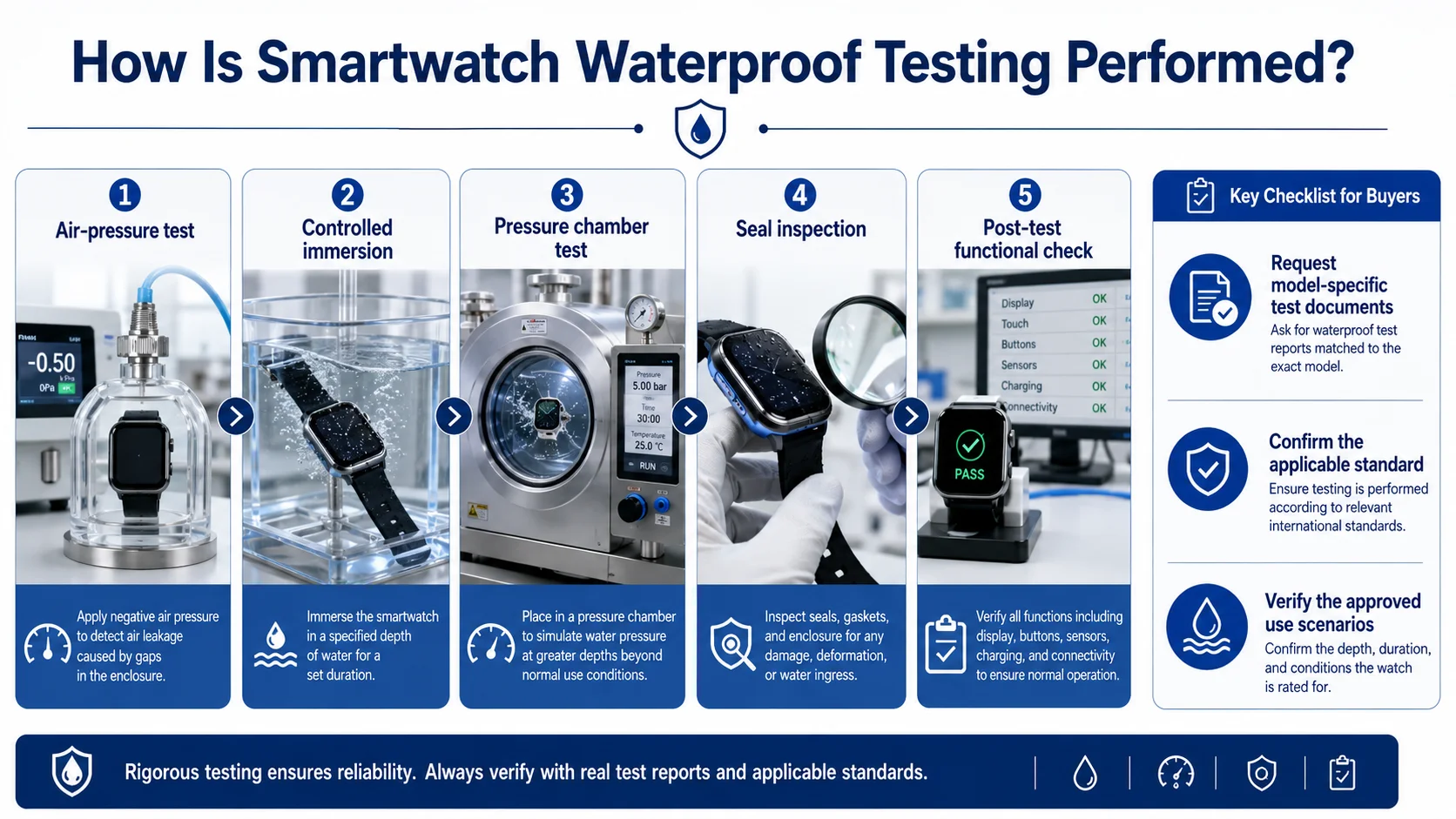
I do not suggest that buyers become laboratory engineers. However, buyers should understand enough to ask useful questions.
Common testing and inspection steps
-
Visual seal inspection
The factory checks the watch housing, screen assembly, buttons, back cover, and charging area for assembly issues. -
Air-pressure or vacuum testing
Some production processes use air-based checks to identify possible leakage without exposing every unit to water. -
Water immersion testing
A sample may be immersed according to the defined rating conditions. -
Pressure chamber testing
Pressure-based testing may be used for models claiming ATM resistance. -
Post-test function checks
The team checks display response, touch function, charging, Bluetooth connection, sensors, speakers, and microphones after testing. -
Sample and batch control
Buyers should ask whether testing is performed on engineering samples, production samples, or a defined percentage of production units.
For wholesale orders, I recommend asking about the factory’s quality control process before confirming the PO. The answer should be practical and specific. Vague claims such as “100% waterproof tested” should be clarified: What test? At which production stage? For which model? Under what conditions?
How Should You Source Waterproof Smartwatches for Wholesale?
Waterproof smartwatch wholesale sourcing involves more than selecting a design and negotiating price. Buyers need consistent specifications, suitable claims, reliable documents, and packaging that does not overpromise.
To source waterproof smartwatches for wholesale, buyers should verify the exact model’s rating, test documents, permitted activities, warranty exclusions, labeling, production quality controls, and user instructions. A supplier should provide evidence that matches the specification sheet, packaging, and retail listing.
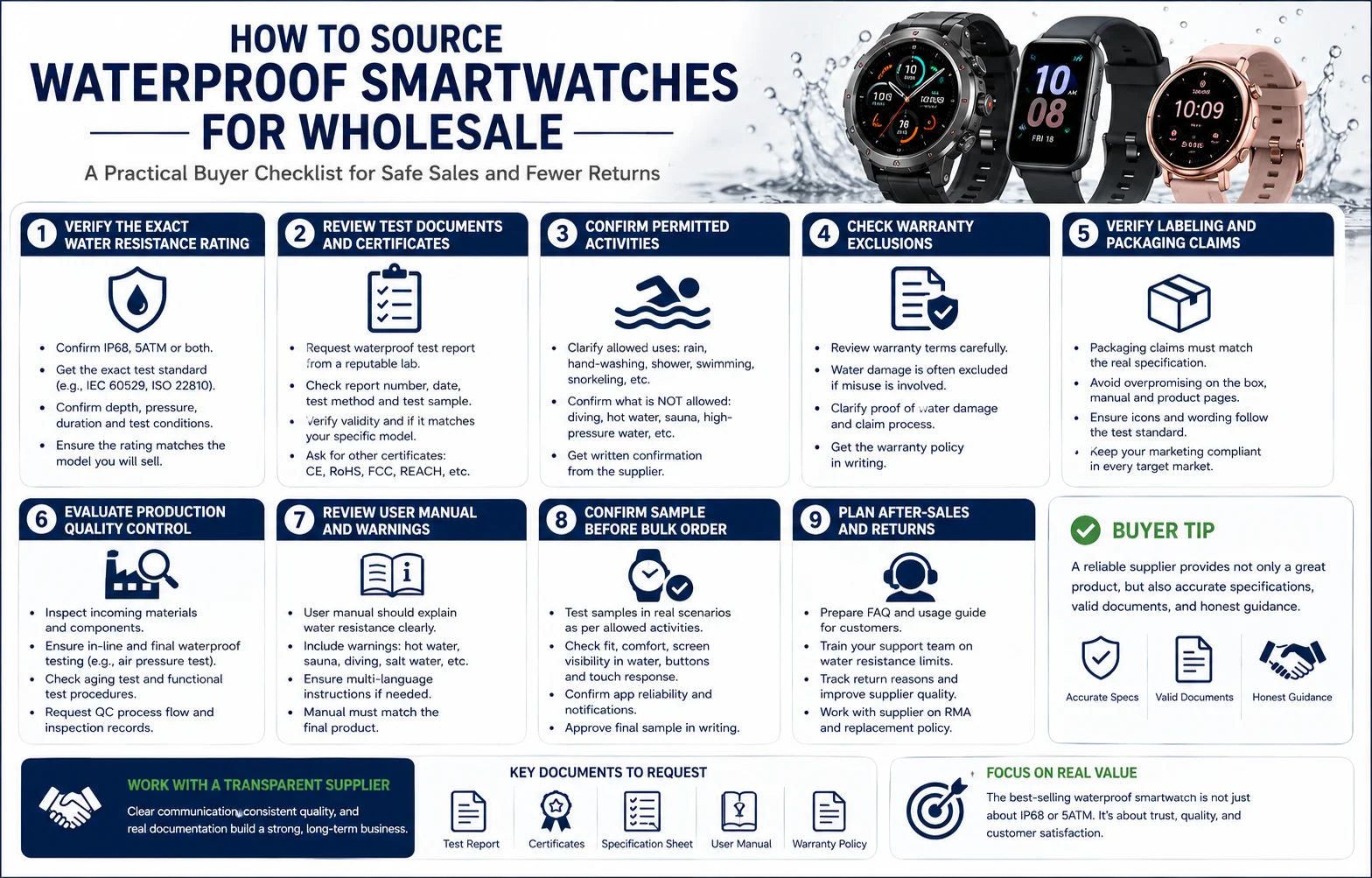
For European and US buyers, I recommend using this pre-purchase checklist before confirming a model.
Waterproof smartwatch sourcing checklist
- Confirm whether the model is IP68, 5ATM, or IP68 + 5ATM
- Request the relevant test report or certification documentation
- Confirm the test conditions for the exact model
- Ask whether swimming is explicitly permitted
- Ask whether showering, sauna use, diving, and hot water are excluded
- Check that the user manual matches the product claim
- Check packaging artwork before mass production
- Confirm warranty handling for water-related claims
- Ask about sample testing and production quality control
- Test pre-production samples in line with the approved product documentation
At Kingfuji Tech, we work with overseas B2B customers who need clear smartwatch specifications, stable supply, and practical OEM support. For swim-focused projects, we can help buyers evaluate 5ATM swimming watch options based on target price, MOQ, feature requirements, packaging needs, and market positioning.
I always recommend starting with the retail scenario. If your customer wants a smartwatch for daily wear and basic fitness, an IP68 model may be the right balance. If your customer expects pool tracking and swimming features, consider a documented 5ATM smartwatch and build your product page around approved activities.
Frequently Asked Questions
Is 5ATM better than IP68 for swimming?
A documented 5ATM smartwatch is generally more suitable for swimming-focused positioning than an IP68 smartwatch alone. However, buyers should still check the specific model’s manual and test documents. Neither rating automatically guarantees suitability for diving, hot water, or every water sport.
Can I sell an IP68 smartwatch as a swimming watch?
You should only market an IP68 smartwatch for swimming if the supplier’s official documents specifically permit swimming. IP68 confirms dust protection and controlled immersion resistance, but the exact water-use boundary depends on the manufacturer-defined test conditions and product instructions.
Can customers shower with a 5ATM smartwatch?
We recommend that customers avoid showering with a 5ATM smartwatch unless the product documentation clearly allows it. Hot water, steam, soap, shampoo, and direct spray can create risks that differ from controlled laboratory pressure testing or normal pool swimming.
Does IP68 + 5ATM mean a smartwatch is fully waterproof?
No. IP68 + 5ATM does not mean unlimited water protection. It means the smartwatch has claims related to dust, immersion, and pressure resistance. Buyers should still follow the model’s documented limits and avoid unsupported activities such as sauna use, diving, or high-pressure water exposure.
What should wholesalers request from a smartwatch supplier?
Wholesalers should request the exact product specification sheet, relevant test documentation, permitted-use instructions, warranty terms, packaging artwork, and production quality-control details. These materials should match each other before the buyer uses water-resistance claims in retail listings or advertisements.
Conclusion
IP68 vs 5ATM is not about choosing the biggest number. It is about selecting a smartwatch rating that matches your customer’s real water-related activity and your retail promise. IP68 can suit daily protection, dust exposure, rain, and general fitness use. A documented 5ATM smartwatch is often the stronger choice for swimming-oriented sales. Before ordering, verify the exact model’s test documents, approved activities, labeling, and warranty limits. If you need waterproof smartwatch wholesale or OEM support, contact us to discuss suitable models, MOQ, customization, and delivery options.
"IP code", https://en.wikipedia.org/wiki/IP_code. IEC 60529 defines the IP code: the first characteristic numeral 6 denotes dust-tight enclosure protection, while the IPX8 immersion test is conducted under conditions more severe than IPX7 that are specified for the equipment. Evidence role: definition; source type: institution. Supports: The source should define IP6X as dust-tight and explain that IPX8 immersion conditions are more severe than IPX7 and are specified by agreement or manufacturer documentation.. ↩
"IP code", https://en.wikipedia.org/wiki/IP_code. Guidance based on IEC 60529 explains that, unlike the fixed IPX7 immersion condition, IPX8 exposure conditions are specified for the particular product; consequently, an IP68 label alone does not state a universal depth or duration. Evidence role: general_support; source type: research. Supports: The source should show that IPX8 test depth and duration are not a universal fixed value and must be stated in product documentation.. Scope note: A cited general standard explanation does not verify the 1.5-metre, 30-minute condition for any particular smartwatch. ↩
"Water Resistant mark", https://en.wikipedia.org/wiki/Water_Resistant_mark. Watch water-resistance standards and pressure-unit references describe a 5-bar/5-atmosphere marking as a laboratory pressure-resistance designation often represented in consumer materials as 50 metres of water resistance. Evidence role: definition; source type: institution. Supports: The source should define atmosphere or bar pressure and explain the watch water-resistance marking associated with a 5-bar or 5-atmosphere test.. Scope note: The nominal metre expression is a pressure equivalence, not a demonstrated safe diving depth for a wearer. ↩
"Water Resistant mark", https://en.wikipedia.org/wiki/Water_Resistant_mark. ISO watch-water-resistance guidance distinguishes ordinary water-resistant watches from diving watches tested to dedicated requirements; a nominal 50-metre pressure marking therefore does not by itself establish suitability for diving to that depth. Evidence role: general_support; source type: institution. Supports: The source should distinguish laboratory pressure testing for ordinary water-resistant watches from diving-watch requirements.. Scope note: Permitted activities remain dependent on the individual watch manufacturer's instructions. ↩
"Ingress Protection (IP) ratings", https://www.iec.ch/ip-ratings. IEC 60529 classifies protection of enclosures against solid-object and water ingress, whereas watch water-resistance standards assess resistance to specified water-pressure exposures; the markings therefore are not measurements on one common numerical scale. Evidence role: mechanism; source type: institution. Supports: The source should establish that IEC 60529 classifies enclosure ingress protection, whereas watch water-resistance standards use pressure and water-exposure tests.. Scope note: A product's actual allowed uses must be determined from its model-specific documentation, not from either rating label alone. ↩
"IP code - Wikipedia", https://en.wikipedia.org/wiki/IP_code. The IP code reports enclosure resistance to dust and water ingress, while a 5-atmosphere marking reports resistance to a specified pressure test; displaying both designations can communicate different tested characteristics. Evidence role: general_support; source type: institution. Supports: The source should explain the distinct scope of IP-code and watch pressure-resistance classifications.. Scope note: The combination does not establish unlimited water resistance or validate activities not covered by the relevant test and manufacturer instructions. ↩
"Experimental and numerical investigation of the water-entry ...", https://pmc.ncbi.nlm.nih.gov/articles/PMC11599595/. Hydrodynamic research shows that water impact and relative motion can generate transient pressures that differ from static hydrostatic loading, supporting the distinction between controlled immersion tests and more variable real-world exposures. Evidence role: mechanism; source type: paper. Supports: The source should document that moving bodies and water impacts can generate transient hydrodynamic pressures distinct from hydrostatic pressure.. Scope note: Such research does not quantify seal failure pressure for any specific smartwatch or prove that a particular activity will cause leakage. ↩
"Ingress Protection (IP) ratings", https://www.iec.ch/ip-ratings. IEC 60529 specifies enclosure ingress-test classifications rather than a universal approval for swimming; whether swimming is permitted must therefore be established by the manufacturer's documented use instructions. Evidence role: general_support; source type: institution. Supports: The source should show that an IP68 classification describes tested ingress protection rather than a universal list of permitted sporting activities.. Scope note: The standard does not itself determine the commercial wording or warranty terms for a specific smartwatch. ↩
"Research Progress of Elastomer Materials and Application of ...", https://pmc.ncbi.nlm.nih.gov/articles/PMC9959665/. Materials research reports that temperature and chemical exposure can alter elastomeric seal properties, while water-resistant-device care guidance commonly excludes hot, soapy, or directly sprayed water from ordinary use recommendations. Evidence role: mechanism; source type: research. Supports: The source should support that elevated temperature and chemical exposure can affect elastomeric sealing materials or that water-resistant-device care guidance advises avoiding showers.. Scope note: This contextual evidence does not demonstrate damage to every seal design or establish that a single shower will cause a particular watch to leak. ↩
"Interfacial leakage of elastomer seals at low temperatures", https://www.sciencedirect.com/science/article/abs/pii/S0308016117303162. Engineering studies of sealed assemblies show that thermal cycling can change component dimensions, adhesive and elastomer behavior, and internal pressure differentials, all of which are relevant to the integrity of water-excluding seals. Evidence role: mechanism; source type: paper. Supports: The source should document the effects of thermal cycling on gaskets or adhesive joints and pressure changes within sealed enclosures.. Scope note: This mechanism evidence is not a product-specific water-resistance test and does not show that every smartwatch will fail in sauna or hot-shower use. ↩
"Condensation and the Water Cycle | U.S. Geological Survey", https://www.usgs.gov/water-science-school/science/condensation-and-water-cycle. Meteorological guidance explains that water vapour condenses when humid air cools to its dew point, so warm steam contacting a cooler watch surface can form liquid water on that surface. Evidence role: mechanism; source type: government. Supports: The source should explain that water vapour condenses when moist air is cooled to its dew point at a cooler surface.. Scope note: Surface condensation alone does not demonstrate that moisture will penetrate an intact smartwatch enclosure. ↩
"Water Resistant mark", https://en.wikipedia.org/wiki/Water_Resistant_mark. Accredited test guidance for IEC ingress ratings and watch water-resistance standards describes controlled immersion and pressure-exposure procedures; manufacturers may add leak screening and post-test functional inspection as quality-control measures. Evidence role: general_support; source type: research. Supports: The source should describe standardized immersion and pressure-based water-resistance tests and clarify that additional leak or functional checks may be manufacturer quality-control procedures.. Scope note: Not every listed inspection is mandated by every standard, and a factory's actual sampling plan must be verified from its own records. ↩