Quick Answer
EU Ecodesign for USB-C chargers can feel confusing for importers because a product may look compliant at first glance while its documents, power profile, or intended launch timing still need review. A USB-C connector is only one part of the picture. We recommend a SKU-by-SKU readiness process before you buy, list, or ship chargers into Europe.
EU Ecodesign for USB-C chargers requires importers to verify more than the presence of a USB-C port. Each charger SKU should be reviewed for its technical configuration, rated power, charging functions, applicable product rules, CE-related documentation, and planned EU market-entry date. Existing certificates and reports can support the review, but buyers should confirm their current scope with official EU sources and qualified compliance professionals.
For European retailers, wholesalers, and online sellers, the practical question is rarely “Can we sell USB-C chargers?” The better question is, “What must we verify for this exact charger before it enters the EU market?” That shift helps buyers avoid costly assumptions during sourcing and product launch.
EU charger readiness for USB-C chargers is not a simple “does it have USB-C?” question
In recurring customer inquiries and document-review discussions, we often see buyers confuse USB-C requirements with broader Ecodesign obligations. That confusion can create gaps in product selection, technical file review, packaging preparation, and retail listing. A charger may include USB-C output and still require further checks before an importer can treat it as EU-ready.
For EU charger readiness, importers should assess every USB-C charger as an individual SKU. The review should cover the charger’s output ports, rated power, supported charging behavior, intended product category, technical documentation, conformity declarations, labeling, instructions, and market-launch date. USB-C connectivity is relevant, but it is not automatic proof of compliance with all applicable EU Ecodesign or related requirements.

Start by separating the regulatory questions
The phrase “EU USB-C rule” is commonly used in purchasing discussions, but it can combine several different issues into one vague requirement. That is risky because different EU rules can address different products, functions, dates, documents, and parties in the supply chain.
In practical sourcing conversations, we encourage buyers to separate at least these questions:
-
Does the finished product fall within a common-charger requirement?
Rules concerning harmonised charging interfaces may apply to certain categories of radio equipment.[1] The relevant scope depends on the product type and the current legal framework, not simply on whether a charger includes a USB-C port. -
Does the external power supply need Ecodesign review?
A wall charger or power adapter may be assessed as an external power supply. Ecodesign requirements can involve energy-efficiency performance, no-load power consumption, active-mode efficiency, information requirements, and product documentation.[2] The applicable assessment depends on the product’s technical design and regulatory scope.[3] -
Is the charger sold alone or supplied with another product?
A standalone 20W USB-C charger, a travel adapter, a multi-port charging station, and a charger packed with an electronic device can raise different procurement questions. Buyers should not assume that a rule applying to one sales format automatically applies in the same way to another. -
Does the product support charging protocols that match its claim?
A USB-C charger may support USB Power Delivery, programmable power supply functions, proprietary fast-charging systems, or only basic 5V output. Product claims, rated output markings, instructions, and technical evidence should align. -
When will the SKU be placed on the EU market?
Timing matters. Importers should verify the current implementation and applicability dates against official EU sources before confirming stock plans, retail listings, or promotional claims.
We treat this as a sourcing translation exercise: legal and technical rules must eventually become clear supplier questions, document requests, packaging checks, and launch decisions.
Why a USB-C port does not answer the whole question
A USB-C port describes a physical connection format.[4] It does not, by itself, confirm the electrical performance, efficiency level, interoperability, safety design, or documentation status of a charger.[5]
For example, two USB-C chargers may look almost identical in a product image:
- One may have a single USB-C output rated at 20W.
- One may have two USB-C ports with shared output limits.[6]
- One may support USB Power Delivery at several voltage levels.
- One may offer only 5V charging through a USB-C connector.
- One may be supplied with a cable, while another is sold without one.
- One may be packaged as an external power supply, while another is bundled with a consumer electronic product.
These differences can affect how an importer frames the compliance review. They also affect what a retail buyer needs to understand before making a product claim such as “fast charging,” “universal charging,” or “EU compliant.”
| Procurement check | Why it matters for USB-C chargers | Questions for the supplier |
|---|---|---|
| Port configuration | Single-port and multi-port products can behave differently under load | How many output ports are active, and what is the shared output rule? |
| Rated output | Wattage alone does not explain all supported power profiles | Please provide the full output marking and specification sheet. |
| Charging protocol | USB-C connector type and fast-charge compatibility are separate questions | Does the SKU support USB PD, PPS, or another protocol? |
| Product category | Scope can depend on whether the item is a standalone charger or bundled accessory | How is the SKU intended to be sold and described? |
| Documentation | Reports may cover only a defined model, version, or standard edition | Which exact model number, revision, and product configuration do the documents cover? |
| Launch timing | Requirements can change and transition periods may be relevant | What is the planned EU market-entry date, and has current applicability been verified? |
We have seen how easily a sales sample can create false confidence. A sample may charge a phone correctly, show a USB-C socket, and carry a familiar mark. However, procurement due diligence needs more than a basic functional check. The buyer should connect the commercial SKU, specification, documentation, packaging, and intended market plan.
Use CE marking as a review starting point, not the end point
CE marking is important, but it should not be treated as a universal answer to every importer question. A CE mark indicates that the responsible economic operator has made a conformity declaration under applicable EU harmonisation legislation.[7] It does not tell a buyer, by itself, which requirements were assessed, what product revision was tested, or whether newer and product-specific obligations were considered.[8]
For EU Ecodesign for USB-C chargers, we suggest that buyers use CE-related documents as the beginning of a structured review.
A practical document pack may include, depending on the product and applicable requirements:
- A Declaration of Conformity that identifies the legal entity and exact product model.
- Product specifications showing input, output, wattage, port configuration, and supported charging modes.
- Relevant test reports or evaluation records tied to the correct SKU or technical variant.
- Product photos showing markings, labels, plug type, and port layout.
- User instructions and safety information prepared for the intended EU sales countries.
- Packaging artwork showing required commercial and traceability information.
- Bill of materials or component declarations where a buyer’s internal process requires them.
- A statement explaining model variants, such as housing color, plug version, cable inclusion, or output differences.
The key is consistency. If the Declaration of Conformity names model “A20-C,” but the carton says “A20-C Pro,” and the report refers to a different output rating, the buyer should pause. The issue may be a simple naming inconsistency, but it can also show that documents were assembled around a related product rather than the exact sales SKU.
Build a three-stage procurement workflow
We find that the most reliable import process begins before a purchase order is issued. Waiting until a container is ready to ship creates pressure, and pressure can lead to weak decisions.
Stage 1: Ask the right questions before sourcing
At the inquiry stage, buyers should provide a clear product brief. This helps us identify whether the requested USB-C charger is a simple standard model or a configuration that needs deeper technical review.
Useful pre-sourcing questions include:
- Is the charger intended for EU retail, e-commerce, wholesale, or promotional bundles?
- Will it be sold as a standalone external power supply?
- What output power and charging protocols are required?
- Does the buyer need USB-A plus USB-C, dual USB-C, or USB-C only?
- Are there country-specific plug, language, packaging, or instruction needs?
- What is the expected launch date?
- Does the retailer have a compliance checklist or document portal?
- Does the buyer need private label branding, custom packaging, or a new model number?
We often advise buyers not to choose a charger only by wattage and unit price. A 30W GaN charger can appear attractive, but its true procurement cost also includes document preparation, artwork review, carton requirements, quality-control checks, and post-sale support expectations.
Stage 2: Verify specifications and documents before placing the order
Before deposit payment or production approval, buyers should ask for the technical and commercial evidence that matches the actual SKU. This is especially important for customised USB-C chargers.
A disciplined pre-order review can follow this sequence:
- Confirm the final model number.
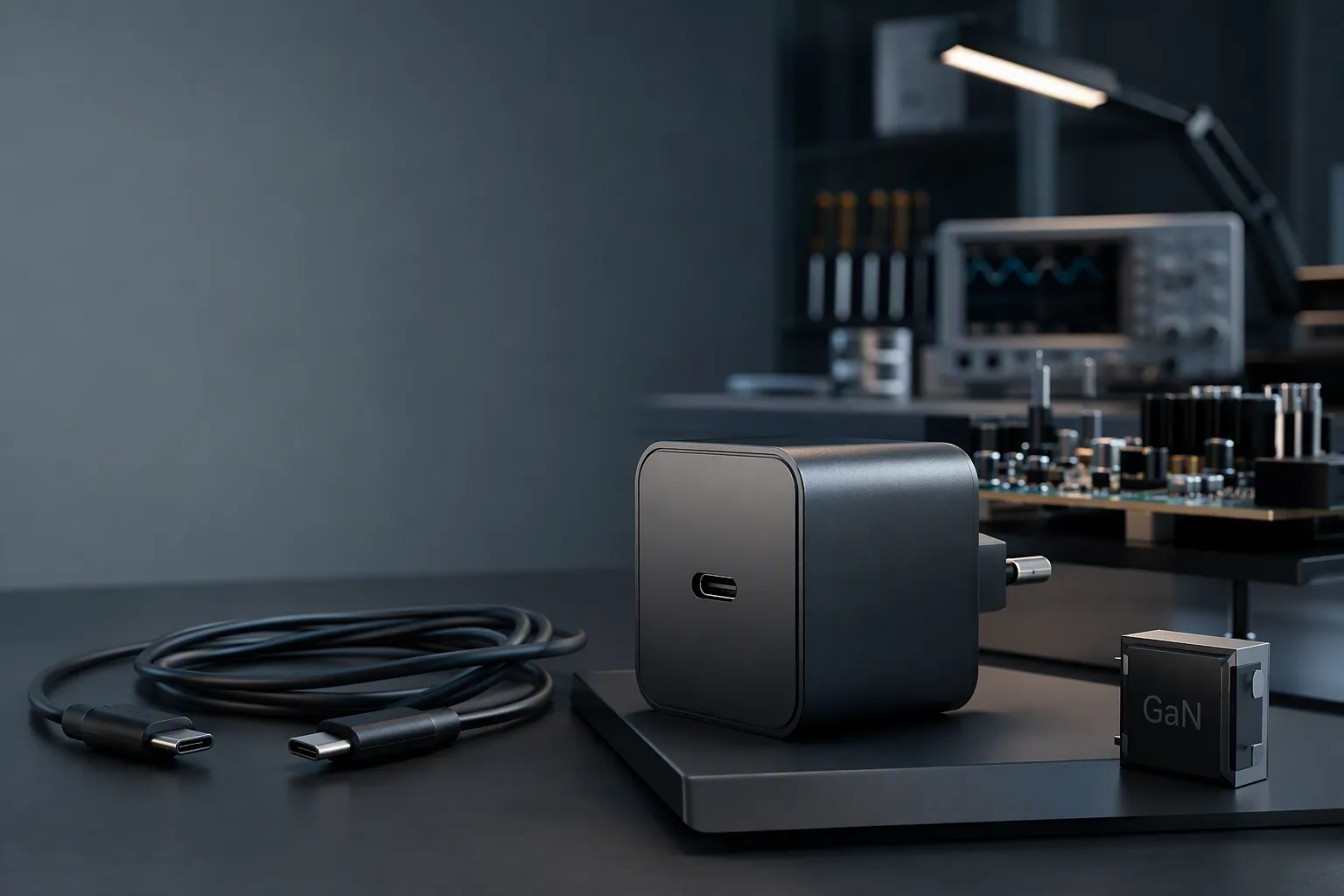
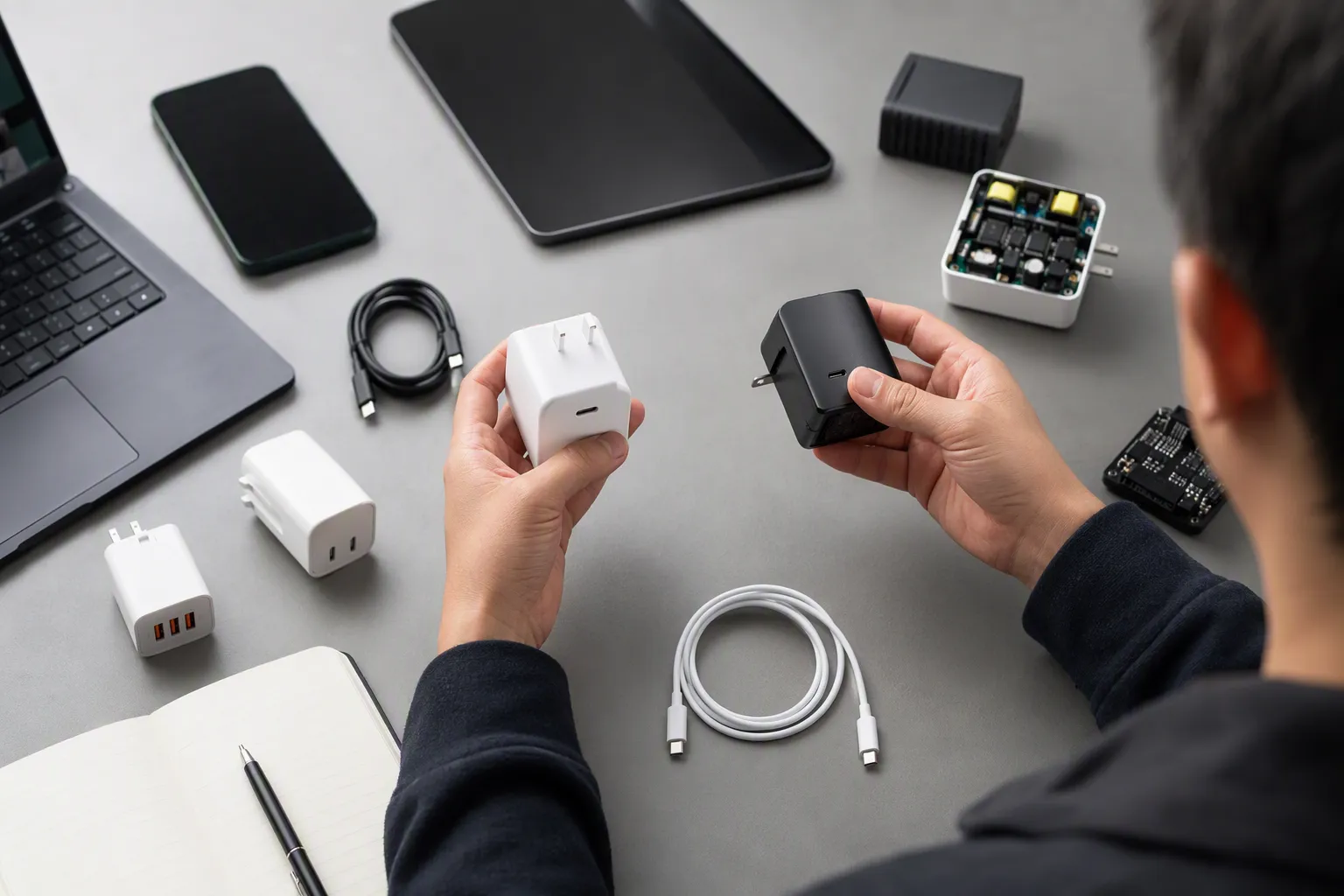
The model code should remain consistent across the quotation, purchase order, product label, packaging, instructions, test reports, and conformity documents.
-
Confirm the electrical specification.
Review input range, output profiles, maximum power, port-sharing rules, and supported protocols. A multi-port charger needs clear information about what happens when two devices charge at the same time. -
Confirm the physical configuration.
Check plug type, enclosure, port count, cable inclusion, color, branding, and packaging language. Small changes can create a new commercial variant that requires document alignment. -
Review available conformity documentation.
Buyers should ask what the documents cover and when they were issued. They should not assume an older report automatically addresses every current requirement. -
Check product claims.
If the packaging says “65W fast charger,” “PD charging,” or “GaN technology,” the claims should be accurate, supportable, and consistent with the specification. -
Escalate unclear points.
A qualified compliance professional, laboratory, or legal adviser should review application-specific questions. We can support the sourcing side by organizing available supplier documents, but we do not replace a formal conformity assessment.
Stage 3: Check consistency before EU listing or retail launch
The final review should happen before the product goes live online or reaches retail shelves. This is the stage where many preventable mistakes become visible: incorrect product images, old instruction files, mismatched wattage claims, missing importer details, or a listing that describes a function the charger does not support.
For each USB-C charger SKU, we recommend comparing these items side by side:
| Item | Consistency check |
|---|---|
| Product sample | Does the physical charger match the approved product photos and port configuration? |
| Product label | Does the model number and electrical rating match the specification and documents? |
| Retail box | Does the wattage, charging claim, plug type, and included-accessory statement match the actual contents? |
| Online listing | Does the title, bullet points, images, and compatibility language avoid unsupported claims? |
| Instructions | Are the usage, safety, and charging details appropriate for the final SKU and intended markets? |
| Importer records | Can the buyer quickly identify the supplier, batch, model, documents, and version history? |
This final stage is important for retailers and marketplace sellers. Online listings can create their own problems when marketing teams reuse content from another charger model. For example, a listing may say “supports PPS” because a higher-power version does, while the selected entry-level SKU does not. The charger may still be functional, but the listing becomes inaccurate.
Supplier selection should include document discipline
Price remains important in consumer electronics procurement. However, very low pricing can become expensive if the supplier cannot maintain stable model control, provide traceable documents, or answer technical questions clearly.
As a Shenzhen 3C export trading company with 15 years of export experience, we understand why buyers compare several suppliers. We also know that a good supplier relationship should make readiness checks easier, not harder.
When evaluating suppliers of USB-C chargers, we suggest looking beyond the headline quotation.
Ask how the supplier manages:
- Model-number control across production and documents.
- Product revisions and component substitutions.
- Pre-production sample approval.
- Incoming and finished-product quality checks.
- Label, carton, and instruction artwork approval.
- Storage of current technical files and reports.
- Response time for retailer or marketplace document requests.
- MOQ flexibility for private-label or regional packaging projects.
- Lead-time communication when documents or artwork require updates.
- After-sales handling for product-quality questions.
We also recommend asking whether a supplier can explain the difference between a product specification, a test report, a declaration, and a final legal conclusion. A reliable supplier should be comfortable saying, “This needs verification,” instead of making broad promises.
A practical readiness checklist for importers
Before you approve an order for EU Ecodesign for USB-C chargers, use a short internal checklist. It does not replace professional advice, but it gives your purchasing, quality, and sales teams a common workflow.
- [ ] We have identified the exact SKU and model number.
- [ ] We know whether the charger is standalone, bundled, single-port, or multi-port.
- [ ] We have reviewed the rated input and output specifications.
- [ ] We understand the supported charging protocols and port-sharing behavior.
- [ ] We have checked whether product claims match the actual charging capability.
- [ ] We have requested current documents for the exact product configuration.
- [ ] We have confirmed that labels, packaging, instructions, and online listings use consistent information.
- [ ] We have verified the relevant current EU requirements through official sources and qualified professionals.
- [ ] We have considered the product’s planned EU market-entry date.
- [ ] We have retained supplier contact details and product traceability records.
This process may seem detailed for a small accessory. Yet chargers are electrical products used daily in homes, offices, hotels, and retail environments. A structured review protects the buyer’s brand, reduces last-minute listing delays, and helps procurement teams compare suppliers on more than price.
Frequently Asked Questions
Does a USB-C port mean a charger is EU Ecodesign compliant?
No. A USB-C port only identifies a connector format. Importers should also review the charger’s technical configuration, energy-related requirements that may apply, documentation, product claims, intended sales format, and EU market-entry timing. Qualified compliance professionals should confirm product-specific conclusions.
Is CE marking enough for USB-C chargers sold in Europe?
CE marking is important, but it is not a complete procurement checklist. Buyers should verify which product model and configuration the supporting documents cover, whether the documents are current, and whether the charger’s labels, packaging, instructions, and online claims remain consistent with them.
What documents should I request from a USB-C charger supplier?
We recommend requesting the Declaration of Conformity, technical specification, available test documentation, product photos, label artwork, packaging artwork, instructions, and a clear explanation of model variants. The required evidence depends on the product and applicable requirements, so buyers should obtain professional advice where needed.
Do multi-port USB-C chargers need extra review?
Yes. Multi-port chargers deserve careful review because total rated power may not be available from every port at the same time. Buyers should confirm single-port output, shared-power rules, supported protocols, markings, instructions, and the accuracy of retail or e-commerce claims.
Can an older charger model remain suitable for EU sale?
Possibly, but buyers should not assume so based on past sales or existing documents. The product configuration, applicable rules, documentation scope, and intended launch timing all need review. We recommend checking current official EU sources and seeking qualified professional guidance before committing to stock.
Conclusion
EU Ecodesign for USB-C chargers is a procurement and launch-readiness issue, not a simple connector question. We recommend evaluating each SKU by its technical design, output behavior, document set, labeling, claims, and intended EU sales timeline. CE marking and existing reports are valuable starting points, but buyers should verify their scope and current relevance. If you are sourcing USB-C chargers, GaN chargers, charging cables, or private-label 3C accessories for Europe, we can help you organize product specifications, samples, and supplier-side documentation for a more structured review.
Sources
- (EU)2022/2380 - EUR-Lex", Directive (EU) 2022/2380 amends the Radio Equipment Directive to establish common charging-interface requirements for specified categories of radio equipment
- [PDF] commission regulation (eu) 2019/1782 - EUR-Lex - European Union", Commission Regulation (EU) 2019/1782 sets Ecodesign requirements for external power supplies, including limits on no-load power consumption, minimum average active efficiency, and product-information provisions
- Official Journal L 272/2019 - EUR-Lex - European Union", Commission Regulation (EU) 2019/1782 defines the external power supplies within its scope and specifies exclusions that can affect whether a particular product is subject to its requirements
- USB Type-C® Cable and Connector Specification", USB Implementers Forum specifications distinguish the USB Type-C connector and cable interface from USB Power Delivery rules that govern negotiated charging power
- USB Power Delivery", USB specifications treat connector configuration and power-delivery functionality separately, while EU conformity guidance requires supporting assessment and technical documentation beyond a product's visible connector type
- USB Charger (USB Power Delivery)", USB Power Delivery defines source power capabilities and negotiated contracts; in multi-output designs, the manufacturer's total available power budget can constrain simultaneous port output
- CE marking - Internal Market, Industry, Entrepreneurship and SMEs", European Commission guidance explains that CE marking indicates that the manufacturer declares a product's conformity with applicable EU requirements and assumes responsibility for that conformity
- Official Journal C 247/2022 - EUR-Lex", The European Commission's Blue Guide describes CE marking as part of a wider conformity-assessment system requiring applicable assessment procedures, technical documentation, and an EU declaration of conformity