Apple C94 vs C48 is a common question for cable buyers, but choosing the wrong connector solution can lead to weak charging claims, higher returns, and compliance concerns. Many suppliers use connector names loosely. We help buyers look beyond the label and verify the complete cable, charging setup, and documentation before placing an order.
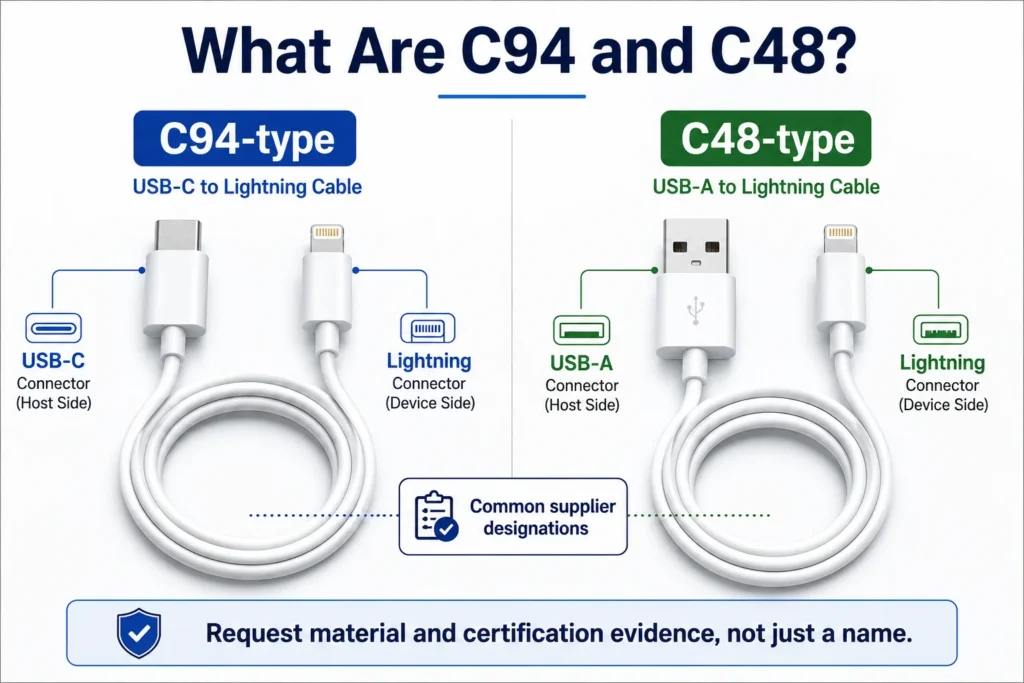
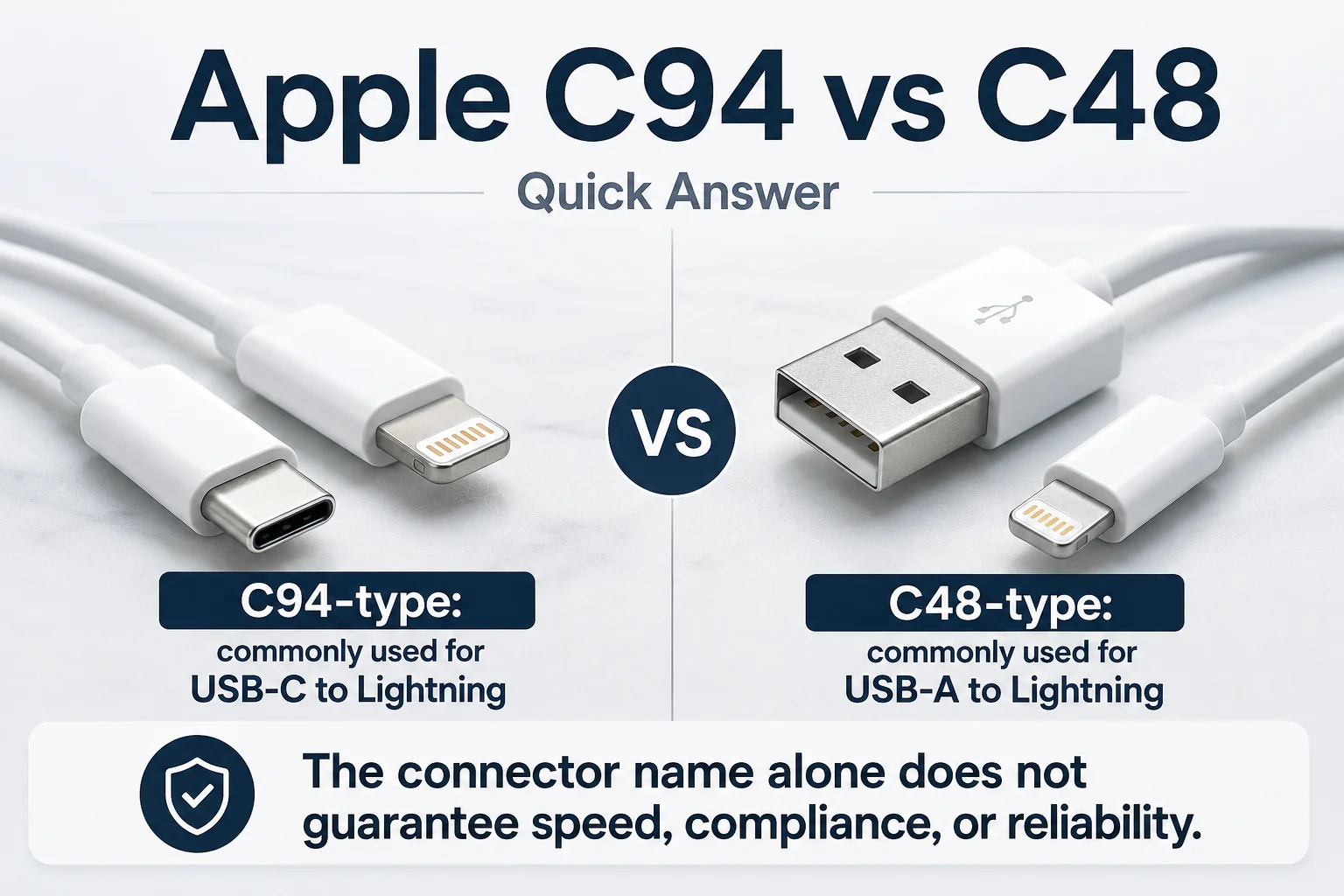
Apple C94 vs C48 usually refers to different Lightning connector solutions used in MFi-related cable designs. C94 is commonly associated with USB-C to Lightning cables designed for USB-C Power Delivery charging setups, while C48 is commonly seen in traditional USB-A to Lightning cable designs1. However, neither connector name alone guarantees charging speed, MFi compliance, or retail reliability. Buyers should verify the complete cable specification, connector source, MFi-related documents, and real charging performance.
Apple publicly confirms that iPhone 14 and earlier models can fast charge through a USB-C to Lightning cable and a compatible USB-C Power Delivery charger2. However, Apple’s consumer-facing pages do not explain internal connector designations such as C94 or C483. In sourcing, we treat these terms as supply-chain references that must be supported by approved materials, BOM records, and testing evidence.
What Is the Quick Answer on Apple C94 vs C48?
Buyers often want a simple answer: “Which one is better?” That question can create problems because a Lightning connector is only one part of the charging system. A cable may look premium, yet still fail to meet the charging promise printed on its retail packaging.
For most USB-C to Lightning fast-charging projects, suppliers commonly use a C94-type MFi Lightning connector solution. C48 is more often associated with traditional USB-A to Lightning cable designs. Still, Apple C94 vs C48 should not be treated as a universal performance ranking. The iPhone model, USB-C PD charger, cable wire specification, connector materials, and production consistency all affect the final result.
We see this misunderstanding often in pre-sales discussions. A buyer may ask for a “C94 cable” but have not yet confirmed whether the retail product will be paired with a 20W USB-C charger, an older USB-A charger, or both. That missing information can turn a straightforward purchase order into an after-sales issue.
Start With the Retail Promise
Before discussing connector terminology, we recommend defining what the product must honestly promise:
- Which iPhone generations will customers use?
- Is the cable USB-C to Lightning or USB-A to Lightning?
- Will the retailer sell a USB-C PD charger with the cable?
- Does the packaging claim “fast charging”?
- What cable length, color, and jacket material are required?
- What return-risk level can the buyer accept?
A USB-C to Lightning cable can support a fast-charge setup only when the connected iPhone and charger also support the relevant charging method. In practical terms, the cable does not “create” fast charging by itself4.
We always advise buyers to approve the complete charging claim, not simply approve a connector photo.
What Are C94 and C48 Lightning Connectors?
The names C94 and C48 are widely used in the Lightning cable supply chain, but they are not consumer-facing product names that Apple explains in public support content. This can make quotations confusing, especially when two suppliers use the same words but quote very different prices.
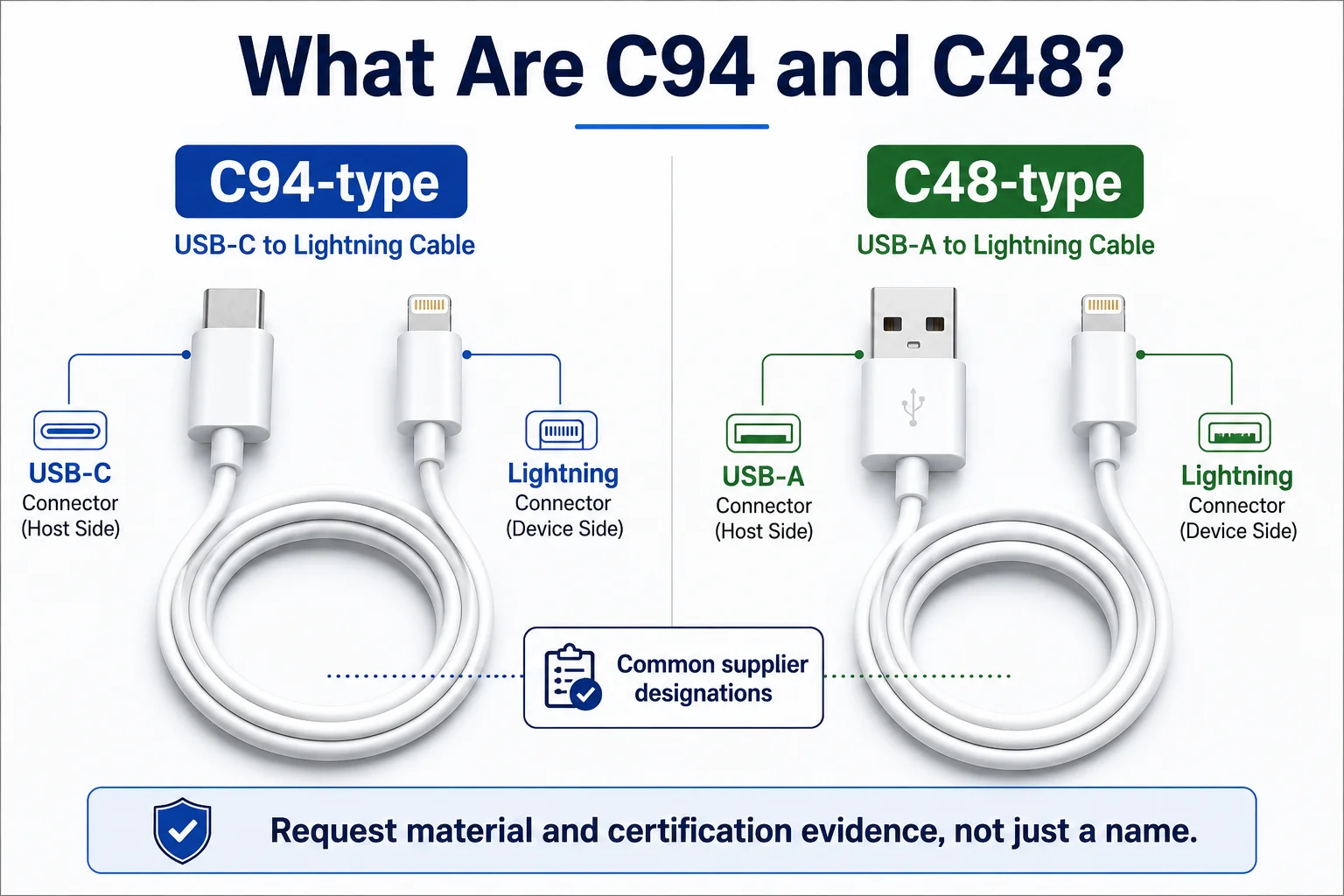
C94 and C48 are commonly used supplier designations for Lightning connector solutions used in different cable generations and interface combinations. C94 is generally linked with USB-C to Lightning cable projects, while C48 is generally linked with older USB-A to Lightning cable projects. Buyers should request material and certification-related evidence instead of relying on the designation alone.
How Connector Type Relates to Cable Design
In our experience, the connector discussion should include both ends of the cable:
| Cable Configuration | Typical Market Position | Buyer Focus |
|---|---|---|
| USB-C to Lightning | Modern iPhone charging, PD charger bundles | Fast-charge claim, PD compatibility, MFi evidence |
| USB-A to Lightning | Legacy chargers, replacement cables, value retail | Broad device compatibility, charging expectations |
| USB-C to USB-C | Newer USB-C iPhones and Android products | PD wattage, e-marker needs, USB-C compliance |
The Lightning connector is only one component. A finished cable also includes:
- Copper conductor size and strand count
- Data wires and shielding
- Connector PCB and internal components
- Strain-relief molding
- Jacket material, such as PVC, TPE, or braided nylon
- USB-C or USB-A plug construction
- Assembly process and quality controls
We have seen buyers compare a low-price cable with a premium cable based only on connector appearance. Later, they discover differences in wire gauge, molding strength, or charging stability. That is why a BOM-level comparison is more useful than a connector-name comparison.
Why Is C94 Used for USB-C to Lightning Fast Charging?
Fast-charge claims are attractive in retail, but they also create a higher burden of proof. If a product says it supports fast charging, the buyer needs confidence that the cable will perform properly with the intended charger and iPhone range.
C94-type connector solutions are commonly used for USB-C to Lightning cables because these cables are designed for USB-C Power Delivery charging ecosystems. However, fast charging depends on the complete setup: a compatible iPhone, a USB-C PD charger, a correctly designed USB-C to Lightning cable, and consistent connector assembly. A C94 designation by itself is not enough proof.
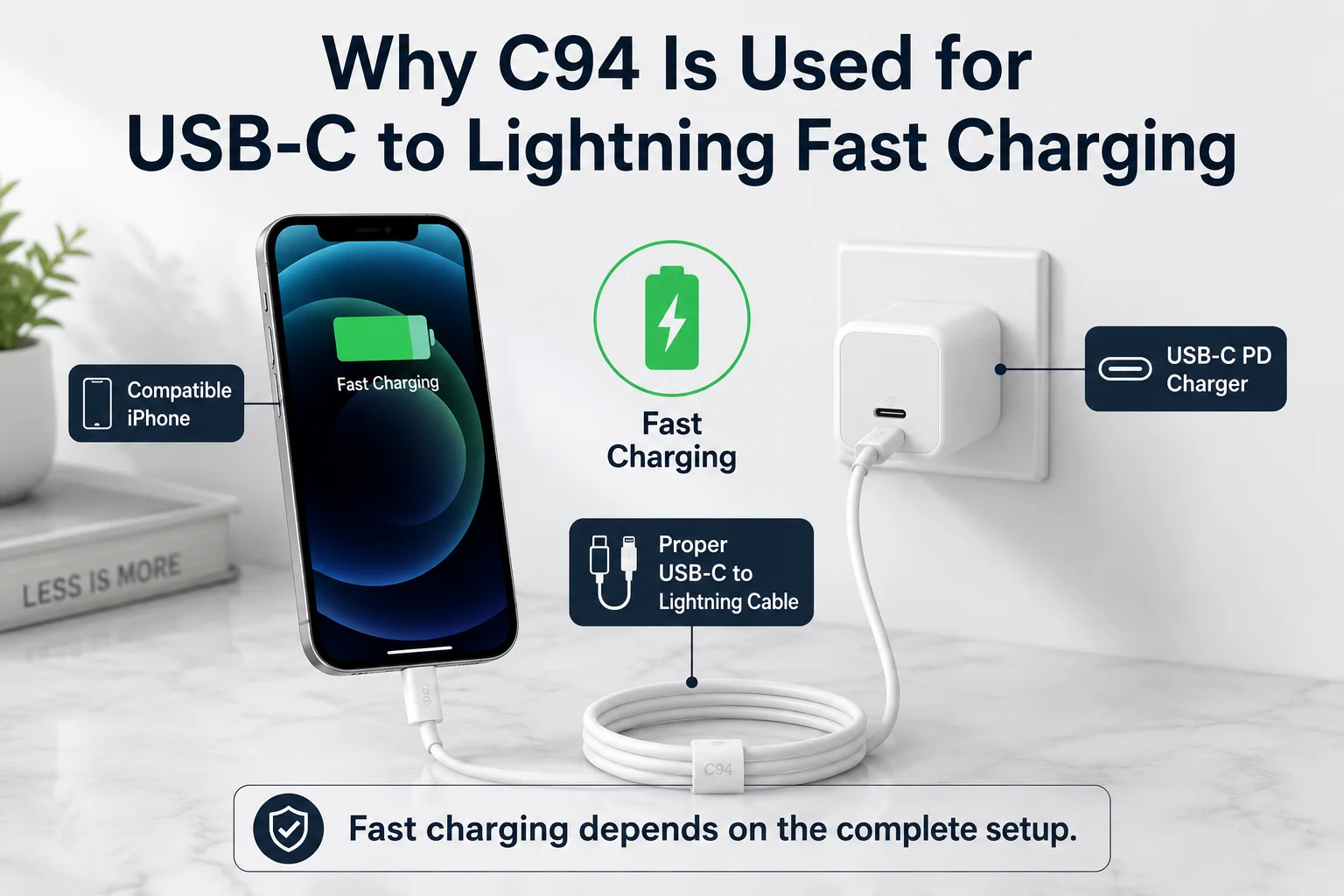
Apple states that compatible iPhones can fast charge with a USB-C to Lightning cable and a USB-C Power Delivery adapter. Buyers can review Apple’s public guidance in its iPhone fast-charging support article. That public statement is useful for product planning. It does not, however, validate every supplier’s C94 cable or every “MFi” claim.
Why the Full System Matters
We recommend reviewing these variables together:
-
Target iPhone models
Older Lightning iPhones and newer USB-C iPhones require different cable strategies. -
Charger protocol and output
A USB-C charger should support the intended PD charging profile. A basic USB-A charger is a different use case. -
Cable construction
Internal conductors, connector assembly, shielding, and resistance influence stability. -
Connector authorization and sourcing
Buyers should ask where the Lightning connector materials come from and whether the supplier can provide appropriate MFi-related documentation. -
Finished-product testing
A sample should be checked with the actual chargers and iPhone models that match the retail claim.
In our Shenzhen factory discussions, a European importer once asked why a cable sample did not meet the expected charging result. The connector was not the only issue. The buyer had tested it with an older low-output charger rather than the USB-C PD charger intended for the retail bundle. Once the full setup was clarified, the product positioning became much more accurate.
Does Apple Still Use C48 Connectors?
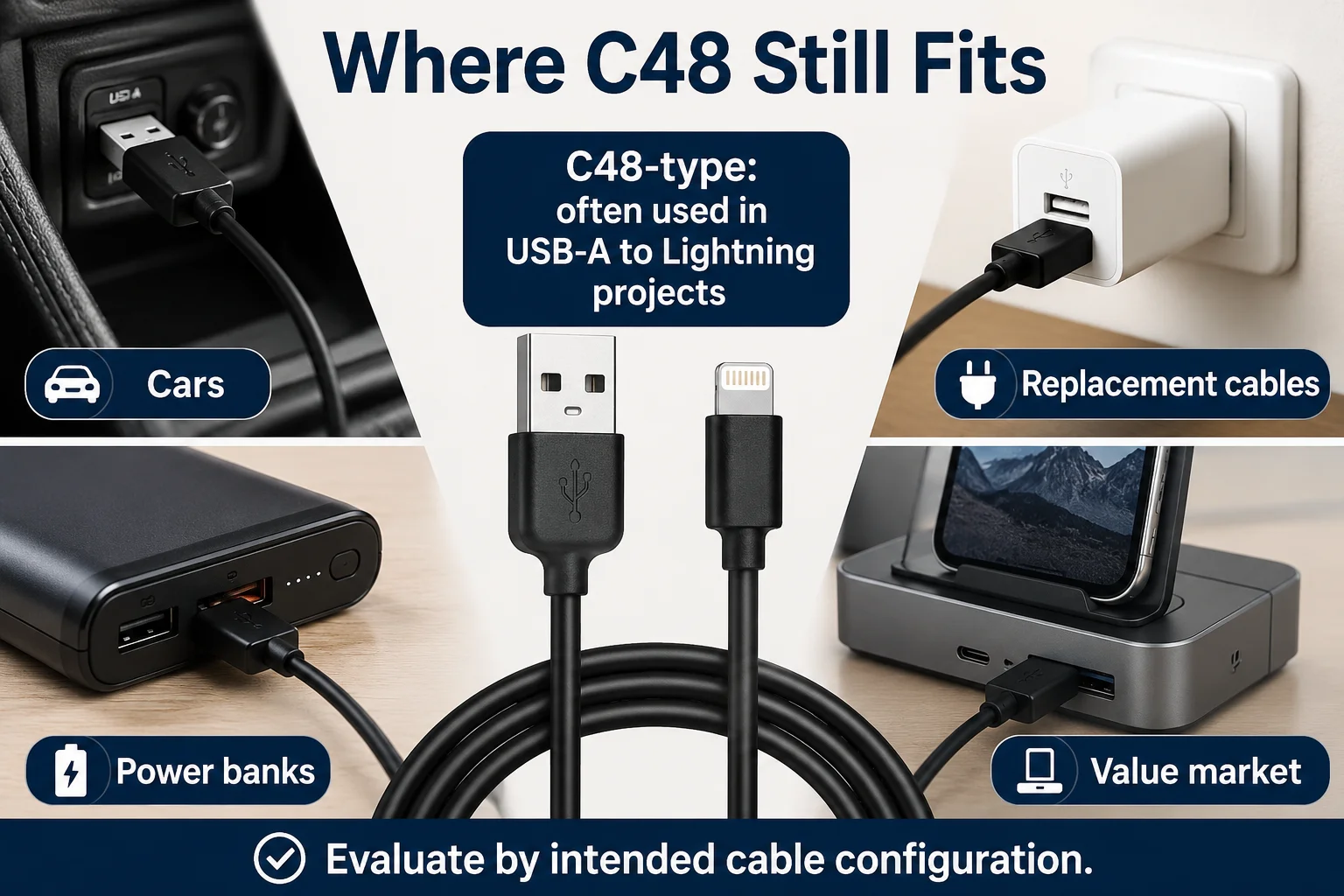
Some buyers assume that C48 is automatically obsolete. That is too simple. Traditional USB-A to Lightning cables still serve a large installed base of chargers, cars, power banks, docks, and replacement-cable customers5.
C48 connector solutions can still appear in traditional USB-A to Lightning cable projects, especially for replacement and value-market products. However, buyers sourcing new iPhone fast charging cable ranges should confirm whether their product promise requires USB-C to Lightning and USB-C PD compatibility instead. C48 should be evaluated by the intended cable configuration, not dismissed only because newer charging trends exist.
Where Traditional Lightning Cables Still Sell
USB-A to Lightning products remain relevant in several channels:
- Accessory replacement sections in supermarkets and convenience retailers
- Automotive charging kits
- Older power bank bundles
- Hotel, travel, and promotional accessory programs
- Discount retail and wholesale markets
- Customers using existing USB-A wall chargers
The opportunity is real, but the packaging must be accurate. We would not recommend printing a broad “PD fast charging” claim on a USB-A to Lightning cable simply because it uses a connector described as C48. The cable, charger, and supported charging method must match the statement.
Ask the Supplier Better Questions
Instead of asking only, “Is this C48?”, buyers should ask:
- Is this USB-A to Lightning or USB-C to Lightning?
- What iPhone models and charger types was the sample evaluated with?
- What charging claim can the supplier support with documentation?
- What are the conductor and jacket specifications?
- Is the quoted connector material consistent across production batches?
- What inspection records are available before shipment?
These questions reduce the chance that a buyer receives a cable that is technically different from the approved sample.
Is a C94 Connector More Expensive?
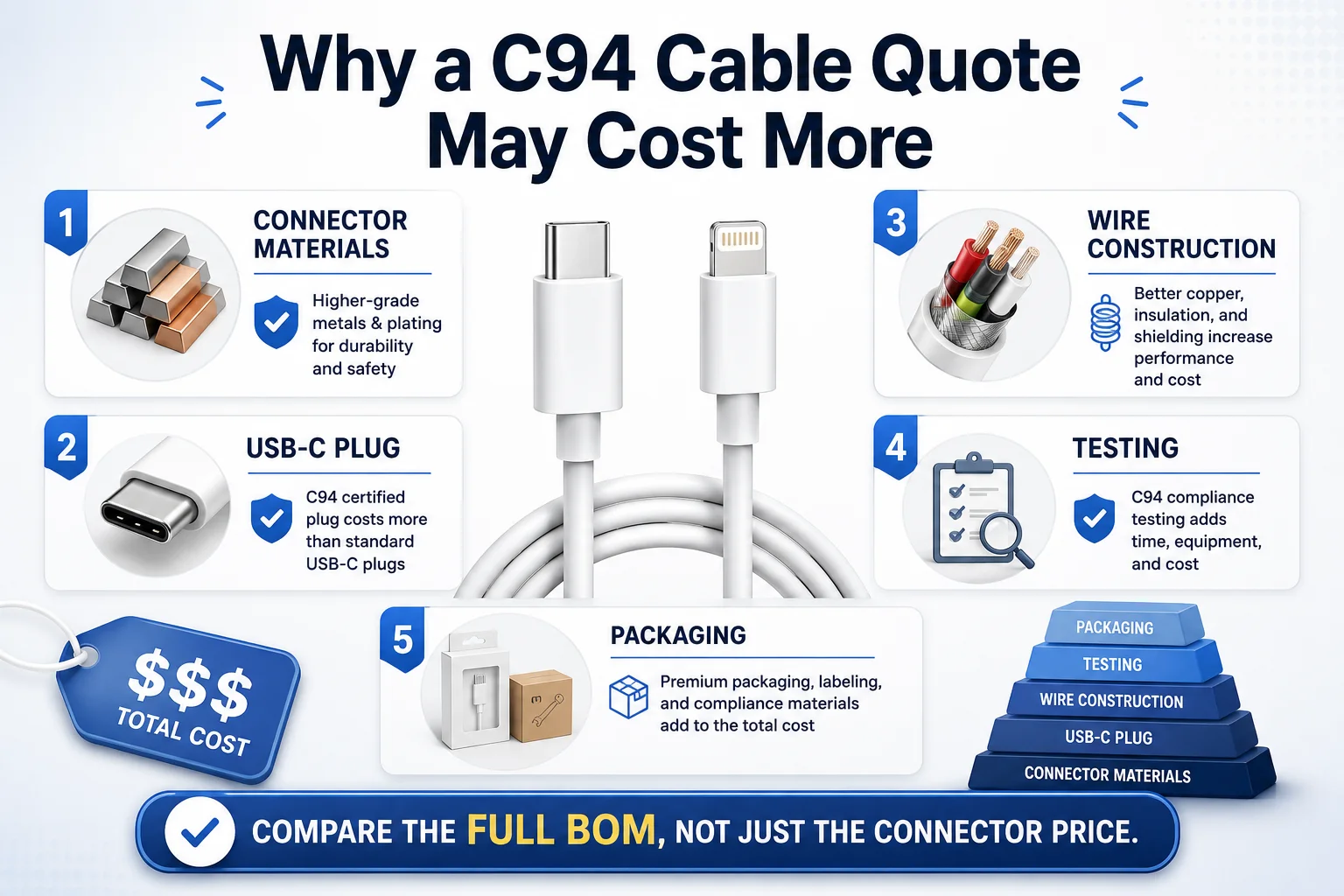
Price differences can be frustrating when cable samples look nearly identical. However, a low quote may exclude important elements such as authorized materials, stronger wire construction, better molding, traceable components, or more complete quality controls.
A C94-based USB-C to Lightning cable may cost more than a basic traditional Lightning cable6 because its price can include different connector materials, USB-C plug construction, wire design, testing, packaging, and certification-related sourcing requirements. However, price varies by cable length, MOQ, jacket material, order volume, and supplier documentation. Buyers should compare the full BOM, not just the connector price.
What Usually Changes the Cable Cost?
| Cost Factor | Lower-Cost Approach | Higher-Value Approach |
|---|---|---|
| Cable conductor | Thinner or simplified construction | Specified copper construction for intended use |
| Jacket | Basic PVC | TPE, braided nylon, or upgraded finish |
| Connector molding | Standard strain relief | Reinforced molding and bend-focused design |
| Documentation | General marketing claims | Traceable material and quality documentation |
| Packaging | Plain bulk packing | Retail packaging, barcodes, manuals, localization |
| Order quantity | Small MOQ | Larger volume with more efficient production |
We advise buyers not to make a decision from the ex-factory unit price alone. A cable that saves a few cents but produces more returns can hurt the actual margin7. This is especially important for European and U.S. retailers, where customer reviews and return handling costs can quickly outweigh the original saving.
How Can Buyers Identify Fake or Non-Compliant C94 Cables?
“MFi” is often used as a sales word, but responsible buyers should treat it as a verification process. A logo on packaging, a connector photo, or a supplier message is not enough on its own8.
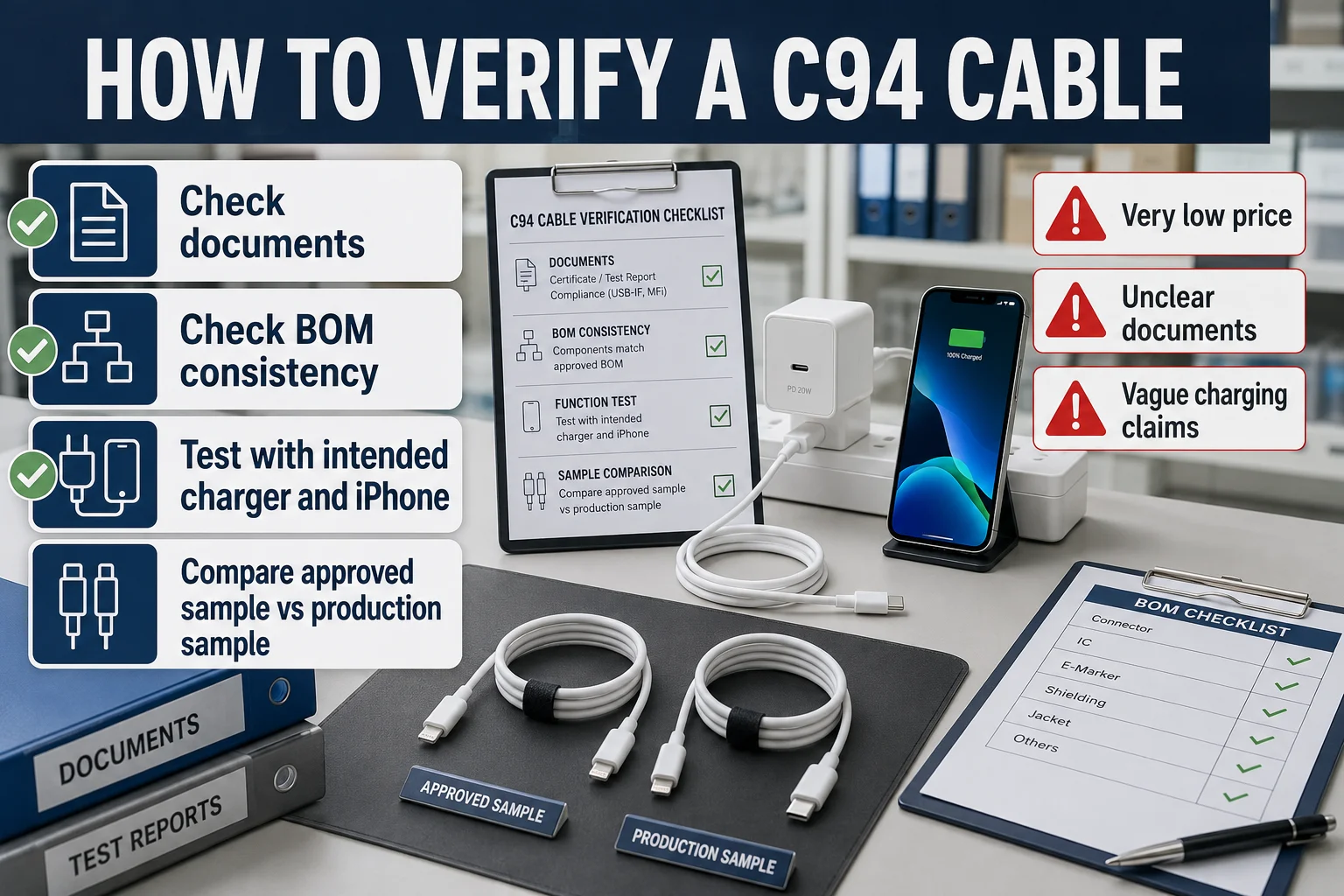
To identify questionable C94 cables, buyers should verify certification-related documents, connector sourcing records, quoted BOM consistency, packaging claims, and sample performance with the intended USB-C PD chargers and iPhone models. Buyers should also compare production samples with approved samples. A low price, unclear documents, or vague charging claims are warning signs that deserve further investigation.
A Practical Verification Workflow
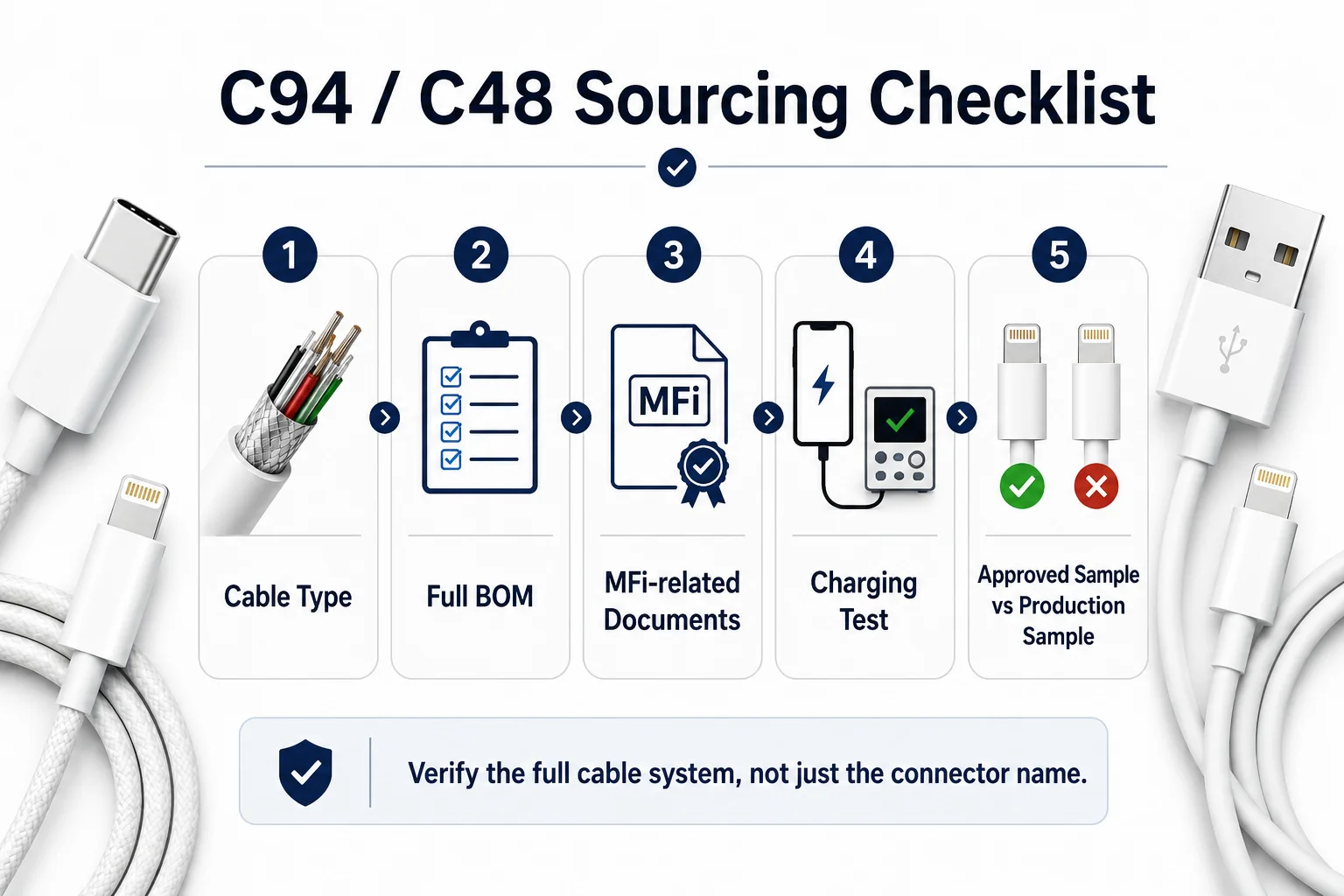
We recommend this process before mass production:
-
Request supplier information
Ask for company details, relevant authorization evidence, product specifications, and the exact cable configuration. -
Review the BOM
Confirm connector solution, conductor structure, jacket material, cable length, USB-C plug type, and packaging. -
Approve labeled samples
Mark the approved sample with a version number or signed specification sheet. -
Test the complete charging setup
Use the target iPhone models and charger types. Check connection stability, charging behavior, and repeated insertion. -
Check production consistency
Request pre-shipment inspection photos, batch records, and carton markings where appropriate. -
Review packaging language
Avoid claims that cannot be supported by the actual product and test scope.
A U.S. wholesale buyer once told us that a supplier’s “MFi cable” had caused store complaints. The issue was not just charging. Packaging had made a broad compatibility promise, while the supplier could not clearly show whether quoted materials matched the original sample. That is a classic sourcing risk.
How Do C94, C48, and Non-MFi Lightning Connectors Compare?
A comparison table can help buying teams make a first decision. Still, every supplier quotation should be verified because market terminology and actual material choices may differ.
In an Apple C94 vs C48 comparison, C94-type solutions are commonly selected for USB-C to Lightning fast-charging projects, while C48-type solutions are more often used for USB-A to Lightning projects. Non-MFi options may offer lower upfront prices, but they can present higher compatibility, retail, and after-sales risks9. Buyers should validate every claim through supplier documents and sample checks.
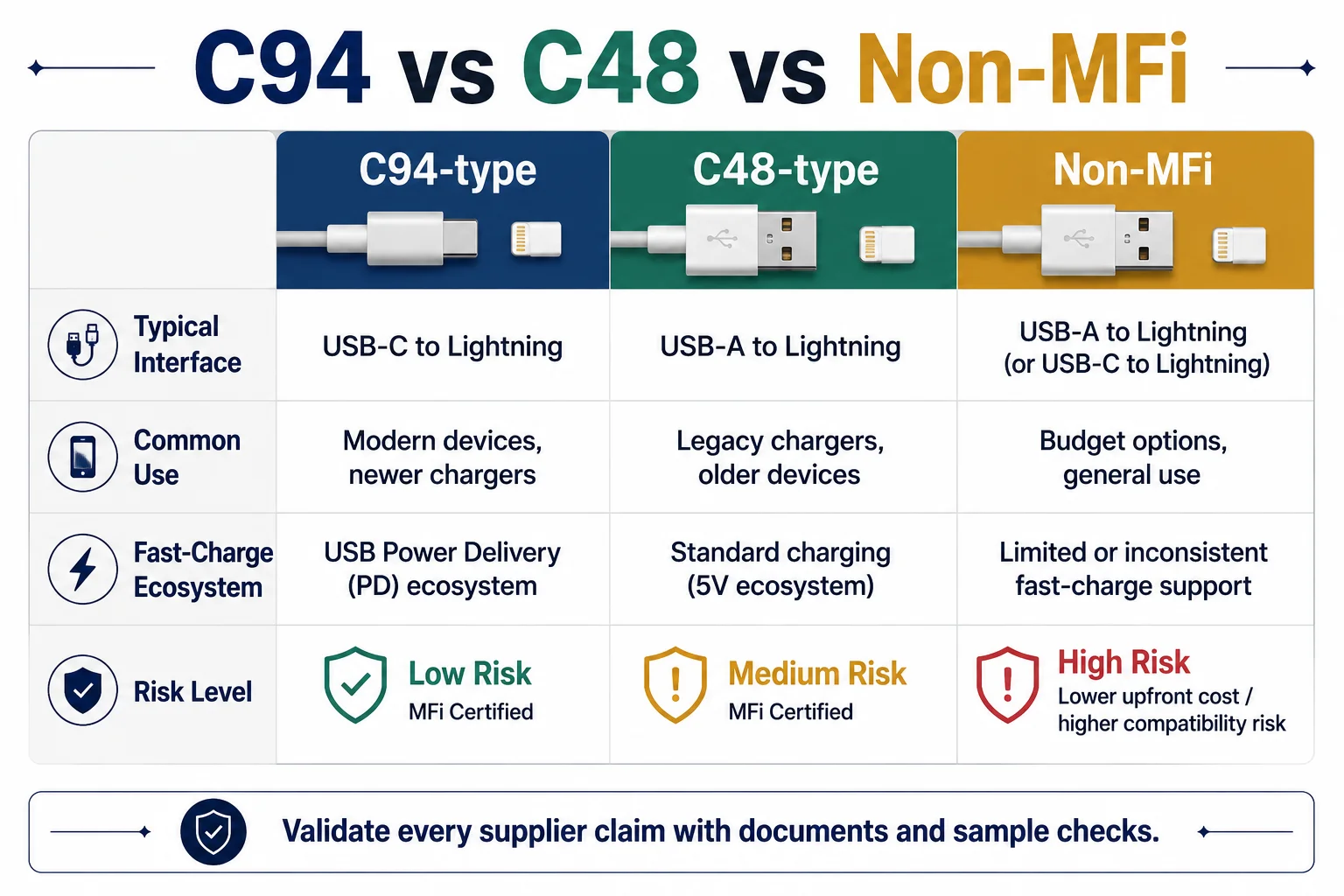
| Feature | C94-Type Solution | C48-Type Solution | Non-MFi / Unverified Solution |
|---|---|---|---|
| Typical cable setup | USB-C to Lightning | USB-A to Lightning | Varies |
| Typical use | PD charging ecosystem | Legacy and replacement charging | Low-price or unclear projects |
| Fast-charge potential | Depends on full USB-C PD setup | Depends on cable and charger setup | Often unclear and must be verified |
| MFi-related sourcing | Should be documented | Should be documented where claimed | May be absent or unverifiable |
| Compatibility confidence | Depends on authentic materials and production consistency | Depends on authentic materials and production consistency | Higher risk of inconsistent behavior |
| Cost position | Often higher | Often lower to mid-range | Often lowest initial quote |
| Best for | Modern retail USB-C charging programs | USB-A replacement cable programs | Not recommended for risk-sensitive retail |
| Main buyer risk | Overstating charging performance | Using old positioning for new demand | Returns, claims, and compliance exposure |
The table is not a certification decision. It is a buying framework. We always encourage importers to ask for documents and evaluate samples before confirming any product claim.
Will C94 Lightning Cables Be Phased Out?
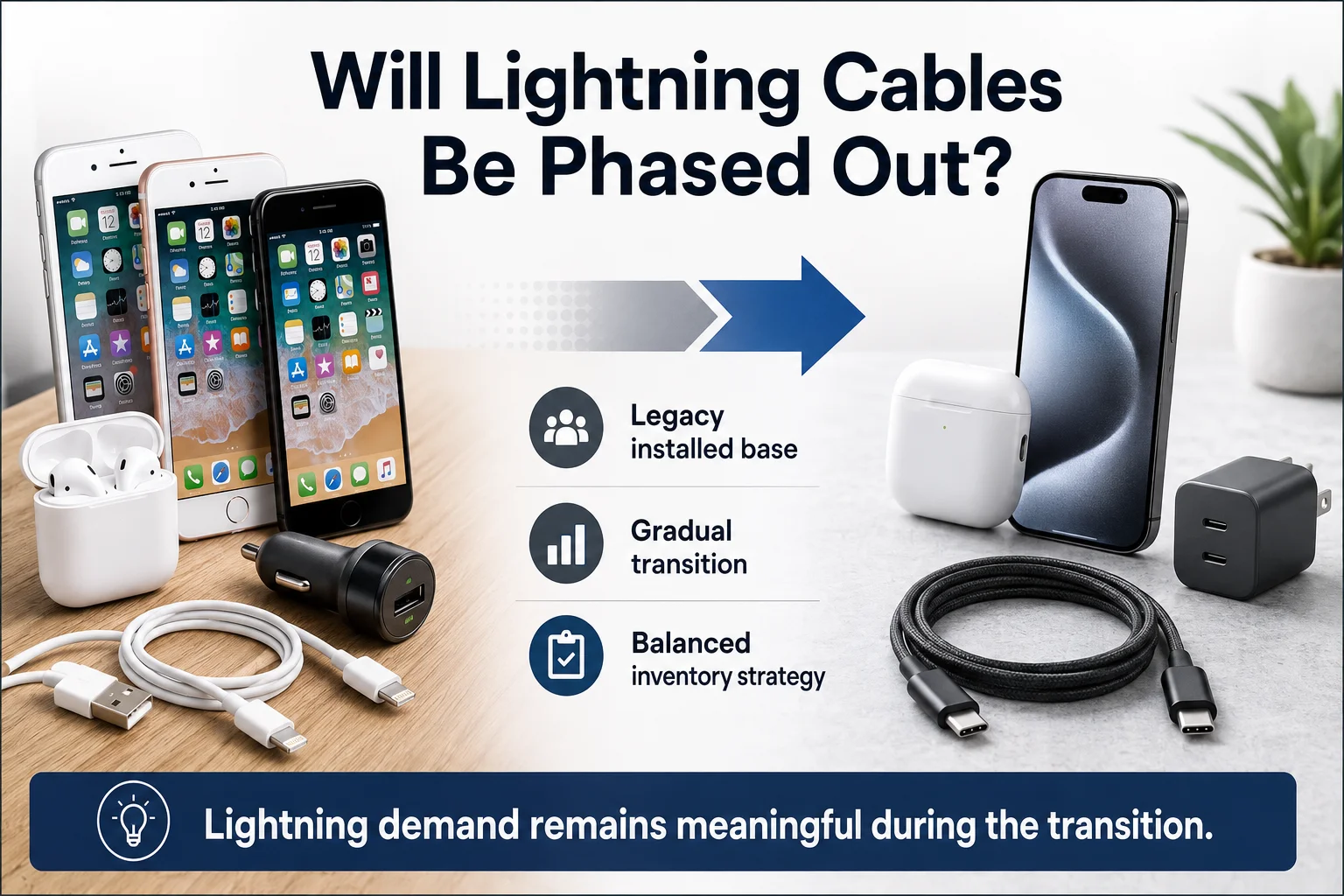
USB-C adoption in newer iPhone generations has changed the accessory market10, but it has not erased Lightning demand overnight. Millions of Lightning devices remain in homes, offices, stores, cars, and travel bags11.
C94 Lightning cables will likely face gradual demand changes as USB-C iPhones become more common, but Lightning replacement demand remains meaningful for older iPhones, iPads, AirPods cases, and existing accessories12. Buyers should manage Lightning inventory carefully rather than assume immediate disappearance. A balanced USB-C and Lightning cable range can reduce stock risk during the transition.
Build a Transition Portfolio
For many retailers, the best strategy is not “all Lightning” or “all USB-C.” We suggest a mixed range:
- USB-C to USB-C cables for newer USB-C devices
- USB-C to Lightning cables for Lightning iPhone fast-charging customers
- USB-A to Lightning cables for legacy replacement demand
- Multi-port chargers that support USB-C PD and USB-A use cases
- Clearly labeled cable lengths and charging capabilities
Regional demand also matters. Some importers still have strong Lightning turnover because their customer base uses older iPhones or buys replacement accessories instead of new devices. Other channels move quickly toward USB-C.
We encourage buyers to use recent sell-through data, not assumptions. A smaller initial MOQ with repeat ordering can be safer than overcommitting to a large Lightning inventory position.
How Should Buyers Source MFi C94 Lightning Cables?
Sourcing a reliable MFi C94 Lightning cable requires more than finding a factory that can print a logo or offer a connector name. The buyer needs a documented product definition, realistic performance claims, and a factory process that supports consistent production.
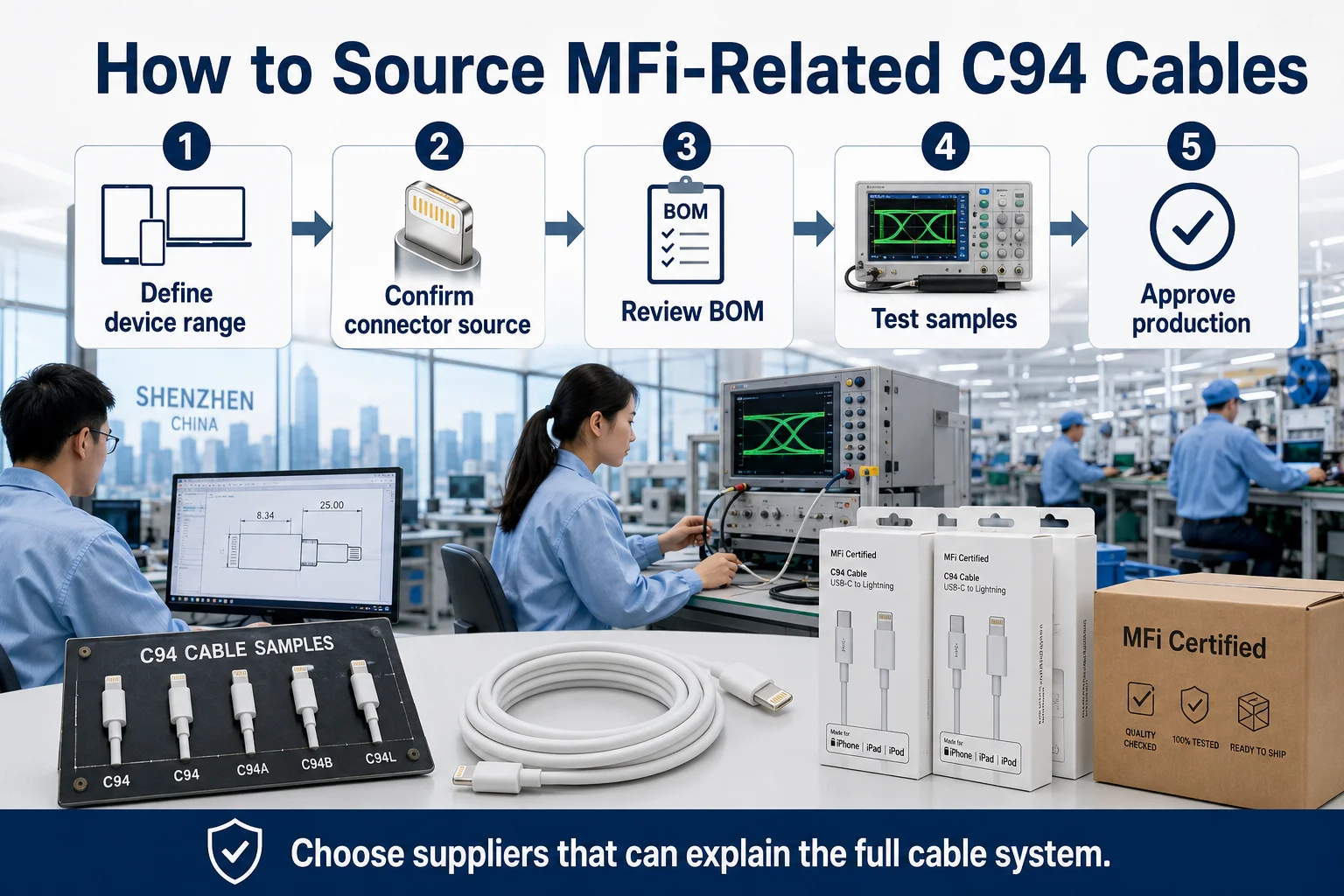
To source MFi C94 Lightning cables, buyers should confirm the target device range, USB-C PD charger setup, MFi-related authorization evidence, connector source, cable BOM, durability requirements, sample-test scope, packaging language, MOQ, and delivery schedule. The safest choice is a supplier that can explain the full cable system and provide documentation for the quoted production version.
Our Pre-Production Checklist
At Kingfuji Tech, we normally help buyers work through these points before production:
- Product positioning: Value replacement cable, premium braided cable, charger bundle, or retail fast-charge line
- Cable specification: Length, color, jacket, conductor construction, USB-C plug, and strain-relief design
- Charging claim: Match the claim to the intended iPhone and USB-C PD charger setup
- Documentation: Request relevant MFi-related and material records from the supplier
- Sample approval: Confirm samples before bulk production
- Durability expectations: Define bend, pull, and insertion expectations in the product specification
- Packaging: Confirm artwork, barcodes, language requirements, and compliant claims
- Commercial terms: Review MOQ, lead time, payment terms, carton packing, and inspection requirements
Our factory has worked with cable importers and retailers for 15 years, mainly serving European and U.S. markets. We know that buyers need stable quality, practical MOQs, competitive pricing, and clear communication. For a C94 project, we recommend discussing the charging system first, then choosing the connector and cable construction that fit the intended market.
Frequently Asked Questions
Is C94 always faster than C48?
No. C94 is commonly associated with USB-C to Lightning cable designs used in USB-C PD charging setups, while C48 is commonly associated with USB-A to Lightning designs. However, charging speed depends on the iPhone, charger, cable construction, protocol support, and finished-product quality.
Does a cable labeled MFi guarantee it is compliant?
No. A label alone is not sufficient proof. Buyers should request certification-related documentation, confirm the source of quoted materials, review the BOM, and test approved samples. They should also verify that mass-production materials match the approved cable specification.
Can USB-A to Lightning cables fast charge an iPhone?
It depends on the charger, cable, and iPhone model. USB-A to Lightning cables serve many replacement and legacy charging applications, but buyers should not make USB-C PD fast-charge claims unless the full setup supports that claim and it has been verified.
What should I ask an MFi cable manufacturer before ordering?
Ask about connector sourcing, MFi-related evidence, cable conductor construction, jacket material, sample testing, charging claims, MOQ, lead time, packaging, inspection process, and after-sales policy. You should also ask whether the production BOM will match the approved sample.
Are Lightning cables still worth stocking?
Yes, for many markets. Older iPhones, AirPods charging cases, existing chargers, cars, and replacement-cable buyers still create demand. We suggest balancing Lightning inventory with USB-C products instead of making an abrupt switch without checking your own sell-through data.
Conclusion
Apple C94 vs C48 is not simply a question of which connector is faster or more expensive. C94-type solutions often fit USB-C to Lightning fast-charging projects, while C48-type solutions often fit traditional USB-A to Lightning programs. Still, the right sourcing decision depends on the complete charging setup, MFi-related verification, cable BOM, construction quality, retail claim, MOQ, and return-risk target. If you are sourcing reliable Lightning cables for Europe or the U.S., contact Kingfuji Tech to review your cable specification and wholesale project requirements.
"Lightning (connector)", https://en.wikipedia.org/wiki/Lightning_(connector). Industry documentation commonly uses C94 and C48 as supply-chain labels for certain Lightning cable connector assemblies, including assemblies sold with USB-C and USB-A host connectors, respectively. Evidence role: definition; source type: other. Supports: Documented industry usage of C94 and C48 labels in descriptions of Lightning cable assemblies and their host-side connector configurations.. Scope note: These labels are not established consumer-facing Apple product categories, and usage in supplier listings alone does not verify component authenticity, certification status, or charging performance. ↩
"Fast charge your iPhone", https://support.apple.com/en-us/102574. Apple states that compatible iPhone models can fast charge when connected to a USB-C Power Delivery power adapter using a USB-C to Lightning cable. Evidence role: general_support; source type: institution. Supports: Apple’s stated requirements for fast charging compatible iPhone models with a USB-C to Lightning cable and a USB-C Power Delivery adapter.. ↩
"iPhone SE (3. Generation) - Ladezubehör", https://www.apple.com/at/shop/iphone/accessories/charging-essentials?f=iphonese3&fh=459d%2Bc23a42. Apple’s publicly searchable consumer-support materials describe Lightning accessories and charging requirements but do not use C94 or C48 as consumer-facing connector names. Evidence role: general_support; source type: institution. Supports: The absence of C94 and C48 terminology from Apple’s publicly searchable consumer-support documentation, while such documentation describes Lightning and charging accessories in general.. Scope note: This supports a statement about publicly searchable consumer documentation, not a claim that Apple has never used these designations in nonpublic or program-specific materials. ↩
"Fast charge your iPhone", https://support.apple.com/en-us/102574. Apple’s charging guidance specifies both a compatible iPhone and a USB-C Power Delivery power adapter in addition to the appropriate cable, indicating that fast charging is a system-level capability. Evidence role: mechanism; source type: institution. Supports: Fast charging depends on compatibility among the receiving device, the power adapter, and the cable rather than on the cable alone.. Scope note: This does not establish the performance of any particular third-party cable or charger combination. ↩
"Mobile Chargers Market Size And Share Report, 2024-2030", https://www.grandviewresearch.com/industry-analysis/mobile-charger-market-report. Research and policy discussion of the USB-C transition recognizes that legacy USB-A chargers and accessories remain in circulation, supporting continued replacement demand for compatible cables. Evidence role: general_support; source type: research. Supports: Evidence that legacy USB-A charging infrastructure and accessories remain in use during the transition to USB-C.. Scope note: Installed-base evidence does not quantify demand for USB-A-to-Lightning cables in a particular retailer, country, or sales channel. ↩
"USB-C Power Delivery: Fast Charging Up to 240W", https://www.belkin.com/products/product-resources/power-delivery/. Technical analyses of USB-C cable design show that connector electronics, conductor specifications, protocol support, and validation requirements can add material and testing complexity relative to simpler cable designs. Evidence role: general_support; source type: research. Supports: That USB-C cable construction, protocol support, compliance testing, and component specifications can affect cable manufacturing cost.. Scope note: This contextual evidence does not prove that every C94-labelled cable costs more than every C48-labelled or USB-A-to-Lightning cable. ↩
"Reverse logistics return policies and their possible impacts on customer ...", https://www.academia.edu/66107364/Reverse_logistics_return_policies_and_their_possible_impacts_on_customer_loyalty_in_e_retailing_environment. Research on reverse logistics finds that customer returns create handling, transportation, inspection, and disposition costs that can materially affect retailer profitability. Evidence role: mechanism; source type: research. Supports: Product returns impose processing, shipping, disposition, and customer-service costs that can reduce retail margins.. Scope note: The effect on margin depends on return rate, product value, resale options, and each retailer’s operating model. ↩
"Guidelines for Using Apple Trademarks and Copyrights", https://www.apple.com/legal/intellectual-property/guidelinesfor3rdparties.html. Apple’s MFi program materials describe licensed accessory development and controlled use of program-related marks, supporting the need to verify claims beyond packaging appearance or supplier representations. Evidence role: general_support; source type: institution. Supports: That MFi branding and Apple accessory marks are subject to program and licensing controls, so independent documentation is relevant to verification.. Scope note: Program documentation alone cannot authenticate a specific product unless the relevant supplier, authorization, and production records are independently checked. ↩
"If an 'Accessory may not be supported alert' appears on ...", https://support.apple.com/en-us/101565. Apple warns that counterfeit or uncertified Lightning accessories may fail to charge or sync reliably, may trigger compatibility messages, and can present safety concerns. Evidence role: general_support; source type: institution. Supports: Apple’s warnings that uncertified Lightning accessories may cause compatibility or charging problems.. Scope note: Such warnings address the risks of uncertified accessories generally and do not establish that every non-MFi product will fail or that every MFi-labelled product is genuine. ↩
"Radio Equipment Directive (2022)", https://en.wikipedia.org/wiki/Radio_Equipment_Directive_(2022). Apple’s iPhone 15 technical specifications identify USB-C as the connector, and European Union common-charger rules require USB-C receptacles for covered mobile devices placed on the EU market from December 2024. Evidence role: historical_context; source type: institution. Supports: That iPhone 15 models use USB-C and that the European Union’s common-charger rules require USB-C for covered mobile devices placed on the market.. Scope note: These facts demonstrate a technology and regulatory transition but do not quantify its effect on accessory sales in any particular market. ↩
"iPhone Statistics 2026: 235M Sold, 1.46B Active & Market ...", https://www.skillademia.com/statistics/iphone-statistics/. Industry installed-base estimates indicate that a substantial number of active Apple devices were sold during Lightning-based product generations, making a large installed base plausible. Evidence role: statistic; source type: research. Supports: A credible estimate of the active installed base of iPhones and other Apple devices from Lightning-era product generations.. Scope note: An installed-base estimate does not identify how many devices remain active, require replacement cables, or are located in a particular sales channel. ↩
"iPhone 14 - Tech Specs", https://support.apple.com/en-us/111850. Apple technical specifications document Lightning connectors on iPhone 14 models and on selected AirPods charging cases, providing a continuing device-compatibility basis for Lightning replacement accessories. Evidence role: general_support; source type: institution. Supports: That multiple Apple products sold in recent years, including iPhone 14 models and some AirPods charging cases, use Lightning connectors.. Scope note: Device compatibility does not by itself measure current sales volume or prove that Lightning demand is meaningful in every region or retail channel. ↩