Bluetooth LE Audio is becoming a common feature request in TWS earbud sourcing, but many buyers still struggle to turn the term into a clear retail benefit. A codec logo can look impressive on packaging, yet poor compatibility claims can create returns, reviews, and customer-service problems. We help buyers assess where LE Audio truly adds value.
Bluetooth LE Audio is a newer wireless-audio architecture that uses the LC3 codec and can support better audio efficiency, lower-bitrate transmission, multi-stream audio, and Auracast broadcast audio.%%%FOOTNOTE_REF1%%% However, [its real benefits depend on end-to-end compatibility between the earbuds, phone or source device, operating system, firmware, and product implementation.](https://en.wikipedia.org/wiki/LC3(codec))2 For 2026 TWS buyers, it is best treated as a verified value-add rather than an automatic upgrade.
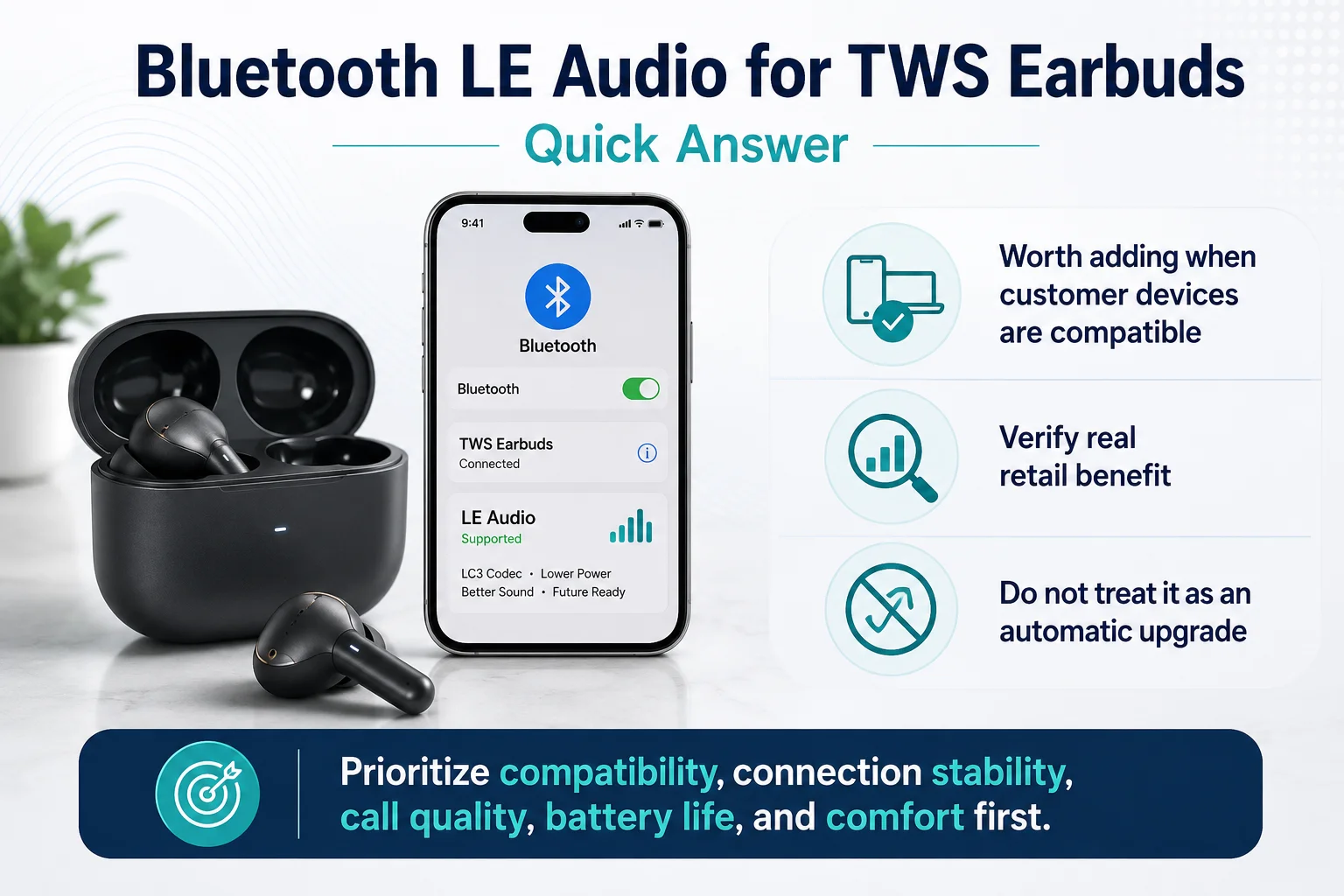
From our work with European and North American retail buyers, we see the same question repeatedly: “Will LC3 help this model sell, or will it only complicate the product listing?” The right answer depends less on a single specification and more on the customer devices, sales channel, price point, and support promise behind the product.
Quick Answer: Is Bluetooth LE Audio Worth Buying for TWS Earbuds?
Bluetooth LE Audio can be a useful TWS earbud feature, but buyers often face a simple risk: they may pay for a technical feature that their customers cannot use. That can lead to confusing product claims and disappointment after purchase.
Bluetooth LE Audio is worth adding to TWS earbuds when the intended customer base has compatible smartphones and when the product has a clear, tested consumer benefit. For mainstream wholesale Bluetooth earbuds, buyers should prioritize stable connection, call quality, battery life, comfort, and backward compatibility before making LC3 support a mandatory requirement.
Start With the Sellable Benefit
I always recommend that buyers start with the retail claim, not the codec name. Consumers rarely search for a codec unless they are technology enthusiasts. They do search for practical benefits, such as:
- Better sound at an efficient bitrate
- Stable left and right earbud connection
- Battery-saving wireless technology
- Future-ready compatibility
- Audio sharing at public venues
- Smooth video and call performance
Bluetooth LE Audio may support some of these benefits, but the word “may” matters. An LC3 codec in an earbud does not mean every phone will transmit LC3 audio. Auracast support is also not automatic just because a product supports LE Audio.
For chain-store buyers, I would position LE Audio in one of three ways:
| Product Position | Recommended LE Audio Approach |
|---|---|
| Entry-level TWS earbuds | Treat it as a conditional bonus; focus on reliable basics |
| Mid-range retail earbuds | Use it as a future-ready feature after compatibility checks |
| Premium or tech-focused earbuds | Build a clear LC3/Auracast story with tested device guidance |
This approach protects the product message. It also prevents packaging from promising “better sound on every phone,” which is not a safe claim.
What Is Bluetooth LE Audio?
Traditional Bluetooth audio has served the TWS category for years, but buyers now need to plan for newer device ecosystems. Bluetooth LE Audio introduces a different audio architecture that can bring new capabilities to compatible earbuds and source devices.
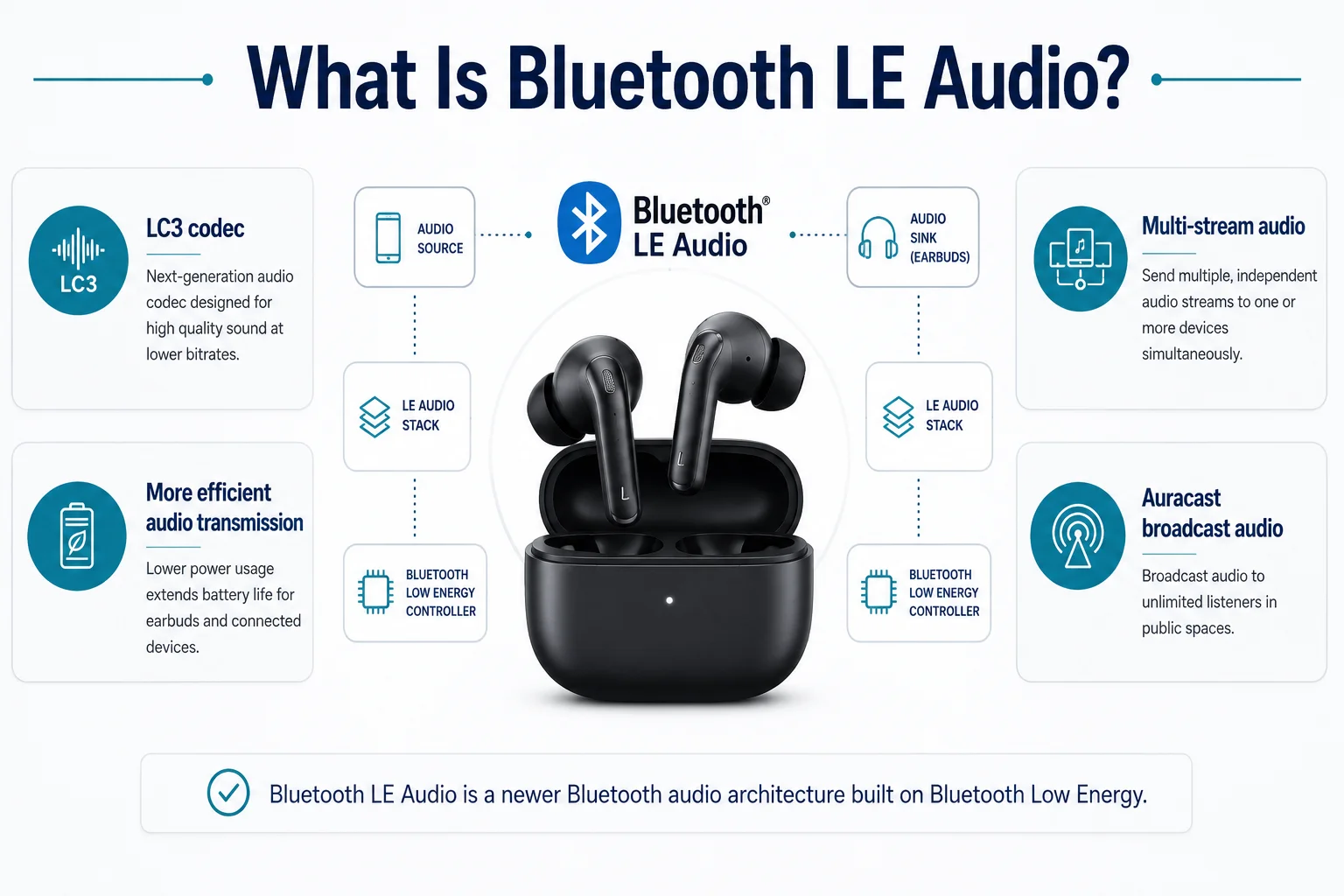
Bluetooth LE Audio is a Bluetooth audio standard built on Bluetooth Low Energy technology. It uses the LC3 codec as its mandatory baseline codec3 and enables features such as more efficient audio transmission, multi-stream audio, hearing-accessibility improvements, and Auracast broadcast audio.
Why It Matters Beyond Earbuds
Bluetooth Classic Audio has historically powered many wireless headphones and TWS earbuds. It commonly relies on the SBC codec as a baseline, while brands may add AAC, aptX, LDAC, or other codecs depending on licensing and platform support.
Bluetooth LE Audio does not simply mean “Bluetooth 5.2 earbuds” or “Bluetooth 5.3 earbuds.” A Bluetooth version number alone does not confirm full LE Audio capability.4 The product chipset, firmware, source device, operating system, and enabled profiles all matter.
For buyers, Bluetooth LE Audio is important because it can reach beyond personal listening. The wider ecosystem may include:
- Smartphones and tablets
- Smart TVs and streaming devices
- PCs and gaming devices
- Hearing aids and assistive-listening products
- Airport, museum, gym, and classroom audio systems
- Public TV audio and multilingual venue broadcasts
I see this as a long-term platform shift, not a reason to replace every existing TWS model immediately. In 2026, many consumers will still use mixed device ecosystems. A good LE Audio TWS earbud should therefore retain dependable backward compatibility with conventional Bluetooth audio use cases.
Our commercial rule is simple: future-ready features should not make today’s basic user experience worse.
What Is the LC3 Codec?
Many TWS listings now highlight the LC3 codec, but the feature is easy to overstate. Buyers may assume LC3 automatically creates a premium audio experience. In reality, the source device must also support the correct LE Audio pathway.
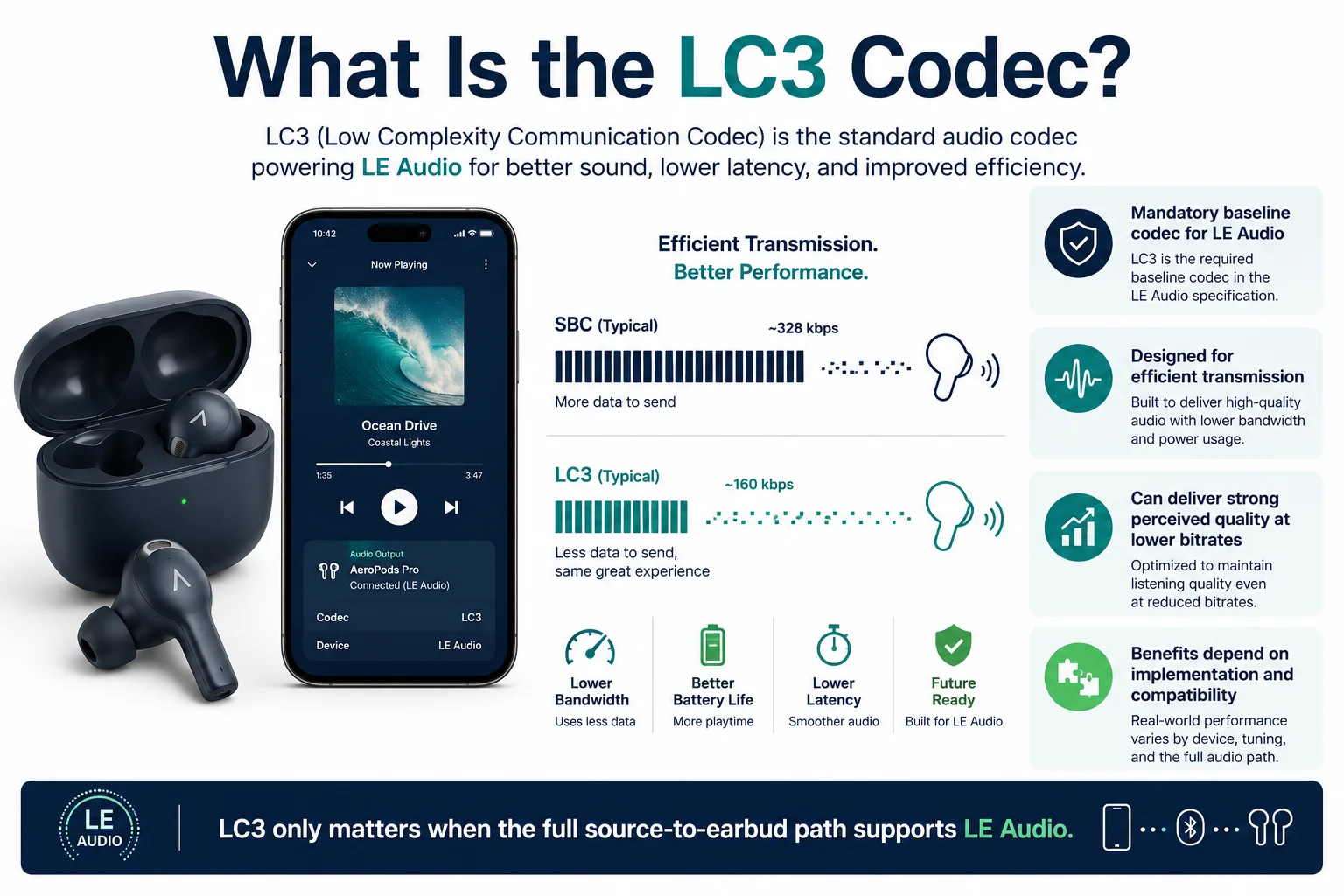
The LC3 codec, or Low Complexity Communication Codec, is the standard audio codec used by Bluetooth LE Audio. It is designed to provide efficient audio transmission and can deliver comparable or improved perceived audio quality at lower bitrates than older baseline Bluetooth audio approaches5, depending on implementation and compatibility.
What LC3 Can Mean for Product Design
LC3 is valuable because wireless earbuds operate under tight physical limits. Every decision affects battery capacity, antenna performance, audio tuning, microphone quality, cost, and charging-case size.
When the whole connection supports LE Audio and LC3, the technology can help brands pursue:
- Efficient transmission: Lower bitrate requirements may reduce data demand.
- Battery optimization: Efficient wireless operation can support battery-life goals.
- Product flexibility: Brands may have more room to balance sound, power, and compact design.
- Audio consistency: The codec is designed for modern LE Audio use cases.
- New feature paths: LC3 supports the wider LE Audio ecosystem, including broadcast audio.
However, I would not put “LC3 delivers superior audio quality” on packaging without controlled, model-specific validation. Sound quality still depends on the driver, acoustic chamber, DSP tuning, ear tip seal, volume level, source material, and the phone’s actual connection mode.
A well-tuned SBC or AAC TWS earbud can still provide a pleasant consumer experience. Conversely, an LC3-enabled product with weak tuning, unstable firmware, or poor microphones will not become a strong retail item because of the codec alone.
LC3 vs SBC: What Is the Difference?
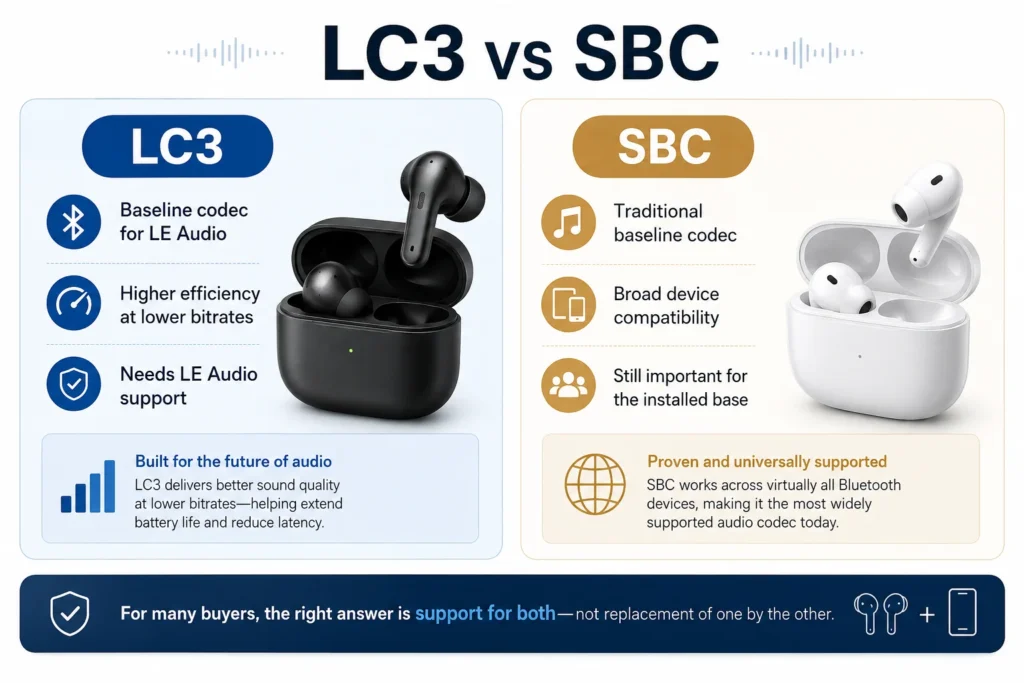
TWS buyers need a clear comparison between LC3 and SBC because SBC remains relevant in the installed base of phones, laptops, tablets, and older consumer devices. The decision is not always about replacing SBC; it is often about supporting both.
LC3 is the baseline codec for Bluetooth LE Audio, while SBC is the traditional baseline codec for Bluetooth Classic Audio. LC3 is designed for more efficient audio delivery at lower bitrates, but SBC remains essential for broad compatibility with many existing Bluetooth devices.6
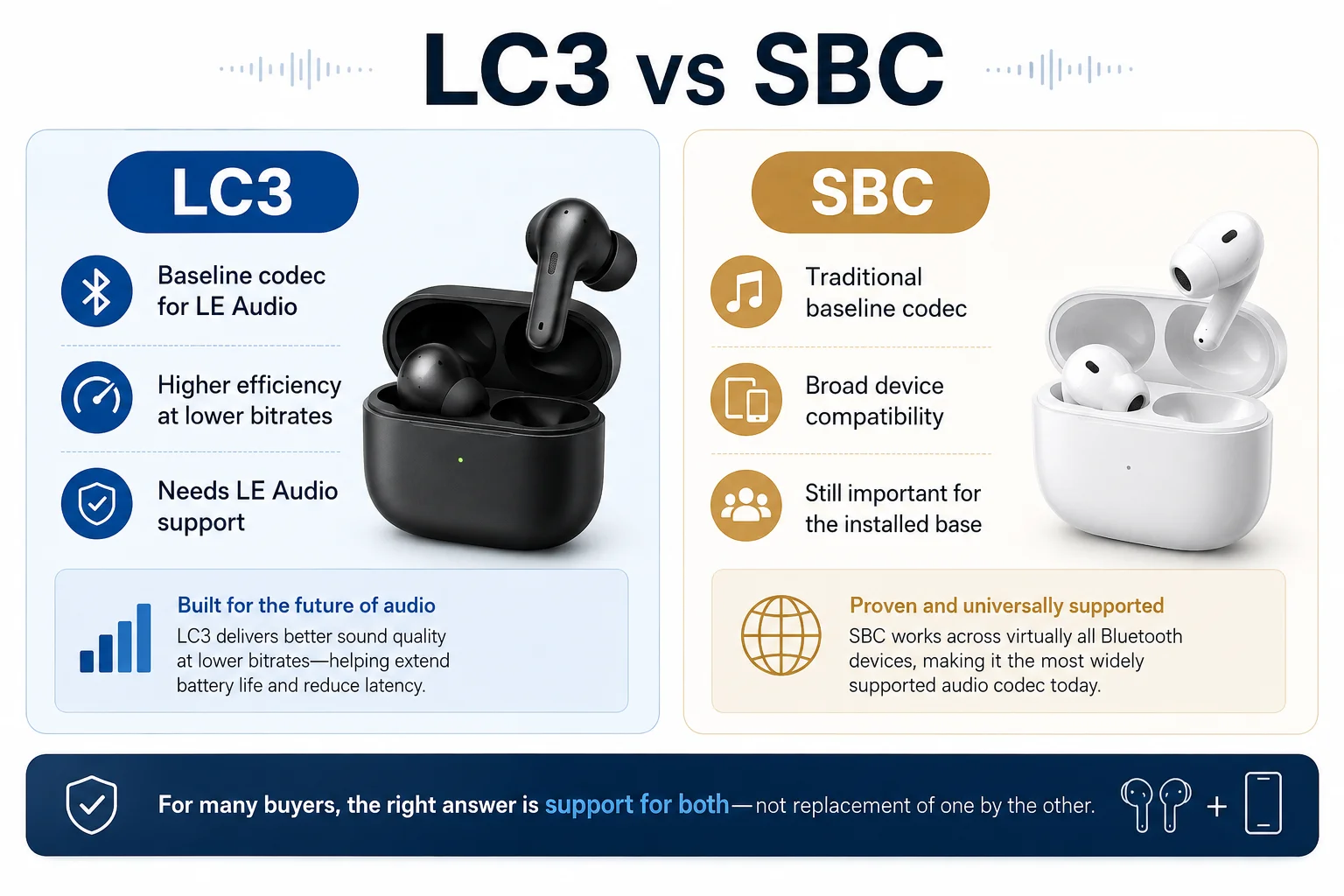
A Practical Codec Comparison
| Factor | LC3 Codec | SBC Codec |
|---|---|---|
| Main audio architecture | Bluetooth LE Audio | Bluetooth Classic Audio |
| Efficiency | Designed for efficient lower-bitrate operation | Widely used baseline approach |
| Device ecosystem | Requires compatible LE Audio source and receiver | Supported by a very broad installed base |
| Audio result | Depends on bitrate, tuning, source, and implementation | Depends on bitrate, tuning, source, and implementation |
| Power potential | Can support efficient LE Audio designs | Established Classic Audio approach |
| Buyer role | Differentiator for compatible 2026 ecosystems | Compatibility foundation |
Do Not Treat This as a Winner-Takes-All Decision
In procurement discussions, I encourage buyers to avoid asking, “Is LC3 better than SBC?” as if the answer is universal. A better question is:
“Which codec will our customers actually use with their phones, TVs, and laptops?”
A wholesale Bluetooth earbud can support LC3 and still rely on SBC in many real-world connections. That is normal. It is also why product pages should explain compatibility in plain language.
For example, a safer listing statement is:
- “Supports Bluetooth LE Audio and LC3 when used with compatible source devices.”
A riskier statement is:
- “LC3 provides better sound quality on all Bluetooth phones.”
The first statement describes conditional support. The second statement creates a broad performance promise that may not hold across customer devices.
What Is Auracast Broadcast Audio?
Auracast is one of the most interesting Bluetooth LE Audio developments, but it is also one of the easiest features to misrepresent. Buyers may see it as an instant public-audio solution, even though both the broadcast location and the receiving device need appropriate support.
Auracast broadcast audio is a Bluetooth LE Audio capability that can allow compatible devices to receive an audio broadcast from a compatible transmitter.7 It may be used for shared TV sound, public announcements, classroom audio, guided tours, or assistive listening in venues that deploy Auracast systems.
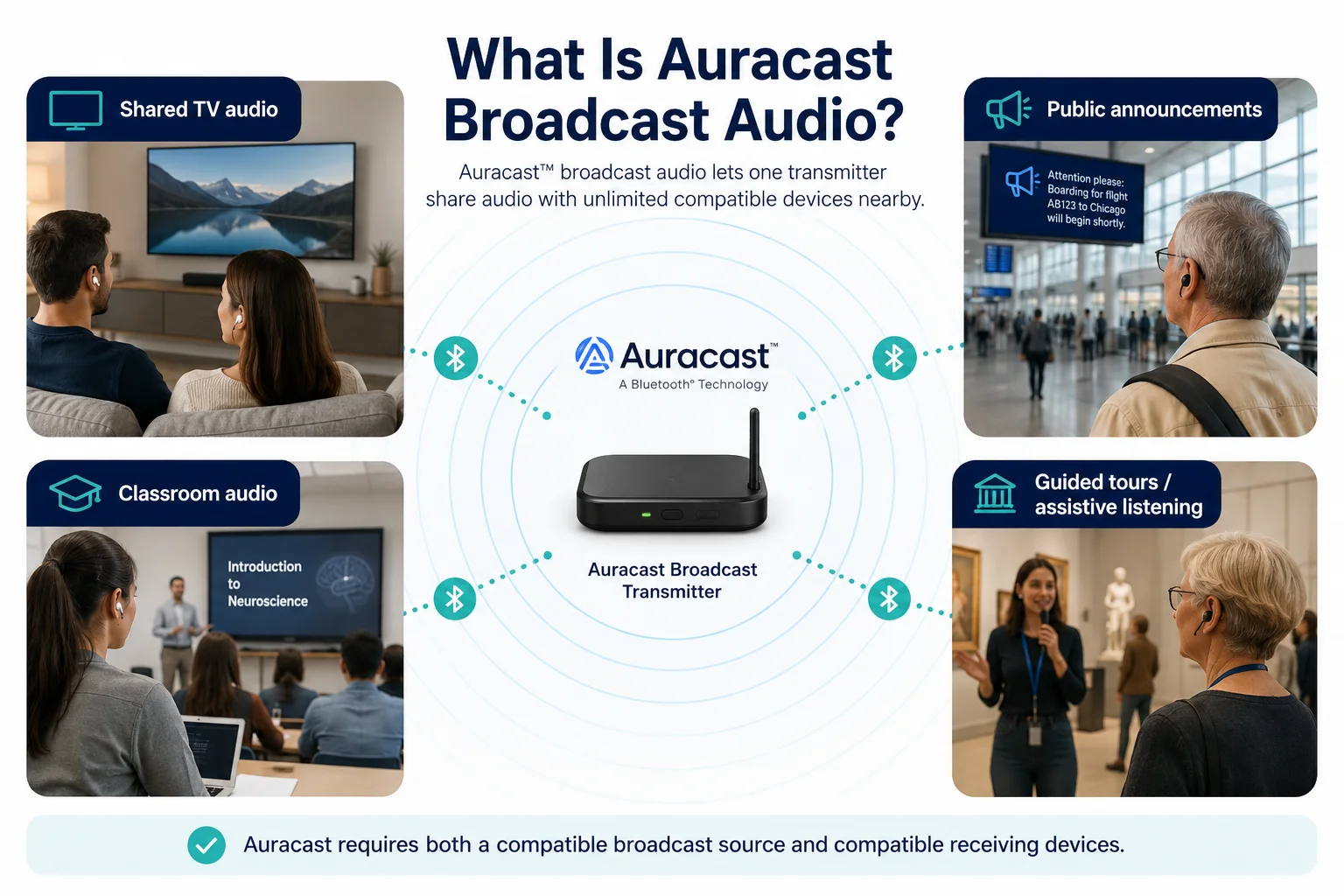
Where Auracast Could Create Retail Value
Auracast can make TWS earbuds more relevant in shared environments. Instead of pairing one device with one headset, a compatible transmitter can broadcast audio for multiple compatible receivers.
Potential applications include:8
- Airports and transport hubs: Travelers may receive gate or announcement audio.
- Gyms: Customers may listen to muted televisions through their own earbuds.
- Museums: Visitors may access tour commentary in multiple languages.
- Classrooms: Students may receive audio from a teacher or presentation system.
- Waiting rooms: Clinics and public spaces may offer private TV listening.
Still, I would not market every LE Audio TWS model as “Auracast ready” unless the finished product supports the required receiving function and the feature has been verified in the intended firmware. LE Audio support, LC3 support, and Auracast receiver support are related, but they are not interchangeable product claims.
For retail buyers, Auracast works best as a future-facing differentiator. It is especially relevant for technology retailers, travel-focused assortments, accessibility-oriented products, and premium TWS ranges. For low-cost promotional earbuds, it may be less important than a reliable microphone, stable pairing, and a competitive shelf price.
How Does Multi-Stream Audio Improve TWS Earbuds?
A common TWS earbud complaint is uneven left-right behavior: one bud connects more slowly, one side loses audio, or the two sides become unsynchronized. Multi-stream audio aims to improve the architecture behind stereo wireless listening.
Multi-stream audio allows a compatible Bluetooth LE Audio source to send separate, synchronized audio streams to the left and right earbuds.9 This can improve stereo management and may support more stable, flexible TWS earbud performance when the entire system supports the feature correctly.
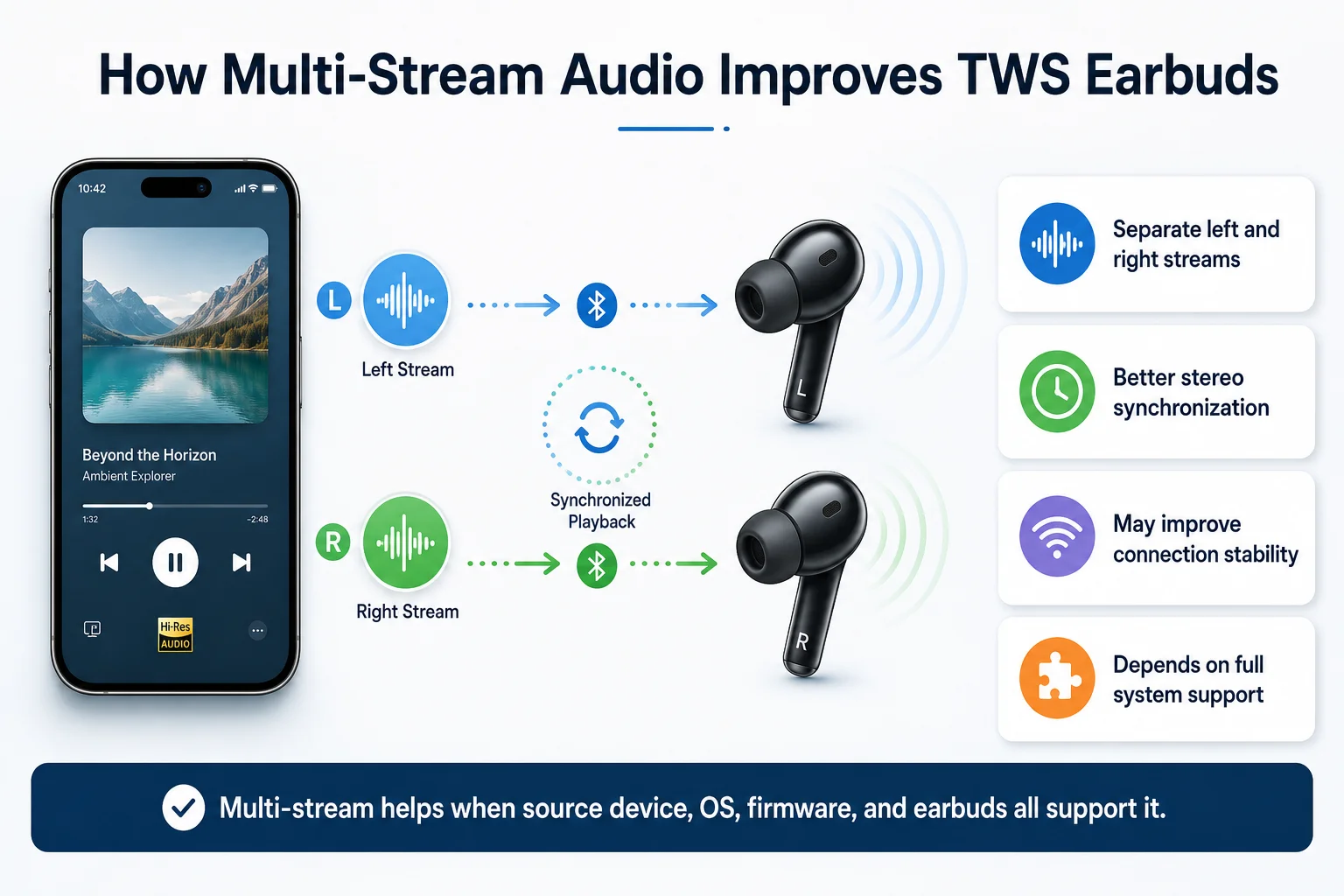
Why Buyers Should Care About the Connection Architecture
Older TWS designs often use a relay-style structure in which one earbud receives audio first and then sends audio to the other side.10 Modern implementations vary, but buyers still care about the same customer-facing outcomes:
- Fast and reliable connection
- Good left-right synchronization
- Stable use in busy wireless environments
- Easy single-earbud operation
- Smooth switching between calls, music, and video
- Fewer reconnection complaints
Multi-stream can be part of a stronger TWS design, but it is not a substitute for proper RF design, antenna placement, firmware tuning, and production testing. We have seen that retail buyers care much more about whether a customer can take out both earbuds and connect quickly than about the technical path used inside the product.
Questions to Ask a Supplier
When reviewing LE Audio TWS earbuds, I suggest asking:
- Does the model support multi-stream audio in its current firmware?
- Which phone platforms have been tested?
- How does the earbud behave when one side is placed back in the case?
- How quickly do both earbuds reconnect after the case opens?
- Has the product been tested in crowded Wi-Fi and Bluetooth environments?
- Does the firmware support OTA updates if compatibility issues appear?
These questions turn a standards discussion into a real product-selection process.
Does Bluetooth LE Audio Reduce Latency and Power Consumption?
Gaming and video latency are major selling points in the TWS market, but broad promises can become a post-sale problem. Buyers often expect Bluetooth LE Audio to solve all delay issues. The actual result depends on the complete audio chain.
Bluetooth LE Audio can support lower-latency and lower-power product designs, but it does not guarantee a specific latency figure or battery-life improvement.11 Real performance depends on the chipset, firmware, source device, codec mode, game or app, RF environment, and overall TWS earbud design.
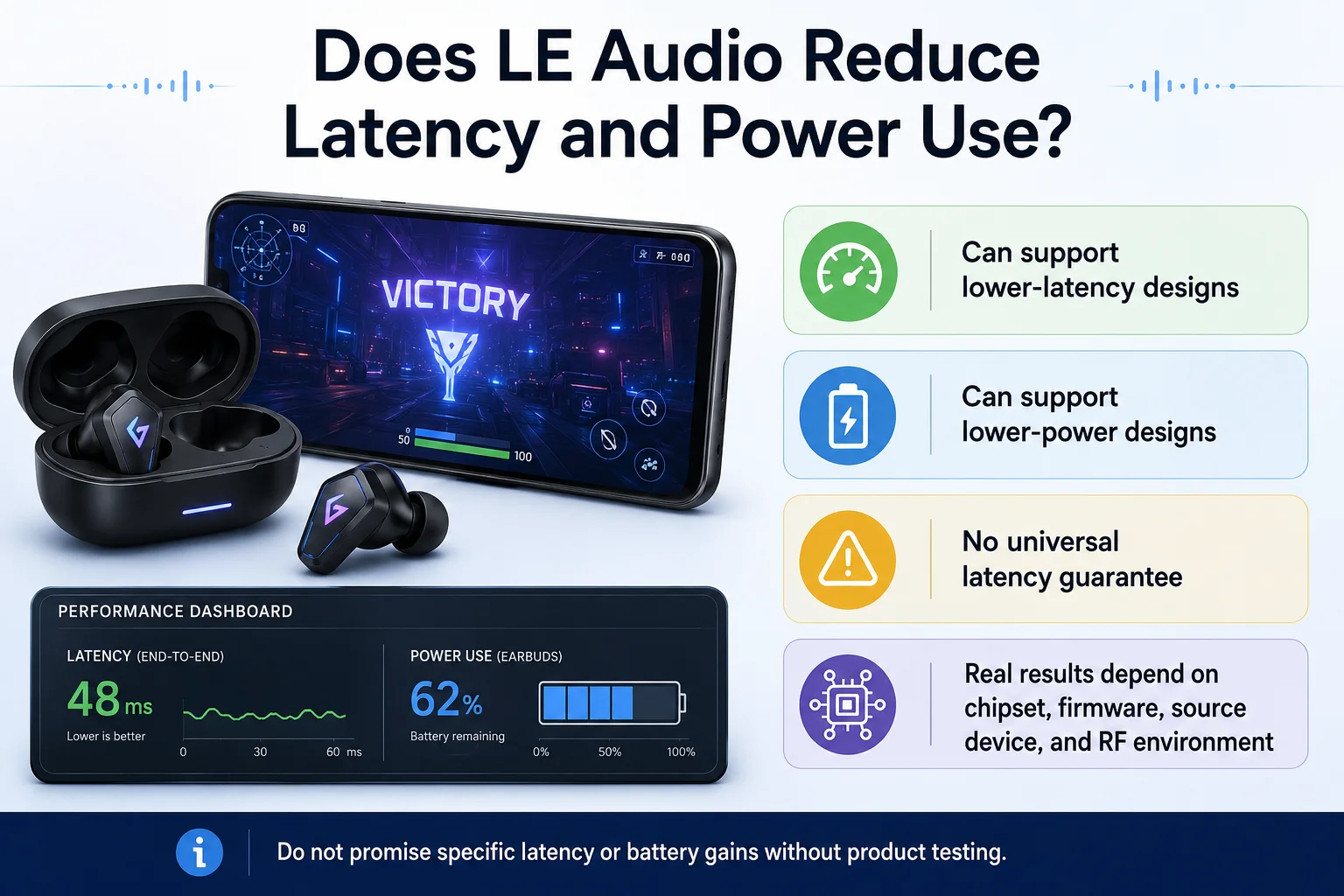
What Determines Real-World Performance?
Latency is the delay between an action and the sound a listener hears. In gaming, this may affect gunfire, movement, and voice communication. In video, users may notice lip-sync delay. In calls, microphone processing and network conditions add more variables.
A low-latency TWS earbud experience depends on:
- Audio codec and transmission mode
- Earbud chipset performance
- Phone operating system behavior
- Game or video app processing
- DSP functions such as ANC and EQ
- Microphone noise reduction
- Wireless interference
- Whether a dedicated gaming mode is available
Battery life follows the same pattern. Bluetooth LE Audio can help manufacturers optimize efficiency, but a product with ANC, high output volume, large drivers, heavy DSP, and multiple microphones may still consume substantial power.
For product listings, I recommend using tested, measurable claims. If a model has a gaming mode, state the conditions clearly. If battery testing is done at 50% volume with ANC off, put that condition in the specification sheet.
This protects both the brand and the retailer. It also helps customers compare products fairly.
Bluetooth Classic Audio vs Bluetooth LE Audio vs Proprietary Low-Latency Modes?
Buyers often compare three different approaches: conventional Bluetooth Classic Audio, newer Bluetooth LE Audio, and brand-specific low-latency modes. Each has a role in a 2026 assortment.
Bluetooth Classic Audio offers broad compatibility, Bluetooth LE Audio provides a newer standards-based path with LC3 and broadcast-audio potential, and proprietary low-latency modes can target specific gaming benefits. The best wholesale choice depends on the customer device base and the product promise.
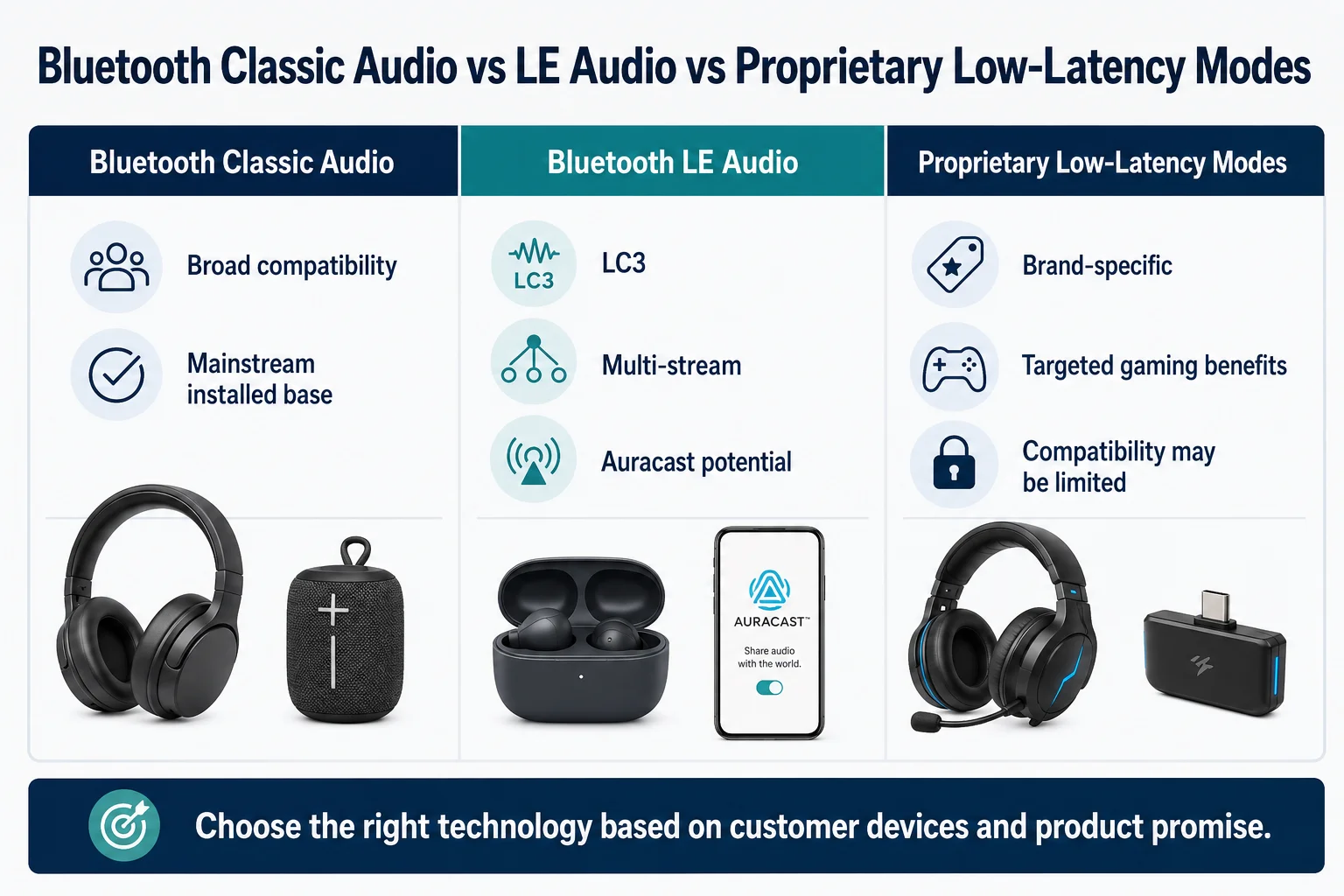
| Feature | Bluetooth Classic Audio | Bluetooth LE Audio | Proprietary Low-Latency Modes |
|---|---|---|---|
| Typical baseline codec | SBC | LC3 | Varies by brand and chipset |
| Power approach | Established Bluetooth audio design | Low Energy audio architecture | Varies |
| Latency potential | Varies by codec and implementation | Can support improved designs | Can be optimized for selected devices |
| Multi-stream support | Not the core LE Audio feature set | Supported in compatible implementations | Varies |
| Broadcast audio | Not Auracast-based | Can support Auracast capabilities | Usually not standardized |
| Compatibility | Very broad | Requires compatible source and receiver | Often limited to selected models |
| Best target | Mass-market everyday users | Future-ready TWS and premium retail | Gaming-focused or ecosystem-specific products |
| Wholesale positioning | Safe core assortment | Differentiated, compatibility-led offering | Strong niche feature when tested |
Build an Assortment, Not a Single Technology Bet
For many retailers, the best strategy is a tiered product range:
- Good: Stable Bluetooth Classic Audio earbuds with good battery life and calls
- Better: LE Audio TWS earbuds with LC3 support and strong overall tuning
- Best: Premium earbuds with verified LE Audio functions, app support, ANC, and a clear lifestyle or travel use case
This gives customers choice without forcing every buyer into a feature they may not use yet.
Do Buyers Need a New Phone for LE Audio?
Compatibility is the most important commercial issue in Bluetooth LE Audio. A buyer can source excellent LC3 earbuds, but the consumer may still use them in conventional Bluetooth mode if the phone or operating system does not support the required LE Audio functions.
Buyers may need a newer compatible phone, operating system, chipset, and firmware to use Bluetooth LE Audio features such as LC3 or Auracast.12 LE Audio TWS earbuds can often still work with older devices through Bluetooth Classic Audio, but the advanced LE Audio functions may not activate.
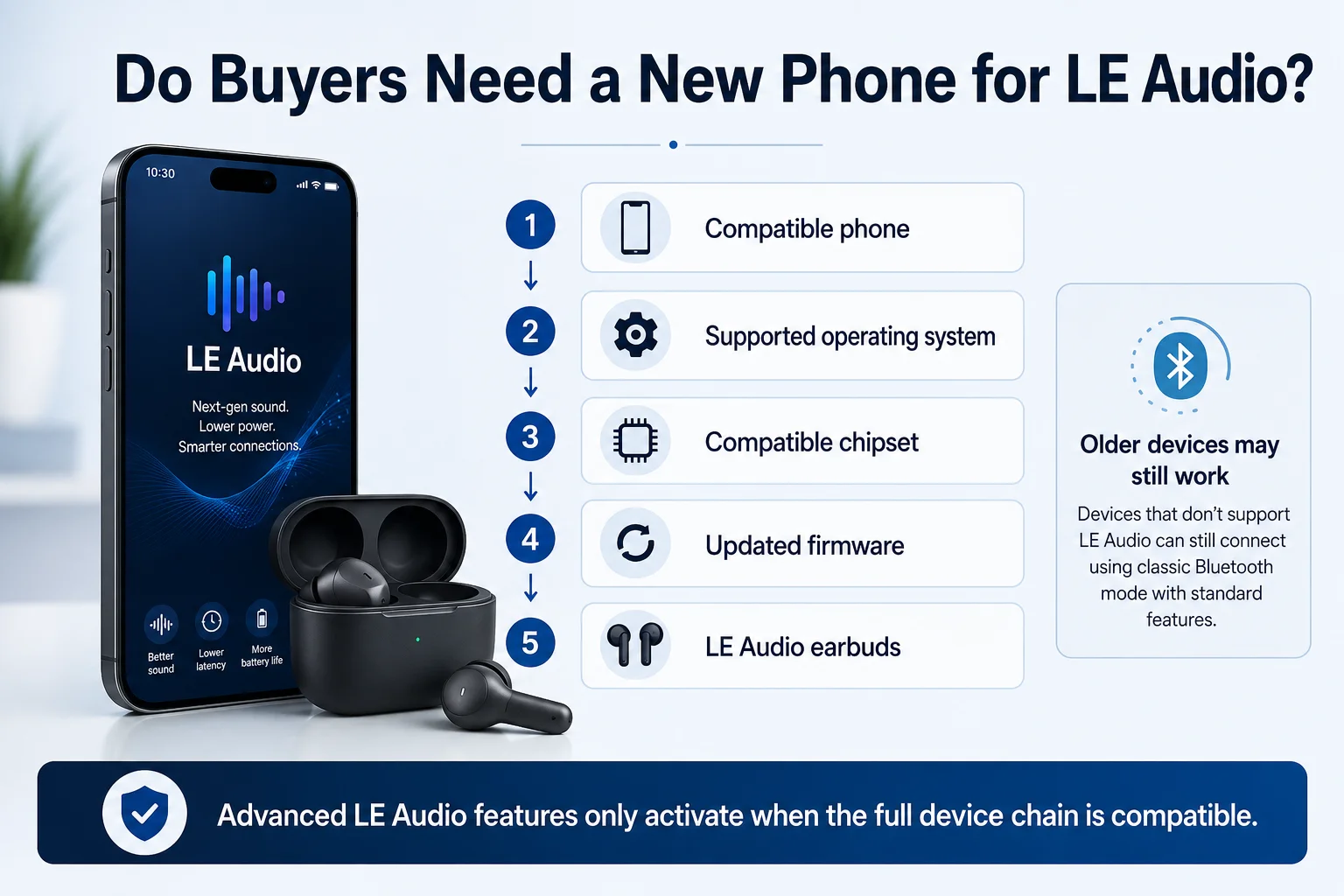
Create a Compatibility Plan Before Launch
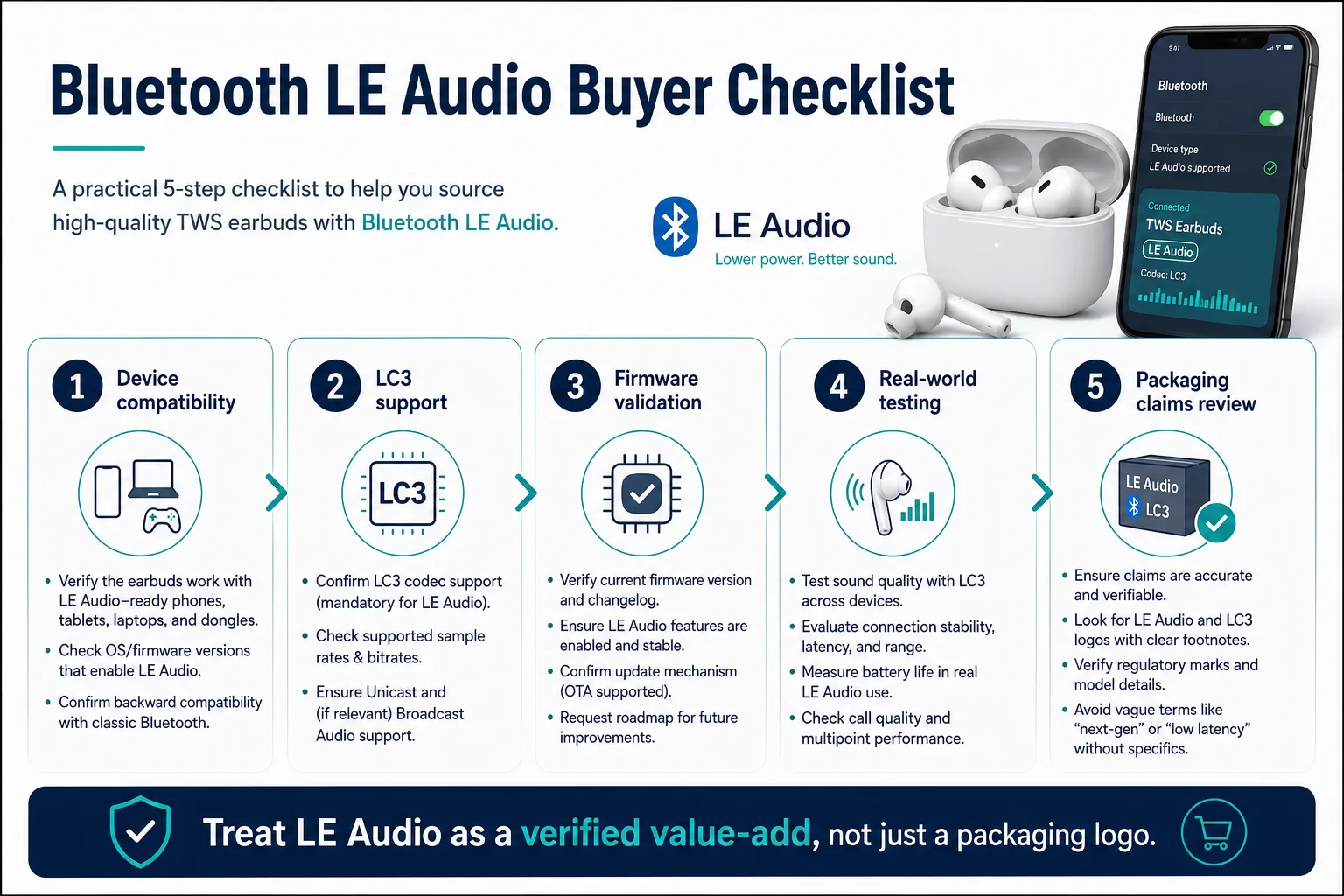
I recommend that every buyer build a simple compatibility checklist before approving packaging or product content:
- Identify key customer phone brands. Review the leading iOS and Android devices in your target market.
- Verify the source-device requirement. Check whether the targeted function requires a specific OS version, chipset, software update, or app.
- Test real pairings. Test the finished earbuds with representative phones, laptops, and tablets.
- Confirm fallback behavior. Make sure the earbuds pair and perform well through standard Bluetooth audio when LE Audio is unavailable.
- Write conservative claims. Use “with compatible devices” where needed.
- Train customer service. Give support teams a simple explanation of compatibility limits.
A feature matrix can be useful on a product page:
| Function | Compatible Device Needed? | Consumer Message |
|---|---|---|
| Basic music and calls | Most Bluetooth devices | “Works with Bluetooth-enabled devices” |
| LC3 playback | Compatible LE Audio source | “LC3 available with compatible devices” |
| Auracast receiving | Compatible receiver function and broadcast source | “Auracast use depends on supported broadcasts” |
| Gaming mode | Model-specific conditions | “Check supported mode and device conditions” |
This may feel cautious, but it reduces returns and protects review ratings.
How Can Buyers Source Bluetooth LE Audio-Ready TWS Earbuds?
A low factory quote can hide a high retail risk if the firmware, compatibility claims, or quality-control process are unclear. Buyers need to evaluate LE Audio TWS earbuds as complete consumer products, not as isolated chipset specifications.
To source Bluetooth LE Audio-ready TWS earbuds, buyers should verify the chipset platform, LC3 function, backward compatibility, firmware maturity, battery results, call quality, certifications, app support, and final consumer claims. A reliable supplier should provide practical test information instead of relying only on feature labels.
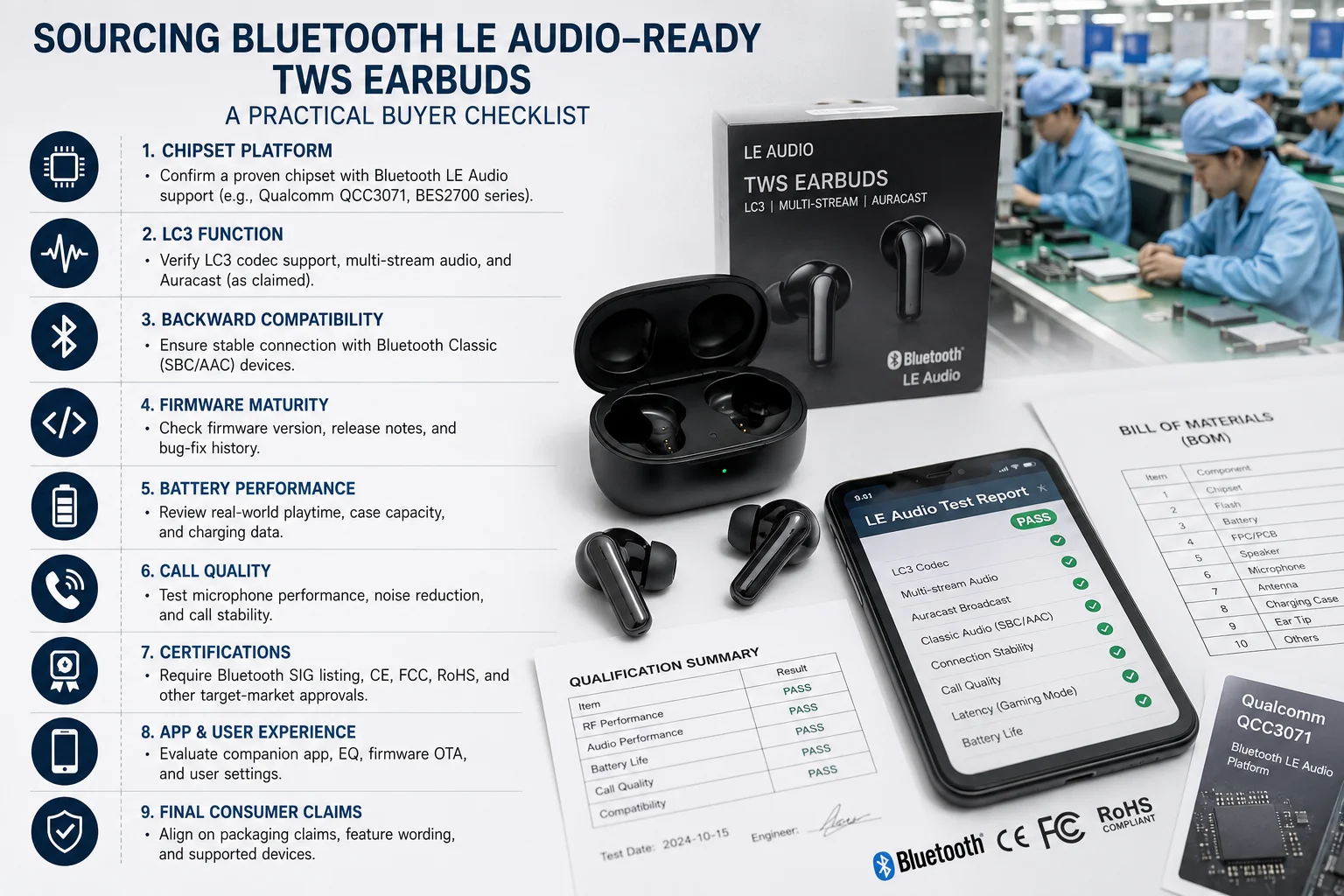
Our Sourcing Checklist for Retail Buyers
At Kingfuji, we work from a commercial product-selection perspective. We know that a buyer needs a product that can survive shelf comparison, e-commerce reviews, and customer-service questions.
Before confirming a Bluetooth LE Audio model, we recommend checking:
- Chipset capability: What LE Audio features does the platform support in the delivered firmware?
- LC3 implementation: Is LC3 active and tested with named compatible source devices?
- Backward compatibility: Does the product provide stable use with common non-LE Audio devices?
- Auracast readiness: Is Auracast receiver support included, optional, or unavailable?
- Call performance: How do microphones perform indoors, outdoors, and in noisy spaces?
- Battery testing: What are the tested conditions for music playback and calls?
- Connection stability: Has the model been tested for dropouts, pairing speed, and one-earbud use?
- Certification: Are CE, FCC, RoHS, REACH, and battery transport documents available where required?
- Customization: Can we support logo printing, color options, retail packaging, manuals, and MOQ planning?
- Firmware support: Is OTA update support available for suitable models?
With 15 years of export experience from Shenzhen, we understand that EU and US buyers need more than a trendy feature list. They need stable quality, practical MOQ options, clear delivery planning, and product claims that their teams can confidently stand behind.
Frequently Asked Questions
Is Bluetooth LE Audio the same as Bluetooth 5.2?
No. Bluetooth LE Audio is a set of audio capabilities built on Bluetooth Low Energy technology. A Bluetooth 5.2 or Bluetooth 5.3 label alone does not prove that a device supports LC3, multi-stream audio, or Auracast. Buyers should verify the actual implemented functions.
Do LC3 codec earbuds work with older phones?
In many cases, yes. LC3 earbuds can often connect to older phones through conventional Bluetooth audio modes. However, the older phone may not activate LC3 or other Bluetooth LE Audio features. Buyers should verify the fallback connection behavior before launch.
Does Bluetooth LE Audio guarantee lower gaming latency?
No. Bluetooth LE Audio can support efficient, low-latency designs, but it does not guarantee a specific gaming result. Latency depends on the earbud chipset, firmware, phone, application, audio processing, and wireless environment.
Can every Bluetooth LE Audio earbud receive Auracast broadcasts?
No. Auracast receiving must be supported in the finished product. LE Audio and LC3 support do not automatically mean that a TWS earbud includes every Auracast function. Buyers should request clear feature confirmation and practical testing information.
Should wholesale buyers make LC3 a mandatory feature in 2026?
It depends on the target market. LC3 is a good value-add for compatible, technology-focused customers and future-ready assortments. For broad mass-market sales, stable connectivity, sound tuning, microphone performance, comfort, price, and battery life may still have a stronger daily impact.
Conclusion
Bluetooth LE Audio gives TWS earbud buyers real opportunities in 2026, especially through LC3 efficiency, multi-stream audio, and Auracast potential. Still, we believe the feature should be sold responsibly. The key question is not simply whether a model supports LC3, but whether your customers’ devices can use it and whether the benefit is clear enough to market safely. If you are sourcing wholesale Bluetooth earbuds with OEM branding, retail packaging, and verified feature positioning, contact Kingfuji to discuss a suitable LE Audio-ready TWS range.
"Bluetooth LE Audio and Auracast: The Profile Stack Explained", https://novelbits.io/bluetooth-le-audio-auracast-profiles/. Bluetooth LE Audio specifies the LC3 codec and introduces capabilities including Multi-Stream Audio and broadcast audio; its practical availability depends on implementation in the transmitting and receiving devices. Evidence role: general_support; source type: institution. Supports: The Bluetooth LE Audio feature set, including LC3 as the baseline codec, Multi-Stream Audio, and broadcast-audio capabilities.. Scope note: A standards overview establishes feature capabilities, not the performance of a particular earbud model. ↩
"LC3 (codec)", https://en.wikipedia.org/wiki/LC3_(codec). Bluetooth LE Audio features operate only when the relevant functions are implemented and enabled across the participating source and receiving devices, including their software configurations. Evidence role: general_support; source type: institution. Supports: LE Audio functions require support across the relevant source, receiver, software, and enabled Bluetooth profiles.. Scope note: Compatibility documentation may vary by operating-system release and does not prove support for every device or firmware version. ↩
"LC3 (codec)", https://en.wikipedia.org/wiki/LC3_(codec). The Bluetooth LE Audio architecture defines the Low Complexity Communication Codec (LC3) as its baseline audio codec. Evidence role: definition; source type: institution. Supports: LC3 is the required baseline audio codec in the Bluetooth LE Audio specification.. ↩
"Bluetooth Core Specification v5.2", https://faculty-web.msoe.edu/johnsontimoj/EE4980/files4980/Core_v5.2.pdf. A Bluetooth Core Specification version denotes protocol capabilities available to implementers; support for particular LE Audio features must be confirmed separately in the product implementation. Evidence role: definition; source type: institution. Supports: Bluetooth version labels describe core-specification versions and do not by themselves certify implementation of all LE Audio capabilities.. Scope note: The core version can indicate technical prerequisites but cannot establish which optional profiles or functions a finished product enables. ↩
"An Open Benchmark for Evaluating Audio Coding Performance", https://arxiv.org/html/2409.08374v1. In controlled listening evaluations, LC3 has been reported to provide comparable perceived audio quality at lower bitrates than earlier Bluetooth baseline codec approaches. Evidence role: mechanism; source type: paper. Supports: Controlled codec evaluations report that LC3 can achieve comparable subjective audio quality at lower bitrates than legacy Bluetooth baseline coding under tested conditions.. Scope note: Listening-test results depend on tested material, bitrates, encoder settings, and experimental conditions and do not establish sound quality for a specific earbud. ↩
"SBC (codec)", https://en.wikipedia.org/wiki/SBC_(codec). The Bluetooth Advanced Audio Distribution Profile specifies SBC as its mandatory baseline codec, which underpins its broad interoperability in Bluetooth Classic Audio devices. Evidence role: definition; source type: institution. Supports: SBC is the mandatory baseline codec in the Bluetooth Advanced Audio Distribution Profile used for Classic Audio streaming.. Scope note: Mandatory profile support does not guarantee identical audio quality, latency, or behavior across implementations. ↩
"Bluetooth Transmitter for Hearing Aids", https://avantree.com/collections/bluetooth-transmitter-for-hearing-aids?srsltid=AfmBOorkbup41OjfupZleCT3MoSC2cbshbT1ZJrG7jF-IbtGaPYYEt-Q. Auracast broadcast audio enables compatible Bluetooth receivers to discover and join audio broadcasts provided by compatible broadcast transmitters. Evidence role: definition; source type: institution. Supports: Auracast is a Bluetooth broadcast-audio capability in which compatible receivers can join audio broadcasts from compatible transmitters.. Scope note: This capability does not show that a particular venue has deployed a broadcast transmitter or that every LE Audio receiver supports every Auracast function. ↩
"Auracast Technology for Public Space Listening", https://kleckneraudiology.com/blog/auracast-technology-public-space-listening. Broadcast-audio systems based on Bluetooth LE Audio have been identified as potential tools for shared media, public-address, guided-tour, classroom, and assistive-listening use cases. Evidence role: case_reference; source type: research. Supports: Broadcast audio can be used in public and assistive-listening contexts, including shared television, public-address, tour, and classroom applications.. Scope note: These use cases are contingent on venue infrastructure, receiver accessibility, and local deployment; they do not demonstrate widespread adoption in each setting. ↩
"Bluetooth LE Audio - MATLAB & Simulink", https://la.mathworks.com/help/bluetooth/ug/bluetooth-le-audio.html. Bluetooth LE Audio Multi-Stream Audio supports the delivery of multiple independent, synchronized audio streams, including streams directed to separate left and right earbuds. Evidence role: mechanism; source type: institution. Supports: LE Audio Multi-Stream Audio permits synchronized independent audio streams to multiple receiving devices, including separate left and right earbuds.. Scope note: The feature's presence does not by itself establish connection reliability or synchronization performance in a particular product. ↩
"A Deterministic Approach to Wireless Relay Networks", https://web.stanford.edu/~dntse/papers/relay.pdf. Technical descriptions of early true-wireless systems commonly characterize them as primary-secondary architectures, with a primary earbud receiving the source connection and relaying audio to the second earbud. Evidence role: historical_context; source type: paper. Supports: Earlier true-wireless designs commonly used primary-secondary or master-slave arrangements in which one earbud relayed audio to the other.. Scope note: TWS connection topologies differ by chipset generation and implementation, so this description is historical rather than universal. ↩
"Bluetooth Low Energy", https://en.wikipedia.org/wiki/Bluetooth_Low_Energy. Bluetooth LE Audio provides mechanisms intended to improve audio-transport efficiency and support low-latency operation, but achieved latency and power consumption remain dependent on codec settings, hardware, software, and use conditions. Evidence role: mechanism; source type: paper. Supports: LE Audio and LC3 are designed to support efficient and potentially low-latency audio transport, while measured latency and energy use depend on system implementation.. Scope note: A system-level performance study cannot predict battery life or latency for an untested earbud, source device, application, or RF environment. ↩
"Bluetooth Low Energy Audio | Connectivity", https://developer.android.com/develop/connectivity/bluetooth/ble-audio/overview. Use of Bluetooth LE Audio functions such as LC3 playback and broadcast-audio reception requires compatible hardware on the participating devices together with the necessary operating-system and firmware support. Evidence role: general_support; source type: education. Supports: Use of LE Audio functions requires compatible participating hardware and relevant software or firmware support.. Scope note: Requirements vary by device model, operating-system release, enabled profile, and manufacturer implementation. ↩