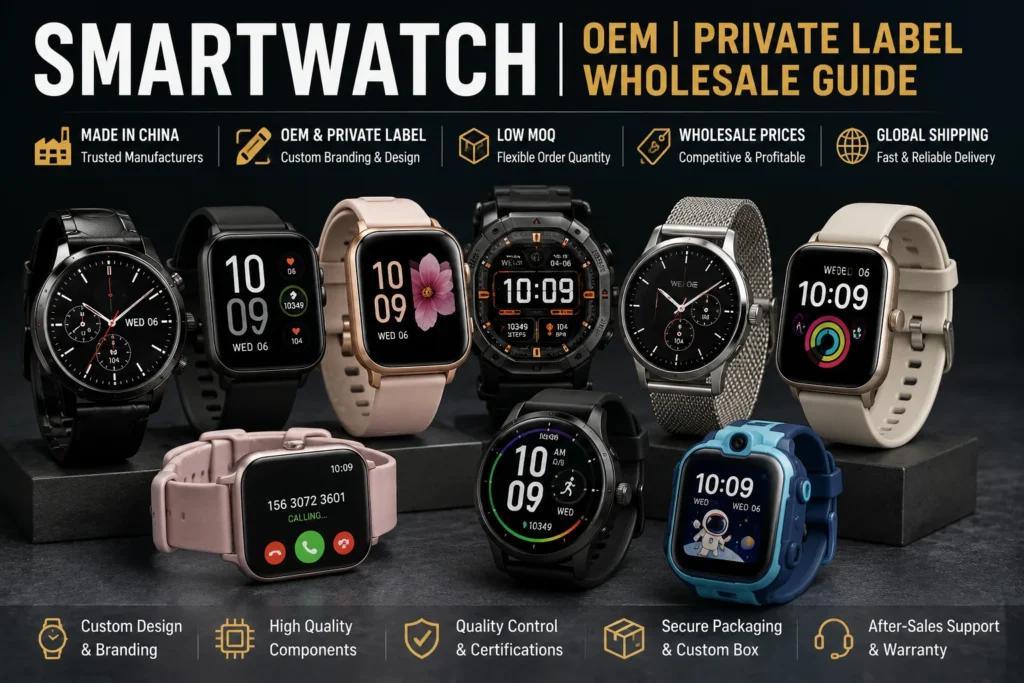
Struggling to pick between OEM, private label, or wholesale for smartwatches? Making the wrong choice can waste your money and time. This guide helps you choose the right model for your business.
The best sourcing model—OEM, private label, or wholesale—depends on your business scale, brand goals, and budget. It's a risk management choice. Wholesale is for market testing, private label is for branding existing products, and OEM is for creating a unique product with significant investment.
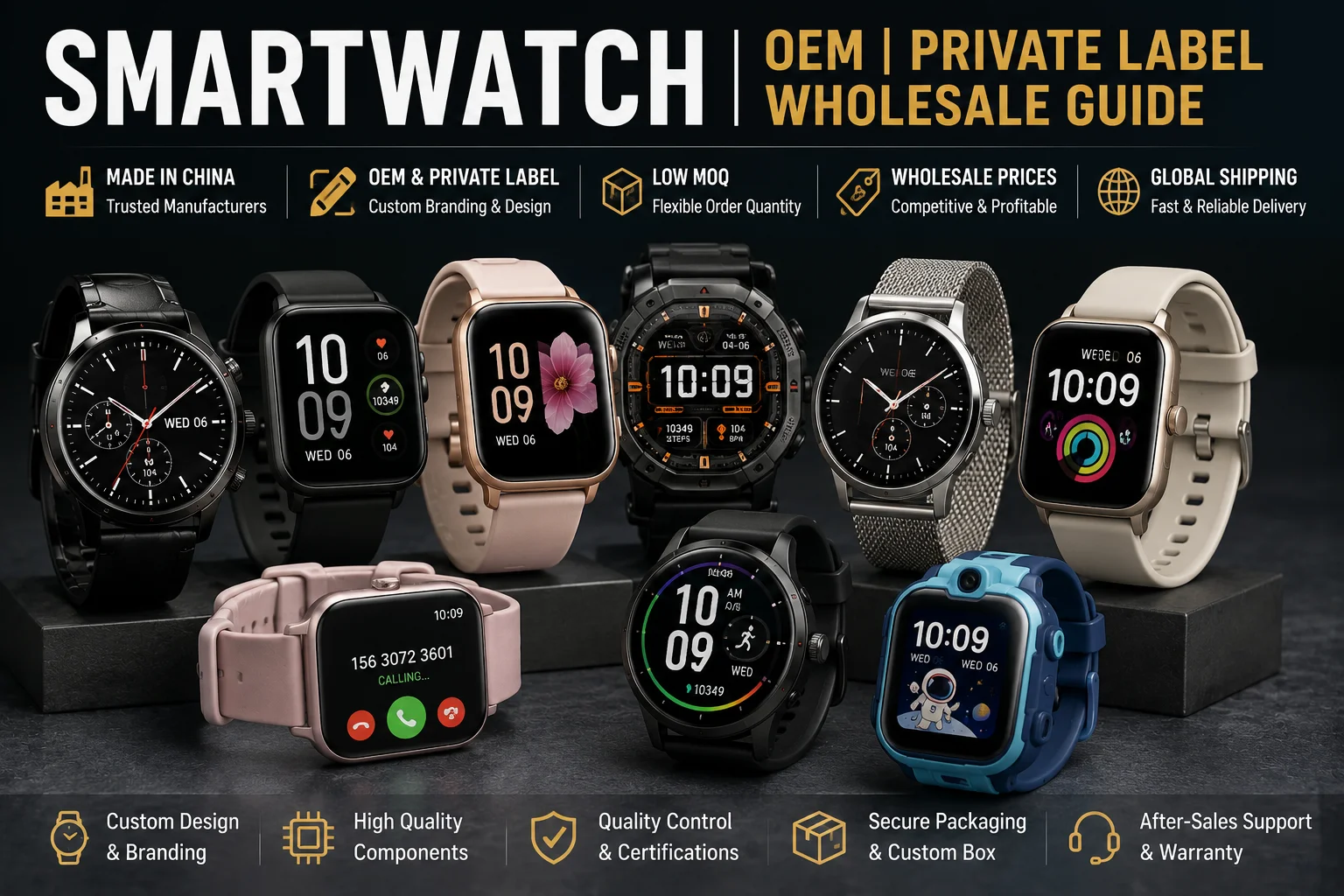
Choosing how to source smartwatches from China is one of the biggest decisions you'll make. It’s more than just finding a supplier; it's about defining your business strategy. For 15 years, I've helped international buyers navigate this process, and I've seen what works and what doesn't. This isn't just a list of definitions. It's a framework to help you assess the risks and pick the path that matches your goals. Let's dive into the questions you should be asking to make a smart, profitable decision.
Why Are Chinese Smartwatch Manufacturers So Popular with Global Buyers?
You see "Made in China" everywhere, but do you know the real reason why it's the go-to for electronics? You might assume it's just about price, but that’s only part of the story.
Global buyers choose Chinese smartwatch manufacturers for their huge production scale, mature supply chains, fast innovation, and competitive pricing1. This complete ecosystem in cities like Shenzhen allows for everything from simple wholesale orders to fully custom OEM projects, all in one place.
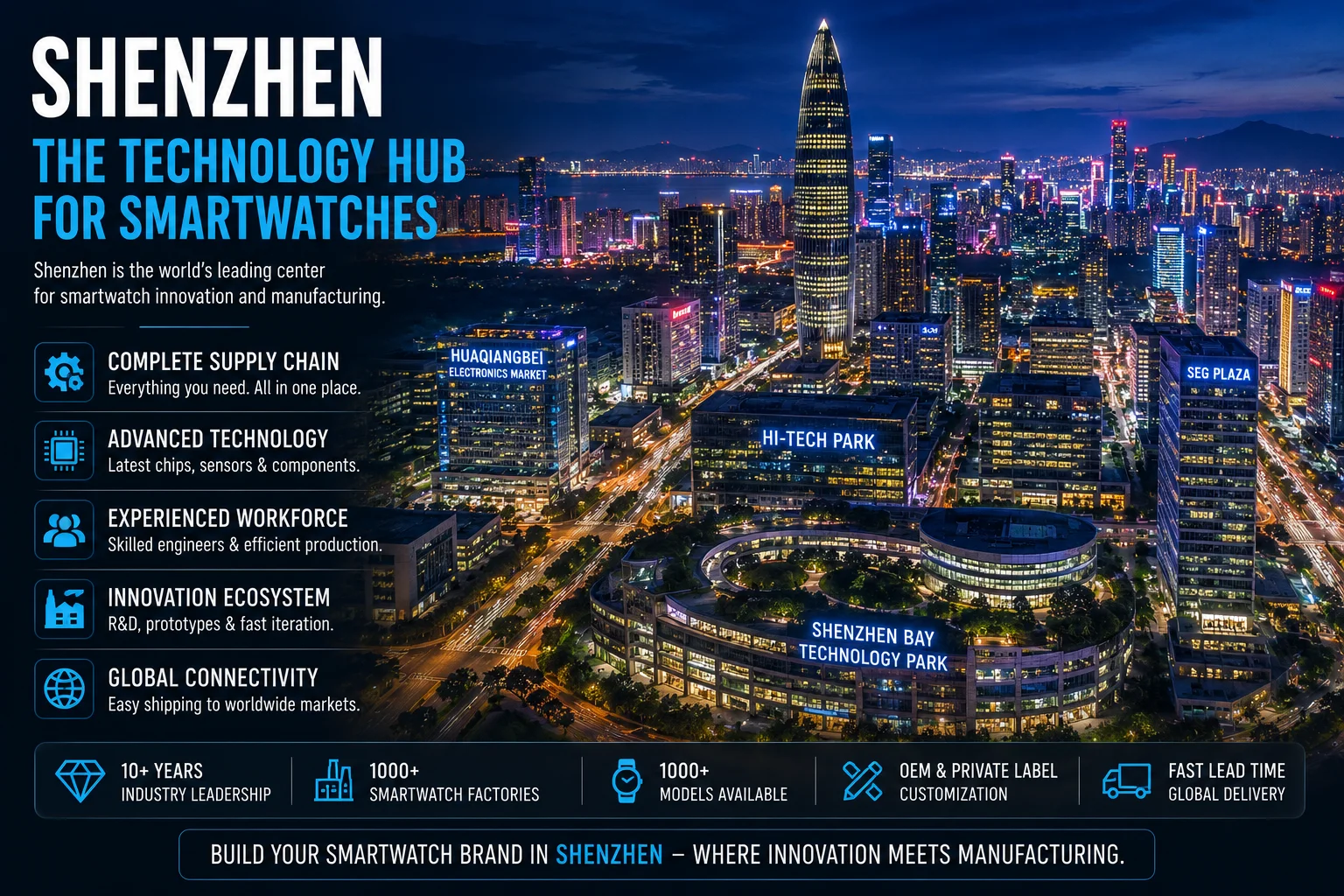
When clients visit us in Shenzhen, they are always shocked. It's not just about factories. It's what we call the "Silicon Valley of Hardware2." Everything you need to build a smartwatch is right here. This means we can develop and launch products incredibly fast. I remember a client from Germany who was amazed that we could get samples with a new heart rate sensor just weeks after it was announced. That's the power of this ecosystem. It's a combination of speed, cost, and innovation that is hard to find anywhere else in the world. This environment benefits you, the buyer, by giving you access to the latest technology at a price that allows you to compete.
| Factor | Why it Matters for Your Business |
|---|---|
| Mature Supply Chain | Fast access to the latest chips, screens, and sensors means lower costs and faster production. |
| Massive Scale | High-volume production lines reduce the unit price, making your products more profitable. |
| Rapid Innovation | New features and designs appear on the market here first, giving you a competitive edge. |
| Export Experience | Most suppliers, like us, have years of experience with international quality standards and shipping. |
OEM vs. Private Label: Which Model Really Fits Your Business?
You hear the terms OEM and private label, but it's hard to know which is right. Choosing the wrong path can lock you into a project that’s too expensive or doesn't fit your brand.
Choose Private Label if you want to test the market quickly with low investment by putting your brand on an existing product. Choose OEM if you are an established business with the budget and technical team to create a unique product from scratch. It's about market testing versus brand creation.
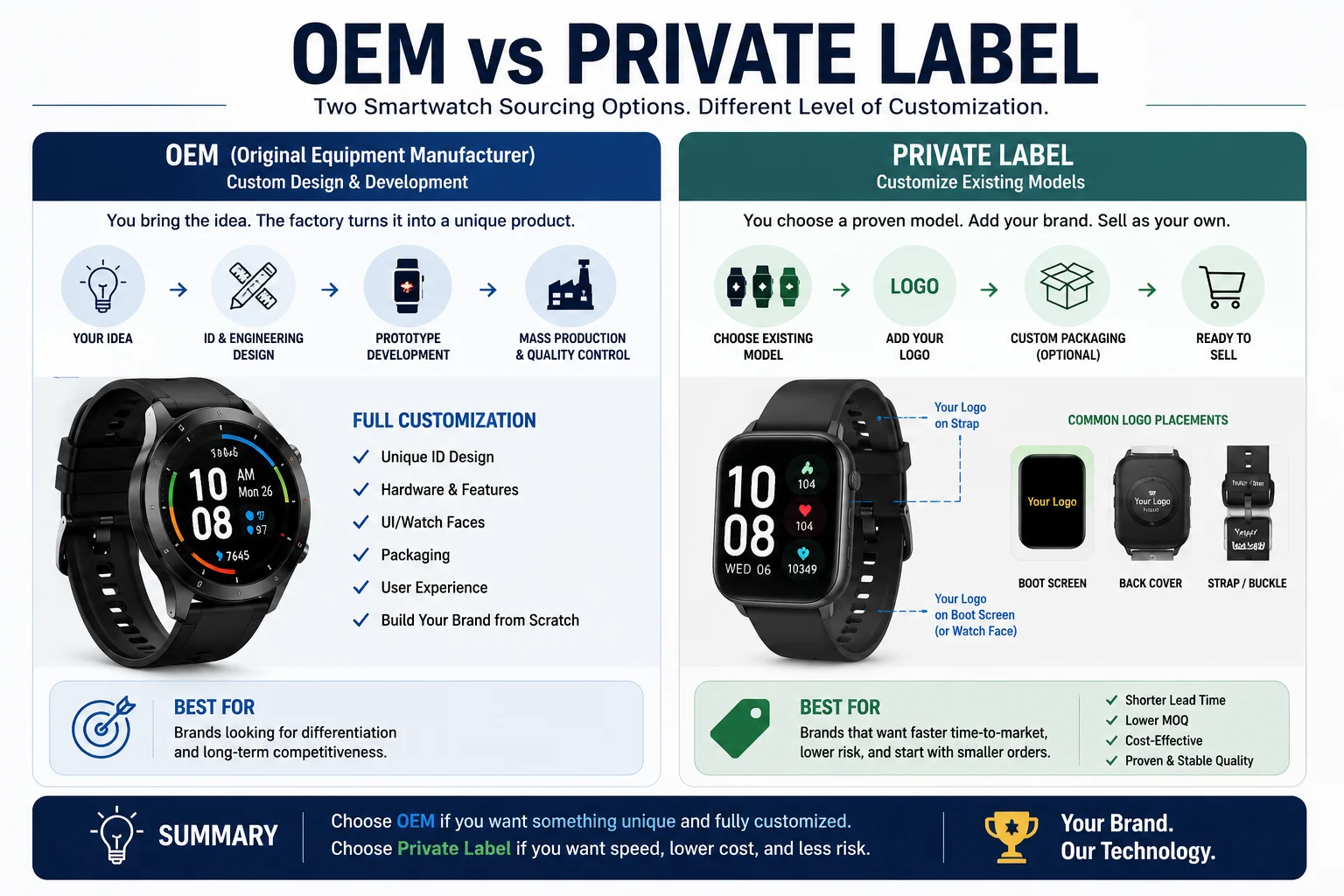
A common question we get from first-time importers is, "Which option is best?" My first question back is always, "What is your sales channel and what is your realistic first-order budget?" The right choice is really about which risks your business can afford. Private label is low-risk; you’re betting on your marketing skills to sell a proven product. OEM is high-risk; you’re investing heavily in creating something new, betting that the market wants your unique vision. Underestimating the work involved is a common mistake. Private label needs strong marketing. OEM requires deep technical involvement in R&D, tooling, and quality control. It's a partnership, not just a purchase order.
Here’s a breakdown to help you self-diagnose:
| Aspect | Private Label (Lower Risk & Commitment) | OEM (Higher Risk & Commitment) |
|---|---|---|
| Initial Investment | Low. No mold fees. You pay for inventory and custom packaging. | High. Mold fees can be thousands of dollars3, plus R&D costs. |
| Time to Market | Fast. Usually 3-5 weeks from order to shipment. | Slow. Can take 6-12 months from idea to first production4. |
| Customization | Low. You can change colors, straps, and add your logo. | High. You can design the hardware, software, and features. |
| Team Required | A marketing and sales focus is enough. | You need technical staff for project management and QC. |
| Best For | New e-commerce sellers, market testers, promotional gifts. | Established brands, large retailers with specific needs. |
What Smartwatch Specifications Should You Really Compare?
Spec sheets are filled with technical jargon that can be confusing. Focusing on the wrong features means you could end up with a product that looks good on paper but disappoints your customers in real life.
When comparing smartwatches, focus on the Chipset (for performance), Screen (type and resolution), Sensors (for accuracy), Battery Capacity (for real-world usage), and Water Resistance. These five specs define the daily user experience more than anything else.
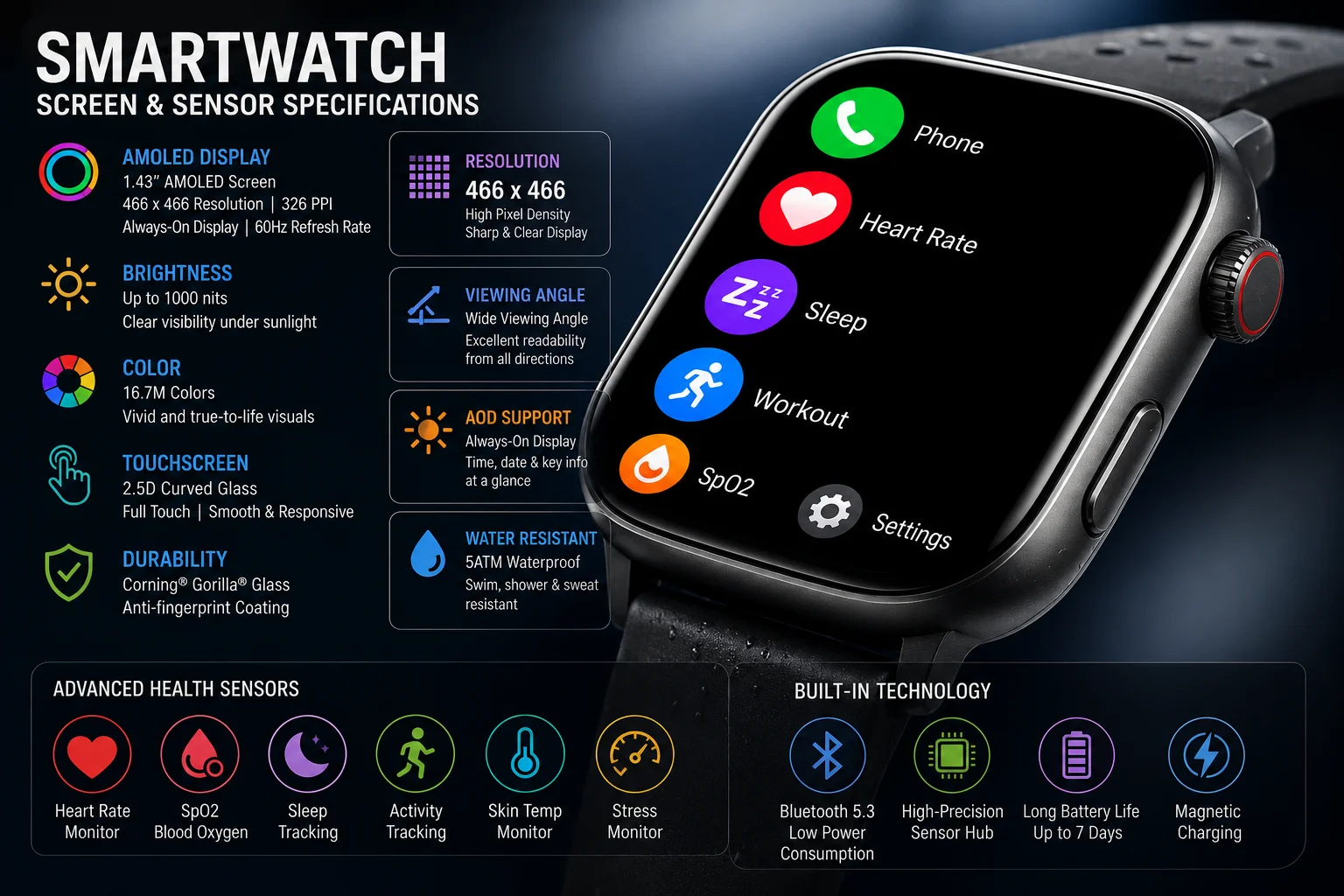
Don't get lost in a long list of features. A watch can have 100 sport modes, but if the screen is dim and the battery dies in a day, your customers will not be happy. The chipset is the "brain"; a better chipset like a Realtek or Apollo means a smoother, faster interface with fewer bugs. For the screen, AMOLED offers vibrant colors and deep blacks but costs more than a standard IPS screen5. When it comes to sensors, ask about the model. A basic heart rate sensor is different from an advanced one that also tracks blood oxygen (SpO2) and ECG. The battery is another tricky spec. Don't just look at the mAh number. Ask the supplier for the "typical usage" time, as software optimization makes a huge difference. A 300mAh battery might last 5 days or 10, depending on the chipset and software.
Here is a simple way to think about the tiers:
| Specification | Good (Entry-Level) | Better (Mid-Range) | Best (Premium) |
|---|---|---|---|
| Chipset | Basic (e.g., RTL8762C) | Advanced (e.g., RTL8763E) | Premium (e.g., Qualcomm/Nordic) |
| Screen | TFT | IPS LCD | AMOLED |
| Sensors | Heart Rate only | Heart Rate + SpO2 (Blood Oxygen) | HR + SpO2 + ECG |
| Battery Life | 3-5 days of use | 7-10 days of use | 14+ days of use |
| Waterproofing | IP67 (Splash-proof)6 | IP68 (Submersible) | 5ATM (Swim-proof) |
How Can You Check Quality, Certifications, and Battery Performance?
You can't physically touch a product thousands of miles away. This makes you worry about receiving a container of faulty watches that you can't sell and that will damage your brand's reputation.
To verify quality, always order a sample to test yourself. Ask the supplier for copies of key certifications like CE, RoHS, and FCC. For battery life, perform your own multi-day test on the sample instead of just trusting the spec sheet.
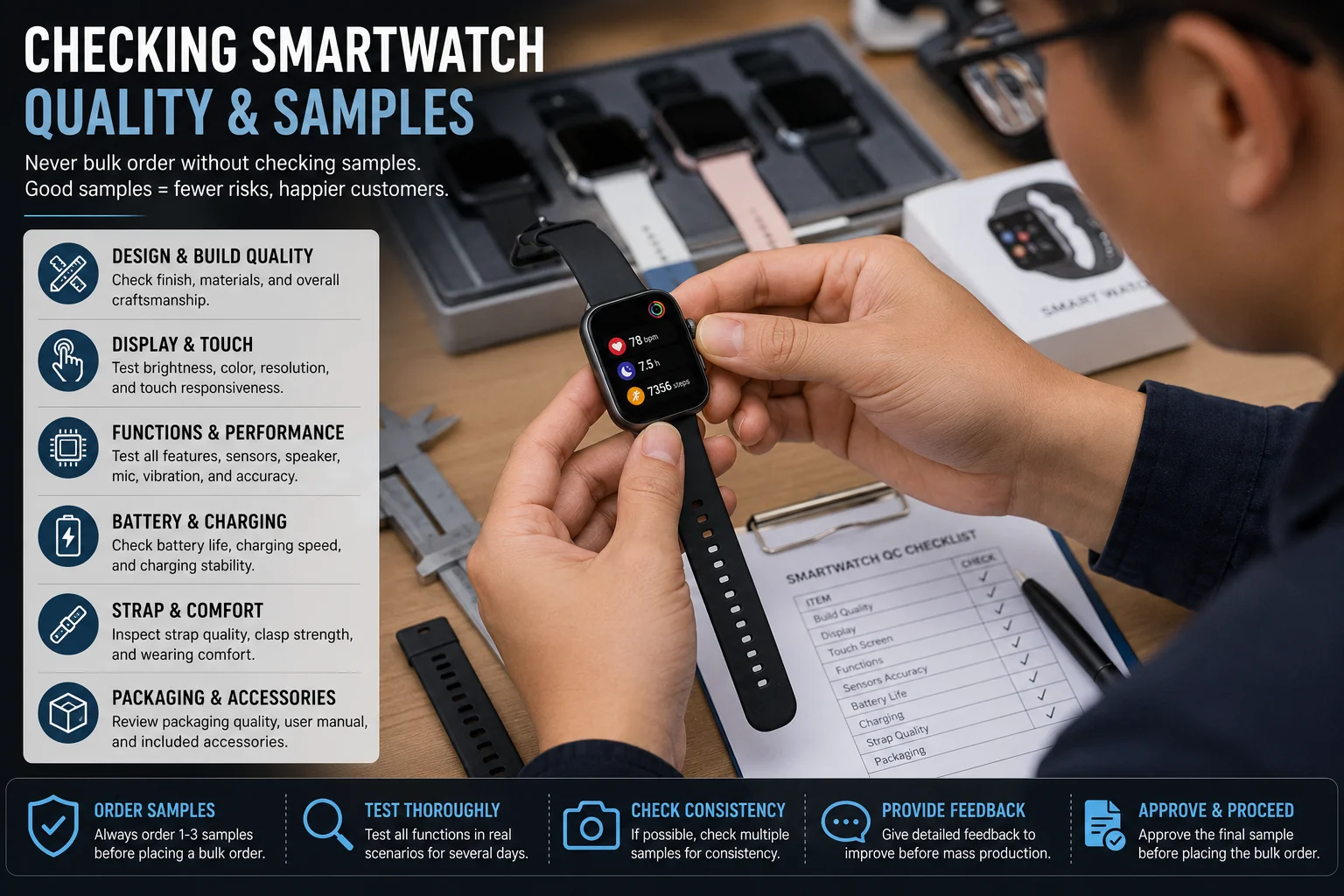
Getting a sample is the single most important step you can take. When you get it, don't just look at it. Use it. Wear it for a week. Connect it to your phone, check the app's stability, see how bright the screen is outdoors, and feel the quality of the strap. Next, ask for the paperwork. A reliable supplier will have certifications like CE (for Europe), RoHS (for materials safety in Europe), and FCC (for the US)7 ready to send you. If a supplier says, "we can get it for you," that's a red flag. It often means you will have to pay for the testing yourself.
Battery performance is a major cause of customer complaints. Suppliers often advertise "standby time," which is useless.8 I had a client who was impressed by a competitor's "30-day standby" claim. But when he tested it, the battery died in 3 days of normal use. Our watch, which we advertise with a realistic "7-10 day typical use" claim, actually performed better for the end customer. Test it yourself: charge the sample to 100%, connect it, enable notifications, and see how many days it actually lasts.
What Are the MOQ, Unit Price, and Packaging Options for Wholesale Orders?
You need to know the numbers to see if a product is profitable for you. Hidden costs or a high Minimum Order Quantity (MOQ) can destroy your margins before you even place your first order.
For private label smartwatches, MOQs usually start at 500–1,000 units9. The unit price ranges from $10 to over $50, depending on specs. Standard packaging is a neutral box, but you can customize it with your brand's design for a small extra fee and a slightly higher MOQ.
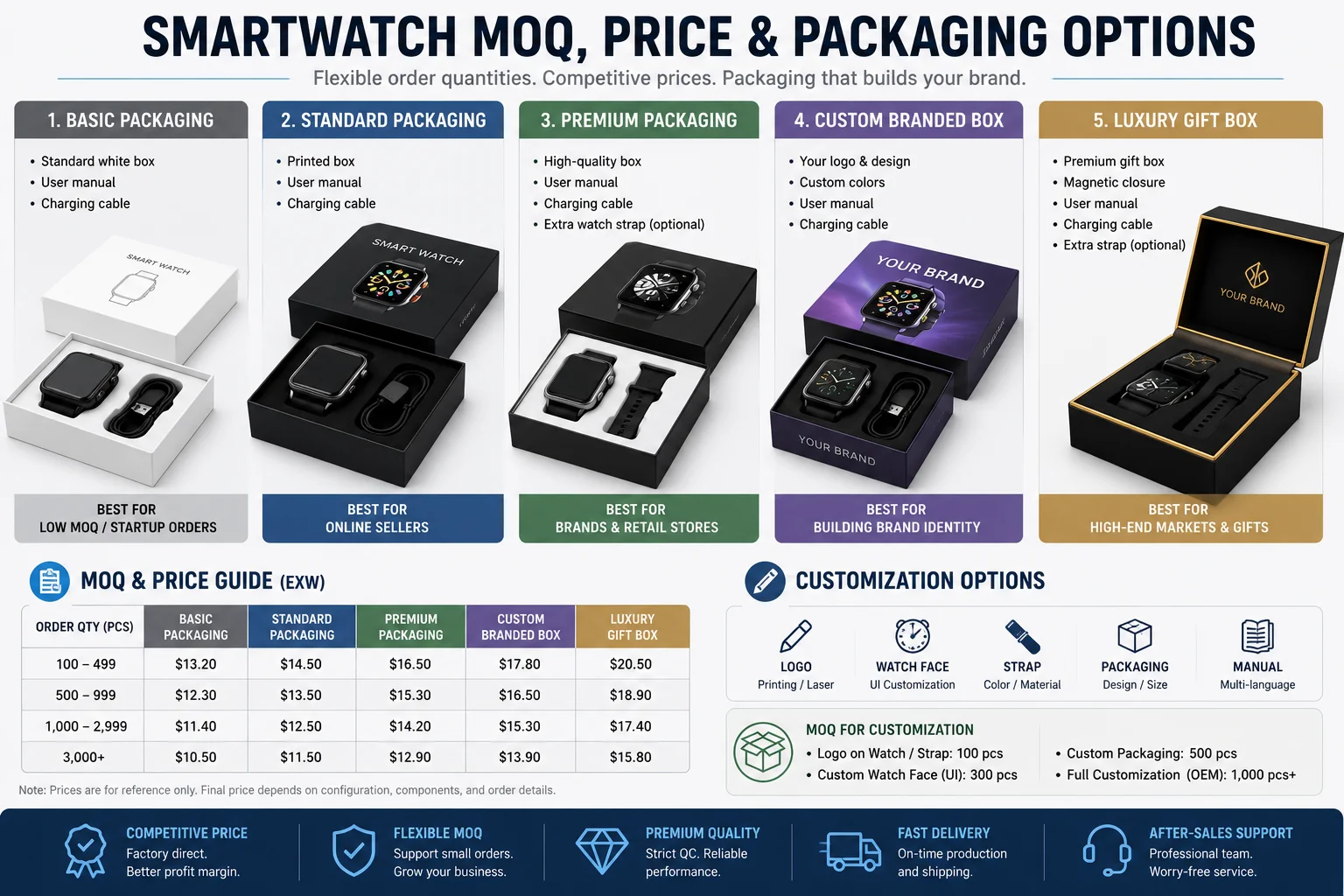
When a new client asks for the price, my first question is always, "What's your target quantity and do you need custom packaging?" This helps me give them an accurate quote. The MOQ exists to cover the factory's setup costs for a production run. For private label orders where we just print a logo on an existing model, the MOQ is usually around 500-1000 pieces. For a fully custom OEM project, the MOQ starts at 3,000-5,000 pieces because we have to create new molds. The price depends entirely on the components you choose. A basic fitness tracker can be under $15, while a more advanced watch with a better screen, GPS, and calling features will be in the $25-$40 range. For packaging, you have options. The cheapest and fastest is the factory's standard neutral box. A popular middle ground is a custom-printed paper sleeve that slides over that box. For a truly professional look, we can create a fully custom box with your design, but this usually requires an MOQ of at least 1,000-2,000 pieces and adds about $0.50 to $1.00 per unit.
| Sourcing Option | Typical MOQ | Unit Price Impact | Best For |
|---|---|---|---|
| Wholesale (No Brand) | 100–500 pcs | Base Price | Market testing, small retail shops |
| Private Label (Logo) | 500–1,000 pcs | Base Price + ~$0.10/unit | E-commerce sellers building a brand |
| Custom Packaging | 1,000–2,000 pcs | Base Price + ~$0.50-$1/unit | Established brands wanting a premium feel |
How Can You Avoid Copycat Designs and Low-Quality Smartwatches?
The market is flooded with cheap smartwatches that look like popular brands. Buying a poor-quality copycat can lead to high customer return rates and will quickly destroy your brand's reputation.
To avoid low-quality products, work with established suppliers with a proven export history. Ask for detailed technical datasheets, not just marketing photos. Be very careful if a price seems "too good to be true," as it almost always means cheaper components are being used.
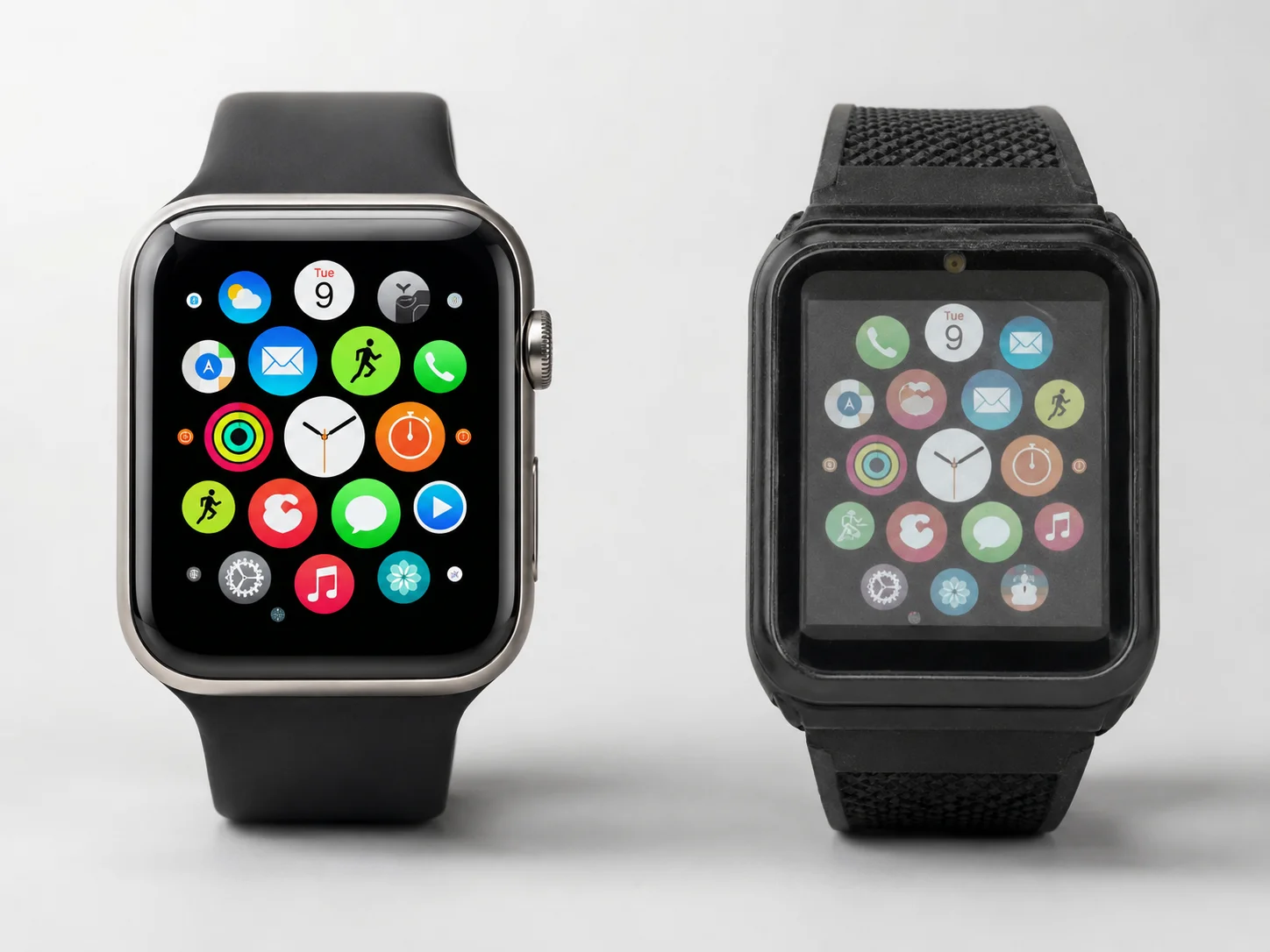
First, it's important to understand the difference between a "public model" and a "copycat." Many factories use the same open mold for the watch case, which is normal and perfectly legal10. A copycat is a product that illegally uses a famous brand's logo or software design to trick customers. The real danger, however, is not the obvious fake but the low-quality lookalike. Two watches can look identical on a website, but one costs $10 and the other costs $20. Why? The $10 version is likely using a cheaper chipset, a dimmer TFT screen instead of a bright IPS screen, a smaller battery, or even a fake sensor that just blinks a green light11.
I always tell buyers to ask the hard questions: "What is the exact chipset model?" and "Who is the manufacturer of the screen?" A good, transparent factory will tell you instantly. A supplier who is hiding something will give a vague answer like "a good quality one." That's a major red flag. Paying a few dollars more per unit to a reputable supplier is an investment in quality. It will save you much more in the long run from customer returns and bad reviews.
What About Lead Time, Shipping, and After-Sales Support?
Placing your order is just the beginning of the process. Long production delays, shipping problems, or no support for defective units can turn a profitable order into a complete disaster.
Standard lead time for a private label smartwatch order is 20–30 days after the deposit is paid. Shipping by air freight to Europe or the US takes 7–10 days, while sea freight takes 30–40 days12. For after-sales, only work with a supplier who offers a 12-month warranty.
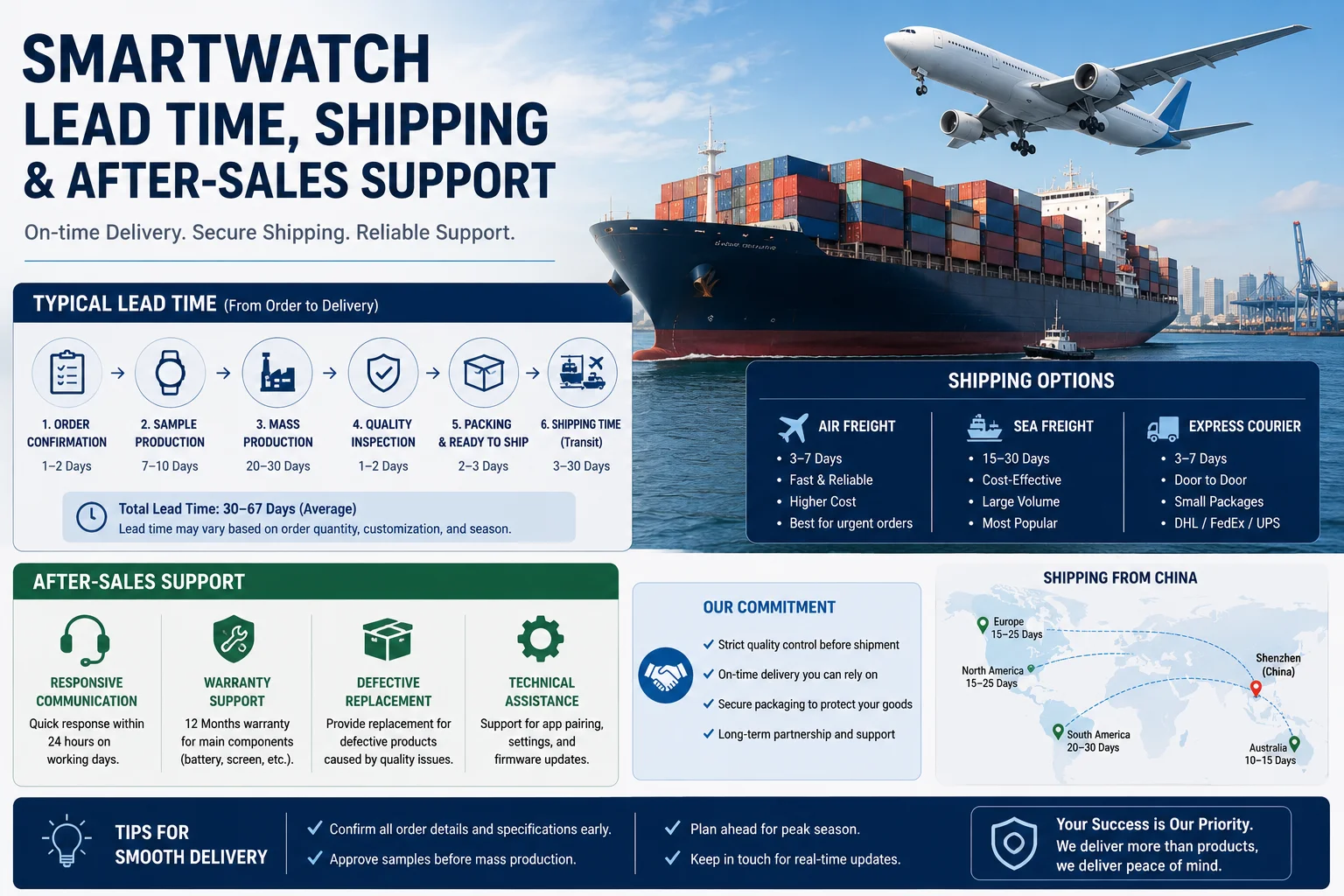
Let's break down the timeline. The "lead time" is the time it takes for production. For most private label orders, this is 20-30 days. This clock starts after you have paid the deposit and confirmed the final production sample. For new OEM projects, the lead time is much longer. Once the product is ready, you have to choose your shipping method. Air freight is fast but expensive, best for small, urgent orders. Sea freight is much cheaper but slow, best for larger, planned stock replenishments.
But what happens after you get the goods? A common question I get is, "What if some units are defective?" This is a critical point to discuss before you place the order. As a company, we provide a 12-month warranty. We also typically include a 1% buffer of free spare parts or extra units in the shipment to help you handle any occasional defects quickly. For any larger issues, we have a clear policy for replacement. A good partner stands behind their product. If a supplier is vague about their warranty policy, you should not work with them.
| Shipping Method | Cost | Speed | Best For |
|---|---|---|---|
| Air Freight | High | 7–10 Days | Small, urgent orders or initial market tests. |
| Sea Freight | Low | 30–40+ Days | Large, planned inventory orders to maximize profit. |
What's My Final Buying Advice? Start Small, Test Demand, Then Scale.
You have all this information, but you might still feel overwhelmed. Jumping in with a huge order is a massive risk if you're not sure the product will sell in your market.
My best advice is to start with a small wholesale or private label order of a proven, popular model. Use this first batch to test your sales channels and get real customer feedback. Then, you can scale confidently.
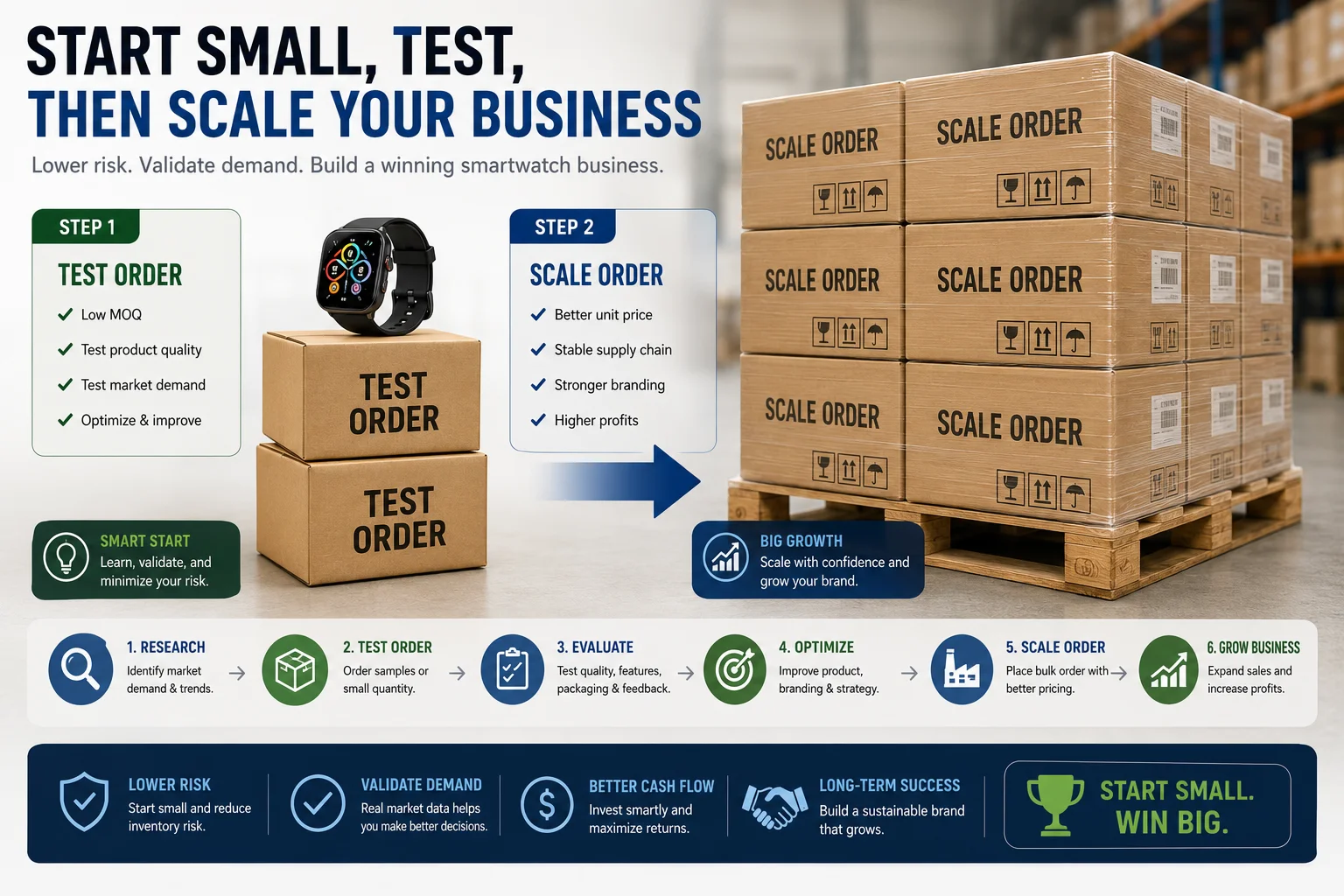
The most successful e-commerce clients I have worked with over the past 15 years almost never start with a big, custom OEM project. They are much smarter than that. They follow a simple, four-step process.
First, they research and talk to 3-5 potential suppliers. They don't just pick the cheapest one.
Second, they order samples from their top 2 choices and test them thoroughly. They wear the watch, test the app, and check the battery life.
Third, they start small. They place a private label order for 500 or 1,000 units. Their goal isn't to have the most unique product on day one. Their goal is to prove they can sell it. This first order is for market validation.
Fourth, they gather feedback and scale. They listen to their first customers. What features do they love? What are their complaints? Once they have this real-world data, they come back to us with confidence, ready to place a larger order of 5,000 or 10,000 units. Sometimes, they use their customer feedback to start an OEM project to build the perfect watch for their audience. This is the smart, low-risk way to build a successful brand.
Conclusion
Choosing the right sourcing model for smartwatches is about matching the risk to your business stage. Start smart with a small order, test your market, and then scale up confidently.
"Made in China 2025: Evaluating China's Performance", https://www.uscc.gov/research/made-china-2025-evaluating-chinas-performance. A research paper or industry analysis can provide evidence of the integrated electronics ecosystem in China, particularly in cities like Shenzhen, which combines large-scale production capabilities, a dense and mature supply chain, rapid product development cycles, and cost advantages. Evidence role: general_support; source type: research. Supports: The claim that China's electronics manufacturing sector is dominant due to its scale, supply chain maturity, innovation speed, and pricing.. ↩
"Inside Shenzhen: The Silicon Valley of hardware - WIRED", https://www.wired.com/story/shenzhen-silicon-valley-of-hardware-wired-documentary/. An article from a reputable business or technology publication can provide context for the nickname 'Silicon Valley of Hardware' as applied to Shenzhen, describing the city's dense ecosystem of component suppliers, factories, and skilled engineers that enables rapid prototyping and manufacturing. Evidence role: historical_context; source type: encyclopedia. Supports: The claim that Shenzhen is widely known as the 'Silicon Valley of Hardware'.. ↩
"How to Estimate Injection Molding Cost? - Formlabs", https://formlabs.com/blog/injection-molding-cost/. A manufacturing industry guide or cost analysis can provide data on the typical cost range for creating new injection molds for consumer electronics, supporting the claim that these fees are a significant upfront investment in OEM projects. Evidence role: statistic; source type: education. Supports: The claim that mold fees represent a significant cost, often in the thousands of dollars.. ↩
"OEM in action: How does electronics manufacturing work? - AIUT", https://aiut.com/us/blog/oem-electronics-manufacturing/. A guide on hardware product development or an industry report can outline the typical stages and timelines for an OEM project—from design and engineering to tooling, prototyping, and mass production—confirming that a 6-12 month period is a standard estimate. Evidence role: general_support; source type: paper. Supports: The claim that a 6-12 month timeframe is a realistic estimate for an OEM project.. ↩
"AMOLED Screen vs IPS LCD Screen Full Comparison ... - YouTube",
. A technical guide or encyclopedia entry can explain the underlying technology of AMOLED and IPS displays, supporting the assertion that AMOLED's self-emissive pixels result in deeper blacks and more vibrant colors, and that this technology generally has a higher manufacturing cost. Evidence role: mechanism; source type: encyclopedia. Supports: The claim that AMOLED screens provide superior color and contrast compared to IPS screens, and are typically more expensive.. ↩"Water Resistant mark - Wikipedia", https://en.wikipedia.org/wiki/Water_Resistant_mark. The International Electrotechnical Commission (IEC) standard 60529 defines the IP Code, specifying that IP67-rated devices are protected against immersion in water up to 1 meter for 30 minutes. The 5ATM rating, governed by ISO 22810, indicates suitability for swimming in shallow water. Evidence role: definition; source type: institution. Supports: The definitions of IP67, IP68, and 5ATM water resistance ratings.. ↩
"CE marking - Wikipedia", https://en.wikipedia.org/wiki/CE_marking. Official documentation from government bodies, such as the European Commission for CE marking and RoHS and the U.S. Federal Communications Commission for FCC, can define the specific legal and technical requirements these certifications entail for electronic products sold in their respective markets. Evidence role: definition; source type: government. Supports: The purpose and regional applicability of CE, RoHS, and FCC certifications.. ↩
"[Discussion] Standby Battery Drain and Why it Matters : r/Android", https://www.reddit.com/r/Android/comments/43q9y4/discussion_standby_battery_drain_and_why_it/. An article from a consumer electronics testing publication or technology review site can explain that 'standby time' measures a device's battery life with minimal to no usage, which is not representative of real-world performance, and that 'typical usage' metrics are more reliable indicators for consumers. Evidence role: expert_consensus; source type: other. Supports: The claim that 'standby time' is a poor indicator of a device's actual battery performance.. ↩
"Comprehensive Guide to Minimum Order Quantity MOQ in China", https://china.docshipper.com/en/sourcing/guide-to-minimum-order-quantity-requirement-in-china/. A guide on sourcing from China or a manufacturing industry overview can provide data or expert consensus on typical Minimum Order Quantities (MOQs) for private label consumer electronics, supporting the stated range as a common starting point for negotiation with factories. Evidence role: statistic; source type: education. Supports: The claim that a 500-1,000 unit MOQ is standard for private label smartwatches.. Scope note: Actual MOQs can vary significantly based on the factory, product complexity, and level of customization. ↩
"Differences Between Closed Molding vs Open Molding", https://www.osborneindustries.com/news/differences-closed-molding-vs-open-molding/. A manufacturing or international sourcing guide can define the term 'open mold' (or 'open tooling') as a factory-owned design and tool that is available for use by multiple clients, distinguishing it from a 'private mold' which is exclusive to one client. This practice is a standard and legal part of the private label industry. Evidence role: definition; source type: education. Supports: The definition of 'open mold' and its status as a common, legal manufacturing practice.. ↩
"Do Not Use Smartwatches or Smart Rings to Measure ...", https://www.fda.gov/medical-devices/safety-communications/do-not-use-smartwatches-or-smart-rings-measure-blood-glucose-levels-fda-safety-communication. An investigative report or product teardown from a technology journalist or electronics expert can provide evidence of low-cost smartwatches being sold with components, such as heart rate sensors, that are non-functional and designed only to mimic the appearance of a real sensor. Evidence role: case_reference; source type: other. Supports: The claim that some low-cost smartwatches contain non-functional or 'fake' sensors.. ↩
"A Breakdown of China to USA Shipping Time - Dimerco", https://dimerco.com/blog-post/a-breakdown-of-china-to-usa-shipping-time/. Data from a logistics provider or an international trade publication can corroborate the average transit times for freight from major Chinese ports to the US and Europe, confirming that air freight typically takes around a week and sea freight takes over a month. Evidence role: statistic; source type: research. Supports: The typical transit times for air and sea freight from China to the US and Europe.. Scope note: These times are estimates and can be affected by port congestion, customs delays, and other logistical factors. ↩