GaN charger safety is a serious concern for retailers, importers, and e-commerce sellers because a compact high-wattage charger can create costly returns, compliance problems, and reputation damage if its design is weak. The good news is that GaN technology can be safe when the complete charger is properly engineered, tested, certified, and manufactured consistently.
A properly designed GaN charger is safe for everyday use, but safety does not come from GaN material alone. GaN charger safety depends on thermal management, protection ICs, insulation, fire-retardant enclosure materials, reliable components, certified designs, and stable production quality. Buyers should verify each charger model, its target market documents, and its factory quality-control process before importing or listing it for sale.
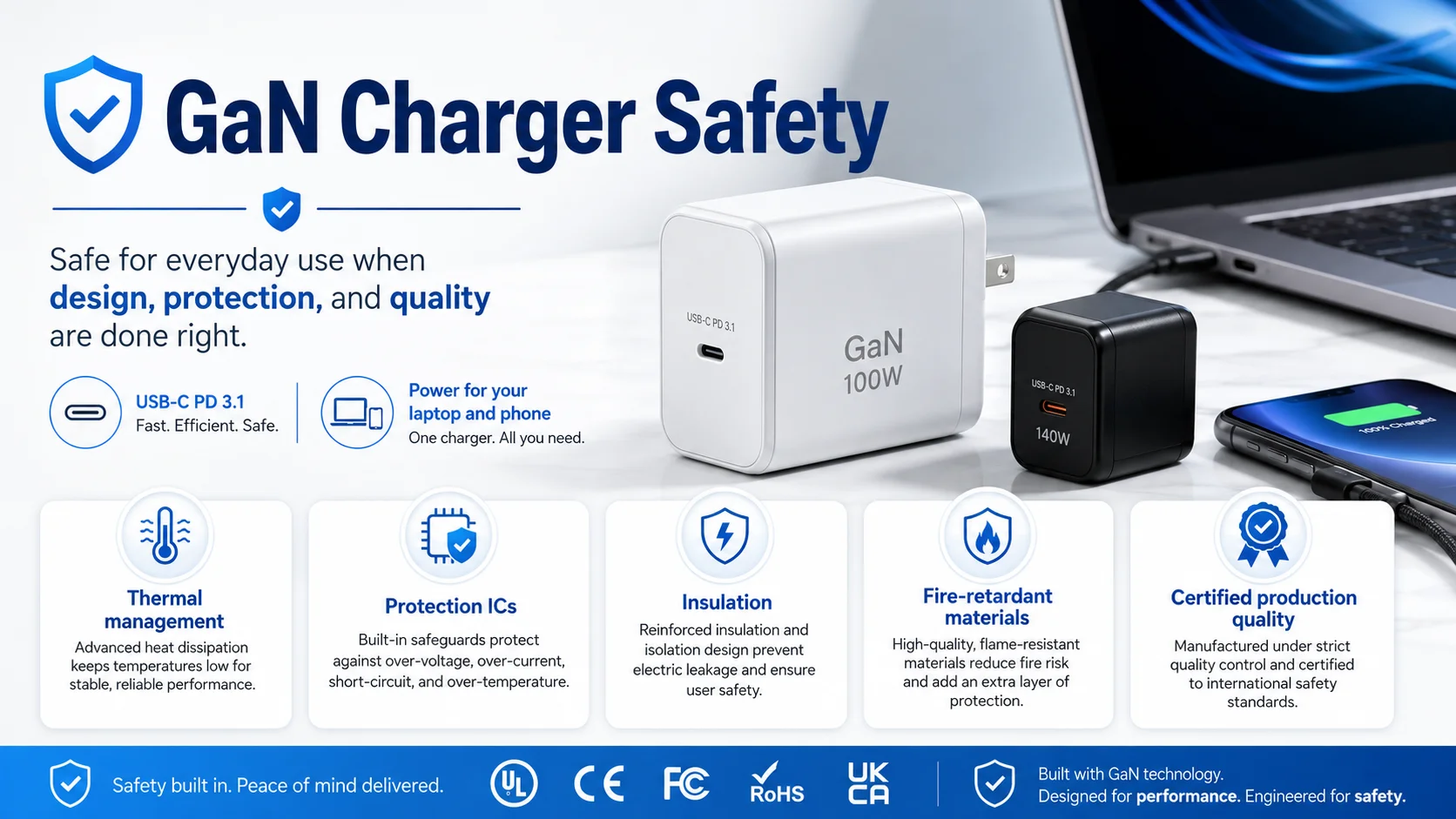
From our experience as a Shenzhen 3C manufacturer with 15 years of export work, we know that buyers rarely ask only about wattage anymore. They ask about charger heat, fire risk, certifications, returns, and batch consistency. Those are the right questions to ask before choosing an OEM or wholesale GaN charger supplier.
Are GaN Chargers Safe for Everyday Use?
Many buyers see a small 65W, 100W, or 140W charger and wonder how it can safely handle so much power. That concern is understandable. A compact product leaves less room for poor design decisions, weak materials, or inconsistent assembly.
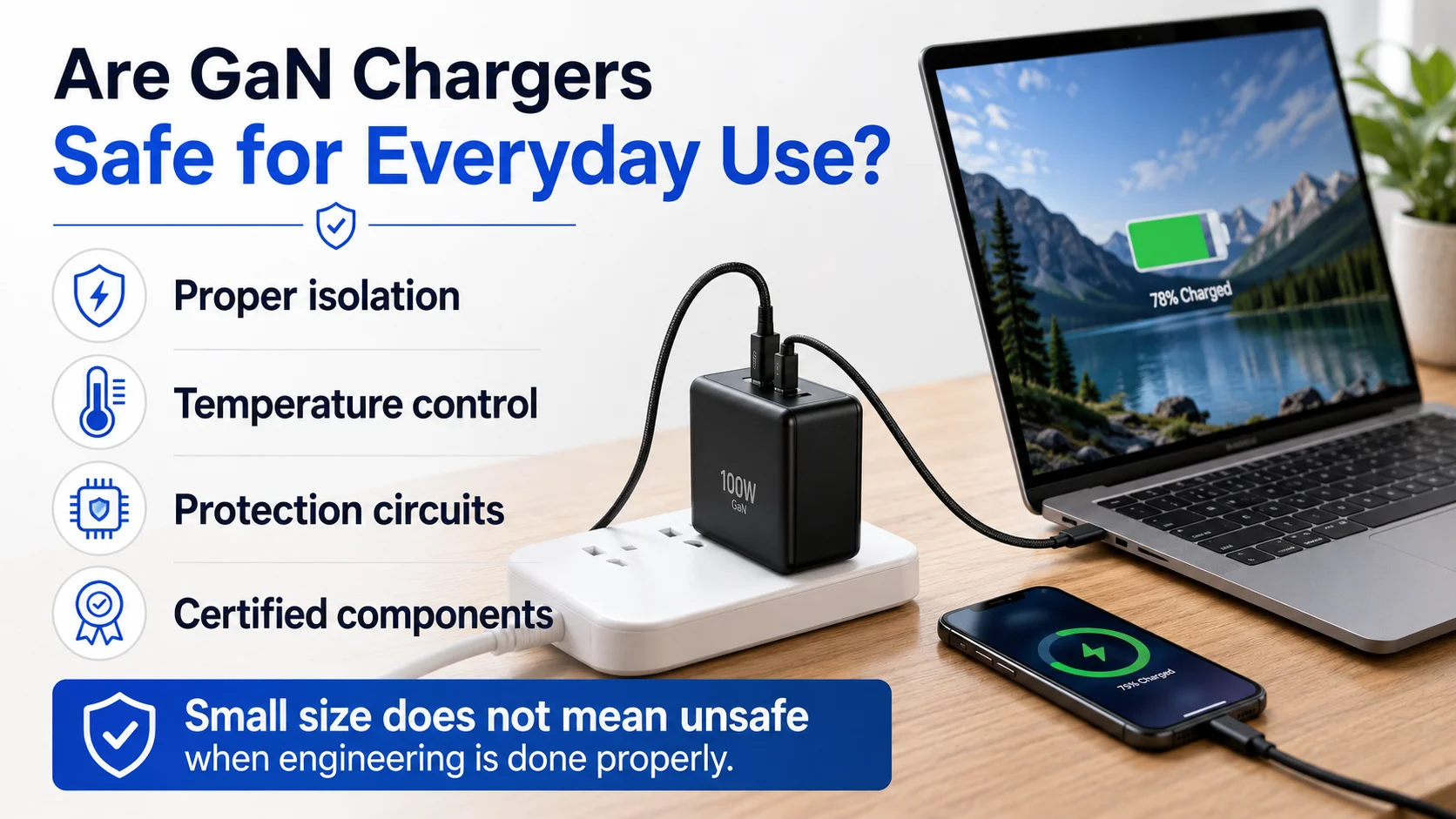
GaN chargers can be safe for everyday use when they are designed with proper electrical isolation, temperature control, protection circuits, and certified components. A well-made GaN charger may deliver high power in a smaller size than a traditional silicon charger, but it still requires responsible engineering and quality control.
GaN does not automatically mean safe or unsafe
Gallium nitride, commonly called GaN, is a semiconductor material used in power electronics. It can switch power more efficiently than conventional silicon in many charger designs.1 This efficiency can help manufacturers create smaller chargers with higher power output.
However, GaN charger safety is a complete-system question. A GaN power chip is only one part of the product. The final safety level also depends on:
- Transformer insulation and creepage distance
- PCB layout and component spacing
- Capacitor quality and voltage rating
- Protection controller design
- USB-C Power Delivery protocol control
- Plastic enclosure material
- Plug and pin construction
- Soldering quality
- Aging tests and final inspection
- Market-specific certification documentation
I have seen buyers ask whether any warmth means a charger is dangerous. In most cases, the better starting point is to understand the actual situation: What power is being delivered? Is the charger used in a hot room? Is it covered by bedding or clothing? Is the cable damaged? Is the connected device requesting high power?
A safe GaN charger should manage ordinary operating heat while responding to abnormal conditions. It should not rely on marketing language alone.
Why Do GaN Chargers Become Warm?
A warm charger can make customers nervous, especially when they are charging a laptop, tablet, smartphone, or power bank overnight. Without context, users may assume that every warm charger has a fire risk. That is not always true.
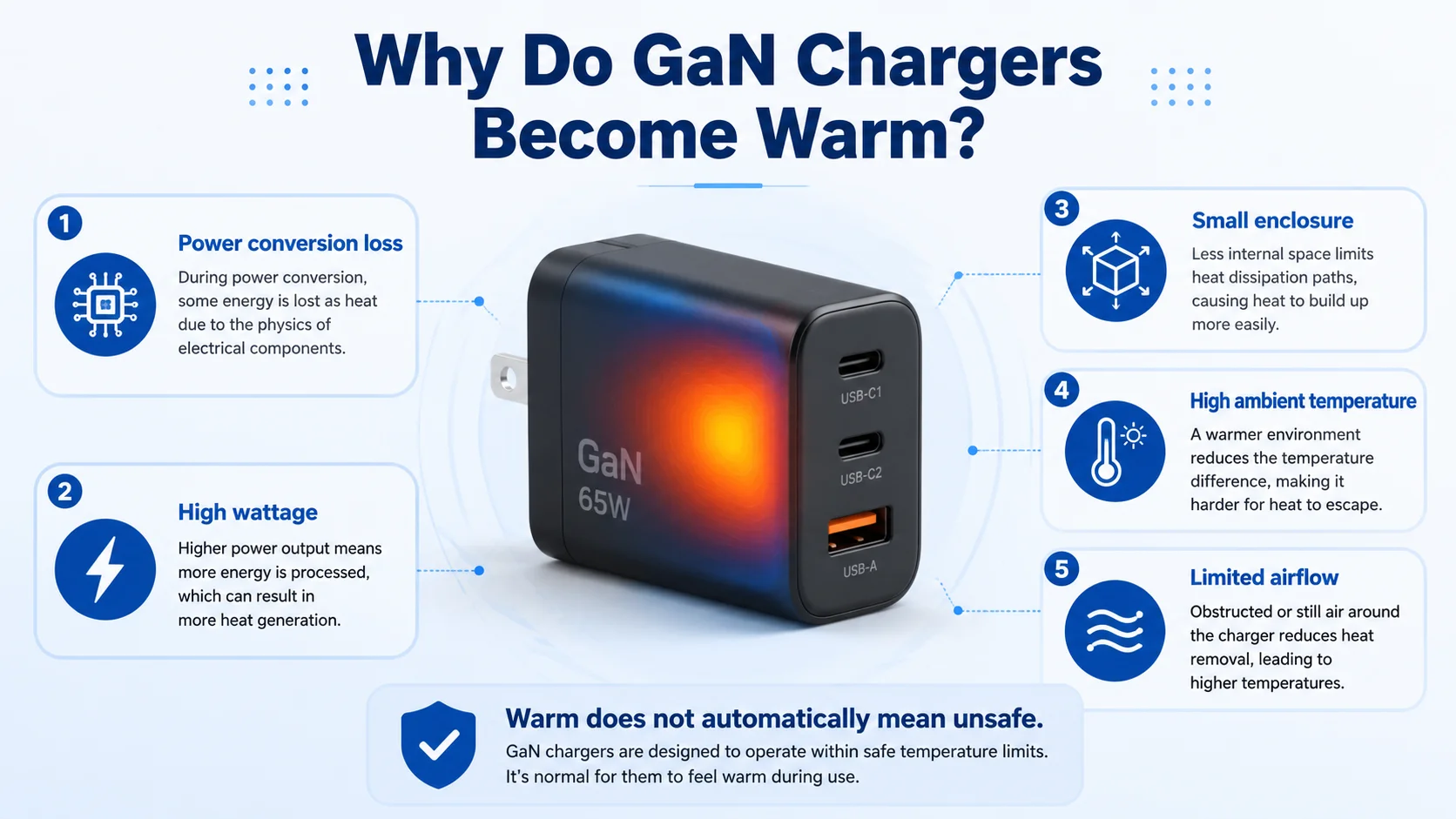
GaN chargers become warm because they convert AC wall power into regulated DC charging power, and no power conversion process is 100% efficient2. Heat can increase with higher charging wattage, small enclosure size, high ambient temperature, limited airflow, or heavy device load.3
Normal warmth versus abnormal overheating
Warmth alone does not prove that a charger is unsafe. A 100W USB-C charger powering a laptop will usually work harder than a 20W phone charger. The enclosure may feel warmer during peak charging, particularly in a warm office, car, warehouse, or travel environment.
Still, buyers and users should not ignore warning signs. A practical review should consider both the charger and the real-world setup.
| Situation | Likely Interpretation | Recommended Action |
|---|---|---|
| Charger feels mildly warm during fast charging | Often normal operating behavior | Check airflow and confirm compatible cable/device use |
| Charger is used in a hot, enclosed area | Heat may build up faster | Move it to an open, ventilated location |
| Charging stops and resumes | Protection or device power management may be responding | Check the charger model, cable, and device load |
| Burning smell, discoloration, crackling, or deformation | Abnormal condition | Stop use immediately and investigate |
| Plug is loose, damaged, or unusually hot | Connection issue may be present | Replace or inspect the charger and socket |
From customer support conversations, we have learned that cables deserve more attention. A damaged USB-C cable, poor connector fit, or cable not rated for the required current can create poor charging performance and unnecessary heat.4 A safe USB-C charger needs a suitable cable and a properly functioning wall socket.
How Does GaN Charger Safety Prevent Overheating?
Overheating can damage internal components, shorten product life, and increase customer complaints. A small GaN charger needs careful thermal planning because high power density leaves little margin for weak layouts or poor materials.
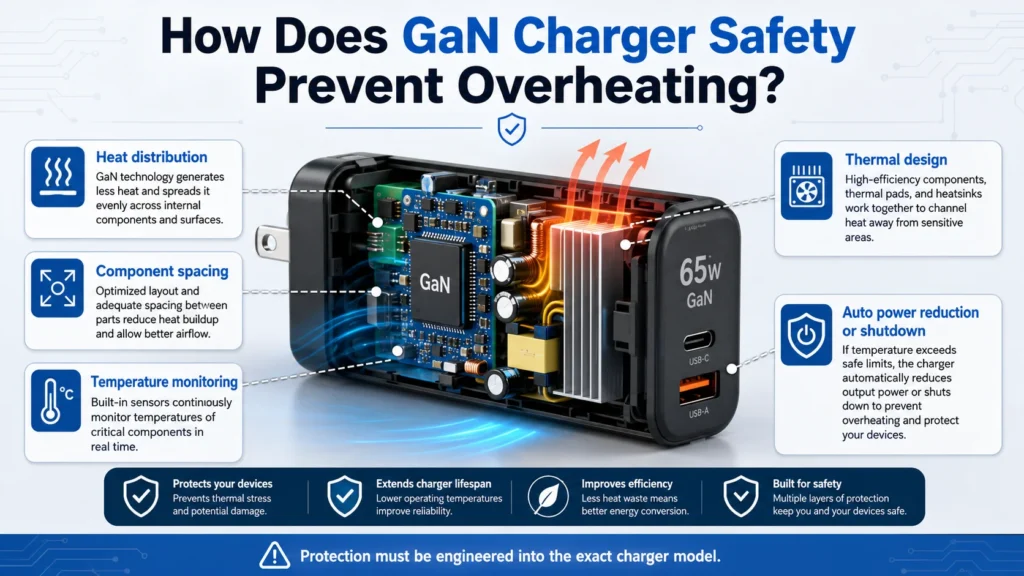
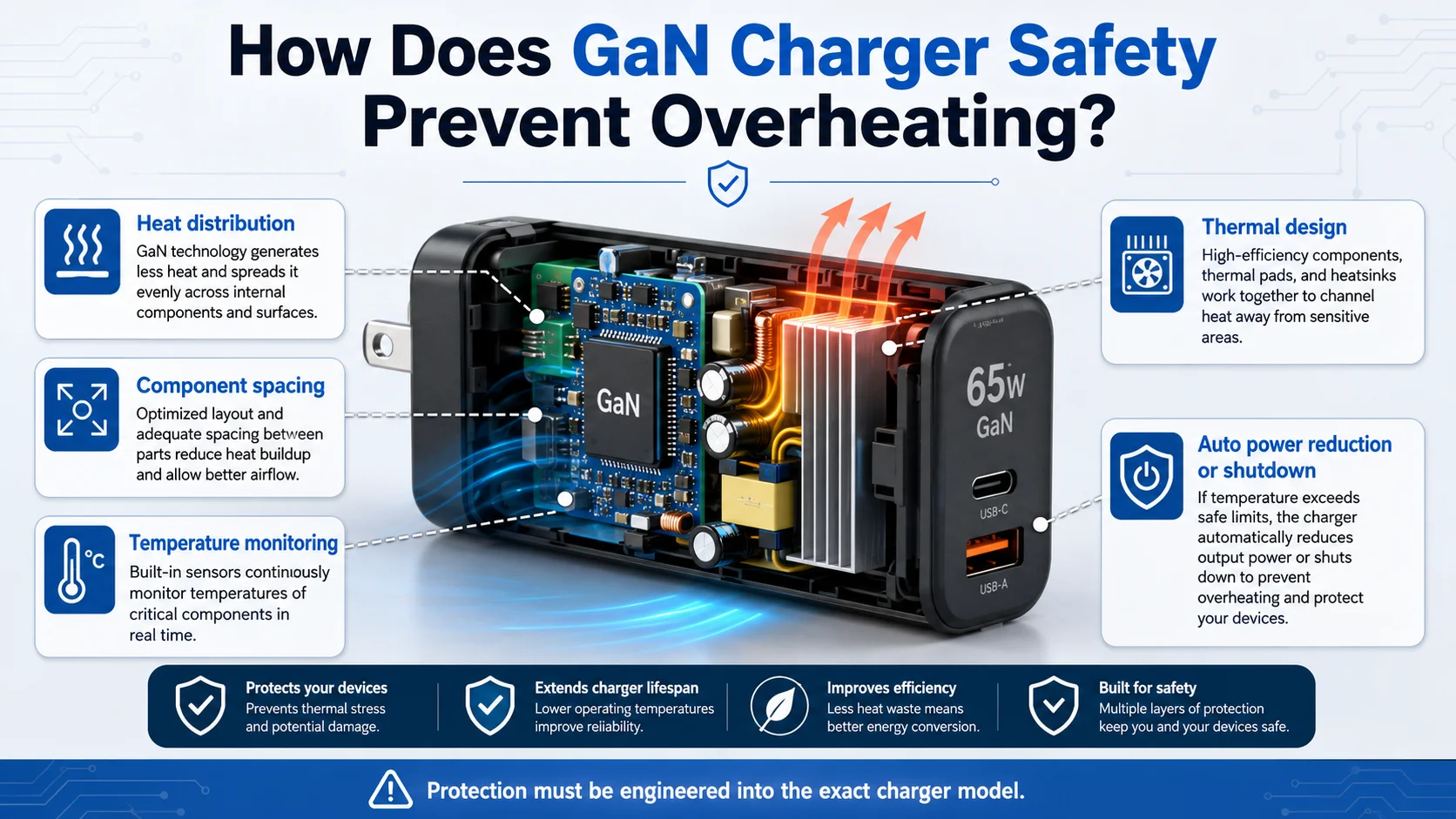
GaN charger safety prevents overheating through thermal design, heat distribution, component spacing, temperature monitoring, and automatic power reduction or shutdown when operating conditions become abnormal5. These safeguards must be engineered into the specific charger model and verified during testing.
Thermal design starts before production
Thermal management is not one component. It is a design process that begins with the circuit board and continues through the enclosure, assembly line, and final test process.
Important thermal design considerations include:
- PCB layout: Power components should be positioned to control heat concentration.
- Copper area and traces: Appropriate conductive paths help distribute heat.
- Internal spacing: Components need sufficient clearance for safety and airflow.
- Thermal interface materials: Depending on the model, pads, compounds, or heat-spreading elements can transfer heat away from critical parts.
- Transformer design: The transformer must be selected and built for the intended power level.
- Ventilation strategy: Some compact wall chargers have limited airflow, so internal heat distribution becomes especially important.
- Temperature sensing: A thermal sensor or controller can detect rising temperature and trigger a response.
Automatic power reduction matters
A responsible charger design may reduce output power before conditions become unsafe. This is often more useful than a simple on-or-off concept. When a charger detects excessive temperature, it may limit power delivery, pause charging, or shut down depending on the design.
For B2B buyers, I recommend asking a supplier practical questions:
- Does this exact model include overtemperature protection?
- What is the intended thermal test method for the model?
- Is the thermal protection function documented in the specification or test record?
- Does the supplier conduct aging tests after assembly?
- How does the factory control changes to key thermal components?
Those questions are more meaningful than simply asking whether the charger uses GaN.
How Do Fire-Retardant Materials Improve GaN Charger Safety?
Fire prevention is one of the biggest concerns for charger importers. A charger may look clean and modern on the outside, but its enclosure material, insulation structure, plug quality, and internal assembly determine whether it is suitable for demanding use.
Fire-retardant materials improve GaN charger safety by reducing the chance that the enclosure contributes to flame spread during a serious electrical fault.6 Safe charger construction also requires suitable insulation, secure plug components, strong enclosure assembly, and controlled material sourcing.
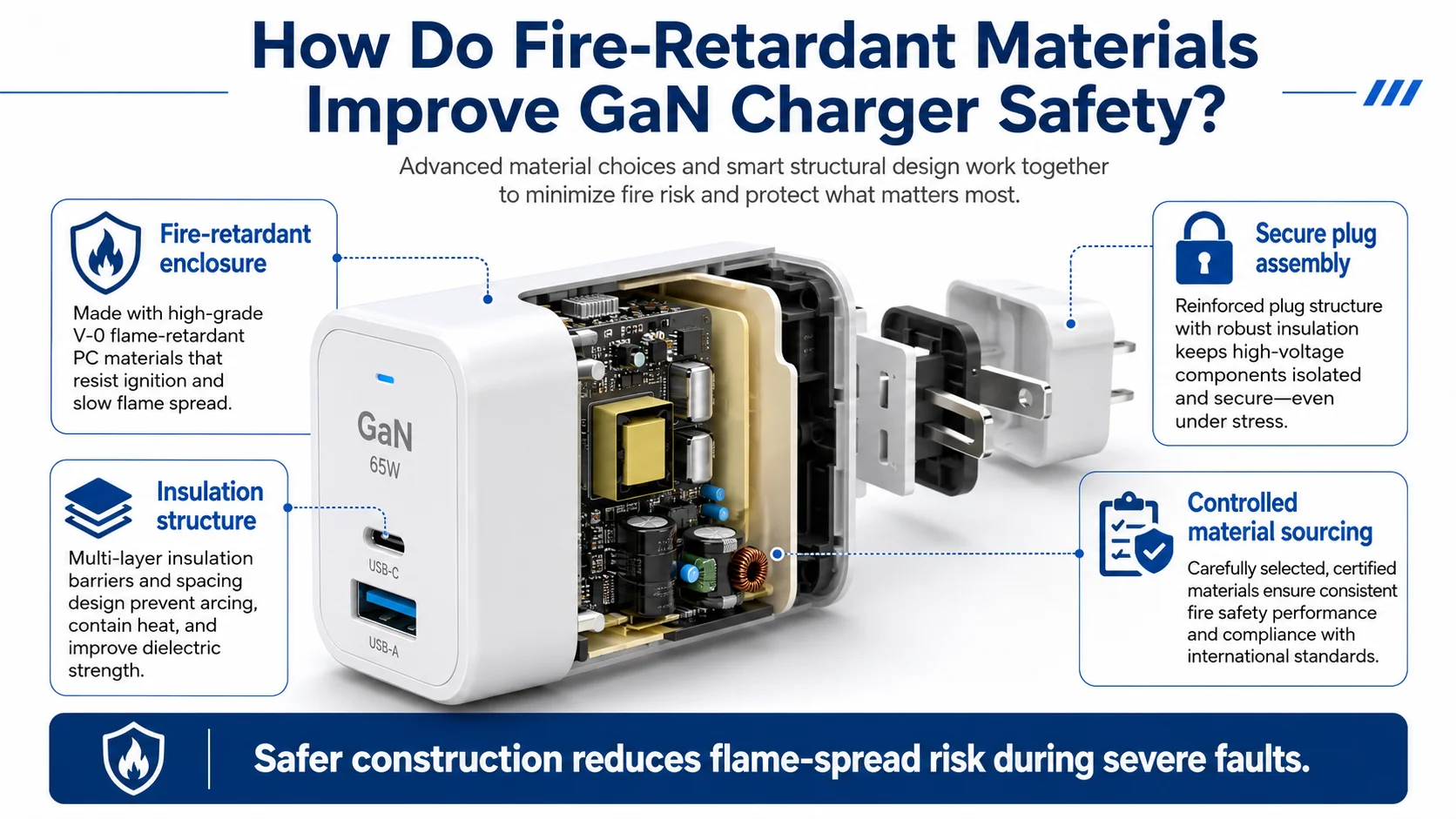
The enclosure is not just cosmetic
A charger enclosure protects users from live electrical parts, mechanical damage, and heat. For that reason, buyers should review more than color, logo placement, and surface finish.
A well-considered enclosure design should address:
- Flame-retardant plastic specification
- Wall thickness and structural strength
- Heat resistance near internal power components
- Reliable ultrasonic welding, screws, or enclosure joining method
- Pin retention and plug stability
- Insulation barriers between high-voltage and low-voltage sections
- Consistent material sourcing across production batches
Low-grade or uncontrolled recycled material can create uncertainty in strength, heat resistance, color consistency, and flame performance. This does not mean every recycled material is unsuitable. It means the supplier should be able to explain what material is used, how it is controlled, and whether it matches the product’s compliance requirements.
Plug quality also affects charger fire risk
A loose plug connection can create resistance and heat at the socket contact point.7 This issue may come from the charger plug, the wall outlet, or both. For UK, EU, US, and other regional plugs, the physical construction and applicable requirements differ.
When we discuss a project with an importer, we encourage them to confirm the target plug type early. A charger cannot be evaluated only by its USB-C output. The AC input side, plug design, insulation, and regional compliance route matter just as much.
How Do Protection ICs Support GaN Charger Safety?
Customers expect modern chargers to respond when something goes wrong. A short circuit, power surge, unstable input, damaged cable, or excess heat can happen in real use. Without coordinated protection functions, a compact high-power charger carries unnecessary risk.
Protection ICs support GaN charger safety by monitoring voltage, current, temperature, and fault conditions. Depending on the model, the charger may limit output, disconnect power, or shut down during overvoltage, overcurrent, overpower, short-circuit, overheating, surge, or electrostatic events.8
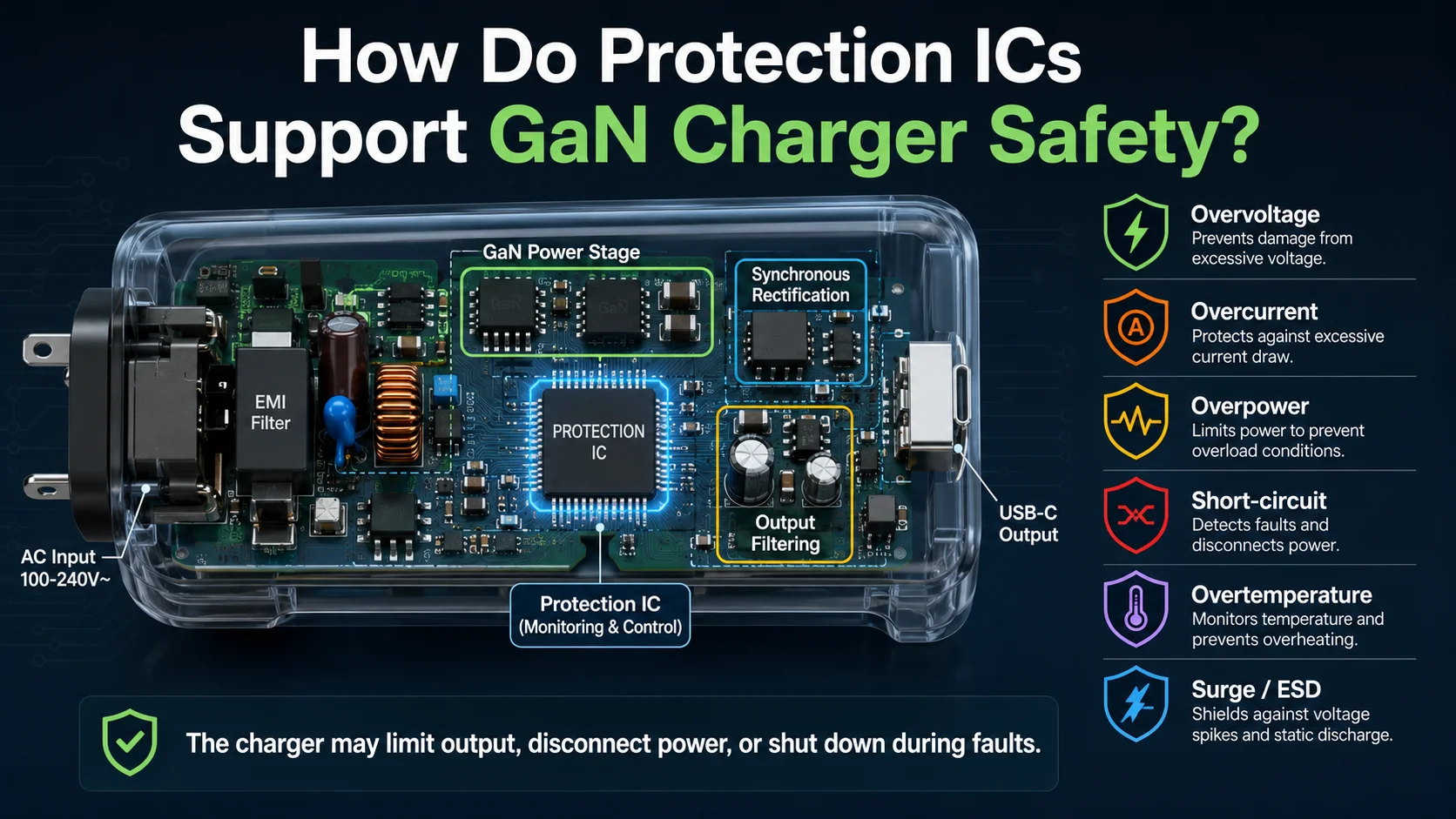
Common USB-C charger protection functions
The following functions are commonly discussed in charger specifications. Actual functions and performance must always be confirmed for the exact model.
| Protection Function | What It Helps Address |
|---|---|
| Overvoltage protection | Output voltage above the intended limit |
| Overcurrent protection | Excess current draw |
| Overpower protection | Output demand beyond the designed power range |
| Short-circuit protection | Fault between output conductors |
| Overtemperature protection | Excess internal temperature |
| Input surge protection | Temporary voltage disturbances |
| Electrostatic discharge protection | Static electricity events at ports or controls |
Seven layers of protection should be specific
In our OEM discussions, we sometimes describe a seven-layer protection approach. This should never be treated as a vague marketing slogan. For a specific model, the seven layers should correspond to real design features and records that a buyer can review:
- Input surge protection
- Overvoltage protection
- Overcurrent protection
- Overpower protection
- Short-circuit protection
- Overtemperature protection
- Electrostatic discharge protection
The actual implementation may differ by charger model, port configuration, and power rating. A responsible supplier should provide a specification sheet, applicable test information, and clarification about which protections apply to each SKU.
How Does Component Quality Affect GaN Charger Safety?
A charger can have a good-looking enclosure and a strong product listing, yet still perform poorly if key internal components are inconsistent. This is where production control becomes important for wholesalers and private-label brands.
Component quality affects GaN charger safety because the GaN power device, transformer, capacitors, controller ICs, MOSFETs, connectors, and solder joints must all perform reliably under expected electrical and thermal conditions. Stable sourcing and incoming inspection reduce batch-to-batch risk.
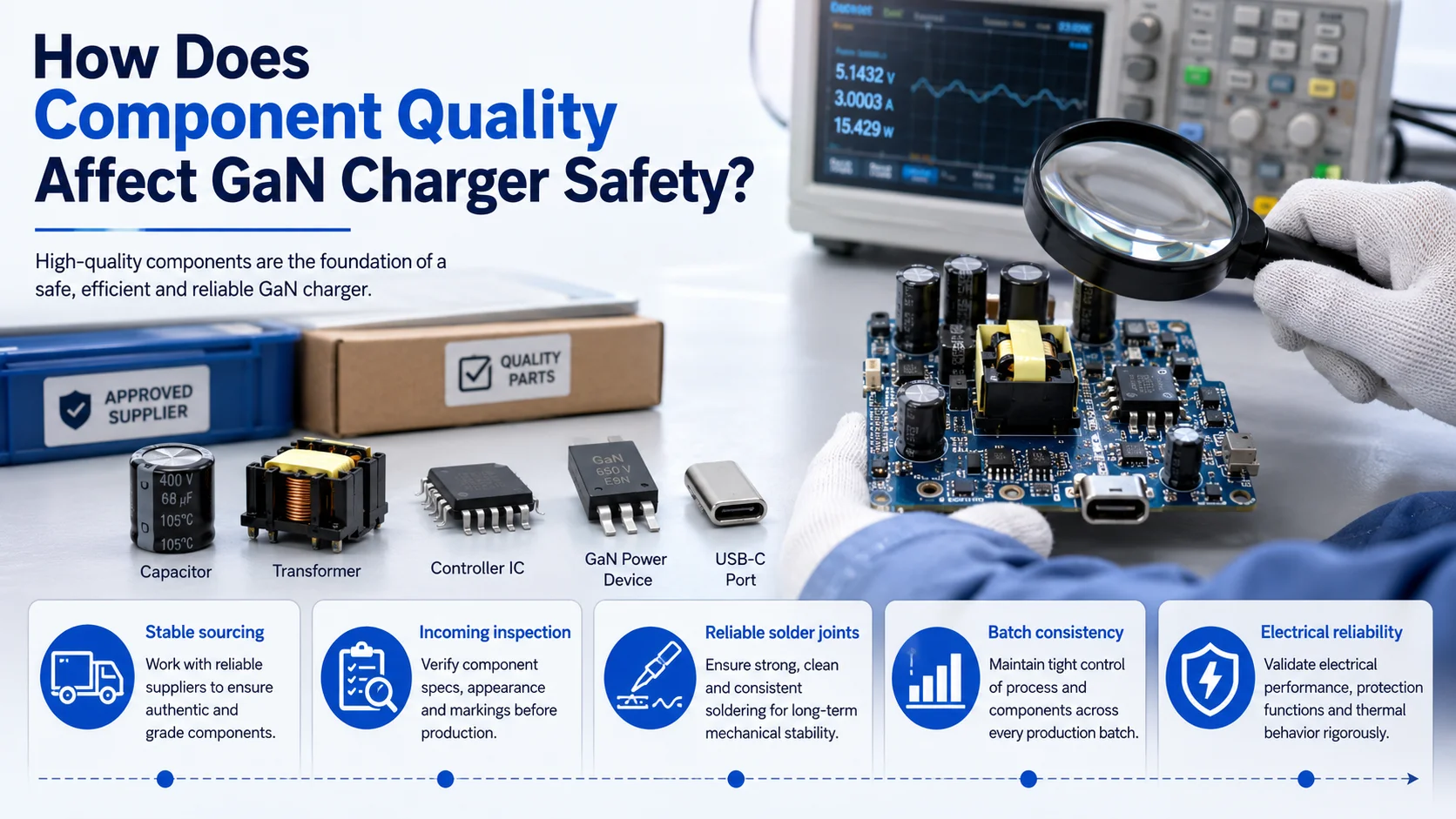
Parts that deserve buyer attention
Buyers do not need to become electrical engineers. However, they should understand which components influence reliability.
- GaN power chips: These manage high-frequency power switching.
- Control ICs: These help regulate power delivery and protection responses.
- Transformers: These support voltage conversion and electrical isolation.
- Capacitors: These must withstand the intended voltage, ripple, and operating environment.
- MOSFETs and rectification components: These affect conversion control and efficiency.
- USB-C connectors: These must maintain stable connection performance.
- Solder joints: Poor soldering can lead to intermittent performance or localized heat.
Production consistency is a safety issue
A prototype can perform well while later batches change because of substituted components, uncontrolled suppliers, or rushed assembly.9 That is why B2B customers should ask how the factory manages engineering changes and incoming materials.
At our factory, buyers often request a component list, sample confirmation, and pre-shipment inspection process. Those requests are reasonable. They help both sides avoid disputes after the goods reach an Amazon warehouse, retail distribution center, or local importer.
What Is the Difference Between a Safe GaN Charger and a Low-Quality GaN Charger?
The biggest sourcing mistake is comparing chargers only by wattage, unit price, and appearance. Two 65W GaN chargers can look nearly identical but have very different design controls, documentation, and production consistency.
A safe GaN charger is supported by documented thermal design, suitable materials, verified protection functions, controlled components, and applicable compliance records. A low-quality GaN charger may lack clear traceability, consistent testing, or model-specific documentation, creating higher return and compliance risk for buyers.
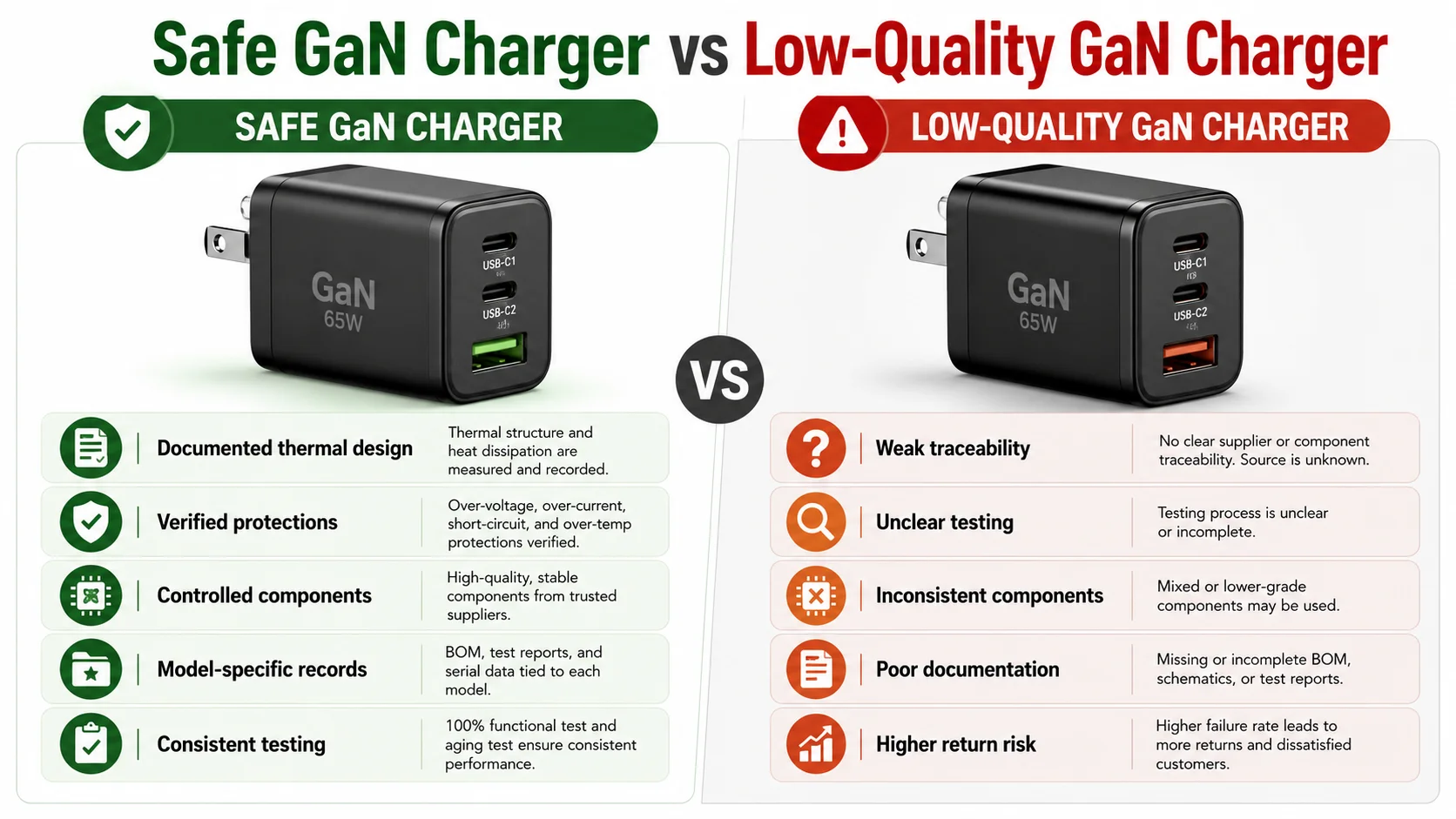
| Evaluation Area | Safer, Better-Controlled GaN Charger | Higher-Risk, Poorly Controlled Charger |
|---|---|---|
| Thermal design | Documented component layout and heat management | Limited explanation of heat control |
| Enclosure material | Defined material specification | Unclear material source or grade |
| Protection features | Model-specific protection list | Generic claims without documents |
| Components | Traceable, controlled sourcing | Frequent unapproved substitutions |
| Aging test | Defined aging or burn-in process | No clear production test process |
| Certification | Applicable documents for stated model/market | Unverified or mismatched documents |
| Temperature response | Protection strategy explained | No stated thermal response |
| Quality control | Incoming, in-process, and final checks | Reliance on final appearance inspection only |
A lower quoted price is not automatically a problem. Yet a buyer should understand what is included in that price. If a supplier cannot explain its materials, protections, testing, and documentation, the lower cost may move risk downstream to the importer.
Which Certifications Should a GaN Charger Have?
Certification questions can become confusing because the required documents depend on the destination market, charger specification, plug type, and sales channel. A certificate mark should be reviewed carefully, not assumed to cover every product variation.
GaN charger safety certifications should match the intended market and exact charger model. Buyers commonly need to consider electrical safety, EMC, energy efficiency, and environmental compliance, but the required standards and documents vary by country, product configuration, and import route.10
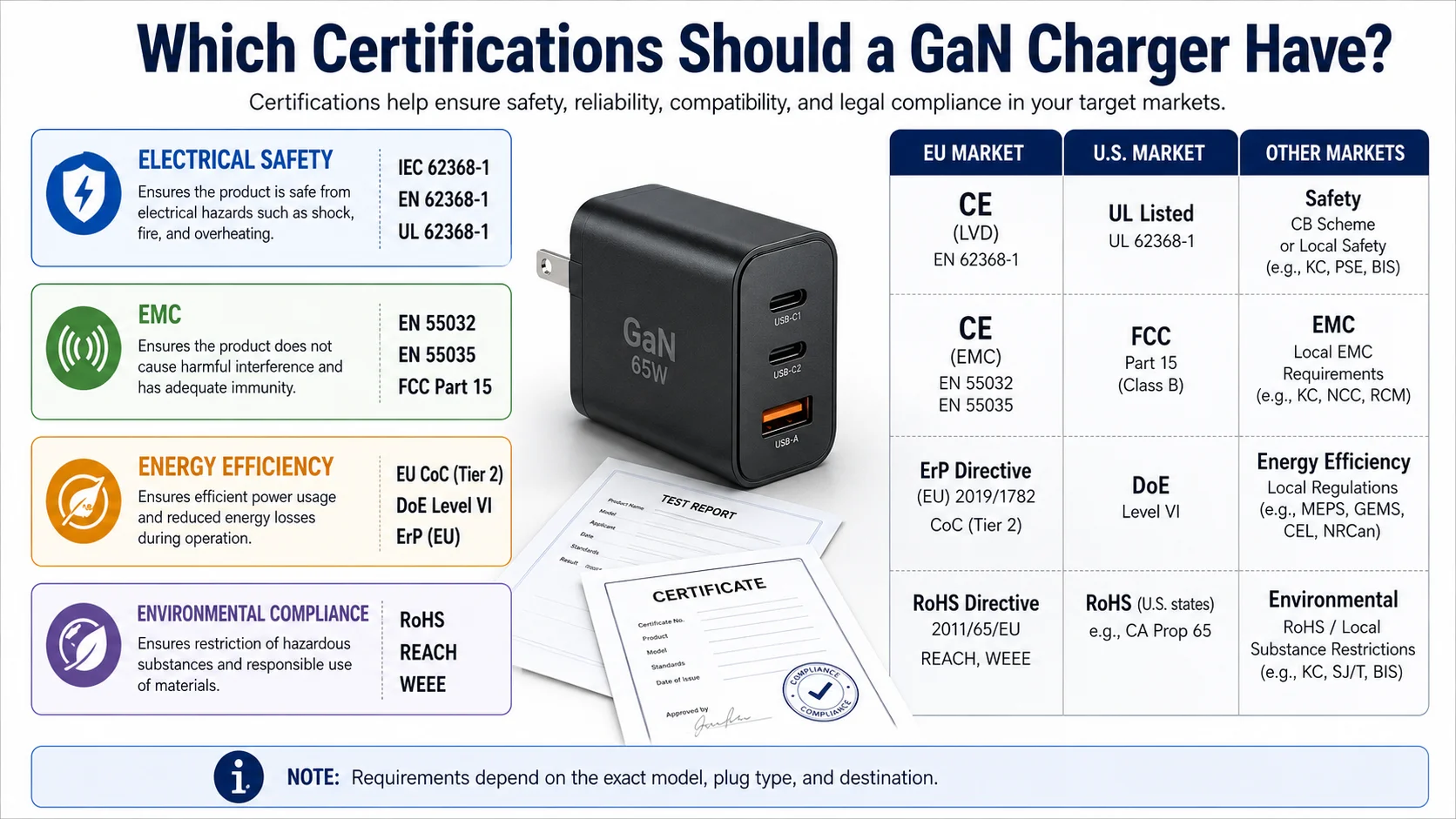
Common compliance areas for export markets
For European and North American customers, common compliance conversations may include:
- Electrical safety: Product safety requirements for the relevant market
- EMC: Electromagnetic compatibility requirements
- Energy efficiency: External power supply efficiency rules where applicable
- RoHS: Restrictions on certain hazardous substances for relevant markets
- REACH: Chemical compliance considerations for EU sales
- FCC: Relevant electromagnetic requirements for the US market
- CE: EU conformity marking based on applicable directives and documentation
- UKCA: UK conformity requirements where applicable
Certification requirements are not universal. A report for one wattage, plug version, factory, or product revision may not automatically apply to another.11 We encourage buyers to check:
- Is the document linked to the exact model number?
- Does the product photo and specification match the offered charger?
- Is the issuing organization identifiable?
- Is the target market correct?
- Has the design changed since the document was issued?
How Can You Source a Safe GaN Charger Manufacturer?
Choosing a safe GaN charger manufacturer can feel difficult because every supplier may claim strong quality and multiple protections. The real challenge is separating clear evidence from broad promises before you place a large order.
To source a safe GaN charger manufacturer, buyers should verify the exact model’s safety design, protection functions, test records, certification scope, component control, aging process, quality inspection steps, MOQ, lead time, and after-sales process. The supplier should answer technical and documentation questions clearly.
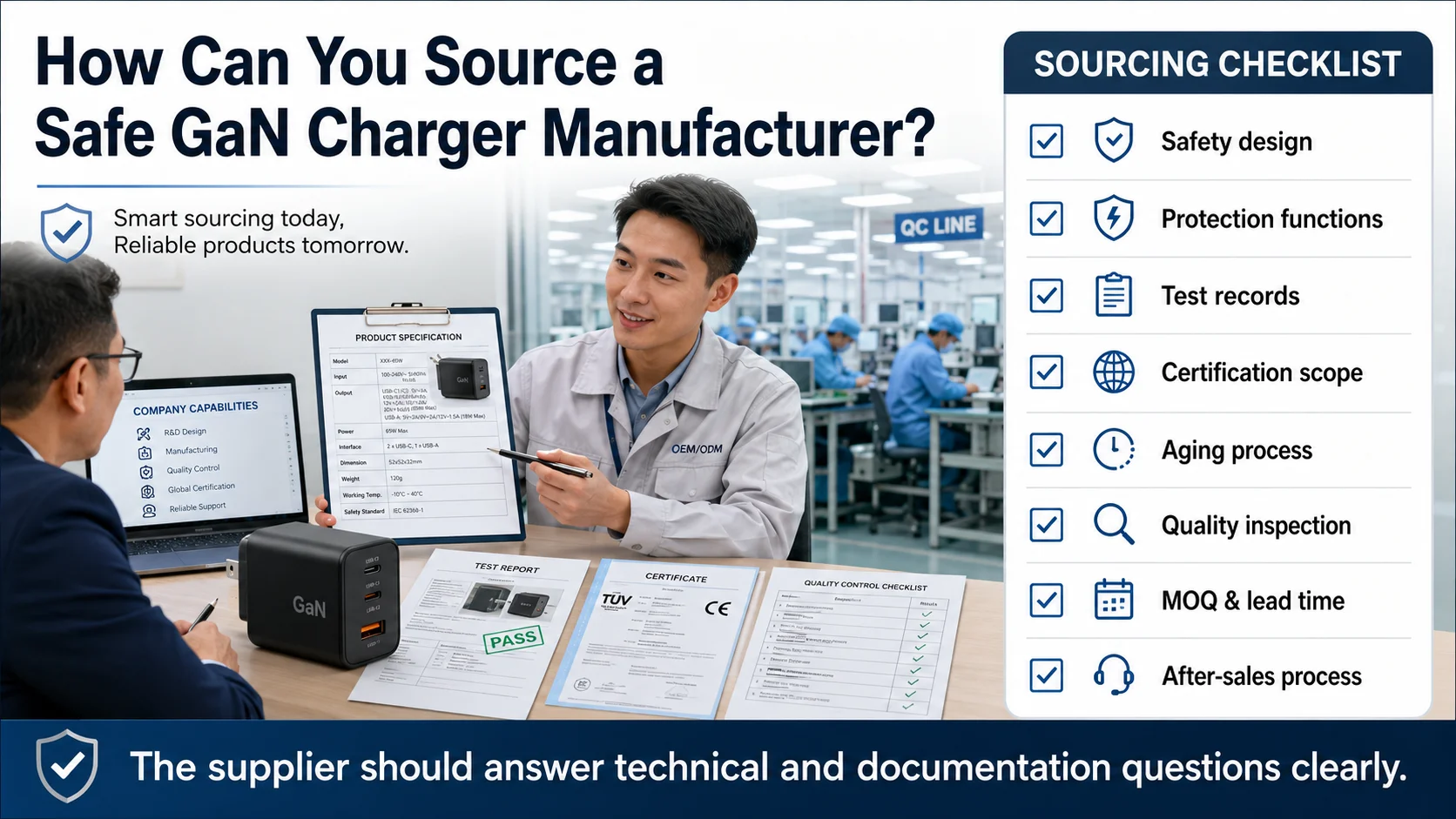
A practical supplier-verification checklist
Before placing an OEM, wholesale, or private-label order, I recommend asking for:
- Product specification sheet with ports, wattage, and charging protocols
- Model-specific protection-function list
- Applicable safety and compliance documents
- Product photos matching the offered model
- Factory quality-control workflow
- Aging-test or reliability-test process description
- Incoming component inspection process
- Sample before mass production
- Packaging and label review for the target market
- Clear warranty and after-sales procedure
- Confirmation process for component or design changes
Look beyond the sample
A sample is important, but it does not prove that every production batch will match it. Buyers should discuss how the supplier controls materials, assembly, final testing, and shipment inspection.
As a Shenzhen manufacturer, we understand that European and North American customers need more than a competitive price. They need stable quality, practical MOQ options, reliable lead times, customization support, and documents they can use for internal compliance review.
The best sourcing question is not “Is GaN safe?” It is “Can this supplier prove that this exact GaN charger model is safely designed, consistently produced, and correctly documented for my market?”
Frequently Asked Questions
Are GaN chargers safer than regular chargers?
GaN chargers are not automatically safer than regular silicon chargers. GaN can support efficient, compact high-power designs, but charger safety depends on the complete product: thermal control, protection circuits, insulation, components, enclosure materials, production quality, and compliance verification.
Is it normal for a GaN charger to get warm?
Yes, some warmth can be normal, especially when a GaN charger delivers high power to a laptop, tablet, or fast-charging phone. However, users should stop using the charger if they notice burning smells, visible damage, discoloration, deformation, crackling, or unstable plug connections.
Can a GaN charger cause a fire?
Any electrical charger can create risk if it has a design defect, damaged components, poor materials, improper use, or an electrical fault. A properly designed GaN charger with suitable thermal management, protection functions, fire-retardant materials, and applicable certification reduces those risks but does not eliminate all risk.
What protections should a USB-C GaN charger have?
A USB-C GaN charger may include overvoltage, overcurrent, overpower, short-circuit, overtemperature, surge, and electrostatic discharge protection. Buyers should confirm the protections for the exact model because feature lists can differ by wattage, port configuration, and design.
How do I verify a GaN charger supplier’s certifications?
Ask for model-specific documents, confirm that the model number and product specification match the offered charger, review the issuing organization, and check whether the documents apply to your destination market. You should also confirm whether the charger design has changed since testing.
Conclusion
GaN charger safety depends on much more than the GaN chip inside the charger. A safe product needs sound thermal management, reliable components, protection ICs, fire-retardant materials, stable assembly, and market-appropriate compliance documentation. For retailers, wholesalers, and e-commerce sellers, supplier verification is the best way to reduce overheating complaints, product returns, and compliance risk. If you are sourcing OEM or wholesale GaN chargers for Europe or North America, contact us to discuss model selection, customization, certifications, MOQ, and quality-control requirements.
"Gallium Nitride for Power Electronics", https://arpa-e.energy.gov/sites/default/files/migrated/documents/files/PowerTech_Workshop_Johnson.pdf. Wide-bandgap GaN devices can enable higher-frequency power conversion and lower switching losses than comparable silicon devices in suitable circuit designs, although system-level efficiency depends on the topology, operating point, and surrounding components. Evidence role: mechanism; source type: research. Supports: GaN wide-bandgap power devices can operate at higher switching frequencies and may reduce switching losses relative to silicon devices in appropriate power-conversion applications.. Scope note: Device-level advantages do not by themselves establish the efficiency or safety of any particular charger. ↩
"DOE Data Center Energy Efficiency Program Presentation ...", https://www1.eere.energy.gov/manufacturing/tech_assistance/pdfs/doe_data_centers_presentation.pdf. AC-to-DC power supplies have conversion losses; consequently, output power is lower than input power and the lost energy is dissipated as heat within the supply. Evidence role: mechanism; source type: government. Supports: Power converters incur electrical losses, so the difference between input and output power is dissipated primarily as heat.. ↩
"AN-2020 Thermal Design By Insight, Not Hindsight (Rev. C)", https://www.ti.com/lit/pdf/snva419. Thermal analyses of power electronics identify dissipated power, ambient temperature, airflow, and package or enclosure thermal resistance as principal determinants of component and enclosure temperature. Evidence role: mechanism; source type: research. Supports: Power-electronics temperature is influenced by power dissipation, ambient conditions, thermal resistance, enclosure design, and airflow.. Scope note: The resulting temperature for a particular charger requires model-specific measurements under defined load and environmental conditions. ↩
"USB Type-C® Cable and Connector Specification", https://www.usb.org/usb-type-cr-cable-and-connector-specification. USB Type-C cable assemblies are specified for particular current capabilities, while resistive losses in cables and connector contacts increase with current and can produce localized heating. Evidence role: mechanism; source type: institution. Supports: USB Type-C cables have defined current capabilities, and electrical resistance at conductors or contacts produces heat under load.. Scope note: This principle does not determine whether a specific cable or charger is defective without inspection or testing. ↩
"Battery Charger Overload Protection in Boost Mode ...", https://www.ti.com/lit/pdf/slua832. Power-management controllers commonly incorporate thermal protection that can reduce output capability or disable switching after a temperature threshold is reached to limit further temperature rise. Evidence role: mechanism; source type: research. Supports: Power-management circuits can use thermal sensing and protection thresholds to limit output or disable operation during excessive temperature conditions.. Scope note: Whether and how such protection operates depends on the controller, circuit implementation, and thresholds of the exact charger model. ↩
"Fire performance of wire and cable : reaction-to-fire tests", https://nvlpubs.nist.gov/nistpubs/Legacy/TN/nbstechnicalnote1291.pdf. Polymer flammability tests such as UL 94 evaluate whether a material self-extinguishes and how it behaves after exposure to a test flame, properties relevant to limiting enclosure contribution to flame spread. Evidence role: mechanism; source type: institution. Supports: Flammability classifications for polymeric materials assess their behavior when exposed to ignition sources and their tendency to sustain or propagate flame.. Scope note: A material classification alone does not demonstrate the fire safety of a completed charger or every fault scenario. ↩
"What Causes Wiring Fires in Residences?", https://www.cpsc.gov/s3fs-public/firejournal.pdf. Electrical-safety guidance recognizes that loose connections can develop elevated contact resistance, causing localized heating when current flows and potentially damaging plugs or receptacles. Evidence role: mechanism; source type: institution. Supports: Loose or deteriorated electrical connections can have increased contact resistance and overheat under load.. Scope note: The source supports the electrical mechanism; it cannot attribute heat in a particular installation to the charger rather than the wall outlet or wiring. ↩
"TPD6S300 USB Type-C™ Port Protector: Short-to-VBUS ...", https://www.ti.com/lit/gpn/TPD6S300. USB power-delivery and power-management reference designs may incorporate overvoltage, overcurrent, short-circuit, thermal, surge, and ESD protection functions that limit energy delivery or interrupt operation during specified faults. Evidence role: mechanism; source type: research. Supports: Power-delivery and port-protection designs can include overvoltage, overcurrent, short-circuit, thermal, surge, and ESD protective functions.. Scope note: The presence, threshold, coordination, and test performance of these functions must be verified for the exact charger design. ↩
"End-to-End Quality Information Framework (QIF) Technology ...", https://nvlpubs.nist.gov/nistpubs/ir/2016/NIST.IR.8127.pdf. Quality-management standards emphasize control of purchased materials, external providers, production processes, and design or process changes to maintain conformity between approved products and subsequent production. Evidence role: general_support; source type: institution. Supports: Quality-management systems require control of externally provided materials, production processes, and changes in order to maintain product conformity.. Scope note: Such controls reduce variation but do not prove that every unit in a production batch conforms without appropriate inspection and testing. ↩
"EU - Labeling/Marking Requirements", https://www.trade.gov/country-commercial-guides/eu-labelingmarking-requirements. Official market-access guidance states that electrical products must meet the legislation applicable in the destination jurisdiction, with conformity obligations determined by the product and relevant regulatory framework. Evidence role: general_support; source type: government. Supports: Electrical-product compliance obligations are jurisdiction-specific and depend on applicable regulations, product characteristics, and the route by which products are placed on the market.. Scope note: This general guidance is not a determination of the requirements for a particular charger, plug variant, or sales arrangement. ↩
"INTERNATIONAL ELECTROTECHNICAL COMMISSION ...", https://code-authorities.ul.com/wp-content/uploads/2019/03/20-IC-C0850.doc. Product certification and conformity-assessment systems define the assessed model and manufacturing scope, and material changes to a product, its components, or production conditions may require review to determine whether existing evidence remains applicable. Evidence role: general_support; source type: institution. Supports: Conformity-assessment documentation is tied to the evaluated product, manufacturing conditions, and defined scope; changes may require review or additional assessment.. Scope note: Whether a particular change invalidates or extends a report depends on the governing scheme, the exact change, and the certification body or responsible compliance authority. ↩