Tired of TWS earbuds that don't sell or get returned? You need a reliable manufacturer who gets it right. Let's find one that can actually help your business grow.
To find a great TWS earbuds manufacturer in China, you must look beyond price. Focus on their expertise in key areas like chipset stability1, real battery life2, clear call quality3, and consistent production4. This ensures you get a product that sells well and minimizes customer complaints.
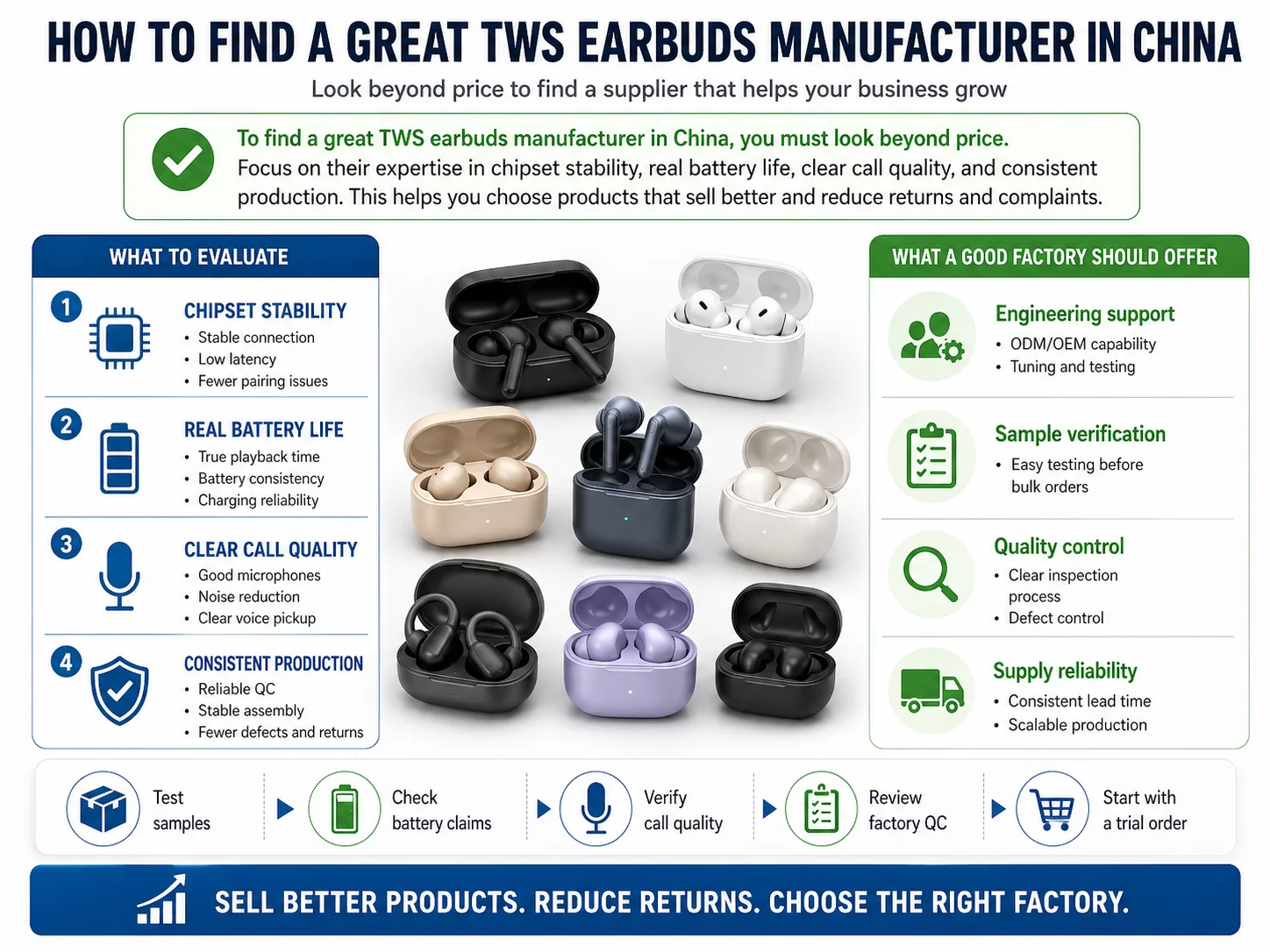
I've been in the 3C electronics export business for 15 years. Many of my clients come to me after getting burned by other suppliers. They ask simple questions like, "How much for AirPods style earbuds?" but that's just scratching the surface. To really succeed in the TWS earbuds market, you have to understand that it's a much more complex product than a simple USB cable. The real money is made by finding a partner who can deliver a stable product, batch after batch. Let's break down what you really need to be asking.
Why do buyers really search for a TWS earbuds manufacturer?
You're searching for a factory, but what you really need is a solution. Your current earbuds probably aren't selling, or worse, you're drowning in customer complaints and returns.
Buyers search for "TWS earbuds manufacturer in China" not just for a factory, but for a partner. They need someone who can provide stable, quality products to solve issues like poor connectivity, short battery life, and high return rates from their current suppliers.
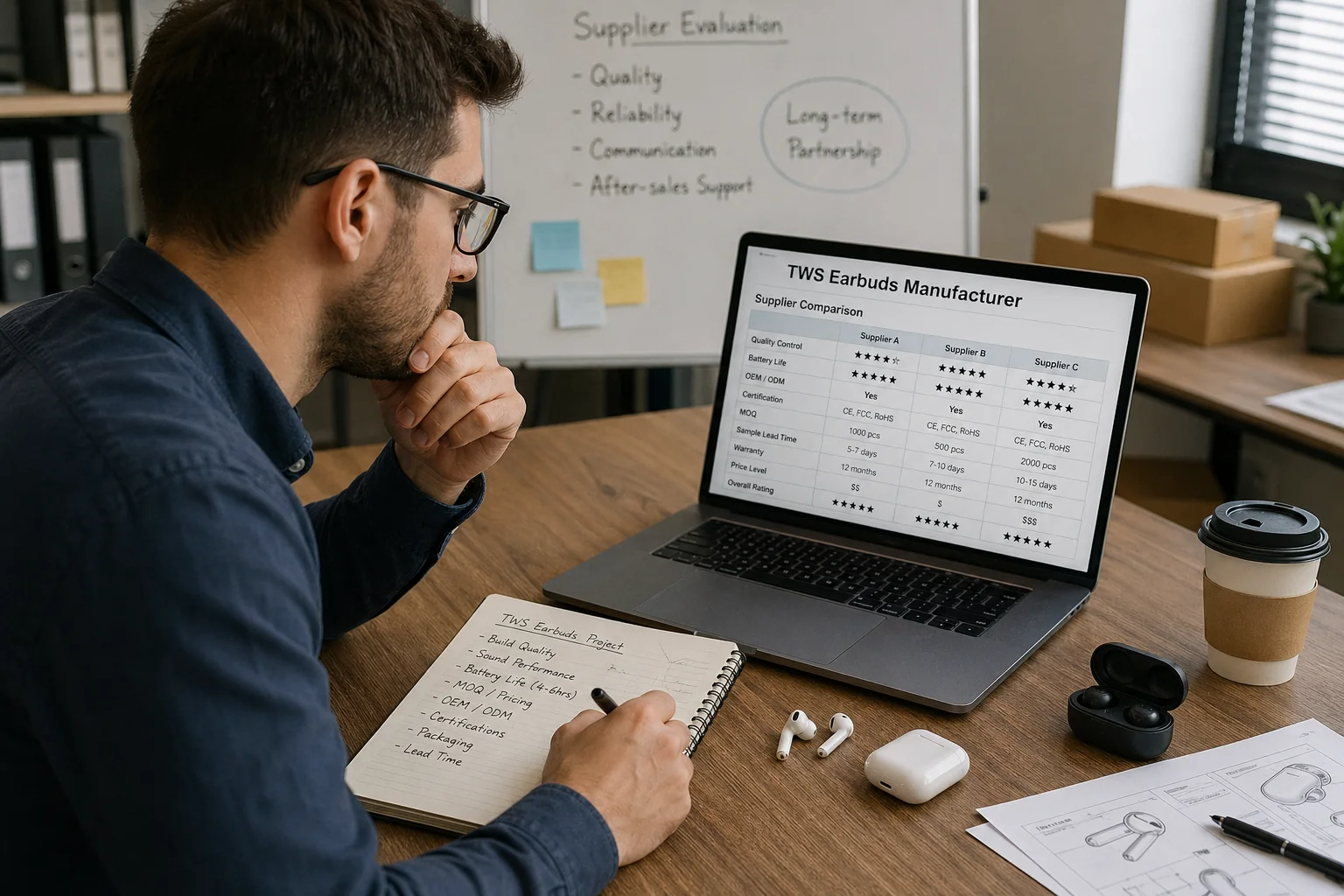
In my experience, TWS earbuds seem more attractive than cables or chargers. They have nice packaging, cool designs, and a higher perceived value. But that complexity is also the problem. A single TWS earbud involves a Bluetooth chip, battery, speaker, microphone, noise-cancellation tech, and software. If just one part is done poorly, your customer will complain.
What You're Really Trying to Solve
You're not looking for the cheapest supplier. You're looking for a partner who can solve real business problems. The common complaints I hear from my clients about their previous suppliers are endless: unstable connections, one earbud not working, terrible battery life, and cheap-looking packaging. Novice buyers ask about price and logos. Pro buyers, the ones who build successful brands, ask much deeper questions.
| Novice Questions | Pro Questions |
|---|---|
| "How much for this?" | "What Bluetooth chipset5 are you using?" |
| "Best price for ANC?" | "Is the battery life real or inflated?" |
| "Can you print my logo?" | "What is your typical defect rate?" |
| "What's the MOQ?" | "Can you guarantee consistency with the sample?" |
Before you even think about price, you need to know who you're selling to. A product for a convenience store is completely different from one sold by an Amazon FBA seller.
What are the key features that actually affect product selection?
Overwhelmed by all the technical specs for TWS earbuds? Let's cut through the noise and focus on the few features that actually drive sales and keep customers happy.
The most critical TWS features are appearance, chipset stability, real battery life, good sound, clear call quality, and comfort. These factors have a much bigger impact on sales and returns than a long list of minor tech specs.
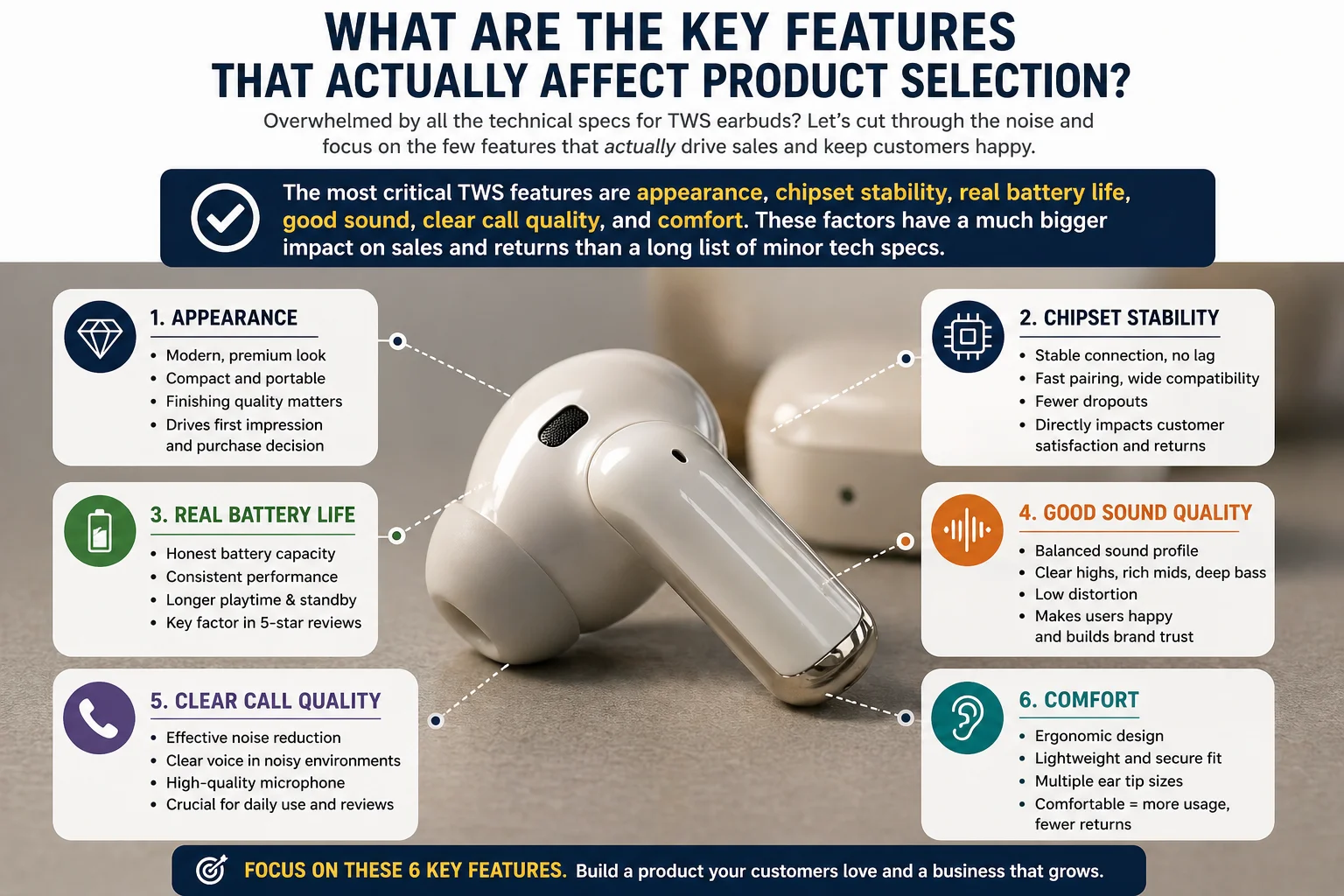
You can get lost in a sea of parameters, but after 15 years in this business, I can tell you that only a handful of things truly matter to the end customer. If you get these right, you'll have a winning product.
1. Appearance and Packaging
This is the first thing a customer sees. Does it look like an AirPods knock-off? Does the charging case have a premium feel? Does the packaging look good on a retail shelf? A product might be great, but if it looks cheap, it will never sell.
2. Chipset and Connection Stability
This is the biggest source of complaints for low-cost earbuds. Problems like difficult pairing, audio drops, and high latency for games and videos will destroy your product's reputation. The Bluetooth version number isn't enough; the quality of the chipset solution is what matters.
3. Real Battery Life
Many suppliers inflate their battery life specs. They'll advertise "30 hours," but that's including the charging case. You must clarify the single playtime versus the total battery life. If you don't, you're setting your customers up for disappointment.
4. Sound and Call Quality
You don't need to be an audiophile, but the sound can't be terrible. Many cheap earbuds have weak bass, harsh treble, or noticeable background hiss. Even more important is call quality. A lot of buyers forget to test this. If the microphone is bad, the product is useless for calls, which is a huge part of how people use them today.
5. Wearing Comfort
If an earbud is uncomfortable, nothing else matters. You need to consider the weight, shape, and fit. An earbud that feels great for 5 minutes might cause ear pain after 30 minutes. An uncomfortable product will never get repeat purchases.
How do battery, ANC, and comfort perform in the real world?
Are the specs on the box matching what customers actually experience? Let's dive into how these key features really hold up after the sale, because that's what determines your return rate.
In real-world selling, advertised specs can be misleading. Real battery life is often shorter, "ANC" might just be call noise reduction, call quality fails in noisy places, and poor comfort leads to returns. Thorough testing is non-negotiable.
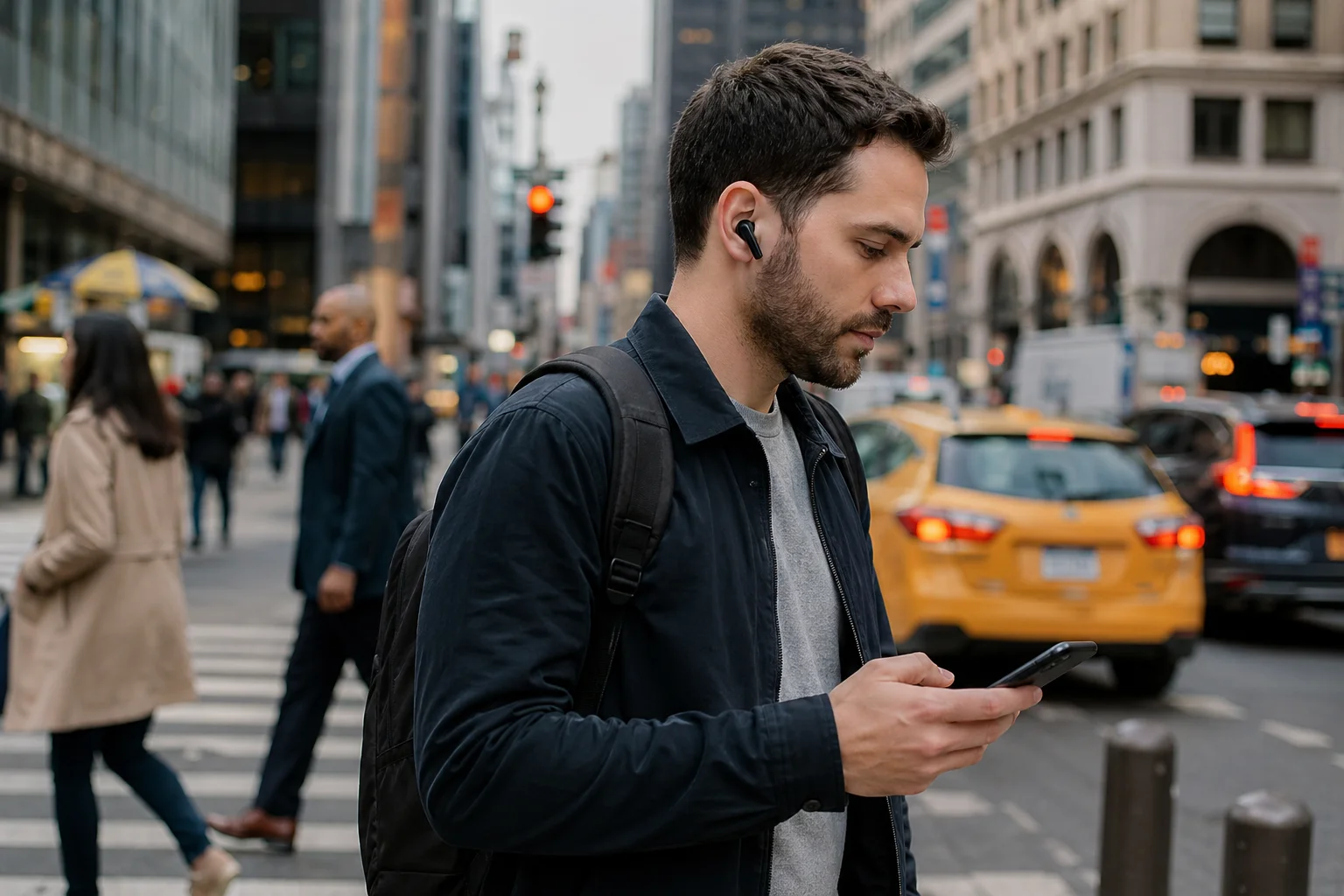
A spec sheet doesn't tell you the whole story. A product's success is decided by the customer's day-to-day experience. Here's what I've learned really matters.
The Truth About Battery Life
This is a major reason for returns. If the box says 6 hours of playtime and the customer only gets 3, they will feel cheated. Worse, some cheap batteries degrade quickly. The earbuds work fine for a week, then the battery life drops off a cliff. You can't just test a sample for one day. You need to use it for several days, checking how long it lasts at 70% volume, how many times the case can recharge the earbuds, and if the left and right earbuds drain at the same rate.
Is the ANC Real?
Active Noise Cancellation (ANC)6 is a huge selling point, but it's also where many suppliers cut corners. Some will advertise ANC when the product only has Environmental Noise Cancellation (ENC)7. They are not the same thing.
- ANC (Active Noise Cancellation): Reduces background noise for the person wearing the earbuds.
- ENC (Environmental Noise Cancellation): Uses microphones to reduce background noise for the person on the other end of a phone call. If you sell an ENC product as ANC, your customers will notice immediately, and your reviews will be terrible. Ask for the real noise reduction depth (in dB) and if it has a transparency mode.
Call Quality: The Hidden Dealbreaker
Many earbuds that sound okay for music are awful for phone calls. This is usually because the manufacturer used a cheap microphone and poor noise-canceling algorithms to save money. You must test calls in real-world situations: on a noisy street, in a coffee shop, while walking. If the person on the other end says you sound like you're underwater, you have a problem. Bad call quality is a silent killer of product reputation.
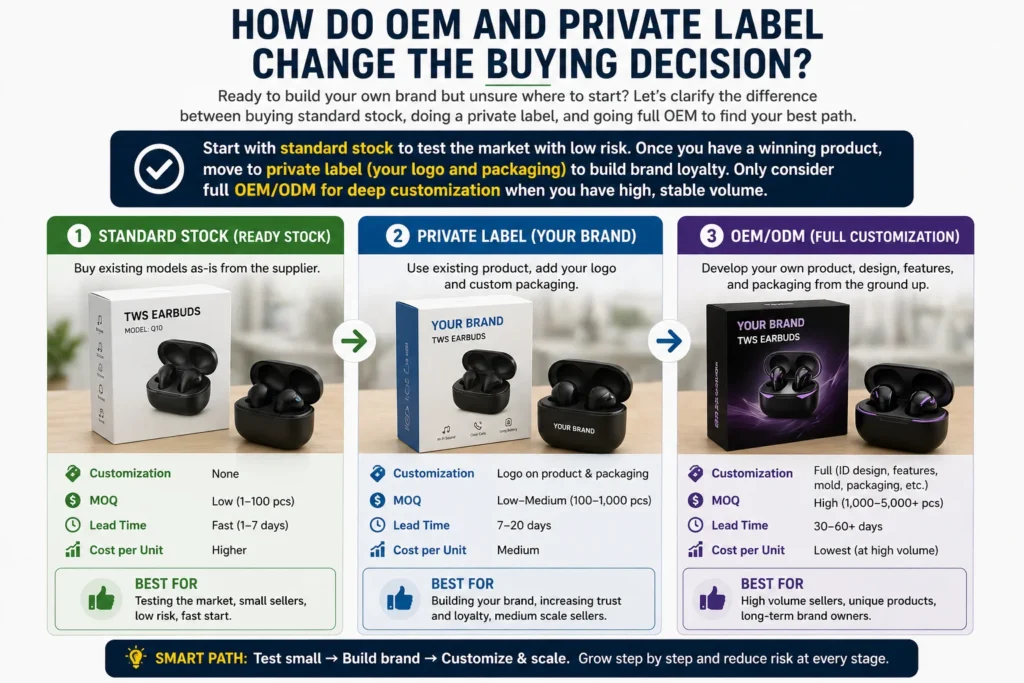
How do OEM and private label8 change the buying decision?
Ready to build your own brand but unsure where to start? Let's clarify the difference between buying standard stock9, doing a private label, and going full OEM to find your best path.
Start with standard stock to test the market with low risk. Once you have a winning product, move to private label (your logo and packaging) to build brand loyalty. Only consider full OEM/ODM10 for deep customization when you have high, stable volume.
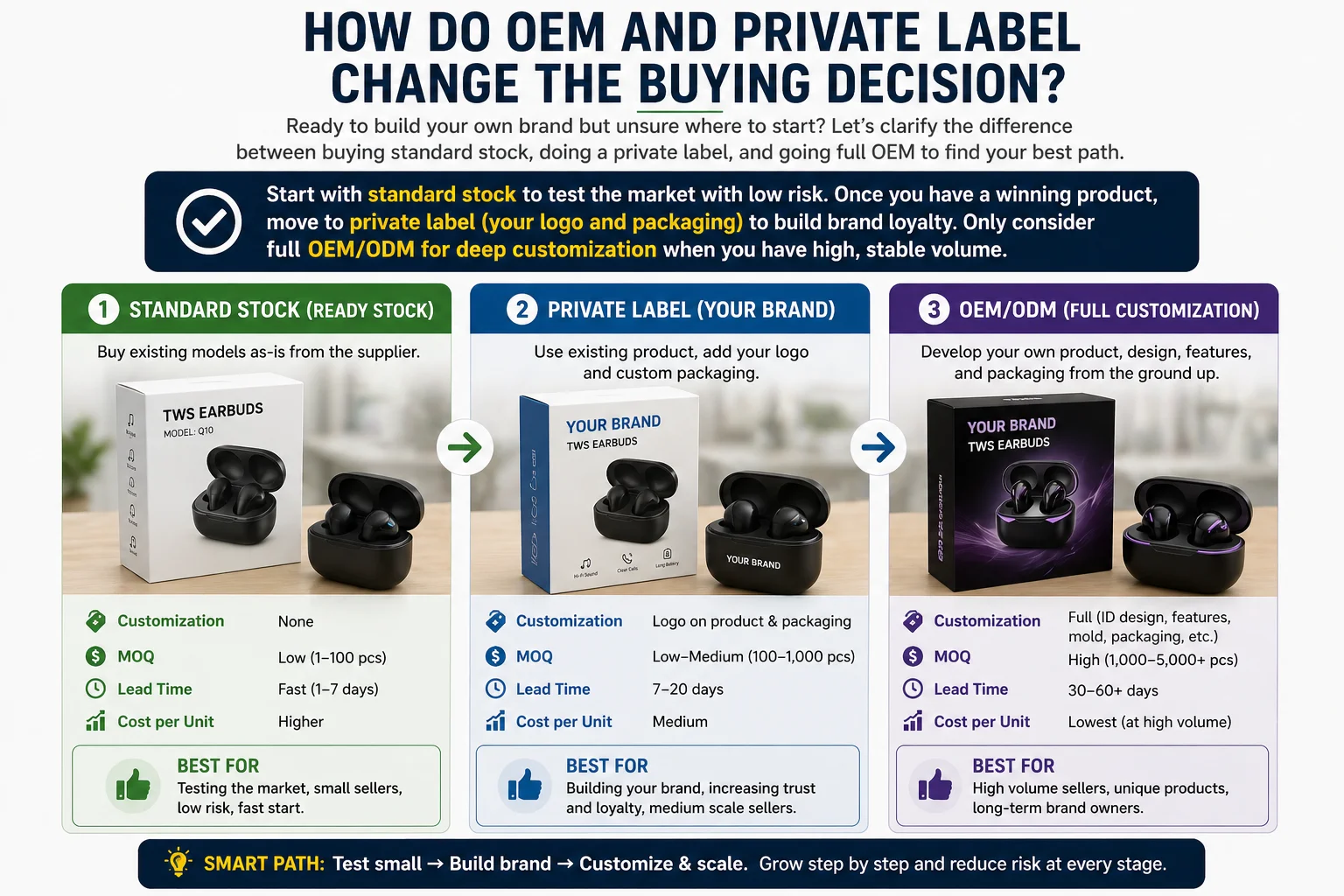
Many buyers want to jump straight into creating their own brand, but that's often not the smartest move. There's a smarter, safer way to grow.
Step 1: Start with Standard Stock
If you're new to TWS earbuds, I always recommend starting with a factory's standard, in-stock products. The benefits are huge:
- Low MOQ (Minimum Order Quantity)
- Fast shipping
- Minimal financial risk
- Allows you to test different styles and price points You can try a few different models—an AirPods style, one with an LED display, a budget gaming earbud—and see what your customers actually buy. The market will give you better data than your own guesses.
Step 2: Move to Private Label
Once you've identified a product that sells well and has a low return rate, it's time to create your own brand. This is often called "private label." You're not changing the earbud itself, but you are customizing the branding elements. This includes:
- Printing your logo on the earbuds and case
- Designing your own retail box
- Creating a custom user manual
- Adding your own barcodes and labels Private label builds brand recognition and encourages repeat business. But don't do this until you've proven the product sells.
Step 3: When to Consider OEM/ODM
Full Original Equipment Manufacturer (OEM) or Original Design Manufacturer (ODM) is for mature businesses with stable, high-volume orders. This is where you can customize everything: the earbud shape, charging case design, chipset, battery capacity, speaker drivers, and even the app software. This gives you a truly unique product, but it requires a much higher MOQ, longer development time, and a bigger budget. My advice is to follow this path: standard stock → private label → OEM/ODM. It's a slower but much safer way to build a successful business without tying up all your cash in unproven inventory.
What should you confirm before placing a wholesale order?
Worried about placing a large TWS order and getting a bad batch? Let's create a final checklist to ensure your bulk order is exactly what you tested and approved.
Before ordering TWS earbuds wholesale, confirm the exact chipset, test the real battery life, and check call quality in noisy environments. Also, verify ANC claims, comfort, packaging details, defect rate policy11, and ensure bulk order consistency with the sample.
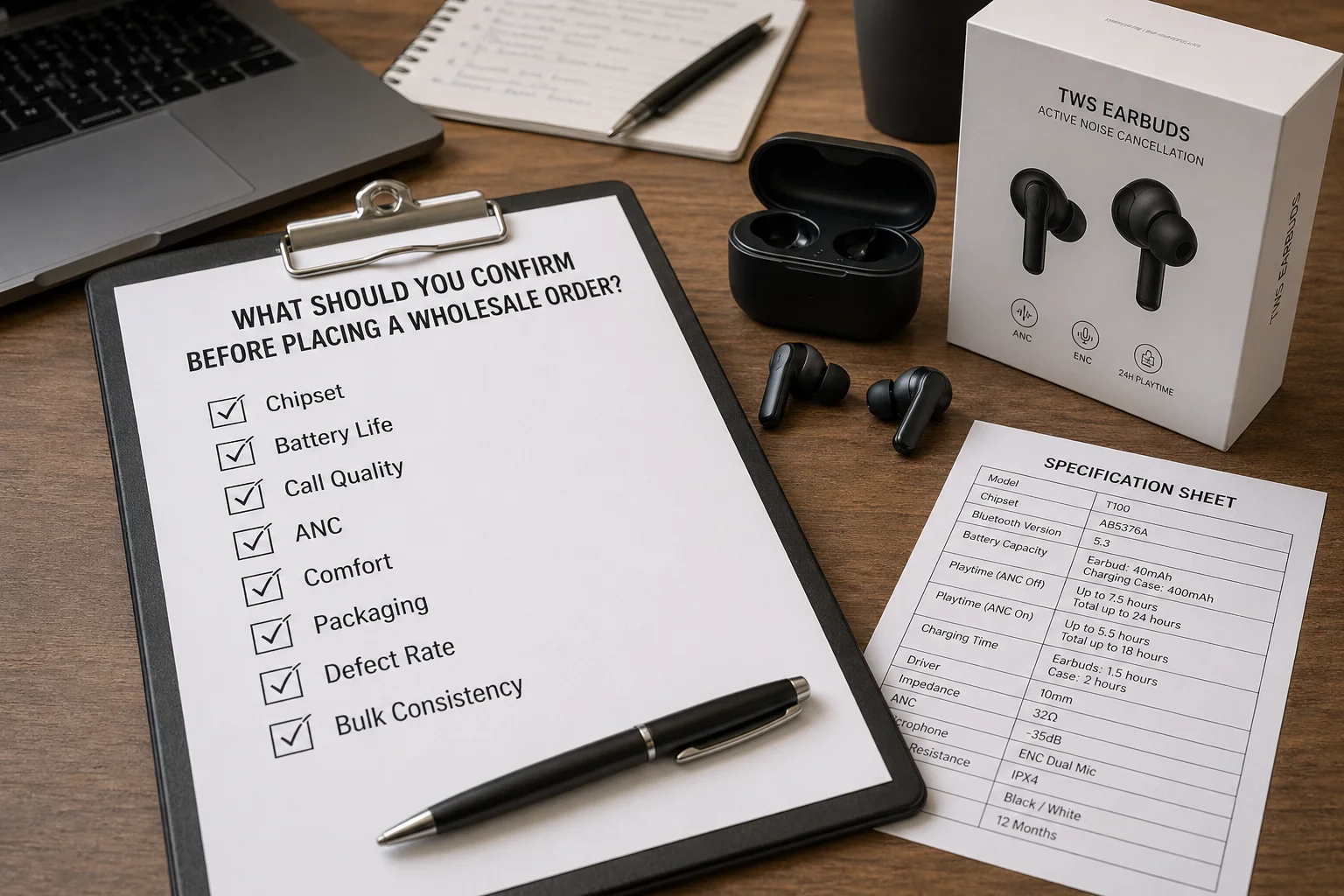
TWS earbuds have far more potential failure points than a charger or a cable. The risk is higher, so your due diligence needs to be better. Here is the checklist I use with my clients before we place any large order.
Your Final Confirmation Checklist
Never assume the bulk order will be identical to the sample. Many issues arise when a factory substitutes cheaper components to save costs after the sample has been approved. You must get these details confirmed in writing.
| Category | Key Questions to Ask Your Supplier |
|---|---|
| Components | "Can you guarantee the bulk order will use the same chipset, battery, and speaker as the sample?" |
| Performance | "What is the confirmed single playtime at 70% volume? Is the ANC depth guaranteed?" |
| Quality Control | "What is your typical defect rate? How do you handle defective units in my order?" |
| Logistics | "What are the final packaging dimensions, weight, and carton quantity?" |
| Warranty | "What is the warranty period12 and what is the process for replacements?" |
One of the most important things to confirm is how they will ensure consistency. Ask for photos or a video from the production line. A reliable supplier will not have a problem with this. They understand that your success is their success. TWS earbuds can't have a zero defect rate, but a good partner will have a clear plan for how to solve problems when they happen.
Conclusion
Success in the TWS wholesale business isn't about the lowest price. It's about finding a stable product and a reliable partner to ensure quality, minimize returns, and build a lasting business.
"Evolution of Bluetooth Technology: BLE in the IoT Ecosystem - PMC", https://pmc.ncbi.nlm.nih.gov/articles/PMC11859364/. Chipset stability is critical for ensuring reliable Bluetooth connectivity and minimizing audio dropouts, as supported by technical reviews and industry standards. Evidence role: mechanism; source type: research. Supports: Chipset stability is a key factor in ensuring reliable Bluetooth connectivity and minimizing customer complaints.. ↩
"Battery Accelerated Cycle Life Testing Data - calce, umd", https://calce.umd.edu/battery-accelerated-cycle-life-testing-data. Real battery life often differs from advertised specs due to varying usage conditions, as shown in consumer electronics testing studies. Evidence role: statistic; source type: research. Supports: Real battery life is often shorter than advertised, leading to customer dissatisfaction.. Scope note: Battery life can vary based on user habits and environmental factors. ↩
"Zoom bias: The social costs of having a 'tinny' sound during video ...", https://news.yale.edu/2025/03/24/zoom-bias-social-costs-having-tinny-sound-during-video-conferences. Clear call quality is influenced by microphone design and noise-canceling algorithms, as detailed in audio engineering research. Evidence role: mechanism; source type: research. Supports: Clear call quality is essential for customer satisfaction and is influenced by microphone and noise-canceling technology.. Scope note: Call quality may vary depending on environmental noise levels. ↩
"How SMT Technology Enhances Efficiency in Electronics ...", https://fenix-mfg.com/smt-technology-electronics-production-efficiency/. Consistent production quality is vital for minimizing defect rates, as highlighted in manufacturing quality control studies. Evidence role: expert_consensus; source type: education. Supports: Consistent production quality minimizes defect rates and ensures customer satisfaction.. Scope note: Consistency can vary between production batches. ↩
"Princeton will lead U.S. effort to design better chips for wireless ...", https://www.princeton.edu/news/2025/08/04/princeton-will-lead-us-effort-design-better-chips-wireless-communication. Bluetooth chipsets determine connection stability and latency, as supported by wireless communication technology research. Evidence role: mechanism; source type: research. Supports: Bluetooth chipsets are critical for ensuring stable connections and low latency in TWS earbuds.. Scope note: Performance can vary based on chipset model and implementation. ↩
"Active noise control - Wikipedia", https://en.wikipedia.org/wiki/Active_noise_control. Active Noise Cancellation (ANC) reduces background noise for the wearer by using microphones and sound wave inversion, as explained in acoustic technology research. Evidence role: definition; source type: encyclopedia. Supports: ANC reduces background noise for the wearer, enhancing the listening experience.. Scope note: ANC effectiveness can vary based on the implementation and environment. ↩
"Telecommunications", https://ece.gatech.edu/directory/tig/telecom. Environmental Noise Cancellation (ENC) focuses on reducing background noise for the person on the other end of a call, as described in telecommunication studies. Evidence role: definition; source type: encyclopedia. Supports: ENC reduces background noise for the person on the other end of a call, improving call clarity.. Scope note: ENC does not improve noise reduction for the wearer. ↩
"Private label - Wikipedia", https://en.wikipedia.org/wiki/Private_label. Private labeling involves branding existing products with a company's logo and packaging, as described in retail and branding studies. Evidence role: definition; source type: education. Supports: Private labeling allows businesses to build brand recognition without altering the product itself.. Scope note: Private label does not involve changes to the product's core design or functionality. ↩
"[PDF] Understanding safety stock and mastering its equations - MIT", https://web.mit.edu/2.810/www/files/readings/King_SafetyStock.pdf. Standard stock products are pre-designed and manufactured items available for immediate purchase, as outlined in supply chain management resources. Evidence role: definition; source type: education. Supports: Standard stock products offer a low-risk entry point for testing market demand.. Scope note: Standard stock may lack customization options compared to private label or OEM products. ↩
"OEM vs ODM: What's the Difference in Hardware Manufacturing?", https://www.seacomp.com/resources/oem-vs-odm-manufacturing. OEM (Original Equipment Manufacturer) and ODM (Original Design Manufacturer) allow for varying levels of product customization, as explained in manufacturing business models. Evidence role: definition; source type: encyclopedia. Supports: OEM and ODM provide options for product customization based on business needs and order volume.. Scope note: Customization options depend on the manufacturer's capabilities and buyer volume. ↩
"Predicting Defect Rates of Printed Circuit Board Assemblies", https://www.sciencedirect.com/science/article/pii/S2405896324007730. Defect rate policies in manufacturing typically include thresholds and replacement terms, as discussed in quality assurance frameworks. Evidence role: mechanism; source type: institution. Supports: Defect rate policies are crucial for managing quality and customer satisfaction in bulk orders.. Scope note: Policies may differ based on industry standards and supplier agreements. ↩
"Warranties - FTC Consumer Advice", https://consumer.ftc.gov/articles/warranties. Warranty periods for consumer electronics typically range from 6 months to 2 years, depending on the product and manufacturer policies, as outlined in consumer protection guidelines. Evidence role: general_support; source type: government. Supports: Warranty periods are an important consideration for buyers to ensure product reliability and support.. Scope note: Warranty terms can vary significantly between manufacturers. ↩