Are you worried about tying up your capital in new 3C products? A single bad order can ruin your profits and leave you with stock you can't sell1.
Small wholesale orders are the best way to reduce your risk. They allow you to test product quality, supplier reliability, and market demand with a minimal financial investment. This strategy helps you avoid dead stock, protects your cash flow2, and builds a solid foundation for growth.
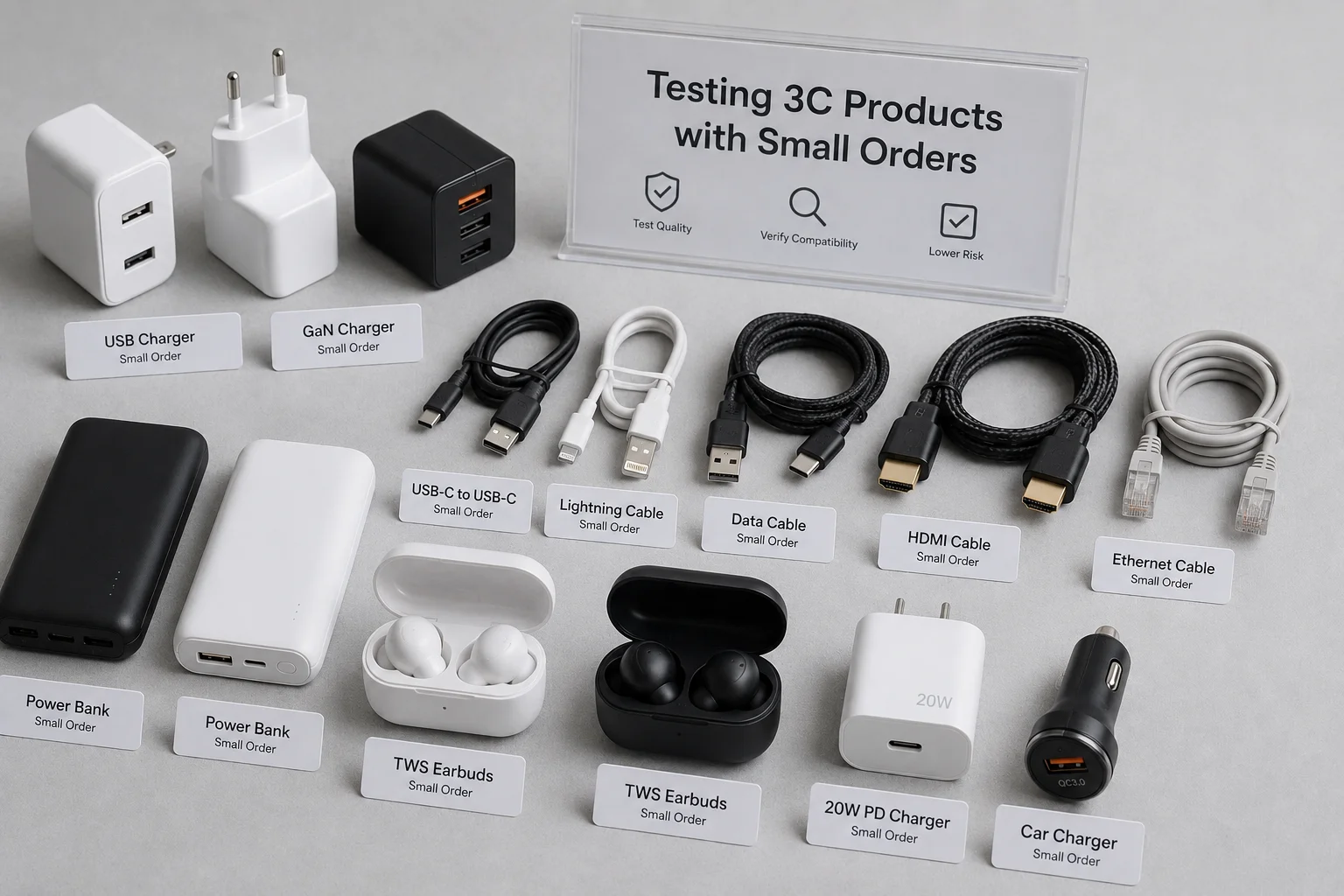
Over my 15 years in this business, I've seen too many importers make costly mistakes by going too big, too soon. It's a painful lesson to learn. Let's break down the specific ways small orders can be your smartest strategy for managing risk and growing your business. It's about working smarter, not just spending more.
Why Do Small Wholesale Orders Matter in 3C Electronics?
Want to import the latest electronics but fear the risk of a bad investment? A large, unverified order can become a business disaster overnight. Smart importers always test the waters first.
Small trial orders are critical. They let you check the actual product quality and see if your supplier is reliable. You also get to gauge real market demand before you commit significant capital.
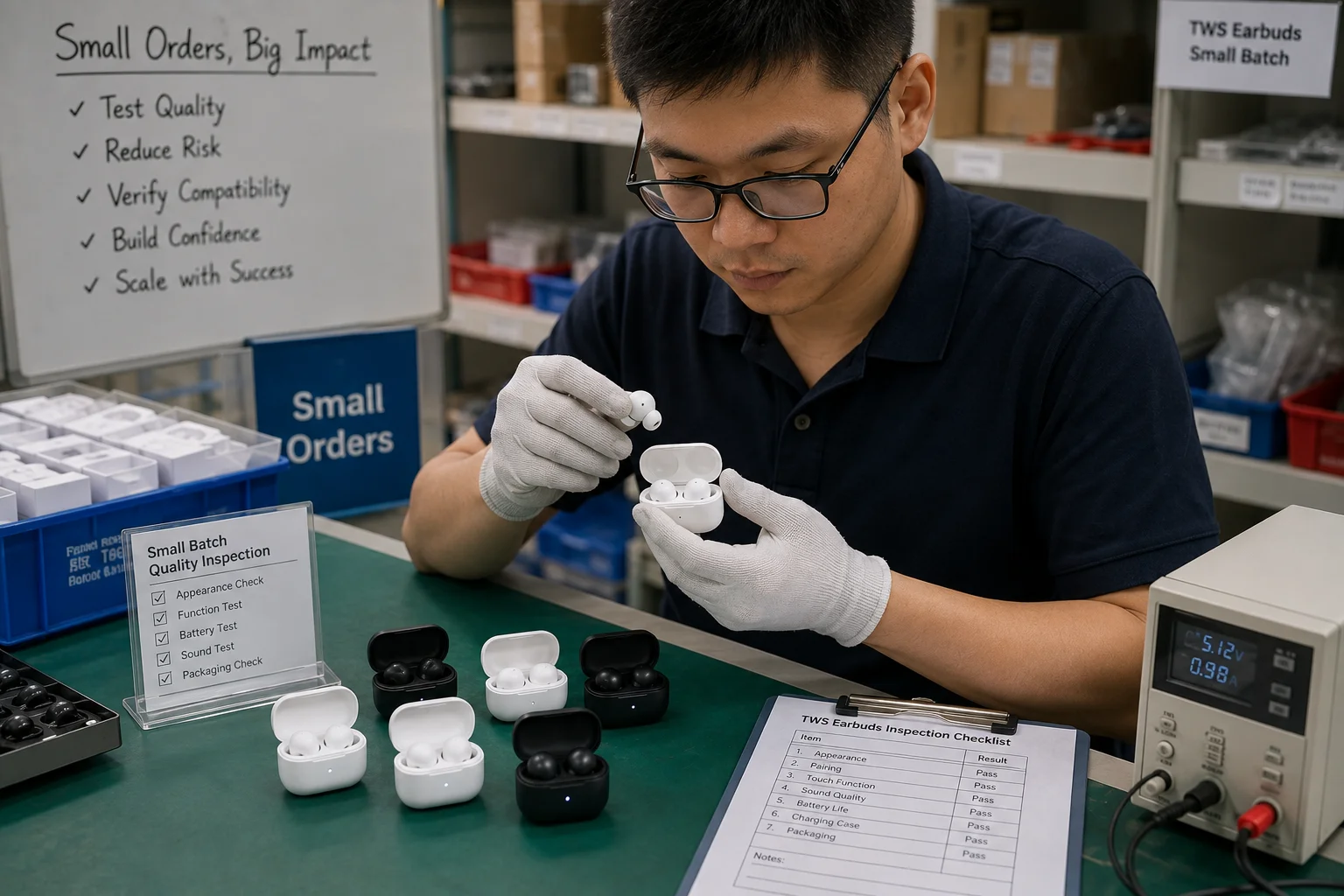
I remember a client from Germany who was ready to order 10,000 units of a new TWS earbud. He was excited, but I advised him to start with a smaller order of just 500 units. He was a bit hesitant at first, thinking it showed a lack of commitment. But he trusted my experience and placed the small order. A few weeks later, he called me. The earbuds were great, but he discovered they had a minor connectivity issue with a specific phone model that was very popular in his local market. That small 500-unit test saved him from dealing with thousands of angry customers and costly returns. That's the real power of starting small. It isn't about a lack of ambition; it's about smart, calculated risk management. You get real-world data, not just promises from a sales presentation. This process gives you the confidence to place a larger order, knowing the product is right for your customers.
How Can You Reduce the Risk of Dead Inventory?
Is your warehouse filling up with products that just won't sell? This "dead inventory" ties up your cash and blocks you from investing in winners. There is a simple way to prevent this.
To avoid slow-moving products, start with small wholesale orders. This strategy dramatically cuts the risk of having unsold inventory sitting on your shelves, which protects your profits and frees up cash.
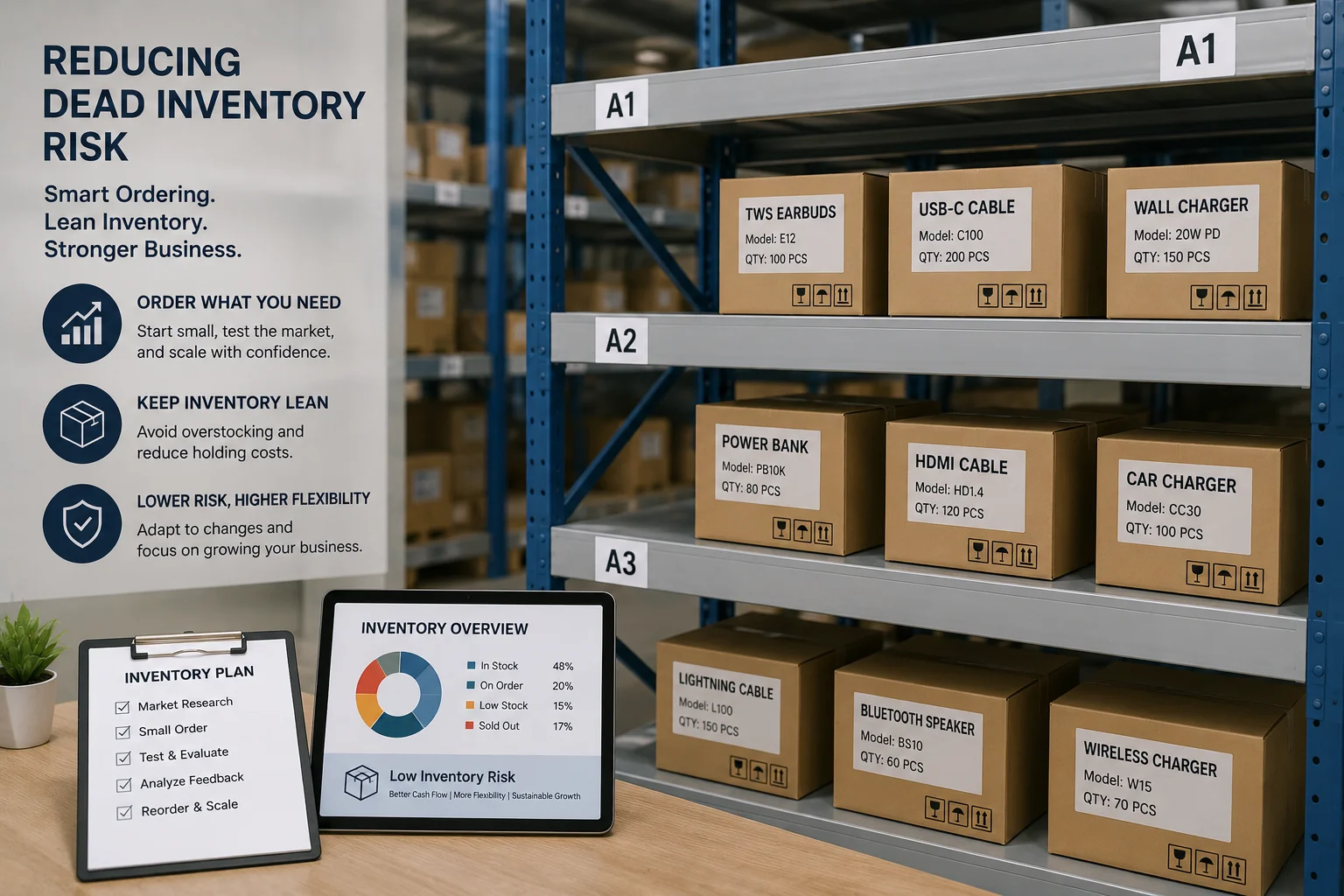
Dead inventory is just money sitting on a shelf, collecting dust. In the fast-paced 3C electronics market, this is a huge problem. A product can be a bestseller today and completely outdated in six months3. Imagine you order 5,000 units of a new smartwatch. By the time it lands and you start selling, a new model with better features and a lower price might already be announced. Suddenly, you're forced to discount your stock heavily just to get your money back. Now, picture a different scenario. You order just 500 units. You sell them quickly, make a good profit, and learn what customers liked and disliked. Now you're ready to order the next hot product while your competitor is stuck with their old stock. This agility is a key advantage. Your goal isn't just to buy products; it's to sell them profitably. Small orders help you stay nimble and avoid the dead stock trap that has sunk many businesses.
How Do You Test Real Product Quality Before Scaling?
Have you ever received a perfect sample, only for the bulk order to be a huge disappointment? It’s a common and frustrating experience. A small wholesale order is your best insurance policy.
Many suppliers provide excellent samples but fail to maintain that quality in mass production4. A small wholesale order acts as a "real-world" sample. It lets you verify the actual quality of mass-produced items before you commit to a much larger order.
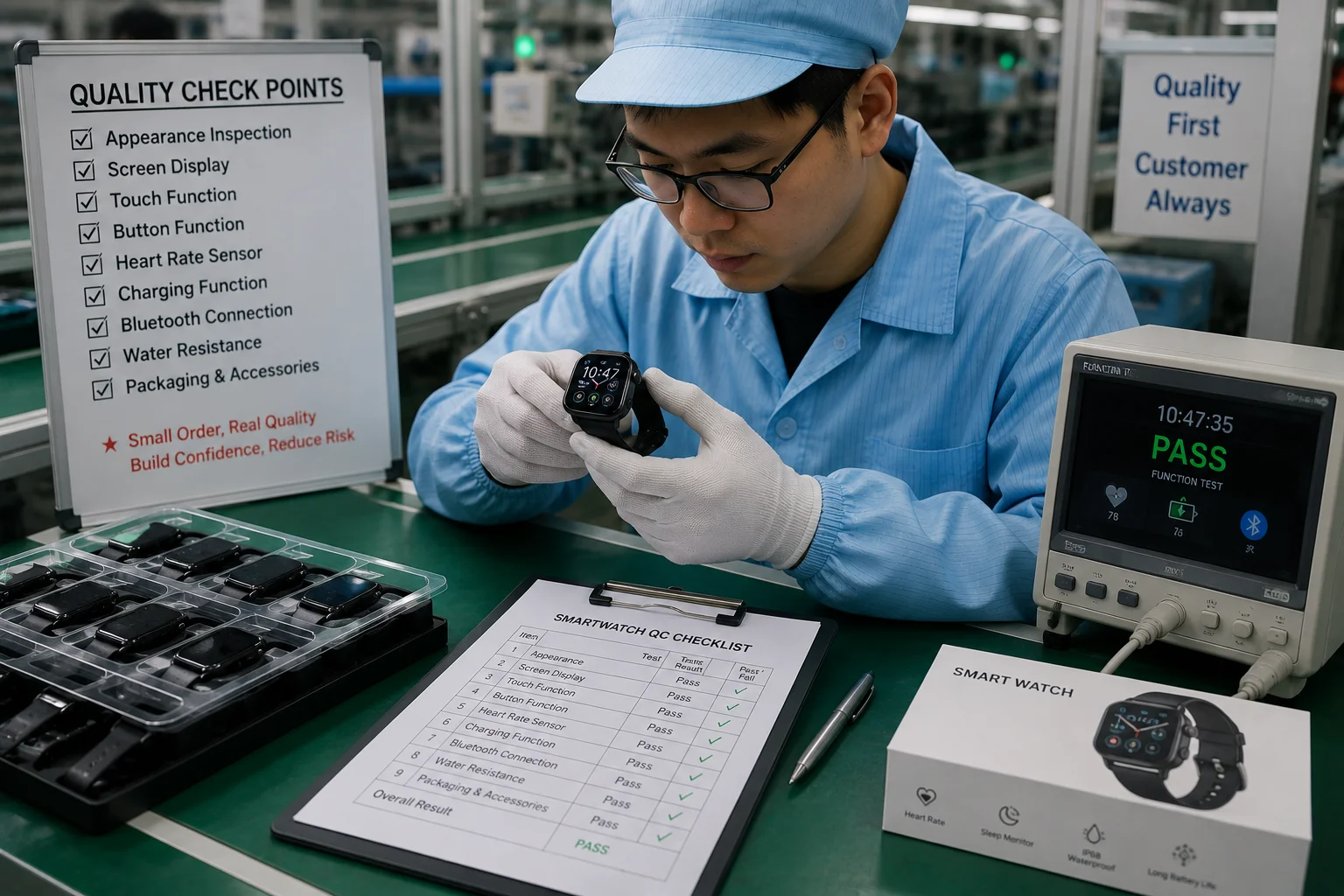
I always tell my clients: "A sample shows you what a factory can do. A small order shows you what they will do." The difference is massive. A single "golden sample" is often hand-picked and perfect. But what about the 999th unit off the production line? A small order of, say, 200 or 500 pieces goes through the exact same mass production process as a 10,000-piece order. This is your chance to see the truth. You can check for consistency across the batch. Is the plastic casing the same color on every unit? Is the screen brightness consistent? How does the battery life perform across 20 different units, not just one? You can calculate the defect rate yourself. Is it a manageable 1%, or an unacceptable 10%5? This information is priceless, and it's something a single sample can never reveal. Think of it as your quality insurance policy against a large, disastrous order.
How Can You Protect Cash Flow and Improve Turnover?
Is your cash constantly tied up in large inventory orders? This slows down your growth and makes your business vulnerable. Smaller initial investments mean faster turnover and much more financial flexibility.
By making a smaller initial investment with a trial order, you rotate your capital much faster6. This reduces the pressure on your cash flow. It also gives you the freedom to test multiple products at once instead of betting everything on a single item.
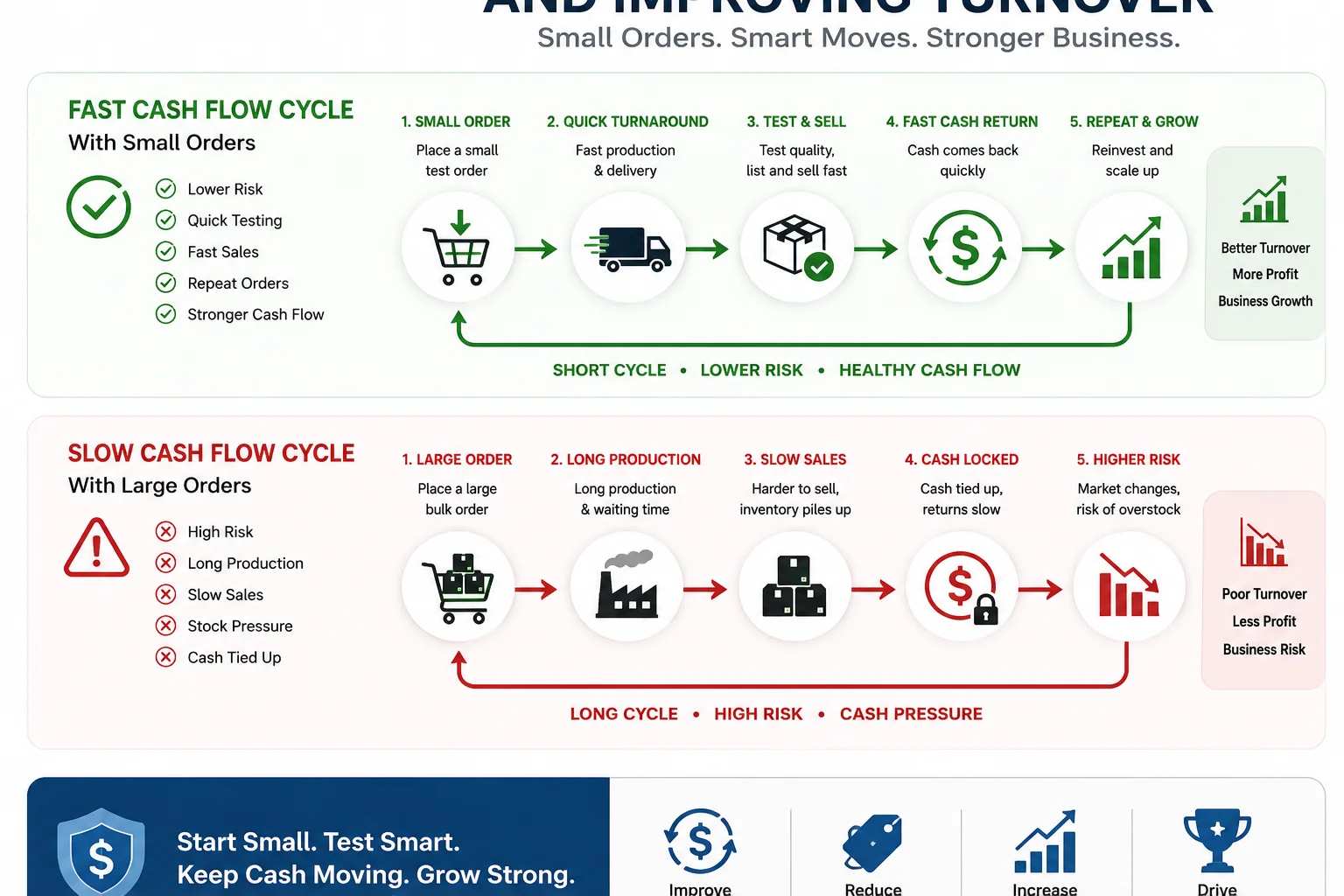
Let’s look at a simple comparison. Imagine you have a $20,000 budget for new products.
| Strategy | Scenario A: Big Order | Scenario B: Small Orders |
|---|---|---|
| Initial Order | $20,000 on 4,000 units of one smartwatch model. | $5,000 on 1,000 units of the same smartwatch. |
| Risk | High. If the watch doesn't sell, all $20,000 is stuck. | Low. Only $5,000 is at risk. |
| Flexibility | None. You have no cash left for other opportunities. | High. You still have $15,000 to test other products. |
| Learning | You learn about one product. | You can test 4 different products (e.g., a watch, earbuds, a GaN charger, and cables). |
In Scenario B, you might find that the earbuds are a surprise hit and sell out in two weeks. You can then immediately reinvest your profit and the initial $5,000 into a larger order of earbuds. You used a small part of your capital to discover a clear winner. This is what we mean by improving turnover. It's not just about selling; it's about learning what sells best, fast. This approach turns your budget into a powerful tool for market research7, not just a one-time bet.
How Can You Compare Different Suppliers With Lower Cost?
Choosing a new long-term supplier feels like a huge gamble, doesn't it? It is a big commitment. Small orders let you "date" multiple suppliers before you commit to a long-term partnership.
Place small trial orders with several potential suppliers at the same time. This allows you to compare crucial factors like lead times, packaging quality, defect rates, and communication. This low-cost comparison helps you pick the best long-term partner8.
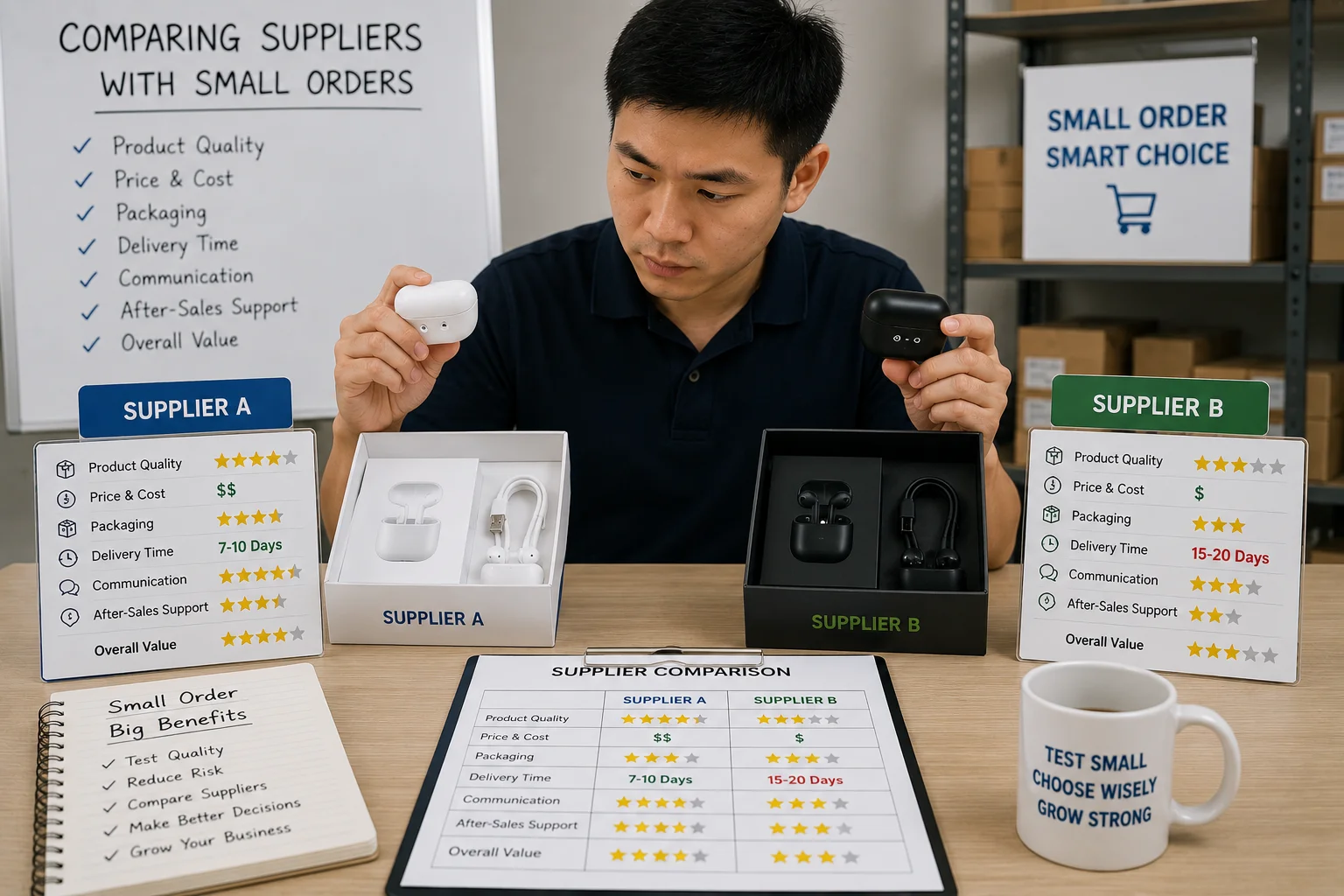
A few years ago, an American e-commerce seller was deciding between our company and another supplier. On paper, the other factory was slightly cheaper per unit. He wisely placed a 300-unit trial order for a GaN charger with both of us. This real-world test revealed things a price list never could.
| Factor | Our Company | Other Supplier |
|---|---|---|
| Communication | Responded within hours, clear English. | Took 1-2 days to reply, vague answers. |
| Lead Time | Shipped in 20 days, as promised. | Shipped in 35 days (15 days late). |
| Packaging | Sturdy, professional retail box. | Flimsy box, some were crushed. |
| Product Quality | Defect rate under 1%. | Defect rate around 4%. |
Even though our unit price was a few cents higher, he realized he would save more money in the long run by working with us. He avoided the costs of shipping damage, customer returns from defective units, and the headache of poor communication. He's been a loyal client ever since. That's a lesson you can't learn from a quote sheet. You learn it from a real-world test order.
How Can You Understand Local Market Demand Faster?
Are you just guessing what your customers really want? Launching a new product based on a hunch is incredibly risky. Trial orders provide real, actionable feedback directly from your target market.
Small trial orders are the fastest way to collect real customer feedback. You can quickly learn what your customers think about the packaging, features, compatibility, and performance before you invest in a large inventory.
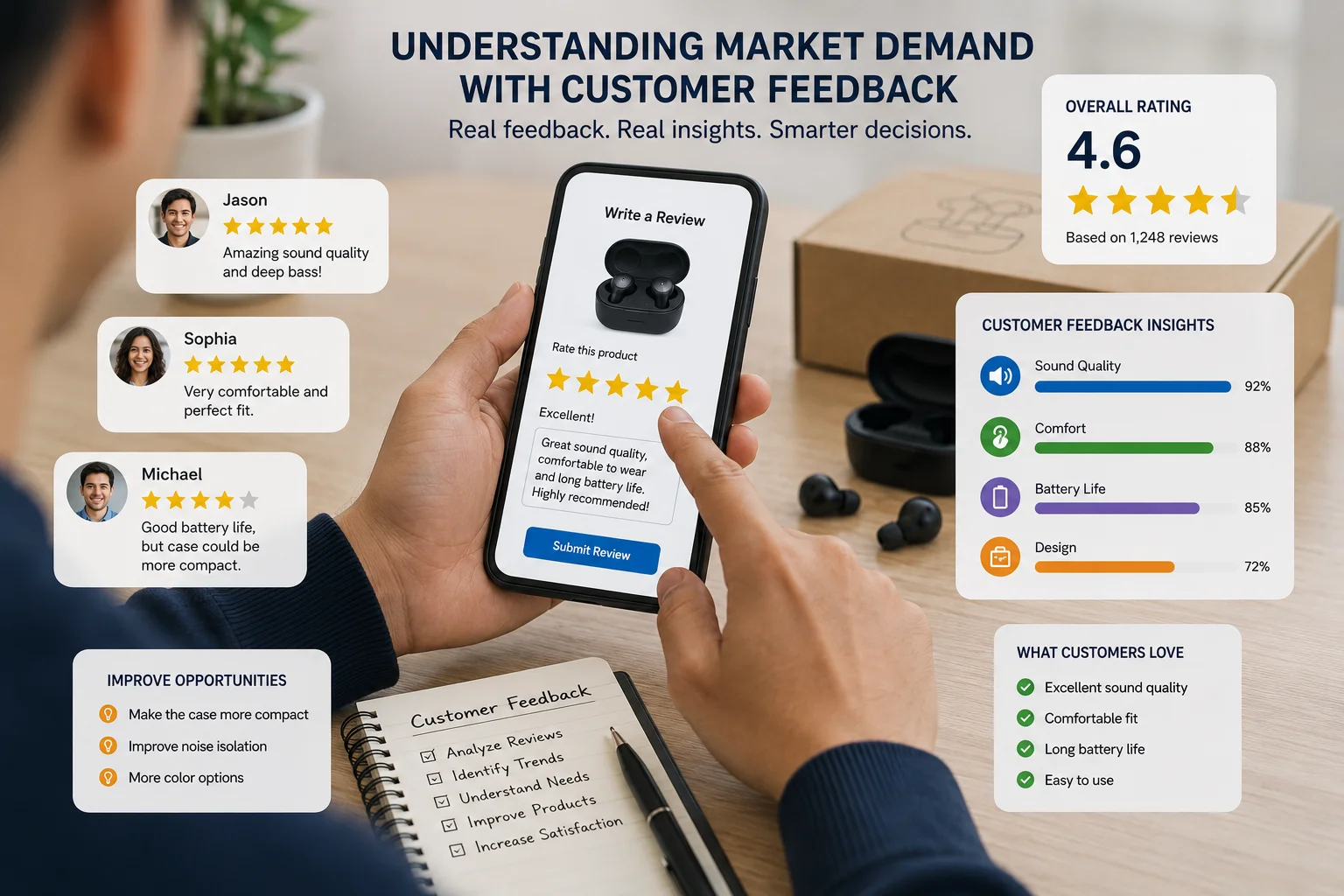
This early feedback is pure gold. It helps you avoid major mistakes and optimize the product for your specific market. After selling your first small batch, you get answers to critical questions.
Packaging and Unboxing
Did customers feel the product was premium, or did the box look cheap? The unboxing experience is the first impression and matters a lot for brand perception9.
Real-World Performance
Does the smartwatch battery really last for 7 days with typical use? Is the GaN charger noticeably faster than standard chargers for your customers' devices? Advertising claims need to be validated in the real world.
Compatibility Issues
We once had a client who imported a popular smart band, only to find out through early customer complaints that it didn't sync well with older phone models that were still common in his country10. A small order caught this before it became a massive problem.
This feedback allows you to have a very specific, intelligent conversation with your supplier. You can say, "My customers love the earbuds, but they say the case feels cheap. Can we improve the material on the next order?" This kind of targeted improvement is impossible if you're already sitting on 10,000 units. A small order effectively turns your first buyers into a free market research group.
How Do You Build Better Long-Term Supplier Relationships?
Do you want better pricing, lower MOQs, and VIP treatment from your suppliers? Demanding these things on day one rarely works. A successful small order is the best way to earn their trust and respect.
Good suppliers value reliable, long-term partners, not just big one-time buyers. When you successfully complete a small order, they see you as a serious and professional partner. This builds trust and makes them much more willing to offer you better terms on future orders11.
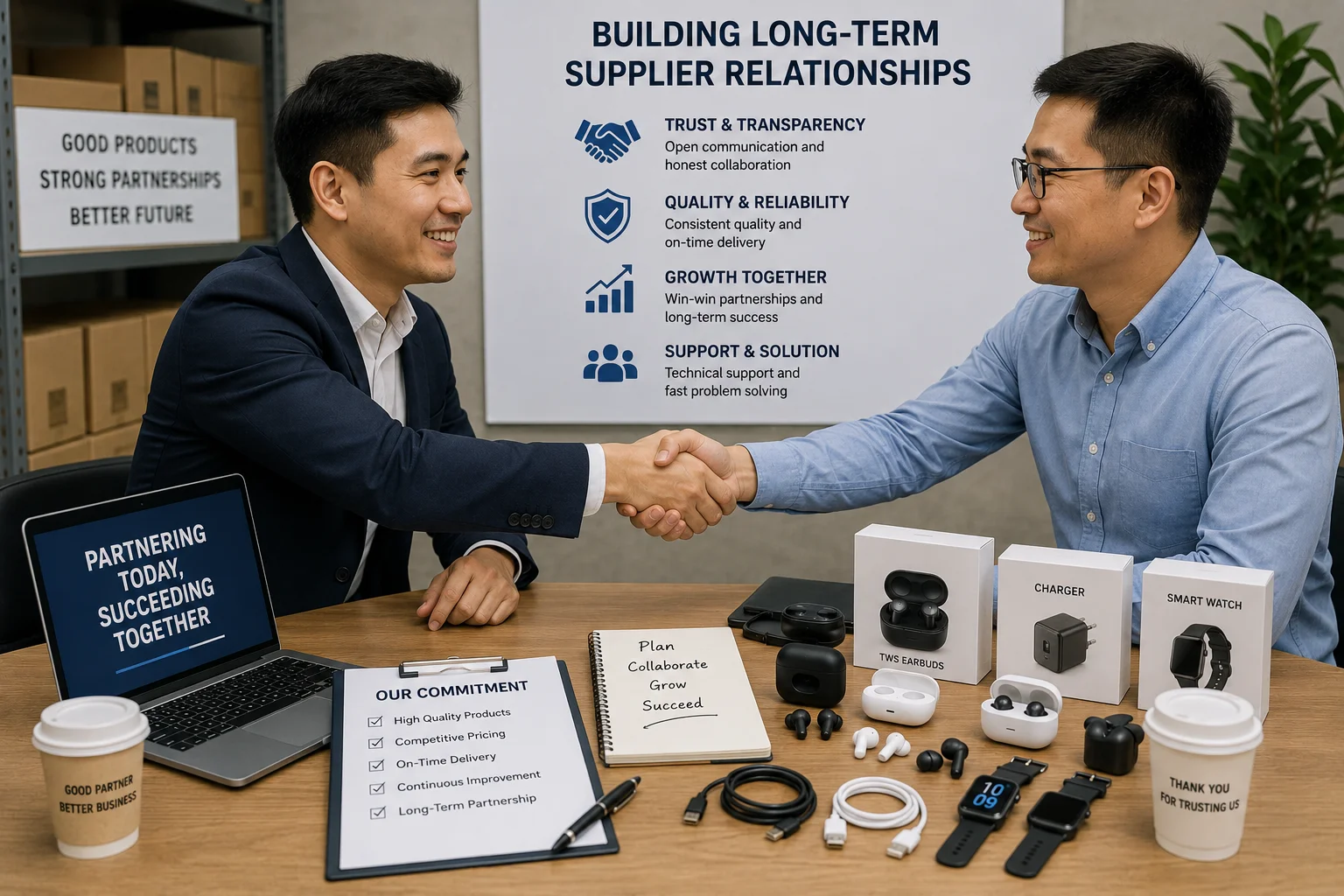
Let me share a perspective from my side of the desk. When a new customer contacts us and immediately asks for our lowest price on 20,000 units, it can be a red flag. It often signals that they might be inexperienced or focused only on price, which can lead to problems later. However, when a buyer says, "I'd like to start with 500 units to test my market and your process," it tells me they are strategic and professional. They have a plan. Once that first order goes smoothly—you pay on time, communication is clear, and the process is easy—you are no longer just another inquiry. You become a trusted partner. For your second order, when you ask for custom branding on 1,000 units or slightly better pricing, we are far more open to it. Why? Because you've proven you're serious and easy to work with. We want to grow with partners like you. A small, successful order is the best first step to building that strong, long-term relationship.
What's the Safest Way to Scale Orders Based on Real Sales Data?
Are you ready to grow your business but scared of making a huge, costly mistake? Guesswork and ambition alone lead to failure. Scaling your orders based on real data is the only sustainable path to success.
The safest growth model is a simple, data-driven cycle12. You start with a small order, gather market feedback, use that data to optimize your next reorder, and then gradually scale up to larger, more stable orders.
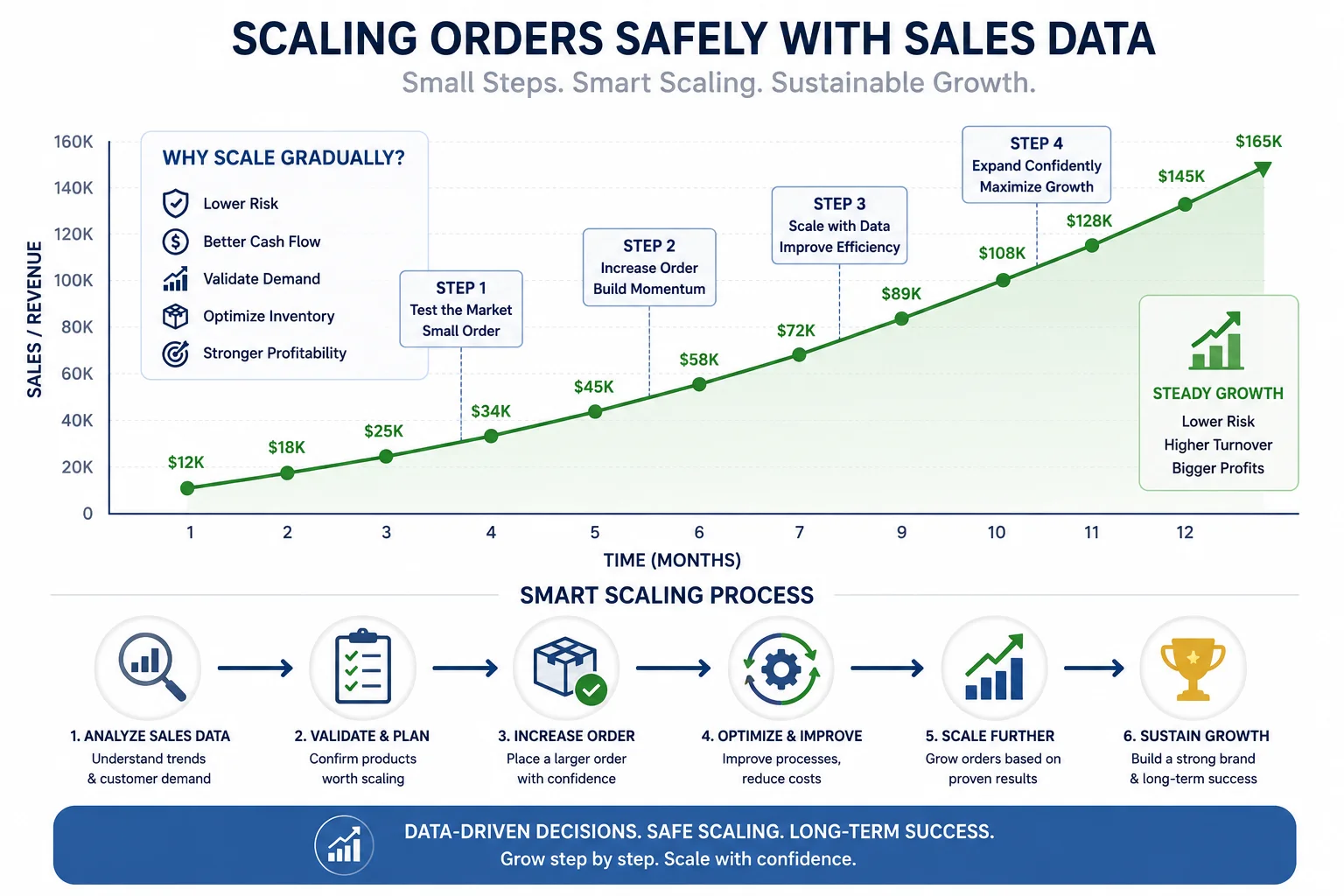
This is the blueprint our most successful clients use. They don't take wild guesses. Every decision to increase order volume is justified by real sales data. Here’s how it works in practice:
-
Order 1: Test the Waters. You order 500 units of a new smartwatch. They sell out in three weeks. You collect feedback: customers love the big screen but wish there were more color options. The defect rate was under 1%.
-
Order 2: Optimize and Reorder. Based on this data, your next order is for 1,500 units. This time, you order 750 of the original black color, plus 500 in blue and 250 in pink to test new variations. The blue units sell out first.
-
Order 3: Scale with Confidence. Now you have even better data. You place an order for 5,000 units, but you adjust the color ratio based on what sold best: 2,500 blue, 1,500 black, and 1,000 pink.
See how that process works? There's no gambling. Each step is an informed business decision backed by data. This methodical approach reduces mistakes, improves your long-term profitability, and turns your business from a risky venture into a predictable, scalable machine.
Conclusion
In short, small wholesale orders are not a sign of weakness. They are a powerful, low-risk strategy to test, learn, and scale your 3C electronics business intelligently and profitably.
"What Is Dead Stock and How Can You Avoid It? | MRPeasy Blog", https://www.mrpeasy.com/blog/dead-stock/. Dead stock, also known as obsolete inventory, refers to items that have reached the end of their product lifecycle with no remaining demand, leading to significant financial losses from tied-up capital, storage costs, and eventual write-downs. Evidence role: definition; source type: education. Supports: The source should define dead stock (or obsolete inventory) and explain its negative financial consequences, such as tied-up capital, carrying costs, and potential write-offs, which supports the claim that it can ruin profits.. ↩
"[PDF] Cash Management Principles in a Small Business", https://som.yale.edu/sites/default/files/2025-04/Cash%20Management%20Principles%20in%20a%20Small%20Business.pdf. According to financial management principles for small businesses, maintaining a lean inventory through smaller, more frequent orders is a key strategy for protecting cash flow, as it minimizes the amount of working capital tied up in unsold goods. Evidence role: definition; source type: government. Supports: The source should explain that large inventory purchases require a significant upfront cash outlay, which can strain a business's working capital and reduce its ability to cover other short-term expenses.. ↩
"Durability of smartphones: A technical analysis of reliability and ...", https://pmc.ncbi.nlm.nih.gov/articles/PMC7871336/. The consumer electronics industry is characterized by extremely short product life cycles, where new models with incremental improvements can render previous versions commercially obsolete in as little as 6 to 18 months, creating high risks of inventory devaluation. Evidence role: statistic; source type: research. Supports: The source should provide data or expert analysis on the rapid product lifecycles in the consumer electronics industry, confirming that products can become obsolete in a short period, such as a year or even months.. Scope note: The exact lifecycle duration varies significantly by product category, with high-demand items like smartphones having faster cycles than accessories like cables. ↩
"'Quality Fade': China's Great Business Challenge", https://knowledge.wharton.upenn.edu/podcast/knowledge-at-wharton-podcast/quality-fade-chinas-great-business-challenge/. This discrepancy between an initial 'golden sample' and the final mass-produced goods is a recognized issue in supply chain management known as 'quality fade,' where suppliers may substitute cheaper materials or relax quality controls after securing a contract. Evidence role: mechanism; source type: paper. Supports: The source should describe the phenomenon of 'quality fade,' where a supplier's quality deteriorates over time after the initial samples or batches are approved, often due to cost-cutting or process drift in mass production.. ↩
"Acceptable quality limit - Wikipedia", https://en.wikipedia.org/wiki/Acceptable_quality_limit. In manufacturing, Acceptable Quality Limits (AQL) are used to set statistical thresholds for defects. For consumer electronics, an AQL for major defects is often set at 2.5% or lower, meaning a batch with a 10% defect rate would typically be rejected. Evidence role: general_support; source type: institution. Supports: The source should explain the concept of Acceptable Quality Limit (AQL) and provide examples of typical AQL levels for consumer electronics, which would contextualize why a 1% defect rate might be considered acceptable while 10% would be a major failure.. Scope note: AQL standards are a tool for batch acceptance sampling, not a guarantee of the defect rate for every single unit; the specific acceptable rate can also vary based on the product's criticality and price point. ↩
"Inventory Turnover Ratio: What It Is, How It Works, and Formula", https://www.investopedia.com/terms/i/inventoryturnover.asp. The inventory turnover ratio is a key financial metric measuring how many times inventory is sold and replaced over a period. By reducing the amount of capital tied up in a single large order, businesses can increase this ratio, improving cash flow and working capital efficiency. Evidence role: definition; source type: education. Supports: The source should define the inventory turnover ratio and explain that holding less inventory (via smaller orders) for a shorter period allows capital to be reinvested more quickly, thus increasing the turnover ratio and improving financial efficiency.. ↩
"Why Minimum Viable Products are the Real MVP", https://businesstech.bus.umich.edu/blog/why-minimum-viable-products-are-the-real-mvp/. This strategy aligns with lean startup principles, where small, iterative product releases are used to test hypotheses and gather validated learning from the market with minimal initial investment, thereby reducing the risk of large-scale failure. Evidence role: general_support; source type: paper. Supports: The source should discuss market validation techniques, such as using a Minimum Viable Product (MVP) or small test batches, to gather real-world sales data and customer feedback before committing to large-scale production.. ↩
"Supplier Vetting 101: Best Practices for Identifying Top Performers", https://www.zycus.com/blog/supplier-management/supplier-vetting-101-best-practices-for-identifying-top-performers. Using trial orders to vet multiple suppliers is a recommended practice in strategic sourcing. It allows a firm to conduct a real-world performance comparison on critical factors beyond the initial price quote, such as production quality, lead time adherence, and responsiveness. Evidence role: mechanism; source type: education. Supports: The source should describe supplier evaluation methods, including the use of trial orders or pilot runs to assess a potential supplier's actual performance on metrics like quality, delivery time, and communication before signing a larger contract.. ↩
"The Role of Packaging in Crafting the Perfect Unboxing Moment.", https://kadence.com/en-us/knowledge/the-role-of-packaging-in-crafting-the-perfect-unboxing-moment/. Marketing studies and consumer behavior research have shown that the unboxing experience serves as a critical touchpoint that significantly influences a customer's initial perception of product quality, brand value, and attention to detail. Evidence role: general_support; source type: research. Supports: The source should provide research or analysis showing a correlation between a positive unboxing experience and improved brand perception, customer satisfaction, and willingness to share the product on social media.. ↩
"From Zero to Hero: Product Localization for Global Markets", https://productschool.com/blog/user-experience/localization-products. Product localization for electronics extends beyond language to include technical compatibility; failure to test with device ecosystems and network standards prevalent in a target market can lead to significant functional issues and product rejection by consumers. Evidence role: case_reference; source type: research. Supports: The source should discuss the challenges of launching electronic products globally, highlighting the need for thorough compatibility testing with local infrastructure, popular device models, and software ecosystems to avoid market-specific failures.. ↩
"Managing Relationships with Suppliers and Vendors You Use", https://www.apu.apus.edu/area-of-study/business-and-management/resources/managing-relationships-with-suppliers-and-vendors-you-use/. Research in supply chain management indicates that trust, built through consistent and reliable interactions such as successful initial orders, is a cornerstone of long-term collaborative partnerships, often leading to benefits like improved pricing, flexibility, and preferential treatment for the buyer. Evidence role: expert_consensus; source type: paper. Supports: The source should discuss the importance of trust and demonstrated reliability in forming strong buyer-supplier relationships, explaining that suppliers are more likely to invest in and offer preferential terms to partners who have proven to be professional and dependable.. ↩
"Data Driven Marketing: Strategies, Tools, and Benefits", https://online.edhec.edu/en/blog/data-driven-marketing-transforming-strategy-with-analytics-and-insight/. This iterative approach to scaling is a core principle of the Lean Startup methodology, which emphasizes a 'Build-Measure-Learn' feedback loop to validate business decisions with real market data before committing significant resources. Evidence role: mechanism; source type: education. Supports: The source should explain a data-driven business framework, such as the Build-Measure-Learn feedback loop from the Lean Startup methodology, which advocates for using empirical data from small-scale tests to guide decisions about scaling and investment.. ↩