Struggling to sell your TWS earbuds or dealing with too many complaints? It's frustrating when a promising product fails. Let's uncover what truly matters when choosing a TWS earbud manufacturer.
Buyers should compare OEM TWS earbuds by focusing on real-world performance, not just specs. Prioritize stable connectivity from a quality chipset, true battery life, clear call quality, and comfort. For branding, start with stock items to test the market before moving to private label or full OEM customization.
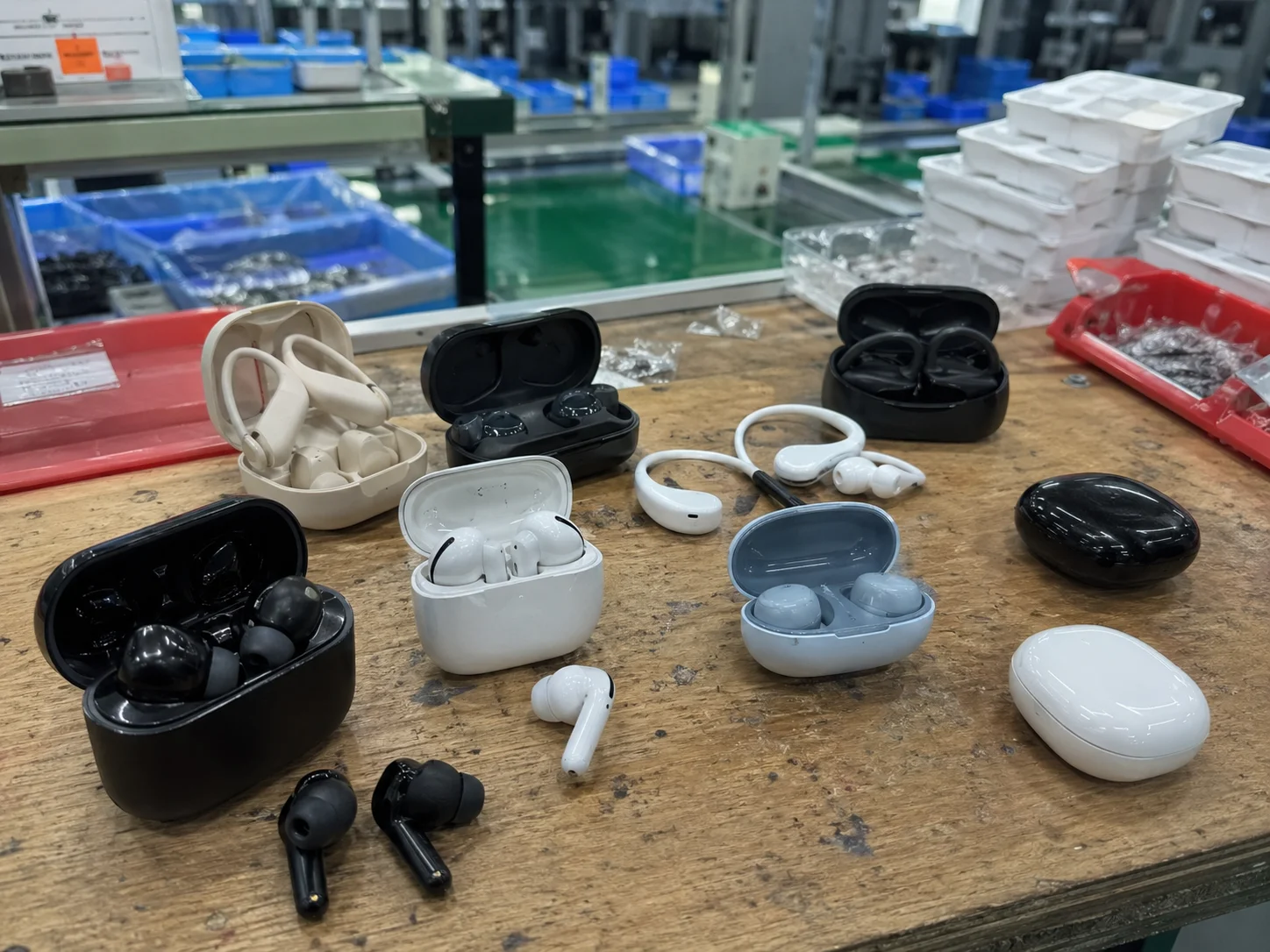
I’ve been in the electronics export business for 15 years. TWS earbuds look more appealing than simple cables. They have nice packaging, cool designs, and features that customers seem willing to pay more for. But this complexity is also a trap. I've seen many buyers get burned because one small issue—like a weak battery or a bad microphone—can lead to a flood of customer complaints. To succeed, you need to look past the surface. Let's break down how to avoid these common problems and choose a product that actually sells.
Why Do Buyers Really Search for TWS Earbud Manufacturers?
Are your current TWS earbuds not selling well, or are returns piling up? You thought earbuds would be profitable, but constant complaints are killing your margins and your reputation. It's time to understand the real reason you need a reliable manufacturer.
Buyers search for TWS manufacturers not just for a cheap supplier, but for a partner. They need someone who provides stable quality, clear specs, and reliable after-sales support to solve issues like poor connectivity, short battery life, and bad call quality that lead to customer complaints.

In my experience, when a buyer from the US or Europe searches for a "TWS earbuds manufacturer in China," they are usually trying to solve a very practical problem: their current earbuds are a headache. The product looks great but fails in practice.
The Real Problem Behind the Search
TWS earbuds are not simple like a USB cable. They involve a complex mix of components1: Bluetooth chips, batteries, speakers, microphones, noise-canceling tech, charging cases, and software. If a factory gets just one of these wrong, the customer will notice immediately. I've seen it all. The most common complaints include:
- Unstable connection
- One earbud has no sound
- Battery life is too short
- The case won't charge
- Call quality is terrible
- High latency during games or videos
- Uncomfortable to wear
- The plastic feels cheap
- Packaging looks low-grade
So, what buyers are truly looking for is a partner who can deliver a stable product, control quality, explain the features honestly, and handle after-sales issues.
From Simple Questions to Smart Questions
Many new buyers start with basic questions like, "How much for AirPods style earbuds?" or "Best price for ANC earbuds?" These are fine to ask, but they don't get to the heart of the matter. An experienced wholesaler digs deeper. They know the right questions to ask to avoid future problems.
| Newbie Buyer Questions | Pro Wholesaler Questions |
|---|---|
| "How much for these?" | "What Bluetooth chipset solution are you using?" |
| "Can you put my logo on it?" | "Is the battery life listed single-playtime or total?" |
| "Do you have ANC?" | "Is it real ANC, or just ENC for calls? What's the depth?" |
| "What's the best price?" | "What is the typical defect rate and your warranty policy?" |
Know Your Customer First
Before you even start comparing prices, you need to know who you're selling to. The right earbud for a convenience store is completely different from one for an Amazon seller. If your customers are looking for a cheap gift item, then appearance, packaging, and basic stability are key. If you're selling to online shoppers who read reviews, then features, user experience, and low return rates are what matter most. Don't just chase the lowest price; find the right fit for your market.
What Key Features Actually Affect Your TWS Earbud Selection?
Are you feeling overwhelmed by long spec sheets for TWS earbuds? Focusing on the wrong features can lead you to buy a product that looks good on paper but completely fails in reality. Let's focus on the six core features that truly matter.
The most critical features are a visually appealing design and packaging, a stable connection from a quality chipset, and true battery life. You must also personally test the sound quality, call clarity in noisy environments, and long-term wearing comfort. These factors directly impact customer satisfaction.
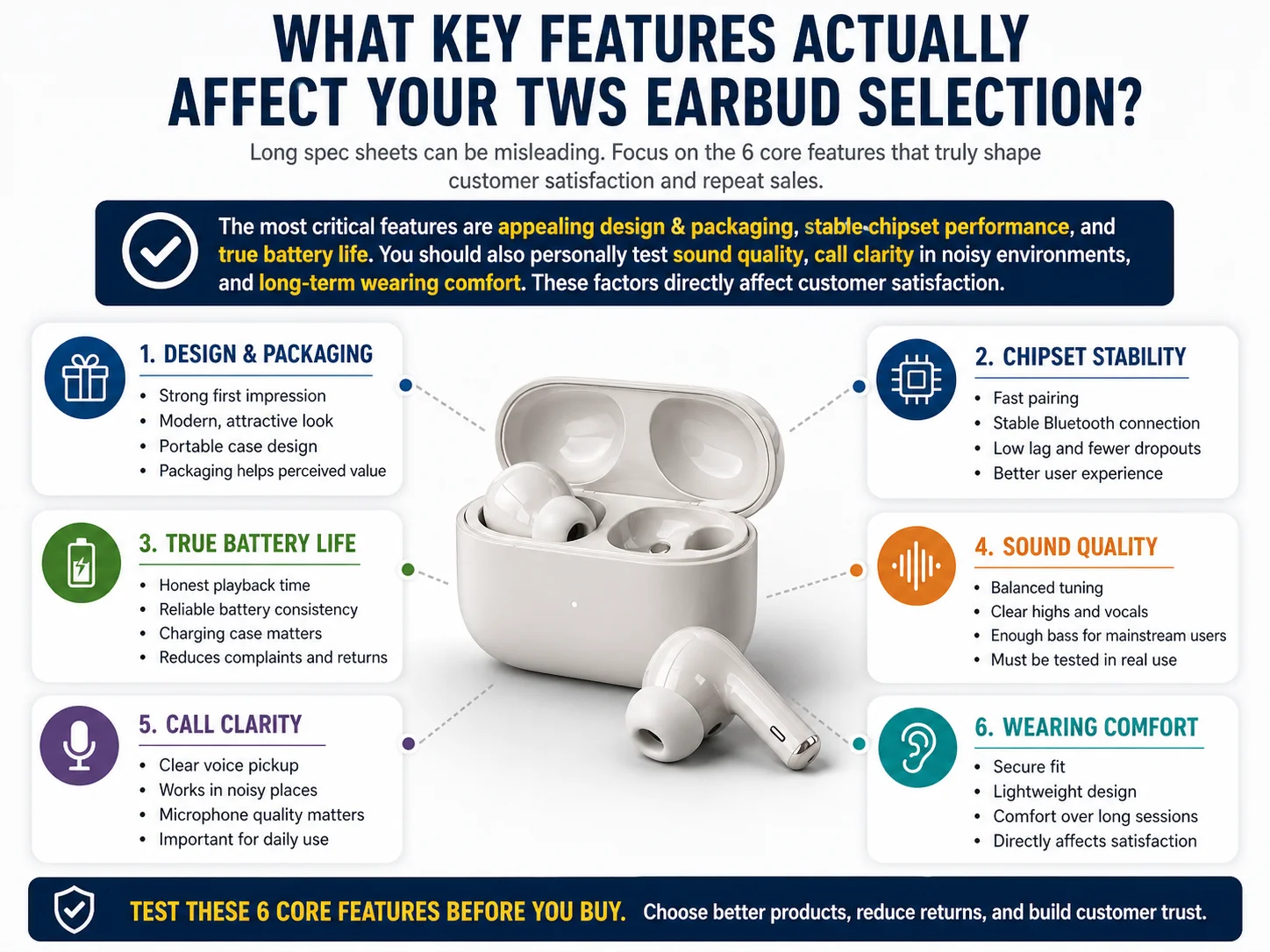
There are dozens of specs a factory can list, but after years of shipping these products, I can tell you that only a handful truly decide if a product will be a success or a failure. Let's go through them one by one.
1. Appearance and Packaging
This might sound shallow, but it's the reality of retail. The first thing a customer sees is the design. Does it look like a premium product? Does the charging case feel solid? Are the colors appealing? In a physical store, the packaging is just as important. A product with great features but a cheap-looking box will be ignored. A clean, attractive package that clearly lists the selling points will grab a customer's attention, even at a slightly higher price.
2. Chipset and Connection Stability
The number one source of frustration for TWS earbud users is a bad connection2. This includes difficult first-time pairing, audio cutting out, left and right earbuds going out of sync, and high latency in videos. Don't just ask about the Bluetooth version (e.g., 5.3 or 5.4). That's just a baseline spec. The actual chipset solution and how well the manufacturer has tuned the software are far more important for a stable, seamless user experience3.
3. Real Battery Life
This is where many suppliers can be misleading4. A box might say "30 hours of battery life," but this is often the combined total with the charging case. You need to ask for the specifics: single playtime, total battery life with the case, earbud battery capacity (mAh), and case capacity. If these aren't clear, you're setting yourself up for customer disputes later.
4. Sound Quality
Never trust a supplier who just says "good sound quality." You have to listen for yourself. Many low-cost earbuds suffer from weak bass, harsh treble, muffled vocals, or noticeable background hiss. For a general audience, the sound doesn't need to be audiophile-grade, but it must be pleasant and not sound cheap.
5. Call Quality
This is a huge pitfall for many buyers. They test music playback but forget to make phone calls. Your customers will use their earbuds for calls, meetings, and voice chats. If the microphone is terrible, they will complain. Test it in a quiet office, on a noisy street, and in a busy café. If the person on the other end says you sound distant or like you're underwater, that product is not ready for the market.
6. Wearing Comfort
An earbud is useless if it's uncomfortable to wear. Key factors include the weight of a single earbud, the angle of the ear tip, and the material of the ear caps. A sample might feel fine for five minutes, but what about after 30 minutes? Does it cause ear fatigue? Does it stay in during a run? A product that isn't comfortable will never get repeat customers.
How Do Battery, ANC, and Comfort Impact Real-World Sales?
Are your product's impressive specs not matching the customer's actual experience? This gap between what's on the box and reality leads to bad reviews and high return rates, which hurts your brand. Let's see how these key features perform in the hands of real users.
In real-world selling, true battery life is crucial; if a 6-hour spec only lasts 3 hours, customers feel cheated. Real ANC must be distinguished from ENC to avoid misleading claims. Excellent call quality and all-day comfort are what drive repeat purchases and positive reviews.
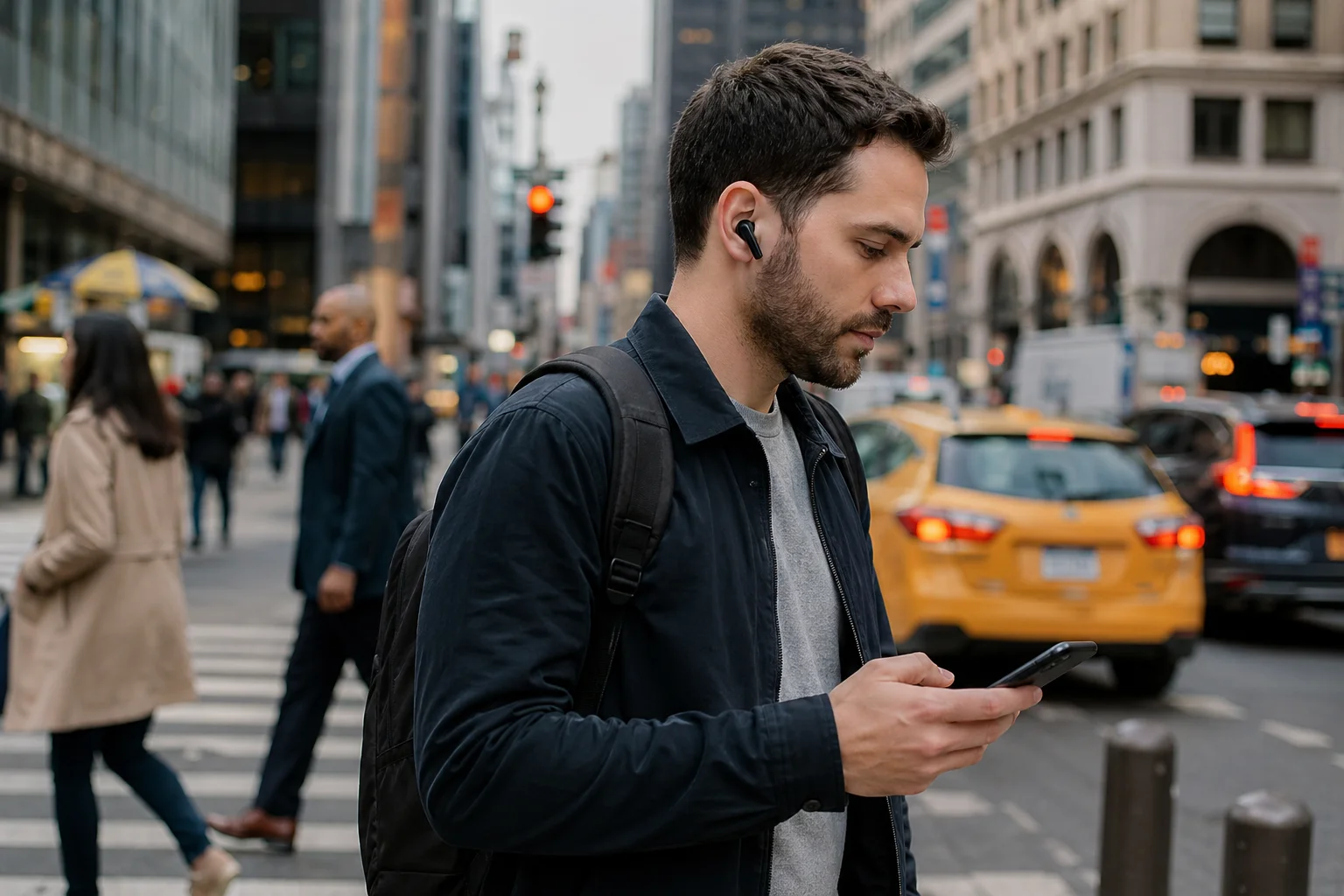
A product's success isn't determined by a spec sheet. It's determined by the daily experience of the end user. Here’s how these critical features play out in the real world.
Real-World Battery Life
Battery life is one of the top reasons for product returns. If your packaging promises 6 hours of playtime and a customer only gets 2-3 hours, they will feel cheated. This problem is tricky because a battery might perform well for the first week and then degrade quickly5. As a wholesaler, you can't just rely on the sample's initial performance. You should test it over several days.
- How long does it last playing music at 70% volume?
- How many full charges can the case provide?
- Does the battery drain significantly after being idle for a few days? Many cheap earbuds cut costs on the battery. This gives you a good initial price but creates a long-term headache with after-sales service.
The Truth About ANC
Active Noise Cancelling (ANC) is a major selling point today, but it's also the most commonly exaggerated feature. Some suppliers will list ANC on the box when the product only has ENC (Environmental Noise Cancelling). They are not the same thing.6
- ANC actively cancels out ambient noise so you can hear your music better.
- ENC uses microphones to reduce background noise so the person on a call with you can hear you better. Selling a product with ENC as if it has ANC will get you very angry customers. If you are targeting a lower-price market, it's better to offer a stable, non-ANC product than a fake ANC one. If you are selling to a mid-to-high-end market, your ANC must be genuine and effective.
Call Quality as a Dealbreaker
I've said it before, but it's worth repeating: many earbuds that are decent for music are terrible for calls. This is often where cheap models cut corners—on the microphone quality and noise-reduction algorithms7. Don't just test calls in your quiet office. A real test involves real-world noise. Use them for a WhatsApp call while walking down the street or a Zoom meeting from a café. If the call quality is poor, the product will have a hard time getting positive reviews.
Comfort is King
Comfort is subjective, but it is incredibly important. Different markets have different preferences. Some users prefer the relaxed fit of semi-in-ear buds, while others want the tight seal of in-ear buds for better bass and noise isolation. For your product selection, think about the end user.
- Office Workers: Prioritize comfort for long wear and clear call quality.
- Students: Focus on style, colors, bass, and an affordable price.
- Athletes: Waterproofing, a secure fit, and sweat resistance are essential.
- Business Travelers: ANC, long battery life, and a premium feel are key. The goal isn't to have the most features. It's to have the right features for your target customer.
How Do OEM and Private Label Options Change Your Buying Decision?
Are you confused about whether to start with standard stock, private label, or full OEM? Choosing the wrong path can tie up your capital in unsold inventory or cause you to miss a crucial branding opportunity. Let's explore the right strategy for your business stage.
Start with standard stock to test the market with low risk and low MOQ. Once you identify best-sellers, move to private label (custom logo, packaging) to build your brand. Reserve full OEM/ODM for when you have stable sales and need a unique product, as it requires much higher investment.
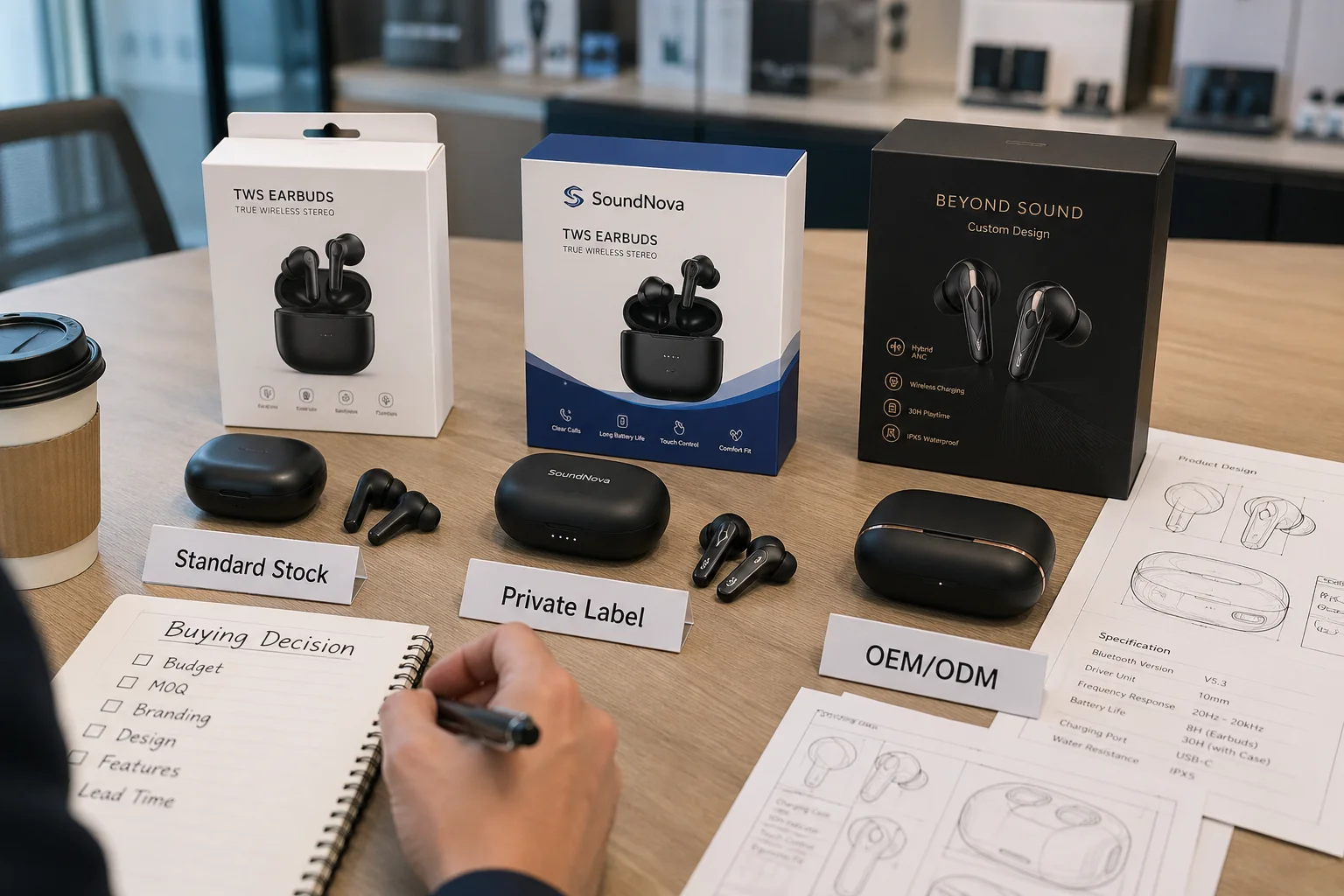
When buying TWS earbuds, you generally have three options. Picking the right one at the right time is key to growing your business without taking on too much risk.
Start Smart with Standard Stock
If you are new to selling TWS earbuds, I always recommend starting with standard, off-the-shelf products. The benefits are huge:
- Low Minimum Order Quantity (MOQ)8
- Fast shipping times
- Minimal financial risk
- Allows you to test different styles and price points Instead of guessing what will sell, you can order small batches of a few different models: an AirPods-style basic model, one with an LED display case, a low-cost gaming earbud, and an entry-level ANC model. Let your sales data tell you what your market wants. The market's feedback is always more valuable than your own assumptions.
Build Your Brand with Private Label
Once you have a model that sells consistently, it's time to consider a private label. This doesn't mean you need to redesign the entire product. Often, you can start with simple customizations:
- Printing your logo on the earbuds and case
- Designing your own retail box
- Customizing the user manual
- Adding your barcode and labels The value of a private label is brand recognition and customer loyalty. If a customer buys your branded product and likes it, they will look for your brand again. However, don't jump into a large private label order before you've validated the product. It's much harder to sell off custom-branded stock if it doesn't move.
Differentiate with OEM/ODM
Full Original Equipment Manufacturing (OEM) or Original Design Manufacturing (ODM) is for mature businesses with stable sales volumes and a clear product vision. Here, you can customize everything:
- The external mold and design
- Chipset solution and battery capacity
- Speaker and microphone components
- Custom touch controls and voice prompts
- A dedicated companion app OEM/ODM gives you a unique product that no one else has, but the risks are higher. It requires a large MOQ, a long development timeline, and significant investment9. The best path for most businesses is a gradual one: Test with standard stock → Build with private label → Differentiate with OEM/ODM. This approach is slower, but it protects your cash and helps you make smarter decisions.
What Must You Confirm Before Placing a Wholesale TWS Earbud Order?
Are you worried about your bulk order not matching the quality of the sample you approved? A bad batch can ruin your reputation and your finances, especially with a complex product like TWS earbuds. Here is a final checklist to go through before you place that order.
Before ordering, confirm the exact chipset and test Bluetooth stability. Verify real battery life, not just advertised specs. Test sound and call quality in various environments. Clarify if it's true ANC. Finally, confirm all details on packaging, defect rates, warranty, and ensure bulk order consistency.
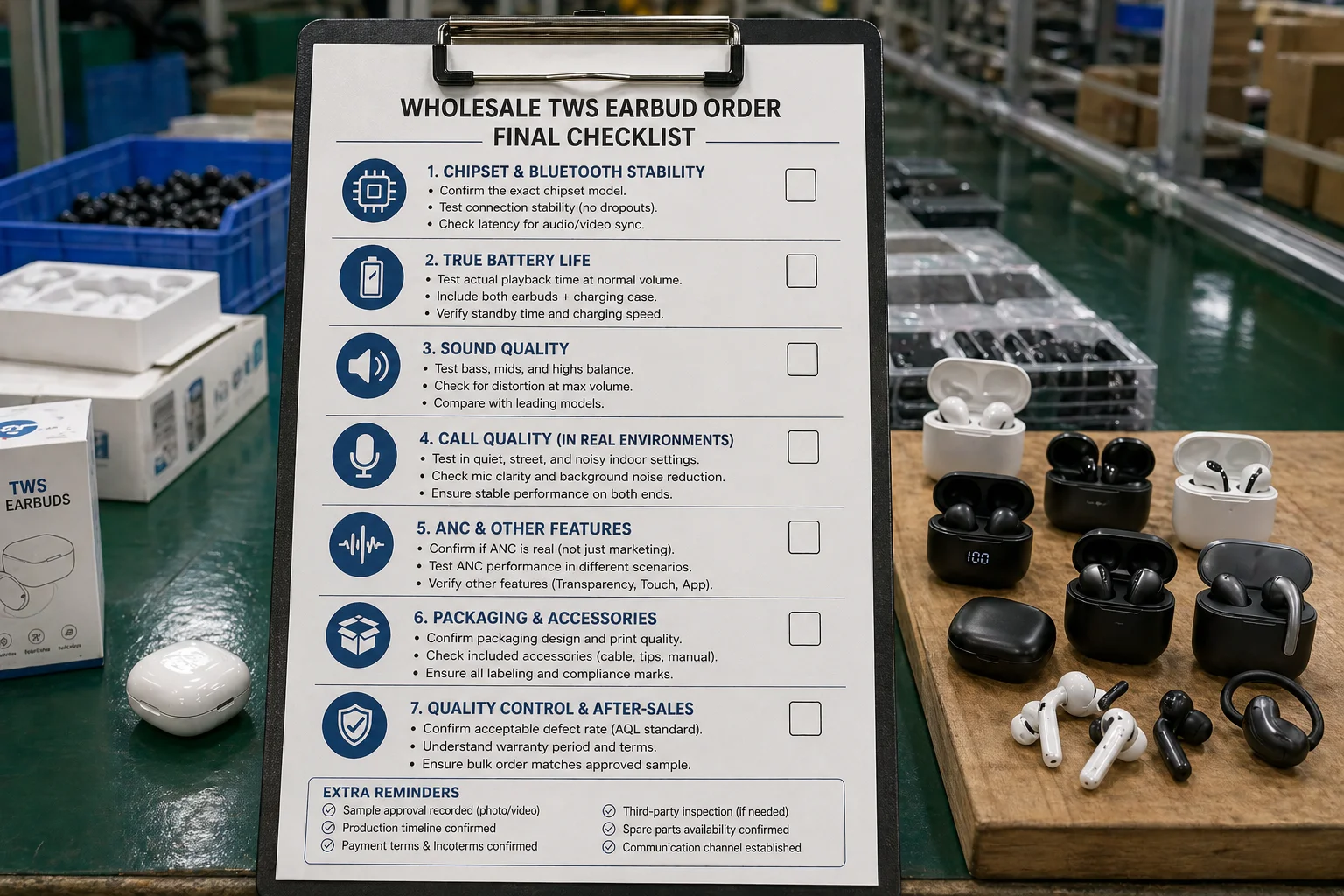
Placing a wholesale order for TWS earbuds requires more diligence than for simpler accessories. The potential for failure is much higher. Here are the things you absolutely must confirm with your supplier before sending any money.
1. Confirm the Chipset and Bluetooth Stability
Ask for the specific Bluetooth chipset solution being used. Test the sample's pairing speed, connection range, and stability with multiple phones (both iOS and Android), not just one.
2. Confirm Real Battery Life
Get the exact battery capacities (mAh) for both the earbuds and the charging case in writing. Ask for the single playtime at a specific volume. Then, test it yourself to verify their claims.
3. Confirm Sound and Call Quality
Test the sample in multiple scenarios: listening to music, watching videos, and making calls on different apps (Phone, WhatsApp, Zoom). Make sure to test calls in both quiet and noisy environments.
4. Confirm ANC or ENC Details
If the product is advertised with noise cancellation, ask directly: "Is this ANC or ENC?" If it's ANC, ask for the noise reduction depth (in dB)10 and if it has a transparency mode. Don't let them sell you ENC disguised as ANC.
5. Confirm Comfort and Fit
Have a few different people try on the sample. See if it's comfortable for long periods and if it stays secure during movement. Check that the ear tips come in different sizes to fit more users.
6. Confirm Packaging and Accessories
Finalize the retail box design, user manual language, and included accessories like the charging cable and extra ear tips. Cheap packaging can make a decent product feel low-quality.
7. Confirm Defect Rate and Warranty
Ask your supplier about their typical defect rate and how they handle faulty units. A reliable partner won't promise "zero problems." Instead, they will have a clear policy for replacements, spare parts, or credits.
8. Confirm Sample and Bulk Order Consistency
This is the most critical step. Insist that the components used in the bulk order (chipset, battery, speaker) will be identical to the sample you approved. Before shipping, ask for photos or a video from the production line, or even a final production sample. This helps prevent a "bait and switch,"11 where the great sample is followed by a mediocre bulk order.
Conclusion
Success in the TWS earbud business isn't about the lowest price. It’s about finding a stable product and a reliable partner. Appearance makes the first sale; quality determines if you'll ever get a second.
"Simplifying TWS Earbud Designs with 1-Wire Connectivity", https://www.analog.com/en/resources/analog-dialogue/articles/simplifying-tws-earbud-designs-with-1-wire-connectivity.html. Technical analyses of TWS earbuds detail the intricate system-on-a-chip (SoC) architecture, which integrates Bluetooth connectivity, audio processing, and power management, illustrating how a failure in one sub-system can impact the entire user experience. Evidence role: mechanism; source type: paper. Supports: The source should provide a technical overview of the components inside TWS earbuds (e.g., SoC, battery, drivers, microphones) and explain how their integration affects overall performance and reliability.. ↩
"Perceived Risk and Fashion on the Intention to Adopt Wireless ...", https://pmc.ncbi.nlm.nih.gov/articles/PMC12199847/. Market research and consumer surveys frequently identify Bluetooth connectivity issues, such as audio dropouts and pairing difficulties, as a leading cause of user frustration and negative reviews for TWS earbuds. Evidence role: statistic; source type: research. Supports: The source should present data from user surveys or market research identifying connectivity issues as a primary complaint or reason for dissatisfaction among TWS earbud owners.. ↩
"Seven Must-know Things about TWS (True Wireless) Earphones", https://www.mobvoi.com/hk/blog/Seven-Must-know-Things-about-TWS-(True-Wireless)-Earphones?_id=60c86ba7476ca50011c6bcca&srsltid=AfmBOorx7WBcsP9AgsdoRHGVl-0Da6DJO8bsfpvIlQIHe9RvQUyfrKr-. Audio engineering sources explain that the specific Bluetooth chipset and antenna design, rather than the Bluetooth version number alone, are the primary determinants of a TWS earbud's connection stability and range. Evidence role: mechanism; source type: institution. Supports: The source should explain that while the Bluetooth version defines the protocol's capabilities, the specific System-on-a-Chip (SoC) and its firmware implementation are what determine real-world performance like connection stability, latency, and power consumption.. ↩
"PSA: Uneven battery drain on TWS IEM's is an inherent design flaw ...", https://www.reddit.com/r/NothingTech/comments/1l8px7z/psa_uneven_battery_drain_on_tws_iems_is_an/. Technology review outlets and consumer protection agencies have noted that manufacturers often prominently advertise the total battery life of TWS earbuds including the case, which can be confusing for consumers who are more concerned with the continuous single-charge playtime. Evidence role: case_reference; source type: other. Supports: The source should document instances where the advertised battery life of TWS earbuds refers to the total time including recharges from the case, which can be significantly different from the continuous playtime of the earbuds themselves.. ↩
"Predicting the slow death of a lithium-ion battery", https://sustainability.stanford.edu/news/predicting-slow-death-lithium-ion-battery. Research from materials science and battery technology fields indicates that lower-cost lithium-ion cells often have higher impurity levels and less stable electrode materials, leading to a faster decline in capacity and a shorter overall cycle life compared to higher-grade cells. Evidence role: mechanism; source type: education. Supports: The source should explain how the quality of lithium-ion battery cells and the battery management system (BMS) affects charge capacity and cycle life, and why lower-grade components can lead to rapid performance degradation.. ↩
"ANC VS ENC Explained: Choosing The Right Noise Tech For Your ...", https://www.soundcore.com/blogs/open-ear/anc-vs-enc. Audio technology resources define Active Noise Cancellation (ANC) as a method for reducing unwanted background sound for the listener, whereas Environmental Noise Cancellation (ENC) is a feature that uses microphones to suppress ambient noise around a speaker to improve call clarity for the far-end listener. Evidence role: definition; source type: encyclopedia. Supports: The source should clearly define both ANC and ENC, explaining that ANC uses microphones and inverted sound waves to cancel ambient noise for the listener, while ENC uses microphones to isolate the speaker's voice from background noise for the person on the other end of a call.. ↩
"The 5 Best Earbuds With A Mic of 2026 - Headphones - RTINGS.com", https://www.rtings.com/headphones/reviews/best/earbuds-mic. Comparative analyses and product teardowns of TWS earbuds demonstrate that premium models often incorporate multiple high-performance MEMS microphones and sophisticated noise-reduction algorithms, components that are frequently simplified or omitted in budget-oriented devices to reduce cost, leading to inferior call quality. Evidence role: mechanism; source type: research. Supports: The source should provide evidence, such as from product teardowns or acoustic testing, showing that lower-cost earbuds tend to use smaller, less sensitive MEMS microphones and simpler noise-reduction algorithms compared to premium models.. ↩
"OEM Manufacturing with Flexible MOQ - Alibaba.com Seller Central", https://seller.alibaba.com/blogs/2026/southeast-asia/electronics-components/oem-manufacturing-flexible-moq-guide-alibaba-b2b. Guides on global sourcing and manufacturing explain that Minimum Order Quantities (MOQs) for off-the-shelf electronics are typically much lower than for private label or full OEM orders, as the latter require dedicated production setups and material procurement. Evidence role: general_support; source type: other. Supports: The source should explain the business models of electronics manufacturing, noting that standard (stock) products are produced in continuous runs, allowing wholesalers to purchase in smaller quantities, whereas custom (OEM/ODM) orders require dedicated production runs, necessitating higher MOQs to be profitable.. ↩
"Gaps in the Historical Record: Development of the Electronics Industry", https://www.library.hbs.edu/working-knowledge/gaps-in-the-historical-record-development-of-the-electronics-industry. Industry guides on electronics manufacturing detail that OEM/ODM projects involve substantial non-recurring engineering (NRE) costs for tooling and development, leading to high minimum order quantities (often thousands of units) and development cycles that can span from 6 to 18 months. Evidence role: general_support; source type: institution. Supports: The source should detail the OEM/ODM process, including stages like industrial design, mold creation, prototyping, and certification, explaining why these steps lead to higher minimum order quantities, development timelines of several months, and significant upfront non-recurring engineering (NRE) costs.. ↩
"What is ANC? How Noise Canceling Headphones Work | B&O", https://www.bang-olufsen.com/en/us/story/active-noise-cancellation. Acoustic engineering resources explain that the effectiveness of Active Noise Cancellation is often measured by its noise reduction depth in decibels (dB), where every 10 dB reduction corresponds to a perceived halving of loudness. Evidence role: definition; source type: education. Supports: The source should explain that the decibel (dB) rating for ANC measures the amount of sound reduction at specific frequencies, and provide context that a reduction of 20 dB is significant, while high-end systems may claim 30-40 dB of reduction in the low-frequency range.. ↩
"Ask Us Anything: Supply Chain Risk Management", https://www.sei.cmu.edu/library/ask-us-anything-supply-chain-risk-management/. Supply chain management literature identifies 'quality fade,' a phenomenon where manufacturers substitute lower-cost components or materials after a sample is approved, as a significant risk in global sourcing, underscoring the importance of pre-shipment inspections and clear component specifications in contracts. Evidence role: general_support; source type: other. Supports: The source should discuss common risks in global sourcing, such as 'quality fade' or deliberate component substitution, where a manufacturer uses lower-cost materials in the mass production run than were used in the approved pre-production samples.. ↩