Struggling to decide which wearable to stock? You're not alone. The market is confusing, and making the wrong choice can hurt your profits and increase customer complaints.
The best-selling wearable for your business depends entirely on your target customer, retail price point, and business model. For mass-market volume, fitness trackers are often safer. For higher margins with tech-savvy customers, smartwatches are the stronger but riskier choice.1
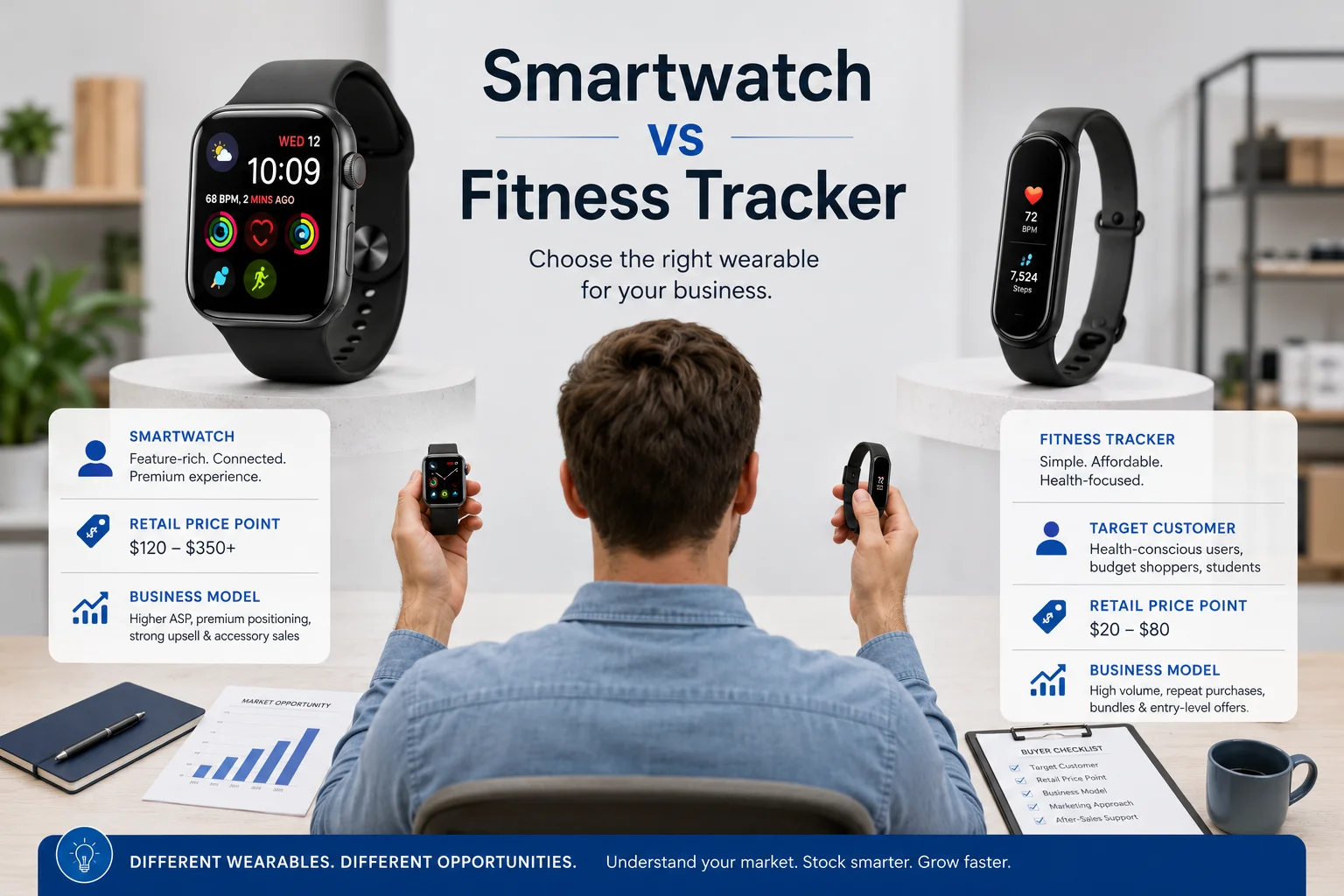
I've been in the electronics export business for 15 years, and this is a question I get from buyers almost every day. They want a simple answer, but the truth is more nuanced. It’s not about picking the "better" product. It's about picking the right strategy for your specific store or e-commerce site. A choice that works for a discount retail chain will likely fail for a specialized online electronics store. Let's break down how you can make the right decision for your business, based on hundreds of conversations I've had with buyers just like you. This will help you see the risks and opportunities clearly, so you can invest your money wisely.
Smartwatch vs Fitness Tracker: What Is the Main Difference?
Think the only difference is the feature list? The real difference for a wholesaler is complexity and risk. This affects your profits and customer support needs more than anything else.
A fitness tracker is a simple health-monitoring device with a single purpose. A smartwatch is a complex mini-computer for your wrist2, which brings more features but also more potential problems for you, the seller.
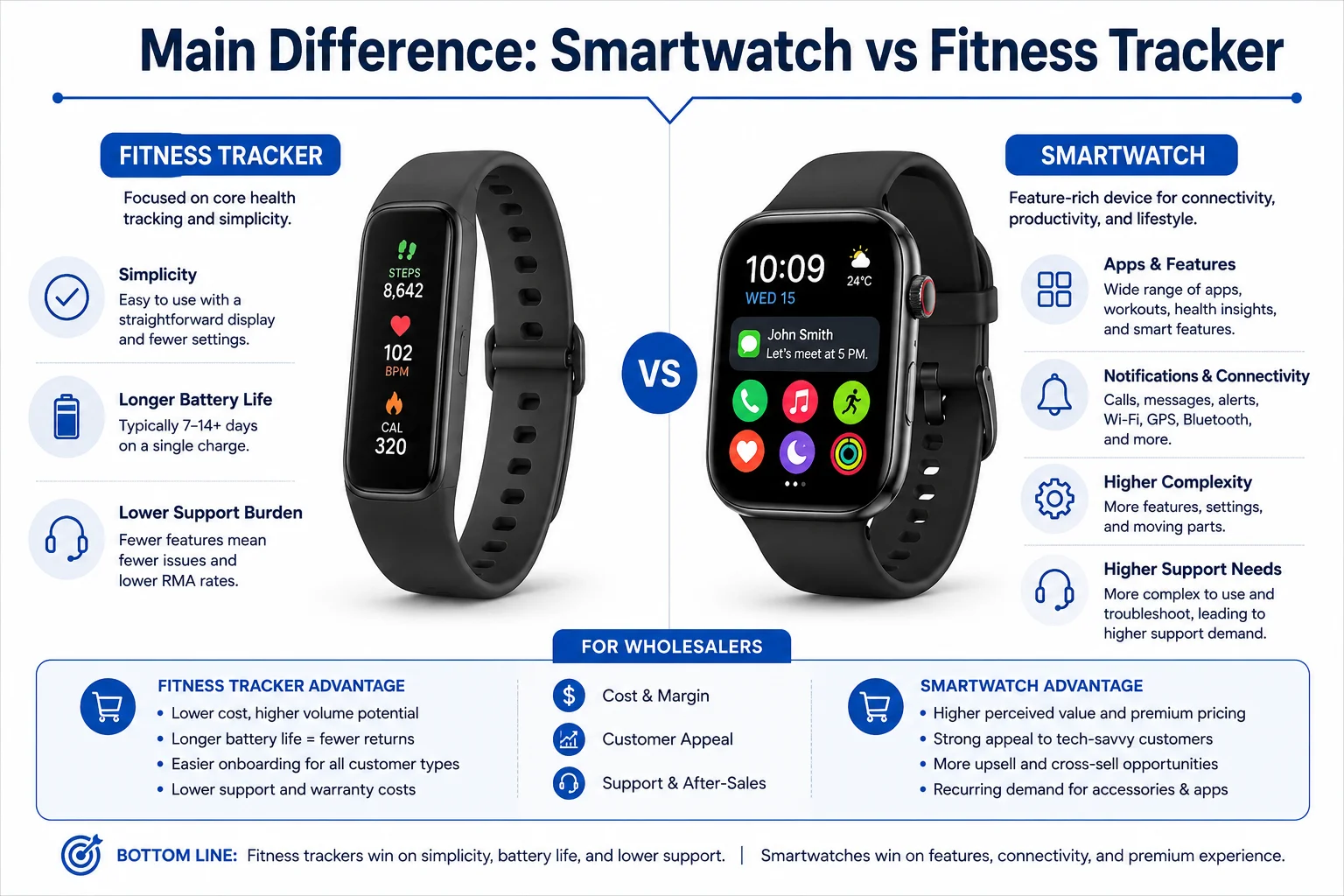
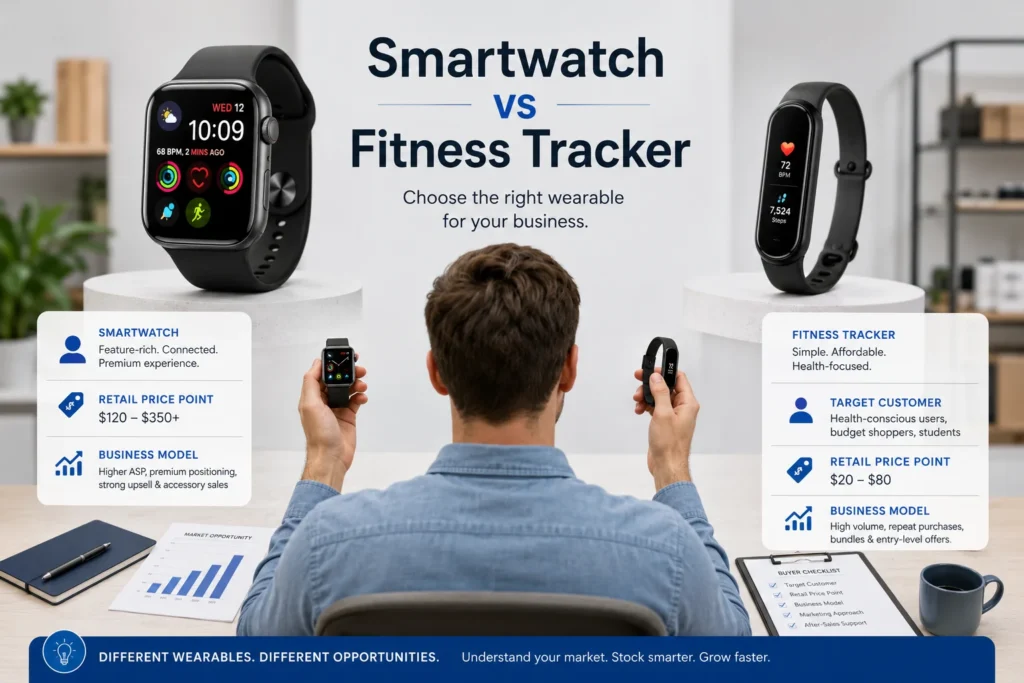
When a buyer asks me to explain the difference, I don't start with screen types or processors. I start with the business implications. From a wholesaler's perspective, the most important differences are not technical; they are commercial. A fitness tracker is designed to do a few things well, like count steps and monitor heart rate. Its simplicity is its greatest strength. This means fewer customer questions, lower return rates, and an easier sale. A smartwatch, on the other hand, tries to be a smartphone on your wrist. It has an operating system, apps, and connectivity options. While this justifies a higher price, it also opens the door to a lot of new problems. Customers will have questions about app compatibility, software updates, and notifications. Each of these is a potential support ticket and a possible return. Here’s a table I often share with clients to make it clear:
| Factor | Fitness Tracker | Smartwatch |
|---|---|---|
| Primary Use | Simple health & activity tracking | Communication, apps, advanced health tracking |
| Wholesale Cost | Low ($5 - $15) | High ($20 - $60+) |
| Customer Profile | Price-sensitive, health-focused | Tech-savvy, feature-driven |
| Support Load | Low (Mostly hardware issues) | High (Software, compatibility, user error) |
| Customization (OEM) | Easy (Logo, strap, basic UI) | Very Complex (OS, app development) |
Why Have Smartwatches Become a Stronger Wholesale Category?
Seeing smartwatches everywhere and feeling pressure to stock them? Their popularity comes from offering more functions, which lets you charge a much higher price and earn more per unit.
Smartwatches command higher retail prices because they function like a smartphone on the wrist. For wholesalers, this means a higher-margin product, but only if your business is equipped to handle the increased complexity and customer expectations.
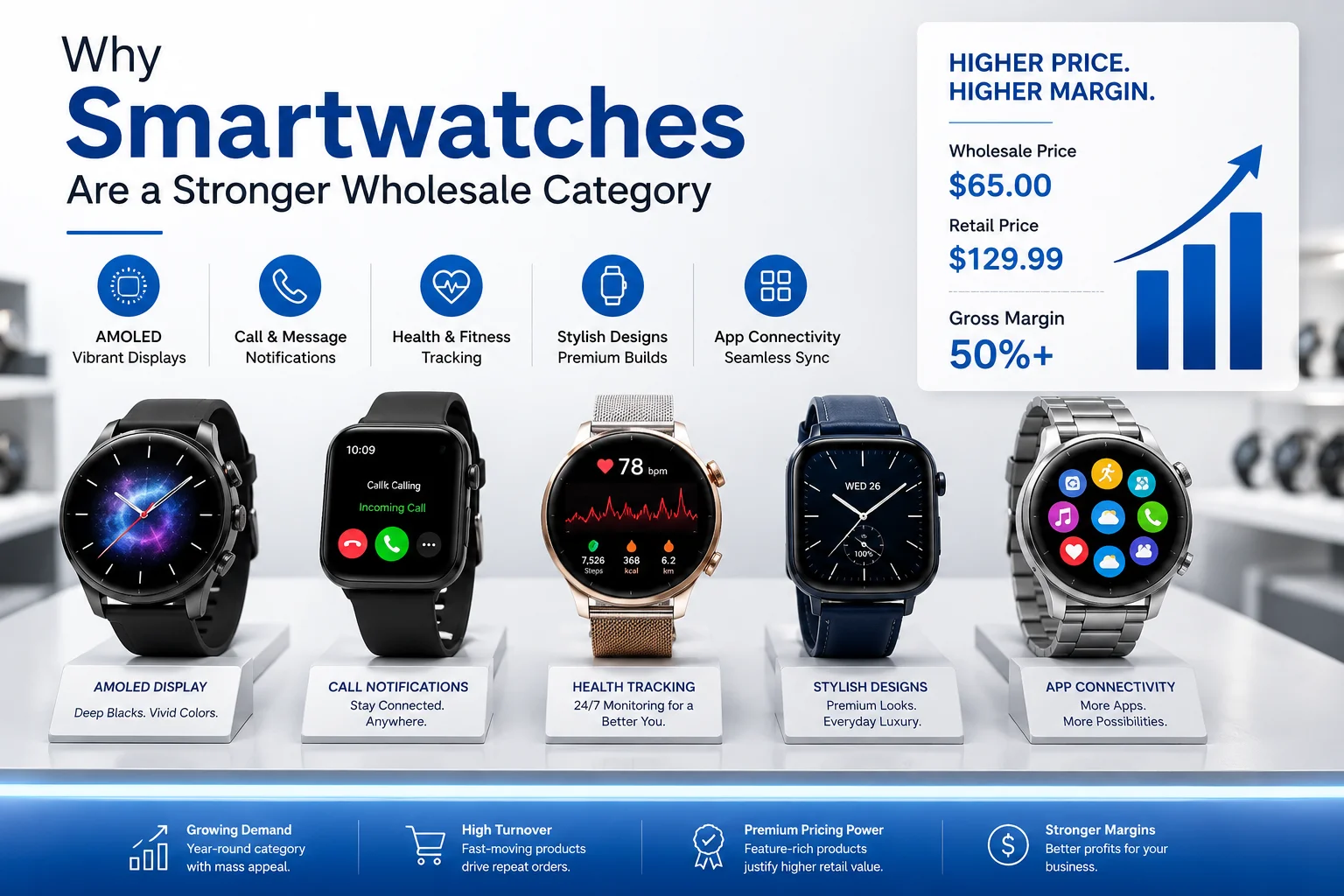
The trend is clear. Customers want more from their wearables.3 They don’t just want to count steps; they want to read messages, make contactless payments, and maybe even take calls. Smartwatches deliver on this promise, and that's why they can sell for $70, $80, or even over $100 at retail, while a fitness tracker might sell for $30. For a wholesaler, that's an attractive proposition. The profit on one smartwatch can be equal to the profit on three or four fitness trackers.
I have a client in Germany who runs a successful online electronics store. For years, they only sold fitness trackers. We advised them to test a small batch of our smartwatches. They were hesitant because of the higher cost. But their customers, who were already buying high-end headphones and chargers from them, loved the new product. They understood the technology and were willing to pay for features like an AMOLED screen and app notifications. This move increased their average order value significantly. However, it also increased their customer service workload. They had to learn how to answer questions about connecting the watch to different phone models and troubleshooting app issues. It’s a high-risk, high-reward game.
Do Fitness Trackers Still Sell Well in 2026?
Worried that the market for simple fitness trackers is dead? Not at all. You just need to know who you're selling to. They remain a massive volume opportunity for the right retailer.
Yes, fitness trackers sell extremely well, especially to price-sensitive or non-technical customers.4 Their long battery life and simple operation make them a low-risk, high-volume product for mass-market retailers, promotional companies, and general merchandise importers.
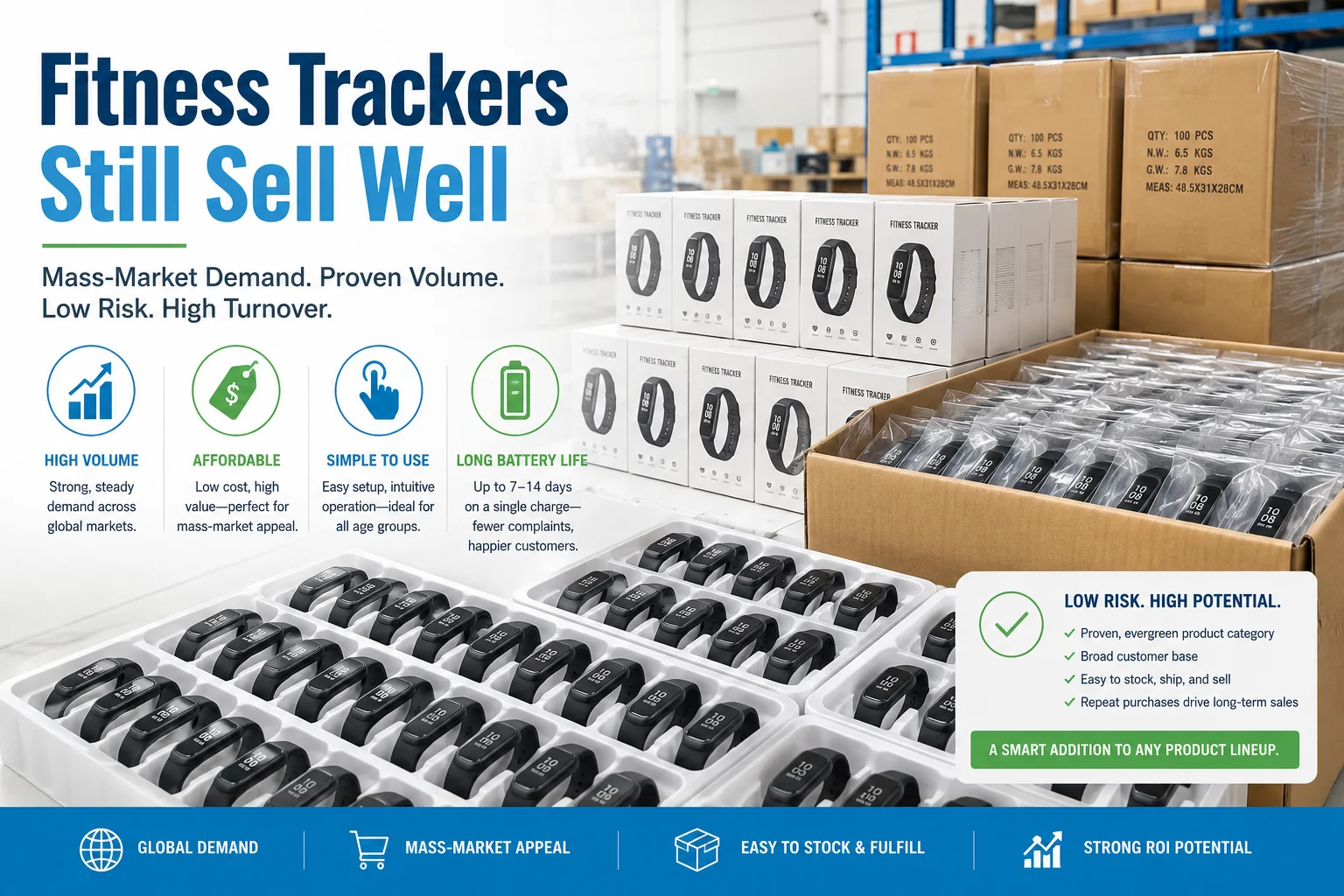
One of the most common questions I get from first-time importers is, "Are fitness trackers obsolete?" My answer is always a firm "no." The mistake is trying to sell a simple tracker to a tech enthusiast. That market wants a smartwatch. The real market for fitness trackers is huge and underserved. Think about customers who are older and just want to track their daily walks. They don't want a device that buzzes with notifications every five minutes. They want something they can charge once every two weeks and forget about.
Think about corporate wellness programs5. We have a client who supplies promotional goods, and they buy thousands of fitness trackers from us at a time. They get a simple logo printed on them and sell them to companies for employee health initiatives. The low cost and ease of use are essential. For these buyers, a smartwatch would be too expensive and too complicated. Fitness trackers are the perfect low-risk, high-volume workhorse. They are an easy sell in supermarkets, discount stores, and as part of gift bundles because their value proposition is simple: track your activity, check your heart rate, and do it for weeks on a single charge.
Price Range, Profit Margins, and Retail Positioning Compared?
Confused about how to price wearables? The product you choose dictates your entire pricing strategy. A tracker is a volume play, while a smartwatch is a margin play.
Fitness trackers are low-cost, high-volume items perfect for impulse buys. Smartwatches are higher-cost, higher-margin products that require a more considered purchase. Your store's identity determines which model will be more profitable for you.
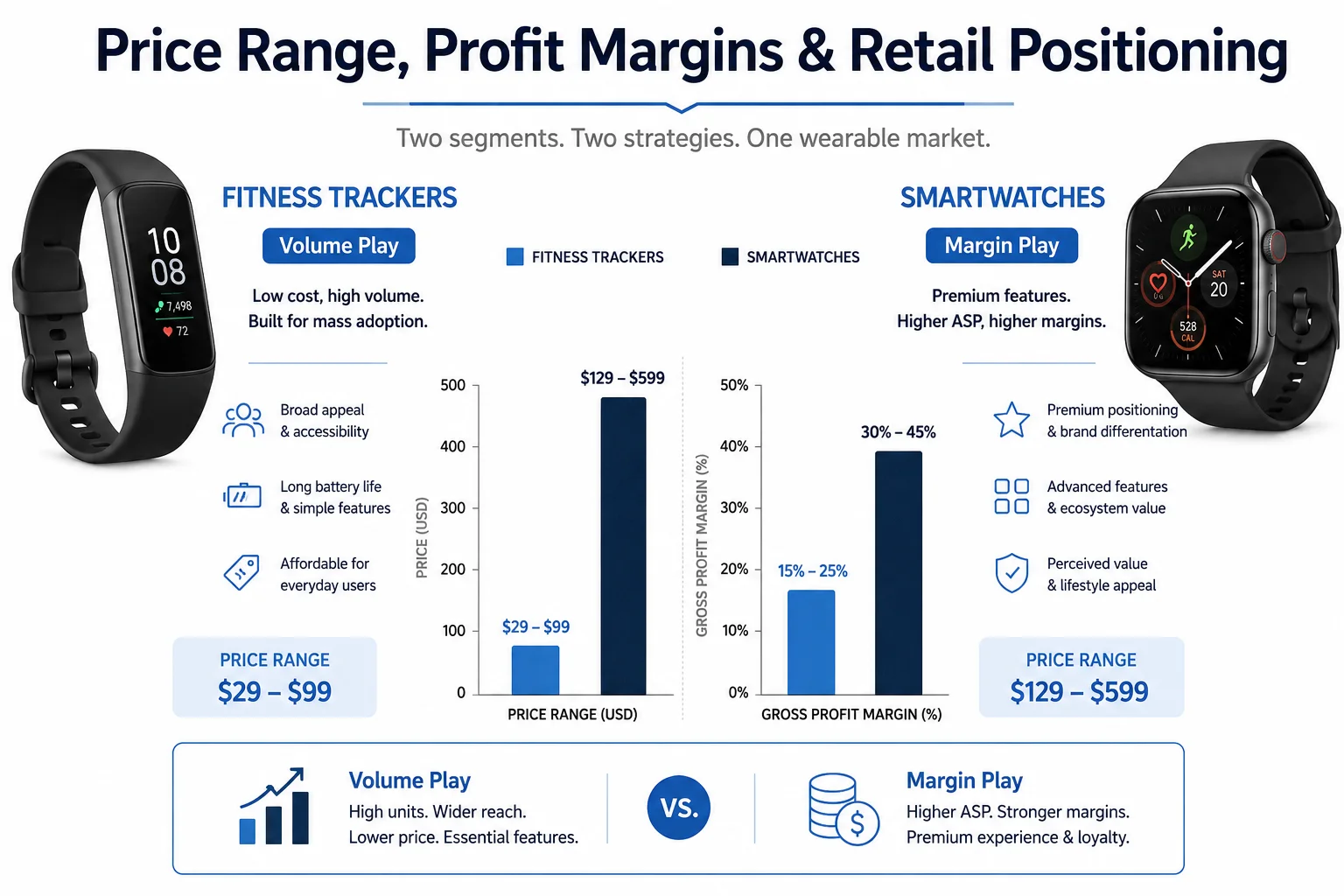
Let's get straight to the numbers, because that's what matters most to your business. When we consult with a new buyer, we don't just show them a product catalog. We ask them about their store. Are you a large discount chain or a boutique electronics shop? The answer changes everything. You have to match the product to your retail environment to succeed. We can break this down into two clear models.
The Fitness Tracker Model: Volume and Accessibility
This is the strategy for mass-market retail. Your wholesale cost for a solid fitness tracker might be between $5 and $15. You can retail it for $25 to $40. The per-unit profit isn't huge, but you can sell hundreds or thousands of them. You position it near the checkout counter as an impulse buy, or in the health and wellness aisle. It’s perfect for general merchandise stores, pharmacies, and large online marketplaces that compete on price. The key here is volume. Your success comes from selling many units with minimal sales effort and very few returns.
The Smartwatch Model: Margin and Features
This strategy is for retailers who can sell technology. Your wholesale cost for a good entry-level smartwatch starts around $20 and can go up to $60 or more. You can retail these for $60 to $120+. The per-unit profit is much higher. However, you can't just put it on a shelf and expect it to sell. You need to position it as a serious piece of consumer electronics. This means better packaging, in-store displays, and staff who can explain the features. It's a great fit for mobile phone stores, electronics retailers, and specialized e-commerce sites. The risk is higher—more capital is tied up in inventory, and returns can be costly—but the reward per sale is much greater.
Target Customers: Who Buys Smartwatches and Who Buys Fitness Trackers?
Still asking "Which product is better?" You are asking the wrong question. The right question is, "Who is my end customer?" Answering this is the most important step you can take.
Don't focus on the product; focus on the person who will buy it. Fitness trackers appeal to users who value simplicity and health data. Smartwatches attract tech-savvy users who want features, apps, and connectivity.
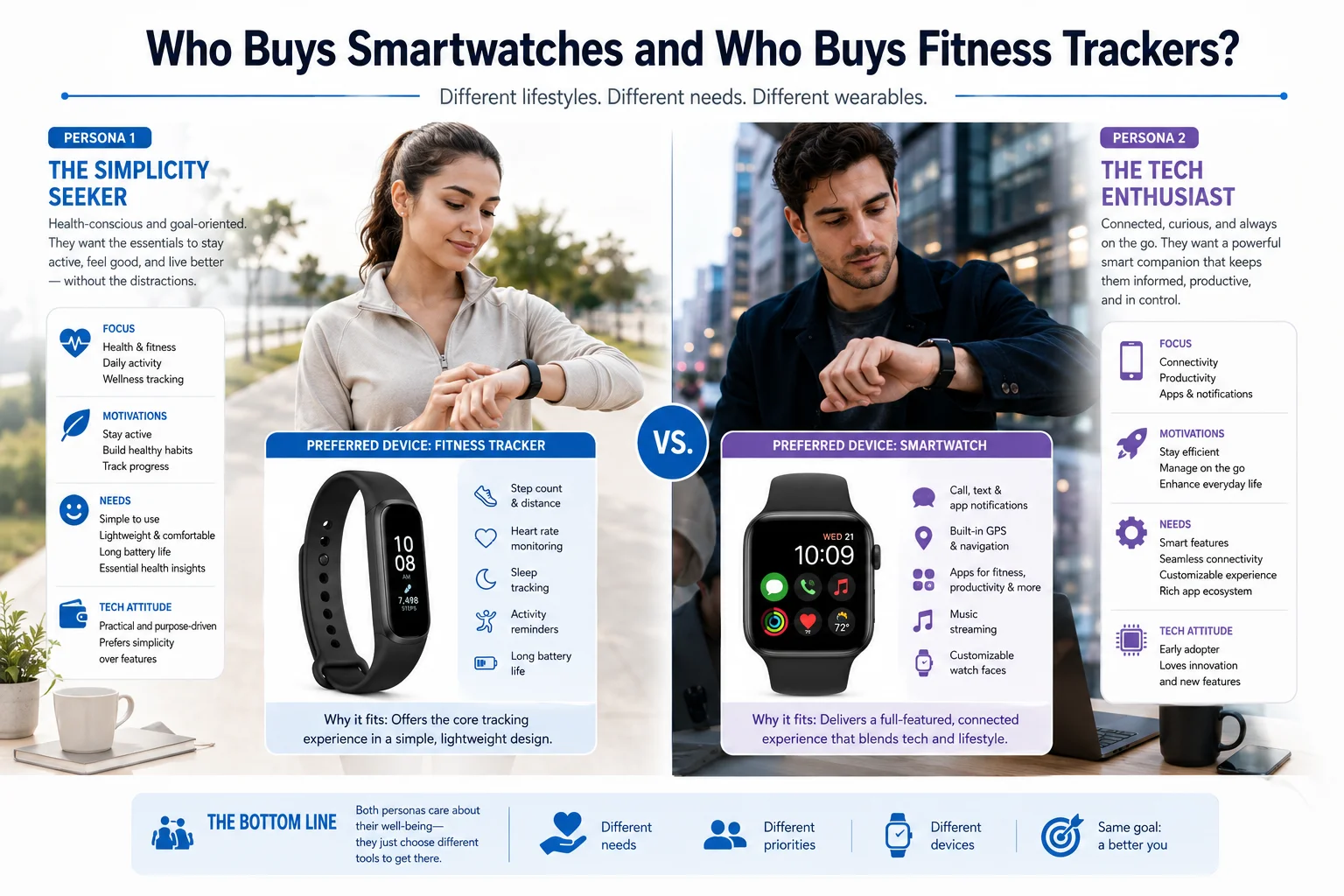
This is the core of our consulting process. I've seen many buyers fail because they fall in love with a product's features without thinking about who will actually use it. You must have a clear picture of your end customer in mind before you place a wholesale order. Let's create two simple customer profiles. Which one shops at your store?
The Fitness Tracker Customer
Meet Susan. She's 55 years old, and her doctor told her to be more active. She wants to track her daily steps and see her heart rate during her walks. Technology makes her nervous. She wants a device that is easy to use, has a very long battery life, and doesn't cost much. She has no interest in reading emails or getting Facebook notifications on her wrist. She is the perfect customer for a simple fitness tracker. Or meet James, a sourcing manager for a large company. He needs 500 affordable, reliable devices for a corporate wellness challenge. Simplicity and cost are his only concerns. The fitness tracker is the obvious choice.
The Smartwatch Customer
Now, meet Mike. He's 28 and works in IT. He loves gadgets. He wants a watch that connects to his phone, shows him notifications from all his apps, lets him control his music, and maybe even has GPS for his runs. He is willing to pay more for a bright, colorful AMOLED screen and is comfortable navigating menus and settings. He expects the device to have its own app and receive occasional software updates. He is your ideal smartwatch customer. He is willing to trade shorter battery life for more functionality and will pay a premium for it.
Battery Life, AMOLED Screens, Health Sensors, and Daily Use Experience?
Do more features always mean a better product? For a wholesaler, more features can mean more headaches, more returns, and lower profits if they don't match your customer's needs.
While features like AMOLED screens and advanced sensors help sell smartwatches at a premium, they also increase cost and customer expectations. For mass-market sales, the tracker's long battery life and simplicity often lead to higher customer satisfaction.
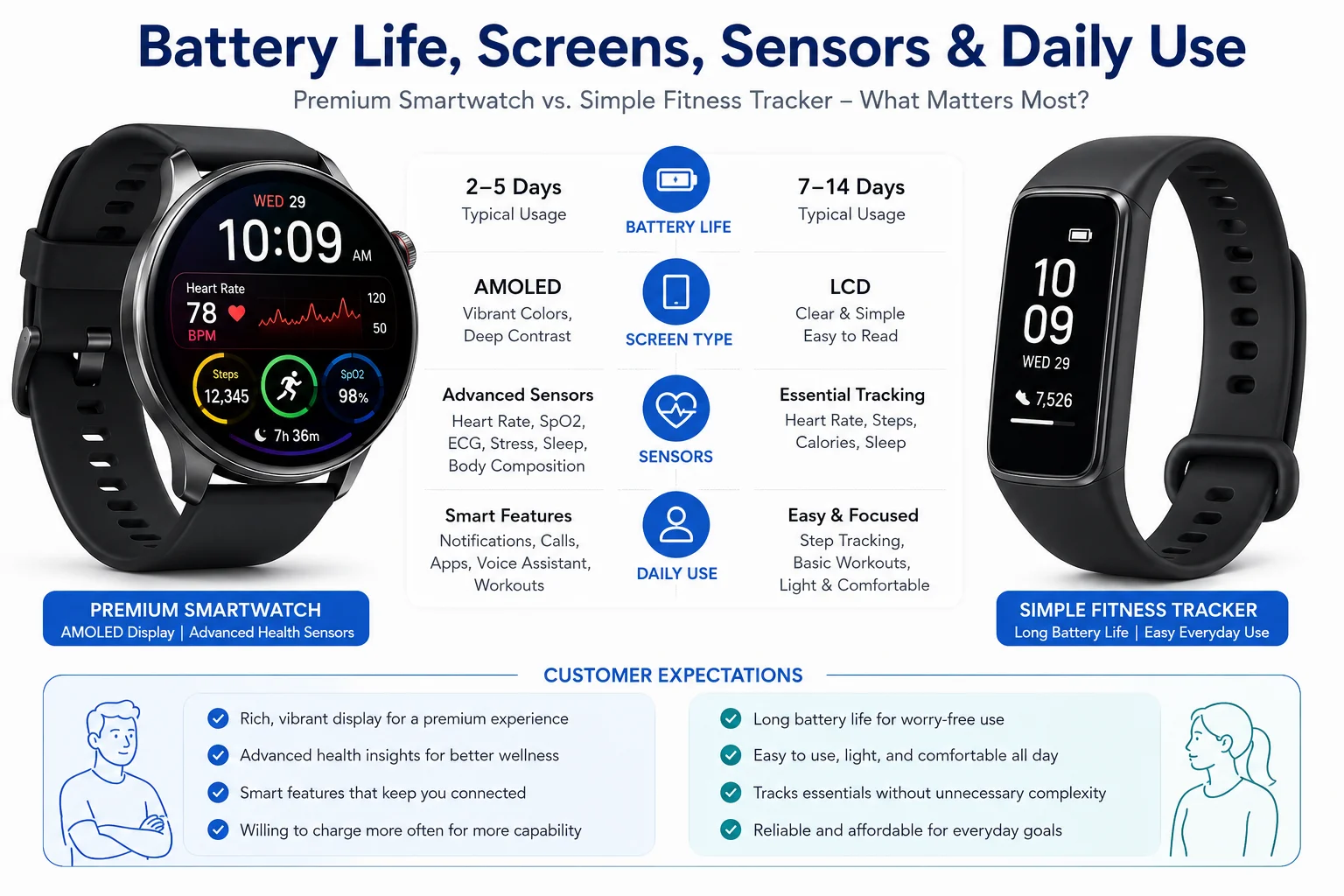
Every feature has a business consequence. As an importer, you need to think past the marketing bullet points and consider the real-world impact on your bottom line. We guide our clients to evaluate features based on the risk they introduce.
Battery Life: The Underrated Feature
This is the number one source of satisfaction for tracker users and a common complaint for smartwatch users. A fitness tracker can last 1-3 weeks on a charge. A smartwatch often lasts 1-3 days.6 For a "set it and forget it" customer, long battery life is the most important feature. For you, it means fewer complaints like, "My device died again!"
Screens: Beauty vs. Practicality
A bright, beautiful AMOLED screen is a major selling point for a smartwatch.7 It looks premium. But it also uses a lot of power and is one of the most expensive components, driving up the wholesale price. A fitness tracker's simpler screen (often monochrome or basic color LCD) is perfectly functional, sips power, and keeps the cost down. It’s less impressive, but more practical for the target user.
Health Sensors: Accuracy and Expectations
Basic heart rate and step counting are standard now. But when smartwatches add advanced sensors like Blood Oxygen (SpO2) or ECG, it creates a new risk.8 These features raise customer expectations for medical-grade accuracy. If a user compares the reading to a medical device and sees a difference, they may return the product as "defective." For wholesalers targeting a non-specialist audience, we often advise sticking to products with basic, reliable sensors to minimize this risk. A complex feature is not a benefit if it leads to a 10% return rate.
Inventory Strategy: Should Retailers Stock Smartwatches, Trackers, or Both?
Feeling uncertain about your inventory plan? The answer isn't to stock everything. It's to build a clear strategy that aligns with your store's brand and your customers' expectations.
Your inventory should reflect your business identity. Mass-market stores should focus on high-volume trackers. Tech-focused stores should focus on high-margin smartwatches. Larger retailers can stock both, but must merchandise them carefully to avoid confusion.
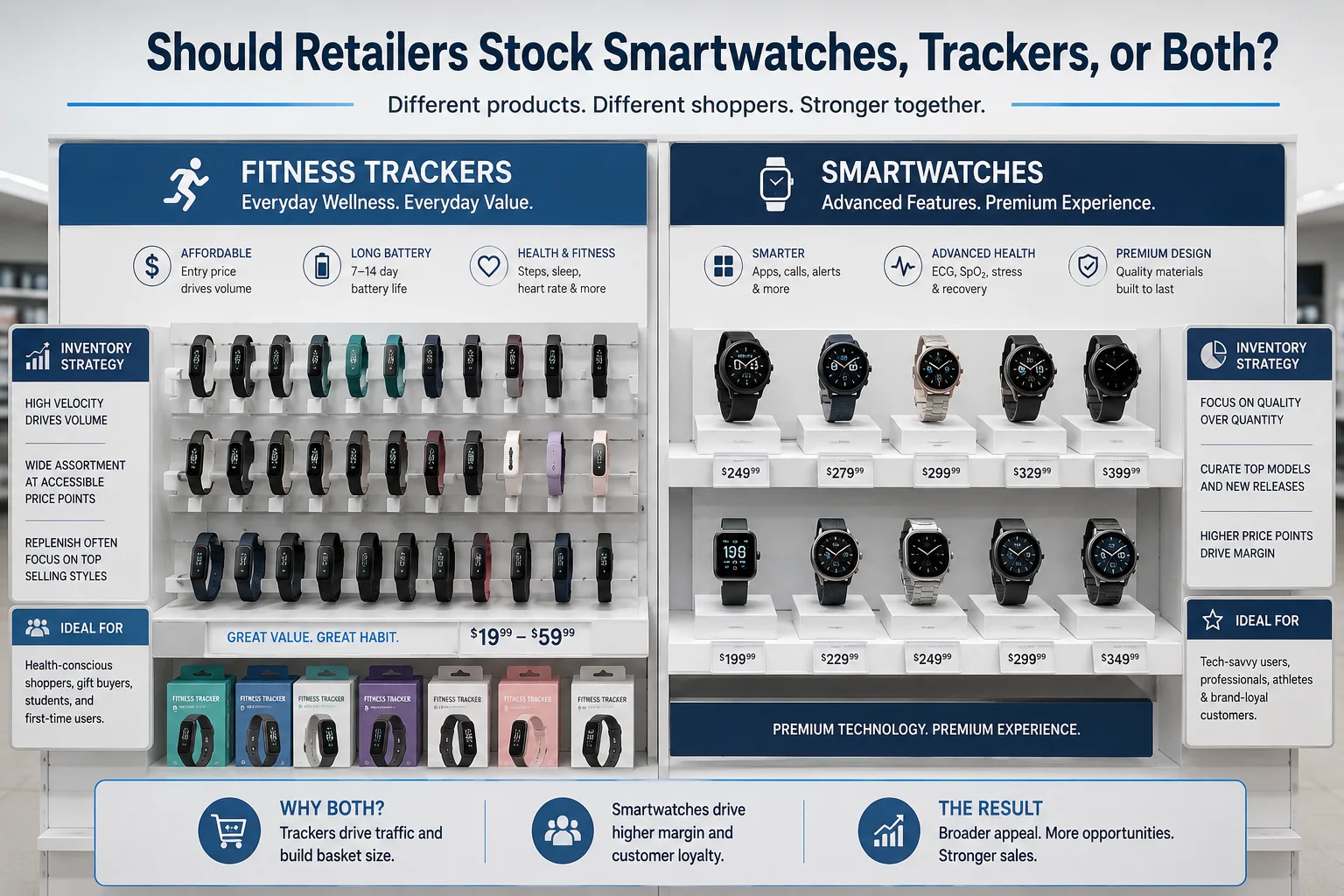
Based on my 15 years of experience, a scattered approach to inventory is a recipe for failure. You can't be everything to everyone. You need a focused strategy. Here are the three successful models I've seen our clients use.
Strategy 1: Focus on Fitness Trackers (The Volume Play)
This is the right choice for discount chains, supermarkets, promotional product companies, and general online marketplaces. Your strength is your ability to move large quantities of affordable goods. You should stock one or two reliable fitness tracker models at sharp price points. Your goal is to maximize sales volume and minimize operational headaches. Don't complicate your inventory with high-cost smartwatches that your customer base isn't looking for.
Strategy 2: Focus on Smartwatches (The Margin Play)
This is the strategy for specialized electronics stores, mobile phone retailers, and online brands that have a tech-savvy audience. Your customers come to you for the latest technology. You should build a curated selection of smartwatches at different feature levels. Your goal is to maximize per-unit profit and establish your brand as a destination for tech gadgets. Stocking cheap fitness trackers could devalue your brand.
Strategy 3: Stock Both (The "Good, Better, Best" Model)
This hybrid model can work for larger retailers or department stores, but it requires careful execution.9 You can offer a basic fitness tracker as your "good" option for around $30, a mid-range smartwatch as your "better" option for $60, and a premium model as your "best" for $100+. This allows you to capture different customer segments. The key is clear merchandising. You must physically separate the products and use signage to explain the difference, so customers can easily self-select the right product for their needs.
How to Choose a Reliable Wholesale Smartwatch and Fitness Tracker Supplier?
Realized that the product choice is only half the battle? Your success also depends heavily on choosing a supplier who acts as a partner and helps you navigate the market.
A reliable supplier does more than just ship boxes. They offer certified products, provide market insights, have flexible MOQs, and offer support that protects your business from risk. Their experience is your safety net.
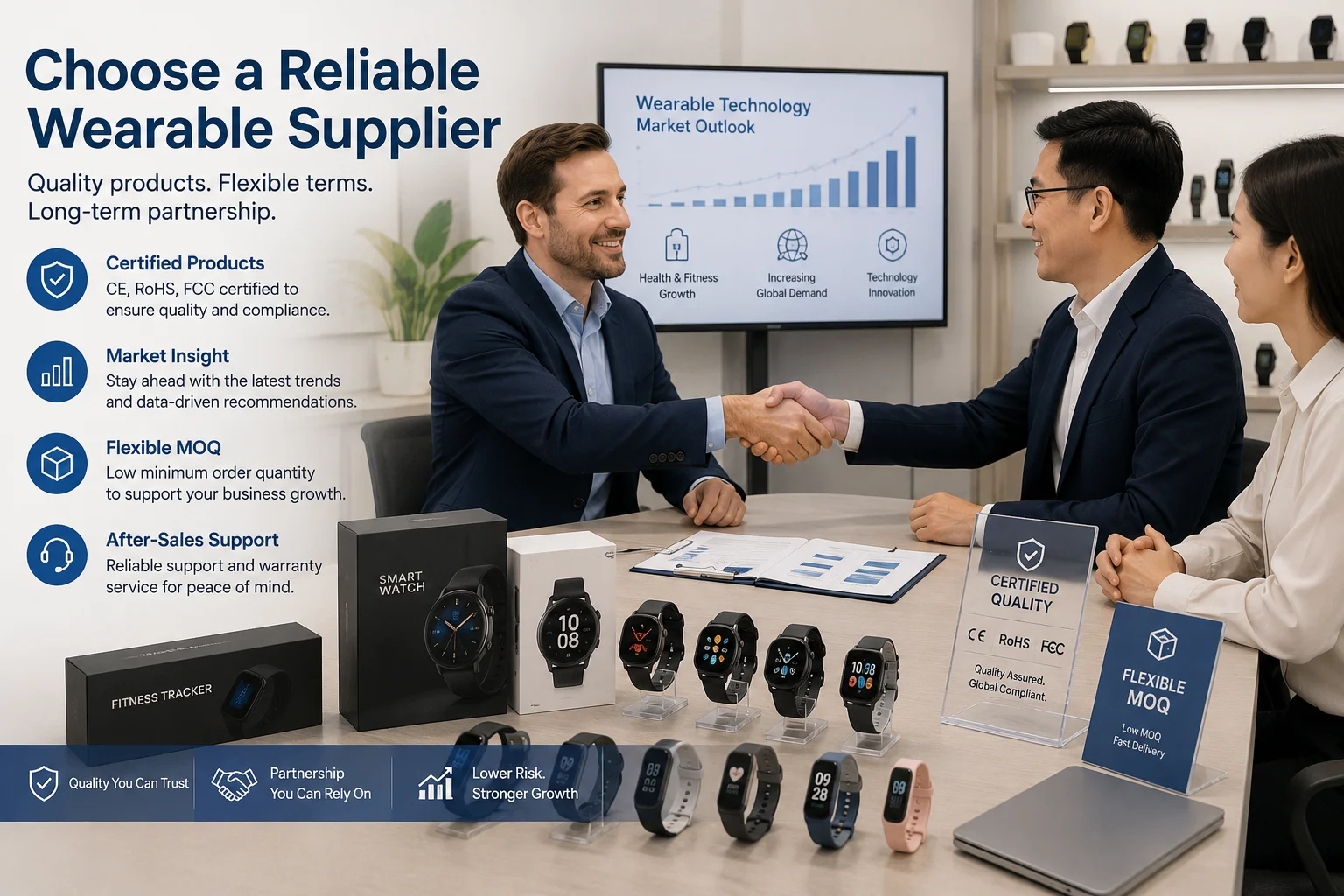
After you decide what to sell, you need to decide who to buy from. This choice is just as critical. A bad supplier can send you products that get stuck in customs, have high defect rates, or don't meet your market's expectations. As an export manager for 15 years, I know what separates a great partner from a simple trader. Here’s what you should look for.
1. Experience in Your Target Market
A supplier who exports to Europe and the US understands the landscape. They know what certifications are required (like CE, FCC, RoHS)10 and what features customers in those regions actually want. This prevents costly mistakes. Our experience means we can advise a US buyer away from a model that only sells well in South America, saving them from dead inventory.
2. Complete and Verifiable Certifications
This is non-negotiable. Without the proper certifications, your shipment could be seized by customs, resulting in a total loss.11 Ask for copies of all certification documents and verify them. A professional supplier will have these ready for you. It shows they are serious about quality and compliance.
3. Flexible MOQ and Customization
A good partner understands that you may want to start with a smaller test order. Look for suppliers with reasonable Minimum Order Quantities (MOQs). Also, ask about customization. For fitness trackers, adding your logo or changing the strap color should be a simple process. As we've discussed, customizing a smartwatch is much more complex. A good supplier will be honest about the difficulty and cost, guiding you to the right choice for your budget.
4. Transparent After-Sales Support
What happens when a customer returns a product? What if you have a technical question? A reliable supplier has a clear process for handling defects and providing support. They stand behind their product. This partnership is crucial for managing your risk and protecting your long-term profitability.
Conclusion
The best wearable for you isn't a single product. It's a strategic choice based on your customers, your brand, and your business model. Choose wisely and partner with an experienced supplier.
"Using Fitness Trackers and Smartwatches to Measure Physical ...", https://pmc.ncbi.nlm.nih.gov/articles/PMC5887043/. Market analysis from firms like IDC, Canalys, or Counterpoint Research often details the shipment volumes and average selling prices (ASPs) for different wearable categories, supporting the strategic distinction between high-margin smartwatches and high-volume fitness bands. Evidence role: statistic; source type: research. Supports: The claim that smartwatches command higher prices and margins but have lower shipment volumes compared to fitness trackers, which sell in higher volumes at lower price points.. Scope note: Global market data may not perfectly reflect the dynamics of specific niche or regional retail environments. ↩
"Fitbit - Wikipedia", https://en.wikipedia.org/wiki/Fitbit. Technology encyclopedias and consumer electronics publications define smartwatches by their use of a sophisticated operating system that can run third-party applications, distinguishing them from fitness trackers, which are typically specialized devices focused on a limited set of health-monitoring functions. Evidence role: definition; source type: encyclopedia. Supports: The functional difference between smartwatches and fitness trackers, based on complexity, operating systems, and third-party app capabilities.. ↩
"The Value of Smartwatches in the Health Care Sector for Monitoring ...", https://pmc.ncbi.nlm.nih.gov/articles/PMC11549588/. Consumer surveys and market analysis from firms like Gartner or Deloitte frequently highlight a growing consumer appetite for advanced wearable features such as contactless payments, cellular connectivity, and expanded health monitoring, driving value growth in the market. Evidence role: statistic; source type: research. Supports: The growing consumer demand for advanced features in wearables, which is driving the growth of the smartwatch segment.. Scope note: This trend is most pronounced in mature markets; demand for basic, affordable devices remains very strong in other segments and demographics. ↩
"Using Fitness Trackers and Smartwatches to Measure Physical ...", https://pmc.ncbi.nlm.nih.gov/articles/PMC5887043/. Quarterly market reports from industry analysis firms like IDC and Canalys consistently show that fitness bands, while having a lower market share by value, still account for tens of millions of unit shipments per quarter globally, confirming their continued mass-market appeal. Evidence role: statistic; source type: research. Supports: The fact that fitness trackers (or 'basic bands') continue to constitute a significant portion of the total wearables market by unit volume.. ↩
"(PDF) Redefining Workplace Wellness: Wearable Technology and ...", https://www.researchgate.net/publication/334678335_Redefining_Workplace_Wellness_Wearable_Technology_and_Corporate_Wellness. Reports and surveys from business and human resources institutions, such as the Society for Human Resource Management (SHRM), often document the adoption of wearable fitness trackers in corporate wellness programs to promote employee health and activity. Evidence role: case_reference; source type: institution. Supports: The widespread use of fitness trackers as a tool within corporate wellness initiatives.. Scope note: The scale of adoption can vary significantly by company size and industry. ↩
"Batteries for wearables - PMC - NIH", https://pmc.ncbi.nlm.nih.gov/articles/PMC9843125/. Comprehensive product reviews and comparison tests from established technology publications consistently demonstrate that most smartwatches with full-color displays and advanced processing require charging every 1 to 3 days, whereas fitness trackers commonly last 7 to 21 days on a single charge. Evidence role: general_support; source type: other. Supports: The widely accepted difference in battery life expectations between feature-rich smartwatches and simpler fitness trackers.. Scope note: Actual battery performance varies significantly based on specific model, screen technology, and individual usage patterns. ↩
"The Role of Usefulness and Visibility in Smartwatch Adoption", https://rdw.rowan.edu/cgi/viewcontent.cgi?article=1036&context=business_facpub. Display technology market analysis shows a clear trend towards the adoption of AMOLED screens in mid-range to premium smartwatches due to their superior contrast, color vibrancy, and power efficiency with dark interfaces, making them a key feature for product marketing. Evidence role: mechanism; source type: research. Supports: The role of advanced display technologies like AMOLED in differentiating premium smartwatches and justifying higher price points.. ↩
"General Wellness: Policy for Low Risk Devices - Guidance - FDA", https://www.fda.gov/regulatory-information/search-fda-guidance-documents/general-wellness-policy-low-risk-devices. Regulatory bodies like the U.S. Food and Drug Administration (FDA) provide guidance that distinguishes between low-risk 'general wellness' products and regulated 'medical devices.' Features like ECG and SpO2 on consumer wearables are often positioned for wellness awareness and are not medically cleared, which can lead to returns if users expect clinical-grade accuracy. Evidence role: mechanism; source type: government. Supports: The regulatory distinction between general wellness features and certified medical applications, which creates a risk of mismatched consumer expectations.. Scope note: Specific regulations and the certification status of features can vary by country and by individual product model. ↩
"Good–better–best - Wikipedia", https://en.wikipedia.org/wiki/Good%E2%80%93better%E2%80%93best. Business and marketing literature describes the 'Good, Better, Best' approach as a common tiered pricing and product strategy used to appeal to different customer segments. Its success hinges on clear communication of value and features at each tier to guide consumer choice and prevent confusion. Evidence role: general_support; source type: education. Supports: The 'Good, Better, Best' model is a recognized retail strategy for segmenting customers and maximizing revenue, which requires clear differentiation between tiers.. Scope note: While a general retail principle, its specific application to the wearables category is contextual. ↩
"Equipment Authorization | Federal Communications Commission", https://www.fcc.gov/engineering-technology/laboratory-division/general/equipment-authorization. Official websites for the European Commission (CE marking, RoHS) and the U.S. Federal Communications Commission (FCC) provide the legal framework and technical standards that electronic products must meet to be legally sold in these markets. Evidence role: definition; source type: government. Supports: The mandatory nature of CE, FCC, and RoHS certifications for market access in the EU and US.. ↩
"Border Search of Electronic Devices at Ports of Entry", https://www.cbp.gov/travel/cbp-search-authority/border-search-electronic-devices. Official publications from national customs authorities, such as the U.S. Customs and Border Protection (CBP), explicitly state their power to inspect, detain, seize, and/or demand the re-export of imported merchandise that does not comply with regulations, including product safety and electronics certifications. Evidence role: general_support; source type: government. Supports: The legal authority of customs agencies to seize imported goods that fail to meet national compliance standards.. ↩