Thinking about launching your own smartwatch brand but feeling lost in the process? The complexity can be paralyzing, leading to expensive mistakes and delays.
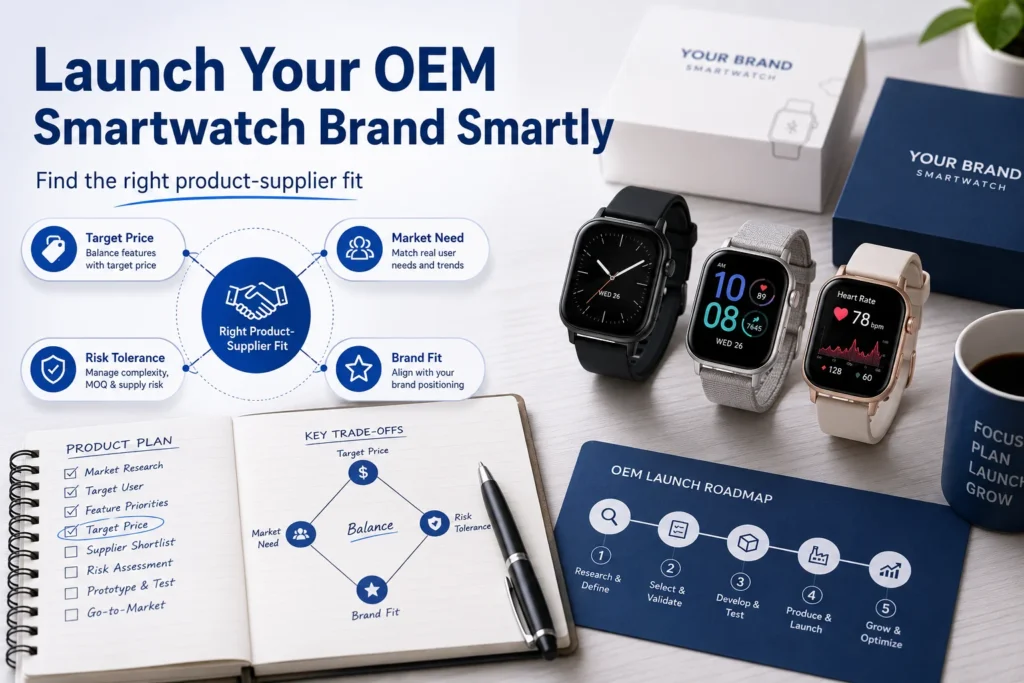
Start by shifting your mindset from finding the "best" watch to finding the right product-supplier combination for your brand. This means balancing your target price, market needs, and risk tolerance through a series of strategic trade-offs, which is the key to a successful launch.
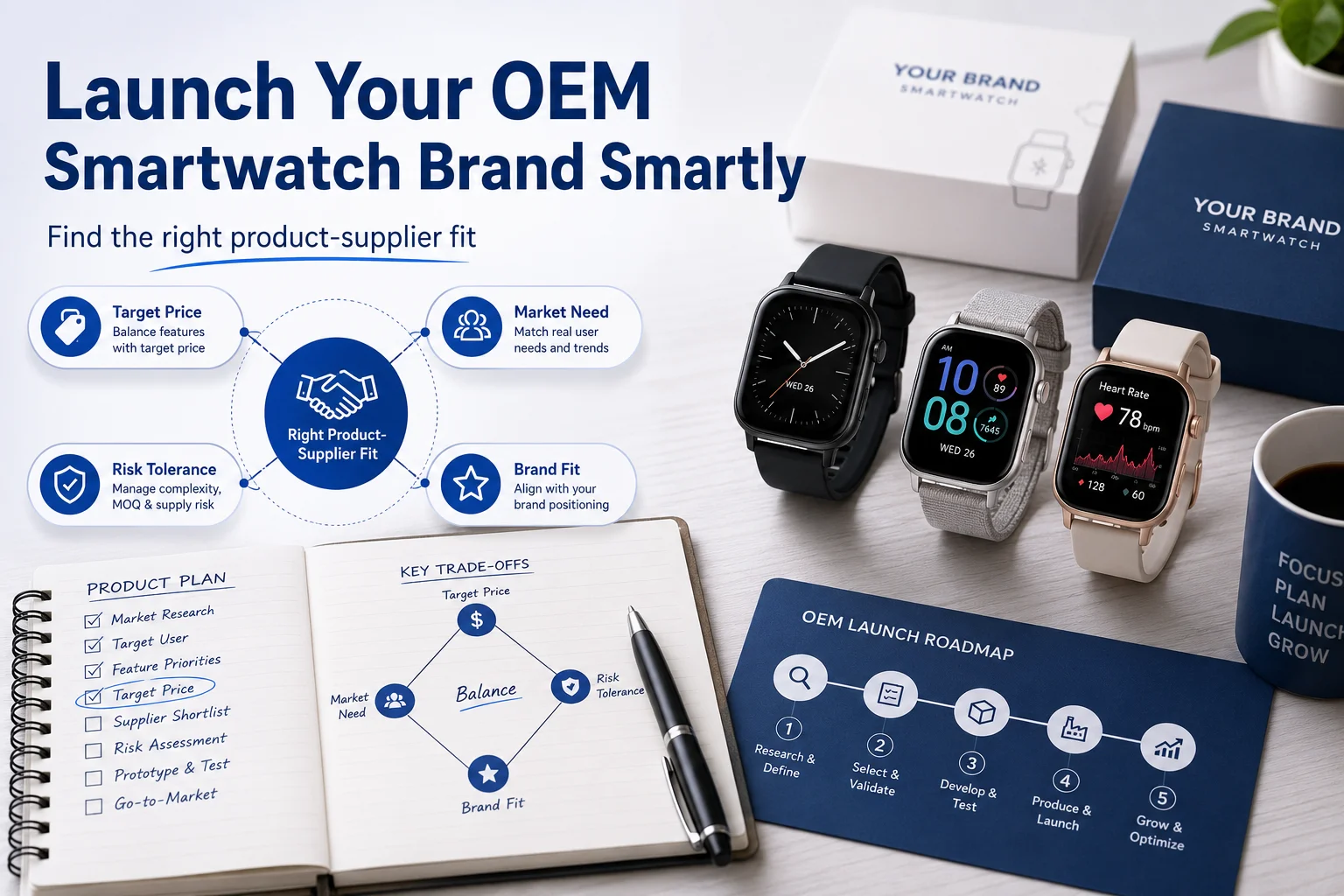
Over my 15 years in the consumer electronics export business, I've seen countless entrepreneurs start this exact journey. Many come to us with a long list of dream features, but the ones who succeed are those who start by asking different, smarter questions. This guide isn't just another checklist. It's a real-world roadmap based on hundreds of conversations with brand owners like you, designed to help you navigate the critical decisions and avoid the common pitfalls. Let's get into what really matters when you're building a watch brand from the ground up.
Why Are OEM Smartwatches a Strong Opportunity for New Brands?
Thinking about entering the wearables market? It might seem dominated by huge companies1, making you wonder where a new brand can even begin.
OEM smartwatches offer a lower barrier to entry. You can use existing, stable hardware and software platforms. This greatly reduces R&D costs and speeds up your time to market. It lets you focus your budget on branding, marketing, and creating a unique customer experience.
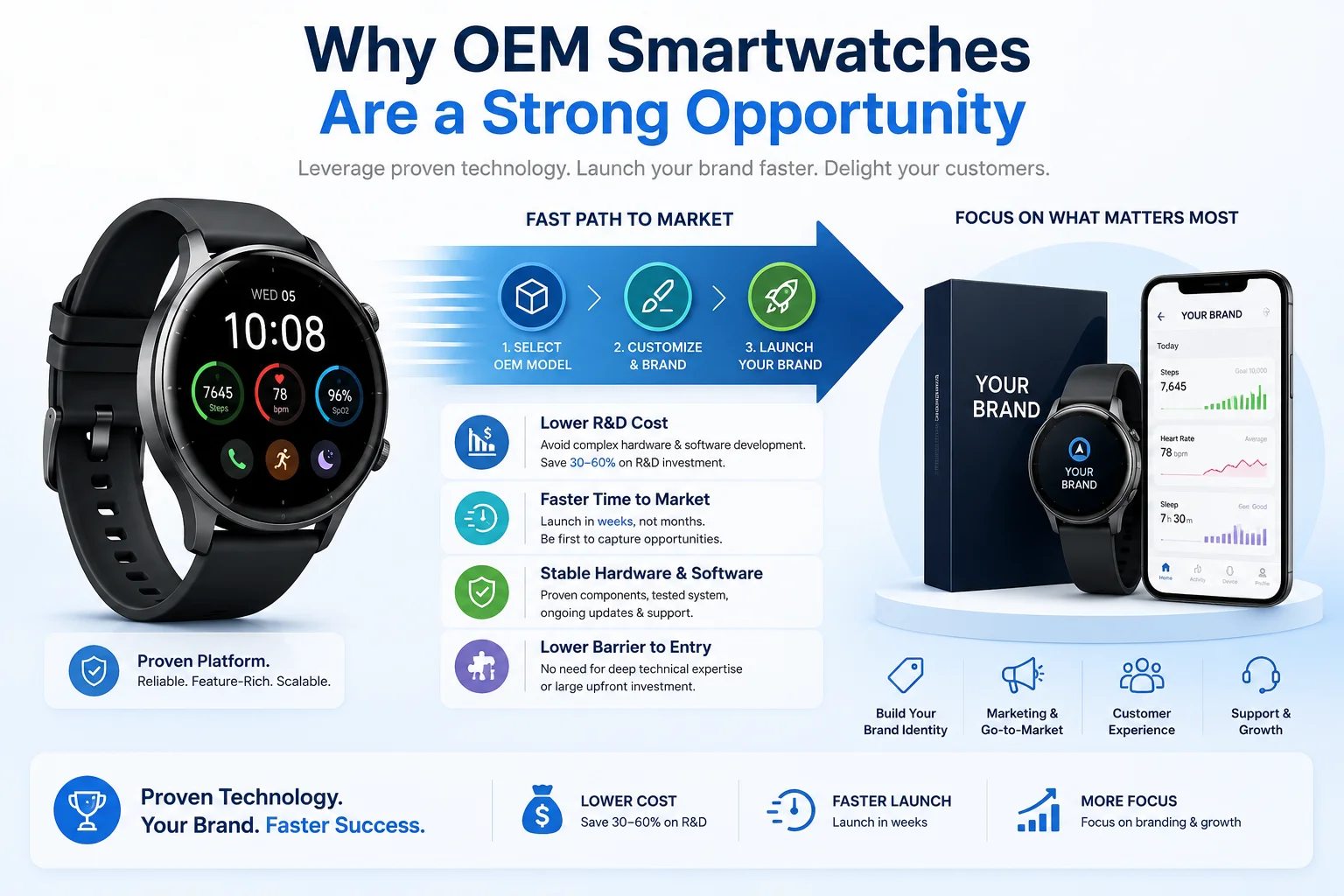
The main advantage of the OEM model is that you are not starting from zero. The supply chain for smartwatches is now very mature.2 The core technology, like the chipsets, sensors, and screens, is reliable and widely available from established manufacturers. Your job isn't to invent a new watch; your job is to build a compelling brand around a proven hardware solution. We see this work all the time. New brands can't compete with the big guys on R&D budget, but they can absolutely win on brand story, customer service, and targeting a specific niche. This approach lets you enter the market with a high-quality product much faster and with significantly less risk.
The Business Case: OEM vs. Full Custom R&D
| Aspect | Full Custom R&D | OEM Model |
|---|---|---|
| Initial Investment | Extremely High ($$$$$) | Low to Moderate ($$) |
| Time to Market | 24+ Months3 | 3-6 Months |
| Technical Risk | Very High | Low (based on proven models) |
| Your Focus | Engineering & Hardware | Branding & Marketing |
How Should You Define Your Target Market Before Starting a Smartwatch Project?
Are you excited to just pick a watch model and start selling? Jumping ahead without a clear customer in mind often leads to a product that nobody is excited to buy.
Don't just choose a watch that looks "cool." First, you must clearly define who will buy it. Are they serious athletes, busy office workers, or seniors needing simple health monitoring? Your target customer will guide every single decision you make, from features and price to your brand message.
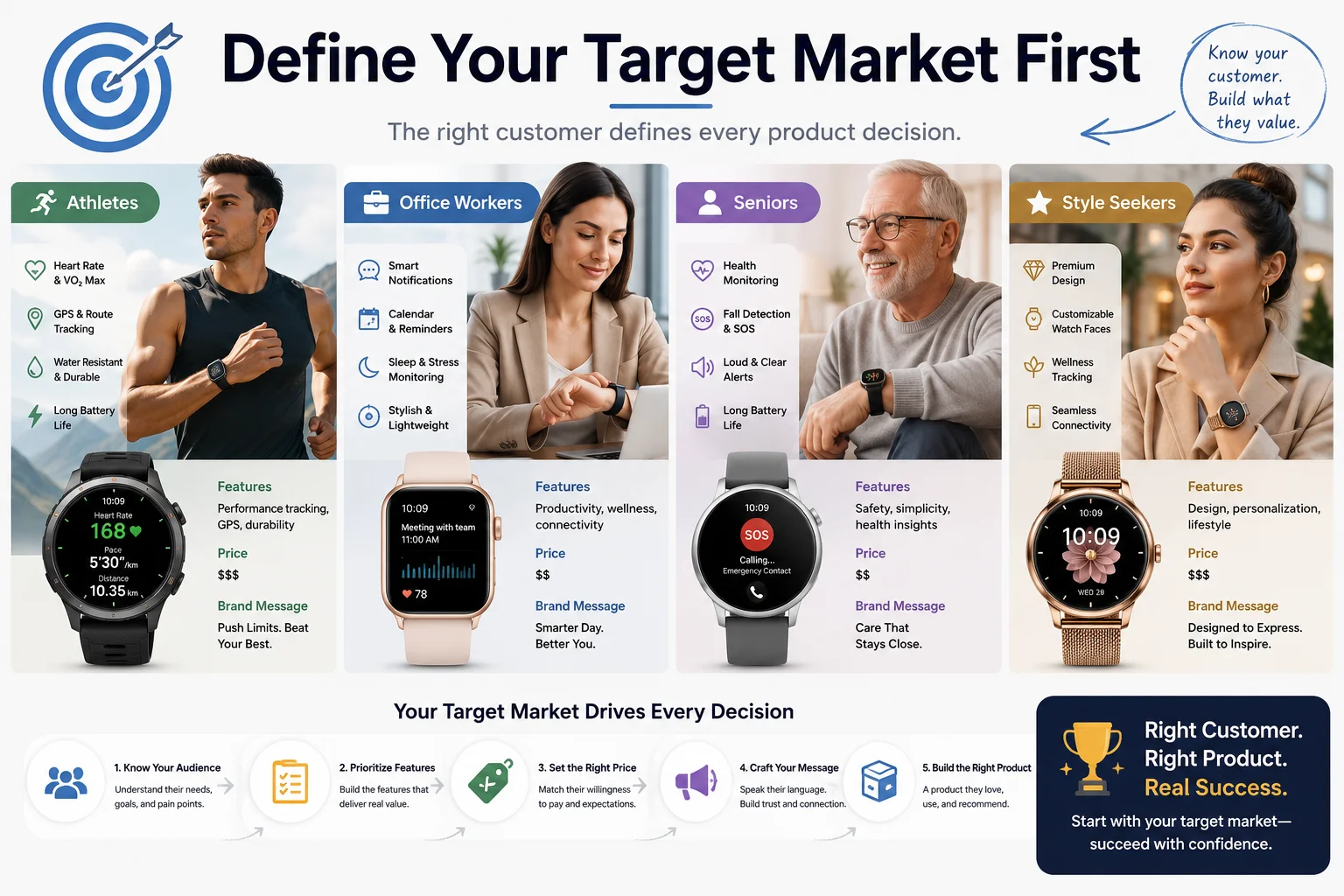
This is the most critical step, and one I see new buyers skip too often. A watch that tries to be for "everyone" usually ends up being for "no one."4 You can't build a product that is perfect for a marathon runner and also perfect for an 80-year-old who just wants to see their text messages. Trying to do so results in a generic, uninspiring product with a confusing message. Instead, get specific. The more focused you are, the easier it is to make every other decision.
Who Are You Selling To?
- Fitness Enthusiasts: They will demand accurate GPS for running, reliable heart rate tracking during workouts, and a wide variety of sports modes. For them, data precision and durability are the most important features.
- Seniors: They need a completely different product. Think large, easy-to-read fonts, a very simple user interface, long battery life, and maybe safety features like fall detection or an SOS button. Usability is everything.
- Fashion-Conscious Users: This group cares more about aesthetics. The design of the watch case, the quality of the materials, and the selection of stylish, customizable watch faces are what will convince them to buy.
What Should Buyers Understand First About PCBA, Screen, Battery, and Hardware?
Are you drowning in technical terms like PCBA, AMOLED, and mAh? It’s easy to feel confused and like you're not in control of your own product development.
You should focus on the commercial results of these technical choices, not just the specs themselves. Your hardware decisions create a "performance triangle" of cost, battery life, and user experience. Understanding this balance is much more important than memorizing every engineering detail.
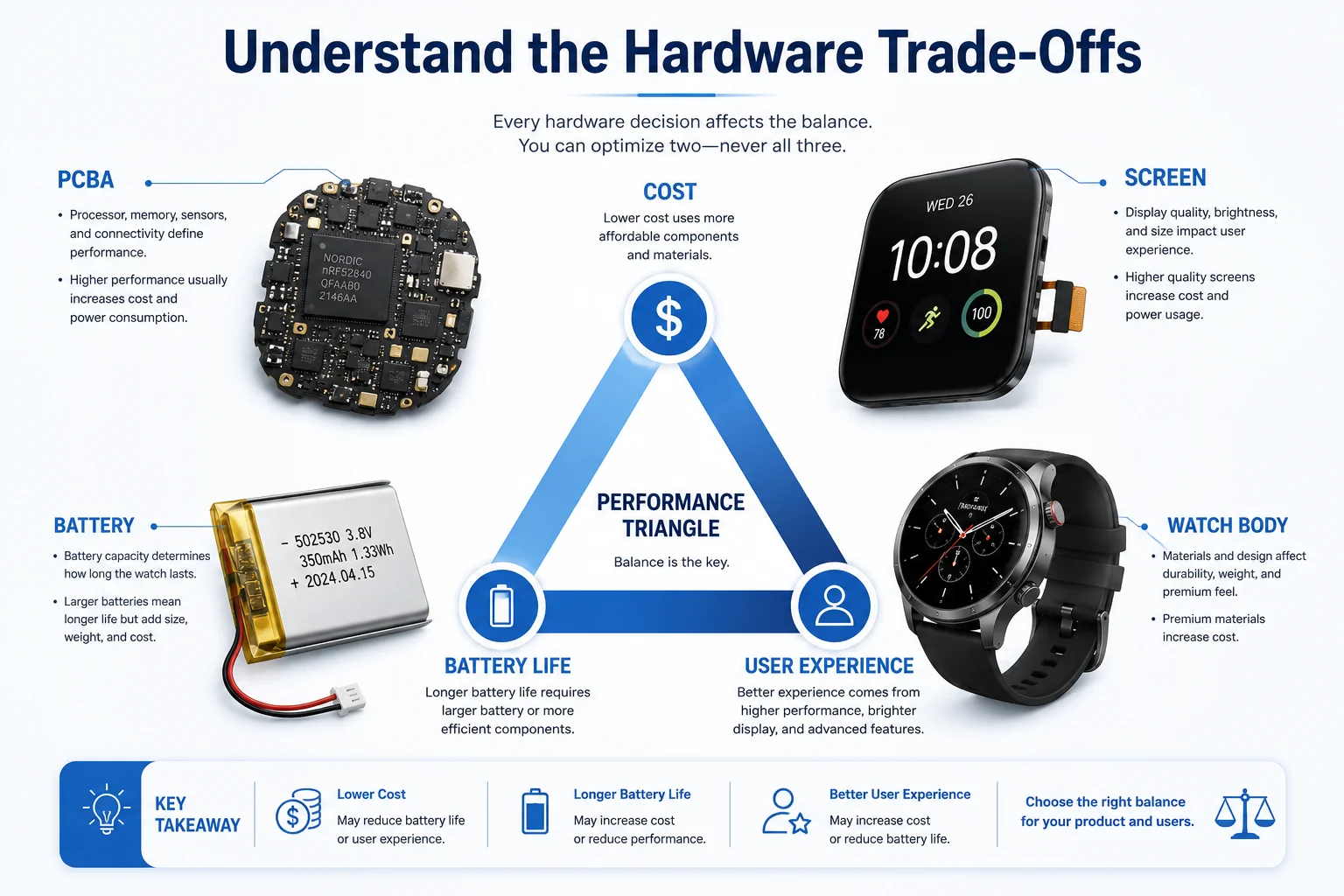
When clients come to us, they sometimes ask for "the best" of everything. The truth is, "the best" screen might kill your battery life, and "the best" chipset might push your product out of your target price range. It's all about making smart trade-offs that serve your target customer and business goals. A good supplier should help you navigate these choices. Instead of asking "What is the best chipset?", a better question is "For a retail price of $99, what chipset, screen, and battery combination gives the best user experience without sacrificing stability?"
The Core Hardware Trade-offs
- PCBA (The Brain): The main board with the chipset determines the watch's stability, speed, and what software features are even possible. A faster chipset costs more and often uses more battery. The goal is to choose the most stable and appropriate chipset for your needs, not necessarily the newest or most powerful.
- Screen (The Face): An AMOLED screen looks amazing with deep blacks and vibrant colors, but it costs more and uses more power than a standard TFT screen5. The right choice depends on whether your brand is positioned as premium/fashion or as functional/value-focused.
- Battery (The Lifespan): A bigger battery (measured in mAh) means longer life between charges. But it also means a thicker, heavier, and bulkier watch. We often get requests for a super-slim watch that lasts for a week, but physics makes that a very difficult engineering challenge6.
What Can Be Customized in Health Sensors, Fitness Tracking, and Smart Features?
You want to add unique health features to make your smartwatch stand out. But you're rightly concerned about the accuracy and reliability of the data your watch will collect.
You can customize the combination of standard sensors (like heart rate and step counting) and how that data is presented to the user. Real medical-grade accuracy is not the goal here7; the focus is on providing reliable lifestyle and wellness trend data, not medical diagnoses.
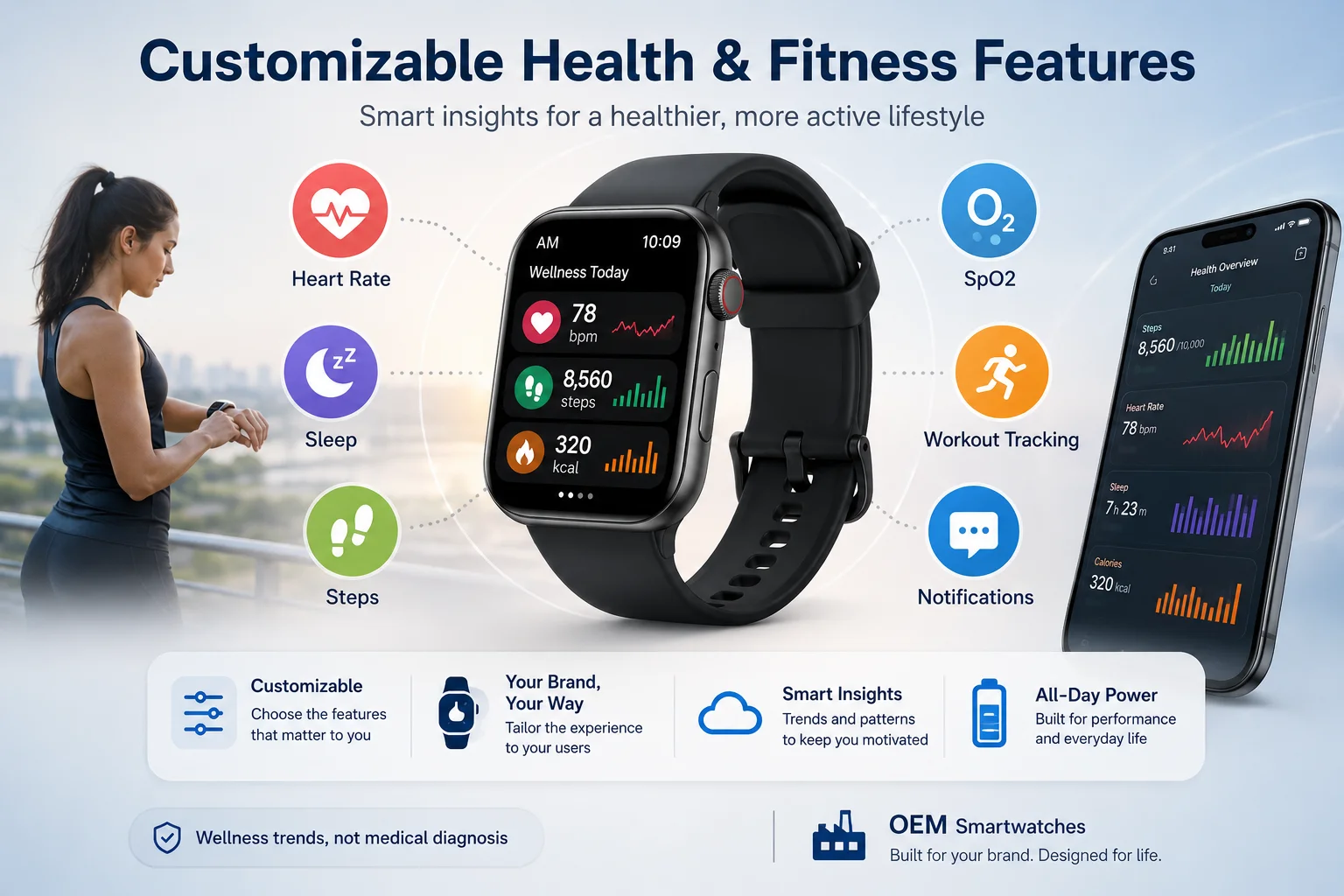
We always make a point to be very clear with our clients on this topic. The sensors used in most OEM smartwatches—for heart rate (PPG), blood oxygen (SpO2), and movement (accelerometers)—are proven, off-the-shelf components. They are great for tracking general wellness trends. Your customization opportunity isn't in inventing a new sensor, but in how you use the data from these standard sensors. You can decide which sports modes to feature, how to visualize health data in the app, and what kind of reminders to create. It's very important to market these features responsibly. In Europe and the US, making specific medical claims can lead to serious legal problems8. Frame your product as a consumer wellness device, not a medical instrument.
Standard vs. Custom Features
- What's Standard: The physical sensors for heart rate, blood oxygen, and step counting are typically fixed for a given watch model. You select a model that already has the hardware you need.
- What's Customizable: The software that interprets and displays the data is where you can make your mark. You can choose to emphasize certain features, design unique data dashboards in the app, and create custom alerts for your target audience (e.g., a "get up and stretch" reminder for office workers).
How are Watch Faces, UI, App Customization, and Brand Experience Connected?
You know that a generic, clunky user interface can make your product feel cheap. You need your brand's unique personality to shine through in every tap and swipe.
The software experience is your single greatest opportunity to build a real brand. This includes the watch UI, custom watch faces, and the companion smartphone app. A cohesive, polished experience is what makes your product feel premium and builds the loyalty that separates you from generic competitors.
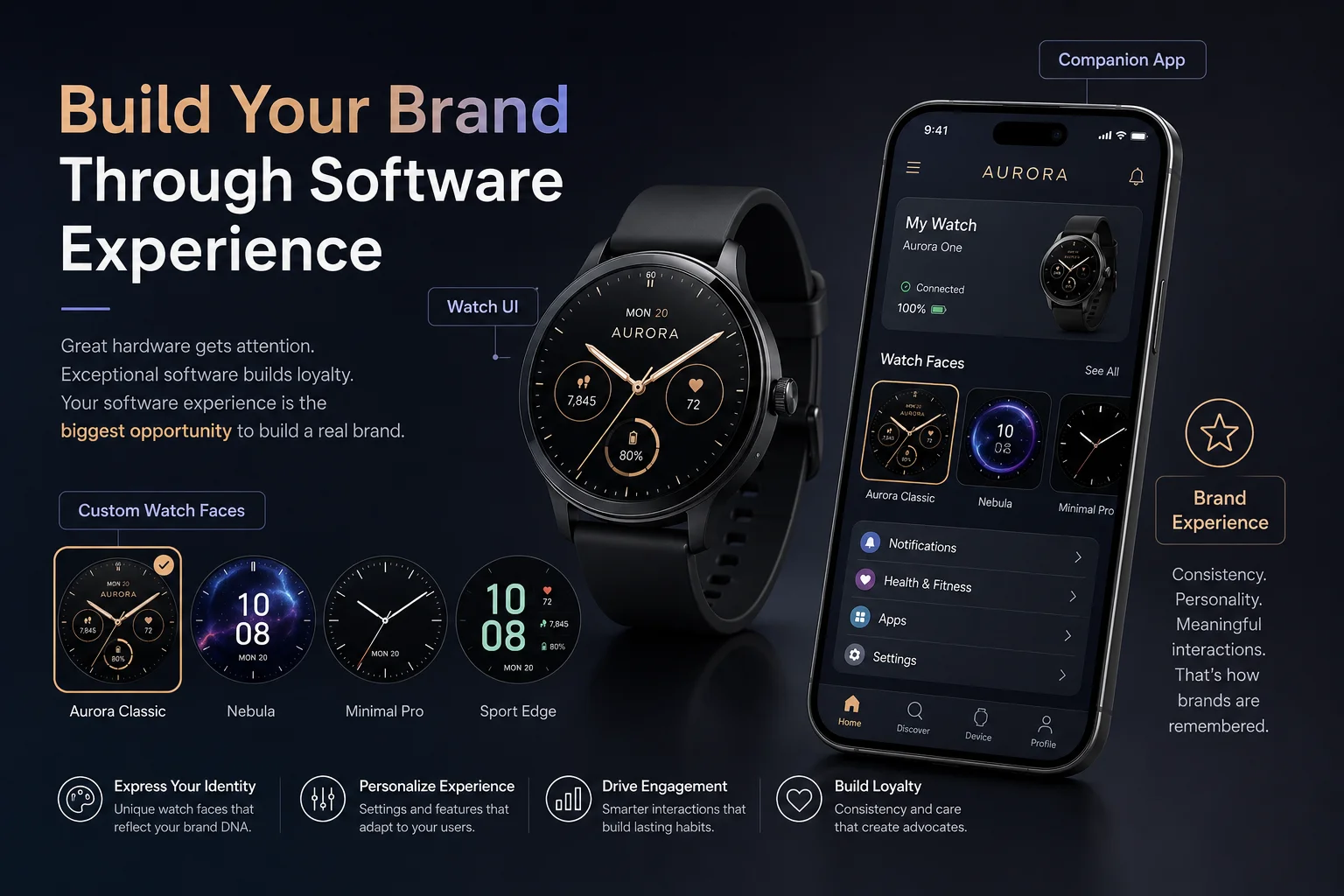
When a user interacts with your watch, they are interacting with your brand. This is where you can create a feeling of quality that goes far beyond the physical hardware. The most successful brands we work with spend significant time thinking about this user journey. From the moment the user turns on the watch to the daily check-ins on the app, every element should feel like it came from your brand, not from a generic factory. This is what justifies a premium price and makes customers recommend your product to their friends.
Building Your Brand in Software
- Level 1: Boot Logo & Watch Faces: The simplest, fastest, and most essential customization. We can put your brand's logo on the startup screen and help you design a few exclusive watch faces. This is a low-cost, high-impact change that immediately makes the watch yours.
- Level 2: UI/UX Reskinning: This goes a step deeper. We can change the colors, icons, and fonts throughout the watch's operating system to match your brand's style guide. The underlying menu structure usually stays the same for stability, but the look and feel become unique to you.
- Level 3: App Customization: This is where the magic happens. Most factories offer a "white-label" app that you can use. But to build a real brand, you need your own app in the Apple App Store and Google Play Store, with your name and your branding. This has its own costs and timelines, and often requires a higher MOQ9, but it is the ultimate step in creating a complete brand experience.
What Are the OEM Smartwatch MOQ, Sample Time, Lead Time, and Production Process?
So you've found a watch model you like, but now you're hit with unfamiliar terms like MOQ and lead time. These numbers can make or break your entire business plan.
MOQ, or Minimum Order Quantity, is typically 1000 to 3000 units for a standard model with basic logo and packaging customization. Deeper customizations, especially for the software and app, often require a higher MOQ. It's crucial to confirm all these numbers upfront.
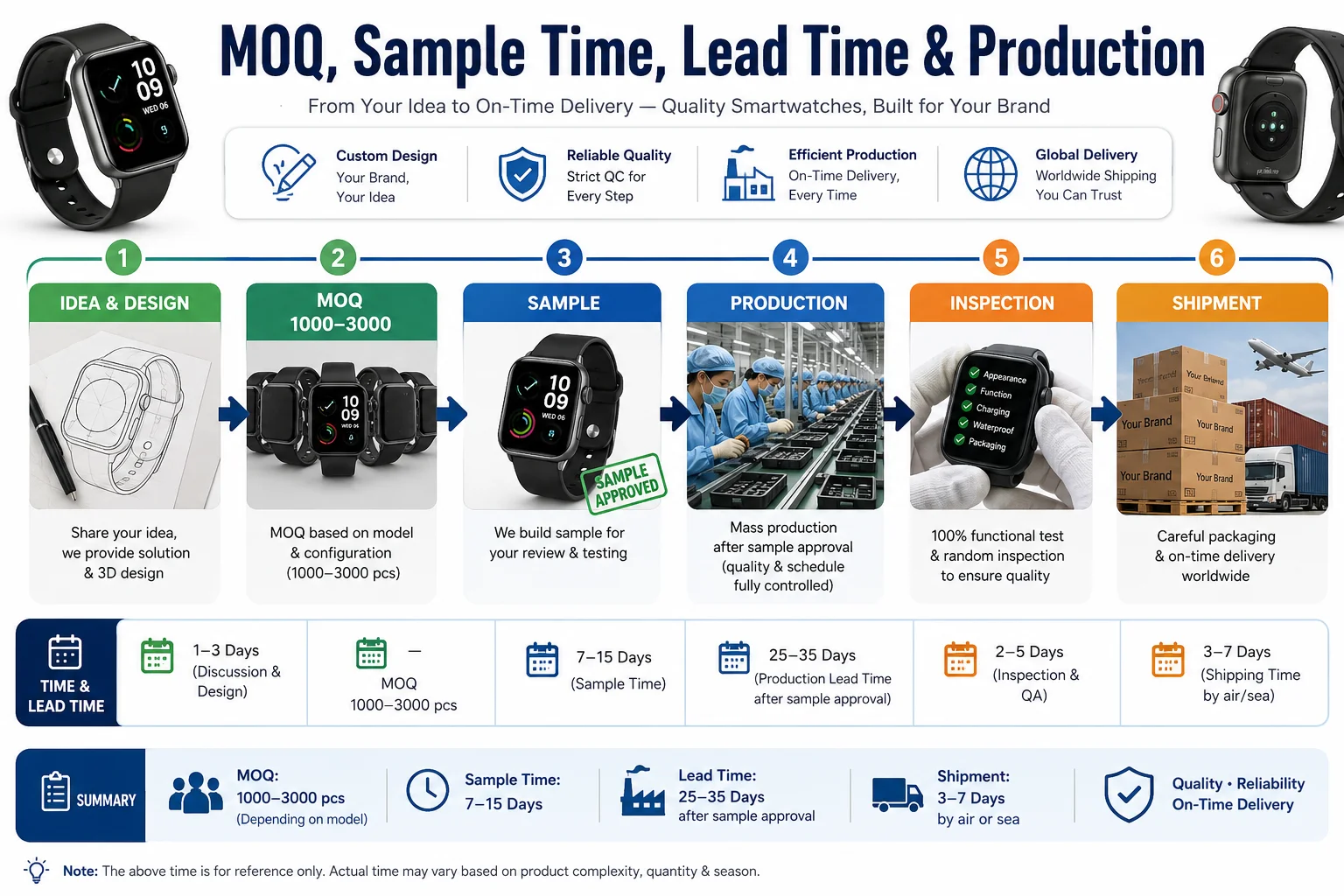
One of the biggest surprises for new buyers is the different MOQs for different parts of the project. For example, our factory might have an MOQ of 1000 pieces for the physical watch. But the independent software house that develops the companion app might require a commitment equivalent to 5,000 units to justify building and supporting a custom app just for your brand. This is a critical point of negotiation that we help our clients navigate every day. Being transparent about the entire timeline and process is key.
A Typical Production Timeline
- Step 1: Samples (1-2 weeks): First, you'll receive "factory neutral" samples to evaluate the physical quality and core functions. After that, you can order customized samples with your logo, which takes a bit more time.
- Step 2: Deposit & Pre-Production Sample (2-4 weeks): Once you approve the initial sample and place your deposit, we create a "golden sample." This is the final, perfect version of your product that you must approve before we start the main production run.
- Step 3: Mass Production (4-6 weeks): After your final approval of the pre-production sample, the factory begins assembling your full order. The exact lead time depends on component availability and the factory's production schedule.
- Step 4: Quality Control & Shipping: After production is complete, we perform our quality control checks before packing the goods and arranging shipment to your destination.
What's Involved in Quality Control, Certifications, Packaging, and Pre-Shipment Inspection?
Your watches are finally manufactured and paid for. But how can you be sure the quality is consistent across thousands of units and that they are legal to sell in your country?
Don't let your guard down on the final steps. You must insist on a clear Quality Control (QC) plan, get the right certifications (like CE, RoHS, FCC), design appealing packaging, and consider a final pre-shipment inspection. These steps protect your investment and your brand's reputation.
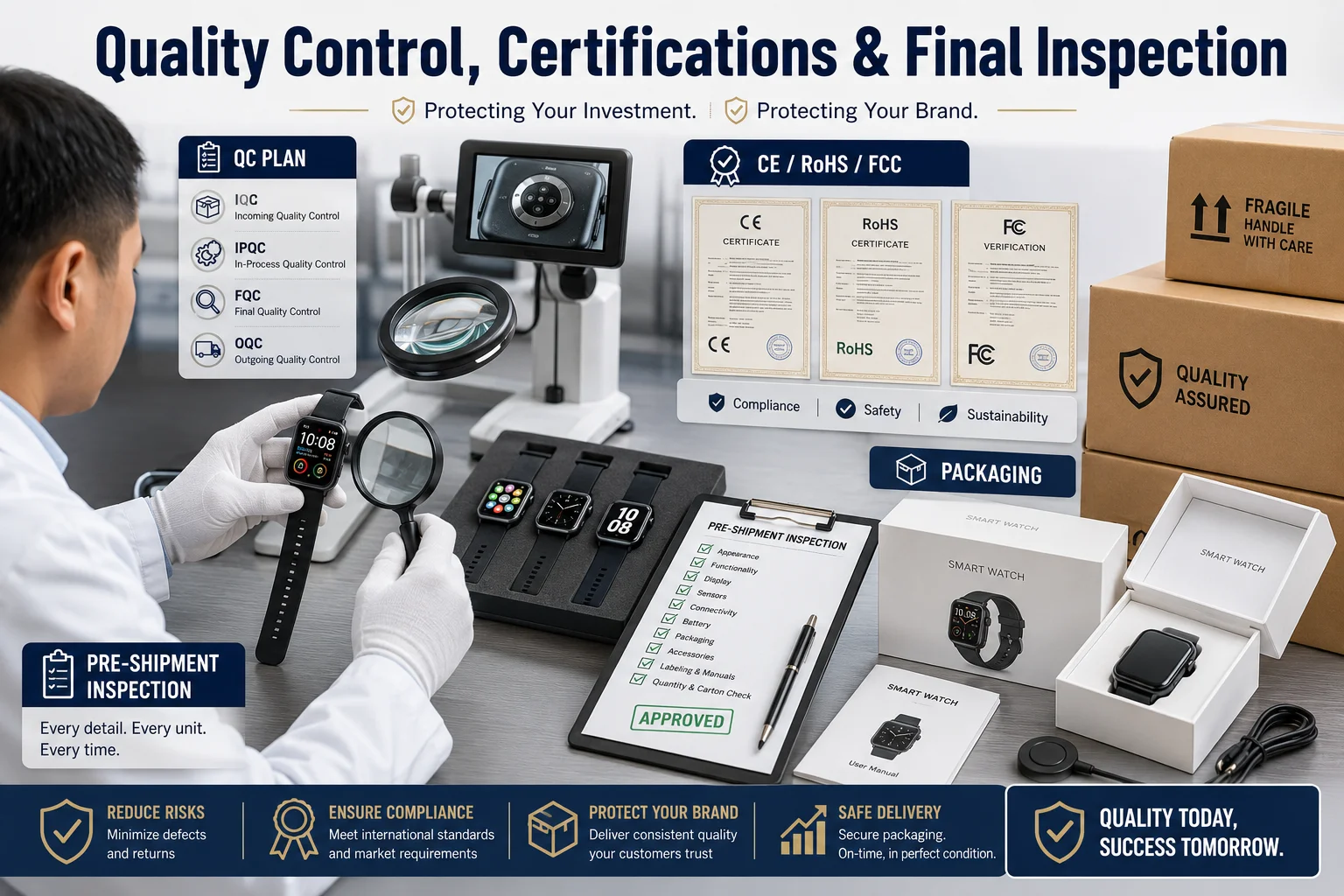
After spending so much time and money developing your product, the last thing you want is a problem with quality or legal compliance. As your partner, our job is to make this part of the process smooth and transparent. We've been exporting to Europe and America for 15 years, so we know exactly what is required. We see these final steps not as an expense, but as insurance for your brand. A happy customer who gets a high-quality, reliable product is the best marketing you can have.
Protecting Your Investment
- Quality Control (QC): Good QC is not just a single check at the end. It's a process. We inspect incoming materials, monitor the assembly line, and conduct a battery of tests on the finished goods, checking everything from battery life and water resistance to sensor accuracy.
- Certifications: This is non-negotiable. For Europe, you need CE and RoHS. For the US, you need FCC.10 We have these reports ready for most of our standard models, which saves our clients a lot of time and money. If you request heavy hardware modifications, new testing might be required, and we can guide you through that.
- Packaging: Your retail box is the first physical interaction a customer has with your brand. We can help you design custom packaging that looks great, protects the product during shipping, and communicates your brand's value.
- Pre-Shipment Inspection: For larger orders, many of our clients choose to hire an independent, third-party inspection company11. They will visit the factory and check a random sample of the finished goods before the final payment is made. This gives you an unbiased report and total peace of mind.
How Do You Choose a Reliable OEM Smartwatch Manufacturer in China?
You're probably getting quotes from many suppliers online. They all seem to promise great quality and low prices, but how can you really know who to trust with your brand?
Look beyond the product photo and the price tag. A reliable partner communicates clearly, understands your market's requirements (like certifications), is transparent about their entire process, and has a long history in the industry. They should act more like a consultant than just a salesperson.
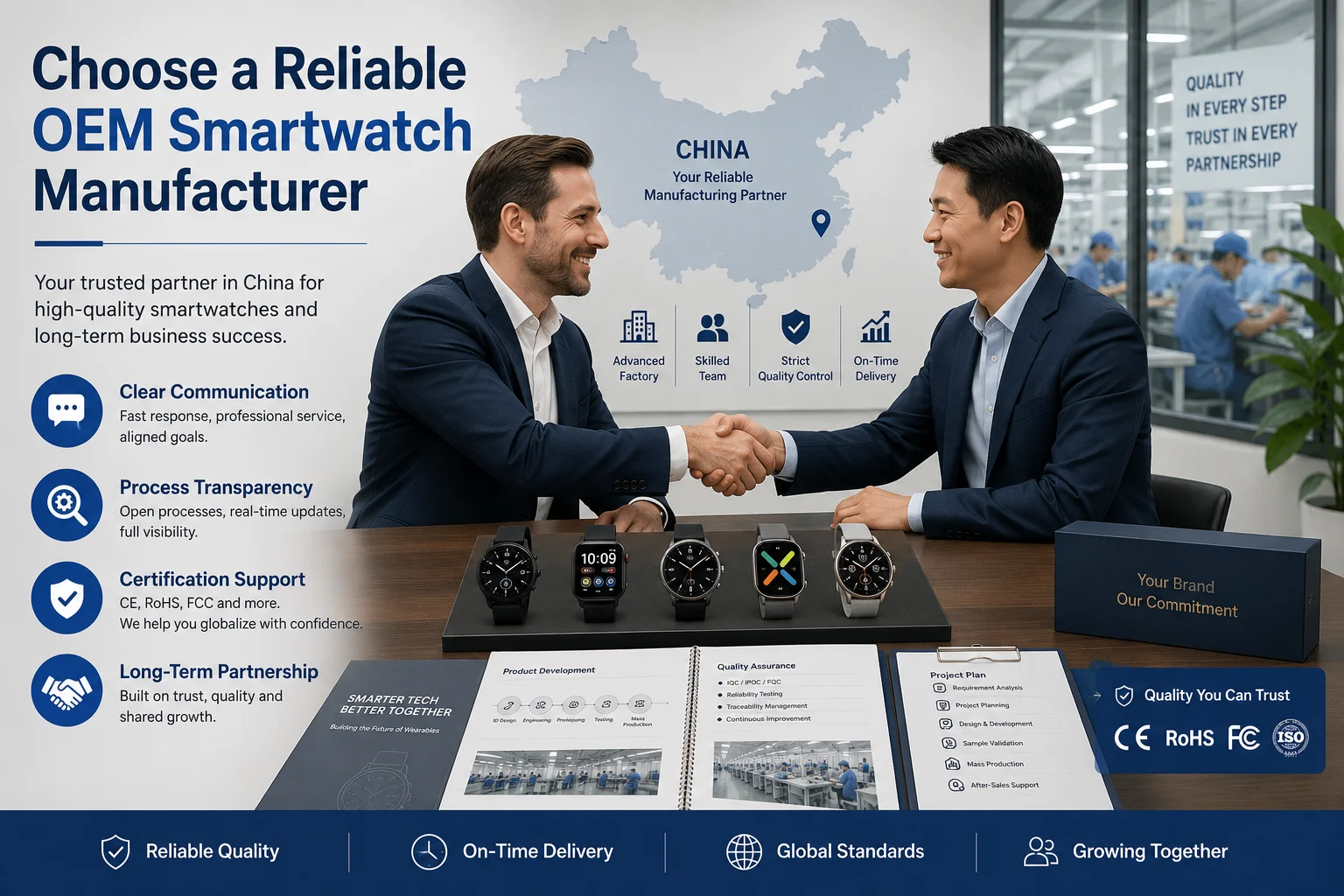
After 15 years of exporting, I can tell you that the cheapest offer is rarely the best deal12. A low price can often hide issues like poor-quality components, a lack of proper certification, or an inexperienced team that doesn't understand your needs. Your supplier isn't just a vendor; they are your partner in China. Their expertise and reliability are just as important as the product itself. The relationship you build with them is the foundation of your supply chain.
What to Look for in a Partner
- Experience & Specialization: How long have they been in business? Do they specialize in wearables, or are they a general trading company that sells everything? A specialized supplier will know the market and the potential problems before they happen.
- Clear Communication: Do they answer your questions directly and in detail? Can they explain the trade-offs between different options? A good partner will tell you "no" or "that's difficult" sometimes, which is far better than a supplier who just says "yes" to everything to get the order.
- Understanding of Your Market: Ask them specific questions about CE or FCC certification for the US market. A professional supplier will have these reports on hand for their main models or will know the exact process to get them. If they seem confused by the question, it's a major red flag.
- Process Transparency: Ask them to walk you through their QC process. A reliable partner will be proud of how they ensure quality and will be open about it. You are not just buying a box; you are buying into their entire system for producing a quality product.
Conclusion
Launching a smartwatch brand is a journey of making smart, strategic decisions, not just finding a product. By focusing on your target market, understanding the trade-offs, and choosing a reliable partner, you can successfully build a brand that stands out.
"Wearable Devices Market Insights - IDC", https://www.idc.com/promo/wearablevendor/. Market analysis from firms such as the International Data Corporation (IDC) or Counterpoint Research consistently shows that a small number of companies, including Apple, Samsung, and Huawei, command a significant majority of the global smartwatch market share. Evidence role: statistic; source type: research. Supports: The claim that a few large companies dominate the smartwatch market.. ↩
"Why High-Tech Commoditization Is Accelerating", https://sloanreview.mit.edu/article/why-high-tech-commoditization-is-accelerating/. The maturation of the consumer electronics supply chain over the past two decades has led to the commoditization and widespread availability of core wearable components like ARM-based chipsets, MEMS sensors (accelerometers, gyroscopes), and compact display technologies (OLED, TFT). Evidence role: historical_context; source type: other. Supports: The claim that the smartwatch supply chain has reached a state of maturity.. ↩
"What are typical times to market for consumer electronics ...", https://www.quora.com/What-are-typical-times-to-market-for-consumer-electronics-products-in-the-US. Analyses of new hardware product introductions indicate that development cycles involving custom engineering, tooling, and manufacturing from the ground up can frequently extend beyond 18-24 months, encompassing stages from concept and prototyping to mass production and certification. Evidence role: statistic; source type: research. Supports: The claim that custom hardware development timelines are lengthy, often exceeding two years.. ↩
"The Importance of Target Audience in Marketing Strategy", https://online.hbs.edu/blog/post/target-audience-in-marketing. This statement reflects a core marketing principle: market segmentation. Without a clearly defined target audience, a product's features, messaging, and value proposition become diluted, making it difficult to compete against focused offerings that cater to the specific needs of a niche. Evidence role: general_support; source type: education. Supports: The idea that a lack of focus on a target market leads to product failure.. ↩
"Dark mode may not save your phone's battery life as much as you ...", https://www.purdue.edu/newsroom/archive/releases/2021/Q3/dark-mode-may-not-save-your-phones-battery-life-as-much-as-you-think,-but-there-are-a-few-silver-linings.html. While AMOLED displays can be more power-efficient than LCD/TFT screens when displaying dark or black pixels (as individual pixels are turned off), they may consume more power when displaying bright, full-color, or white-background images. The overall power consumption is therefore highly dependent on the user interface design. Evidence role: mechanism; source type: research. Supports: The claim about the relative power consumption of AMOLED and TFT screens.. Scope note: The source clarifies that the claim is context-dependent and not universally true. ↩
"FOTW #1234, April 18, 2022: Volumetric Energy Density of Lithium ...", https://www.energy.gov/cmei/vehicles/articles/fotw-1234-april-18-2022-volumetric-energy-density-lithium-ion-batteries. This challenge is rooted in the energy density of current lithium-ion battery technology. A battery's capacity, measured in milliampere-hours (mAh), is directly proportional to its physical volume. Therefore, achieving longer battery life requires a larger, thicker battery, creating a direct trade-off with the device's slimness. Evidence role: mechanism; source type: paper. Supports: The claim that there is an engineering trade-off between battery size/life and watch thickness.. ↩
"General Wellness: Policy for Low Risk Devices - Guidance", https://www.fda.gov/regulatory-information/search-fda-guidance-documents/general-wellness-policy-low-risk-devices. Regulatory bodies such as the U.S. Food and Drug Administration (FDA) distinguish between 'General Wellness Products' that pose a low risk and are not intended to diagnose or treat medical conditions, and regulated 'Medical Devices' which must undergo rigorous clinical validation to prove their accuracy and efficacy for a specific medical purpose. Evidence role: definition; source type: government. Supports: The distinction between consumer wellness devices and regulated medical devices.. ↩
"Health Claims | Federal Trade Commission", https://www.ftc.gov/business-guidance/advertising-marketing/health-claims. In the United States, the Federal Trade Commission (FTC) and the Food and Drug Administration (FDA) regulate health-related advertising and product claims. In Europe, the Medical Device Regulation (MDR) establishes strict requirements for any device marketed with a medical purpose, with significant penalties for non-compliance. Evidence role: general_support; source type: government. Supports: The claim that making medical claims for non-certified devices has legal consequences.. ↩
"Non-recurring engineering - Wikipedia", https://en.wikipedia.org/wiki/Non-recurring_engineering. This is typically due to the Non-Recurring Engineering (NRE) costs associated with custom software development. To make the project financially viable, the software developer or factory must amortize these one-time NRE costs over a larger number of units, resulting in a higher MOQ compared to projects using standard, off-the-shelf software. Evidence role: mechanism; source type: education. Supports: The claim that custom software work increases MOQ.. ↩
"Equipment Authorization – RF Device", https://www.fcc.gov/oet/ea/rfdevice. The FCC mark indicates compliance with U.S. Federal Communications Commission standards for electromagnetic interference. The CE mark signifies conformity with health, safety, and environmental protection standards for products sold within the European Economic Area. The RoHS directive, often a requirement for CE marking, restricts the use of specific hazardous materials in electronics. Evidence role: definition; source type: government. Supports: The requirement for FCC, CE, and RoHS certifications in the US and EU markets.. ↩
"Pre-shipment inspection - Wikipedia", https://en.wikipedia.org/wiki/Pre-shipment_inspection. Pre-shipment inspection (PSI) by a neutral third-party is a standard quality control service in international trade. As described by organizations like the International Chamber of Commerce, it is used to verify product specifications, quantity, and quality at the factory before shipment and final payment, reducing risk for the importer. Evidence role: general_support; source type: institution. Supports: The practice of using third-party inspectors for pre-shipment quality control.. ↩
"'Quality Fade': China's Great Business Challenge", https://knowledge.wharton.upenn.edu/podcast/knowledge-at-wharton-podcast/quality-fade-chinas-great-business-challenge/. This principle aligns with the supply chain management concept of Total Cost of Ownership (TCO). TCO analysis evaluates not only the initial purchase price but also all direct and indirect costs over the product's lifecycle, including those from quality failures, shipping delays, rework, and reputational damage that can arise from selecting a supplier based solely on the lowest bid. Evidence role: definition; source type: education. Supports: The idea that the lowest price is not always the best value.. ↩