Quick Answer
USB cable buyers often face a confusing problem: suppliers may present familiar labels, test reports, and impressive specification sheets, yet the documents may not match the exact cable, retail claim, or destination market. This can create listing delays, packaging changes, and avoidable sourcing risk. We recommend starting with the product’s planned use and sales destination.
For USB cable buyers, the certifications and specifications that matter are the ones that match the exact cable model, destination market, and claims made on the product or packaging. A CE mark, RoHS document, test report, or supplier declaration is not a universal pass.[1] Buyers should verify what each document covers, compare it with the cable’s technical specifications, and confirm the requirements for their intended sales channel with qualified compliance professionals.
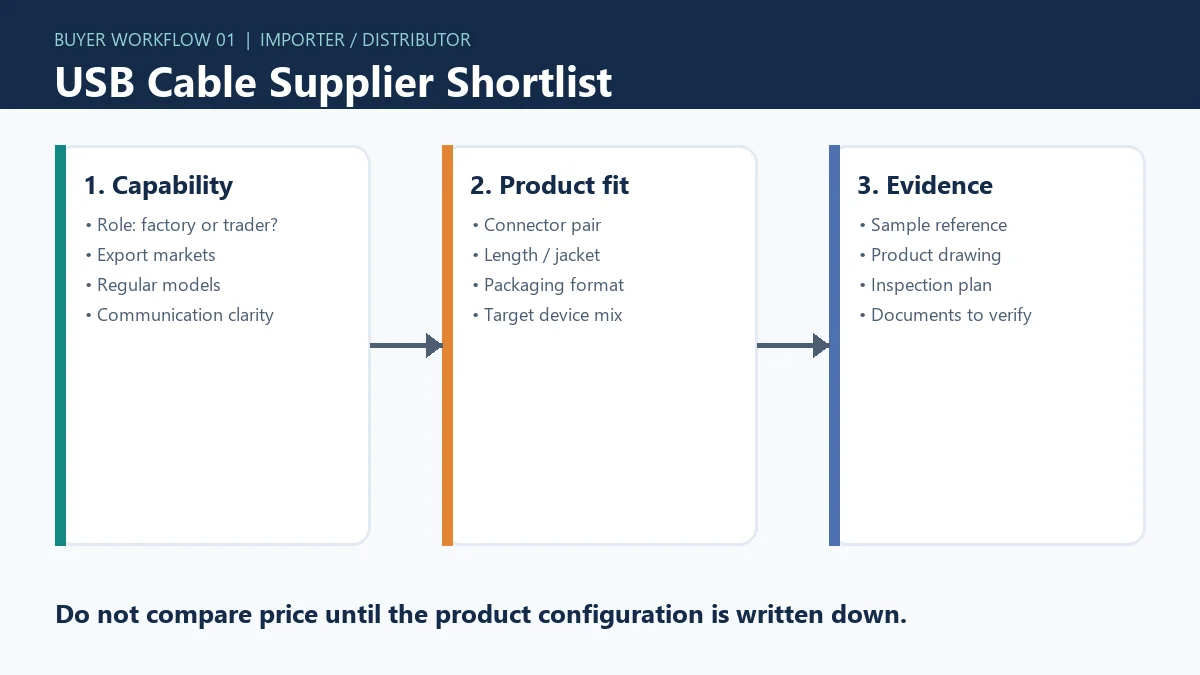
After 15 years of exporting 3C products from Shenzhen, we have learned that document review works best when it follows the product decision—not the other way around. A USB cable for basic charging does not create the same evaluation questions as a cable promoted for high-watt charging, fast data transfer, or video output.
For USB Cable Buyers, Should Market and Product Claims Come First
Many USB cable buyers begin by asking for “all certifications.” That request sounds safe, but it can produce a stack of documents without a clear connection to the cable they plan to sell. The real risk appears when a retailer’s product claim, packaging, or online listing goes beyond what the supplied documentation supports.
USB cable buyers should define the destination market, sales channel, intended use, and advertised claims before requesting compliance documents. A charging-only cable, a USB-C data cable, and a video-capable cable may need different technical evidence. The supplier’s documents should be reviewed against the specific model and the claims that buyers intend to make.
Start with the retail promise
We suggest that buyers write a short product brief before contacting suppliers. This brief does not need to be complicated. It should simply state what the cable is, where it will be sold, and what customers will be told it can do.
For example, a buyer may be sourcing:
- A USB-A to USB-C cable for standard charging
- A USB-C to USB-C cable for laptop charging
- A braided cable marketed as “fast charging”
- A cable promoted for data synchronization
- A USB-C cable sold with a video-output claim
- A private-label cable for a European retail chain
- A budget cable for an online marketplace in the United States
Each example raises different questions. A cable that only transfers charging current may be evaluated differently from a cable that claims a specific charging wattage, transfer speed, or display capability. The more specific the claim, the more important it becomes to verify that the cable design and supporting evidence actually match that promise.
Ask what the customer will see
Retail risk often comes from the visible claim rather than the product itself. We encourage buyers to review the full customer-facing presentation:
| Retail element | Question to ask | Procurement risk |
|---|---|---|
| Product name | Does the name imply charging, data, or video performance? | An unclear name can lead to unsupported assumptions. |
| Packaging | Does the packaging state wattage, speed, or compatibility? | A claim may exceed the product’s verified capability. |
| Online listing | Are product titles and bullet points consistent with the specification? | Marketplace listings can be blocked or challenged. |
| Icons and logos | Is each logo permitted and supported? | A logo can create a separate verification issue. |
| Compatibility statement | Does the cable work as described with the intended devices? | Broad claims can increase return rates and complaints. |
We sometimes receive a simple question from European and U.S. retail buyers: “Does this cable have CE?” We understand why they ask. However, the more useful question is: “What documentation supports this exact cable for our intended market and product claims?”
That wording helps both buyer and supplier focus on the real procurement task.
How Should USB Cable Buyers Match Documents to the Exact Model?
A supplier may provide a declaration, a test report, a product photo, and a specification sheet. These documents can all be useful, but they do not all serve the same purpose. Problems arise when a buyer assumes that one document automatically proves everything about a complete product range.
USB cable buyers should check that every key document identifies or clearly applies to the exact cable model, connector combination, material version, and planned claim. Buyers should separate declarations, laboratory reports, labels, and technical specifications rather than treating them as interchangeable evidence.
Understand the difference between document types
A practical review starts by identifying what each document actually is.
| Document or item | What it may help show | What buyers still need to verify |
|---|---|---|
| Supplier declaration | The supplier’s stated position on a requirement or substance restriction | Product model, date, scope, responsible party, and market relevance |
| Test report | Test results for identified samples under stated conditions | Sample identity, report scope, methods, date, and whether the sold version matches |
| Technical specification sheet | Claimed cable construction and performance parameters | Whether the stated specifications are supported for the final product |
| Product label or packaging artwork | What the end customer will see | Accuracy of claims, logos, warnings, and market presentation |
| Material declaration | Information about materials or restricted substances | Coverage of all relevant parts, including connectors, jacket, and accessories |
| Factory quality record | Internal production-control information | Whether controls apply to the buyer’s order and selected model |
A CE mark, where relevant to a product and market context, should not be treated as a universal certificate that automatically clears every country, channel, or product variation. Similarly, RoHS-related documents can be important for substance-restriction evaluation, but buyers should verify their scope and relevance rather than treating the document title as final approval.
We are not a laboratory, regulator, or legal authority. We help buyers organize supplier information and identify questions that need further review. Final regulatory interpretation should be confirmed with qualified compliance professionals, testing laboratories, and applicable local market requirements.
Check the model identity carefully
A common sourcing issue is “family documentation.” A supplier may offer one report or declaration for several similar cables. Similarity alone is not enough for a buyer’s file.
We recommend comparing these details across the purchase order, specification sheet, packaging artwork, sample, and documents:
- Model number or internal reference
- Connector type, such as USB-A, USB-C, Lightning-compatible, Micro-USB, or another configuration
- Cable length
- Jacket material, such as PVC, TPE, nylon braid, or silicone
- Wire construction and conductor details
- Charging and data claims
- Color, connector shell, and accessory changes
- Packaging version and retail branding
- Document issue date
- Supplier or manufacturer identity
A one-meter USB-C cable and a two-meter USB-C cable may look almost identical, but their electrical performance can differ.[5] A braided version may also use different materials from a PVC version.[6] If a buyer changes the cable length, connector housing, wire gauge, or advertised wattage after the initial review, we recommend treating the change as a new verification point.
Which USB Cable Specifications Matter Most for Retail Buyers?
Technical specifications are not only engineering details. For USB cable buyers, they affect customer expectations, return rates, product claims, and the supplier’s ability to deliver a consistent product. A low price can look attractive until a cable fails to support the advertised charging or data function.
USB cable buyers should evaluate connector configuration, supported power, data capability, cable length, conductor construction, shielding, jacket material, and durability claims. The most important specification is the one tied to the buyer’s advertised use. Buyers should avoid promoting performance that is not clearly defined and supported for the selected cable model.
Charging capability needs a clear claim
“Fast charging” is a popular retail phrase, but it is not a complete technical specification. A buyer should ask what the cable is designed to support and under what connected-device and charger conditions.
For USB-C cables, the cable’s current capability, electronic marking where applicable, connector quality, and overall design can affect the intended charging use.[4] A cable cannot create charging performance on its own. The charger, device, power protocol, and cable must work together.[3]
We recommend that buyers avoid vague claims where possible. Instead of making a broad statement that may confuse customers, buyers can use a precise claim that matches the supplier’s technical information and intended use.
For example, the buyer can ask:
- What charging use is this cable designed for?
- Is the stated wattage a cable capability, a tested setup result, or a marketing target?
- Does the claim apply to all lengths in the range?
- Does the cable include any required electronic component for its intended use?
- What charger and device conditions were used for any performance testing?
Data and video are separate questions
A USB-C connector does not automatically mean that every cable supports the same data speed or video feature.[2] USB-C describes a connector format, while actual functionality depends on the cable design and the systems connected to it.
A cable sold for charging may have limited data capability. A cable marketed for high-speed data or display output requires more careful technical review. Buyers should ask for clear information rather than relying on connector appearance.
| Intended retail claim | Specification questions we recommend asking |
|---|---|
| Charging cable | What current or power use is intended? What cable length is covered? |
| Data sync cable | What data function is claimed? Is the speed claim defined? |
| High-speed USB cable | Which performance level is stated on the product specification? |
| Video-capable USB-C cable | What display-related function is claimed, and under what setup? |
| Durable braided cable | What construction or test basis supports the durability statement? |
| Car or travel cable | Is the strain relief suitable for repeated handling and bending? |
Construction affects quality consistency
Our customers often compare cables based on outer appearance: braided finish, aluminum shell, soft-touch jacket, or slim connector. These features matter for retail appeal, but internal construction often decides long-term consistency.
When evaluating samples, we encourage buyers to discuss:
- Conductor material and size
- Insulation and jacket material
- Shielding approach, where relevant to the intended function
- Strain-relief design
- Connector overmolding
- Soldering and assembly controls
- Length tolerance
- Visual inspection standards
- Functional testing during production
- Packaging protection during shipment
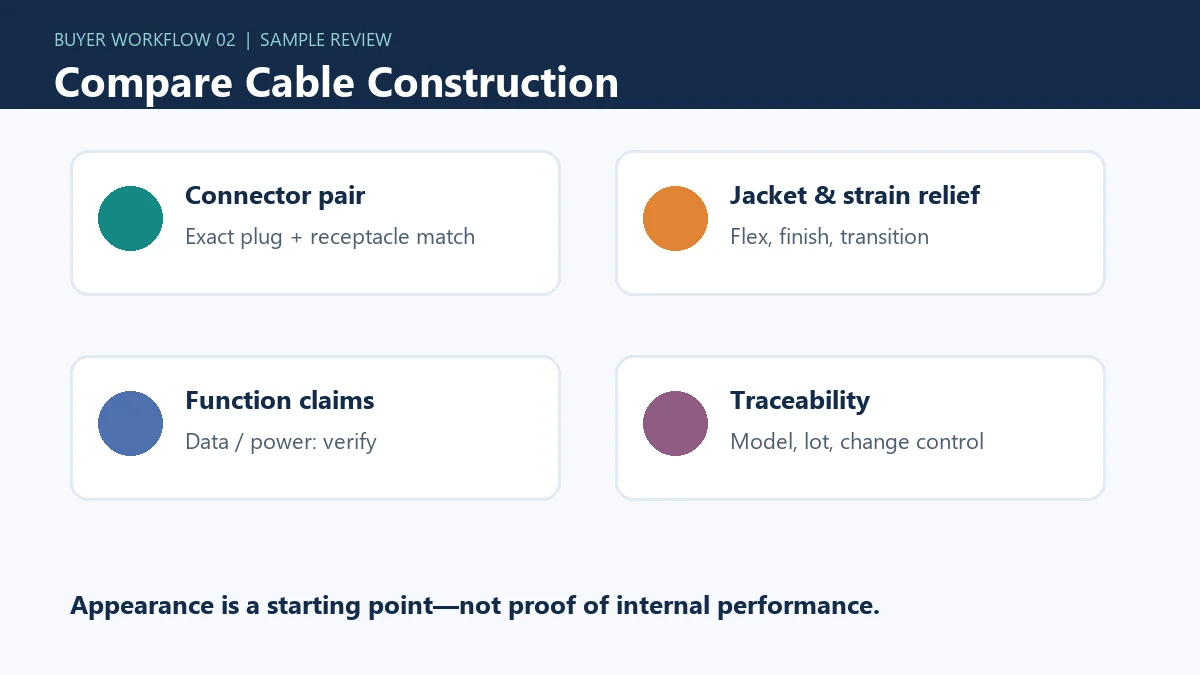
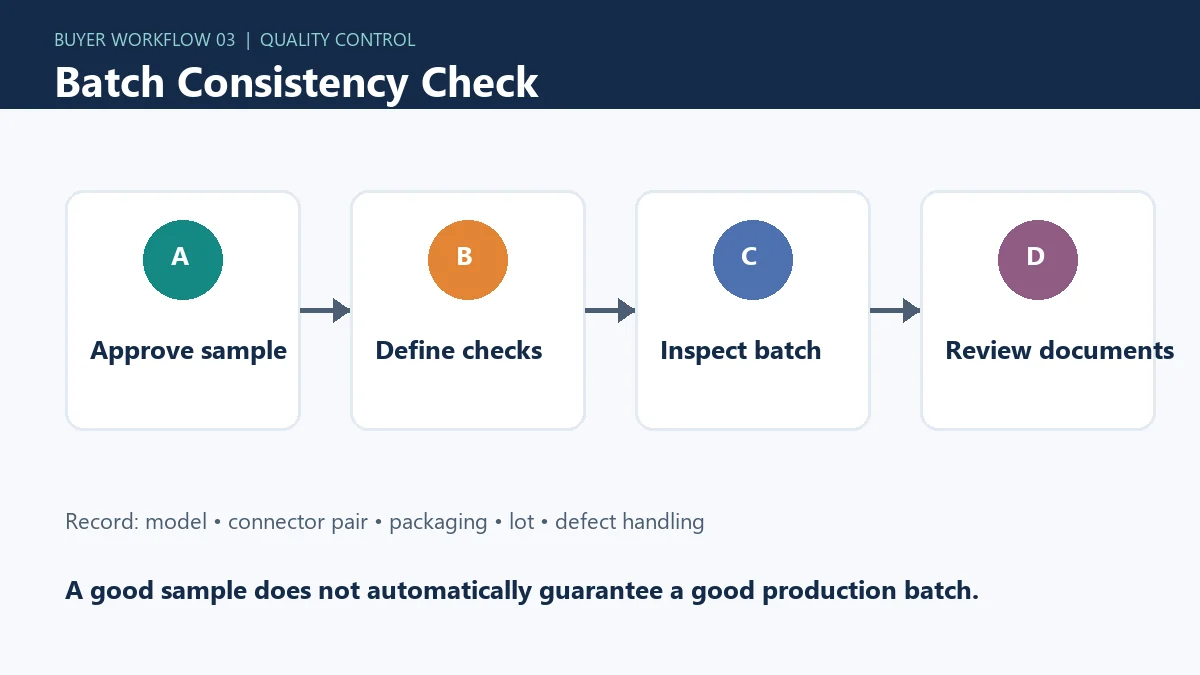
A sample can look good and still fail to represent mass production. For this reason, we recommend that buyers agree on the approved sample, specification, packaging artwork, and inspection requirements before production begins. A qualified third-party inspection or professional technical review may be appropriate for higher-risk programs or major retail launches.
Can Packaging Labels and Logos Create USB Cable Compliance Risks?
Buyers sometimes focus on the cable and leave packaging until the end. That approach can create a last-minute problem because packaging often contains the strongest claims: speed icons, charging wattage, compatibility statements, environmental messages, and certification-related markings.
USB cable buyers should review packaging, labels, online content, and logos as part of product compliance review. Every visible statement should match the exact cable specification and available supporting documents. A familiar symbol or certification name should not be added simply because it appears on another supplier’s product.
Treat packaging as part of the product file
For private-label and retail programs, we recommend collecting packaging artwork early. This allows buyers to compare the proposed presentation with the product specification and supplier documents before printing begins.
The review should cover:
- Product name and connector description
- Cable length
- Charging, power, data, or video claims
- Compatibility wording
- Material claims, such as “braided” or “recycled”
- Durability claims, such as bend or pull statements
- Certification-related marks or environmental symbols[7]
- Manufacturer, importer, or responsible-party information where applicable
- Warnings, instructions, and language requirements that may apply in the destination market
A logo can carry meaning beyond marketing design. For example, a USB-related logo may be associated with program rules, trademark permissions, or specific performance expectations. A buyer should ask what the logo represents, who is authorized to use it, and whether it is appropriate for the exact product and market presentation.
Avoid “copy the market” sourcing
We sometimes see buyers send a competitor’s packaging photo and ask us to copy every icon. We understand the commercial reason. A familiar shelf appearance can make a product easier to sell. However, copying a claim or symbol without verifying its basis can create unnecessary exposure.
A safer approach is to make a claim-by-claim table:
| Proposed packaging claim | Evidence to request | Decision |
|---|---|---|
| “Up to” charging wattage | Product-specific technical support and relevant test information | Use only if verified for the selected model |
| Data speed statement | Clear performance specification and supporting evidence | Use precise, not vague, wording |
| Durability statement | Defined internal or external test basis | Avoid unsupported numbers |
| RoHS-related statement | Current declaration and scope review | Verify market context and product coverage |
| Certification mark | Documentation and confirmation of permitted use | Verify before printing |
| Device compatibility | Tested or technically supported compatibility basis | Narrow the claim if needed |
This process protects the buyer’s listing quality as well as the supplier relationship. It also reduces the chance that artwork needs to be revised after production has started.
What Procurement Process Helps USB Cable Buyers Reduce Delays?
A rushed document request often produces rushed answers. Buyers may receive generic files, unclear model references, or documents that arrive after packaging has already been approved. A simple procurement sequence can reduce this confusion and make supplier comparison more meaningful.
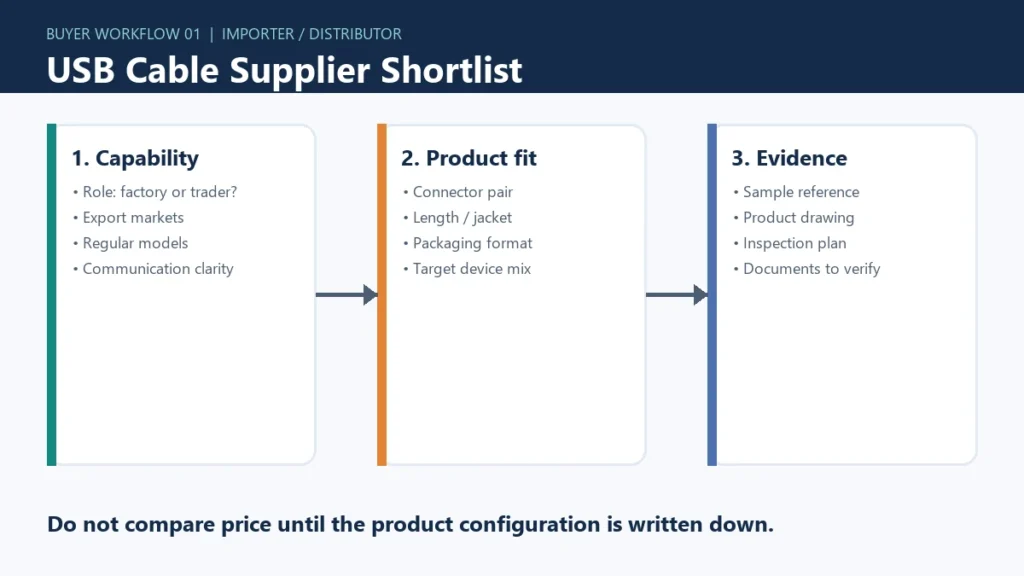
USB cable buyers can reduce compliance gaps by following a sequence: define the destination and claims, select the cable specification, request model-specific documents, compare all evidence with the final sample and artwork, and obtain qualified external advice when needed. This process is more reliable than asking suppliers for a generic list of certifications.
A practical five-step sourcing sequence
We use the following sequence as a working method when discussing USB cable projects with retail, wholesale, and e-commerce customers.
-
Define the commercial brief
Confirm destination countries, customer type, expected price level, target quantity, sales channel, product use, and planned claims. -
Confirm the technical specification
Select connector type, length, jacket material, color, charging or data requirement, packaging, and any private-label details. -
Request product-specific supplier evidence
Ask for relevant declarations, reports, specifications, product photos, quality-control information, and packaging details that relate to the selected model. -
Compare the evidence against the final product
Check that model details, claims, product construction, packaging language, and supplier identity are consistent across the file. -
Verify market-specific requirements externally when necessary
For important programs, new markets, unusual claims, or uncertain requirements, obtain guidance from qualified compliance professionals, laboratories, legal advisers, or local regulatory resources.
Compare suppliers beyond document volume
A supplier that sends ten documents is not automatically safer than one that sends three well-organized, product-specific documents. We recommend that buyers assess clarity, responsiveness, and production control alongside paperwork.
Useful supplier evaluation questions include:
- Can the supplier explain which document applies to which cable model?
- Can the supplier provide a stable specification before mass production?
- Does the supplier identify differences between cable lengths or material versions?
- Can the supplier support customized packaging without changing the product claim basis?
- Does the supplier have a documented quality-control process for the order?
- Can the supplier provide pre-production samples and production updates?
- Does the supplier clearly state what it does not know?
That last point matters. A responsible supplier should not pretend to provide final legal interpretation. We believe clear boundaries build stronger long-term business relationships.
For buyers sourcing from Shenzhen, communication quality is especially important. Fast replies are useful, but accurate replies are more valuable. A supplier that asks follow-up questions about destination, packaging, and use case is often helping the buyer avoid a costly assumption.
Frequently Asked Questions
Is CE certification enough for USB cable buyers?
No. Buyers should not treat CE-related information as a universal pass for every country, cable version, sales channel, or packaging claim. We recommend verifying what the documentation covers, whether it applies to the exact model, and what requirements apply in the intended destination market.
Do USB cable buyers need a separate document for every cable length?
Not always, but buyers should verify whether the available documents and specifications clearly cover each length. Cable length can affect electrical performance, construction, and retail claims.[8] A one-meter and three-meter version should not be assumed identical without supporting confirmation.
Can a USB-C cable claim fast charging automatically?
No. A USB-C connector alone does not prove a specific charging capability. Buyers should confirm the cable’s intended power use, technical construction, and the conditions behind any wattage or fast-charging claim before placing that statement on packaging or online listings.
What should USB cable buyers ask suppliers before placing an order?
We recommend asking for the exact model specification, product photos, cable construction details, relevant product-specific documents, quality-control process, packaging artwork, MOQ, lead time, and after-sales terms. Buyers should also explain their destination market and planned retail claims from the beginning.
Should retailers use third-party testing for USB cables?
The answer depends on the market, claim level, order value, and risk tolerance. Third-party testing or professional review can be valuable for high-power, high-speed, video-capable, or large retail programs. Qualified laboratories and compliance professionals can provide application-specific guidance.
Conclusion
For USB cable buyers, the best compliance strategy is not collecting the longest list of familiar certification names. It is matching the destination market, exact cable model, technical specification, supplier documents, and retail claims. We recommend reviewing the product and packaging together, checking model-level consistency, and seeking qualified external advice for market-specific decisions. If you are sourcing USB cables for European or U.S. retail, wholesale, or e-commerce programs, we can help you compare product options, MOQ, lead times, customization possibilities, and supplier documentation.
Sources
- CE marking - Internal Market, Industry, Entrepreneurship and ...", European Commission guidance explains that CE marking and the EU declaration of conformity concern compliance with applicable EU requirements for the relevant product, rather than a general-purpose approval for all markets or product variants
- What is USB-C DisplayPort (DP Alt Mode) and Why it Matters", USB Implementers Forum materials distinguish the USB Type-C connector system from the USB data specifications and alternate modes that determine supported data and display functions
- USB Charger (USB Power Delivery)", USB Power Delivery documentation describes power delivery as a negotiated system involving the source, sink, and, where relevant, cable capability, rather than a performance characteristic created by the cable alone
- Universal Serial Bus Type-C Cable and Connector ...", USB Type-C and USB Power Delivery materials specify cable capability information, including cases in which electronically marked cables communicate characteristics relevant to supported current and power operation
- USB-C Cable Voltage Drop - LTT Labs : r/UsbCHardware", Electrical engineering references describe how conductor resistance, voltage drop, attenuation, and signal-integrity margins vary with cable length and construction, so visually similar cables of different lengths can perform differently
- RoHS Directive - Environment - European Commission", EU RoHS guidance treats restricted-substance compliance in relation to the materials and components of electrical and electronic equipment, making material changes relevant to a product's technical documentation and assessment
- EU - Labeling/Marking Requirements", EU guidance defines CE marking as a conformity marking for applicable Union requirements and defines the crossed-out wheeled-bin symbol as information related to separate collection of electrical and electronic equipment
- Advanced Electrical Voltage Drop and Cable Length Calculator", Electrical engineering teaching materials explain that conductor resistance rises with length and can increase voltage drop under load, which can affect the performance basis for cable-specific claims