A USB Cable Manufacturer in China can offer attractive pricing, flexible customization, and broad product choices, but a low quotation does not remove sourcing risk. In my export work, I have seen how inconsistent materials, unclear specifications, and weak after-sales support can turn a small saving into rework, complaints, returns, and lost customer trust.
Quick Answer
- Define the cable’s use case, connector type, charging and data requirements before requesting quotations.
- Compare materials, internal structure, testing evidence, packaging, MOQ, lead time, and customization—not only unit price.
- Verify samples, certification documents, product claims, and mass-production controls separately.
- Use a supplier comparison table before sampling and placing a controlled trial order.
- Choose the supplier that offers the best balance of suitability, consistency, documentation, communication, and total procurement cost.
To choose a USB cable manufacturer in China, I recommend starting with your exact product requirements, then comparing qualified suppliers on product quality, testing evidence, MOQ, lead time, customization, communication, and after-sales support. You should verify samples and documents before placing a trial order, because the cheapest quotation or strongest sample does not automatically prove stable mass production.
The right supplier is not always the largest factory or the company with the lowest price. I usually look for evidence that a supplier understands the buyer’s market, can control the agreed specification, and can repeat the same quality during replenishment. The sections below explain how I make that evaluation more structured.
How Do I Choose a USB Cable Manufacturer in China?
Many buyers begin with a search for “USB cable factory China” and immediately request a price list. That approach can create dozens of similar quotations without clarifying whether the products are comparable. The buyer may then compare different cable structures as if they were the same item.
I choose a USB cable manufacturer in China by first defining the application, then checking technical suitability, quality controls, documentation, commercial terms, and production evidence. I compare suppliers in the same table and use samples and a controlled trial order to reduce uncertainty before committing to regular purchasing.
Start with the buyer’s actual use case
- Connector combination, such as USB-A to USB-C, USB-C to USB-C, or another configuration.
- Intended charging use and the performance claim that may be printed on the package.
- Whether data transfer is required, and what evidence supports the stated data performance.
- Cable length, flexibility, jacket material, color, and appearance.
- Expected daily use and the customer’s quality expectations.
- Packaging, labeling, barcode, language, and market requirements.
- Target order quantity, MOQ, launch date, and replenishment plan.
Why the product brief matters
| Requirement | Better description | Point to verify |
|---|---|---|
| Length | 1.0 m measured connector end to connector end | Measurement tolerance |
| Jacket | PVC, TPE, nylon braid, or another agreed material | Material and appearance |
| Connector | USB-C plug and USB-C plug | Connector construction |
| Function | Charging only or charging plus data | Test method and result |
| Package | Printed box, bag, or bulk carton | Artwork and packing count |
| Quantity | Trial order and expected monthly volume | MOQ and replenishment |
The buyer should also separate required features from preferred features. A custom color may be preferred, while correct connector compatibility and safe operation may be essential. This distinction helps me negotiate practical alternatives without weakening the core product.
What USB Cable Specifications Should I Compare?
Unclear cable specifications create hidden differences between quotations. Two products can look almost identical while using different conductor sizes, shielding arrangements, connector components, or strain-relief designs. These differences can affect performance, durability, price, and customer complaints.
When I compare USB cable specifications, I review the connector configuration, conductor and insulation description, outer jacket, shielding, strain relief, length tolerance, charging or data claims, packaging, and required testing evidence. I do not treat a connector name or a “fast charging” label as complete proof of compatibility.
Review the construction, not only the appearance
-
What is inside the cable?
The supplier should describe the conductor and relevant internal arrangement in a way the buyer can record and approve. Buyers should ask what document or test supports the description. -
What material protects the cable?
PVC, TPE, and braided constructions can provide different tactile qualities, flexibility, abrasion resistance, and cost.[3] A braided exterior alone does not prove that the internal cable is stronger.[4] -
What does the performance claim mean?
“Fast charging” depends on the connected devices, charger, power negotiation, cable design, and test conditions.[1] “Data cable” also needs a clear performance basis.[2] I ask the supplier to identify the applicable test conditions rather than accepting a label alone.
Compare specifications in a controlled format
| Evaluation point | Supplier A | Supplier B | Evidence required |
|---|---|---|---|
| Connector combination | Specification sheet and sample | ||
| Cable length and tolerance | Drawing or approved sample | ||
| Jacket and braid material | Material declaration where relevant | ||
| Charging claim | Test report and conditions | ||
| Data claim | Test method and result | ||
| Connector appearance | Golden sample or photos | ||
| MOQ | Written quotation | ||
| Trial lead time | Production schedule | ||
| Custom packaging | Artwork approval process | ||
| Warranty or claim process | Written commercial terms |
I have found that suppliers respond differently when the same questions are presented in a structured table. A professional supplier normally identifies assumptions and asks clarifying questions. A weak response may simply repeat general words such as “premium quality” without explaining the construction.
Keep technical claims traceable
The buyer should save the approved specification, sample photos, test documents, and purchase order together. If a later production batch differs, these records help determine whether the problem involves a changed component, an unclear requirement, or a production failure.
For USB-related information, buyers can review resources from the USB Implementers Forum and confirm whether a specific product or claim requires additional verification. I use such sources for reference, but I still ask the supplier to provide product-specific evidence.
How Can I Check USB Cable Quality Before a Trial Order?
A sample is useful, but it is only one point of evidence. A supplier can send a carefully selected sample that does not represent every production batch.[5] Buyers therefore need a sample process that checks both the product and the supplier’s ability to control it.
I check USB cable quality by approving a written sample specification, examining construction and finish, reviewing available test evidence, and asking how the supplier controls incoming materials and finished goods. I then use a limited trial order and an agreed inspection standard to compare mass production with the approved sample.
What I examine during sample review
- Connector fit with representative chargers, devices, and adapters.
- Cable length, color, printing, and visible finish.
- Molding consistency and strain-relief appearance.
- Braid uniformity, if the cable has a braided jacket.
- Flexibility and obvious damage after reasonable handling.
- Packaging dimensions, labels, barcodes, and carton information.
- Charging or data function under the buyer’s intended conditions.
- Differences between units in the same sample set.
The buyer should test more than one sample when possible. One cable may perform well by chance. A small group gives a better view of visible consistency, although it still does not replace a production inspection or suitable engineering test.[6]
Ask for a sample approval record
- Sample date and supplier reference.
- Exact model or internal item number.
- Product photos from several angles.
- Agreed color and length.
- Packaging version.
- Functional test conditions.
- Any acceptable cosmetic tolerance.
- Changes that the supplier must not make without written approval.
Use independent inspection when the order justifies it
For a larger or strategically important order, the buyer can appoint a qualified inspection company to perform a pre-shipment inspection. The inspection scope should identify the quantity, sampling plan, critical defects, major defects, minor defects, packaging checks, and functional checks. The buyer should ensure that the inspection criteria match the approved product specification.
A supplier’s own report can be useful, but it should not be treated as independent evidence. The buyer should also ask whether the report covers the exact model, configuration, and production batch. A generic report or a document for another item may not support the claim being made.
Certification documents require careful verification
- The legal name and address of the certificate holder.
- The exact product family and model coverage.
- Validity dates and issuing organization.
- Test standards and report references.
- Whether the document covers the final configuration and packaging.
- Whether the destination market has additional obligations.
For European sales, buyers should review official information about applicable product requirements[7] through the European Commission’s CE marking guidance and relevant substance restrictions through EUR-Lex RoHS legislation. The supplier can provide documents, but the importer or brand owner should obtain qualified advice about its own legal responsibilities.
How Do I Compare USB Cable Suppliers Beyond Unit Price?
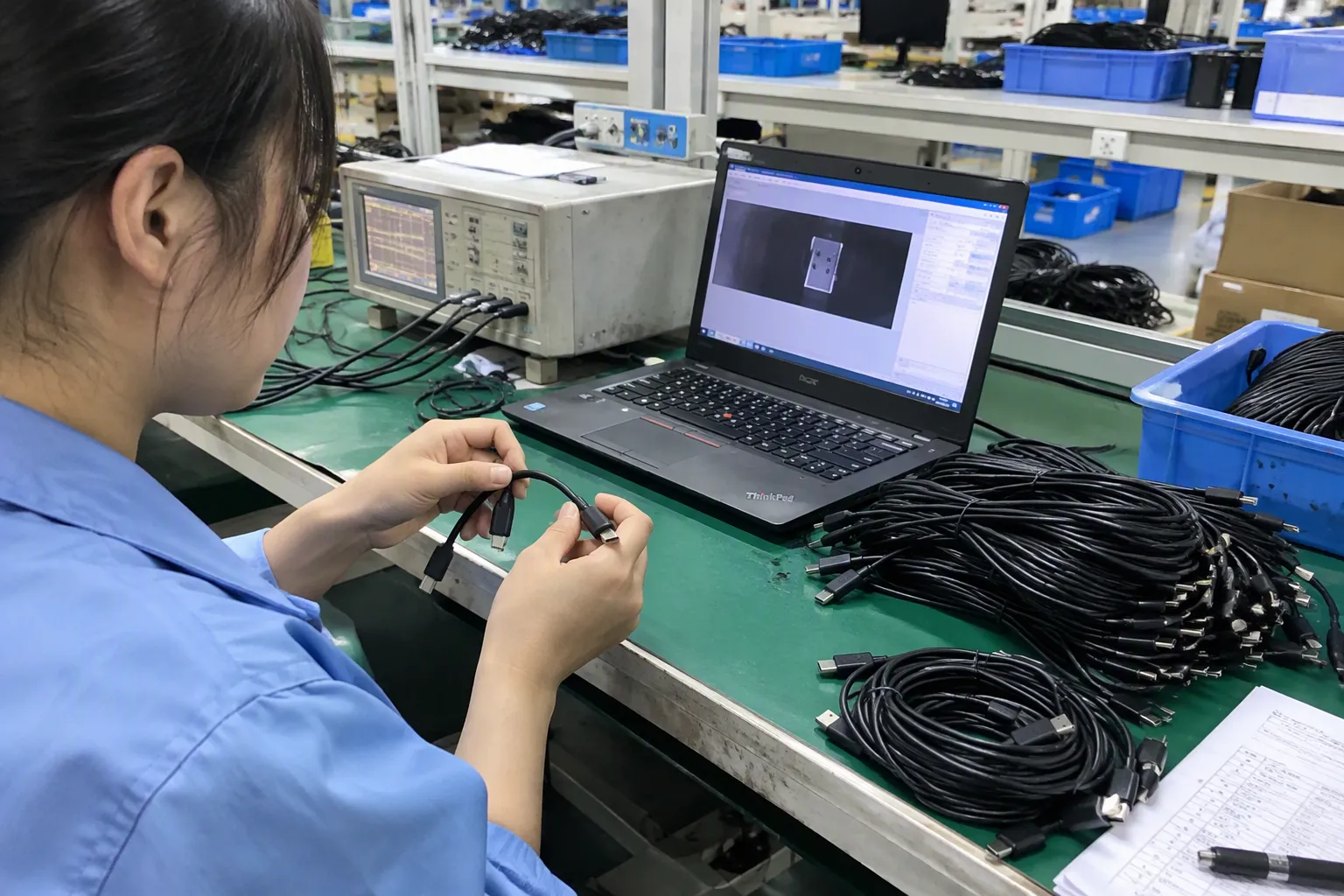
A low unit price can look attractive until the buyer pays for sorting, rework, urgent replacement, customer refunds, or delayed promotion.[8] I have handled quality-related communication where the commercial problem was larger than the original product difference because the buyer had to explain the issue to retailers or end customers.
I compare USB cable suppliers by calculating total procurement cost. This includes the product price, freight-related effects, packaging, inspection, rework risk, returns, after-sales effort, payment terms, and the business cost of delayed or unreliable replenishment.
A practical total-cost model
| Cost or risk | Questions to ask |
|---|---|
| Purchase price | Is the quotation based on the same materials and packaging? |
| Quality cost | What happens if goods need sorting or rework? |
| Logistics cost | Does packaging create unnecessary volume or damage risk? |
| Compliance cost | Are market documents current and product-specific? |
| After-sales cost | How are verified complaints investigated and resolved? |
| Delay cost | Can late delivery affect a launch or retailer booking? |
| Replenishment cost | Can the supplier repeat the approved construction later? |
A supplier that is slightly more expensive may be commercially better if it provides clearer documentation, fewer variations, better communication, and more predictable production. I do not assume that a higher price guarantees quality. I use the price difference as one part of a broader risk discussion.
Distinguish price differences from specification differences
A supplier may offer a lower price because it has excluded the printed package, quoted a shorter cable, used a different connector construction, or assumed a larger order quantity. The buyer should request a revised comparison rather than pressuring every supplier to match the lowest number.
Include the cost of communication
Communication affects procurement efficiency. If a supplier gives unclear answers, changes details in different messages, or avoids written confirmation, the buyer may spend more time checking orders and correcting misunderstandings. This cost is easy to overlook for a first order.
I usually prefer a supplier that answers technical and commercial questions in one organized document. Clear communication does not prove factory quality, but it makes the supplier easier to evaluate and gives the buyer stronger records.
What Should I Check in a USB Cable Manufacturer’s Factory and Documents?
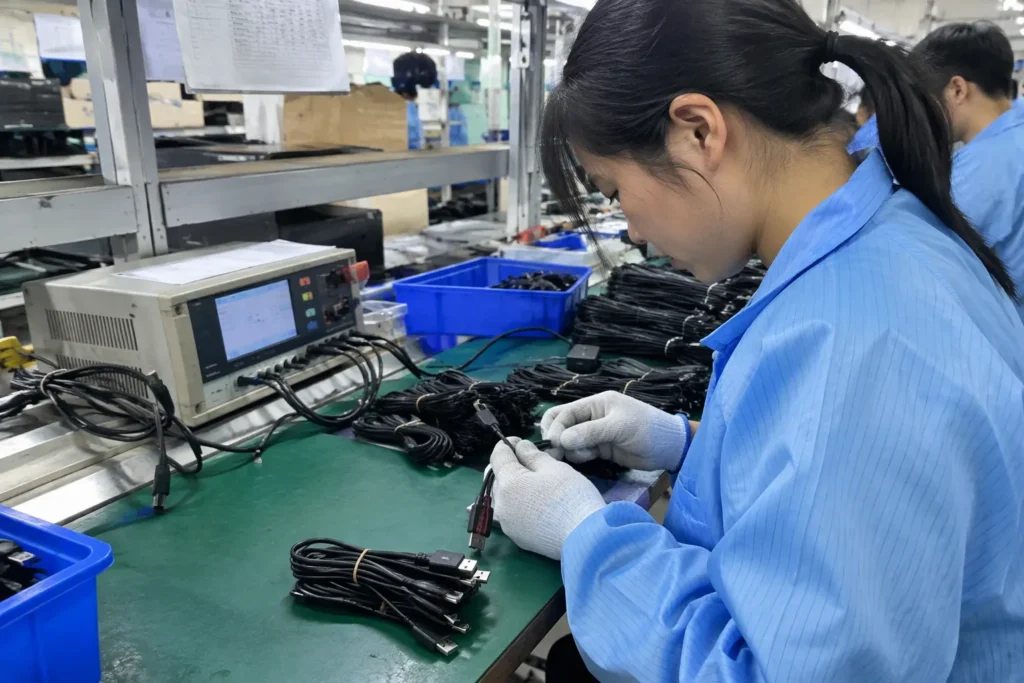
A supplier’s presentation can be impressive, but a website, showroom, or factory photograph does not establish production control. Buyers should distinguish between a trading company, an assembly facility, a specialized factory, and an integrated supplier arrangement.
I check a USB cable manufacturer in China by identifying the actual production party, reviewing relevant business and quality documents, asking about process control, and confirming which operations are performed in-house or subcontracted. I treat every document as evidence to verify, not as a substitute for an audit or product testing.
Identify who will make the product
- Is the supplier a factory, exporter, or trading company?
- Which operations are performed by the named supplier?
- Are connectors, cable cores, molding, printing, and packaging subcontracted?
- Who controls incoming materials?
- Who handles corrective action when a problem appears?
- Can the same production site support replenishment?
A trading company is not automatically unsuitable. A capable trading company may coordinate reliable factories and export service. However, the buyer should understand the supply chain and decide whether the communication and accountability structure is acceptable.
Review quality-control evidence
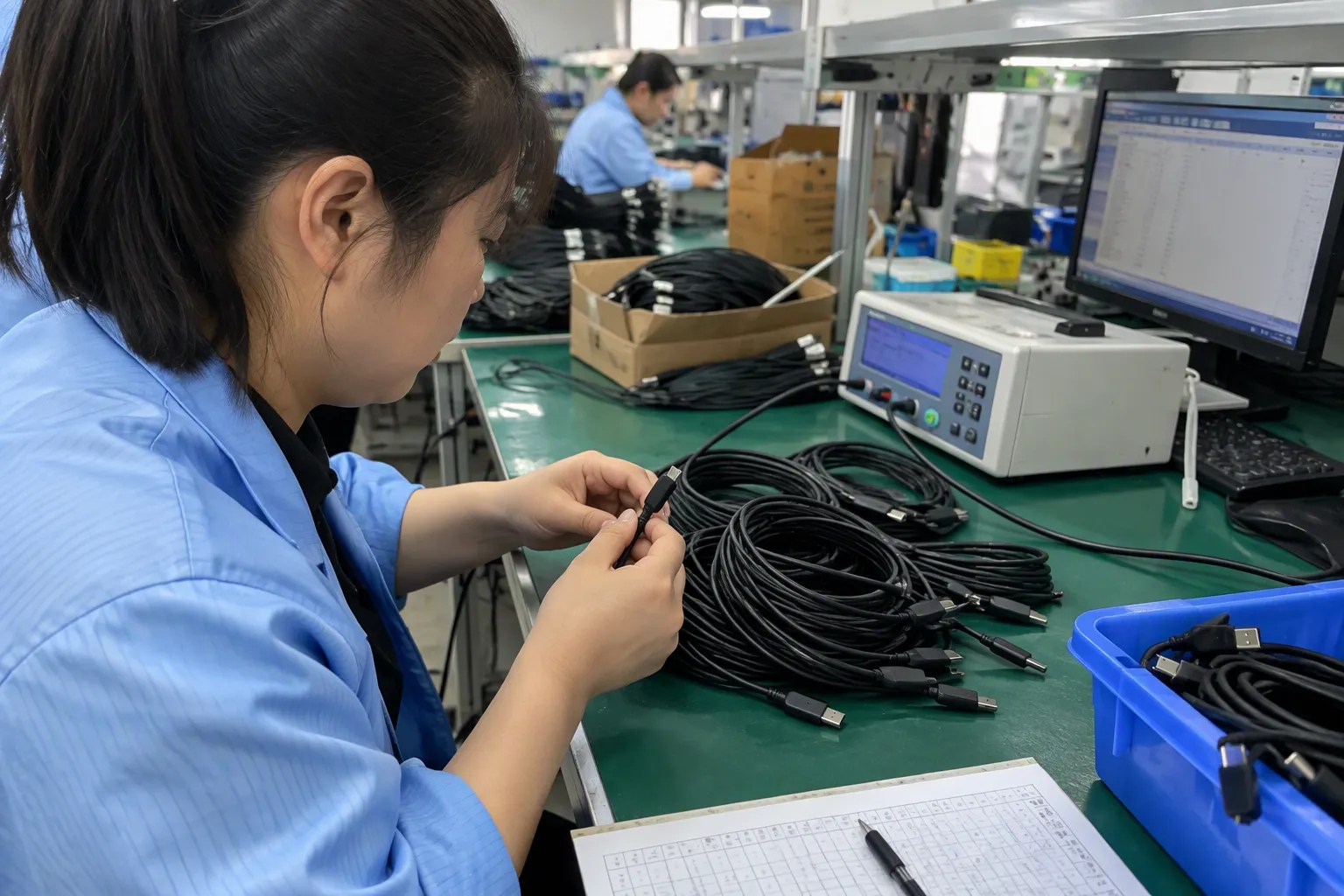
- Incoming material inspection records.
- Work instructions and production checkpoints.
- Functional testing records.
- Finished-goods inspection records.
- Traceability or batch identification.
- Corrective-action records for previous issues.
- Calibration records for relevant equipment.
- A documented complaint and replacement process.
The buyer should ask for examples with confidential information removed if necessary. A supplier that has a real process should be able to explain how it identifies defects and prevents recurrence. A document with a quality-related title but no clear connection to the product provides limited value.
Understand factory audits
- Legal and organizational information.
- Production capacity and equipment.
- Worker and process controls.
- Material storage.
- Inspection and testing.
- Environmental and social requirements, where relevant.
- Subcontractor management.
How Do MOQ, Lead Time, and Customization Affect Supplier Selection?
MOQ and lead time often determine whether a product works for a retailer, wholesaler, or e-commerce launch. A supplier may quote an attractive item but require more inventory than the buyer can sell. Another supplier may accept a small trial order but struggle to repeat custom packaging later.
I evaluate MOQ, lead time, customization, and replenishment together. I ask for separate timelines for material preparation, production, testing, packaging, and shipment, and I confirm whether the quoted MOQ applies to each color, length, connector combination, and package design.
Questions about MOQ
Build a realistic lead-time plan
- Artwork confirmation.
- Material and component preparation.
- Sample or pre-production approval.
- Cable production and assembly.
- Functional and visual inspection.
- Packaging.
- Final inspection and shipment booking.
I ask suppliers to identify the factors that could extend lead time. These factors may include custom colors, unusual connector parts, packaging approval, peak-season capacity, or delayed customer confirmation. A written schedule is more useful than a general promise such as “delivery soon.”
Protect future replenishment
The buyer should ask how the supplier will maintain the approved specification in later orders. This question matters because a supplier may change a component, subcontractor, or package without clearly communicating the change.
A purchase agreement or product file should identify the approved sample and prohibit material or construction changes without written approval. The buyer should also confirm whether the supplier can provide a pre-production sample when a significant component changes.
Which USB Cable Supplier Is Best for European and North American Buyers?
Market requirements differ, and the buyer remains responsible for confirming the rules that apply to the finished product, packaging, claims, and sales channel. A supplier may have experience exporting to Europe or North America, but that experience does not automatically cover the buyer’s brand, product configuration, or current legal obligations.
The best supplier for a European or North American buyer is one that can provide market-relevant documentation, consistent product records, suitable packaging support, and clear accountability. I verify the exact documents and claims for the intended market instead of relying on a general statement that the supplier is “certified” or “exporting worldwide.”
Review market documentation carefully
- Electrical and electronic product safety.
- Electromagnetic compatibility where applicable.
- Restricted substances.
- Packaging and labeling.
- Importer, economic operator, or brand-owner information.
- Consumer product claims.
- Retailer-specific testing or compliance procedures.
I recommend using official government or standards-body information and asking a qualified compliance professional to review application-specific questions. The U.S. Consumer Product Safety Commission provides business guidance, while the U.S. Customs and Border Protection importing page provides general import information. These resources do not replace legal advice, but they help buyers ask better questions.
Check packaging and claims
A cable package may claim charging speed, data function, device compatibility, durability, or certification. Each claim should have a reasonable basis. I ask suppliers to provide the conditions behind performance claims and to confirm whether the package artwork matches the approved product.
How Should I Run a Supplier Comparison and Trial Order?
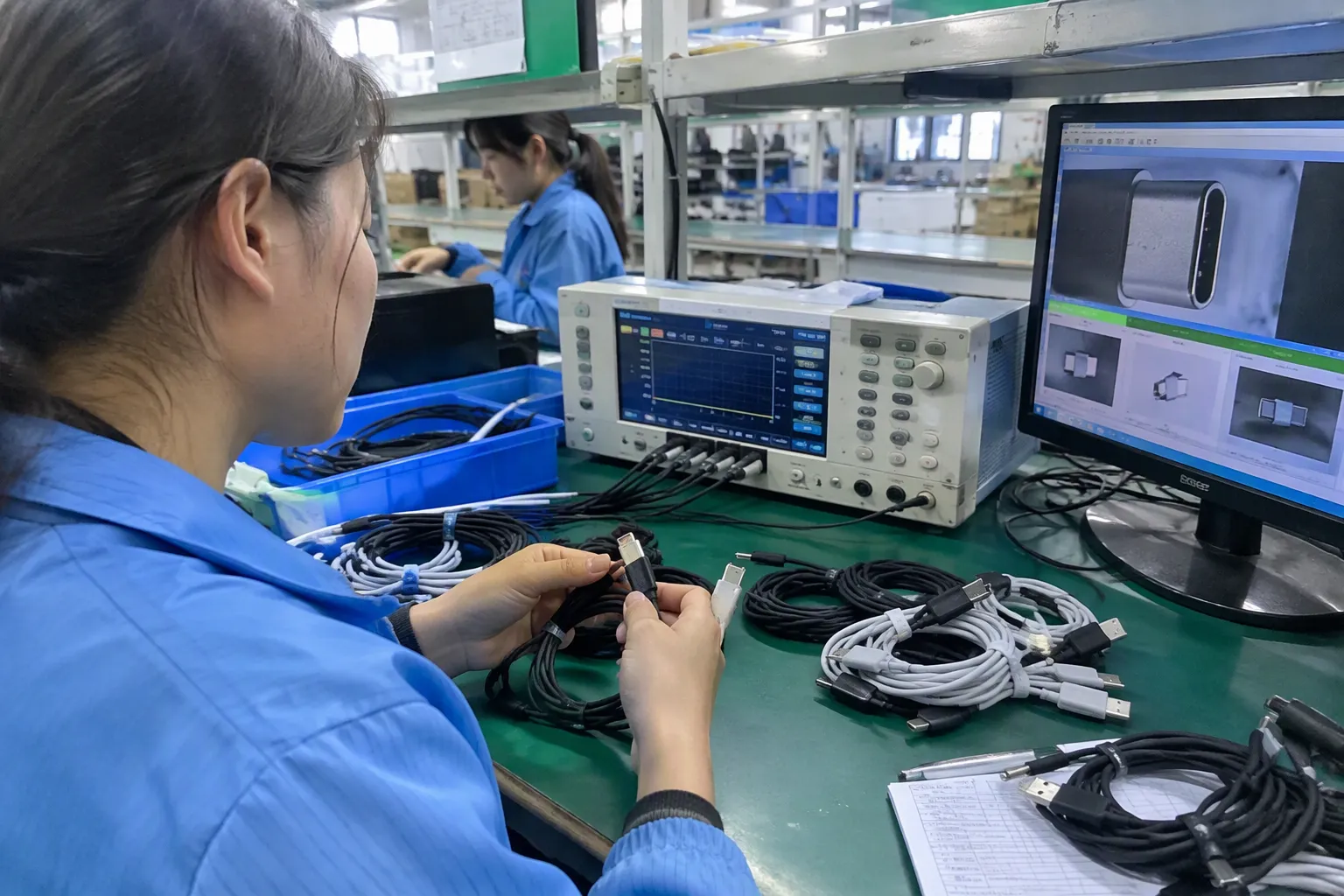
The supplier-selection process becomes easier when I use stages rather than making one large decision after the first quotation. The buyer can move from requirements to screening, sampling, trial production, and regular purchasing.
I recommend a five-stage process: define the specification, screen suppliers, compare evidence and quotations, approve samples, and place a controlled trial order. After the trial order, I review quality, delivery, communication, and corrective action before increasing volume.
Stage 1: Create the requirement sheet
Stage 2: Shortlist suitable suppliers
I normally look for suppliers with relevant USB cable experience, export communication, suitable MOQ, and a willingness to answer detailed questions. I do not assume that a long company history, large product catalog, or attractive website proves suitability.
Stage 3: Score suppliers consistently
| Category | Suggested questions |
|---|---|
| Product fit | Did the supplier answer every technical requirement? |
| Quality evidence | Are samples, records, and tests relevant and traceable? |
| Price | Is the quotation comparable with other offers? |
| MOQ | Does it fit the launch and replenishment plan? |
| Lead time | Is the schedule detailed and realistic? |
| Customization | Can the supplier manage artwork, colors, and packaging? |
| Communication | Are replies clear, complete, and documented? |
| After-sales | Are claim handling and corrective actions defined? |
| Replenishment | Can the supplier repeat the approved item? |
Stage 4: Approve samples and production controls
Stage 5: Place a controlled trial order
The trial order should be large enough to reveal production and packaging issues but limited enough to control exposure. Before shipment, the buyer should review inspection results and confirm that the goods match the approved sample and documents.
- Defect rate and defect types.
- Packaging condition.
- Actual delivery date.
- Communication during production.
- Response to any complaint.
- Ease of placing a repeat order.
- Any difference between sample and mass production.
Frequently Asked Questions
Is the cheapest USB cable manufacturer in China the best choice?
Not necessarily. The lowest quote may exclude important specifications, packaging, testing, or after-sales support. I compare total procurement cost and product suitability first. A slightly higher unit price can be more economical if it reduces rework, returns, delays, and customer complaints.
How many samples should I request from a USB cable supplier?
I usually request several samples when possible, especially for a new supplier or customized product. Multiple samples help reveal visible variation and confirm that the supplier understands the specification. However, samples do not prove stable mass production, so I also recommend a controlled trial order and suitable inspection.
What documents should a Chinese USB cable supplier provide?
The document set depends on the product and target market. It may include a specification sheet, relevant test reports, material information, packaging details, quality records, and business information. Buyers should verify the model, configuration, certificate holder, validity, and issuing organization instead of accepting document images without review.
Should I choose a factory or a trading company?
Either can be suitable. A factory may provide direct production access, while a trading company may offer broader product coordination and export support. I focus on who controls production, who is accountable for quality, how subcontracting is managed, and whether the supplier can support consistent replenishment.
How can I reduce risk with a first USB cable order?
I reduce risk by writing a detailed specification, comparing several suppliers, approving samples, confirming documents, using clear purchase terms, and placing a controlled trial order. I also define inspection criteria and a complaint process before production starts. Qualified technical or compliance evaluation may be necessary for application-specific products.
Conclusion
Choosing a USB cable manufacturer in China is a risk-adjusted procurement decision, not a contest for the lowest quotation. I recommend comparing product construction, performance evidence, quality controls, documents, MOQ, lead time, customization, communication, and after-sales support in one clear table. Then I would approve samples and place a controlled trial order before expanding volume. If you are sourcing USB cables for a European or North American retail, wholesale, or e-commerce business, contact me with your target specifications, quantity, packaging, and market requirements so I can help organize a practical supplier comparison.
Sources
- USB Charger (USB Power Delivery)", A technical reference on USB power delivery supports the statement that charging power is established through protocol negotiation among compatible devices and that cable capability and test conditions affect the resulting performance
- Document Library", USB technical documentation supports distinguishing a cable’s connector configuration from its supported signaling specification and maximum data rate; consequently, the generic term “data cable” is not a complete performance specification
- Comprehensive Performance Regulation and ... - PMC", Materials-engineering research supports the contextual claim that polymer jacket composition and external textile reinforcement influence cable flexibility and resistance to mechanical wear
- Determination of Tensile Characteristics and Electrical ... - PMC", Cable-mechanics research supports the conclusion that external braid appearance is not, by itself, a direct measure of internal conductor strength or whole-cable durability
- Annex 4 WHO guidelines for sampling of pharmaceutical ...", Quality-control literature supports the proposition that a pre-production or supplier-selected sample provides limited evidence about a later production lot unless sampling and process controls establish representativeness
- 6.2.2. What kinds of Lot Acceptance Sampling Plans (LASPs ...", Acceptance-sampling guidance supports the use of defined sample sizes and inspection criteria to assess production lots, while indicating that a small convenience sample cannot substitute for a controlled lot-inspection plan
- CE marking – obtaining the certificate, EU requirements", European Commission guidance supports the proposition that products placed on the European market must be assessed against the product legislation applicable to their characteristics and intended use
- Analyzing Costs Using Total Cost of Ownership", Quality-cost research supports evaluating supplier economics beyond purchase price because defects can generate internal and external failure costs such as rework, returns, complaints, and operational disruption