Are your USB cables causing customer complaints and hurting your business? This is a common problem. Let's fix it by finding a reliable partner who understands your needs.
The best USB cable manufacturer in China is not the cheapest one, but a partner who provides stable quality, clear specifications, and reliable service. For wholesale, focus on suppliers who can prove their quality control, handle custom packaging, and maintain consistency across repeat orders.
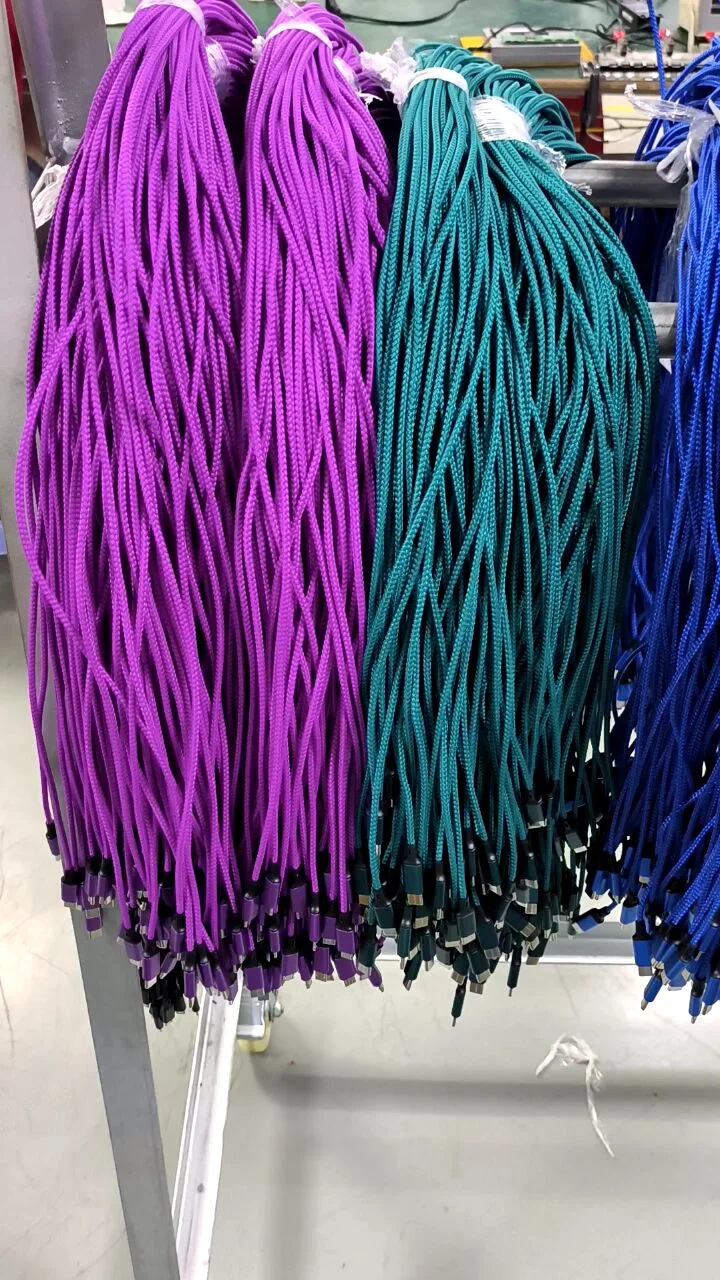
It sounds simple, but the details are what make or break your business. A cheap cable that fails can cost you a customer for life. A quality cable builds trust and brings repeat business. Let's break down what you really need to know to find the right partner and grow your sales.
Why do buyers really search for USB cable manufacturers in China?
You are getting complaints about slow charging or broken cables. These small issues can do big damage to your brand's reputation and your bottom line.
Buyers search for a "USB cable manufacturer in China" because their current cables sell poorly or cause too many problems.1 They are not looking for just a name; they need a reliable supplier for stable quality, clear specs, and consistent supply to protect their reputation.
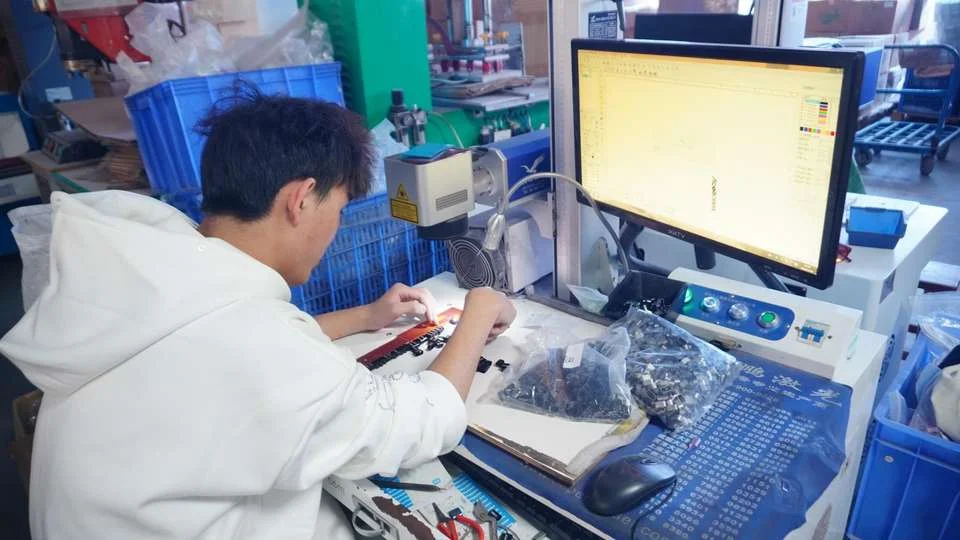
When overseas buyers look for a Chinese USB cable manufacturer, they're usually trying to solve a problem. The cables they have are not selling well, or they're causing too many headaches after the sale.
The Real Problems You Face
Customers complain about slow charging, cables breaking easily, loose connectors, or cheap-looking packaging. Some Type-C cables are marked "fast charging" but perform like standard ones. For wholesalers and brand owners, these are not just product issues; they are reputation issues. A USB cable seems like a simple item, but it's a classic "low price, high repeat purchase, high complaint risk" product.2 If you sell a good one, it can be a steady source of income. If you sell a bad one, a single batch can destroy customer trust. So, buyers are not looking for the cheapest cable. They are looking for a Chinese manufacturer who can provide a stable supply, clear specs, controlled quality, good packaging, and on-time delivery.
Smart Questions to Ask
Many new buyers start by asking, "How much for a 1-meter Type-C cable?" But experienced buyers know to ask the right questions:
- What charging current does it support? Is it 3A, 5A, or 100W PD?
- What is the wire gauge?
- Is the connector reinforced?
- Can it pass a pull test?
- Can you do private label packaging?
- Can you keep the same quality in repeat orders?
These are the questions that truly matter in the wholesale business.
What key product spec differences should you understand first?
All USB cables might look the same on the outside. But hidden differences in specs can ruin your product's performance, reputation, and your customers' trust.
The key differences are connector type (USB-A, USB-C, Lightning), charging power (3A, 100W PD), internal wire core and copper quality, and the outer material (PVC, TPE, Nylon). These specs determine the cable's performance, durability, and cost, so you must compare them before comparing prices.
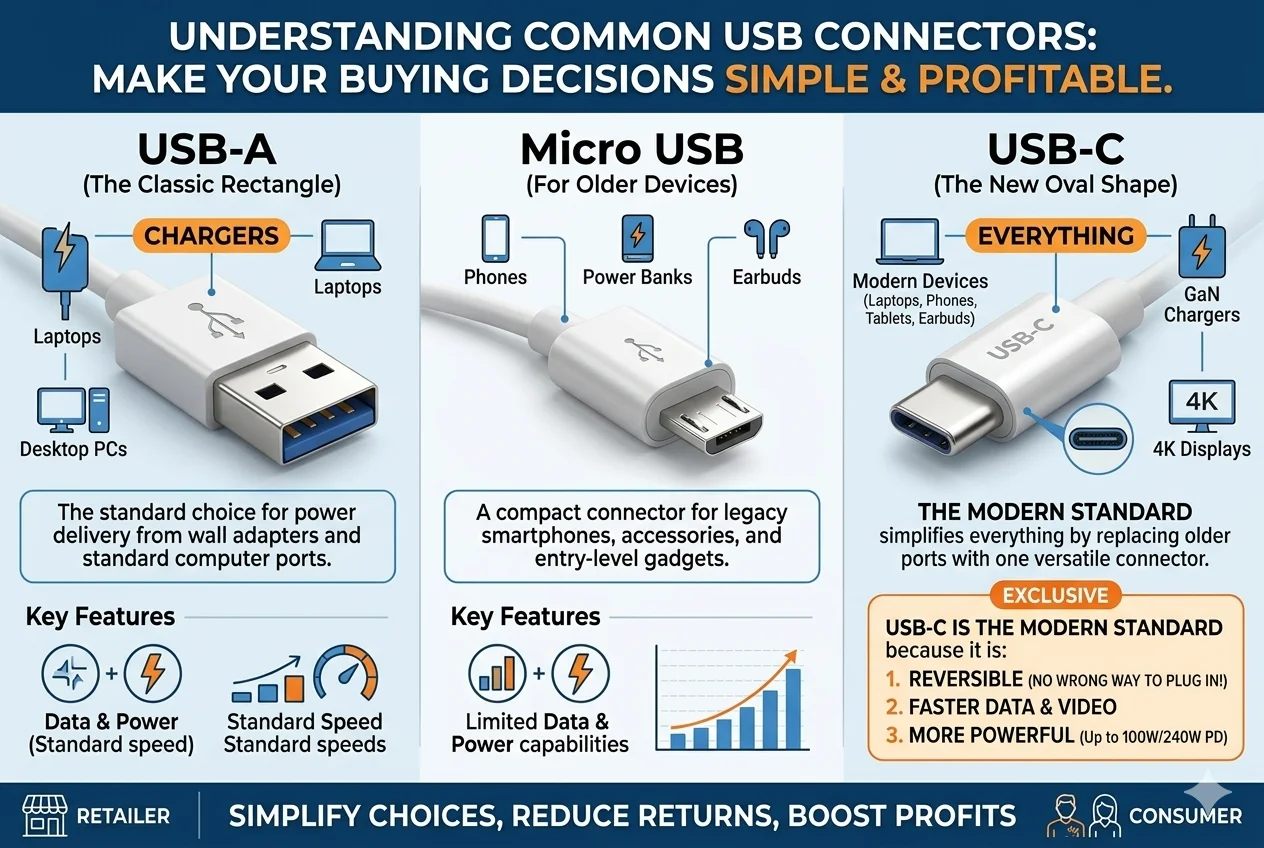
The biggest trap with USB cables is that they look similar on the outside but are completely different on the inside. A cable might be Type-C to Type-C, one meter long, and have a braided exterior, but its cost and performance can vary widely.3 The first thing to understand isn't the color or packaging, but a few core specifications.
Key Specifications to Check
- Connector Type: The most common types are USB-A to Type-C, USB-C to USB-C, USB-A to Lightning, and USB-C to Lightning. In Europe and the US, demand for USB-C to USB-C is rising as new phones, laptops, and chargers adopt the standard.4
- Charging Power: This is a major point of confusion. Some suppliers just write "fast charging" on the package without giving a specific power rating. You need to know the exact specs: 3A, 5A, 60W, 100W, or even 240W PD. A cable's internal chip, wire core, and materials all change based on the power it needs to handle.
- Wire Core and Copper: This is one of the biggest differences between cheap and quality cables. Low-cost cables often use thin wires or even copper-clad aluminum, which leads to slow charging, overheating, and a short lifespan.5 A good cable depends on its wire gauge, copper quality, and reinforced connectors.
- Outer Material: The material affects the feel, durability, and perceived value of the cable.
| Material | Characteristics | Best For |
|---|---|---|
| PVC | Inexpensive, standard feel, average durability. | Budget-friendly options |
| TPE | Flexible, soft, moderate cost. | Mid-range retail products |
| Nylon Braided | Durable, premium look, tangle-resistant. | Retail and premium brands |
| Silicone | Very soft, flexible, tangle-free, high-end feel. | High-end accessory lines |
A USB cable is not a simple "how much per meter" product. You must compare these specifications before you can truly compare prices.
How do specs affect compatibility, quality, and sell-through?
Choosing a cable with the wrong specs might seem like a small mistake. But it can lead directly to customer returns, bad reviews, and dead stock on your shelves.
Specifications directly impact your business.6 Compatibility determines if the cable works with the customer's devices. Quality affects customer complaints and returns. Sell-through depends on perceived value and features, which are all tied to specs. A better cable often sells faster, even if it costs a bit more.
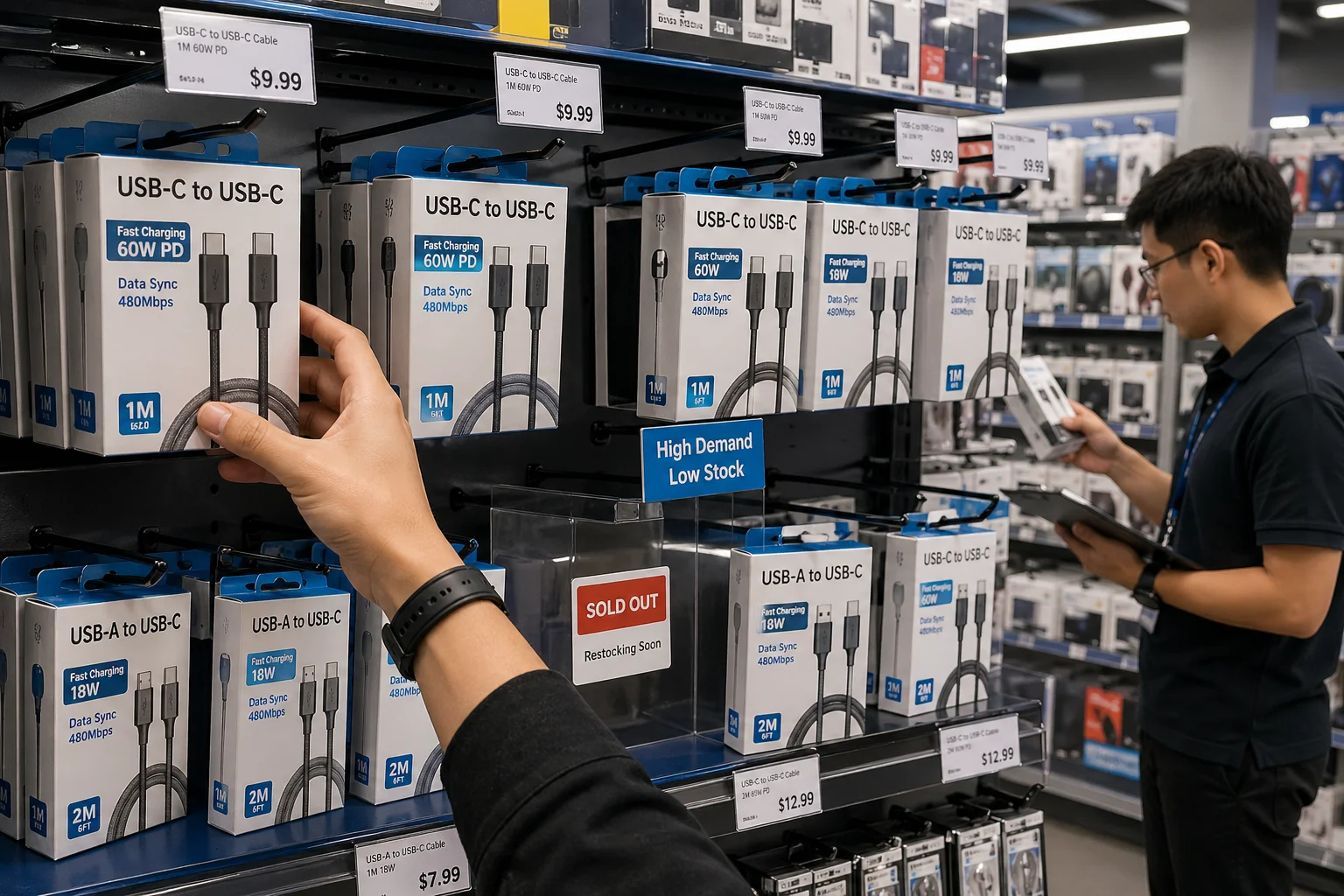
How well a USB cable sells isn't just about price; it's about whether it solves a real customer need. If a product is labeled 100W but can only deliver 30W, a customer who bought it for their laptop will return it.7 If the connector gets loose after a few uses, they won't buy from you again. If the cable feels stiff and the packaging looks cheap, it won't sell well in a retail store.
How Specs Impact Your Business
- Compatibility Affects Usability: This determines if the cable can even be used. For example, some USB-C to USB-C cables only support charging, not data transfer. Others support data, but at slow speeds. Some work for phones but not for high-powered laptops. If you don't clarify the use case with your supplier, you will run into problems later.
- Quality Affects Your Reputation: USB cables are not high-margin products, so a high complaint rate is a disaster. If 5% of a 1,000-piece order is defective, that's a serious issue. The cost of handling returns, negative reviews, and customer service will eat away your profits.
- Sell-Through Affects Your Cash Flow: Many buyers think cheaper is better, but that’s not always true. A generic, poorly packaged cable might sit on the shelf, even at a low price.8 In contrast, a cable with clear packaging, strong features, nice colors, and fast charging support might sell much faster, even at a higher price. In wholesale, cash flow is king. A cable that is 10% cheaper but sells slowly and gets complaints is not profitable. A cable that costs a little more but sells quickly with few issues is the product you want.
What should wholesale buyers check before ordering?
You found a supplier and you're ready to place an order. Be careful. A mistake at this stage can be very costly. Just follow this simple checklist to protect your investment.
Before placing an order, always test samples for performance and durability. Confirm all specifications in writing. Assess the factory's ability to maintain quality on repeat orders. Check their packaging capabilities. Finally, review their payment terms and lead times to make sure they are reasonable.
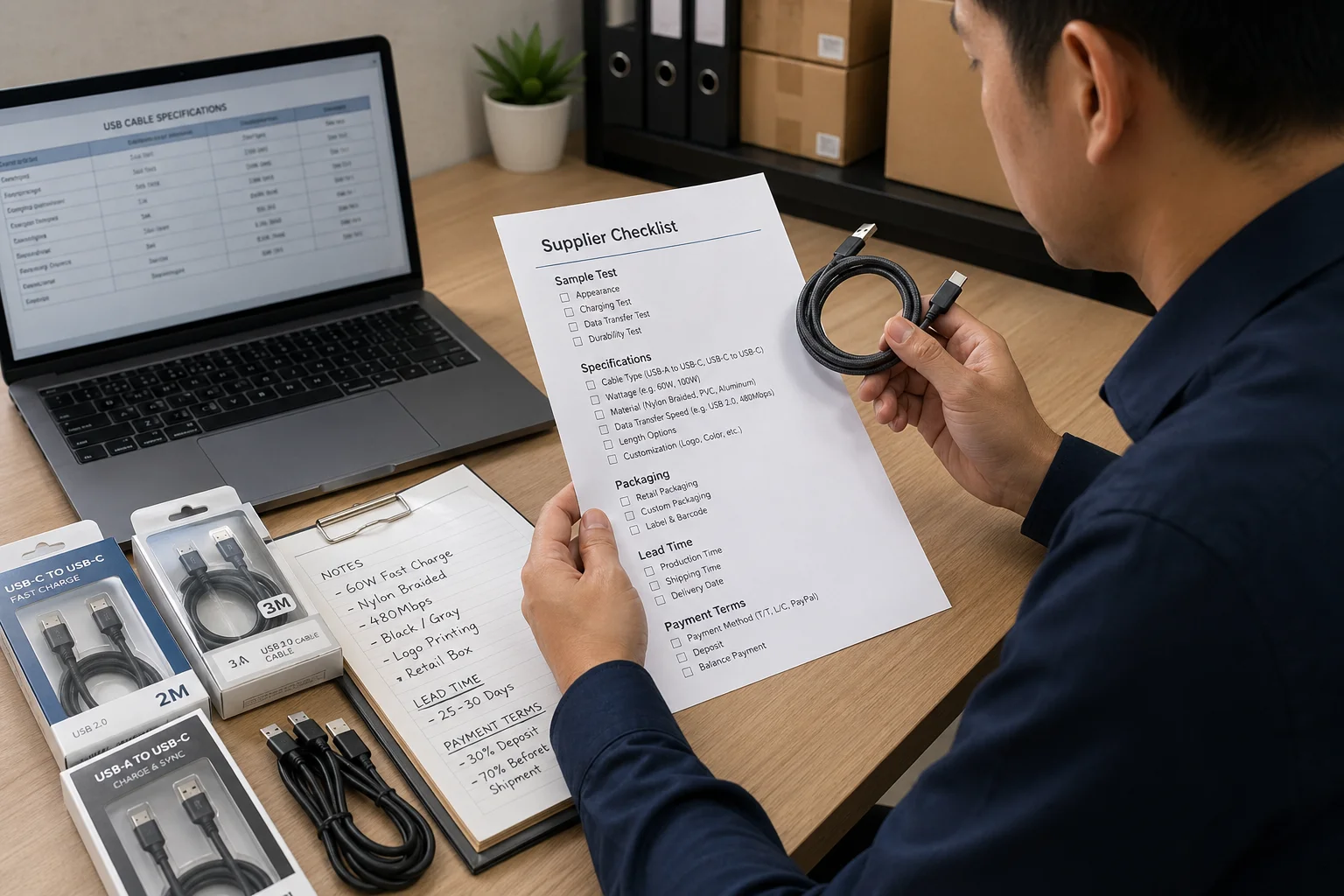
As a wholesale buyer, there are a few things you must check before placing an order. This will save you a lot of trouble down the road.
Your Pre-Order Checklist
- Always Test Samples: You can't judge a cable by its photo. Pictures can be deceiving, but performance must be tested. I recommend you test for actual charging power (wattage), PD support, data transfer speed, connector tightness, bend durability, and compatibility across several devices.
- Confirm Specifications in Writing: Don't accept vague terms like "good quality" or "fast charging." Get everything in writing from your supplier. This includes the cable type, length, material, current, wattage, data speed, wire gauge, and packaging details. The more specific you are, the fewer disputes you'll have later.
- Check for Repeat Order Consistency: Many smaller factories or trading companies can make a good first sample, but the quality drops in mass production.9 This is a very common problem. Ask your supplier: Can you guarantee the same materials for repeat orders? Can you provide pre-production samples for approval? How do you handle defective goods?
- Evaluate Packaging Capabilities: If you sell in retail stores, packaging is critical. You're not just selling a cable; you're selling trust. The packaging should clearly state the specifications: "60W PD Fast Charging," "USB-C to USB-C," "Nylon Braided," "Data Sync." When a customer can understand the benefits at a glance, they are more likely to buy.
- Review Terms and Lead Times: Be wary of any supplier who promises prices that are too low or delivery times that are too fast. A reliable factory needs time for material preparation, production, testing, and packaging. Custom orders with private label packaging or special colors will always require extra time for sampling and confirmation.10
When should you choose OEM, standard stock, or private label?
You know what to check, but which sourcing method is right for your business? Choosing the wrong one can mean wasted money, dead inventory, or missed opportunities.
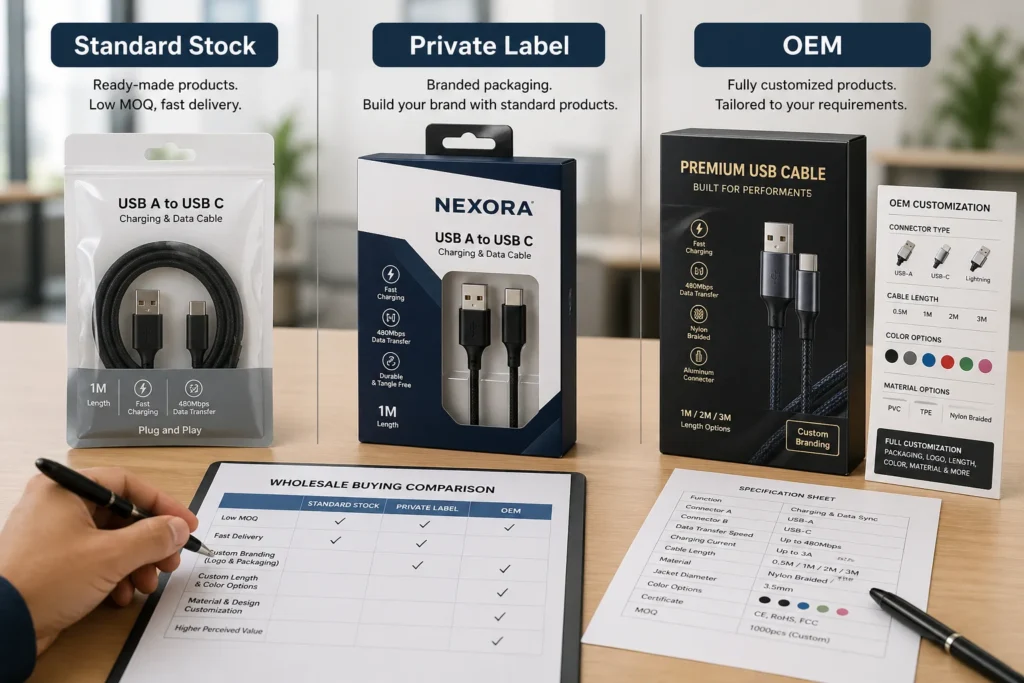
Choose standard stock to test the market with low risk and a low minimum order quantity (MOQ). Use private label when you have steady sales and want to build your brand. Opt for OEM for full customization when you have high volume and specific product requirements.
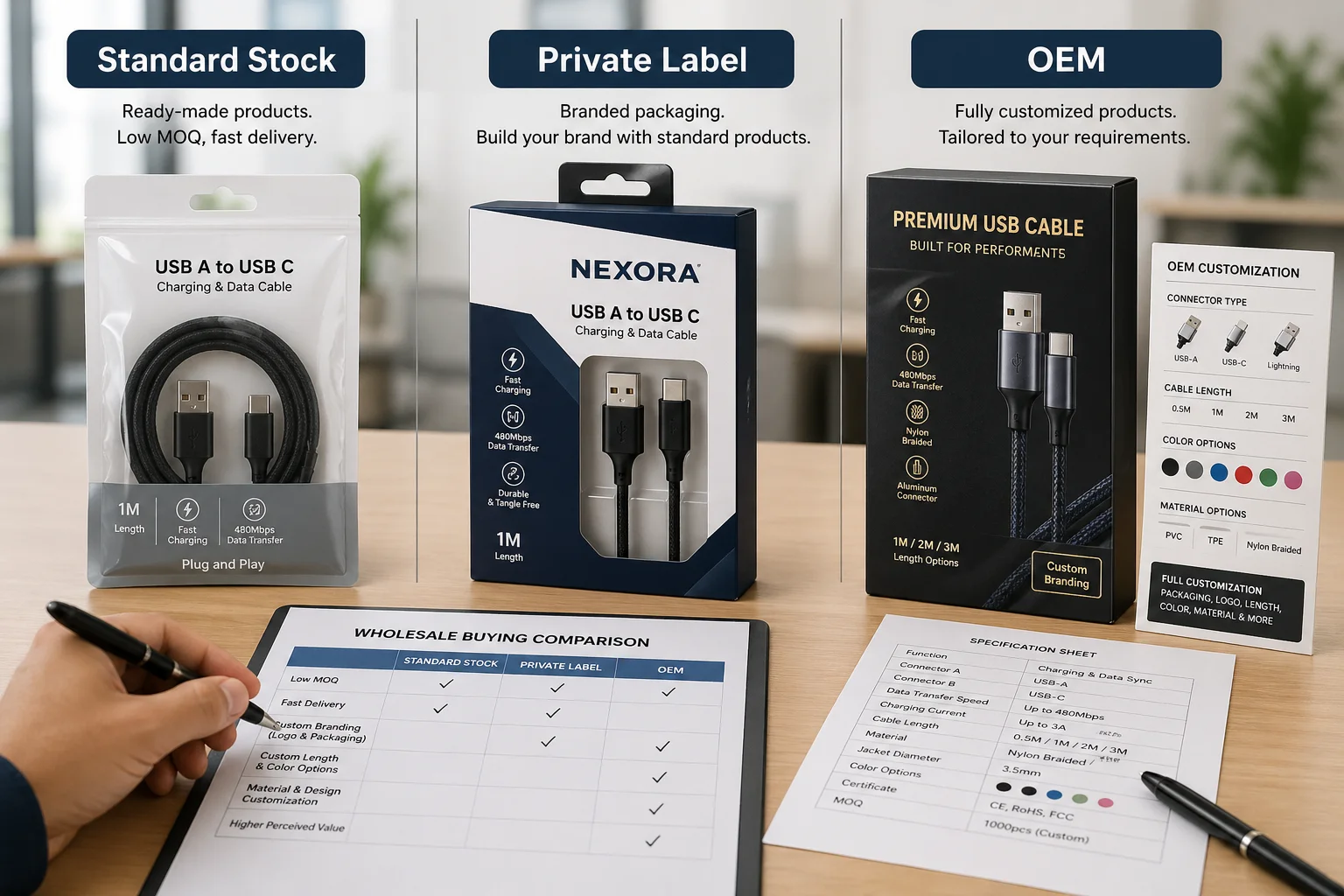
There are three common ways to buy USB cables: standard stock, private label, and OEM. The right choice depends on your business.
Standard Stock
If you are just starting or are unsure about market demand, standard stock is your best option.
- Pros: Low MOQ, fast shipping, low risk, and great for testing the market without investing in design or molds.
- How to start: You can begin by ordering a few popular models, like a 1m USB-A to Type-C, a 60W USB-C to USB-C, and a USB-C to Lightning cable. See what your customers prefer before committing to a larger order or customization.
Private Label
If you already have a stable customer base and want to build your brand, private label is the next step.
- Pros: This is perfect for wholesalers, chain store suppliers, and Amazon sellers who want to increase brand recognition and repeat purchases.
- How to start: Private labeling doesn't have to mean redesigning the whole product. Often, you can just customize the packaging, add your logo, print a barcode, or choose a custom color combination. This approach has a bigger impact than standard stock but requires less investment than full OEM. For many small and medium-sized buyers, this is the most practical step.
OEM (Original Equipment Manufacturer)
OEM is for experienced buyers with clear product ideas, stable sales, and a larger budget.
- Pros: OEM allows for complete differentiation.11 You can customize special lengths, unique colors, specific materials, thicker wires, or custom connector housings.
- Cons: The downside is a higher MOQ, a longer sampling process, and more complex communication. It is not recommended for buyers who have not yet proven their market.
My advice is simple: Start with standard stock to test the market, grow your brand with private label, and finally, scale your business with OEM to stand out. This is the safest and most effective path to success.
Conclusion
I have been in foreign trade for many years, and my biggest takeaway is this: the simpler a product looks, the more you need to look beyond its price. A cheap cable that causes daily complaints is worthless. A quality cable that satisfies customers and brings them back is the foundation of a real business.12
"The Evolution of USB Cable Manufacturing in China's Tech Industry", https://www.xm-evershine.com/news/the-evolution-of-usb-cable-manufacturing-in-chinas-tech-industry. This source explains common reasons why buyers seek USB cable manufacturers in China, including issues with product quality and performance. Evidence role: general_support; source type: education. Supports: Buyers search for USB cable manufacturers in China due to dissatisfaction with current suppliers.. ↩
"Using Caution with USB Drives | CISA", https://www.cisa.gov/news-events/news/using-caution-usb-drives. This source discusses the market dynamics of USB cables, including their pricing and risk factors. Evidence role: expert_consensus; source type: education. Supports: USB cables are characterized by low price, high repeat purchase rates, and high complaint risks.. ↩
"USB: Port Types and Speeds Compared - Tripp Lite - Eaton", https://tripplite.eaton.com/products/usb-connectivity-types-standards. This source highlights how internal differences in USB cables affect cost and performance despite similar external appearances. Evidence role: mechanism; source type: research. Supports: Internal differences in USB cables can lead to significant variations in cost and performance.. ↩
"USB-C - Wikipedia", https://en.wikipedia.org/wiki/USB-C. This source provides data on the increasing adoption of USB-C standards in Europe and the US. Evidence role: statistic; source type: institution. Supports: Demand for USB-C to USB-C cables is increasing in Europe and the US due to adoption of the standard by new devices.. Scope note: The data may focus on specific regions or industries, not global trends. ↩
"USB hardware - Wikipedia", https://en.wikipedia.org/wiki/USB_hardware. This source discusses the impact of using copper-clad aluminum in USB cables, including performance and durability issues. Evidence role: mechanism; source type: research. Supports: Low-cost cables often use inferior materials like copper-clad aluminum, leading to performance issues.. ↩
"The Role of Product Specs in Quality and Customer Satisfaction", https://helio.app/product-discovery/product-jargon/product-specs/. This source explains how product specifications influence compatibility, quality, and customer satisfaction in the electronics industry. Evidence role: expert_consensus; source type: education. Supports: Product specifications have a direct impact on business outcomes like compatibility and customer satisfaction.. ↩
"Returns, Refunds, and Other Resolutions - FTC Consumer Advice", https://consumer.ftc.gov/node/77484. This source explains the consequences of mislabeled USB cable specifications on customer satisfaction and returns. Evidence role: case_reference; source type: education. Supports: Mislabeled USB cable specifications can lead to customer dissatisfaction and product returns.. Scope note: The example may not represent all mislabeled products or customer reactions. ↩
"How Outdated Packaging Hurts Retail Sales and Shelf ...", https://www.sutherlandpackaging.com/how-outdated-packaging-hurts-retail-sales-and-shelf-impact/. This source explains how packaging quality influences retail sales performance. Evidence role: mechanism; source type: research. Supports: Poor packaging quality can negatively affect retail sales performance, even for low-priced products.. Scope note: The impact of packaging may vary by market segment or product type. ↩
"Quality Control Challenges in Manufacturing - ECQA", https://ecqa.com/quality-control-challenges/. This source discusses quality control challenges in mass production by smaller factories or trading companies. Evidence role: expert_consensus; source type: education. Supports: Smaller factories or trading companies often face quality control issues in mass production.. Scope note: The issue may not apply to all smaller factories or trading companies. ↩
"On Time Delivery in your Industry : r/manufacturing - Reddit", https://www.reddit.com/r/manufacturing/comments/1odhajq/on_time_delivery_in_your_industry/. This source explains the additional time required for custom orders in manufacturing, including sampling and confirmation processes. Evidence role: mechanism; source type: education. Supports: Custom orders in manufacturing require extra time for sampling and confirmation processes.. Scope note: The time required may vary depending on the complexity of the customization. ↩
"Original equipment manufacturer - Wikipedia", https://en.wikipedia.org/wiki/Original_equipment_manufacturer. This source explains how OEM manufacturing enables product differentiation through customization. Evidence role: definition; source type: encyclopedia. Supports: OEM manufacturing allows for complete product differentiation through customization.. ↩
"The Power of Surveys to Increase Repeat Business", https://kellercenter.hankamer.baylor.edu/news/story/2018/power-surveys-increase-repeat-business. This source discusses the importance of product quality in building customer loyalty and repeat business. Evidence role: expert_consensus; source type: education. Supports: Product quality is essential for customer satisfaction and repeat business.. ↩