When I help buyers compare an Order Online USB Cable Factory, I often see the same problem: the lowest quotation looks attractive, but the cable may not match the device, power requirement, data protocol, packaging plan, or delivery schedule. That uncertainty can lead to returns, delayed launches, and unhappy retail customers. A structured supplier review reduces that risk.
Quick Answer
- Confirm the cable’s connector type, power requirement, data protocol, length, construction, and intended device before comparing prices.
- Ask each USB cable factory for clear specifications, samples, MOQ, customization conditions, lead time, and after-sales terms.
- Treat certifications, factory photographs, and online listings as supporting information, not proof of product suitability.
- Compare the total procurement cost, including packaging, sampling, shipping, accessories, testing, and possible replacement risk.
- Start with samples or a controlled trial order before making a large commitment.
The best way to order from a USB cable factory online is to treat the process as supplier validation rather than an instant purchase. I recommend confirming the technical specification, reviewing samples, checking communication and delivery capability, and agreeing on quality and customization terms before placing a bulk order. The lowest unit price is only useful when the cable performs consistently and arrives when your business needs it.
Many European and American buyers contact me with a simple request such as “USB-C cable, good quality, competitive price.” I understand the reason for keeping an inquiry short, especially when a buyer is comparing many suppliers. However, the supplier cannot quote responsibly without more information. I will explain the questions I use when reviewing these inquiries and show how buyers can make online sourcing more practical.
How Do I Evaluate a USB Cable Factory Online?
An online supplier page can help me create a shortlist, but it cannot confirm the full commercial or technical fit. I evaluate the supplier’s answers, product information, sample process, customization limits, and ability to communicate clearly. I also check whether the supplier understands my intended market and sales channel.
A USB cable factory should provide more than attractive product images. I look for a structured reply that covers specifications, MOQ, sample arrangements, packaging, production timing, shipping terms, and quality handling. I treat certifications as documents to verify rather than automatic evidence that every listed cable is suitable.
Start with the supplier’s communication
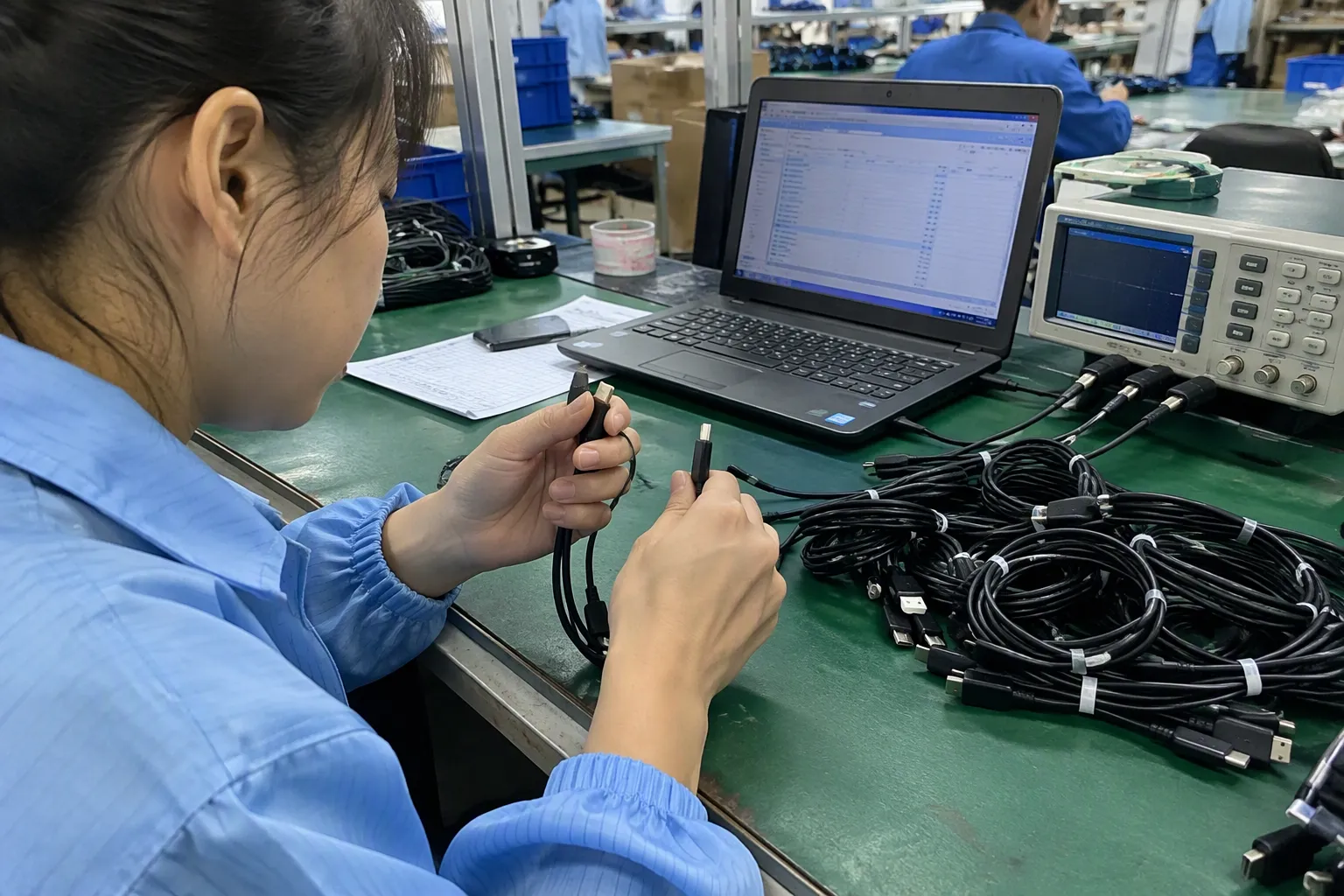
- Which connector combinations are available.
- Whether the cable is intended for charging, data transfer, or both.
- Supported power and data requirements, subject to the exact model.
- Available lengths, colors, materials, and finishes.
- MOQ for standard and customized products.
- Sample cost and sample lead time.
- Estimated bulk lead time after approval.
- Packaging options and carton information.
- Quality inspection and replacement procedures.
A supplier that answers every inquiry with only a price may still offer a suitable product, but I need more evidence before recommending a purchase. In my experience with European and American inquiries, misunderstandings often begin because a buyer assumes that “USB-C cable” describes one universal product. It does not describe the complete performance or construction.[2]
Review online information with care
I examine product pages for consistency. I compare the stated length, connector, current, wattage, data speed, material, and packaging information. If different pages use conflicting terminology, I ask the supplier to clarify which specification applies to the exact model.
I also look for a clear business identity, export contact, company address, and practical order process. A professional presentation is useful, but website quality alone does not prove manufacturing capability, stock availability, or stable quality.
Buyers can use the USB Implementers Forum USB Type-C information to understand official terminology and ecosystem information. I still ask the supplier to confirm the specification of the actual cable because general USB information does not validate a particular listing.
Ask for documents that match the product
If a supplier mentions RoHS, REACH, CE, or other compliance information, I ask what the document covers, who issued it, its date, and whether it applies to the actual cable and materials. Buyers should verify documents independently when the market or product category requires it. The European Commission provides information about RoHS requirements, but a general regulatory page is not a product certificate.
What USB Cable Specifications Should I Confirm Before Ordering?
I confirm the application before I compare cable prices. A USB cable is an application-specific product, not simply a connector and a length. The device, charging power, protocol, transmission requirement, construction, and use environment can change the suitable model and its cost.
For an accurate quotation, I normally ask the buyer to describe the end device and expected use. I then separate confirmed requirements from assumptions. This process prevents a common mistake: choosing a visually similar cable that does not provide the expected charging or data performance.
The main specification questions
| Requirement | Question for the buyer |
|---|---|
| Device | Which phone, tablet, laptop, power bank, accessory, or other device will use the cable? |
| Connectors | Is it USB-A to USB-C, USB-C to USB-C, Lightning-compatible, Micro-USB, or another combination? |
| Charging | What charger and device power level must the cable support? |
| Data | Does the cable need data transfer, and what performance does the application require? |
| Length | What length is needed for the retail product or end use? |
| Construction | Is the priority flexibility, durability, compact storage, premium appearance, or cost? |
| Environment | Will the cable be used at home, in vehicles, stores, offices, travel, or industrial settings? |
| Packaging | Does the buyer need a polybag, paper box, hang tag, retail carton, or private-label packaging? |
| Market | Which country or sales channel will receive the product? |
Charging power is not only about the connector
A USB-C connector does not automatically mean that every cable supports the same charging capability.[1] The buyer should confirm the cable’s intended power specification with the supplier and check whether the charger and device are also compatible.
I avoid making broad statements such as “this cable supports fast charging” without a defined basis. The buyer should ask for the relevant rated current or power information, the testing basis, and any conditions that affect performance. A professional evaluator may be needed for application-specific power decisions.
Data performance needs separate confirmation
I ask whether the cable is charging-only or a charging-and-data model. I also ask the supplier to state the claimed data capability in clear terms rather than using vague language such as “high speed.” The buyer should match that claim to the intended host device and application.[3]
Physical details affect the commercial result
Length, jacket material, connector housing, strain relief, braid, color, and logo treatment all affect the product position. A retailer selling entry-level accessories may prefer a cost-controlled PVC cable. A premium e-commerce seller may request braided material, reinforced joints, or custom packaging.
I also ask whether the requested design is a standard model or a new customization. Standard products usually provide a simpler route to samples and replenishment. Custom molds, special colors, printed logos, and packaging changes may require additional MOQ, tooling, approval time, or production planning.
How Can I Order Online from a USB Cable Factory?
I use a staged ordering process instead of moving directly from a website inquiry to a large purchase. The process normally includes a written specification, supplier comparison, sample review, quotation confirmation, purchase terms, and controlled production follow-up.
An online order becomes safer when both sides use the same written information. I recommend keeping the product code, approved sample, packaging artwork, agreed specifications, quantity, delivery terms, and quality handling conditions in one documented order file.
A practical online ordering sequence
1. Prepare a clear inquiry
- Product type and connector combination.
- Required length and color.
- Charging and data expectations.
- Target market and sales channel.
- Estimated trial quantity and future order potential.
- Packaging requirement.
- Logo or private-label needs.
- Target delivery window.
- Destination country or port.
2. Compare at least several commercial offers
| Quote item | Why it matters |
|---|---|
| Unit price | Useful only when the product specification is the same |
| MOQ | Affects inventory exposure and cash flow |
| Sample fee | May indicate development or courier cost |
| Packaging | Can materially change the landed cost |
| Logo or mold fee | Relevant for private-label projects |
| Lead time | Affects launch and replenishment planning |
| Payment terms | Changes financial and purchasing risk |
| Shipping basis | EXW, FOB, CIF, or another term changes comparison |
| Replacement policy | Helps define after-sales risk |
3. Request and review samples
I prefer to review a physical sample before approving a bulk order. I check the connector fit, cable length, appearance, flexibility, strain relief, marking, packaging, and general workmanship. I also compare the sample against the written quotation.
I do not treat one sample as proof of every future production batch.[6] The sample is a screening tool. For an important retail program, the buyer may need a more formal inspection or testing plan from a qualified professional.
4. Confirm the final order file
- Exact model and product code.
- Quantity and acceptable split shipment terms.
- Approved artwork and packaging.
- Required accessories.
- Agreed lead time and shipping terms.
- Inspection expectations.
- Handling of defects or shortages.
- Contact person for production and shipping updates.
Do not confuse “online” with “unverified”
Online sourcing can be efficient because it allows me to compare product ranges, communicate quickly, and request quotations from different regions. However, online convenience does not remove the need for due diligence.
I use online communication to identify suitable suppliers. I use samples, documents, written terms, and order follow-up to validate them. That distinction is especially important for buyers who sell through chain stores, marketplaces, wholesale networks, or multiple retail locations.
How Should I Compare USB Cable Factory Prices?
I compare the total procurement cost rather than selecting the lowest unit price. The total cost includes the cable, packaging, sampling, customization, shipping, inspection, inventory, and possible after-sales handling.[4] A lower quotation can become more expensive if it causes delays, inconsistent quality, or product returns.[5]
A fair price comparison requires identical or closely matched specifications. I also separate standard products from customized products because their MOQ, tooling, approval, and replenishment conditions can differ significantly.
Use a landed-cost view
For example, two suppliers may quote the same cable at different prices. One may include a retail box while the other quotes a plain bag. One may offer a lower MOQ but a higher packaging charge. Another may provide a longer lead time that creates air freight pressure. The visible unit price does not show the whole decision.
Compare commercial flexibility
- Standard MOQ and customized MOQ.
- Sample availability.
- Reorder quantity.
- Price breaks at different volumes.
- Packaging flexibility.
- Color and logo options.
- Production lead time.
- Response time for quality issues.
- Ability to support future replenishment.
A buyer may not need the lowest possible MOQ if the product is expected to sell steadily. Another buyer may need a smaller initial order to test a new listing. I match the supplier model to the buyer’s inventory strategy rather than assuming one MOQ is best for everyone.
Be careful with “8k+” claims
The phrase “8k+” in a product title can mean different things depending on the listing. It may refer to a search category, a product count, a marketing phrase, or an advertised cable performance claim. I ask the supplier to explain exactly what the number means.
Price should support a stable retail proposition
A buyer who sells through e-commerce may need consistent photography, packaging, stock availability, and replacement support. A wholesaler may prioritize carton efficiency and repeat supply. A chain store may require documentation and packaging compliance. Each channel has a different cost structure.
The supplier can then recommend a more realistic product route. I do not promise that a buyer can receive maximum customization, minimum MOQ, lowest pricing, and fastest delivery at the same time. Those conditions often compete with one another.
How Do MOQ, Customization, and Lead Time Affect an Online Order?
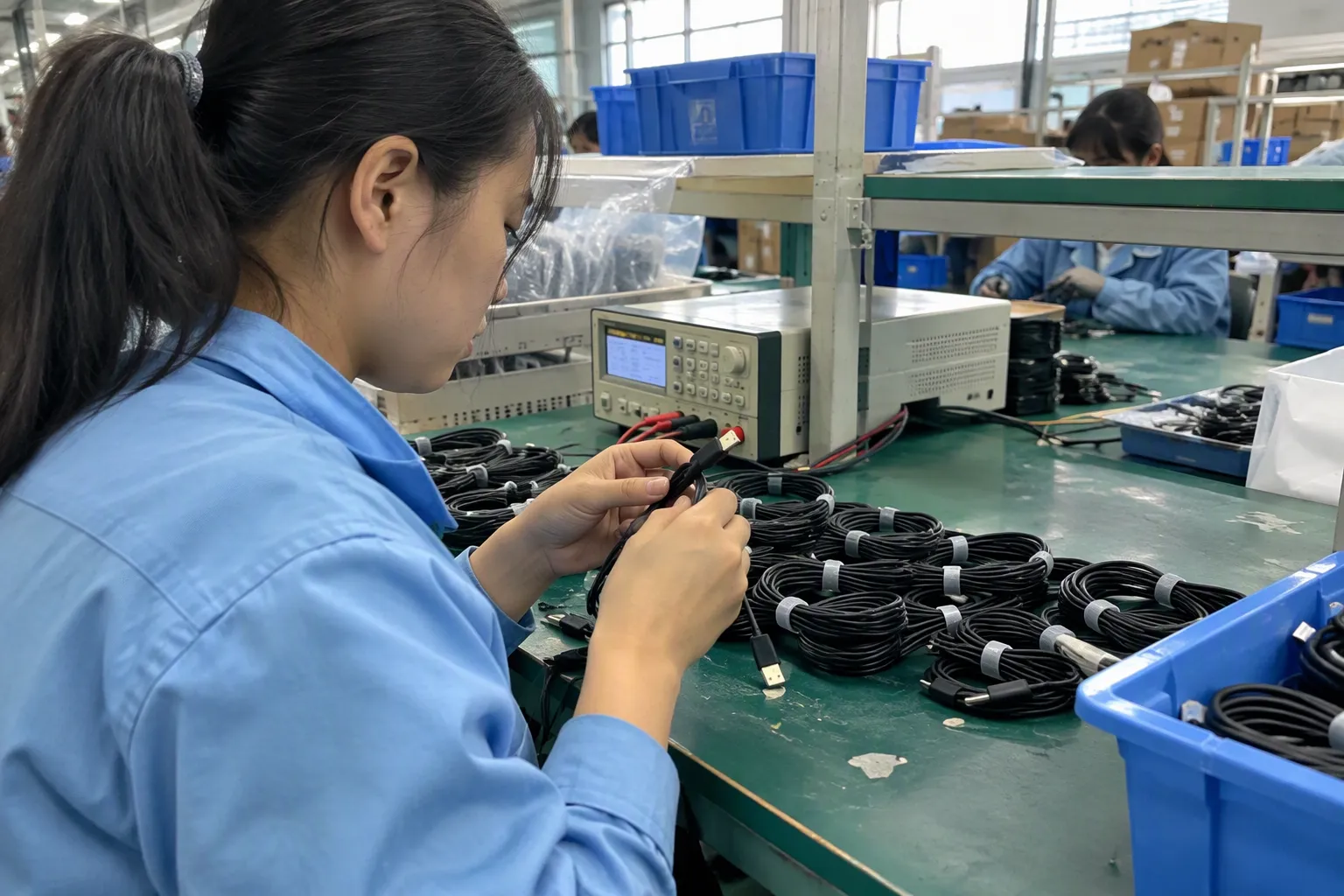
MOQ, customization, and lead time are connected. A standard cable may be easier to sample and replenish, while private-label packaging or special construction may require more planning. I review these conditions before approving the design because they directly affect cash flow, launch timing, and inventory risk.
A supplier should explain what is standard, what is adjustable, and what requires a separate development process. I consider unclear answers a reason to ask more questions, not a reason to assume everything is possible.
Standard products and customized products
| Project type | Typical advantage | Main point to confirm |
|---|---|---|
| Standard cable, standard packaging | Faster quotation and simpler sampling | Available colors, stock, and replenishment |
| Standard cable, custom logo | More brand visibility | Logo method, MOQ, artwork, and approval |
| Standard cable, custom retail box | Better shelf presentation | Packaging MOQ, dieline, printing, and lead time |
| Modified construction | More product differentiation | Technical feasibility, sample process, and cost |
| New mold or special connector housing | Stronger private-label identity | Tooling ownership, development time, and MOQ |
I ask who owns the artwork, mold, and packaging files. I also ask what happens if the buyer changes the quantity after artwork approval. These details may seem administrative, but they can delay an order when they are left unclear.
Lead time needs a starting point
A supplier’s lead time should identify when the clock starts. Does production begin after deposit, after artwork approval, after sample approval, or after all materials are available? I ask this question because “15 days” can mean different things in different quotations.
Replenishment deserves early discussion
A first order may be small, but the second order often reveals the real supplier capability. I ask whether the same model, color, packaging, and construction can be replenished. I also ask whether the supplier expects the buyer to repeat the same MOQ.
When I handle inquiries from retailers and online sellers, I encourage them to discuss the possible reorder plan even if the first quantity is limited. A product that sells well creates a new requirement for reliable supply. Early discussion can reveal whether the supplier is a practical long-term option.
What Quality Checks Should I Use Before a Bulk USB Cable Order?
I use samples and written specifications to screen quality before a bulk order. I review both the physical product and the supplier’s process for handling deviations. For higher-risk programs, I recommend a qualified inspection or testing service because visual review alone cannot verify every electrical or compliance requirement.[7]
What I can check during a basic sample review
- Connector fit with the intended device.
- Cable length against the quotation.
- Housing appearance and assembly.
- Strain relief and visible joint quality.
- Jacket surface, flexibility, and finish.
- Markings and logo position.
- Packaging dimensions and printed information.
- Accessories included in the package.
- General consistency between samples.
What may require professional testing
- Electrical performance.
- Charging behavior under defined conditions.
- Data transfer performance.
- Material or chemical compliance.
- Mechanical durability.
- Safety-related requirements.
- Electromagnetic or device-specific concerns.
I make this distinction clear because I am involved in sourcing communication, quotations, and order coordination, not independent laboratory certification. Buyers should obtain application-specific advice from qualified professionals and ask for test reports that match the actual product.
Create an approval standard
- Product photographs from several angles.
- The exact sample or reference unit.
- Confirmed dimensions and length.
- Agreed connector and cable construction.
- Packaging artwork.
- Required markings.
- Inspection points.
- Defect-handling terms.
The buyer should also define what happens if the bulk goods differ from the approved sample. Possible remedies depend on the contract and commercial agreement, but the issue should be discussed before production rather than after a shipment arrives.
Certifications need verification
Certifications and declarations can support procurement, but buyers should verify their scope, issuer, date, product model, and market relevance.[8] A document for one model may not apply to another model with different materials or construction.
I also avoid saying that “certified” automatically means “suitable for every market.” Regulatory responsibilities can depend on the product, importer, destination, labeling, packaging, and sales channel. The buyer should review current requirements with an appropriate compliance specialist. The European Commission’s product safety information can provide useful background for businesses selling in the EU.
How Do I Select a Supplier for Long-Term USB Cable Replenishment?
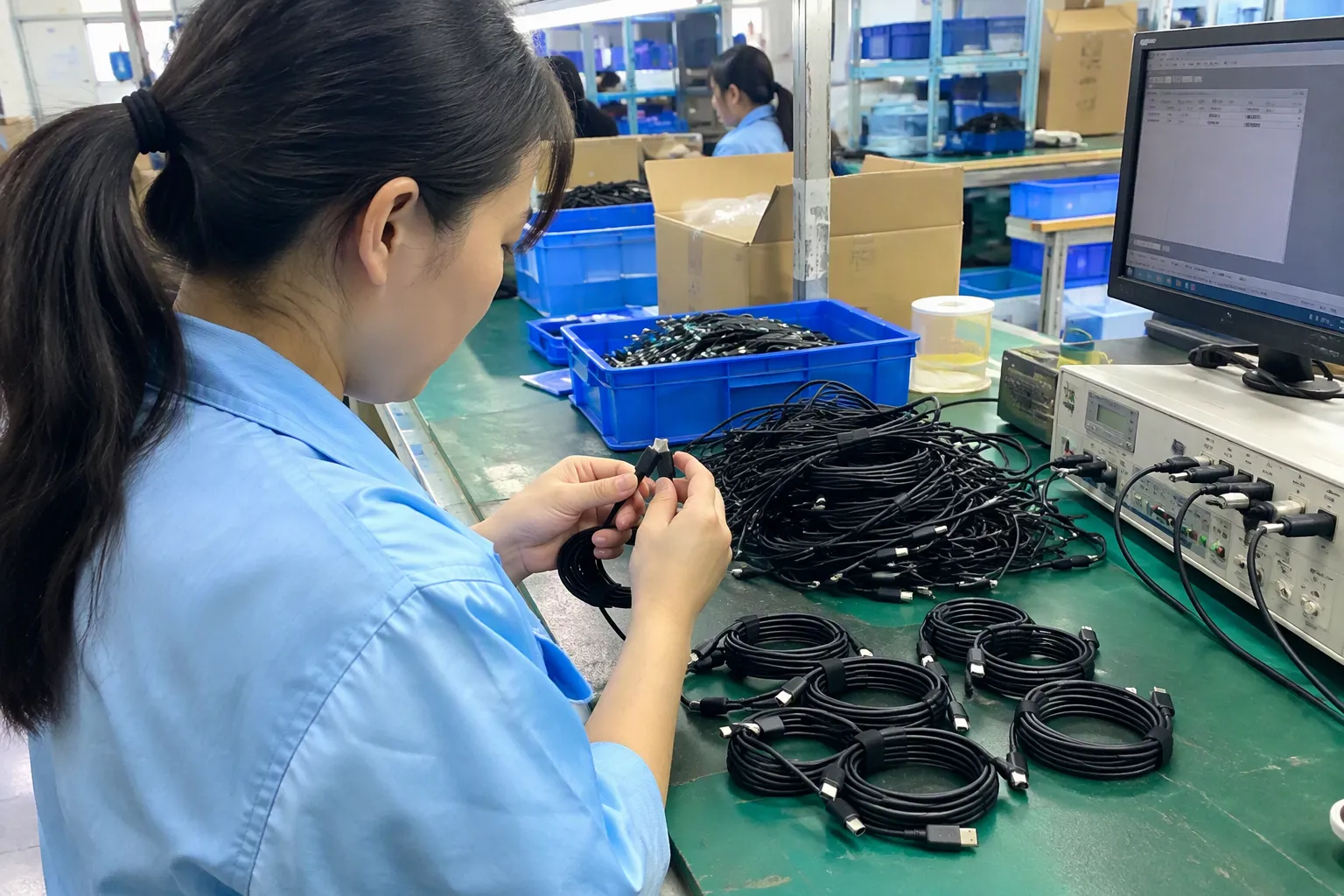
I select a long-term supplier by reviewing consistency, communication, delivery planning, commercial transparency, and problem-solving. A supplier that is suitable for one sample order may not be suitable for repeated retail replenishment. I want evidence that the supplier can maintain the agreed product and communicate changes early.
I also consider whether the supplier’s business model fits the buyer’s needs. I do not assume that a factory is automatically cheaper or more reliable than a trading company. I compare the actual service, product control, communication, and order support.
Questions I ask before an ongoing program
- Who will manage the account after the first order?
- Which person confirms technical questions?
- How are model changes communicated?
- How are shortages or defects handled?
- Can the supplier support repeat packaging?
- What is the normal reorder process?
- How far in advance should I place replenishment orders?
- Which shipping documents can the supplier provide?
- What happens during peak production periods?
- Can the supplier support a reasonable forecast without treating it as a firm order?
Look for evidence of process, not only promises
I compare the supplier’s first quotation with later communication. Does the supplier remember the agreed specifications? Does it notify me when a detail is unclear? Does it provide a realistic schedule instead of saying yes to every request?
Build a supplier scorecard
| Evaluation area | Suggested review question |
|---|---|
| Specification fit | Does the proposed cable match the actual application? |
| Sample quality | Does the sample match the written offer? |
| Communication | Does the supplier answer questions clearly? |
| MOQ | Does the quantity fit the buyer’s inventory plan? |
| Customization | Are the limits, costs, and approval steps clear? |
| Delivery | Is the lead time realistic and properly defined? |
| Documentation | Do documents match the product and target market? |
| Quality handling | Is there a clear process for discrepancies? |
| Replenishment | Can the supplier support repeat orders? |
| Total cost | Does the commercial offer remain competitive after extras? |
Consider a controlled first order
A controlled first order can reveal more than another long online conversation. I confirm the specification, inspect the goods, review the shipping process, and record any issues. I then decide whether to increase the quantity or adjust the product.
Frequently Asked Questions
Is ordering USB cables online suitable for European and American buyers?
Online ordering can work well when the buyer uses clear specifications, samples, written terms, and appropriate compliance checks. I recommend treating online communication as the beginning of supplier validation. The buyer should confirm the product, packaging, delivery, and after-sales conditions before placing a large order.
Is a USB-C cable automatically a fast-charging cable?
No. USB-C describes a connector and related ecosystem, but it does not by itself confirm the complete charging performance of a particular cable. I ask the supplier to state the supported power or current conditions for the exact model and then match that information to the device and charger.
What is a reasonable MOQ for a customized USB cable?
There is no universal MOQ. A standard model may have a different MOQ from a cable with custom colors, logos, packaging, or tooling. I ask for separate quantities for samples, standard bulk orders, logo orders, and fully customized projects so that I can compare the options realistically.
Should I request a sample before a bulk order?
I strongly recommend a sample for most B2B orders. I use it to check appearance, dimensions, connectors, packaging, and general workmanship. A sample does not replace professional testing where technical or regulatory risks are important, but it helps identify basic mismatches before production.
How can I verify a USB cable supplier’s certifications?
I ask for the complete document, including the covered product model, issuer, date, and scope. I compare the document with the actual quoted cable and verify it through the issuer or an appropriate compliance resource when necessary. I do not rely only on a certification logo displayed on a website.
Conclusion
When I help buyers source from an Order Online USB Cable Factory, I focus first on application fit and supplier risk, not on the lowest displayed price. I confirm charging, data, connector, construction, packaging, MOQ, lead time, and after-sales terms. I request samples, verify relevant documents, and use a controlled first order before planning repeat replenishment. My Shenzhen-based 3C export team has 15 years of experience handling USB cable inquiries for European and American buyers. Contact me with your target device, specification, quantity, packaging needs, and delivery plan so I can help you compare a practical sourcing option.
Sources
- Cables and Connectors", USB-IF specifications distinguish the USB Type-C connector from the electrical characteristics and power-delivery capabilities defined for particular cables and devices
- USB-C technology explained", USB technical documentation treats Type-C as a connector and interface specification while identifying data signaling, power, and cable characteristics as additional attributes of a particular implementation
- ELI5 What exactly does USB data transfer speed depend ...", USB specifications describe data operation as dependent on the capabilities and negotiated mode of the interconnected host, device, and cable
- "Procurement Total Cost Analysis: A Supply Chain Strategy for ...", Supply-chain procurement literature commonly defines total acquisition cost as extending beyond the supplier's quoted unit price to include logistics, quality, inventory, and related transaction costs
- Supply chain disruptions and resilience: a major review ... - PMC", Research on supplier quality and supply-chain performance links defects and delivery failures with downstream costs such as rework, customer returns, disruption, and expedited logistics
- statistical techniques", Statistical quality-control methods distinguish acceptance or evaluation of a sample from evidence that an entire production process or future lot will remain within specified limits
- Electrical Safety-Related Work Practices -- Inspection ...", Product-compliance guidance distinguishes visual examination from technical testing and documentation used to demonstrate electrical, chemical, mechanical, or safety conformity
- Conformity Assessment of Medical Devices - PMC - NIH", European product-compliance guidance requires conformity documentation to be connected to the applicable product and legal requirements and assigns verification responsibilities to relevant economic operators