Repairable earbuds can look attractive to buyers who want longer product life, fewer complete replacements, and stronger after-sales support. However, a product that can be opened is not automatically easy or economical to repair. I have found that the real question is whether the earbuds, charging case, spare parts, and service process work together for the target market.
Repairable earbuds are most practical when the battery, charging case, and key spare parts can be replaced safely, repeatedly, and at a commercially acceptable cost. Buyers should assess adhesives, soldered connections, enclosure sealing, spare-part availability, MOQ, lead time, repair procedures, and after-sales responsibility before approving a design. A replaceable battery alone does not prove that the complete product is genuinely serviceable.
I usually recommend treating repairability as a sourcing decision rather than a feature checklist. A premium retailer may benefit from a serviceable design, while a low-cost promotional product may create more operational work than value. The right choice depends on failure patterns, customer expectations, sales channels, and the supplier’s ability to support parts over time.
Quick Answer
- Inspect the complete TWS system, including both earbuds, the charging case, contacts, hinges, buttons, and charging electronics.
- Separate “disassemblable” from “repairable.” A glued or soldered product may technically open but still be unsafe or uneconomical to service.
- Ask for a spare-part plan, including battery and case availability, MOQ, lead time, storage conditions, and replacement instructions.
- Compare service cost with full replacement cost for your target market and warranty process.
- Request samples and repair trials before making claims about lifespan, repair rates, savings, or environmental benefits.
- Use qualified technical and regulatory professionals for application-specific safety, battery, and compliance decisions.
What Do Repairable Earbuds Actually Mean?
Many buyers use “repairable earbuds” to describe any model with a removable cover or replaceable battery. That definition is too broad. A repairable product must allow a trained service provider to identify a fault, access the relevant part, replace it without creating a new safety problem, and return the product to reliable operation.[1]
In practical sourcing, I look at the entire service path. I do not judge repairability from a product photograph or a supplier sentence such as “battery replaceable.”
Repairable earbuds should be evaluated by practical serviceability. This includes access to the battery and electronics, replaceable connections, safe reassembly, available tools, replacement-part continuity, and a reasonable repair cost. A design can be opened and still fail this test if it uses destructive adhesives, fragile housings, unavailable parts, or complicated pairing procedures.
Opening a product is only the first step
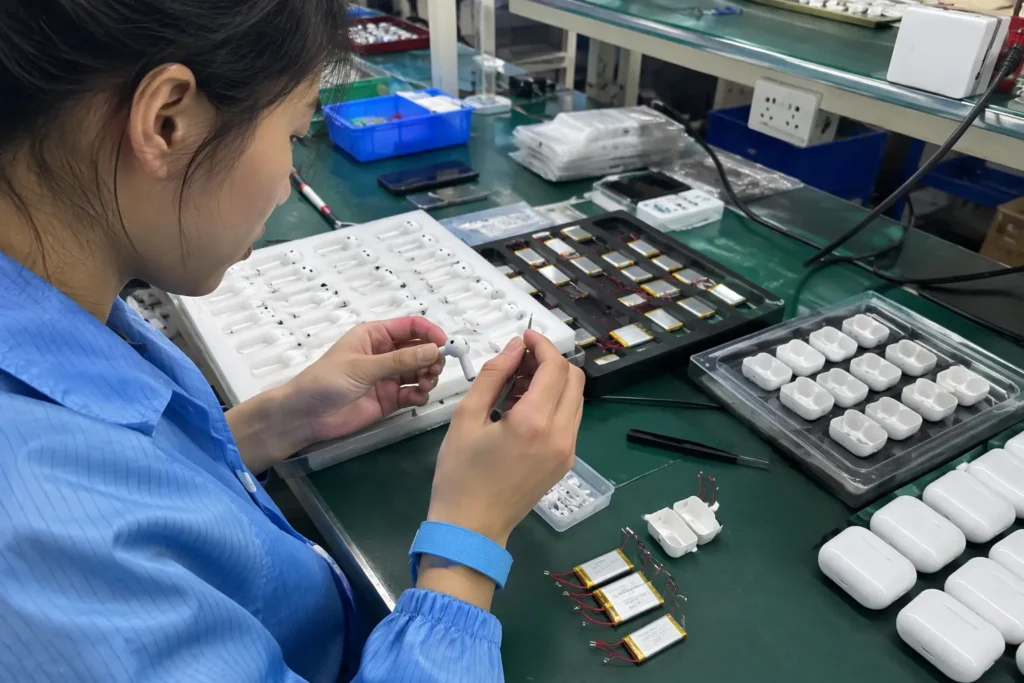
A service technician may open an earbud by cutting adhesive or separating a welded enclosure. That action does not necessarily mean the earbud can be repaired successfully. The technician also needs to:
- Avoid puncturing or deforming the lithium battery.[2]
- Disconnect the battery without damaging the PCB.
- Replace adhesive or sealing materials correctly.
- Reconnect wires or solder joints safely.
- Restore acoustic components and microphone openings.
- Confirm charging, pairing, touch controls, and audio performance.
- Close the enclosure without changing comfort or water resistance.[3]
The same principle applies to the case. A case may have a screwed bottom cover but still use soldered battery wires, fragile spring contacts, or a non-replaceable charging board. The visible fastener does not tell the whole story.
A useful procurement definition
| Question | What I would verify |
|---|---|
| Can the fault be diagnosed? | Test points, service instructions, error indicators, and replacement procedure |
| Can the faulty part be removed safely? | Adhesive type, screws, connectors, soldering, battery protection |
| Can the product be restored? | New seals, adhesive, calibration, pairing, functional testing |
| Can the process continue commercially? | Spare stock, MOQ, lead time, tools, training, warranty responsibility |
I have seen customers focus heavily on a replaceable earbud battery while overlooking the charging case. In actual use, the case can become the more important service item because it is carried loose, exposed to drops, and used for repeated charging. A repair plan that covers only the earbuds is incomplete.
Which Battery Design Options Should Buyers Compare?
Battery design creates the main repairability discussion, but it also creates the main safety and quality questions. Buyers should compare not only whether the cell can be removed, but also how the replacement affects protection, fit, charging, and final testing.
The main options are a sealed battery, a battery connected by a replaceable plug, and a battery that requires soldering. A plug-in battery usually offers easier service, while a soldered battery may reduce space or component cost. A sealed or heavily glued battery may support compact construction but normally creates a replacement-unit rather than component-repair model.
Sealed and adhesive-fixed batteries
A sealed battery can support a small and attractive earbud. It may also help the manufacturer control assembly consistency. However, service becomes difficult when the battery is deeply bonded to the housing or PCB.
- Battery removal may require heat, solvents, or cutting tools.
- A technician may damage the speaker, antenna, flex cable, or housing.
- The replacement battery may not fit after adhesive residue remains.
- The enclosure may not close to its original condition.
- The process may be unsuitable for ordinary retail returns centers.
This design is not automatically unacceptable. It can suit a product where the normal remedy is complete earbud replacement and the retailer does not operate component-level repair. I would describe it as a replacement-oriented design rather than a genuinely serviceable one.
Plug-connected batteries
A small connector can make replacement more repeatable.[5] It can also reduce soldering work and shorten technician training. However, the connector must be mechanically stable and correctly rated for the design. A loose plug, damaged socket, or incorrectly routed wire can create intermittent charging or safety problems.
- The connector type and locking method.
- The battery protection arrangement.
- The polarity and installation controls.
- The recommended replacement tool.
- A functional test after battery installation.
- Whether the replacement part is supplied as a complete approved assembly.
Soldered battery connections
Soldered connections may be common in compact electronics. They can occupy less space than a plug. They also require more skill and equipment during service. A retailer or importer should not assume that every repair center can safely solder a small lithium battery connection.
- A controlled soldering station.
- Battery-safe handling.
- ESD protection.
- A battery spot-welding process.
- A specific wire length or temperature rating.
- Post-repair charging and discharge checks.
Battery performance claims need evidence
I avoid promising a specific number of charge cycles or years of service unless the supplier provides test conditions and the buyer independently verifies the information. Battery life depends on volume, codec use, charging habits, temperature, storage, firmware, and the battery management system.[6]
- Initial capacity.
- Charging time.
- Operating time under stated conditions.
- Capacity retention after a defined cycle count.
- Abnormal temperature or swelling observations.
- Results for both earbuds and the case.
The European Commission battery policy information is a useful starting point for buyers reviewing battery obligations in the European market. I still recommend professional review for the exact product category, market date, and compliance responsibility.
How Should Buyers Evaluate the Charging Case?
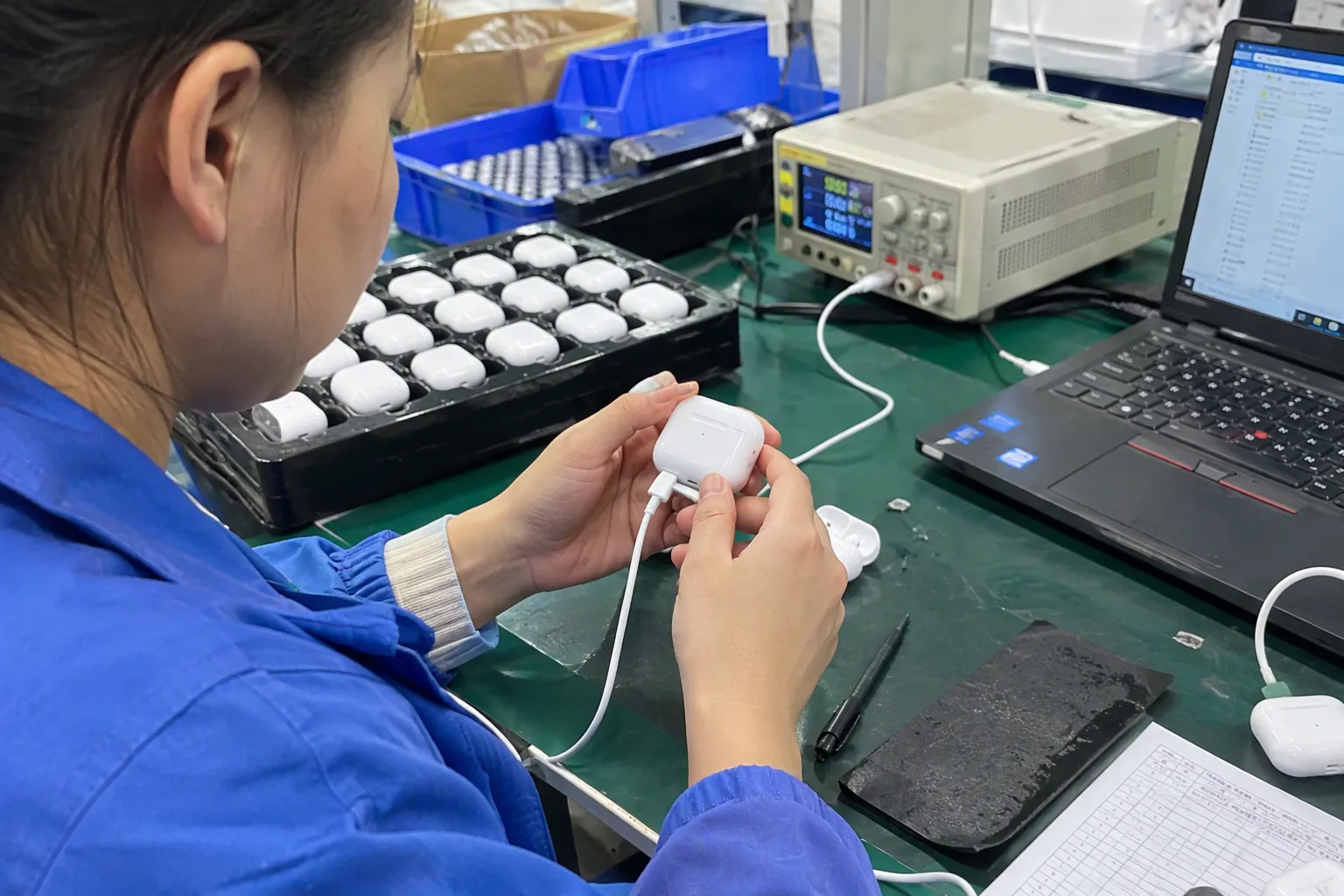
The charging case is often treated as an accessory, but it is a core part of the TWS product.[4] It stores energy, charges both earbuds, manages contacts, communicates status, and protects the earbuds during transport. A case failure can make a perfectly good pair of earbuds unusable.
A repairable charging case should provide a realistic method for replacing the case battery, charging board, USB port, hinge, contacts, and enclosure parts where those items are likely to fail. Buyers should also confirm whether a replacement case can be paired or synchronized with the original earbuds without creating a complicated support process.
Common case failure points
| Case component | Possible issue | Procurement question |
|---|---|---|
| Battery | Capacity loss, swelling, charging failure | Is the battery replaceable and stocked separately? |
| USB-C port | Loose connection or physical damage | Can the port board be replaced without damaging the shell? |
| Charging contacts | Dirt, corrosion, spring failure | Are contacts modular and available as spare parts? |
| Hinge | Cracking, looseness, misalignment | Is the hinge serviceable or is a complete case needed? |
| PCB | Charging or communication failure | Is a tested replacement board available? |
| Housing | Scratches, cracks, broken latch | Can the shell be replaced and reassembled? |
| Magnets | Weak retention or displacement | Are magnet positions controlled during service? |
A case with a replaceable battery may still be unsuitable if the USB port is integrated into a board that cannot be sourced independently. A case shell may be available, but the replacement may require transferring magnets, contacts, lights, and PCB components. That work can cost more than sending a complete replacement case.
Pairing and firmware considerations
A replacement case may need firmware compatibility with the earbuds.[7] The product may also need a reset sequence or a charging-board identification process. These details matter to customer service because a replacement case that does not work immediately can increase return rates.
- Confirm the original fault.
- Install the replacement part.
- Charge the case to the required level.
- Insert both earbuds.
- Reset or pair the system.
- Test charging indicators and Bluetooth behavior.
- Record the serial number or batch information.
Case replacement as a commercial option
In some markets, a complete replacement case is the most practical spare part. It avoids delicate battery work and can reduce repair labor. However, it increases inventory complexity. The buyer may need separate stock for left earbuds, right earbuds, cases, batteries, and cosmetic colors.
| Model | Strength | Main risk |
|---|---|---|
| Component repair | Less complete-product waste | Requires trained labor and tools |
| Replacement earbud or case | Faster customer resolution | Needs compatible parts inventory |
| Full product replacement | Simple retail process | Higher unit cost and more product waste |
Which Spare Parts and Supplier Commitments Matter Most?
A spare-part list is only useful when it is supported by a supply plan. A supplier may confirm that batteries or cases are available today, but the buyer must understand how that support will work after the initial production order.
A practical spare-part program should define the part list, compatibility, packaging, MOQ, lead time, storage requirements, quality checks, warranty period, and expected support window. Buyers should obtain these details in writing rather than relying on a general promise of long-term availability.
Build the spare-part list around failure risk
- Left and right earbud batteries.
- Charging-case batteries.
- Complete replacement cases.
- Charging contacts.
- Ear tips and cosmetic components.
Questions I ask during supplier evaluation
- What is the approved replacement battery model?
- Does the battery include protection and a connector?
- Are left and right batteries different?
- Can the case battery be ordered separately?
- What is the spare-part MOQ?
- What is the normal lead time after mass production?
- How long will the supplier support the same part number?
- What happens if the battery cell or chipset changes?
- Does a component revision require firmware changes?
- Which repairs affect the product warranty?
- Can the supplier provide a repair manual and test fixture?
- What packaging and transport rules apply to spare batteries?
I also ask for sample parts from actual production batches. A generic sample can hide differences in connector, dimensions, capacity, or firmware compatibility.
MOQ and inventory planning
Spare parts often have a different commercial logic from finished products.[8] A buyer may accept a 1,000-piece production MOQ but need only 50 replacement batteries. The supplier may apply a separate MOQ because the battery is purchased from another factory or requires special packing.
The service incidence must be treated as a planning assumption, not a verified repair rate. I would test the model with low, medium, and high scenarios. I would also add a buffer for color differences, lost parts, and replacement requests outside warranty.
Documentation and traceability
- Part number and revision.
- Compatible product model.
- Battery specifications supplied by the manufacturer.
- Installation instructions.
- Functional test checklist.
- Packaging and handling instructions.
- Date or batch traceability.
- Warranty and return procedure.
I would keep supplier certifications and test reports in the procurement file, but I would not treat them as a substitute for product-specific verification. Buyers should confirm that documents match the exact model and market version.
Is a Repairable Design Commercially Viable for Every Market?
Repairability can support a premium product position, a longer support promise, or a retailer’s internal service strategy. It can also increase assembly cost, training needs, spare-part inventory, and warranty complexity. The buyer must compare the complete operating model rather than judging the feature in isolation.
Repairable earbuds are commercially viable when the expected value of serviceability exceeds the added design, labor, inventory, and support costs. They are more likely to suit premium, specialist, institutional, or service-oriented channels than highly price-sensitive products with low retail margins and simple replacement policies.
Compare the full cost of ownership
| Cost or benefit | Sealed replacement model | Serviceable model |
|---|---|---|
| Initial product cost | Often lower | May be higher |
| Repair labor | Low | Medium or high |
| Spare-part inventory | Simple complete units | More part numbers |
| Technician training | Limited | Required |
| Warranty resolution | Fast replacement | Diagnosis and repair |
| Customer waiting time | Usually shorter | Depends on service network |
| Product customization | Often easier | Must consider service design |
| Long-term support | Replacement stock | Parts and procedures |
I would calculate cost per resolved warranty case, not only cost per unit. For example, a low-cost earbud may not justify battery replacement if labor, shipping, testing, and customer communication exceed the value of a new unit.
Market positioning matters
A retailer selling premium audio products may use repairability as part of a longer product-life proposition. A chain store may value a clear service process because it wants to reduce repeated customer complaints. An e-commerce seller may prefer complete replacement because it lacks local repair capacity.
- Does the buyer have a local repair partner?
- Will the retailer hold spare parts?
- Does the customer expect a replacement within a few days?
- Is the product premium enough to carry service labor?
- Does the brand make product-life or repair claims?
- Will multiple colors and versions complicate inventory?
- Can the supplier provide technical support in the sales market?
Sustainability claims require evidence
A serviceable design may reduce the need to replace a complete product when one component fails. That potential benefit should not become an automatic environmental claim. The result depends on repair success, part transport, technician activity, packaging, replacement frequency, and what happens to removed batteries and electronics.
For environmental reporting, I recommend using verified life-cycle information and qualified review. The European Environment Agency information on electronic waste can help buyers understand the wider context, while the European Commission circular economy materials provide policy background. These sources do not validate a specific earbud’s environmental performance.
Customization should include service design
When a customer requests a replaceable battery, I would include the request in the product specification from the first sample stage. Late changes can affect the housing, waterproofing, acoustic chamber, PCB layout, and assembly process.
- Which parts must be replaceable.
- Who will perform the repair.
- What tools are available.
- What repair time is acceptable.
- Which components need spare stock.
- How the product will be tested after service.
- Whether the buyer wants a complete-case replacement option.
- Which claims may appear on packaging or online listings.
How Should I Test a Repairable Earbuds Sample Before Ordering?
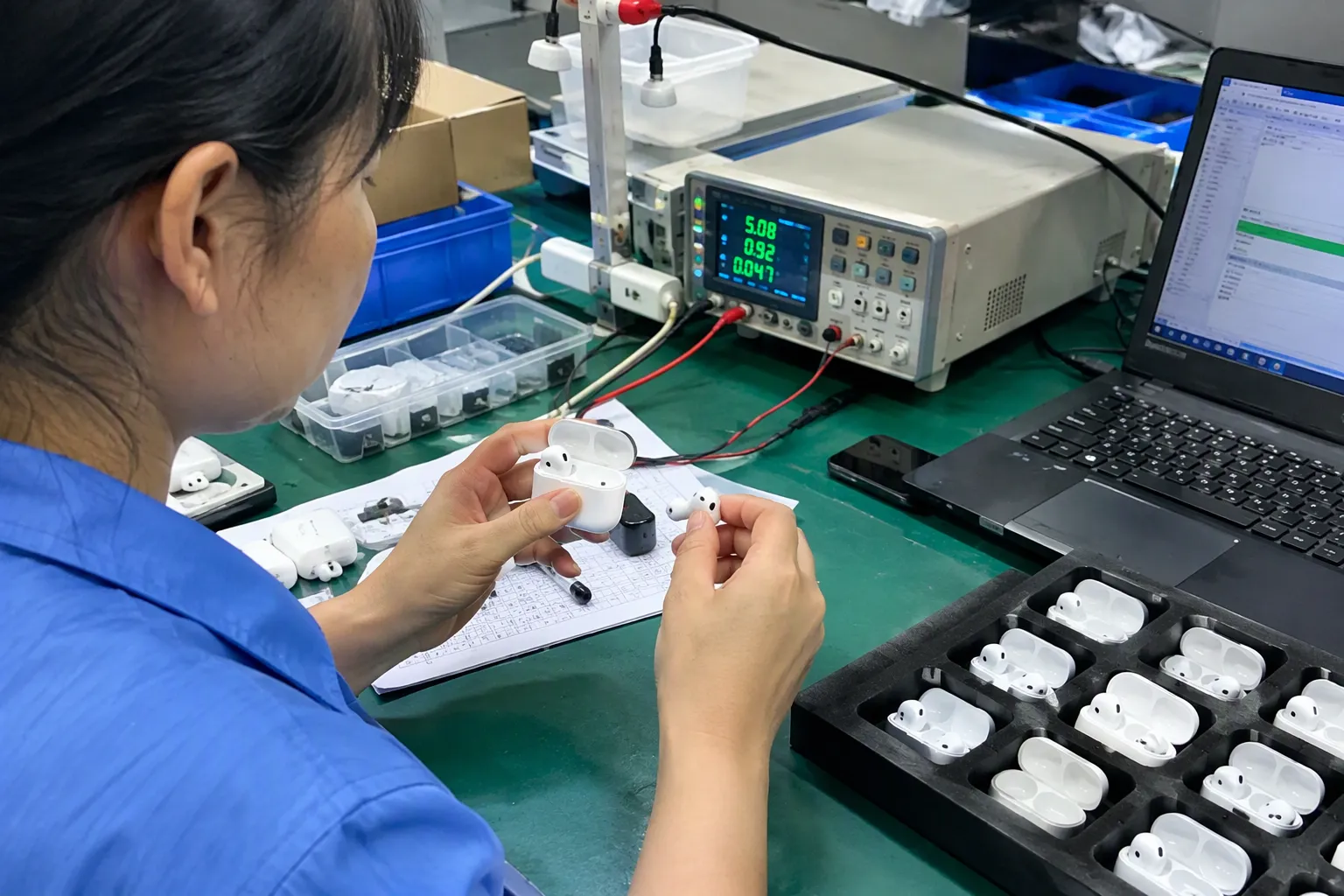
A supplier sample can demonstrate that a product works when new. It does not prove that the product can be repaired repeatedly. Buyers should conduct a controlled design review and, where appropriate, ask a qualified technician to perform the repair trial.
Before placing a production order, buyers should inspect and document disassembly, battery replacement, case servicing, reassembly, charging, pairing, audio performance, and cosmetic condition. The buyer should repeat the test on more than one sample and record any process that depends on undocumented skill or factory-only equipment.
A practical sample review
1. Incoming inspection
Record the model, firmware, color, battery marking, serial information, and sample condition. Test both earbuds and the case before opening them. Confirm Bluetooth pairing, microphone operation, touch controls, charging, battery indicators, and left-right balance.
2. Disassembly
Photograph each step. Record the tools, force, heat, adhesive, screws, connectors, and damaged parts. If opening the product destroys a seal or housing, that fact belongs in the repair specification.
3. Part replacement
Use the approved replacement part, not a visually similar battery. Record the installation time and whether the technician needs soldering, special fixtures, software, or calibration.
4. Reassembly and functional testing
- Charging of each earbud.
- Case charging and USB-C connection.
- Bluetooth connection.
- Audio output.
- Microphone performance.
- Touch or button functions.
- Battery status reporting.
- Fit of the enclosure and cosmetic finish.
5. Repeatability review
Use another sample or ask another technician to follow the instructions. A process that works only because one experienced engineer knows hidden details is not yet a robust commercial repair process.
Questions for the supplier’s quality team
I would ask the supplier to identify the production controls for the repair-related features. These may include connector insertion, adhesive application, battery placement, contact alignment, screw torque, and case sealing.
- Which components are inspected during final assembly.
- How battery polarity is controlled.
- How charging protection is tested.
- Whether repaired products receive a new quality check.
- How failed parts are analyzed.
- How design revisions are communicated.
- Which certifications and reports apply to the exact model.
Certifications can be important procurement documents, especially for products sold in Europe and North America. I still tell buyers to verify the issuing body, model number, test scope, validity, and market requirements. A certificate for one configuration does not automatically cover another customized version.
Service instructions should be usable
- Required tools.
- Safety warnings.
- Battery handling steps.
- Replacement-part codes.
- Adhesive or sealing material.
- Torque or fastening instructions where relevant.
- Pairing and reset procedure.
- Final test requirements.
- Disposal guidance for removed batteries.
For battery-related work, I recommend qualified professional evaluation. Lithium battery handling, transport, storage, and disposal can involve technical and legal requirements that depend on the market and shipment type. I would not ask an untrained retail employee to perform component-level battery replacement simply because the housing can be opened.
Frequently Asked Questions
Are repairable earbuds always better than sealed earbuds?
No. A repairable design can reduce complete-product replacement in the right service model, but it can also increase cost, labor, inventory, and safety responsibilities. I compare the design with the buyer’s retail price, warranty process, repair network, expected service volume, and customer expectations before recommending it.
Should I choose earbuds with a replaceable battery?
A replaceable battery can be useful when the buyer has a trained service channel and a reliable supply of approved replacement cells. I would also inspect the charging case, battery connector, enclosure, charging protection, and post-repair test process. The battery feature alone does not prove commercial repairability.
Is a replaceable charging case important?
It can be important because the case controls charging and protects the earbuds. A complete replacement case may be more practical than repairing a damaged USB port or charging PCB. Buyers should confirm compatibility, pairing, color availability, MOQ, lead time, and warranty handling before listing this option.
What spare parts should a retailer stock?
The answer depends on product volume and failure patterns. Common planning categories include batteries, complete cases, charging contacts, ear tips, housings, and replacement earbuds. I would begin with a demand estimate and ask the supplier for part numbers, compatibility information, lead times, and support commitments.
Can a repairable design support sustainability claims?
It may support a longer-life or reduced-replacement proposition, but buyers should not make broad claims without evidence. Repair success, logistics, part production, labor, and end-of-life handling all affect the result. I recommend qualified environmental and regulatory review before publishing market claims.
Conclusion
Repairable earbuds should be judged as a complete after-sales system, not as earbuds that can simply be opened. I recommend reviewing battery access, case serviceability, charging contacts, spare-part continuity, MOQ, lead time, repair tools, and final testing together. A serviceable design can suit premium or support-focused channels, but a sealed replacement model may remain more practical for other markets. In my Shenzhen sourcing work, I treat repairability as a scenario-based product decision. Contact me to review your target price, MOQ, customization needs, and spare-part plan before sampling.
Sources
- What is design for repair and how does it help combat ...", A repairability framework defines repairability in relation to the effort, procedures, tools, and conditions required to restore a product to working order; this supports evaluating serviceability beyond whether an enclosure can be opened
- Internal short circuit detection in Li-ion batteries using ... - PMC", Battery-safety guidance identifies mechanical damage, including crushing, penetration, and deformation, as conditions that can damage cell separators or internal structures and increase the risk of short circuit and thermal runaway
- Ingress Protection (IP) ratings", Ingress-protection standards assess resistance to water entry under specified test conditions, supporting the view that opening and reassembling a sealed enclosure requires renewed verification rather than an assumption that its prior rating remains unchanged
- High-Efficiency Charging for TWS Using a 2-Pin Interface", Technical descriptions of true-wireless-earbud architectures show that the charging case commonly combines energy storage, charging circuitry, contact interfaces, and system-status functions, supporting its treatment as a functional subsystem
- Ease of Product Disassembly Through a Systematic ...", Design-for-maintenance studies associate reversible connectors with reduced dependence on soldering and other destructive operations, which can improve the repeatability of component replacement under controlled service conditions
- Effect of thermal environments on fast charging Li-ion ...", Reviews of lithium-ion battery degradation identify temperature, state of charge, charge and discharge conditions, and storage history as important influences on capacity loss and service life; device runtime also varies with electrical load and system operation
- Before_you_start-zp6i", Technical accounts of TWS systems indicate that charging cases and earbuds may exchange identification or control information during charging and pairing, so replacement-case compatibility can depend on firmware and reset procedures
- Demand Forecasting and Inventory Management for Spare ...", Spare-parts inventory research treats replacement components as a distinct planning problem because demand is often intermittent, service-level requirements are high, and part-specific lead times and obsolescence affect stocking decisions
Related reading: