ANC earbud quality is easy to overestimate when buyers rely on a box claim, a short trade-show demo, or a supplier’s “up to XX dB” statement. That can lead to disappointed end users, weak reviews, and expensive returns. I recommend a repeatable, multi-environment sample test before you choose an ANC model.
To test ANC earbud quality, I compare samples using the same music, volume, ear tips, fit, ANC mode, and test duration across several noise environments. I check how well each sample reduces steady engine and HVAC noise, voices, café sounds, traffic, and wind. Then I judge whether the experience matches the product’s intended retail price, customer expectations, and marketing promise—not whether ANC makes every environment silent.
After 15 years of exporting 3C products from Shenzhen, I have seen one issue come up repeatedly: buyers expect ANC to work equally well everywhere. In reality, different earbuds handle different noise types differently. A structured test helps us select the right product and avoid overpromising.
1. Quick Answer: How Can Buyers Test ANC Earbud Quality?
When buyers test ANC earbud quality casually, they often choose the loudest sample after one quick comparison. That approach creates risk because a single environment does not represent daily use. I suggest testing the same samples in several controlled and real-world conditions.
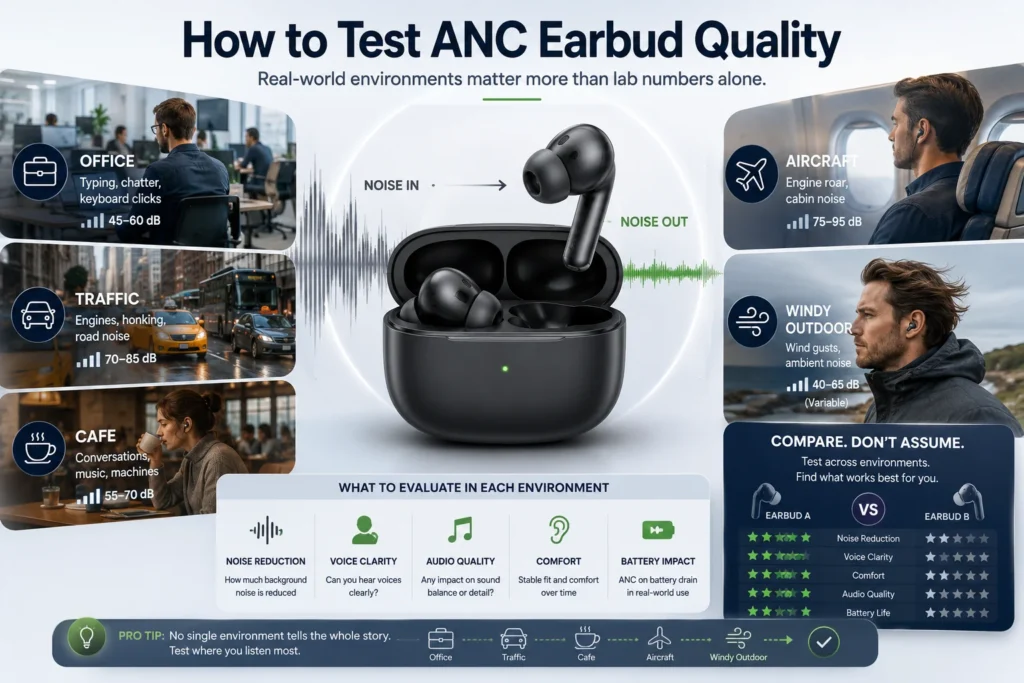
Buyers can test ANC earbud quality by using identical settings across samples and comparing ANC on versus off in at least five noise situations: HVAC noise, office chatter, traffic, café noise, aircraft-style engine noise, and wind. I record comfort, sound changes, microphone performance, and battery behavior alongside perceived noise reduction.
Build a repeatable sample test
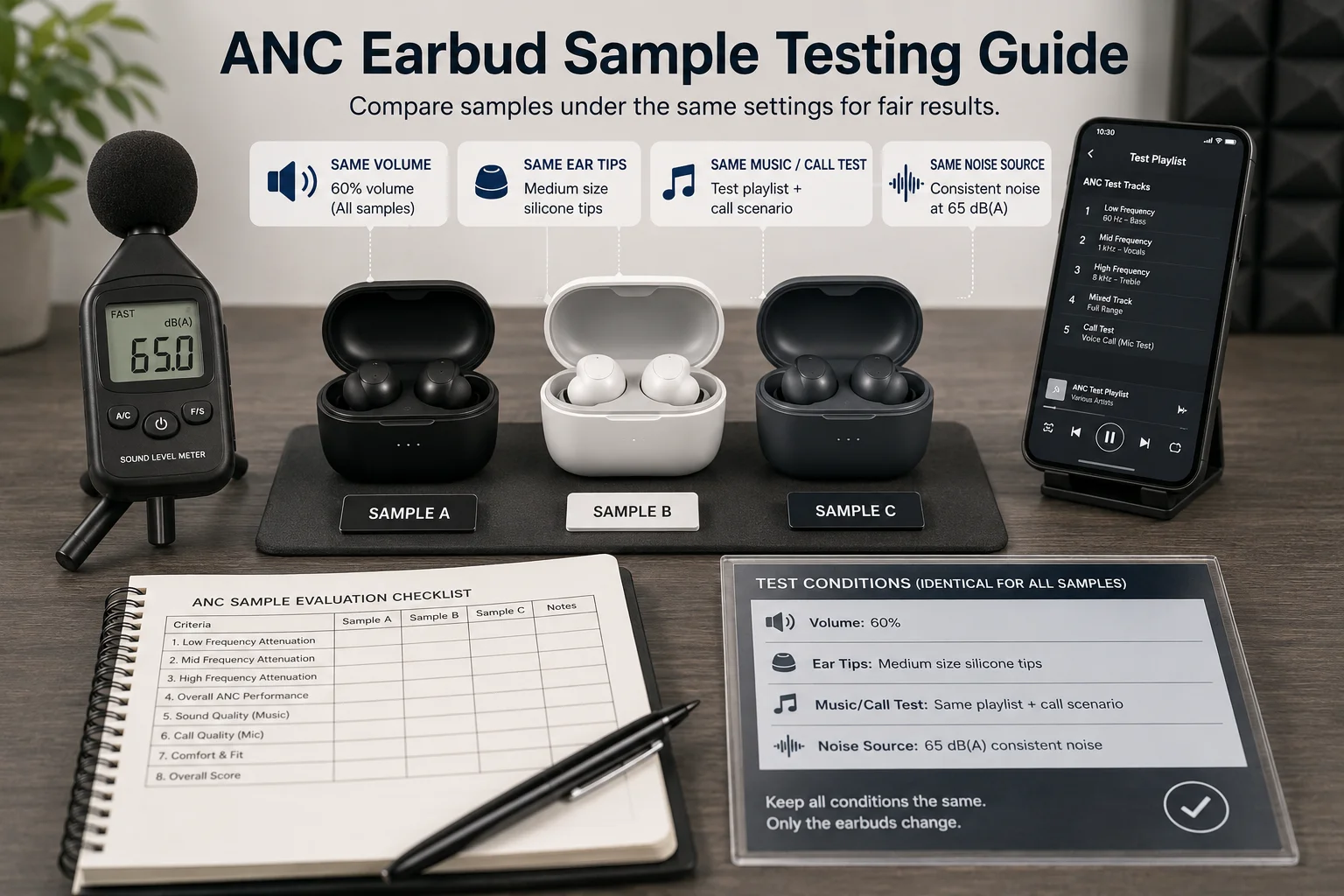
I always advise buyers to create a simple test sheet before they receive samples. This avoids the common problem of comparing one sample at 30% volume and another at 70% volume with different ear tips.
Keep these variables consistent:
- Use the same playlist for every sample.
- Set the same phone model, Bluetooth codec setting, and volume level.
- Use similar ear tip sizes and confirm a secure seal.
- Turn on the same ANC mode for every model.
- Test each sample for at least 5–10 minutes per environment.
- Compare ANC on, ANC off, and transparency mode.
- Note observations instead of trying to estimate exact dB reduction.
I usually score samples from 1 to 5 in several categories. This makes discussions with a purchasing team much easier.
| Test area | What I check | Why it matters |
|---|---|---|
| Low-frequency reduction | HVAC, bus, engine rumble | This is where ANC often performs best |
| Voice handling | Nearby conversations | Customers may expect too much here |
| Fit and seal | Ear tip stability and pressure | Poor fit can reduce perceived ANC |
| Sound quality | Bass, vocals, hiss, balance | ANC can change tuning |
| Call quality | Wind and background noise | Important for online reviews |
| Comfort | Ear pressure after 30 minutes | Important for daily use |
A good buying decision is not “Which model has the strongest ANC?” It is “Which model delivers the right experience for our target customer and price level?”
2. How Does Active Noise Cancelling Work in TWS Earbuds for ANC Earbud Quality?
Many buyers see “ANC” in a quotation and assume all ANC systems work the same way. They do not. Different microphone positions, chipsets, acoustic structures, and tuning approaches can produce very different results in ANC earbud quality.
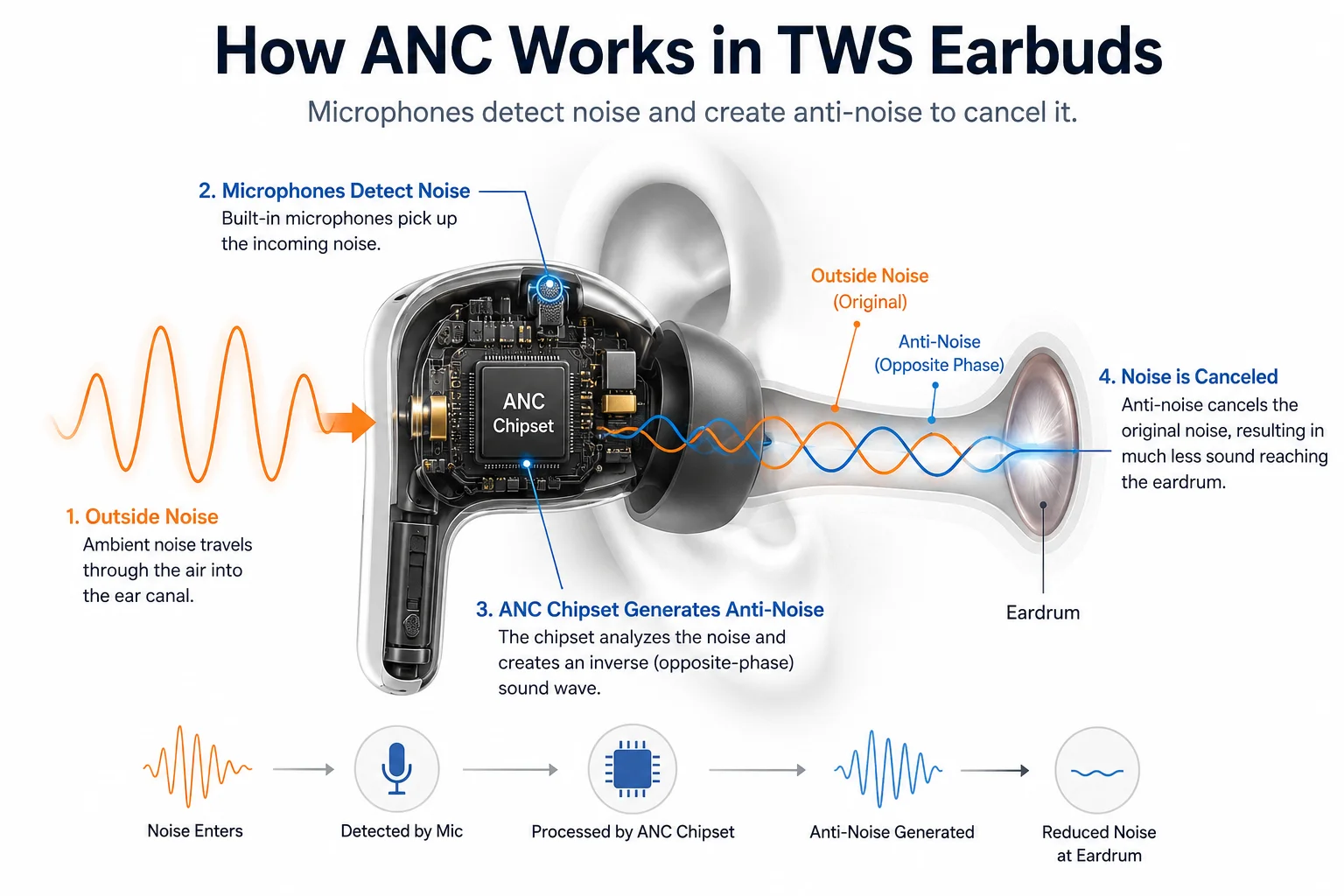
Active noise cancelling in TWS earbuds uses microphones to detect surrounding sound and generates an opposing audio signal to reduce certain external noise. ANC usually works best with steady, low-frequency sounds such as aircraft cabin rumble, air conditioning, buses, and trains.1 It does not fully remove voices, sudden sounds, or all high-frequency noise.
What ANC can and cannot do
ANC earbuds use microphones to pick up outside sound. The chipset processes that sound and sends an anti-noise signal through the speaker.2 At the same time, the ear tip provides passive isolation by physically blocking some sound.3
In practical sample tests, I often see the best result with low, repetitive noise:
- Air conditioner hum
- Aircraft engine rumble
- Train movement
- Bus engine noise
- Computer fan noise
However, ANC is less predictable with:
- Nearby human voices
- Sudden clattering dishes
- Sirens
- Keyboard clicks
- Irregular high-pitched sounds
- Strong wind hitting the microphones
This distinction matters for product positioning. A commuter-focused model can promise a more comfortable experience on trains, buses, and flights. A model aimed at shared-office workers should not promise complete silence from nearby conversations.
I have spoken with European and U.S. buyers who expected ANC to remove office speech completely. After sample testing, they usually revised their product listing language. That small change can reduce customer disappointment significantly.
I also remind buyers that ANC performance is only one part of the full user experience. If the earbud has strong cancellation but weak comfort, unstable Bluetooth, or poor calls, customers may still return it.
3. Comparison Table: Feedforward vs Feedback vs Hybrid ANC Earbuds?
Buyers often receive technical terms such as feedforward, feedback, and hybrid ANC without a clear explanation. Those labels can be useful, but they are not proof of performance. I still recommend sample testing every design before placing an order.
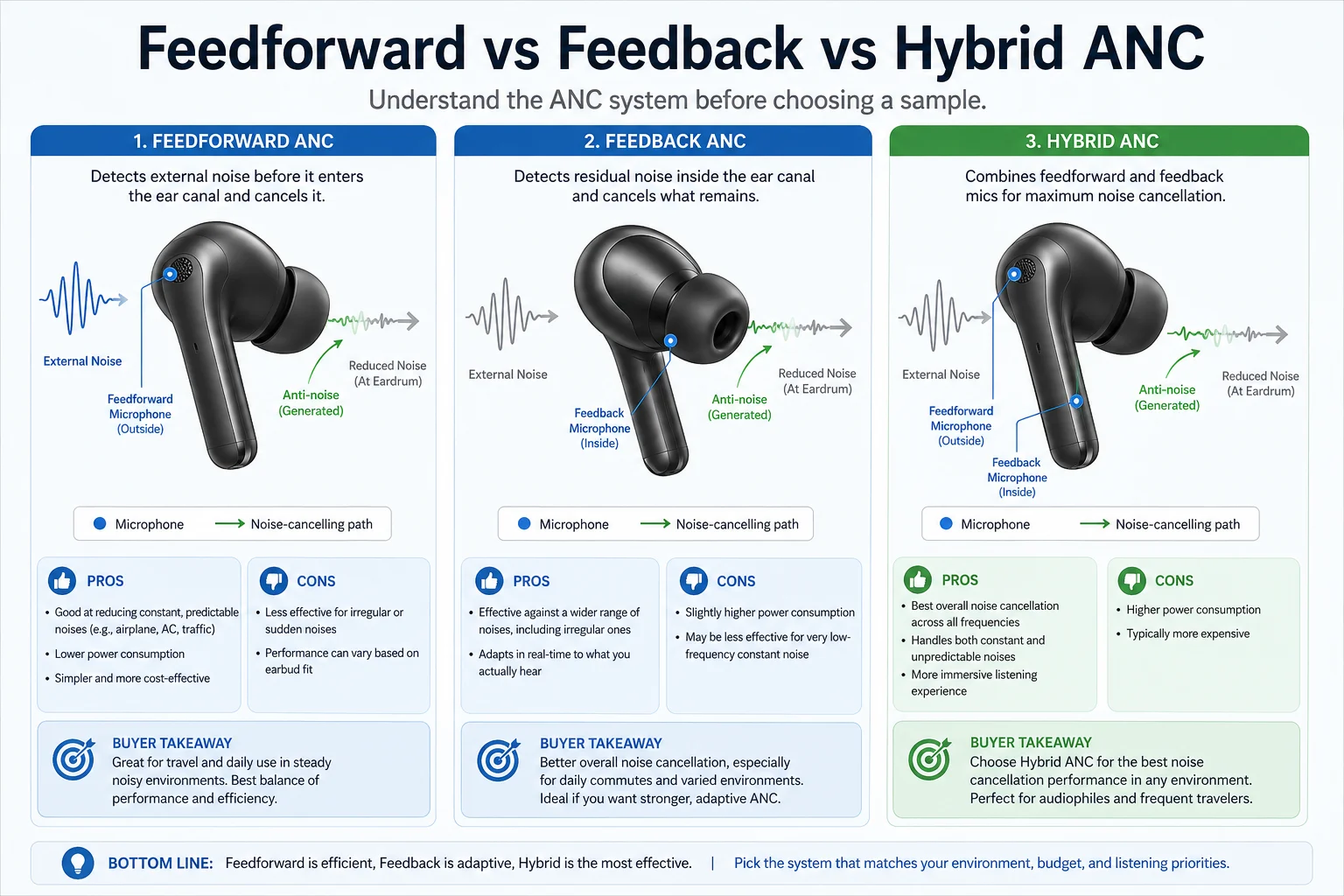
Feedforward ANC uses outer microphones, feedback ANC uses inner microphones, and hybrid ANC combines both approaches.4 Hybrid ANC earbuds often offer broader noise control in real use, but actual performance depends on microphone quality, acoustic design, fit, tuning, and the chipset—not the ANC type alone.5
Compare the system, not only the label
| ANC type | Microphone position | Typical strength | Potential limitation | Best buying approach |
|---|---|---|---|---|
| Feedforward ANC | Outside the earbud | Detects outside noise before it enters the ear | Can be affected by wind and fit changes | Test outdoors and in traffic |
| Feedback ANC | Inside the ear canal | Responds to sound reaching the ear | Can be more sensitive to fit and tuning | Test with different ear tips |
| Hybrid ANC | Outside and inside | Can cover more noise conditions | Usually needs better tuning and component control | Test in several environments |
Why hybrid ANC is not automatically “better”
Hybrid ANC is usually the preferred option for mid-range and premium TWS products because it can use more environmental information. Still, I do not treat “hybrid ANC” as a purchasing decision by itself.
Two hybrid ANC models can sound very different because of:
- Microphone sensitivity and placement
- Earbud shell design
- Ear tip seal
- Speaker driver tuning
- Noise-cancelling algorithm tuning
- Wind-noise handling
- Production consistency
For example, one hybrid ANC sample may reduce air-conditioner noise well but create a slight pressure feeling. Another may feel more natural but provide less dramatic cancellation. Neither result is automatically wrong. The correct choice depends on the target retail channel.
For an entry-level supermarket or accessory-store product, buyers may prefer a stable, comfortable model with honest ANC claims. For a premium e-commerce listing, buyers may want stronger low-frequency cancellation, app control, and more detailed specifications. In both cases, I recommend judging the complete package.
4. What Is a Good ANC dB Rating for Wholesale Earbuds and ANC Earbud Quality?
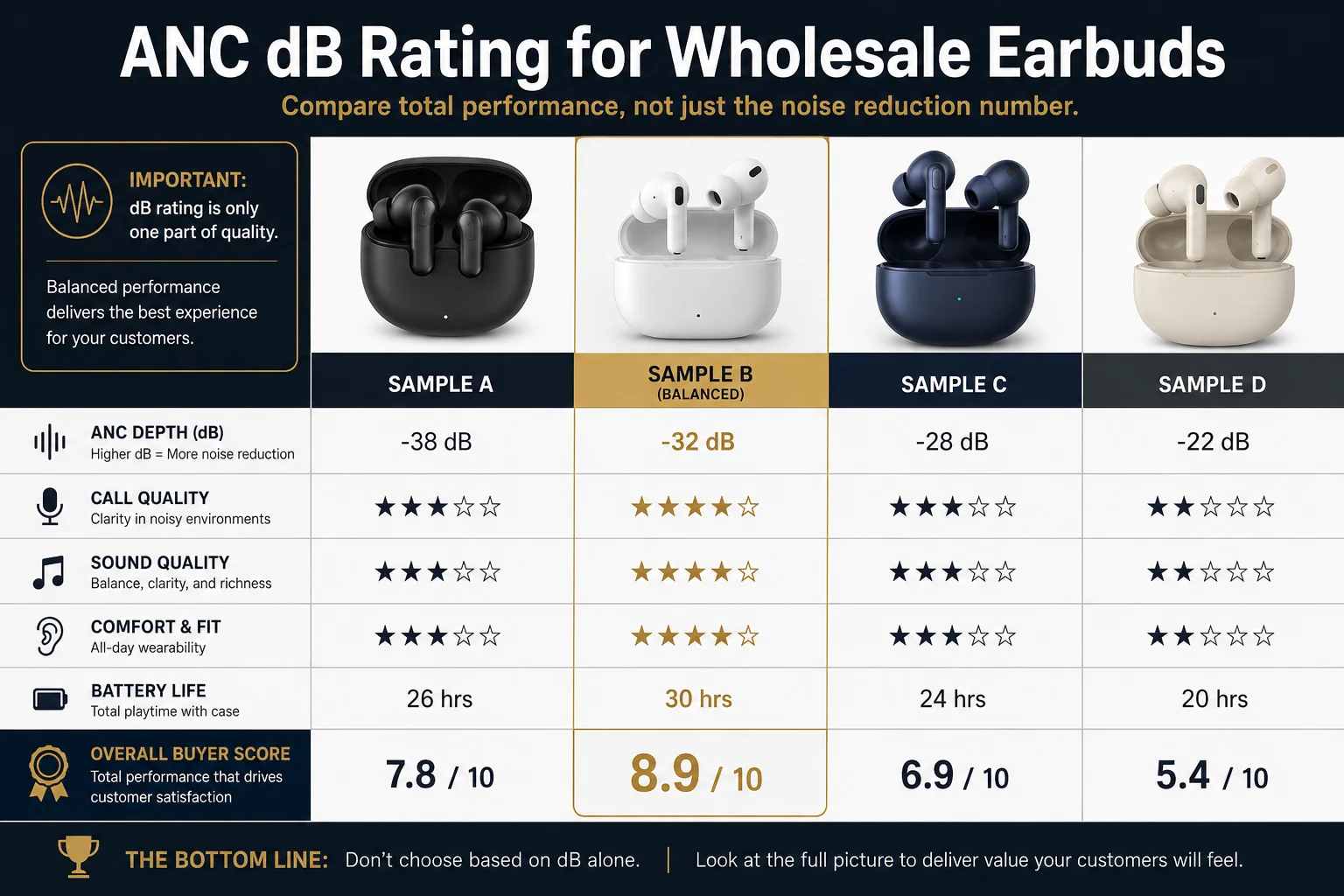
A large ANC dB number can make a quotation look attractive. However, I have learned that buyers should treat any ANC rating as a reference point, not as a complete description of real user experience. Test methods can vary between factories and brands.
A good ANC dB rating for wholesale earbuds depends on the supplier’s test method, frequency range, fit conditions, and product positioning. I recommend using the rating only as a preliminary comparison point. Buyers should confirm ANC earbud quality through side-by-side sample testing and avoid making retail claims that they cannot verify.
Ask what the dB claim means
When I review an ANC specification sheet, I ask these questions:
- What test method produced the rating?
- Which frequency range was measured?
- Was the figure a peak value or an average?
- Was the test done with a specific ear simulator or fixture?
- Does the number refer to a lab condition only?
- Can the supplier provide supporting test information?
A stated figure such as “up to 35 dB” may refer to a best-case result at a certain frequency.6 It does not mean that every sound around the user becomes 35 dB quieter.
Use retail positioning instead
I find it more practical to classify samples by intended market position:
| Positioning | Typical customer expectation | Recommended claim style |
|---|---|---|
| Entry level | Better focus during commuting or study | “Helps reduce everyday background noise” |
| Mid-range | Noticeable support for travel and work | “Designed to reduce low-frequency ambient noise” |
| Premium | Stronger, more refined noise control | “Advanced hybrid ANC for travel and daily use” |
I avoid claims such as “blocks all noise,” “silences voices,” or “perfect for any environment.” Those claims create unnecessary return risk, especially in marketplaces where customers compare products aggressively.
5. Why Do Laboratory ANC Ratings Not Always Match Real-World ANC Earbud Quality?
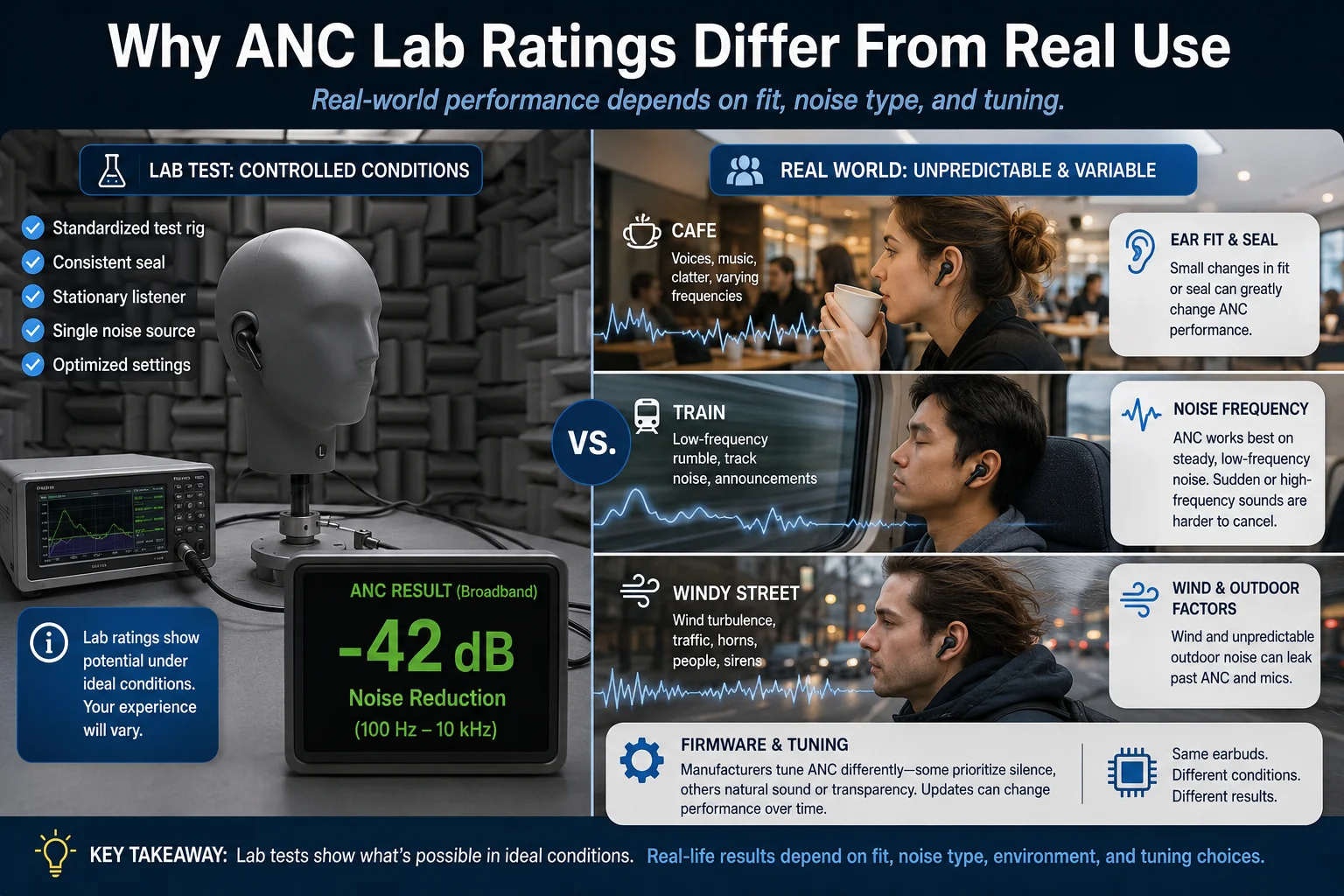
Laboratory data can be useful for engineering comparisons, but end users do not wear earbuds inside a laboratory fixture. They move, talk, walk outdoors, change ear tips, and use different phones. That is why laboratory ratings and daily impressions may differ.
Laboratory ANC ratings may not match real-world ANC earbud quality because fit, ear shape, ear tips, wind, movement, noise type, firmware, and listening volume all affect the experience.7 I use lab information as supporting evidence, then rely on structured sample tests to judge real retail suitability.
Fit changes everything
A good ear-tip seal improves passive isolation and supports ANC performance. A loose fit can make a capable earbud seem weak. During buyer testing, I recommend involving at least several listeners with different ear shapes.
I also suggest testing:
- Small, medium, and large ear tips
- Sitting versus walking
- Music playing versus no music
- One earbud versus both earbuds
- ANC mode versus normal mode
- Indoor versus outdoor use
In our sample discussions, buyers sometimes report that one model feels “more powerful” while another feels “more natural.” Both observations can be valid. Strong ANC can create a noticeable pressure sensation for some users.8 A more balanced system may feel less dramatic but still work well for long listening sessions.
Real life contains changing noise
A laboratory signal is controlled. A café contains voices, coffee machines, music, dishes, and sudden sounds. A city street includes traffic, wind, footsteps, and uneven noise levels. These situations challenge ANC differently.
For this reason, I never recommend approving a model based only on a factory demo room. The demo may show a favorable noise source, but it cannot represent every customer environment.
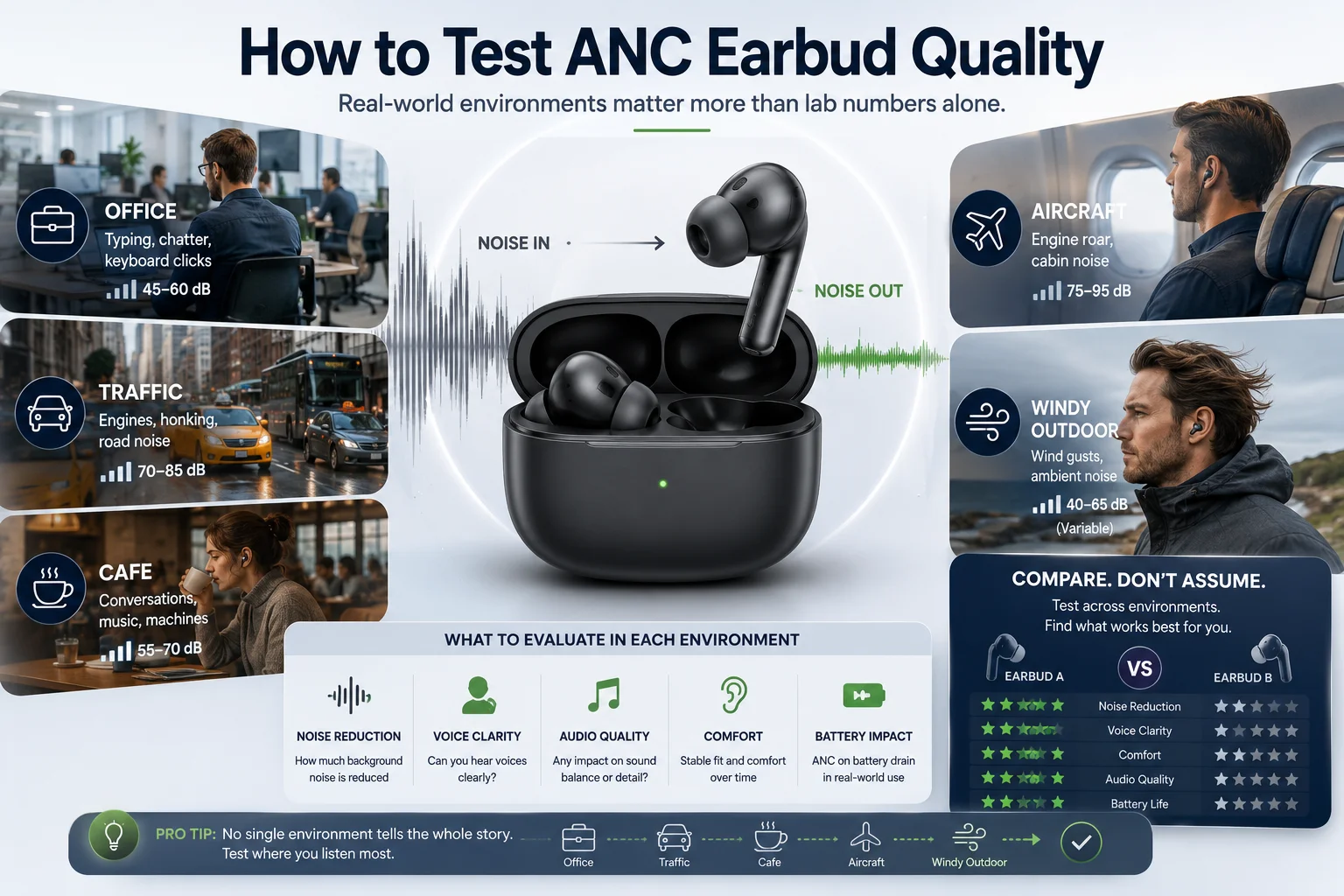
6. How Can Buyers Test ANC Earbud Quality in Offices, Aircraft Cabins, Traffic, Cafés, and Windy Conditions?
A single noise source cannot reveal the full story. Buyers need a practical test route that reflects where their customers will use the product. I recommend a repeatable test across the most relevant real-world environments.
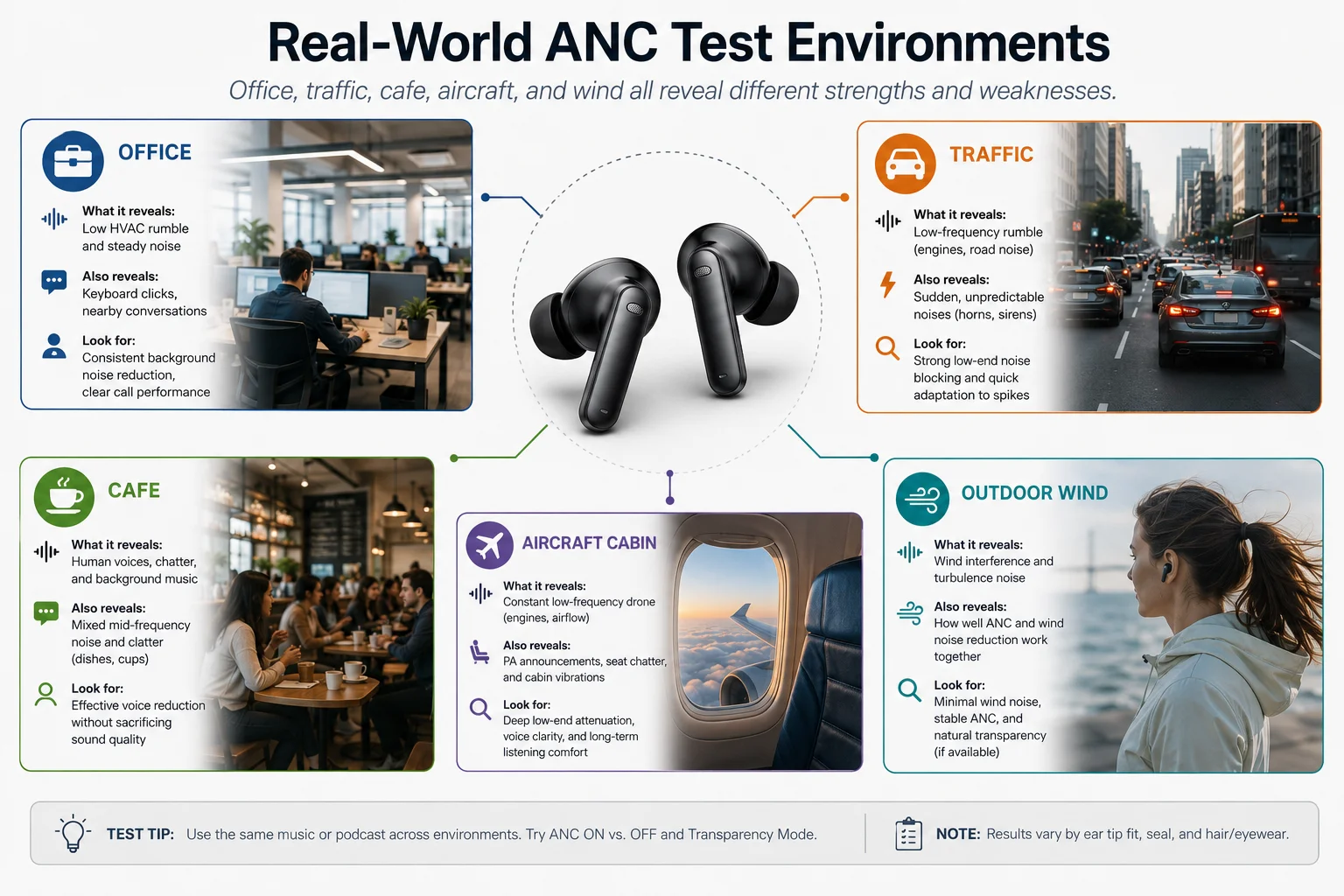
To test ANC earbud quality in real environments, buyers should compare ANC on and off using the same settings in offices, transport-like low-frequency noise, traffic, cafés, and wind. I recommend recording whether noise becomes less distracting, rather than claiming exact attenuation levels from listening impressions.
A five-environment test plan
| Environment | Main noise type | What I listen for |
|---|---|---|
| Office | HVAC, keyboard, voices | Fan reduction and remaining speech clarity |
| Aircraft-style noise | Low, steady rumble | Comfort and reduction of continuous engine-like sound |
| Traffic | Engines, road noise, horns | Low-end reduction and safety awareness |
| Café | Voices, music, dishes | Whether background noise feels less tiring |
| Wind | Air movement over microphones | Wind noise, popping, and ANC stability |
Keep safety in mind
I do not recommend testing at unsafe volumes or using deep ANC in situations where environmental awareness is critical.9 Users should remain alert near roads, stations, and other hazardous places. Transparency mode can be a useful feature, but it also needs testing.
When I test traffic noise, I focus on whether the earbuds reduce the tiring low-frequency layer without creating strange artifacts. When I test a café, I focus on whether the experience feels calmer. I do not expect voices to disappear.
For wind testing, I walk outdoors at a normal pace. Wind can cause microphone noise or unstable ANC behavior. This issue matters for cyclists, runners, delivery workers, and commuters. If your target customer uses earbuds mainly indoors, wind performance may be less important. If your customer is active outdoors, it should be a major selection factor.
7. How Does ANC Affect Sound Quality, Microphone Performance, Comfort, and Battery Life?
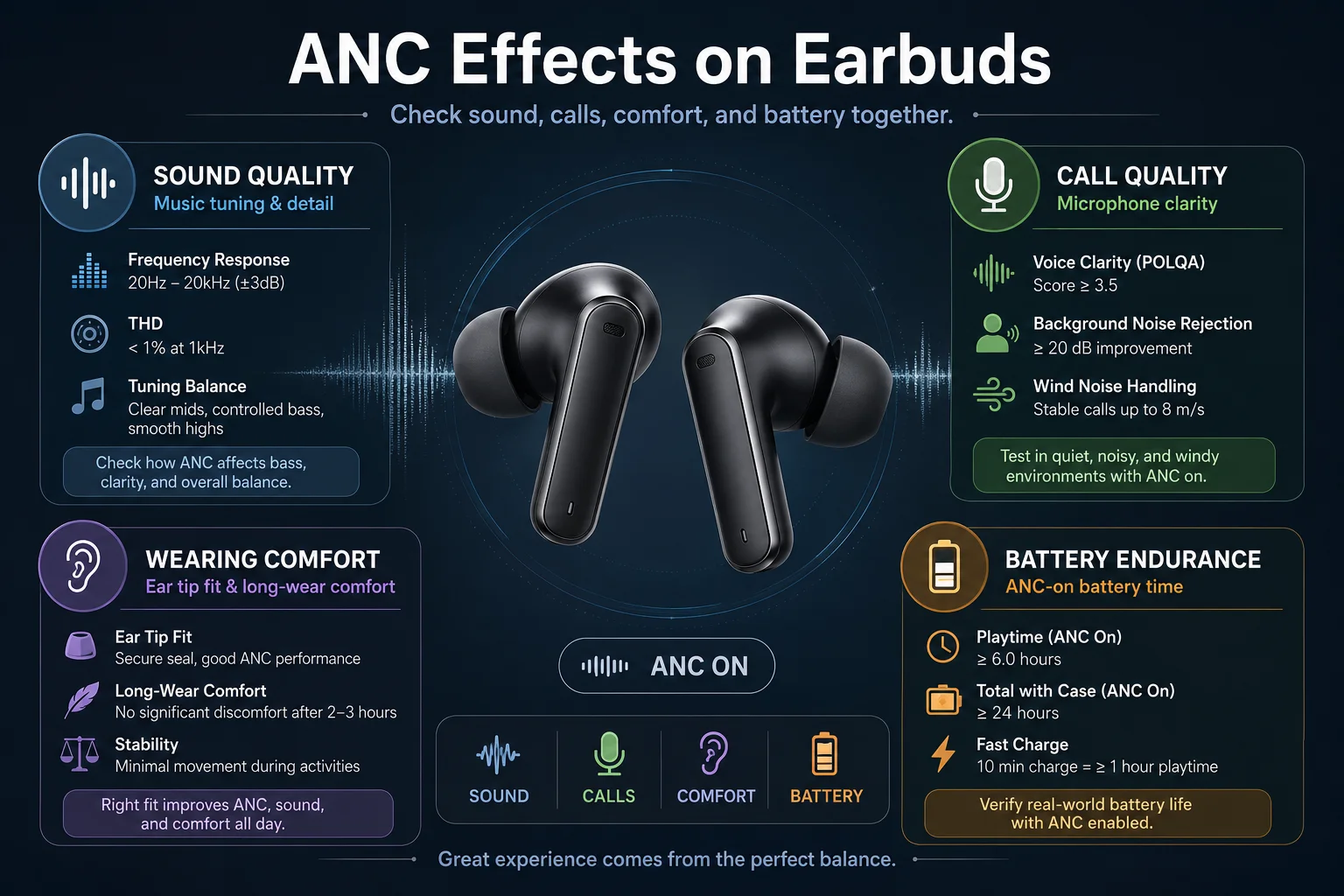
Some buyers focus so much on cancellation that they overlook the compromises around it. Stronger ANC settings can change sound tuning, add pressure sensation, consume more power, and affect call performance. I evaluate these factors as part of total ANC earbud quality.
ANC can affect sound quality, call microphones, comfort, and battery life because the earbuds use additional microphones and processing.10 I compare music balance, call clarity, ear pressure, wind behavior, and playtime with ANC on and off before deciding if a sample fits the intended price segment.
Check the whole user experience
I use the same tracks for every sample. I choose one vocal track, one bass-heavy track, one acoustic track, and one podcast. Then I switch between ANC on and off.
I listen for:
- Changes in bass weight
- Reduced vocal clarity
- Background hiss in quiet rooms
- Audio imbalance between left and right earbuds
- Delays when switching modes
- Unnatural pressure sensation
For calls, I test in a quiet room and a noisy setting. I ask the person on the other side whether my voice sounds clear, thin, robotic, or interrupted. I also check whether the microphones handle wind.
Battery life should be verified separately. Suppliers may state playtime under specific volume, codec, and ANC conditions. I ask for battery test conditions and request practical verification during sample evaluation. ANC-on playtime is usually more relevant for a product marketed around noise cancellation.11
Comfort is equally important. A sample may impress a buyer for three minutes but feel tiring after 40 minutes. I recommend a longer wear test, especially for office workers, travelers, and students.
8. What Chipsets, Microphones, Algorithms, and Acoustic Designs Should Buyers Check for ANC Earbud Quality?
Technical specifications can help buyers ask better supplier questions. Still, I do not believe buyers need to become acoustic engineers. The goal is to understand which components and design choices can influence ANC earbud quality and long-term product positioning.
Buyers should check the ANC chipset platform, microphone count and placement, wind-noise control, ear tip design, speaker tuning, firmware options, and supplier testing process. I use these details to compare product maturity, but I always validate the final decision with physical samples and documented quality checks.
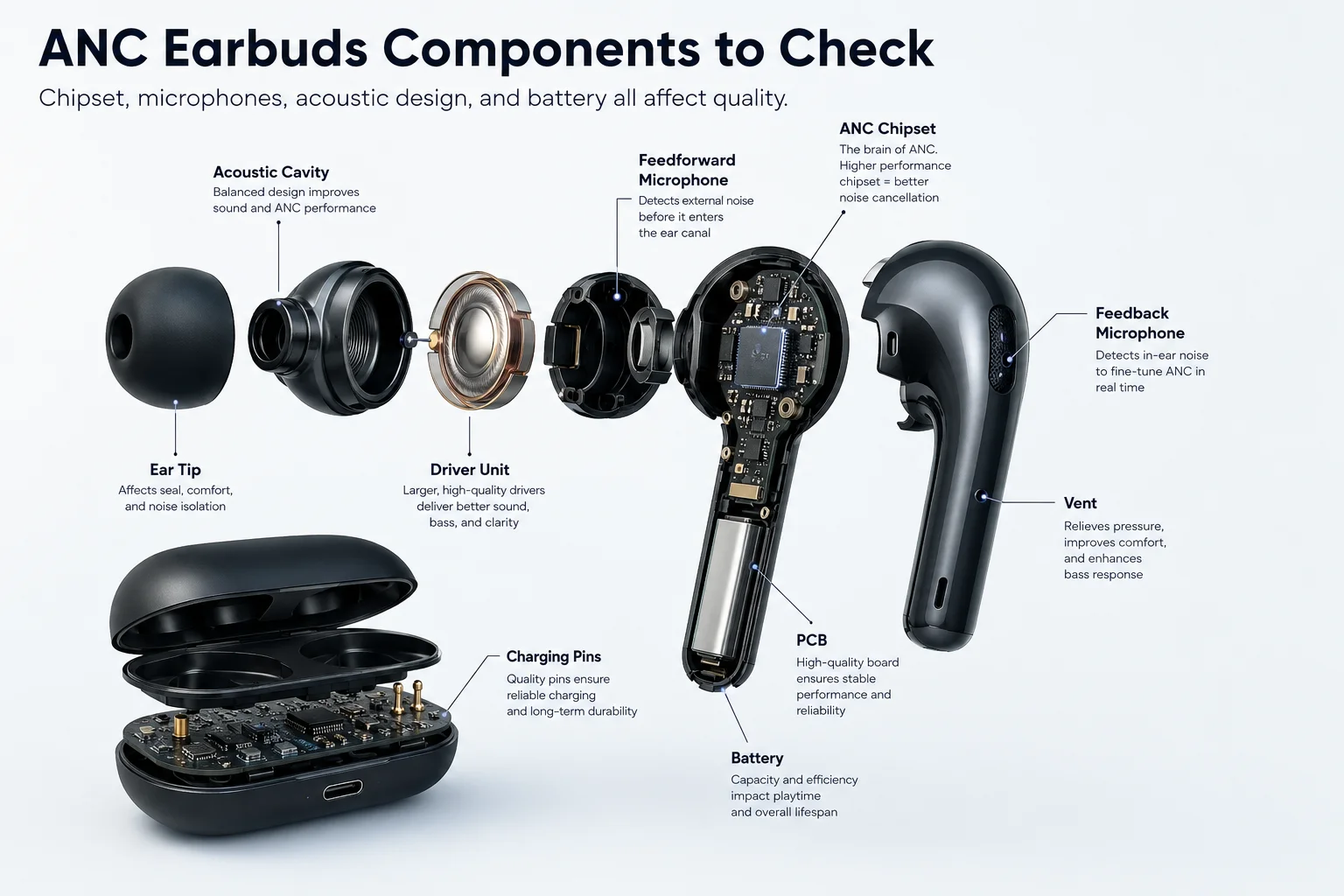
Questions I ask an OEM supplier
Before I move forward with a model, I ask:
- Which Bluetooth and ANC chipset platform does the product use?
- Is the ANC system feedforward, feedback, or hybrid?
- How many microphones does each earbud use?
- Where are the microphones positioned?
- Does the product include wind-noise reduction?
- Can ANC modes be adjusted through an app?
- Is firmware upgrade support available?
- What ear tip materials and sizes are included?
- What sample and production tests does the factory perform?
Acoustic design matters
A well-designed ear tip and nozzle structure can support passive isolation. This does not replace ANC, but it helps the user experience. Earbuds with poor sealing may require users to increase volume, which can reduce comfort and create dissatisfaction.
I also pay attention to mode switching. Customers often expect ANC, normal, and transparency modes to switch quickly and reliably. If the voice prompt is too loud, the touch control is inconsistent, or the modes are confusing, the feature loses value.
In my experience, a stable and well-tuned mid-range product can outperform a feature-heavy model with poor user experience. For retailers and e-commerce sellers, that often means fewer complaints and stronger repeat orders.
9. What Quality-Control Tests Should Importers Request Before Mass Production?
A strong approved sample does not guarantee every production unit will perform exactly the same. Buyers should separate sample evaluation from production verification. This is especially important when ANC is a key marketing feature.
Importers should request a written quality-control plan covering appearance, pairing, charging, audio, microphones, ANC mode switching, battery, packaging, and AQL inspection before mass production. I also recommend confirming the approved golden sample and defining how production units will be checked against it.
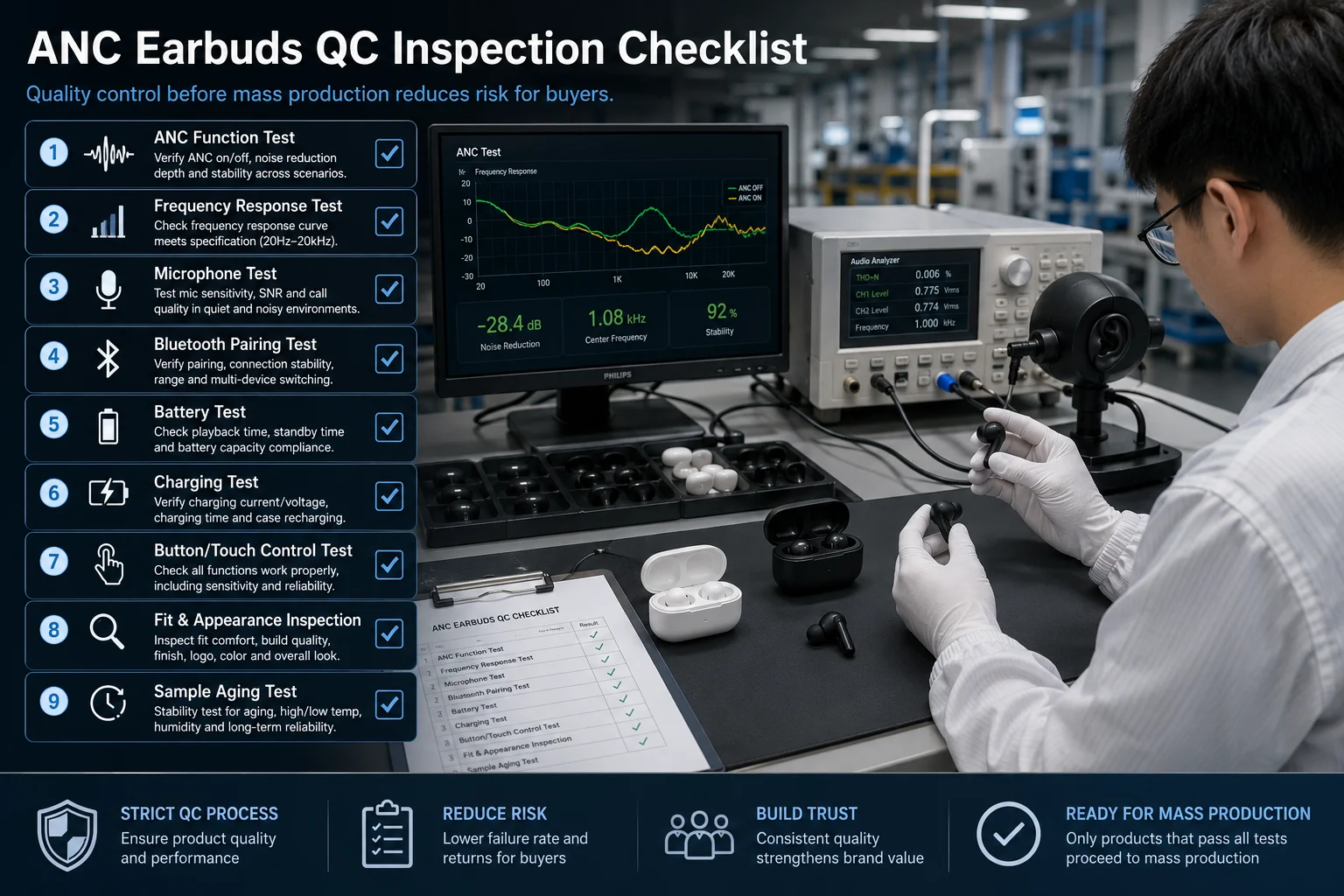
Build a practical QC checklist
I recommend including the following checks in a purchase order or QC agreement:
| QC category | Suggested check |
|---|---|
| Appearance | Scratches, color consistency, logo quality, assembly gaps |
| Function | Pairing, reset, touch controls, charging, LED behavior |
| Audio | Left-right balance, distortion, speaker defects |
| ANC modes | ANC on/off/transparency switching and obvious functional faults |
| Microphones | Call test and basic voice pickup check |
| Battery | Charging and playtime verification under agreed conditions |
| Packaging | Barcode, manual, label, accessories, carton marks |
| Reliability | Drop, charging-cycle, and basic aging tests where agreed |
Define the golden sample
I strongly recommend approving a golden sample. This sample becomes a visual and functional reference for production discussions. It should include the final color, logo, packaging, firmware version, accessory list, and agreed operating modes.
However, I remain careful with claims about consistency. One sample does not prove batch-level quality. Buyers should use pre-production samples, in-process checks, pre-shipment inspection, and agreed AQL standards to manage risk.12
For higher-volume orders, third-party inspection can add another layer of confidence. This is especially useful for importers who cannot visit the factory in person.
10. How Can Buyers Source Reliable Hybrid ANC Earbuds from an OEM Manufacturer?
Finding a reliable OEM partner is not only about receiving the lowest quotation. Buyers need a manufacturer that can communicate clearly, provide stable documentation, support customization, and respond when issues appear after shipment.
Buyers can source reliable hybrid ANC earbuds by comparing qualified OEM manufacturers on sample performance, certifications, MOQ, lead time, customization options, quality-control process, communication speed, and after-sales support. I recommend selecting a supplier based on proven process control and realistic product claims, not only headline ANC specifications.
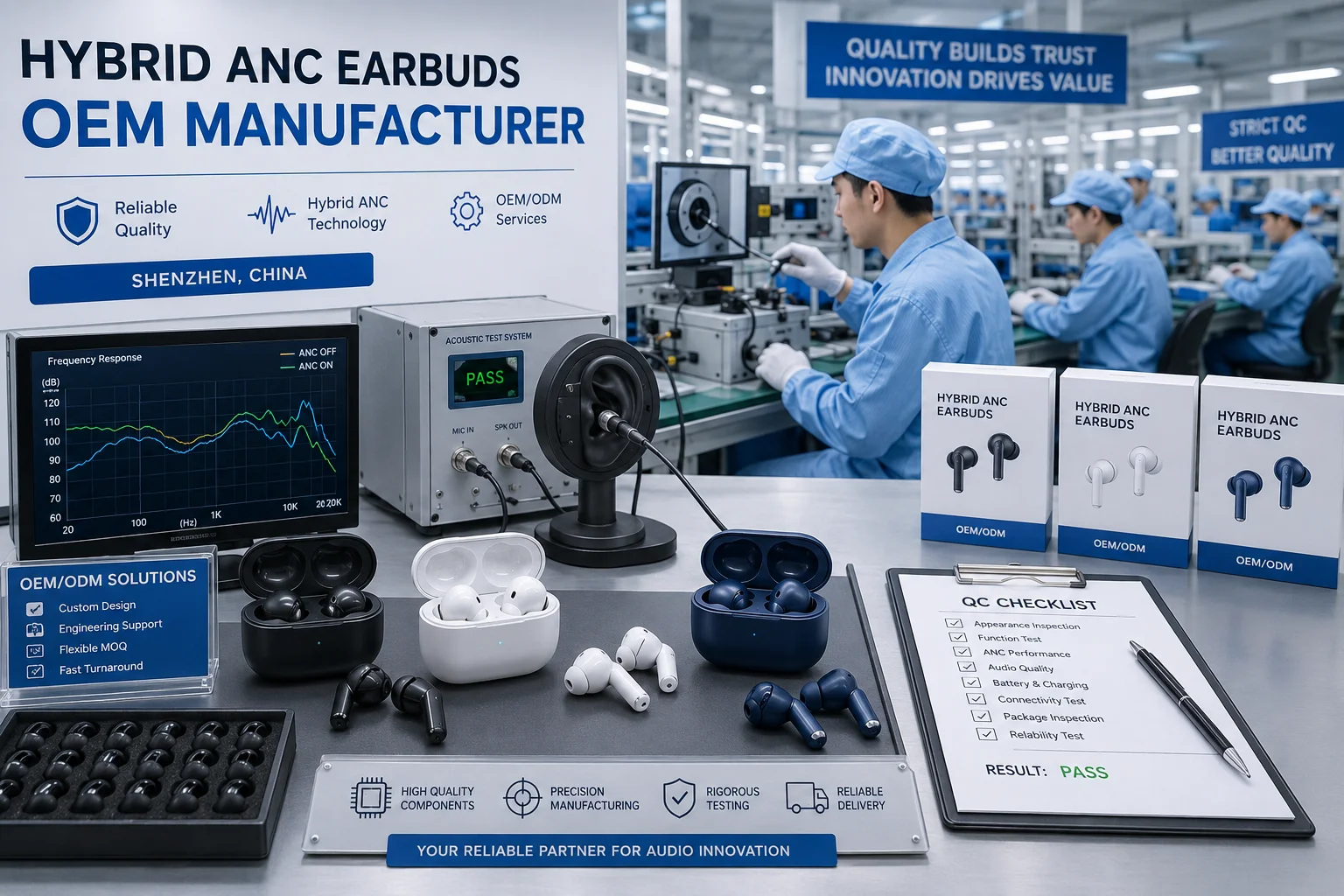
Evaluate the supplier behind the sample
I encourage buyers to look beyond the product page. A reliable partner should be able to explain:
- Available certifications for your destination market
- MOQ for standard and customized orders
- Lead time for samples and mass production
- Logo, color, packaging, and accessory customization
- Firmware and app options, if applicable
- QC process and inspection standards
- Warranty policy and after-sales response process
As a Shenzhen 3C manufacturer, we have seen that clear expectation-setting prevents many problems. If a buyer wants an affordable ANC model for a value retail chain, we should recommend a realistic solution. If the buyer needs premium hybrid ANC for an online brand, we should discuss the expected cost, development time, and test process honestly.
I also suggest that buyers send us their target market, expected retail price, sales channel, expected order quantity, and key customer use case. Those details help us recommend the right ANC platform instead of simply offering the most expensive model.
Frequently Asked Questions
Can ANC earbuds completely block voices?
No. ANC earbuds can reduce some surrounding noise, especially steady low-frequency sounds, but they do not completely remove nearby voices, sudden sounds, or irregular high-frequency noise. I recommend using realistic product descriptions to avoid customer disappointment.
Is hybrid ANC always better than feedforward ANC?
Hybrid ANC can provide broader noise control because it uses both outer and inner microphones. However, I do not consider it automatically better. Microphone quality, fit, acoustic design, firmware tuning, and real-world testing all influence final performance.
How long should I test ANC earbud samples?
I recommend at least 5–10 minutes in each environment, plus a longer 30–60 minute comfort and battery observation session. A short demo may reveal obvious differences, but it cannot show the full daily-use experience.
Should I market ANC using a dB number?
You can use a supplier-provided rating carefully if you understand the test basis and can support the claim. However, I recommend focusing marketing on user benefits, such as reducing everyday low-frequency background noise, rather than promising silence.
What is the most important factor when buying ANC earbuds wholesale?
The most important factor is whether the product matches your customer’s real use case and price expectation. I recommend evaluating noise reduction, comfort, sound, calls, battery, QC capability, MOQ, lead time, and after-sales support together.
Conclusion
ANC earbud quality is not proven by a single dB claim, one short demo, or the words “hybrid ANC” on a specification sheet. I recommend a consistent comparison process across several noise environments, with equal settings and realistic customer expectations. Buyers should also assess sound, comfort, calls, battery life, and production QC before confirming a bulk order. If you are sourcing TWS or hybrid ANC earbuds for Europe or the U.S., contact us for samples, customization options, certification support, and a practical OEM quotation.
"Objective Signal Analysis for Investigating Feasibility of Active ...", https://pmc.ncbi.nlm.nih.gov/articles/PMC9572409/. Active noise control is generally most effective for predictable low-frequency sound, because cancellation becomes more difficult as frequency increases and sound fields vary more rapidly. Evidence role: mechanism; source type: paper. Supports: Active noise control is particularly suited to reducing predictable, low-frequency sound components, while performance is more limited for higher-frequency or rapidly varying noise.. Scope note: The extent of reduction in a particular earbud depends on its fit, microphones, algorithms, and test conditions. ↩
"Engineering Silence: Active Noise Cancellation", https://rsmith.math.ncsu.edu/MA574_S19/REFERENCES/silence.pdf. Active noise control uses a measured noise signal to generate an acoustically opposing signal; where the signals meet under suitable conditions, destructive interference reduces the resulting sound pressure. Evidence role: mechanism; source type: education. Supports: ANC measures unwanted sound and uses signal processing and a loudspeaker to generate an anti-noise signal that reduces sound through destructive interference.. Scope note: Perfect cancellation is not achievable across all positions, frequencies, and changing real-world environments. ↩
"Provide Hearing Protection | Noise and Hearing Loss", https://www.cdc.gov/niosh/noise/prevent/ppe.html. Passive hearing protectors attenuate sound by physically impeding its transmission into the ear canal, with attenuation affected by the quality of the seal. Evidence role: mechanism; source type: government. Supports: Earplugs and other sealing devices reduce sound reaching the ear by creating a physical acoustic barrier.. Scope note: Consumer earbud tips are not necessarily tested or rated as hearing-protection devices. ↩
"Effects of wind noise on hybrid active noise cancellation ...", https://ui.adsabs.harvard.edu/abs/2023jkpv.conf....3W/abstract. In active-noise-control terminology, feedforward systems use a reference measurement of incoming noise, feedback systems use an error measurement near the controlled region, and hybrid systems combine both control paths. Evidence role: definition; source type: paper. Supports: Feedforward ANC uses a reference microphone sensing external noise, feedback ANC uses an error microphone near the protected acoustic region, and hybrid control combines these arrangements.. Scope note: Commercial earbud implementations may vary in microphone placement and signal-processing details. ↩
"Optimal microphone placement for active noise control in a forced", http://maeresearch.ucsd.edu/callafon/publications/2010/nc10_231.pdf. Hybrid active-noise-control designs can broaden the available control information, but achieved attenuation remains governed by acoustic-path modeling, microphone and loudspeaker behavior, controller tuning, and the listener-specific seal. Evidence role: general_support; source type: paper. Supports: Hybrid ANC can combine the advantages of feedforward and feedback control, while attenuation remains dependent on transducer characteristics, acoustic paths, controller tuning, and fit.. Scope note: A general engineering comparison does not establish that every hybrid earbud outperforms every feedforward or feedback product. ↩
"Provide Hearing Protection | Noise and Hearing Loss", https://www.cdc.gov/niosh/noise/prevent/ppe.html. Noise attenuation is frequency dependent, and a single decibel value summarizes results obtained under specified test conditions rather than demonstrating equal reduction across all sounds. Evidence role: general_support; source type: government. Supports: Sound attenuation is frequency dependent, and single-number ratings are derived from defined test procedures rather than representing identical reduction at every frequency.. Scope note: Standards for passive hearing protectors are not automatically the same test protocols used for ANC earbuds. ↩
"Optimized Active Noise Cancellation for Hearing Tests Using ...", https://pmc.ncbi.nlm.nih.gov/articles/PMC12772985/. Measurements of ear-worn acoustic attenuation vary with ear-canal geometry, insertion and seal, and the surrounding sound field, so controlled test results may not fully predict individual real-world experience. Evidence role: general_support; source type: research. Supports: Individual ear anatomy, seal quality, movement, and changing acoustic environments can alter the attenuation achieved by ear-worn audio devices.. Scope note: The relative contribution of firmware, listening volume, and wind differs by device design and cannot be inferred from fit studies alone. ↩
"Influence of the Noise-Canceling Technology on How We ...", https://pmc.ncbi.nlm.nih.gov/articles/PMC9408706/. Psychoacoustic research indicates that low-frequency acoustic conditions can produce subjective aural-pressure or discomfort sensations even when they do not correspond to a harmful physical pressure change. Evidence role: general_support; source type: paper. Supports: Low-frequency sound and active noise-control conditions can produce subjective sensations of pressure or discomfort in some listeners.. Scope note: Individual sensitivity varies, and the evidence does not show that all ANC products or users experience this effect. ↩
"Investigating and improving pedestrian safety in an urban ...", https://pmc.ncbi.nlm.nih.gov/articles/PMC5005641/. Safe-listening guidance emphasizes limiting excessive audio exposure and preserving awareness of environmental hazards when situational hearing is important. Evidence role: expert_consensus; source type: government. Supports: Public-health guidance recommends safe listening levels and maintaining awareness of surroundings in situations where environmental sounds may be important for safety.. Scope note: Specific legal restrictions on headphone use vary by jurisdiction and transport mode. ↩
"Signal Processing Challenges for Active Noise ...", https://ieeexplore.ieee.org/document/8577985/. Active noise control requires microphones, processing hardware, and anti-noise reproduction, creating power demand and possible interactions with audio tuning and microphone processing. Evidence role: mechanism; source type: paper. Supports: ANC operation requires sensing, digital processing, and acoustic output, all of which consume power and can interact with the audio signal path.. Scope note: The magnitude and direction of sound-quality or call-quality changes depend on the particular hardware and firmware implementation. ↩
"Bluetooth Headset Battery Life Guide: How to Extend & ...", https://electronics.alibaba.com/buyingguides/bluetooth-headset-battery-life-realistic-expectations-fixes. Wireless-audio battery life is conditional on the enabled operating mode and other test parameters; runtime reported with active noise cancellation enabled therefore describes a materially relevant use case for ANC products. Evidence role: general_support; source type: institution. Supports: Battery runtime for wireless audio devices depends on operating conditions, including enabled features such as active noise cancellation, volume, and codec use.. Scope note: No universal reporting protocol necessarily applies to all consumer earbuds or supplier specifications. ↩
"6.2.1. What is Acceptance Sampling?", https://www.itl.nist.gov/div898/handbook/pmc/section2/pmc21.htm. Acceptance-sampling standards such as ISO 2859-1 provide procedures for lot inspection using specified acceptance-quality limits, supporting structured decisions about whether production lots meet agreed criteria. Evidence role: definition; source type: institution. Supports: Acceptance sampling plans use defined inspection levels and acceptance-quality limits to determine whether lots meet agreed quality criteria.. Scope note: AQL sampling manages, rather than eliminates, the risk that nonconforming units remain in an accepted lot. ↩