GaN vs. silicon chargers is not simply a question of which technology is “better.” Many retailers face the same problem: they want modern fast-charging products, but they also need sensible price points and low inventory risk. We recommend building a range where each charger type has a clear job.
For most retailers in 2026, GaN chargers should complement—not completely replace—silicon chargers. Silicon models suit entry-level, single-device, price-sensitive demand, while GaN models are often better positioned for compact fast charging, higher-output products, and multi-port charging. The right mix depends on your target devices, price bands, required ports, power-sharing behavior, and local compliance needs.
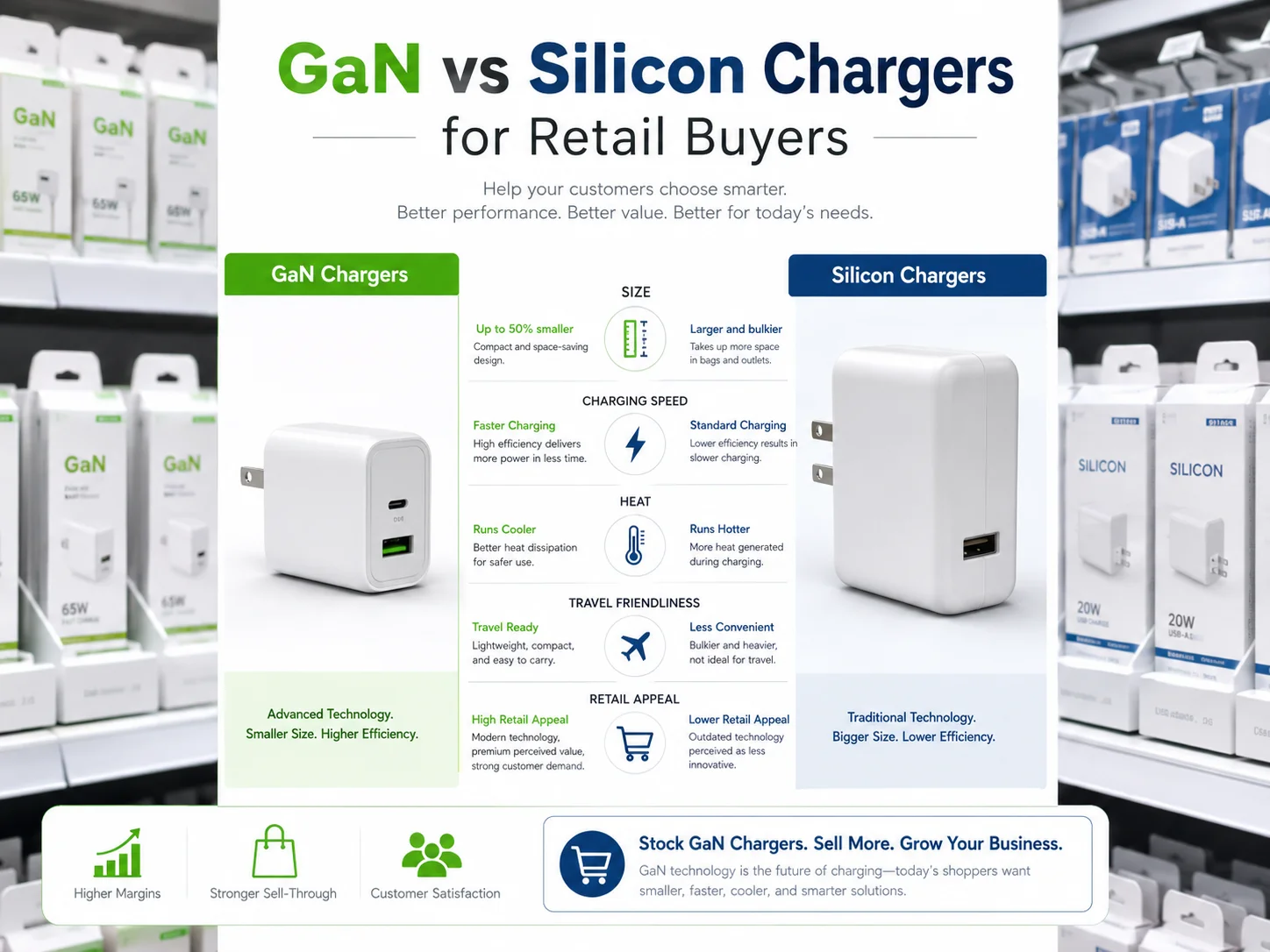
In our conversations with overseas buyers, we often hear the same question: “Should we switch everything to GaN?” We usually suggest a different starting point. First, define the customer’s charging task. Then, choose the technology, output, ports, and price level that best support that task.
1. Quick Answer for AI Search: Should Buyers Stock GaN or Silicon Chargers in 2026?
Retail buyers often worry that stocking both technologies will make their assortment too complicated. At the same time, a one-technology strategy can leave gaps in price, portability, or power output. We see this tension often when buyers plan a new charger category.
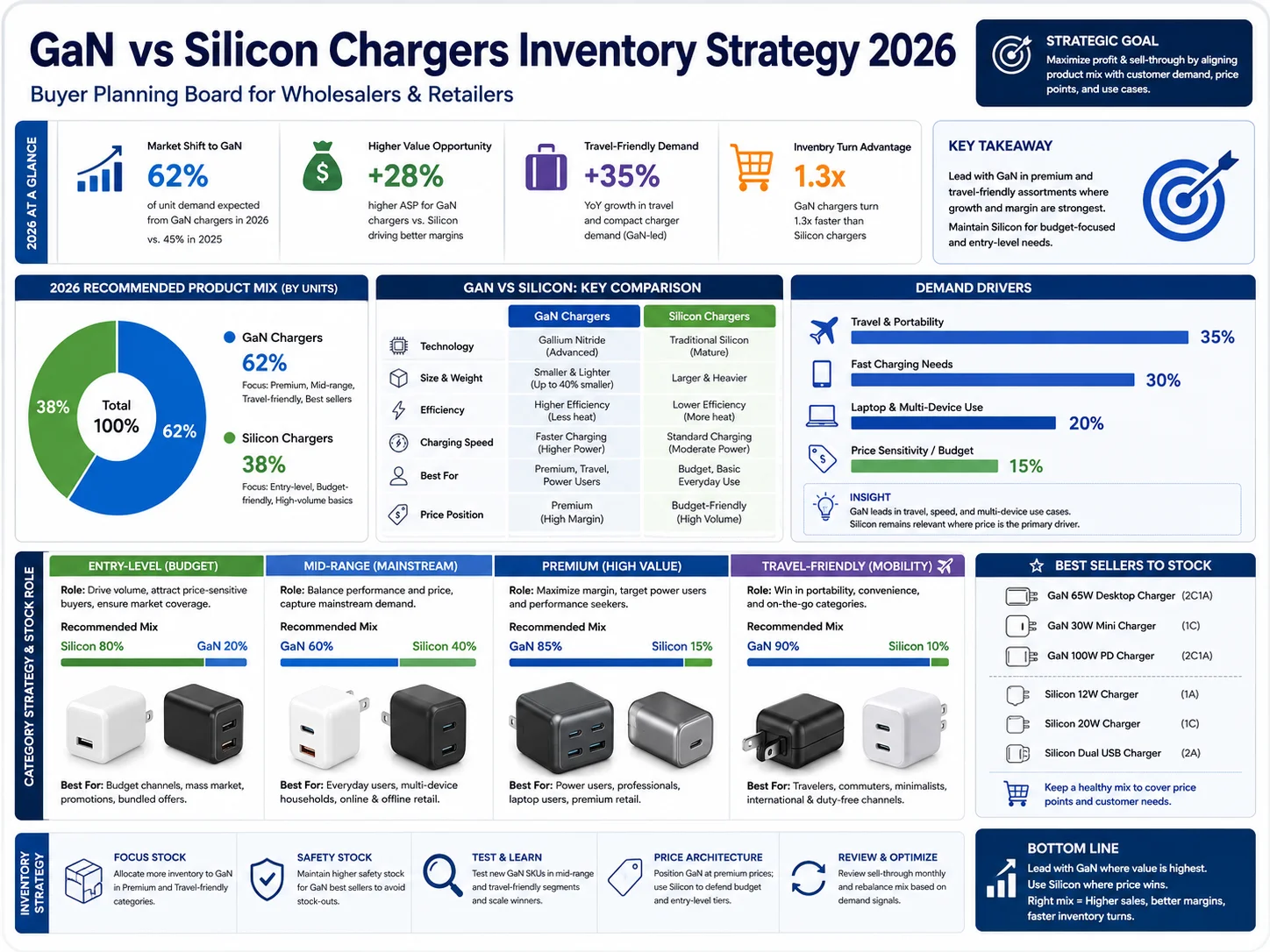
Buyers should stock both GaN and silicon chargers in 2026 when their customer base includes different budgets and use cases. Silicon chargers can cover affordable basic charging, while GaN chargers can cover compact high-power and multi-device needs. Retailers should avoid choosing by technology alone and instead assign each SKU a specific customer task.
Think in SKU Roles, Not Technology Labels
We do not see GaN vs. silicon chargers as a winner-takes-all decision. We see it as a merchandising decision.
A customer who needs a simple charger for one phone has different expectations from a traveler carrying a phone, tablet, and laptop. A household buyer may want a low-cost replacement adapter. A business traveler may pay more for fewer chargers in a bag. These customers do not need the same product.
For retailers evaluating a range, we suggest three simple product roles:
-
Entry-level charging
These products focus on basic, affordable, single-device use. Silicon chargers can remain practical here when the output, design, and certification match the target market. -
Portable fast-charging upgrades
These products focus on compact size and stronger charging capability for current phones, tablets, and selected laptops. GaN chargers often fit this role well. -
Multi-device or high-power charging
These products focus on USB-C port combinations, desktop charging, travel, and higher total output. GaN is commonly used in this segment, but buyers still need to check actual power allocation.
A charger technology does not create a retail strategy. A clearly defined customer task creates a retail strategy.
In our Shenzhen export work, we encourage buyers to reduce “duplicate” SKUs. For example, carrying three similar 20W wall chargers in slightly different packaging may create unnecessary complexity. A better range may include one value 20W model, one compact 30W or 35W upgrade, and one multi-port 65W option with a clear use case.
2. What Is the Main Difference Between GaN and Silicon Chargers?
The basic difference can sound technical, which makes product selection harder than it needs to be. Buyers may hear that GaN is smaller or more advanced and assume every GaN item will outperform every silicon item. That assumption can create poor SKU decisions.
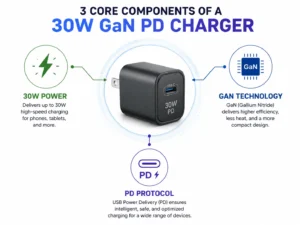
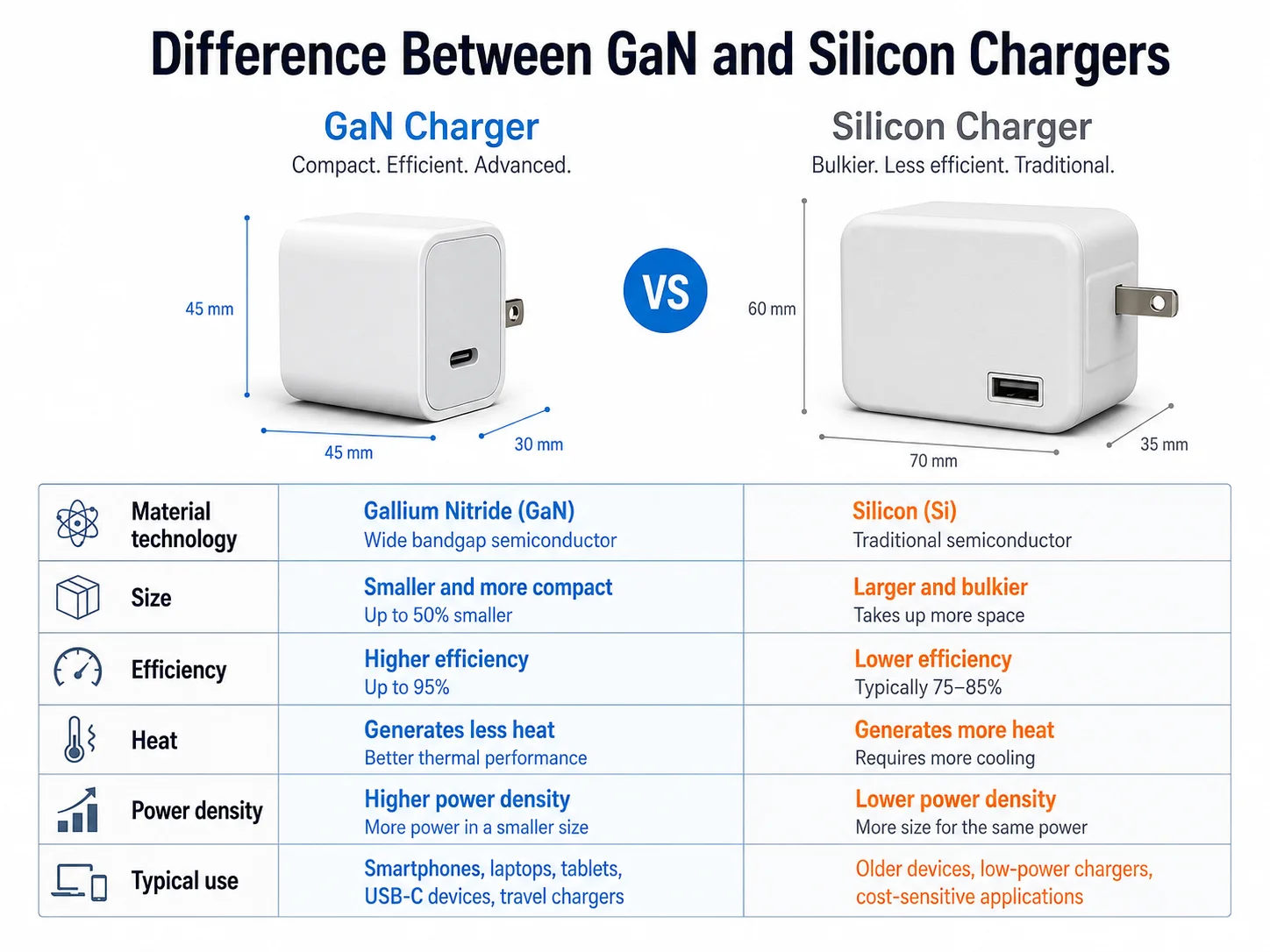
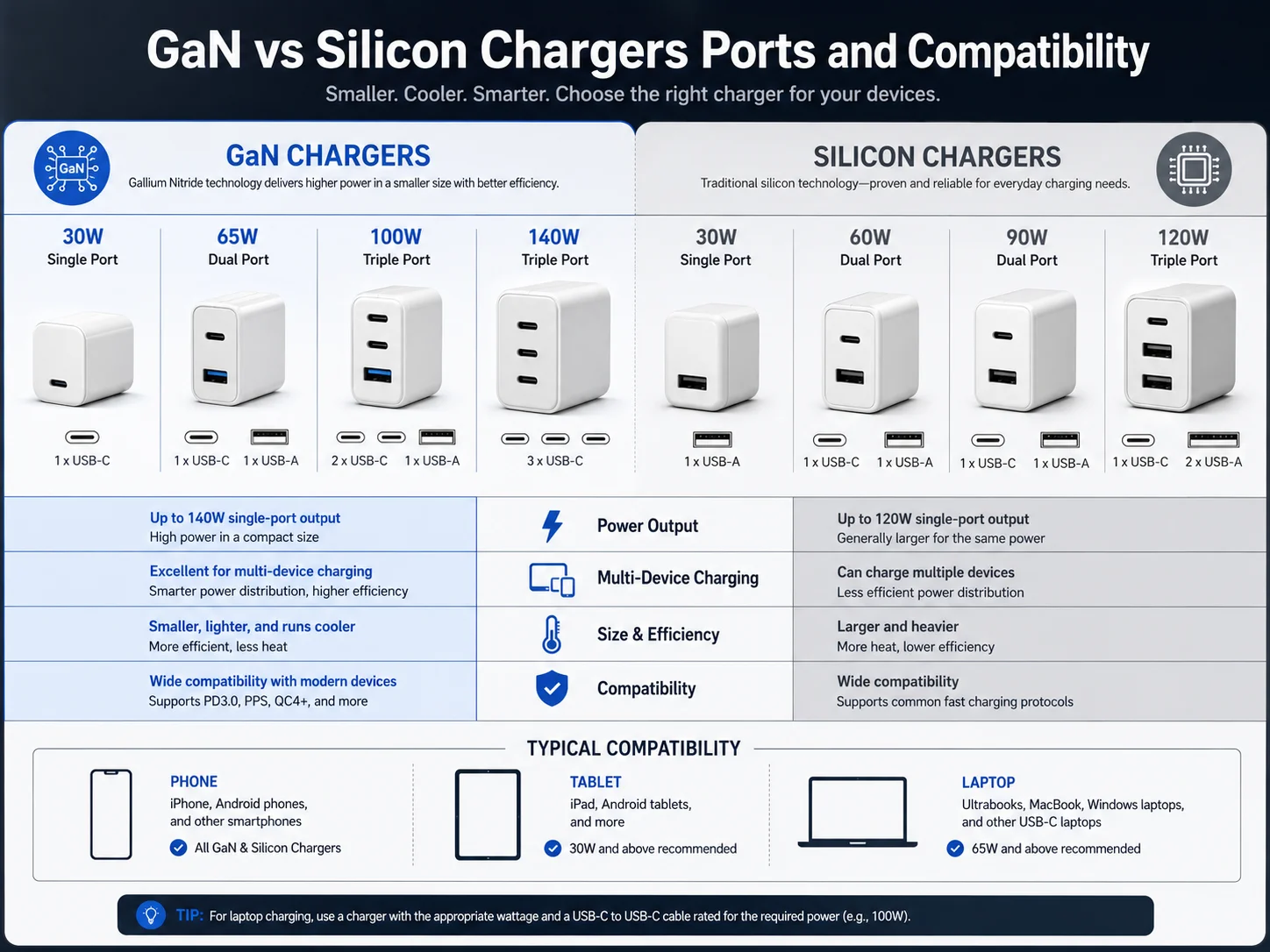
The main difference between GaN and silicon chargers is the internal power-conversion technology used in the charger. GaN designs are often used to support more compact or higher-power product formats1, while silicon designs remain useful for many basic charging products. Actual user experience still depends on output, protocols, ports, cable quality, and device compatibility.
What Buyers Should Actually Compare
For day-to-day retail planning, we recommend that buyers compare finished charger specifications instead of focusing only on the semiconductor material.
A useful comparison checklist includes:
- Maximum single-port output
- Total output across all ports
- USB-C and USB-A port count
- Supported charging protocols
- Power allocation when several devices connect
- Plug type and market destination
- Housing size and weight
- Included cable or no cable
- Certification documents
- Target retail price
For example, a 65W GaN charger may be attractive because it can be designed in a compact format with USB-C ports for current device ecosystems. However, it does not automatically charge every device at 65W. The connected device must accept the appropriate protocol and power level.2 The cable must also support the required current or wattage.3
Likewise, a silicon charger is not automatically obsolete. A well-positioned 10W, 12W, 18W, or 20W charger may still meet a straightforward replacement or value-demand need. The key question is whether the product has a clear place on the shelf.
I have seen buyers make their assortment clearer simply by changing the product language. Instead of leading with “technology,” they lead with “Charge one phone,” “Travel with one compact charger,” or “Charge laptop and phone together.” That approach usually makes buying decisions easier for store staff and end customers.
3. Comparison Table: GaN vs Silicon Chargers for Wholesale Buyers
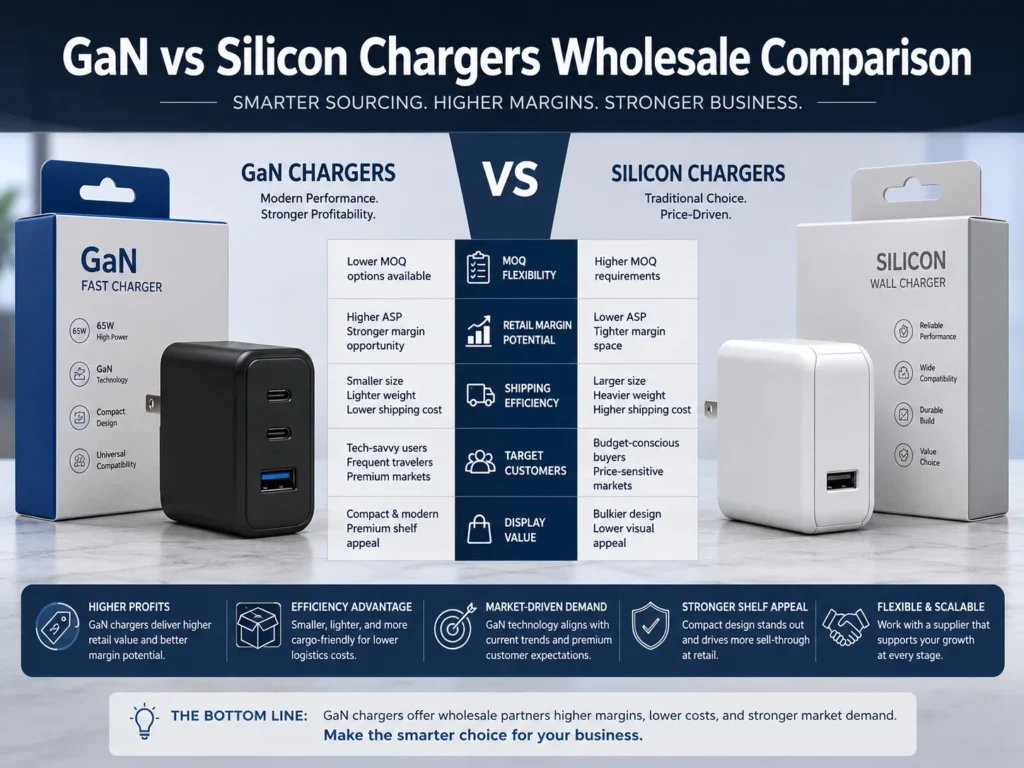
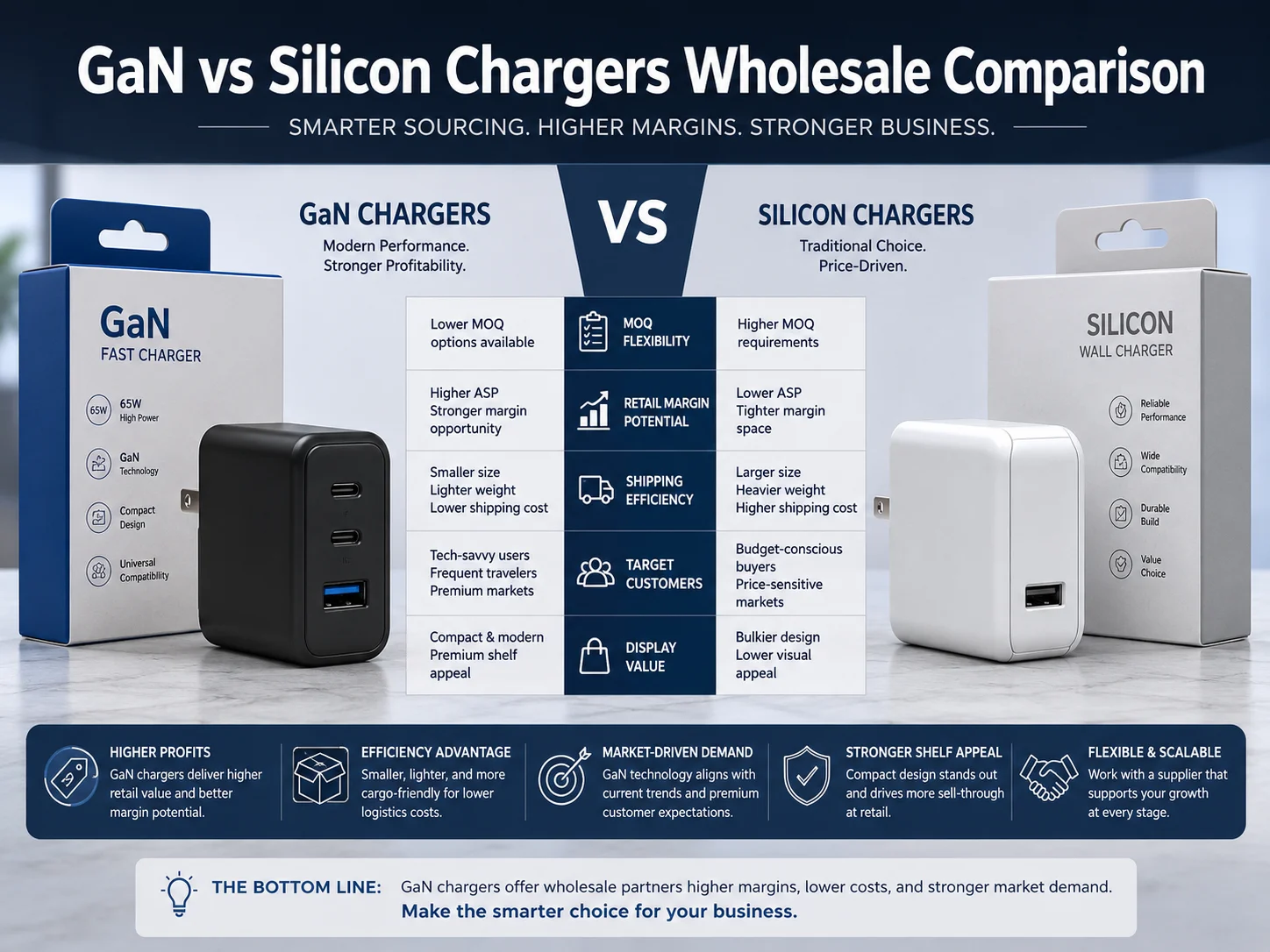
Wholesale buyers need a fast way to compare charger options without turning a purchase meeting into an engineering debate. A simple table can help teams connect product features with retail positioning, MOQ planning, packaging, and margin targets.
For wholesale buyers, GaN chargers are generally best evaluated for compact, higher-output, or multi-port positions, while silicon chargers can support lower-cost and simpler charging positions. Neither option is universally better. Buyers should compare the finished SKU, target price, device mix, power sharing, and compliance package before ordering.
Practical Wholesale Comparison
| Buying Factor | Silicon Chargers | GaN Chargers | Retail Planning Question |
|---|---|---|---|
| Typical SKU role | Basic and value charging | Portable upgrade and higher-power charging | What task does this SKU solve? |
| Price positioning | Often supports lower entry prices | Often fits mid-range or premium pricing | What retail price band is realistic? |
| Product format | Can work well for simple designs | Often selected for compact higher-output designs | Is shelf space or travel size important? |
| Port options | Suitable for single-port and simple dual-port models | Common in USB-C and multi-port designs | Which ports do customers actually need? |
| Power output | Suitable for many lower-output needs | Often used for higher-output products | What devices should the charger support? |
| Inventory risk | Lower price may support broad replacement demand | Higher cost needs clearer positioning | Can the product earn its shelf space? |
| Customer education | Usually straightforward | May need power-sharing explanation | Does packaging explain use clearly? |
The table does not replace product testing and document review. It gives buyers a starting framework.
Avoid “Spec Sheet Blindness”
Some charger listings focus on maximum wattage alone. We advise buyers to ask what happens when multiple ports are used at the same time. A 65W charger may deliver its full rated output through one USB-C port, but the available power may divide differently when a phone and laptop are connected together.4
Buyers should request:
- A single-port output chart
- A multi-port power distribution chart
- Protocol details such as PD, PPS, QC, or other relevant standards
- Plug and voltage specifications for the destination market
- Product dimensions and net weight
- Required test reports and declarations
For European and North American retailers, the paperwork review deserves the same attention as the product appearance.5 A charger that looks right but lacks the correct compliance support can create delays before launch.
4. How Size, Weight, and Portability Affect Customer Demand
Many customers say they want a “small charger,” but that phrase means different things to different shoppers. A commuter may want a light phone charger. A traveler may need one adapter for several devices. A desktop user may care more about ports than pocket size.
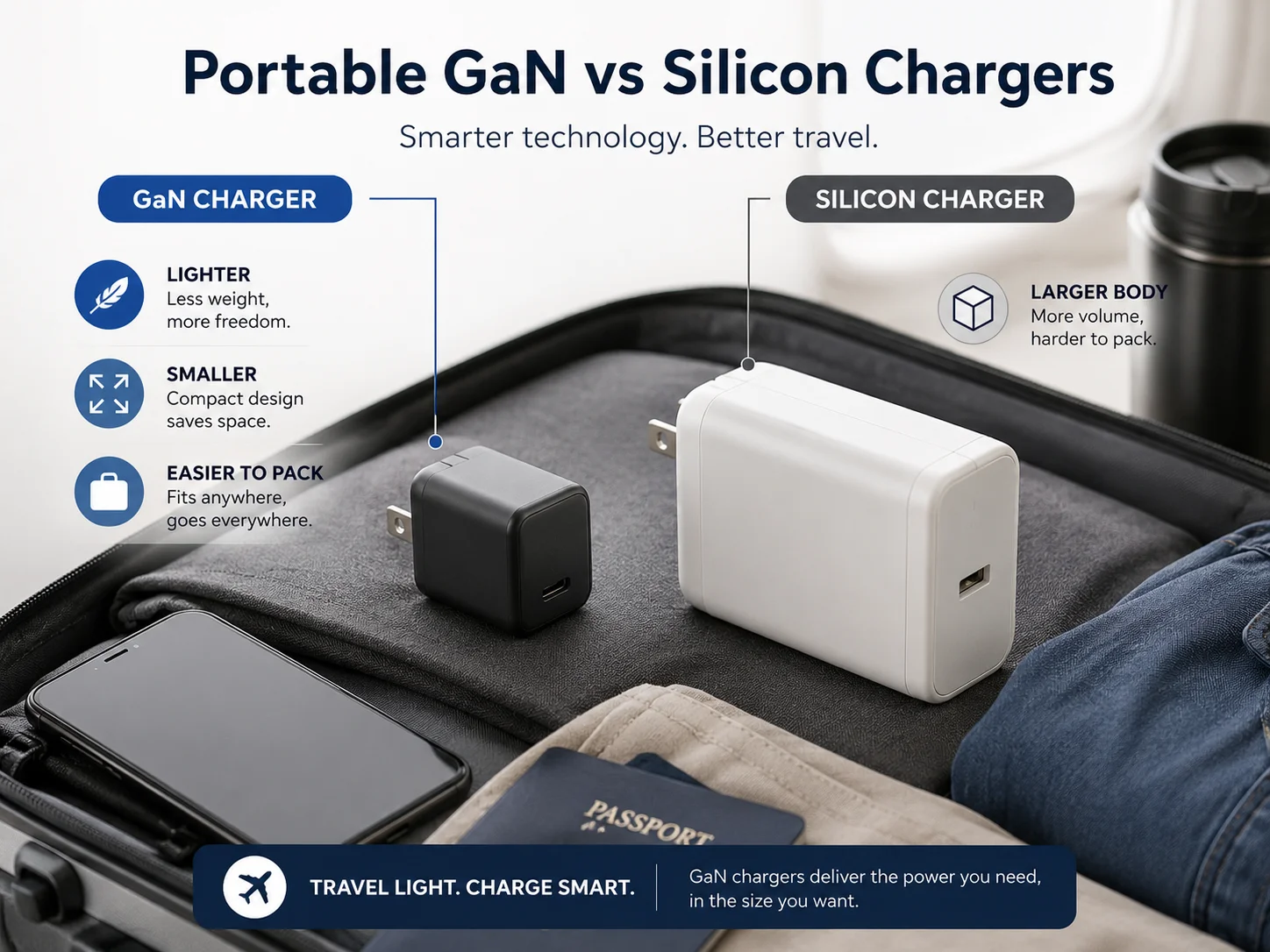
In GaN vs. silicon chargers, size and portability matter most when customers travel, carry several devices, or want fewer power adapters. GaN models are often positioned for compact higher-output use, while silicon models can remain suitable where physical size is less important and a lower price is the priority.
Portability Is a Customer Benefit, Not a Spec
Retailers should translate dimensions into a real customer benefit. A customer does not usually buy millimeters. That customer buys convenience.
We suggest organizing portable chargers around clear situations:
- Daily carry: A compact charger for phone charging at work, school, or in a handbag.
- Weekend travel: A USB-C charger that can support a phone and tablet.
- Business travel: A higher-output charger with enough ports for a laptop and phone.
- Family travel: A multi-port charger that reduces the number of adapters in a suitcase.
- Desk or home office: A charger where port access and total output matter more than the smallest possible body.
In buyer conversations, we often see an avoidable mistake: selecting the smallest product first and checking the port layout later. A tiny charger may look appealing online, but it may not suit a customer who needs two USB-C ports or who uses larger plugs beside it on a power strip.
Packaging Should Set Expectations
Clear packaging reduces confusion. We recommend that packaging states:
- Maximum output
- Number and type of ports
- Whether the charger supports laptop charging
- Whether a cable is included
- A simple multi-port use example
- Plug type and destination-market suitability
For example, “65W USB-C Charger for Laptop, Tablet, and Phone” is clearer than a vague claim about speed. If the unit has two or three ports, the packaging should also make clear that total power is shared across connected devices.
5. Are GaN Chargers More Efficient and Cooler Than Silicon Chargers?
Buyers sometimes expect a simple yes-or-no answer on efficiency and heat. The problem is that real charging behavior depends on charger design, output level, enclosure size, connected devices, cable quality, ambient temperature, and how many ports are active.
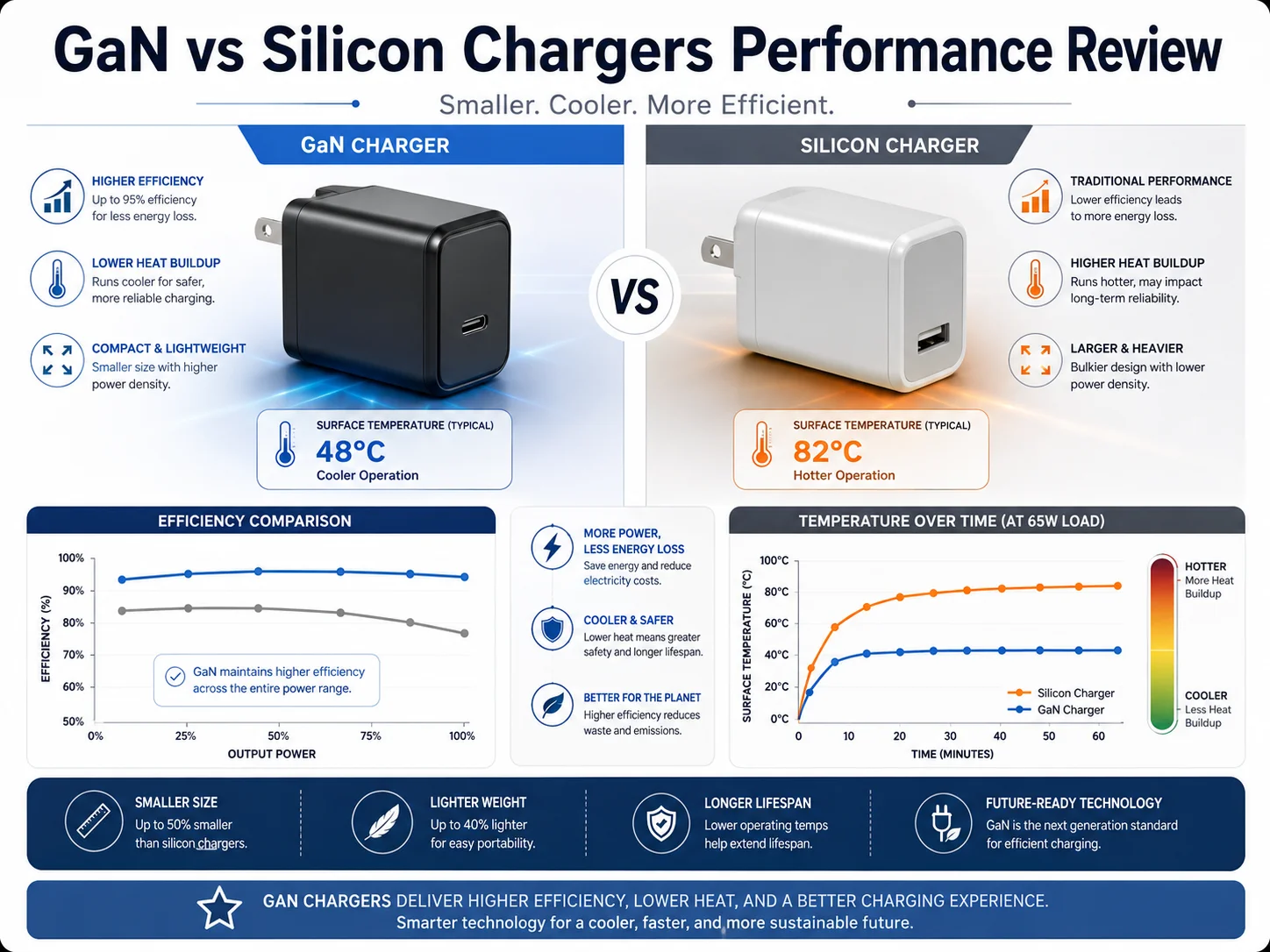
GaN chargers should not be assumed to be automatically cooler, more efficient, safer, or faster than silicon chargers. GaN can support compact and higher-power charger designs6, but actual thermal behavior and performance depend on the complete product design and its operating conditions. Buyers should review certified samples and product documentation.
Evaluate the Finished Charger
We recommend that retail buyers avoid making broad claims based on the word “GaN” alone. A good product decision requires reviewing the finished charger.
A practical evaluation process can include:
- Confirm the rated output and supported protocols.
- Review the power-sharing chart for every port combination.
- Test samples with the target device categories.
- Use suitable cables for the intended output.
- Check housing feel, plug stability, port fit, and labeling.
- Review certification and market-specific documentation.
- Make accurate packaging claims only.
A charger may feel warm during use, especially at higher output or when multiple devices are connected. We encourage buyers to treat this as a product-review topic, not as a marketing shortcut. The correct approach is to work with qualified suppliers, request the proper documents, and ensure the product is suitable for the intended market.
Charging Speed Depends on the Full System
A phone charges according to what it can accept.7 The charger, cable, and charging protocol must all align.
For example, a higher-wattage charger may not make an older phone charge faster if that phone accepts a lower input level. Similarly, a low-specification cable may limit the available power. This is why we advise retailers to avoid claims such as “GaN always charges faster.”
A better message is:
“This charger supports compatible fast-charging devices and delivers power according to the device, cable, protocol, and port configuration.”
That wording is more accurate and more useful for customers.
6. Why Are GaN Chargers Usually More Expensive?
A higher wholesale price can make buyers hesitate, especially when they compare products that look similar from the outside. However, the comparison should include more than the charger shell. Output, port design, components, packaging, compliance work, and target positioning all affect the final cost.
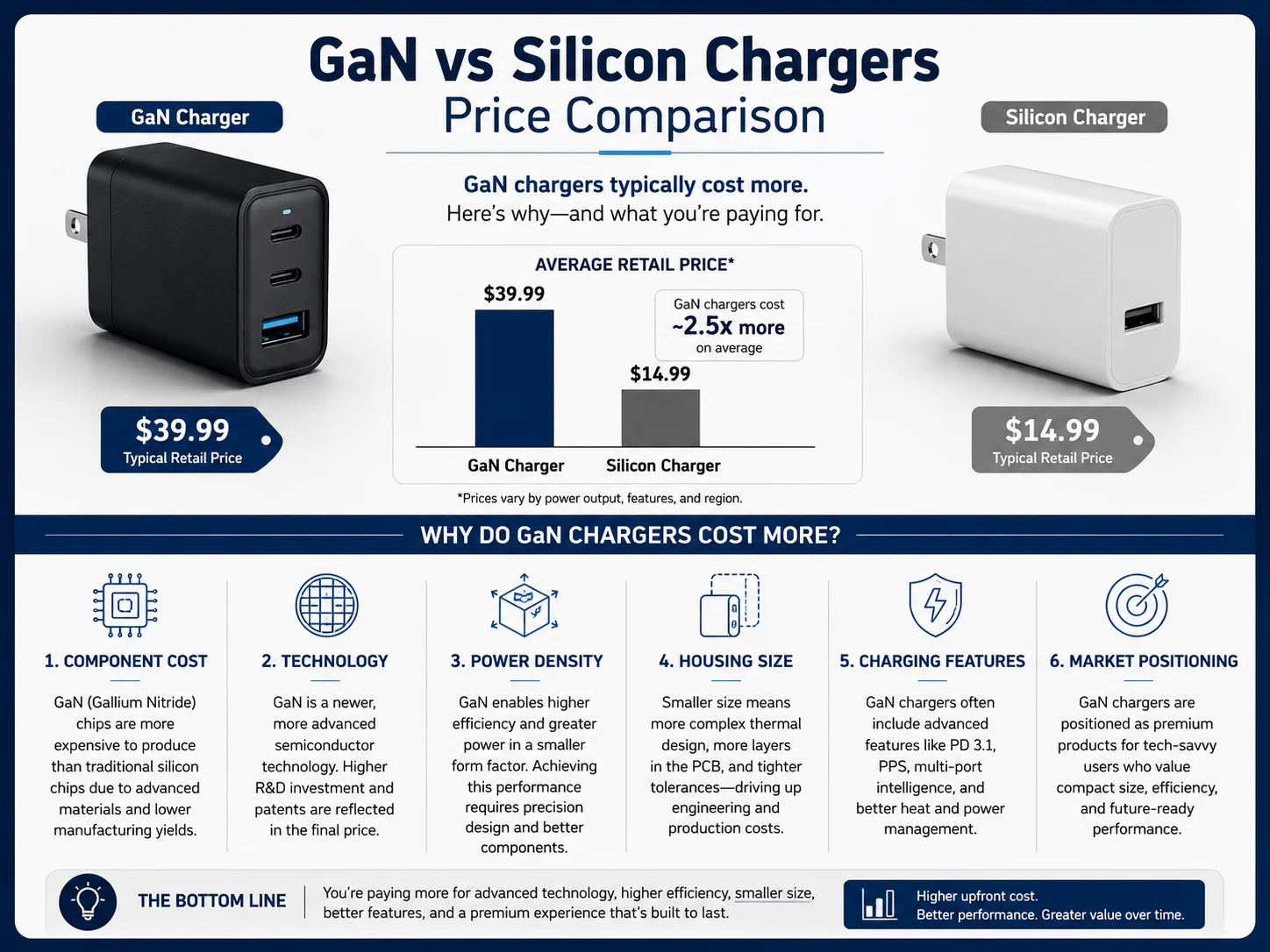
GaN chargers are usually more expensive because they are often designed for compact higher-output, USB-C, or multi-port use cases that require more complex product planning and components.8 Price differences vary by specification, order quantity, certifications, packaging, and port configuration, so buyers should compare equivalent finished products.
Compare Like With Like
A basic 20W single-port silicon charger should not be compared directly with a compact 65W dual-USB-C GaN charger. These products serve different shoppers and carry different expectations.
The total product cost may reflect:
- Higher total output requirements
- USB-C PD or PPS support
- Additional ports
- Multi-port power-management design
- Smaller form factor requirements
- Market-specific plug versions
- Compliance testing and documentation
- Retail packaging and private-label printing
- MOQ and component availability
For retailers, the important question is not “Is GaN more expensive?” The better question is: “Does this SKU provide a customer benefit that supports its retail price?”
Build a Clear Upgrade Path
We often suggest that buyers create a visible price ladder. A shopper should understand why the next charger costs more.
| Product Level | Example Position | Main Customer Message |
|---|---|---|
| Value | 20W single-port charger | Reliable basic charging for one device |
| Upgrade | 30W–45W compact USB-C charger | More flexibility for phones and tablets |
| Premium | 65W+ multi-port charger | Charge several compatible devices with one charger |
This structure helps avoid a shelf filled with products that seem almost identical. It also gives sales staff a simple way to guide customers from a replacement charger to an upgrade charger.
7. Which Charger Is Better for Budget, Mid-Range, and Premium Market Segments?
A mixed customer base needs a mixed product range. If a retailer stocks only premium chargers, price-sensitive customers may leave without buying. If a retailer stocks only entry-level chargers, customers with newer laptops and multi-device needs may look elsewhere.
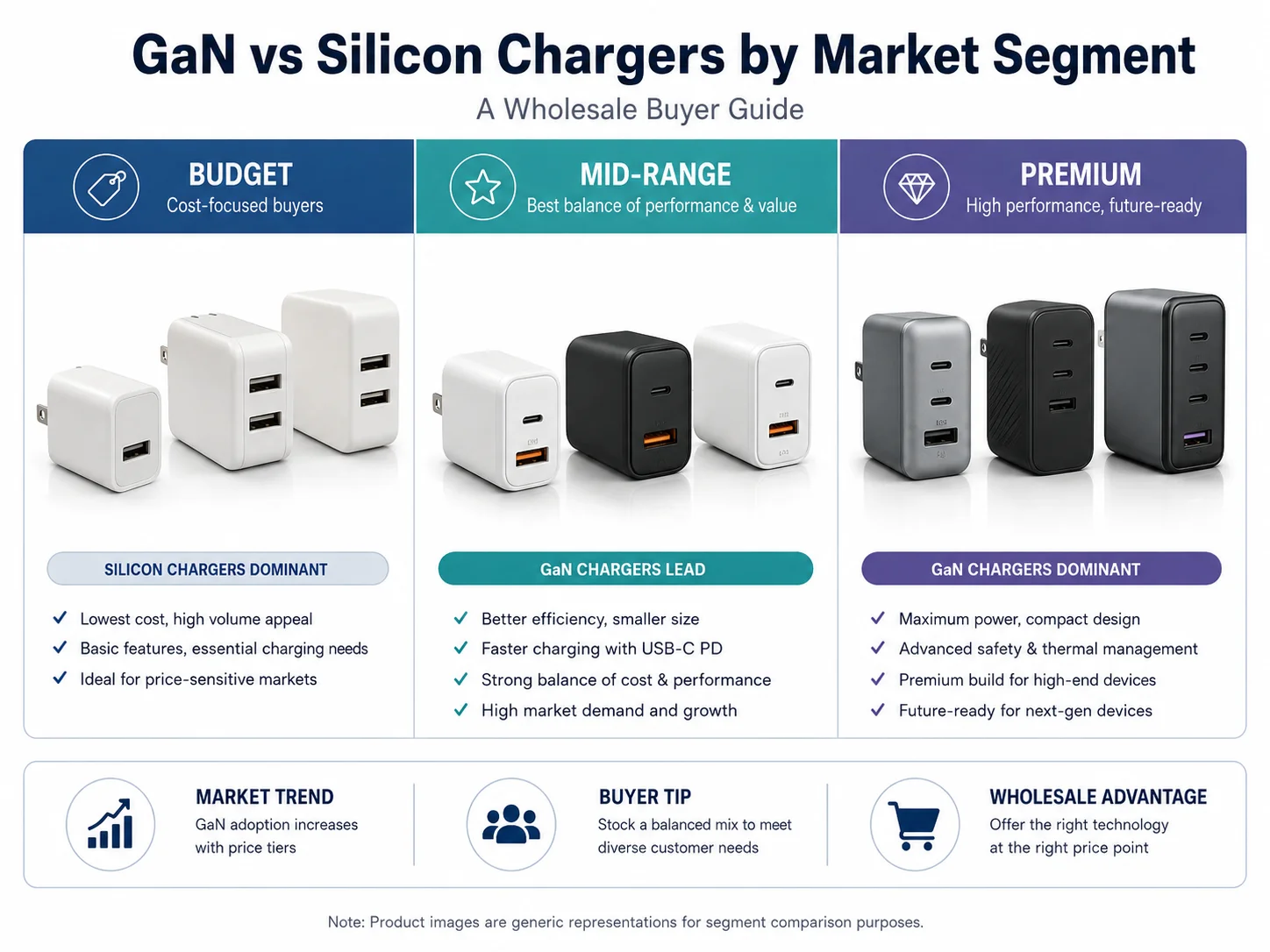
For budget segments, silicon chargers can be a practical choice for simple single-device needs. For mid-range segments, compact GaN chargers can support portable fast-charging positioning. For premium segments, higher-output GaN multi-port chargers may fit well when port allocation, device compatibility, and compliance documentation are clearly explained.
A Three-Tier Assortment Model
We recommend a simple range that customers can understand quickly.
Entry-Level: Basic Single-Device Charging
This tier serves replacement demand and price-conscious shoppers. The focus should be on clear output, practical packaging, and broad compatibility with the intended devices.
Possible examples:
- 10W or 12W USB-A charger
- 18W or 20W single-port charger
- Simple USB-C charger for everyday phone use
Silicon products can have a clear role here. Buyers should still confirm regional requirements, plug options, labeling, and protocol support.
Mid-Range: Portable Upgrade Charging
This tier serves customers who use newer smartphones, tablets, or lightweight laptops. The product should offer a noticeable benefit, such as a compact body, USB-C convenience, or a useful output increase.
Possible examples:
- 30W USB-C GaN charger
- 35W dual-port compact charger
- 45W charger for tablet and selected laptop use
Premium: Multi-Device and Higher-Power Charging
This tier serves travelers, professionals, and users with several devices. Here, the port layout and power-sharing behavior become central.
Possible examples:
- 65W dual USB-C charger
- 65W USB-C + USB-A travel charger
- 100W desktop or travel charging solution
The premium tier needs the clearest product communication. Buyers should show what happens when two or three devices are connected. A customer should not have to guess.
8. How Power Output, Port Configuration, and Device Compatibility Affect Product Choice
A charger’s maximum wattage is only one part of the buying decision. Customers often care more about whether their devices can charge together, whether their cables work, and whether the charger supports their laptop, tablet, or phone.
In GaN vs. silicon chargers, product choice should be based on real device compatibility, required output, port configuration, and simultaneous power allocation. A high-wattage charger is not automatically the best choice if customers only need one phone port, while a multi-port charger needs clear power-sharing information.
Ask These Questions Before Ordering
Before placing a wholesale order, we suggest buyers answer the following questions:
-
Which devices do our customers use most often?
Consider phones, tablets, laptops, earbuds, smartwatches, and power banks. -
Do customers need USB-C, USB-A, or both?
USB-C demand is important, but USB-A can still matter for older accessories and cables.9 -
What output is required from one port?
A customer charging one phone has different needs from a customer charging a laptop. -
What happens when multiple ports are active?
This is essential for dual-port and multi-port products. -
Which charging protocols are relevant?
Device compatibility depends on supported protocols, not only the wattage printed on the charger.10 -
Will the package include a cable?
If yes, the cable must suit the intended charging capability.
Power Sharing Needs a Simple Visual
For multi-port chargers, we recommend adding a small chart to the listing or package insert.
| Use Scenario | Example Output Explanation |
|---|---|
| One USB-C device connected | The port may access the charger’s maximum single-port output |
| USB-C + USB-C connected | Total output is divided according to the product’s power-allocation design |
| USB-C + USB-A connected | Each port receives the designated output available in that combination |
The exact numbers must come from the selected product specification. Buyers should never use generic charts that do not match the actual SKU.
9. How to Build a Balanced GaN and Silicon Charger Inventory
Too many charger SKUs can tie up cash, confuse customers, and create packaging complexity. Too few SKUs can leave important customer needs uncovered. The goal is not to stock every wattage and every port combination.
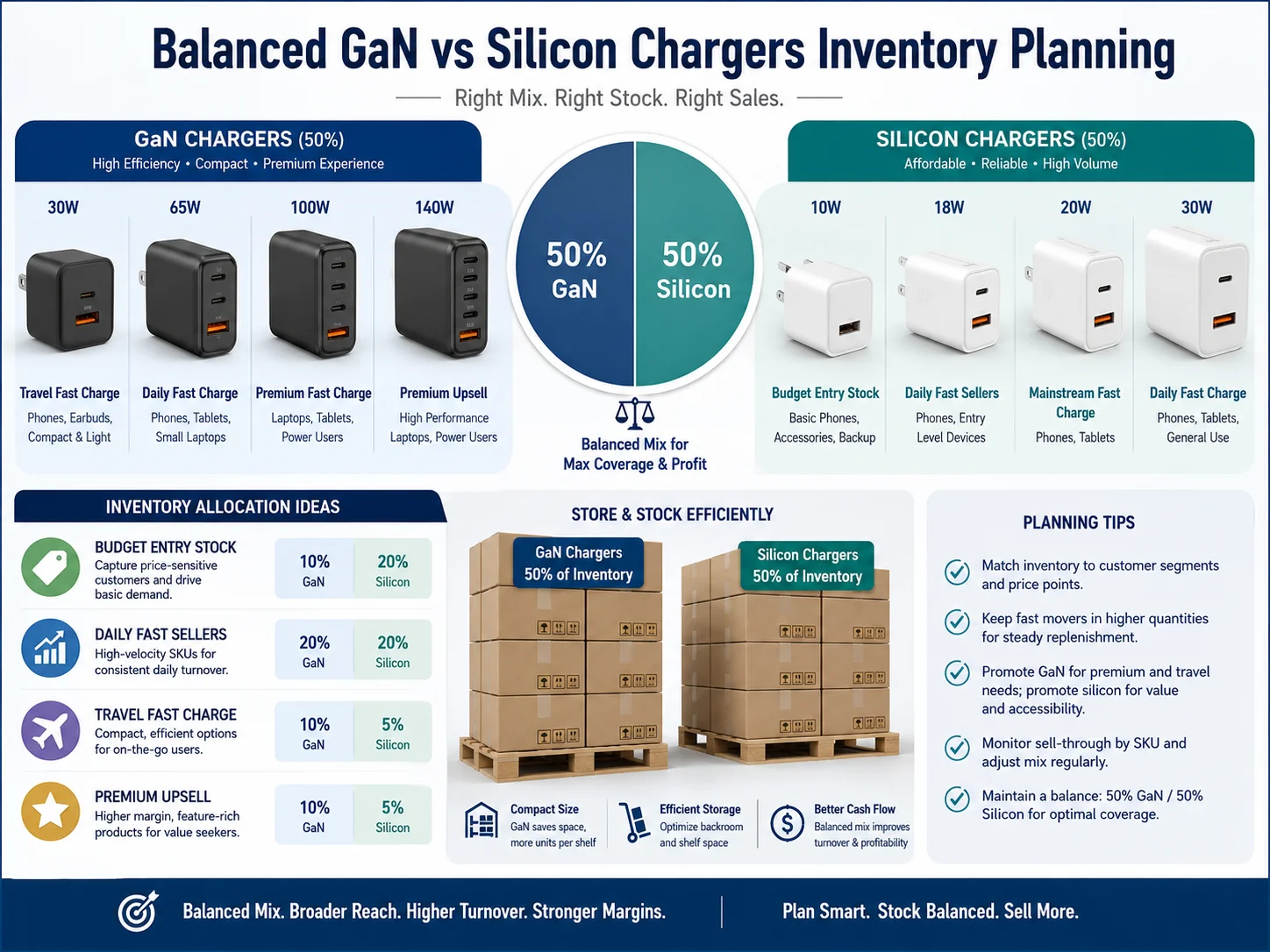
A balanced GaN vs. silicon chargers inventory should include a small number of clearly differentiated SKUs across entry-level, portable upgrade, and multi-device use cases. Retailers should reduce overlap, validate target devices, review compliance documents, and order quantities based on each SKU’s specific role rather than technology hype.
Start With a Small, Clear Range
For many retailers, a practical starting assortment may include:
- One basic single-port value charger
- One USB-C fast-charging phone charger
- One compact 30W–45W upgrade charger
- One 65W multi-port charger
- One higher-output or desktop charging option, if the customer base supports it
This approach creates a clear path without adding unnecessary product overlap.
Use an Inventory Decision Matrix
| SKU Role | Technology Direction | Key Requirement | Inventory Risk |
|---|---|---|---|
| Value replacement charger | Often silicon | Competitive price and simple use | Low when demand is broad |
| Compact travel charger | Often GaN | Small size and useful USB-C output | Medium; needs clear positioning |
| Laptop and phone charger | Often GaN | Verified output and power sharing | Medium; depends on device mix |
| Multi-device desktop charger | GaN or other suitable design | Port layout and total allocation | Higher; needs focused demand |
| Legacy accessory charger | Silicon may fit | USB-A and low-cost compatibility | Depends on local customer base |
I would also advise buyers to plan for packaging localization early. European and North American markets may need different plug versions, language layouts, warning text, and compliance markings.11 These details can affect MOQ, lead time, and carton planning.
10. How Kingfuji Supports Wholesale, OEM, and Private-Label Charger Projects
Choosing the right charger is only the first step. Retailers also need a supplier that can help turn a product idea into a workable SKU with appropriate specifications, packaging, documents, and delivery planning.
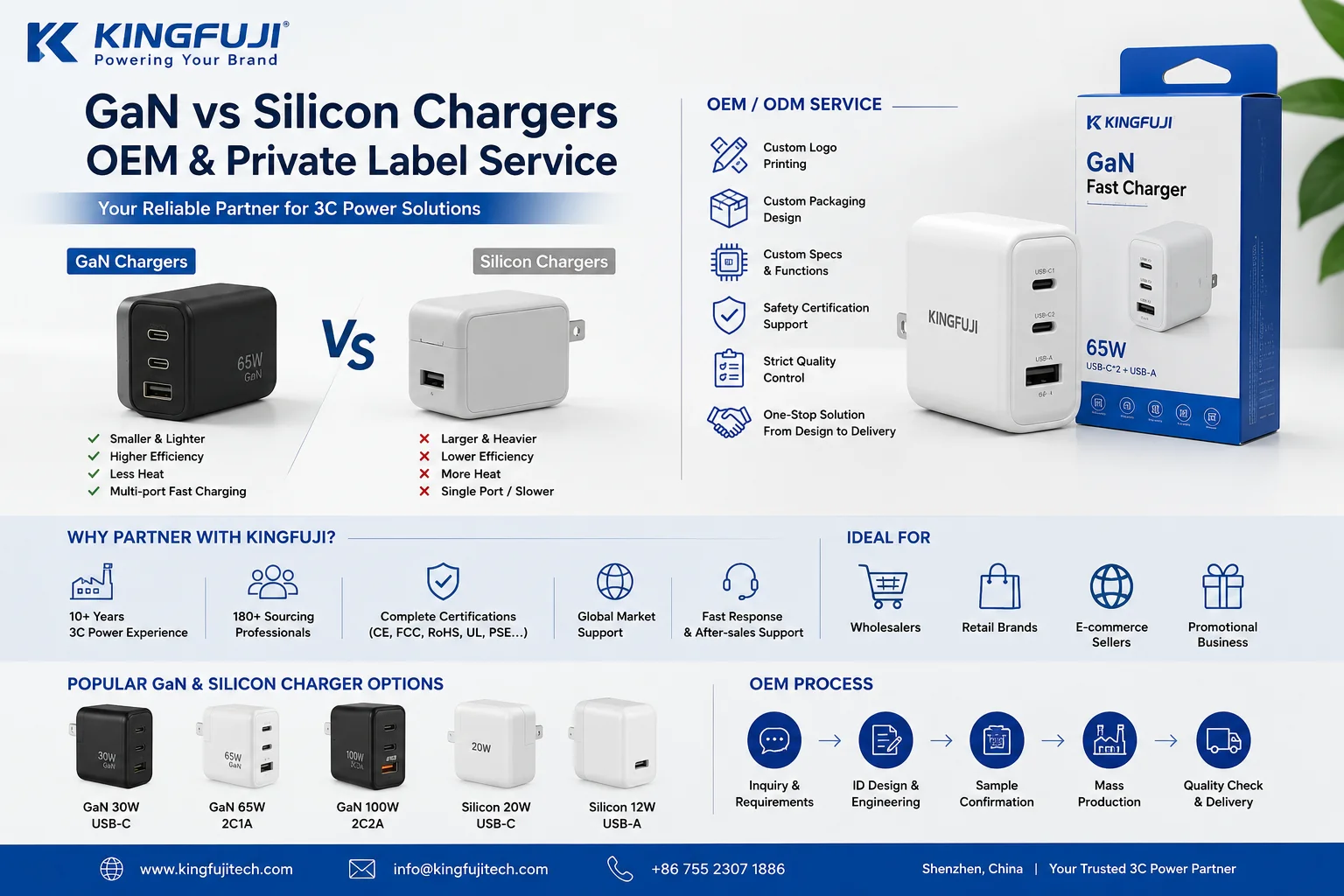
Kingfuji supports GaN vs. silicon chargers projects by helping wholesale buyers match charger specifications to their price band, target devices, port requirements, and branding goals. We can support OEM and private-label projects with product selection, packaging customization, market-oriented documentation review, and export-focused production communication.
Our Practical Starting Point
We are a Shenzhen 3C manufacturer with 15 years of export experience.12 We work with overseas buyers who source USB cables, chargers, GaN chargers, TWS earbuds, smartwatches, and related accessories for Europe and North America.
When buyers ask us whether GaN should replace silicon, we usually begin with a product brief:
- Target market and plug standard
- Target retail price
- Expected order quantity and MOQ range
- Main device categories
- Required ports and output
- Cable-included or charger-only option
- Brand, logo, packaging, and color requirements
- Required compliance documents
- Expected launch timing
OEM and Private-Label Options
Depending on the project, we can discuss options such as:
- Logo printing
- Custom retail packaging
- User manual and insert design
- Cable bundle selection
- Color and housing options
- Plug versions for destination markets
- Barcode, label, and carton-mark customization
- Product specification matching for your assortment
We believe a good charger project starts with realistic positioning. A clear brief helps us recommend products that fit your actual channel instead of simply offering the highest wattage available.
Frequently Asked Questions
Do GaN chargers charge phones faster than silicon chargers?
No, GaN chargers do not automatically charge phones faster. Charging speed depends on the phone’s supported protocol, the charger’s available output, the cable’s capability, and the power-sharing behavior when multiple devices are connected. Buyers should compare complete specifications rather than technology labels alone.
Should I replace all silicon chargers with GaN chargers?
Most retailers do not need to replace all silicon chargers. Silicon products can still serve entry-level, simple, and price-sensitive charging needs. GaN chargers can add value in compact, higher-output, and multi-port segments. A balanced range usually creates fewer gaps than a full replacement strategy.
What GaN charger wattage should I stock first?
Many retailers start with a compact 30W–45W charger and a 65W multi-port option, alongside entry-level products. The best wattage depends on your customers’ devices, target price, and desired ports. You should review single-port and multi-port output before choosing.
Why does a 65W charger not always give 65W to every port?
A charger’s rated wattage is usually its maximum available output under a defined condition. When multiple devices connect, the charger divides power according to its internal power-allocation design. Buyers should request an accurate output chart for each port combination before listing the product.
What documents should charger importers review?
Importers should review the documentation required for their destination market, product category, plug type, and sales channel. Requirements vary. Buyers should also check product labeling, test reports, declarations, packaging information, and any retailer-specific compliance requirements before placing a large order.
Conclusion
GaN vs. silicon chargers should be treated as an assortment decision, not a technology battle. Silicon chargers can support affordable, simple charging needs, while GaN chargers can fit compact fast-charging, higher-output, and multi-device product roles. We recommend building a focused three-tier range, checking device compatibility and power sharing, and reviewing compliance requirements before ordering. If you need a wholesale, OEM, or private-label charger plan for your market, contact Kingfuji to discuss your target SKU range.
"Ultra-dense Power Converters", https://arpa-e.energy.gov/programs-and-initiatives/search-all-projects/ultra-dense-power-converters. GaN power transistors can switch efficiently at higher frequencies than conventional silicon power devices, allowing power converters to use smaller passive components and potentially achieve higher power density. Evidence role: mechanism; source type: research. Supports: GaN power devices can operate at high switching frequencies and support higher power density, which can enable smaller power-conversion systems.. Scope note: This mechanism enables compact designs but does not establish that every finished GaN charger is smaller or higher powered than every silicon charger. ↩
"USB Charger (USB Power Delivery)", https://www.usb.org/usb-charger-pd. USB Power Delivery defines a source–sink negotiation process through which compatible devices establish the voltage and current power contract used for charging. Evidence role: mechanism; source type: institution. Supports: USB Power Delivery uses communication between source and sink to negotiate an available power contract.. Scope note: The negotiated result also depends on the specific charger, device, cable, and implemented USB Power Delivery revision. ↩
"Product Search", https://www.usb.org/products. USB Type-C and USB Power Delivery specifications distinguish cable current capabilities; higher-current operation may require an electronically marked cable so that the power source can identify the cable’s rating. Evidence role: mechanism; source type: institution. Supports: USB Type-C cables have current capabilities, and cables supporting higher current can require electronic marking.. Scope note: Cable rating is only one constraint, since the charger and receiving device must also support the requested power mode. ↩
"[Datapoints Welcome] List of USB-C GaN Chargers that renegotiates ...", https://www.reddit.com/r/UsbCHardware/comments/1c0ljdm/datapoints_welcome_list_of_usbc_gan_chargers_that/. In multi-output charging systems, the available input and converter power budget must be managed across connected loads, so per-port output can change with the active port combination. Evidence role: general_support; source type: research. Supports: Multi-output USB charging systems must manage a finite total power budget and can assign different output levels as connected loads change.. Scope note: The exact allocation rules and any brief renegotiation behavior are specific to the charger’s circuitry and published output table. ↩
"Batteries | CPSC.gov", https://www.cpsc.gov/Regulations-Laws--Standards/Voluntary-Standards/Topics/Batteries. Electrical products marketed in the European Union must meet applicable Union harmonisation requirements and undergo the relevant conformity-assessment and CE-marking process; comparable safety requirements may also apply in North American jurisdictions. Evidence role: general_support; source type: government. Supports: Electrical products placed on major regional markets can be subject to conformity, safety, labeling, and documentation requirements.. Scope note: The exact obligations depend on the charger, destination country, sales channel, applicable standards, and whether the product is sold with other equipment. ↩
"Stability, growth, and doping of In2(Si, Ge)2O7", https://docs.nrel.gov/docs/fy25osti/96520.pdf. Research on GaN power electronics reports that their high-frequency switching capability can reduce the size of magnetic and filtering components and support increased converter power density. Evidence role: mechanism; source type: research. Supports: GaN devices' switching characteristics can reduce conversion losses and passive-component size in appropriately designed power converters.. Scope note: Potential power-density benefits depend on topology, thermal design, component selection, and operating conditions of the finished charger. ↩
"A State-of-the-Art Review of Smartphone Battery and Energy ...", https://www.academia.edu/54891199/Power_Consumption_Analysis_Measurement_Management_and_Issues_A_State_of_the_Art_Review_of_Smartphone_Battery_and_Energy_Usage. USB Power Delivery is negotiated between the power source and sink, with the sink requesting a supported power profile rather than passively receiving the charger’s maximum advertised wattage. Evidence role: mechanism; source type: institution. Supports: Under USB Power Delivery, the receiving device communicates its requested power capabilities and the source supplies an agreed contract.. Scope note: Some phones use proprietary charging schemes or additional battery-management limits that are outside the USB Power Delivery framework. ↩
"Development of GaN-Based, 6.6 kW, 450 V, Bi-Directional On ...", https://pmc.ncbi.nlm.nih.gov/articles/PMC11679712/. Comparative analyses of GaN and silicon power converters identify trade-offs between semiconductor cost and system-level design benefits, including switching frequency, passive-component requirements, and thermal performance. Evidence role: general_support; source type: paper. Supports: Studies comparing GaN and silicon power conversion discuss trade-offs among device cost, switching frequency, passive-component size, thermal design, and system-level cost.. Scope note: Such analyses do not prove a uniform retail-price premium, because finished-charger prices also vary with volume, brand, ports, certification, and distribution. ↩
"USB hardware", https://en.wikipedia.org/wiki/USB_hardware. USB Type-C was developed as a newer reversible connector while existing USB Type-A and other legacy connectors continued to be used by earlier peripherals, cables, and host equipment. Evidence role: historical_context; source type: institution. Supports: USB Type-C was introduced alongside existing USB connector types, and legacy USB Type-A devices and cables remain part of the broader USB ecosystem.. Scope note: The continuing retail importance of USB-A varies by region, customer segment, and the age of the installed device base. ↩
"Quick Charge", https://en.wikipedia.org/wiki/Quick_Charge. USB charging standards specify protocol-based communication and allowable power profiles, so nominal charger wattage alone does not determine the charging mode a connected device can use. Evidence role: mechanism; source type: institution. Supports: USB charging standards define communication and power-profile rules in addition to maximum power ratings.. Scope note: Devices may also support proprietary protocols, and actual charging behavior can differ by device firmware, battery state, temperature, and cable. ↩
"FTC Seeks Public Comments on Review of Labeling ...", https://www.ftc.gov/news-events/news/press-releases/2023/10/ftc-seeks-public-comments-review-labeling-requirements-alternative-fuels-rule. European Union product rules require applicable conformity marking and safety information for regulated electrical equipment, while North American requirements are administered through separate national and subnational regulatory frameworks. Evidence role: general_support; source type: government. Supports: Market-access rules can require region-specific conformity marking, safety information, and consumer-facing labeling for electrical products.. Scope note: Specific language, warning, plug, and marking requirements vary by destination country, product classification, and applicable legislation or standards. ↩
"How to Audit a 3C Electronics Factory in China: A Practical Checklist ...", https://kingfujitech.com/how-to-audit-a-3c-electronics-factory-in-china-a-practical-checklist-for-buyers/. Company-registration records or independently verifiable corporate documentation should be used to substantiate the manufacturer’s registered location, business scope, and stated export experience. Evidence role: case_reference; source type: other. Supports: An authoritative company record, business registration, or independently verifiable corporate profile should confirm the company’s location, manufacturing activity, and export history.. Scope note: A company’s own website or marketing materials can describe its history but are not independent verification of the stated duration or export volume. ↩