Cheap Apple cables look easy to buy. Then complaints, returns, and unclear certification can turn one container into a painful sourcing mistake.
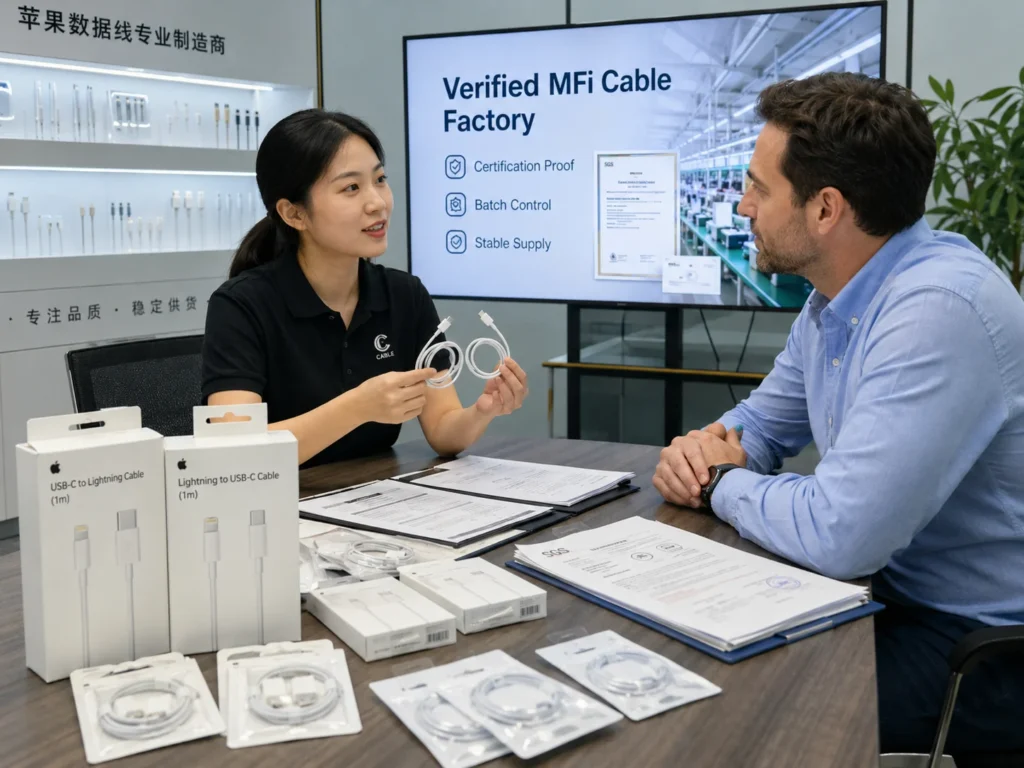
Wholesale buyers should source Apple cables from verified MFi cable factories because certification proof, batch control, and supplier responsibility reduce resale risk, customer complaints, and channel problems. The goal is not only a working sample. The goal is stable supply that can be sold again and again.
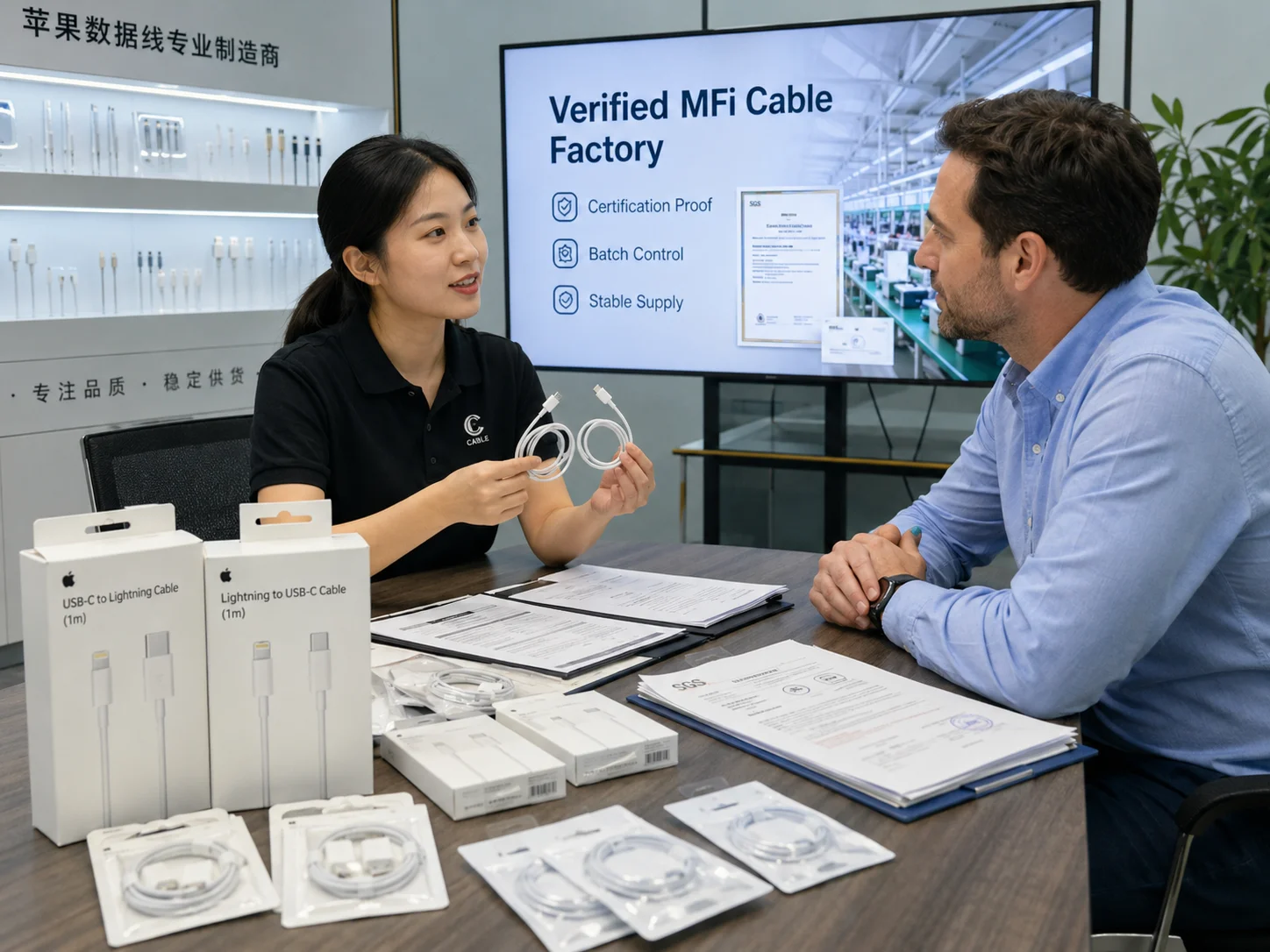
I work with European and American buyers who often ask price first. I understand that. Price matters in wholesale. But I have also seen buyers return to the same question later: “Can I sell this cable safely in my channel?” That question is more useful than asking only for the lowest quote.
1. What Is MFi Certification and Why Does It Matter for Apple Cables?
Many buyers see “compatible with iPhone” and feel safe. That can be a problem when the claim is only marketing and not verifiable.
MFi certification is Apple’s licensing program for certain accessories made for Apple devices.1 For wholesale cable buyers, it matters because it helps separate verified Apple accessory sourcing from loose compatibility claims2 that may create resale, packaging, and customer support risks.
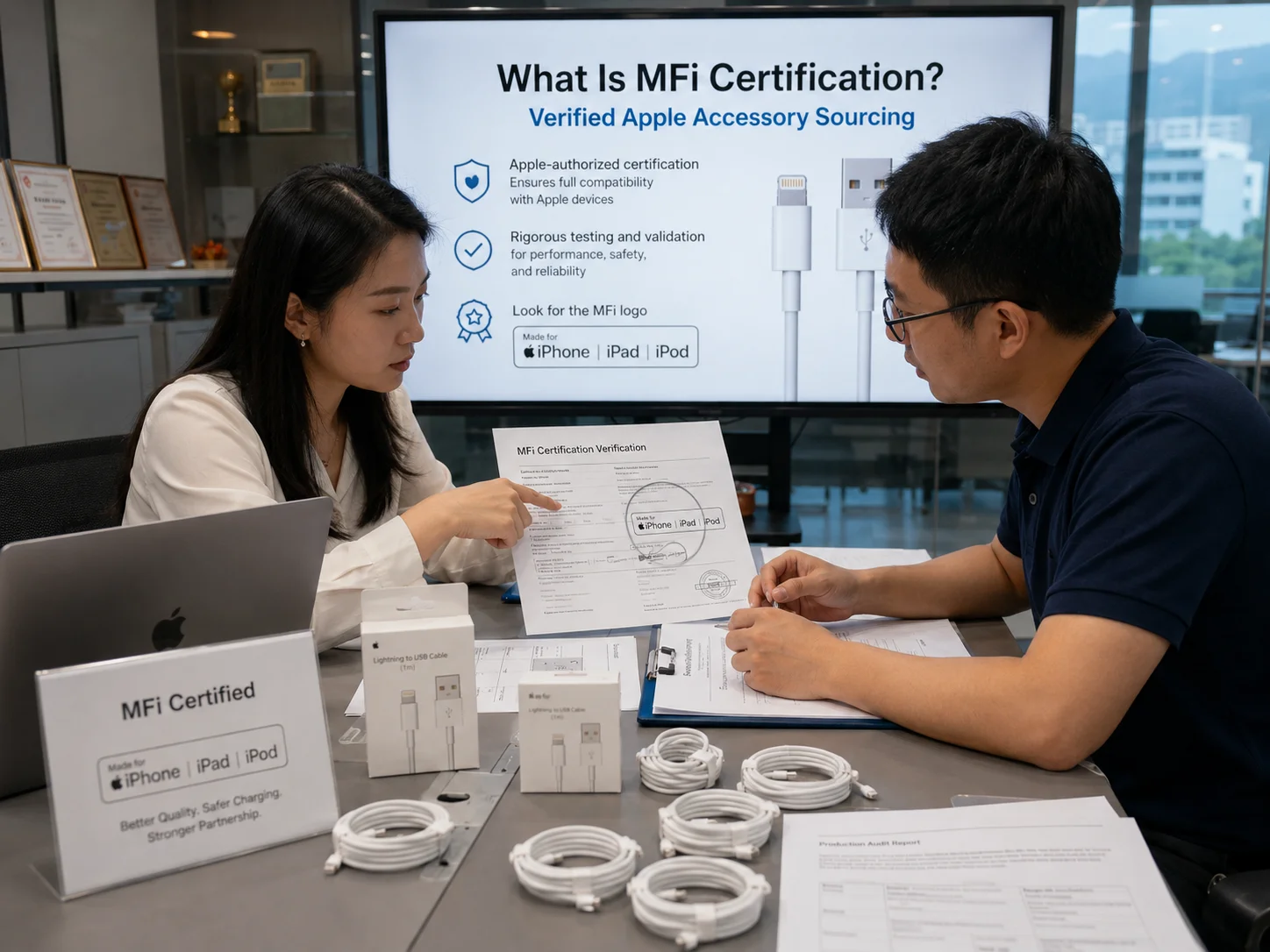
MFi Is a Sourcing Filter, Not Just a Logo
In my daily communication with buyers, I often hear one sentence first: “Send me your best price for iPhone cable.” I usually ask one more question: “Do you need MFi certified cable, or do you only need a compatible cable?” This small question changes the whole order.
A cable can charge an iPhone during a sample test. That does not mean the cable has verified MFi status.3 A sales page can write “for iPhone.” That does not mean it is MFi certified. A supplier can say “same quality.” That does not mean the buyer can use MFi claims on packaging or sales listings.
| Buyer Question | Better Sourcing Check |
|---|---|
| Does the sample charge? | Can the batch perform consistently? |
| Is it for iPhone? | Is the certification claim verifiable? |
| Is the price low? | Can I resell it without channel complaints? |
| Can I print my brand? | Can I make legal and accurate packaging claims? |
Why It Matters in Wholesale
Wholesale buyers do not buy one cable. They buy cartons, pallets, and repeat orders. One small issue becomes large when it appears across thousands of units. MFi certification does not remove every possible quality issue.4 But it gives buyers a better starting point. It helps buyers ask clearer questions. It also helps buyers avoid suppliers who use Apple-related words too casually.
When I advise buyers, I do not say every non-MFi cable is useless. Some channels accept compatible cables if claims are clear and expectations are set. But if a buyer sells through retail chains, Amazon, branded e-commerce, or strict import channels, MFi sourcing becomes a serious risk-control step.
2. Why Selling Uncertified Apple Cables Is Risky for Wholesale Buyers?
A cheap uncertified cable can look profitable at first. Then one bad review pattern can reduce margin faster than the low cost saved.
Selling uncertified Apple cables is risky because wholesale buyers may face higher return rates, unclear product claims, listing issues, customer complaints, and unstable repeat supply.5 The main risk is not only whether one cable works. The risk is whether the whole batch can be sold without problems.
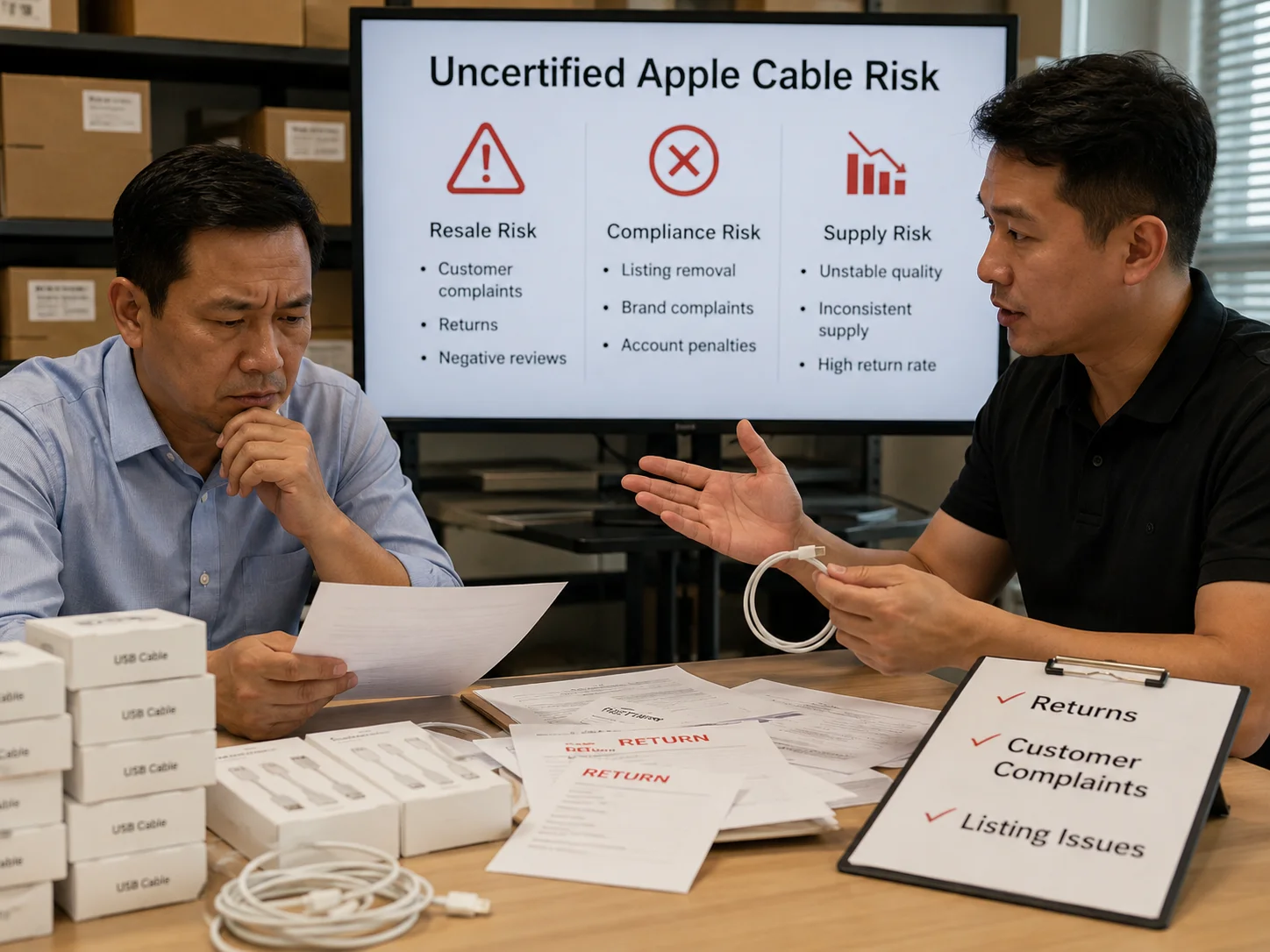
The Real Risk Starts After Delivery
Many buyers test one sample. The sample works. The order looks simple. The purchase order is placed. The cartons arrive. Then the real test begins. End users use the cable with different iPhone models, different adapters, different car chargers, and different daily habits.6 A problem that did not appear in one sample can appear in the market.
In our buyer communications, I often see this order path:
| Stage | Buyer Focus | Hidden Risk |
|---|---|---|
| Inquiry | Lowest unit price | Supplier may reduce material or control |
| Sample | One cable works | Sample may not represent full batch |
| Bulk order | Fast delivery | Batch consistency may be weak |
| Sales | Good photos and claims | Certification wording may be unsafe |
| After-sales | Low returns | Supplier may not take responsibility |
Common Buyer Pain Points
Uncertified cables can create several issues. Some buyers get customer complaints about charging stability. Some sellers worry about marketplace listing wording. Some importers find that packaging claims are too strong. Some retailers ask for proof after the order has shipped. At that point, the buyer has fewer options.
I also see another problem. A supplier may say, “No problem, it is compatible.” But the buyer needs more than a sentence. The buyer needs clear responsibility. Who made the cable? Who controls the connector source? Who handles after-sales? Who supports repeat orders? Who gives accurate product information?
Uncertified Does Not Always Mean Bad
I want to be fair. Not every non-MFi cable is poor quality. Some buyers choose non-MFi compatible cables for price-sensitive channels. That can work when the product claim is honest and the channel accepts it. But buyers should not treat uncertified cables as equal to MFi cables. The sourcing plan should match the channel. A low-price promotional market has different needs than a branded retail chain.
3. MFi Certified vs Non-Certified Cables: Key Differences Buyers Should Know?
Two cables can look the same in a product photo. The real difference appears in proof, consistency, claims, and buyer protection.
MFi certified cables offer verifiable sourcing support for Apple accessory claims, while non-certified cables usually rely on general compatibility claims.7 Buyers should compare certification proof, batch control, packaging language, after-sales support, and channel requirements before choosing either option.
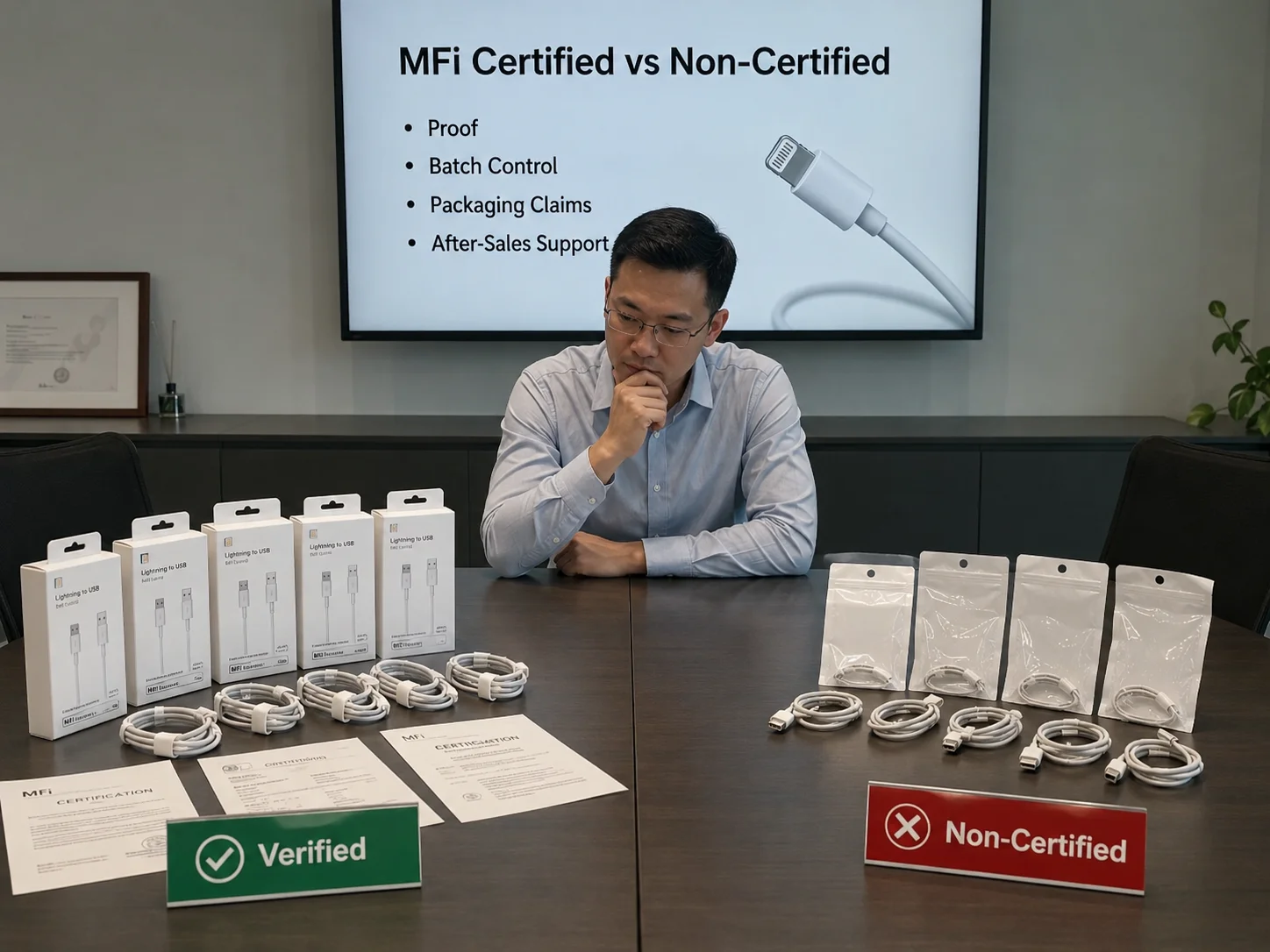
The Product Photo Does Not Tell the Whole Story
When a buyer compares two cable photos, both may look clean. Both may have braided jackets. Both may show fast charging wording. Both may have nice retail packaging. The key difference is not always visible. The key difference is what the supplier can prove and support.
| Item | MFi Certified Cable | Non-Certified Compatible Cable |
|---|---|---|
| Certification claim | Should be verifiable | Usually not verifiable |
| Packaging wording | Must be more controlled | Often uses loose wording |
| Buyer confidence | Higher for strict channels | Depends on buyer channel |
| Cost | Usually higher | Usually lower |
| Risk level | Lower when verified | Higher if claims are unclear |
| Repeat supply | More structured when factory is stable | Can vary by supplier |
How I Explain This to Buyers
I usually tell buyers to think about the sales channel first. If the buyer sells to chain stores, brand owners, or higher-end e-commerce customers, MFi certified cables are easier to defend. If the buyer sells to price-sensitive wholesale markets, a non-MFi cable may fit, but the buyer should avoid overclaiming.
The difference also affects after-sales. If a customer says, “This cable does not work well with my iPhone,” the seller needs a clear answer. With verified MFi sourcing, the seller has stronger support from the supply side. With non-certified cables, the seller may still solve the issue, but the proof base is weaker.
A Simple Decision Table
| Your Channel | Recommended Direction |
|---|---|
| Amazon or branded online store | Verify MFi options first |
| Retail chain or supermarket | Use certified or carefully verified supply |
| Discount wholesale channel | Compatible may work with clear claims |
| Corporate gift channel | Check branding, claims, and return risk |
| Repeat private label business | Prioritize stable factory sourcing |
Price matters. But resale safety matters too. I prefer to help buyers compare total risk, not only unit cost.
4. What Are C94 Connectors and Why Are They Important?
Some buyers hear C94 in supplier quotes and feel lost. The term sounds technical, but the buying point is simple.
C94 is commonly discussed in the Apple Lightning cable supply chain as a connector-related specification for certain MFi cable products.8 Buyers should not rely only on the term. They should ask suppliers to explain the product version, certification status, and proof before placing bulk orders.
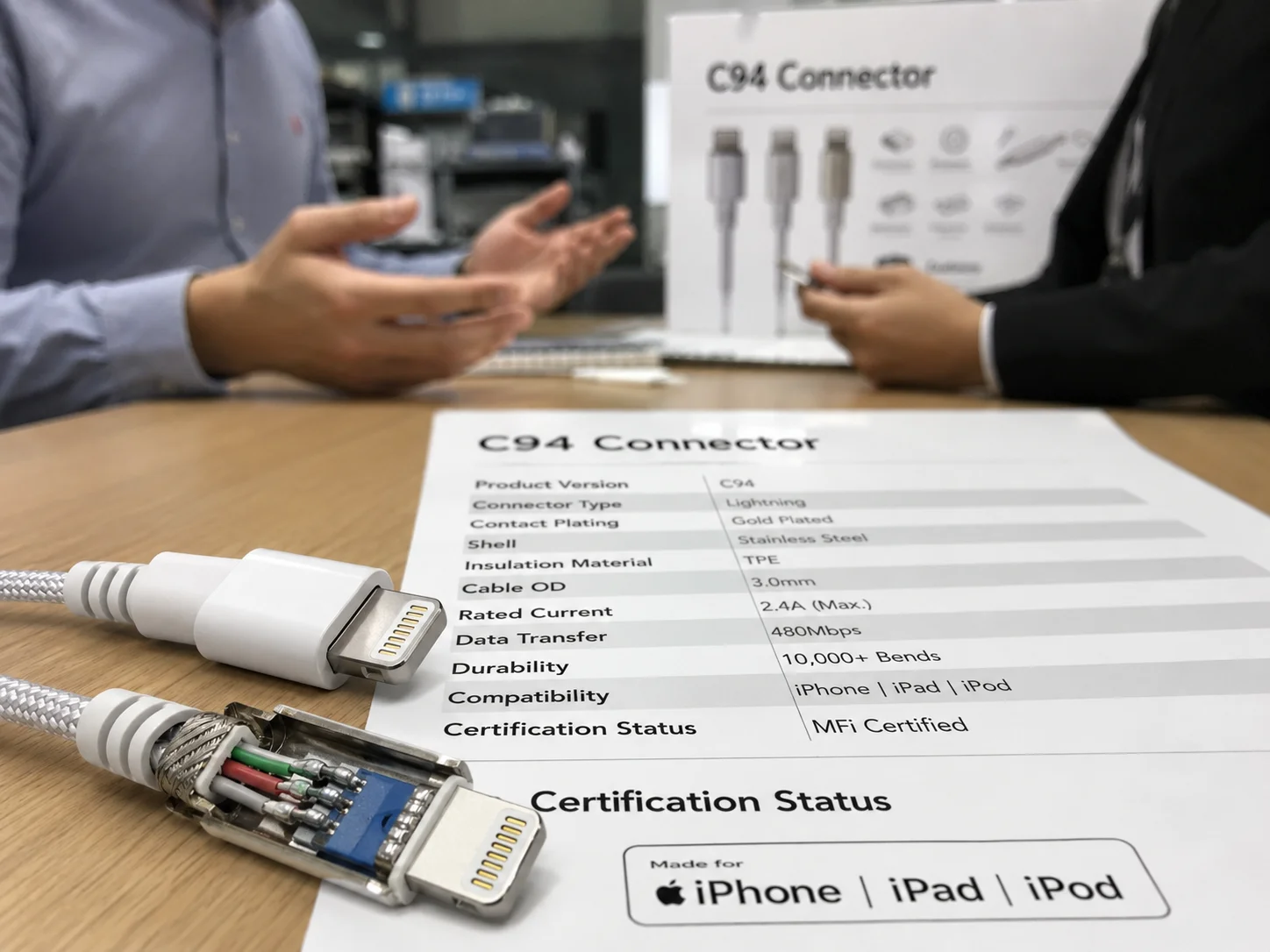
Buyers Should Treat C94 as a Verification Topic
I do not advise buyers to make a chip-level decision without verified technical support. I am not an Apple lab. I am not writing this as an Apple engineer. I am writing this from the sourcing side. When a supplier mentions C94, the buyer should ask what it means for that product, that quote, and that order.
Some suppliers use technical words to sound professional. Some suppliers use them correctly. Some buyers repeat the word without checking the product details. That is risky. The buyer should connect every technical term to a clear commercial answer.
| Supplier Says | Buyer Should Ask |
|---|---|
| “We use C94.” | Is this product MFi certified and verifiable? |
| “It is original.” | What proof can you provide? |
| “It supports iPhone.” | Which models and charging performance are covered? |
| “Same as MFi.” | Is it actually MFi certified or only compatible? |
| “No issue.” | What is the warranty and complaint process? |
Why It Matters for Wholesale Orders
A wholesale buyer needs stable repeat production. If one batch uses one connector source and the next batch uses another, the buyer may face different performance and complaint levels.9 This is why I ask suppliers about production control and order responsibility. The connector term matters because it affects how the cable is positioned, quoted, and supported.
For buyers, the main point is not to memorize every component name. The main point is to stop vague conversations. A buyer should not accept only “good quality” or “works with iPhone.” A buyer should ask for specific product documents, exact packaging wording, sample approval, batch standard, and after-sales terms.
When a buyer understands this, the negotiation becomes healthier. The buyer can still ask for competitive pricing. But the buyer also protects the sales channel.
5. How to Verify an MFi Certified Cable Manufacturer?
Many suppliers can say they are verified. A serious buyer should check the proof before money leaves the account.
To verify an MFi certified cable manufacturer, buyers should request relevant MFi proof, confirm company and product information10, check whether the supplier controls production or only trades, review packaging claims, test samples, and confirm after-sales responsibility in writing before bulk production.
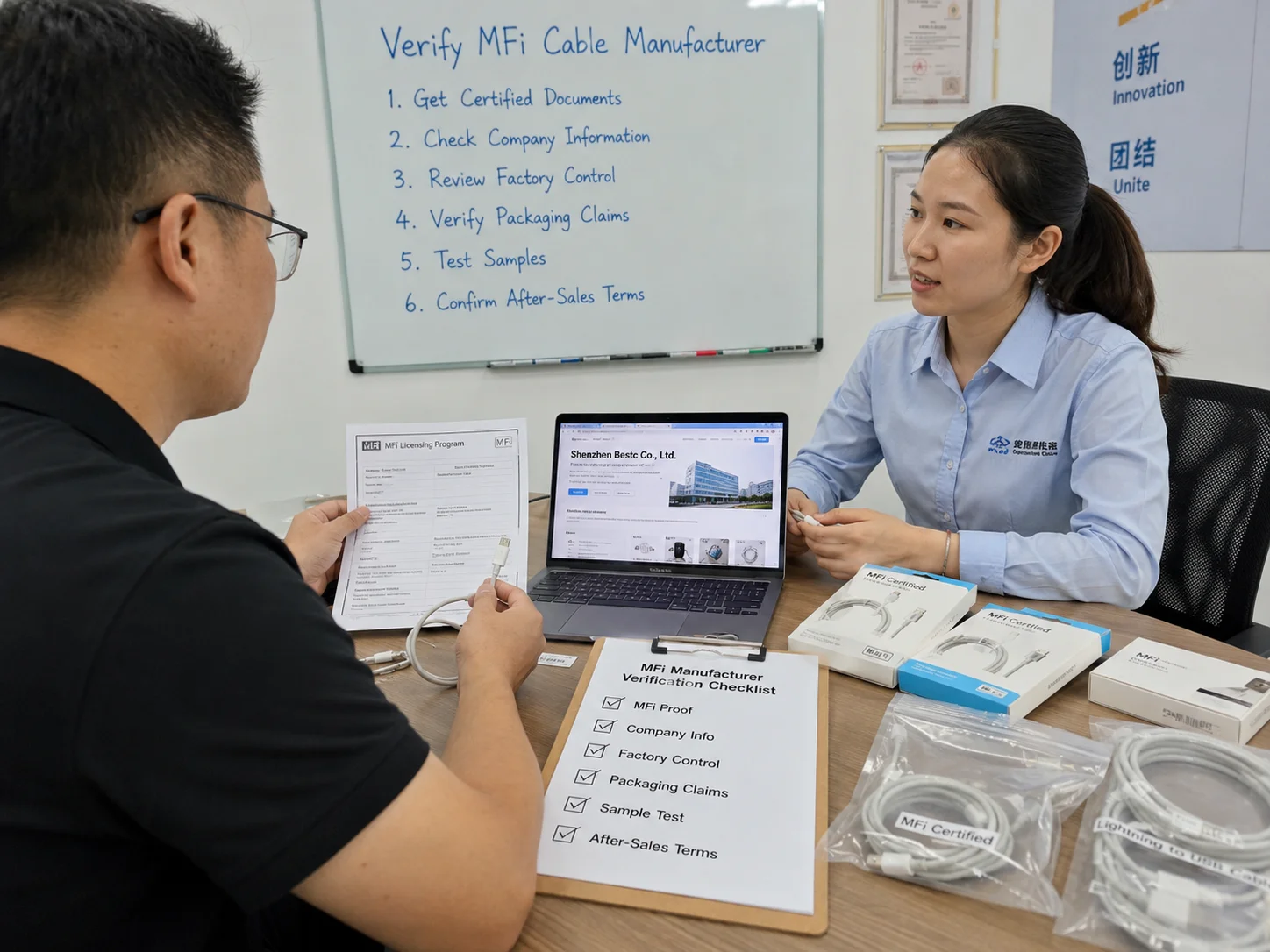
My Practical Verification Checklist
I always prefer a step-by-step check. It does not need to be complicated. It only needs to be clear. A buyer should not rely on one PDF, one screenshot, or one sales sentence. The buyer should match the document, product, factory role, packaging claim, and order terms.
| Verification Step | What Buyer Should Check |
|---|---|
| MFi-related proof | Does the proof match the product and supplier claim? |
| Supplier identity | Is the company name clear and consistent? |
| Factory role | Is the supplier the factory, authorized source, or trading partner? |
| Product details | Does the sample match the quoted specification? |
| Packaging wording | Are Apple-related claims accurate and allowed? |
| Bulk control | Is there a standard for inspection and defect handling? |
| After-sales | Who pays or replaces if a real batch issue appears? |
Ask Better Questions
I recommend buyers ask simple but direct questions. “Can you provide proof for this exact MFi cable model?” “Who is responsible for production?” “Can I use this claim on my packaging?” “Will the bulk order match the approved sample?” “What happens if customers report repeated charging problems?”
These questions reduce confusion. They also show whether the supplier is professional. A strong supplier will answer with structure. A weak supplier may only say, “Trust me, we sell many.” That is not enough for a wholesale buyer.
Verification Is Not Distrust
Some buyers worry that too many questions hurt the supplier relationship. I do not think so. A good supplier understands risk. A good buyer also understands risk. Verification protects both sides. It helps prevent wrong expectations before production starts.
In our Shenzhen 3C export work, we deal with USB cables, chargers, GaN chargers, TWS earphones, smart watches, and other products. I have learned that documents, samples, and written terms save time later. They make the order easier to repeat.
6. MFi Cable Cost, MOQ, Lead Time, and Wholesale Pricing Explained?
Some buyers reject MFi cables after seeing the first quote. But the better question is why the cost is different.
MFi cable pricing is affected by certification-related costs, connector source, cable material, packaging, order quantity, inspection standard, and lead time.11 Wholesale buyers should compare total resale risk and repeat-order stability, not only the unit price on the first quotation.
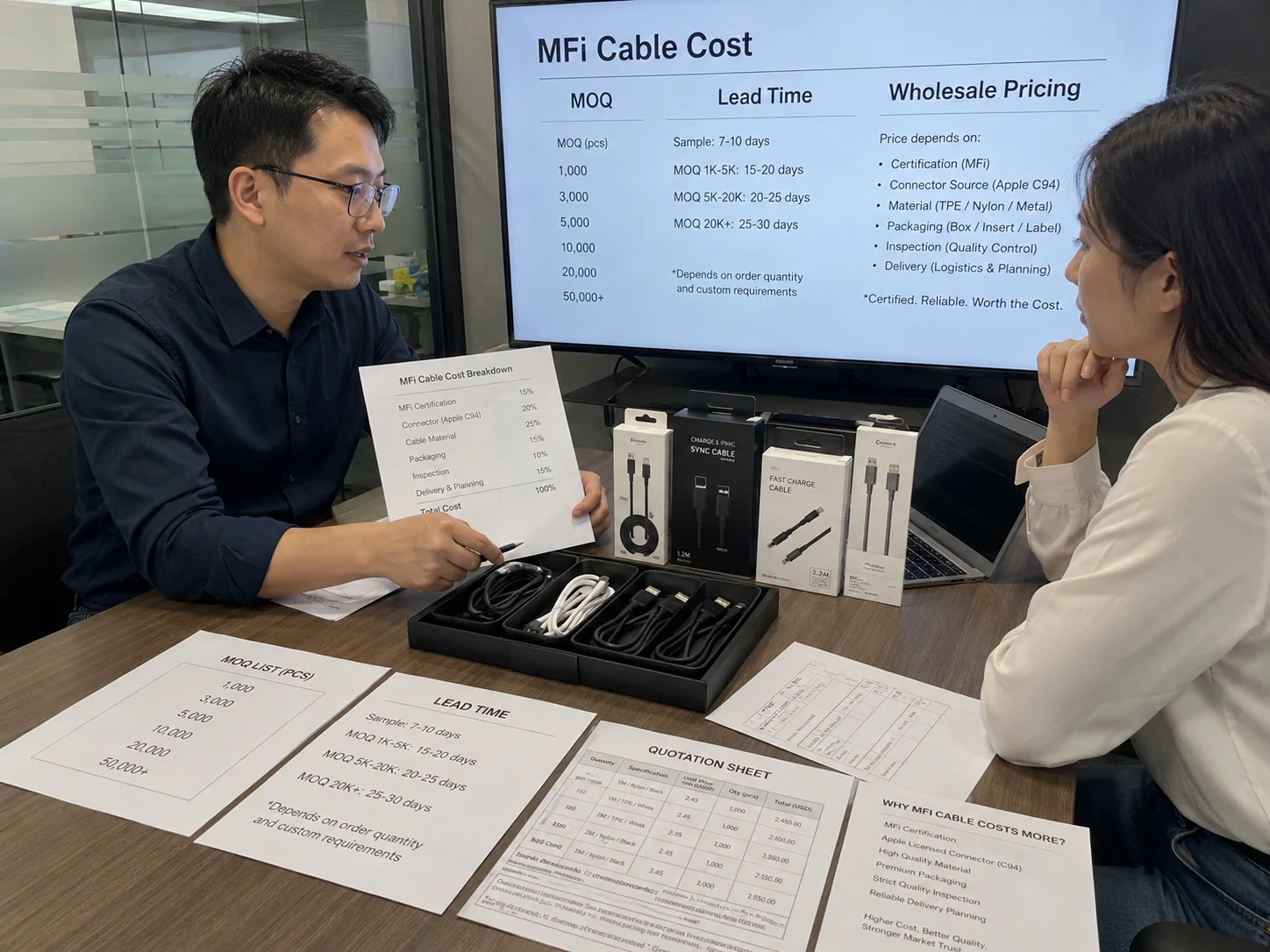
Why MFi Cables Usually Cost More
A buyer may receive two quotes. One quote is much lower. One quote is for an MFi certified option. The difference may look too big. But the quote is not only about copper, PVC, or braided material. It can include verified sourcing, controlled components, documentation, production standards, and lower channel risk.
| Cost Factor | Why It Matters |
|---|---|
| Certification-related sourcing | It supports verified product positioning |
| Connector and component control | It affects stability and repeat supply |
| Cable material | It affects durability and user experience |
| Packaging | It affects retail value and claim risk |
| MOQ | It affects factory production efficiency |
| Lead time | It affects delivery planning and inventory |
| Inspection | It affects defect rate and after-sales cost |
MOQ and Lead Time Need Context
MOQ is not just a supplier rule. MOQ often comes from material purchase, production setup, packaging printing, and factory scheduling.12 If a buyer wants private label packaging, special color, special length, or mixed SKU orders, MOQ may change. A lower MOQ may be possible for standard stock or neutral packaging. A private label MFi cable order may need more planning.
Lead time also needs a clear conversation. A supplier may quote fast delivery for samples but need more time for bulk production. A buyer should ask for a realistic timeline: sample time, packaging confirmation time, production time, inspection time, and shipping time.
How I Suggest Buyers Compare Quotes
I suggest buyers compare quotes in one table. A very low price is not always bad. But if the low price comes with no proof, unclear packaging, weak warranty, and no batch standard, the real cost may become higher later.
| Quote Item | Supplier A | Supplier B |
|---|---|---|
| Unit price | Low | Higher |
| MFi proof | Unclear | Verifiable |
| MOQ | Flexible | Standard |
| Packaging support | Basic | Retail-ready |
| Lead time | Fast promise | Confirmed schedule |
| Warranty | Verbal | Written |
| Repeat supply | Unknown | More stable |
This table makes the decision more practical. It also helps purchasing teams explain why they did not choose only the lowest price.
7. How MFi Certification Protects Your Brand, Customers, and Retail Channels?
A cable problem is not only a product problem. It can become a brand problem when the customer blames the seller.
MFi certification helps protect buyers by supporting clearer product claims, reducing compatibility-related complaints, improving buyer confidence, and making retail or e-commerce channels easier to manage. It works best when buyers also verify the supplier, batch standard, packaging, and after-sales terms.
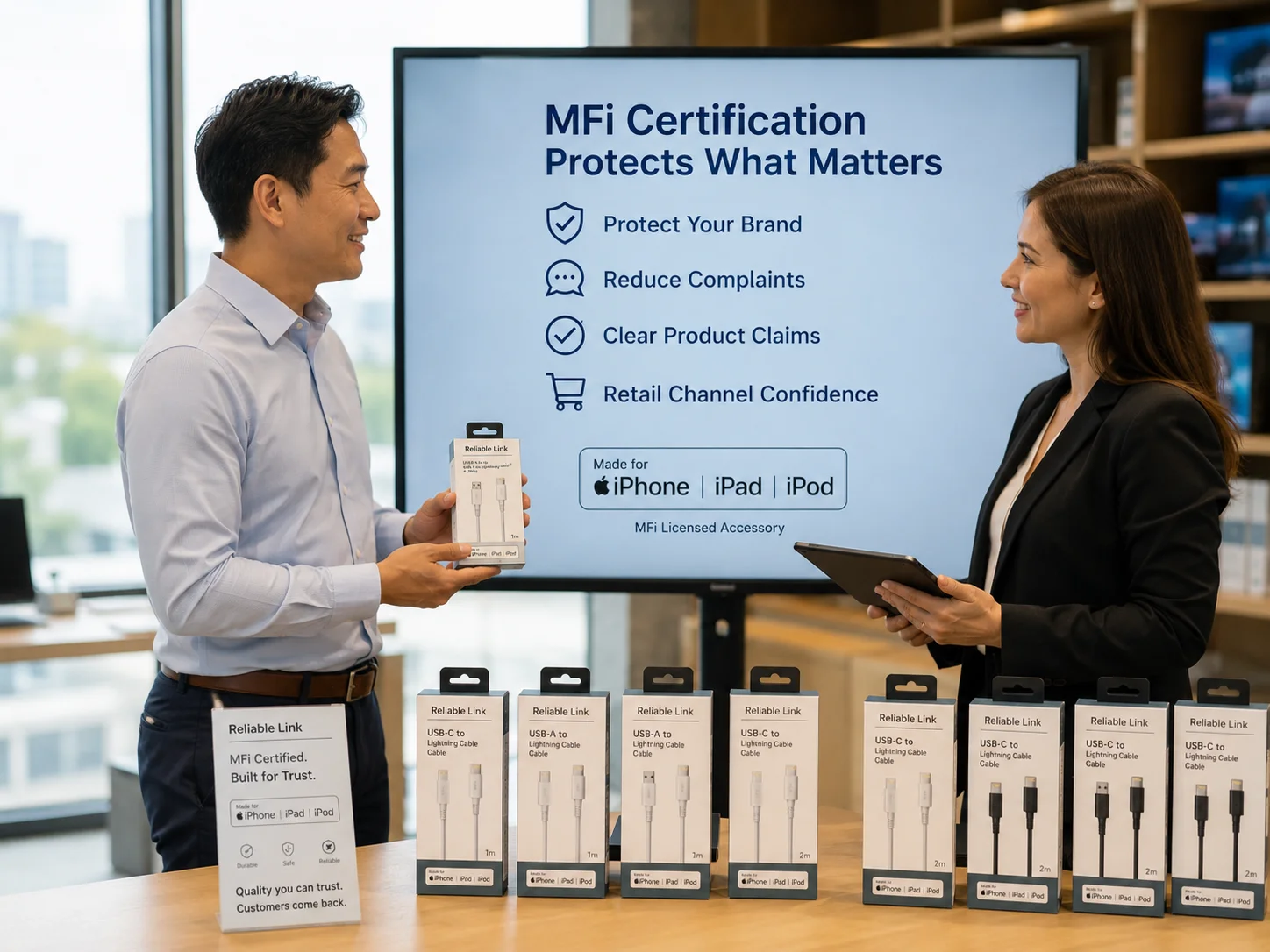
Your Customer Sees Your Brand First
End users do not usually blame the factory in China. They blame the seller, the store, or the brand on the package. This is why wholesale buyers need to think beyond the purchase price. A cable return can cost more than the cable itself. It can cost shipping, handling, staff time, review damage, and customer trust.
| Risk Area | How Better MFi Sourcing Helps |
|---|---|
| Brand trust | Product claims become more controlled |
| Customer complaints | Compatibility concerns may be reduced |
| Retail review | Buyers can show better sourcing process |
| E-commerce listings | Product wording can be more accurate |
| Repeat business | Stable sourcing supports stable supply |
| After-sales | Clear supplier responsibility helps response |
Retail Channels Need Clean Claims
Chain retailers and larger buyers often ask for clear documents. They may not accept vague words like “original quality” or “Apple standard” without proof. E-commerce platforms can also be sensitive to brand wording and compatibility claims. A buyer should not wait until a listing problem or retail audit appears.
In my experience, careful packaging review is very important. The cable may be good, but the packaging wording may still create trouble. Buyers should check the product name, compatibility wording, logo use, icons, and certification claims before printing.
Protection Comes from a Full System
MFi certification alone is not a magic shield. The buyer still needs supplier verification, sample approval, incoming inspection, and after-sales agreement. But certification can be a strong part of the system. It gives buyers a better base for retail and branded sales.
I like to think of MFi sourcing as risk insurance in the purchasing process. It does not remove every risk. It helps buyers reduce risks they can predict before the order starts.
8. How to Choose a Reliable MFi Cable Factory in China?
A reliable factory is not only the one with the fastest reply. It is the one that gives clear answers before problems appear.
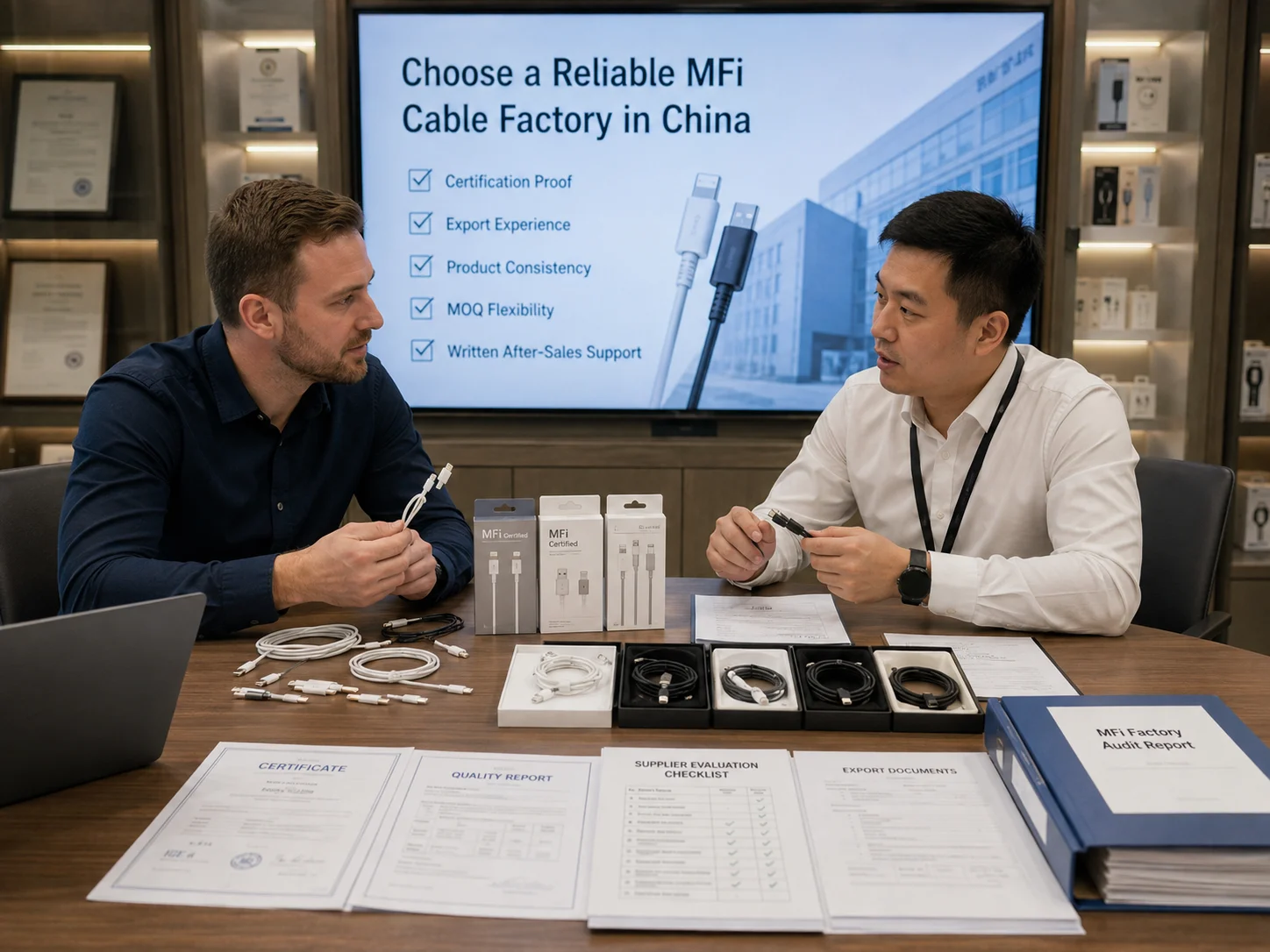
To choose a reliable MFi cable factory in China, buyers should check certification proof, export experience, product consistency, packaging ability, MOQ flexibility, communication quality, inspection process, and written after-sales support. A good factory should help buyers reduce risk, not only lower the quote.
What I Look for When I Help Buyers Source
China has many cable suppliers. Shenzhen has many strong 3C supply chain resources. But the buyer still needs to separate a real long-term partner from a short-term low-price seller. I usually look at how the supplier handles details. A reliable supplier does not avoid questions. A reliable supplier explains what can be done, what cannot be done, and what needs checking.
| Supplier Quality | What It Looks Like |
|---|---|
| Clear proof | Documents and claims are consistent |
| Realistic pricing | The quote explains what is included |
| Stable samples | Samples match the bulk plan |
| Packaging support | Wording and design are reviewed carefully |
| Export experience | The supplier understands EU and US buyer needs |
| Inspection process | The supplier can share basic QC steps |
| After-sales plan | Defect handling is discussed before shipment |
| Communication | Answers are direct and written clearly |
Questions Buyers Should Ask Before Ordering
A buyer should ask, “Can you support my channel requirements?” This question is better than “What is your lowest price?” A reliable factory should be able to talk about certification, packaging, MOQ, lead time, and after-sales in one full plan.
Buyers should also ask about repeat supply. One order is not enough for many wholesale businesses. If the first order sells well, the buyer needs the same cable again. The supplier should be able to keep the same quality level, same packaging, same color, same length, and same product positioning.
Why I Prefer Verified Factory Sourcing
As a Shenzhen 3C export trading company, we work with many types of electronics buyers. We know that European and American buyers care about price, MOQ, delivery, custom packaging, and after-sales. We also know that a cable order can become stressful if the supplier cannot support claims or repeat quality.
A reliable MFi cable sourcing process should feel boring in a good way. The documents are checked. The sample is approved. The packaging is confirmed. The production plan is written. The inspection is arranged. The after-sales terms are clear. That is how a buyer protects margin and customer trust.
Conclusion
MFi cable sourcing is not only about paying more. It is about buying with proof, control, and lower resale risk.
"MFi Program - Wikipedia", https://en.wikipedia.org/wiki/MFi_Program. Apple’s MFi Program materials define MFi as a licensing program for developers and manufacturers of accessories intended to work with Apple devices. Evidence role: definition; source type: institution. Supports: An official or institutional source should define the MFi Program as Apple’s licensing program for compatible accessories.. ↩
"Accessory Search - MFi Licensee App - Apple", https://mfi.apple.com/account/accessory-search. Apple’s MFi and accessory-identification materials describe a formal certification framework for compatible accessories, supporting the distinction between licensed MFi claims and unsupported compatibility wording. Evidence role: mechanism; source type: institution. Supports: The source should show that Apple maintains a formal MFi licensing or accessory-identification process that can distinguish certified accessories from uncertified compatibility claims.. ↩
"Identify counterfeit or uncertified Lightning connector accessories", https://support.apple.com/en-us/111103. Apple’s guidance on counterfeit and uncertified Lightning accessories indicates that device connection or charging behavior is not equivalent to confirmed certification status. Evidence role: general_support; source type: institution. Supports: The source should support the difference between a cable merely working with an Apple device and the cable being certified or licensed under Apple’s program.. ↩
"Conformity Assessment Basics | NIST", https://www.nist.gov/standardsgov/conformity-assessment-basics. Conformity-assessment guidance from ISO or NIST treats product certification as evidence of conformity to specified requirements within a defined scope, not as a guarantee that every product will be defect-free in all conditions. Evidence role: expert_consensus; source type: institution. Supports: The source should explain that product certification verifies conformity to specified requirements within a defined scope, not an absolute guarantee against all defects.. ↩
"FTC Policy Statement Regarding Advertising Substantiation", https://www.ftc.gov/legal-library/browse/ftc-policy-statement-regarding-advertising-substantiation. Apple’s guidance on counterfeit and uncertified Lightning accessories documents possible performance and safety-related issues, while consumer-claim rules require sellers to substantiate product representations; together these sources support the article’s risk framing for uncertified cables. Evidence role: general_support; source type: institution. Supports: The source should support that uncertified or counterfeit Apple accessories may create functional problems and that sellers must be careful with claims about compatibility or certification.. ↩
"Quality Assurance/ Quality Control", https://www.umces.edu/quality-assurancequality-control/. Reliability-engineering literature explains that product performance depends on operating conditions and user environments, so a limited sample test may not reveal failures that occur across varied devices, power sources, and usage patterns. Evidence role: mechanism; source type: research. Supports: The source should explain that product reliability depends on operating conditions and that limited sample tests may not reveal failures across diverse field-use environments.. ↩
"Accessory Search - MFi Licensee App - Apple", https://mfi.apple.com/account/accessory-search. Apple’s MFi Program and trademark guidance provide a formal basis for licensed accessory claims, whereas generic compatibility statements are not themselves evidence of MFi certification. Evidence role: mechanism; source type: institution. Supports: The source should support that MFi-certified accessories are connected to a formal Apple licensing or verification process, unlike generic compatibility assertions.. ↩
"Lightning (connector) - Wikipedia", https://en.wikipedia.org/wiki/Lightning_(connector). Reference sources on Apple’s Lightning connector describe the connector ecosystem as involving accessory authentication and MFi-related components; this supports the article’s contextual treatment of C94 as a connector-related supply-chain term, although public sources may not fully document Apple’s internal specification labels. Evidence role: definition; source type: encyclopedia. Supports: The source should provide contextual support that Lightning accessories use connector or authentication components associated with Apple’s accessory ecosystem, and ideally identify C94 as a Lightning connector specification.. ↩
"THE RELATIONSHIP BETWEEN COMPONENT AND PRODUCT ...", https://hammer.purdue.edu/articles/thesis/THE_RELATIONSHIP_BETWEEN_COMPONENT_AND_PRODUCT_QUALITY_IN_MANUFACTURING_WITH_EMPHASIS_ON_COMPETITIVENESS/14495772. Quality-management standards such as ISO 9001 require control of externally provided components and processes, reflecting the general principle that supplier or component changes can affect product conformity and performance. Evidence role: mechanism; source type: institution. Supports: The source should support that supplier and component control are part of quality management and that changes in externally supplied components can affect conformity or performance.. ↩
"MFi Program - Wikipedia", https://en.wikipedia.org/wiki/MFi_Program. Apple’s MFi accessory resources and standard procurement due-diligence guidance support matching certification evidence to the relevant company and product before relying on certified-accessory claims. Evidence role: mechanism; source type: institution. Supports: The source should support the practice of checking certification status against company and product information rather than relying only on a supplier statement.. ↩
"Why Focusing on Lead Time—Not Just Efficiency—Drives Success", https://interpro.wisc.edu/lead-time-drives-manufacturing-success/. Operations-management sources identify materials, setup costs, order volume, quality inspection, packaging, and production scheduling as standard manufacturing cost drivers; this provides contextual support for the pricing factors listed for MFi cables. Evidence role: general_support; source type: education. Supports: The source should support the general cost drivers in manufacturing, including materials, setup, order quantity, quality inspection, packaging, and lead time.. ↩
"Material requirements planning with a novel lot sizing method ...", https://pmc.ncbi.nlm.nih.gov/articles/PMC12307884/. Production and operations-management literature explains that batch size and minimum order quantities are influenced by setup costs, procurement constraints, packaging runs, and scheduling efficiency. Evidence role: mechanism; source type: education. Supports: The source should explain that production batch sizes and minimum quantities are influenced by setup costs, procurement quantities, packaging runs, and scheduling efficiency.. ↩