A wrong cable promise can create returns, angry customers, and dead stock. I have seen buyers lose margin because one small spec was not checked.
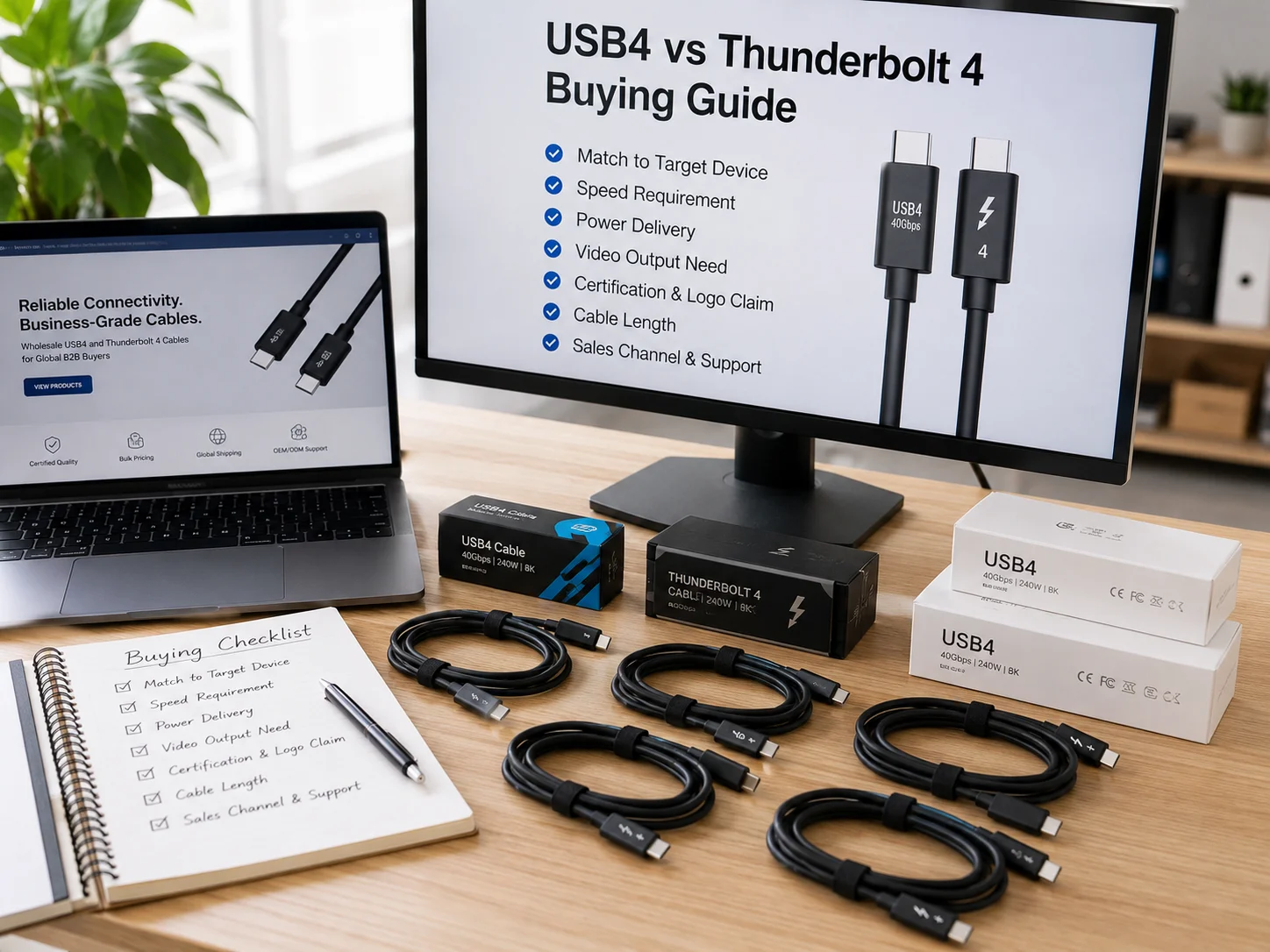
I do not ask whether USB4 or Thunderbolt 4 is better first. I first match the cable to the target device, speed, power, video need, certification claim, cable length, and sales channel. This helps me avoid wrong stock, unclear labels, and after-sales trouble.
I work with USB-C cables, chargers, TWS products, and other 3C items from Shenzhen. In many buyer calls, I notice the same problem. The buyer sees “USB-C,” “USB4,” or “Thunderbolt 4,” and then expects one cable to solve every sales case. I do not think that is safe for wholesale buying. A cable is not only a connector shape. It is also a promise on the retail box, a product page claim, and a future after-sales issue. If I choose the wrong promise, my customer pays for it later.
1. What Are USB4 Cables and Why Are They Important for Distributors?
USB-C looks simple, but the wrong USB4 stock can confuse buyers fast. I have seen one cable listing create many support questions.
USB4 cables are USB-C shaped cables designed for high-speed data, power delivery, and possible video use1, depending on the cable design and device support. I treat them as B2B inventory items, not just accessories, because the label must match real customer use.
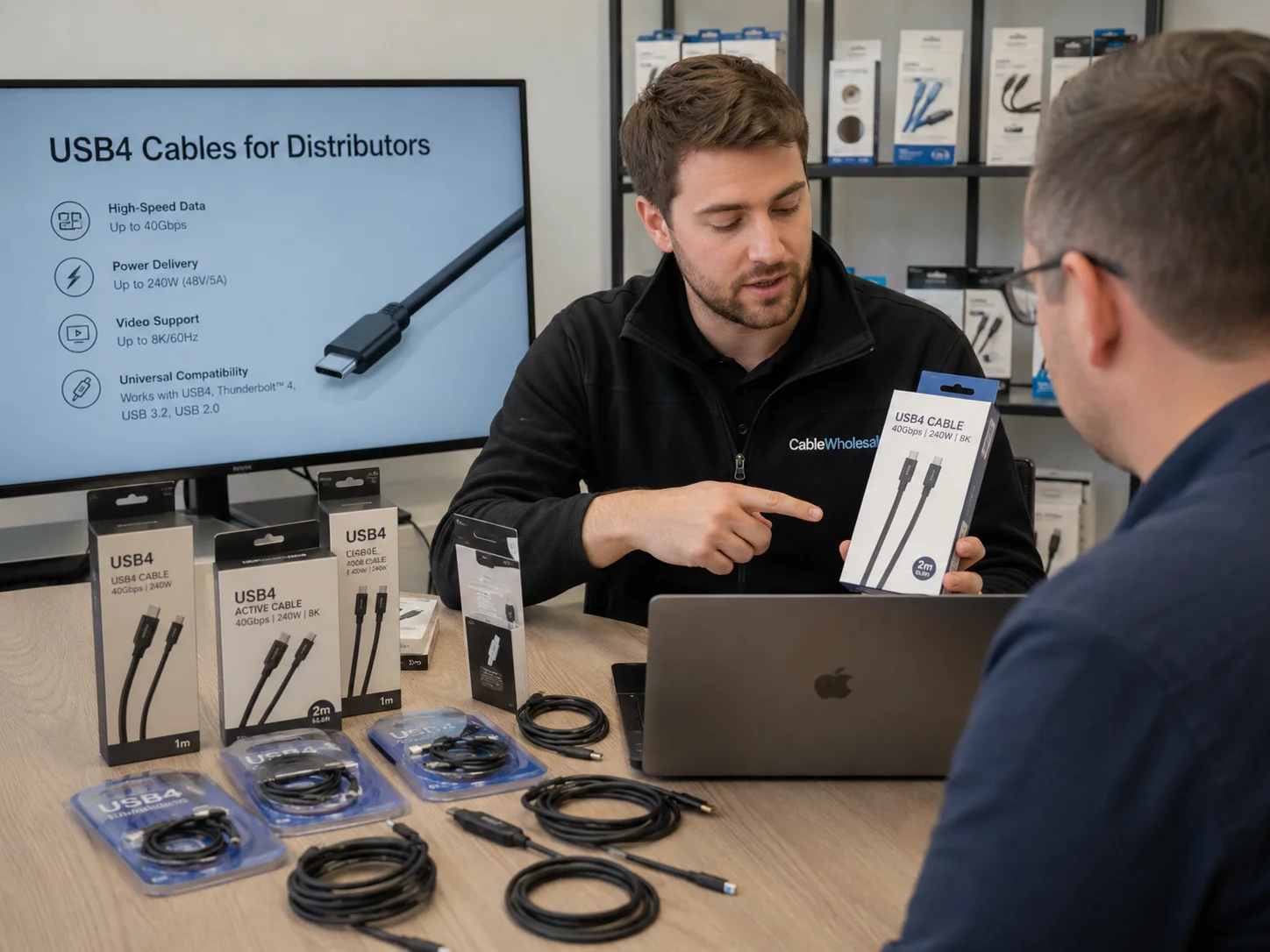
I start with the use case before I read the label
I see many importers search for USB4 cables because the term looks modern and premium. I understand this. USB4 sounds stronger than a regular USB-C charging cable. But I still ask one basic question first. What will the final customer connect? If the customer only charges a phone, a high-spec USB4 cable may be too expensive. If the customer connects a laptop to a dock, a monitor, or an external SSD, a normal charging cable may fail the sales promise.
I separate connector shape from real function
| Buyer question I ask | Why I ask it | Risk if I skip it |
|---|---|---|
| Is the cable for charging only? | I need to confirm wattage and E-marker needs | The buyer may overpay for data speed |
| Is it for external SSDs? | I need to check data speed claims | The product may feel slow |
| Is it for monitors or docks? | I need to check video and device support | The customer may see no display output |
| Is it for premium retail? | I need to check packaging and claims | The shelf price may not fit the market |
I treat USB4 cables as channel products. A distributor does not only buy cable performance. A distributor buys a clear sales story. If the story says “40Gbps,” then the cable, packaging, product page, and customer support team must all say the same thing. If the story says “for laptop docking,” then I need to know which laptop group and which docking case. This simple check reduces returns and helps the distributor choose the right MOQ, color, length, and packaging level.
2. USB4 Evolution: From USB-C Charging Cables to High-Speed Data Cables?
USB-C made the market easier at first, but it also made buying harder. I now see more buyers confuse charging cables with data cables.
USB4 is part of the move from basic USB-C charging to high-speed data, video, and power use. I do not treat every USB-C cable as USB4 because the connector is only one part of the product2.
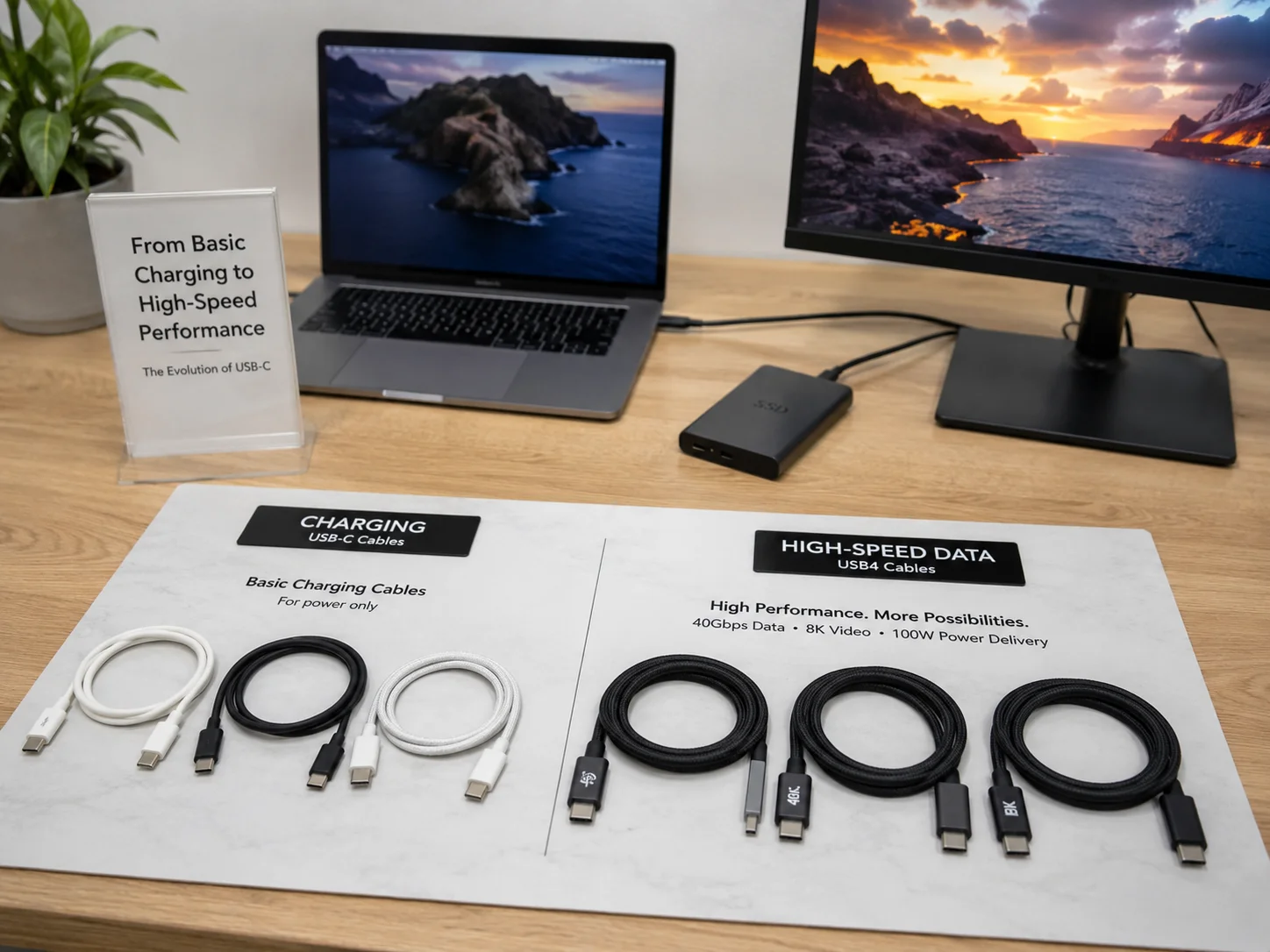
I remember when USB-C mainly meant charging
In earlier inquiries, many buyers only asked for USB-C to USB-C charging cables. They wanted 60W or 100W. They cared about price, length, color, and package. The cable was often sold with chargers, power banks, or phone accessories. Then laptops, docks, monitors, gaming devices, and external drives became more common in daily use. The same USB-C shape started to carry more sales promises. This changed the buying logic.
I now classify cables by job
| Cable type | Common sales promise | Common buyer focus | My buying warning |
|---|---|---|---|
| Basic USB-C charging cable | Charge phone or tablet | Low price and MOQ | Do not promise high-speed data |
| 60W or 100W PD cable | Charge laptop or charger bundle | Wattage and durability | Check E-marker for high power cases3 |
| USB4 cable | Fast data, charging, possible display | Speed, PD, compatibility | Confirm target devices |
| Thunderbolt 4 cable | Premium dock and pro setup use | Certification and premium channel | Check official claim rules before printing |
I do not see USB4 as just a higher price point. I see it as a different buying category. A buyer who sells on Amazon, a retail shelf, or to a laptop accessory chain must make clean claims. If the cable is only for charging, I should not put “USB4 style” in the listing. If the cable supports high-speed transfer, I should still confirm the claimed speed, length, and device scenario. This matters because the final customer does not read technical details slowly. The customer expects the box title to work. If the box title is too wide, the after-sales pressure becomes wide too.
3. USB4 vs Thunderbolt 4: Key Differences in Speed, Compatibility, and Certification?
The word “compatible” can be dangerous in wholesale. I have seen buyers use it too freely and then face return requests.
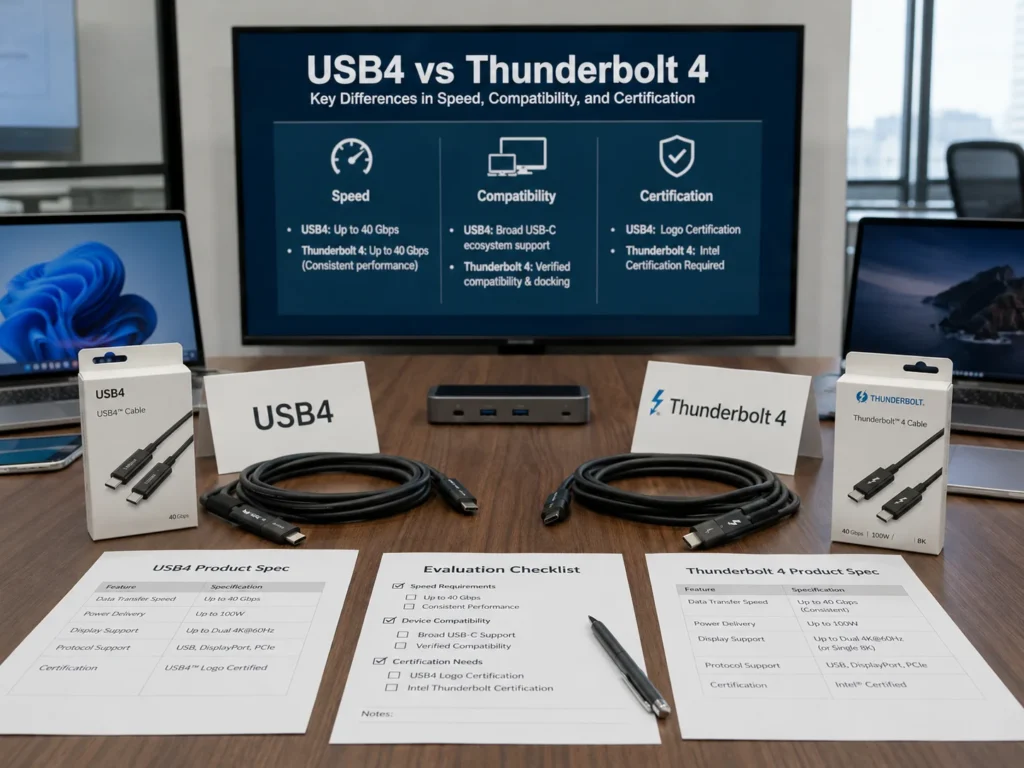
USB4 and Thunderbolt 4 both use USB-C connectors, but they are not the same buying promise.4 I compare speed, device environment, certification needs, and channel positioning before I choose which cable to stock.
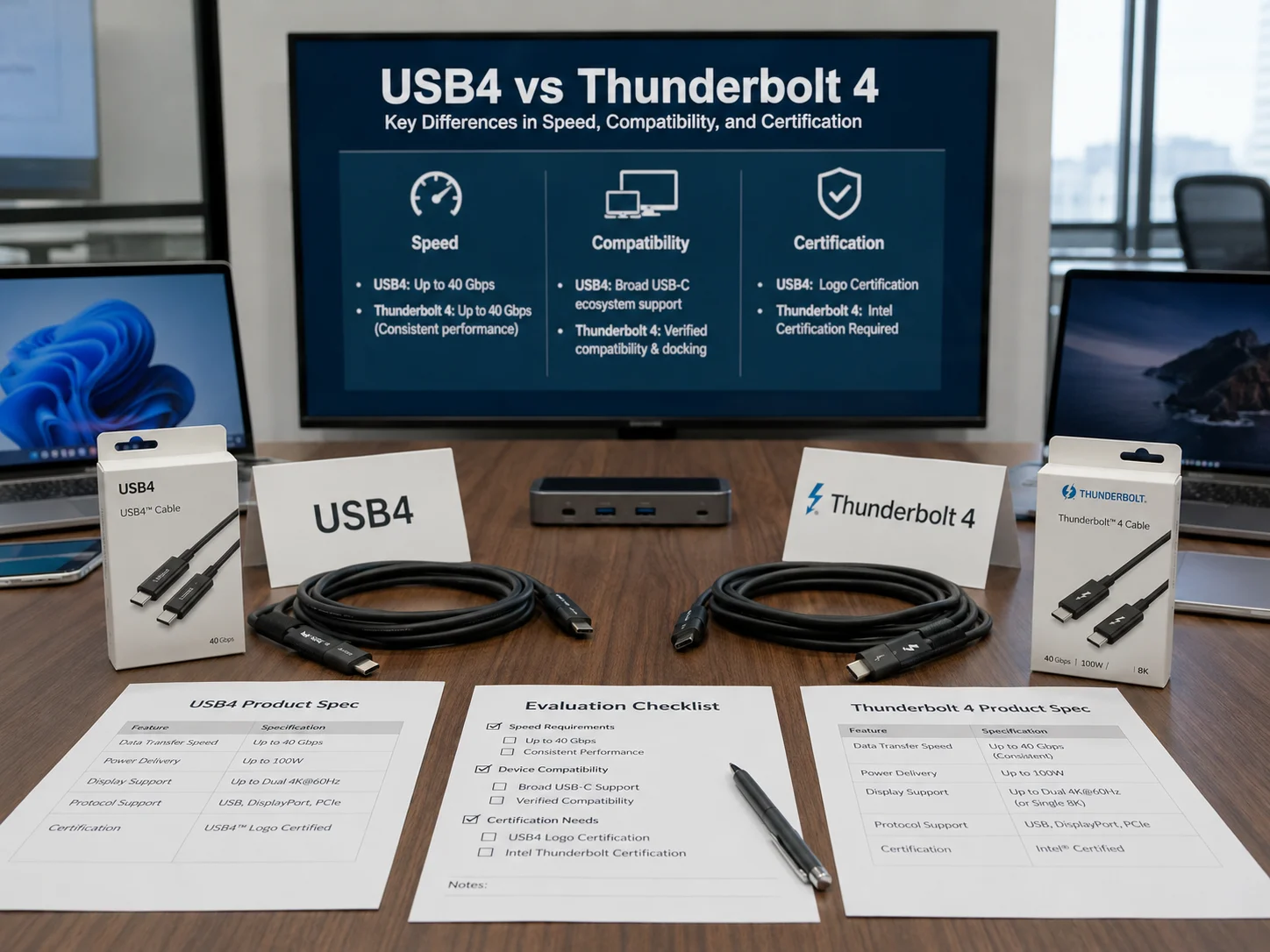
I do not say one is always better
I avoid simple answers like “Thunderbolt 4 is better” or “USB4 is enough.” That answer may help a consumer for one laptop, but it can hurt a distributor with many channels. I first look at the buyer’s customer base. If the buyer sells mainly phone accessories, USB4 may already be a premium item. If the buyer sells to laptop dock users, creators, or professional offices, Thunderbolt 4 may fit better5. If the buyer sells to mixed retail, the product line may need both levels.
I check the promise, not only the speed number
| Point | USB4 buying view | Thunderbolt 4 buying view | My B2B concern |
|---|---|---|---|
| Connector | USB-C shape | USB-C shape | Shape does not prove performance |
| Speed claim | Usually sold around high-speed data needs | Often sold as premium 40Gbps class | Claims must match test documents and packaging |
| Certification | Buyers should verify correct USB claims | Buyers should verify Thunderbolt logo rules | Wrong marks can create legal and channel risk6 |
| Target channel | Mass market premium cable | Premium laptop, dock, and creator channel | Wrong channel means wrong inventory |
| Price level | Often more flexible | Usually higher positioning | Margin depends on real customer need |
I tell buyers to think like a category manager. A category manager does not buy the highest spec every time. A category manager buys the spec that matches the shelf, the product page, and the customer support script. If a distributor buys Thunderbolt 4 cables for a market that only asks for laptop charging, the stock may move slowly. If the same distributor sells a lower USB4 cable into a dock and monitor channel, the product may create support pain. I do not want either case. I want the cable claim to be narrow enough to be true and strong enough to sell.
4. USB4 Cable Tech Specs Explained: 20Gbps, 40Gbps, 80Gbps, Video Output, and Power Delivery?
Speed numbers look clean on a product page, but they can hide many details. I always check the full spec list before quoting.
USB4 cable specs should be checked by speed, power rating, video use, cable length, connector quality, and supported device scenario. I never buy only because the cable says 20Gbps, 40Gbps, or 80Gbps7.
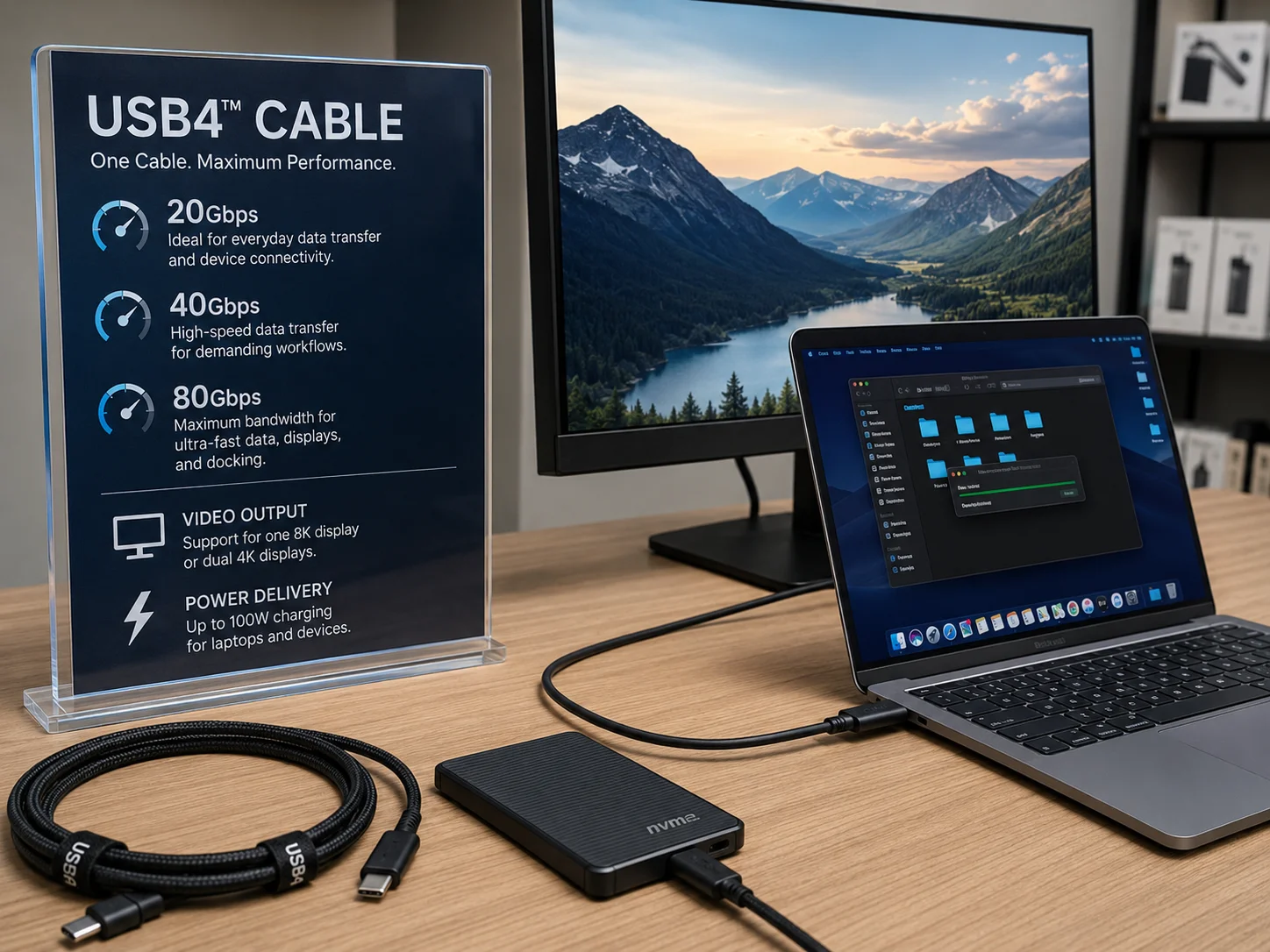
I treat speed as only one column
Many buyers ask me, “Is this 40Gbps?” I answer the question, but I also ask more questions. What length do you need? Do you need 100W or 240W?8 Do you need video output? Do you need retail packaging with clear icons? Do you need test reports or specification sheets for your channel? The speed number is important, but it is not the whole product.
I build the quote around several specs
| Spec item | What I check | Why it matters for wholesale |
|---|---|---|
| Data speed | 20Gbps, 40Gbps, or newer higher-speed claims | The buyer needs a clear product tier |
| Power delivery | 60W, 100W, or 240W claim | The customer may use laptop chargers |
| Video support | Display use with supported devices | Monitor users expect a clear answer |
| Cable length | Commonly 0.8m, 1m, 1.2m, 2m, or custom | Longer cables may need stricter design |
| Shell and jacket | Metal shell, TPE, PVC, nylon braid | Retail feel and durability change price |
| Label and packaging | Icons, speed, wattage, warning text | Claims must be easy and safe |
| Documentation | Spec sheet, test data, certification proof where needed | Channel buyers need evidence |
I have learned that “40Gbps” alone does not sell the product safely. A 40Gbps cable with weak packaging may fail in retail because the customer cannot understand it. A strong package with unclear technical backing may fail in after-sales because the claim is too large. A long cable with a high speed claim may need extra review because performance can be harder to keep as length grows.9 I am not a lab, and I do not pretend to be one. I am a sourcing and export partner, so I focus on checking documents, aligning claims, and making sure the buyer does not print a promise that the cable cannot support in real sales.
5. Do USB4 Cables Support 240W Fast Charging?
A buyer may think a USB4 cable always charges at the highest wattage. I think that assumption creates risk.
Some USB4 cables can be sold with 240W fast charging support when the cable design, E-marker, charger, and device all support it. I always verify the rated wattage before I print or quote any 240W claim.
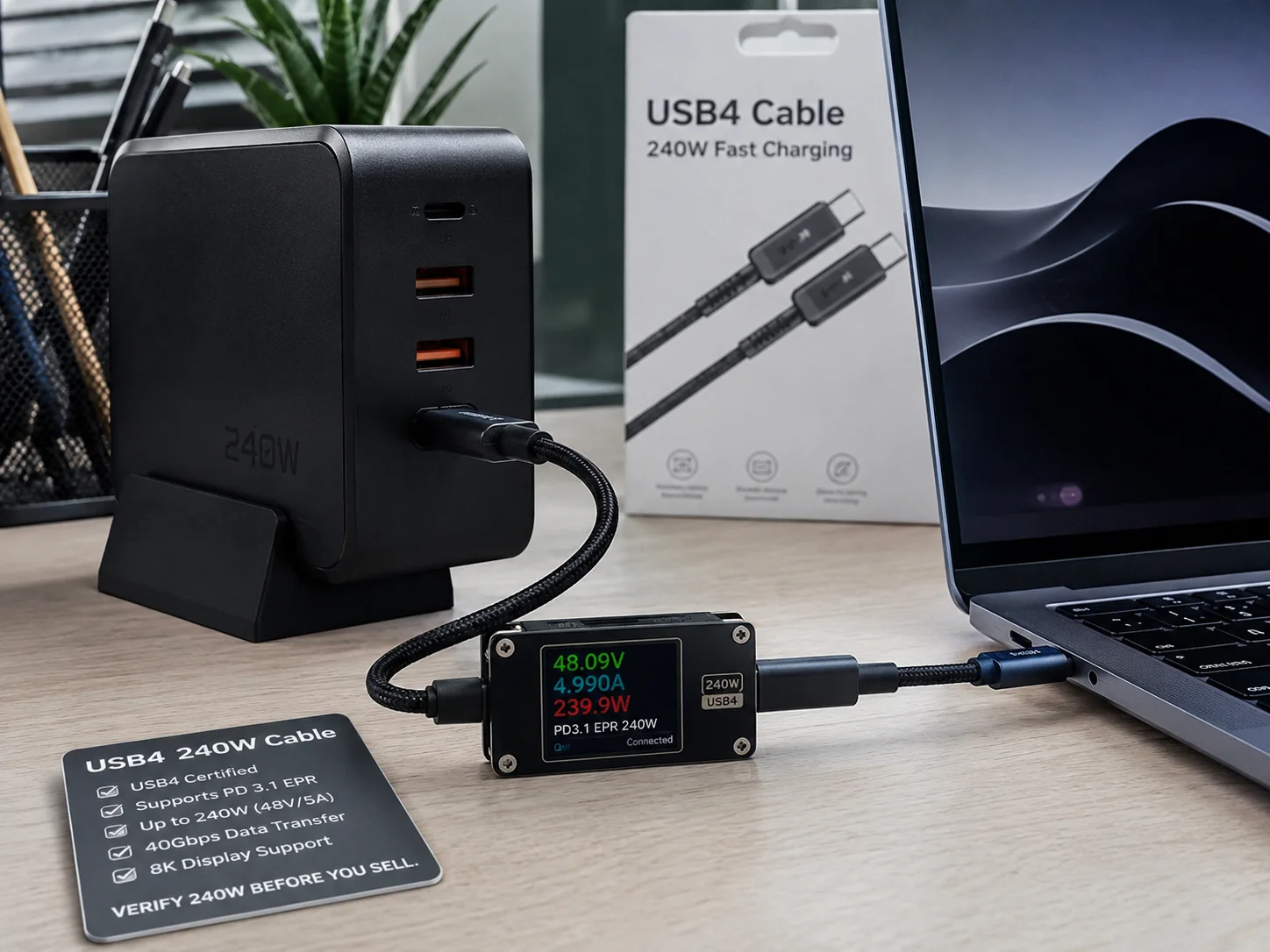
I separate data speed from charging power
I see this issue very often. A buyer asks for a USB4 cable and then adds, “It should support 240W, right?” I never answer yes without checking the actual product version. A cable can have strong data ability but a different power rating. A cable can also be built for high power but not positioned for high-speed data. The final charging result also depends on the charger and device. The cable is only one part of the chain.10
I confirm the power promise step by step
| Check point | My question | My reason |
|---|---|---|
| Cable rating | Is it 60W, 100W, or 240W? | I need the correct SKU |
| E-marker | Does the cable include the right chip for high power claim? | High-power claims need clear support |
| Charger | Will the buyer bundle it with a charger? | The bundle claim must match |
| Device | What laptop or device will customers charge? | Not every device draws the same power |
| Packaging | Will the package print 240W in large text? | The claim needs proof and careful wording |
I do not like vague packaging such as “super fast charging” without a real wattage. It may look easy, but it is hard to support. I prefer clear levels. For example, a buyer may create one 100W USB4 cable for mainstream laptop accessories and one 240W USB4 cable for higher-end users. This makes the shelf easier to understand. It also helps the sales team explain price differences. If the buyer sells online, I also suggest adding a simple note that the charging power depends on the charger and device. That note reduces unfair complaints. It also keeps the product page more honest. I believe honest claims sell better in the long term because the buyer can build repeat orders, not only one shipment.
6. Why Are USB4 and Thunderbolt 4 Cables Thicker Than Regular USB-C Cables?
Some buyers worry when a premium cable feels thicker. I understand that worry, but thickness can come from real design needs.
USB4 and Thunderbolt 4 cables can be thicker because they may need more internal wires, shielding, better signal control, E-marker support, and stronger materials.11 I still check flexibility and retail comfort before placing bulk orders.
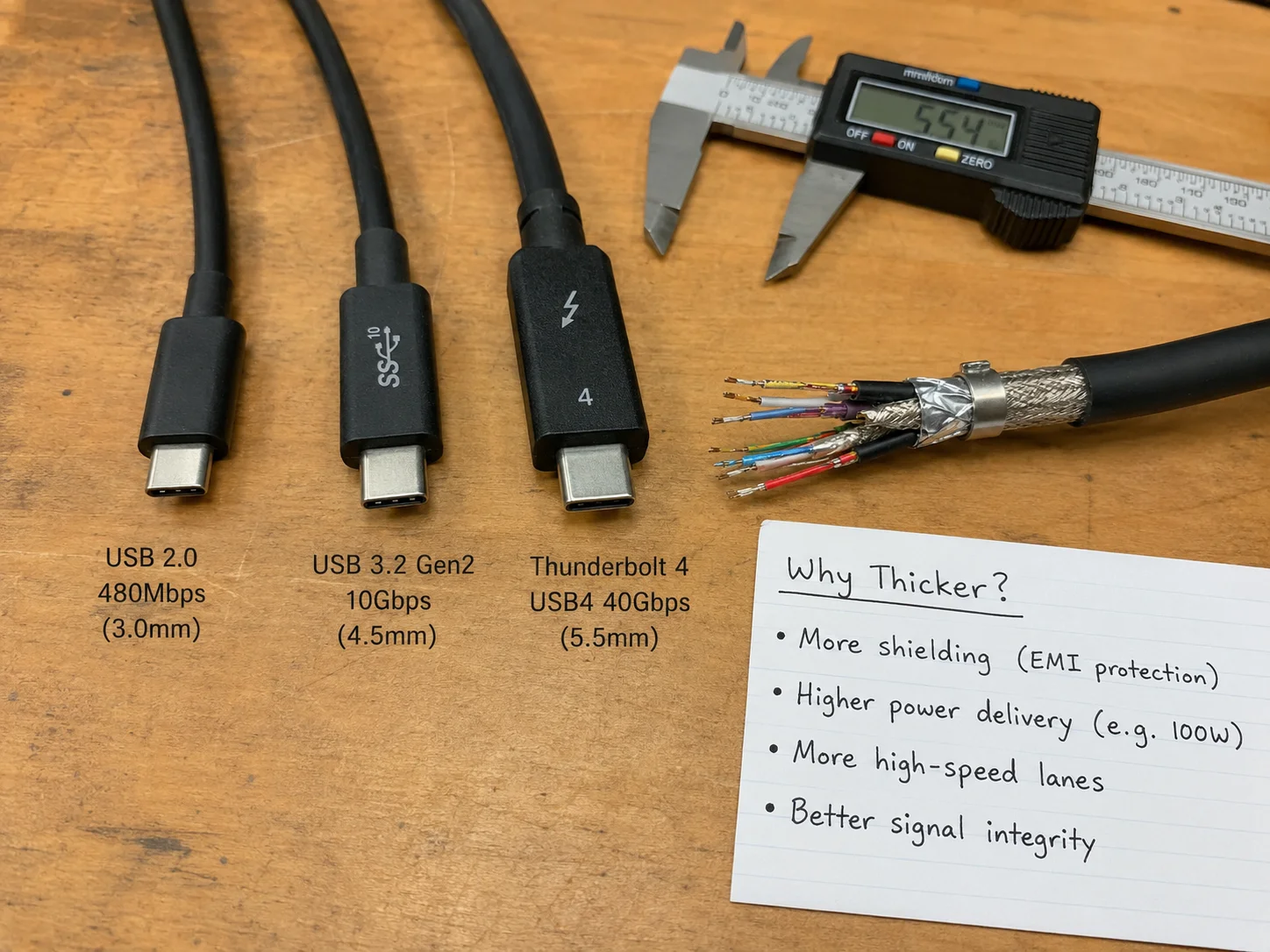
I explain thickness before the sample review
When I send samples to a buyer, the buyer may compare a USB4 cable with a normal USB-C charging cable. The buyer may say, “This one is too thick.” I agree that hand feel matters. But I also explain that high-speed data and high-power use often need more careful cable structure. The cable may include shielding layers, more conductors, and stronger connector parts. These details can increase diameter and stiffness.
I balance performance and user feeling
| Design factor | Possible result | My buying note |
|---|---|---|
| More shielding | Better signal stability target | Cable may feel thicker |
| Higher power rating | Stronger internal structure | Cable may feel less soft |
| Nylon braid | Better retail look and abrasion resistance | Cable may be stiffer |
| Metal shell | Premium look | Cost and weight increase |
| Longer length | More difficult signal control | Need extra checking |
| Ultra-soft jacket | Better hand feel | May affect durability or cost |
I do not judge a cable by thickness alone. I check the target buyer. A gaming or creator customer may accept a thicker cable if the cable feels strong and premium. A phone accessory customer may prefer a thinner and softer cable. A retail chain may care about how the cable coils inside packaging. An e-commerce seller may care about product photos and review comments. I usually ask for samples before bulk order, especially for USB4 and Thunderbolt-style products. I test the hand feel like a normal customer. I bend it. I coil it. I check the connector fit. I look at the print on the cable. I also compare the sample with the packaging design. A premium cable should not only perform well. It should also feel like the price is fair.
7. Who Should Buy USB4 Cables: Retailers, Distributors, Laptop Users, and Content Creators?
Not every channel needs USB4 stock. I have seen slow sales when the buyer chooses premium cables for the wrong audience.
USB4 cables fit buyers who serve laptop users, docking stations, external SSDs, monitors, creators, and premium accessory shelves.12 I suggest distributors buy them when the customer base needs speed, power, or video features.
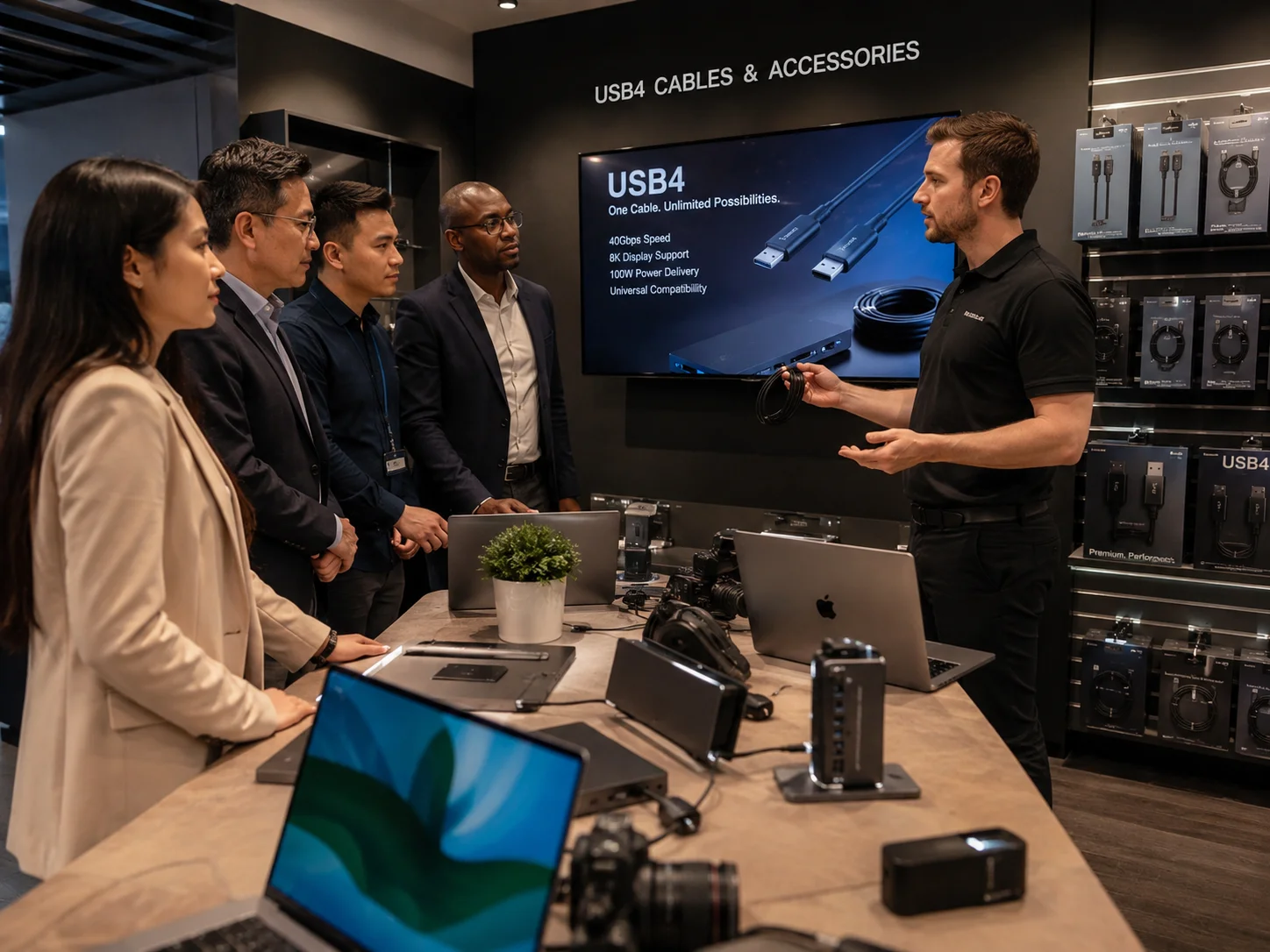
I match USB4 cables to channel demand
A wholesale buyer should not only ask, “Can I sell USB4?” The better question is, “Who will buy USB4 from me, and why?” If the answer is not clear, the buyer may choose the wrong MOQ. USB4 cables can be great products, but they need the right channel story. A phone-focused shop may sell a few units as premium add-ons. A laptop accessory distributor may sell many more because the need is clearer.
I use channel fit to decide the product line
| Customer type | USB4 fit | Possible product angle |
|---|---|---|
| 3C retailers | Medium to high | Premium cable section |
| Laptop accessory distributors | High | Docking, SSD, monitor use |
| E-commerce sellers | High if listings are clear | Speed and PD keyword product |
| Chain stores | Medium | Simple packaging and clean icons |
| Office supply buyers | Medium | Laptop and monitor cable |
| Content creator stores | High | External SSD and display use |
| Phone accessory wholesalers | Low to medium | High-end charging add-on |
I advise buyers to start with a clear range. A simple range may include one 100W high-speed USB4 cable in 1m, one 240W version in 1m, and one longer option if the channel asks for desk setups. A premium range may add Thunderbolt 4 positioned cables, stronger packaging, and more formal documentation. I do not suggest that every buyer starts with too many SKUs. More SKUs can look professional, but they also create inventory pressure. I prefer a small line that solves real customer needs. After the first order, I review sales feedback. If customers ask for longer length, I add it. If customers ask for braided jacket, I add it. If customers only ask about price, I reduce the line and focus on the faster-moving model.
8. How to Source Wholesale USB4 Cables from a Reliable Factory in China?
A low price is useful, but a wrong specification can cost more than the saving. I check the factory process before I check volume price.
To source USB4 cables from China, I first confirm target devices, speed, wattage, video needs, length, packaging claims, certification needs, sample quality, lead time, MOQ, and after-sales terms. I choose suppliers who help clarify specs before quoting.
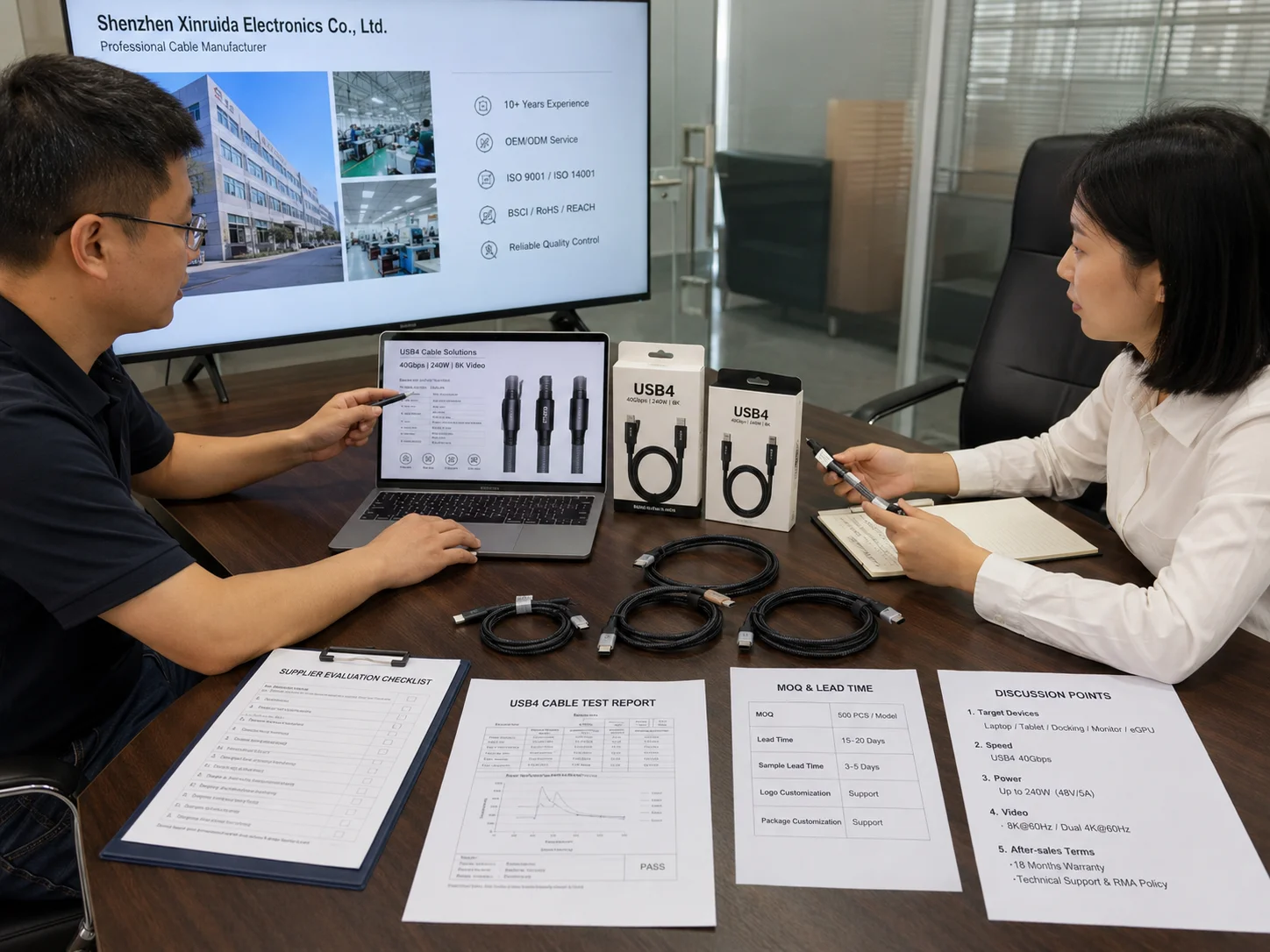
I use a buying checklist before I quote
As a Shenzhen 3C trading company with years of export work, I have learned that the best supplier is not the one who says yes the fastest. The best supplier asks questions before saying yes. USB4 and Thunderbolt 4 cable buying needs this attitude. If a buyer only sends “Need USB4 cable, best price,” the quote may look fast, but it may not be safe. I ask for device use, market, packaging style, and claim level first.
I confirm these items with the buyer and factory
| Sourcing item | What I confirm | Why I confirm it |
|---|---|---|
| Target market | Europe, North America, or other region | Compliance and package language may change |
| Customer use | Laptop, dock, SSD, monitor, phone | The cable spec must match the use |
| Speed tier | 20Gbps, 40Gbps, or higher claim | The product line needs clear levels |
| Power rating | 60W, 100W, or 240W | Charging claim affects price and label |
| Length | 0.8m, 1m, 2m, or custom | Length affects cost and performance |
| Cable material | TPE, PVC, nylon braid, silicone feel | Hand feel and price change |
| Certification and logo | USB or Thunderbolt-related marks if needed | I verify rules before printing |
| Packaging | Bulk, retail box, blister, paper box | Channel positioning changes |
| MOQ and lead time | First order and repeat order plan | Inventory risk must stay controlled |
| After-sales | Defect handling and replacement terms | B2B trust needs clear rules |
I also ask for samples before mass production when the buyer has a new channel or a high-value claim. I compare the sample to the written spec. I check the connector, cable diameter, jacket feel, print, package wording, and basic function with normal available devices. I do not present myself as a certification lab. If the buyer needs official claims, I help collect documents and suggest that the buyer verifies them against current official rules. This is important for Thunderbolt marks, USB logos, and high-speed wording. A reliable supplier should not push the buyer to print claims without proof. A reliable supplier should protect the buyer from overpromising.
Conclusion
I choose USB4 or Thunderbolt 4 cables by use case, not by hype. Clear specs, honest labels, and correct channel fit protect margin and repeat orders.
"USB - Wikipedia", https://en.wikipedia.org/wiki/USB. USB-IF materials on USB4 describe the protocol as operating over the USB Type-C connector and supporting high-speed data transport with USB Power Delivery and display-protocol tunneling; this establishes the general capability set but does not verify any particular cable SKU. Evidence role: definition; source type: institution. Supports: A standards source should confirm that USB4 operates over the USB Type-C connector and is designed to carry high-speed data with support for power and display-related functions depending on implementation.. Scope note: The source supports the standard-level capability, not the compliance of a specific wholesale cable. ↩
"USB-C - Wikipedia", https://en.wikipedia.org/wiki/USB-C. USB Type-C documentation distinguishes the reversible connector interface from the capabilities of individual cable assemblies, including current rating, data lanes, alternate-mode support, and electronically marked cable information; the point is architectural rather than proof about any named product. Evidence role: mechanism; source type: institution. Supports: An official or educational source should explain that USB-C defines a connector system while cable assemblies can differ in supported current, data rate, alternate modes, and electronic marking.. Scope note: This is contextual support for the buying principle, not evidence about a specific cable listing. ↩
"240W USB C to USB C Cable,PD 3.1 Type C to C 5A Fast Charging ...", https://www.amazon.com/Charging-Compatible-MacBook-Pro12-9-Samsung/dp/B0C1X89F3N. USB Type-C and USB Power Delivery specifications use electronically marked cable assemblies to identify cable capabilities such as current rating, which is material to high-power charging claims; the standard does not by itself verify a seller's implementation. Evidence role: mechanism; source type: institution. Supports: A standards source should support that USB-C cables used for higher current or higher power levels rely on electronic marking to advertise cable capability.. Scope note: The citation would support the technical requirement, not the quality of the factory's E-marker programming or testing. ↩
"USB-C - Wikipedia", https://en.wikipedia.org/wiki/USB-C. Reference sources describe USB4 as a USB-IF specification and Thunderbolt 4 as a Thunderbolt certification generation, both using USB-C connectors but imposing different technical and certification requirements; this supports the distinction without ranking one as universally superior. Evidence role: definition; source type: encyclopedia. Supports: A neutral reference should confirm that USB4 and Thunderbolt 4 both use USB-C while differing in governance, certification, and minimum feature requirements.. ↩
"Thunderbolt (interface)", https://en.wikipedia.org/wiki/Thunderbolt_(interface). Thunderbolt 4 technical requirements include support for high-bandwidth peripheral connections and display-oriented use cases such as docking configurations; this supports the contextual suitability claim but does not prove that Thunderbolt 4 is the best choice for every professional buyer. Evidence role: general_support; source type: institution. Supports: A Thunderbolt standards or technical source should document Thunderbolt 4 features relevant to docks, displays, and high-speed peripherals.. Scope note: Suitability depends on the customer's installed devices, budget, and required certification claims. ↩
"FTC Policy Statement Regarding Advertising Substantiation", https://www.ftc.gov/legal-library/browse/ftc-policy-statement-regarding-advertising-substantiation. FTC guidance on endorsements, certifications, and advertising substantiation indicates that marketers should not use seals or claims in a way that misleads consumers and should possess support for objective product claims; this supports the general legal-risk point rather than any particular retailer's channel policy. Evidence role: general_support; source type: government. Supports: A government or standards source should support that certification seals and technical claims in marketing require substantiation and proper authorization.. Scope note: Government advertising guidance supports the legal-risk principle, but channel rejection policies vary by marketplace, retailer, and brand program. ↩
"USB4 - Wikipedia", https://en.wikipedia.org/wiki/USB4. USB-IF documentation identifies USB4 operation at 20 Gbps and 40 Gbps classes and USB4 Version 2.0 as introducing operation up to 80 Gbps; these figures describe specification-level bandwidth and do not confirm a given cable's tested throughput. Evidence role: definition; source type: institution. Supports: A USB-IF source should verify the recognized USB4 and USB4 Version 2.0 data-rate categories.. Scope note: Specification bandwidth is not the same as verified real-world performance for a particular cable length or device pair. ↩
"What Is 240W USB Extended Power Range (EPR)?", https://plugable.com/blogs/news/what-is-240w-usb-extended-power-range-epr?srsltid=AfmBOopzxI1jUFEnmQH5E612P0arncWOxocBHq4xbSNevc5UOlFxfbQb. USB Power Delivery 3.1 introduced Extended Power Range operation up to 240 W, while earlier USB-C PD implementations commonly supported up to 100 W; this substantiates the wattage categories but not compatibility with every charger, cable, and device combination. Evidence role: definition; source type: institution. Supports: A USB-IF or standards source should confirm that USB Power Delivery includes 100 W-class operation and Extended Power Range up to 240 W.. ↩
"Signal integrity research of high-speed interconnection systems ...", https://www.nature.com/articles/s41598-025-08567-1. Signal-integrity literature on high-speed copper interconnects shows that increased channel length generally increases insertion loss and other impairments that reduce timing and amplitude margins; this provides engineering context rather than USB4-specific pass/fail criteria. Evidence role: mechanism; source type: paper. Supports: A signal-integrity paper should explain that longer copper interconnects introduce greater insertion loss, attenuation, or timing effects, making high-speed data transmission harder.. Scope note: The mechanism is general to high-speed copper links and should be paired with USB4 test requirements for direct compliance claims. ↩
"USB Charger (USB Power Delivery) - USB-IF", https://www.usb.org/usb-charger-pd. USB Power Delivery describes a negotiated power contract between the power source and sink, with cable capabilities considered for allowable current and voltage; this supports the statement that the cable alone cannot determine final charging power. Evidence role: mechanism; source type: institution. Supports: A USB Power Delivery source should explain that power is negotiated between source and sink, with cable capability limiting available current or power.. ↩
"What is an E-Marker in a USB Type-C Cable and How Does It Work?", https://www.totalphase.com/blog/2020/10/what-is-e-marker-how-does-it-work/?srsltid=AfmBOorC9llWM26j70wHyQDukzWSeS0yl8KZFdsr6iWA8NDbMMLOGODJ. USB Type-C technical documentation describes full-featured cable assemblies with high-speed signal pairs, shielding considerations, and electronic cable identification; these construction requirements plausibly explain greater thickness, although exact diameter depends on manufacturer design choices. Evidence role: mechanism; source type: institution. Supports: A standards or technical source should show that full-featured high-speed USB-C cables use differential pairs, shielding, and electronic identification, which can affect cable diameter and stiffness.. Scope note: The source would explain the design mechanism, not prove that every USB4 or Thunderbolt 4 cable is thicker than every ordinary USB-C cable. ↩
"USB4 - Wikipedia", https://en.wikipedia.org/wiki/USB4. USB4 over USB Type-C is documented as supporting high-speed data transport, display tunneling, and USB Power Delivery, functions commonly associated with docks, external storage, monitors, and laptop accessories; this supports the channel logic only indirectly. Evidence role: general_support; source type: institution. Supports: A USB4 technical overview should support that USB4 is designed for high-speed data, display tunneling, and power delivery, which are relevant to these device categories.. Scope note: The source supports technical relevance, not actual sales demand in a particular wholesale market. ↩