Travel chargers for digital nomads can become a return-risk product when buyers focus only on wattage, tiny size, or a long list of ports. A weak power-allocation design, unclear plug compatibility, or unverified compliance can quickly turn a promising SKU into a customer-service problem. I recommend selecting chargers around real multi-device use, verified specifications, and target-market requirements.
The best travel chargers for digital nomads in 2026 are compact USB-C PD models that can reliably charge a laptop, phone, and small accessories at the same time. For wholesale buyers, the right choice depends on verified multi-port power allocation, supported fast-charging protocols, thermal design, plug configuration, applicable safety documentation, MOQ, lead time, and OEM support—not simply the highest advertised wattage.
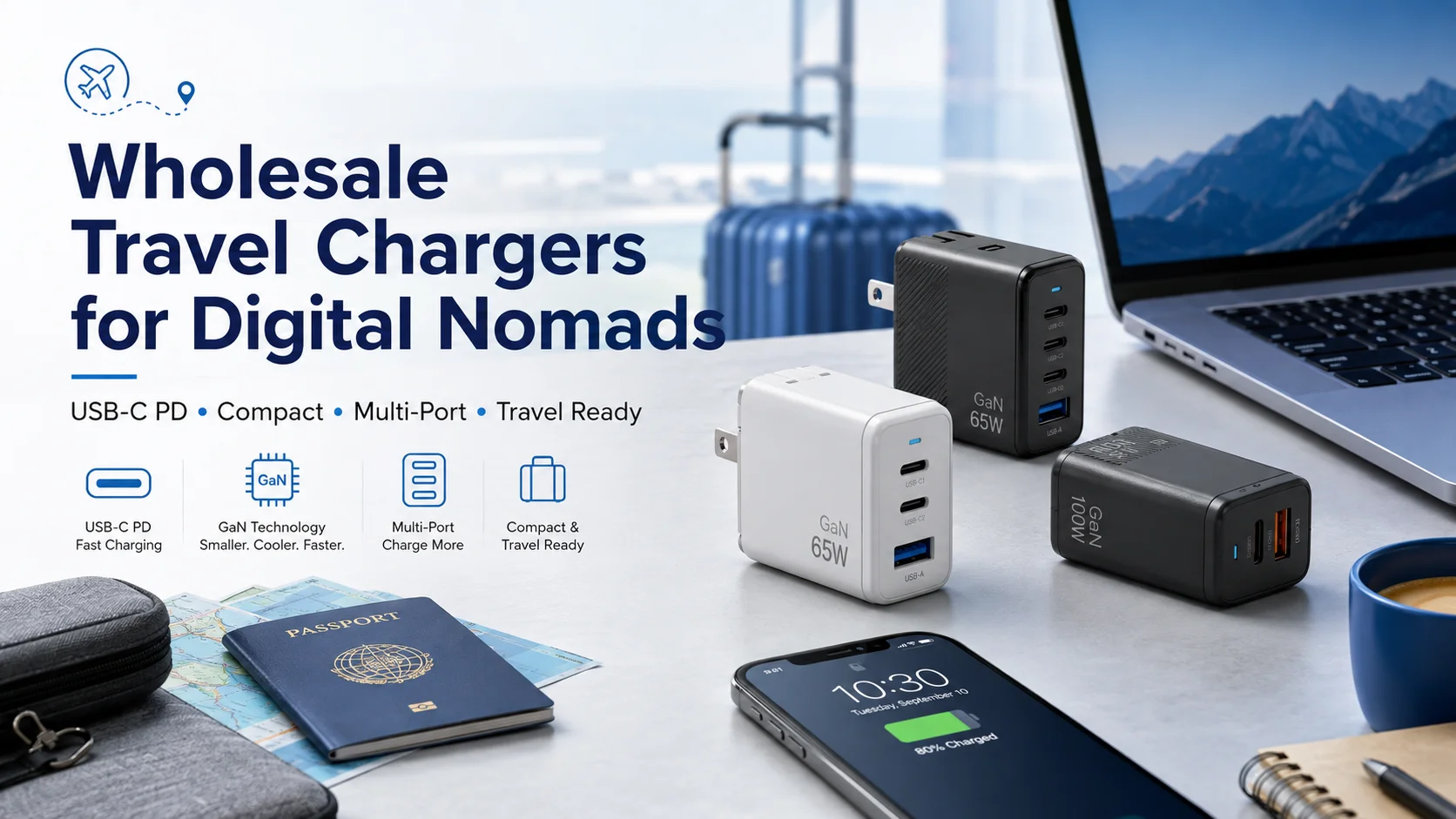
I have seen many charger concepts look excellent in product photos but create questions during production review. The practical buying decision is not about finding one “perfect” charger for every traveler. It is about building a reliable, market-ready SKU for the common travel routine: one laptop, one phone, and a few low-power accessories.
Quick Answer
Travel chargers for digital nomads should offer USB-C Power Delivery, a clear multi-port output-allocation table, suitable plug options, and verified documentation for the destination market. I would usually prioritize 65W models for common laptop-and-phone use, while 100W models can fit buyers serving users with higher-power laptops or several USB-C devices.
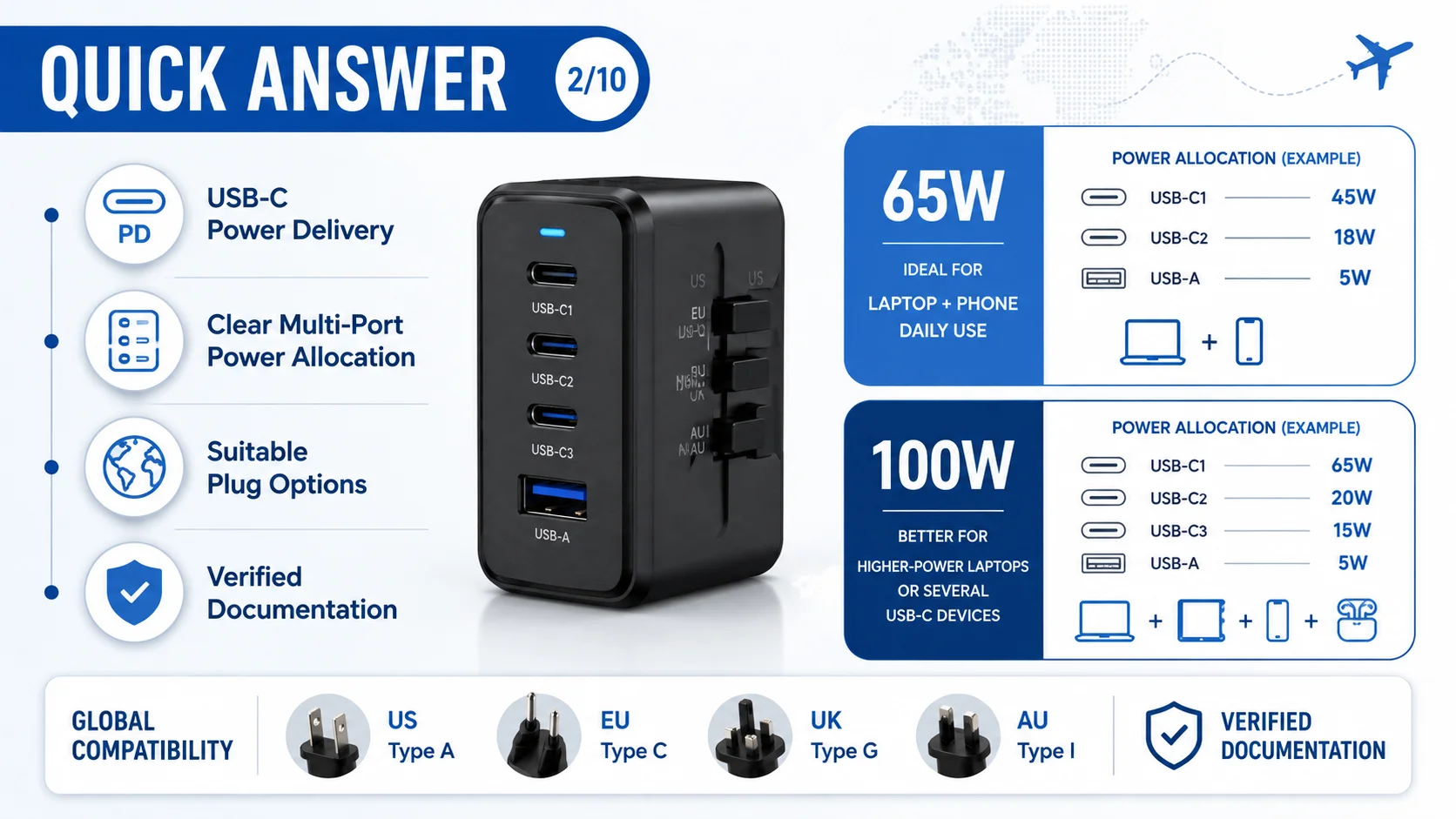
The fastest way to make a poor sourcing decision is to compare only total wattage. A 100W charger may still reduce laptop output significantly when a phone is connected.1 I always encourage buyers to start with the user scenario, then evaluate the electrical design and commercial details.
Start With the Primary Charging Task
For most digital-nomad customers, the core task is straightforward:
- Charge one laptop.
- Charge one smartphone.
- Keep earbuds, a smartwatch, or another small device topped up.
- Pack the charger without adding unnecessary weight or plug adapters.
This does not mean every customer needs a 100W or 140W charger. A traveler using a 13-inch laptop may be well served by a dependable 65W USB-C PD charger. A customer using a power-hungry workstation laptop may need more power, but that customer may also need to understand the laptop’s original charger rating and USB-C charging limits.
Ask for the Allocation Table First
I recommend requesting an output table before discussing color, logo placement, or packaging. A supplier should clearly show what happens when ports are used together.
| Usage Scenario | Example Output Allocation | Buyer Question |
|---|---|---|
| USB-C1 only | Up to 65W | Does the port support the required PD profile? |
| USB-C1 + USB-C2 | 45W + 20W | Can the laptop still charge while the phone fast charges? |
| USB-C1 + USB-C2 + USB-A | 45W + 15W + 5W | Is the total output stable under sustained use? |
| All ports active | Shared output | Does the manual explain power redistribution clearly? |
A clear allocation table helps retailers write accurate listings. It also helps reduce the risk of customers assuming that every port delivers maximum power at the same time.
What Makes a Travel Charger Suitable for Digital Nomads in 2026?
Travel chargers for digital nomads must balance charging capability, portability, plug practicality, and predictable operation. Many products claim to be ideal for travel, but unclear port behavior and unsuitable plug formats can disappoint users after purchase. I look for chargers that support realistic daily charging rather than just impressive headline specifications.
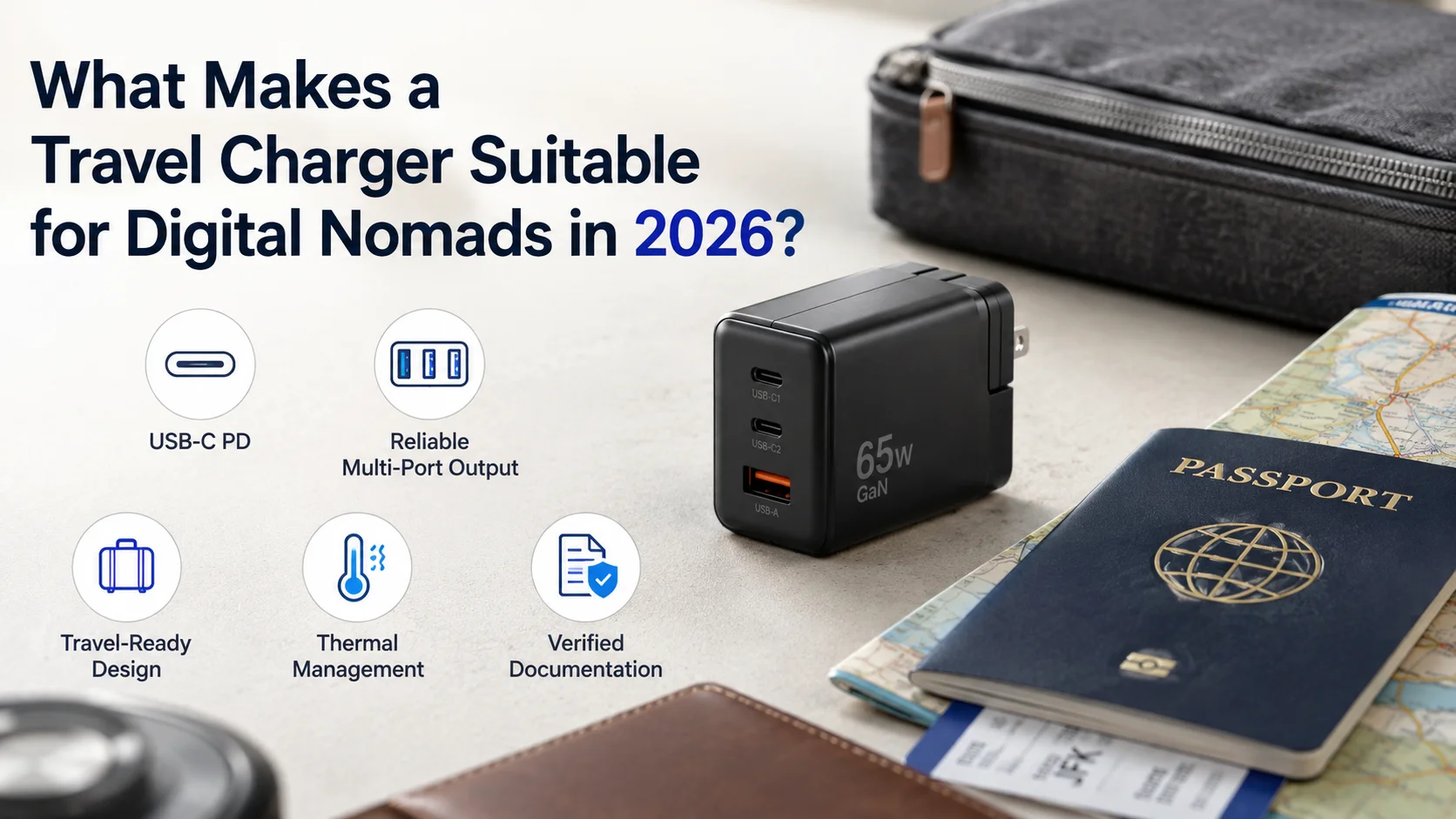
A suitable digital nomad charger should support common USB-C PD devices, provide dependable multi-port output, fit the intended travel regions, and use a structure that can manage heat and repeated packing. I recommend that buyers match the charger’s wattage, ports, plug design, and certifications to their target customer rather than treating one design as universally suitable.
The Core Features I Would Evaluate
A well-positioned travel charger usually combines the following features:
- USB-C Power Delivery support for laptops, tablets, and phones.
- PPS support, where relevant, for compatible Android fast charging.
- At least two USB-C ports for common laptop-and-phone use.
- A compact housing that suits backpacks and carry-on luggage.
- Foldable or interchangeable plug options based on the destination market.
- Clear labeling for total power and individual port output.
- Appropriate safety and compliance documents for the sales region.
I do not treat GaN technology as an automatic quality signal. GaN can help designers create smaller, higher-power chargers2, but the final result still depends on the circuit design, internal spacing, thermal materials, components, protection functions, and manufacturing consistency.
Heat Is a Procurement Issue, Not Just an Engineering Detail
In charger production, I have observed that compact high-power designs require more careful review than larger, lower-power products. A small body has less room to dissipate heat.3 This can create risk if the design pushes power density too aggressively or if production control is weak.
Buyers should ask suppliers how they evaluate:
- Surface temperature during sustained loads
- Over-current protection
- Over-voltage protection
- Short-circuit protection
- Over-temperature protection
- Plug and cable connection reliability
- Repeated insertion and folding performance
I also recommend that buyers request product samples and have qualified professionals evaluate them for the intended application and market. Product claims should match the available documentation and test scope.
Foldable Plug vs Interchangeable Adapter: Which Design Is Better?
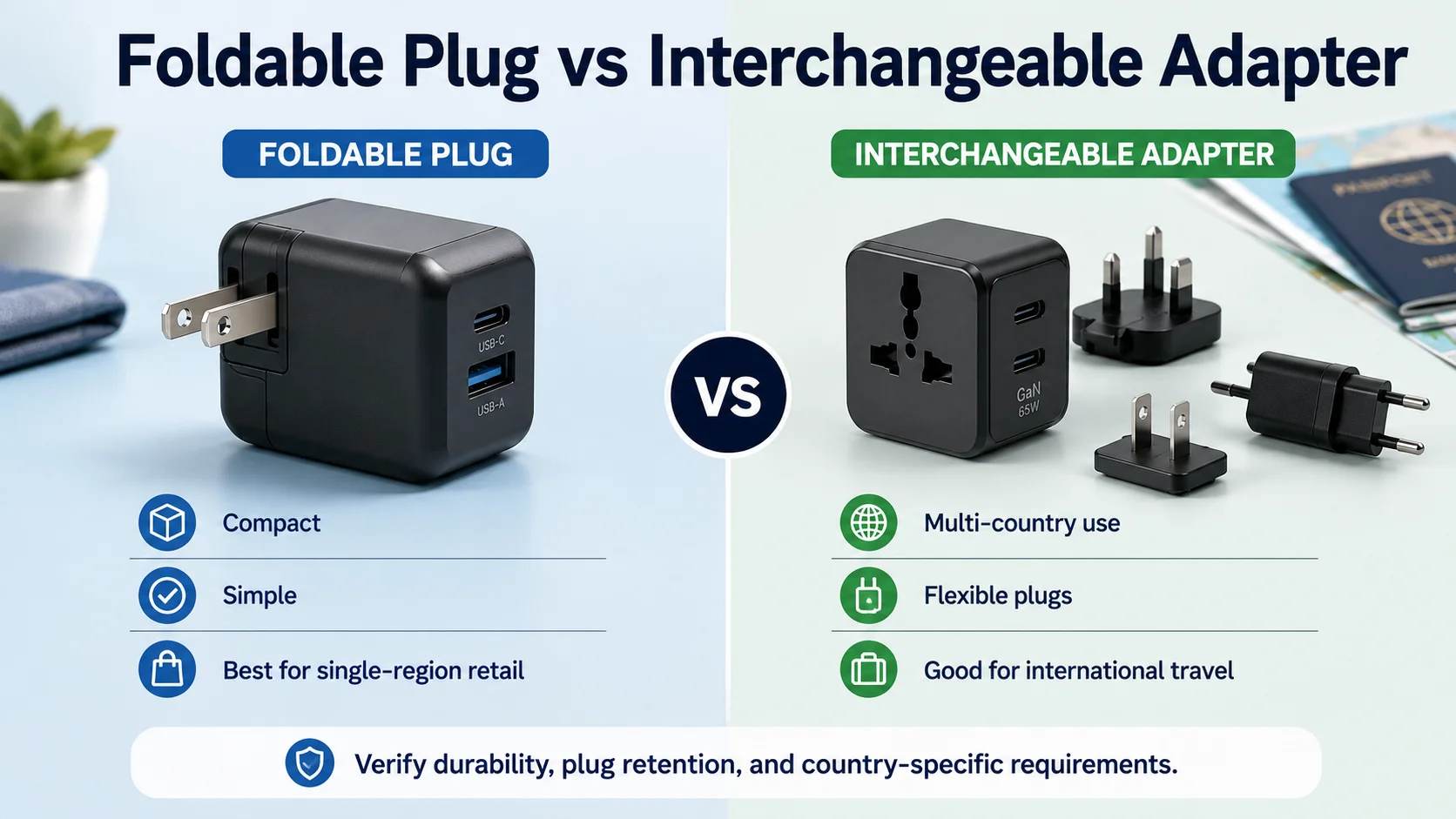
Foldable plugs and interchangeable adapters solve different travel problems. A foldable plug can make a charger easier to pack, while interchangeable plugs can support several regional socket formats. I see buyers choose the wrong design when they assume “universal” always means more convenient for every customer.
Foldable plug chargers are often best for single-region retail programs because they are compact and simple.4 Interchangeable adapter chargers can suit international travelers and multi-market distribution, but buyers should verify mechanical durability, plug retention, voltage specifications, and country-specific compliance requirements before placing an order.
Foldable Plug Chargers
A foldable plug charger usually has fixed prongs that tuck into the body. For example, a US-style plug may fold flat against the charger housing. This design can work well for North American retail, cross-border e-commerce, and travel-focused brands selling into a defined plug region.
Advantages include:
- Slimmer packing profile
- Fewer loose accessories
- Simpler customer experience
- Lower chance of losing a plug head
- Often easier packaging design
Potential concerns include:
- The fixed plug may limit international usefulness.
- Fold mechanisms need durability review.
- A charger designed for US plugs may need a separate SKU for EU or UK markets.
- Users may still need a passive travel adapter overseas.
Interchangeable Plug Chargers
Interchangeable plug systems can include US, EU, UK, and AU-style plug heads. They can make sense for wholesale buyers supplying airport stores, travel retailers, global e-commerce sellers, and distributors serving multiple countries.
However, I would not assume every interchangeable adapter system is equally reliable. Buyers should inspect:
- Plug-head locking structure
- Contact fit and retention force
- Repeated installation performance
- Clear country plug identification
- Packaging organization
- Instructions explaining voltage and use limitations
A plug adapter changes the physical connection. It does not automatically convert voltage.5 Buyers should ensure product labeling and instructions state the charger’s input range clearly.
For many USB-C chargers, a wide input range such as 100–240V, 50/60Hz may be appropriate6, but buyers should verify the actual product specification and target-market rules.
Comparison Table: Foldable, Universal and GaN Travel Chargers
Travel chargers for digital nomads come in several formats, and each format creates different sourcing priorities. A universal adapter may appear more versatile, while a compact GaN charger may look more premium. I compare designs by intended use, power behavior, and risk-control needs instead of by marketing labels alone.
Foldable chargers work well for region-specific portability, universal adapters support plug flexibility, and GaN chargers can support compact higher-power designs. I recommend selecting the format that matches the buyer’s target market, primary charging scenario, and required compliance documentation rather than treating any one category as automatically better.
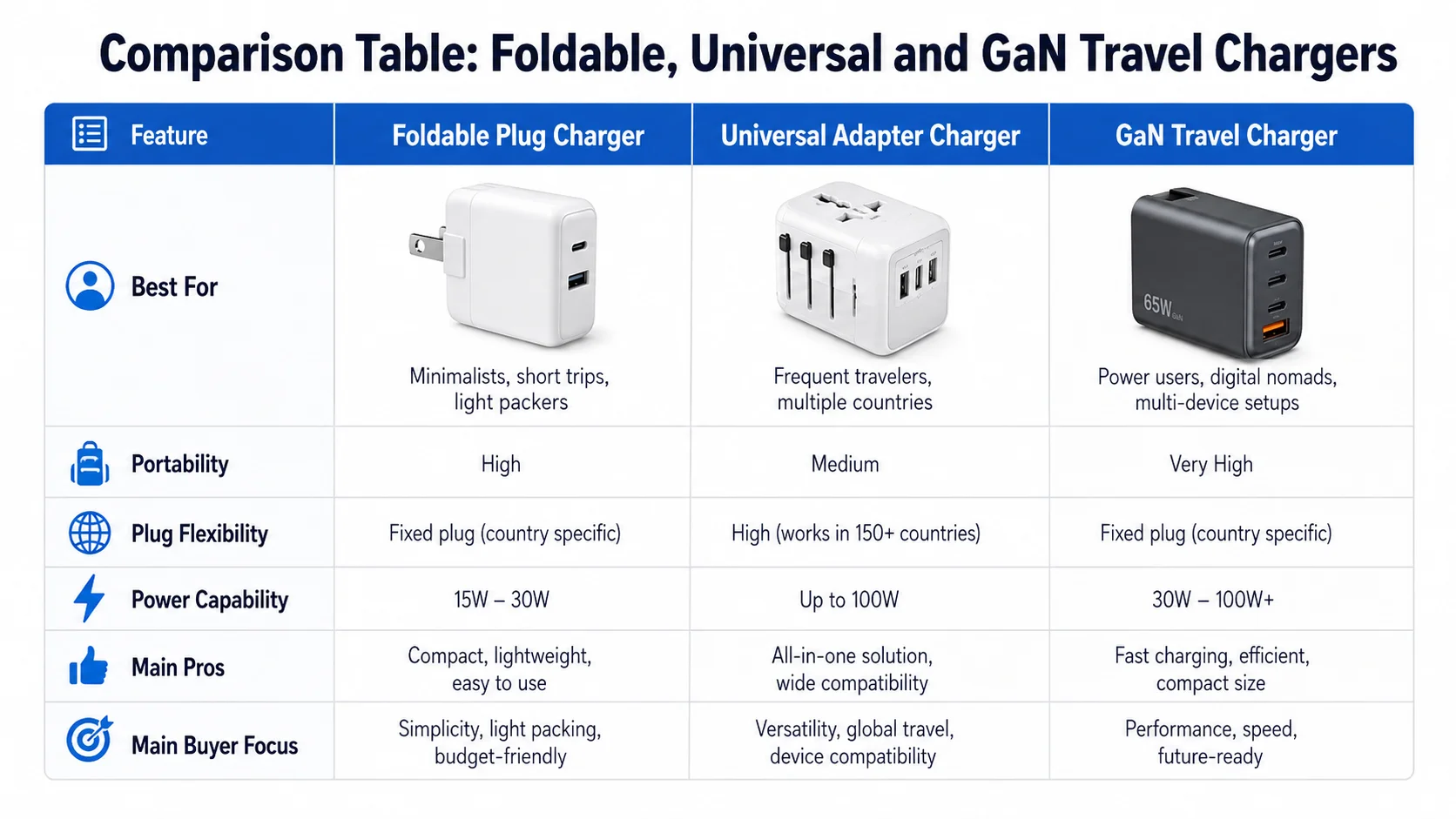
| Charger Type | Best Fit | Typical Strength | Key Risk to Verify | Buyer Positioning |
|---|---|---|---|---|
| Foldable plug charger | Single-region travel retail | Compact and easy to pack | Folding-plug durability | Everyday travel charger |
| Universal travel adapter with USB ports | Multi-country travelers | Several plug formats | Adapter fit, output limits, instructions | International travel accessory |
| GaN USB-C charger | Laptop and phone users | High power in a smaller body | Thermal design and allocation table | Premium USB-C PD charger |
| Multi-port desktop travel charger | Hotel and work-from-anywhere users | More ports and stable placement | Bulk and cable requirements | Multi-device charging hub |
| Interchangeable-plug charger | Global distributors | Regional plug flexibility | Plug-head mechanism and certification scope | International SKU program |
Avoid Mixing Categories in Product Claims
I often see product listings blur the line between a travel adapter and a travel charger. This can confuse end users.
A travel adapter mainly changes the physical plug shape.7 Some adapters also include USB charging outputs, but their total power may be limited. A travel charger is a power supply designed to convert AC input into controlled USB output. A product can combine both functions, but buyers should confirm exactly what it can and cannot do.
For example, a universal adapter with two USB-C ports might be useful for phones and tablets but may not provide enough USB-C PD power for a laptop. On the other hand, a 65W GaN travel charger may power a laptop effectively but still require separate plug heads for different countries.
I recommend that buyers create separate product pages and packaging claims for each category. Clear positioning helps customers select the correct product and helps reduce avoidable returns.
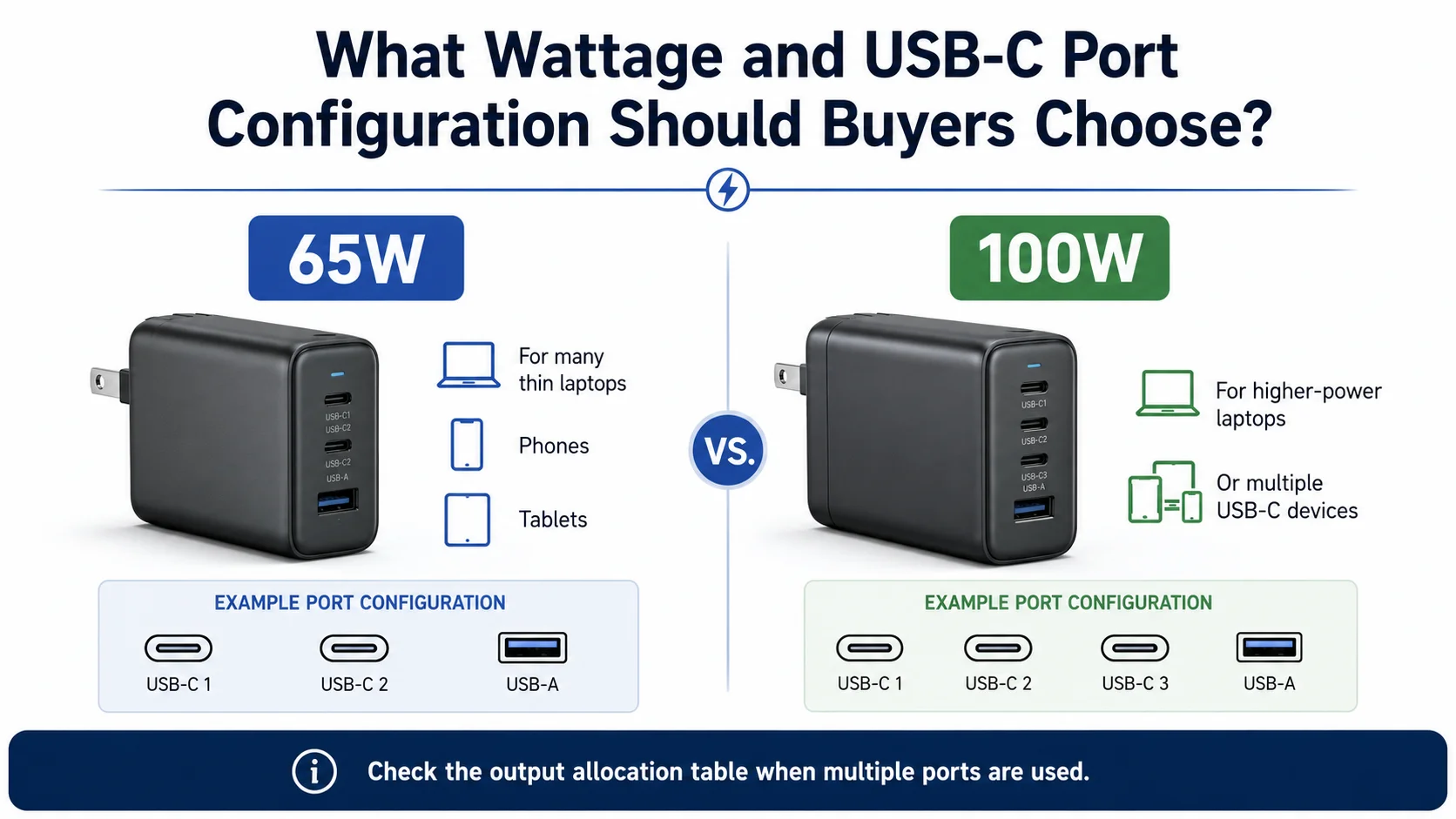
What Wattage and USB-C Port Configuration Should Buyers Choose?
Wattage choices can become confusing because laptop requirements vary widely. A 65W charger may be enough for many thin laptops, while other systems need 100W or more for full-speed charging. I advise wholesale buyers to choose wattage based on the target user’s device mix and simultaneous charging expectations.
For many digital-nomad retail programs, a 65W charger with two USB-C ports is a practical starting point. A 100W charger can fit customers with higher-power laptops or more demanding multi-device needs, but buyers should verify each port’s PD profiles and the power available when several devices are connected.
A Practical Wattage Framework
| Buyer Target | Suggested Starting Range | Useful Port Setup |
|---|---|---|
| Phone and tablet travelers | 30W–45W | 1–2 USB-C ports |
| Lightweight laptop users | 65W | 2 USB-C ports, optional USB-A |
| Laptop plus phone users | 65W–100W | 2 USB-C ports |
| Higher-power laptop users | 100W+ | 2–3 USB-C ports |
| Family or multi-device travelers | 100W+ | 3–4 mixed ports, clear sharing rules |
I would treat these ranges as procurement starting points, not universal guarantees. Laptop brands, battery states, active workloads, and cable ratings can all affect charging behavior.
Ports Matter More Than the Port Count
A charger with four ports is not necessarily more useful than a charger with two well-designed USB-C ports. For a digital nomad, the common priority is usually:
- A laptop-capable USB-C port.
- A second USB-C port for a phone or tablet.
- An optional USB-A port for legacy accessories.
A USB-A port can still be useful for older cables, earbuds, watches, or small accessories. However, USB-C is usually the better long-term focus for a premium travel charger range.
Buyers should also verify supported protocols. USB-C PD is important for many laptops, tablets, and phones.8 PPS may matter for certain Android models. Compatibility claims should be written carefully and based on supported protocols, not broad statements such as “works with all devices.”
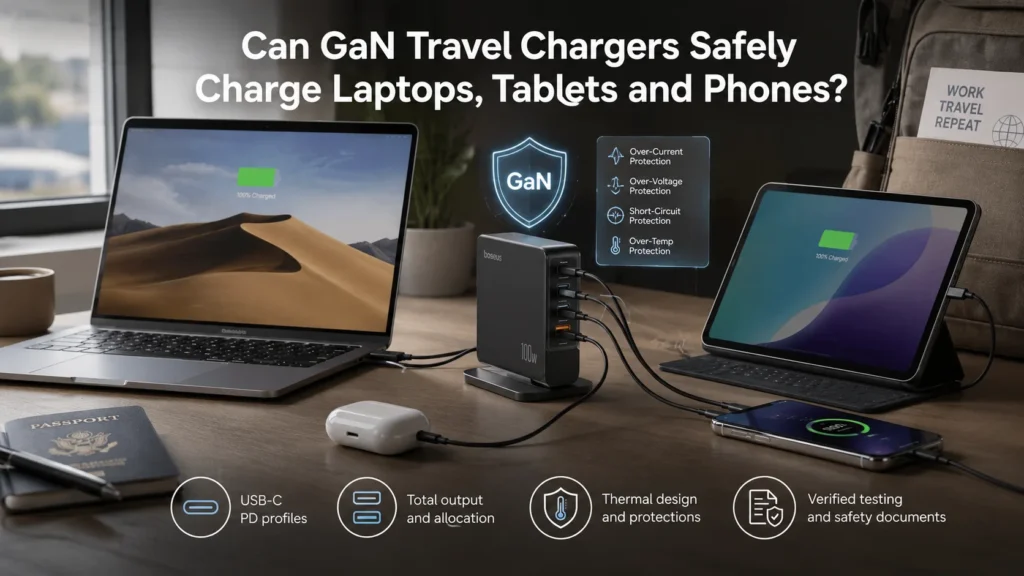
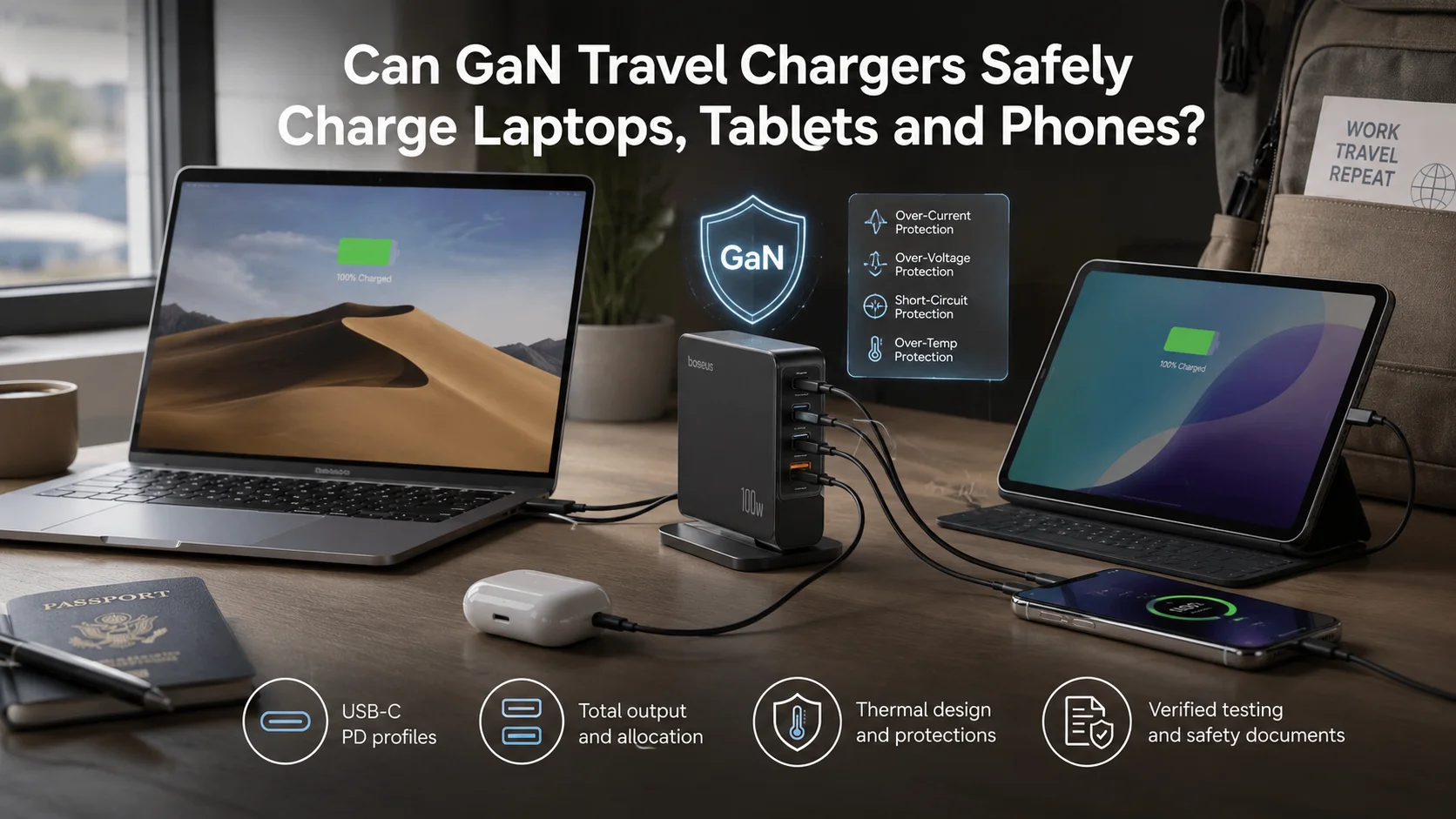
Can GaN Travel Chargers Safely Charge Laptops, Tablets and Phones?
GaN travel chargers are popular because they can deliver useful power from a compact body. Yet compactness alone does not prove safe or stable operation. I have seen buyers become too focused on a small housing and overlook the questions that actually affect product reliability and customer expectations.
GaN travel chargers can charge laptops, tablets, and phones when their USB-C PD profiles, total output, port allocation, cables, and device requirements match. Buyers should verify thermal design, protection features, test documentation, and simultaneous charging behavior because GaN technology alone does not guarantee performance or safety.
What GaN Changes—and What It Does Not
Gallium nitride components can support higher switching frequencies and more compact charger designs compared with some conventional silicon-based approaches.9 This can help manufacturers reduce charger size while maintaining useful output power.
However, I would remind buyers that the semiconductor material is only one part of the charger.
A complete quality review should include:
- PCB layout and component selection
- Transformer and capacitor quality
- Heat dissipation approach
- Housing material and structure
- Internal insulation and spacing
- Firmware or control behavior, where applicable
- Power negotiation stability
- Protection circuit design
- Assembly quality and inspection standards
Verify Sustained Use, Not Only Short Demonstrations
A charger can appear stable during a brief charging demonstration but behave differently during sustained multi-port use. For example, a laptop and phone may initially charge normally, then the charger may redistribute power as device demand changes.
I recommend asking suppliers for:
- Product specification sheets
- Multi-port allocation charts
- Supported PD/PPS profiles
- Test reports relevant to the target market
- Temperature-related evaluation information, where available
- Quality-control process descriptions
- Sample units for third-party or qualified professional review
A high-power USB-C cable is also part of the system. A 100W charger may not deliver expected performance if the cable is not rated for the required power or protocol.10
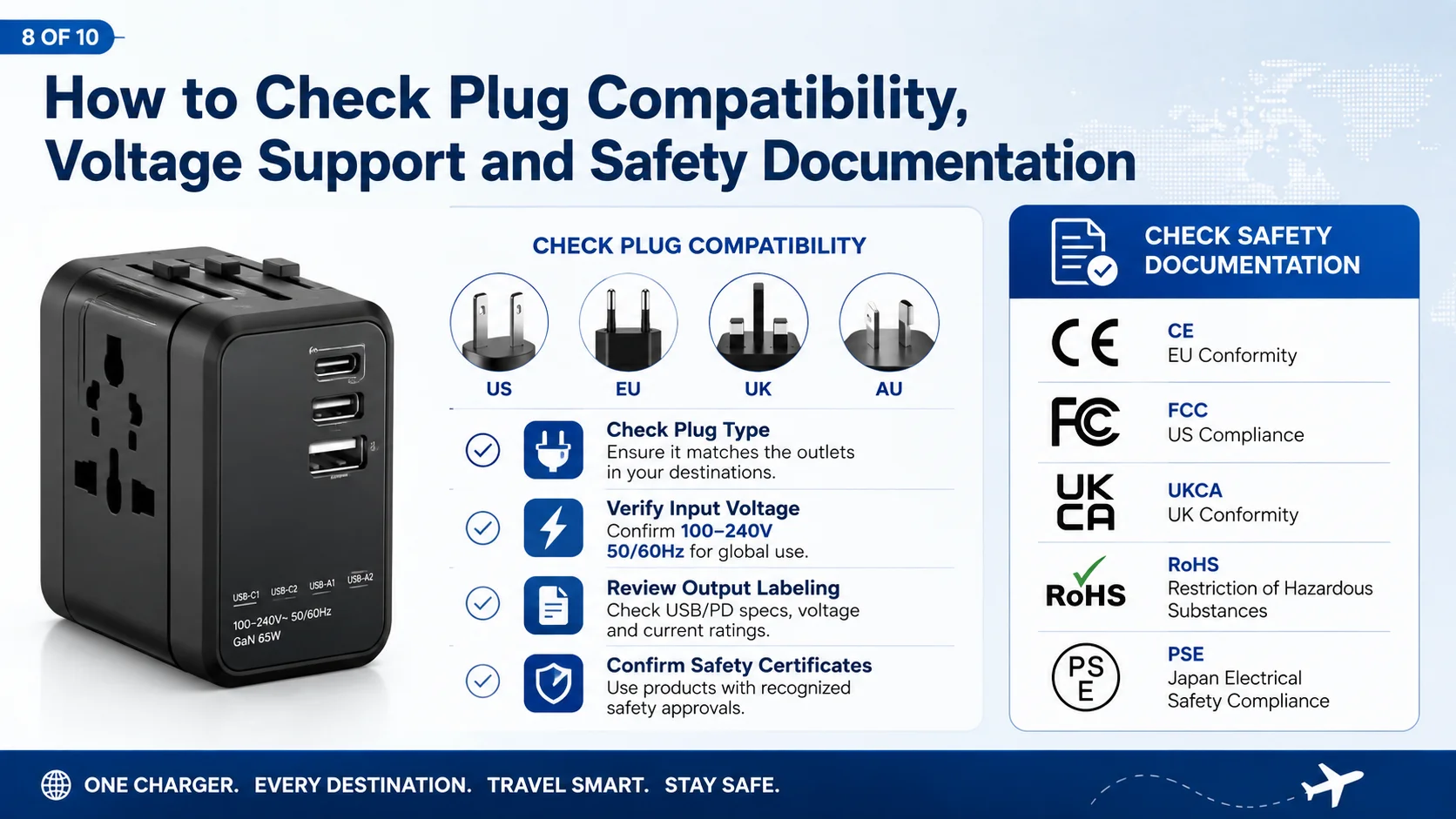
How to Check Plug Compatibility, Voltage Support and Safety Certifications
Travel chargers for digital nomads must meet both user expectations and market-entry requirements. Plug shape, input voltage range, labeling, and compliance documentation all matter. I encourage buyers to verify each requirement for the exact destination market because regulations and retailer standards can vary.
Buyers should confirm the charger’s plug type, input range, output labeling, and applicable compliance documents before importing travel chargers. A supplier should provide documentation that matches the model, factory, and target market, while buyers should verify country-specific legal, regulatory, and retailer requirements with qualified compliance professionals.
Check the Product Basics
I suggest starting with the physical and electrical facts:
- Which plug is included: US, EU, UK, AU, or interchangeable heads?
- Does the charger state an input range such as 100–240V, 50/60Hz?
- What are the USB-C PD output profiles?
- Is the rated output printed clearly on the charger?
- Are user instructions included in the required language?
- Does packaging make accurate claims about laptop charging and fast charging?
Verify Documents, Not Just Logos
A compliance logo on packaging is not enough for a procurement decision. Buyers should request documentation and confirm its relevance to the exact SKU.
Depending on the market and product category, buyers may need to examine documents related to standards or requirements such as:
- Electrical safety requirements
- EMC requirements
- RoHS or restricted-substance requirements
- Energy-efficiency requirements
- Material declarations
- Battery-related requirements, if the product includes a battery
- Retailer-specific testing requirements
For EU sales, buyers may need to verify CE-related obligations and supporting technical documentation.11 For US or Canadian retail channels, some buyers may require safety certification through recognized testing programs12, depending on the product, state, retailer, and channel. I recommend confirming these requirements with an experienced compliance professional before shipment.
What Wholesale Buyers Should Verify Before Placing an OEM Order?
An OEM order can fail even when the charger sample looks good. Packaging claims, cable selection, logo placement, compliance files, factory capacity, and post-sale terms all affect the final program. I recommend that buyers turn their product brief into a written verification checklist before approving mass production.
Before placing an OEM travel charger order, buyers should verify specifications, multi-port allocation, plug design, quality-control steps, target-market documents, packaging claims, MOQ, lead time, warranty handling, and sample approval standards. A written specification sheet reduces misunderstandings between buyers, factories, and sales channels.
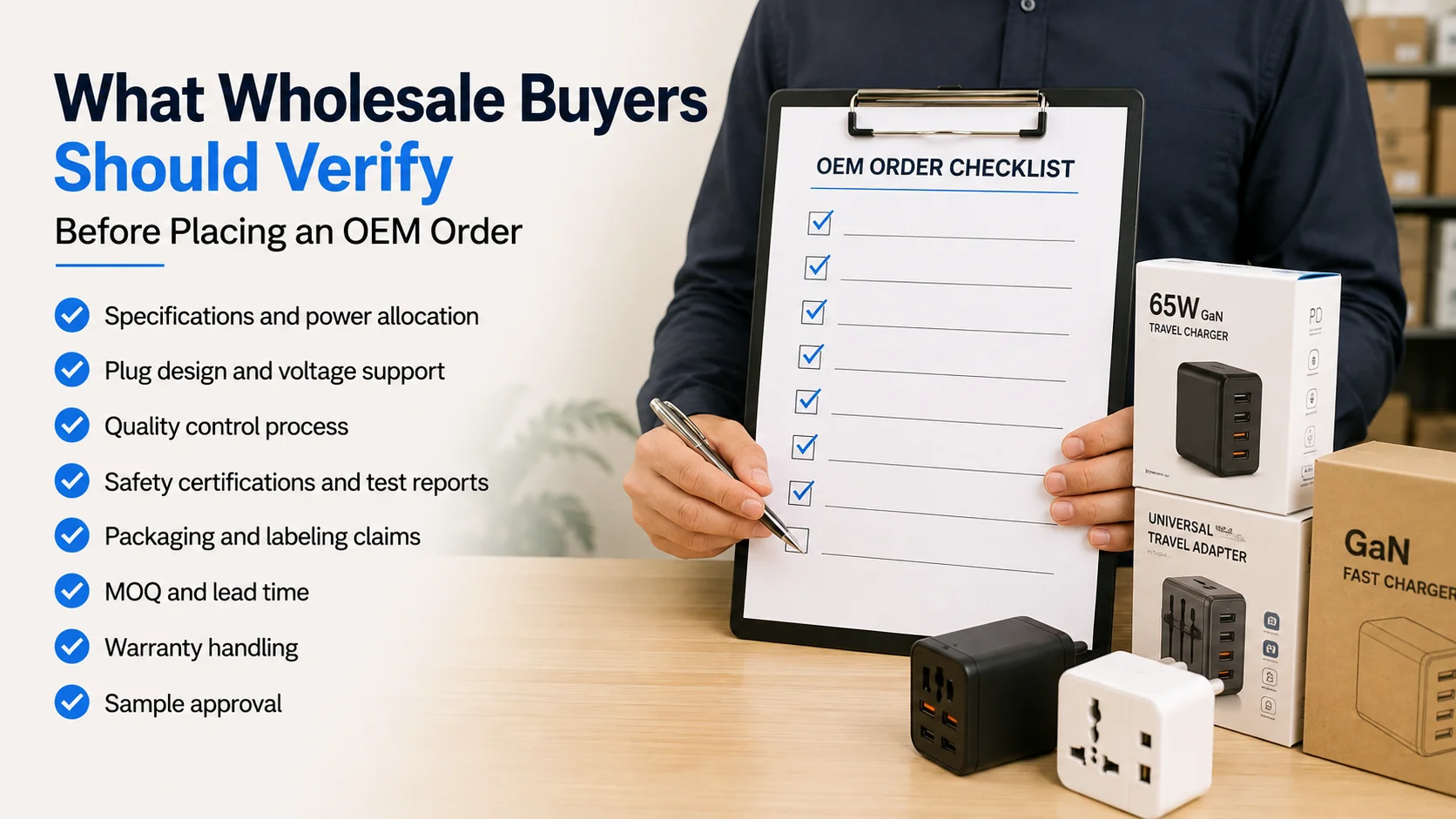
My OEM Buyer Checklist
I would ask a supplier to confirm the following points in writing:
| Category | What Buyers Should Verify |
|---|---|
| Electrical performance | Total wattage, PD profiles, PPS support, allocation table |
| Device use case | Laptop, phone, tablet, and accessory charging scenarios |
| Plug configuration | Fixed, foldable, or interchangeable plug format |
| Product structure | Housing, plug mechanism, port reinforcement, finish |
| Quality control | Incoming inspection, production inspection, final inspection |
| Compliance | Applicable reports, declarations, labels, and document validity |
| Packaging | Claims, languages, barcode, warning labels, included cable |
| Commercial terms | MOQ, sample cost, lead time, payment terms, warranty process |
| Customization | Logo method, housing color, packaging, manuals, cable options |
Build Quality Gates Into the Order
At Kingfuji, we work from Shenzhen with long-term export experience in 3C products, including USB cables, chargers, GaN chargers, TWS earbuds, and smart watches. In practical production discussions, I find that early specification alignment is often more valuable than a late-stage cosmetic change.
I recommend using clear approval stages:
- Specification approval before sampling
- Pre-production sample approval before mass production
- Packaging and labeling approval before printing
- Inspection agreement before shipment
- Document review before market entry
Buyers should also define what happens if a batch does not meet the approved specification. This includes inspection standards, acceptable quality limits where relevant, rework procedures, and communication responsibilities.
Frequently Asked Questions About Wholesale Travel Chargers
What is the best wattage for a wholesale travel charger?
I usually recommend starting with 65W for a mainstream laptop-and-phone travel charger program. Buyers can consider 100W for customers using higher-power laptops or several USB-C devices. The final choice should depend on verified power allocation, supported PD profiles, and the target device mix.
Are universal travel adapters the same as travel chargers?
No. I treat a universal travel adapter and a travel charger as different product categories. An adapter mainly changes plug shape, while a charger supplies controlled USB power. Some products combine both functions, but buyers should verify USB-C PD output, voltage specifications, and device limitations.
Can a 65W charger charge a laptop and phone together?
It can in many cases, but buyers should not assume this without checking the output-allocation table. A charger may split power between ports, such as 45W for a laptop and 20W for a phone. Device needs and cable ratings also affect actual charging performance.
What certifications should wholesale buyers request for travel chargers?
I recommend requesting documents relevant to the destination market, product category, and retailer requirements. Buyers may need to verify electrical safety, EMC, restricted substances, energy efficiency, labeling, and other obligations. A qualified compliance professional should confirm the exact requirements before import or sale.
Should I choose a GaN travel charger for my product line?
A GaN travel charger can be a strong option for compact, higher-power positioning. However, I would not select it based on the GaN label alone. Buyers should review thermal design, protection functions, power sharing, housing quality, documentation, and sample performance.
Source Compact GaN Travel Chargers from Kingfuji
Travel chargers for digital nomads should be selected as a complete procurement package, not as a wattage number on a listing. Retailers and distributors need a product that supports common devices, explains its limits clearly, and fits the destination market. I believe a disciplined sourcing process protects both margins and brand reputation.
Kingfuji supports buyers looking for compact GaN travel chargers, USB-C PD chargers, charging cables, and OEM 3C accessories for European and North American markets. We recommend defining the target user, power allocation, plug format, documentation needs, MOQ, and packaging requirements before confirming an order.
I recommend beginning a supplier discussion with a practical brief rather than a vague request for “the best charger.” Include your target market, expected retail price, preferred wattage, plug type, port configuration, packaging style, estimated order quantity, and compliance expectations.
That approach gives both sides a clearer starting point. It also makes it easier to compare samples, verify claims, and select a travel-charger SKU that fits your customers’ real needs.
"USB Charger (USB Power Delivery)", https://www.usb.org/usb-charger-pd. USB Power Delivery permits negotiated power delivery between a source and connected devices; in multi-port products, the power available to each device depends on the charger's total capacity and its implemented power-allocation policy. Evidence role: mechanism; source type: institution. Supports: USB Power Delivery charging systems can negotiate and distribute limited available power among connected devices, so per-port output depends on the charger's implemented allocation design.. Scope note: The USB Power Delivery standard does not establish the allocation behavior of every individual charger model. ↩
"GaN vs. Silicon in High-Frequency Power Transistors - Stanford", http://large.stanford.edu/courses/2025/ph240/jahan2/. Research on gallium nitride power electronics reports that their high-frequency switching capability can reduce the size of magnetic and passive components in power converters, supporting more compact adapter designs. Evidence role: mechanism; source type: research. Supports: Gallium nitride power devices can operate efficiently at higher switching frequencies than conventional silicon devices, enabling reductions in the size of some power-conversion components.. Scope note: Semiconductor characteristics alone do not demonstrate the quality, thermal performance, or safety of a particular finished charger. ↩
"Impact of Heat Dissipation Profiles on Power Electronics ...", https://www.osti.gov/servlets/purl/1474615. Thermal-management principles for electronics show that heat dissipation depends on thermal paths, surface area, and thermal resistance; compact enclosures can therefore require more careful thermal design at a given power level. Evidence role: mechanism; source type: education. Supports: Heat removal from electronic equipment depends on conduction, convection, radiation, available surface area, and thermal resistance, making compact high-power packaging a thermal-design challenge.. Scope note: Enclosure size alone cannot predict a charger's operating temperature because component efficiency, materials, airflow, and internal design also matter. ↩
"PD30W European Travel Plug Adapter, International ...", https://villageofgreenwoodlake.gov/products/pd30w-european-travel-plug-adapter-international-power-adapt/227370817/. International plug and socket systems differ in physical configuration; consequently, a charger with a fixed regional plug requires a compatible outlet or an appropriate adapter when used in regions with other socket types. Evidence role: general_support; source type: institution. Supports: Electrical plugs and socket configurations vary internationally, so a charger with fixed prongs is physically compatible only with sockets designed for that plug type unless an adapter is used.. Scope note: The conclusion that foldable plugs are best for a particular retail program is a commercial judgment rather than a universal technical rule. ↩
"220V to 110V Converter US to Europe, Voltage ...", https://villageofgreenwoodlake.gov/products/220v-to-110v-converter-us-to-europe-voltage-converter-for-european-travel-1600w-plug-play-power-any-us-appliances-overseas-step-down-transformer-universal-adapter-for-international-travel/220567905/. Consumer electrical-safety guidance distinguishes plug adapters, which alter physical plug compatibility, from voltage converters or transformers, which are required when an appliance cannot operate on the local supply voltage. Evidence role: definition; source type: government. Supports: A plug adapter enables a device plug to fit another socket shape, whereas voltage conversion requires a separate transformer or converter.. ↩
"Mains electricity by country", https://en.wikipedia.org/wiki/Mains_electricity_by_country. Mains electricity varies by country in nominal voltage and frequency; equipment marked for 100–240 V, 50/60 Hz is commonly designed for use across a broad range of international supply conditions. Evidence role: general_support; source type: encyclopedia. Supports: National electricity supplies use different nominal voltages and frequencies, and a device rated for 100–240 V at 50/60 Hz is designed to accommodate many of these supply systems.. Scope note: A wide input rating does not establish plug compatibility, local regulatory compliance, or suitability for every electrical installation. ↩
"PD30W European Travel Plug Adapter, International ...", https://villageofgreenwoodlake.gov/products/pd30w-european-travel-plug-adapter-international-power-adapt/227370817/. Electrical-safety guidance defines a plug adapter as a device that permits a plug to fit a differently shaped outlet; it does not by itself perform voltage conversion or establish USB charging capability. Evidence role: definition; source type: government. Supports: A travel plug adapter changes the physical interface between a device plug and a wall receptacle and is distinct from a voltage converter.. Scope note: Some travel products combine adapter and USB power-supply functions, so their capabilities must be determined from the specific product specifications. ↩
"USB hardware", https://en.wikipedia.org/wiki/USB_hardware. USB Power Delivery is a USB Type-C power-negotiation technology designed to support higher-power charging and to allow sources and sinks to negotiate an appropriate power contract. Evidence role: mechanism; source type: institution. Supports: USB Power Delivery is a USB-C power-negotiation standard capable of supporting charging across device classes with different power requirements.. Scope note: USB-C connector presence does not by itself guarantee Power Delivery support, charging acceptance, or identical charging rates for all devices. ↩
"Workshop on Crystalline Silicon Solar Cell Materials and ...", https://www.nrel.gov/docs/fy02osti/32717.pdf. Power-electronics literature reports that gallium nitride devices can support high-frequency switching with favorable loss characteristics, which may enable smaller power-conversion magnetics and more compact converter designs than comparable silicon approaches. Evidence role: mechanism; source type: paper. Supports: GaN power transistors have material and switching characteristics that can support higher-frequency power conversion and reductions in passive-component size relative to some silicon implementations.. Scope note: The magnitude of any size or efficiency benefit depends on converter topology, operating conditions, component choices, and implementation. ↩
"100W USB-C Cable with E-Marker Chip, 3M /10Feet / 90 Degree 5A ...", https://www.amazon.com/Delivery-Charging-Compatible-Mac-Book-Pixelbook/dp/B094CTSY3H. USB Type-C and USB Power Delivery specifications define cable current capabilities and electronic-marking requirements for higher-power operation, meaning the cable can constrain the power contract available between a charger and device. Evidence role: mechanism; source type: institution. Supports: USB Type-C cable current capability and electronic marking affect which USB Power Delivery power levels can be negotiated and safely delivered.. Scope note: Cable rating is only one factor; device acceptance, charger profiles, connector condition, and protocol implementation also affect actual charging performance. ↩
"CE marking", https://en.wikipedia.org/wiki/CE_marking. European Commission guidance states that manufacturers of products covered by applicable EU harmonisation legislation must carry out conformity assessment, compile technical documentation, prepare an EU declaration of conformity, and affix CE marking before market placement. Evidence role: historical_context; source type: government. Supports: EU CE-marking rules require manufacturers to assess applicable legislation, prepare technical documentation, issue an EU declaration of conformity where required, and affix CE marking before placing covered products on the market.. Scope note: The precise directives, standards, and conformity-assessment route depend on the charger's design, functions, and intended EU market placement. ↩
"OSHA's Nationally Recognized Testing Laboratory (NRTL) Program", https://www.osha.gov/nationally-recognized-testing-laboratory-program. OSHA describes Nationally Recognized Testing Laboratories as organizations recognized to test and certify products to specified product-safety standards; Canadian electrical-approval requirements are administered within applicable national and provincial regulatory frameworks. Evidence role: general_support; source type: government. Supports: In the United States, OSHA recognizes Nationally Recognized Testing Laboratories for product-safety testing and certification, while Canadian electrical products may require approval under applicable provincial or territorial rules.. Scope note: Whether certification is legally required for a particular charger depends on the product, jurisdiction, installation context, retailer policy, and applicable electrical-safety rules. ↩