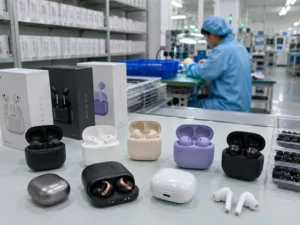
Open-ear headphones are attracting growing interest from wholesale buyers1 because they offer a different balance of comfort, awareness, and style than traditional in-ear TWS earbuds. Buyers can face slow-moving inventory when they treat every trending design as a guaranteed bestseller. We help them reduce that risk by matching the right open-ear model to the right customer, channel, and price band.
Open-ear headphones are becoming popular because many consumers want to listen to music, calls, and podcasts without fully blocking their ears2. For wholesale buyers, the opportunity is not to replace all in-ear earbuds. It is to add targeted products for sports users, commuters, office workers, and comfort-focused shoppers who value situational awareness and a less enclosed wearing experience.

In our 15 years of exporting 3C products from Shenzhen, we have seen product inquiries shift quickly. Recently, more overseas buyers have asked us to add open-ear headphones to quotations, send samples, and compare ear-hook and clip-on forms. That is a useful sourcing signal, but buyers still need a clear assortment strategy before placing an order.
Quick Answer: Should Wholesale Buyers Add Open-Ear Headphones?
Open-ear headphones can create a useful new product category, but they are not automatically right for every retailer or online seller. A buyer who orders without a target customer, price position, or listing angle may end up with attractive products that turn slowly.
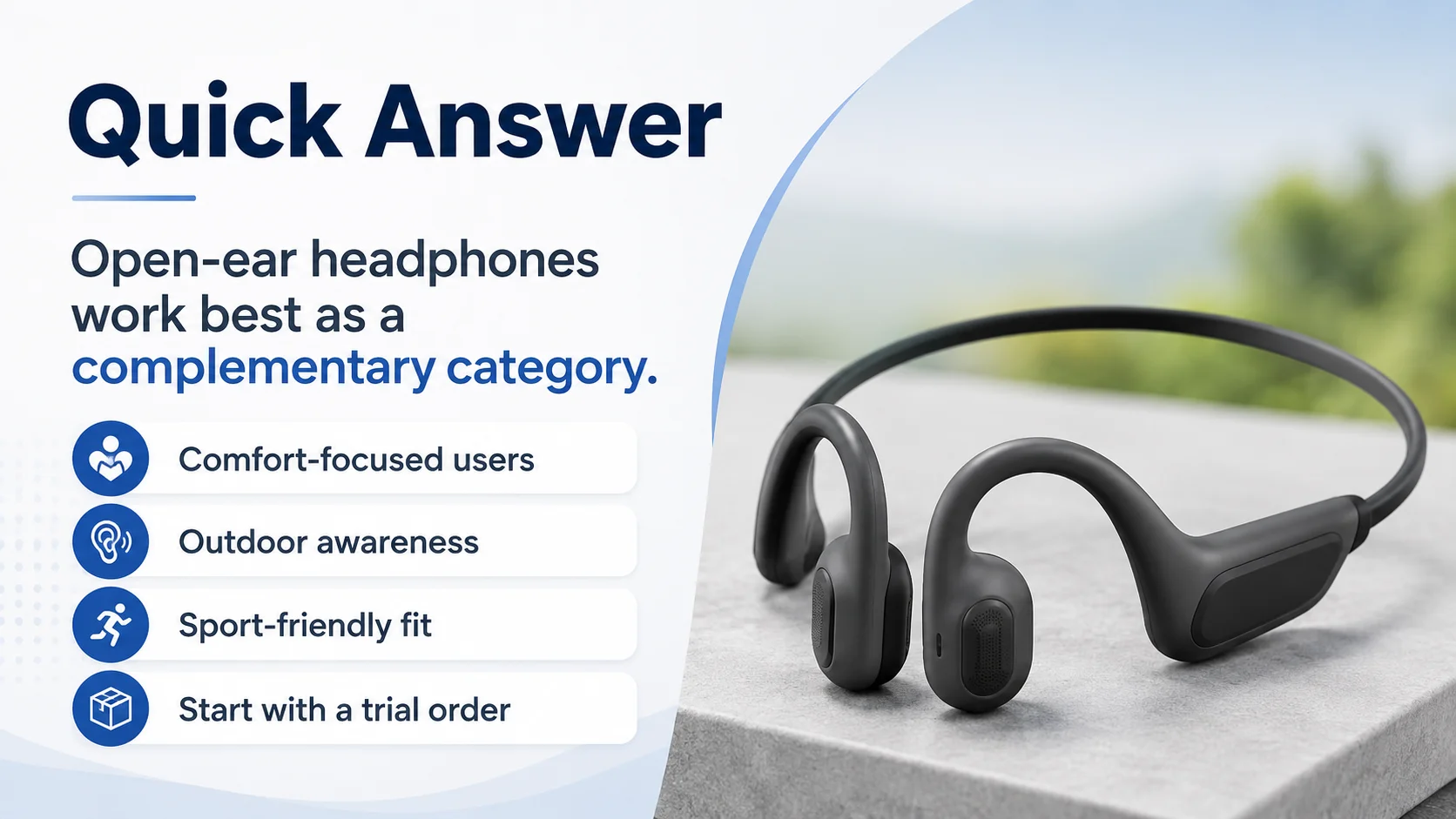
Wholesale buyers should consider open-ear headphones as a complementary category for customers who prioritize comfort, outdoor awareness, stable sport fit, and modern styling. The best first order is usually a controlled trial with selected designs, verified specifications, suitable packaging, and a clear sales message rather than a broad purchase based only on appearance or social-media visibility.
Start With an Assortment Question
The most important question is not, “Which model looks newest?” It is, “Who will buy this model, and why?” Open-ear products can appeal to different groups, but each form has a different commercial role.
For example, a sporting-goods retailer may prefer an ear-hook model because customers can immediately understand its stability during running or cycling. An e-commerce seller may prefer a compact clip-on design because its visual shape can create a strong listing image for younger, style-focused shoppers.
In our buyer conversations, practical questions usually appear early:
- Can this model fit users with different ear shapes?
- Does the design stay in place during exercise?
- What is the battery capacity and real-world use pattern?
- Can the product be packed under a private label?
- Is the MOQ suitable for a first test order?
- Which compliance documents are available for the destination market?
A small trial order does not remove all risk, but it gives buyers a better basis for evaluating reviews, customer questions, repurchase potential, and product positioning.
We generally recommend that buyers treat open-ear products as an assortment test, not as a blanket replacement for their existing TWS range.
Why Are Open-Ear Headphones Becoming So Popular?
Open-ear headphones are gaining attention because many consumers dislike the pressure or isolation associated with some in-ear products. They may want to hear traffic, coworkers, family members, or gym announcements while still using Bluetooth audio devices.
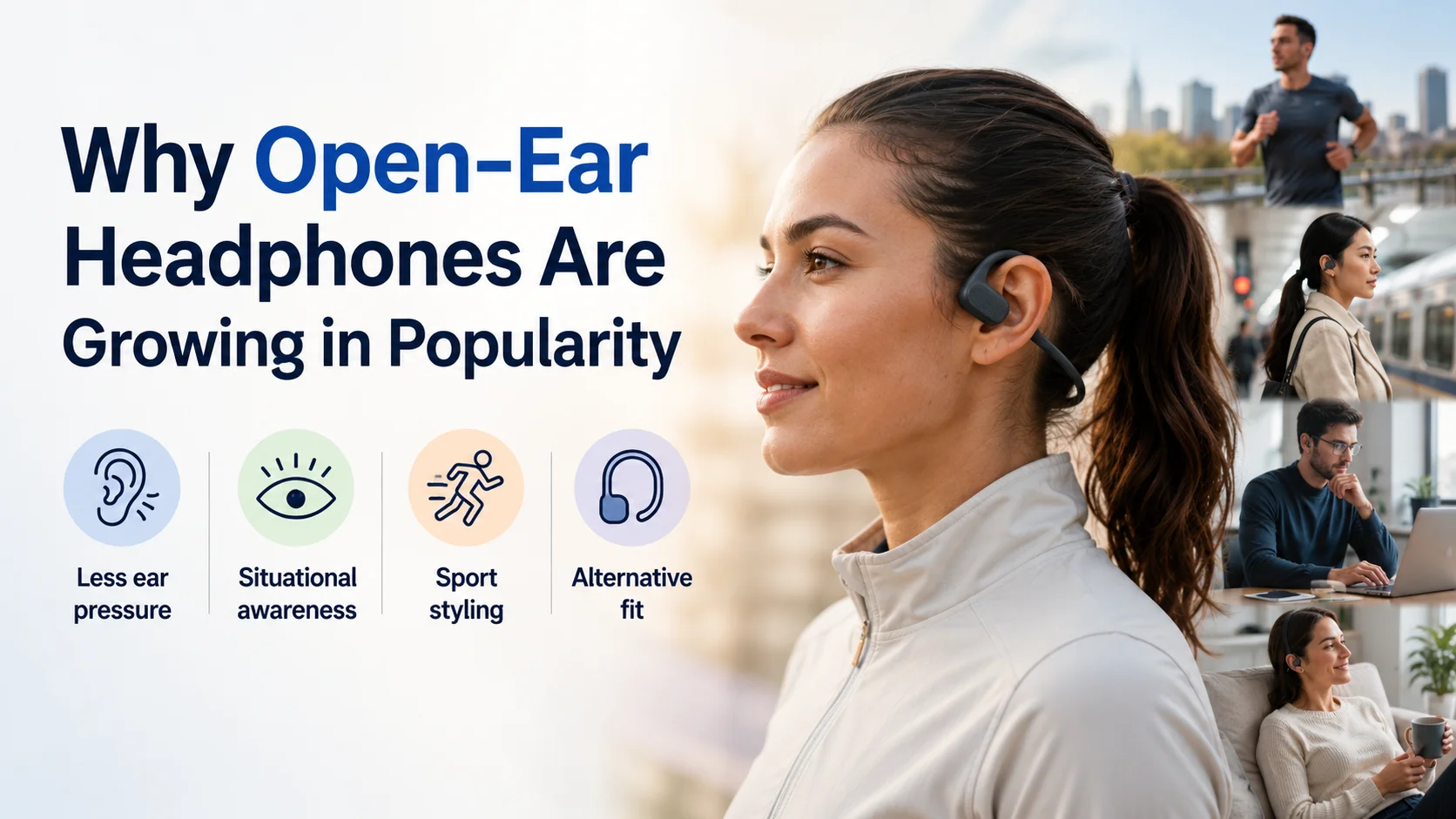
Open-ear headphones are popular because they serve comfort- and lifestyle-driven needs that traditional earbuds do not always address. Their appeal often comes from awareness, reduced ear-canal contact, sport-friendly styling, and an alternative fit experience. However, demand can vary by design, price point, retail channel, and local customer preference.
Buyer Interest Is Not the Same as Guaranteed Sales
We should frame popularity carefully. We cannot claim that every open-ear model is a bestseller, and buyers should not assume that online visibility equals sustainable demand. What we can observe is a rise in requests for samples and quotations from retailers, wholesalers, and e-commerce sellers exploring this category.
Several factors may explain the interest:
- Comfort positioning: Some users do not like silicone ear tips or the feeling of a sealed ear canal.
- Safety and awareness messaging: Outdoor users may value hearing surrounding sounds.
- Visible product differentiation: Ear-hook and clip-on forms look different from conventional TWS earbuds.
- Sports lifestyle appeal: Certain designs communicate movement, exercise, and active use.
- Assortment expansion: Buyers may want alternatives beyond standard in-ear models.
Ear-Hook and Clip-On Designs Are Different
A common sourcing mistake is treating all open-ear headphones as one product. In practice, ear-hook and clip-on models can serve different buyer goals.
| Form Factor | Typical Positioning | Likely Customer Interest | Key Evaluation Point |
|---|---|---|---|
| Ear-hook open-ear headphones | Sports, outdoor activity, longer wearing | Runners, walkers, commuters, gym users | Stability and comfort around the ear |
| Clip-on open-ear headphones | Fashion, portability, casual use | Younger shoppers, social-media-driven buyers, office users | Fit consistency and visual appeal |
| Bone conduction headphones | Awareness-focused activity use | Outdoor sports users and niche customers | Vibration feel, sound expectations, headband fit |
A retailer can carry one carefully chosen open-ear style rather than overloading the shelf with similar-looking models. An online seller can test separate listings with distinct use cases instead of combining every design under one generic message.
How Do Open-Ear Headphones Work?
Many buyers need a simple explanation before they can train sales teams or write product listings. The category includes different technologies, and confusing air conduction with bone conduction can lead to inaccurate product descriptions and disappointed customers.
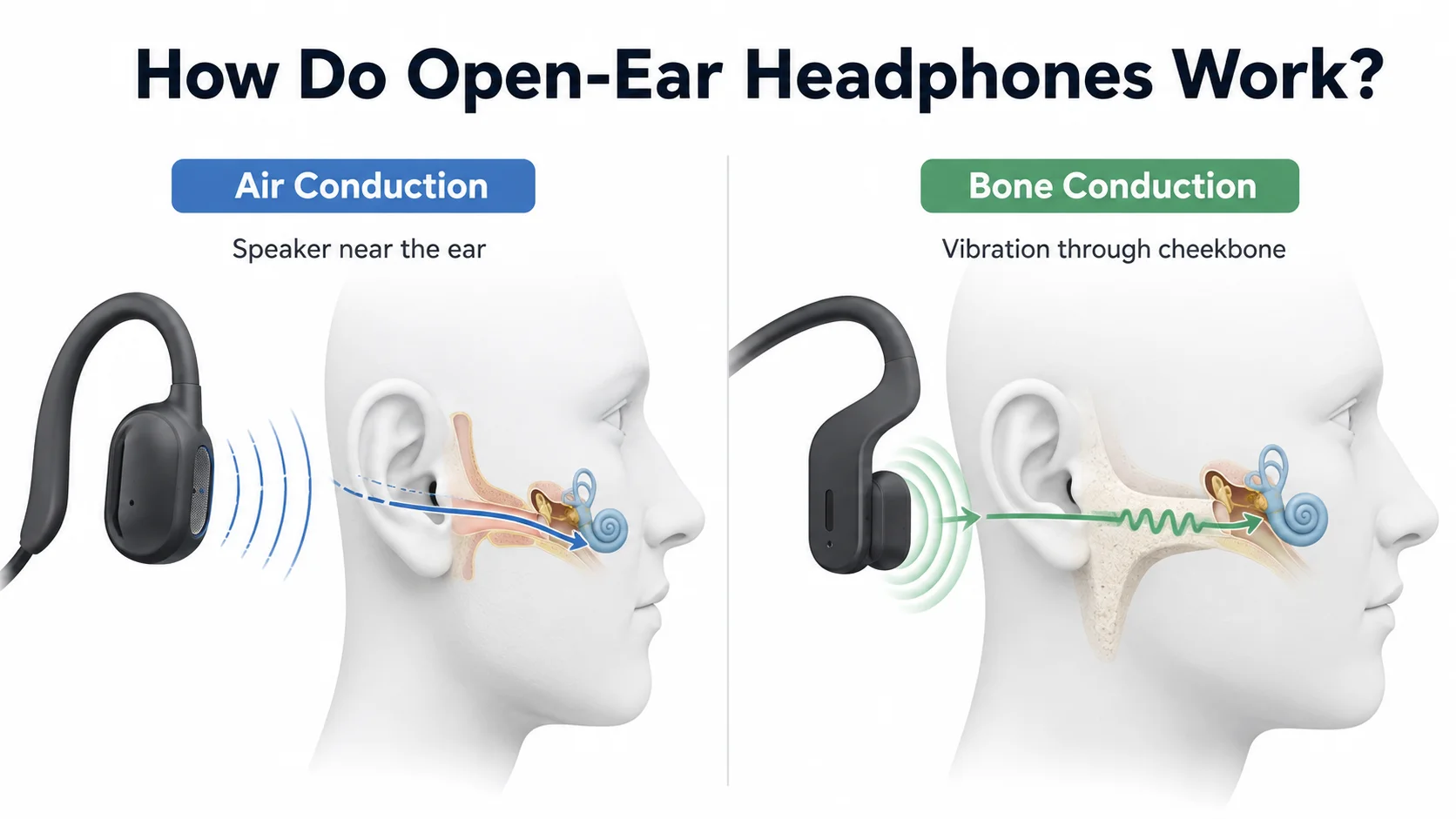
Most open-ear headphones use air conduction speakers positioned near the ear rather than inside the ear canal3. Bone conduction headphones use vibration through the cheekbone area to transmit sound4. Buyers should confirm the actual audio technology, speaker position, and product claims with the supplier before creating packaging or marketing content.
Air Conduction Open-Ear Designs
Air conduction models use small speakers that direct sound toward the ear. The speakers may sit beside the ear, above the ear canal, or near the outer ear depending on the design.
These products often include:
- Bluetooth connectivity
- Dual speakers or directional speaker structures
- Ear hooks, clips, or flexible support arms
- Touch controls or physical buttons
- Charging cases or direct charging ports
- Noise-reduction features for calls, depending on the model
The user still hears sound through the air, as with most conventional headphones. The difference is that the speaker does not create a tight seal inside the ear canal5.
Bone Conduction Models
Bone conduction headphones use transducers that create vibrations against the cheekbone area. These vibrations can transmit sound to the inner ear while leaving the ear canal more open.
However, buyers should avoid describing every open-ear product as bone conduction. Many fashionable clip-on products are air conduction headphones. Incorrect labeling can create customer confusion and return risk.
Procurement Questions to Ask
Before confirming a model, we suggest asking for:
- A clear technology description
- Product drawings or photos showing speaker placement
- Chipset and Bluetooth version information
- Battery and charging details
- User manual wording
- Supported audio codecs, if relevant to the sales channel
- Available test reports and compliance documents
The supplier’s specification sheet should match the packaging, online listing, and user manual. This simple check helps buyers avoid costly inconsistencies later.
Comparison Table: Air Conduction vs Bone Conduction Headphones?
Buyers can struggle to compare air conduction and bone conduction headphones because both are often described as “open-ear.” The label alone does not explain fit, sound character, or the right retail audience.
Air conduction headphones generally place speakers near the ear and may offer a more familiar music-listening experience. Bone conduction headphones transmit vibration through contact points on the head and are often positioned for awareness-focused activity use. Buyers should compare the actual model, not rely only on category labels.
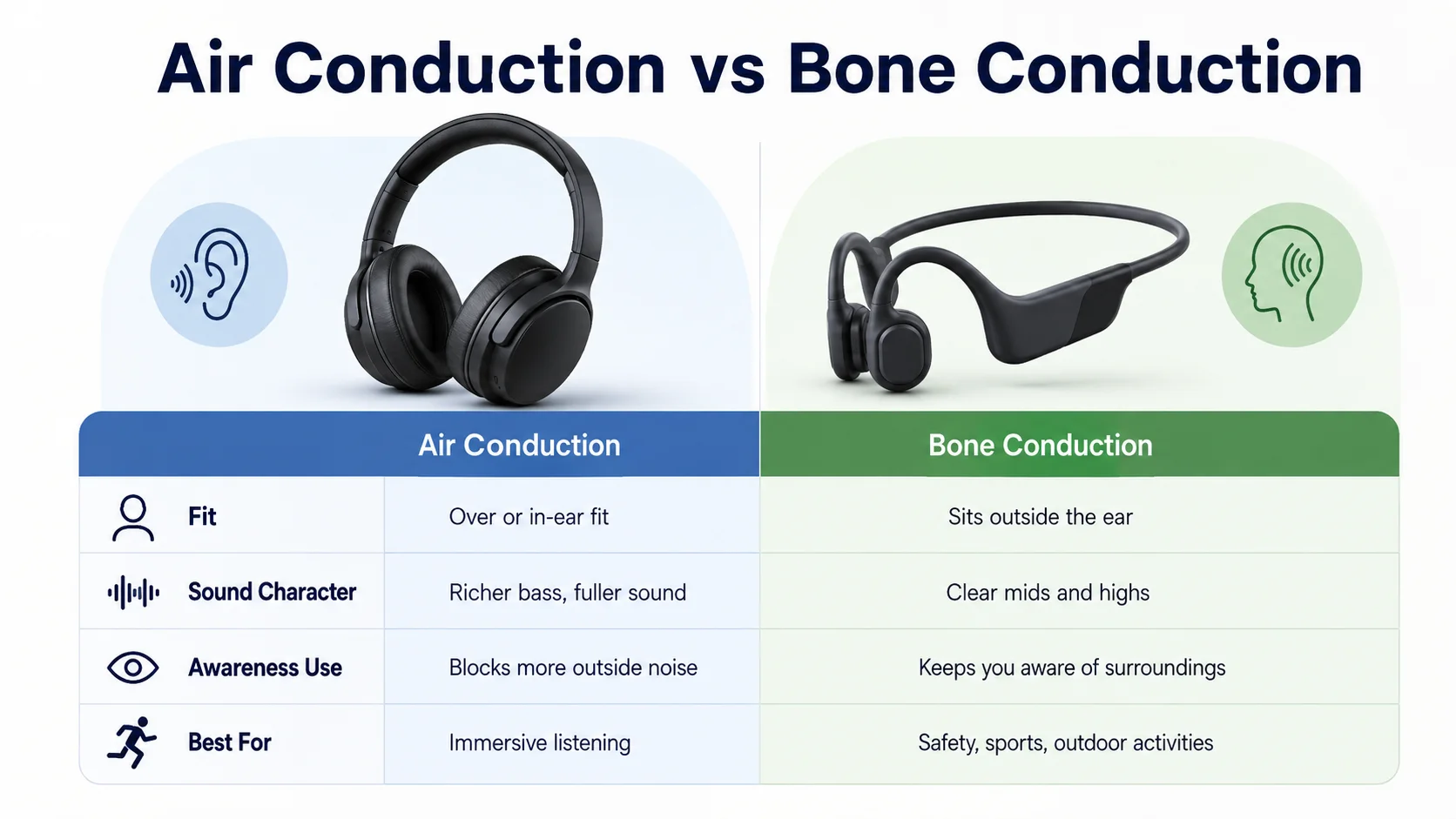
| Buying Factor | Air Conduction Headphones | Bone Conduction Headphones |
|---|---|---|
| Sound delivery | Speaker directs sound through air | Transducer sends vibration through bone contact |
| Common form | Ear hook, clip-on, open-fit earbud | Wraparound band with cheekbone contact |
| Typical appeal | Casual listening, comfort, fashion, sport | Outdoor awareness, running, cycling, specialized use |
| Bass expectation | Can feel more familiar, depending on speaker design | Often perceived differently from conventional earbuds |
| Wearing feel | Depends on hook or clip pressure | Depends on band tension and contact-point comfort |
| Product education needed | Moderate | Higher, as users may not know the technology |
| Key sourcing risk | Poor fit, weak call quality, excessive leakage | Unclear claims, vibration discomfort, fit mismatch |
Build a Different Sales Message for Each Technology
We advise buyers to avoid a generic “best open-ear headphone” claim. A customer shopping for a compact clip-on accessory may not want a wraparound sport band. Likewise, a cyclist who values awareness may not prioritize the smallest charging case.
For air conduction models, useful listing angles may include:
- Open-fit comfort for daily wear
- Ear-hook stability for workouts
- Clip-on style for casual listening
- Bluetooth calling for work and travel
For bone conduction models, a buyer may focus more on:
- Open-ear awareness during outdoor activities
- Headband fit and stability
- Sweat resistance claims, where supported by documentation
- Practical usage limits, including lower bass expectations compared with sealed earbuds
A qualified product manager, acoustic engineer, or local compliance professional should review application-specific claims when needed. We can provide product information and available documents, but buyers should verify that final claims are appropriate for their market.
What Comfort and Safety Benefits Do Open-Ear Designs Offer?
Traditional earbuds can feel uncomfortable for some users during long listening sessions. At the same time, outdoor users may worry about missing traffic sounds or nearby conversations when their ears are fully sealed.
Open-ear headphones can offer a more open wearing experience because they do not sit deeply inside the ear canal. They may also help users remain more aware of their surroundings6. Comfort and awareness still depend on the specific design, fit, volume level, activity, and individual user preference.

Comfort Depends on Product Geometry
Comfort is not a universal promise. A light clip-on model may feel easy for one person but create pressure for another. An ear-hook design may feel stable during movement but may interfere with glasses, hats, or certain hairstyles.
Buyers should evaluate comfort through physical samples with a range of testers. We recommend checking:
- Ear-hook flexibility
- Clip pressure
- Product weight
- Contact-point materials
- Stability during walking and light exercise
- Compatibility with glasses
- Ease of wearing and removing
- Left-right identification and control access
Awareness Is Helpful, But It Is Not a Safety Guarantee
Open-ear designs may allow users to hear more of their environment than sealed in-ear models. That can be relevant for walking, commuting, running, or working in shared spaces.
Still, buyers should avoid overpromising. No headphone makes every activity safe7. High volume can reduce awareness8, and local laws or workplace rules may apply. Packaging and online content should use careful language, such as “designed to help users stay aware of surrounding sounds,” rather than making absolute safety claims.
For retailers, this category can create a clear merchandising story:
“For customers who want music without the fully sealed feeling of traditional earbuds.”
That message is simple, accurate, and easier for store staff to explain.
Do Open-Ear Headphones Have Good Bass and Audio Quality?
Audio quality is often the first concern for buyers who are used to selling sealed TWS earbuds. Open designs may create different expectations because they do not isolate the ear canal in the same way.
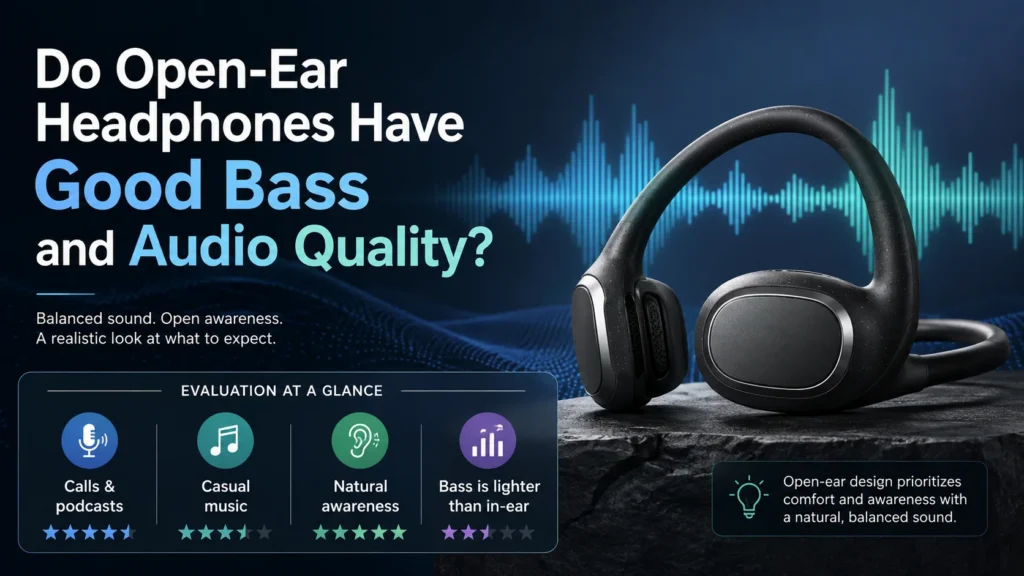
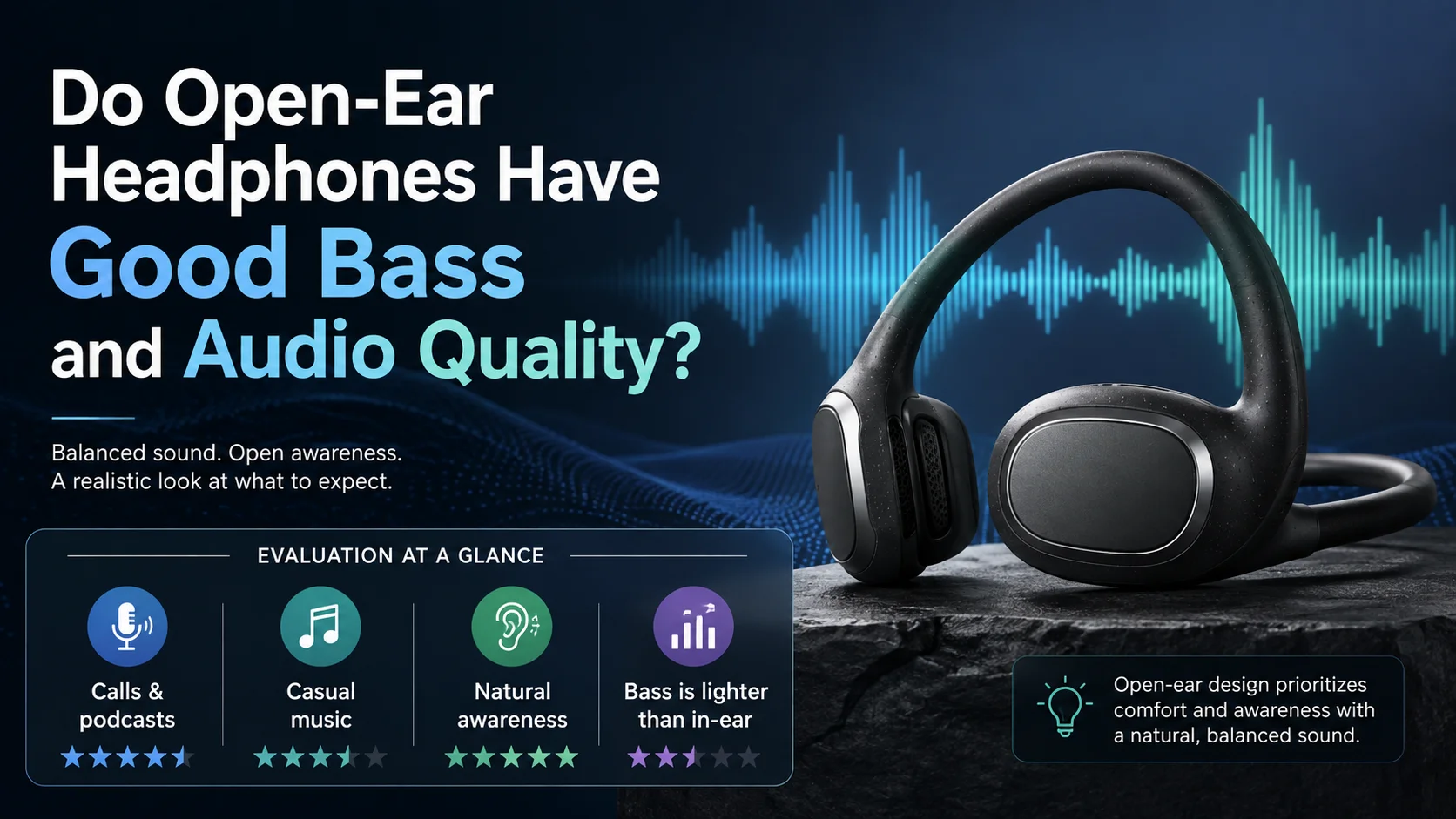
Open-ear headphones can provide clear audio for calls, podcasts, casual music, and many daily activities, but they usually do not deliver the same isolation or bass impact as well-fitted in-ear TWS earbuds9. Buyers should position sound quality honestly and test samples at realistic listening volumes before ordering.
Audio Quality Is a Product-Level Question
A product’s sound depends on many elements beyond whether it is open-ear:
- Speaker size and structure
- Tuning choices
- Amplifier and chipset performance
- Directional sound design
- Physical distance from the ear
- Ear-hook or clip placement
- Volume level
- Environmental noise
A well-positioned air conduction model may sound suitable for casual listening. However, a sealed in-ear earbud can often create stronger perceived bass because the ear tip creates isolation and a more enclosed acoustic space.
Test the Use Case, Not Only the Specification Sheet
We encourage buyers to test samples with the customer’s likely use case in mind. A buyer serving office workers should test call clarity and comfort. A sports retailer should test stability, wind noise, and control usability. An e-commerce seller should test whether the sound experience supports the listing claims.
A practical sample review can include:
- Music playback at low, medium, and high volume.
- Voice calls in quiet and moderately noisy conditions.
- Wear testing for 30 to 60 minutes.
- Comparison with a price-equivalent in-ear model.
- Battery-use checks based on the supplier’s stated conditions.
We do not recommend making laboratory-grade audio claims without verified testing. Instead, buyers can use realistic wording: “Open-fit audio designed for daily listening and calls.” That creates more accurate customer expectations and can reduce mismatch after purchase.
How Much Sound Leakage Should Buyers Expect?
Sound leakage can concern buyers who want to sell open-ear headphones for office, public transport, or shared living spaces. The risk becomes greater when users increase volume in noisy environments.
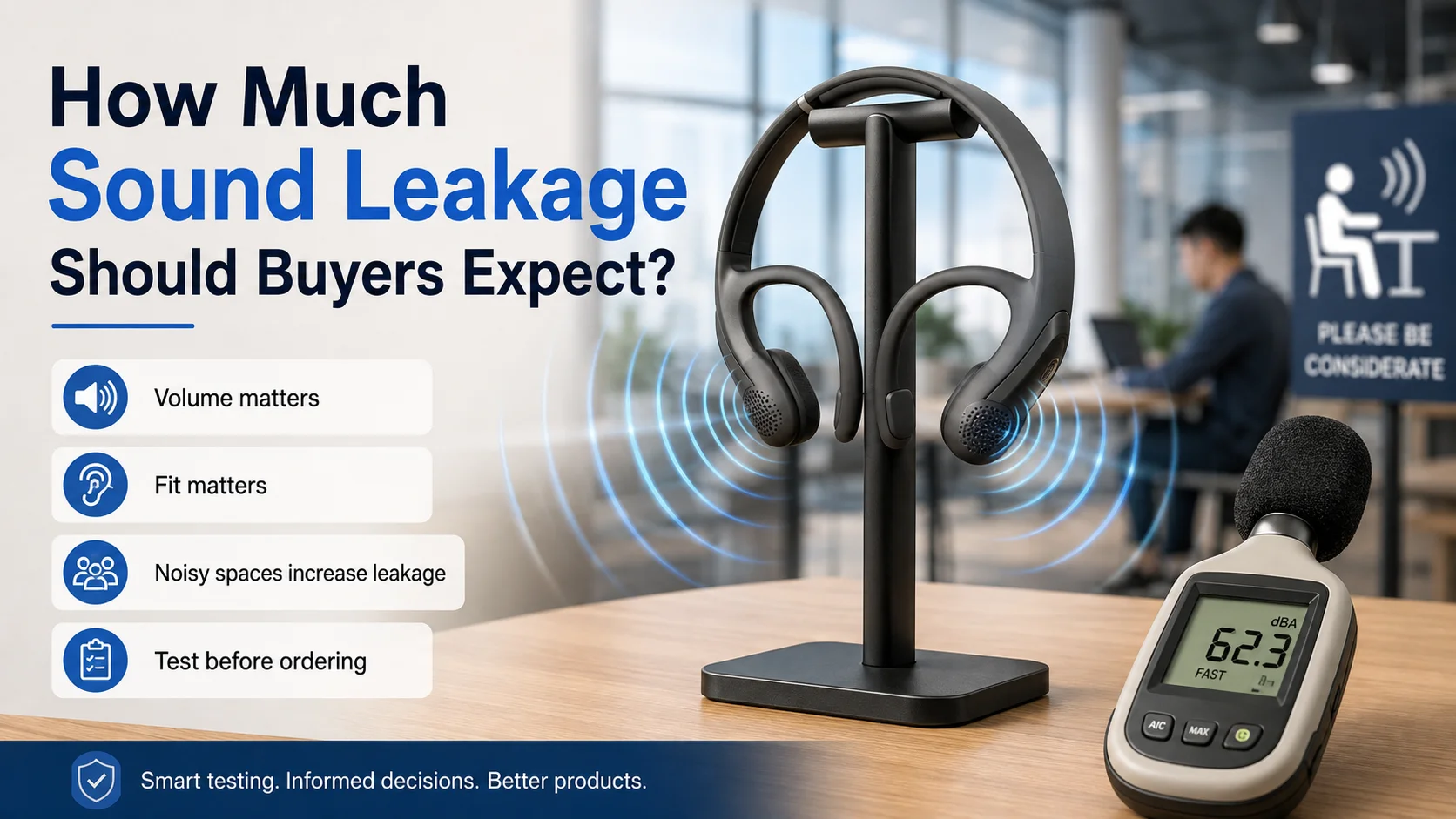
Open-ear headphones can leak some sound because their speakers sit outside the ear canal10. The amount varies by speaker direction, fit, volume, music type, and surrounding noise. Buyers should test leakage in realistic settings and should not promise private listening at all volume levels.
Why Leakage Varies
A directional speaker can reduce the amount of sound traveling outward, but it cannot eliminate leakage under every condition. Bass-heavy music, high volume, and poor placement can all make sound more noticeable to nearby people.
We suggest a simple internal evaluation process:
| Test Situation | What Buyers Should Observe |
|---|---|
| Quiet office simulation | Can a nearby person hear speech or music at normal volume? |
| Public transport simulation | Does the user need excessive volume to hear content? |
| Outdoor walking | Does wind or traffic noise affect listening? |
| Different ear sizes | Does speaker position change noticeably? |
| Call use | Is the caller’s voice clear without pushing volume too high? |
Set Proper Customer Expectations
An open-ear product should not be marketed as the best option for every quiet environment. It may suit users who want awareness, but someone who needs strong privacy or maximum noise isolation may be better served by in-ear TWS earbuds with suitable ear tips.
This is why category segmentation matters. We often advise customers to keep both product types:
- Open-ear headphones for comfort, awareness, sport, and open-fit preference.
- In-ear TWS earbuds for compact portability, passive isolation, and stronger bass expectations.
A balanced assortment gives consumers a choice instead of forcing one product format to serve every listening need.
Who Are the Main Target Customers for Open-Ear Headphones?
A visually interesting product can fail if the buyer does not know who it is for. Retailers and e-commerce sellers need a defined customer segment before choosing a design, packaging style, and price position.
The main target customers for open-ear headphones include active users, commuters, comfort-focused listeners, office workers, and shoppers who want a fashionable alternative to standard earbuds. Ear-hook and clip-on products may appeal to different groups, so buyers should define the target user before selecting a model.

Match Form Factor to Customer Segment
| Customer Segment | Suitable Product Direction | Main Sales Angle |
|---|---|---|
| Runners and gym users | Ear-hook open-ear sports headphones | Stable fit and open awareness |
| Commuters and walkers | Lightweight air conduction headphones | Everyday comfort and calls |
| Office and home users | Clip-on or discreet ear-hook designs | Open-fit listening and convenience |
| Fashion-focused shoppers | Compact clip-on headphones | Modern appearance and easy wear |
| Outdoor activity buyers | Bone conduction or secure ear-hook designs | Awareness-focused use |
Retail Shelf vs E-Commerce Listing
A physical retailer needs products that customers can understand quickly. The packaging should communicate form factor, battery basics, Bluetooth compatibility, and the intended use case. A demo unit can also help buyers understand the fit.
An e-commerce seller needs stronger visual and written positioning. The listing should answer common questions before the customer asks them:
- Does it go inside the ear?
- Is it suitable for running?
- Can it be used for calls?
- Does it work with glasses?
- Is it air conduction or bone conduction?
- What is included in the box?
In our experience, a product line works better when each SKU has a reason to exist. For example, one entry-level clip-on model, one sport-oriented ear-hook model, and one upgraded model with stronger materials or additional features may create a clearer ladder than five near-identical designs.
What Should Wholesale Buyers Check Before Ordering Open-Ear Headphones?
Open-ear headphones can look simple, but the product details affect comfort, returns, pricing, and customer reviews. A buyer who focuses only on unit cost may overlook factors that matter after the goods arrive.
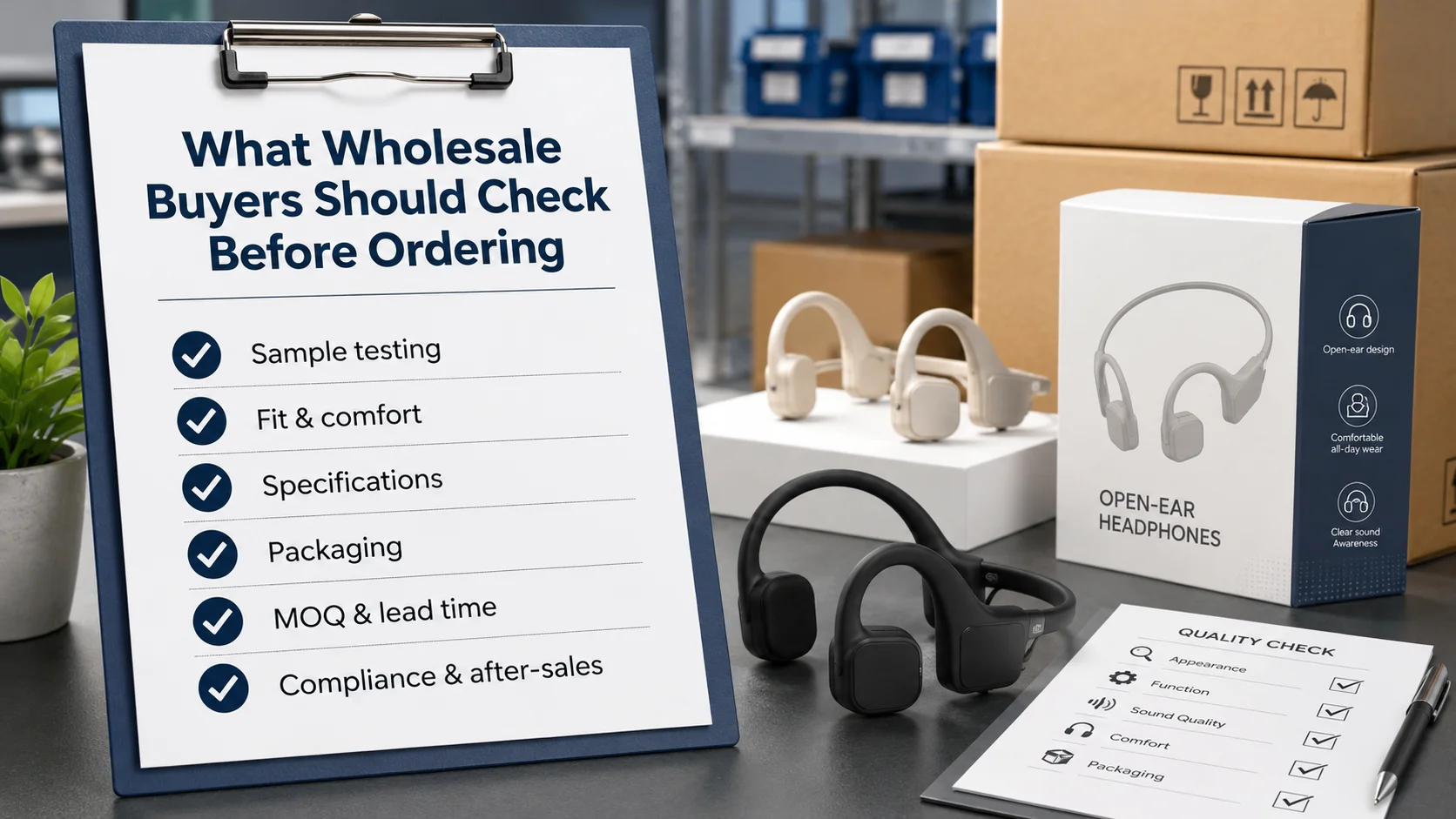
Wholesale buyers should evaluate open-ear headphones through samples, specifications, fit testing, packaging review, compliance documentation, MOQ, lead time, and after-sales planning. The goal is to confirm that the model fits the intended customer and channel before committing to a larger order.
Product and Quality-Control Checklist
Before placing an order, we recommend reviewing:
- Fit and stability: Test several users, including users with glasses.
- Material quality: Check hooks, clips, charging contacts, hinges, and surface finish.
- Bluetooth performance: Confirm pairing, reconnection, range, and control response.
- Call function: Test microphones in realistic environments.
- Battery performance: Verify stated battery capacity, charging time, and usage conditions.
- Charging case: Check lid fit, magnet strength, USB port alignment, and indicator lights.
- Packaging: Review barcode needs, language requirements, warning labels, and retail presentation.
- Accessories: Confirm charging cable, manual, ear accessories if applicable, and packing list.
Supplier and Compliance Review
For European and North American markets, buyers should request the relevant documents for the exact product configuration. Common requirements may involve CE, RoHS, FCC, UKCA, battery transport documentation, and other market-specific materials11. Requirements vary by product and destination.
Buyers should verify documents independently and confirm that model numbers, factory information, dates, and product configurations are consistent. Certifications should be treated as documents to review, not as marketing phrases.
Commercial Terms Matter
A good product can still create problems if the commercial plan is weak. We suggest confirming:
| Commercial Item | Why It Matters |
|---|---|
| MOQ | Helps buyers control trial-order risk |
| Lead time | Supports launch planning and replenishment |
| Private label options | Helps brands create differentiation |
| Sample policy | Allows fit and function evaluation |
| Warranty approach | Supports after-sales planning |
| Spare-unit policy | Helps manage service issues |
| Inspection arrangement | Adds a quality-control checkpoint before shipment |
A qualified third-party inspection provider can be useful for larger orders or when a buyer needs an independent pre-shipment review.
Source OEM and Wholesale Open-Ear Headphones from Kingfuji?
Finding a supplier is easy. Finding a supplier that understands assortment fit, packaging needs, export requirements, and practical communication takes more work. Buyers need product information they can use for commercial decisions, not only a low quotation.
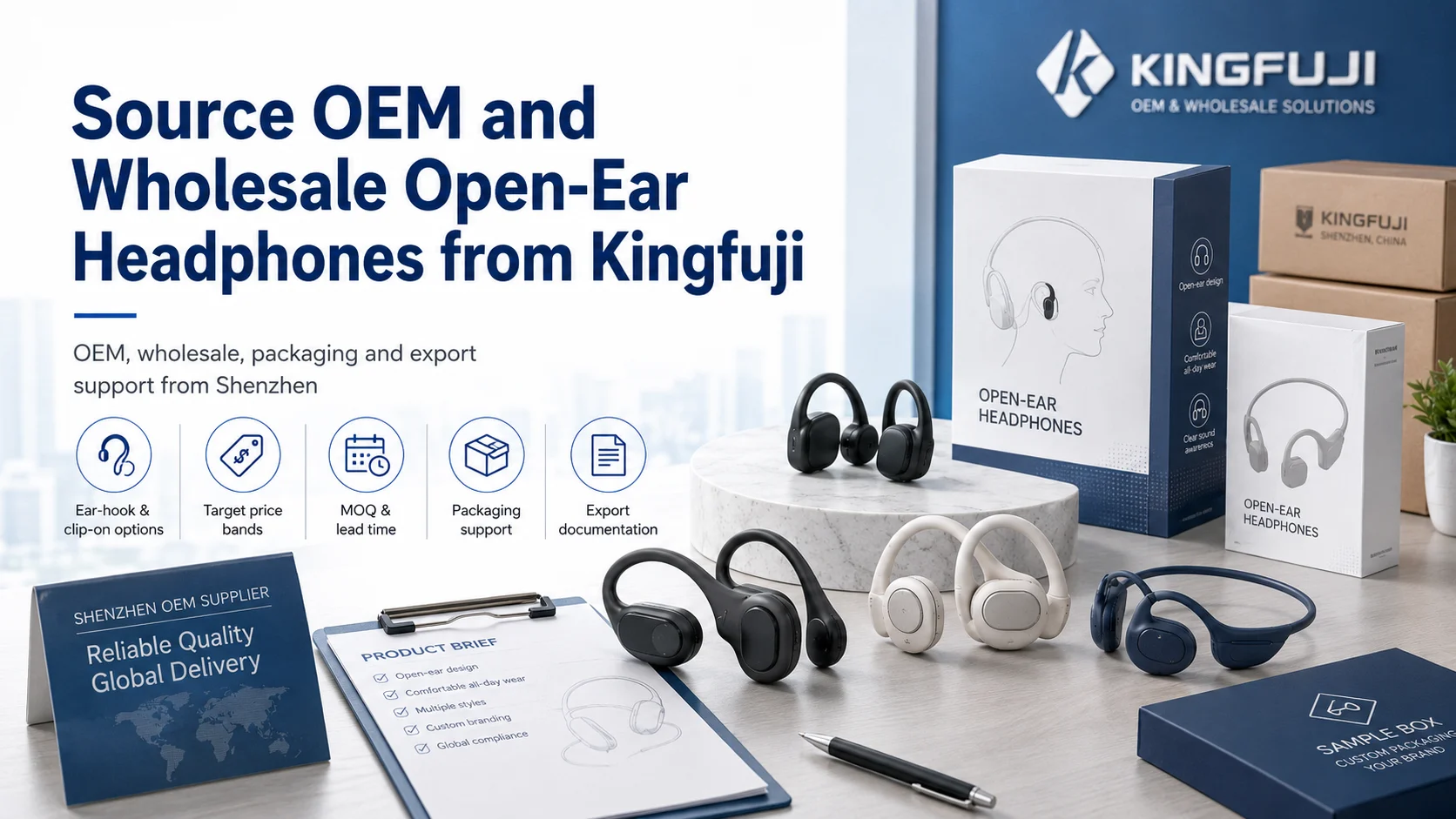
At Kingfuji, we support retailers, wholesalers, chain stores, and e-commerce sellers with OEM and wholesale open-ear headphones from Shenzhen. We help buyers compare ear-hook, clip-on, air conduction, and related Bluetooth audio options based on target customer, price band, MOQ, lead time, packaging, and available documentation.
Our Practical Sourcing Approach
We do not believe every buyer needs the same product. A discount wholesaler may need a value-focused model with simple packaging. A European online brand may need custom color, logo printing, upgraded packaging, and a stronger product story. A chain-store buyer may need consistent specifications and repeat-order planning.
Our process usually begins with several questions:
- Which customer group do you want to reach?
- Will you sell through retail stores, online channels, or both?
- What is your target retail price?
- Do you need a clip-on, ear-hook, or bone conduction form?
- What MOQ can you support for a first order?
- Do you need OEM branding or standard packaging?
- Which destination market and documentation requirements apply?
We manufacture and source a wider 3C range that includes USB cables, chargers, GaN chargers, TWS earbuds, smart watches, and related accessories. This can help buyers build coordinated product assortments rather than purchasing each category from disconnected suppliers.
Still, we encourage buyers to evaluate samples carefully. Open-ear headphones are personal-fit products. A proper sample review, clear product positioning, and documented quality requirements remain essential before bulk production.
Frequently Asked Questions
Are open-ear headphones better than in-ear TWS earbuds?
Open-ear headphones are not automatically better. They offer a different wearing experience, often with greater awareness of surrounding sounds. In-ear TWS earbuds may provide stronger passive isolation and bass. Buyers should carry each category for the customer needs it serves.
Are clip-on open-ear headphones suitable for sports?
Some clip-on open-ear headphones can suit light activity, but stability varies by design and ear shape. Buyers should test samples during walking, jogging, and gym movement. Ear-hook models may be easier to position for more active users when stability is the main selling point.
Do open-ear headphones work well for phone calls?
Call quality depends on microphone design, noise-reduction features, Bluetooth performance, and the surrounding environment. Buyers should test calls in quiet and moderately noisy settings before making claims. Product listings should avoid promising perfect calls in every outdoor condition.
What MOQ should I expect for OEM open-ear headphones?
MOQ depends on the model, color, logo method, packaging, and customization level. Standard models may allow lower starting quantities than fully customized products. We recommend starting with a manageable trial quantity when entering a new category or testing a new sales channel.
What documents should buyers request for open-ear headphones?
Buyers should request documentation relevant to their destination market and exact product model. This may include CE, RoHS, FCC, UKCA, battery transport materials, and declarations where applicable. Buyers should independently verify documentation with qualified compliance professionals when needed.
Conclusion
Open-ear headphones deserve attention because they give retailers and online sellers another way to serve comfort-focused, active, and awareness-minded customers. They should not replace every in-ear TWS earbud in an assortment. The stronger approach is to select the right form factor, define the target user, test samples, verify documents, and begin with a controlled order. If you are sourcing wholesale open-ear headphones for Europe or North America, contact Kingfuji to discuss models, OEM options, MOQ, lead time, and sample evaluation.
"HEADPHONES", https://upcommons.upc.edu/bitstreams/d9e3181c-4021-422e-b4f4-361349d07cb4/download. Industry market analyses identify growing interest in open-ear and open-fit headphone formats, although reported growth rates and category definitions vary across research publishers. Evidence role: statistic; source type: research. Supports: Independent market research or industry data indicating growth in the open-ear or open-fit headphone segment.. Scope note: Market reports may use different definitions for open-ear, air-conduction, and bone-conduction products. ↩
"The association between headphones use during study and concentration ...", https://pmc.ncbi.nlm.nih.gov/articles/PMC11856898/. Studies of personal-audio use indicate that situational awareness can be an important consideration for listeners in mobile, outdoor, and shared environments. Evidence role: general_support; source type: research. Supports: Research showing that some headphone users value environmental awareness or reduced auditory isolation during listening.. Scope note: Such studies support the existence of this preference but do not establish that it applies to all consumers or all retail markets. ↩
"Air conduction vs. bone conduction – discovering open-ear audio", https://www.bose.com/stories/air-conduction-vs-bone-conduction?srsltid=AfmBOoomqyBnA0iu9DF8eYhggYhJPCnWzo8TjwVsUPbYjddF6pZIGpM8. Air-conduction audio devices reproduce sound waves through the air to the outer ear, unlike bone-conduction devices that use mechanical vibration at points of contact with the head. Evidence role: definition; source type: education. Supports: An authoritative explanation that air-conduction headphones transmit sound through the air using speakers located outside or near the ear canal.. Scope note: The source may define the acoustic mechanism without quantifying what proportion of commercially marketed open-ear products use it. ↩
"Bone Conduction Evaluation - StatPearls - NCBI Bookshelf", https://www.ncbi.nlm.nih.gov/books/NBK578177/. Bone conduction transmits acoustic vibration through cranial bones to stimulate the cochlea, bypassing some components of the outer and middle ear sound pathway. Evidence role: mechanism; source type: government. Supports: A clinical or scientific explanation of bone conduction as transmission of sound vibrations through the skull to the inner ear.. Scope note: Clinical descriptions of bone conduction explain the mechanism but do not assess the performance of a particular consumer headphone model. ↩
"Open Versus Closed Hearing-Aid Fittings: A Literature Review ...", https://pmc.ncbi.nlm.nih.gov/articles/PMC4765810/. Acoustic studies show that earphone coupling and ear-canal sealing materially affect isolation and low-frequency sound reproduction relative to open-fit configurations. Evidence role: mechanism; source type: paper. Supports: Acoustic research explaining how an ear-canal seal changes sound isolation and the acoustic coupling between an earphone and the ear.. Scope note: The magnitude of these effects depends on the individual ear, earphone geometry, and fit. ↩
"Awareness about the relation of noise induced hearing loss and use of ...", https://pmc.ncbi.nlm.nih.gov/articles/PMC8685984/. Research on headphone occlusion and environmental audibility indicates that designs which leave the ear canal open can allow greater access to surrounding sound than sealed earphones. Evidence role: general_support; source type: paper. Supports: Research indicating that less occluding headphone designs can permit more environmental sound to reach the listener than sealed in-ear designs.. Scope note: Greater audibility is not a guarantee of safe behavior, because awareness also depends on volume, attention, ambient noise, and the activity. ↩
"Distracted Driving Dangers and Statistics", https://www.nhtsa.gov/risky-driving/distracted-driving. Road-safety guidance recognizes that portable audio and other distractions can reduce attention to environmental hazards; device design alone does not eliminate this risk. Evidence role: expert_consensus; source type: government. Supports: Public-safety guidance stating that audio-device use can contribute to distraction and that users should remain alert to surrounding hazards.. Scope note: Safety guidance is generally behavioral and contextual rather than a direct evaluation of a specific open-ear headphone design. ↩
"Deafness and hearing loss: Safe listening", https://www.who.int/news-room/questions-and-answers/item/deafness-and-hearing-loss-safe-listening. Auditory masking research establishes that louder reproduced sound can make external signals less detectable, reducing the listener's access to surrounding auditory cues. Evidence role: mechanism; source type: institution. Supports: Hearing-science or public-health evidence that louder audio can mask external sounds and increase listening-related risks.. Scope note: The degree of masking depends on the program material, volume, headphone design, ambient sound level, and listener hearing characteristics. ↩
"Influence of the Noise-Canceling Technology on How We Hear Sounds", https://pmc.ncbi.nlm.nih.gov/articles/PMC9408706/. Studies of earphone acoustics show that ear-canal sealing affects passive isolation and low-frequency response, helping explain why sealed in-ear devices may produce stronger perceived bass than open-fit designs. Evidence role: mechanism; source type: paper. Supports: Acoustic evidence that a sealed earphone fit increases passive attenuation and influences low-frequency sound reproduction.. Scope note: Perceived bass and overall sound quality remain dependent on tuning, fit, playback level, and listener preference. ↩
"Air-Leak Effects on Ear-Canal Acoustic Absorbance - PMC", https://pmc.ncbi.nlm.nih.gov/articles/PMC4272628/. Acoustic measurements of headphone radiation show that non-sealed listening devices can emit audible sound to nearby listeners, with leakage affected by level, frequency content, placement, and fit. Evidence role: mechanism; source type: paper. Supports: Acoustic research showing that open or non-occluding headphone configurations can radiate sound into the surrounding environment.. Scope note: Measured leakage varies substantially among products and test conditions; this evidence does not predict leakage for any individual model. ↩
"Equipment Authorization", https://www.fcc.gov/engineering-technology/laboratory-division/general/equipment-authorization. Official authorities describe separate obligations that may apply to wireless consumer electronics, including radio-equipment conformity, hazardous-substance restrictions, electromagnetic compliance, and lithium-battery transport testing. Evidence role: general_support; source type: government. Supports: Official regulatory guidance on radio equipment, restricted substances, US FCC authorization, UK conformity marking, and lithium-battery transport testing.. Scope note: Applicable obligations depend on the destination, product configuration, importer role, battery arrangement, and current law; this is not a complete compliance determination. ↩