Quick Answer
Custom USB cable production process decisions can become expensive when a buyer starts with only a connector, cable length, and quantity. That short request may hide power, data, compatibility, appearance, packaging, and delivery requirements. I use requirement clarification early because it reduces quotation errors and prevents a sample from being approved for the wrong application.
The custom USB cable production process usually includes requirement confirmation, specification review, quotation, sampling, sample approval, material preparation, cable assembly, testing, inspection, packaging, and delivery.[1] The buyer should first define the application, connector types, cable length, power and data needs, appearance, quantity, and target date. A supplier can then confirm feasibility and provide a more reliable quotation.
A USB-C connector or “fast charging” description does not complete a product specification. I have seen many inquiries become more complicated after the first supplier questions. Those questions are not unnecessary obstacles. They show which details affect materials, tooling, testing, cost, lead time, and batch consistency.
How Does the Custom USB Cable Production Process Work?
A vague cable inquiry creates risk for both the buyer and supplier. The buyer may compare quotations that describe different products, while the supplier may price an item that cannot meet the real application. I reduce this risk by connecting every production stage to a purchasing decision.
The custom USB cable production process moves from a commercial requirement to a production-ready specification. It normally covers application review, connector and cable selection, performance confirmation, quotation, sampling, approval, assembly, testing, inspection, and delivery. The exact sequence varies by supplier and product design, so I recommend verifying the proposed process before placing an order.
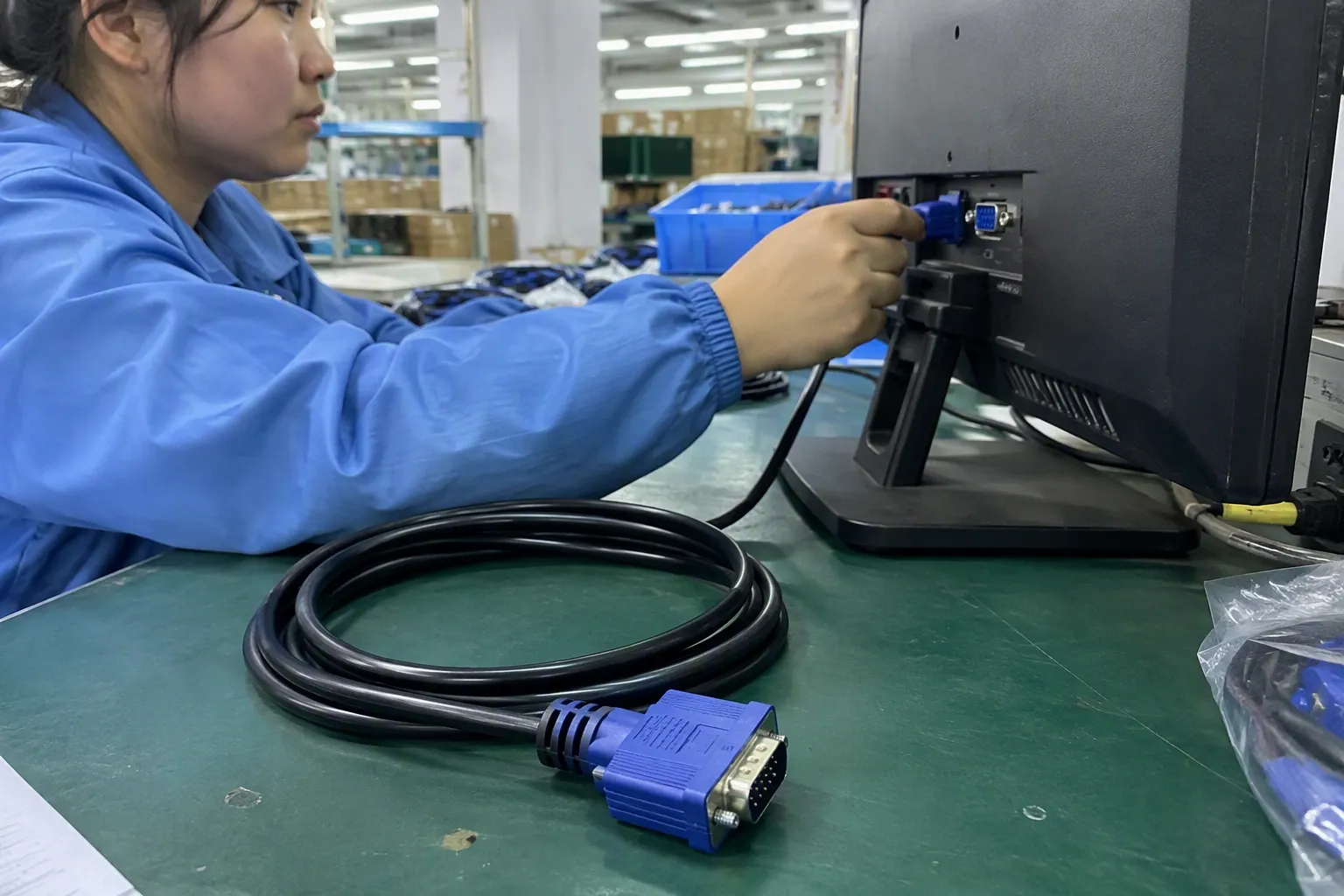
When I handle a USB cable inquiry, I do not treat the first message as a complete technical brief. I treat it as the starting point for clarification. This approach helps my customers compare suppliers on the same basis and makes later discussions more precise.
1. Start with the application, not the connector
A buyer may write:
- USB-C to USB-C cable
- 1 meter
- 10,000 pieces
This information identifies a general product family, but it does not define the final cable. I still need to understand how the cable will be used.
Important questions include:
- Will the cable be used for charging, data transfer, or both?
- What devices will be connected?
- Does the buyer require a particular power level?
- Does the buyer require a particular data performance level?
- Will the cable be sold separately or included with a charger, power bank, tablet, or other product?
- Will the cable be used by consumers, stores, offices, vehicles, or another environment?
- Does the retailer require private-label packaging or a specific visual style?
I do not assume that a connector type proves a particular charging or data capability. USB-C describes a connector family and interface format. It does not, by itself, prove the complete electrical performance of a cable.[2] Buyers should request relevant technical documents and test evidence for any claimed power, data speed, or compatibility.
2. Confirm the specification before requesting a final quotation
After the application is clear, I organize the information into a specification sheet. The sheet can include the following categories:
| Category | Questions for the buyer | Purchasing impact |
|---|---|---|
| Application | Charging, data, synchronization, or combined use? | Determines construction and verification requirements |
| Connectors | USB-A, USB-C, Micro-USB, Lightning-compatible, or another interface? | Affects components, compatibility, and tooling |
| Length | What finished length and tolerance are required? | Changes material use, packing, and production control |
| Cable construction | Basic PVC, braided, reinforced, flat, round, or another design? | Affects appearance, flexibility, cost, and handling |
| Performance | What power and data requirements must be demonstrated? | Requires suitable component selection and supporting evidence |
| Appearance | Color, logo, housing shape, plating, texture, and strain relief? | Affects tooling, artwork, and sample approval |
| Quantity | Trial order, repeat order, or annual forecast? | Influences MOQ, pricing, and material planning |
| Packaging | Bulk carton, polybag, retail box, blister, or custom package? | Adds packaging materials, artwork, and inspection points |
| Delivery | Target shipment date and destination? | Affects production planning and transport decisions |
This process is important because several requirements interact. A longer cable may change resistance and handling.[3] A braided outer jacket may require a different construction than a standard PVC jacket.[4] A private-label housing may require tooling or a minimum order quantity. Custom packaging may add an approval stage even when the cable itself is already ready.
3. Review material and design feasibility
The supplier should review whether the requested design can be produced consistently at the required quantity. I ask for clarification when the request combines several difficult requirements, such as a very slim cable, a high stated performance level, a long length, heavy reinforcement, and a low target price.
A feasibility review may cover:
- Connector shell and terminal options
- Cable conductor arrangement
- Insulation and outer-jacket material
- Shielding or reinforcement requirements
- Strain-relief design
- Logo method and position
- Color matching method
- Custom mold requirements
- Packaging dimensions
- Available testing and inspection records
I present this stage as a commercial and sourcing review, not as a substitute for application-specific engineering. If a cable will be used in a safety-sensitive, medical, automotive, industrial, or regulated application, I recommend an appropriately qualified professional evaluate the design and documentation.[5]
4. Prepare the quotation
A reliable quotation should describe what it includes. A low unit price is not useful if another supplier has excluded packaging, logo treatment, tooling, testing, or a required accessory.
I normally ask the supplier to identify:
- Unit price and currency
- Minimum order quantity
- Sample cost
- Tooling or mold charge
- Printing or logo charge
- Packaging cost
- Production lead time
- Sample lead time
- Payment terms
- Price validity period
- Shipping terms
- Inspection arrangements
- Warranty or after-sales policy
- Documents available for review
The quotation should also state the assumed specification. For example, “USB-C cable” is too broad for a final commercial comparison. The quotation should identify the connector combination, length, outer material, color, packaging, and any documented performance requirement.
I have found that a short specification attached to each quotation is often more useful than a long message. It gives the buyer a clear basis for comparing offers and gives the supplier a reference for production.
5. Produce and review the sample
A sample converts written requirements into a physical product. It allows me to check details that are difficult to judge from a quotation, including:
- Connector appearance
- Housing dimensions
- Logo position and clarity
- Cable color
- Braiding or jacket finish
- Flexibility and handling
- Strain relief
- Cable length
- Packaging size
- Label information
A sample is not automatically proof that every production unit will be identical.[6] The buyer should confirm what the sample represents. It may be a standard construction, a handmade development sample, or a sample made with final materials and tooling. These differences matter.
I recommend recording sample approval in writing. The approval should identify the approved version, photos, drawings where available, packaging artwork, performance documents, and any permitted tolerances. A simple statement such as “sample approved” may leave too many details open.
6. Prepare materials and manage changes
After sample approval, the supplier prepares components and production materials. The exact factory procedure will differ, but material control normally affects consistency and lead time.
The supplier may need to arrange:
- Cable material
- Connector components
- Terminals or internal parts
- Housings
- Strain-relief parts
- Braiding or surface materials
- Labels
- Printed logos
- Retail packaging
- Cartons and packing materials
I tell buyers to report design changes before production begins. A change to the connector housing, color, cable length, logo, or package can affect the approved sample, price, and production schedule. A late change may also cause unused materials or require a new sample.
For repeat orders, buyers should confirm whether the supplier will use the same approved construction and whether any substitute material requires approval. A supplier may propose a replacement when a component becomes unavailable. I recommend asking for written confirmation and, when the change could affect appearance or performance, a new sample or documented evaluation.
7. Assemble the cable
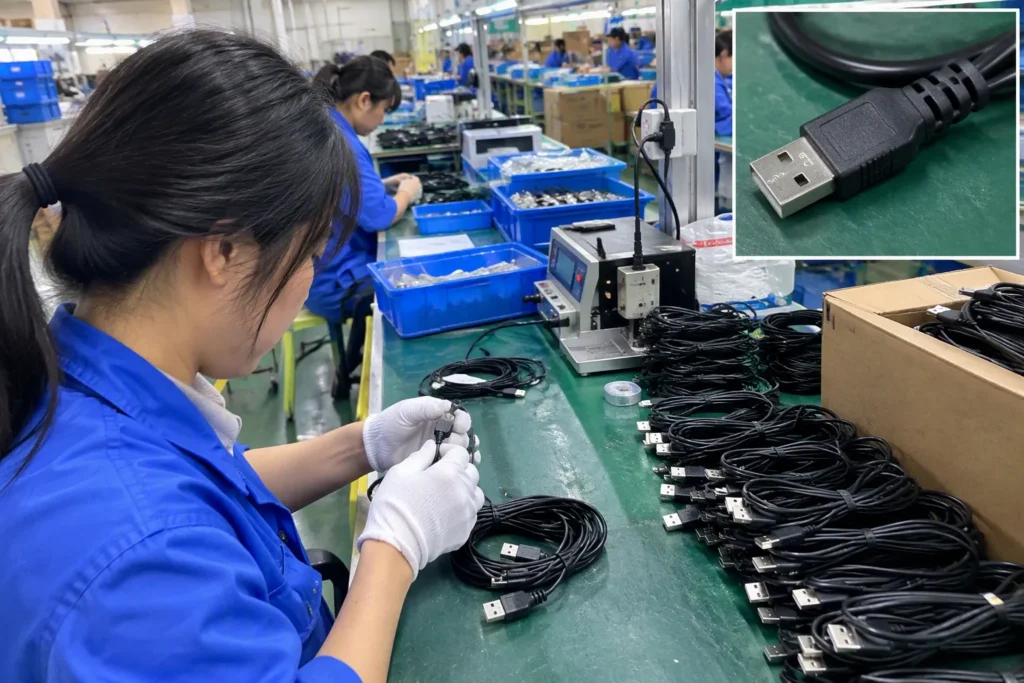
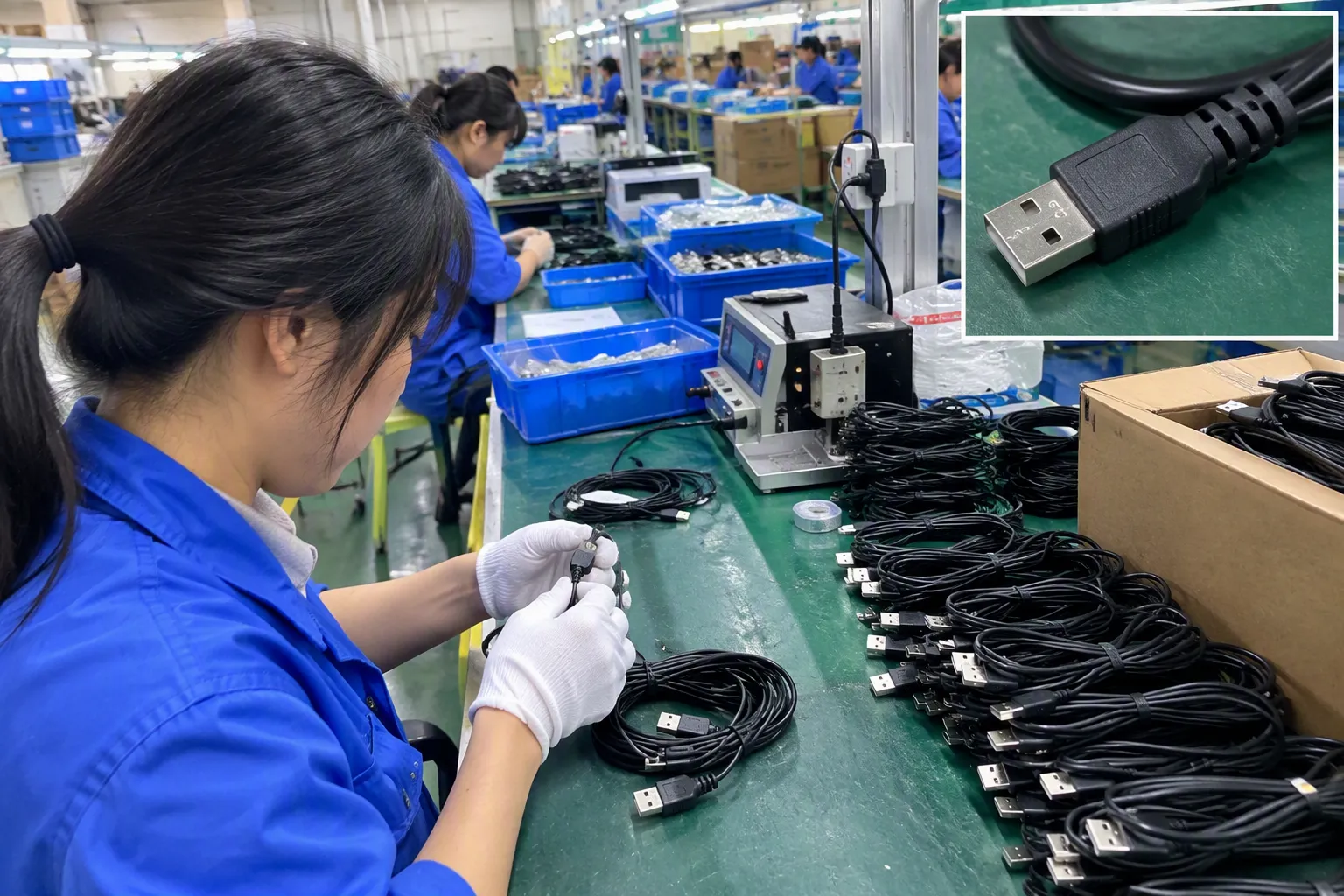
Assembly may include cutting the cable to length, preparing conductors, attaching connector components, adding insulation or reinforcement, fitting housings, and completing strain relief.[7] The details depend on the cable design and the supplier’s equipment.
From a buyer’s perspective, the important question is not whether a factory uses one particular machine. The important question is whether the production method is suitable for the approved design and whether the supplier controls the repeatability of the result.
Potential assembly risks include:
- Incorrect connector configuration
- Uneven cable length
- Loose or damaged housing
- Poor strain relief
- Exposed conductors
- Inconsistent braiding
- Scratched plating or housing surfaces
- Logo misalignment
- Mixed versions within one batch
I do not describe every supplier as following the same operating procedure. I ask the supplier how it identifies materials, controls work instructions, checks the line, and separates approved products from nonconforming products.
8. Test performance and inspect appearance
Testing should match the claims made to the buyer. A visual inspection cannot prove a particular power or data performance level.[8] Likewise, a continuity check alone cannot demonstrate every aspect of a finished cable’s use.
Depending on the specification, the buyer may ask about evidence for:
- Continuity
- Wiring configuration
- Connector function
- Charging performance
- Data performance
- Resistance or electrical characteristics
- Insulation or safety-related checks
- Mechanical fit
- Label accuracy
The relevant test method, equipment, sample size, and acceptance criteria should be clear. I recommend asking for test records or reports when the claimed performance is important to the product’s market position.
Appearance inspection may cover:
- Connector and housing condition
- Cable surface
- Color consistency
- Logo position
- Length
- Strain relief
- Packaging
- Quantity and carton marking
Certification claims also require document review. I do not treat the word “certified” as a substitute for checking the certificate scope, model reference, issuing body, validity, and relationship to the actual product. Buyers should verify whether the document covers the cable design and destination-market requirements.
9. Complete final inspection and packaging
A final inspection creates a checkpoint before shipment. The buyer and supplier should agree on what will be checked and what constitutes an acceptable result.
A practical inspection plan may include:
- Confirming the order specification.
- Checking production quantity.
- Selecting samples using an agreed method.
- Reviewing appearance and dimensions.
- Verifying labels and packaging.
- Reviewing available test records.
- Recording defects and corrective actions.
- Confirming carton quantity and shipping marks.
I recommend using photos, a reference sample, or an approved artwork file for subjective details. Words such as “nice color,” “strong cable,” or “premium finish” are difficult to inspect. A color reference, material description, measurement, or agreed visual standard is more useful.
Packaging also deserves attention. A cable that passes inspection can still create retail problems if the retail box is damaged, the barcode is wrong, or the cartons are marked incorrectly. I ask buyers to review package artwork and shipping marks before mass production.
10. Deliver and control future batches
Delivery is the final step in the first order, but it is not the end of supplier management. My customers often care about repeat-order consistency more than the appearance of one sample.
For repeat purchases, I recommend maintaining a controlled file containing:
- Approved specification
- Approved sample photos
- Drawings or measurements
- Packaging artwork
- Test documents
- Inspection criteria
- Order history
- Approved changes
- Corrective-action records
This file helps the buyer identify whether a later quotation refers to the same product. It also helps the supplier understand what must remain unchanged.
Lead time should be divided into realistic stages. A quotation may mention production lead time, but the buyer should ask whether that period starts after payment, sample approval, artwork approval, or material confirmation. Tooling, packaging, and transport can add separate time requirements.
What Information Should Buyers Include in a Custom USB Cable Inquiry?
An incomplete inquiry can lead to several different quotations for products that are not equivalent. I usually see this problem when buyers send only a connector type, length, and quantity. A complete inquiry does not need to use complicated engineering language, but it should describe the intended use and commercial expectations.
A strong custom USB cable inquiry should include the application, connector combination, length, construction, performance requirements, appearance, quantity, packaging, destination, and target delivery date. Buyers should mark uncertain items as “to be confirmed” rather than allowing the supplier to make silent assumptions.
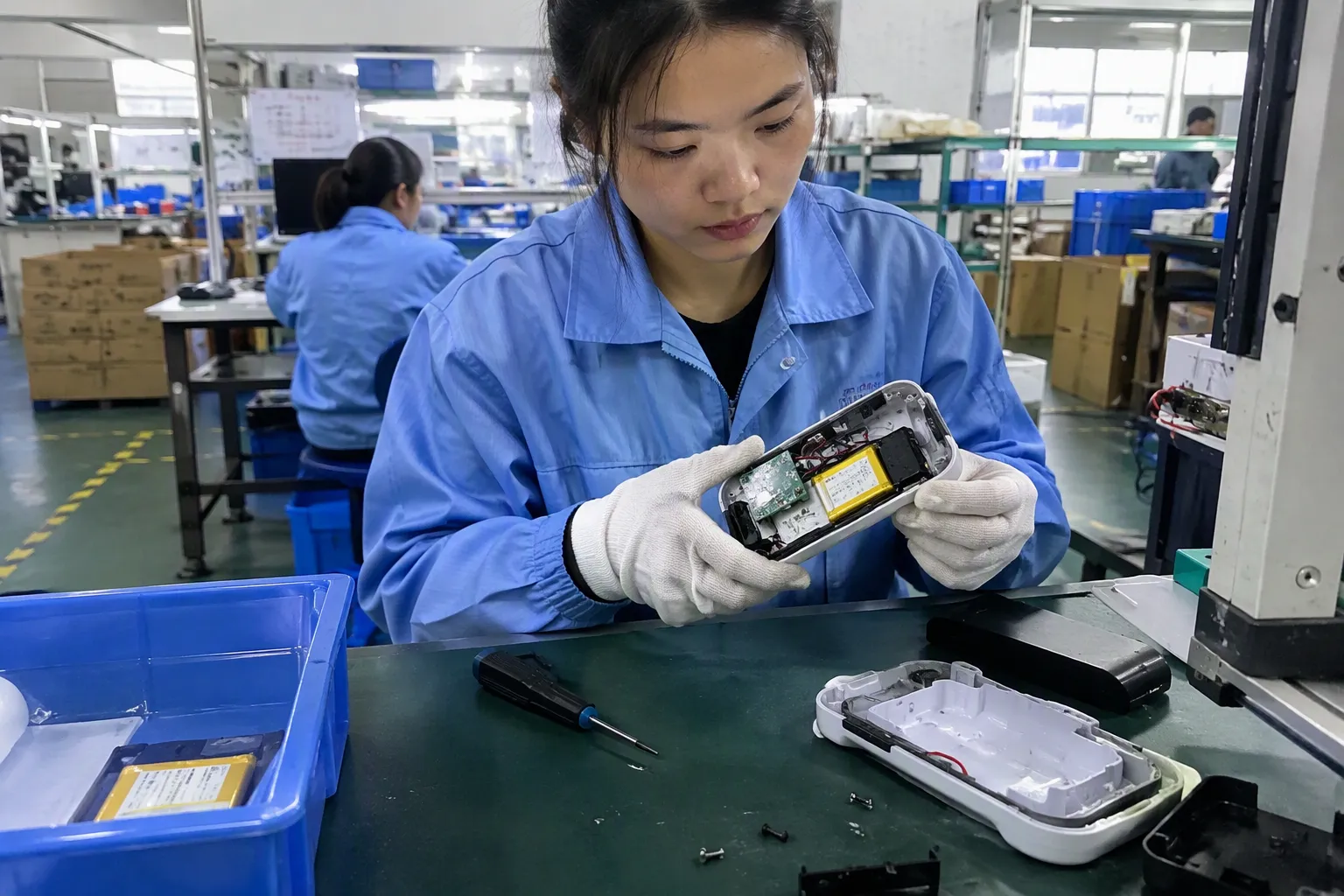
Application and compatibility
Start by explaining what the cable will connect. For example, the buyer may need a cable for a charger and smartphone, a laptop accessory, a power bank, a retail bundle, or a particular device family.
The buyer should provide:
- Device types and models where relevant
- Charging-only or charging-and-data use
- Expected operating environment
- Whether the cable is sold alone or bundled
- Destination market
- Any customer or retailer requirements
I do not recommend writing “compatible with all devices” unless the supplier can support that statement with appropriate evidence. Compatibility can depend on the connector, wiring, protocol, device, charger, operating system, and intended function.
Connector and cable construction
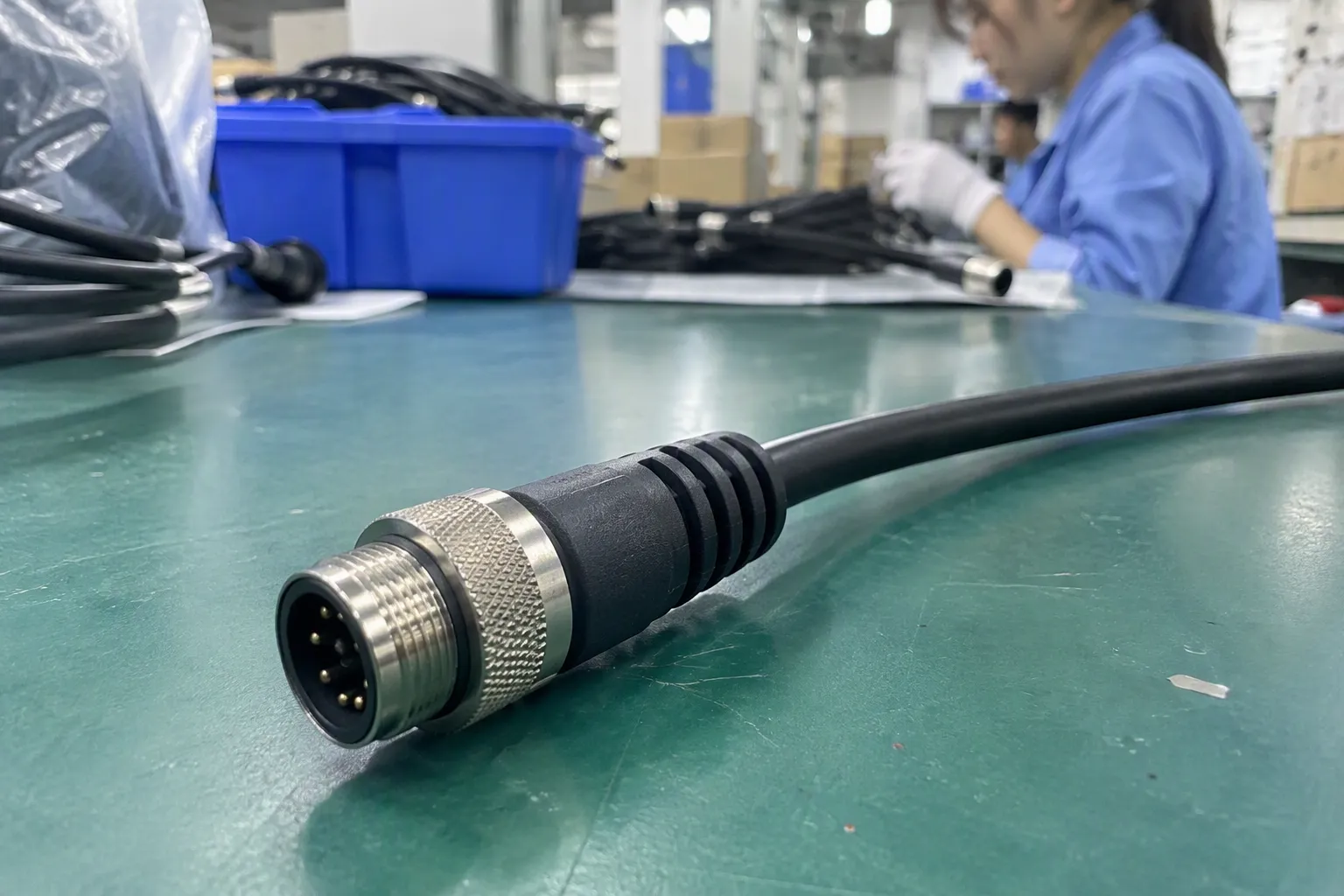
The inquiry should identify both ends of the cable. “USB-C cable” could mean USB-A to USB-C, USB-C to USB-C, or another combination.
The buyer should also describe:
- Connector orientation and housing style
- Standard or custom connector appearance
- Cable length and measurement method
- Round, flat, braided, or smooth jacket
- Color and finish
- Reinforcement needs
- Logo or branding
- Preferred packaging
The buyer should avoid specifying a construction only by its marketing name. Terms such as “durable,” “premium,” or “heavy duty” need measurable or visual clarification. A photo, drawing, reference sample, or written tolerance can make the request more actionable.
Power and data requirements
Performance claims need special care. I ask buyers to state the required outcome and request the supplier’s supporting documentation. The buyer should not assume that a connector or cable appearance proves a particular result.
The inquiry can ask the supplier to confirm:
- Whether the cable is charging-only or supports data
- Required charging performance
- Required data performance
- Applicable test method
- Available test records
- Any electronic components or identification requirements
- Device combinations used for verification
The supplier should identify the conditions under which a performance claim applies. Professional technical evaluation may be necessary when the cable is part of a larger electrical system or when the application has higher safety or reliability consequences.
Quantity, MOQ, and forecast
Quantity influences price, material planning, packaging, and the feasibility of customization. The buyer should provide:
- Sample quantity
- Initial order quantity
- Expected repeat order quantity
- Annual or seasonal forecast if available
- Desired price range
- Whether the buyer can accept standard components
A custom logo, mold, color, or package may require a higher MOQ than a standard cable. I ask suppliers to separate one-time charges from recurring unit costs. This separation helps my customers calculate the actual landed cost and compare standard and custom options.
Delivery and after-sales expectations
A target date should include the destination and shipment basis. The buyer should ask when the lead time begins and which approvals are required before production.
The inquiry should cover:
- Target ex-factory or arrival date
- Shipping destination
- Preferred shipping method
- Packaging and carton requirements
- Inspection timing
- Defect-handling process
- Replacement or credit policy
- Communication process for quality issues
I prefer to clarify the after-sales process before the order rather than after a problem occurs. A written process gives both sides a practical way to handle shortages, appearance defects, incorrect labels, or performance concerns.
A copy-and-use inquiry checklist
I use the following checklist as a simple starting point:
- Application: What devices will the cable connect?
- Function: Charging, data, synchronization, or combined use?
- Connectors: What is the connector at each end?
- Length: What finished length is required?
- Construction: PVC, braided, flat, round, reinforced, or another design?
- Performance: What power and data requirements need confirmation?
- Appearance: What color, housing, logo, and finish are required?
- Quantity: What are the sample, first-order, and forecast quantities?
- Packaging: Bulk, polybag, retail box, blister, or custom packaging?
- Delivery: What is the target date and destination?
- Documents: What test reports, declarations, or certification documents must be reviewed?
- Quality control: What inspection points and acceptance criteria are expected?
- Commercial terms: What MOQ, tooling, payment, and shipping terms are acceptable?
When a buyer sends this information, I can ask more focused supplier questions. I can also identify which items need a sample, a drawing, a document, or professional technical review.
Frequently Asked Questions
How long does custom USB cable production take?
The timeline depends on specification complexity, sample approval, tooling, component availability, packaging, order quantity, and inspection requirements. I ask suppliers to separate sample lead time, material preparation, mass production, packaging, and shipping. A final estimate should begin only after the key specifications and approvals are confirmed.
What is the usual MOQ for custom USB cables?
There is no universal MOQ. Standard cables may have a lower minimum than cables with custom molds, colors, logos, or retail packaging. I ask suppliers to quote sample quantity, initial order quantity, and repeat-order quantity separately. Buyers should also ask whether tooling or printing charges apply below a certain volume.
Does USB-C automatically mean fast charging or high-speed data?
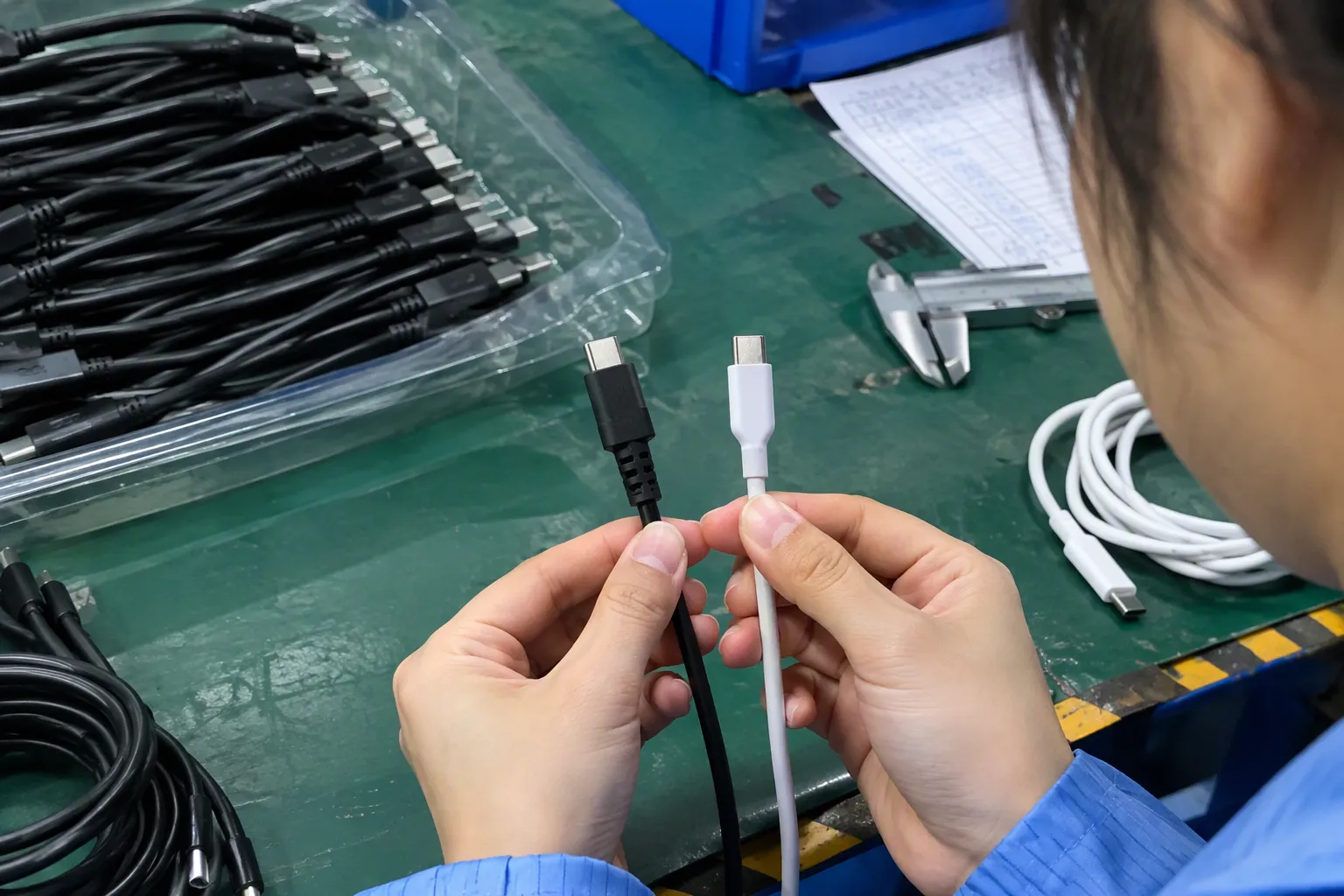
No. USB-C identifies a connector and interface family, but it does not alone prove a specific charging power, data speed, or device compatibility. I recommend requesting the exact performance claim, test conditions, applicable documents, and any limitations before using such claims in product listings or packaging.
Should I approve a sample before placing a mass-production order?
I strongly recommend sample approval for custom appearance, packaging, connector design, and important performance requirements. The buyer should record the approved version and confirm whether the sample used final materials and tooling. A sample approval should support production control, but it should not replace agreed inspection and testing.
Which documents should I request from a USB cable supplier?
The documents depend on the product and destination market. Buyers may request specifications, test reports, inspection records, declarations, and certification documents where relevant. I recommend verifying the document scope, model reference, date, issuer, and relationship to the actual product. A supplier’s statement alone is not enough for important compliance decisions.
Conclusion
The custom USB cable production process begins with requirement clarification, not connector selection. I help buyers move from a brief inquiry to a production-ready specification by confirming application, compatibility, construction, performance, appearance, quantity, packaging, inspection, and delivery expectations. Buyers should compare quotations on equivalent specifications, approve samples carefully, and verify technical or certification documents. If you are sourcing USB cables for a retail, wholesale, chain-store, or e-commerce business, contact my Shenzhen team with the inquiry checklist so I can help organize the requirements and coordinate a suitable supplier evaluation.
Sources
- Electrical Inspection Procedures Handbook", A documented cable-manufacturing process commonly separates specification, material preparation, assembly, verification, inspection, and product release into controlled stages
- USB Charger (USB Power Delivery) | USB-IF", USB-IF documentation distinguishes the USB Type-C connector specification from separate requirements governing cable construction, signaling, and USB Power Delivery performance
- Resistance in Wires of Different Length and Diameter", For a given conductor material and cross-sectional area, electrical resistance increases with conductor length; cable geometry and jacket construction also influence flexibility and handling
- NEW_Catalog_2024.pdf", Technical descriptions of braided cables identify the braid as an additional textile or polymer layer whose materials, processing, and interaction with the underlying jacket differ from those of a conventional extruded PVC jacket
- [PDF] Electromagnetic Compatibility (EMC) of Medical Devices Guidance ...", Regulatory frameworks for medical, automotive, and industrial equipment generally require application-specific safety evaluation and documentation rather than relying solely on a component's general description
- Manufacturing and Quality | www.waru.edu", Quality-management practice treats a reference or approved sample as one control input and relies on defined production processes, inspections, and records to demonstrate continuing conformity
- NASA-STD-8739.4A PDF", Descriptions of cable and wire-harness assembly commonly include cutting and stripping, conductor termination, insulation or shielding preparation, housing installation, and strain-relief completion
- USB Cable Inspection: Voltage Drop, Current Load & Bend ...", Visual inspection can identify physical attributes and defects, but electrical power delivery and data signaling require appropriate functional or electrical measurements under defined test conditions