Quick Answer
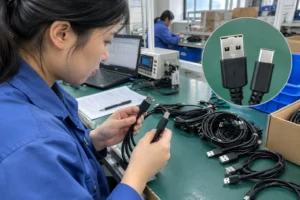
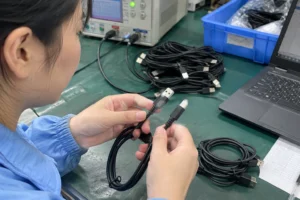
USB-C pin-map testing helps buyers identify some basic cable and connector defects before a shipment reaches customers. A cable may look identical to an approved sample while hiding an open conductor, an unstable contact, or an unintended short. These issues can lead to returns, support cases, and damaged buyer confidence.
USB-C pin-map testing is a useful incoming-goods screening method for finding obvious open circuits, contact problems, and unintended connections in USB-C cables. However, a continuity beep or resistance reading does not prove that a cable supports fast charging, reliable data transfer, high-speed signals, safe power delivery, or full USB-C compliance[1]. Buyers should use this test as one layer in a broader quality-control process.
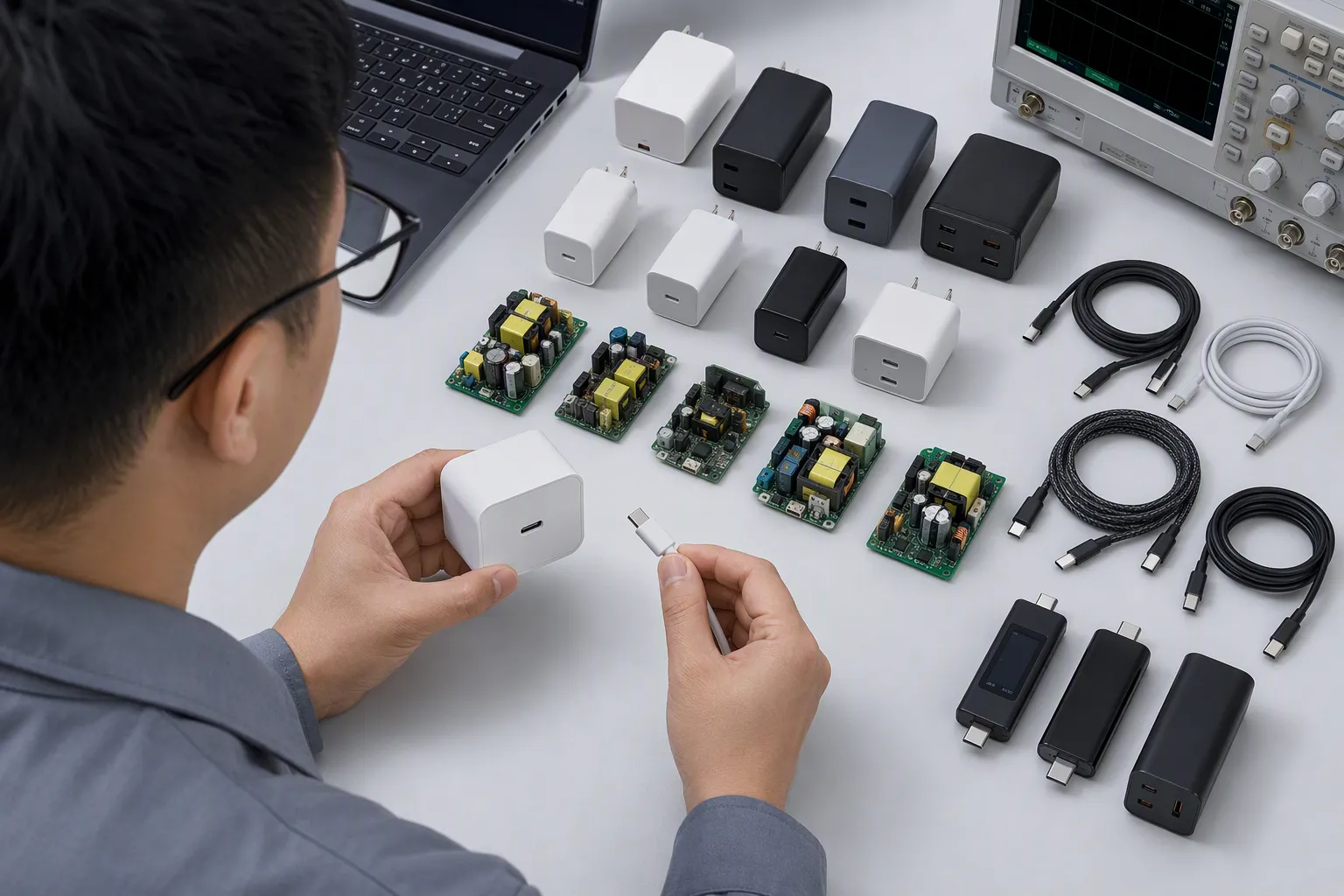
In our Shenzhen 3C export work, we treat basic electrical checks as an early-warning tool rather than a final approval standard. A quick test can stop an obviously defective batch from moving forward, but the right follow-up depends on the agreed cable specification, intended use, supplier documents, and customer market.
Why Are USB-C Pin-Map Testing Checks Valuable as Fast Incoming-Goods Risk Screens?
USB-C pin-map testing is valuable because it can quickly identify certain defects that are difficult to see during visual inspection. A basic continuity check may reveal a broken conductor or poor contact, while a short-circuit check may reveal an unintended connection between paths that should remain isolated.
For incoming inspection, USB-C pin-map testing can reduce the risk of shipping visibly normal cables with basic internal faults. It works best as a fast screening step: isolate suspicious samples, compare findings with the agreed specification, expand sampling if defects appear, and escalate to qualified testing for fast charging, high-power, or data-critical products.
The important point is simple: buyers should not ask only, “Do all pins connect?” They should ask, “Which customer-facing failure risks can this check eliminate before this batch enters our warehouse or online sales channel?” That change in thinking makes the inspection process more useful.
What We Mean by a Practical USB-C Cable Check

We use the phrase practical USB-C pin-map testing carefully. In a procurement setting, it usually means a basic inspection of electrical paths and obvious unwanted connections. It is not the same as full USB-C protocol validation, high-speed signal testing, USB Power Delivery analysis, or formal certification testing.
A typical practical screen may include:
- Visual inspection of connector shells, strain relief, molding, and cable jackets
- Connector insertion and retention checks using suitable fixtures or devices
- Basic continuity checks on expected conductive paths
- Basic short-circuit checks between paths that should not be connected
- Comparison of the tested cable with the approved sample and purchase specification
- Functional checks with relevant chargers, phones, tablets, computers, or test equipment
- Sampling expansion when a defect is found
We recommend that buyers document what their inspection actually covers. This prevents a common misunderstanding later: a factory, importer, or retailer may say that a cable “passed testing,” while each party assumes that this means something different.
A passing continuity result means only that the tested path appears electrically continuous under that test setup. It does not prove the cable’s charging capability, data speed, current rating, safety, or compliance status.
For example, a USB-C to USB-C cable can look the same as another cable but have very different internal construction. One may be intended only for charging. Another may support a limited data function. A third may be designed for higher power use and may include electronics relevant to its intended capability. The connector shape alone does not tell the buyer what is inside[3].
Why Simple Pass-or-Fail Thinking Creates Risk
USB-C has made charging and connectivity easier for end users, but it has also made product selection more complicated for buyers[2]. Many customers see the same connector at both ends and assume all USB-C cables perform the same job. In reality, cable capability depends on the product design, internal conductors, shielding, electronic components where applicable, connector assembly, and the system being connected.
That means a “pass” result from a simple meter cannot answer every procurement question.
A basic continuity test may help identify:
- An open circuit, where an intended electrical path is broken
- An intermittent connection caused by poor termination or weak contact
- A conductor that fails when the cable is bent or moved
- A connector pin that does not make stable contact
- An obvious internal assembly problem in a sampled cable
A basic short-circuit test may help identify:
- An unintended connection between conductive paths
- Internal debris or solder bridging in some failure situations
- A damaged connector assembly
- A cable that should be isolated for deeper inspection
However, the same checks do not establish:
- USB Power Delivery negotiation performance
- Charging profile compatibility
- Maximum supported power
- Actual current-handling performance under load
- Data-transfer speed
- High-speed signal integrity
- Electromagnetic compatibility
- Thermal behavior during charging
- Long-term durability
- USB-IF-level compliance
- Regulatory compliance or certification validity
For buyers, this distinction matters because the cost of a wrong assumption can be high. A basic cable tester may help prevent one category of returns, but it cannot validate every promise printed on retail packaging.
The Practical Role of VBUS, CC, and Data Paths
We find it useful to explain a few USB-C terms in plain language, while keeping the limits clear.
VBUS is associated with power delivery through the USB-C connection. A buyer should understand that identifying continuity on a power path does not show whether a cable will safely handle a specific charging load. Electrical continuity is not the same as safe operation under real power conditions[5].
CC, often called the configuration channel, plays an important role in USB-C connection behavior and cable/device negotiation. A problem involving this path may affect how devices recognize or negotiate a connection. Still, a basic check cannot replace protocol-level evaluation.
Data paths carry information between devices where the cable design supports data. A cable can show continuity yet still perform poorly in real data use because high-speed behavior depends on much more than whether a conductor is unbroken[4]. Signal quality, construction consistency, shielding, termination, and cable design all matter.
We do not recommend publishing or relying on a universal USB-C pin-map table without defining the cable type, connector orientation, test fixture, and authoritative technical source. USB-C cable configurations vary, and simplified diagrams can create false confidence when they are used outside their proper context.
For procurement teams, the useful takeaway is not to memorize every pin. The useful takeaway is to define what the product is supposed to do, then choose tests that reasonably support that claim.
A Basic Incoming-Goods Workflow We Recommend
In our experience, the most useful inspection systems are not always the most complicated. They are clear, repeatable, and linked to the buyer’s product risk.
We suggest a workflow like this:
-
Confirm the approved specification before testing.
The inspection team needs a clear product description. This should include connector type, cable length, charging claim, data claim, packaging, color, branding, and any agreed performance documents. Without a defined specification, a test result has little context. -
Separate products by intended use.
A basic charging cable, a fast-charging USB-C cable, and a data-focused cable should not automatically receive the same acceptance decision. The higher the power or data requirement, the more important it becomes to use suitable functional and specialized evaluation. -
Conduct visual and mechanical checks first.
We often start with simple observations: molding quality, cable jacket consistency, connector alignment, logo placement, packaging accuracy, and strain-relief condition. Visual checks cannot reveal every internal issue, but they can identify poor process control. -
Run basic continuity and short-circuit screening.
Use an appropriate fixture or testing method. Record the sample ID, lot number, test date, test setup, and result. If the result is unclear or unstable, isolate the sample rather than forcing a pass decision. -
Perform movement or flex observations where appropriate.
Some contact problems appear only when the connector or cable is moved. A cable that passes in one position but loses continuity during ordinary movement deserves further review[6]. -
Compare suspicious samples against the approved sample.
Differences in cable diameter, connector molding, weight, finish, or behavior may suggest a production change. These clues do not prove the root cause, but they help buyers ask better supplier questions. -
Expand the sample size when a defect appears.
A single failed sample should not automatically define the entire batch[7]. At the same time, it should not be dismissed. We recommend expanding the inspection according to the buyer’s quality plan and risk tolerance. -
Escalate when the application is sensitive.
High-power charging, fast charging, laptop charging, professional accessories, data-critical use, and branded retail programs may require specialized test equipment, qualified laboratories, or verification against current technical requirements.
Anonymized Issues That Basic Screening Can Help Surface
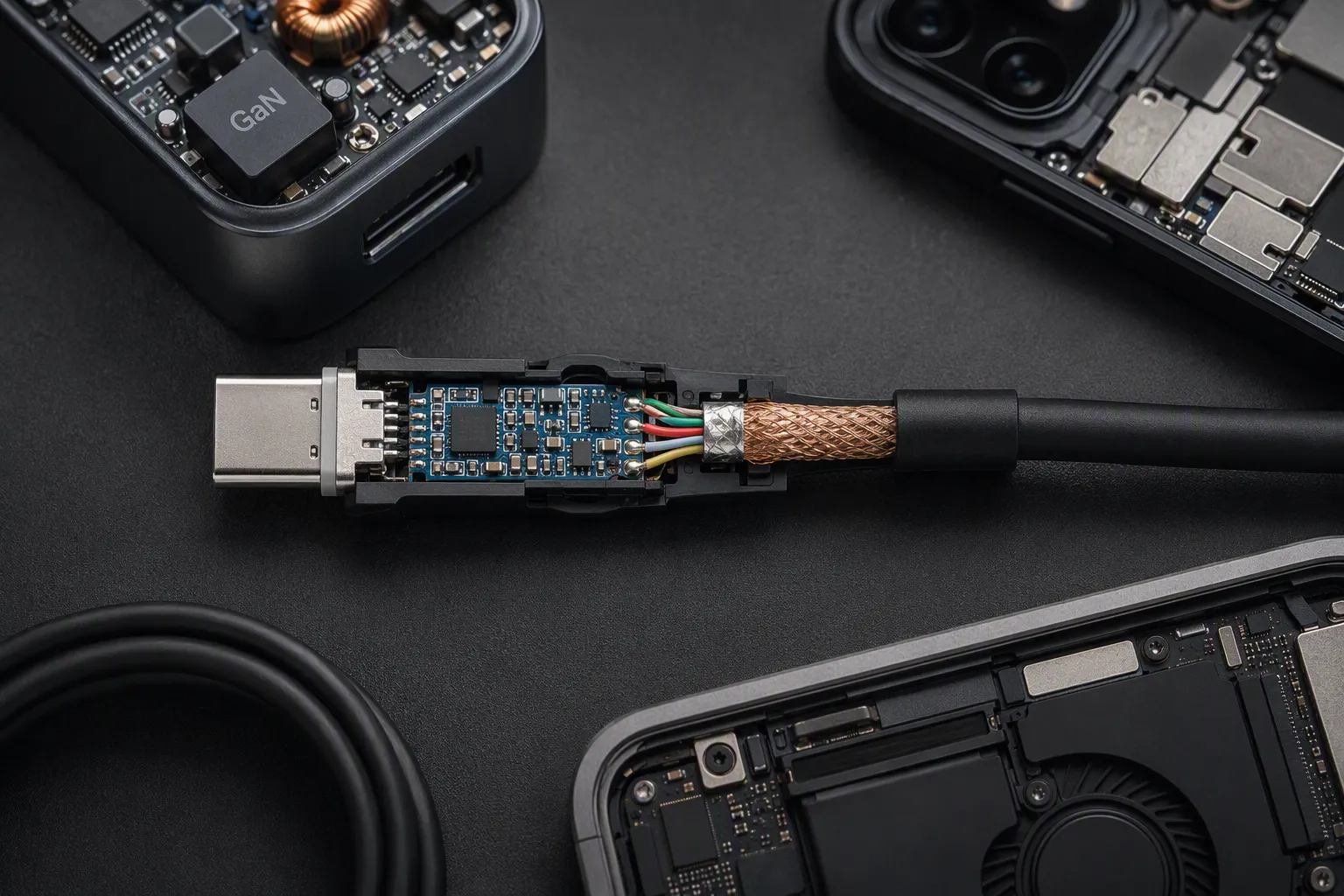
We have handled cases where a cable looked acceptable during routine visual inspection but showed unstable behavior during a basic electrical check. In one type of situation, the issue may be a conductor or termination that appears connected at rest but becomes unreliable when the cable is moved. That kind of problem can become a customer complaint such as “charging starts and stops” or “the device disconnects when touched.”
We have also seen why short-circuit screening matters. An unexpected connection can indicate a defect that requires immediate isolation and technical review. The exact cause may vary. It can involve connector assembly, internal workmanship, material damage, or another production issue. We do not treat one finding as proof of a universal manufacturing trend. Instead, we treat it as a signal to inspect the lot more carefully.
When our team finds a suspicious result, our first actions are usually practical:
- Mark and isolate the sample
- Confirm the test setup and repeat the check
- Review the applicable product specification
- Compare with an approved reference sample
- Inspect additional units from the same batch
- Ask the supplier for production and inspection records
- Decide whether the issue needs engineering review or external testing
This approach is useful because it avoids two extremes. One extreme is ignoring a warning sign because the cable looks normal. The other is declaring an entire shipment defective based on one incomplete test result. Good quality control requires evidence, documentation, and proportionate action.
What Buyers Should Ask Suppliers Before Placing an Order
A supplier’s answer to “Is this USB-C cable good?” is not enough for a professional buying decision. We encourage buyers to request specific, commercially relevant information.
Ask questions such as:
- What is the cable’s intended charging and data application?
- Is the cable designed for charging only, charging plus data, or another defined use?
- What product specification will be used for inspection?
- What is the agreed cable length and tolerance?
- What type of incoming materials and process controls does the supplier use?
- Does the supplier have batch inspection records?
- Which test methods does the supplier use before shipment?
- Can the supplier provide current supporting documents for the claimed market and product category?
- Does the supplier control component changes, connector changes, or material substitutions?
- What is the warranty and after-sales process if a field issue is found?
- What is the MOQ for a customized cable, package, color, or private-label program?
- What is the expected lead time for samples and mass production?
Buyers should also verify any certifications, declarations, test reports, and compliance documents that are relevant to their destination market and product claim. A document should be reviewed for the correct product model, issuing party, date, scope, and applicability[8]. We recommend qualified professional guidance for market-specific compliance decisions.
When Basic USB-C Pin-Map Testing Is Not Enough

Basic USB-C pin-map testing becomes insufficient when the product claim or customer application carries more technical risk.
For example, a retailer selling cables for laptop charging cannot rely on a simple continuity result to support performance claims. An e-commerce seller advertising fast charging needs evidence that is relevant to the actual cable design and intended devices. A distributor selling USB-C data cables to professional users should consider the risk of unstable transfer performance, compatibility problems, and return costs.
The following table provides a practical procurement view:
| Product scenario | What basic screening may help detect | What it cannot confirm | Recommended next step |
|---|---|---|---|
| Standard USB-C charging cable | Obvious opens, shorts, weak contacts | Real charging behavior, current capability, safety | Functional charging checks and supplier documentation review |
| Fast-charging cable | Basic assembly faults | Fast-charge negotiation and sustained performance | Suitable charging tests and qualified technical evaluation |
| Laptop charging cable | Some wiring or contact defects | High-power suitability, thermal behavior, protocol performance | Specialized testing and application-specific review |
| USB-C data cable | Broken or unstable paths | Data speed and signal integrity | Functional data tests and relevant technical validation |
| Premium retail cable | Early batch-quality warnings | Full durability and compliance | Defined AQL plan, documentation verification, broader QC program |
The purpose is not to over-test every low-risk product. The purpose is to match the inspection level to the sales claim and likely consequence of failure.
If a cable will be sold as a basic accessory at a value price, the buyer may choose a focused incoming inspection plan. If the product will support high-value electronics, premium retail placement, or higher-power charging claims, the buyer should invest in a more robust evaluation process before the product reaches consumers.
USB-C Pin-Map Testing FAQs

Does a continuity beep prove that a USB-C cable is good?
No. A continuity beep only suggests that the tested electrical path is connected under the test conditions. It does not prove charging speed, power capability, data performance, signal integrity, safety, durability, or full USB-C compliance.
Can USB-C pin-map testing find every defective cable?
No. USB-C pin-map testing can help find certain open circuits, unstable contacts, and obvious unintended connections. It cannot reliably identify every hidden construction issue, protocol problem, high-speed data issue, or performance problem that appears only under load or during real device use.
Should we use the same USB-C inspection method for every cable?
No. Buyers should match the inspection plan to the cable’s intended application and product claim. A simple charging cable, a fast-charging cable, and a data-focused cable can require different functional checks, documentation, and technical evaluation.
What should we do if one sample fails a short-circuit check?
We recommend isolating the sample, confirming the test setup, repeating the check, and expanding inspection according to your quality plan. Buyers should compare the findings with the agreed specification and request supplier investigation before deciding whether to accept, rework, or hold the batch.
Can supplier certificates replace USB-C cable testing?
No. Supplier documents can support a sourcing decision, but buyers should verify that documents apply to the correct product, model, market, and claim. Documents also do not replace appropriate incoming inspection or application-specific performance evaluation.
What Should Buyers Do After USB-C Pin-Map Testing?
USB-C pin-map testing is most useful when buyers treat it as a fast risk screen, not as a complete product verdict. It can help us identify basic continuity failures, contact issues, and obvious shorts before goods move through the supply chain. Still, cable capability depends on far more than a meter result. We recommend combining basic screening with clear specifications, supplier-document verification, functional tests, expanded sampling when needed, and qualified technical evaluation for higher-risk applications. If you are sourcing USB-C cables for retail, wholesale, or e-commerce, our team can help you define practical inspection points, MOQ options, customization requirements, and supplier-facing quality expectations.
Sources
- How to Test and Analyze USB Type-C Cable Functions ...", USB Implementers Forum technical materials describe USB Type-C cable evaluation as including requirements beyond basic continuity, such as Power Delivery behavior and, where applicable, high-speed electrical performance
- USB Charger (USB Power Delivery)", Reference descriptions of USB-C note that the common connector may be used with substantially different data-transfer and power-delivery capabilities, so connector appearance alone does not determine function
- Identifying USB-C E-Mark Cables", USB Type-C technical documentation distinguishes cable implementations by internal wiring and, in some cases, electronically marked or active components, demonstrating that an identical connector form does not by itself specify cable capability
- Signal integrity research of high-speed interconnection ... - PMC", Signal-integrity literature explains that high-speed links depend on controlled impedance, loss, reflections, crosstalk, and related transmission-line effects, so DC continuity alone cannot demonstrate high-speed data performance
- CCC and Connector Design: Why Temperature Rise Matters", Electrical connector and USB Type-C testing guidance treats current capability and temperature-related performance as load-dependent characteristics separate from a basic continuity result
- Custom Cable Assembly Testing: Is Continuity Testing Enough", Interconnect reliability literature recognizes flex and mechanical-motion testing as methods for exposing intermittent electrical discontinuities that a stationary continuity measurement may miss
- What kinds of Lot Acceptance Sampling Plans (LASPs) are ...", Acceptance-sampling guidance describes lot disposition as a decision made under a specified sampling plan and acceptance rule, rather than as an automatic conclusion from an isolated observation
- FAQs - Certification and Third Party Testing", Conformity-assessment guidance requires documentation to identify the relevant product and responsible party and to state the applicable requirements, supporting review of model identity, issuer, date, scope, and market relevance