Wholesale 3C electronics for corporate gifting can look easy to source, but the wrong item often becomes an unused desk accessory. A trendy product may impress during unboxing yet create frustration if recipients cannot use it quickly. We recommend choosing practical, easy-to-understand electronics that fit real work, commuting, and travel routines.
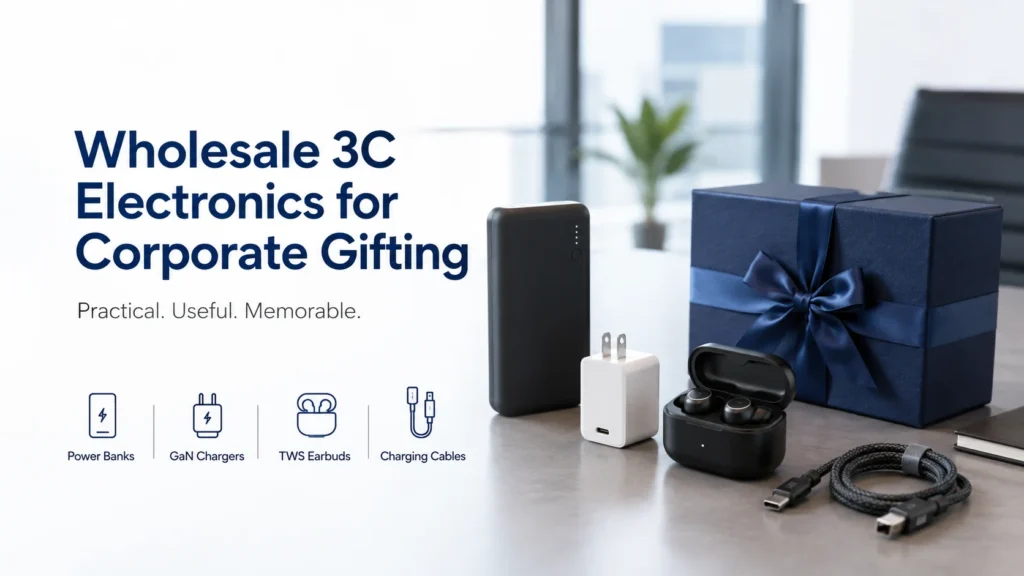
The best wholesale 3C electronics for corporate gifting in 2026 are useful products that recipients can use repeatedly, such as power banks, GaN chargers, multi-port charging sets, TWS earbuds1, and smart accessories. Buyers should match the product to the recipient profile, daily scenario, branding goals, budget, and required safety documentation rather than simply selecting the newest or highest-specification model.
In our Shenzhen factory, we have spent years discussing product selection, logo placement, quotations, samples, and delivery plans with branded clients. The same question appears again and again: “What will people actually keep using after the event?” That question should guide every gifting decision.
Quick Answer: Which Wholesale 3C Electronics Work Best for Corporate Gifting?
A corporate gift can miss the mark when it looks premium but solves no daily problem. Recipients may already own similar devices, may not understand the features, or may find the product inconvenient. We see better outcomes when buyers start with practical use rather than a product catalogue.
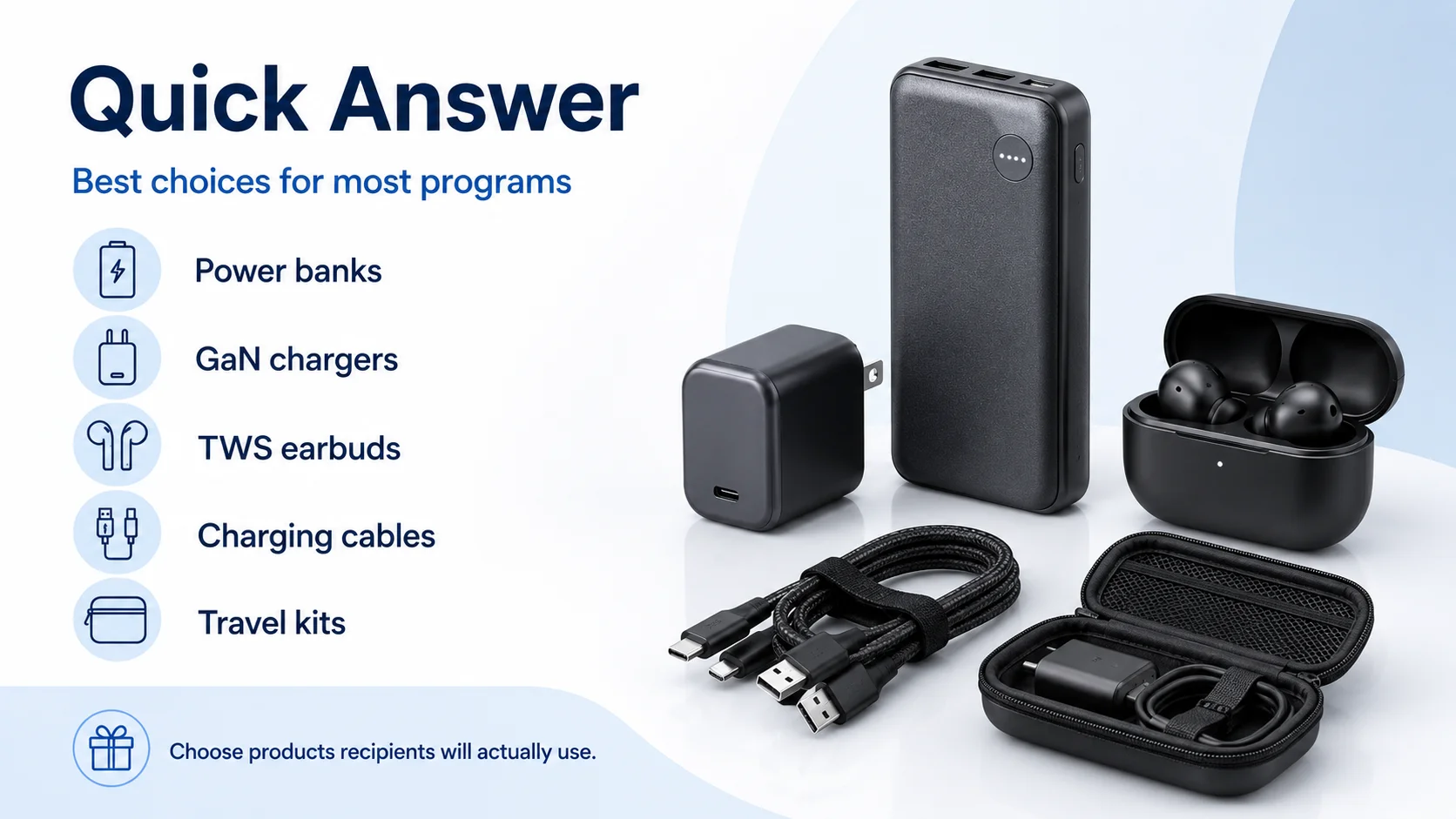
For most corporate programs, the strongest choices are compact power banks, GaN wall chargers, charging cables, TWS earbuds, and bundled travel charging kits. These wholesale 3C electronics work well because they support common device needs, offer visible branding space, and can be customized into different budget tiers without becoming difficult to explain or use.
The product category alone does not determine success. A 65W charger can be excellent for a traveling sales team2, while a simpler cable-and-charger set may be more appropriate for a large event audience. The recipient and the moment of use matter more than specifications on a brochure.
Start With the Recipient’s Daily Routine
When we speak with corporate gift buyers, we usually ask a few basic questions before discussing a model:
- Who will receive the gift? Employees, VIP clients, trade-show visitors, or channel partners may need different products.
- Where will they use it? Office desks, cars, airports, hotels, or home workspaces create different needs.
- Which devices do they own? USB-C laptops, iPhones, Android phones, tablets, and wireless earbuds affect compatibility.
- What should the brand communicate? Practicality, innovation, care, sustainability, or premium service?
- How long should the gift remain useful? A campaign giveaway and an executive appreciation gift have different expectations.
A useful corporate gift does not need to be complex. In fact, simplicity often protects the investment. A recipient who plugs in a charger on day one and uses it every week sees the brand repeatedly. That repeated interaction is usually more valuable than a novelty item that gets stored in a drawer.
Why Are Wholesale 3C Electronics Effective Corporate Gifts in 2026?
Traditional gifts can feel generic, while poorly chosen technology can feel disposable. Corporate teams need gifts that carry a clear message and remain relevant after an event. Electronics can solve this problem because many people charge, connect, listen, and travel with devices every day3.
Wholesale 3C electronics are effective corporate gifts because they connect a company’s brand with everyday routines. A well-selected charger, power bank, earbud set, or cable kit can offer practical value, repeated brand exposure, and a more modern gifting experience—provided the product fits the audience and is responsibly sourced.
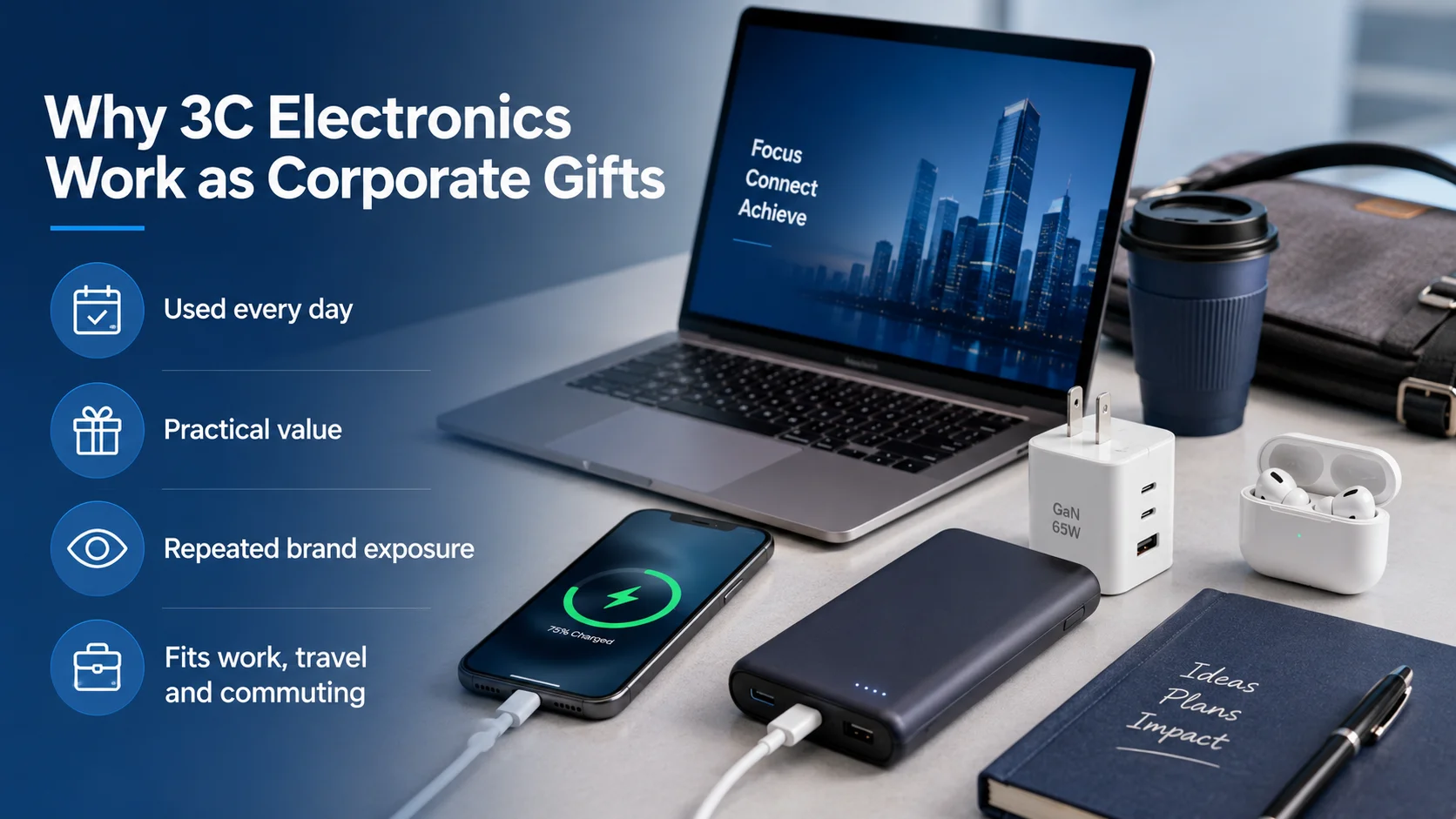
The strongest corporate gifts usually combine three elements: usefulness, ease of use, and presentation. Electronics can perform well in all three areas, but only when buyers avoid treating every recipient as the same.
Everyday Use Creates Brand Recall
A branded mug may stay in an office kitchen. A branded charging accessory may travel between home, office, and airport.4 That makes electronics especially suitable for organizations that want their gift to remain visible after the initial handover.
For example, a compact charger can fit a recipient who:
- Works from several locations
- Carries a phone and laptop
- Travels for meetings
- Needs a spare charger at home or in a bag
- Values fewer accessories on a desk
However, we do not recommend assuming that “higher wattage” automatically means “better.” A high-power GaN charger may be unnecessary for a guest receiving a simple event giveaway. It may also need more explanation if the audience only charges a phone.
Corporate Gifts Need a Clear Use Case
We have found that buyers often get better internal approval when they can describe the product in one sentence:
“This is a compact travel charger for employees who work across offices.”
That message is clearer than saying, “This is our newest charging technology.” Product novelty can support a campaign, but practical relevance should lead the selection.
For 2026 programs, buyers should verify current consumer preferences and local compliance obligations independently. We do not treat broad trend claims as a substitute for understanding the specific audience.
Which Wholesale 3C Electronics Are Best for Corporate Gifting?
A long product list can make selection harder. Some buyers choose an impressive-looking item before defining the occasion, audience, or desired brand level. That approach can lead to poor retention and unnecessary customization costs.
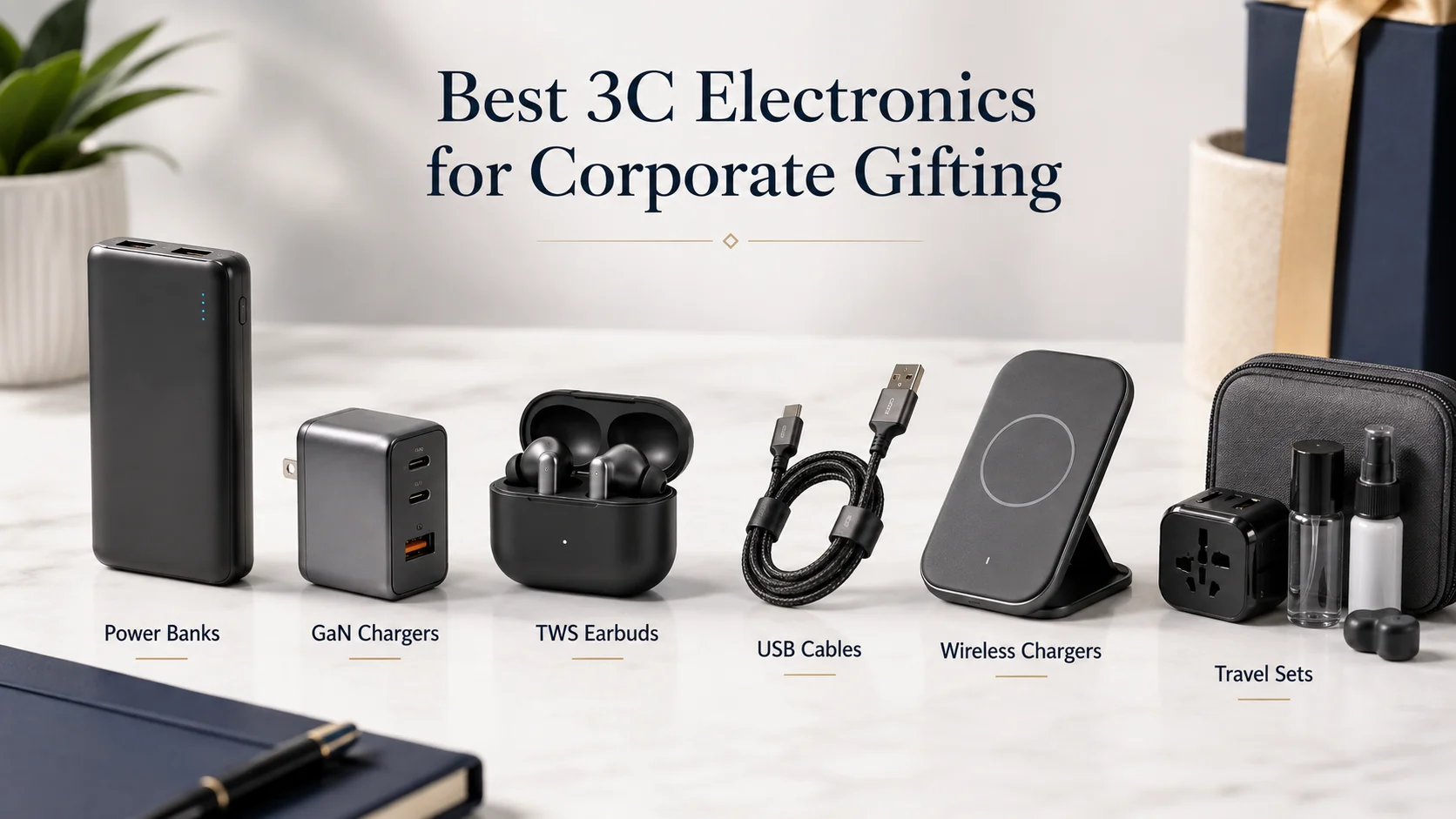
The best wholesale 3C electronics for corporate gifting are usually power banks, GaN chargers, multi-port chargers, TWS earbuds, USB cables, wireless chargers, and travel accessory sets. Each category works best in a different scenario, so buyers should choose based on recipient habits, gift tier, and compatibility needs.
Practical Categories to Consider
| Product category | Strong gifting scenario | Main buyer consideration |
|---|---|---|
| Power bank | Travel, outdoor events, employee appreciation | Battery transport documents and capacity |
| GaN charger | Business travel, executive gifts, laptop users | Output ports and device compatibility |
| Multi-port charger | Families, office users, premium client gifts | Clear charging-power allocation |
| TWS earbuds | Incentives, lifestyle campaigns, client gifts | Comfort, pairing experience, sound expectations |
| USB charging cable | Large-volume events and add-on gifts | Connector mix and durability |
| Wireless charger | Desk gifts and office campaigns | Phone compatibility and charging position |
| Travel charging kit | Premium onboarding or partner programs | Packaging and component consistency |
Avoid the “One Product for Everyone” Trap
A power bank is often easy for recipients to understand. Yet it may not be the right fit for a company with strict air-travel policies or a campaign where lightweight mailing is important. Similarly, TWS earbuds can feel personal and modern, but buyers should consider whether the target audience already uses earbuds, whether the product fits local preferences, and whether the gift needs a universal business purpose.
In our own conversations with buyers, we usually encourage a short screening process rather than a “top product” ranking. We ask whether the item will be used in the first week, whether it needs instructions, and whether the logo improves the experience rather than overwhelms it.
A dependable cable set can sometimes outperform a more expensive gadget because it solves a familiar problem immediately. The “best” product is the one that recipients understand, keep, and use.
Comparison Table: How Do Power Banks, TWS Earbuds and GaN Chargers Compare?
Buyers often narrow their shortlist to power banks, earbuds, and chargers. Each product can support a successful gifting project, but each also creates different sourcing, safety, and customization questions. A direct comparison helps teams avoid choosing only by appearance.
Power banks suit mobile and travel-focused recipients5, TWS earbuds suit lifestyle or incentive gifts, and GaN chargers suit professionals who charge multiple devices. Buyers should compare these products by real use case, perceived value, branding surface, compliance documents, and packaging requirements—not only by unit price.
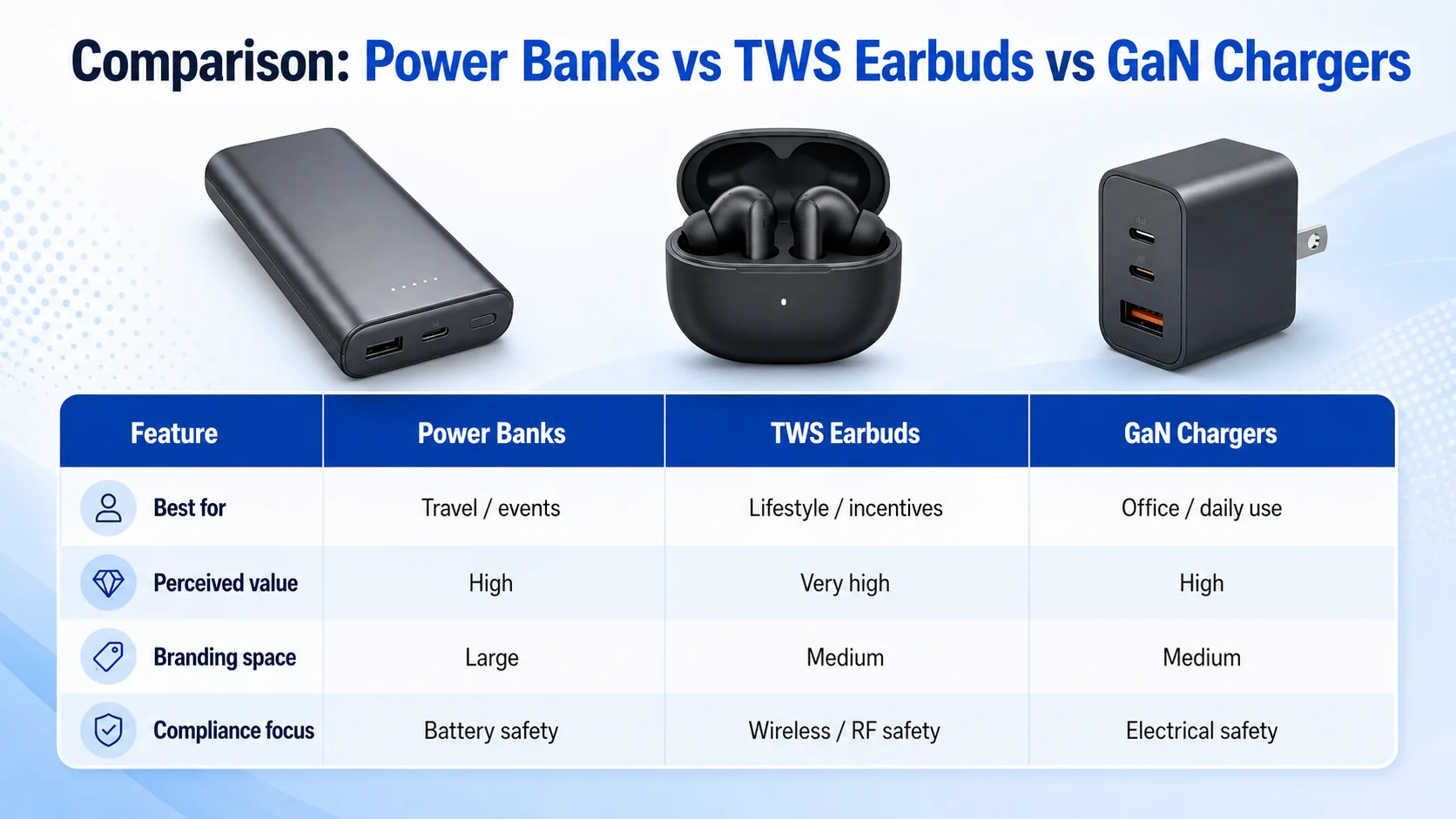
| Factor | Power Banks | TWS Earbuds | GaN Chargers |
|---|---|---|---|
| Best use case | Travel and mobile charging | Music, calls, commuting | Work, travel, multi-device charging |
| Ease of understanding | Very high | High, but pairing is required | High, if ports are clearly labeled |
| Perceived value | Strong when capacity is appropriate | Often premium and personal | Strong for professional audiences |
| Branding area | Good | Moderate | Good |
| Main risk | Battery shipping and documentation | Fit, audio expectations, pairing | Compatibility and power expectations |
| Packaging potential | Good | Excellent | Excellent |
| Suitable gift tier | Mid to premium | Mid to premium | Mid to premium |
How We Would Frame the Choice
We would often recommend a power bank when the campaign message involves mobility, emergency readiness, commuting, or outdoor events. Capacity, dimensions, built-in cables, and airline-related transport needs should be discussed early. Buyers should request relevant battery transport and safety documentation for the destination market.
We would consider TWS earbuds when a company wants a more personal lifestyle gift. The unboxing experience can be strong, especially with a custom charging case, sleeve, or gift box. However, the product should be easy to pair and comfortable to use. A very technical feature list does not compensate for a poor basic user experience.
We would suggest a GaN charger for professionals, teams, clients, and partners who frequently carry phones, tablets, and laptops. GaN technology can enable compact charger designs6, but buyers should focus on the actual port configuration and supported charging profiles. A charger with the right mix of USB-C and USB-A ports may be more useful than a higher-output model with the wrong connector setup.
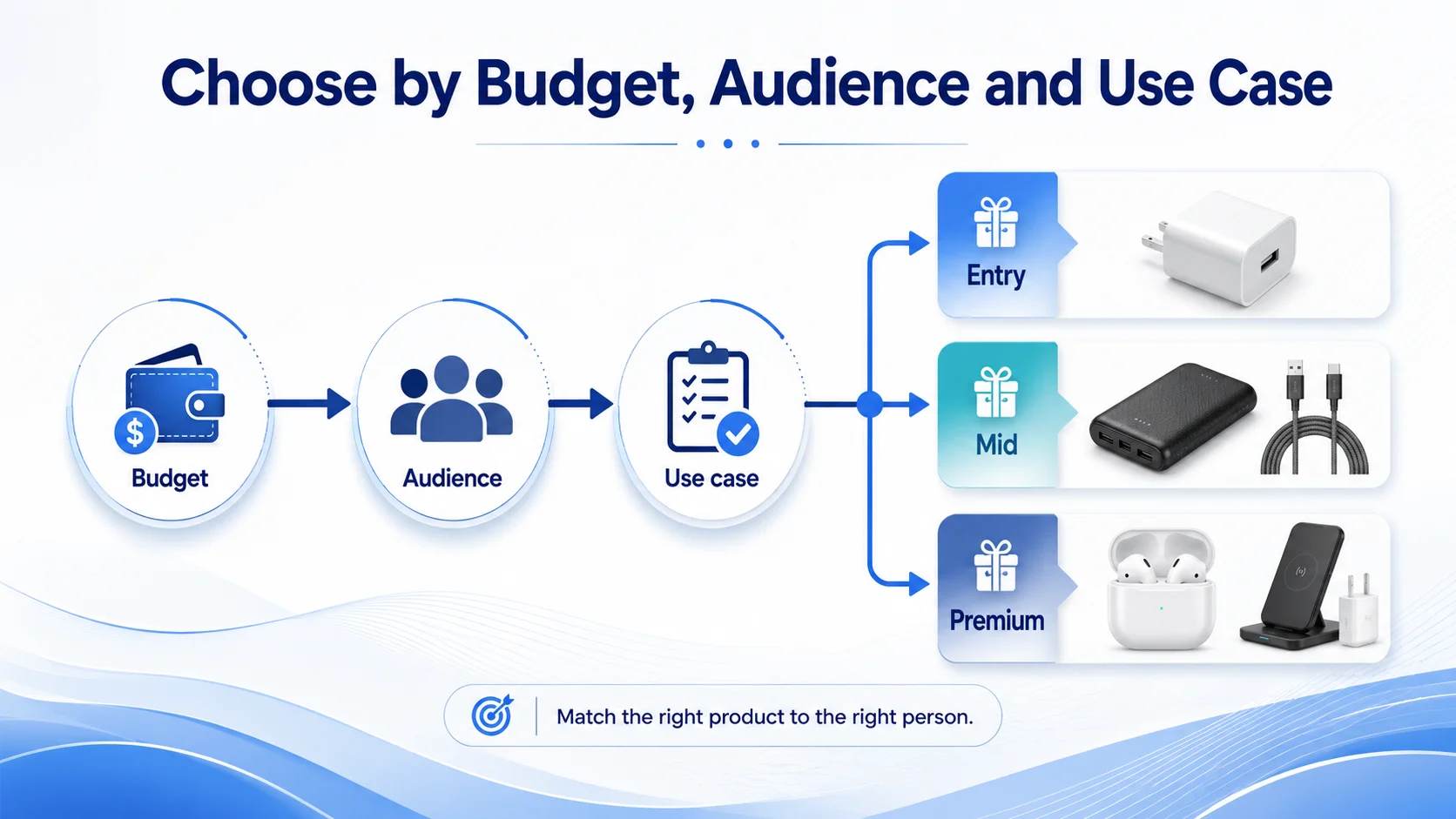
How Should Buyers Choose Wholesale 3C Electronics by Budget, Audience and Use Case?
A budget can push buyers toward the lowest quote, while a premium audience can push them toward unnecessary features. Both choices can weaken the final gift. Corporate teams need a balanced way to evaluate product value before requesting samples.
Buyers should choose wholesale 3C electronics by defining the recipient group, the daily usage scenario, the target gift tier, and the desired brand message. A practical product with clear use often provides stronger long-term value than a feature-heavy device that recipients rarely need.
A Simple Six-Point Screening Framework
We use a practical framework during early project discussions:
- Recipient profile — Are recipients office staff, travelers, students, executives, or event visitors?
- Usage scenario — Will the item be used at a desk, on a commute, during travel, or at home?
- Perceived usefulness — Can a recipient understand the value in a few seconds?
- Ease of use — Does the product require an app, complex setup, or special device knowledge?
- Brand fit — Does the product support the company’s intended image?
- Execution quality — Can the logo, color, packaging, documents, and delivery plan work as one coherent project?
Match the Gift Tier to the Relationship
For a large exhibition giveaway, a durable branded cable or entry-level charging accessory may make sense. For employee onboarding, a compact charging kit with a charger, cable, and pouch may create a more complete experience. For an executive client program, a higher-quality GaN charger or TWS earbud set in a custom box may be appropriate.
We do not recommend using gift price alone as the decision rule. A lower-cost item may offer better value if it is genuinely useful and branded well. Likewise, a premium item can disappoint if it is too specialized.
When we prepare quotations, we encourage buyers to compare like for like. They should confirm product specifications, materials, logo method, packaging, testing requirements, shipping terms, and sample standards. A quote becomes meaningful only when those details are aligned.
What Logo Printing and Laser Engraving Options Are Available for Wholesale 3C Electronics?
A logo can turn a practical device into a corporate gift, but excessive branding can make a product feel promotional rather than premium. Buyers need a logo method that fits the housing material, artwork, color, and expected usage life.
Common customization options for wholesale 3C electronics include silk-screen printing, pad printing, UV printing, laser engraving, full-color printing, custom colors, and molded logos. The best option depends on the product material, logo detail, target quantity, and desired brand presentation.
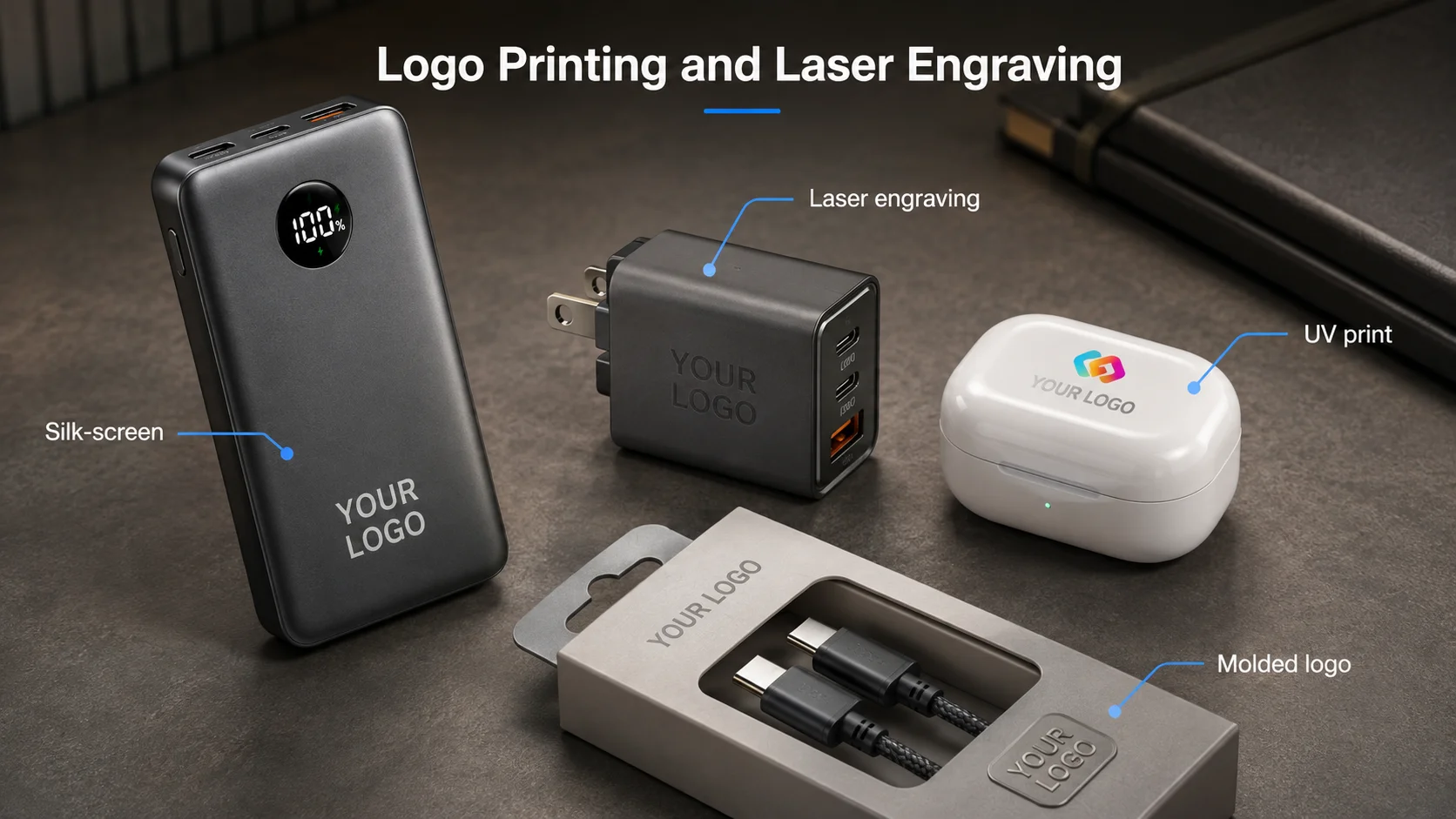
Common Branding Methods
| Method | Suitable materials | Typical effect | Buyer consideration |
|---|---|---|---|
| Silk-screen printing | Plastic, metal, silicone | Clean solid-color logo | Best for simple artwork |
| Pad printing | Curved surfaces | Precise small logo | Useful for compact products |
| UV printing | Flat surfaces | Full-color artwork | Check abrasion expectations |
| Laser engraving | Metal and some coated surfaces | Subtle, premium finish | Works well for minimalist branding |
| Full-color wrap | Packaging or selected housings | High visual impact | Artwork setup needs careful review |
A logo should support the object’s design. For example, a small engraved logo on an aluminum charger can feel understated and professional. A large full-color logo may be more suitable for an event-focused power bank or retail-style gift box.
Artwork Approval Matters
We always recommend a pre-production artwork confirmation and, where possible, a physical sample before mass production. Digital renderings are helpful, but they cannot fully show color variation, logo placement, texture, or the visual balance of a printed design.7
Buyers should provide vector artwork when available and confirm:
- Pantone or brand color references
- Logo position and orientation
- Maximum print size
- Whether individual names are needed
- Packaging artwork requirements
- Approval process and revision timing
A good logo application does not rescue an unsuitable product. It simply helps the right product carry the brand more effectively.
How Do Custom Gift Boxes and Packaging Increase Perceived Value?
A useful device can lose impact if it arrives in plain or inconsistent packaging. At the same time, overly elaborate packaging can increase cost, shipping volume, and waste. The goal is not more packaging; it is better presentation.
Custom gift boxes increase the perceived value of wholesale 3C electronics by creating a clear unboxing experience, protecting the product, and explaining its purpose. A well-designed box, sleeve, insert, or message card can make a practical charger or earbud set feel like a thoughtful corporate gift.
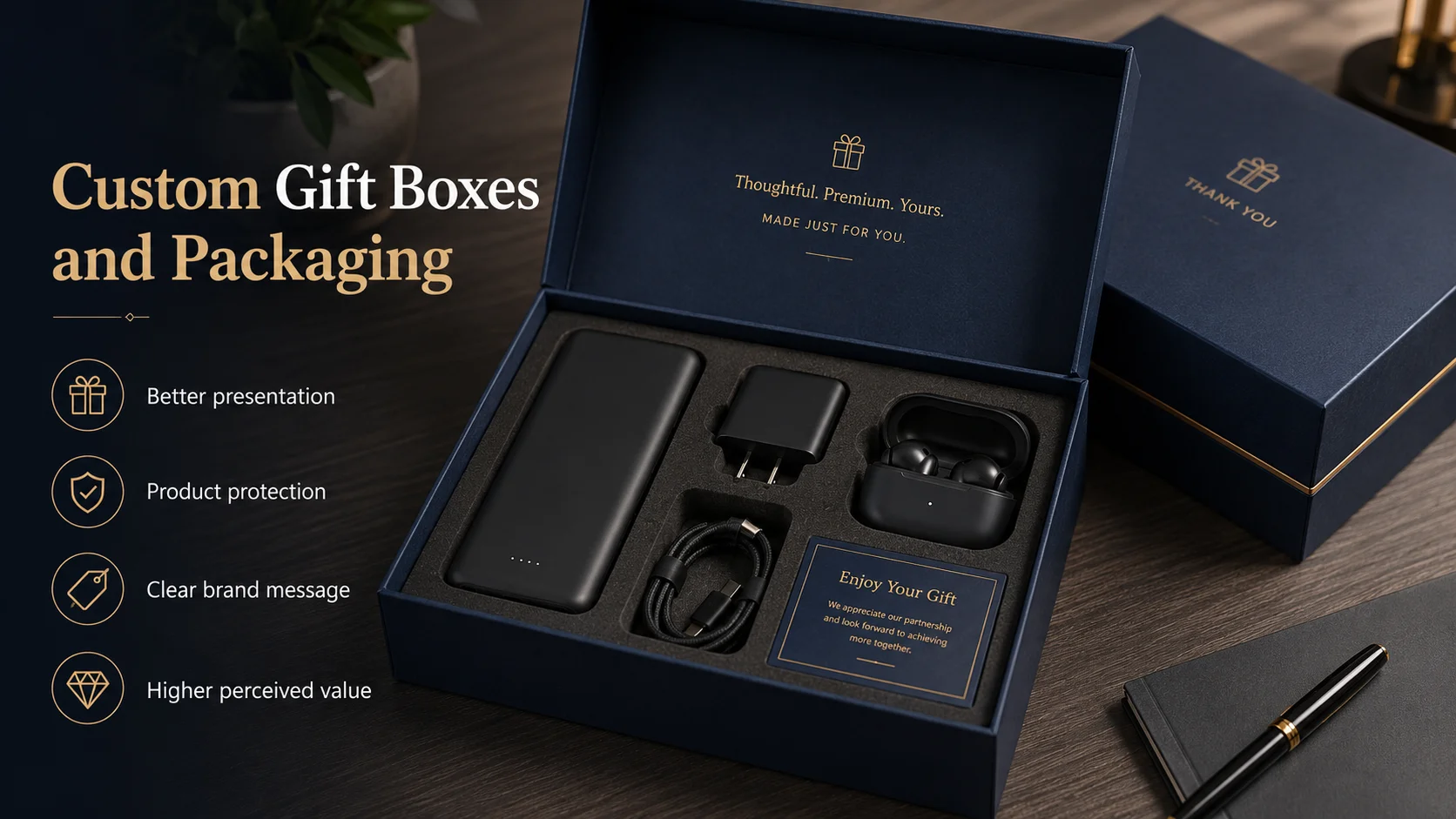
Packaging Should Tell a Simple Story
A corporate gift box can include:
- A branded outer sleeve or rigid box
- A molded pulp, EVA, paperboard, or cardboard insert
- A welcome card or campaign message
- Basic usage instructions
- A cable or accessory compartment
- A QR code linking to digital product support, where appropriate
For employee gifts, packaging can reinforce belonging through a welcome message or team theme. For client gifts, a more restrained design may feel more suitable. For event programs, compact packaging may matter most because staff need to store, transport, and distribute the gifts efficiently.
We often remind buyers that packaging decisions affect more than appearance. Box dimensions affect shipping volume.8 Inserts affect assembly time. Printed cards may require language review for multiple markets. Batteries and electronic accessories may also require specific markings or paperwork depending on the shipping route and destination.
Keep the Product as the Main Character
The packaging should make the product easier to understand. A simple label such as “Your Travel Charging Kit” can be more useful than a long list of technical features. If recipients know why the item is valuable, they are more likely to take it home and use it.
What Safety, Compatibility and Quality Standards Should Buyers Check?
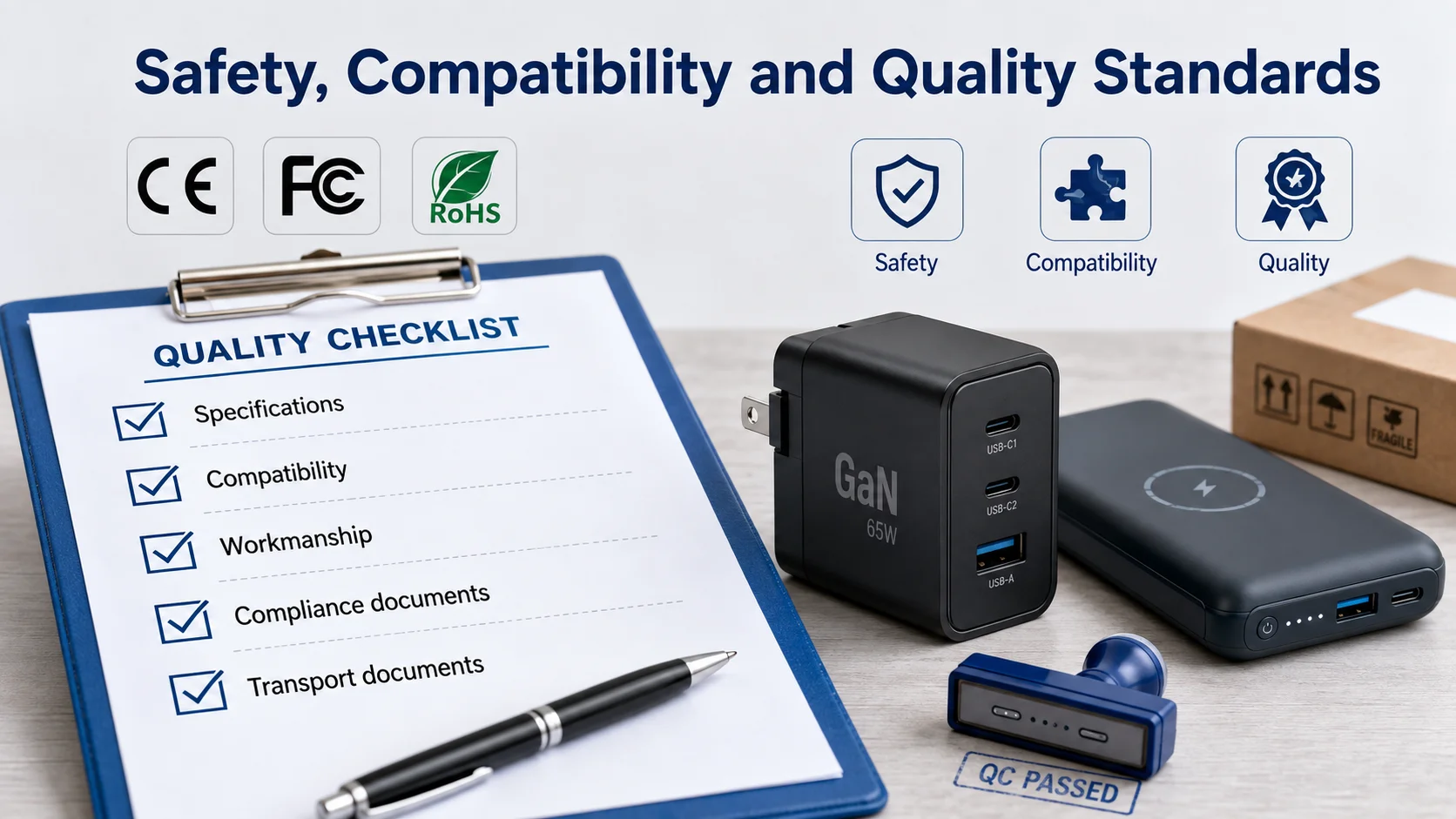
A corporate gifting project can face avoidable problems when buyers evaluate only appearance and price. Electronics need appropriate quality control, compatibility checks, and documentation review. A logo on a product does not reduce the buyer’s responsibility to verify its suitability.
Buyers of wholesale 3C electronics should check product specifications, charging compatibility, materials, workmanship, sample approval, and market-relevant compliance documents. For battery products, buyers should also review transport documentation. Requirements vary by product and destination, so qualified compliance professionals should confirm application-specific obligations.
Documents Buyers May Need to Review
Depending on the product and destination market, buyers may ask suppliers for applicable documents such as:
- Product test reports relevant to safety and electromagnetic compatibility
- EU-related declarations and supporting documentation where applicable9
- RoHS-related material declarations or reports10
- Battery transport documents, including UN38.3 documentation where applicable11
- Material safety data information for battery shipments when requested
- FCC-related documentation for products entering the United States, where applicable12
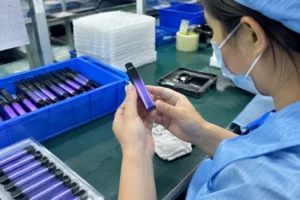
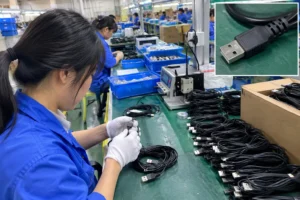
- Factory quality-control records and inspection standards
These documents are not interchangeable, and they are not universal proof that a product is right for every market. Buyers should verify document validity, model consistency, issuing laboratory details, and destination requirements. We recommend professional evaluation for country-specific compliance decisions.
Quality Control Should Reflect Recipient Experience
For corporate gift electronics, we focus on practical checkpoints such as:
- Charging function and port operation
- Cable fit and connector durability
- Surface scratches and housing gaps
- Logo accuracy and adhesion
- Packaging drop protection
- Pairing and basic playback checks for earbuds
- Capacity and charging behavior checks for power banks
A sample approval process should define what “acceptable” means before mass production. This helps reduce misunderstandings about colors, finishes, accessories, and packaging details.
Frequently Asked Questions About MOQ, Samples and Customization
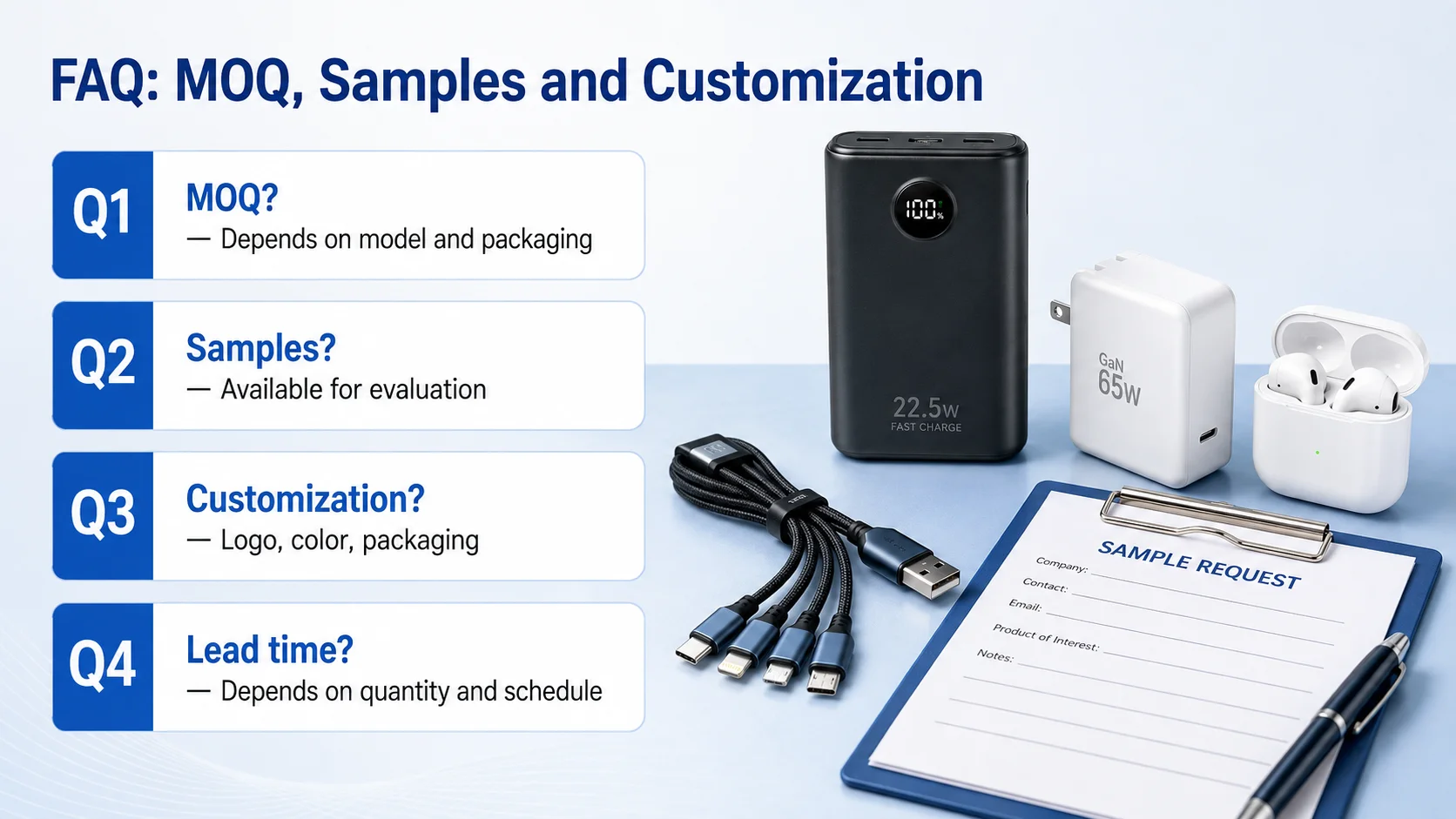
Corporate buyers often need answers quickly, but fixed assumptions can cause problems. MOQ, sample requirements, customization methods, and production schedules depend on the model, artwork, packaging, component availability, and shipping plan.
For wholesale 3C electronics, MOQ, sample cost, customization options, and lead time depend on the selected product and project details. Buyers should send their target quantity, destination, logo file, packaging needs, and desired delivery window so we can evaluate a realistic proposal.
What Is the MOQ for Custom Corporate Tech Gifts?
MOQ varies by product, logo process, custom color requirement, and packaging design. A standard product with a simple printed logo may have different requirements from a fully customized charger, earbud case, or gift box. We recommend confirming MOQ only after the project specification is clear.
Can We Order Samples Before Mass Production?
Yes, buyers can usually request samples for product evaluation, logo review, or packaging confirmation. Sample availability, cost, and timing depend on whether the request uses an existing model or needs new customization. We recommend approving a sample against clear written requirements.
Can You Add Our Logo to Power Banks, Earbuds and Chargers?
We can discuss printing, UV color artwork, laser engraving, custom colors, and packaging options based on the product housing and artwork. We review logo feasibility before production because each material and surface has different limitations.
How Should We Prepare Artwork for Customization?
We recommend providing a vector logo file, brand color references, desired logo position, and packaging text. Buyers should also identify whether the project needs individual names, multilingual instructions, QR codes, or campaign-specific inserts.
Source Wholesale 3C Electronics for Corporate Gifting From Kingfuji
Finding a supplier is not only about locating a product. Buyers need a partner who can discuss recipient use, product configuration, customization, packaging, inspection, and export documentation in a clear way. A supplier should answer detailed questions rather than push one SKU for every project.
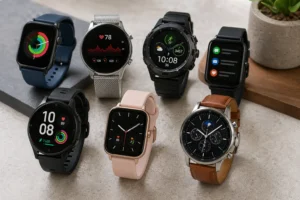
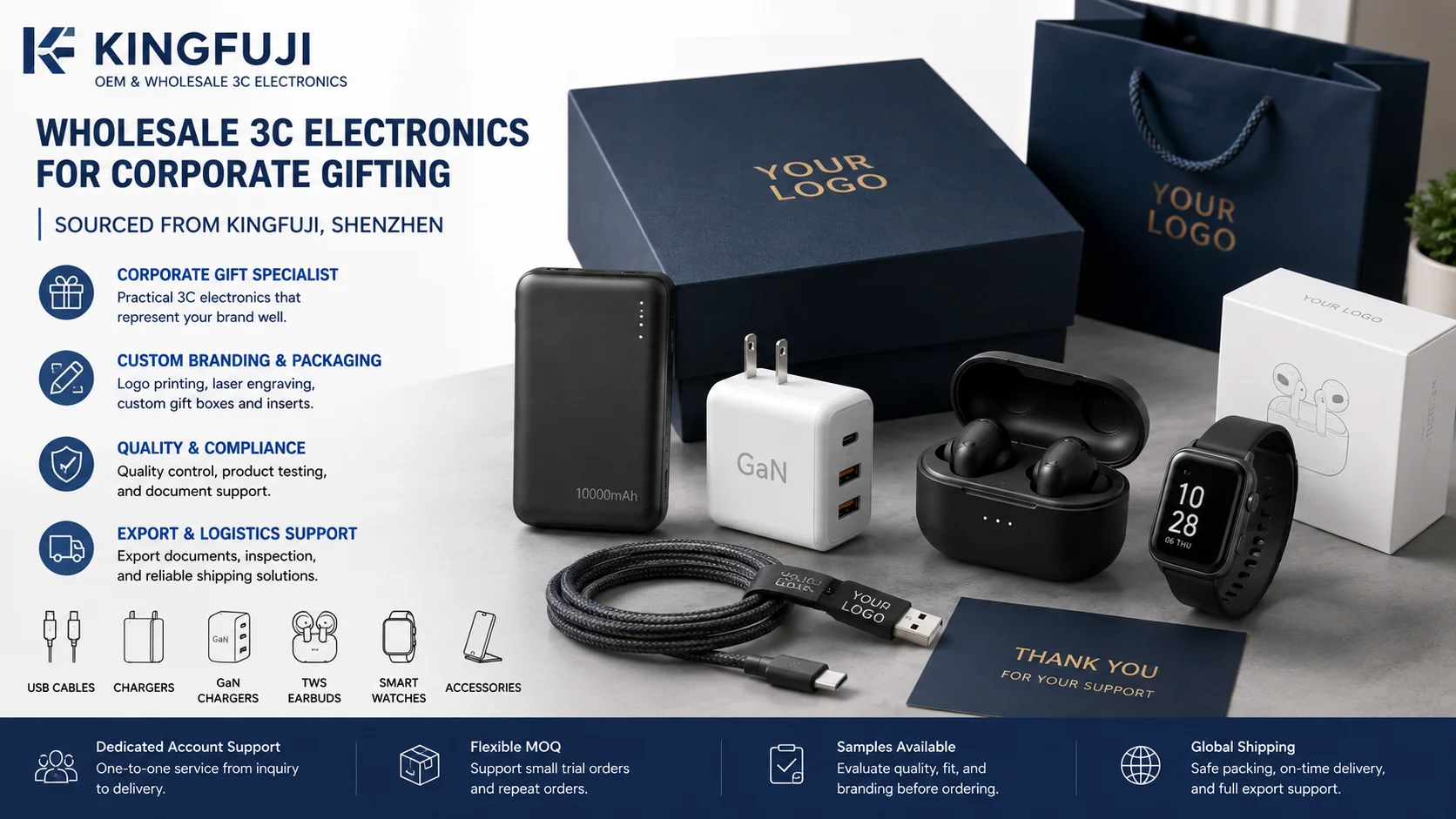
At Kingfuji, we support buyers sourcing wholesale 3C electronics for corporate gifting from Shenzhen, including USB cables, chargers, GaN chargers, TWS earbuds, smart watches, and related accessories. We help buyers evaluate product fit, branding options, packaging, samples, quality-control expectations, and export-oriented documentation requirements.
Our team has more than 15 years of export experience serving overseas buyers, including customers in European and American markets. We approach corporate gifting as a complete project, not just a product transaction.
Before we recommend a model, we would normally ask about:
- Target recipient and gifting occasion
- Preferred product category and budget range
- Target quantity and destination market
- Logo and packaging requirements
- Required documents and quality expectations
- Delivery window and shipping preference
We can then discuss suitable options with clearer trade-offs. A basic charger may be the right answer for one campaign. A branded power bank and cable set may work better for another. Our goal is to help you create a gift that feels useful, consistent, and worth keeping.
Conclusion
The best wholesale 3C electronics for corporate gifting are not always the newest products or the highest-specification models. Strong corporate gifts fit real routines, feel easy to use, and carry the brand naturally through repeated use. Power banks, TWS earbuds, GaN chargers, cables, and charging kits can all work when buyers match them to the audience, budget, use case, packaging, and quality requirements. Contact Kingfuji to discuss your custom corporate tech gift project, request product options, and review sample and branding possibilities.
"Bluetooth", https://en.wikipedia.org/wiki/Bluetooth. Bluetooth industry materials describe true wireless earbuds as separate wireless left and right earpieces that use Bluetooth connectivity, commonly with a charging case. Evidence role: definition; source type: institution. Supports: The meaning of true wireless stereo earbuds and their use of wireless Bluetooth connections.. Scope note: Product implementations differ in codec support, microphone configuration, multipoint behavior, and the connection architecture between earpieces. ↩
"USB Charger (USB Power Delivery)", https://www.usb.org/usb-charger-pd. USB Power Delivery specifications describe negotiated power delivery between a charger, cable, and device; a charger rated at 65 W may support many compatible portable computers and devices when their required power profiles are available. Evidence role: mechanism; source type: institution. Supports: USB Power Delivery's negotiated power-delivery model and the dependence of charging performance on compatible source, cable, and sink capabilities.. Scope note: A 65 W rating does not ensure full-speed charging or compatibility with every laptop, particularly devices requiring higher power or proprietary charging methods. ↩
"Mobile phone ownership", https://www.itu.int/itu-d/reports/statistics/2025/10/15/ff25-mobile-phone-ownership/. International telecommunications statistics document the widespread ownership and routine use of mobile and connected devices, providing context for treating charging and audio accessories as broadly relevant consumer products. Evidence role: statistic; source type: institution. Supports: Population-level evidence that mobile phones and connected devices are widely used in daily life.. Scope note: Device ownership and use rates vary by country, income group, age, and the specific recipient population. ↩
"Electronic Devices and Technology Abroad", https://global.psu.edu/landing/electronic-devices-and-technology-abroad. Research on mobile and hybrid work documents that portable digital devices are used across home, workplace, and travel settings, contexts in which users may need access to charging equipment. Evidence role: general_support; source type: research. Supports: Research describing the use of portable digital devices across work, home, and travel settings.. Scope note: Evidence about device mobility does not directly establish that a particular branded accessory will be carried or used by every recipient. ↩
"More than One Million Anker Power Banks Recalled Due to ...", https://www.cpsc.gov/Recalls/2025/More-than-One-Million-Anker-Power-Banks-Recalled-Due-to-Fire-and-Burn-Hazards-Manufactured-by-Anker-Innovations. Consumer-safety and transport guidance identifies power banks as portable lithium-ion battery packs that store electrical energy and can charge compatible electronic devices when external mains power is unavailable. Evidence role: mechanism; source type: government. Supports: The function of portable battery packs as stored-energy sources for charging consumer electronic devices.. Scope note: Practical usefulness depends on capacity, output protocol, cable availability, device compatibility, battery condition, and applicable transport restrictions. ↩
"GaN-Based High-Efficiency, High-Density, High-Frequency ...", https://vtechworks.lib.vt.edu/items/314dcc4d-ccb6-4118-bcb7-eebae36dd3b6. Reviews of gallium-nitride power electronics report that GaN devices can support high-frequency, high-power-density converter designs, which can contribute to smaller charger form factors. Evidence role: mechanism; source type: paper. Supports: The electrical properties of GaN power devices and their potential to increase switching frequency and power density in power converters.. Scope note: Compactness also depends on circuit topology, thermal design, safety spacing, output rating, and enclosure design; GaN alone does not guarantee a smaller charger. ↩
"Mastering Soft Proofing: How to Get Accurate Colors Every Time",
. Color-management research shows that screen-to-print appearance is affected by display calibration, illuminant conditions, substrate characteristics, inks, and surface texture, so a digital rendering cannot fully predict a physical printed result. Evidence role: mechanism; source type: research. Supports: How display calibration, viewing conditions, substrate properties, and surface texture affect differences between on-screen renderings and physical printed products.. Scope note: A calibrated proofing workflow can reduce discrepancies, but it does not eliminate all material and production variation. ↩"Parcel Size, Weight & Fee Standards", https://faq.usps.com/s/article/Parcel-Size-Weight-Fee-Standards. Postal and carrier guidance explains that dimensional-weight systems calculate billable weight from parcel dimensions, meaning larger package volume can increase shipping charges even when actual weight is low. Evidence role: mechanism; source type: government. Supports: The relationship between package dimensions, dimensional weight, and transportation pricing.. Scope note: The formula, divisor, service level, and billing treatment vary by carrier, transport mode, contract, and destination. ↩
"CE marking", https://en.wikipedia.org/wiki/CE_marking. European Commission guidance explains that products covered by applicable EU harmonisation legislation may require conformity assessment, technical documentation, CE marking, and an EU declaration of conformity before being placed on the EU market. Evidence role: definition; source type: government. Supports: EU requirements for CE marking and declarations of conformity when relevant harmonized product legislation applies.. Scope note: Not every electronic accessory is subject to the same directives, modules, standards, or documentation requirements. ↩
"European Union Reduction of Hazardous Substances ...", https://www.waru.edu/artifact/european-union-reduction-hazardous-substances-rohs-and-waste-electrical-and-electronic. The EU Restriction of Hazardous Substances Directive limits the use of specified hazardous substances in electrical and electronic equipment within its scope, making material-compliance evidence relevant to applicable products. Evidence role: definition; source type: government. Supports: The EU RoHS Directive's restrictions on specified hazardous substances in electrical and electronic equipment.. Scope note: A supplier declaration or report must be assessed against the specific product, exemptions, applicable substance limits, and destination-market requirements. ↩
"Lithium Battery Test Summaries (TS) | PHMSA", https://www.phmsa.dot.gov/training/hazmat/new-un-requirement-test-summaries. The United Nations Manual of Tests and Criteria specifies testing under subsection 38.3 for lithium cells and batteries and provides for the availability of a lithium-battery test summary in the transport supply chain. Evidence role: definition; source type: institution. Supports: The UN 38.3 testing framework and test-summary information requirements for lithium cells and batteries offered for transport.. Scope note: The applicable documentation, labeling, packaging, and mode-specific rules depend on battery configuration, shipment method, carrier policies, and the current regulations of relevant jurisdictions. ↩
"Equipment Authorization", https://www.fcc.gov/engineering-technology/laboratory-division/general/equipment-authorization. Federal Communications Commission guidance describes equipment authorization and supplier-declaration procedures that apply to categories of radio-frequency devices and other regulated electronic equipment marketed in the United States. Evidence role: definition; source type: government. Supports: FCC equipment-authorization and compliance frameworks for radio-frequency devices and relevant electronic equipment.. Scope note: The applicable FCC procedure depends on the product's radio-frequency characteristics, functions, and classification; not all accessories require the same documentation. ↩