Hotel charging solutions can become a guest complaint when they are outdated, poorly placed, incompatible with modern devices, or difficult for staff to maintain. We often see buyers focus only on wattage, then discover that room layouts, cable loss1, and replacement needs matter just as much. A zone-based charging plan gives hotels a more practical answer.
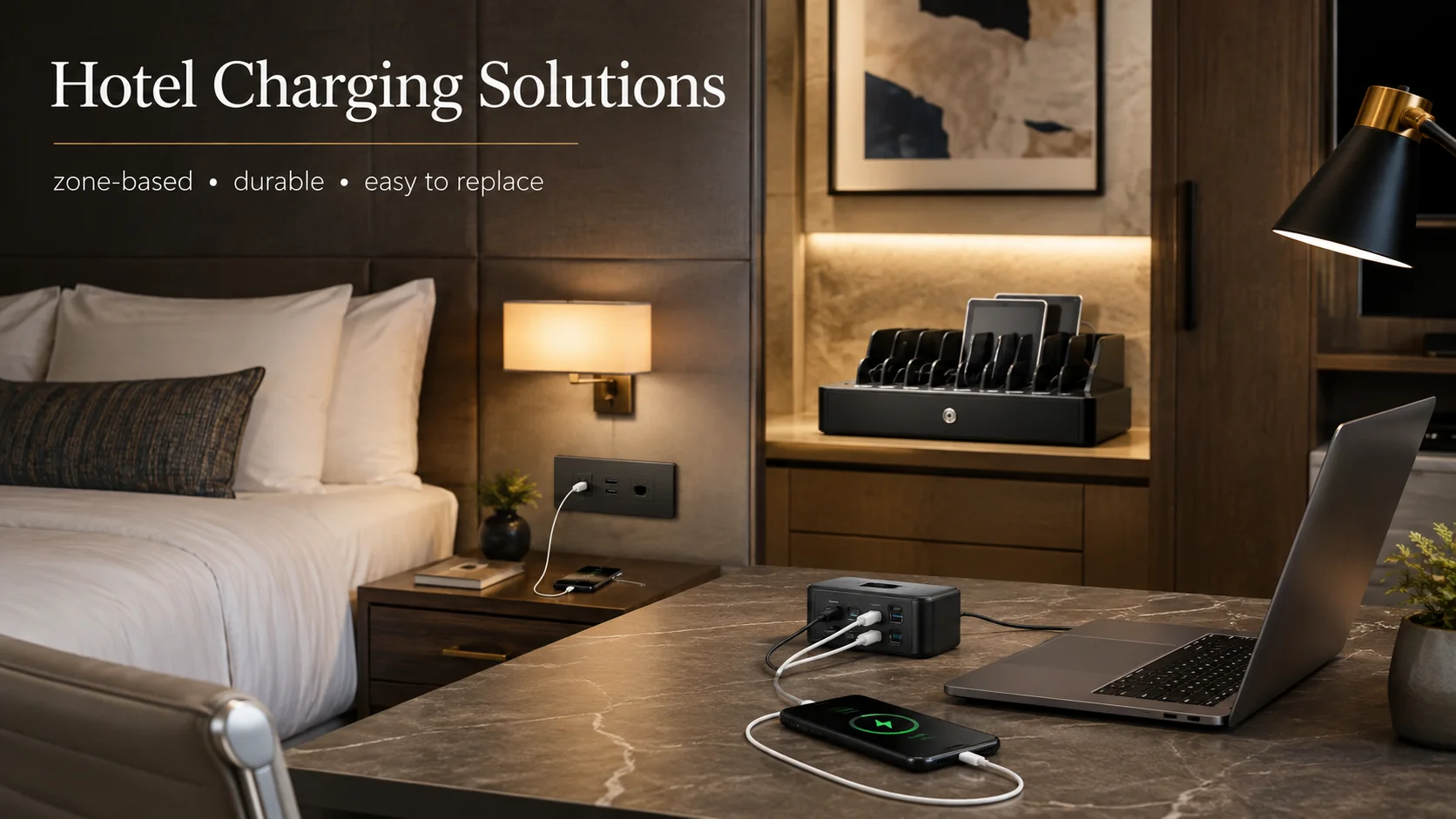
The best B2B hotel charging solutions are zone-specific, durable, and easy to replace. Guest rooms usually need compact bedside or desktop chargers with USB-C and USB-A ports, while public areas may need secured multi-device charging stations. Buyers should compare port mix, simultaneous charging performance, cable management, certification documents, reorder continuity, MOQ, lead time, and after-sales replacement options before selecting a supplier.
At Kingfuji, we manufacture chargers, cables, GaN charging products, and multi-port accessories for export markets. In hotel-related supply discussions, we have learned that the best specification is rarely the same across every area of one property.
Quick Answer: Which Hotel Charging Solutions Work Best?
Hotel buyers often need a fast answer because they may be fitting out new rooms, refreshing guest amenities, or solving recurring charging complaints. However, a single “best charger” can create new problems if it does not fit the guest task or the installation environment.
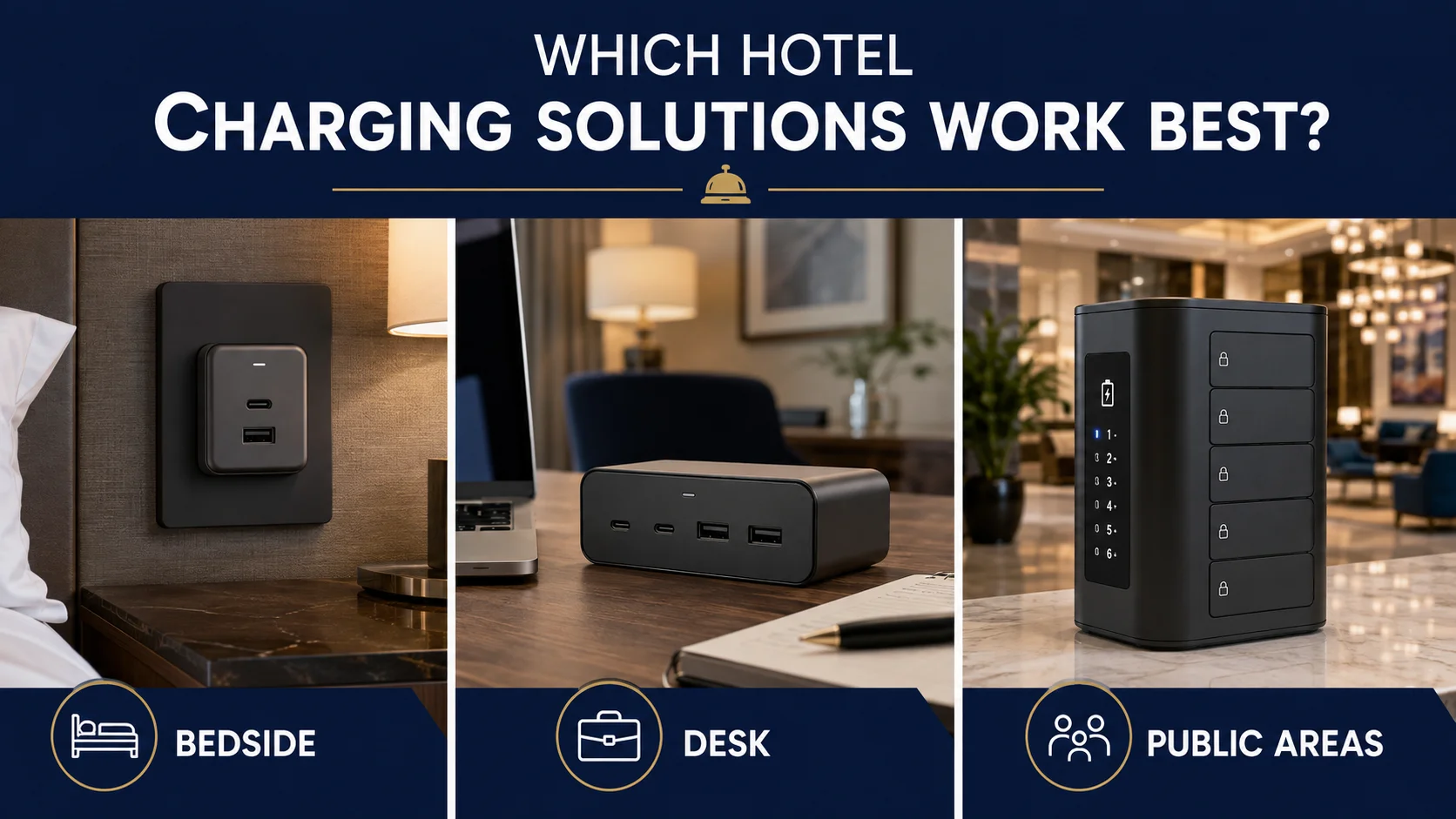
We recommend hotel charging solutions by zone: compact USB-C and USB-A chargers for bedside and desk use, multi-port desktop charging stations for front desks and meeting rooms, and secured charging hubs for public spaces. The right model should support the expected device mix, provide stable multi-device output, use replaceable cables where needed, and remain available for future replenishment.
In our experience, procurement teams should treat chargers as part of a small operational system rather than a one-time room accessory purchase.
Start With the Charging Task
A guest charging a phone overnight has different needs from a receptionist charging several devices during a shift. A traveler in a lobby may need a short emergency charge, while a conference attendee may need access to a laptop-compatible USB-C port.
We suggest mapping each location before comparing products:
- Bedside tables: Simple, low-clutter phone charging.
- Guest-room desks: Phone, tablet, earbuds, and sometimes laptops.
- Front desks: Multiple staff devices and continuous use.
- Meeting rooms: Shared charging for participants.
- Lobbies and lounges: Public access, cable security, and easy cleaning.
- Serviced apartments: More flexible daily-use charging, often with longer stays.
The highest-wattage product is not automatically the best commercial charging solution. A high-output USB-C port may be useful at a desk, but it may add unnecessary cost to a basic bedside application. We encourage buyers to build a product matrix, then order samples for realistic evaluation.
What Charging Solutions Do Modern Hotel Guests Need?
Guests now travel with more devices than they did a few years ago. A room with only one legacy USB-A port can feel dated, yet adding too many ports can confuse users or overload a shared power budget.
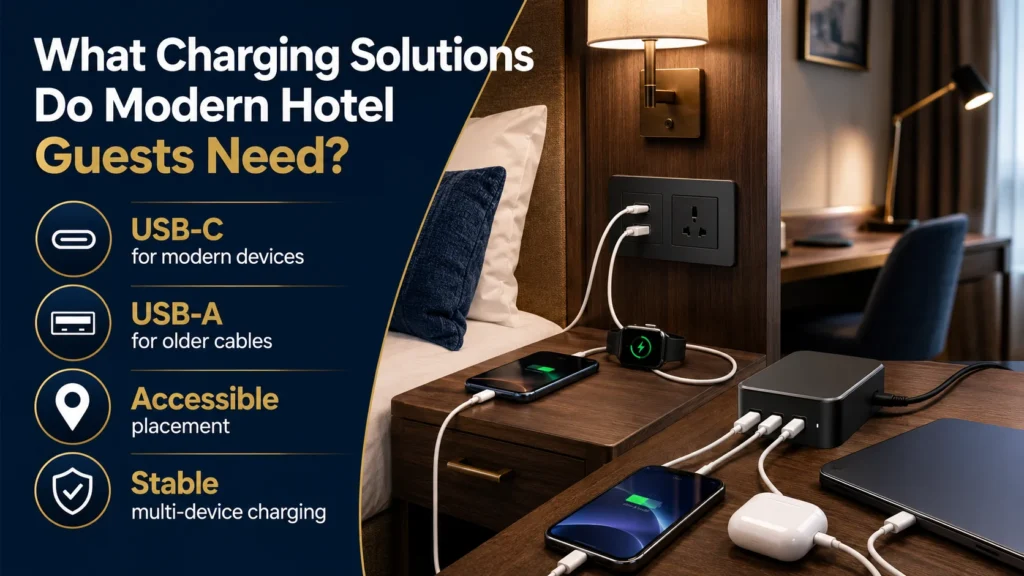
Modern hotel guests usually need accessible USB-C charging, a familiar USB-A option for older cables, and enough total output for common personal devices. Hotels should prioritize clear placement, dependable charging behavior, and compatibility with the devices their guest profile is most likely to carry.
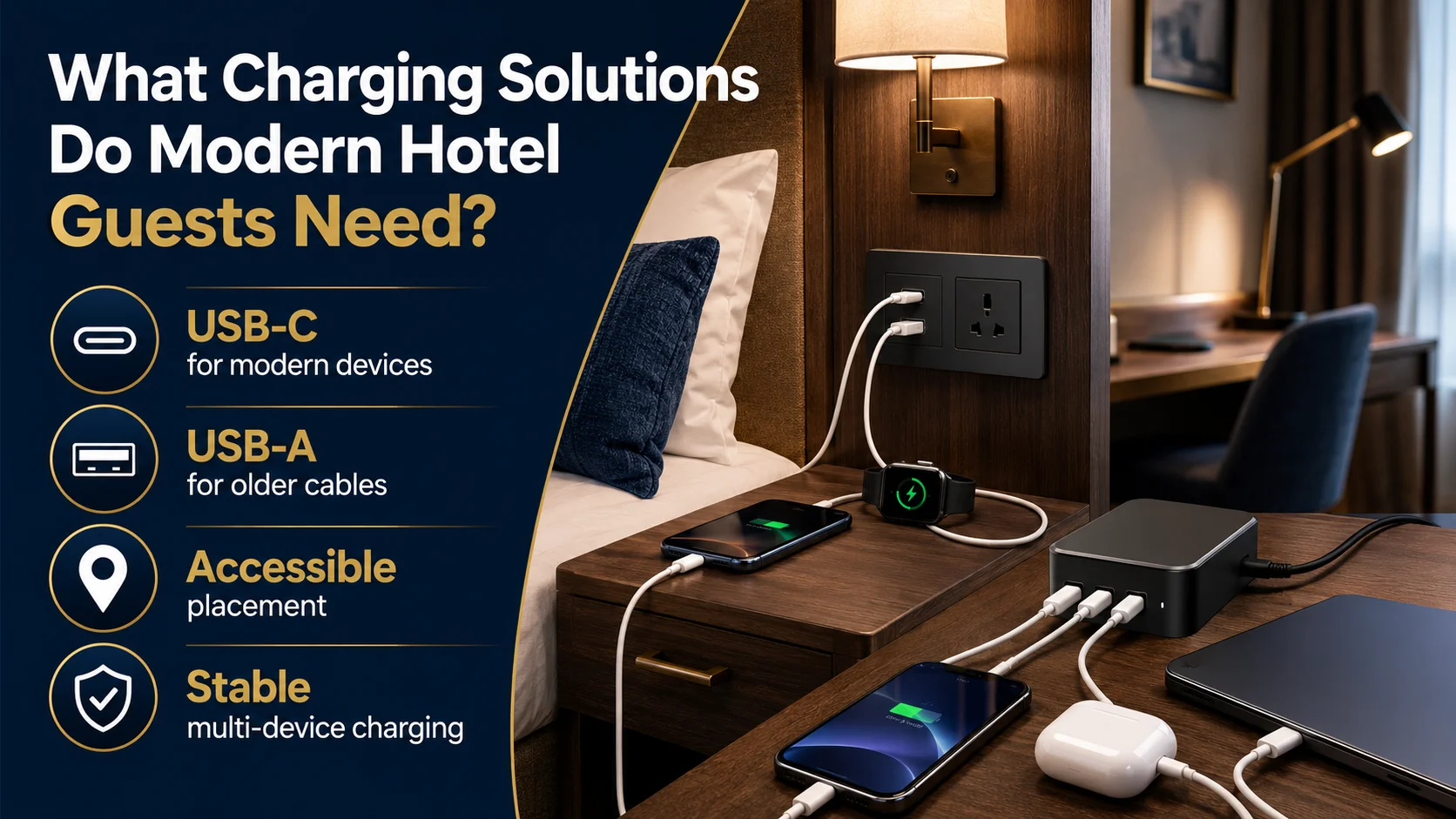
We see the strongest demand around USB-C because many current smartphones, tablets, earbuds, and laptops use it. Still, USB-A remains relevant in many hospitality properties because guests often carry older cables.
USB-C Matters, but Port Mix Matters More
A charger can have USB-C ports and still deliver a poor guest experience if its output is shared in a way that is unclear. Buyers should ask how output changes when several ports are used at once.
Key checks include:
| Procurement question | Why it matters |
|---|---|
| Is the output per port or total output? | It prevents incorrect assumptions about simultaneous charging. |
| Does USB-C support the needed charging protocol? | Device compatibility varies by phone, tablet, and laptop. |
| What happens when all ports are occupied? | Shared output can reduce charging speed.2 |
| Is a USB-A port still included? | It supports older guest cables and accessories. |
| Are cables supplied or separate? | It affects replacement planning and presentation. |
We have found that hotel buyers often ask, “How many watts is it?” We answer with another question: “What devices will be connected at the same time?” That question usually leads to a more useful selection.
For example, a room desk charger may need USB-C power delivery for a tablet or light laptop use, plus USB-A for a wearable or older phone cable. A bedside unit may only need dependable phone charging. We recommend that hotel operators confirm local socket standards, furniture dimensions, and installation requirements with qualified project professionals before finalizing a deployment.
Which Hotel Areas Need Multi-Device Charging Stations?
Shared hotel spaces can create charging demand at unpredictable times. Guests may wait in a lobby, work from a lounge, attend an event, or ask front-desk staff for a place to charge. These locations need more than a standard guest-room adapter.
Multi-device hotel charging solutions are most useful in front desks, business centers, meeting rooms, lounges, breakfast areas, and shared workspaces. These areas benefit from several ports, visible labeling, stable shared output, and a design that reduces cable clutter, accidental unplugging, and loss.
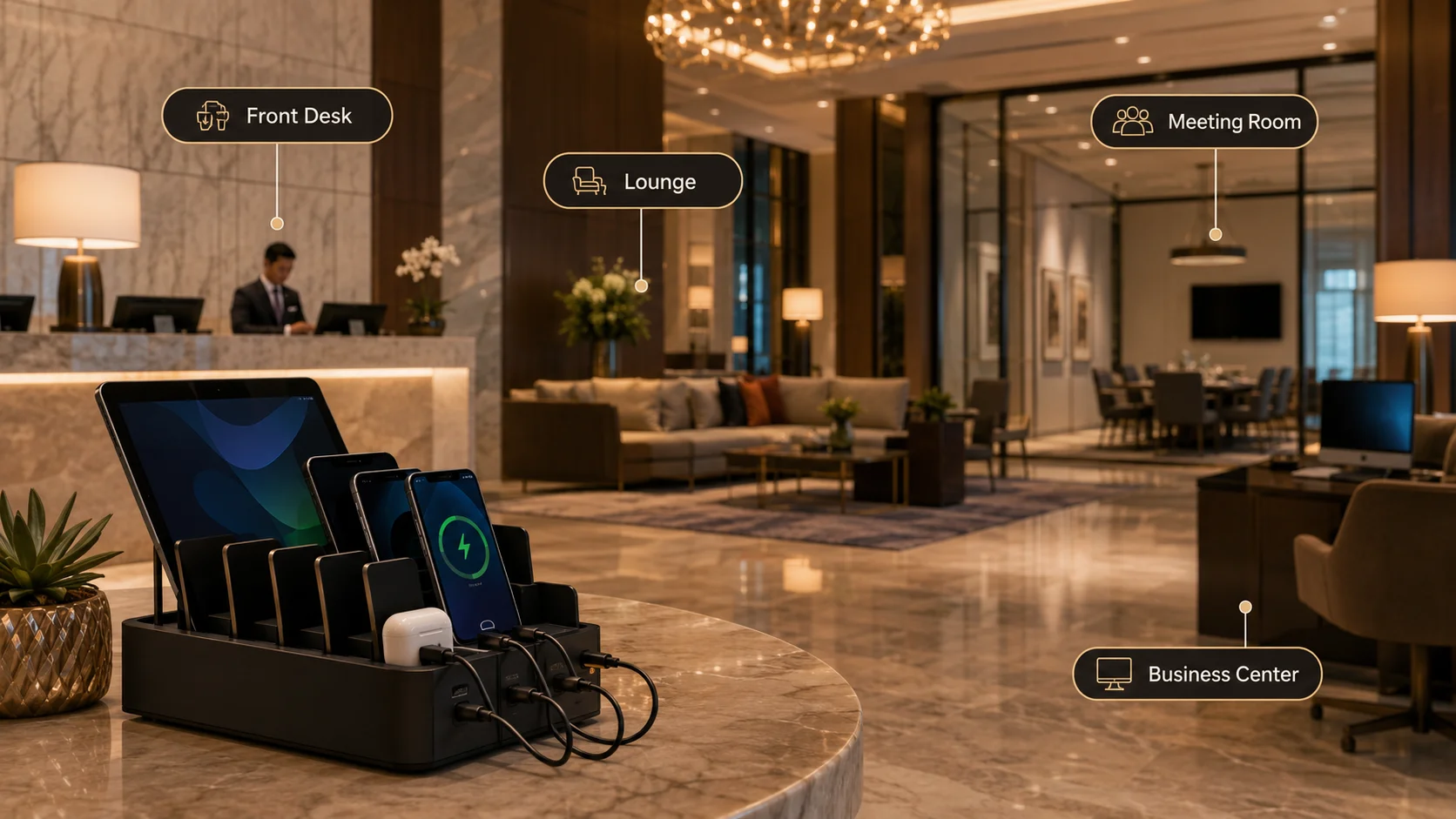
When we discuss public-area projects, we usually advise buyers to consider supervision and maintenance before adding more ports.
Match Access Level to Product Design
A public charging point has a different risk profile from an in-room charger3. Guests may bring different cable types, use ports heavily, and leave cables behind. Staff must also clean around the equipment and identify damaged accessories quickly.
A practical location plan may look like this:
- Guest rooms: One or two fixed charging points per bedside or desk area.
- Reception: A desktop charging station for staff devices, not necessarily guest access.
- Lobby: A secured shared station with short, managed cables if public charging is offered.
- Meeting room: A higher-capacity hub or multiple distributed points around tables.
- Business center: Desktop chargers that support short-term work sessions.
- Restaurant or café: Limited, discreet charging options that do not create cable hazards.
We recommend avoiding the temptation to place one large charging station in every public zone. Distributed charging points may be easier for guests to access and easier for staff to monitor.4 They can also reduce the number of devices competing for the same total output.
For larger rollouts, buyers should ask suppliers whether matching units can be reordered later. A hotel may renovate one floor now and another floor later. Consistent appearance, compatible replacement cables, and stable specifications can reduce visual inconsistency across the property.
Comparison Table: Desktop Chargers vs Built-In USB Charging Hubs?
Hospitality buyers often choose between visible desktop chargers and built-in USB charging hubs. Both can work well, but they create different installation, maintenance, and replacement considerations.
Desktop chargers are generally easier to replace, reposition, and upgrade, while built-in USB charging hubs create a cleaner integrated look.5 Hotels should choose based on furniture design, maintenance access, installation approval, guest visibility, and the expected replacement cycle.
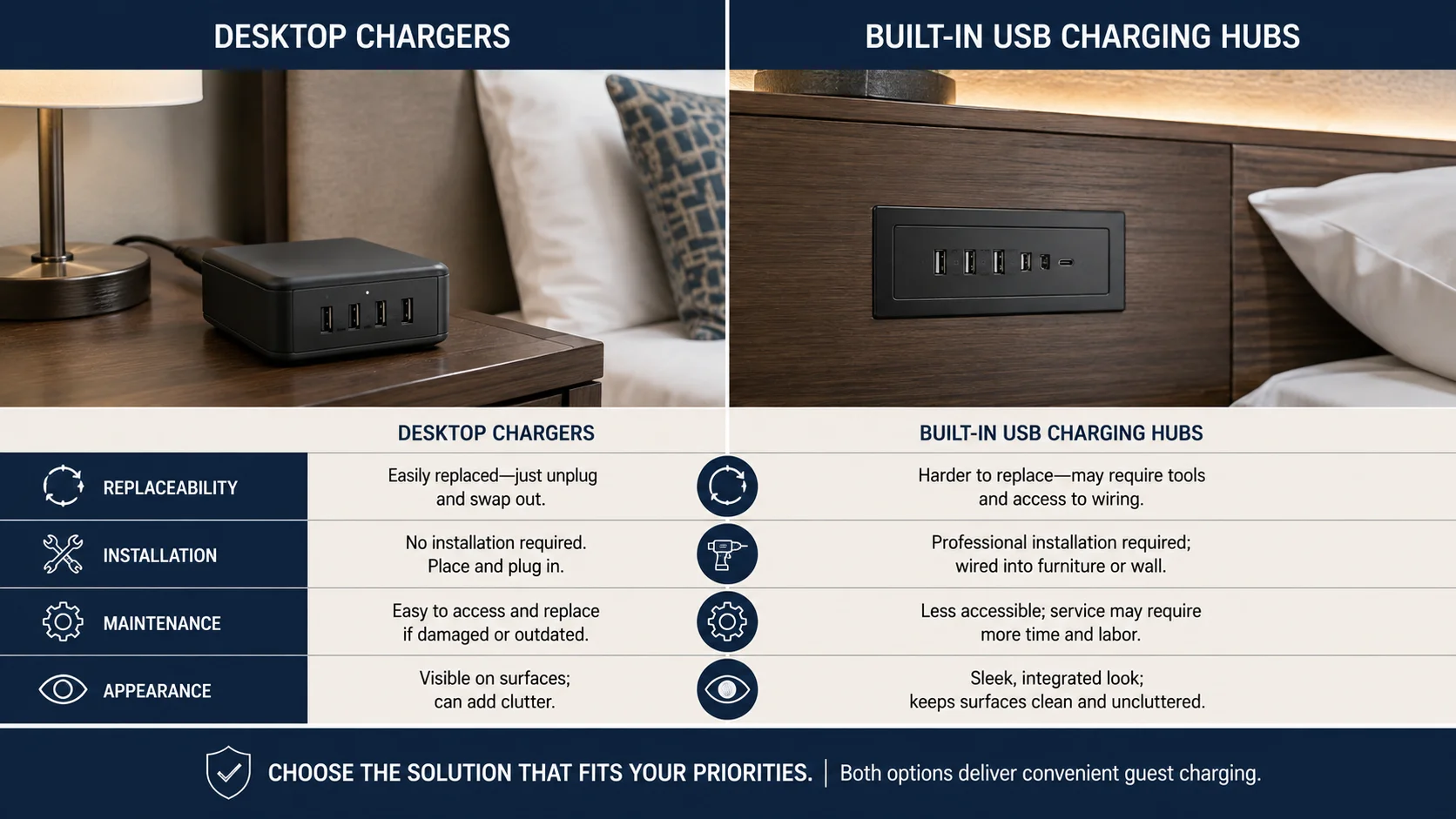
We usually recommend that buyers evaluate a physical sample in the intended furniture before making a large purchasing decision.
| Factor | Desktop charging station | Built-in USB charging hub |
|---|---|---|
| Installation | Plug-and-play or simple placement | May require furniture modification |
| Replacement | Usually quick | May require access to furniture or wiring |
| Appearance | Visible but flexible | Clean and integrated |
| Port upgrades | Easy to change later | More difficult after installation |
| Cable management | Needs planning | Can be designed into furniture |
| Best use | Desks, front desks, meeting rooms | Bedside tables, fixed workstations |
| Procurement risk | Lower initial installation risk | Higher coordination requirement |
Consider the Full Maintenance Cycle
Desktop units can be useful for properties that refresh room accessories frequently or operate across different building types. They can also simplify replacement because staff may swap a complete unit without disturbing furniture.
Built-in hubs can offer a premium appearance. However, the hotel should verify cutout dimensions, mounting method, cable routing, adapter placement, heat clearance, and local electrical requirements. We do not position ourselves as installation engineers, so we advise buyers to work with qualified project and electrical professionals for application-specific decisions.
The decision should also account for cable strategy. A built-in hub with no supplied cables may look neat, but guests must use their own cables. A desktop charger with attached cables can be more convenient in some public areas, though those cables may need periodic replacement.
In our product discussions, we encourage buyers to ask one simple operational question: Can your team replace this item quickly when it fails or becomes damaged? The answer often matters more than a small difference in unit price.
How Should Hotels Choose Ports, Power Output, and Universal Plug Compatibility?
Port selection can look straightforward on a product sheet, but actual charging performance depends on device type, charging protocols, shared output, and regional plug requirements. A charger that works well in one market may not be suitable for another.
Hotels should select ports and power output based on expected devices and simultaneous use, not headline wattage alone. For international properties, buyers should also confirm plug type, input voltage range, adapter requirements, local compliance rules, and whether universal compatibility is appropriate for the project.
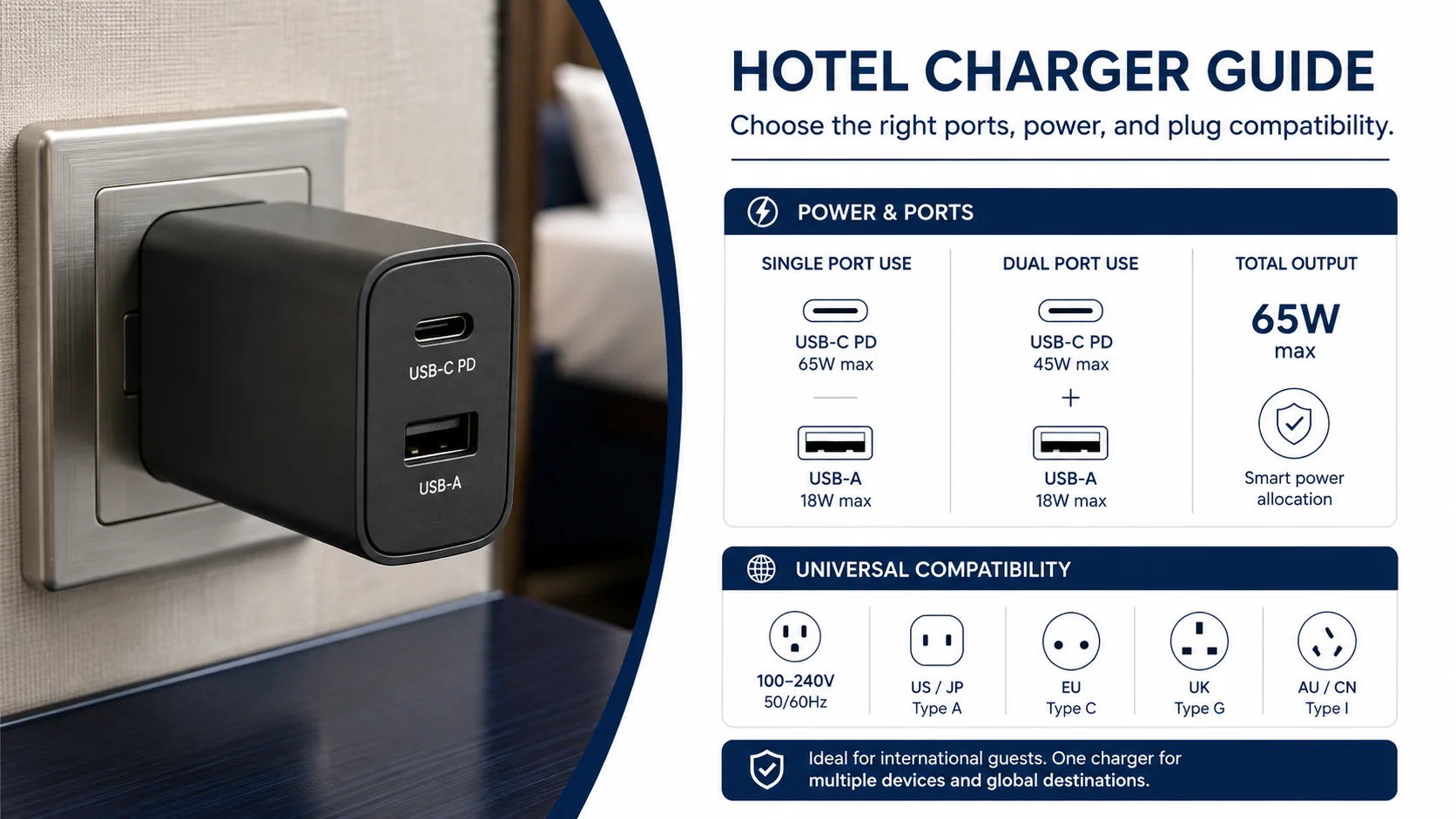
We supply products for European and North American export markets, so we know that plug configuration and documentation must be discussed early.
Ask for a Clear Power Allocation Chart
A multi-port charger may state 65W, 100W, or another total rating. That does not mean every connected device receives the maximum rating at the same time. Buyers should request a port-allocation chart that explains likely output combinations.
For example:
- One USB-C port may provide higher output when used alone.
- Two USB-C devices may share the charger’s total power.
- USB-A ports may have separate limits.
- Some devices may not use the charger’s full available output because of their own charging protocol.
A hotel does not always need laptop-level charging at every outlet. A mixed approach often controls cost better:
| Hotel zone | Typical port approach |
|---|---|
| Bedside | USB-C + USB-A, moderate shared output |
| Guest desk | USB-C with stronger output plus USB-A |
| Front desk | Multi-port station with stable shared capacity |
| Meeting room | Higher-output USB-C options or distributed chargers |
| Lobby | Controlled public-use ports and cable protection |
Universal travel adapters can be useful in selected guest-facing scenarios, but they are not a replacement for market-specific electrical planning.6 Hotels should verify the local socket system and any relevant regulations before deployment. We also recommend checking whether the selected charger includes the appropriate AC plug rather than assuming one SKU will fit all export destinations.
What Anti-Theft and Cable Management Designs Work Best for Hotels?
Loose charging cables can make a hotel space look untidy, create maintenance work, and disappear quickly in public areas.7 At the same time, overly restrictive designs can frustrate guests who need flexible access.
The best anti-theft and cable management approach depends on location. Guest rooms often benefit from discreet fixed placement and short cable routing, while public areas may require attached cables, security mounts, cable channels, or staff-controlled charging points to reduce loss and damage.
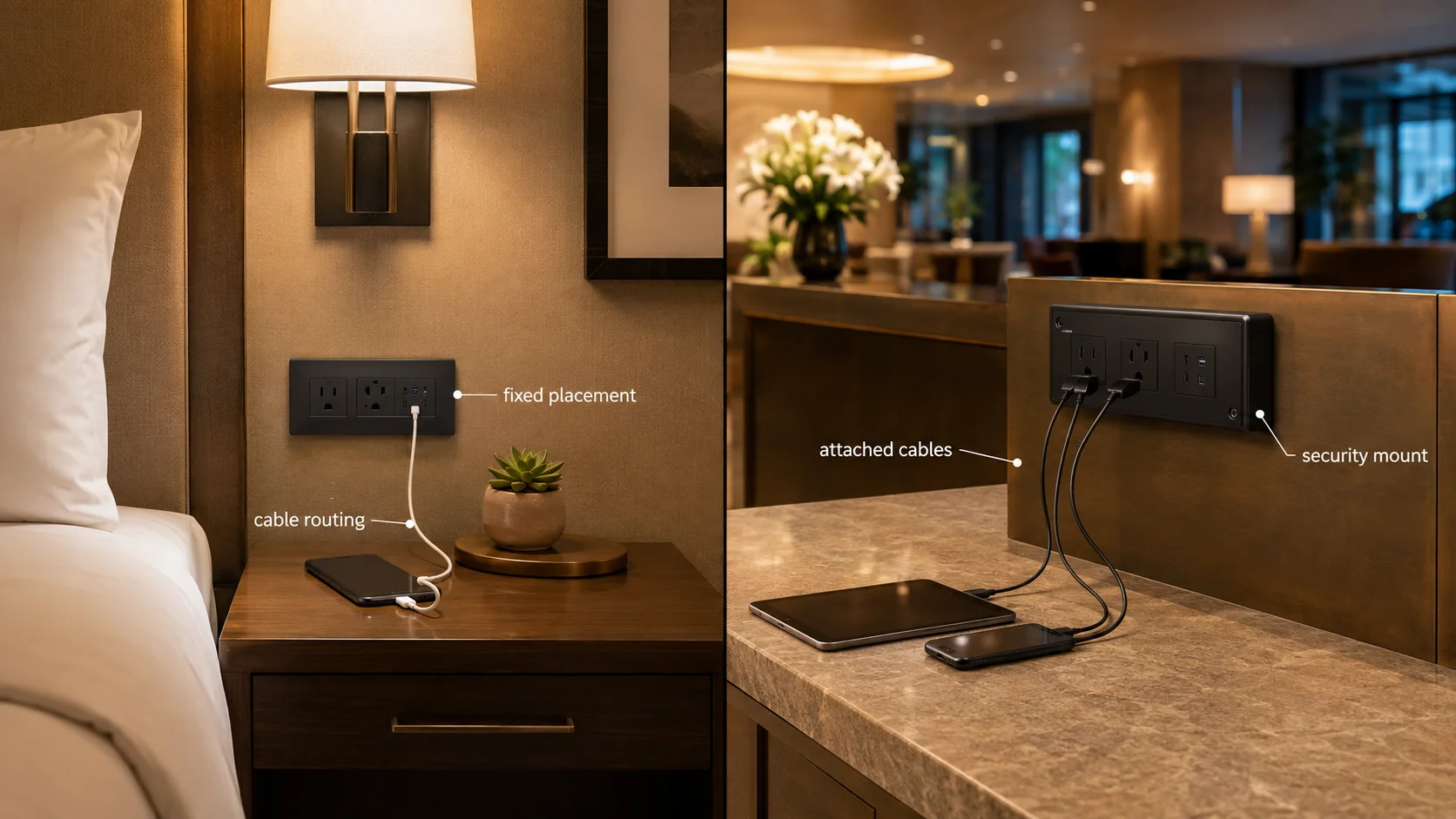
We have seen buyers treat cables as an afterthought. In practice, cables are often the first accessory that staff need to replace.
Plan Chargers and Cables Together
A charger is only useful when guests can connect their devices. For public charging, the cable type, length, attachment method, and replacement availability all matter.
We suggest considering these options:
- Detachable cables: Easier to replace and suitable for guest rooms or staff areas.
- Attached cables: More convenient for public areas but may need stronger strain relief.
- Short cables: Reduce clutter on bedside tables and desks.
- Cable channels: Keep cords away from walking surfaces and cleaning tools.
- Security brackets or adhesive mounting: Help keep desktop units in place.
- Spare cable kits: Support fast replacement without changing the whole station.
Hotels should avoid running loose cables across public walkways or placing chargers where cleaning staff may repeatedly pull or bend cords. A furniture-integrated cable route can be useful, but it must remain accessible for replacement.
For OEM hotel chargers, we can discuss cable color, length, connector combination, and packaging arrangements as part of a project. Buyers should confirm which components are replaceable and whether matching spare parts can be supplied with the main order. This reduces the chance of a property gradually collecting unmatched chargers and cables from several sources.
Are Hotel Charging Stations Safe for 24/7 Use?
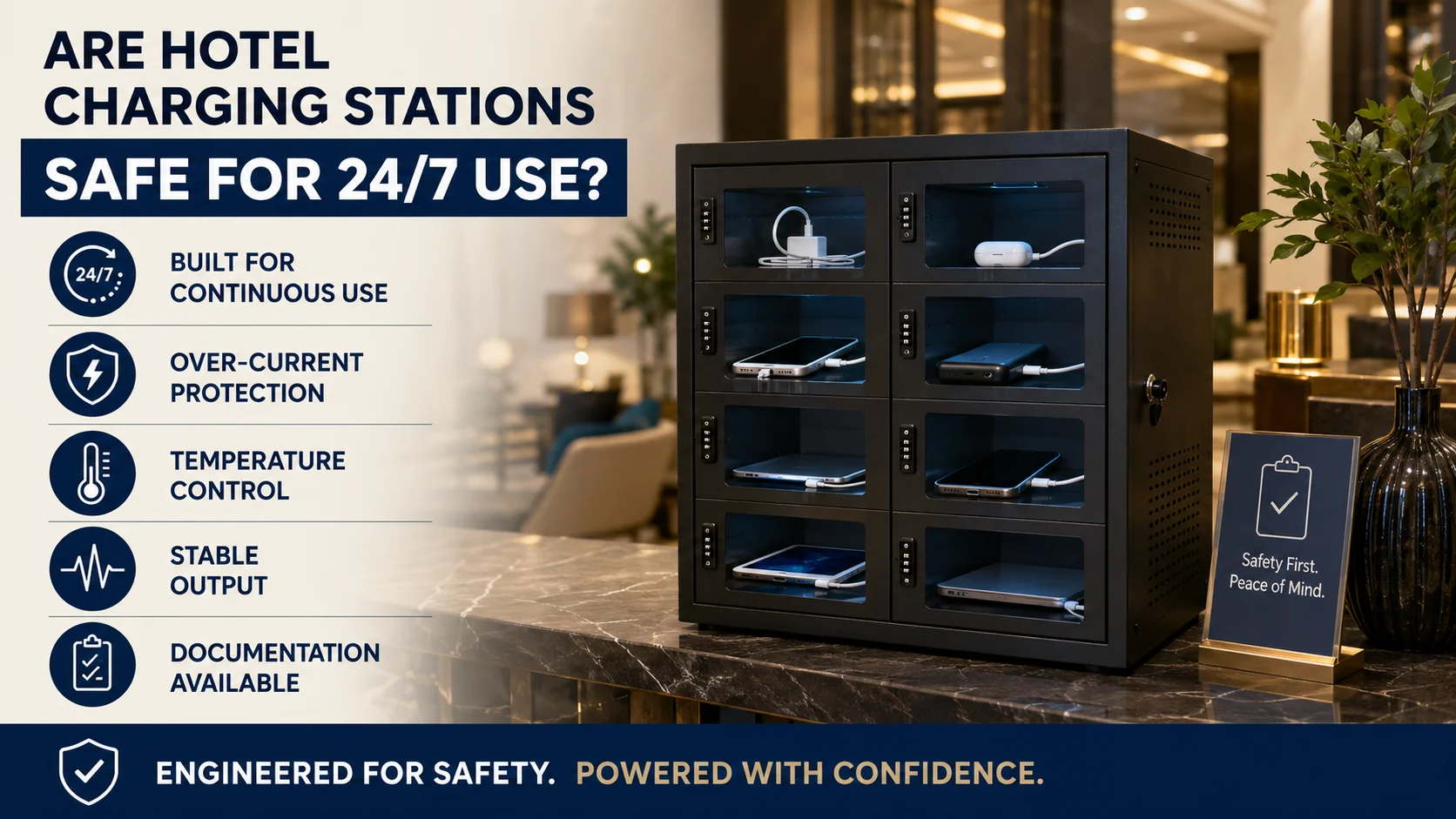
Safety is a core procurement issue because hotel chargers may remain connected continuously and may be used by many different devices. Buyers should not rely on marketing language alone when evaluating safety.
Hotel charging stations intended for continuous use should have appropriate protection features, stable manufacturing controls, and relevant certification documentation for the destination market.8 Hotels should also confirm installation conditions, ventilation, load expectations, and local compliance requirements with qualified professionals.
We can explain product specifications and provide applicable documents, but a hotel’s final installation conditions require project-specific evaluation.
Review Product Protections and Real-World Conditions
Common charger protection features may include:
- Over-current protection
- Over-voltage protection
- Short-circuit protection
- Over-temperature protection
- Overload protection
These features are important, but they do not remove the need for proper placement. A charger can still be unsuitable if it is enclosed without airflow, exposed to moisture, used with damaged cables, or connected to an inappropriate power source.9
We recommend that procurement teams ask suppliers for clear information on:
- Rated input voltage and frequency.
- Total output and port allocation.
- Housing material and heat-management design.
- Intended operating environment.
- Certification documents for the target market.
- Batch identification and traceability practices.
- Warranty and replacement process.
A retail charger may be acceptable for personal use but not ideal for repeated commercial deployment. Hotels need to consider how often a product will be plugged in, cleaned around, moved, and used by unfamiliar devices. In our view, batch consistency and replacement support are as important as the feature list.
What Certifications and Durability Tests Should Hospitality Buyers Verify?
Certification marks can help buyers assess a charger, but they should be treated as documents to verify rather than automatic proof that every deployment is appropriate. Market requirements differ, and product configurations can affect documentation.
Hospitality buyers should verify certification documents that apply to their destination market, confirm that documents match the exact model, and ask about durability and quality-control testing. They should also review supplier batch consistency, inspection procedures, traceability, and replacement arrangements.
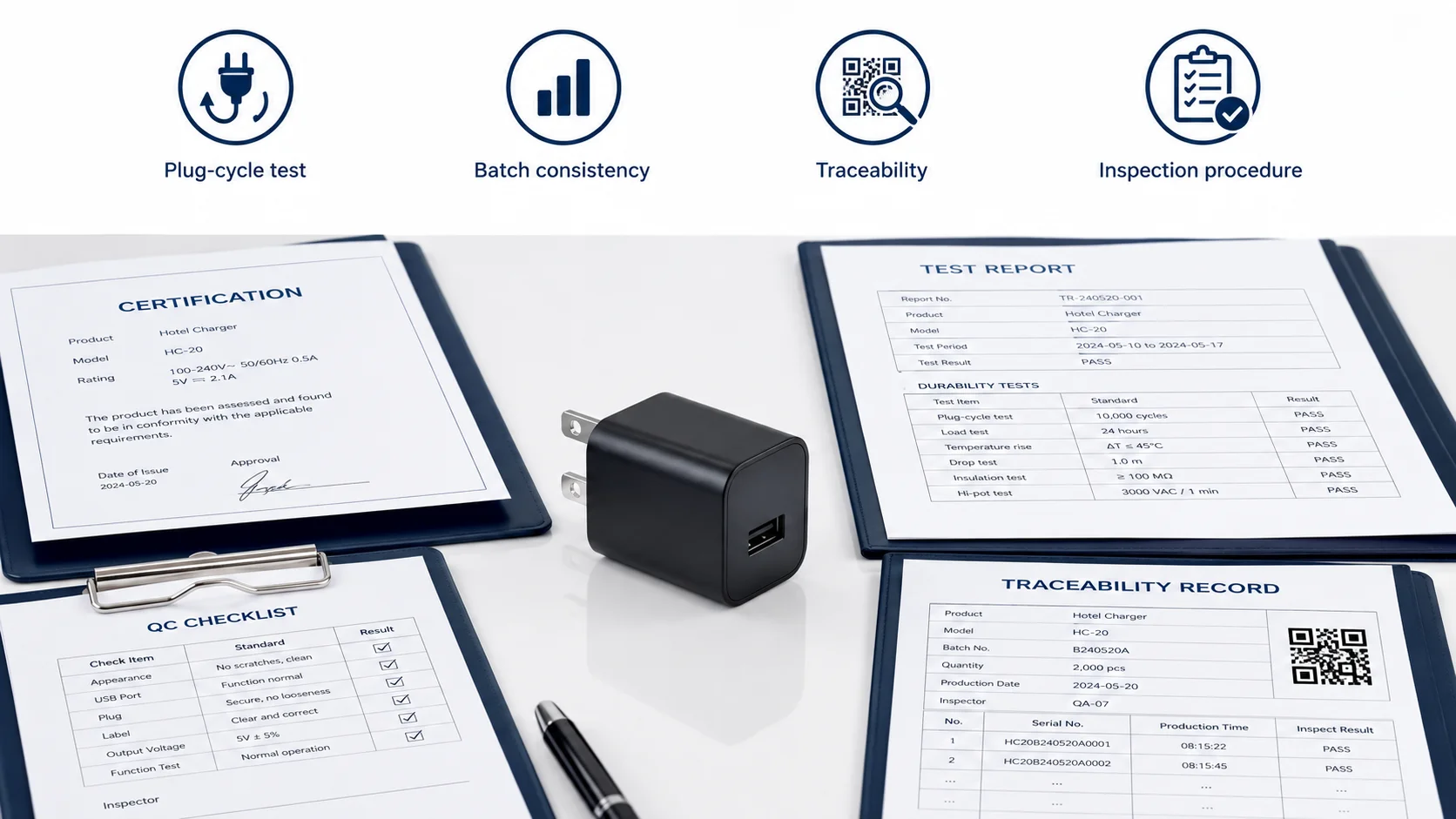
As a Shenzhen manufacturer with 15 years of export experience, we understand why professional buyers ask detailed documentation questions before placing an order.
Build a Documentation Checklist
Depending on the market and product category, buyers may request documents related to CE, RoHS, FCC, UKCA, ETL, UL, or other applicable requirements.10 The correct set depends on the destination, product design, and project conditions.
We recommend verifying:
| Verification item | Buyer check |
|---|---|
| Model number | Does it exactly match the quoted product? |
| Certificate scope | Does it cover the relevant configuration? |
| Test report | Is it current and issued by a credible laboratory? |
| Product labeling | Does labeling match market requirements? |
| Factory quality control | Are incoming, in-process, and final inspections documented? |
| Durability testing | What tests are used for ports, plugs, cables, and housing? |
| Batch control | Can the supplier identify production lots? |
We would not advise buyers to choose solely on a certification logo printed on packaging11. They should request supporting documents and have their compliance or project team review them where necessary.
Durability expectations should also be practical. Ask how the supplier tests port insertion, cable bending, plug performance, temperature behavior, and cosmetic finish. Test methods and thresholds vary12, so buyers should compare like with like rather than relying on vague claims such as “industrial grade.”
Can Hotel Chargers Be Customized With Logos and Branded Packaging?
Hotels, serviced apartments, and hospitality distributors may want chargers that fit their property identity or retail strategy. Customization can be useful, but it should not compromise readability, compliance labeling, or replenishment flexibility.
OEM hotel chargers can often be customized with logos, colors, cable combinations, packaging, and selected product details. Buyers should confirm MOQ, artwork requirements, sample approval, lead time, certification implications, and whether customized units can be reordered consistently in future batches.
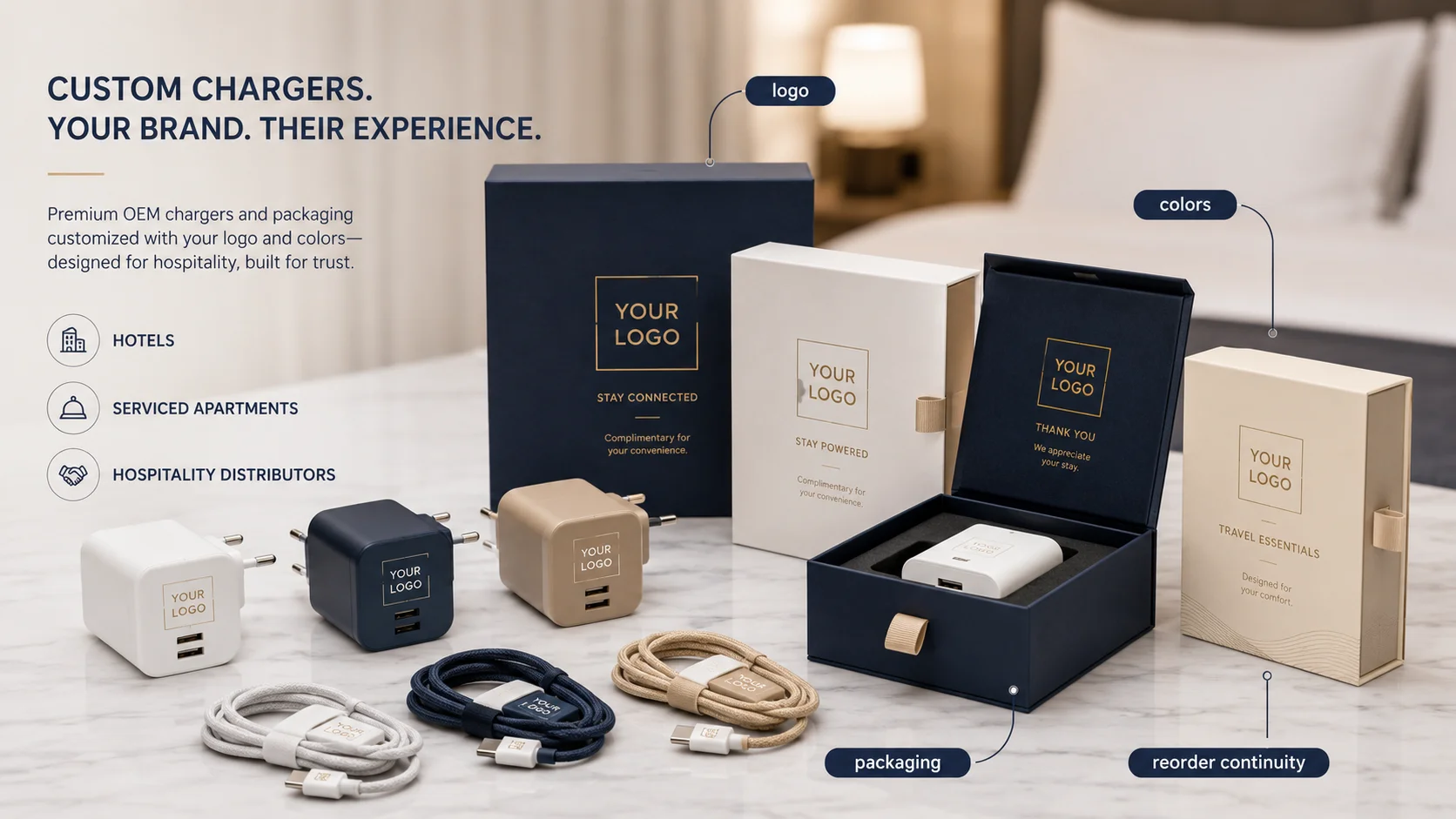
We regularly discuss OEM requirements with export customers, and we always encourage a clear approval process before mass production.
Keep Branding Practical
A subtle logo on the housing can strengthen a hotel’s presentation without making the charger look promotional. Branded packaging may be useful for retail sales, welcome kits, or distributor programs. For in-room use, a clean neutral design may be more suitable.
Common customization options include:
- Logo printing or laser marking
- Housing color selection
- Custom cable length or connector mix
- Private-label retail packaging
- Barcode and carton labeling
- Instruction manuals for the target market
- Bundled cable and charger sets
Buyers should remember that customization may affect MOQ and lead time. It can also require artwork approval, pre-production samples, and packaging verification. We recommend confirming whether the customized configuration changes certification scope or labeling obligations.
For long-term hotel programs, repeatability matters. A custom unit that cannot be reordered later can create problems during renovations or replacements. We advise buyers to agree on a product specification sheet, approved artwork, carton marking, and spare-part plan that can support later replenishment.
How Can Buyers Source OEM and Wholesale Hotel Charging Solutions From Kingfuji?
Sourcing chargers for hospitality requires more than comparing catalog prices. Buyers need a supplier that can discuss product fit, documentation, quality consistency, production planning, and replacement support in a clear way.
At Kingfuji, we support OEM and wholesale hotel charging solutions for buyers who need chargers, charging cables, GaN adapters, USB hubs, and multi-device products for hospitality channels. We work from product specifications and project requirements, then help buyers evaluate samples, customization options, documentation, MOQ, lead time, and replenishment planning.
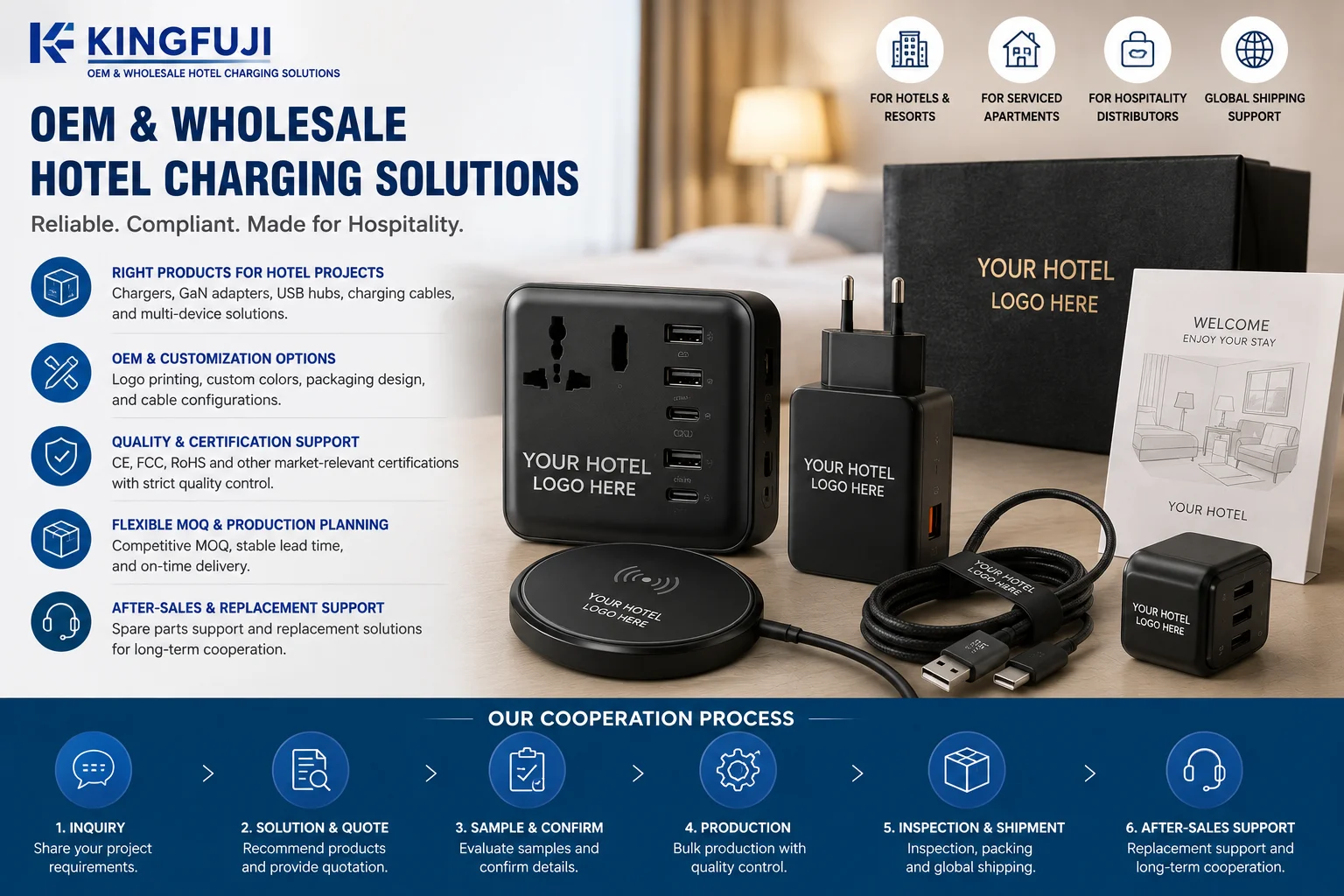
We focus on direct manufacturing communication and export-oriented supply support for customers in Europe and North America.
A Better Procurement Process
We suggest starting with a short project brief that covers:
- Hotel zones: Guest room, bedside, desk, lobby, front desk, or meeting room.
- Device mix: Phones, tablets, earbuds, laptops, or staff equipment.
- Port requirements: USB-C, USB-A, AC outlet integration, or fixed cables.
- Quantity and rollout timing: Initial order and expected future replenishment.
- Destination market: Plug type, labeling, and requested documentation.
- Customization needs: Logo, color, cable set, packaging, and carton marks.
- Support expectations: Spare stock, replacement parts, and after-sales process.
In our conversations with hospitality-related buyers, recurring questions usually involve wattage, compatibility, product consistency, and reorder availability. These are sensible questions because unit cost alone does not show the full operating cost.
A low-priced charger can become expensive if it has unclear documentation, inconsistent batches, delayed replenishment, or no compatible replacement cables. We encourage buyers to compare total supply risk before approving a supplier. We can provide product information and project communication, while hotel teams and qualified professionals should confirm site installation and market-specific compliance conditions.
Frequently Asked Questions
What is the best charger setup for a hotel guest room?
We usually recommend a simple bedside or desk setup with USB-C and USB-A charging. The final choice depends on the guest profile, room furniture, expected device mix, and whether the hotel wants fixed, built-in, or replaceable desktop hotel charging solutions.
Should hotels provide charging cables as well as chargers?
Hotels should consider cables as part of the charging system, especially in public spaces. Guest rooms may use detachable cables or guest-owned cables, while shared areas may benefit from managed cables. Buyers should also plan spare cable stock for maintenance.
Is a higher-wattage hotel charger always better?
No. Higher wattage can help with certain tablets and laptops, but it can increase cost and may not improve a bedside phone-charging application. Buyers should review port allocation, simultaneous-use behavior, device compatibility, and the location’s actual charging task.
What should buyers ask an OEM hotel charger supplier?
Buyers should ask about model specifications, port output, certification documents, quality-control procedures, MOQ, lead time, packaging, customization, spare parts, reorder continuity, and replacement terms. Each item affects the total operating cost of the hospitality charging program.
Can one charging station work in every hotel area?
One model can simplify purchasing, but it is not always the best operational choice. Guest rooms, front desks, meeting rooms, and public lounges have different access, cable-loss, cleaning, and maintenance requirements. A zone-based approach is usually more practical.
Conclusion
The best hotel charging solutions are not defined by the highest wattage or the largest number of ports. We believe they should match each hotel zone, support the expected devices, remain easy to maintain, and come with a realistic plan for cables, replacement stock, and future reorders. At Kingfuji, we help wholesale and OEM buyers evaluate charging specifications, customization, quality documentation, and supply continuity. Contact us to discuss a practical hospitality charging solution for your next project.
"Avoid Public USB Charging Risks | University of Colorado", https://www.cu.edu/security/stay-cybersecure-while-traveling-avoid-public-usb-charging-risks. Research on publicly accessible equipment management may document that exposed accessories and cables are subject to loss, damage, or replacement needs, supporting cable retention as an operational consideration for shared charging installations. Evidence role: general_support; source type: research. Supports: Evidence that publicly accessible charging equipment and cables can create maintenance, replacement, or loss-management concerns.. Scope note: Evidence from public facilities may not measure cable loss specifically in hotels. ↩
"USB Charger (USB Power Delivery)", https://www.usb.org/usb-charger-pd. USB charging specifications and technical guidance describe negotiated power delivery and finite source-power limits; consequently, a multi-port charger may allocate its available output among concurrently connected devices rather than provide its maximum single-port rating to each device. Evidence role: mechanism; source type: institution. Supports: Technical documentation explaining that a multi-port charger has a finite total power budget that may be allocated among connected devices.. ↩
"Stay Cybersecure While Traveling: Avoid Public USB Charging Risks", https://www.cu.edu/security/stay-cybersecure-while-traveling-avoid-public-usb-charging-risks. Government cybersecurity guidance has cautioned that public USB charging points can present risks not normally associated with privately controlled charging equipment, illustrating why publicly accessible installations require separate risk assessment and management. Evidence role: general_support; source type: government. Supports: Official guidance identifying risks associated with public USB charging infrastructure, including untrusted connections and the need for controlled public access.. Scope note: Cybersecurity guidance does not by itself establish the physical-maintenance risk level for a particular hotel installation. ↩
"Evaluating the accessibility of public service facilities to tourists and ...", https://pmc.ncbi.nlm.nih.gov/articles/PMC9868734/. Facility-planning and service-design research can support the principle that amenity location affects both user access and staff oversight; this provides contextual support for evaluating distributed rather than centralized charging points. Evidence role: general_support; source type: research. Supports: Research or facility-design guidance on how the placement and distribution of shared amenities affects user access and operational oversight.. Scope note: The finding is a planning principle and does not prove that distributed chargers are superior in every hotel layout. ↩
"Facilities Services", https://ww1.up.edu/physicalplant/. Furniture-power installation guidance distinguishes plug-in desktop units from integrated modules that require cutouts, mounting, and access to wiring, supporting the general trade-off between replacement flexibility and an integrated appearance. Evidence role: general_support; source type: education. Supports: Facilities or furniture-power guidance showing that integrated power modules require installation access and that plug-in desktop devices can be exchanged without modifying furniture.. Scope note: The appearance assessment is design-dependent, and replacement time varies with the specific furniture and installation. ↩
"1910.303 - General. | Occupational Safety and Health Administration", https://www.osha.gov/laws-regs/regulations/standardnumber/1910/1910.303. Electrical-safety guidance explains that travel plug adapters primarily address plug geometry and may not convert voltage or ensure suitability for local installations; therefore, they do not substitute for market-specific electrical planning. Evidence role: general_support; source type: government. Supports: Electrical-safety guidance explaining that plug adapters do not necessarily convert voltage or substitute for compliant local electrical installations.. Scope note: Applicable rules and approved equipment differ by jurisdiction and by the installed charging product. ↩
"Slips, Trips, and Falls: Understanding, Preventing, and Mitigating Risks", https://ehs.weill.cornell.edu/slips-trips-and-falls-understanding-preventing-and-mitigating-risks. Occupational-safety guidance identifies trailing or unmanaged cords as housekeeping and trip hazards, supporting the need to manage charging cables in accessible hotel areas. Evidence role: general_support; source type: government. Supports: Workplace or public-premises guidance that unmanaged cords can create housekeeping and trip-hazard concerns requiring cable management.. Scope note: Such guidance supports safety and maintenance concerns but does not quantify cable loss in hotels. ↩
"Letter to UL on AC and USB Chargers ...", https://www.cpsc.gov/s3fs-public/Letter%20to%20UL%20on%20AC%20and%20USB%20Chargers%20Nov%202018%20Signed.pdf. Electrical-product safety standards and conformity-assessment frameworks require evaluation of hazards, protective design, and applicable market requirements, supporting verification of protection features and documentation before commercial deployment. Evidence role: expert_consensus; source type: institution. Supports: Safety-standard and conformity-assessment principles for electrical charging equipment, including evaluation of protective design and market-specific compliance.. Scope note: Conformity documentation for a product does not alone establish that a specific hotel installation is suitable under all site conditions. ↩
"Household Extension Cords Can Cause Fires", https://www.cpsc.gov/s3fs-public/5032.pdf. Electrical-safety authorities warn that damaged cords, moisture exposure, overheating, inadequate ventilation, and improper use with electrical supplies can increase the risk of equipment failure or electrical hazards, supporting site-specific suitability checks. Evidence role: mechanism; source type: government. Supports: Electrical-safety guidance linking damaged cords, moisture, overheating, inadequate ventilation, and improper power use to electrical hazards.. Scope note: The precise risk depends on the charger's rating, enclosure, installation method, and operating environment. ↩
"Equipment Authorization", https://www.fcc.gov/engineering-technology/laboratory-division/general/equipment-authorization. Official regulatory guidance distinguishes market-specific frameworks such as EU CE marking and RoHS restrictions, UKCA marking, and United States FCC equipment authorization; the applicable documentation depends on the product and destination market. Evidence role: definition; source type: government. Supports: Official explanations of the distinct compliance frameworks applicable to electrical and electronic products in the European Union, United Kingdom, and United States.. Scope note: UL and ETL are certification marks associated with third-party testing organizations rather than universal legal requirements in every jurisdiction. ↩
"Request for Information: Counterfeit Certification Markings", https://www.regulations.gov/document/CPSC-2026-0100-0001. Conformity-assessment guidance requires manufacturers and importers to maintain specified declarations and technical documentation; a mark displayed on packaging is therefore not, by itself, sufficient evidence that a product meets applicable requirements. Evidence role: general_support; source type: government. Supports: Regulatory guidance stating that conformity claims are supported by required documentation and assessment procedures, not merely a mark displayed on a product or package.. Scope note: Documentation review should be combined with verification that the documents cover the exact model, configuration, and destination market. ↩
"IEC 60320", https://en.wikipedia.org/wiki/IEC_60320. Reliability-testing standards and research specify distinct conditions, cycling methods, environmental exposures, and acceptance criteria for connectors and electronic products, so durability claims are comparable only when their underlying test methods are disclosed. Evidence role: general_support; source type: paper. Supports: Reliability-testing literature or standards showing that durability results depend on specified test conditions, cycles, loads, environments, and acceptance criteria.. Scope note: A common test method does not guarantee identical field life because real-world usage and installation conditions differ. ↩