Liquid silicone USB cables are becoming more visible in retail because their soft-touch finish, flexible feel, and color options help them stand out in a crowded cable category. However, I do not treat silicone as proof of quality. Buyers should confirm charging power, data capability, connector workmanship, packaging, and sample performance before listing a new SKU.
Liquid silicone USB cables can be a useful retail SKU when they have a clear shelf role: they should offer a noticeable tactile or visual difference while meeting the same functional expectations as competing cables. For wholesale buyers, the right decision depends on sample validation, target price, charging specifications, connector options, and supplier quality-control processes—not material claims alone.
In our 15 years of exporting 3C products from Shenzhen, we have seen many buyers ask the same question: “Does this cable look different enough to sell, and will it create after-sales problems?” That is the right starting point. A cable needs more than a new surface material to earn shelf space.
Quick Answer: Are Liquid Silicone USB Cables Worth Adding to a Retail Range?
Retail buyers often face a familiar problem: basic charging cables can look interchangeable. This makes it hard to justify another SKU, especially when shelf space, online listing costs, and inventory risk are limited.
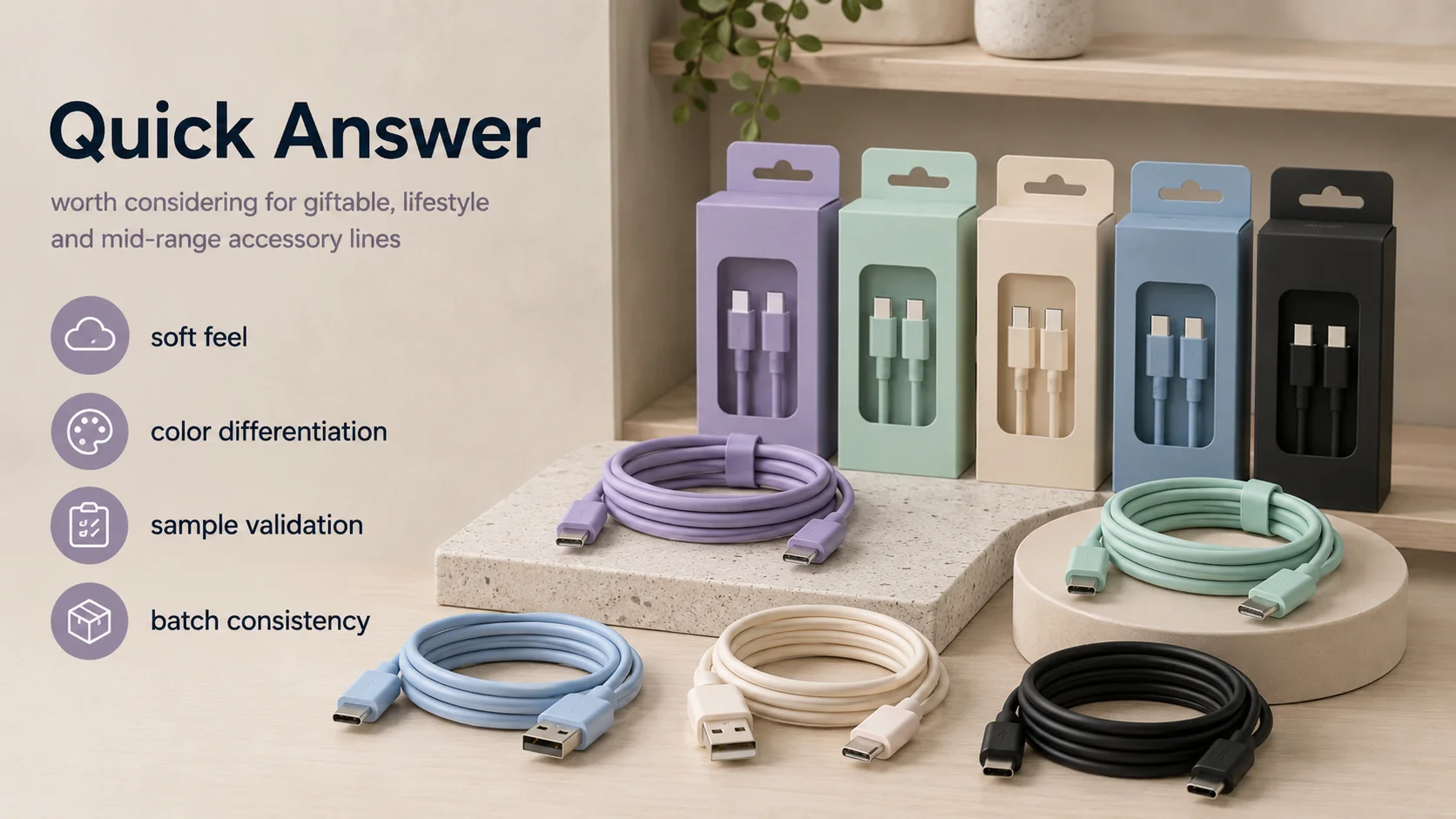
Liquid silicone USB cables are worth considering when their soft feel, colors, and flexible appearance support a specific retail position, such as a giftable accessory, lifestyle cable, or mid-range upgrade. Buyers should approve them only after verifying samples, USB-C charging ratings, data specifications, connector fit, packaging, and batch consistency.
I recommend that buyers start with a simple question: what job will this cable perform in the assortment? A silicone cable may fill a different role from a low-cost PVC cable or a rugged-looking braided cable.
For example, a retailer may use:
- PVC cables for entry-level, price-led sales.
- Braided cables for customers seeking a more technical or rugged visual style.
- Liquid silicone USB cables for color-led displays, soft-touch positioning, and lifestyle-oriented accessories.
The material itself does not guarantee stronger sales. I have handled sample discussions where buyers loved the feel but rejected the final SKU because the connector housing looked too large, the charging rating was unclear, or the packaging did not match the intended price point.
A retail-ready cable should make sense in all of these areas:
| Retail decision area | Buyer question |
|---|---|
| Shelf role | Why should a customer choose this cable over another one? |
| Functional specification | What charging power and data transfer does it support? |
| Appearance | Does the color, finish, and connector design match the target market? |
| Price position | Is the landed cost suitable for the planned retail price? |
| Quality control | Can the supplier maintain the approved sample standard? |
| After-sales risk | Are the claims on packaging supported by the product specification? |
What Is a Liquid Silicone USB Cable?
Material names can sound more meaningful than they are. Buyers may see “liquid silicone” on a quotation and assume the cable is automatically premium, highly durable, or cleaner than other cable types.
A liquid silicone USB cable is a charging or data cable with an outer jacket made from liquid silicone rubber or a silicone-based material process1. The cable’s practical value depends on its complete construction, including conductor quality, shielding, connector design, charging protocol support, and manufacturing consistency.
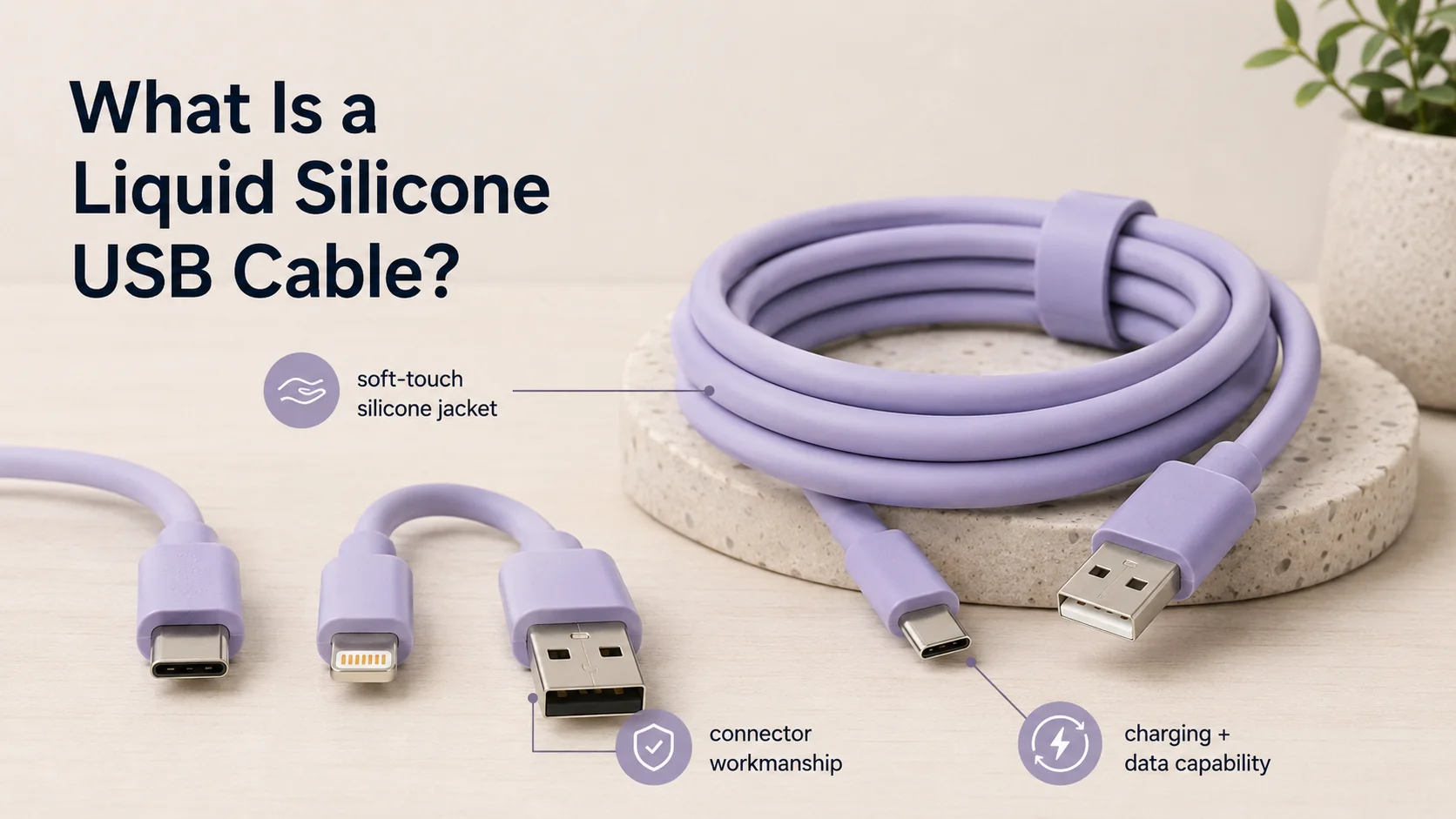
From a buyer’s perspective, the cable jacket is only one part of the product. The visible surface may be soft, matte, flexible, and available in bright colors, but the internal build determines whether the cable can support its advertised function.
When we discuss liquid silicone USB cables with European and U.S. buyers, we encourage them to separate material appearance from functional performance.
What the cable jacket can influence
A silicone outer layer may influence:
- Surface feel
- Flexibility in hand
- Color presentation
- Matte or soft-touch appearance
- The cable’s visual differentiation on a shelf or online product page
What the jacket does not confirm
The jacket does not independently confirm:
- USB Power Delivery wattage2
- Fast-charging compatibility
- USB 2.0 or higher data transfer capability3
- Connector pin quality
- E-marker chip presence4
- Internal wire gauge
- Shielding design
- Device compatibility
For procurement teams, this distinction is important. A cable can look excellent in a product photo but still be the wrong SKU if its technical specification does not match the devices customers use.
I suggest requesting a written specification sheet that identifies the connector type, cable length, rated current, maximum power, data capability, and applicable test records. If the supplier references certifications, buyers should review the relevant documents and confirm that they apply to the exact product configuration being purchased.
Why Are Liquid Silicone USB Cables Becoming a Retail Favorite?
Many cable displays have a sameness problem. Black, white, and generic braided cables can blend together, which makes comparison difficult for customers who are shopping quickly in-store or online.
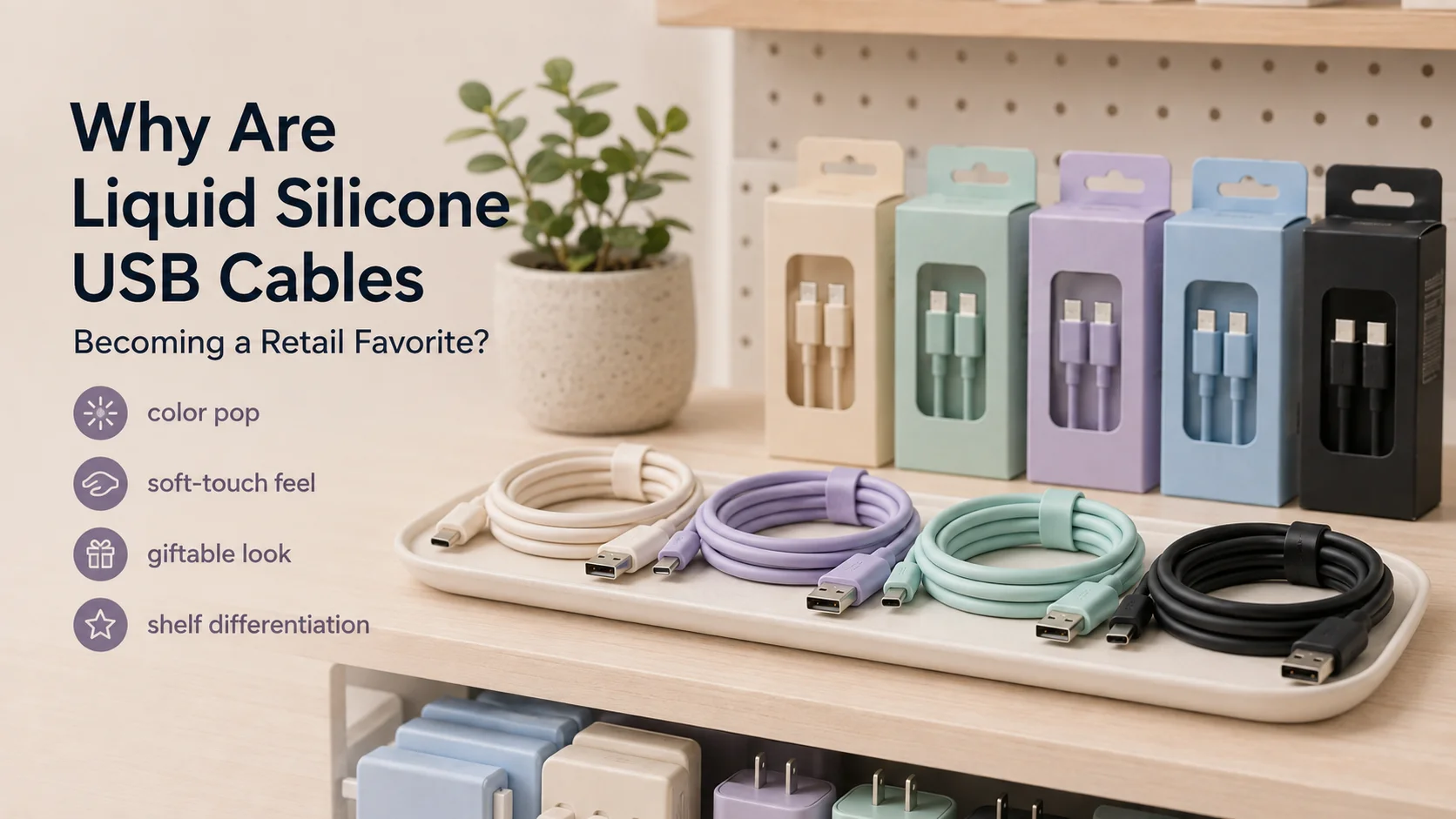
Liquid silicone USB cables can attract retail attention because they offer visible colors and a distinct soft-touch finish5 in a practical product category. Their appeal is mainly a merchandising opportunity, not evidence that they are universally preferred, more durable, or technically superior to all other cable materials.
I see the strongest opportunity when a buyer uses the product intentionally. A cable should not enter a range just because silicone is new. It should have a clear reason to exist.
A shelf-role advantage
Liquid silicone cables may help retailers create a more organized cable assortment. For example, color can support simple merchandising:
- Pink, lavender, and light blue for lifestyle displays
- Neutral beige, gray, and black for minimalist retail environments
- Bright colors for travel, youth-oriented, or impulse-buy areas
- Matching cable colors for chargers, TWS earbuds, smartwatches, or phone cases
A buyer can also use the finish to create a different product story. A soft-touch USB cable may work well near mobile accessories, gift items, desk accessories, or travel products.
The material still needs a commercial case
The retail pitch should remain realistic. Instead of saying “premium silicone cable,” a retailer may use claims such as:
“Soft-touch charging cable with USB-C fast-charging support.”
That statement connects appearance to a verifiable feature. It avoids implying that softness alone equals better charging performance.
I have seen buyers make better decisions when they compare the cable against the existing assortment. If a retailer already sells three basic USB-C cables, the silicone version needs a clear difference in color, packaging, length, charging speed, or bundle strategy. Otherwise, it can become another similar SKU competing for the same buyer.
Comparison Table: How Do Liquid Silicone USB Cables Compare With TPE and Braided USB Cables?
Wholesale buyers often compare cable materials without considering the retail channel. A low-cost wholesale buyer, a premium electronics chain, and an e-commerce seller may need very different product presentations.
Liquid silicone USB cables, TPE cables, and braided USB cables serve different retail purposes. Silicone may support soft-touch and color differentiation, TPE often supports cost-focused cable ranges, and braided styles can provide a textured, technical appearance.6 Buyers should compare full specifications, not material names alone.
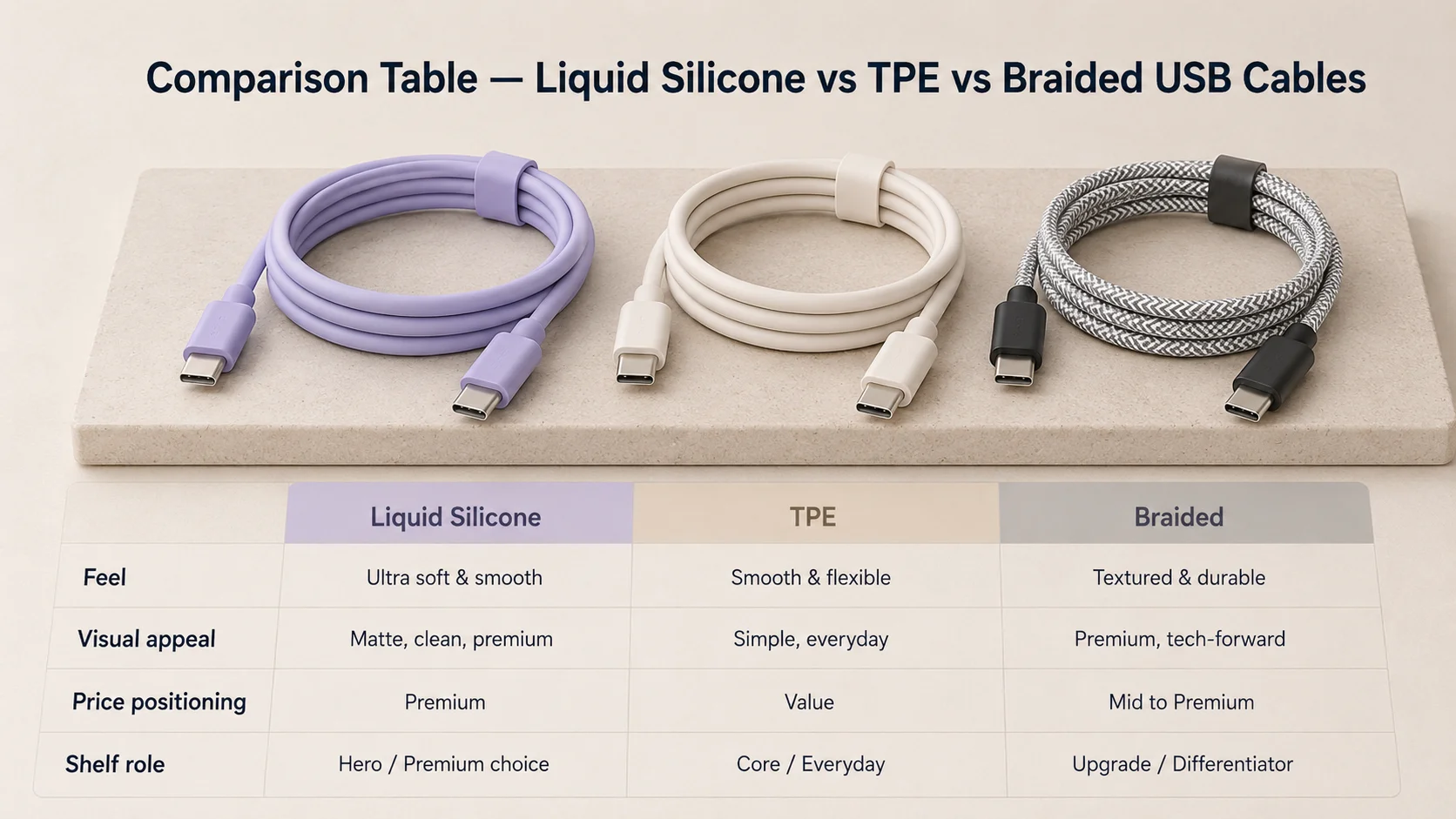
The following table is a procurement guide, not a universal performance ranking. Actual results vary by cable design, materials, connectors, factory controls, and testing requirements.
| Factor | Liquid Silicone USB Cables | TPE USB Cables | Braided USB Cables |
|---|---|---|---|
| Surface feel | Often soft and smooth | Usually smooth or slightly rubbery | Textured fabric-like outer layer |
| Visual role | Colorful, lifestyle-oriented | Basic, practical, cost-led | Technical, rugged, premium-looking |
| Tangle appearance | May appear less prone to sharp kinks | Depends on cable thickness and construction | Depends on braid, stiffness, and cable design |
| Cleaning expectations | Must be checked with samples | Usually familiar to mass-market buyers | Fabric texture may need different care |
| Price position | Often mid-range or design-led | Often entry to mid-range | Often mid-range to premium-looking |
| Best retail role | Differentiated accessories | Everyday replacement cables | Rugged or performance-style displays |
| Key buying risk | Overpromising material benefits | Commodity competition | Appearance may not match actual performance |
How I would select among the three
I would first define the planned retail price. Then I would decide which cable style supports that price without creating unsupported claims.
For example:
- A discount retailer may prioritize a simple TPE cable with clear charging specs.
- A chain store may use braided cables as a visibly upgraded option.
- A lifestyle accessory retailer may use liquid silicone USB cables in coordinated colors and gift-ready packaging.
The sample should decide the final direction. Buyers should bend the cable, inspect the connector molding, check color consistency, test the plug fit, and review packaging language before approving production.
Are Liquid Silicone USB Cables Durable, Tangle-Free and Temperature-Resistant?
Retail claims can create unnecessary after-sales risk. Buyers may be tempted to use words like “unbreakable,” “fully tangle-free,” or “heatproof” because they sound attractive on packaging.
Liquid silicone USB cables may feel flexible and may resist some visible kinking depending on their construction, but buyers should not assume they are inherently more durable, completely tangle-free, or suitable for all temperature conditions. Each claim should be supported by product-specific specifications and sample or test verification.
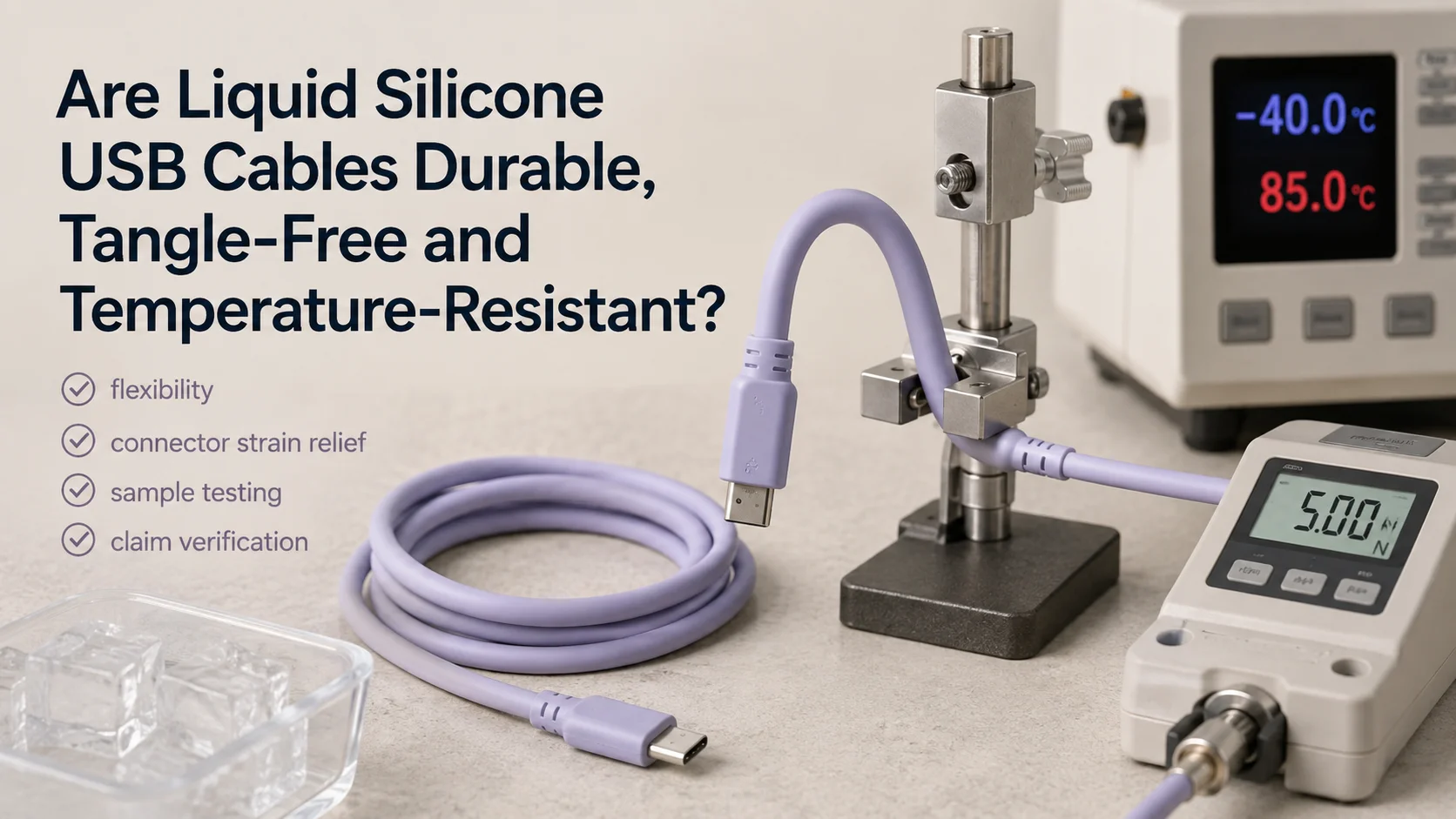
Durability is a system-level question. The cable jacket matters, but common failure points often include the connector strain-relief area, soldering, conductor design, USB-C terminal quality, and repeated bending near the plug7.
What buyers should test in samples
I suggest that buyers evaluate samples in realistic ways:
- Plug and unplug the connector repeatedly.
- Bend the cable near both connector housings.
- Check whether the jacket shows visible marks after normal handling.
- Test charging with intended devices and chargers.
- Confirm whether the cable heats up abnormally during supported charging use.
- Check whether the cable lies neatly in the intended packaging.
- Inspect the connector housing for gaps, uneven molding, or loose parts.
A supplier may provide bend-test information, aging-test records, or material documents. These can be useful, but buyers should verify what the documents cover. A test for one cable length or connector style may not automatically apply to another configuration.
Avoid absolute claims
“Tangle-free” is a good example. A flexible cable may be easier to manage than a stiff cable, but no cable remains perfectly tangle-free in every bag, drawer, or travel situation8.
A safer retail claim may be:
- “Flexible soft-touch cable”
- “Designed for easy everyday handling”
- “Smooth silicone-style jacket”
- “Available in coordinated colors”
For application-specific decisions, buyers should consult qualified technical professionals and validate the cable with the devices, chargers, and usage conditions they expect customers to have.
Do Liquid Silicone USB Cables Attract Dust or Become Sticky?
Buyers may worry that a soft-touch cable will collect dust, show lint, or change feel over time. These concerns are valid because appearance complaints can lead to returns even when charging performance is acceptable.
Liquid silicone USB cables can show dust or lint differently from PVC, TPE, or braided products, especially in light colors or matte finishes. Buyers should inspect real samples after handling and storage, because stickiness, surface feel, and cleaning behavior depend on the specific material formula and manufacturing process.
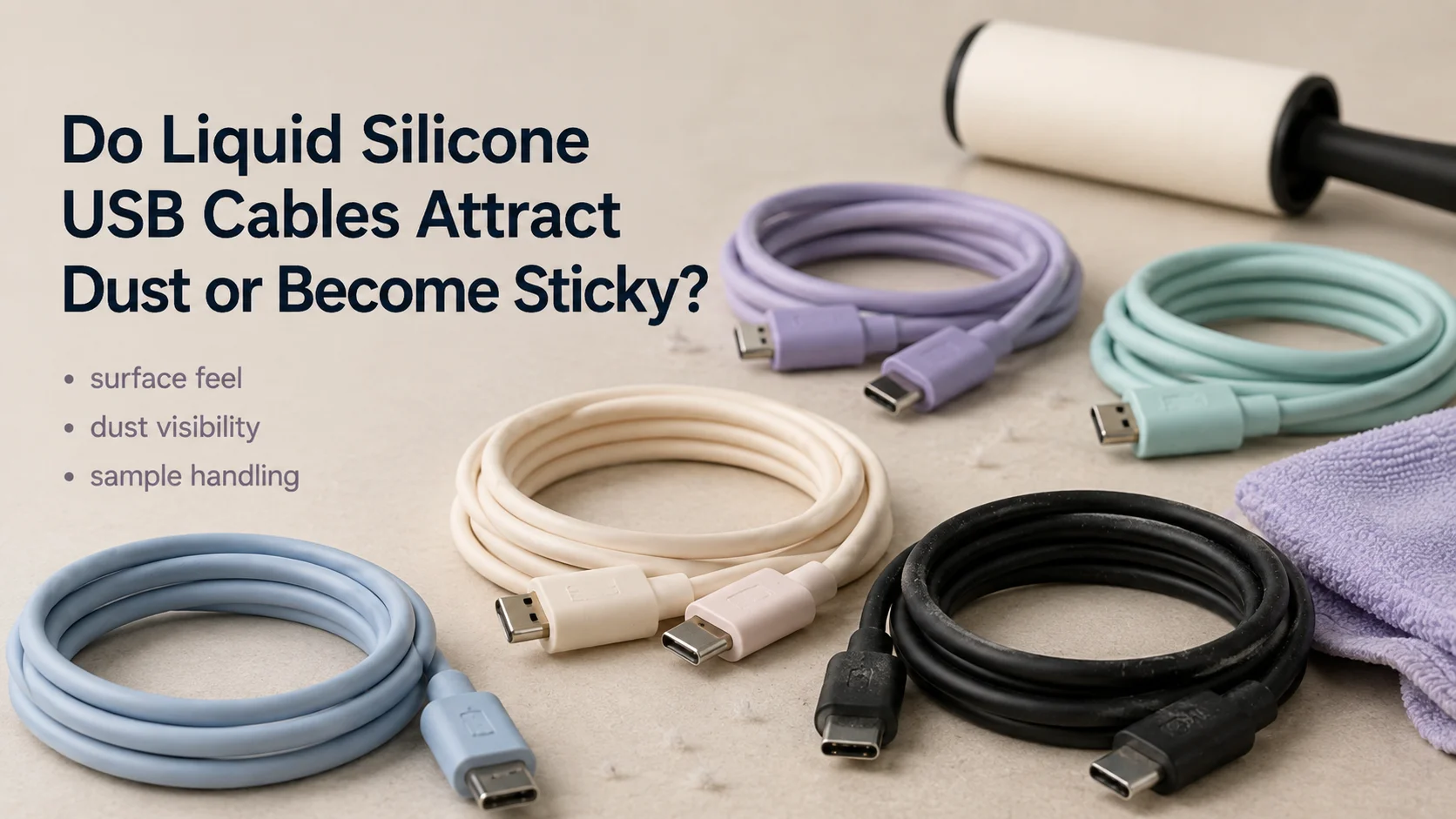
I always recommend a simple sample exercise before a buyer approves a color range. Leave the cable on a desk, handle it several times, place it in the proposed packaging, and inspect it under retail lighting.
Sample checks for surface appearance
A buyer can ask:
- Does black or dark blue show lint easily?
- Do pastel colors show scuffs during handling?
- Does the cable feel consistent along its full length?
- Does the surface transfer color or odor?
- Does the cable look clean after normal wiping?
- Does the finish change after being coiled in packaging?
These checks do not replace laboratory testing, but they are useful procurement steps. They help a buyer understand whether the product looks right for its intended channel.
Packaging matters more than many buyers expect
The packaging can protect the retail impression. A cable that looks clean and attractive in a sealed tray or paper sleeve may look less appealing if it is loosely packed with multiple accessories.
For this reason, I often discuss packaging at the same time as the cable sample. Options may include:
- Kraft paper sleeve
- Color card and blister
- Window box
- Hanging retail box
- Reusable cable tie
- Private-label insert card
The best choice depends on the target price and display method. A soft-touch cable needs packaging that lets customers see its color and finish without creating handling damage before purchase.
Which Liquid Silicone USB Cables, Connectors, Charging Speeds and Data Specifications Should Buyers Choose?
A cable can look excellent but fail commercially if it does not match current devices. USB-C buyers increasingly ask about fast charging, laptop compatibility, data transfer, and connector combinations.
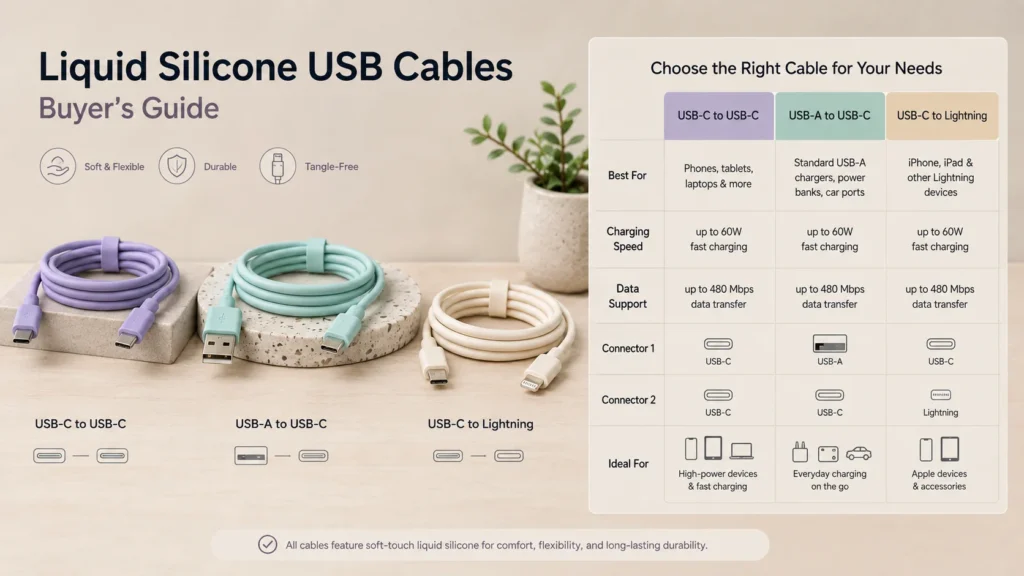
Buyers should choose liquid silicone USB cables based on the devices and charging ecosystem they serve. USB-C to USB-C cables are usually relevant for newer phones, tablets, and laptops9, while USB-A to USB-C, USB-C to Lightning, and multi-connector options may suit specific customer groups. Power and data claims must be clearly specified.
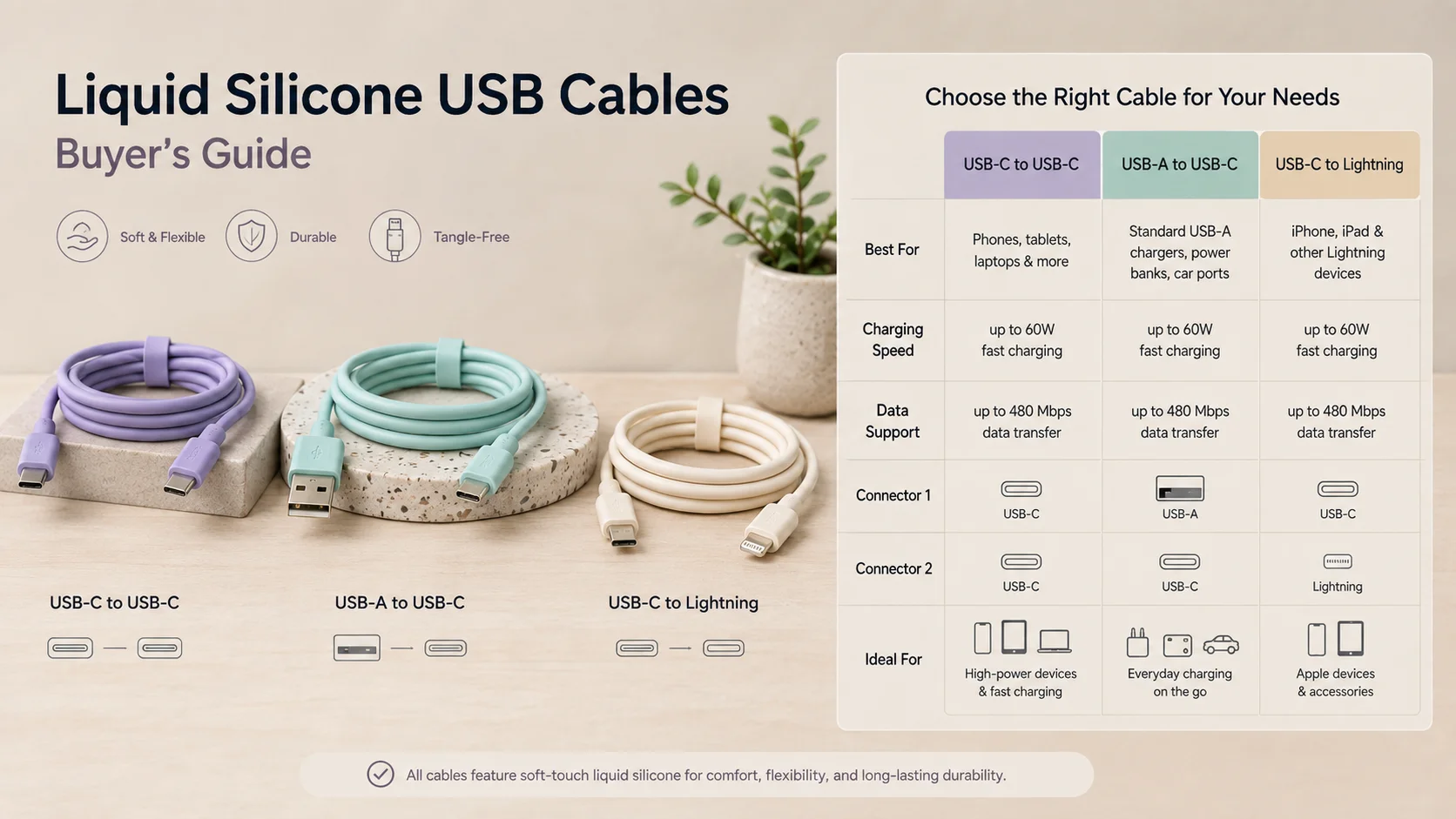
The right specification depends on the product’s purpose. A short cable for power banks has different needs from a cable marketed for laptop charging.
| Cable type | Common retail use | Key specification to verify |
|---|---|---|
| USB-A to USB-C | Legacy chargers and everyday phone charging | Current rating and charging compatibility |
| USB-C to USB-C | New phones, tablets, chargers, laptops | PD wattage, E-marker requirements, data capability |
| USB-C to Lightning | Compatible Apple-device charging use cases | Licensing or applicable compliance documentation |
| USB-A to Lightning | Existing USB-A charging ecosystems | Connector quality and charging compatibility |
| Multi-connector cable | Travel and convenience displays | Supported charging limits for each connector |
Questions I would ask a supplier
Before ordering, I would ask for written answers to these points:
- What is the rated maximum power: 18W, 30W, 60W, 100W, 240W, or another rating?
- Does the cable support USB Power Delivery?
- Does it require an E-marker chip for the advertised power level?
- What data transfer standard does it support?
- Is the cable charge-only, or does it support data sync?
- What conductor specification is used?
- Which devices were used during compatibility checks?
- What claim can appear on the retail package?
A 60W USB-C cable and a 240W USB-C cable should not be presented as interchangeable.10 The buyer needs to match the product to the customer’s device category and price expectations.
Who Is the Target Market for Liquid Silicone USB Cables?
Not every retailer needs a silicone cable range. A product that works well in a lifestyle-focused store may not be the best choice for a wholesale buyer selling only basic replacement cables.
The target market for liquid silicone USB cables includes retailers, e-commerce sellers, chain stores, and accessory importers that need visually differentiated charging products. They are most suitable when customers value color choice, coordinated accessories, giftability, or soft-touch design alongside clearly stated charging performance.
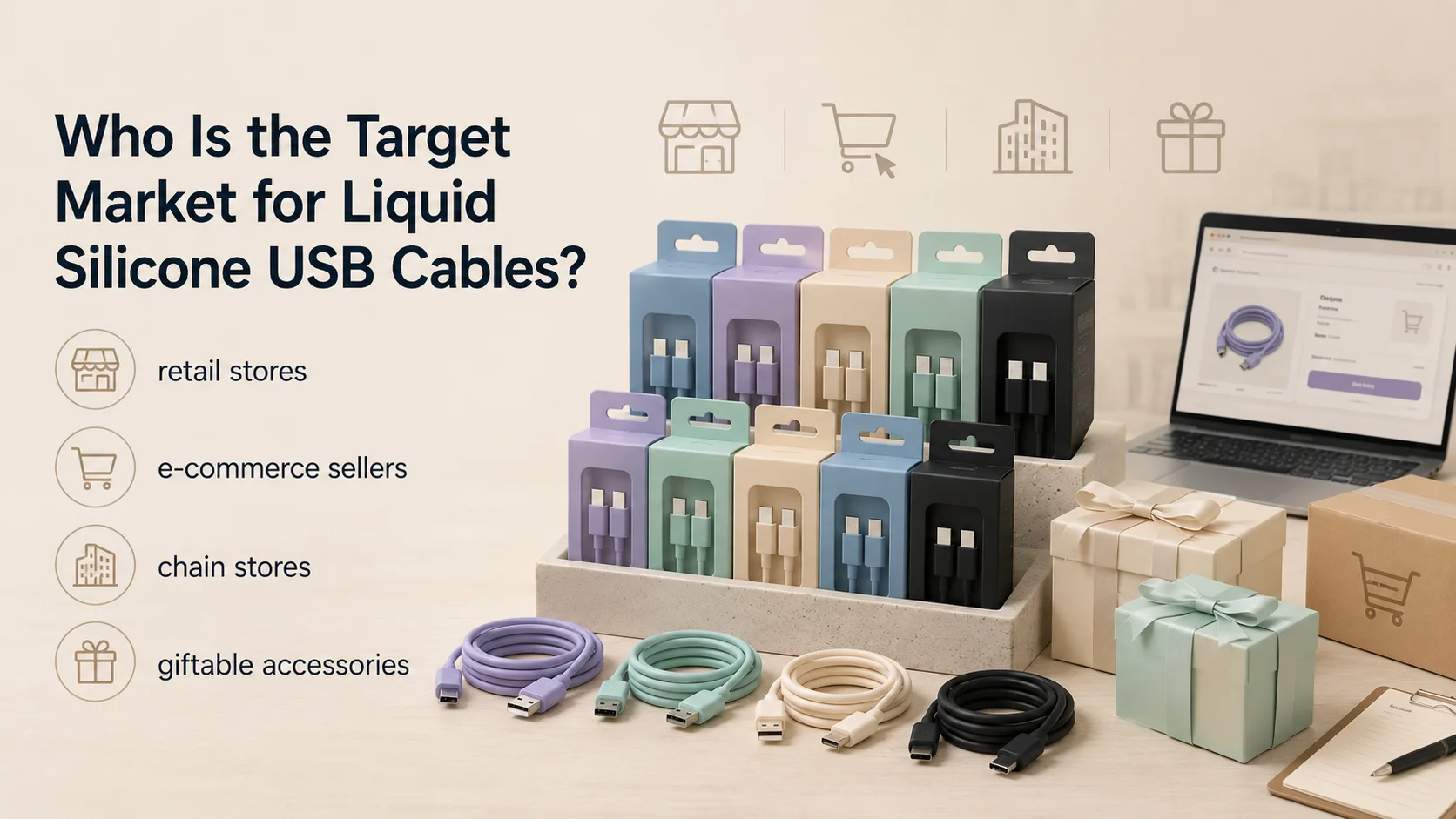
In our experience, buyers usually consider these cables for one of four commercial reasons.
1. Lifestyle and color-led retail
These buyers want products that create a stronger visual display. They may sell phone cases, TWS earbuds, smartwatches, desk accessories, or travel products alongside cables.
2. E-commerce product differentiation
Online sellers need product photos that help customers understand why one cable costs more than another. A clear color range and soft-touch visual can support listing images, but the title and bullet points must still lead with verifiable specifications.
3. Chain-store assortment upgrades
Chain buyers may need a step-up product between basic PVC cables and higher-priced technical accessories. Liquid silicone USB cables can potentially occupy this middle position if the packaging, performance, and margin structure support it.
4. Promotional and private-label programs
Some importers use custom colors, logo printing, packaging sleeves, or bundled accessories for seasonal promotions. This can work well when MOQ, lead time, and color approval are managed early.
The wrong target market is one that only wants the lowest possible unit price. In that case, the extra cost of material, color matching, or packaging may not create enough value.
What Should Wholesale Buyers Verify Before Ordering Liquid Silicone USB Cables?
A beautiful pre-production sample can create false confidence. The larger risk appears when bulk production differs in color, connector finish, packaging, or technical performance.
Wholesale buyers should verify approved samples, technical specifications, connector configuration, packaging, quality-control standards, certifications or compliance documents, MOQ, production lead time, and after-sales procedures before placing a liquid silicone USB cable order. A written approval process reduces avoidable disputes.
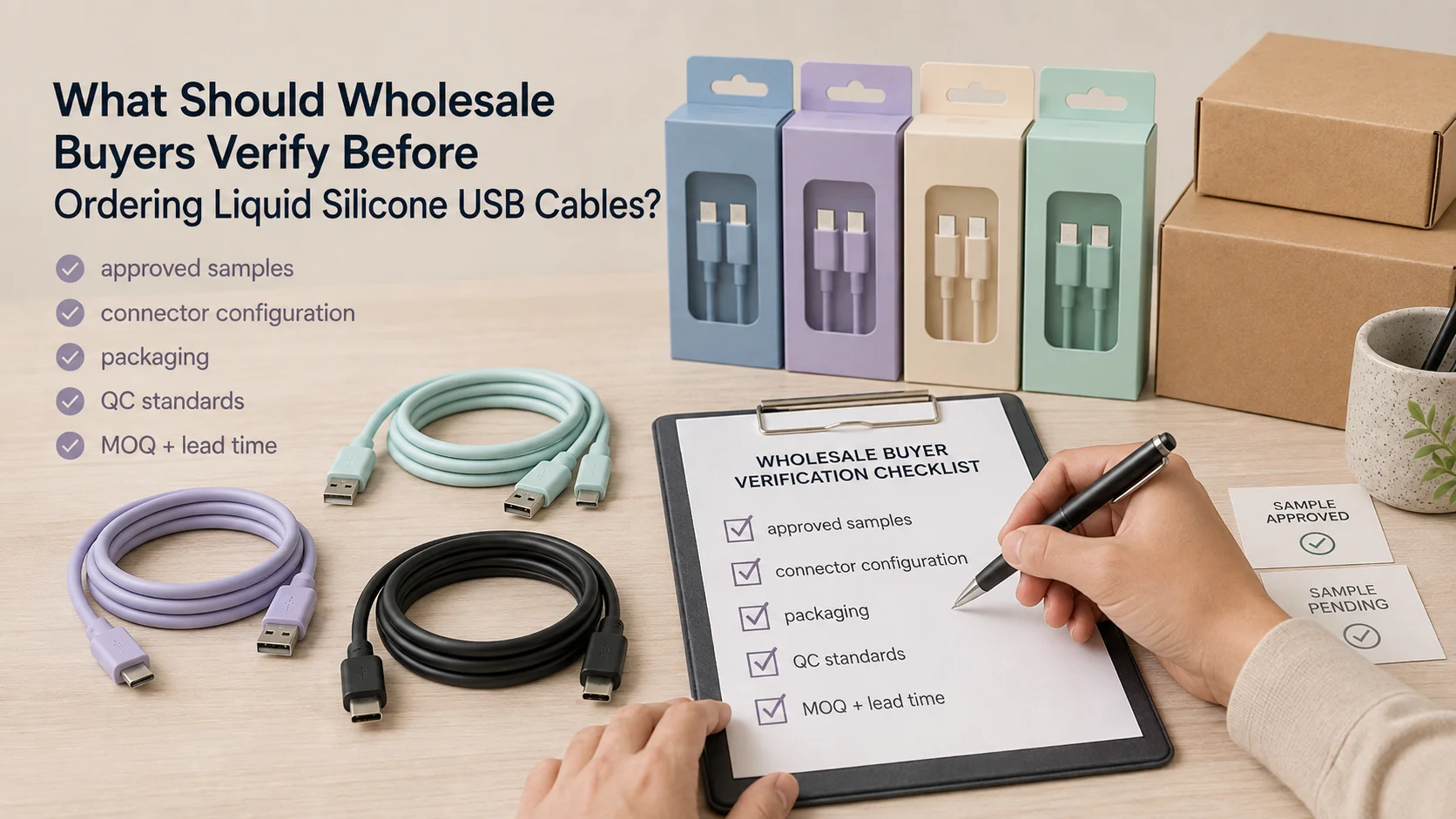
I recommend using a practical checklist before issuing a purchase order.
Product checklist
- Confirm cable length and tolerance.
- Confirm connector type on both ends.
- Confirm charging power and data-transfer capability.
- Confirm color by approved physical sample or color standard.
- Confirm logo position, printing method, and artwork.
- Confirm packaging structure and language.
- Confirm carton quantity and carton dimensions.
- Confirm barcode and labeling requirements.
Quality and compliance checklist
Buyers should request applicable documentation and verify that it matches the exact product. Depending on the market and product configuration, this may include documents related to CE, RoHS, REACH, FCC, or other applicable requirements11. Documentation should not be treated as a blanket guarantee.
I also suggest agreeing on:
| Control point | Why it matters |
|---|---|
| Golden sample | Creates a reference for bulk appearance |
| AQL or inspection standard12 | Defines acceptable defect levels |
| Pre-shipment inspection | Helps identify issues before shipping |
| Charging test method | Confirms the advertised cable function |
| Packaging drop or handling check | Reduces retail presentation risk |
| Warranty and claim process | Clarifies after-sales responsibility |
A short personal note: I have seen avoidable disagreements happen because a buyer approved a cable color from a screen image instead of a physical sample. Digital colors vary. For custom orders, an approved physical sample is much safer.
How Can Buyers Source Custom Liquid Silicone USB Cables From Kingfuji?
Finding a supplier is easy. Finding a supplier that can translate a retail concept into a controlled bulk order requires more structured communication.
At Kingfuji, we support buyers sourcing custom liquid silicone USB cables by discussing target price, connector configuration, charging requirements, cable length, colors, packaging, MOQ, and quality expectations before production. We recommend sample approval and document verification so the finished product matches the intended retail claim.
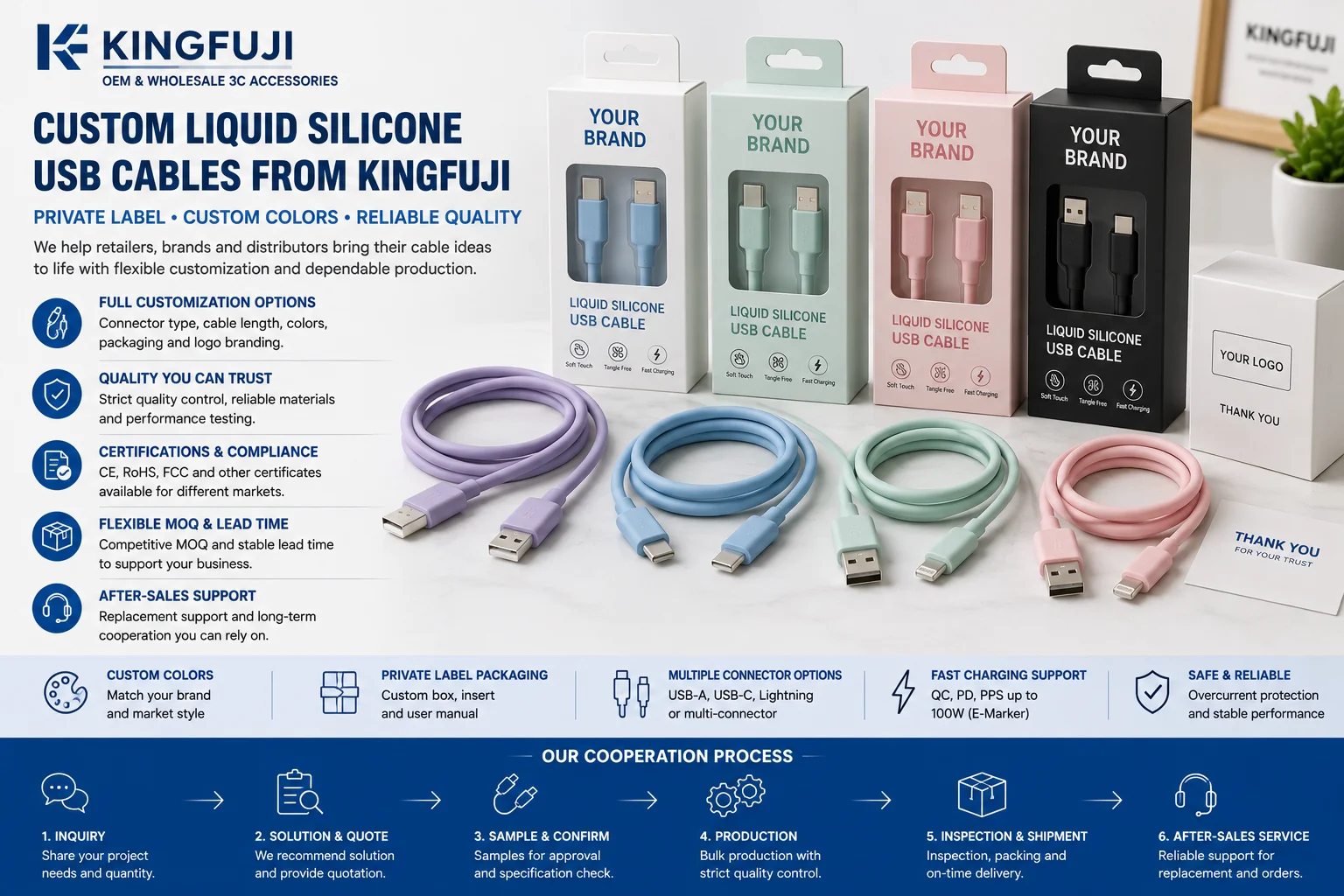
We are a Shenzhen 3C manufacturer with 15 years of export experience serving European and U.S. customers. Our product range includes USB cables, chargers, GaN chargers, TWS earbuds, and smartwatches.
For cable projects, I prefer to begin with the retail plan instead of immediately discussing the lowest unit price. This helps us recommend a configuration that is realistic for the intended sales channel.
Information that helps us quote accurately
Please share:
- Connector type: USB-C to USB-C, USB-A to USB-C, Lightning, or another option.
- Required charging rating and data function.
- Cable length and target color range.
- Estimated order quantity and target MOQ.
- Retail packaging requirements.
- Logo, private-label, or custom artwork needs.
- Target market and applicable compliance expectations.
- Expected delivery date and destination port.
We can then discuss suitable options, samples, packaging, and production planning. Buyers should review samples and applicable certification documents before confirming a bulk order, particularly when the product will be sold under a private label or promoted with technical charging claims.
Frequently Asked Questions
Are liquid silicone USB cables better than braided cables?
Liquid silicone USB cables are not automatically better than braided cables. Silicone may offer a smoother, softer visual and tactile experience, while braided cables may provide a more textured or technical retail appearance. Buyers should compare specifications, sample workmanship, packaging, target price, and intended shelf position.
Are liquid silicone USB cables tangle-free?
Liquid silicone USB cables may feel flexible and may show fewer sharp kinks than some cable styles, but buyers should avoid claiming that any cable is completely tangle-free. Actual handling depends on cable length, thickness, construction, storage, and user habits.
Can liquid silicone USB cables support fast charging?
Yes, liquid silicone USB cables can support fast charging if their internal design, connectors, and rated specifications support the required charging protocol. Buyers should verify the stated wattage, USB Power Delivery support, E-marker requirements, and device compatibility before using fast-charging claims.
What MOQ should I expect for custom liquid silicone USB cables?
MOQ depends on cable configuration, color, logo printing, packaging, and customization level. Standard models may allow lower MOQs than fully custom cable and packaging projects. We recommend discussing expected order volume early so we can suggest a practical option.
Do I need to test samples before placing a wholesale cable order?
Yes. Buyers should test samples for feel, color, connector fit, charging performance, data function, packaging, and overall workmanship. Sample approval is especially important for private-label orders because it creates a clear reference for bulk production quality.
Conclusion
Liquid silicone USB cables can help retailers create a more noticeable, color-led, and soft-touch cable range. Still, I would never select a cable based on material alone. The strongest wholesale decision combines appearance with verified charging power, connector quality, data capability, packaging, MOQ, lead time, and quality-control planning. If you are evaluating liquid silicone USB cables for your retail, wholesale, or e-commerce range, contact Kingfuji to discuss samples, custom colors, private-label packaging, and suitable cable specifications for your market.
"Silicone rubber", https://en.wikipedia.org/wiki/Silicone_rubber. Liquid silicone rubber is generally described as a two-part silicone elastomer system that is mixed and cured to form flexible rubber components; whether a particular cable jacket uses this material must be confirmed from the product's material specification. Evidence role: definition; source type: encyclopedia. Supports: The source should define liquid silicone rubber as a two-part liquid elastomer that is mixed, molded, and cured into silicone rubber components.. Scope note: A general material definition does not verify the jacket composition of a specific cable. ↩
"USB hardware", https://en.wikipedia.org/wiki/USB_hardware. USB Type-C and USB Power Delivery capability depends on the electrical and protocol characteristics of the cable assembly, including its conductors, connectors, and where required electronic marking, rather than on the exterior jacket material. Evidence role: mechanism; source type: institution. Supports: The source should explain that USB Type-C and USB Power Delivery power capability is determined by the cable and connector's electrical design, identification, and protocol compliance rather than jacket material.. Scope note: The standard explains the technical basis for power capability but does not assess the performance of an individual cable. ↩
"USB-C", https://en.wikipedia.org/wiki/USB-C. USB data capability is determined by the signal conductors and supported USB mode of the cable assembly; USB Type-C connector shape or jacket material alone does not establish whether a cable supports USB 2.0 or higher-speed data transfer. Evidence role: mechanism; source type: institution. Supports: The source should explain that USB data modes and transfer rates depend on supported signal paths and cable construction.. Scope note: A standards description does not establish the actual negotiated speed of a particular device-and-cable combination. ↩
"What is an E-Marker in a USB Type-C Cable and How Does It Work?", https://www.totalphase.com/blog/2020/10/what-is-e-marker-how-does-it-work/?srsltid=AfmBOopY0J_zRNHWMx5AytwneLePE6Ja9dit-meDaIwQcjLh6Z7ic_OU. Electronically marked USB Type-C cables include identification electronics that communicate cable capabilities to connected equipment; this internal feature cannot be inferred from the cable's outer finish. Evidence role: mechanism; source type: institution. Supports: The source should document that electronically marked USB Type-C cables contain identification electronics used to communicate specified cable capabilities.. Scope note: Electronic marking requirements vary with the cable's specified current and operating mode. ↩
"Eye-Tracking Evidence on How Product Visual Strategy and Unit ...", https://pmc.ncbi.nlm.nih.gov/articles/PMC13010595/. Consumer-behavior research indicates that visual design cues and haptic interaction can influence product attention and evaluation, providing context for using color and soft-touch finishes as merchandising differentiators. Evidence role: general_support; source type: paper. Supports: The source should provide research showing that visual design attributes and haptic product cues can influence consumer attention, evaluation, or purchase-related judgments.. Scope note: Such research does not prove that silicone USB cables will increase sales in every retail setting. ↩
"Thermoplastic Elastomers: Fundamentals and Applications", https://www.academia.edu/43486005/Thermoplastic_Elastomers_Fundamentals_and_Applications. Materials references describe silicone elastomers, thermoplastic elastomers, and textile-braided coverings as having differing surface, flexibility, and processing characteristics that can affect a cable's tactile and visual presentation. Evidence role: general_support; source type: research. Supports: The source should compare general physical and surface characteristics of silicone elastomers, thermoplastic elastomers, and textile-braided coverings relevant to cable-jacket design.. Scope note: Material characteristics do not by themselves determine retail price position, durability, or consumer preference for a specific cable. ↩
"NASA-STD-8739.4A PDF", https://s3vi.ndc.nasa.gov/ssri-kb/static/resources/nasa-std-8739.4a.pdf. Cable-assembly reliability literature identifies cyclic bending and strain concentration near terminations as important contributors to mechanical failure, making connector strain relief and termination quality relevant durability factors. Evidence role: mechanism; source type: research. Supports: The source should show that cyclic flexing and strain concentration near terminations are important reliability considerations for cable assemblies.. Scope note: The relative importance of each failure mode depends on the cable design, test method, and use conditions. ↩
"Effect of Umbilical Cord Entanglement and Position on Pregnancy Outcomes", https://pmc.ncbi.nlm.nih.gov/articles/PMC4512586/. Studies of flexible filaments show that entanglement can arise under agitation and confinement, so a universal "tangle-free" claim is not supported without defining the cable design and test conditions. Evidence role: mechanism; source type: paper. Supports: The source should show that flexible filaments and cords can form entanglements under agitation and confinement, with outcomes dependent on length, flexibility, and handling conditions.. Scope note: General filament-entanglement research does not measure the tangling behavior of a particular USB cable model. ↩
"USB-C", https://en.wikipedia.org/wiki/USB-C. Public USB-C policy and technical materials identify USB Type-C as a charging interface used across mobile phones, tablets, and other portable electronic equipment, including many portable computers. Evidence role: general_support; source type: government. Supports: The source should document USB-C's use as a common charging interface for categories including mobile phones, tablets, and portable computers.. Scope note: Interface adoption varies by manufacturer, model year, region, and device category. ↩
"Charge high performance USB-C devices at up to 240W ...", https://www.startech.com/en-us/cables/usb2epr10fw?srsltid=AfmBOoqMIwx8ITdZUkB0EflyPKXGrAZhX2KjrhtO0MYNrCWexTmDNStt. USB Power Delivery specifications define distinct cable and power ranges, including Extended Power Range operation up to 240 W for compliant equipment; a cable's stated wattage therefore constrains the charging capability it can represent. Evidence role: mechanism; source type: institution. Supports: The source should establish that USB Power Delivery defines different power ranges and cable capability requirements, including operation up to 240 W for compliant Extended Power Range systems.. Scope note: Actual delivered power also depends on the charger, device, negotiated power profile, and cable compliance. ↩
"Equipment Authorization", https://www.fcc.gov/engineering-technology/laboratory-division/general/equipment-authorization. CE marking, RoHS, and REACH are distinct European regulatory frameworks with product- and substance-specific scopes, while FCC requirements arise under separate United States rules; applicability must be assessed for the particular cable, accessory, market, and importer role. Evidence role: historical_context; source type: government. Supports: The source should explain the scope of EU CE-marking, RoHS, and REACH obligations and, where relevant, the separate U.S. FCC equipment-authorization framework.. Scope note: This overview cannot determine compliance obligations for a specific product configuration or destination market. ↩
"6.2.1. What is Acceptance Sampling?", https://www.itl.nist.gov/div898/handbook/pmc/section2/pmc21.htm. Acceptance-quality-limit sampling standards use AQL values within defined inspection plans to determine lot acceptance or rejection based on sampled nonconformities; an AQL does not guarantee that every unit is defect-free. Evidence role: definition; source type: institution. Supports: The source should define acceptance quality limit terminology within lot-by-lot acceptance sampling and explain its role in inspection planning.. Scope note: The selected sampling plan, inspection level, and defect classification must be agreed for the specific order. ↩