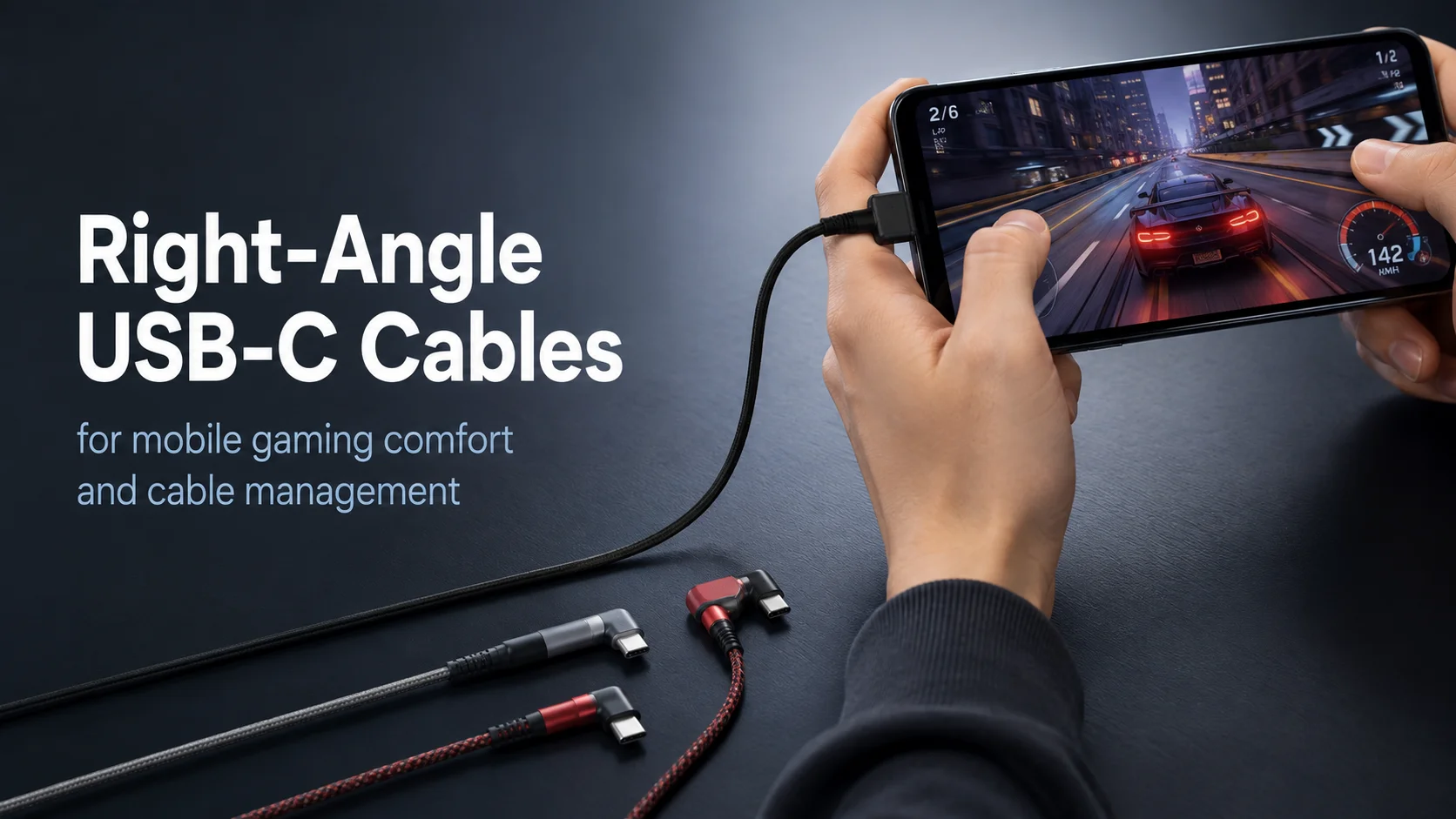
Right-angle USB-C cables solve a specific problem for some mobile gamers: a standard straight plug can interfere with the hand during landscape play. That annoyance can lead to poor comfort, tangled cables, and negative product reviews. We help buyers treat this as a device-and-use-case decision rather than assuming every “gaming” cable will sell.
Right-angle USB-C cables are popular with mobile gamers because the angled connector can route the charging cable away from a player’s grip while gaming in landscape mode1. However, the correct direction depends on the phone’s port position, the player’s hand placement, case thickness, and charging requirements. Wholesale buyers should test focused SKUs before expanding a gaming cable range.
We have spent 15 years discussing USB cable requirements with European and US buyers. One recurring lesson is simple: a cable that looks like a gaming accessory can still create complaints if its connector points toward the user’s hand instead of away from it.
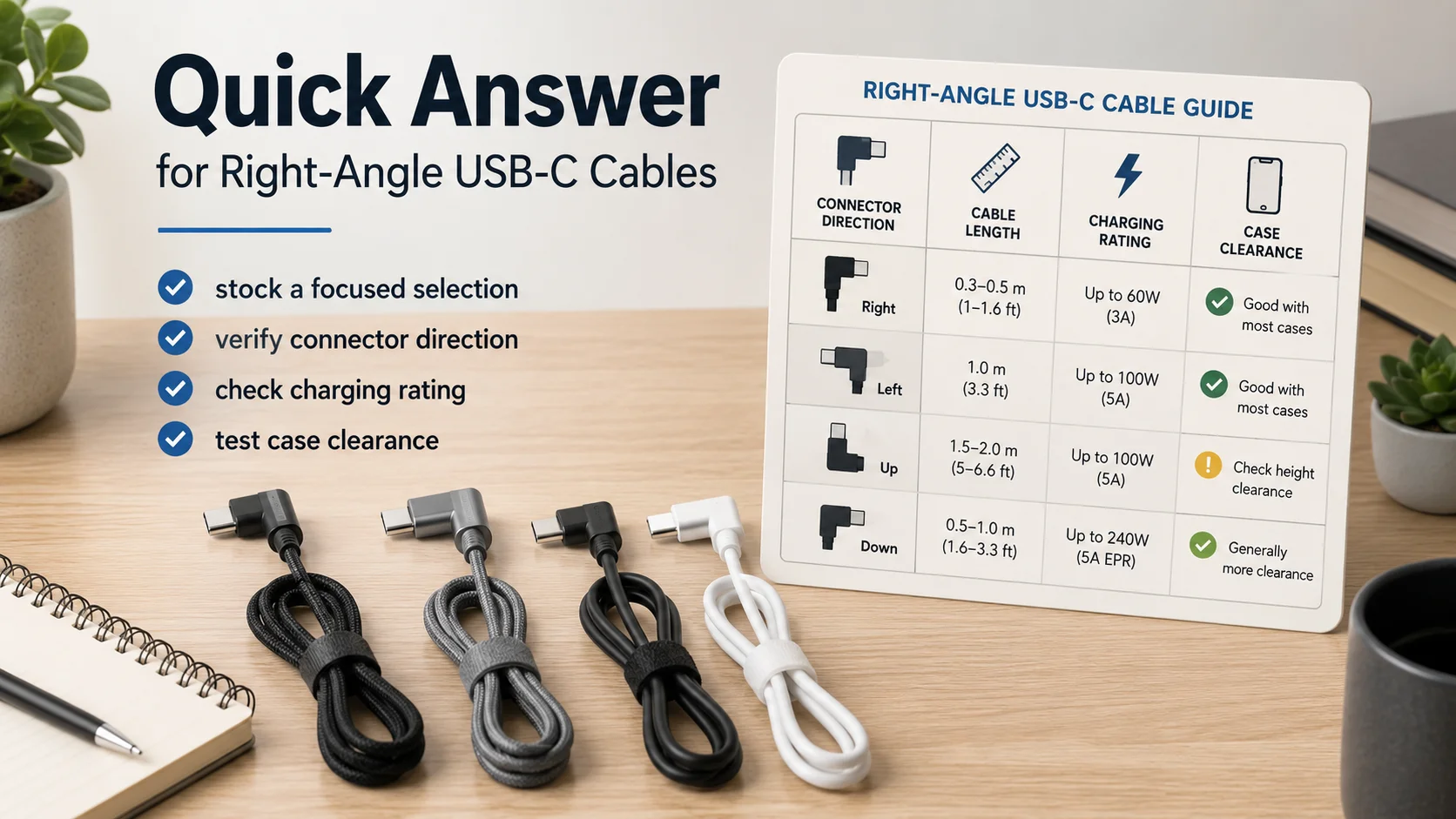
Quick Answer for Right-Angle USB-C Cables?
Mobile gamers may choose right-angle USB-C cables when they charge and play at the same time. The angled plug can reduce interference near the phone’s lower edge, but only when the connector direction matches the phone’s landscape orientation and the user’s grip.
The best wholesale approach is to stock a small, clearly labeled selection of right-angle USB-C cables rather than replacing standard cables. Buyers should verify connector direction, cable length, charging rating, data specification, and case clearance against their target phone models before placing a broad order.
Why a “quick answer” matters for procurement
We often receive a short buyer question: “Is this cable suitable for gaming?” We cannot answer that responsibly from the product photo alone. A 90-degree connector may look practical, but its real value depends on how the cable exits the device.2
A buyer should view this category as a scenario-based accessory, not a universal replacement for straight USB-C cables.
Key conditions include:
- The customer charges while playing.
- The phone uses USB-C.
- The charging port is accessible during landscape play.
- The connector bends away from the player’s grip.
- The user’s case does not block the plug housing.
- The cable supports the required charging protocol.
We recommend that retailers avoid vague package claims such as “perfect for all mobile games.” More useful claims are specific:
“Designed to help route the cable away from the hand during compatible landscape gaming setups.”
That wording gives customers a clear benefit while reducing unrealistic expectations. It also helps retail staff explain why the connector direction matters.
For a first purchase, we usually suggest a focused test assortment: one or two connector directions, one practical length, and verified charging options. This approach helps a buyer assess sell-through and after-sales feedback before committing to many colors, wattages, or package styles.
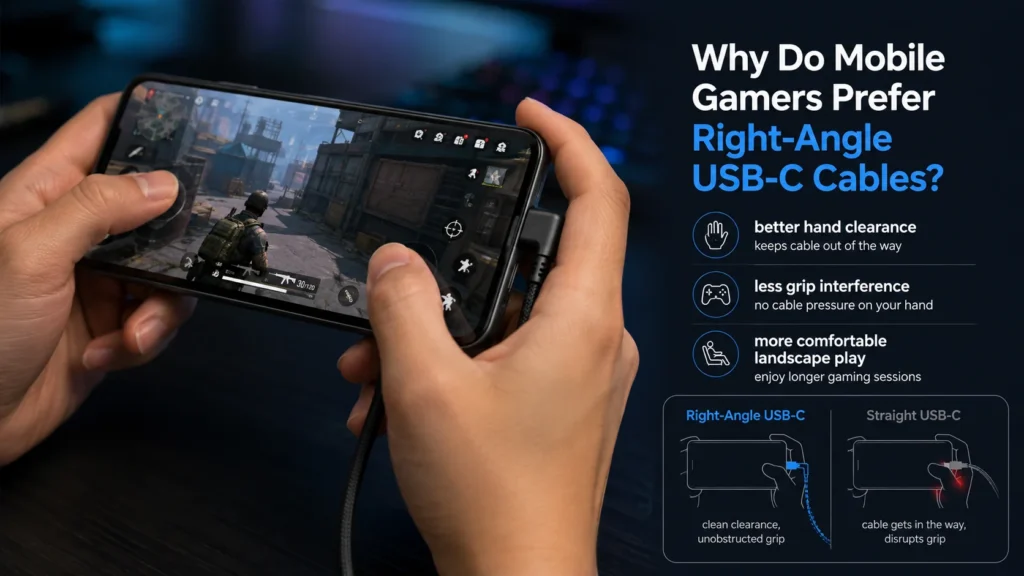
Why Do Mobile Gamers Prefer Right-Angle USB-C Cables?
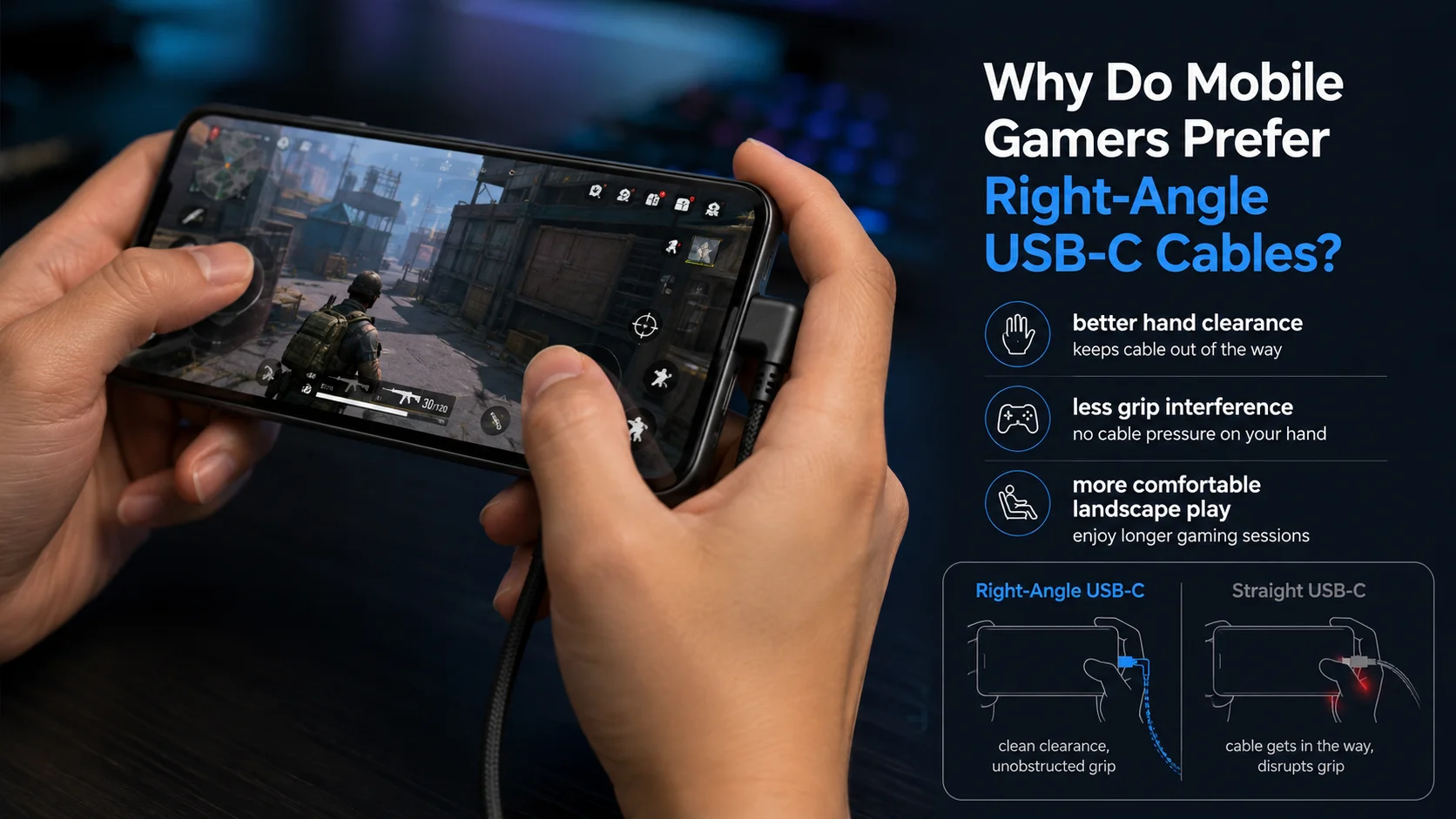
Many players hold phones horizontally for racing, shooting, sports, and multiplayer games. A straight connector can project directly below the device and press against a finger, palm, or lap.3 A right-angle USB-C cable may create more usable hand clearance.
Mobile gamers prefer right-angle USB-C cables when the plug routes the cable away from their hands during landscape play. The preference is not universal. The useful connector orientation changes with the phone model, port location, charging position, and the player’s preferred grip.
The real ergonomic job
We do not position a right-angle plug as automatically better than a straight plug. Its job is more limited: it can move the cable exit path to a less disruptive direction.
When a customer plays in landscape mode, both hands usually support the long edges of the phone. The USB-C port often sits along one short edge. A straight plug extends outward from that edge. Depending on grip style, the cable can touch a hand or create an awkward bend against the body.
A 90-degree connector changes the cable route. That may help the player hold the phone more naturally.
Direction is more important than appearance
The main retail risk is choosing the wrong direction. A connector that angles left may work well for one landscape orientation but interfere in the opposite orientation.
Before selecting a SKU, we recommend that buyers ask:
- Which phone models do our customers commonly use?
- Where is the USB-C port located?
- Which side faces the player during typical landscape use?
- Does the connector point toward or away from the lower hand?
- Will customers play while using a case?
A retailer should ideally show the connector direction in product images. We also recommend using a simple “left-angle” or “right-angle” label, supported by a diagram. This can reduce confusion better than using only “gaming cable” on the package.
How Do Right-Angle USB-C Cables Improve Comfort and Cable Management?
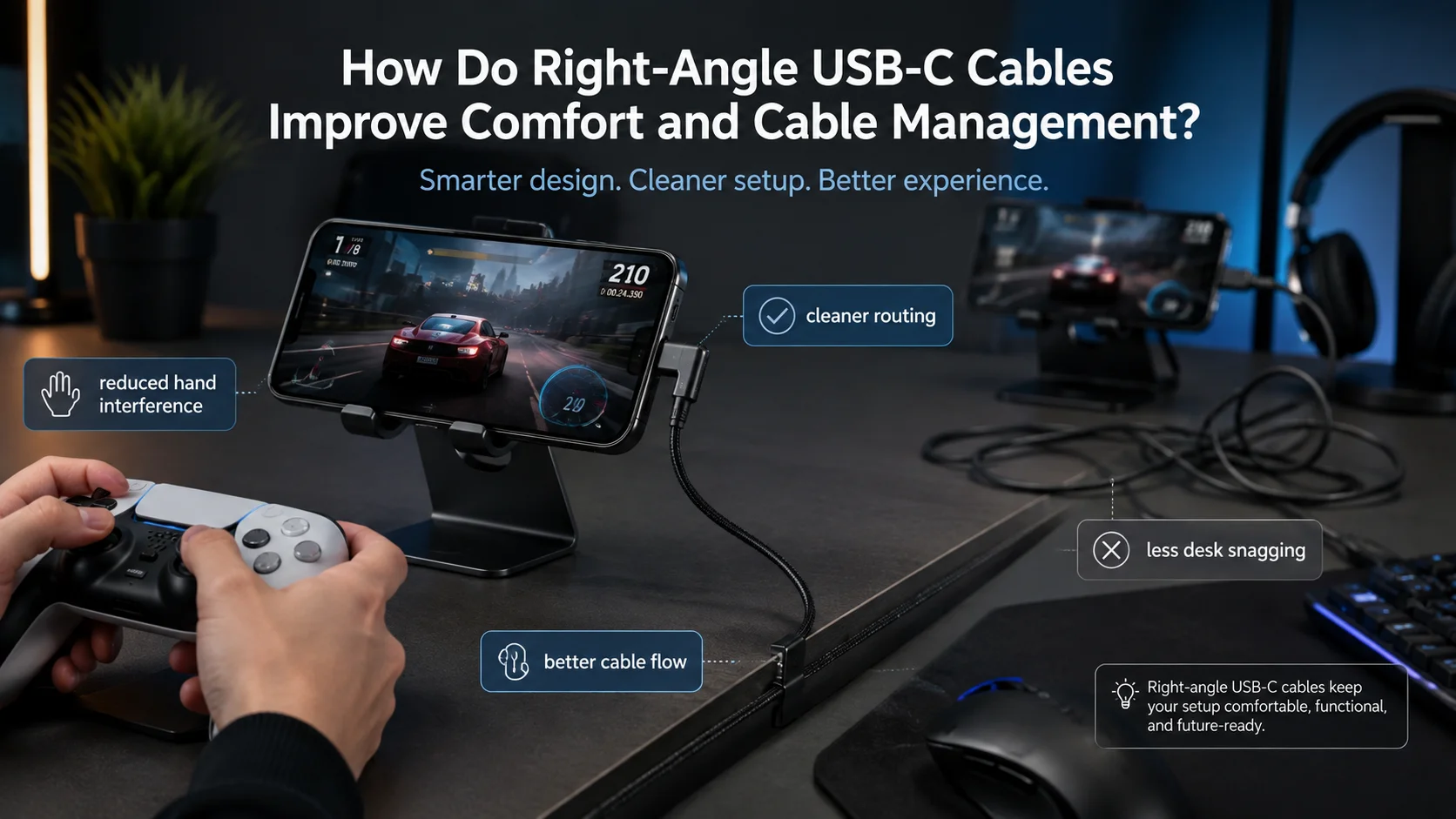
Charging cables can become distracting when they hang across a player’s hand, twist near the port, or catch on a desk edge. Right-angle USB-C cables may offer cleaner cable routing when their connector orientation suits the device and play position.
Right-angle USB-C cables can improve comfort and cable management by directing the cable along the phone’s edge rather than straight out from it. Buyers should still evaluate cable flexibility, length, connector direction, and the customer’s normal charging environment.
Comfort involves more than the connector
We have seen buyers focus on the plug shape while overlooking the rest of the cable. In practice, the cable jacket, length, and stiffness can change the user experience just as much.
For example, a very stiff braided cable may hold its own shape and pull against the phone4. A highly flexible cable may drape more naturally, but its durability depends on material selection and construction. Neither option is automatically superior without verified product specifications and intended usage.
Practical cable-length choices
For a gaming-focused range, we usually see these use cases:
| Cable length | Typical use case | Buyer consideration |
|---|---|---|
| 0.5–1 m | Power bank, desktop charging | Compact, but may be restrictive from a wall outlet |
| 1–1.2 m | Desk or bedside play | Common all-purpose option |
| 1.5–2 m | Sofa or wall-outlet use | More freedom, but more cable to manage |
| 3 m+ | Room-scale charging | Can be useful, but may create clutter |
Packaging should explain the use case
We recommend that buyers communicate the intended setup instead of promising a universal comfort improvement. Good packaging can show:
- A phone held horizontally.
- The cable exiting away from the hand.
- The connector’s angle direction.
- The supported charging specification.
- A case-clearance note where relevant.
This approach supports fewer misunderstandings. It also helps customers choose a cable for a clear reason rather than buying based on appearance alone.
How Do Straight, 90-Degree, and 180-Degree USB-C Cables Compare?
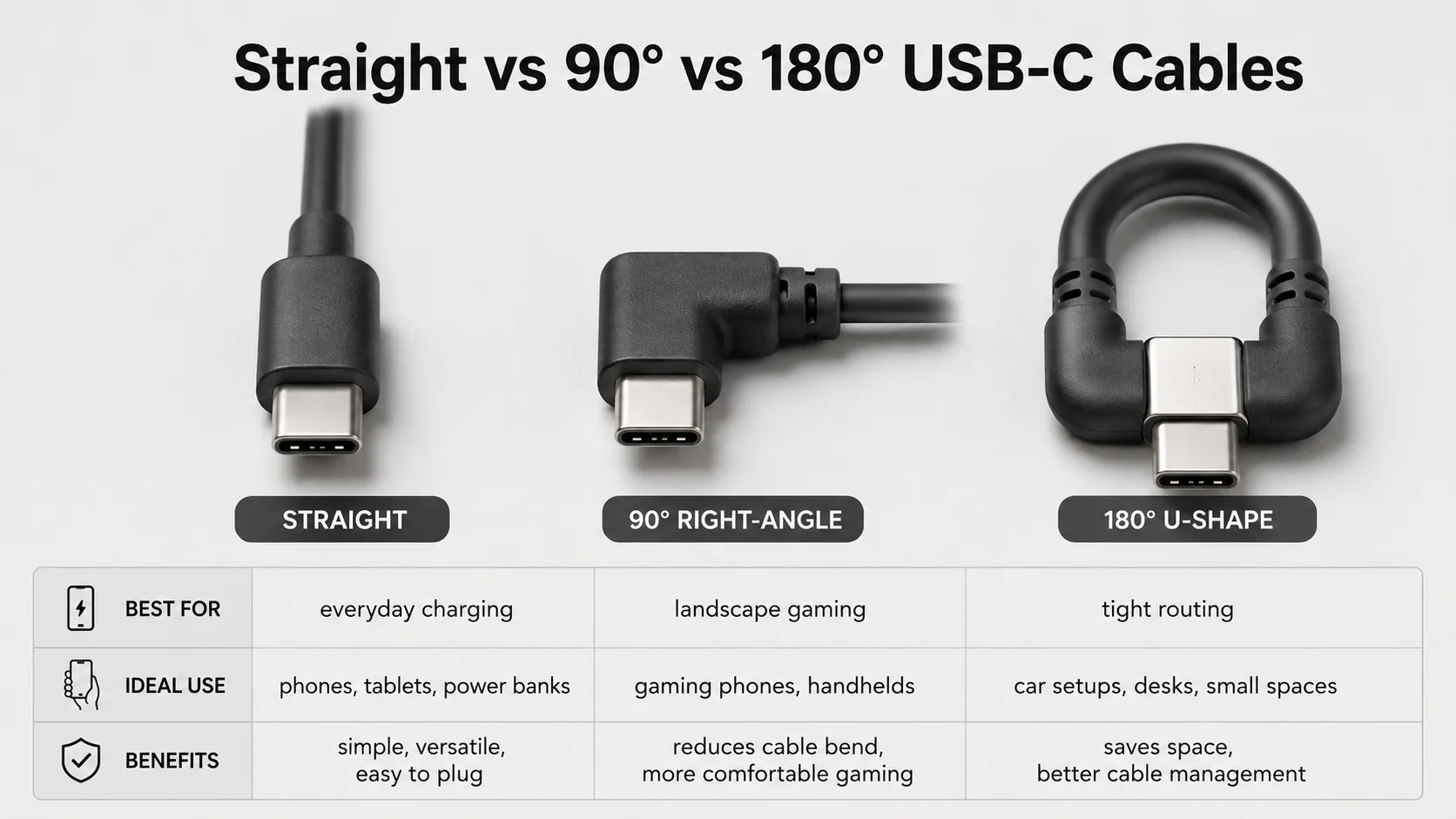
Straight, 90-degree, and 180-degree USB-C cables serve different physical layouts. Each connector style can work well in the right situation, but each also creates different compatibility and retail risks for mobile gaming customers.
Straight USB-C cables offer broad everyday compatibility, 90-degree cables can improve hand clearance in compatible landscape setups, and 180-degree cables may route the cable back along the phone. Buyers should compare physical direction, not just charging specifications.
Connector geometry changes the customer experience
A straight cable remains the baseline SKU for most retailers because it fits many everyday charging situations. It is easy for customers to understand, and it does not require them to think about connector direction.
A 90-degree cable introduces more ergonomic potential, but it also requires clearer merchandising. A 180-degree design can route the cable back along the phone’s rear or edge5, depending on its structure. Some customers may prefer that route for handheld use, while others may find the larger plug body incompatible with a case.
| Feature | Straight USB-C | 90-degree USB-C | 180-degree USB-C |
|---|---|---|---|
| Everyday charging suitability | Broad | Scenario-dependent | Scenario-dependent |
| Landscape hand clearance | Can be limited | May improve it | May improve it |
| Directional compatibility risk | Low | Medium to high | Medium to high |
| Case-clearance concern | Usually lower | Must verify | Must verify |
| Retail explanation needed | Low | High | High |
| Gaming-focused positioning | General | Stronger when matched | Niche and setup-specific |
Build an assortment, not a single “winner”
We suggest that wholesale buyers keep straight cables as the core range. Then they can add selected right-angle USB-C cables as a differentiated accessory line.
A practical initial assortment might include:
- Standard straight USB-C to USB-C cables.
- One verified 90-degree direction for a target customer group.
- One length optimized for desk or bedside use.
- A small number of color options.
- Clear compatibility graphics.
This strategy gives customers a choice without forcing every shopper into a specialized connector design.
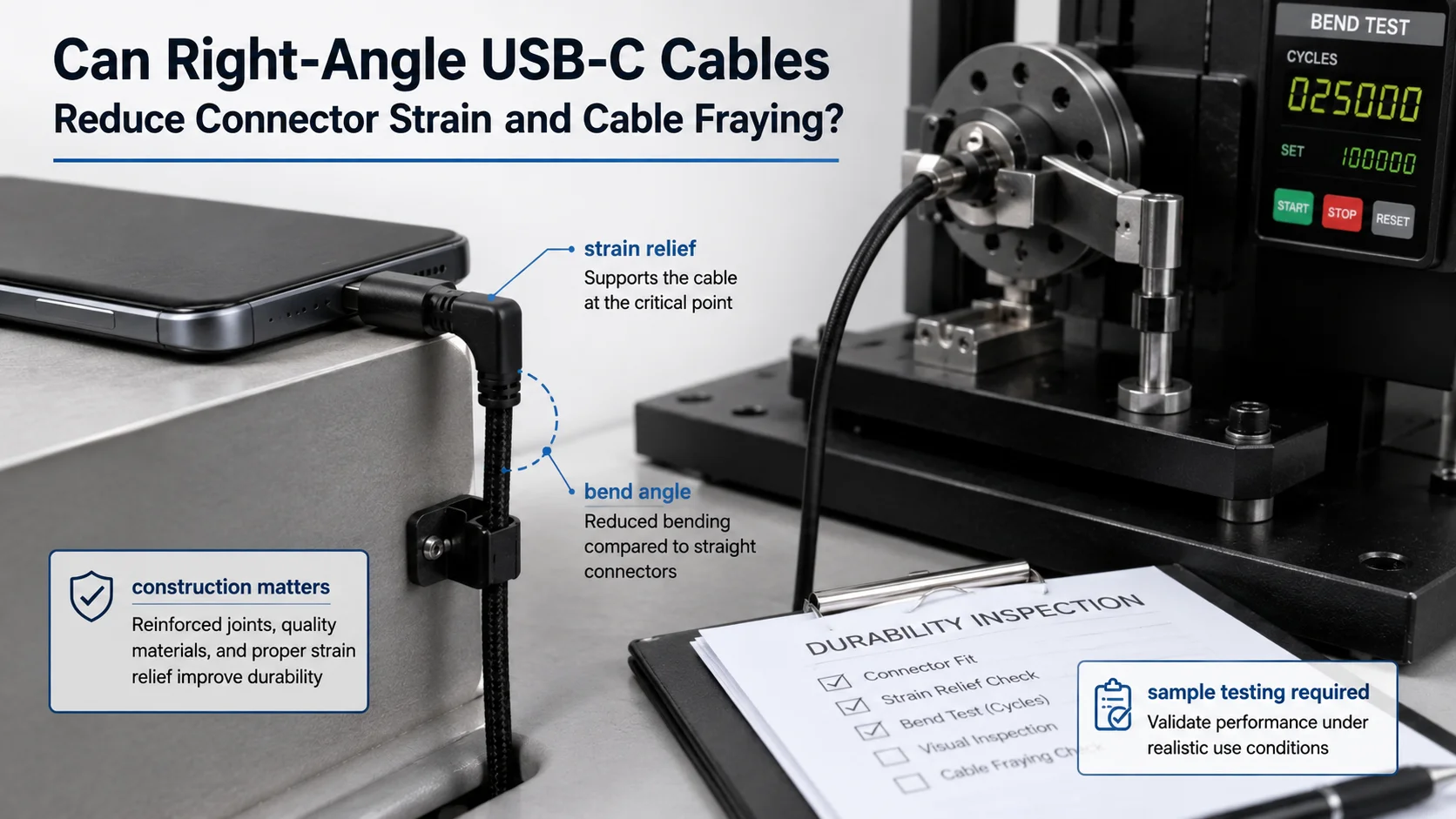
Can Right-Angle USB-C Cables Reduce Connector Strain and Cable Fraying?
A right-angle connector may reduce sharp bending in some positions6, especially when a straight plug would be forced against a desk, hand, or wall. However, connector shape alone does not prove longer service life or prevent cable damage.
Right-angle USB-C cables may reduce bending stress in certain use positions, but durability depends on the complete construction: conductor design, strain relief, jacket material, connector assembly, and actual user behavior. Buyers should request test documents and inspect samples.
Avoid unsupported durability claims
We advise buyers not to claim that an angled connector is “unbreakable” or guaranteed to stop fraying. Real-world cable life depends on many factors. Customers may pull the cable sideways, wrap it tightly, expose it to heat, or use it with an incompatible case.
A well-designed right-angle plug may help in some layouts because it reduces the need for a sharp cable bend immediately after the connector. Still, that benefit must be evaluated through product-specific samples and supplier documentation.
What to inspect during sample review
When we prepare cable samples for buyers, we encourage them to check these points:
- Strain-relief transition: Does the cable exit the connector smoothly?
- Housing fit: Are there gaps, loose parts, or sharp edges?
- Cable flexibility: Does the cable sit naturally in the intended gaming position?
- Plug retention: Does the connector fit securely in target devices?
- Repeated handling: Does the plug remain stable after normal insertion and removal?
- Jacket finish: Is the surface easy to clean and suitable for the retail market?
A supplier may provide bend-test or insertion-cycle information, but buyers should verify the test method, sample size, conditions, and applicable standard. A high cycle number on a data sheet does not automatically predict every customer’s real use.
For application-specific safety or compliance decisions, we recommend qualified professional evaluation and verification against the destination market’s requirements.
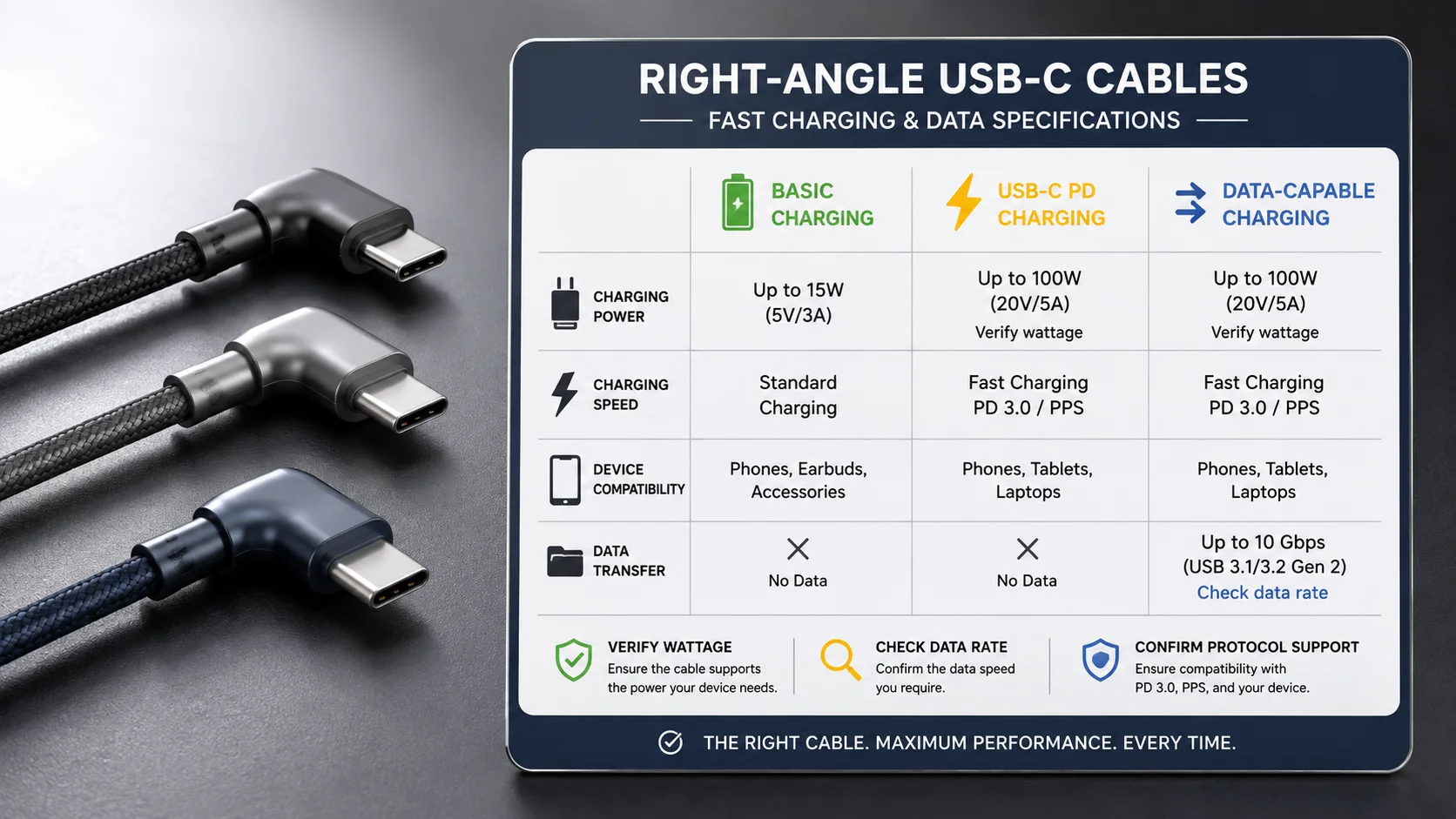
Which Fast-Charging and Data Transfer Specifications Should Buyers Choose?
A right-angle connector does not automatically make a cable fast-charging or high-speed. Charging wattage and data performance depend on the cable’s electronic design, USB-C configuration, supported protocols, connected charger, and connected device.
Buyers should choose right-angle USB-C cables based on the target product category: basic charging, USB Power Delivery charging, or data-capable charging. Every wattage and data-rate claim should be confirmed through product specifications and appropriate testing documents.
Match specifications to retail demand
For mobile gaming accessories, charging is usually the priority. Many customers want to keep playing while the phone receives power. However, the required wattage differs by phone, charger, and battery-management system.
A buyer should not assume that a 100W cable will make every phone charge at 100W. The phone and charger must also support the relevant power profile.7 The same principle applies to data transfer.
| Cable positioning | Common buyer need | What to verify |
|---|---|---|
| Basic charging cable | Daily phone charging | Current rating, connector quality |
| PD charging cable | USB-C charger compatibility | PD support, rated wattage, e-marker where applicable |
| Charging + data cable | Phone-to-laptop transfer | USB generation and stated data rate |
| Premium gaming cable | Charging during play | Physical direction, heat behavior, cable flexibility, verified rating |
Ask for complete technical information
We recommend requesting:
- Rated current and rated power.
- Supported charging protocols, if applicable.
- USB-C to USB-C or USB-A to USB-C configuration.
- Data transfer specification.
- E-marker details for higher-power USB-C cable designs where applicable.8
- Sample test reports or declarations.
- Certification and compliance documents relevant to the sales market.
Our Shenzhen team can provide product-specific documentation for review, but buyers should verify that documents match the exact SKU, factory, production period, and destination-market requirement. This step matters especially for European and US distribution.
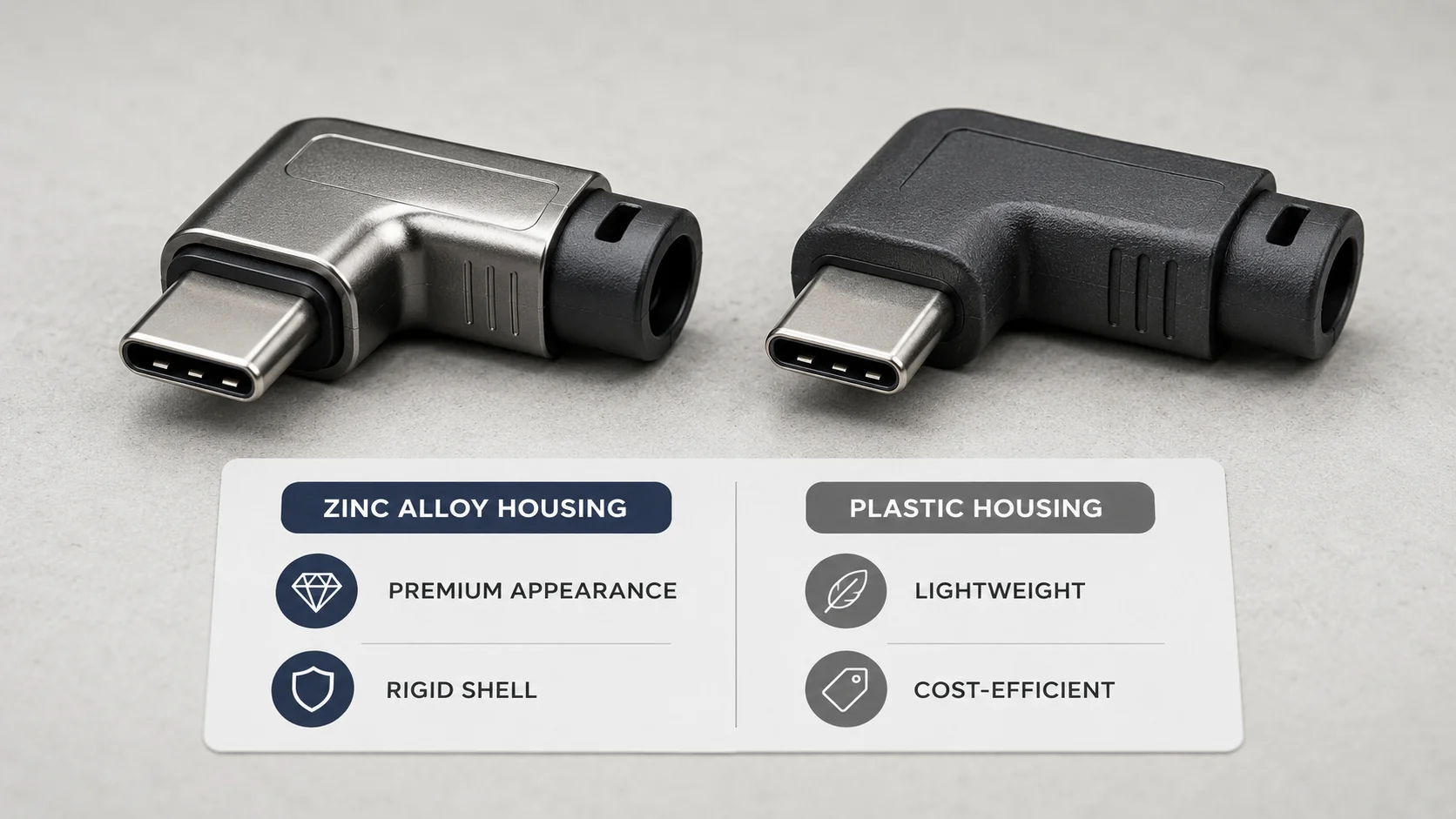
Are Zinc Alloy or Plastic Connector Housings More Durable?
Zinc alloy and plastic connector housings offer different visual, physical, and cost characteristics. Neither material guarantees better durability by itself. Buyers should evaluate housing material together with strain relief, internal assembly, finish quality, weight, and intended retail positioning.
Zinc alloy housings may provide a premium appearance and a more rigid outer shell, while plastic housings can be lighter and more cost-efficient.9 Wholesale buyers should select the option that matches their target price point and verify product-specific durability evidence.
Zinc alloy: premium feel, but not automatic performance
A zinc alloy housing can create a more substantial feel in hand. It may suit premium retail packaging or customers who associate metal finishes with higher perceived value. However, metal can add weight at the connector end. That extra weight may matter for short cables, power-bank use, or customers who prefer lightweight accessories.
The quality of the finish also matters. Buyers should inspect color consistency, coating adhesion, edge smoothness, and logo quality on production samples.
Plastic: practical and adaptable
Plastic housings can offer lower cost and lower weight. They can also support many color options and molded shapes. A carefully designed plastic connector can be suitable for mass-market accessories, especially when paired with a well-engineered strain-relief section.
We recommend evaluating both options against the same checklist:
| Evaluation point | Zinc alloy housing | Plastic housing |
|---|---|---|
| Perceived retail value | Often higher | Depends on finish and design |
| Weight | Usually higher | Usually lower |
| Color customization | More limited | Often flexible |
| Cost target | Often higher | Often lower |
| Strain-relief quality | Must verify | Must verify |
| Case compatibility | Must verify by shape | Must verify by shape |
From our buyer discussions, the better choice often comes down to shelf position. A value-focused importer may prioritize price and color variety. A premium electronics retailer may prefer a refined metal finish. In both cases, we advise reviewing pre-production samples rather than choosing based on material descriptions alone.
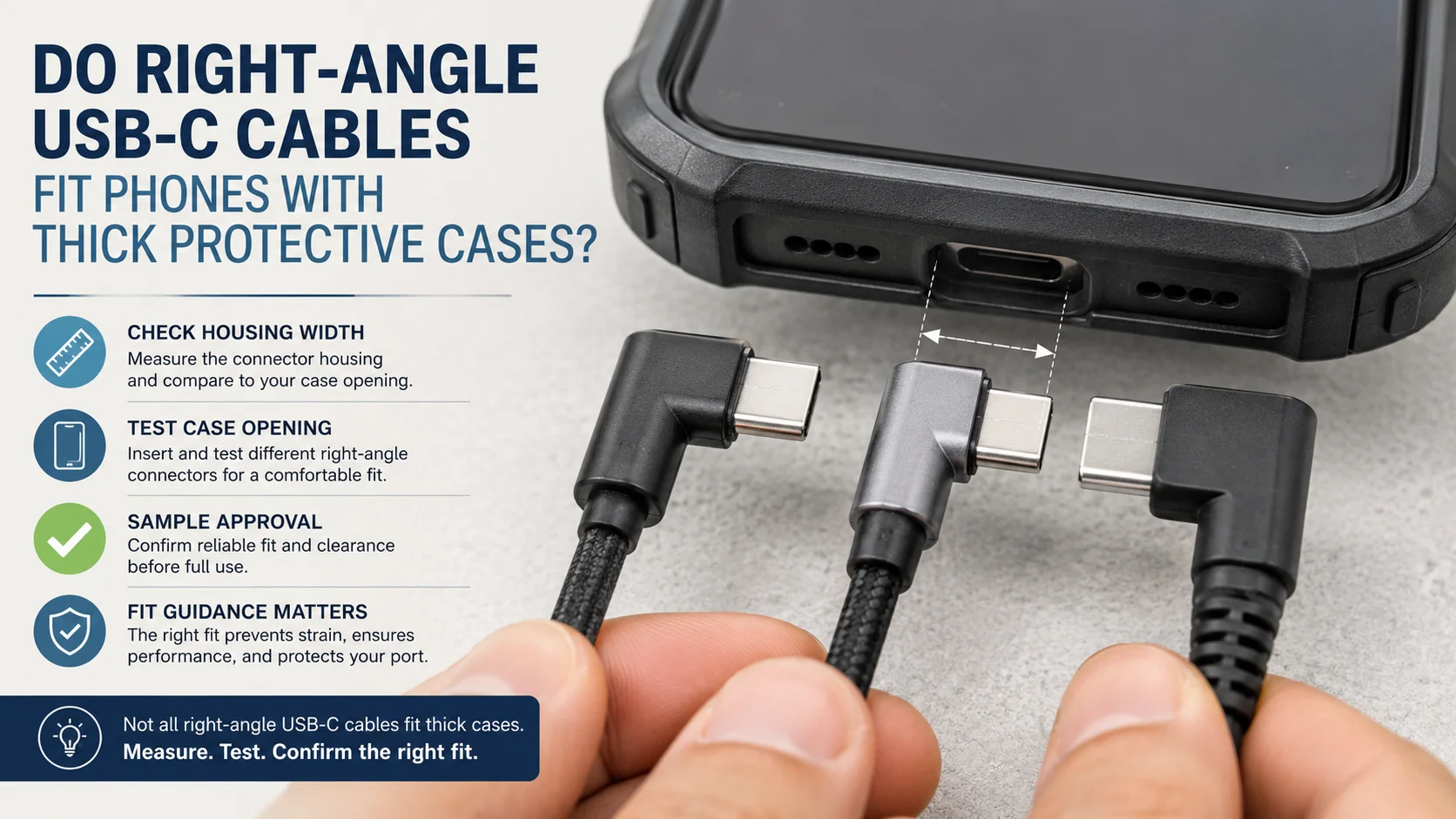
Do Right-Angle USB-C Cables Fit Phones with Thick Protective Cases?
Some right-angle USB-C cables fit phones with protective cases, while others do not. The critical factor is the connector housing’s width, height, depth, and angle design compared with the case opening around the phone’s USB-C port.10
Right-angle USB-C cables do not guarantee compatibility with thick protective cases. Buyers should test physical samples with target phone models and common case styles, then provide accurate fit guidance in product listings and packaging.
Case clearance causes avoidable returns
Case compatibility is one of the most important checks for a gaming cable range. A customer may have a rugged case, a silicone bumper, a wallet case, or a case with a narrow port cutout. Even a cable with excellent electrical performance can become unusable if the connector housing cannot reach the USB-C port.
We recommend that buyers test at least:
- A bare phone.
- A slim TPU case.
- A common protective case.
- A thicker rugged case.
- A case with a recessed charging-port opening.
Measure the real connector shape
Retail buyers should request dimensional drawings or physical samples. Important dimensions include:
- Connector head width.
- Connector head thickness.
- Plug length.
- Distance from the plug to the bend.
- Cable exit direction.
- Clearance needed around the port.
We also recommend avoiding broad claims such as “fits all cases.” A more careful product note is:
“Compatibility depends on the phone case port opening. Please check connector dimensions before purchase.”
This language is especially useful for e-commerce sellers. It can reduce confusion before purchase and gives customer-service teams a clear reference point.
For large chain-store programs, buyers may consider a compatibility matrix for key phone families. That requires ongoing maintenance, but it can be valuable when a retailer serves a narrow group of high-volume devices.
What Should Wholesale Buyers Verify Before Ordering Right-Angle USB-C Cables?
Wholesale buyers should verify more than price, packaging, and color. Right-angle USB-C cables require a complete review of connector direction, device fit, charging specifications, quality controls, documentation, and after-sales expectations.
Before ordering right-angle USB-C cables, buyers should approve samples on target phones, confirm connector orientation and case clearance, verify electrical specifications, review compliance documents, define quality standards, and agree on packaging, MOQ, lead time, and warranty processes.
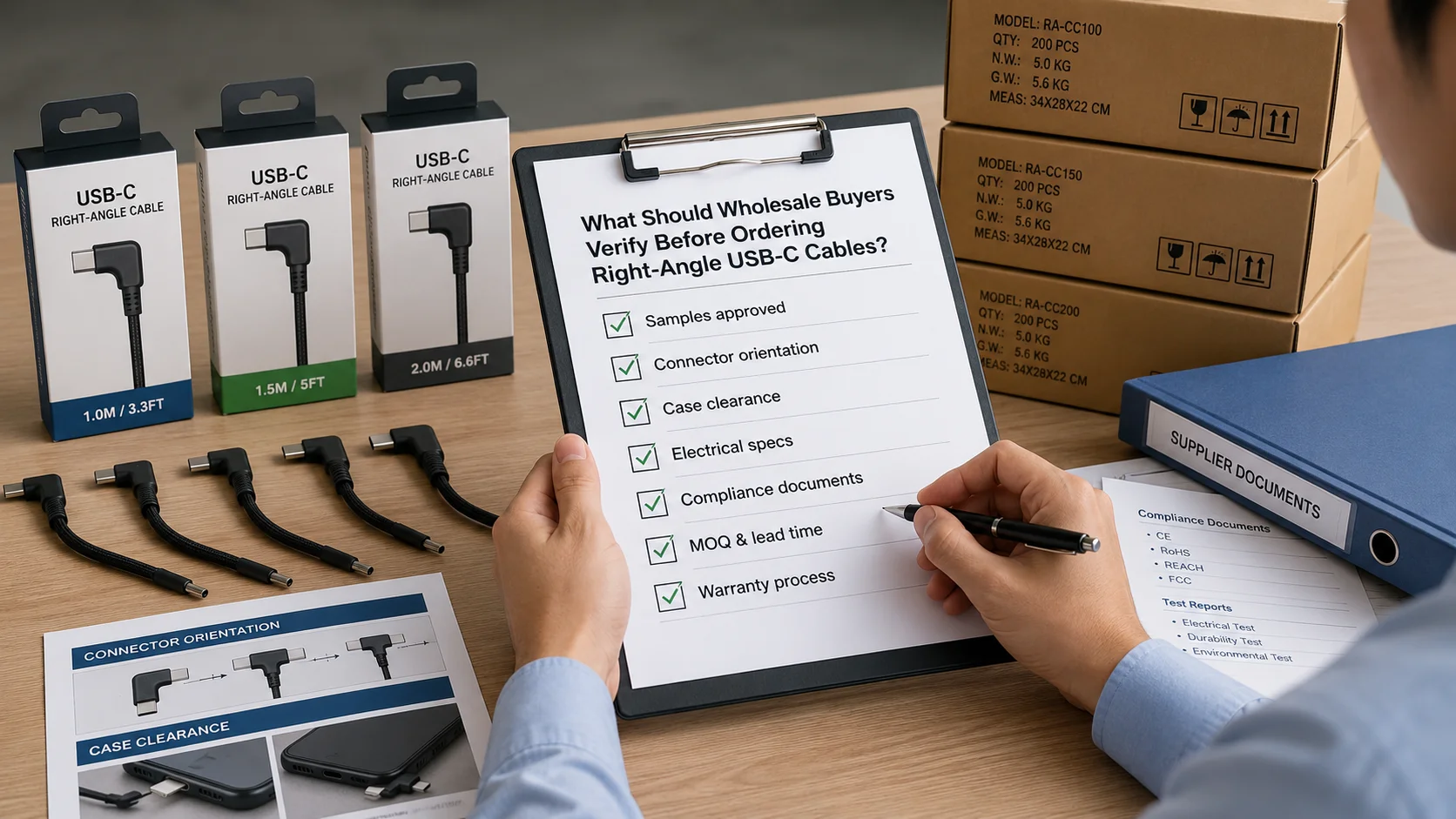
A practical pre-order checklist
We recommend using a written approval process. It prevents the common problem of approving a cable based only on photos or a generic specification sheet.
Product-fit checks
- Test the cable on selected phone models.
- Test both landscape orientations.
- Test with representative phone cases.
- Confirm the cable routes away from the intended hand position.
- Check whether the plug blocks speakers, buttons, cooling accessories, or controller attachments.
Electrical and quality checks
- Confirm connector configuration.
- Confirm rated power and current.
- Confirm data-transfer requirements.
- Review test reports that apply to the exact product.
- Inspect plug finish, housing assembly, and cable jacket.
- Define acceptable cosmetic-quality standards.
- Agree on quality-control sampling requirements.
Commercial checks
| Item | Why it matters |
|---|---|
| MOQ | Determines whether a test SKU is financially practical |
| Lead time | Affects seasonal and promotional planning |
| Packaging | Helps customers understand connector direction |
| Custom logo | Supports private-label retail programs |
| Color options | Can increase SKU complexity |
| Warranty process | Helps manage after-sales issues |
| Spare-stock plan | Supports replacement handling |
We have learned from buyer conversations that a smaller, well-tested launch is usually easier to manage than a large assortment with unclear direction labeling. A buyer can then use actual customer feedback to refine the next order.
How Can Buyers Source Custom Right-Angle USB-C Cables from Kingfuji?
Custom sourcing can help buyers match connector direction, cable length, housing material, color, packaging, and technical requirements to a defined retail program. However, customization should begin with physical-use requirements rather than logo placement alone.
At Kingfuji, we support buyers who want to source custom right-angle USB-C cables by reviewing target use cases, connector direction, specifications, packaging, MOQ, and quality expectations. We recommend sample approval and document verification before mass production.
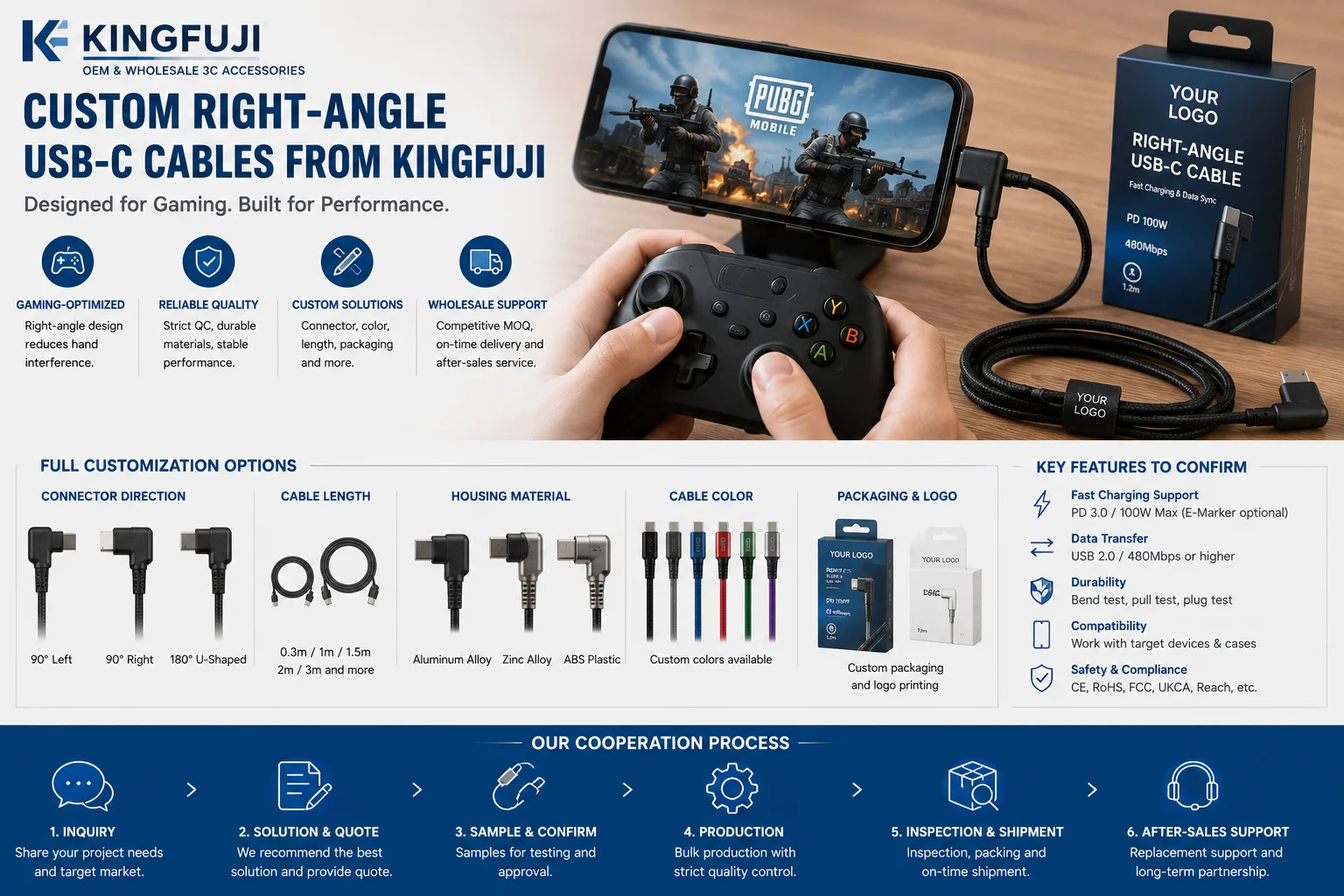
Start with the customer scenario
As a Shenzhen 3C supplier with 15 years of export experience, we begin by asking practical questions. We want to understand whether the cable is for mobile gaming, power-bank use, bedside charging, travel, or a broader charging range.
For a gaming-focused project, we normally discuss:
- Target phone brands and models.
- Preferred landscape orientation.
- Required connector direction.
- USB-C to USB-C or USB-A to USB-C format.
- Cable length and jacket style.
- Charging and data requirements.
- Housing material and color.
- Package design and warning language.
- Target market compliance requirements.
Build a sample process
A responsible OEM project should include a sample stage. We encourage buyers to test the physical cable with real devices, common cases, and intended charging adapters before confirming a bulk order.
We can also discuss branded packaging, private-label logos, barcode placement, and retail-ready presentation. Still, we believe the connector direction and product fit should be approved first. Attractive packaging cannot solve a poor ergonomic match.
For European and US programs, buyers should verify all relevant compliance documents for the exact item and destination market.11 We can provide available product documentation for review, but importers and retailers should make their own compliance decisions with qualified professionals where needed.
Frequently Asked Questions
Are right-angle USB-C cables better for mobile gaming?
Right-angle USB-C cables can be better for mobile gaming when the connector directs the cable away from the player’s hand in landscape mode. They are not automatically better for every phone or grip style. Buyers should test direction, case clearance, and cable flexibility.
Do right-angle USB-C cables support fast charging?
A right-angle design does not determine charging speed. Fast charging depends on the cable’s rated specification, connector configuration, charger, phone, and supported charging protocol. Buyers should verify the exact SKU’s power rating and supporting documentation.
Which right-angle direction should a retailer stock?
A retailer should choose direction based on target phone models, USB-C port location, and typical landscape grip. We recommend testing both left- and right-angle samples before selecting inventory, then showing the cable direction clearly in listings and packaging.
Can a 90-degree USB-C cable work with a phone case?
It may work, but fit depends on the case opening and connector-housing dimensions. Thick or rugged cases may block larger angled plugs. Buyers should test samples with common cases and avoid claiming universal case compatibility.
What should buyers request from an OEM USB-C cable manufacturer?
Buyers should request samples, dimensional details, charging and data specifications, quality-control requirements, compliance documents, MOQ, lead time, packaging options, and after-sales procedures. For right-angle USB-C cables, connector direction and case clearance deserve special attention.
Conclusion
Right-angle USB-C cables offer a focused opportunity for retailers serving customers who charge while playing mobile games. Their value comes from correct cable routing, not from a universal claim that angled plugs are better. We recommend that buyers test connector direction, phone compatibility, case clearance, charging specifications, and packaging clarity before expanding their range. If you are sourcing a scenario-matched gaming cable program, we can help you evaluate custom right-angle USB-C cable options, samples, branding, MOQ, and production requirements.
"Investigating How Smartphone Movement is Affected by ...", https://www.academia.edu/64745617/Investigating_How_Smartphone_Movement_is_Affected_by_Body_Posture. Ergonomics literature on handheld-device use indicates that accessory placement and cable routing can affect grip posture, hand clearance, and perceived comfort; the practical benefit of a particular connector angle nevertheless depends on the device and user setup. Evidence role: general_support; source type: research. Supports: Research or ergonomics guidance explaining that device-cable routing and accessory geometry can affect hand clearance and comfort during handheld use.. Scope note: This evidence would support the ergonomic principle rather than prove that every right-angle cable improves comfort for every player. ↩
"Proper Ergonomics for Hand Held Devices - YouTube",
. Human-factors research generally recognizes that the placement and routing of attached components can alter grip posture and physical interference during handheld-device use, making connector exit direction relevant to a specific use configuration. Evidence role: general_support; source type: research. Supports: Human-factors evidence that the physical arrangement of handheld accessories can influence obstruction, grip posture, and user comfort.. Scope note: Such evidence is contextual and cannot determine the preferred angle for all phone models, cases, or grip styles. ↩"The impact of smartphone use duration and posture on the ... - PMC", https://pmc.ncbi.nlm.nih.gov/articles/PMC11265474/. Studies of smartphone handling show that grip and contact points vary with device orientation and task, so an accessory projecting from a device edge can create physical interference in some hand positions. Evidence role: general_support; source type: paper. Supports: Studies of smartphone posture and grip showing that handheld use is affected by device-edge contact, hand placement, and attached accessories.. Scope note: The finding supports the possibility of interference but does not show that a straight connector will interfere for every user or gameplay posture. ↩
"Implementation and Verification of Cable Bending Stiffness in MoorDyn", https://docs.nlr.gov/docs/fy21osti/76968.pdf. Beam and cable mechanics establish that greater bending stiffness increases resistance to deformation and can transmit higher reaction forces at a constrained connector when the cable is displaced. Evidence role: mechanism; source type: education. Supports: Engineering principles showing that bending stiffness affects the force needed to deform a cable and the forces transmitted at constrained ends.. Scope note: Mechanical principles do not quantify the force from a particular braided consumer cable without measurements of its materials, geometry, and use position. ↩
"180 Degree USB Cable Guide: How to Choose the Right One", https://electronics.alibaba.com/buyingguides/180-degree-usb-cable-guide-when-you-need-it-when-you-don%E2%80%99t. Connector geometry references describe 180-degree cable-exit configurations as designs in which the cable is returned parallel to the connected device or assembly rather than projecting straight outward. Evidence role: definition; source type: other. Supports: Technical connector documentation defining cable-exit orientations and illustrating how a 180-degree form factor returns the cable parallel to a device surface.. Scope note: The exact route around a phone depends on the connector housing, port location, case geometry, and cable flexibility. ↩
"Analysis of Bending Fatigue in a 2-inch IWRC Wire Rope", https://stacks.cdc.gov/view/cdc/161748/cdc_161748_DS1.pdf. Cable-mechanics and reliability literature indicates that repeated tight bending raises mechanical strain in conductors and polymer jackets; a connector geometry that avoids a tight local bend can therefore reduce bending stress in a particular layout. Evidence role: mechanism; source type: research. Supports: Engineering evidence that repeated tight bending can increase mechanical strain in conductors and jackets and that routing geometry can affect local bend radius.. Scope note: This does not demonstrate longer life for every right-angle cable, because construction quality and actual handling remain decisive. ↩
"A Primer on USB Type-C and Power Delivery Applications and ...", https://www.ti.com/lit/slyy109. Under USB Power Delivery, the source advertises available power capabilities and the sink requests a compatible power contract, so the delivered charging level is limited by mutually supported capabilities. Evidence role: mechanism; source type: institution. Supports: USB Power Delivery documentation explaining that source and sink devices exchange capabilities and establish a mutually supported power contract.. Scope note: Cable capability can also limit the negotiated result, and manufacturer-specific charging modes may not be covered by standard USB Power Delivery behavior. ↩
"Product Search", https://www.usb.org/products. USB Type-C specifications provide for electronically marked cables that communicate cable characteristics to connected equipment, including capabilities relevant to higher-current and other enhanced cable operations. Evidence role: mechanism; source type: institution. Supports: USB-IF specifications explaining electronically marked USB Type-C cables and their role in communicating cable current or performance capabilities.. Scope note: Whether an e-marker is necessary for a particular product depends on its cable type, current rating, data capabilities, and the applicable version of the USB Type-C specification. ↩
"MatWeb: Online Materials Information Resource", https://databases.library.jhu.edu/databases/proxy/JHU05311. Materials-property references generally show that zinc alloys have substantially greater density and stiffness than common plastics, while molded plastics can offer low weight and economical production for suitable component designs. Evidence role: general_support; source type: education. Supports: Materials-engineering data comparing the density and stiffness of zinc alloys with common engineering plastics and discussing material-selection trade-offs.. Scope note: Perceived premium quality, finished-product cost, and durability depend on alloy grade, plastic type, wall thickness, tooling, finish, and internal construction. ↩
"USB-C", https://en.wikipedia.org/wiki/USB-C. Mechanical fit principles require sufficient clearance between mating parts, meaning that a connector housing can be blocked by a recessed or narrow case opening even when the USB-C plug itself matches the port. Evidence role: mechanism; source type: education. Supports: Mechanical-design principles establishing that part fit depends on mating geometry, clearances, and dimensional tolerances.. Scope note: A general fit principle cannot establish compatibility with a particular phone and case without direct dimensional comparison or physical testing. ↩
"General Use Products: Certification and Testing | CPSC.gov", https://www.cpsc.gov/Business--Manufacturing/Testing-Certification/General-Use-Products-Certification-and-Testing. European Union and United States regulatory guidance assigns importers and other economic operators responsibilities to determine which product-specific safety, conformity, labeling, and documentation requirements apply before goods are placed on the relevant market. Evidence role: general_support; source type: government. Supports: Official European Union and United States guidance on importer responsibilities and product-specific compliance obligations for consumer electrical or electronic products.. Scope note: The applicable rules for a USB-C cable depend on its exact design, functions, accompanying electronics, claims, and destination jurisdiction; this general guidance is not a legal determination for a specific SKU. ↩