Kevlar-reinforced USB-C cables can look like an easy premium upgrade, but many wholesale buyers discover that durability claims alone do not prevent returns. A cable may use aramid fibers and still fail at the connector, strain-relief collar, or plug housing. We help buyers assess the whole construction before paying a premium.
Kevlar-reinforced USB-C cables are worth considering for premium heavy-duty ranges when their full construction, test conditions, and quality controls support the claim. Kevlar or aramid reinforcement may improve resistance to pulling and repeated bending, but it does not make a cable unbreakable. Wholesale buyers should compare failure-prone areas, warranty terms, target retail price, MOQ, and supplier accountability before adding these cables to their assortment.
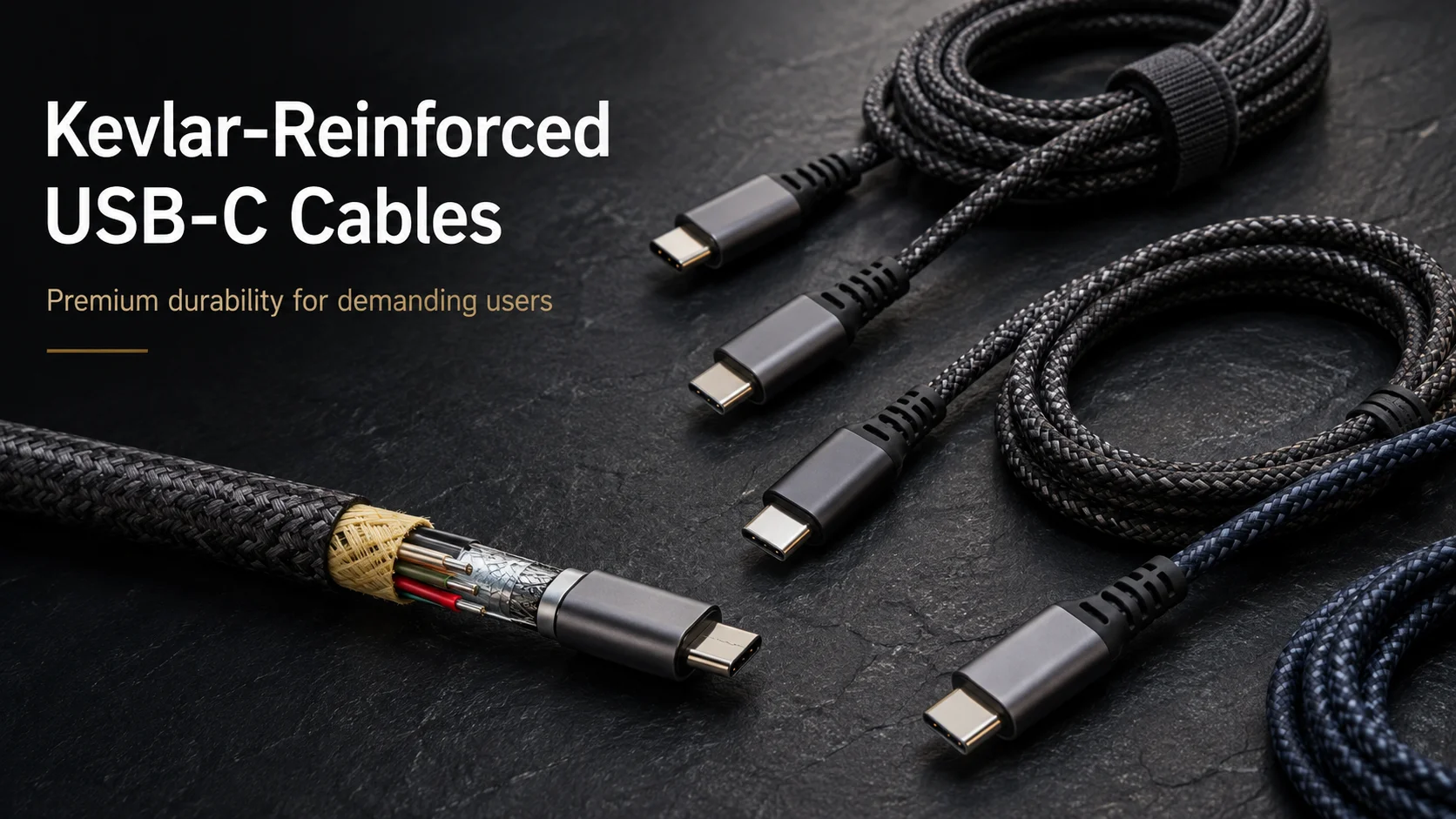
For 15 years, we have discussed cable sourcing with European and U.S. retailers, wholesalers, and online sellers. The recurring question is rarely just “Is Kevlar stronger?” Buyers really want to know whether a higher-cost cable can reduce complaints, protect store ratings, and still move at the right price point.
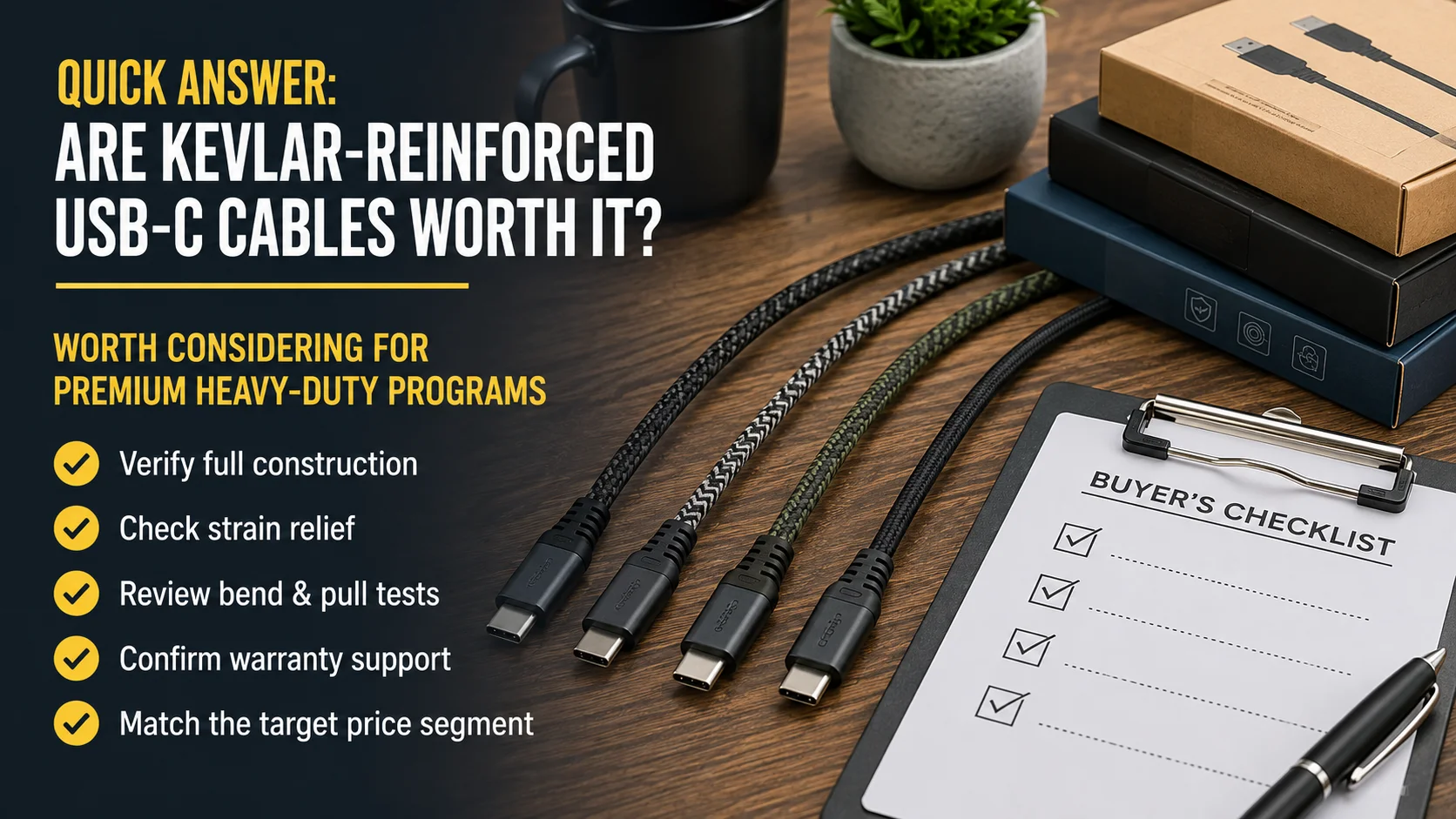
Quick Answer: Are Kevlar-Reinforced USB-C Cables Worth It?
Many buyers face a familiar problem: budget cables can sell quickly, but weak durability can create costly returns. A “reinforced” label may sound reassuring, yet it can also become a marketing claim with little detail behind it.
Kevlar-reinforced USB-C cables can be worthwhile for heavy-duty wholesale programs if buyers sell into a premium segment and verify the cable’s complete durability design. The reinforcement should be evaluated alongside connector molding, strain relief, conductor quality, braid construction, pull testing, bend testing, packaging, and after-sales support. It is not automatically the right choice for every price-sensitive cable SKU.
The commercial decision behind “heavy-duty”
In our quotation discussions, buyers often focus first on the fiber material. That makes sense because “Kevlar” is familiar language for strength. Still, the real wholesale risk usually sits elsewhere.
A cable may be damaged through:
- Repeated bending directly behind the connector
- Pulling the cable from a wall charger or laptop port
- Poorly molded plug housings
- Fraying outer braids
- Loose USB-C connector tolerances
- Inconsistent assembly from one production batch to another
The right question is therefore not whether a supplier uses aramid reinforcement. The better question is:
Will this cable construction reduce the types of failures that create returns in my sales channel?
For a premium e-commerce listing, a durable-cable claim can support a higher retail price and clearer product positioning. For a discount store or basic accessory bundle, the added cost may reduce competitiveness without delivering enough commercial benefit.
We recommend treating Kevlar reinforcement as one part of a durability specification, not as a complete specification by itself.
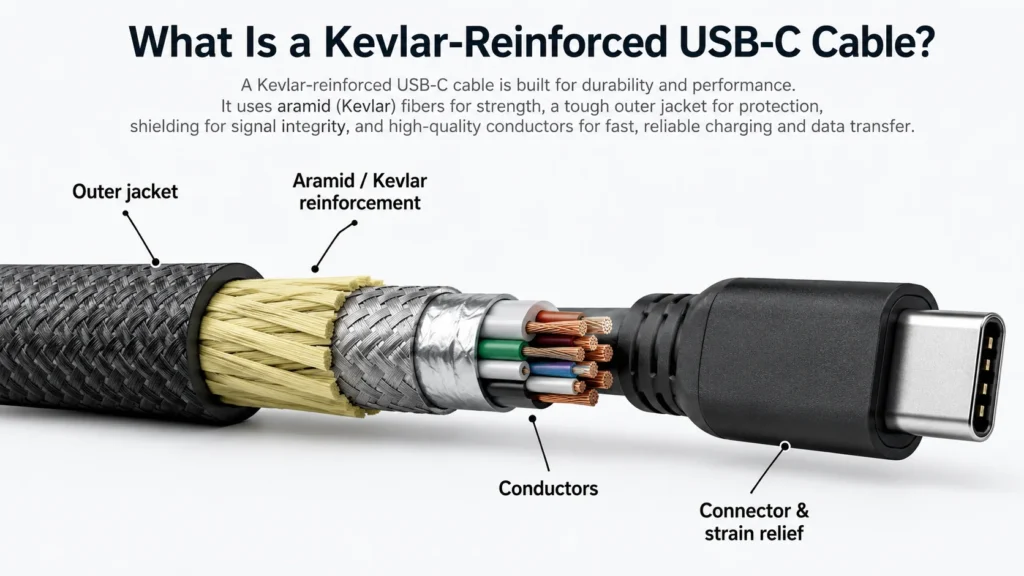
What Is a Kevlar-Reinforced USB-C Cable?
A standard USB-C cable can look strong on the outside while having limited protection around internal conductors. This creates confusion for buyers because different suppliers may use the same “Kevlar cable” wording for very different constructions.
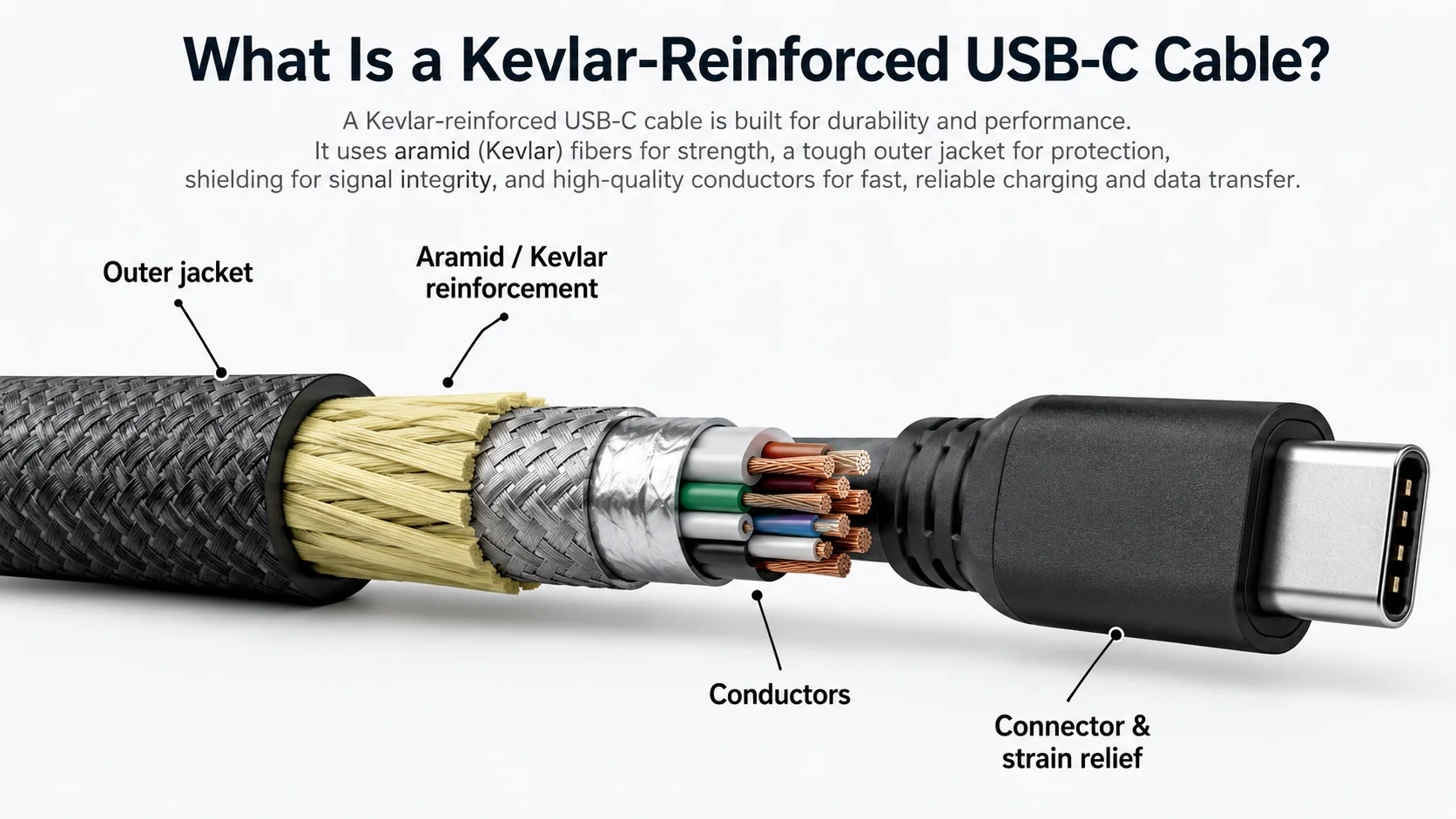
A Kevlar-reinforced USB-C cable is a USB-C charging or data cable that uses aramid fiber, often marketed as Kevlar, within or around its cable structure. The fiber is intended to add tensile strength and help resist damage from pulling or repeated flexing.1 Its actual value depends on where the reinforcement sits and how the full cable is assembled.
Where reinforcement may appear
Suppliers may place aramid fibers in different layers. Buyers should ask for a cross-section drawing, material breakdown, or clear production specification instead of relying only on product photos.
A typical cable construction may include:
- Copper or copper-alloy conductors for power and data transmission
- Insulation layers around individual conductors
- Shielding, where required by the cable design
- Aramid fiber reinforcement for tensile support
- Outer jacket or braided sleeve for handling and abrasion resistance
- Connector strain relief to manage repeated bending near the plug
The word “Kevlar” is also often used loosely in the market. Kevlar is a registered trademark, while aramid fiber is the broader material category. A supplier should be able to state what reinforcement material is used, where it is placed, and whether the claim is supported by purchase records or technical documentation.
From a sourcing perspective, we advise buyers to avoid writing absolute claims such as “unbreakable” or “indestructible.” These phrases increase expectation risk and may create avoidable after-sales disputes.
Why Is the Heavy-Duty Cable Market Growing?
Cable buyers have become less patient with disposable accessories. One failed cable may be inexpensive, but a return can cost far more once shipping, platform fees, support labor, and negative reviews are included.2
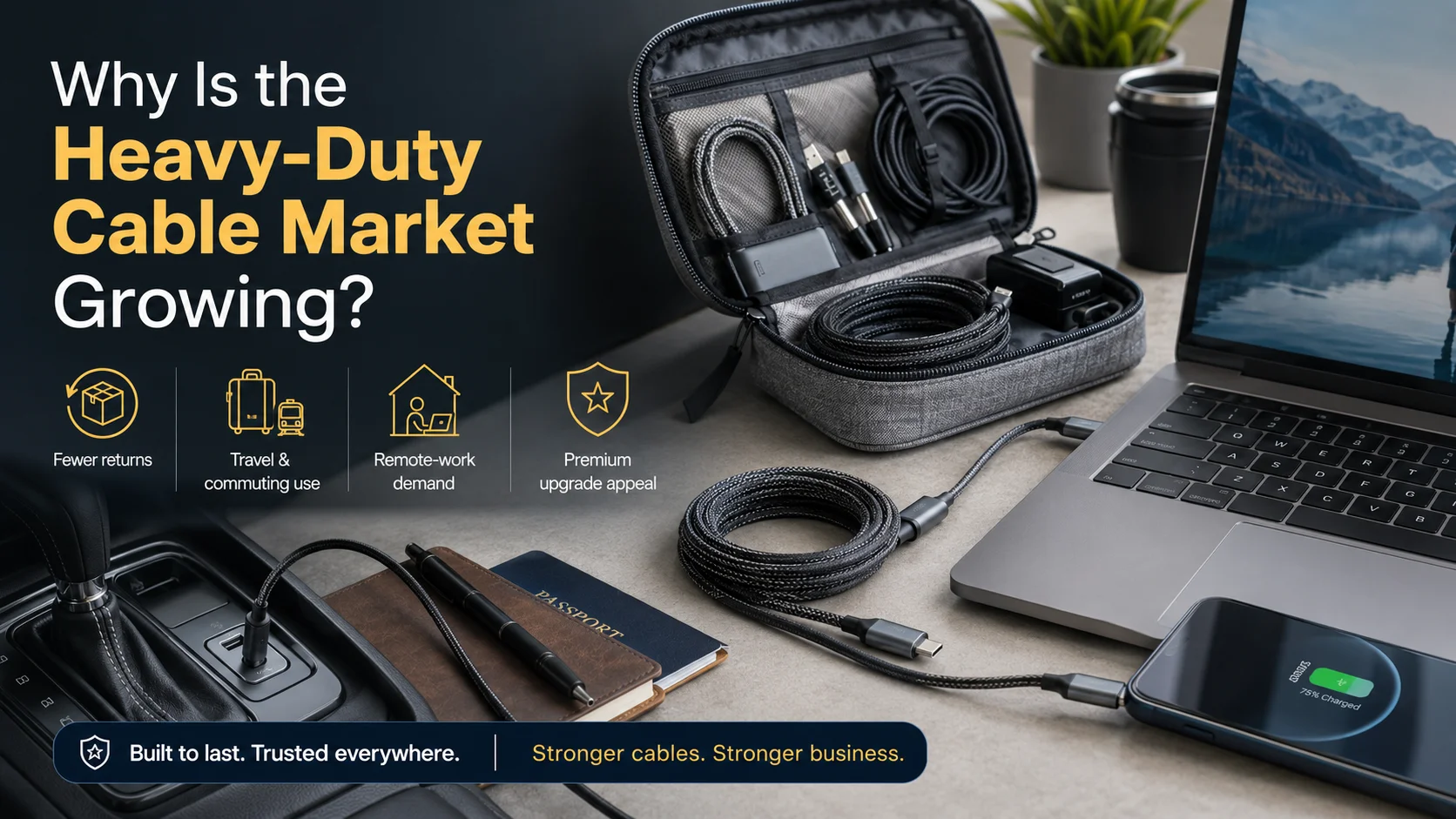
The heavy-duty cable market is growing3 because retailers and e-commerce sellers want products that offer a clearer value proposition than basic charging cables. Durable USB-C cable ranges can appeal to customers who travel, work remotely, use cables in vehicles, or frequently bend and pull them. However, demand varies by channel and price segment.
Why durability has become a selling point
USB-C has become a central connector format across phones, tablets, laptops, power banks, headphones, game devices, and other electronics.4 That broad usage creates repeat demand, but it also means consumers use the same cable in many stressful situations.
We hear several common concerns from wholesale customers:
- “Can we reduce low-star reviews caused by cable failure?”
- “Can we create a premium cable tier without losing volume?”
- “Will the packaging explain why this cable costs more?”
- “Can the supplier maintain the same quality on repeat orders?”
- “What happens if a customer claims the cable failed after a few months?”
A heavy-duty product line can answer these concerns if the positioning is specific. For example, a retailer may sell a basic cable for everyday replacement needs and a reinforced cable for customers who prioritize durability. This creates a clearer good-better-best assortment.
Still, customer feedback and repeat-order patterns are commercial indicators, not independent laboratory proof. We use them to understand common market concerns, but we encourage buyers to conduct their own sample testing and application-specific evaluation before making strong retail claims.
How Do Kevlar-Reinforced USB-C Cables Compare With Nylon-Braided and TPE Cables?
Buyers often compare outer materials rather than total design. A nylon-braided cable may feel premium, while a TPE cable may feel softer and more flexible. Neither appearance alone confirms long-term durability.
Kevlar-reinforced USB-C cables typically target higher tensile resistance than basic TPE or nylon-braided cables, but the outer jacket does not tell the whole story. Nylon braid mainly contributes to surface abrasion resistance and appearance, while TPE often supports flexibility.5 Aramid reinforcement is usually an internal structural feature rather than a replacement for good connector design.
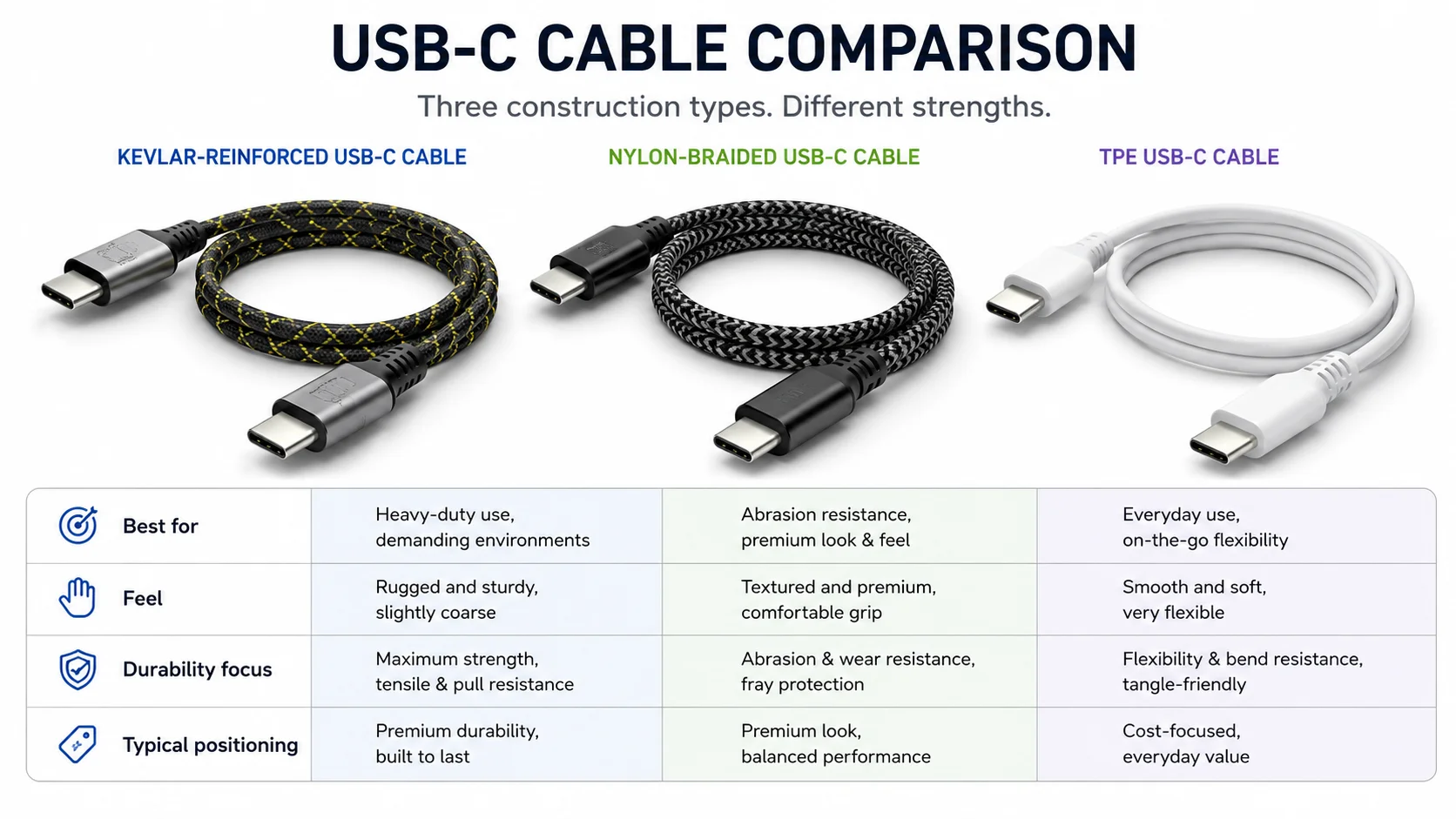
Wholesale comparison table
| Feature | Kevlar-Reinforced USB-C Cable | Nylon-Braided USB-C Cable | TPE USB-C Cable |
|---|---|---|---|
| Main positioning | Premium durability | Mid-range or premium appearance | Value to mid-range everyday use |
| Typical outer feel | Depends on braid and jacket design | Textured, fabric-like | Smooth and flexible |
| Tensile support | May be stronger if aramid is properly integrated | Depends on internal structure | Depends on internal structure |
| Flexibility | Can range from moderate to firm | Usually moderate | Often high |
| Abrasion resistance | Depends on outer jacket | Often good | Can vary widely |
| Retail story | Heavy-duty, reinforced construction | Braided, tangle-resistant appearance | Soft, flexible, practical |
| Buyer verification need | High | High | High |
The common mistake in product comparisons
A nylon-braided cable is not necessarily reinforced internally. Likewise, a cable described as Kevlar-reinforced may have a basic outer jacket or weak strain relief. We recommend that buyers compare complete samples side by side.
During sample review, inspect:
- Connector-to-cable transition
- Plug housing seams
- Braid tightness and finishing
- Cable diameter and consistency
- Flexibility at normal user angles
- USB-C plug fit in representative devices
- Packaging claims versus documented specifications
The best option depends on your intended shelf price and buyer expectations. A premium heavy-duty SKU should look, feel, and perform consistently enough to justify its position.
What Is the Difference Between Internal and External Kevlar Reinforcement?
A cable can be marketed as “Kevlar reinforced” even when the visible braid is the main visual feature. Buyers need to know whether the reinforcement is structural, cosmetic, or a combination of both.
Internal Kevlar reinforcement uses aramid fibers within the cable body to support the internal structure during pulling and flexing. External reinforcement refers to visible protective layers, such as braiding or a reinforced jacket. Internal reinforcement may help tensile performance, while external layers mainly affect abrasion resistance, handling, and visual presentation.6
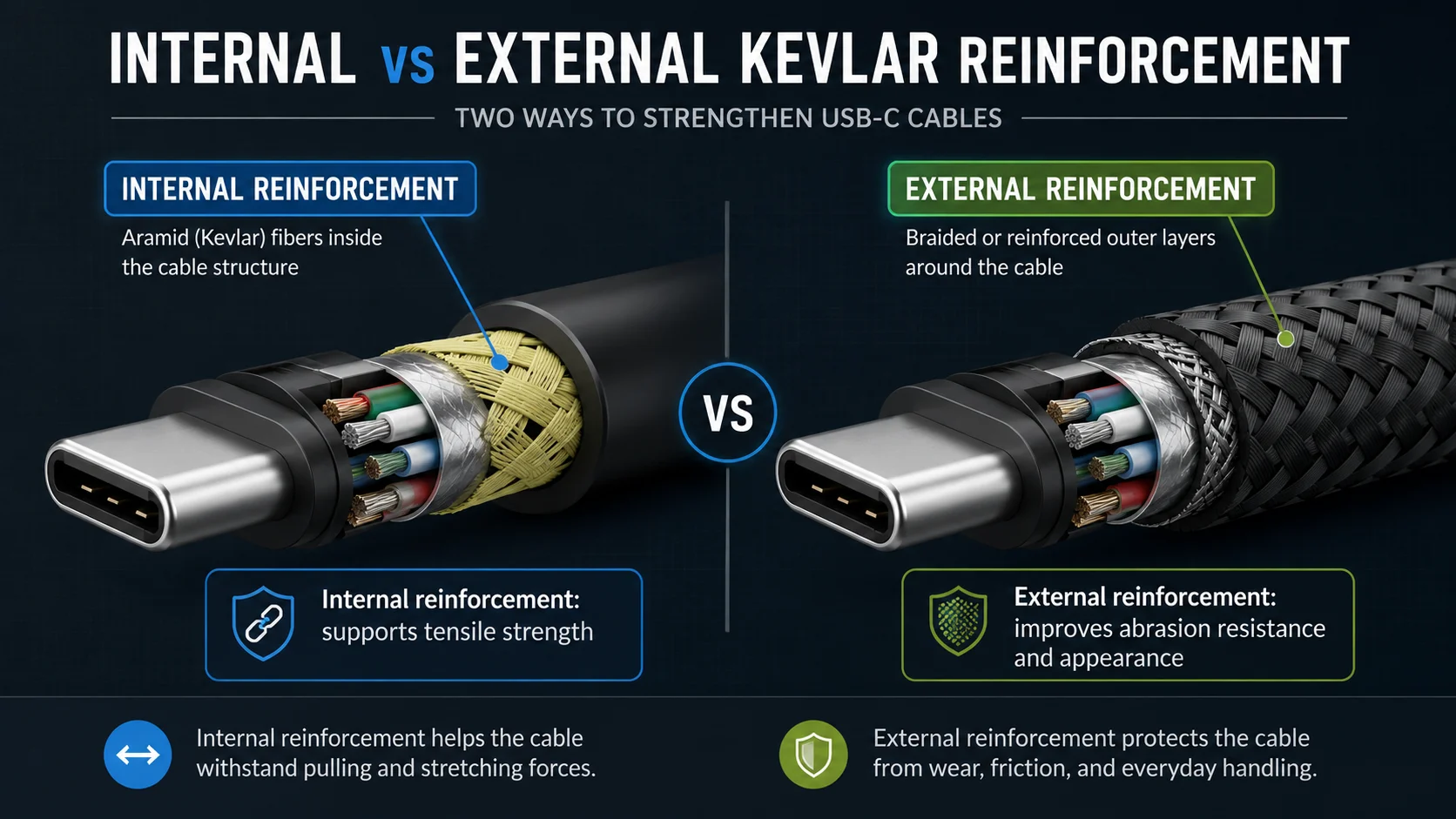
Why placement matters
Internal reinforcement can help carry mechanical stress away from delicate conductors. However, the benefit depends on how the fiber is anchored and how the cable transitions into the connector.
External layers can also matter. A dense braid may help reduce visible wear and can improve shelf appeal. Yet a braid that is too loose may snag, shift, or fray. A stiff outer sleeve can also make the cable less comfortable for daily use.
We suggest asking suppliers these practical questions:
- Is the aramid fiber located inside the cable body, in the braid, or both?
- How does the reinforcement connect near the USB-C plug?
- What material is used for the strain-relief collar?
- Is the cable designed for charging only, USB 2.0 data, or a higher data specification?
- What test method is used for flex and pull claims?
- Can the supplier provide pre-production samples from the intended material set?
A clear supplier will not need to reveal every proprietary detail. However, they should provide enough information for a professional buyer to evaluate the design responsibly.
How Do Kevlar-Reinforced USB-C Cables Improve Bend Lifespan, Pull Strength, and Durability?
Retail claims often mention bend cycles or pull strength without explaining how the test was performed. This can make direct comparison almost meaningless, especially when two suppliers use different angles, loads, speeds, or pass/fail rules.
Kevlar-reinforced USB-C cables may improve resistance to pulling and repeated bending by adding aramid fibers that help support the cable body. However, durability results depend on the complete construction and test method. Buyers should compare like-for-like test conditions rather than relying on a single bend-cycle number or tensile-strength claim.
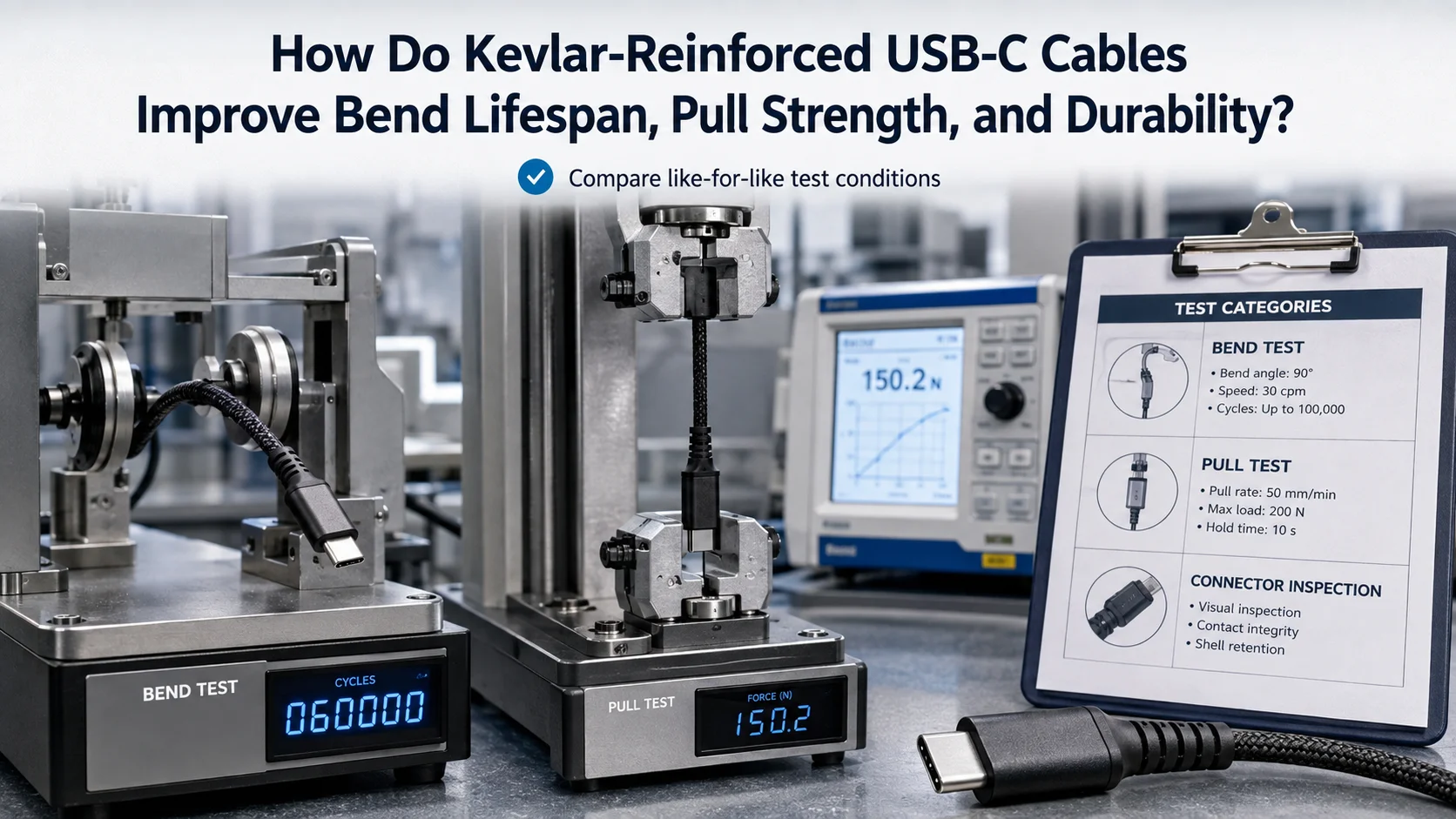
How to read durability claims critically
A bend test might use different conditions for each factory:
| Test variable | Why it changes the result |
|---|---|
| Bend angle | A tighter angle creates more stress |
| Load or hanging weight | More weight increases strain |
| Test speed | Faster cycling may create different failure behavior |
| Bend location | Testing at the connector is more relevant than testing mid-cable |
| Cable condition | Heat, cold, and prior use can affect materials |
| Pass criteria | Electrical continuity and visible damage are different standards |
A pull-force figure also needs context. Buyers should ask whether the force was applied gradually, how long it was held, and whether the cable was tested at the connector or through the cable body.
In our experience, strain relief deserves special attention. Many real-world cable failures happen close to the plug because users bend the cable sharply while charging in bed, in a vehicle, or at a desk.7 Internal aramid fibers may support the cable, but they cannot fully compensate for poor molding or a weak connector transition.
For large projects, we recommend independent laboratory evaluation or qualified professional testing based on your actual use case and market requirements.
Are Kevlar-Reinforced USB-C Cables Too Stiff for Everyday Use?
A cable that feels extremely tough can create a different problem: poor user experience. If it is hard to coil, difficult to route in a car, or pulls on a device port, customers may not see it as an upgrade.
Kevlar-reinforced USB-C cables are not always too stiff for everyday use, but reinforcement can affect flexibility depending on cable diameter, braid density, jacket material, and strain-relief design. Wholesale buyers should evaluate handling alongside durability. The best heavy-duty cable balances resistance to damage with convenient daily use.
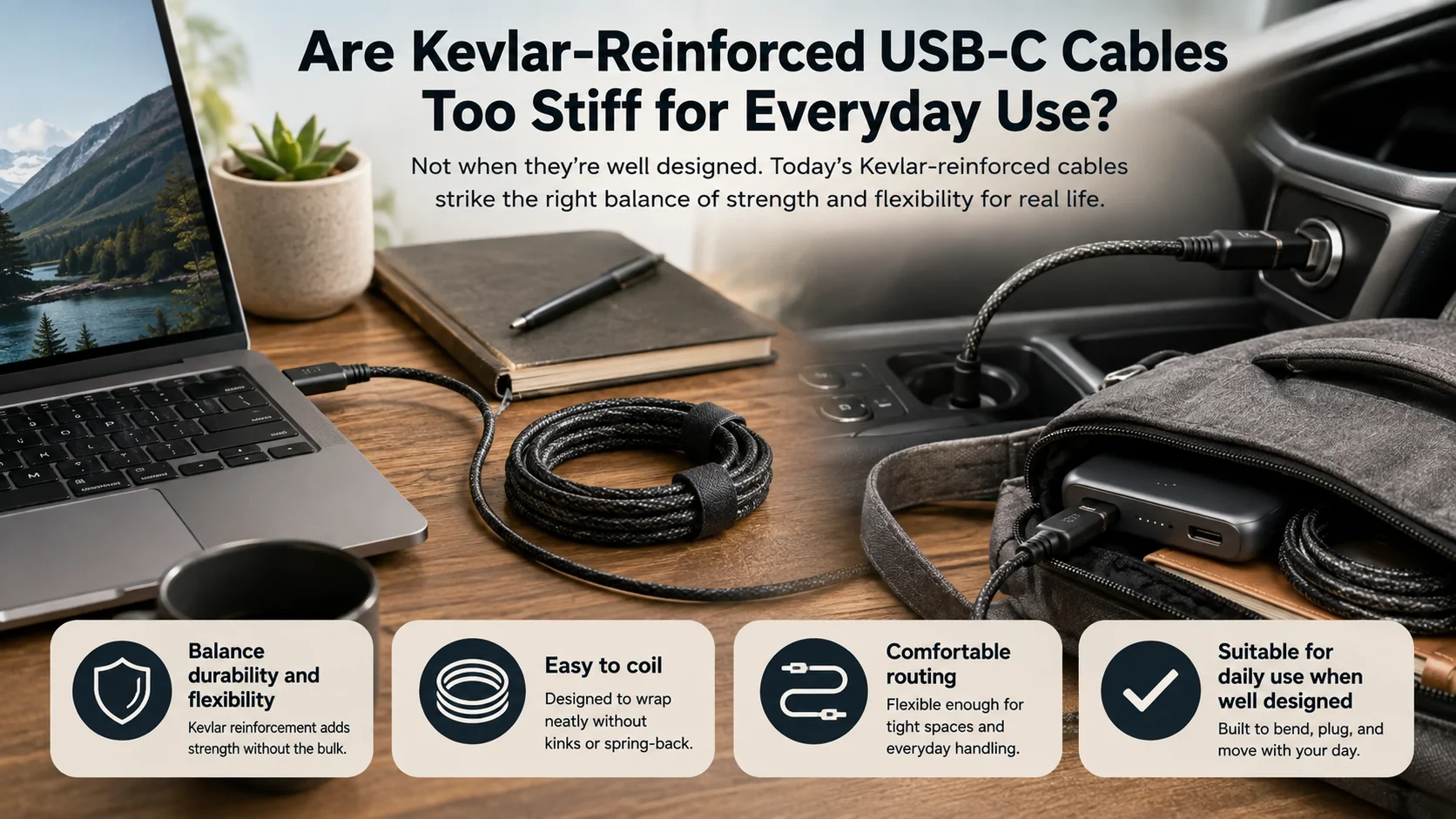
Flexibility is part of product quality
We have seen buyers reject a technically robust sample because it felt awkward in the hand. That feedback is useful because customers interact with the cable every day, not only during a stress test.
A practical sample review should include:
- Coiling the cable for travel
- Connecting it to a phone case with a recessed port
- Routing it through a vehicle console
- Using it with a power bank in a bag
- Checking whether the cable stays flat on a desk
- Evaluating whether the connector creates leverage on the device port
A heavy-duty cable does not need to feel rigid. In fact, excessive stiffness may move stress toward the connector or device port during use.8 The ideal balance will vary by length. A short 0.5-meter cable for power-bank use may tolerate a different feel than a 2-meter bedside cable.
We advise buyers to define their preferred cable feel in the product brief. Terms like “soft,” “firm,” and “premium” are subjective, so physical approved samples are essential before mass production.
Are Kevlar-Reinforced USB-C Cables Dog-Chew-Proof or Only Damage-Resistant?
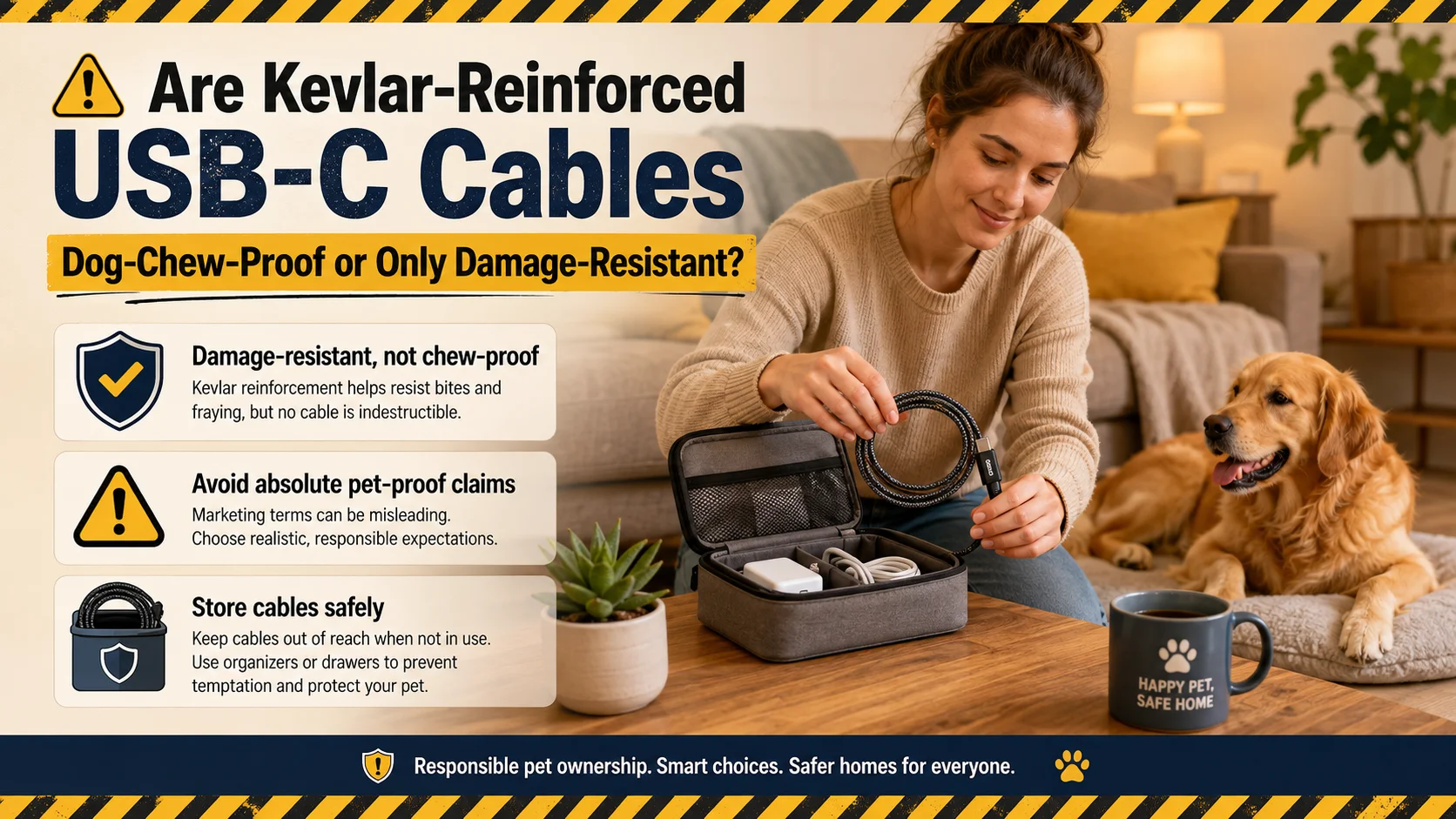
“Pet-proof” claims can attract attention online, but they are risky. Dogs vary widely in bite force, chewing behavior, and persistence.9 Electrical cable damage also creates safety concerns, so marketing language should remain careful.
Kevlar-reinforced USB-C cables should be described as damage-resistant rather than dog-chew-proof. Aramid reinforcement may make a cable more difficult to tear under certain conditions, but it cannot guarantee protection from animal chewing. Wholesale buyers should avoid absolute pet-proof claims unless they have suitable evidence and legal approval for their market.
Safer product messaging for wholesale channels
Overstated language can create return exposure. If a customer sees “dog-chew-proof,” they may reasonably expect the cable to survive every pet-related incident. That expectation is difficult to support.
Safer wording may include:
- “Reinforced cable construction”
- “Designed for improved everyday durability”
- “Aramid fiber reinforcement”
- “Enhanced pull and bend resistance”
- “Heavy-duty cable design”
Buyers should also consider the compliance and labeling requirements for each destination market. Certifications and compliance documents should be reviewed and verified for the specific product configuration, market, and shipment. A certificate associated with one cable model does not automatically apply to every length, connector combination, or customized version.
We believe clear communication is better business. A realistic durability claim can build trust and reduce disputes. A dramatic claim may win clicks, but it can also invite complaints that damage a listing or retail relationship.
What Should Wholesale Buyers Verify Before Ordering Kevlar-Reinforced USB-C Cables?
A premium cable can become a strong repeat-order product, but only if the supplier can deliver consistent quality. The purchase decision should cover commercial terms, technical construction, quality control, and after-sales handling.
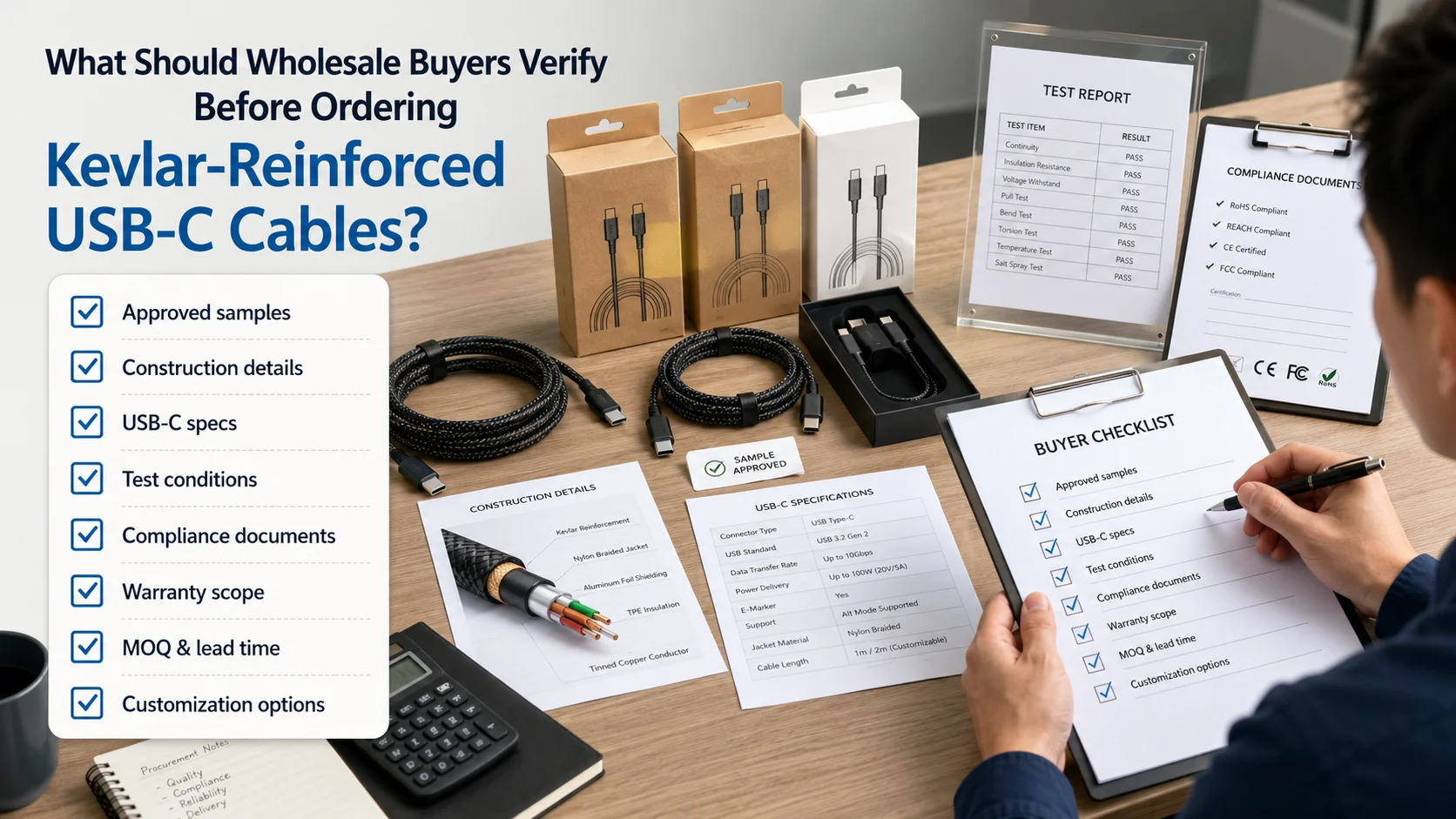
Before ordering Kevlar-reinforced USB-C cables, wholesale buyers should verify construction details, approved samples, test conditions, USB-C specifications, production controls, compliance documents, warranty scope, MOQ, lead time, and customization options. The goal is to assess real return-risk reduction, not simply to buy the strongest marketing claim.
Buyer verification checklist
| Area | Questions to ask |
|---|---|
| Construction | Where are aramid fibers used, and what is the complete layer structure? |
| Connector | What material and molding process are used for the plug and strain relief? |
| Electrical function | What charging, data, and USB-C protocol specifications does the model support? |
| Testing | What are the exact bend, pull, continuity, and visual-inspection conditions? |
| Quality control | What inspections occur before, during, and after production? |
| Documentation | Which compliance documents apply to this exact model and target market? |
| Commercial terms | What are the MOQ, lead time, packaging options, and payment terms? |
| After-sales | How are defects documented, evaluated, and resolved? |
Do not skip pre-shipment inspection
For meaningful orders, buyers may consider:
- Golden-sample approval
- Pre-production sample confirmation
- In-process inspection
- Pre-shipment inspection
- Random functional testing from finished cartons
- Retention samples for later comparison
As a Shenzhen 3C manufacturer, we know that a buyer’s reputation is tied to every unit that reaches the shelf or doorstep. We therefore recommend documenting agreed requirements in writing, including product photos, cable length tolerance, packaging artwork, labeling, and defect-handling expectations.
How Can You Source Custom Kevlar-Reinforced USB-C Cables From Kingfuji?
Many buyers need more than an off-the-shelf cable. They may require retail-ready packaging, private-label printing, a specific length, color matching, or an assortment that fits a defined price band.
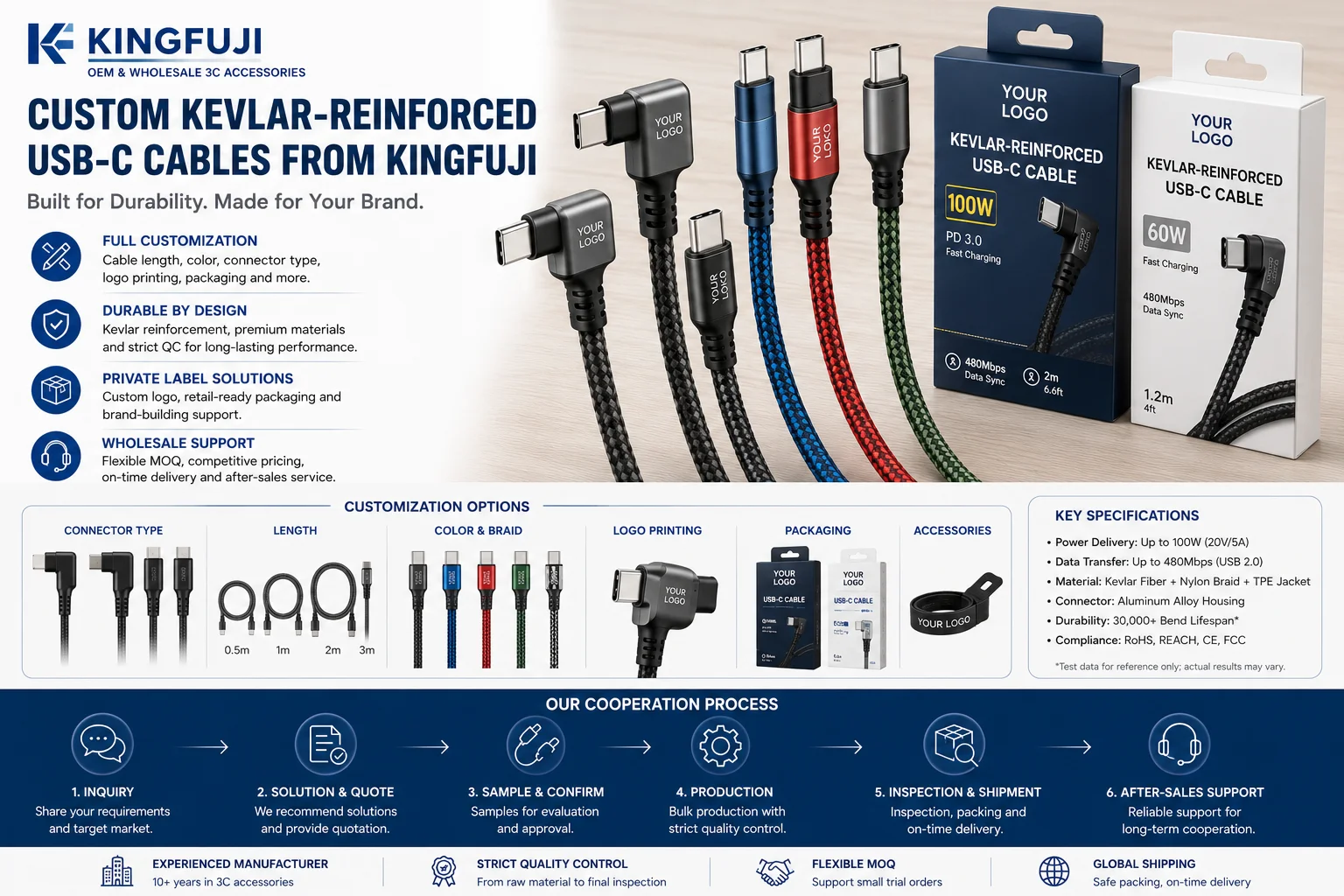
At Kingfuji, we support wholesale buyers sourcing custom Kevlar-reinforced USB-C cables by discussing target channels, durability expectations, cable specifications, packaging, MOQ, lead time, and quality-control requirements before production. We encourage buyers to evaluate samples and verify applicable documentation for their intended market and application.
A practical sourcing process
Our process starts with the commercial goal, not only the material request. A retailer selling premium accessories needs a different solution from a wholesaler serving value-focused independent stores.
We can discuss:
- USB-C to USB-C, USB-A to USB-C, or other connector configurations
- Cable length and color options
- Braided, TPE, or reinforced outer constructions
- Private-label logo printing
- Retail packaging and barcode requirements
- Bundle configurations
- MOQ and production lead time
- Sample approval and quality expectations
We have 15 years of export experience serving overseas 3C buyers, especially in European and U.S. markets. That experience helps us understand the practical questions behind a quotation: price stability, delivery timing, packaging quality, customization feasibility, and after-sales communication.
Still, we encourage every buyer to conduct independent due diligence. Product suitability depends on the intended application, local regulations, end-user expectations, and the exact product specification. A qualified professional should review application-specific technical or compliance decisions where necessary.
Frequently Asked Questions
Are Kevlar-reinforced USB-C cables stronger than regular braided cables?
They may offer higher tensile support when aramid fibers are properly integrated into the internal construction. However, strength depends on the complete cable design, especially the connector, strain relief, conductor arrangement, and testing method. A braided exterior alone does not confirm internal reinforcement.
Do Kevlar-reinforced USB-C cables charge faster?
No. Mechanical reinforcement does not itself improve charging speed, USB-C Power Delivery capability, data rate, or compatibility.10 Buyers should verify electrical specifications separately, including wattage rating, e-marker requirements where applicable11, and supported data protocol.
What MOQ should I expect for custom heavy-duty USB-C cables?
MOQ varies by cable design, color, packaging, logo printing, and component availability. Standard products usually require lower MOQs than fully customized programs. We recommend discussing your forecast volume, retail channel, packaging needs, and target delivery date before confirming a production plan.
Can I use “Kevlar” in my product listing?
Buyers should use trademarked material names carefully and verify that the supplier’s material claim is accurate and permitted for marketing use. “Aramid fiber reinforced” may be more appropriate in some cases. Legal, platform, and market-specific labeling requirements should also be reviewed.
Which cable failures should I focus on during sample testing?
Focus on the connector-to-cable transition, plug fit, continuity after flexing, braid integrity, visible deformation, and cable behavior during normal handling. You should also test the cable with representative chargers and devices to confirm the electrical function promised by the specification.
Conclusion
Kevlar-reinforced USB-C cables can be a smart addition to a premium heavy-duty range, but only when buyers evaluate the full durability system. Aramid fiber may help with pull and bend resistance, yet connector construction, strain relief, testing conditions, and quality control often have a larger effect on real return risk. We recommend comparing approved samples, asking precise supplier questions, and matching the premium to your target channel. Contact Kingfuji to discuss custom durable cable options, MOQ, packaging, and wholesale sourcing requirements.
"Mechanical Properties of Aramid/Carbon Hybrid Fiber ... - PMC", https://pmc.ncbi.nlm.nih.gov/articles/PMC8510375/. Materials-science literature describes aramid fibers as high-tensile-strength reinforcement materials whose effectiveness depends on fiber architecture, matrix or jacket integration, and load transfer within the finished assembly. Evidence role: mechanism; source type: paper. Supports: Aramid fibers have high tensile strength and are used as reinforcing fibers in applications requiring resistance to mechanical loading.. Scope note: This evidence supports the general reinforcement mechanism, not the durability of any particular USB-C cable design. ↩
"Determining the Effect of the Returns Management Experience on ...", https://trace.tennessee.edu/cgi/viewcontent.cgi?referer=&httpsredir=1&article=2592&context=utk_chanhonoproj. Research on retail reverse logistics identifies transportation, inspection, restocking, customer-service, and inventory losses as components of return costs that can exceed a low-value item's direct unit cost. Evidence role: general_support; source type: research. Supports: Product returns impose logistics, processing, customer-service, and inventory costs beyond the initial product cost.. Scope note: Actual costs vary substantially by retailer, marketplace policy, shipping arrangement, product value, and disposition method. ↩
"Current U.S. International Trade in Goods and Services (FT900)", https://www.census.gov/ft900. A market dataset or consumer survey may document growth in demand for durable charging accessories, provided that its geography, product definition, observation period, and methodology are reported. Evidence role: statistic; source type: research. Supports: A neutral market study or survey should document growth in demand, sales, or consumer preference for durable charging accessories.. Scope note: Evidence for the overall USB-cable market may not directly isolate Kevlar-reinforced or heavy-duty cable products. ↩
"USB-C", https://en.wikipedia.org/wiki/USB-C. USB Type-C specifications define a reversible connector system used across a wide range of devices, including mobile products, computers, chargers, and peripherals. Evidence role: general_support; source type: institution. Supports: USB Type-C is designed for use across a broad range of computing and consumer-electronics products.. Scope note: The standard's broad applicability does not establish the market share of USB-C in every device category or region. ↩
"Braided Cable Sleeves Guide | Materials & Benefits", https://aerosusa.com/braided-cable-sleeves-guide/. Polymer and textile references describe nylon coverings as abrasion-resistant protective layers and thermoplastic elastomers as materials capable of flexible, rubber-like mechanical behavior. Evidence role: mechanism; source type: research. Supports: Nylon textile structures are commonly used for abrasion resistance, and thermoplastic elastomers are valued for flexible elastomeric behavior.. Scope note: Performance in a cable depends on the particular polymer grade, braid construction, thickness, and complete cable design. ↩
"IIIIIIIIIIIIIu EIIEo - DTIC", https://apps.dtic.mil/sti/pdfs/ADA091185.pdf. Cable-engineering references distinguish tensile strength members, which help bear axial loads, from outer jackets and braids, which principally provide surface protection, handling characteristics, and environmental resistance. Evidence role: mechanism; source type: education. Supports: Aramid strength members can carry tensile loads in cable constructions, while outer jackets and braids provide environmental and abrasion protection.. Scope note: Layer functions may overlap in a specific product, and connector termination quality remains important to overall cable durability. ↩
"4 Strain Relief Design Mistakes That Cause Cable Failures", https://www.telewiretech.com/blogs/technical-resources/why-your-cables-break-the-engineer-s-guide-to-strain-relief-failure?srsltid=AfmBOoqM7XqwF9vC0pPbJ5PFUDYm_e-YI8NwALrY9cBvfOHdOID8FDy2. Mechanical-fatigue studies of terminated wires and cable assemblies show that repeated flexing near constrained connector transitions can concentrate strain and contribute to fatigue failure, supporting the importance of strain-relief design. Evidence role: mechanism; source type: paper. Supports: Repeated bending near a constrained termination can concentrate strain and contribute to conductor or insulation fatigue.. Scope note: The evidence concerns general terminated-wire mechanics and does not quantify failure rates for all USB-C cable products or usage settings. ↩
"Implementation and Verification of Cable Bending Stiffness in MoorDyn", https://docs.nlr.gov/docs/fy21osti/76968.pdf. Structural-mechanics analyses of cable and wire terminations indicate that increasing bending stiffness can raise bending moments at constrained interfaces, making strain-relief geometry relevant to load distribution. Evidence role: mechanism; source type: paper. Supports: Greater cable bending stiffness can increase moments and stress at constrained terminations under deflection.. Scope note: The magnitude of stress transfer depends on cable length, routing, connector geometry, support conditions, and user handling. ↩
"Cranial dimensions and forces of biting in the domestic dog - PMC - NIH", https://pmc.ncbi.nlm.nih.gov/articles/PMC2673787/. Veterinary and biomechanical research indicates that canine bite performance and chewing behavior vary among individuals and are influenced by morphology, size, motivation, and context. Evidence role: general_support; source type: paper. Supports: Canine biting and chewing forces and behaviors vary with factors such as body size, morphology, age, and individual behavior.. Scope note: Such research does not test whether a specific cable is resistant to chewing or establish a safe basis for a pet-proof product claim. ↩
"USB-C", https://en.wikipedia.org/wiki/USB-C. USB Type-C and USB Power Delivery documentation specifies electrical, signaling, and cable-identification requirements for supported power and data modes; mechanical reinforcement is not itself a determinant of those capabilities. Evidence role: mechanism; source type: institution. Supports: USB-C power delivery and data capabilities are determined by the applicable cable design, conductors, electronic marking where required, and USB specifications rather than reinforcement fiber alone.. Scope note: A reinforced cable may still support high power or data rates if it is separately designed and certified for the relevant USB specification. ↩
"Cables and Connectors", https://www.usb.org/cable_connector. USB Type-C specifications define electronically marked cable assemblies that communicate cable characteristics and are required for certain cable capabilities and operating modes. Evidence role: definition; source type: institution. Supports: USB Type-C specifications define electronically marked cable assemblies and specify circumstances in which cable identification is required for supported capabilities.. Scope note: The precise e-marker requirement depends on the applicable USB specification revision, cable type, current rating, and supported data or power mode. ↩