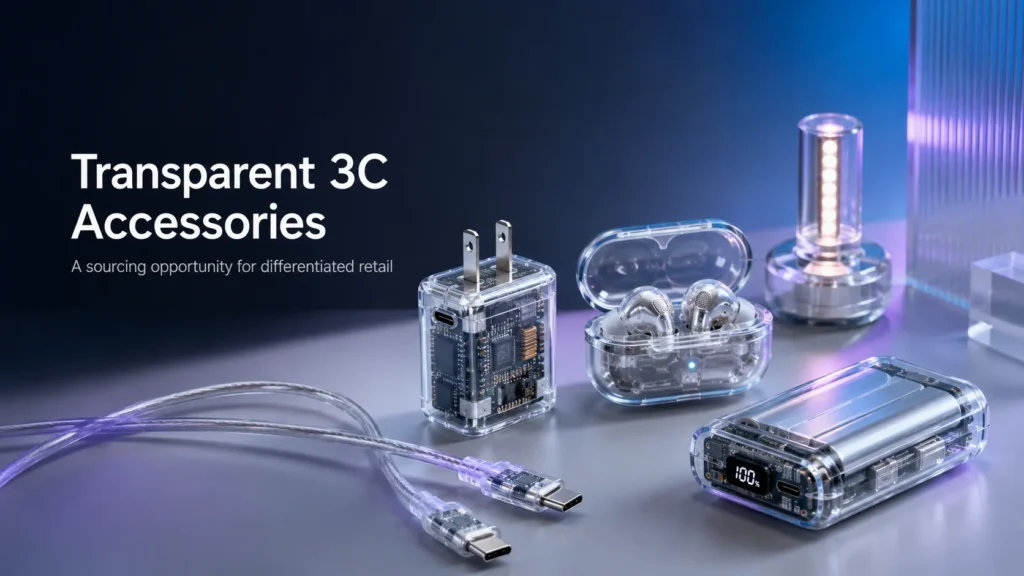
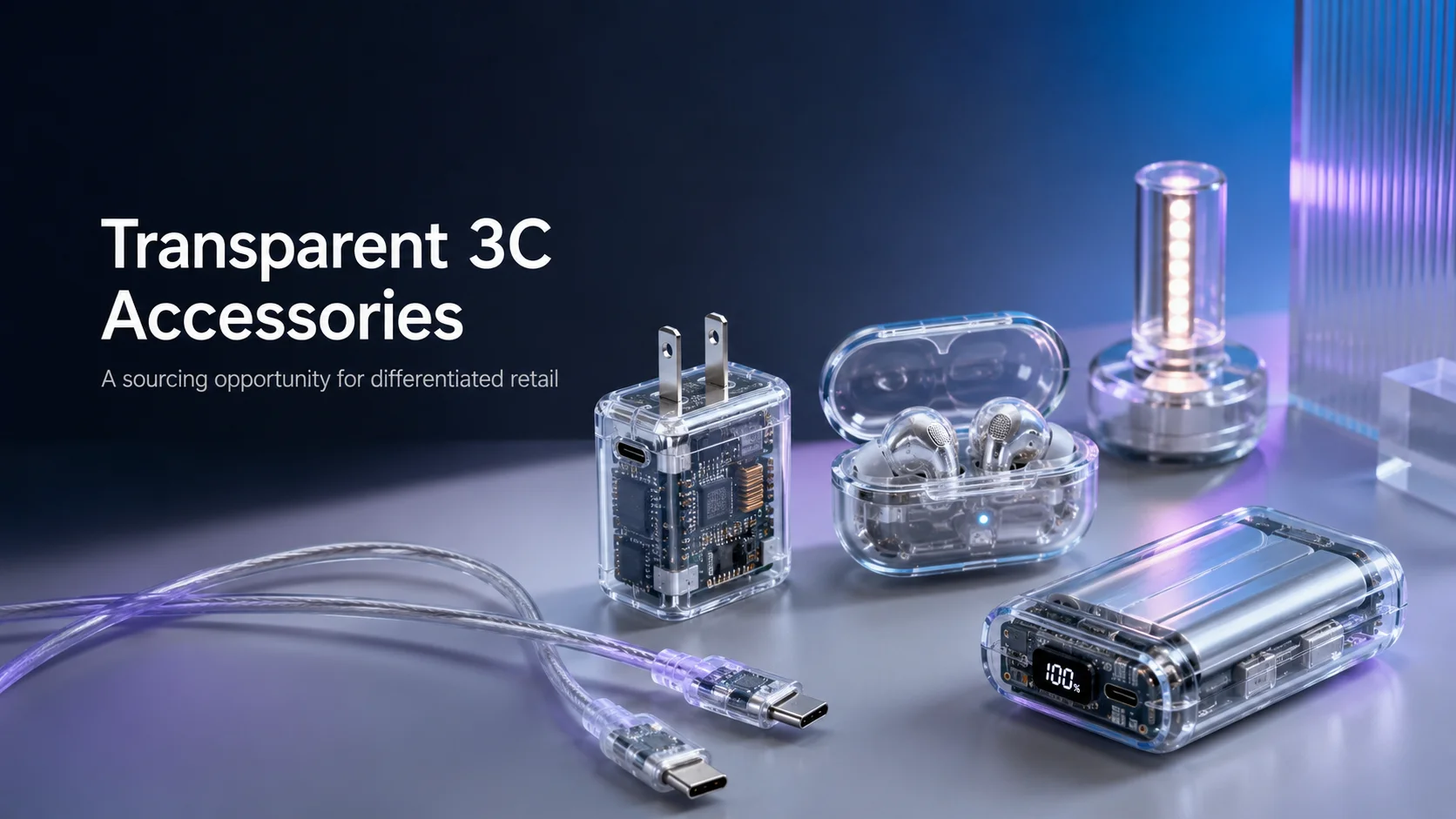
Transparent 3C accessories are attracting more attention because many retail buyers need products that look different without changing the basic function customers already understand. A standard charger or earbud can easily disappear among similar black-and-white products. The cyborg transparent look offers a practical way to create visual distinction—if it fits the channel, price point, and customer profile.
Transparent 3C accessories are becoming a sourcing opportunity1 because visible structures, translucent shells, and LED details can help familiar products stand out on shelves and online listings. However, this is not a guaranteed mass-market winner. Wholesale buyers should test transparent-design SKUs in limited quantities, verify material quality, and expand only when sell-through and repeat-order signals support the decision.
In our 15 years of exporting 3C accessories from Shenzhen, we have seen many design ideas come and go. In recent buyer conversations, transparent housings and cyberpunk-style details come up more often. The key question is not whether the look is fashionable. The key question is whether it supports your assortment strategy.
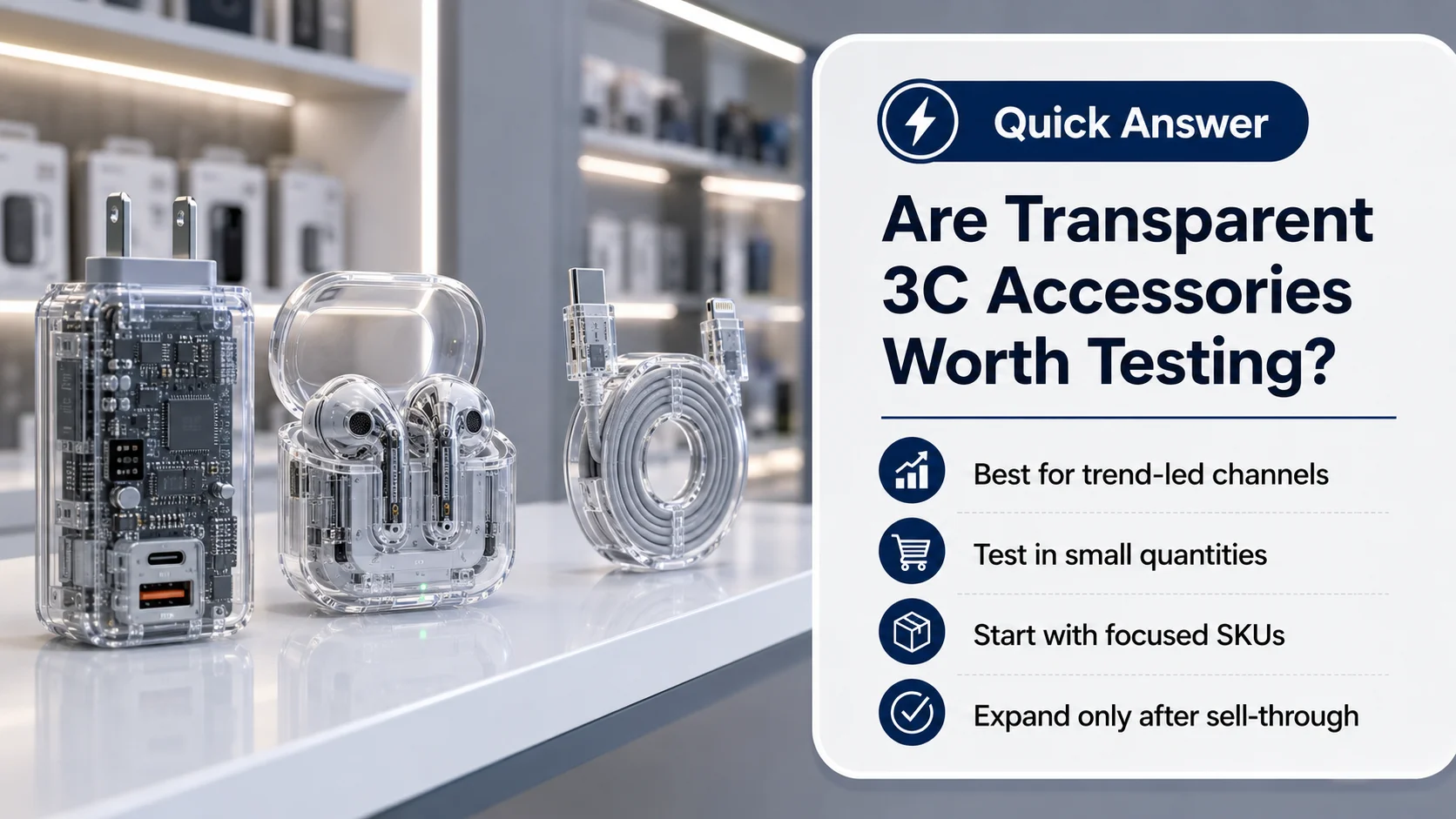
Quick Answer: Are Transparent 3C Accessories Worth Testing?
Buyers often worry that a transparent product may be a short-lived gimmick. That concern is reasonable. A bold design can attract attention, but it can also create inventory risk when it does not match the store environment or local consumer taste.
Transparent 3C accessories are worth testing when a retailer needs stronger visual differentiation in mid-range or trend-led product categories. They tend to fit online stores, gaming-oriented retailers, youth-focused chains, and giftable electronics displays better than conservative value channels.2 Buyers should begin with a small, controlled SKU selection rather than replacing their core assortment.
How We Suggest Buyers Control Inventory Risk
In our pre-sales conversations, we usually recommend that buyers treat transparent design as an assortment test, not as a complete category shift. A reliable black charger still has a place in many markets. The transparent version should add a new visual option, not remove the proven one too early.
A practical test can include:
- One transparent GaN charger in a popular wattage range
- One transparent TWS earbud model
- One transparent USB-C cable with visible connector details
- One coordinated retail package style
- A controlled MOQ that matches the buyer’s expected sales cycle
Before placing a larger order, buyers should consider:
| Evaluation Area | Buyer Question |
|---|---|
| Channel fit | Does our store or website already sell design-led tech products? |
| Price band | Will customers pay slightly more for appearance and packaging? |
| Display | Can the transparent appearance be seen clearly on shelf or in photos? |
| Core quality | Does the product meet the same functional standard as our regular line? |
| Reorder potential | Can we measure sell-through before expanding colors or models? |
A transparent shell cannot solve weak charging performance, poor battery consistency, or unclear packaging. We always advise buyers to protect their baseline quality requirements first. Design is an added reason to choose a product, not a substitute for function.
What Is the “Cyborg” Transparent Design Trend in 3C Accessories?
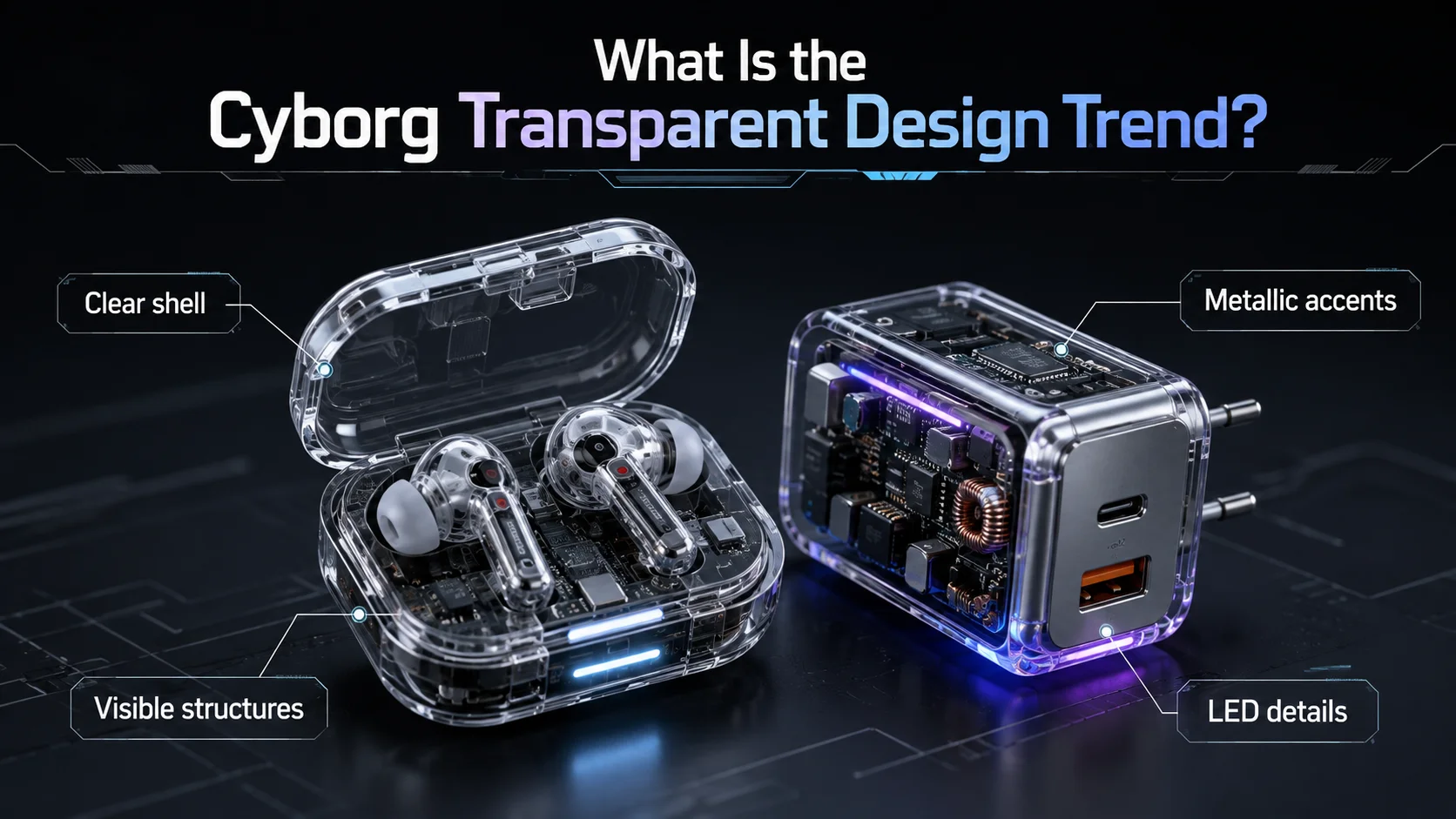
The “cyborg” transparent design trend refers to electronics accessories that use clear or translucent materials, exposed-looking structures, geometric lines, metallic accents, and LED lighting to create a technical, futuristic appearance. The design borrows visual cues from gaming hardware, cyberpunk culture, and industrial electronics.3
In transparent 3C accessories, “cyborg” design usually combines a clear or smoky plastic housing with visible internal-style details, printed circuitry graphics, LED effects, and precise mechanical shapes. The goal is to make ordinary devices look more engineered and expressive without changing their core use.
Transparent Does Not Always Mean Fully Clear
Buyers should separate several visual approaches that are often grouped together:
- Clear transparent: The internal board, battery area, or structural frame is highly visible.
- Translucent: Light passes through, but internal parts remain partially hidden.
- Smoked transparent: A dark gray, brown, or black-tinted shell creates a more premium or gaming-inspired look.
- Decorative transparent: The product uses clear panels, windows, or connectors rather than a full clear housing.
- Printed technical design: A normal shell uses circuit-like graphics to suggest visible technology.
In our experience, translucent and smoked options can be easier for some retail programs. They still create a distinct look, but they may hide minor internal visual variation better than a fully clear shell.
The “cyborg” label should also be used carefully in product marketing. Some buyers prefer terms such as futuristic transparent design, technical aesthetic, or gaming-inspired accessories. The best wording depends on the retailer’s customer base and brand voice.
For procurement purposes, the design should be translated into clear specifications. Buyers should define the housing color, transparency level, LED behavior, printed graphics, logo position, packaging, and acceptable cosmetic standards before mass production starts.
Why Are Transparent Electronics Becoming Popular with Consumers?
Many consumers already own chargers, cables, earbuds, and power accessories. Since the core function is familiar, visual difference can influence which product receives attention first. Transparent electronics can make a product look less generic, especially in crowded online marketplaces and accessories walls.
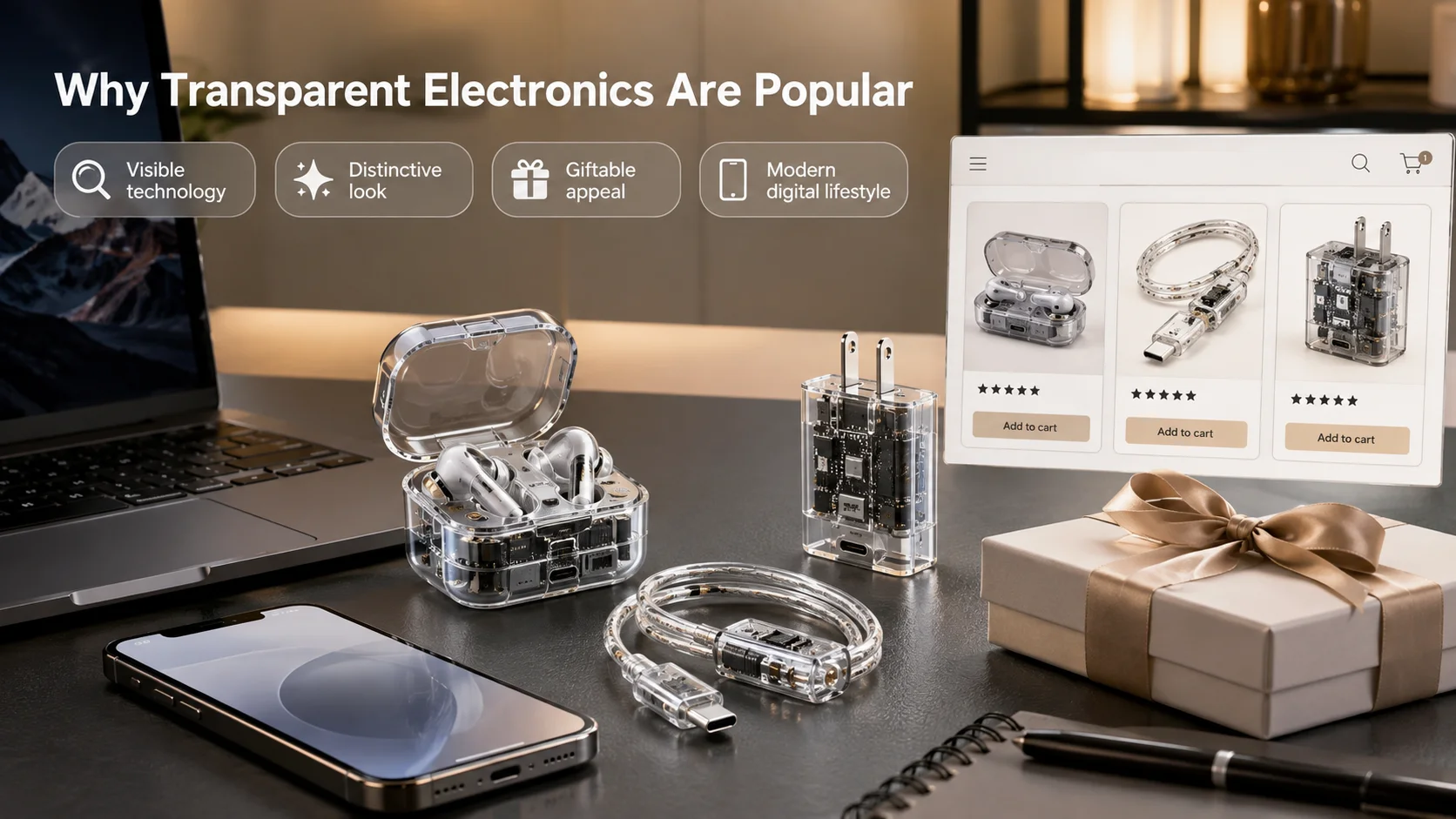
Transparent electronics appeal to some consumers because they make technology feel visible, personal, and more distinctive than standard opaque accessories.4 The effect can be useful for products aimed at gaming, desk setups, travel gifts, youth-oriented retail, and shoppers who want accessories that match a modern digital lifestyle.
Visual Differentiation Matters Most When Products Look Similar
A 30W charger may have the same broad function as many competing chargers. A USB-C cable may also look interchangeable in a product grid. This is where transparent 3C accessories can help a buyer create a clearer visual story.
The consumer appeal often comes from three simple factors:
-
Curiosity
Visible-looking components invite customers to look closer.5 This can improve product-page interest when photography is strong. -
Personal expression
Some customers want accessories that match a gaming desk, RGB setup, streetwear style, or minimalist workspace. -
Perceived detail
A carefully designed transparent shell can make a product appear more considered. However, buyers should not confuse this with verified performance or durability.
I have heard a recurring question from buyers: “Will this still look current next season?” There is no universal answer. Trend-led products should always be matched to the retailer’s buying cycle. A fast-moving e-commerce seller may accept more design risk than a chain store that plans assortments months in advance.
Transparent design may work best where the store can explain it through packaging, display cards, lifestyle photos, and coordinated color options. If the product sits in a plain bulk bin with no visual story, the added design cost may not produce the expected return.
Comparison Table: Transparent vs Translucent vs Opaque 3C Accessories
Choosing the right housing style is not only a design decision. It affects cosmetics, inspection standards, material selection, packaging, and price positioning. Buyers should compare these options before approving tooling or selecting an OEM model.
Transparent housings offer the strongest visual impact, translucent housings balance style and cosmetic control, and opaque housings remain the most forgiving and broadly suitable option. The best choice depends on the channel, target price, expected usage conditions, and acceptable defect threshold.
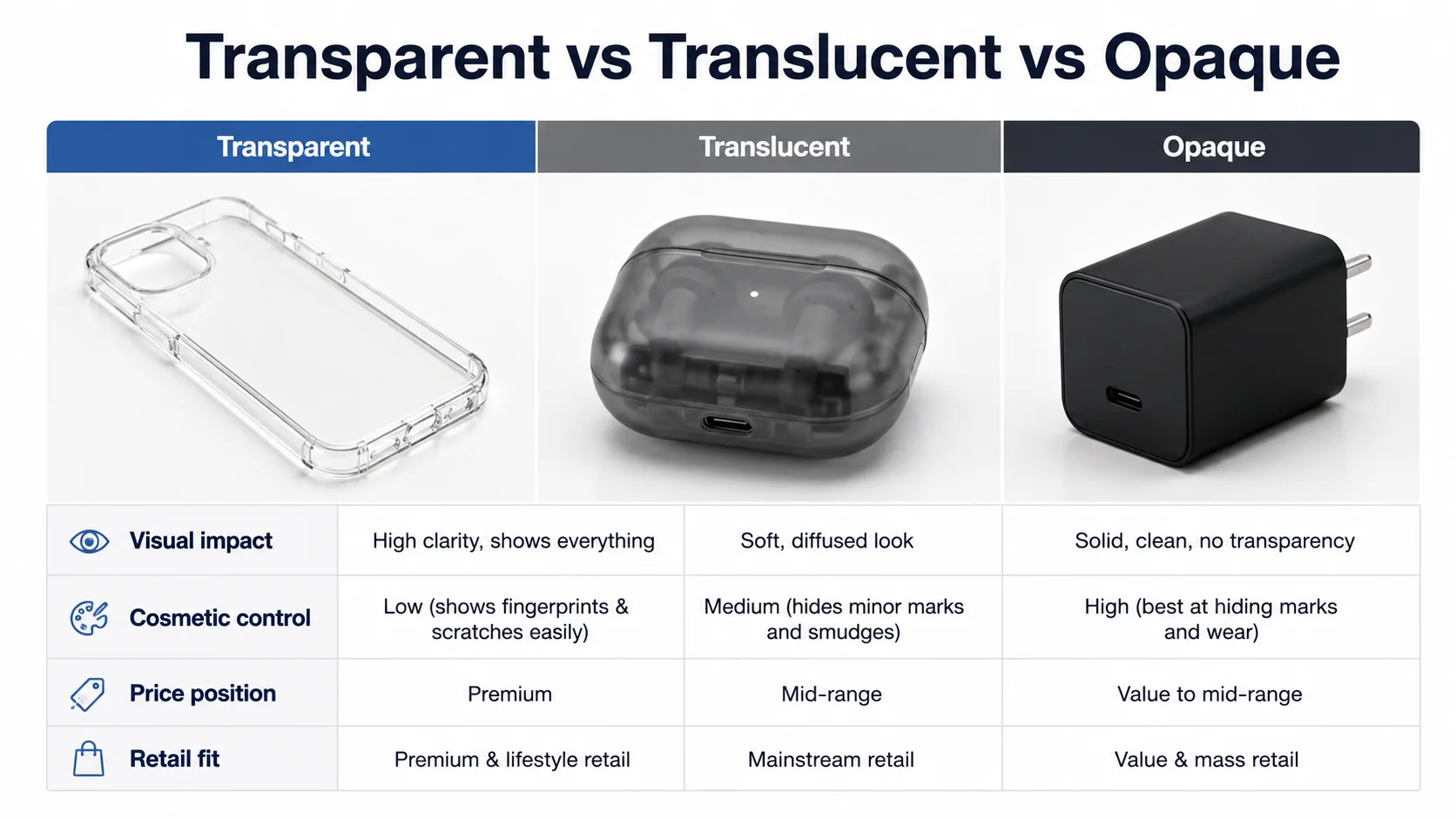
| Feature | Transparent | Translucent | Opaque |
|---|---|---|---|
| Visual impact | High | Medium to high | Low to medium |
| Internal visibility | High | Partial | None |
| Cosmetic sensitivity | High | Medium | Lower |
| Scratch visibility | Often high | Medium | Usually lower |
| Retail positioning | Trend-led, gaming, giftable | Broad modern retail | Value, mainstream, utility |
| Production inspection | More demanding | Moderate | More forgiving |
| Typical inventory risk | Higher if trend fit is unclear | Moderate | Lower |
Why Cosmetic Standards Need More Attention
Clear plastics can reveal issues that opaque shells conceal.6 Buyers may notice:
- Dust or foreign particles inside the housing
- Flow marks from injection molding
- Uneven tint or color variation
- Glue marks near seams
- Small scratches from handling
- Internal wire routing or component placement differences
For this reason, buyers should define an appearance limit sample before production. This is a physical reference sample that shows what is acceptable and what is not acceptable. It helps the supplier, quality-control team, and buyer use the same standard.
We recommend asking for product photos under different lighting conditions. A shell can look excellent in a studio photo but show reflections, fingerprints, or internal details under strong retail lighting. Buyers should review samples in conditions that resemble their actual sales channel.
Which Transparent Electronics Categories Have the Best Wholesale Potential?
Not every 3C category benefits equally from a transparent exterior. The strongest candidates are usually products where design is visible, the product is handled often, and the price band can support more detailed materials and quality control.
Transparent GaN chargers, transparent TWS earbuds, USB cables with clear connector details, and compact desktop accessories are often the most practical categories for wholesale testing.7 These products combine everyday demand with enough visible surface area for the design to make a meaningful difference.
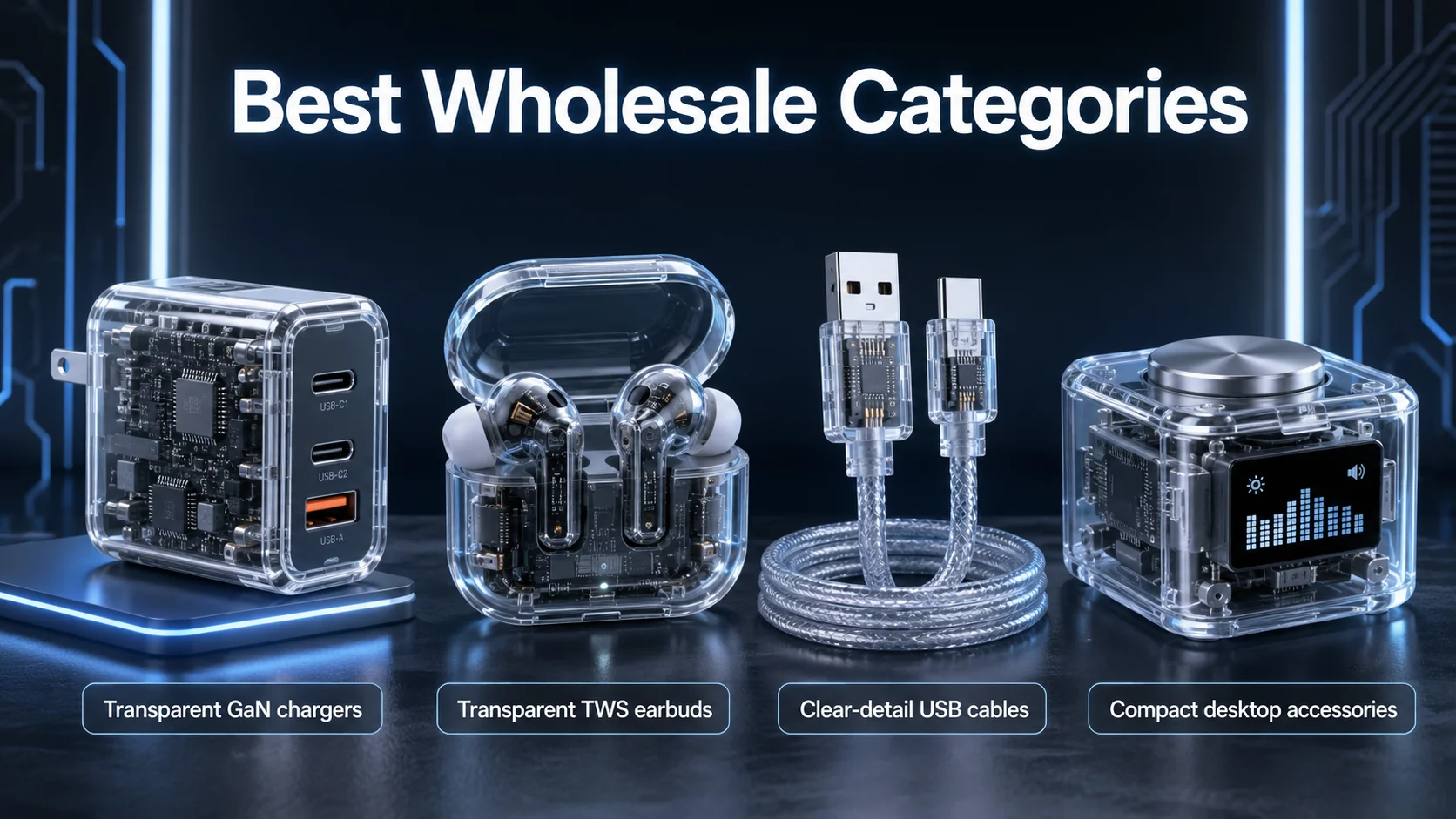
Categories Worth Reviewing First
| Product Category | Why It May Fit | Buyer Checkpoint |
|---|---|---|
| Transparent GaN charger | Small, giftable, easy to display | Confirm heat performance and plug certification needs |
| Transparent TWS earbuds | Strong lifestyle and color appeal | Verify battery, pairing, microphone, and cosmetic consistency |
| Transparent USB cable | Lower entry price and easy add-on sale | Check conductor specification, connector strain relief, and data support |
| Transparent power bank | Larger visual canvas | Review battery documentation, transport requirements, and drop resistance |
| LED desktop charging stand | Fits gaming or desk-setup channels | Confirm LED quality, stability, and compatible-device positioning |
A transparent GaN charger can be especially interesting because GaN technology already carries a modern, compact image.8 Still, buyers should never assume the housing design proves the charger’s electrical quality. The buyer should verify the rated output, protocol support, thermal behavior, plug configuration, and relevant compliance documents.
For TWS earbuds, the transparent charging case is often more commercially important than the earbud itself because the case is visible in packaging and product photos. However, the purchasing decision should still include functional checks for Bluetooth stability, battery runtime, touch control, microphone performance, and charging reliability.
How Do Visible Components and LED Lighting Create a Cyberpunk Aesthetic?
Visible structures and LED details create contrast. They make a small electronic product feel more layered than a smooth, plain housing. This aesthetic can work well for retail programs that already use gaming, RGB lighting, or futuristic visual language.
Visible components and LED lighting create a cyberpunk aesthetic by adding depth, color contrast, and a sense of technical detail to transparent 3C accessories. The strongest designs use these elements with restraint, because excessive lighting or decorative parts can make a product look confusing rather than premium.
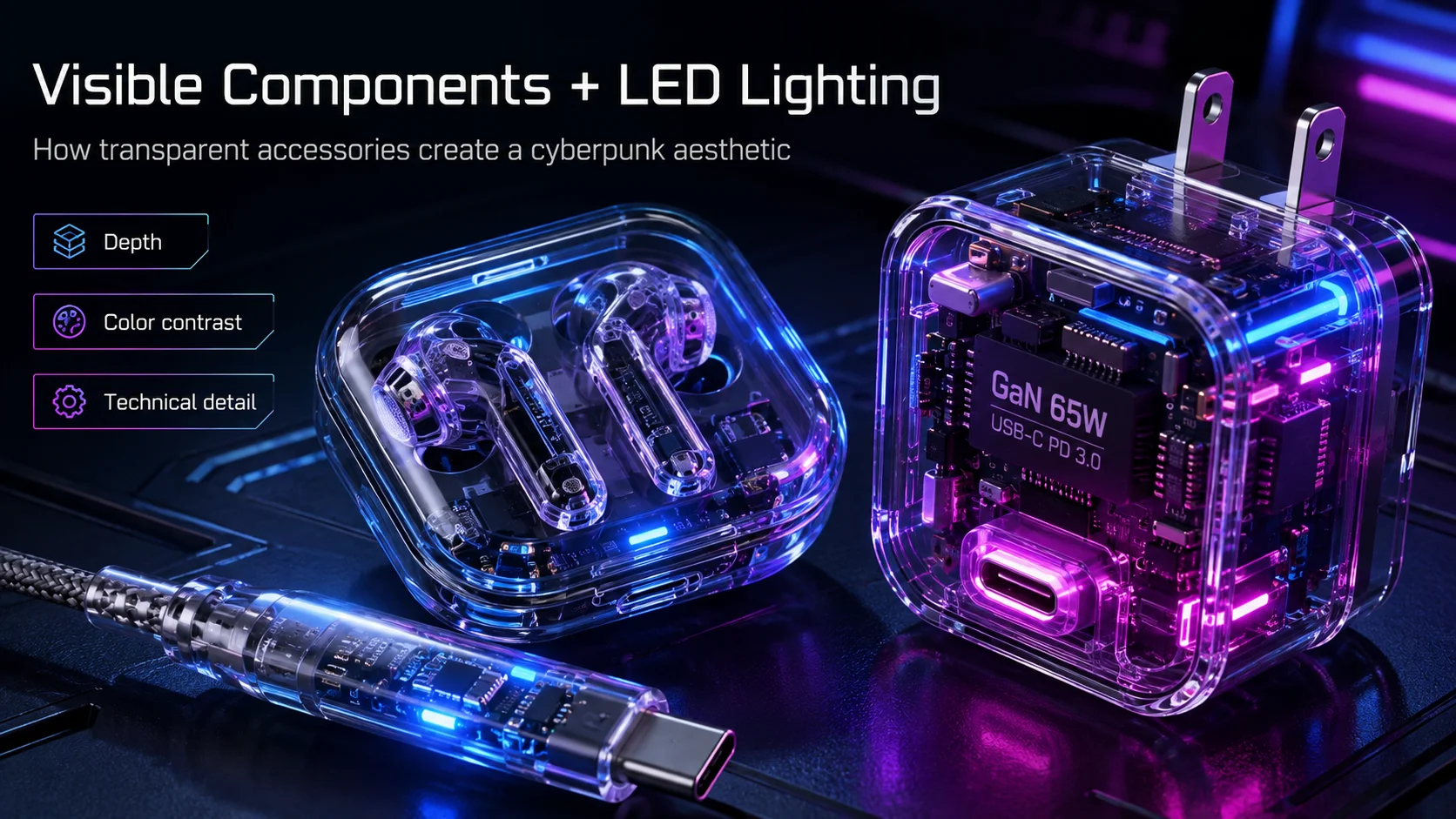
Design Details Buyers Should Specify
A supplier should not receive only a vague request for “cyberpunk style.” Buyers should turn the idea into measurable requirements:
- LED color: single color, RGB, breathing effect, or no light during charging
- Brightness: visible in retail photography without being distracting
- Printed graphics: circuit patterns, icons, lines, or warning-style text
- Interior treatment: real visible board, decorative inner panel, or structured frame
- Surface finish: glossy, frosted, smoked, or mixed texture
- Brand integration: logo size, print method, and placement
- Packaging design: whether the box should reveal the transparent product
The best designs often use one or two strong details. For example, a smoked transparent TWS case with a subtle LED strip may feel more refined than a fully clear case covered in bright graphics.
We also suggest that buyers review the design from the consumer’s viewpoint. Does the product still look good after fingerprints appear? Does the LED light remain visible through the packaging window? Does the printed design align correctly across the housing seam? These small questions influence whether the final product looks intentional.
What Manufacturing Challenges Affect Transparent Electronic Housings?
Transparent shells require closer control than standard opaque housings because minor material and assembly issues are easier to see.9 This does not mean transparent products are unreliable. It means buyers should set clearer appearance specifications and inspection checkpoints.
The main manufacturing challenges for transparent electronic housings include material purity, molding marks, scratches, dust control, glue visibility, internal component placement, and color consistency. Buyers should approve pre-production samples and define cosmetic inspection standards before mass production begins.

Key Quality-Control Points
Transparent housings may use materials such as PC, ABS, PMMA, or blended plastics10, depending on the structural and appearance requirement. Material choice is application-specific. Buyers should ask the supplier which material is proposed and why, then arrange qualified evaluation when safety, heat, or impact requirements are important.
Common production concerns include:
- Injection molding flow marks: Lines or patterns that may appear in clear plastic.
- Bubbles or black spots: These can be more noticeable in transparent material.
- Scratch damage: Clear housings need stronger handling protection during assembly.
- Uneven tint: Smoke gray or colored transparent shells require color control between batches.
- Visible adhesives: Glue placement must be neat when seams are exposed.
- Internal layout variation: Wires, labels, and boards may need more orderly placement.
For our OEM 3C accessories projects, we recommend using a staged approval process:
- Confirm the industrial design and color reference.
- Review the engineering sample for assembly feasibility.
- Approve a pre-production sample for appearance and function.
- Inspect early mass-production units.
- Use agreed AQL or buyer-defined inspection criteria for final shipment.
A buyer should also ask how products are protected after assembly. Individual protective film, trays, or separated compartments can reduce surface damage before the goods reach the destination market.
Do Transparent Plastics Yellow, Scratch or Pass Drop Tests?
Transparent plastics can yellow, scratch, or show damage if the wrong material, finish, storage condition, or handling process is used.11 Performance depends on the actual resin, additives, thickness, product structure, and application environment—not simply on whether a shell looks clear.
Transparent plastics can meet practical durability requirements, but buyers should verify yellowing resistance, scratch performance, fit, and drop-test results for the specific product. A transparent appearance does not guarantee durability, and no material claim should replace documented testing for the intended market and use case.
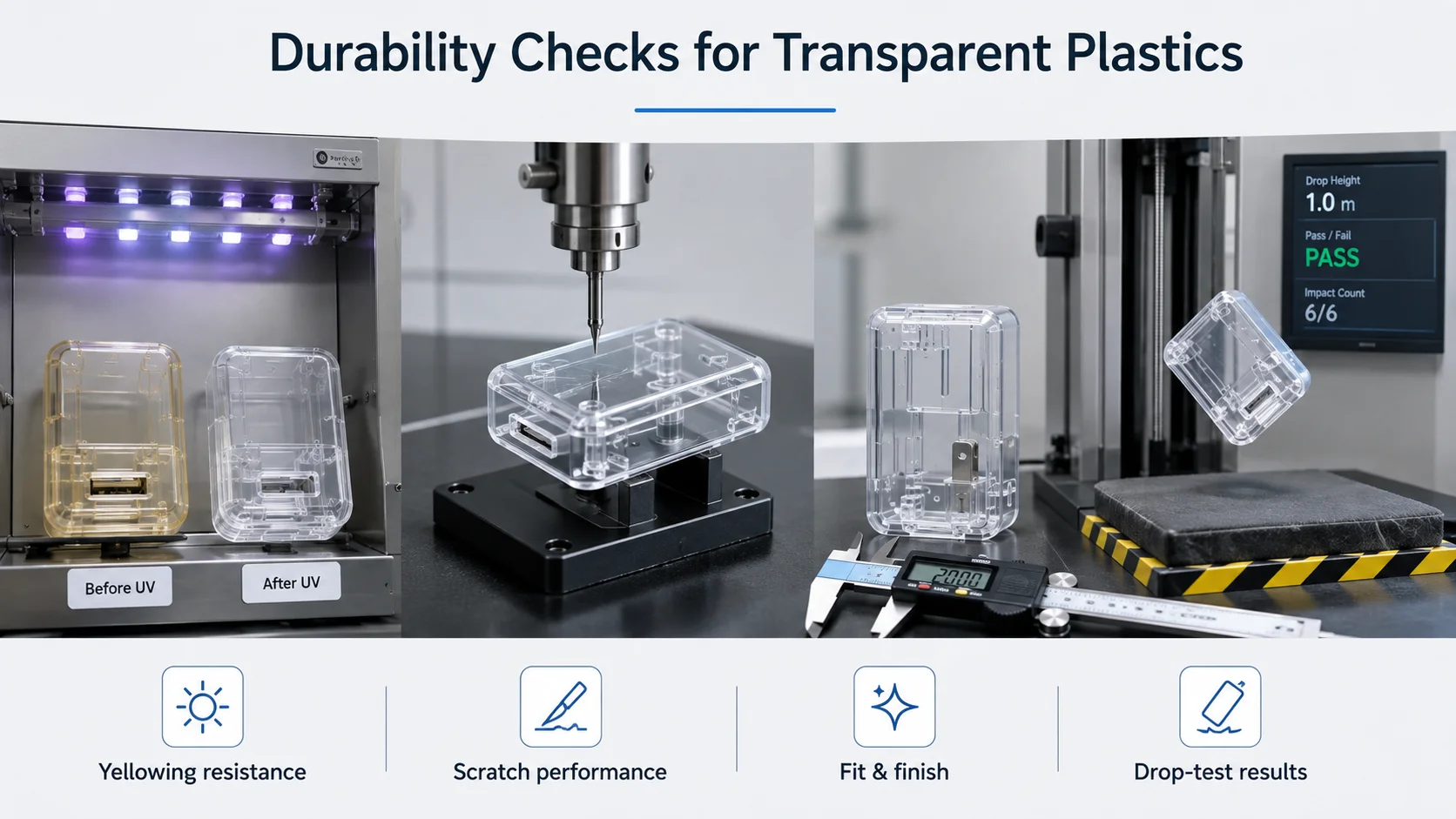
Questions to Ask During Product Evaluation
Buyers should not rely only on a showroom sample. They should request clear information about the validation process and, where needed, use independent inspection or laboratory testing.
Useful questions include:
- Which housing material is used?
- Is there UV-stabilizing treatment or another approach intended to reduce yellowing?
- What surface finish is used to manage scratches?
- What drop-test method was used, including height, surface, and sample quantity?
- Does the product still operate after the test?
- Are there visible cracks, seam openings, or LED failures?
- What storage conditions are recommended?
A hard glossy transparent shell may look sharp, but it can reveal fine scratches more easily than a frosted translucent finish. A buyer selling through a premium-looking retail channel may prefer the clean appearance of glossy clear material. A buyer targeting higher-volume everyday use may prefer a smoked or matte-translucent alternative.
For chargers and power products, housing durability is only one part of evaluation. Buyers should also review electrical safety, thermal performance, plug requirements, labeling, and applicable regulatory documentation. Certifications and test reports should be treated as documents to verify for the exact model, market, and production scope.12
What Should Buyers Verify Before Ordering Transparent OEM Electronics?
The most successful transparent OEM electronics programs start with precise requirements. A supplier can make a transparent model look attractive in a sample, but the buyer needs to confirm whether the product can be produced consistently at the approved standard.
Before ordering transparent OEM electronics, buyers should verify the design specification, housing material, functional performance, cosmetic limit sample, packaging, MOQ, production lead time, after-sales process, and applicable compliance documents. A clear written approval process reduces avoidable surprises after mass production starts.

Transparent Electronics Supplier Checklist
Use this checklist when comparing suppliers:
| Area | What to Verify |
|---|---|
| Product function | Charging speed, protocol support, pairing, battery, cable data capability |
| Appearance | Transparency level, tint, print alignment, LED effect, scratch allowance |
| Materials | Declared housing material and intended use limitations |
| Quality process | Pre-production sample, in-line checks, final inspection method |
| Documentation | Applicable test reports, declarations, and certification documents for verification |
| Customization | Logo, colors, packaging, manuals, inserts, plugs |
| Commercial terms | MOQ, lead time, sample cost, payment terms, warranty process |
| Shipment readiness | Carton marks, drop protection, barcode, labeling, destination requirements |
I often suggest that buyers write down their “non-negotiables” before asking for quotations. For one buyer, the non-negotiable may be a low MOQ. For another, it may be a custom package that fits a retail peg display. For a chain store, carton consistency and documentation may matter more than adding another LED mode.
This approach keeps the sourcing process practical. Transparent 3C accessories should be evaluated as commercial products, not just as visual concepts. The supplier selection decision should reflect quality consistency, communication, lead-time control, and the ability to support your market requirements.
Source Custom Transparent 3C Accessories from Kingfuji
A transparent design project needs more than an interesting concept. It needs clear communication between the buyer, product team, factory, and quality-control process. This is especially important when the design makes small cosmetic details visible.
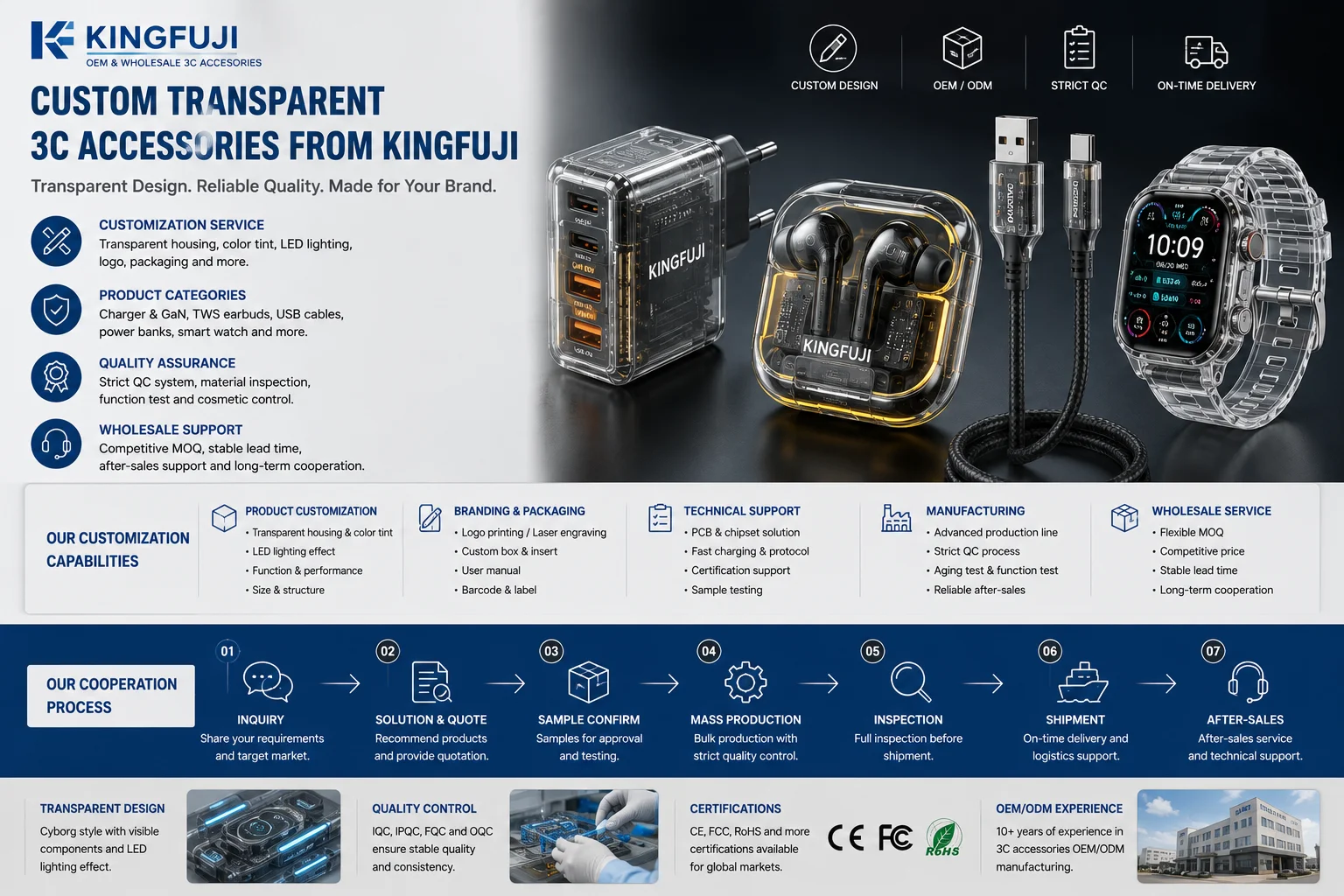
At Kingfuji, we support buyers who want to evaluate custom transparent 3C accessories with a controlled, channel-specific approach. We can discuss transparent chargers, GaN charging heads, TWS earbuds, USB cables, smart watches, packaging, logo options, MOQ expectations, and production requirements based on your target market.
Start with the Right Product Brief
We are a Shenzhen 3C manufacturer and exporter with 15 years of export experience. Our main categories include USB cables, chargers, GaN chargers, TWS earbuds, and smart watches for overseas customers, including European and North American retailers, wholesalers, importers, and e-commerce sellers.
For transparent OEM 3C accessories, a useful inquiry should include:
- Product category and core function
- Target country or sales region
- Expected retail price range
- Estimated order quantity and preferred MOQ
- Required colors, transparency level, and LED details
- Branding and packaging needs
- Target launch date
- Required documents or market-specific compliance expectations
We can then help buyers narrow the options instead of adding unnecessary complexity. For example, a buyer may start with a transparent GaN charger and matching cable rather than launching five unrelated transparent SKUs at once.
Our view is simple: transparent design can be worth testing where it supports the channel and customer profile. It should not be presented as a guaranteed bestseller. We encourage buyers to evaluate samples, verify relevant documentation, inspect quality requirements, and build the assortment around real sales conditions.
Frequently Asked Questions
Are transparent 3C accessories more expensive than standard products?
They can be. Transparent housings may require more careful materials, molding control, handling protection, and cosmetic inspection. The final cost depends on the product structure, finish, LED features, packaging, and order quantity. Buyers should compare the added cost with their target retail price and channel margin.
Is a transparent GaN charger safe?
A transparent GaN charger should be evaluated by the same safety and performance standards as any other charger. Buyers should verify the exact model’s rated output, heat management, relevant test reports, and applicable compliance documents. The clear housing itself does not confirm safety or charging quality.
Which retail channels suit transparent TWS earbuds?
Transparent TWS earbuds may fit online stores, gaming-oriented retailers, gift shops, youth-focused chains, and trend-led electronics displays. They may be less suitable for every conservative value channel. Buyers should consider customer age, visual merchandising, price point, and the existing assortment.
Do transparent electronics scratch easily?
Some transparent surfaces show scratches more visibly than opaque surfaces. The actual result depends on the material, coating, texture, and handling. Buyers should inspect real samples, review packing protection, and agree on cosmetic acceptance standards before approving mass production.
Should I order a full transparent electronics collection at once?
We usually recommend starting with a limited test. Choose one or two transparent 3C accessories that fit your strongest category, then monitor sales response and reorder interest. This approach gives buyers a clearer view of demand while reducing inventory exposure.
Conclusion
Transparent 3C accessories can give retailers and distributors a useful way to create visual distinction in a crowded market. Still, the cyborg transparent look is not automatically right for every product or channel. Buyers should match the design to their customer profile, price architecture, display conditions, and inventory strategy. Start with a focused test, protect core quality standards, and verify every relevant specification and document. If you are sourcing custom transparent chargers, cables, GaN adapters, or TWS earbuds, contact Kingfuji to discuss a practical OEM option for your market.
"Transparent Electronics Market: Industry Analysis & Forecast 2030", https://www.maximizemarketresearch.com/market-report/transparent-electronics-market/206539/. Independent design and market research can document whether transparent product aesthetics have gained measurable attention within consumer-electronics and adjacent lifestyle-product categories. Evidence role: general_support; source type: research. Supports: Evidence of consumer-design and retail interest in transparent or visually distinctive consumer electronics.. Scope note: Trend evidence may describe broad consumer-design interest rather than wholesale demand for specific 3C accessory SKUs. ↩
"Effects of Design Aesthetics on the Perceived Value of a Product - PMC", https://pmc.ncbi.nlm.nih.gov/articles/PMC8359925/. Consumer-behavior research indicates that product aesthetics, novelty, and retail presentation can affect purchase evaluation differently across consumer segments and shopping contexts. Evidence role: general_support; source type: research. Supports: Research on how consumer segment, retail context, product novelty, and visual presentation affect purchase consideration for technology products.. Scope note: Such research supports the segmentation rationale generally and does not establish that every transparent accessory will outperform opaque alternatives in these channels. ↩
"Cyberpunk", https://en.wikipedia.org/wiki/Cyberpunk. Cyberpunk is commonly characterized as a speculative-fiction and visual-cultural genre centered on advanced technology and stylized technological environments, providing context for the term's use in product aesthetics. Evidence role: historical_context; source type: encyclopedia. Supports: A definition of cyberpunk and its association with high technology, dystopian urban imagery, and visually dense technological environments.. Scope note: Genre definitions contextualize the aesthetic reference but do not classify a particular accessory design as cyberpunk. ↩
"Effects of Design Aesthetics on the Perceived Value of a Product - PMC", https://pmc.ncbi.nlm.nih.gov/articles/PMC8359925/. Studies of product aesthetics and consumer behavior report that visually distinctive design attributes can influence perceived uniqueness, self-expression, and product evaluation. Evidence role: mechanism; source type: paper. Supports: Research on the relationship between product aesthetics, perceived uniqueness, self-expression, and consumer evaluation.. Scope note: Evidence on aesthetic distinctiveness is not direct proof that transparent housings appeal equally across all accessory categories or markets. ↩
"Eye-Tracking Evidence on How Product Visual Strategy and Unit ...", https://pmc.ncbi.nlm.nih.gov/articles/PMC13010595/. Research on visual attention in consumer settings finds that salient and visually novel product features can influence the allocation of attention during product evaluation. Evidence role: mechanism; source type: paper. Supports: Evidence that visual complexity, novelty, and salient product features can affect consumer attention and product evaluation.. Scope note: Attention measures do not necessarily translate into purchase, repeat purchase, or commercial success. ↩
"Analysis of Flash in Injection Molding Using Flow ...", https://scholarworks.utrgv.edu/cgi/viewcontent.cgi?article=1305&context=etd. Technical guidance on transparent polymer molding notes that optical clarity can make surface defects, contamination, flow marks, and internal features more readily visible than in opaque molded parts. Evidence role: mechanism; source type: research. Supports: Technical information on cosmetic defects in transparent polymer parts, including flow marks, contamination, scratches, and visibility of internal features.. Scope note: The severity of visible defects depends on resin, pigmentation, mold design, processing conditions, part geometry, and lighting. ↩
"Electronics Accessories Market Size, Share and Forecast ...", https://www.credenceresearch.com/report/electronics-accessories-market. Consumer-electronics market research identifies chargers, audio wearables, cables, and desk-use accessories as recurring accessory categories with distinct replacement, gifting, and add-on purchase patterns. Evidence role: general_support; source type: research. Supports: Category-level evidence that chargers, earbuds, cables, and desktop accessories are established, frequently purchased consumer-electronics accessory categories.. Scope note: Category demand does not directly demonstrate that transparent versions are the most commercially suitable option for every buyer. ↩
"Compact, Interactive Electric Vehicle Charger", https://arpa-e.energy.gov/programs-and-initiatives/search-all-projects/compact-interactive-electric-vehicle-charger. Government and technical research on gallium nitride power electronics describes how GaN devices can enable high-frequency, efficient power conversion and support more compact power-system designs. Evidence role: mechanism; source type: government. Supports: The power-electronics properties of gallium nitride that can support higher switching frequencies, high efficiency, and reduced size in suitable power-conversion designs.. Scope note: GaN semiconductor use alone does not guarantee a charger’s size, efficiency, thermal performance, safety, or quality. ↩
"Why Transparent Plastic Parts Are So Difficult to Inspect - Krevera", https://krevera.com/resources/transparent-plastic-parts-inspection. Technical literature on transparent polymer processing emphasizes control of material cleanliness, molding conditions, handling, and assembly because cosmetic defects are more apparent in optically clear parts. Evidence role: mechanism; source type: research. Supports: Manufacturing evidence that transparent polymer parts require control of contamination, molding parameters, handling, and cosmetic defects to preserve optical appearance.. Scope note: Required control levels vary by material, finish, tolerance, product structure, and the buyer's agreed cosmetic standard. ↩
"Resource Use and Water Implications of Material ...", https://repository.rit.edu/context/theses/article/12282/viewcontent/HMadakaDissertation5_5_2022.pdf. Materials references describe polycarbonate and PMMA as commonly transparent engineering polymers, while ABS and polymer blends may be selected or modified according to required impact, heat, processing, and appearance properties. Evidence role: definition; source type: education. Supports: Material-property information for polycarbonate, PMMA, ABS, and polymer blends, including transparency, impact resistance, heat resistance, and processing considerations.. Scope note: A material family name does not establish the exact composition, optical performance, safety suitability, or durability of a particular housing. ↩
"Effects of UV radiation on natural and synthetic materials - PMC - NIH", https://pmc.ncbi.nlm.nih.gov/articles/PMC10088630/. Polymer-aging research shows that ultraviolet exposure, oxidation, material formulation, and surface abrasion can contribute to discoloration and visible surface damage in transparent plastics. Evidence role: mechanism; source type: research. Supports: Evidence that transparent polymers may undergo photo-oxidative discoloration and surface damage, with outcomes affected by polymer chemistry, additives, coatings, exposure, and handling.. Scope note: Laboratory aging and abrasion results must be matched to the specific resin, coating, exposure environment, and product-use conditions. ↩
"Testing & Certification | CPSC.gov", https://www.cpsc.gov/Business--Manufacturing/Testing-Certification. Official product-compliance guidance states that economic operators must ensure that products placed on a market meet applicable legal requirements and that supporting conformity documentation is maintained for the relevant product. Evidence role: expert_consensus; source type: government. Supports: Official guidance that manufacturers and importers must ensure products meet applicable market requirements and maintain appropriate conformity or technical documentation.. Scope note: The specific documents, testing obligations, and responsible party depend on product type, destination jurisdiction, applicable rules, and supply-chain role. ↩