Low-latency TWS gaming earbuds can look impressive on a product page, but a low millisecond claim alone does not protect wholesalers from complaints, returns, or weak reviews. The risk grows when buyers assume every phone and game will perform the same way. We recommend evaluating real-world compatibility, test conditions, and supplier documentation before placing an order.
Low-latency TWS gaming earbuds should be selected based on verified performance on the buyer’s target phones, games, and usage modes—not only on an advertised latency number. Wholesale buyers should check the chipset and firmware details, gaming-mode conditions, codec support, battery impact, microphone quality, and sample performance before making retail claims. A supplier’s stated latency is useful only when the test method and compatible devices are clear.
In our Shenzhen factory, we have spent 15 years discussing TWS product selection with European and American retailers, wholesalers, and e-commerce sellers. One question appears again and again: “Does the lowest latency number always mean the best gaming earbuds?” In our experience, the answer is no. The more useful question is whether the product performs reliably in the customer’s intended use case.
Quick Answer: Which Low-Latency TWS Gaming Earbuds Specifications Matter Most?
Many buyers face the same problem: product listings highlight RGB lights, aggressive gaming designs, and “sub-50ms” claims, while the specifications that affect customer satisfaction receive less attention. That can make a product look competitive at sourcing stage but create problems after launch.
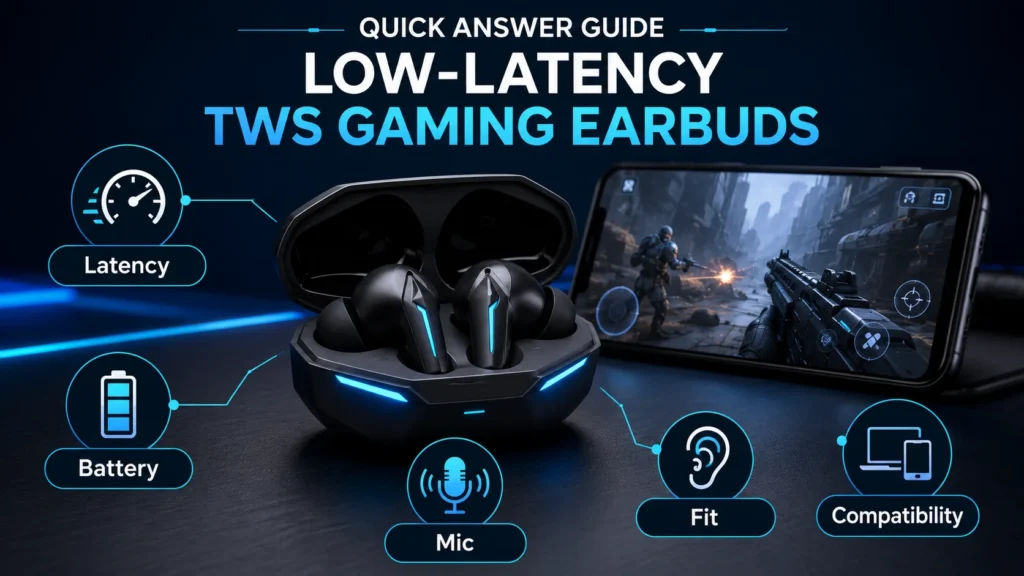
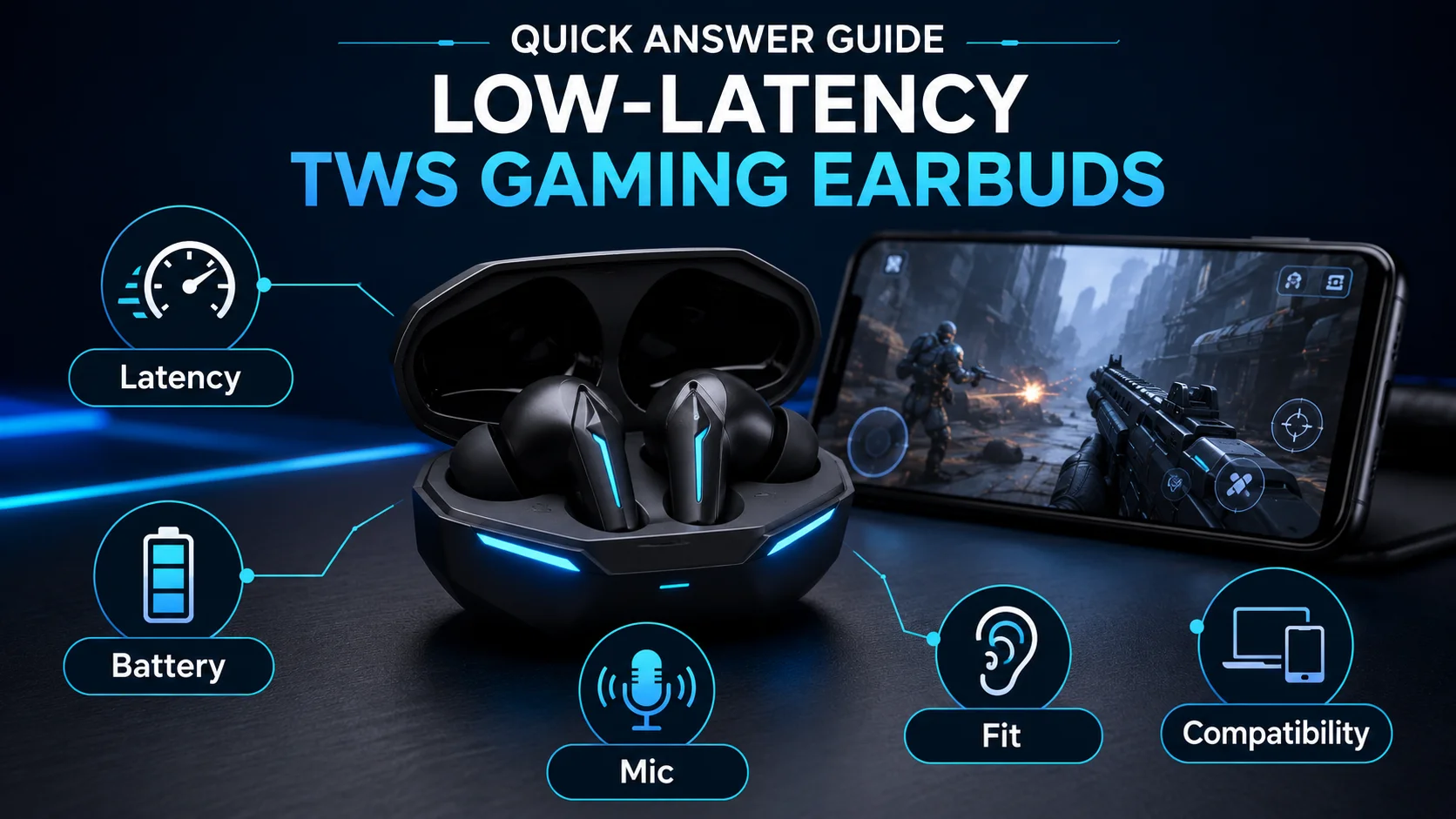
The most important specifications for low-latency TWS gaming earbuds are verified end-to-end latency under stated test conditions, target-device compatibility, gaming-mode behavior, Bluetooth implementation, battery life with gaming mode enabled, microphone performance, fit, connection stability, and supplier quality-control documentation. Buyers should also test samples with their target smartphones and games before confirming product-page claims.
Start With the Customer Use Case
We encourage buyers to define the intended user before comparing specification sheets. A casual mobile gamer, a competitive player, and a commuter watching video clips may all expect different things from the same earbuds.
For example, a retailer may sell to customers who primarily play:
- Fast-action mobile games
- Battle royale games with team voice chat
- Rhythm and timing-based games
- Casual puzzle games
- Console or PC games through Bluetooth-enabled devices
- Video and streaming users who also like gaming styling
A stated low-latency mode may improve responsiveness in one setup but not produce identical results across every device. Phone model, operating system, Bluetooth stack, firmware version, game engine, wireless environment, and user perception all affect the outcome.1
A Wholesale Evaluation Framework
Before ordering gaming TWS earbuds wholesale, we suggest asking suppliers for:
- The claimed latency measurement method
- The devices used during testing
- Whether the figure refers to earbud-side, codec, or end-to-end latency
- The conditions required to activate gaming mode
- Battery-life data for normal mode and gaming mode
- Microphone specifications and voice-chat test information
- Bluetooth version, supported codec details, and chipset information
- Pre-production samples for your own testing
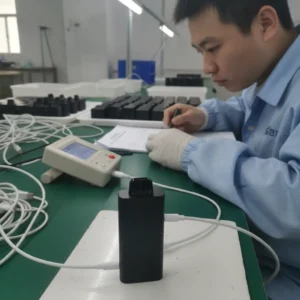
- Quality-control standards and inspection procedures
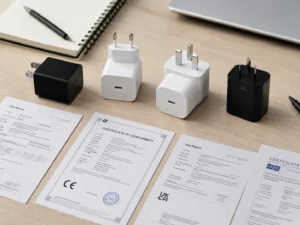
- Certification documents relevant to your destination market
Certifications should always be verified as current documents applicable to the exact model and market. We also recommend qualified compliance review for application-specific decisions.
Why Does Low Latency Matter for Mobile Gaming Earbuds?
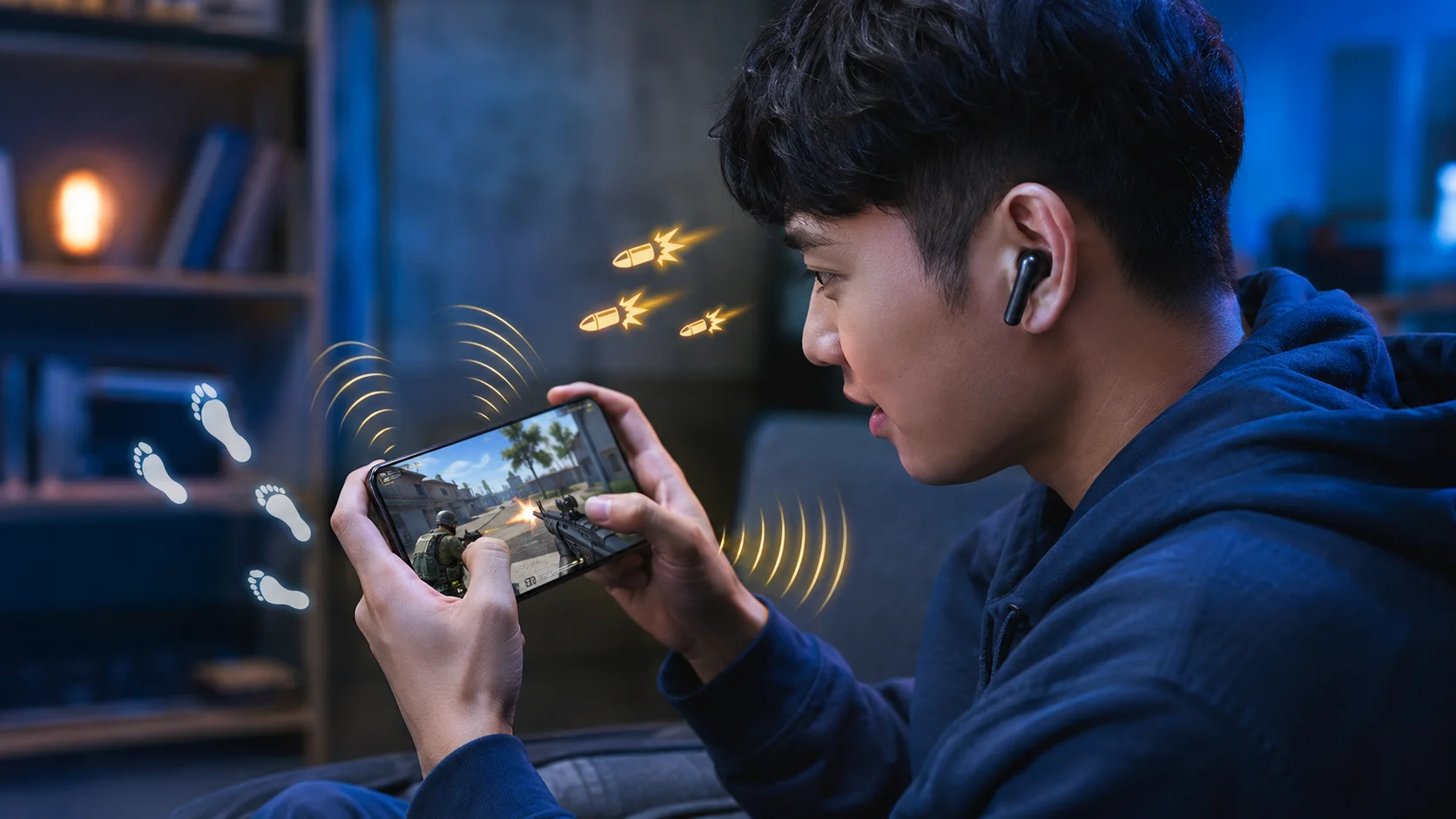
Audio delay can turn a good mobile game into a frustrating experience. When gunshots, footsteps, taps, or visual effects arrive late, users may blame the earbuds even when several factors are involved. For retailers, that gap can lead to negative reviews and avoidable support requests.
Low latency matters because it reduces the delay between an event on the screen and the sound heard through the earbuds. For mobile gaming earbuds, lower and more stable delay can make action, timing, directional cues, and voice communication feel more natural. However, the actual experience depends on the phone, game, connection conditions, and earbud firmware.
Latency Is an End-to-End Experience
In buyer conversations, we often hear: “This model says 40ms, so it must be better than a 60ms model.” That comparison may be incomplete.
The audio path can include several stages:2
- The game creates the audio signal.
- The phone processes and encodes the signal.
- Bluetooth transmits the signal.
- The earbuds receive, decode, buffer, and play the sound.
A supplier may refer to one part of this chain when presenting a latency figure. Another supplier may describe a different measurement basis. Therefore, buyers should not compare numbers unless the test conditions are equivalent.
Why Stability Matters as Much as Speed
A very low advertised number may not help if the connection becomes unstable in busy wireless environments. Gaming customers usually notice dropouts, interruptions, or inconsistent response more than they notice a small specification difference.3
We recommend balancing latency with:
- Connection stability
- Earbud firmware maturity
- Antenna and RF design
- Phone compatibility
- Gaming-mode reliability
- Battery consistency
- Build quality and fit
A stable and honestly marketed product can be commercially safer than a product with an aggressive claim that cannot be repeated on customer devices.
What Does Sub-50ms Latency Mean—and How Should Buyers Verify It?
“Sub-50ms” is widely used in the gaming earbud market4, so buyers may treat it as a universal performance standard. The problem is that the phrase can mean different things depending on the supplier’s test method and the point measured in the audio chain.
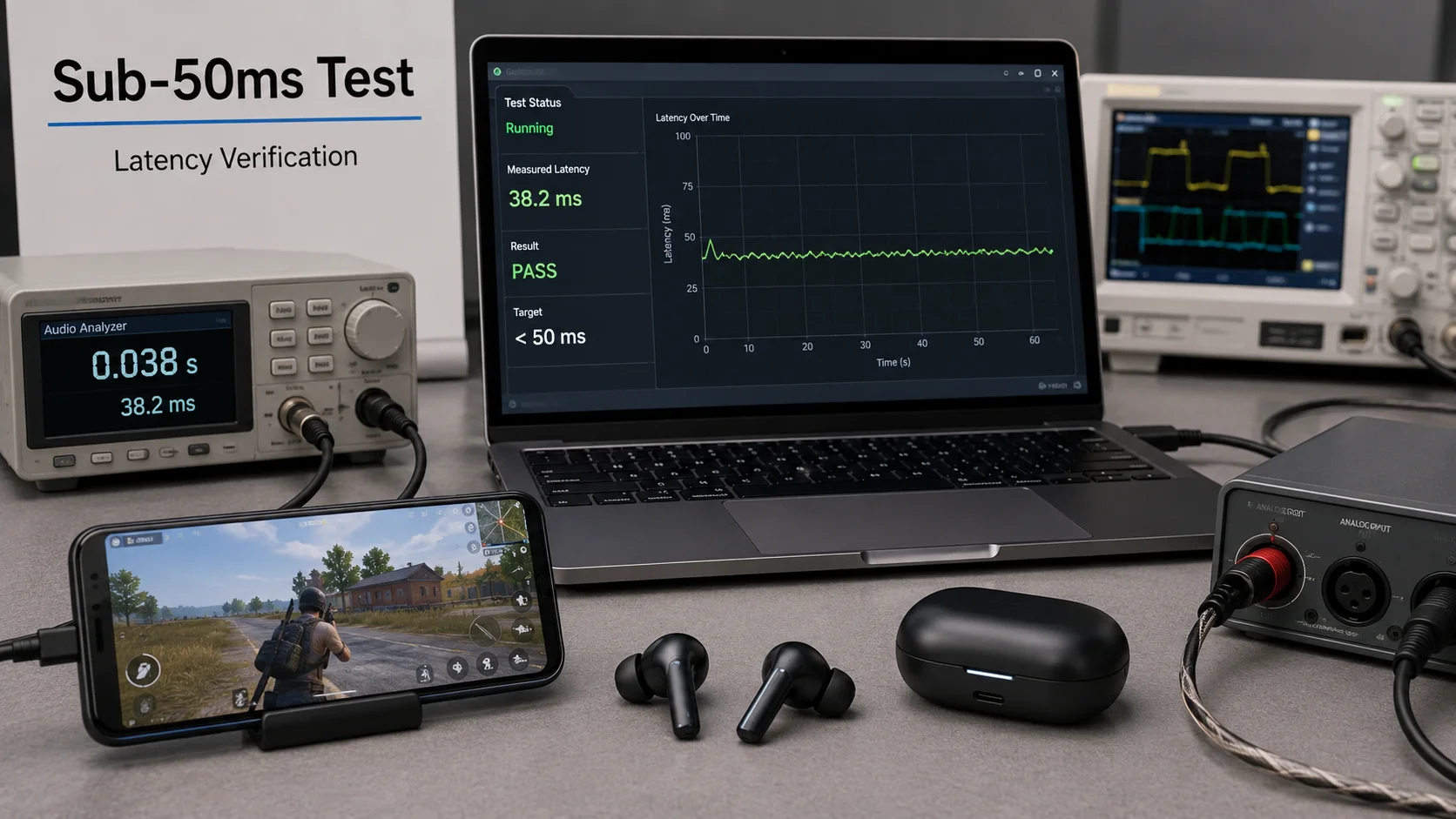
Sub-50ms latency usually means that a supplier reports audio delay below 50 milliseconds under specific test conditions, often with gaming mode enabled. Buyers should ask what was measured, which phone and codec were used, whether the figure represents end-to-end delay, and whether the result can be reproduced with samples on target devices.
Questions to Send Every Supplier
We suggest using a written checklist. A clear response helps the buyer compare suppliers fairly and helps prevent ambiguous product descriptions later.
Ask:
- What exact latency figure do you claim?
- Is the result end-to-end latency or another measurement?
- What phone model, operating system, and game or test software were used?
- Was gaming mode enabled during the test?
- What codec and Bluetooth settings were active?
- What test equipment or method was used?
- Can the supplier provide a demonstration video or test record?
- Does performance vary by Android and iOS device?
- What firmware version was installed on the sample?
- Can the buyer test production samples before shipment?
Avoid Overstating Retail Claims
We recommend that retailers use careful wording unless they have validated a claim on the devices they intend to reference. For example, “gaming mode designed to reduce audio delay” may be more responsible than a universal statement that guarantees a fixed latency result across all phones.
A low-latency claim becomes commercially useful only when the supplier can explain the conditions behind it.
Bluetooth version and chip model are relevant inputs, but neither one guarantees a fixed gaming result.5 The interaction between chipset, firmware, phone implementation, codec, and gaming mode matters more than any single specification line.
How Do Gaming TWS Earbuds Compare With Standard TWS Earbuds?
Standard TWS earbuds often prioritize music playback, calls, comfort, and battery life. Gaming models usually add a low-latency mode, gaming-focused styling, and sometimes lighting effects. However, wholesale buyers should compare the whole product experience instead of treating “gaming” as a guarantee of better performance.
Gaming TWS earbuds generally provide a dedicated mode intended to reduce audio delay, while standard TWS earbuds may prioritize battery efficiency and music tuning. The best choice depends on the buyer’s target customer, required price point, desired design, microphone needs, and verified performance across intended devices.
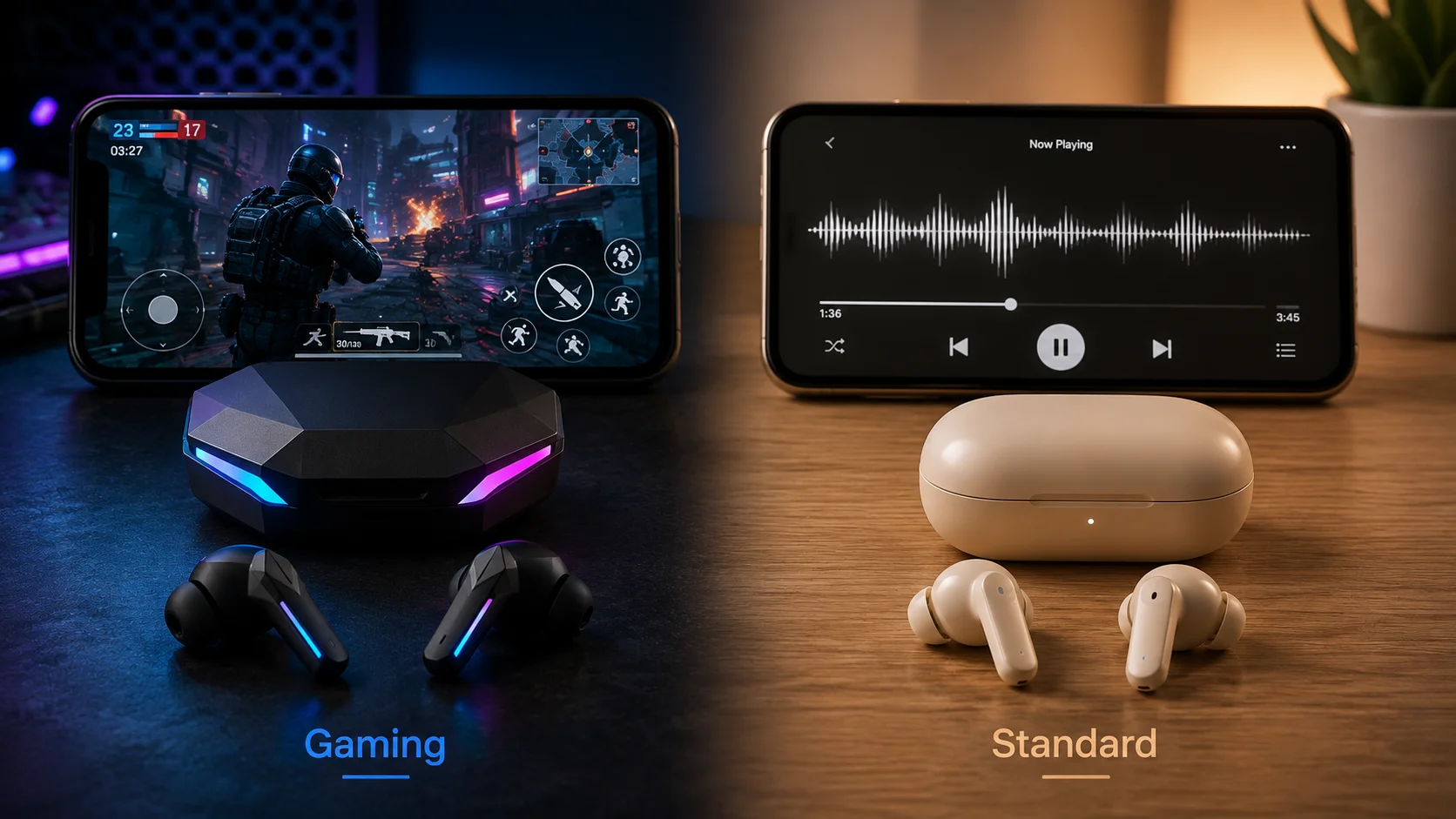
Procurement Comparison Table
| Evaluation Area | Gaming TWS Earbuds | Standard TWS Earbuds | Buyer Verification Point |
|---|---|---|---|
| Primary positioning | Gaming, entertainment, youth retail | Daily music, calls, commuting | Match the product to your channel |
| Low-latency mode | Often included | May be absent or less emphasized | Test activation and real use |
| Battery behavior | May change in gaming mode | Often optimized for standard playback | Request mode-specific battery data |
| Design | RGB, transparent case, angular styling | Minimal or lifestyle-focused | Confirm finish consistency |
| Microphone | May promote team-chat use | Often promotes calling | Test in realistic noisy settings |
| Retail risk | High if latency claims are unclear | High if call expectations are unclear | Use accurate listing language |
| Price pressure | Can be strong in entry-level gaming lines | Broad market range | Compare total value, not only unit cost |
Do Not Ignore Core TWS Quality
Gaming design does not replace basic manufacturing quality. We have seen buyers spend most of their time choosing shell colors and LED effects, then discover that the key commercial questions were elsewhere.
A buyer should still review:
- Charging-case hinge strength
- Earbud fit and wearing stability
- Charging contact reliability
- Battery consistency
- Pairing behavior
- Touch-control sensitivity
- Packaging durability
- Cosmetic inspection standards
- Incoming and outgoing quality-control procedures
For a wholesale program, the lowest factory price can become expensive if the return rate rises. We suggest comparing samples, documentation, and supplier response quality before deciding.
What Changes Between Gaming Mode and Music Mode?
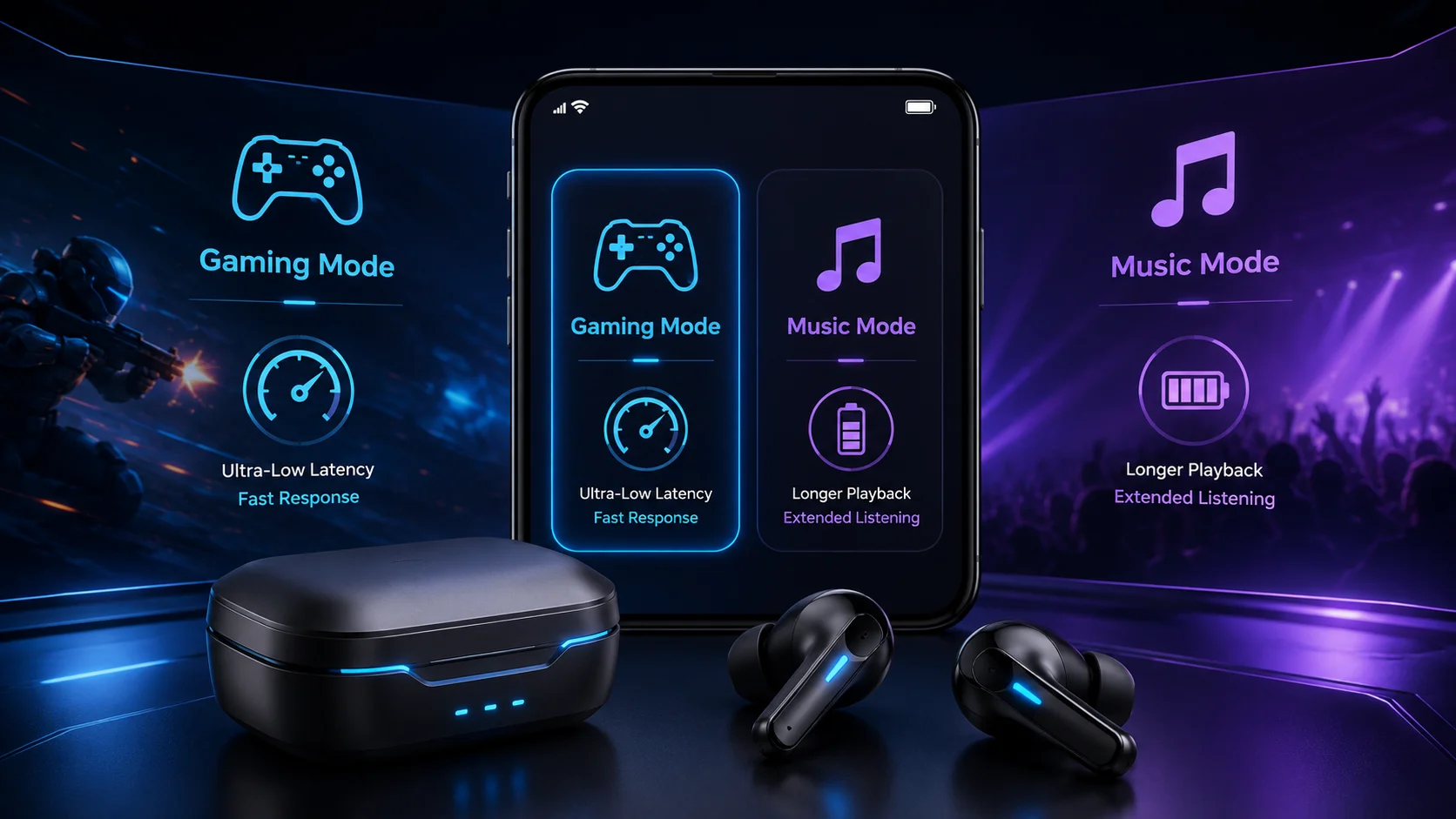
Gaming mode sounds simple, but it is not always a single fixed setting with identical results everywhere. In many products, the mode adjusts how audio data is buffered or processed to prioritize faster response. That may involve trade-offs that buyers should understand before making marketing claims.
Gaming mode is generally designed to reduce perceived audio delay by changing audio processing or buffering behavior.6 Music mode may prioritize stable playback, sound tuning, or power efficiency instead. Buyers should verify how the mode is activated, whether it stays active reliably, and how it affects latency, battery life, and connection stability.
Test the User Experience, Not Just the Feature List
A gaming mode should be easy for customers to find and use. If activation requires an unclear touch sequence, an unreliable app, or a phone-specific setting, customer support teams may receive questions after sale.
We recommend checking:
- How users activate and deactivate gaming mode
- Whether a voice prompt or LED indicator confirms the change
- Whether the setting remains active after reconnection
- Whether the mode works independently on left and right earbuds
- Whether it affects sound quality or connection reliability
- Whether the user manual explains the function clearly
Product Page Wording Matters
A buyer should avoid phrases such as “zero delay” or “no lag.”7 Those statements are difficult to support across all devices and environments. A more responsible description can state that the earbuds include a low-latency gaming mode intended to improve synchronization during compatible mobile gaming use.
This approach protects the retailer’s credibility. It also gives customers more realistic expectations. In our pre-sales discussions, buyers who ask for clear operating conditions usually make better long-term product decisions than buyers who only ask for the lowest number.
Do Low-Latency Modes Increase Battery Consumption?
Battery life is a major purchase factor for TWS customers, and gaming mode can change power consumption. Some buyers focus on latency during sourcing, then discover too late that the published playback time was measured under a different mode or test condition.
Low-latency modes can increase battery consumption because the earbuds may use different processing, buffering, or wireless operating behavior.8 The actual impact varies by product design, volume, codec, phone, and usage conditions. Wholesale buyers should request separate battery-life information for normal playback and gaming mode, then confirm it with samples.
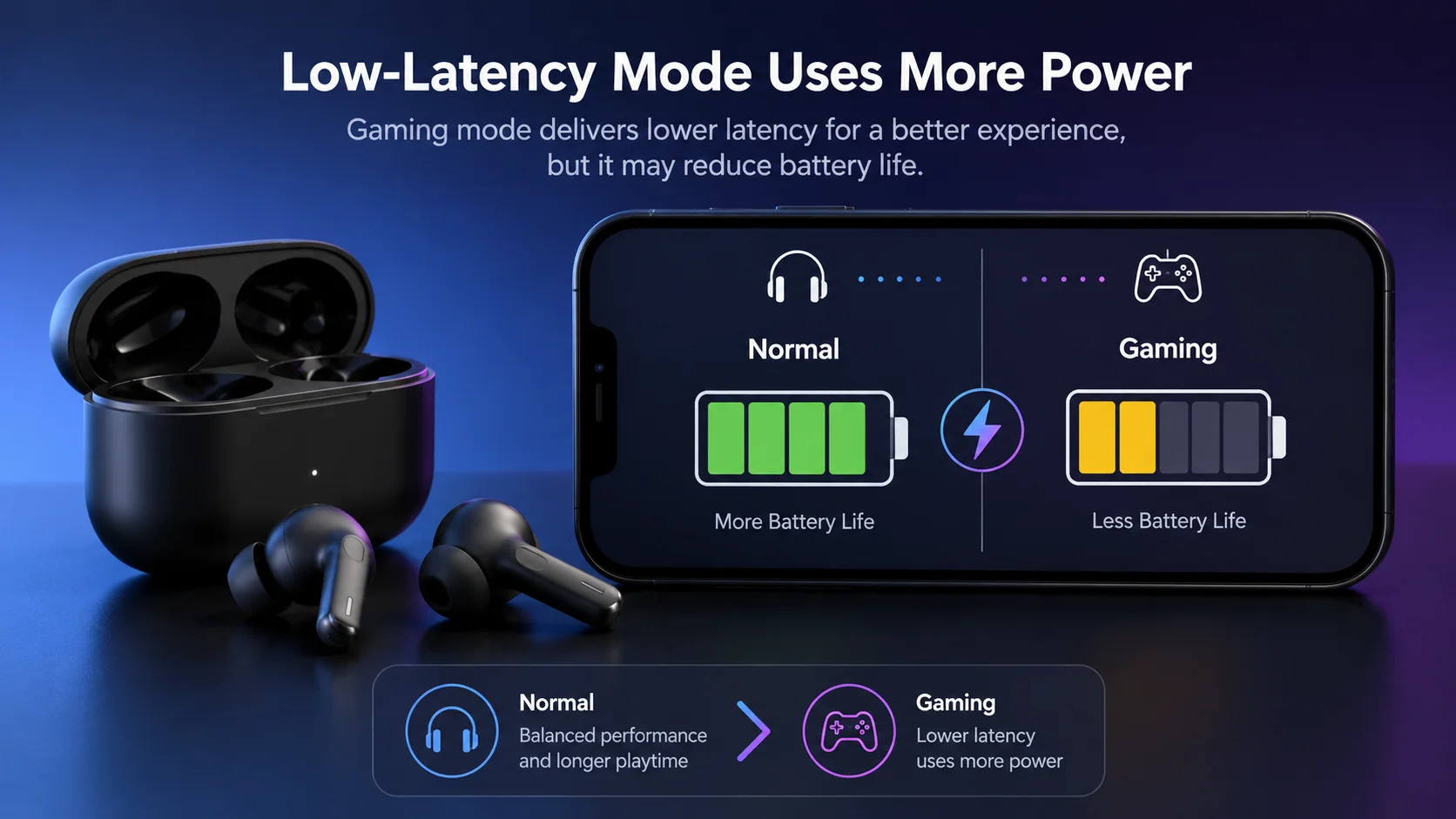
Request Comparable Battery Data
Battery claims are meaningful only when buyers understand the test conditions. Ask suppliers to state:
- Earbud playback time per charge
- Total playtime with charging case
- Test volume level
- Whether ANC or transparency mode was active, if included
- Whether gaming mode was enabled
- Phone and codec conditions used
- Charging time for earbuds and case
- Battery capacity specifications
Balance Marketing With Practical Use
A gaming customer may use earbuds for music, calls, short game sessions, and video throughout the day. Therefore, a balanced product can be easier to sell than a model that focuses only on one extreme performance point.
We suggest that buyers test the following scenarios:
- Music playback in normal mode
- Mobile gaming with gaming mode active
- Voice chat during gameplay
- Video playback and lip-sync performance
- Reconnection after placing earbuds back in the case
- Battery behavior after repeated charging cycles
Battery performance should also be evaluated through a qualified product and compliance process where necessary. We treat supplier-provided specifications as documents and claims to verify, not as automatic guarantees.
How Does Microphone Quality Affect In-Game Voice Chat?
A gaming earbud can offer responsive game audio but still disappoint users if teammates cannot hear them clearly. Voice chat quality matters especially for multiplayer mobile games, where users often communicate in cafés, homes, public transport, or shared spaces.
Microphone quality affects how clearly a player’s voice reaches teammates during in-game chat.9 Buyers should evaluate microphone placement, noise-reduction behavior, wind sensitivity, connection stability, and voice clarity on target phones. A microphone specification alone does not guarantee strong real-world voice-chat performance.
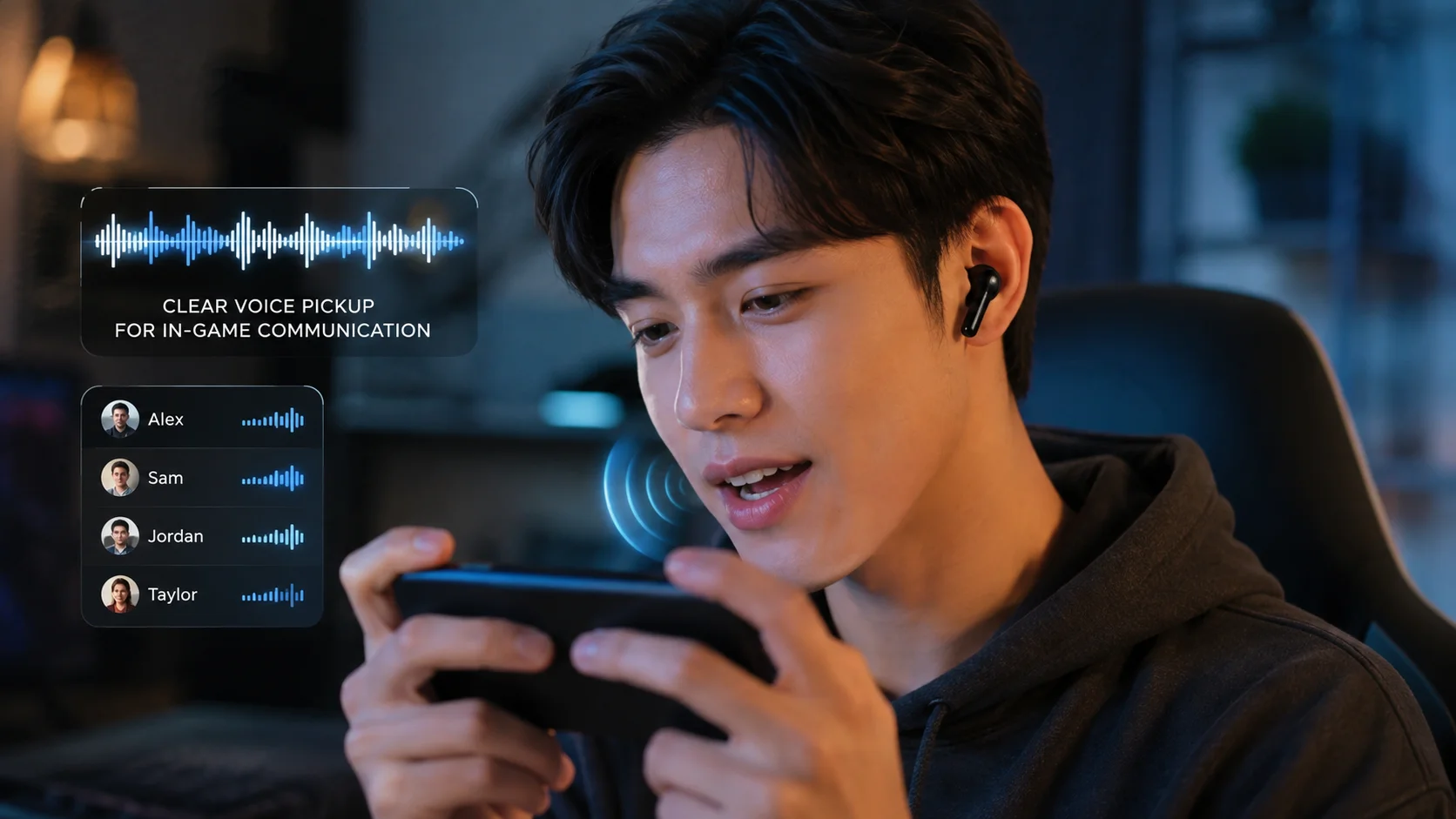
What to Test on Samples
We recommend conducting basic voice tests in several environments rather than relying only on a quiet factory demonstration.
Test voice-chat performance:
- In a quiet office
- Near moderate background conversation
- Near traffic or fan noise
- During outdoor walking
- While using one earbud only
- While both earbuds are connected
- During longer game sessions
The buyer should listen for voice volume, speech clarity, noise artifacts, dropouts, and unnatural processing. If the earbuds include environmental noise reduction, the buyer should ask how that function operates and under which conditions it was tested.
Call Quality and Gaming Quality Are Related but Different
A model that performs well in standard phone calls may behave differently in a specific game’s voice-chat system.10 Game software, phone permissions, network quality, and device processing all influence the result.
For this reason, we advise buyers not to write “professional gaming microphone” unless they have a clear basis for that statement. It is safer to describe the actual feature set and test samples with the intended apps and phones.
Do Low-Latency TWS Gaming Earbuds Prevent Audio Delay in Videos and Movies?
Many customers buy gaming earbuds for more than games. They also watch short videos, stream movies, and use social platforms. Buyers may wonder whether a low-latency mode automatically fixes every lip-sync issue across every app and device.
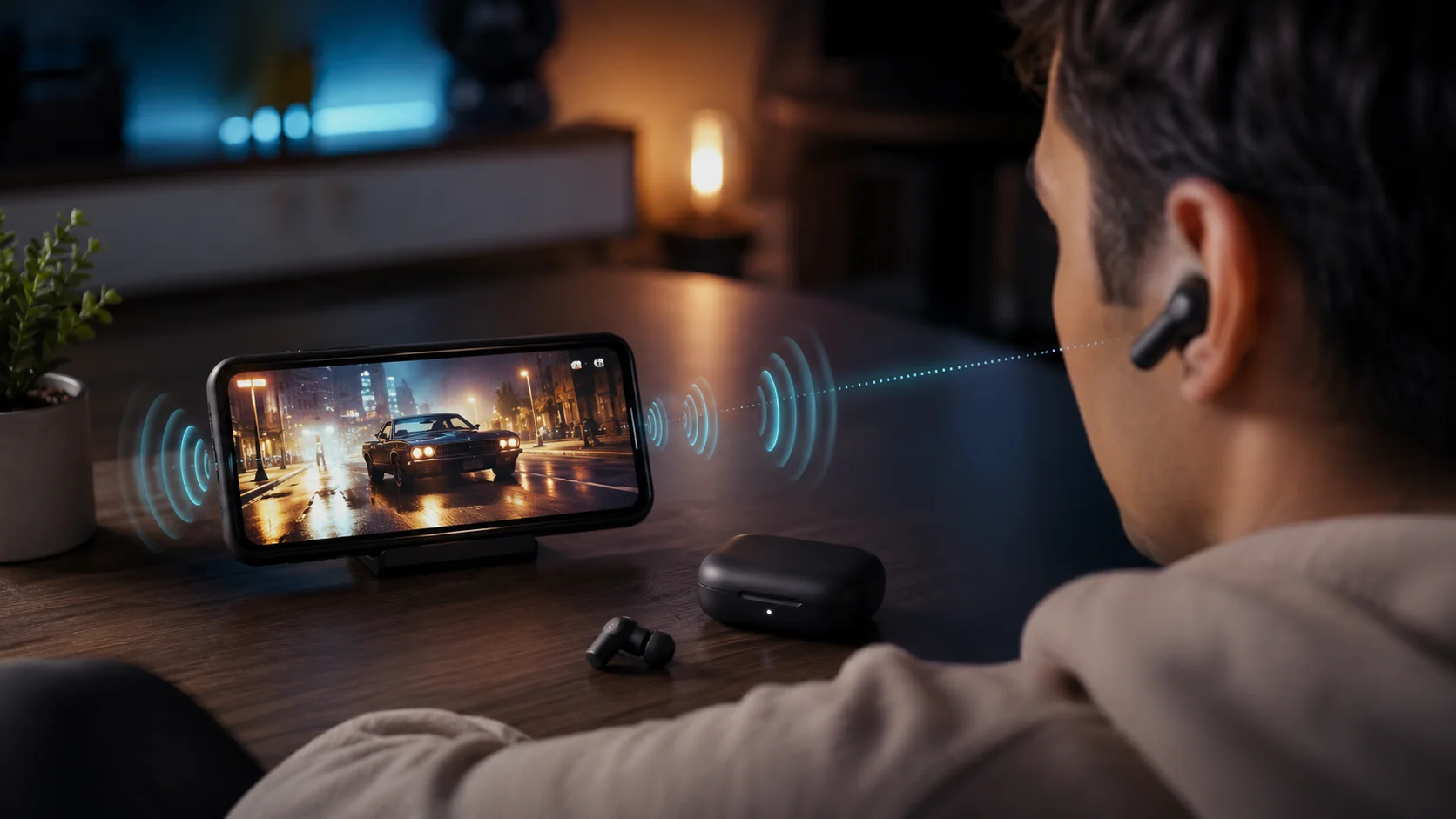
Low-latency TWS gaming earbuds may improve audio synchronization in some video situations, but they cannot guarantee that all video or movie apps will have no delay. Many phones and streaming apps use their own audio-video synchronization methods.11 Buyers should test video playback on target devices before making broad claims.
Video Synchronization Uses Different Systems
Some apps compensate for Bluetooth delay by adjusting video timing. Others may behave differently depending on the operating system, browser, app version, or content type. This means a product can appear well synchronized in one application and less synchronized in another.
We suggest testing:
- Mainstream streaming apps used in your market
- Short-video apps
- Browser-based video
- Local video playback
- Video calls
- Both Android and iOS devices where relevant
Build a More Accurate Product Position
A buyer can still market a gaming model to multimedia users, but the wording should remain measured. For example:
- “Gaming mode designed for faster audio response”
- “Suitable for gaming, music, and video entertainment”
- “Actual performance may vary by connected device and application”
This is not weak marketing. It is responsible retail communication. Clear expectations can reduce disputes and help customers choose the right product.
What Should Wholesale Buyers Check Beyond RGB Lighting and Gaming Design?
RGB lights and gaming-style cases can attract attention in stores and online listings. They can help a product stand out, especially among younger consumers. However, design alone does not determine whether a wholesale program will succeed after the first shipment.
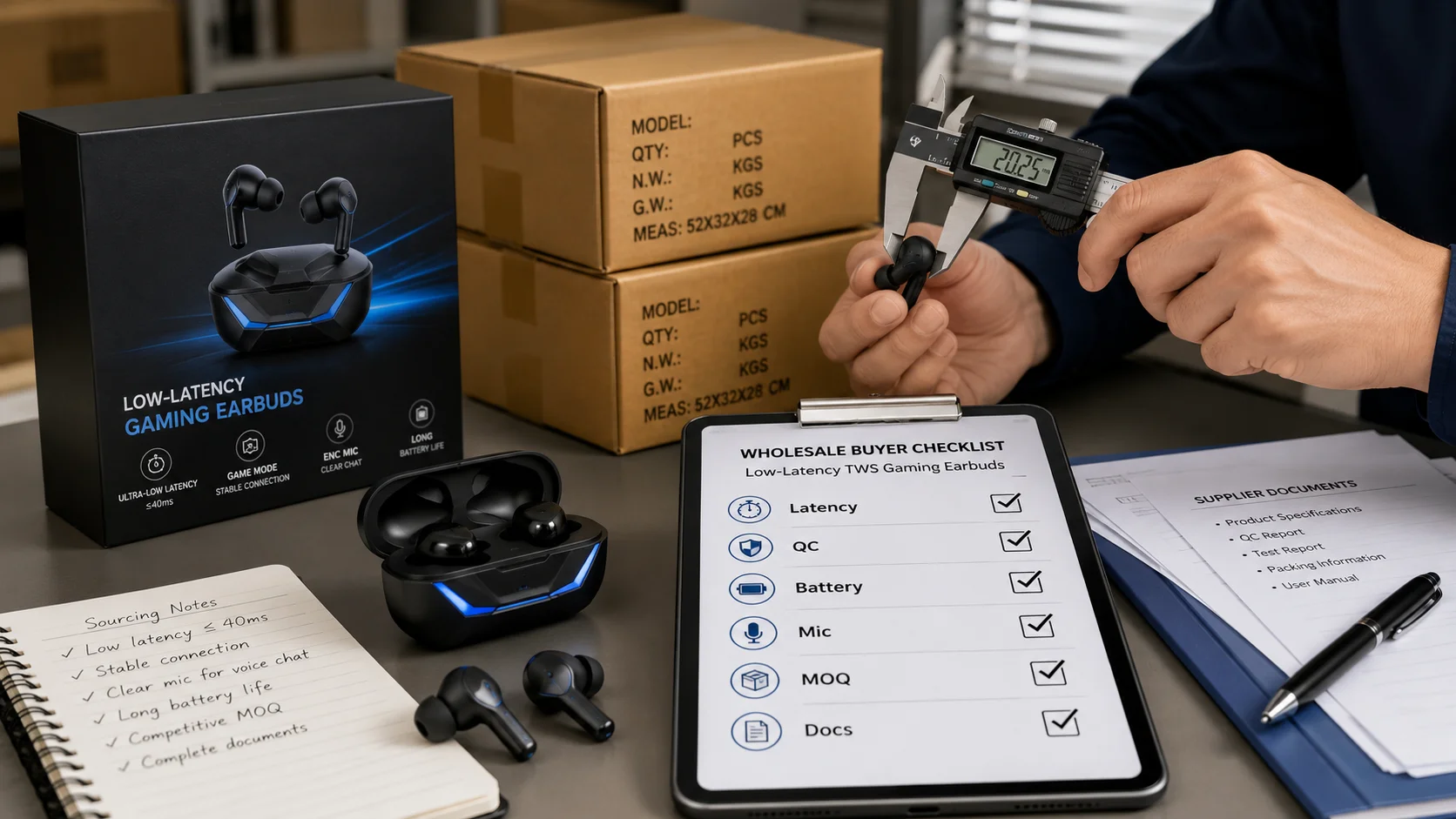
Beyond RGB lighting and gaming design, wholesale buyers should check product reliability, latency verification, fit, battery consistency, microphone quality, packaging, customization options, MOQ, lead time, quality-control procedures, certification documentation, and after-sales support. These factors usually have a greater effect on repeat orders and return rates than appearance alone.12
Supplier Selection Checklist
When we work through a new inquiry, we encourage buyers to look at the full supply-chain picture.
| Procurement Area | Questions to Ask |
|---|---|
| MOQ | What is the MOQ for stock models, logo printing, and custom colors? |
| Lead time | What is the sample timeline and mass-production lead time? |
| Customization | Can the supplier customize logo, shell color, packaging, manuals, or accessories? |
| QC process | What inspections occur during assembly, charging, pairing, and final packing? |
| Documentation | Can the supplier provide applicable test reports and certification documents? |
| Firmware | Is firmware version controlled across production batches? |
| Warranty support | How are confirmed quality issues handled? |
| Packaging | Can packaging meet retailer, marketplace, and destination-market needs? |
Evaluate the Sample-to-Production Process
A good sample is not enough if mass production changes components, firmware, assembly controls, or packaging quality. Buyers should ask how the supplier manages consistency between approved samples and production units.
We recommend confirming:
- Approved sample reference
- Bill of materials control
- Firmware version control
- Pre-production inspection process
- Random inspection level
- Functional testing standards
- Final packing inspection
- Defect reporting process
For larger or application-sensitive projects, qualified third-party inspection and professional compliance evaluation can add useful protection.
How Can Buyers Source Low-Latency TWS Gaming Earbuds From Kingfuji?
Sourcing gaming earbuds should be a structured evaluation process, not a race toward the lowest quoted price. Buyers need enough information to build accurate listings, reduce compatibility risk, and select a model that fits their customer base and sales channel.
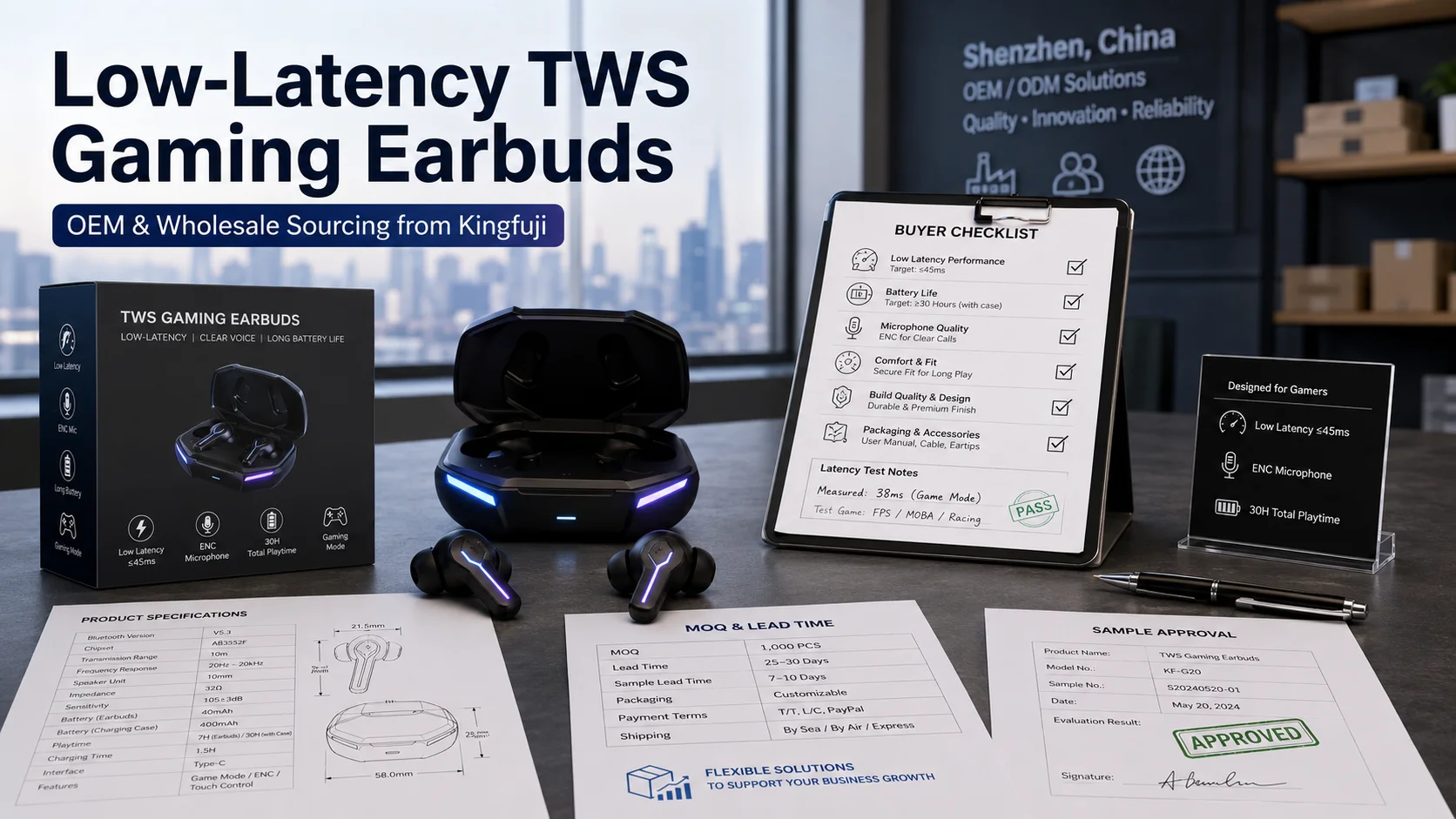
When sourcing low-latency TWS gaming earbuds from Kingfuji or any supplier, buyers should request product specifications, latency test conditions, target-device information, battery data, microphone details, applicable certification documents, customization options, MOQ, lead time, and samples for independent evaluation. The final decision should be based on verified suitability for the buyer’s market.
How We Support Procurement Discussions
We are a Shenzhen 3C manufacturer with 15 years of export experience. Our product categories include USB cables, chargers, GaN chargers, TWS earbuds, and smart watches for overseas markets.
For gaming TWS projects, we can help buyers organize the questions that matter before production begins:
- Which design and price segment fit the channel?
- Is a low-latency mode required for the product position?
- What target phones should be included in sample tests?
- Does the buyer need logo printing or retail packaging?
- What MOQ and lead-time structure supports the launch plan?
- What documentation should the buyer review for the destination market?
We do not suggest treating any specification as universal without verification. Instead, we encourage a practical sample-testing process that supports accurate product listings and more confident purchasing decisions.
Frequently Asked Questions
What is a good latency level for gaming TWS earbuds?
A good latency level depends on the phone, game, codec, firmware, and user expectations. Buyers should not rely on a single advertised number. We recommend testing samples on target devices and confirming whether the stated figure represents end-to-end latency under clearly documented conditions.
Does Bluetooth 5.3 guarantee low-latency gaming performance?
No. Bluetooth version is one technical input, but it does not guarantee a specific gaming result. Chipset integration, firmware, codec behavior, gaming mode, smartphone compatibility, and wireless conditions all influence actual latency and connection stability.
Should wholesalers choose sub-50ms earbuds for every customer?
Not necessarily. Sub-50ms earbuds may suit a gaming-focused product line, but the claim should be verified. Some customer groups may value comfort, microphone quality, battery life, price, or design more than an aggressive latency specification.
Can OEM gaming earbuds include custom logos and packaging?
Many suppliers can support OEM options such as logo printing, custom packaging, color selection, manuals, and accessories. Buyers should confirm the MOQ, artwork requirements, lead time, packaging testing, and approval process before placing a production order.
How should retailers describe low-latency gaming earbuds online?
Retailers should use clear, supportable wording. We recommend describing the presence of a gaming or low-latency mode and stating that performance can vary by connected device, application, and operating conditions. Avoid universal claims such as “zero delay.”
Conclusion
Low-latency TWS gaming earbuds are best evaluated as a complete user experience, not as a single millisecond figure. Wholesale buyers should verify test conditions, target-device compatibility, gaming-mode behavior, battery performance, microphone quality, and manufacturing controls before placing a large order. RGB lighting and gaming styling can help sell a product, but reliable performance and responsible product claims protect long-term margins. If you are sourcing wholesale TWS earbuds for Europe or North America, we welcome you to discuss samples, customization, MOQ, lead time, and your target market requirements with our team.
"Evolution of Bluetooth Technology: BLE in the IoT Ecosystem - PMC - NIH", https://pmc.ncbi.nlm.nih.gov/articles/PMC11859364/. Bluetooth audio delay is an end-to-end property influenced by encoding, packet transmission, buffering, decoding, and device-specific implementation; consequently, observed latency can vary across phones, firmware, and operating conditions. Evidence role: mechanism; source type: paper. Supports: Bluetooth audio latency is shaped by codec processing, buffering, device implementation, wireless transmission conditions, and playback hardware.. Scope note: The source may describe general Bluetooth audio systems rather than the performance of a particular earbud model or game. ↩
"Bluetooth audio latency, codecs, when does it matter", https://hmijailblog.blogspot.com/2019/12/bluetooth-audio-latency-codecs-when.html. End-to-end wireless audio latency includes delays from audio processing and codec operation as well as packet transport, receiver buffering, decoding, and output rendering. Evidence role: mechanism; source type: institution. Supports: Bluetooth audio systems introduce delay at processing, codec, transport, buffering, decoding, and rendering stages.. Scope note: Stage-by-stage latency contributions depend on the Bluetooth profile, codec, host device, and implementation. ↩
"Impact of Audio Delay and Quality in Network Music Performance", https://www.mdpi.com/1999-5903/17/8/337. Quality-of-experience research on streamed and wireless audio identifies interruptions, losses, and temporal instability as salient degradations of perceived listening quality. Evidence role: general_support; source type: paper. Supports: Interruptions, packet loss, and timing instability can substantially degrade perceived wireless audio quality.. Scope note: Evidence on general audio quality of experience may not directly rank gaming-earbud buyers' preferences between every latency difference and every type of dropout. ↩
"Stop Blaming WiFi: How Sub-50ms Low Latency Earbuds Win ...", https://world.taobao.com/lang/en-us/shopping-guide/2008145295908536320.htm. Consumer-market coverage documents that gaming-earbud products are frequently advertised with low-latency modes and millisecond latency figures, including claims below 50 ms. Evidence role: general_support; source type: other. Supports: Consumer-facing gaming-earbud listings and reviews commonly describe low-latency modes with millisecond figures, including claims below 50 ms.. Scope note: A market sample can establish common marketing usage but does not validate the measurement method or accuracy of individual sub-50 ms claims. ↩
"Bluetooth audio latency, codecs, when does it matter", https://hmijailblog.blogspot.com/2019/12/bluetooth-audio-latency-codecs-when.html. Bluetooth Core Specification version alone does not define a fixed end-to-end audio latency, because latency also depends on the selected audio architecture, codec, buffering strategy, and device implementation. Evidence role: mechanism; source type: institution. Supports: Bluetooth audio performance depends on profiles, codecs, buffering, host-device software, and implementation choices in addition to Bluetooth Core Specification version.. Scope note: The source establishes the general technical principle and does not test the specific chipsets or firmware used in a given retail product. ↩
"Ultra-Low Latency Audio Transmission Over Bluetooth LE ...", https://audioxpress.com/article/wireless-audio-ultra-low-latency-audio-transmission-over-bluetooth-le-audio. Low-latency wireless-audio designs commonly reduce end-to-end delay by minimizing buffering and processing time, although reduced buffering can alter robustness under variable transmission conditions. Evidence role: mechanism; source type: paper. Supports: Reducing buffering and processing delay is a recognized method for lowering end-to-end audio latency, often with resilience or power trade-offs.. Scope note: This general mechanism does not prove that every product marketed with a gaming mode uses the same method or achieves the same latency. ↩
"Bluetooth audio latency, codecs, when does it matter", https://hmijailblog.blogspot.com/2019/12/bluetooth-audio-latency-codecs-when.html. Bluetooth audio playback entails measurable processing, transport, and buffering delays, so a universal claim of zero delay is not supported across all connected devices and operating conditions. Evidence role: general_support; source type: research. Supports: Bluetooth audio systems have measurable and implementation-dependent end-to-end delay.. Scope note: Measured latency may be low enough to be imperceptible in some applications, but that does not establish literal zero latency. ↩
"Quantifying the Trade-off Between Latency and Power Consumption in ...", https://ui.adsabs.harvard.edu/abs/2022wfio.conf...43D/abstract. Research on wireless-audio system design describes latency, buffering, processing, radio operation, and energy consumption as interrelated design parameters, such that lower-latency operation may change power use. Evidence role: mechanism; source type: paper. Supports: Wireless-audio system design involves trade-offs among latency, buffering, radio activity, processing, reliability, and energy use.. Scope note: The direction and size of battery-life change must be measured for each product, codec, volume level, and connected device. ↩
"Recommendation ITU-T P.1140 (07/2022)", https://www.itu.int/epublications/en/publication/itu-t-p-1140-2022-07-speech-communication-requirements-for-emergency-calls-originating-from-vehicles. Speech-communication standards and research recognize microphone capture, ambient noise, transmission processing, and speech enhancement as factors affecting received voice quality and intelligibility. Evidence role: mechanism; source type: institution. Supports: Microphone capture quality, background noise, transmission processing, and speech enhancement affect perceived speech quality and intelligibility.. Scope note: General speech-quality findings do not independently verify a particular earbud's in-game microphone performance. ↩
"Performance comparison of various VoIP codecs in wireless environments", https://dl.acm.org/doi/10.1145/1968613.1968718. Real-time voice quality is affected by application-specific audio processing, codec behavior, network performance, and endpoint configuration; results from one communication application therefore may not transfer directly to another. Evidence role: mechanism; source type: paper. Supports: Voice quality in real-time communication applications varies with application audio processing, codec selection, network conditions, and endpoint configuration.. Scope note: The source may address VoIP applications generally rather than the voice-chat implementation of a named mobile game. ↩
"Audio-to-video synchronization", https://en.wikipedia.org/wiki/Audio-to-video_synchronization. Audio-video playback systems use presentation timestamps and synchronization mechanisms to maintain alignment between audio and video streams despite differences in processing and output delay. Evidence role: mechanism; source type: education. Supports: Audio-video systems use synchronization mechanisms to align audio and video presentation despite differing processing and output delays.. Scope note: The availability and effectiveness of synchronization compensation vary by operating system, app, media pipeline, and Bluetooth output route. ↩
"Determining the Effect of the Returns Management ...", https://trace.tennessee.edu/cgi/viewcontent.cgi?referer=&httpsredir=1&article=2592&context=utk_chanhonoproj. Consumer-behavior and service-quality research generally links product reliability and post-purchase satisfaction with lower complaint or return risk and stronger repurchase intention. Evidence role: general_support; source type: paper. Supports: Product quality, reliability, and post-purchase satisfaction are associated with returns, complaints, and repurchase intentions.. Scope note: This evidence is general and does not quantify the relative effect of appearance versus operational factors for gaming-earbud wholesale programs specifically. ↩