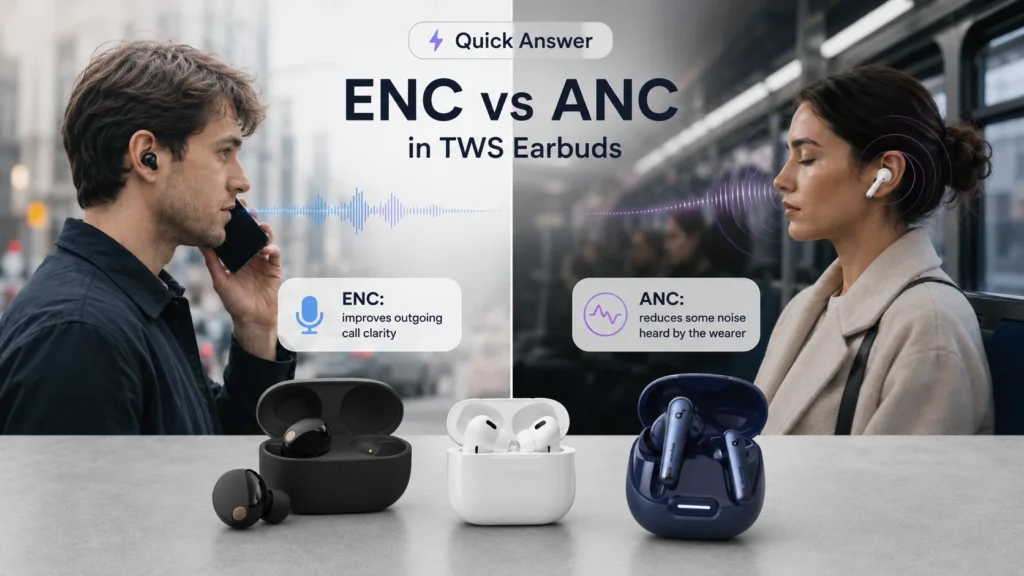
ENC vs ANC in TWS earbuds is a common source of confusion for buyers, sellers, and end users. A supplier may describe a model as “noise cancelling,” but that phrase can mean clearer outgoing calls, quieter music listening, or both. If we do not separate these functions early, product claims and customer expectations can quickly drift apart.
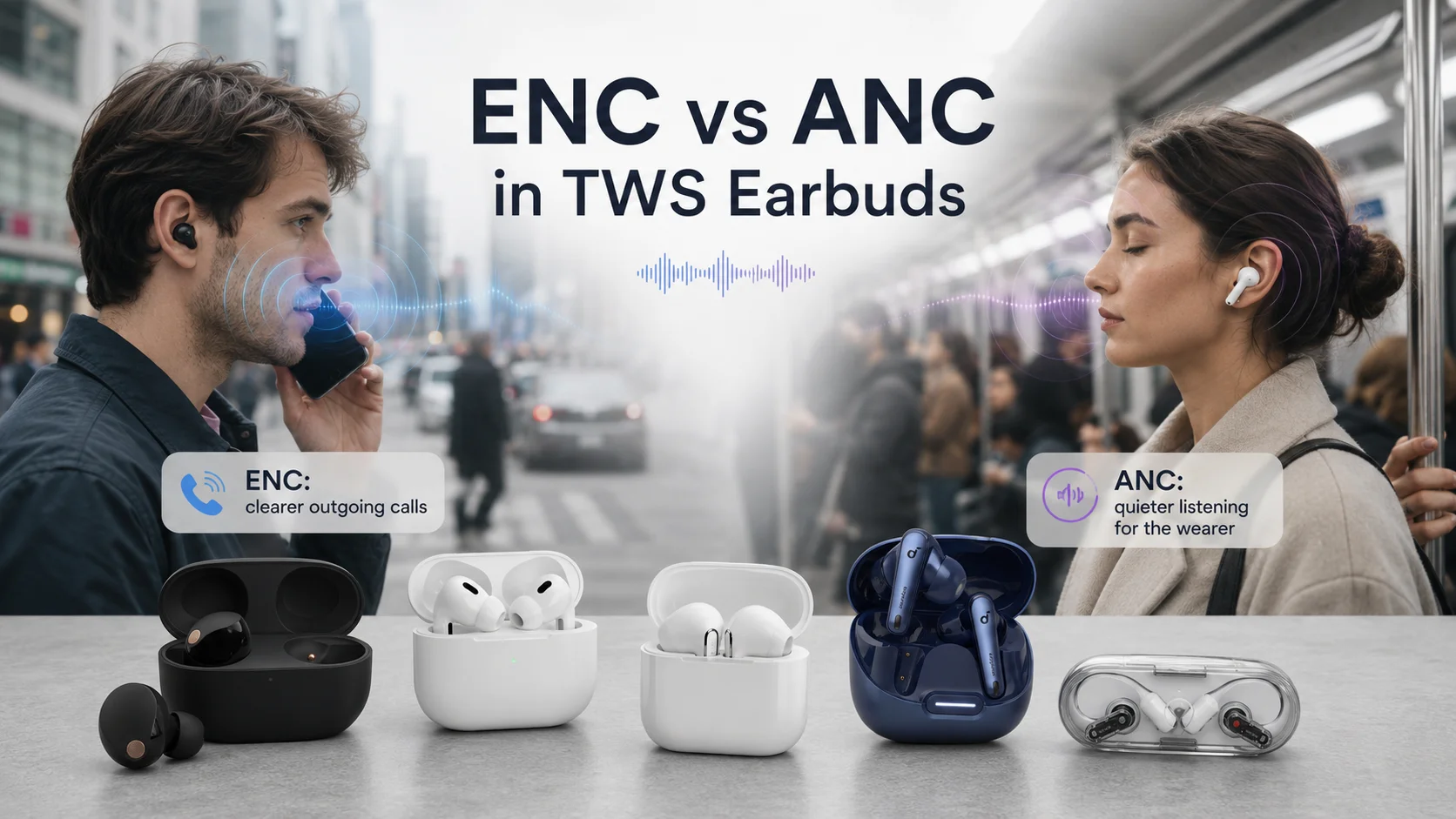
ENC improves the voice signal sent to the person on the other end of a call, while ANC reduces some environmental noise heard by the wearer.1 In ENC vs ANC in TWS earbuds, neither feature is automatically “better”; the right choice depends on whether the product is positioned for clear calls, quieter listening, or a combination of both. Buyers should verify real sample performance, not rely on generic noise-cancellation labels.
For European and North American importers, this distinction matters beyond product specifications. It affects retail listings, packaging claims, customer reviews, return rates, and after-sales disputes. From our 15 years of exporting 3C products from Shenzhen, we have seen that the best sourcing decisions begin with a simple question: Who is supposed to hear less noise—the caller or the wearer?
What Is the Quick Answer on ENC vs ANC in TWS Earbuds?
Many buyers need a fast answer before they compare samples. The problem is that marketing terms often hide the difference between call performance and music-listening performance. This can lead buyers to select a call-focused model for commuters who expect quiet listening.
In ENC vs ANC in TWS earbuds, ENC mainly supports call clarity by reducing background sound captured by the earbuds’ microphones. ANC mainly reduces selected external sounds for the person wearing the earbuds. TWS earbuds can include both features, but each function should be confirmed separately through specifications, samples, and practical use tests.
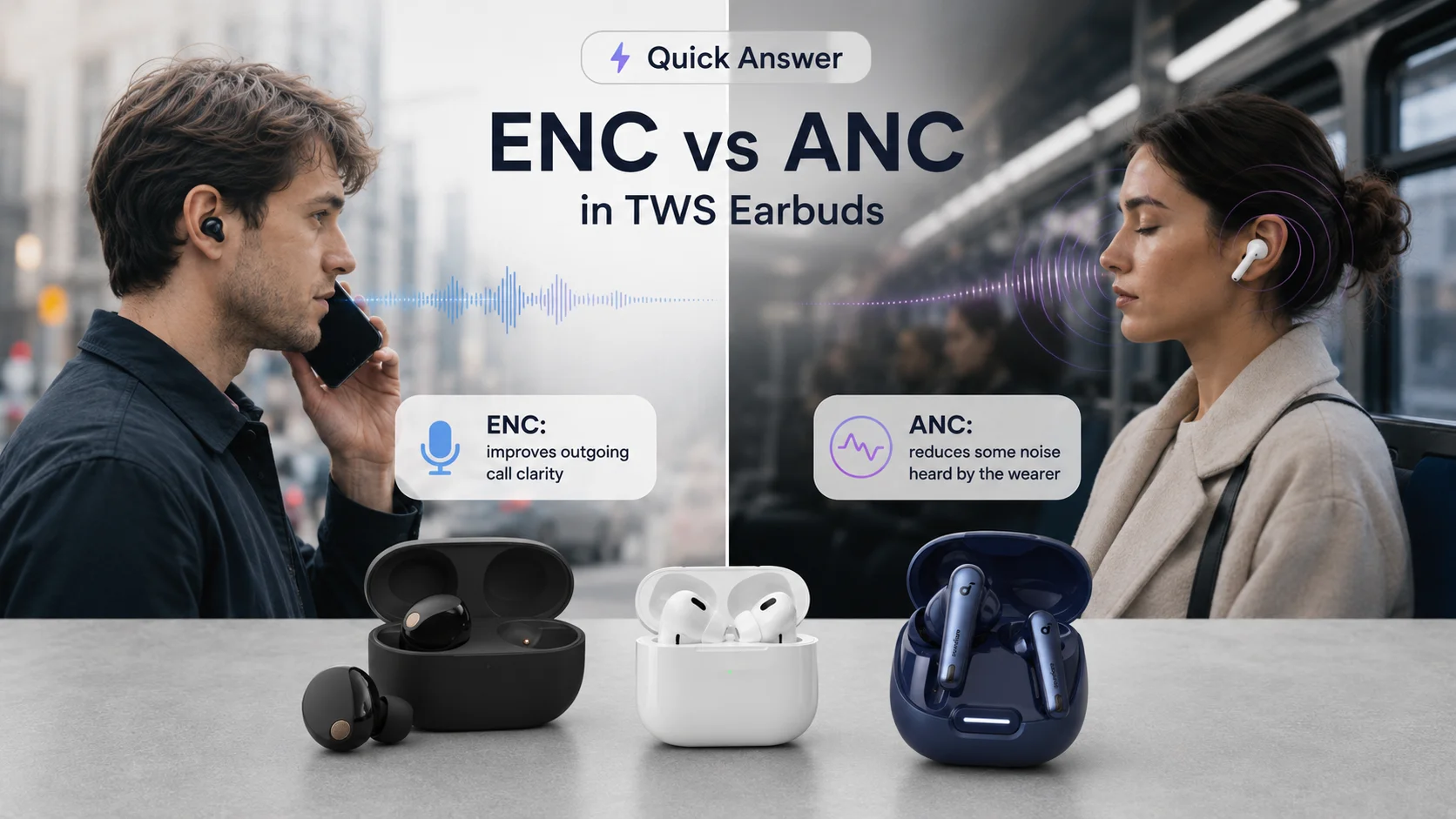
The two audio paths buyers should understand
The clearest way to explain the difference is to separate the two audio paths:
- Outgoing call path: Your voice travels from the earbud microphones to the person you are calling.
- Incoming listening path: Music, video, or call audio plays through the earbud speakers into your ears.
ENC usually works on the outgoing path. The system uses microphones and signal processing to identify the wearer’s voice and reduce parts of the surrounding noise. Its goal is to help the other person hear the speaker more clearly.
ANC works on the incoming listening path. It uses microphones, processing, and anti-noise signals to reduce certain sounds that reach the wearer.2 Its goal is to make the listening experience more comfortable in environments such as public transport, offices, or aircraft cabins.
A useful supplier question is: “Does this feature improve outgoing call voice, reduce incoming environmental sound, or do both?”
This question is more valuable than simply asking whether a model has “noise cancellation.”
Why Does Clear Call Quality Matter When Sourcing TWS Earbuds?
A TWS earbud can sound good during music playback and still perform poorly during a phone call. Buyers often discover this only after products reach retail customers. Then, complaints about “bad microphones” can affect ratings, repeat orders, and brand confidence.
Clear call quality matters because remote work, online meetings, mobile business calls, and gaming voice chat all depend on the microphone system.3 For many value-focused TWS earbuds, verified ENC performance can be more important than ANC because customers may use calls every day, even when they do not use music in noisy environments.
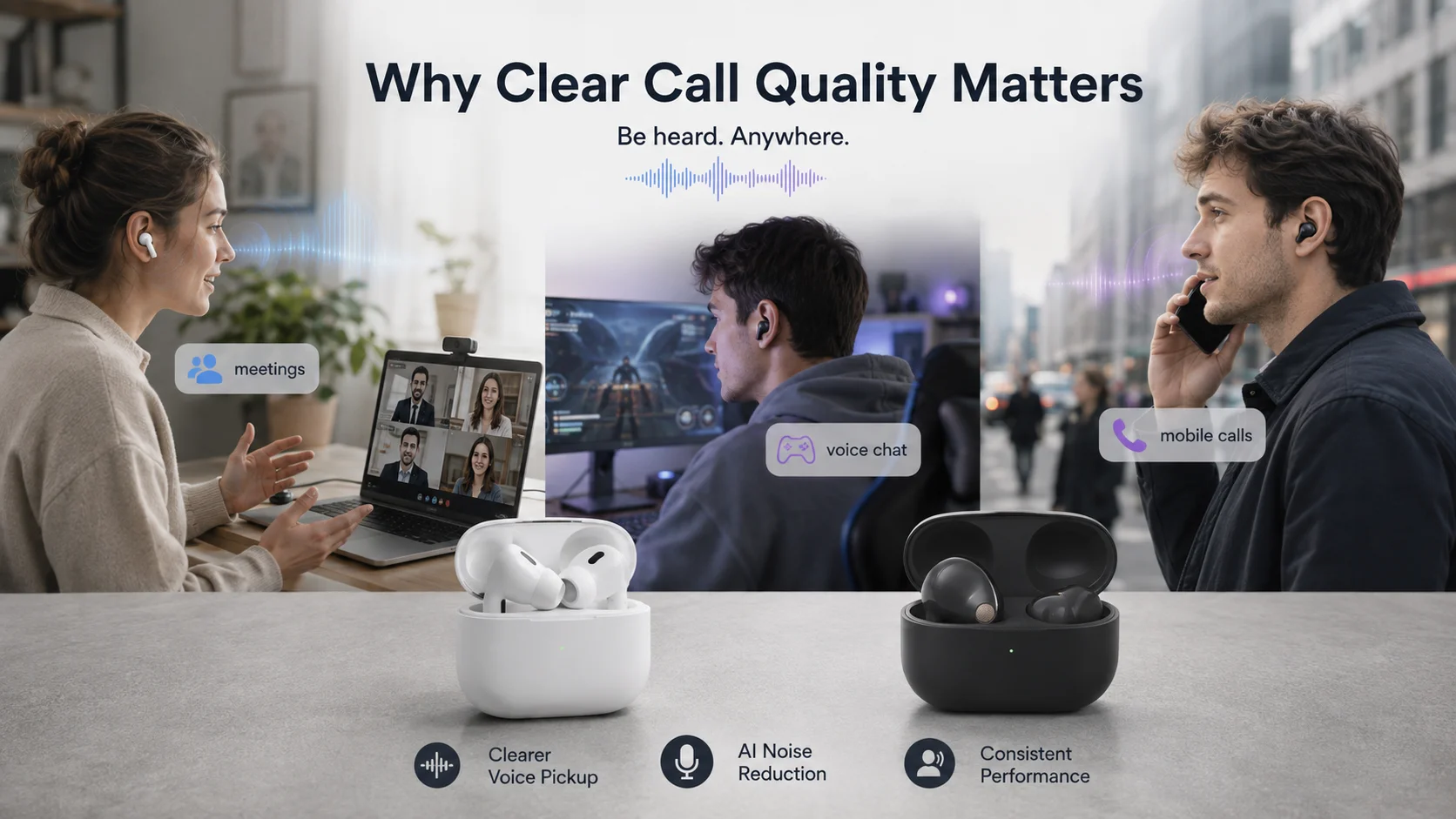
Music quality and call quality are different buying decisions
Retailers should avoid assuming that a strong audio driver means a strong calling experience. These are separate product systems.
A model can offer:
- Good bass and volume, but weak voice pickup
- Multiple microphones, but poor wind-noise handling
- ANC for listening, but average call quality
- ENC for calls, but no quieter listening mode
- Both ENC and ANC, with results that still depend on tuning
In buyer discussions, we often see a familiar situation. A customer asks for “noise-cancelling earbuds,” but their actual target user is a delivery worker, salesperson, or remote employee. That user may care much more about whether clients can hear them clearly than whether train noise is reduced during music playback.
For that reason, product positioning should match the main user scenario:
| Target retail position | Priority feature to verify | Suggested claim direction |
|---|---|---|
| Budget daily-use earbuds | Voice clarity in normal calls | “Clear calls” if samples support it |
| Remote-work earbuds | Mic pickup and voice naturalness | “Designed for online calls” |
| Commuter earbuds | ANC listening experience | “Noise reduction for listening” |
| Travel-oriented earbuds | ANC, fit, battery, comfort | “Comfortable travel listening” |
| Gaming earbuds | Voice chat latency and mic quality | “Clear team communication” |
We recommend that buyers test call quality before approving packaging language. A claim that sounds reasonable in a catalog can create unnecessary returns if consumers interpret it as a promise of ANC-level quietness.
What Is ENC Technology in TWS Earbuds and How Does It Work?
ENC sounds simple in product listings, yet its actual result depends on several hardware and software decisions. A “4-mic ENC” label may sound impressive, but it does not independently prove that the end user will experience clear calls outdoors.
Environmental Noise Cancellation, or ENC, uses microphones and audio processing to reduce unwanted background sound in the outgoing voice signal.4 In ENC microphone TWS earbuds, the system tries to preserve the wearer’s speech while suppressing surrounding noise, such as traffic, office chatter, or mechanical sound. Actual results vary by design and firmware tuning.5
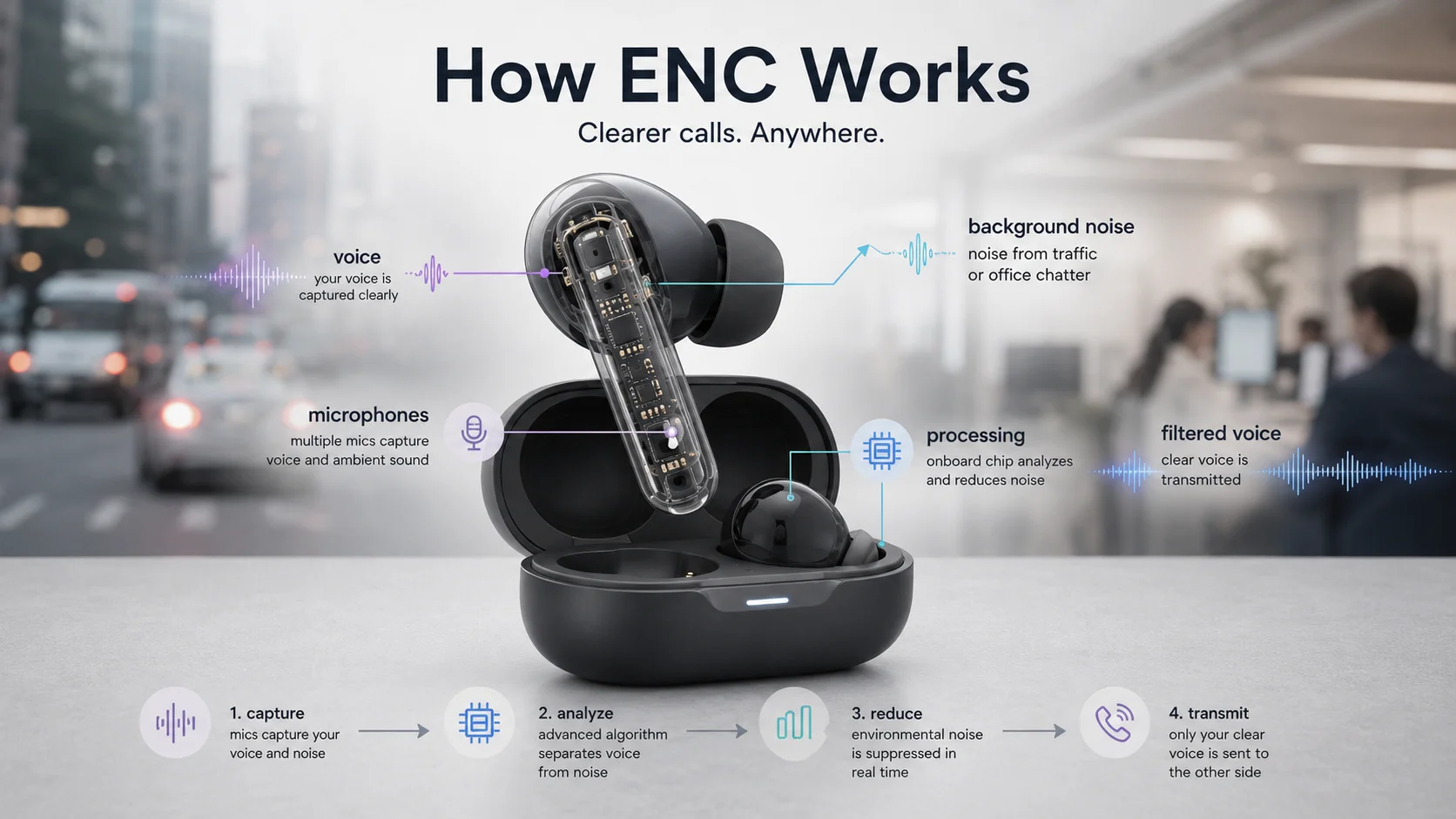
How the ENC call chain works
Most ENC TWS earbuds use some combination of the following components:
- Microphones capture voice and environmental sounds.
- Microphone placement affects how much voice, wind, and ambient sound each microphone receives.
- Chipset or DSP processing analyzes the signals.
- Noise-reduction algorithms attempt to separate voice from unwanted sound.
- Firmware tuning controls how aggressively the system removes noise.
Some suppliers may use phrases such as AI ENC earbuds, “AI call noise reduction,” or “intelligent voice enhancement.” These descriptions can refer to algorithmic processing, but buyers should not treat them as a standardized performance grade.
Why microphone count is not enough
A higher microphone count can support more advanced processing, but it is not a guarantee.6 Buyers should clarify whether a claim means:
- Two microphones per earbud
- Three microphones per earbud
- Four microphones across the complete pair
- Six microphones across the complete pair
- A mix of feedforward, feedback, and call microphones
The physical design also matters. If microphones are poorly positioned, exposed to wind, or insufficiently tuned, the system may still produce unnatural voice, pumping effects, or unstable noise suppression.
For this reason, we suggest using microphone count as a starting point for comparison, not as final evidence of call performance.
How Does ENC vs ANC in TWS Earbuds Compare?
The biggest mistake in ENC vs ANC in TWS earbuds is treating both technologies as interchangeable. They may both involve microphones and digital processing, but they serve different purposes. This distinction should be visible in supplier negotiations, product pages, and retail copy.
ENC is generally intended to improve what the caller hears during a call, while ANC is intended to reduce some environmental noise heard by the wearer. ENC does not automatically create a quieter listening environment, and ANC does not automatically guarantee superior outgoing call quality. Earbuds with both features require separate verification for each mode.
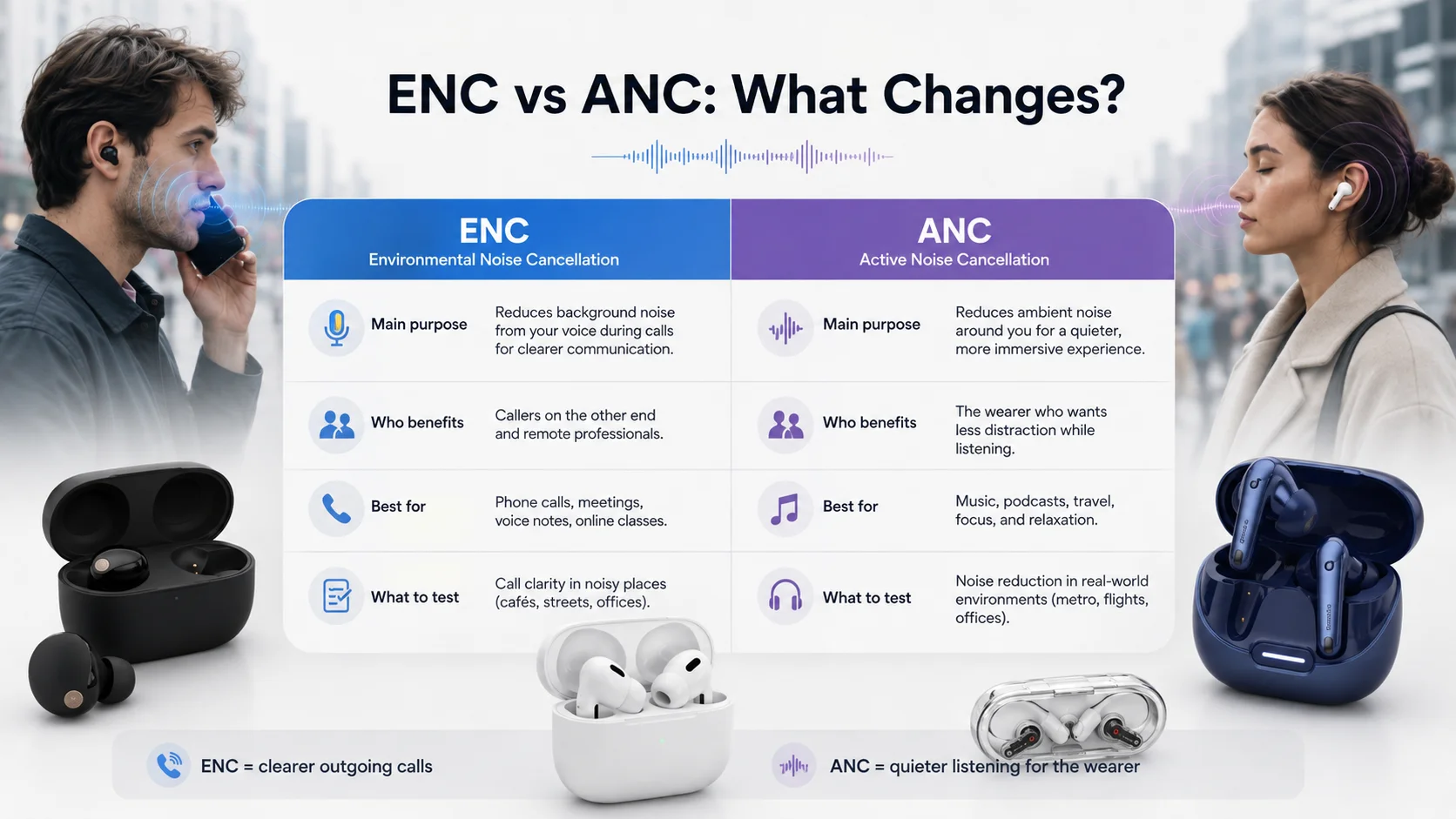
ENC, ANC, and combined models
| Feature | ENC | ANC | ENC + ANC |
|---|---|---|---|
| Main purpose | Improve outgoing voice pickup | Reduce environmental noise heard by wearer | Support calls and quieter listening |
| Primary audio path | Outgoing call signal | Incoming listening signal | Both paths |
| Microphone role | Captures voice and ambient sound for calls | Detects ambient sound for listening control | Supports both systems |
| Best for | Calls, meetings, voice chat | Commuting, travel, focused listening | Mid-range and premium all-round use |
| Call quality | May improve if tuned well | Not a call-quality guarantee | Must still be tested separately |
| Listening experience | Does not equal quiet listening | Can reduce selected external sounds | Depends on ANC design and fit |
| Cost impact | Usually lower than full ANC implementation | Can increase BOM and development demands | Often higher than ENC-only models |
| Buyer verification | Call recording and real-environment tests | Listening tests in repeatable conditions | Test both call and listening modes |
Does ENC block noise for the listener?
No, not in the ANC sense. ENC primarily focuses on the microphone signal during calls. The person speaking may still hear surrounding sounds normally unless the earbuds also include ANC, passive isolation from ear tips, or another listening-noise-reduction function.
Is ENC better than ANC for phone calls?
ENC may be more relevant for the outgoing call experience, but “better” depends on the product’s exact design. ANC is mainly a listening feature. A buyer who sells clear call TWS earbuds should prioritize call tests instead of assuming that ANC will solve microphone performance.
Can TWS earbuds have both ENC and ANC?
Yes. Many models combine ENC and ANC. However, buyers should request a clear feature breakdown because suppliers may use broad “noise cancellation” wording. We recommend confirming the mode names, call behavior, ANC depth claims, microphone arrangement, and test samples before approving sales copy.
What Specifications Should Buyers Check for ENC vs ANC in TWS Earbuds?
Specification sheets can be useful, but they can also create false confidence. Buyers may see “AI ENC,” “6 microphones,” or “Bluetooth 5.3” and assume that the model will deliver clear calls. In practice, a product sheet does not replace application-based testing.
For ENC vs ANC in TWS earbuds, buyers should check microphone configuration, chipset platform, firmware version, Bluetooth behavior, battery life during calls, acoustic structure, and claimed ANC modes. The most important evidence is a representative sample tested in conditions similar to the intended retail use case.
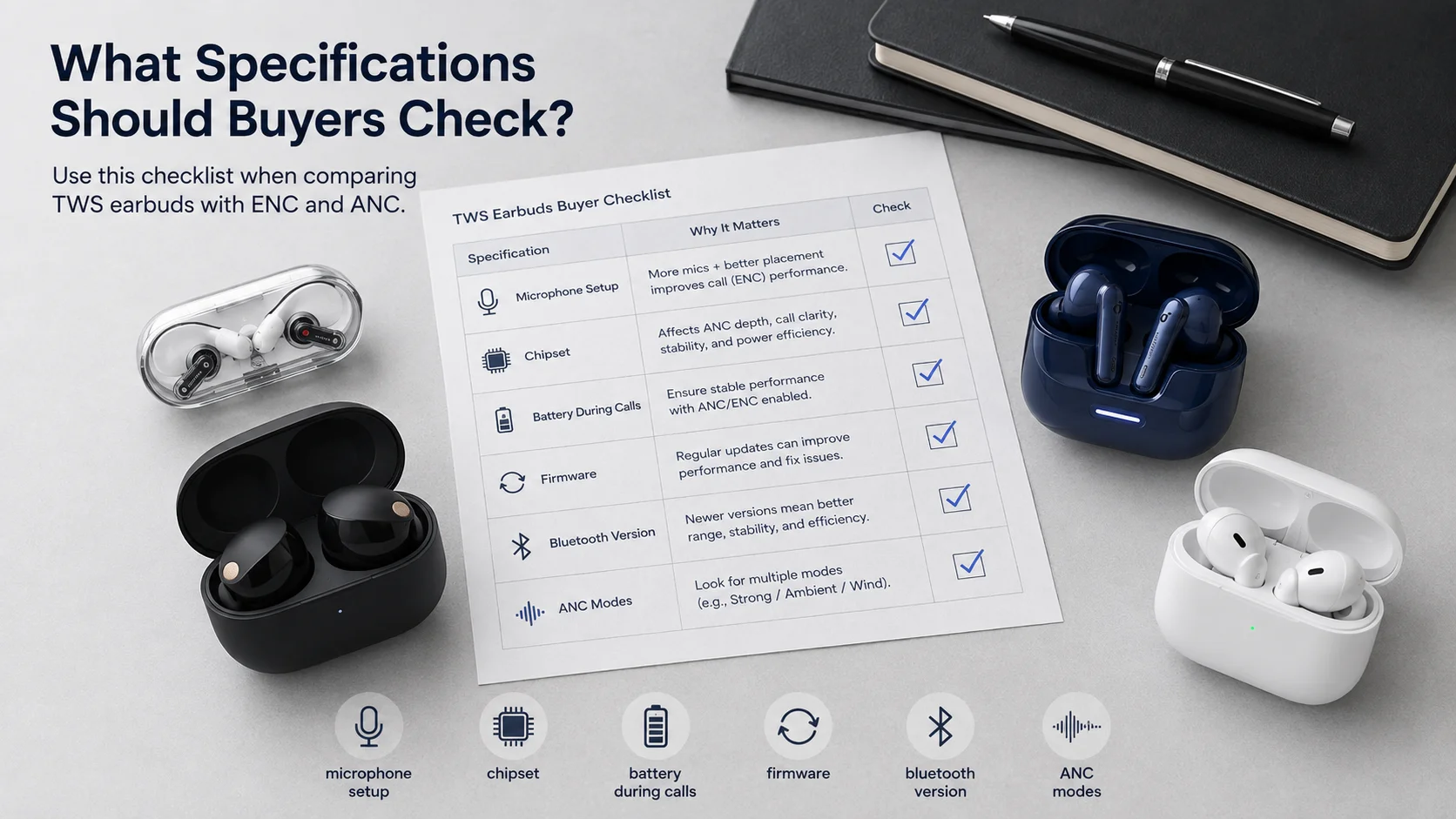
Procurement checklist for ENC TWS earbuds
Ask suppliers to provide clear, model-specific information on:
- Number of microphones per earbud and per pair
- Microphone type and placement
- Chipset platform and supported functions
- ENC algorithm description, if available
- Whether wind-noise reduction is included
- Bluetooth version and supported codecs
- Call-time battery life, not only total playback time
- Firmware version used in the sample
- ANC modes, if the model includes ANC
- Ear tip options and fit design for ANC models
Watch for vague feature wording
The following phrases require follow-up questions:
- “Noise cancelling”
- “HD calling”
- “Crystal-clear voice”
- “AI noise reduction”
- “4-mic call”
- “Smart ANC”
- “Hybrid noise cancellation”
These phrases may be valid marketing descriptions, but they do not tell a buyer what the product actually does. We recommend asking suppliers to explain the claim in plain language and show it in a video call or sample evaluation.
How Should Buyers Test ENC TWS Earbuds Before Bulk Ordering?
The problem with a quiet-office sample test is that it reveals very little about real call performance. Most consumer complaints happen in streets, cafés, shared offices, transport stations, or windy outdoor areas. A consistent test plan helps buyers compare suppliers more fairly.
Buyers should test ENC TWS earbuds in quiet, noisy, windy, and conversation-heavy environments before bulk ordering.7 They should evaluate not only whether noise becomes lower, but also whether the speaker’s voice remains natural, stable, understandable, and free from heavy processing artifacts.
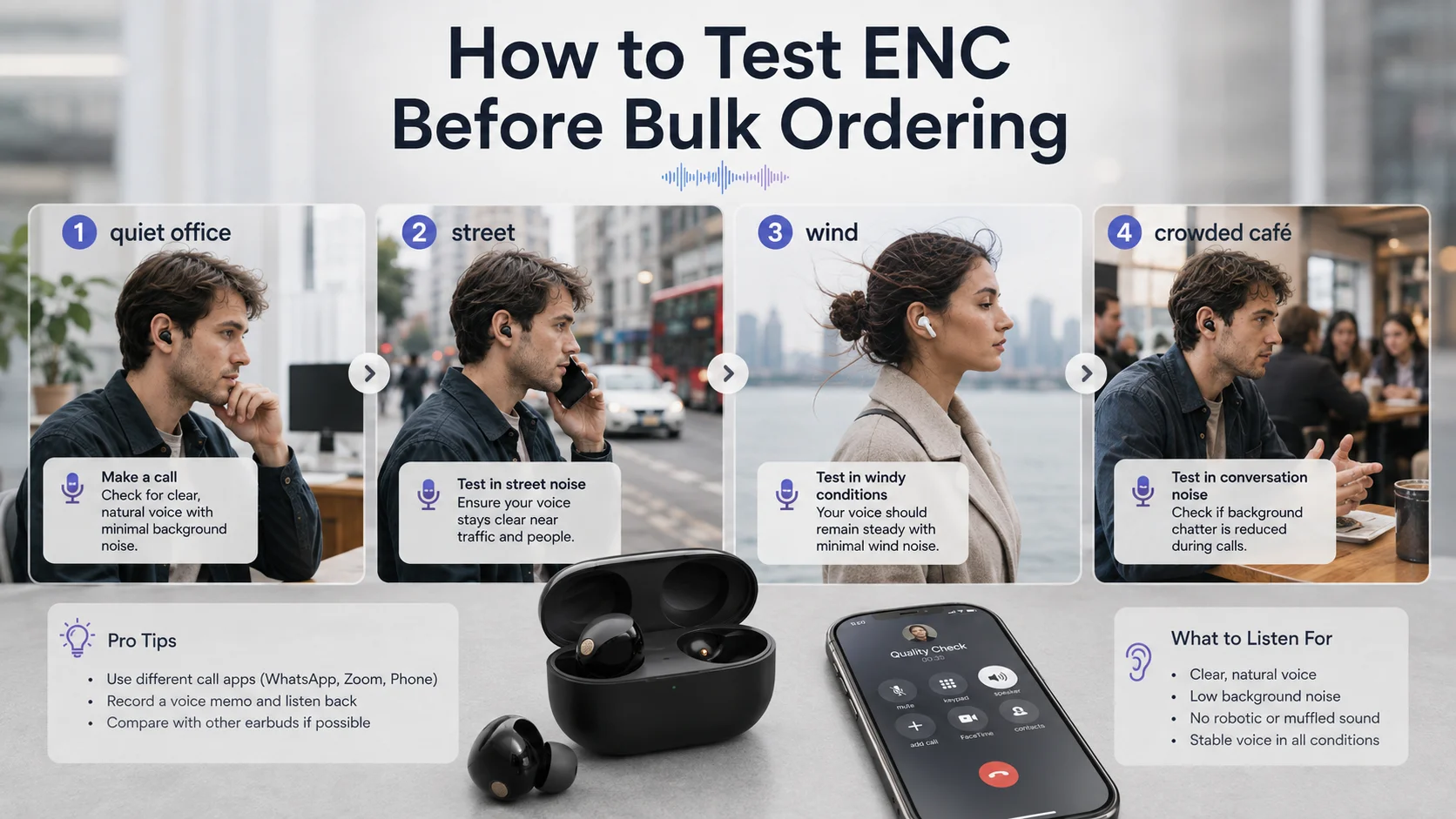
Practical pre-production test plan
| Test item | What to check | Evidence to request | Risk if not verified |
|---|---|---|---|
| Quiet-room call | Voice volume and naturalness | Call recording or live demonstration | Weak baseline microphone quality |
| Street-noise call | Traffic suppression and speech clarity | Recorded comparison | Poor customer reviews outdoors |
| Café-noise call | Handling of mixed voices and clatter | Sample test notes | Background voices dominate calls |
| Wind-noise call | Wind bursts and microphone protection | Outdoor test video | Unusable calls during walking |
| Online meeting | Stability over longer calls | 30–60 minute call test | Dropouts or voice fatigue |
| Bluetooth stability | Connection range and reconnection | Multiple-device test | Pairing complaints and returns |
| Call battery life | Runtime during continuous calls | Timed test result | Misleading battery expectations |
| ANC listening test | Noise reduction for wearer | Repeatable listening comparison | Overstated commuter-use claims |
Keep tests comparable
Use the same smartphone model, app, distance, and test location when comparing samples.8 If possible, test competing samples on the same day. This will not create laboratory-grade data, but it can reduce random differences in your supplier evaluation.
We also suggest recording calls from the receiving side. The wearer may think the call sounds fine, while the other person hears pumping, clipped speech, or amplified wind. That receiving-side experience is the one that matters for ENC.
Which Applications Need ENC vs ANC in TWS Earbuds?
Not every end user needs the same feature balance. A wholesale buyer should choose a model based on the likely customer, price point, and sales claim. A commuter may value ANC, while a remote worker may care more about an ENC microphone TWS design.
ENC vs ANC in TWS earbuds should be selected according to use case. ENC-focused models suit calls, meetings, and voice chat, while ANC-focused models suit listening in transport or busy environments. Combined models can serve broader users, but they need stronger validation and usually a higher target price.
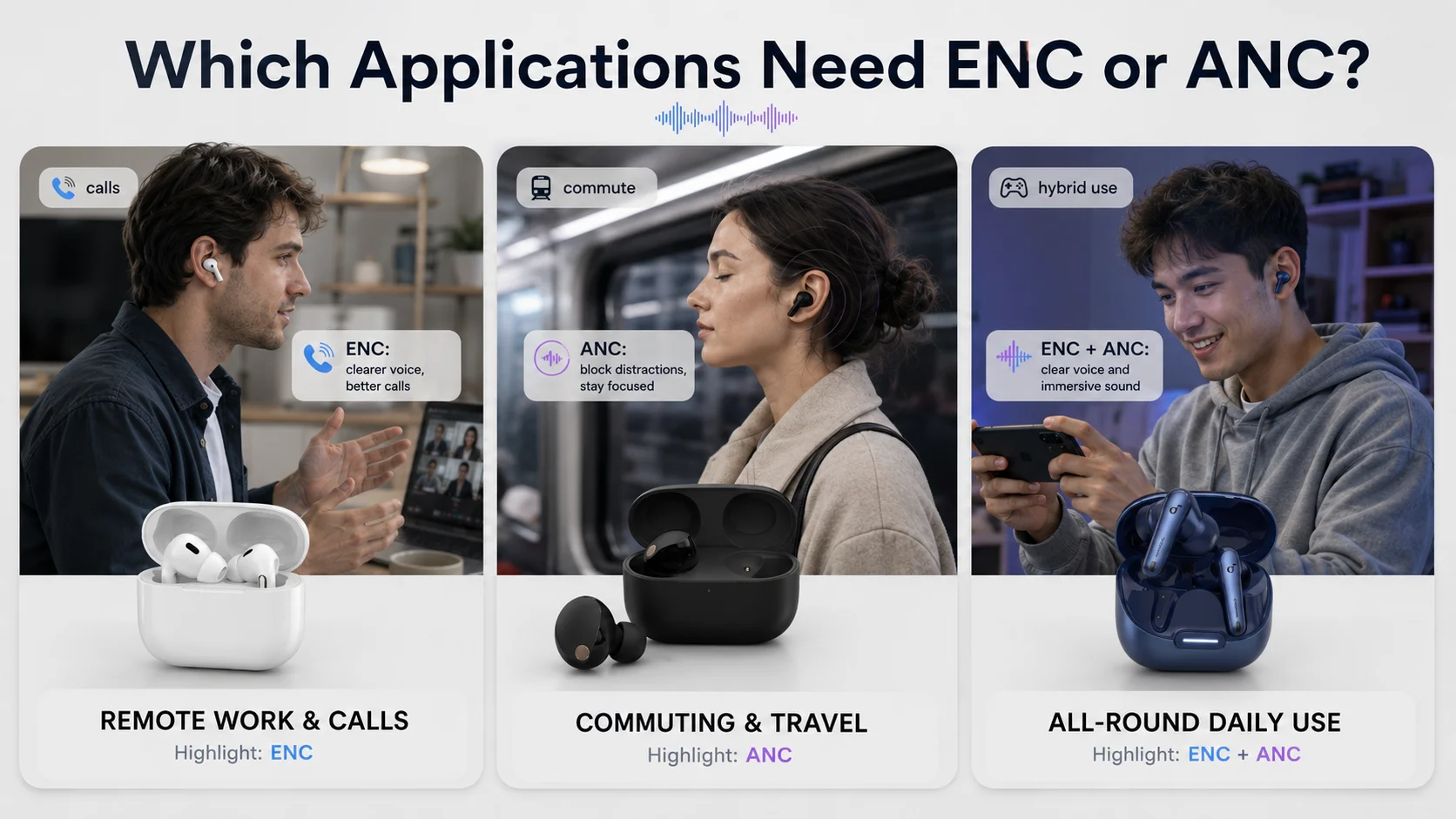
Common use cases
Remote work and online meetings
Remote workers need intelligible voice pickup, connection stability, and comfortable long-call use. ENC can be valuable when users work near household noise, shared workspaces, or moderate office activity. Buyers should test Teams, Zoom, Google Meet, and ordinary phone calls where relevant.
Business calls and mobile professionals
Sales teams, delivery workers, and field staff may take calls near traffic or public spaces. Wind handling and voice naturalness become especially important. An ENC label alone is not enough for this group.
Commuting and travel
ANC is usually more relevant for commuters, train passengers, and frequent travelers. Buyers should be careful with claims. ANC can reduce some steady low-frequency noise, but it does not remove every sound, and performance depends on fit, ear tips, hardware, and tuning.9
Gaming voice chat
Gaming buyers may need low latency, stable connection, and acceptable microphone performance. “Gaming mode” does not automatically mean better voice chat. A sample should be tested in the actual game or chat application used by the target market.
How Can Buyers Source Reliable ENC TWS Earbuds From China?
China offers a wide range of TWS earbuds, but similar-looking models can have very different chipsets, firmware, call behavior, and quality-control standards. Buyers need a process that compares suppliers on evidence, not only on price or feature labels.
To source reliable ENC TWS earbuds from China, buyers should screen suppliers, compare representative samples, verify specifications and certifications, define acceptable claims, and use pre-production and final inspection controls. A qualified sourcing partner can help organize supplier communication and reduce gaps between approved samples and bulk production.
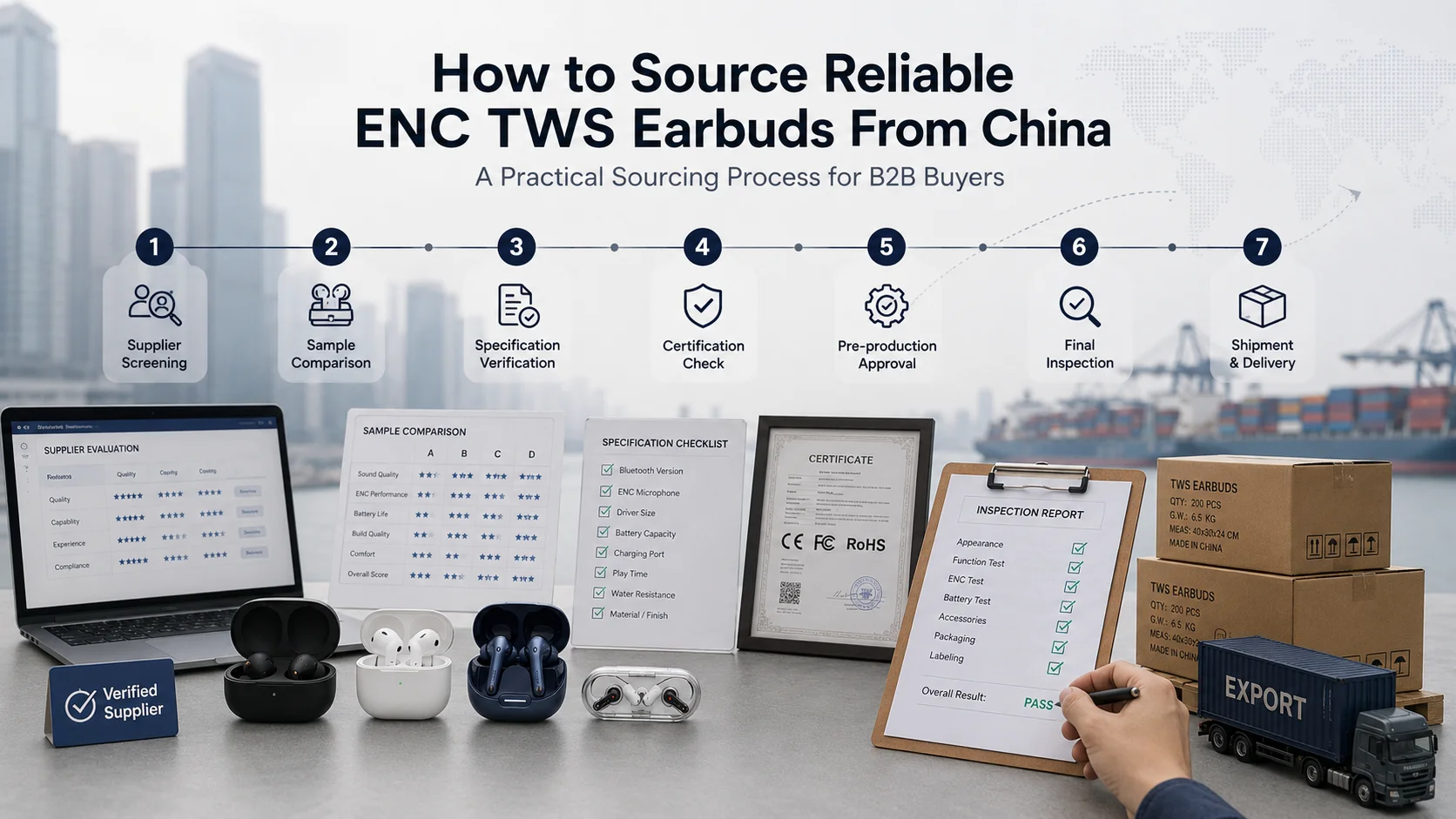
A practical sourcing workflow
-
Define the retail position.
Clarify whether your model is for clear calls, commuting, travel, gaming, or general budget use. -
Write a feature brief.
State whether you require ENC, ANC, or both. Avoid writing only “noise cancellation.” -
Shortlist suppliers.
Review product range, export experience, communication quality, OEM or ODM capability, and willingness to provide technical details. -
Request samples.
Compare more than one sample where possible. Ask suppliers to identify firmware versions and configurations. -
Run call and listening tests.
Test real applications, different environments, pairing stability, battery life, and comfort. -
Confirm claims and packaging.
Use wording that your sample performance can reasonably support. Do not promote ENC as if it were ANC. -
Verify compliance documents.
For the EU, US, or other destination markets, buyers should review applicable documents such as CE, RoHS, FCC, battery transport documents, or other requirements with qualified compliance professionals.10 Certification documents should be verified, not assumed.11 -
Set quality-control standards.
Define AQL requirements, functional testing, cosmetic standards, pairing checks, charging checks, and packaging inspection points.
At KingSourcing, we help buyers source, verify, and manage TWS earbud suppliers in China. We can support sample comparison, supplier communication, packaging customization, production follow-up, and quality-control coordination based on your target market requirements.
Frequently Asked Questions
Does ENC make TWS earbuds quieter for the wearer?
No. ENC mainly improves the outgoing microphone signal during calls. It aims to reduce background noise heard by the person on the other end. For quieter listening for the wearer, buyers should evaluate ANC and passive ear-tip isolation separately.
Are 4-mic ENC TWS earbuds always better than 2-mic models?
No. More microphones can support better noise processing, but microphone count alone does not prove call quality. Placement, microphone quality, chipset, algorithm tuning, wind handling, and firmware all affect the real result.
Can I sell ENC earbuds as active noise-cancelling earbuds?
Buyers should not do this unless the exact model includes verified ANC functionality. ENC and ANC serve different purposes.12 Clear and accurate wording helps prevent consumer confusion, negative reviews, and after-sales claims.
What should I ask a TWS earbuds supplier about ENC?
Ask whether ENC affects outgoing calls, how many microphones each earbud has, whether wind-noise reduction is supported, what chipset is used, which firmware is installed, and whether the supplier can provide samples for real call tests.
Is ANC necessary for remote-work earbuds?
Not always. For remote work, call clarity, comfort, connection stability, and battery life may matter more than ANC. ANC can add value for users in noisy environments, but it should not replace verification of microphone and ENC performance.
Conclusion
ENC vs ANC in TWS earbuds is ultimately a product-positioning and verification decision. ENC is mainly about clearer outgoing calls, while ANC is mainly about reducing environmental sound for the wearer. Buyers should not let generic “noise cancellation” claims replace sample testing, accurate specifications, and careful retail messaging. If you are sourcing clear call TWS earbuds, AI ENC earbuds, or ANC-enabled wholesale TWS earbuds from China, send KingSourcing your target market, price range, and required functions for supplier sourcing and sample comparison.
Tags: ENC TWS earbuds, ENC vs ANC, environmental noise cancellation, ENC microphone TWS, clear call TWS earbuds, AI ENC earbuds, wholesale TWS earbuds, TWS earbuds supplier China, OEM TWS earbuds, China electronics sourcing
"Active noise control", https://en.wikipedia.org/wiki/Active_noise_control. Audio-engineering literature distinguishes speech enhancement or microphone noise reduction for transmitted speech from active noise control, which generates an anti-noise signal to reduce sound at the listener's ear. Evidence role: mechanism; source type: paper. Supports: The distinct mechanisms and applications of microphone-based speech noise reduction and active noise control for headphone listening.. Scope note: Commercial earbud implementations may combine functions or use terminology differently. ↩
"[PDF] Development and Demonstration of Active Noise Control Concepts ,_", https://ntrs.nasa.gov/api/citations/20000112947/downloads/20000112947.pdf. Active noise control systems use measured noise and adaptive processing to generate a secondary sound field that attenuates the unwanted sound in a defined listening region. Evidence role: mechanism; source type: research. Supports: The principle that active noise control measures unwanted sound and produces an opposing acoustic signal to reduce it.. Scope note: The amount of attenuation depends on frequency, fit, acoustic leakage, and system design. ↩
"Center for Voice Intelligence and Security - Carnegie Mellon University", http://cvis.cs.cmu.edu/cvis/voice-intelligence.html. Research on mediated communication identifies speech intelligibility and perceived audio quality as important contributors to effective interaction in teleconferencing settings. Evidence role: general_support; source type: paper. Supports: The importance of speech intelligibility and audio quality for effective communication in teleconferencing and other voice-mediated interactions.. Scope note: Findings from conferencing studies do not by themselves rank the importance of microphone quality across every consumer earbud use case. ↩
"A Dual-Microphone Speech Enhancement Algorithm Based on ...", https://pmc.ncbi.nlm.nih.gov/articles/PMC3246289/. Speech-enhancement research describes microphone-based noise-suppression systems as processing captured speech to reduce interfering background sound while retaining intelligible target speech. Evidence role: definition; source type: paper. Supports: The use of microphone signals and digital speech-enhancement algorithms to suppress background noise in transmitted voice audio.. Scope note: The term "ENC" itself is used inconsistently across consumer-audio manufacturers. ↩
"Sound Localization and Speech Enhancement Algorithm Based on ...", https://pmc.ncbi.nlm.nih.gov/articles/PMC8840739/. Studies of microphone-array speech enhancement show that noise-reduction performance depends on microphone geometry, acoustic environment, and the selected signal-processing method. Evidence role: mechanism; source type: paper. Supports: That speech-noise-reduction performance is affected by microphone configuration, acoustic conditions, and signal-processing design.. Scope note: A general study cannot predict the call quality of a particular earbud model without device-specific measurements. ↩
"Advances in Microphone Array Processing and ...", https://arxiv.org/html/2502.09037v1. Multi-microphone speech-processing systems can exploit spatial information, but their performance remains contingent on array geometry, noise conditions, reverberation, and algorithm design rather than microphone number alone. Evidence role: general_support; source type: paper. Supports: That multi-microphone systems can provide additional spatial information, while realized speech-enhancement performance remains dependent on implementation and conditions.. Scope note: The evidence concerns general microphone-array principles and is not a direct comparative test of all two- and four-microphone earbuds. ↩
"Recommendation ITU-T P.1120 (10/2025)", https://www.itu.int/epublications/es/publication/itu-t-p-1120-2025-10-super-wideband-and-fullband-hands-free-communication-in-motor-vehicles. Telecommunications speech-quality evaluation guidance recognizes that background noise and other transmission conditions can materially affect perceived speech quality and should be represented in testing. Evidence role: general_support; source type: institution. Supports: The use of controlled and representative background-noise conditions when evaluating speech communication quality.. Scope note: Formal laboratory standards may not prescribe the exact buyer-side field-test locations or smartphone setup described in the article. ↩
"[PDF] Simple Guide for Evaluating and Expressing the Uncertainty of NIST ...", https://nvlpubs.nist.gov/nistpubs/TechnicalNotes/NIST.TN.1900.pdf. Measurement guidance emphasizes controlling relevant test conditions and documenting procedures to improve repeatability and permit meaningful comparison between evaluated items. Evidence role: general_support; source type: government. Supports: The general measurement principle that controlling test conditions improves repeatability and comparability.. Scope note: Controlling these variables improves comparability but does not convert informal field testing into a laboratory-standard measurement. ↩
"Using Noise-Cancelling Headphones to Block Harmful Sound ...", https://illumin.usc.edu/engineering-healthy-silence-using-noise-cancelling-headphones-to-block-harmful-sound/. Research on headphone active noise control reports frequency-dependent attenuation, with performance influenced by acoustic leakage, ear-coupling conditions, transducer characteristics, and controller design. Evidence role: mechanism; source type: paper. Supports: The frequency-dependent nature of headphone active noise control and the influence of acoustic fit or leakage on attenuation.. Scope note: Measured attenuation varies substantially by headphone architecture, ear shape, seal quality, and test method. ↩
"FCC ID Search | Federal Communications Commission", https://www.fcc.gov/oet/ea/fccid. EU and US authorities publish product-specific requirements for radio equipment and restricted substances, while lithium-battery transport frameworks include testing and documentation requirements for applicable cells and batteries. Evidence role: general_support; source type: government. Supports: Official requirements and guidance relevant to radio equipment placed on the EU or US market and lithium-battery transport testing or documentation.. Scope note: The precise obligations depend on the destination market, product design, battery configuration, importer role, and current regulations. ↩
"Equipment Authorization – Importation | Federal Communications ...", https://www.fcc.gov/oet/ea/importation. Official market-surveillance and conformity-assessment guidance assigns economic operators responsibilities to ensure that required conformity assessment, technical documentation, and product marking obligations have been met. Evidence role: general_support; source type: government. Supports: Importer and economic-operator responsibilities to ensure or verify applicable conformity documentation before placing products on a market.. Scope note: Documentation review alone may not detect every manufacturing deviation or counterfeit certification claim. ↩
"Category:Audio enhancement - Wikipedia", https://en.wikipedia.org/wiki/Category:Audio_enhancement. Acoustics and speech-processing references treat active noise control for listener-side attenuation and microphone-based speech enhancement for transmitted-voice clarity as different application objectives. Evidence role: definition; source type: education. Supports: The conceptual distinction between active control of sound at the listener and speech-noise reduction applied to a microphone signal.. Scope note: Consumer brands may market hybrid systems under overlapping labels, so each product's documented functions still require separate verification. ↩