Struggling to find a reliable GaN charger supplier? You're worried about quality, safety, and getting the right product for your market. The options seem overwhelming and risky.
The best way to compare GaN charger manufacturers is to look beyond just price and wattage. You must assess their OEM/ODM capabilities, true power output per port, supported charging protocols, safety certifications, heat control technology, lead time, MOQ, and their long-term supply stability.
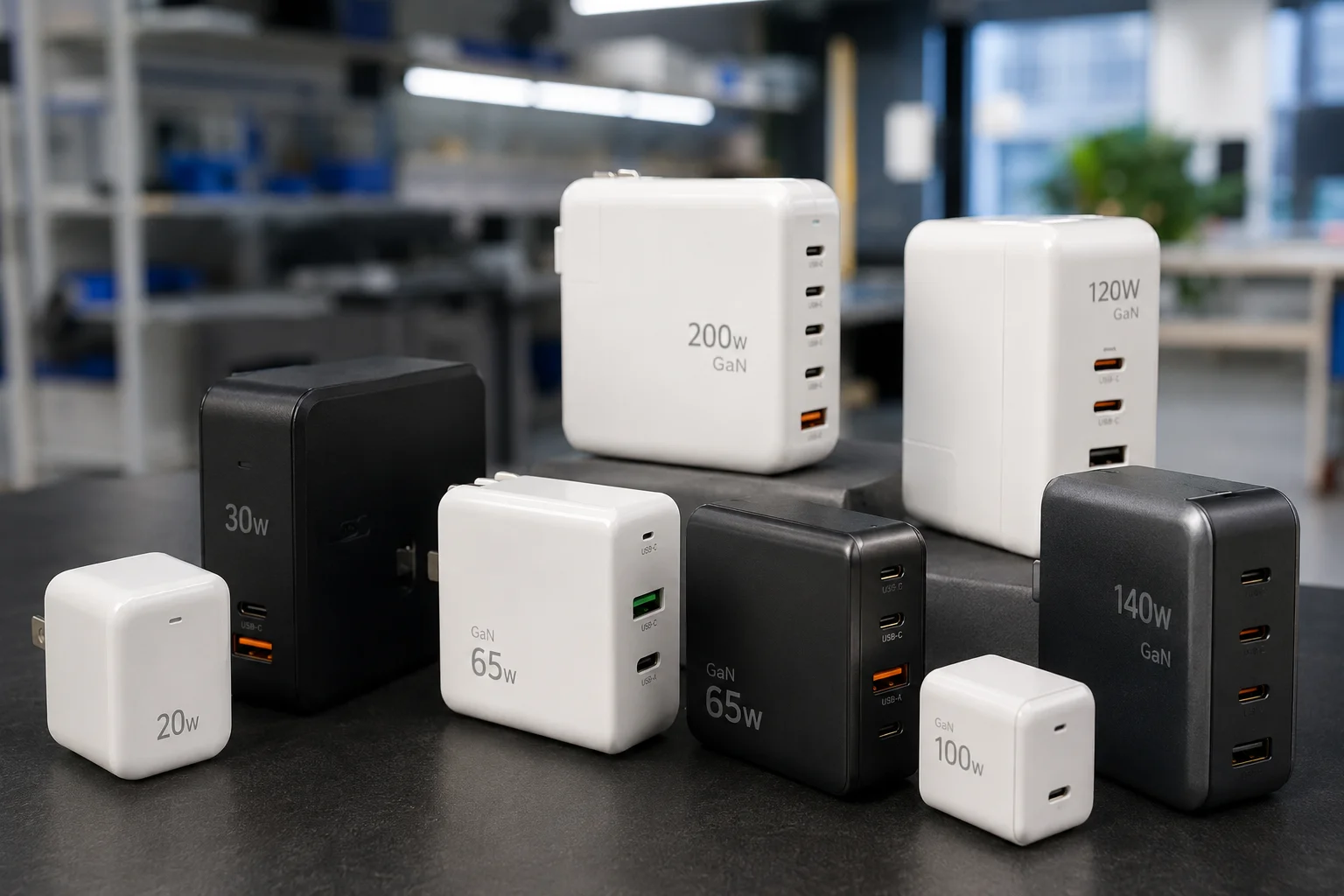
I've been exporting 3C electronics from Shenzhen for 15 years. Every week, I talk to buyers from Europe and the US. I see them make the same mistakes when sourcing GaN chargers. They start by asking, "What's your price for a 65W GaN charger?" but that's the wrong first question. It's like asking the price of a car without knowing if it's a sedan or a truck. The real value is in the details that ensure the product sells well and doesn't cause problems later. Let's break down what truly matters, so you can make a smarter choice that protects your business and keeps your customers happy.
What Is a GaN Charger Manufacturer in China?
Looking for a GaN charger factory feels complex. You need a partner, not just a supplier, but you don't know who to trust with your brand's reputation.
A GaN charger manufacturer in China is a company that specializes in producing chargers using Gallium Nitride (GaN) technology. They range from massive factories handling OEM projects for big brands to smaller, flexible suppliers offering ODM and private label services for wholesalers and e-commerce sellers.
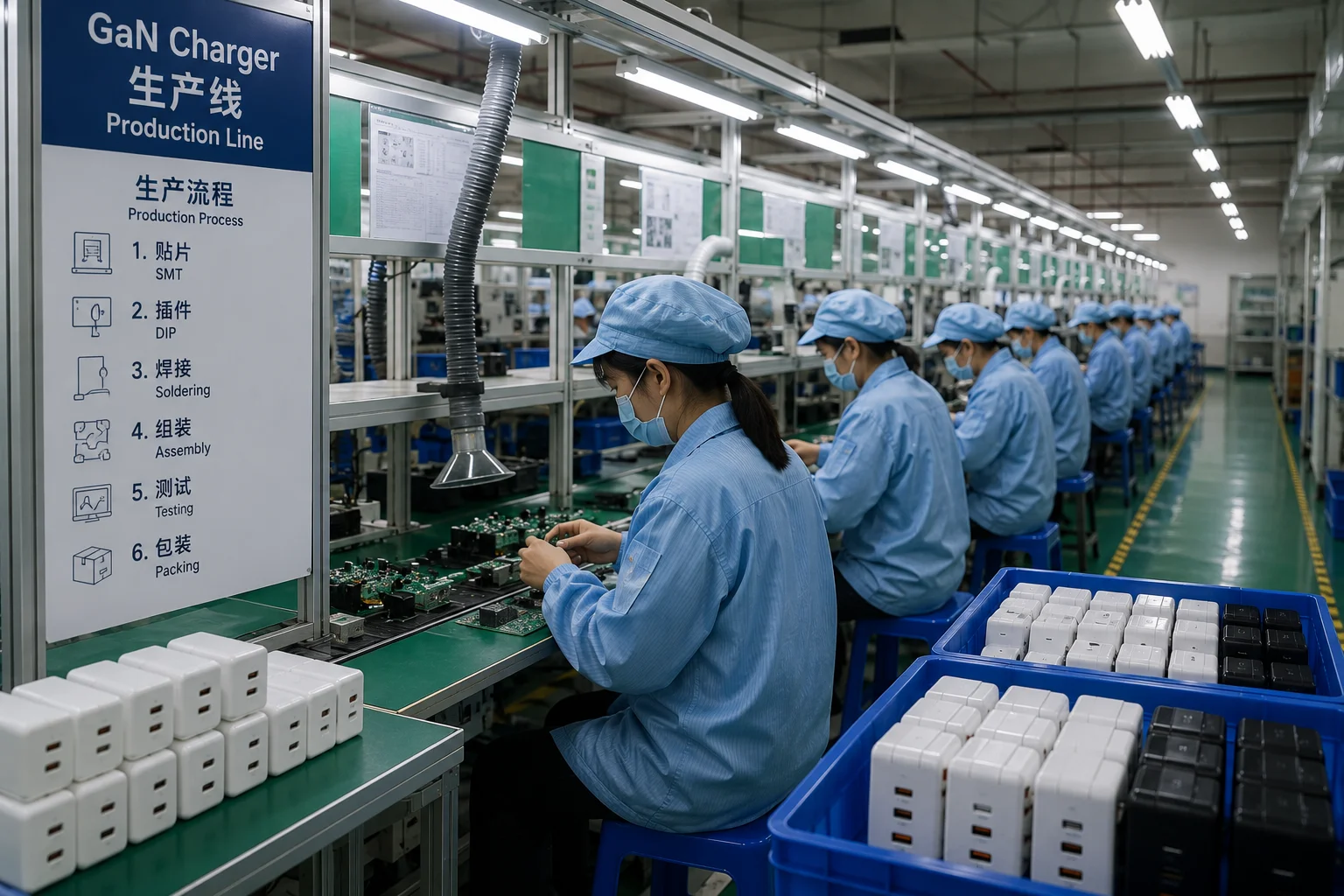
When buyers search for a "GaN charger manufacturer," they're usually not just looking for a factory name. They are looking for a solution. Maybe their current chargers are slow, get too hot, or have a high defect rate. For wholesalers and brand owners, these are not just product issues; they are reputation issues. A GaN charger looks simple, but it has a huge impact on user experience. Get it right, and you have a stable, high-demand product. Get it wrong, and one bad batch can destroy customer trust. The goal isn't to find the cheapest charger. The goal is to find a partner who understands specifications, controls quality, delivers on time, and helps you build a reliable product line. That's the real job of a good manufacturer.
Why Are GaN Chargers Different from Traditional Chargers?
You see "GaN" everywhere, but is it just a marketing gimmick? You're not sure if the higher cost translates into a real benefit that your customers will actually notice.
GaN chargers use Gallium Nitride instead of traditional silicon. This allows them to be much smaller, more energy-efficient, and run cooler while delivering the same or even higher power. This is a real technological advantage, not just marketing hype.
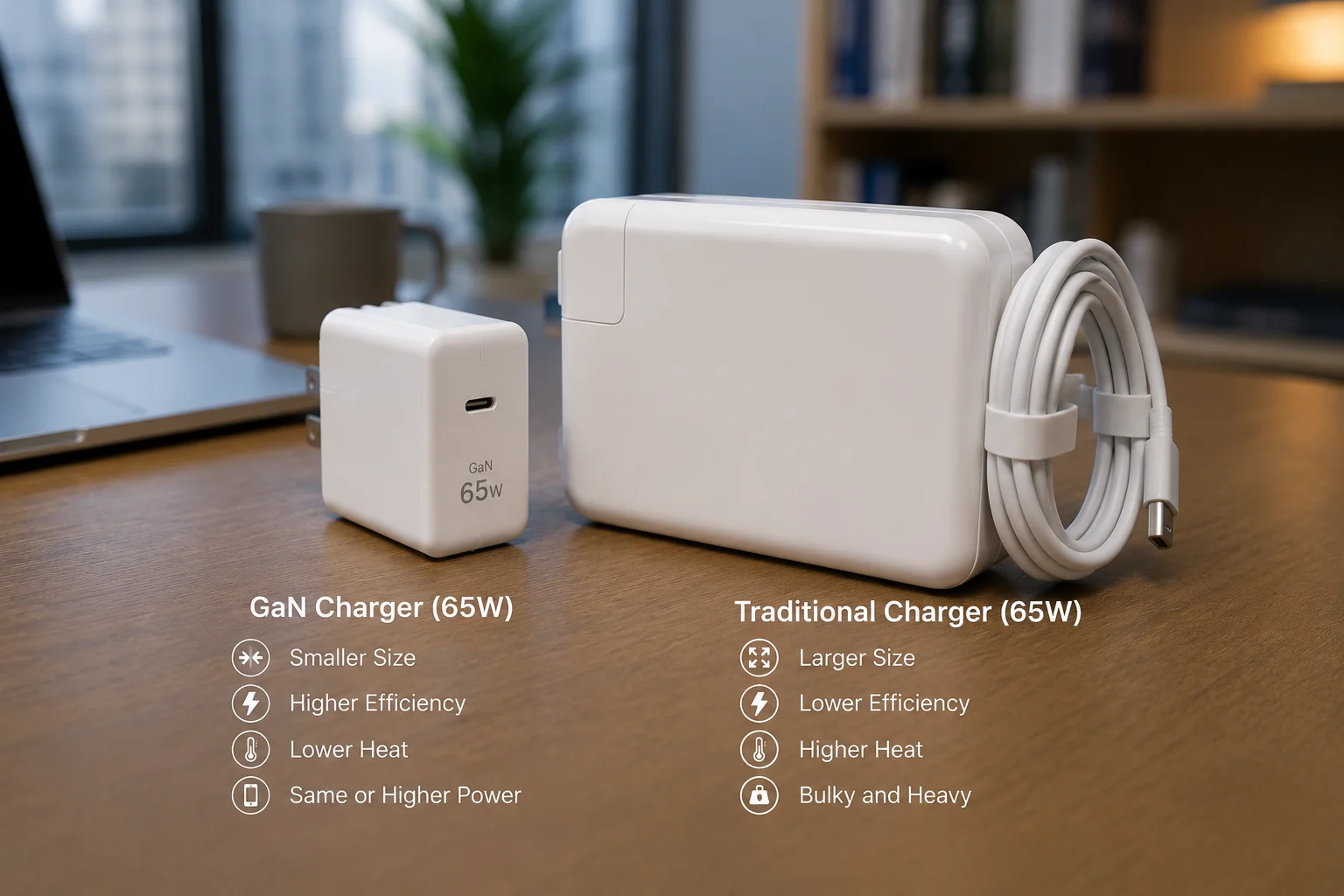
The difference between GaN and old silicon chargers is something I explain to clients all the time. Think of it like a car engine. For years, we had big, heavy V8 engines. They worked, but they were inefficient and took up a lot of space. GaN is like a modern, turbocharged engine. It's smaller, lighter, and produces the same power with less wasted energy (heat).
How GaN Technology Works
GaN is a semiconductor material that can handle higher voltages and switch frequencies much faster than silicon. In a charger, this means the internal components like transformers and capacitors can be shrunk down significantly. Because GaN is more efficient, less energy is lost as heat. This is a huge deal. Hot chargers are not only a safety concern but also a sign of wasted electricity.
The Real-World Benefits for Your Customers
- Size and Portability: A 65W GaN charger can be the size of an old 20W phone charger. Your customers can carry one charger for their phone, tablet, and laptop. This is a powerful selling point.
- Efficiency and Heat: Less heat means a longer lifespan for the charger and the device it's charging. Customers notice when a charger gets dangerously hot. A cooler GaN charger feels safer and more premium.
- Power Delivery: GaN technology is perfect for modern fast-charging standards like USB Power Delivery (PD). It can intelligently deliver high power to a laptop or lower power to a smartwatch from the same port.
For your business, this means you are selling a genuinely superior product that solves a real problem: carrying multiple bulky chargers.
OEM vs ODM: Which Model Is Better for Your Business?
Choosing between OEM and ODM is confusing. You fear picking the wrong path, locking you into a strategy that doesn't fit your budget, timeline, or brand ambition.
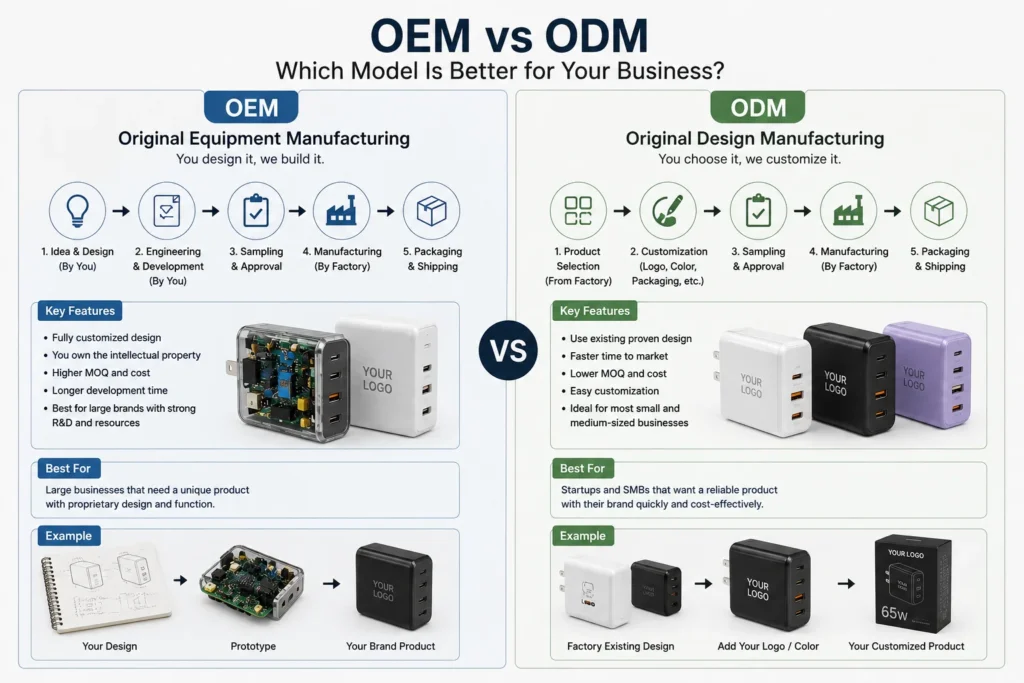
For most new and medium-sized buyers, ODM (Original Design Manufacturing) is better. You customize a proven, existing product. OEM (Original Equipment Manufacturing) is for large-scale businesses that need a unique product built from scratch and have the resources to manage it.
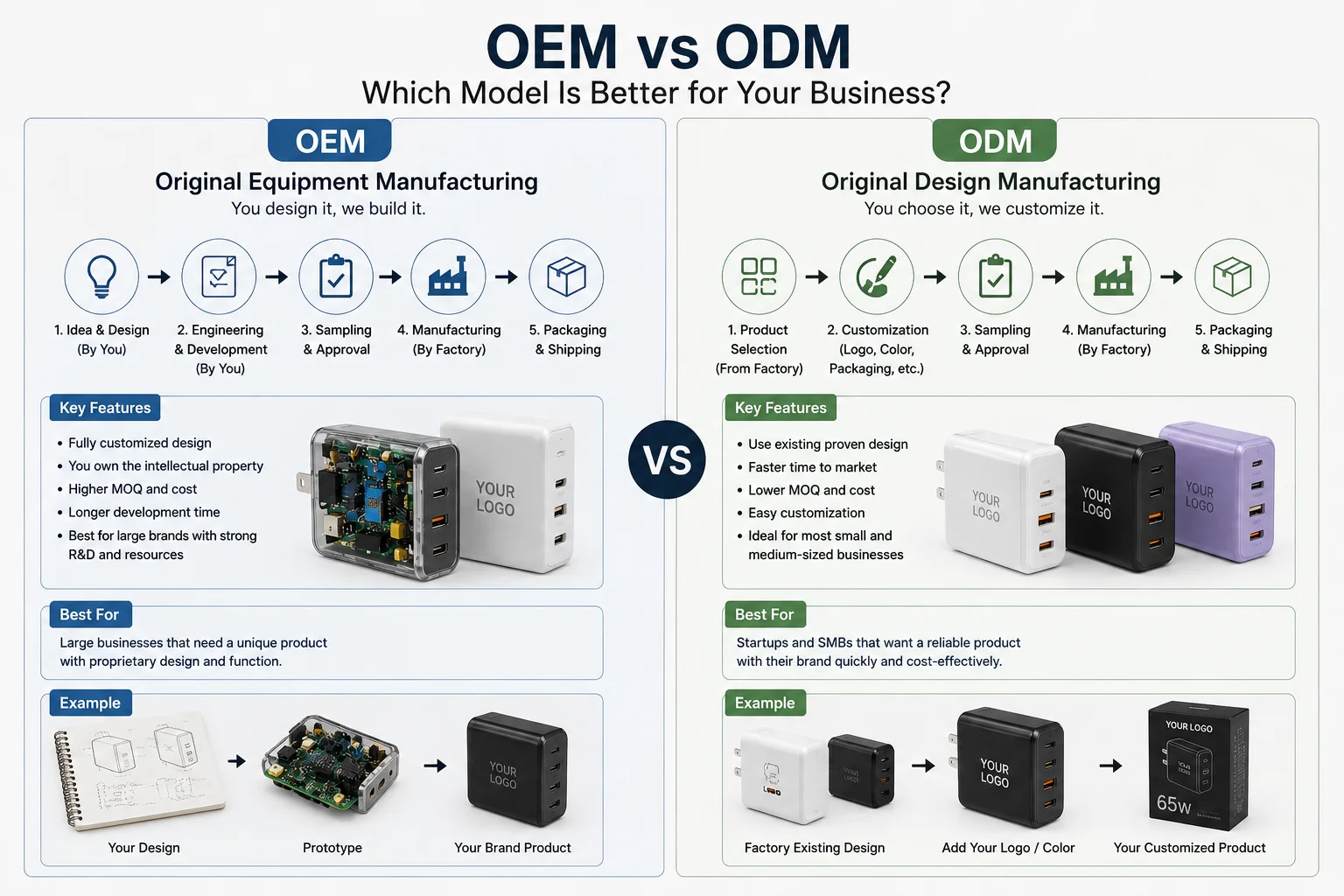
A client from Italy once asked us for a "full OEM" 120W GaN charger with a unique casing. My first question wasn't about price. It was, "Do you have an engineering team and a budget for new molds?" He didn't. This single question changed our conversation from a difficult OEM project to a much simpler and faster ODM project. He got his branded charger to market in two months instead of nine. This is why understanding the difference is so critical. It's not about which is "best," but which is right for your business stage.
When to Choose ODM (Private Label)
ODM is perfect if you are a retailer, e-commerce seller, or wholesaler. The supplier has an existing GaN charger design that is already tested and certified. Your job is to make it yours.
- Your Work: You choose the color, add your logo, and design the packaging.
- Advantages: Lower MOQ, much faster lead time, and lower financial risk because the R&D is already done.
- Best For: Testing a market, building a brand without massive upfront costs, and getting products on shelves quickly.
When to Choose OEM
OEM is for established brands with specific technical needs and high-volume sales channels. You are creating something that doesn't exist yet.
- Your Work: You provide detailed technical specifications, design files, and are deeply involved in R&D, tooling, and certification.
- Advantages: Complete product differentiation and control over every component.
- Best For: Companies with engineering resources, large order volumes to justify mold costs, and a need for a truly unique product.
Most of our clients find the most success by starting with ODM to build their brand and then exploring OEM once they have scale and market data.
What Wattage Options Should Buyers Compare?
You see 30W, 65W, 100W, and more. You're not sure which wattage to stock, and you're afraid of choosing a power level that won't sell or won't meet customer needs.
Don't just choose the highest wattage. Select a range that matches your target customers' devices. 30W-45W is for phones, 65W-100W is the sweet spot for phones and laptops, and 120W+ is for power users with multiple high-draw devices.
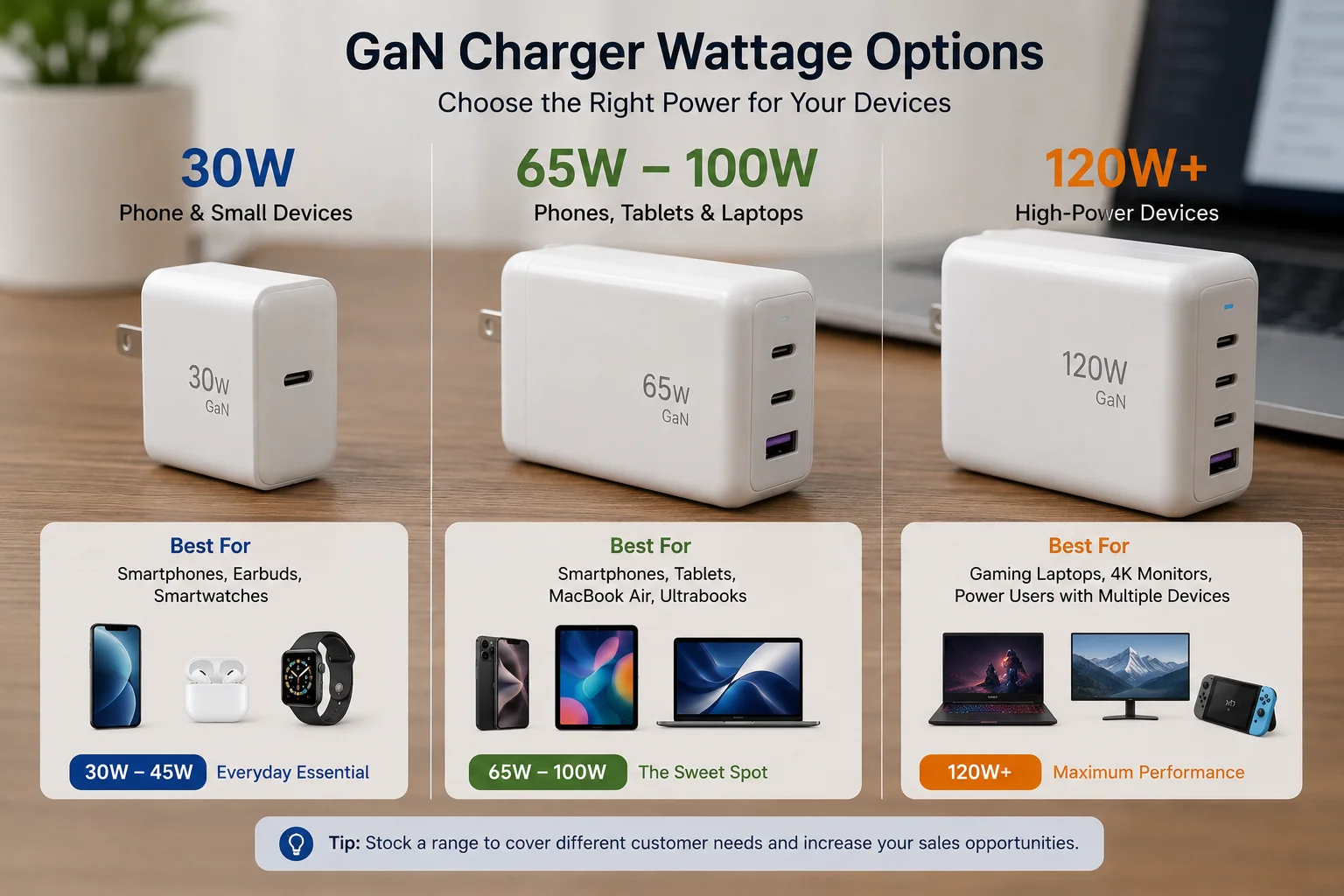
Buyers often think more watts are always better, but that's not true for business. A 140W charger is overkill for a customer who only needs to charge their iPhone. The key is to offer the right tool for the job. We guide our clients to think about use cases first, then wattage. For example, a convenience store chain should focus on 30W single-port chargers. An electronics retailer or Amazon seller, however, needs to offer a wider range, with 65W multi-port chargers often being the bestseller. It’s about matching inventory to customer needs, not just chasing the biggest number.
A Guide to Common GaN Charger Wattages
| Wattage | Primary Use Case | Target Devices | Key Selling Point |
|---|---|---|---|
| 20W-35W | Basic Fast Charging | iPhones, Samsung phones, TWS Earbuds | Compact, affordable upgrade from the charger that came in the box (or didn't). |
| 45W-67W | All-in-One for Travel | Phones, Tablets, MacBook Air, small Ultrabooks | The "one charger" solution. Can fast-charge a phone and power a small laptop. Excellent balance of power and size. |
| 100W-140W | Power User / Desktop Replacement | MacBook Pro, Dell XPS, Gaming Laptops, multiple devices at once | Maximum power for demanding devices. Can charge a high-end laptop and phone at top speed simultaneously. |
| 140W+ | Pro & Multi-Device Hub | The latest powerful laptops (like MacBook Pro 16"), multiple laptops, docking stations | Future-proof power for professionals who need to charge everything at once without compromise. |
When you compare suppliers, ask them about their most popular models for your target market (e.g., "What is your bestseller in the EU for e-commerce?"). A good supplier will give you data, not just a price list.
Single-Port vs Multi-Port GaN Chargers: How to Choose?
You see chargers with one, two, or even four ports. You're unsure if customers prefer a simple single-port charger or a versatile multi-port hub, and which type offers better margins.
Choose based on your customer's lifestyle. Single-port chargers are for simplicity and maximum power to one device. Multi-port chargers are for convenience and efficiency, targeting users who carry multiple gadgets like a phone, laptop, and watch.
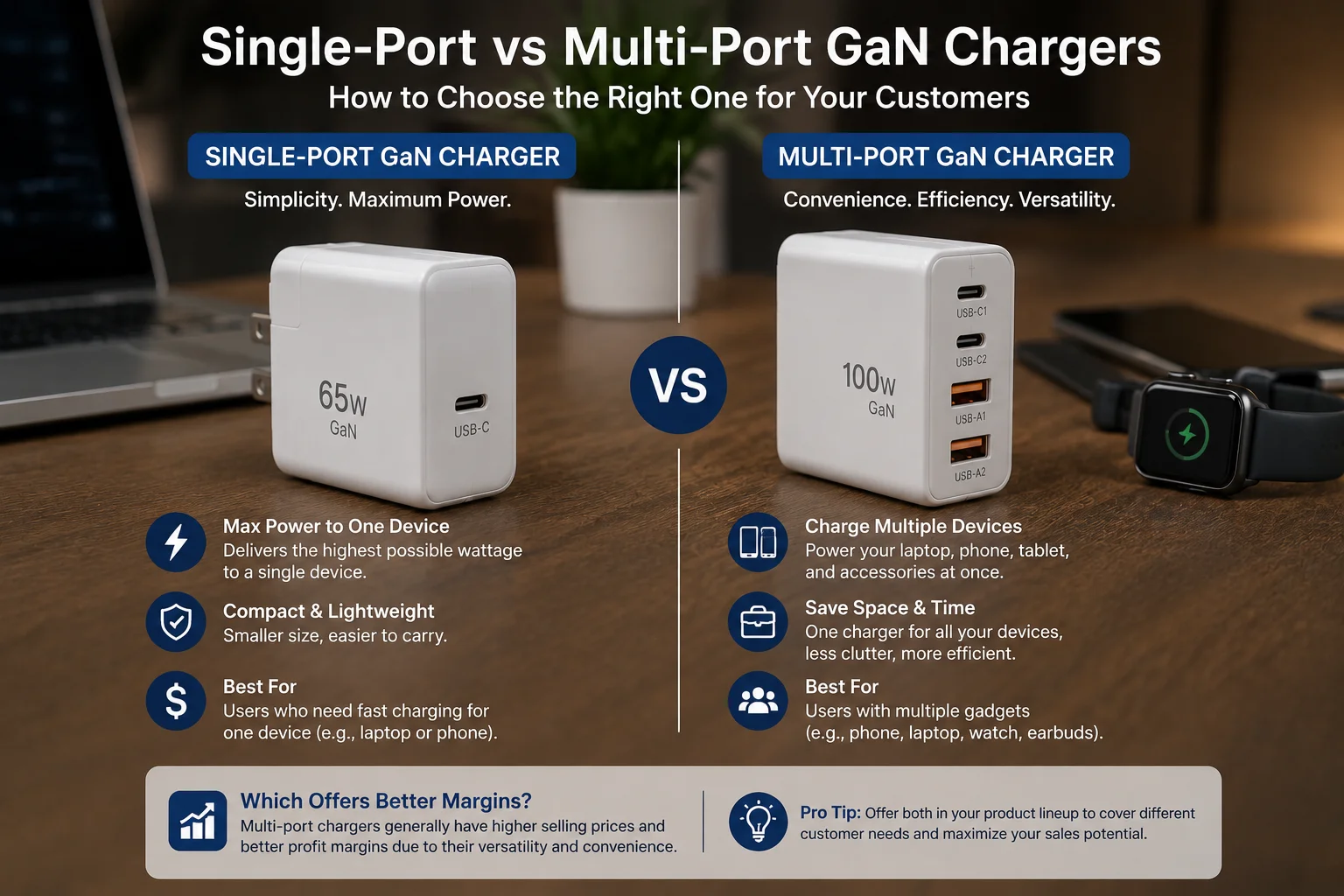
A common mistake I see buyers make is assuming a 4-port 100W charger is always better than a 1-port 100W charger. They can serve completely different customers. The real question is about power distribution. A multi-port charger splits its total wattage. For example, a 100W charger with two USB-C ports might give 100W when one port is used, but only 65W and 30W when both are used. This detail is critical. If you don't communicate this clearly, your customer who wants to charge their powerful laptop might be disappointed.
Making the Right Choice for Your Inventory
This isn't an "either/or" decision. Most successful retailers carry both. Here’s how to think about it:
-
### Single-Port GaN Chargers:
- Pros: Simpler, often smaller, and guarantees maximum power to that one port. Perfect for users who want to charge a specific device (like a MacBook Pro) as fast as possible.
- Cons: Less versatile. The customer still needs other chargers for other devices.
- Best For: A dedicated laptop charger replacement or a super-compact phone fast charger.
-
### Multi-Port GaN Chargers:
- Pros: Extremely convenient. Can replace 3-4 other chargers. Great for travel, desks, and families. This is a very strong selling point.
- Cons: Can be more complex. Buyers must understand and clearly advertise how the power is split between ports. They are also slightly larger and more expensive.
- Best For: The "all-in-one" customer. This is usually the largest market segment. A 65W charger with 2 USB-C and 1 USB-A port is one of the most popular configurations we sell.
Before ordering, always ask the manufacturer for the "power distribution map" for their multi-port chargers and make sure it's printed on your packaging. This prevents customer confusion and returns.
What Certifications and Safety Tests Should Buyers Confirm?
You've heard horror stories of chargers catching fire. You know certifications are important, but the list of acronyms (CE, FCC, UL, RoHS) is confusing, and you fear a supplier might use fake documents.
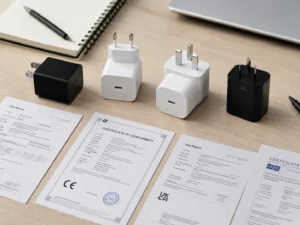
You must confirm the supplier has valid, up-to-date certifications for your target market. For Europe, demand CE, RoHS, and GS if possible. For the US, require FCC and UL/ETL. Always ask for the report number and verify it yourself.
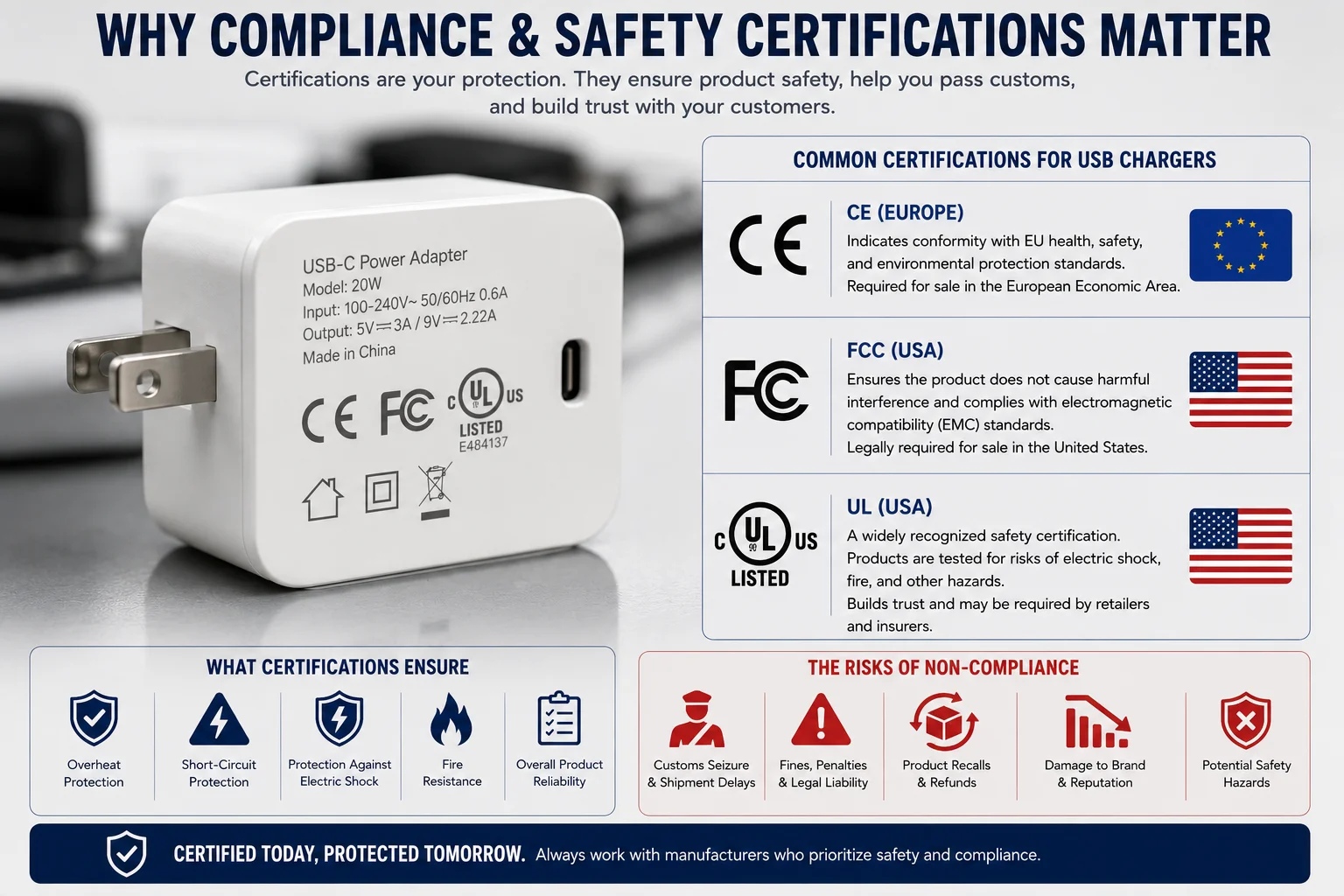
Safety is non-negotiable. I've been in this business for 15 years, and cutting corners on safety is the fastest way to ruin a brand and face legal trouble. A cheap price is never worth the risk of a fire. When a buyer asks us for a quote, one of the first things we provide is our certification folder for their region. A professional supplier will have these documents ready and will not hesitate to share them. If a supplier seems evasive or can't provide a valid test report from a reputable lab (like TÜV, SGS, Intertek), walk away.
Key Certifications and What They Mean
It's your responsibility to sell a safe product. Here is a simplified breakdown of the essential certifications you need to check:
| Certification | Region | What It Covers | Why It's Critical |
|---|---|---|---|
| CE | European Union | Basic safety, health, and environmental protection standards. It's a mandatory self-declaration by the manufacturer. | Legally required to sell in the EU. A charger without a CE mark can be stopped at customs. |
| FCC | United States | Regulates electromagnetic interference. Ensures the charger doesn't disrupt radio, television, and other signals. | Legally required to sell electronic devices in the US. |
| UL / ETL | United States (Nationally Recognized Testing Laboratory - NRTL) | Rigorous third-party safety testing for fire and electrical shock hazards. UL is the most well-known, ETL is an equivalent competitor. | While not always legally mandatory, major retailers and insurance companies require it. It is the gold standard for safety in the US. |
| RoHS | European Union | (Restriction of Hazardous Substances) Restricts the use of specific hazardous materials like lead, mercury, and cadmium. | Mandatory for the CE mark. It shows environmental responsibility and product safety from a material perspective. |
| GS | Germany (but respected across EU) | (Geprüfte Sicherheit - "Tested Safety") A voluntary certification that is more stringent than CE. Involves factory inspections. | A strong marketing tool that signals premium quality and safety to European consumers. |
Always ask for a copy of the certificate and check the report number on the issuing lab's website. Fake certificates are a real problem. A trustworthy partner will be transparent about their testing and compliance.
MOQ, Lead Time, and Production Capacity: What Should You Ask?
You're ready to order, but you don't know what to ask. You're worried about ordering too much, waiting too long for delivery, or choosing a supplier who can't handle your future growth.
Ask for the MOQ for standard and customized orders, the lead time from deposit to shipment, and the monthly production capacity. This tells you if the supplier fits your current budget, timeline, and future scaling plans.
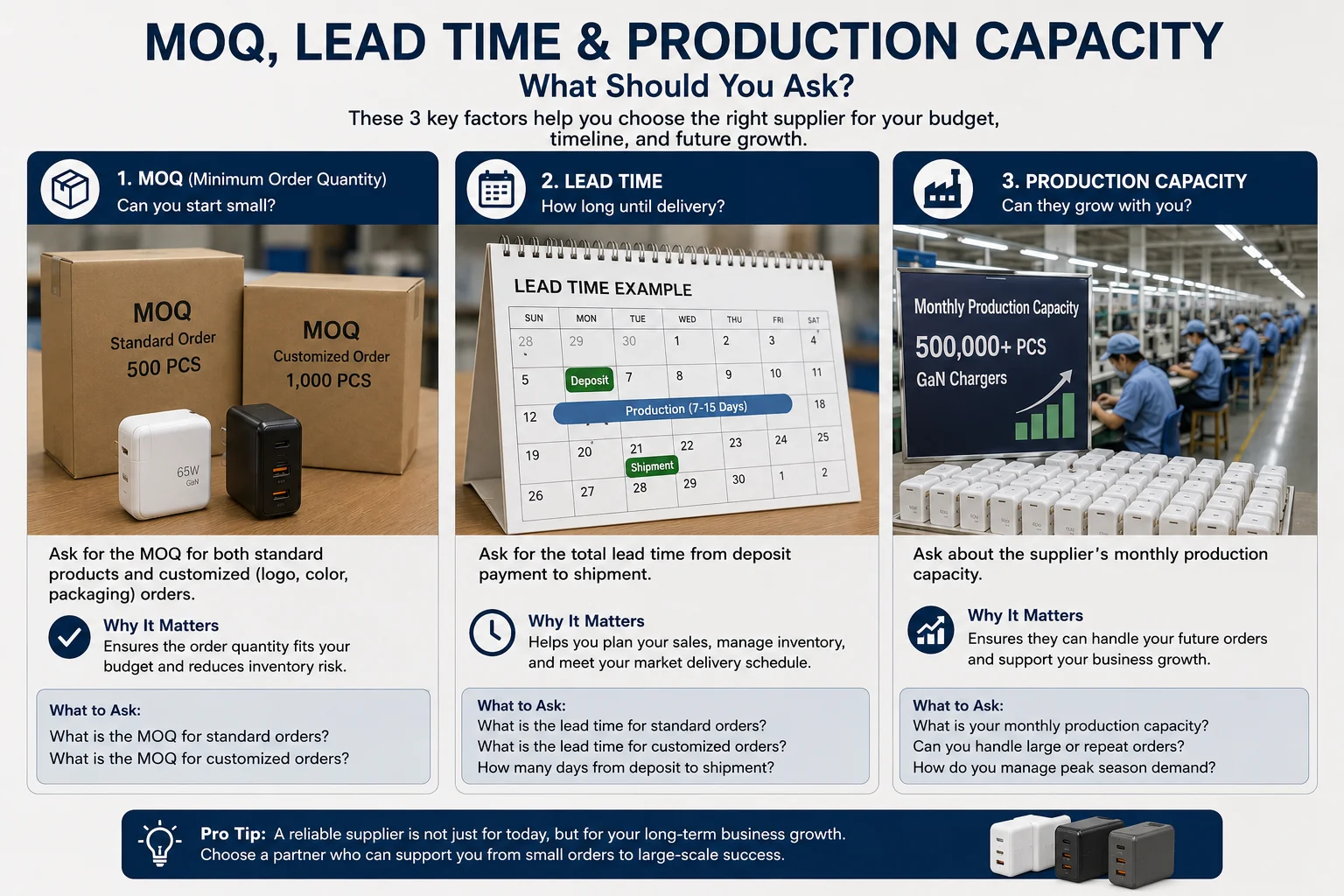
When we get an inquiry, I can tell a lot about a buyer from their questions. A new buyer might only ask for the price. An experienced buyer asks about the supply chain. For example, "What is your lead time for a 5,000-piece order with custom packaging?" This is a much better question. It shows they are thinking about cash flow, inventory management, and time-to-market. A supplier who promises an impossibly short lead time for a custom order is a red flag. Good production takes time for material preparation, manufacturing, testing, and packaging. Transparency about timelines is a sign of a professional partner.
Key Questions to Ask Your Supplier
Don't be shy. A good supplier wants to answer these questions to build a long-term relationship. Here's what you need to clarify before placing an order:
-
### Minimum Order Quantity (MOQ)
- "What is your MOQ for a standard, in-stock product?" (Good for test orders)
- "What is your MOQ for adding my logo (private label)?"
- "What is your MOQ for custom colors or full OEM projects?"
- Why it matters: This determines your initial investment and risk. A low MOQ is great for testing the market.
-
### Lead Time
- "What is the lead time for a sample order?"
- "What is the lead time for a bulk order after I approve the pre-production sample?"
- "Does lead time change during peak seasons (like before Christmas)?"
- Why it matters: This directly impacts your sales planning and ability to keep products in stock.
-
### Production Capacity
- "What is your monthly production capacity for this model?"
- "Can you handle repeat orders of 10,000 or 20,000 units per month if my sales grow?"
- Why it matters: You need a partner who can grow with you. You don't want to find a winning product only to have your supplier be unable to keep up with demand.
Getting clear answers to these questions helps you plan your business operations and avoid costly surprises.
What Are the Common Mistakes When Comparing GaN Charger Suppliers?
You're comparing quotes from several suppliers. You're tempted to just pick the one with the lowest price per unit, but you have a nagging feeling that you might be missing something important.
The most common mistake is comparing suppliers on price and wattage alone. Buyers often ignore critical factors like the quality of internal components, actual power distribution on multi-port chargers, heat management, and the validity of safety certifications.

Over my 15 years in this business, I've seen low-price temptations lead to disaster. I remember a buyer who switched from us to a cheaper supplier for a 65W charger. Three months later, he was back. His new chargers had a 10% failure rate, and customers were complaining they got extremely hot. The "cheaper" chargers ended up costing him more in returns, lost sales, and brand damage. Two 65W GaN chargers that look identical on the outside can be completely different on the inside. One might use high-quality capacitors and a smart power management chip, while the other uses the cheapest components possible to win the price war. This is what you don't see in a photo or a price list.
Top 3 Mistakes to Avoid
-
### Focusing Only on Price A price that seems too good to be true usually is. It often means the supplier is using substandard internal components, skipping quality control steps, or using fake certifications. The real cost shows up later in customer complaints and failed products. Always balance price with quality and safety.
-
### Misunderstanding Multi-Port Power Delivery Buyers assume a 100W 3-port charger can charge three devices at high speed. This is rarely the case. You must understand how the power is split. Ask for the detailed power allocation. For example: "When all 3 ports are in use, what is the output of each port?" A good supplier provides this data.
-
### Ignoring Heat Management A powerful GaN charger generates heat. How a manufacturer manages that heat is a key indicator of quality. Ask them about their thermal design. Do they use heatsinks? What brand of components do they use? A charger that runs too hot is inefficient and a safety risk. A well-designed charger should be warm, but never too hot to touch comfortably.
What's the Final Buying Advice for GaN Chargers?
You have all this information, but how do you put it all together? You need a final, simple framework to make a confident decision that balances all the important factors.
Don't chase the cheapest price or the highest wattage. The best strategy is to find a supplier who offers a balanced combination of proven safety, reliable power delivery, fair pricing, and a realistic production schedule that fits your business needs.
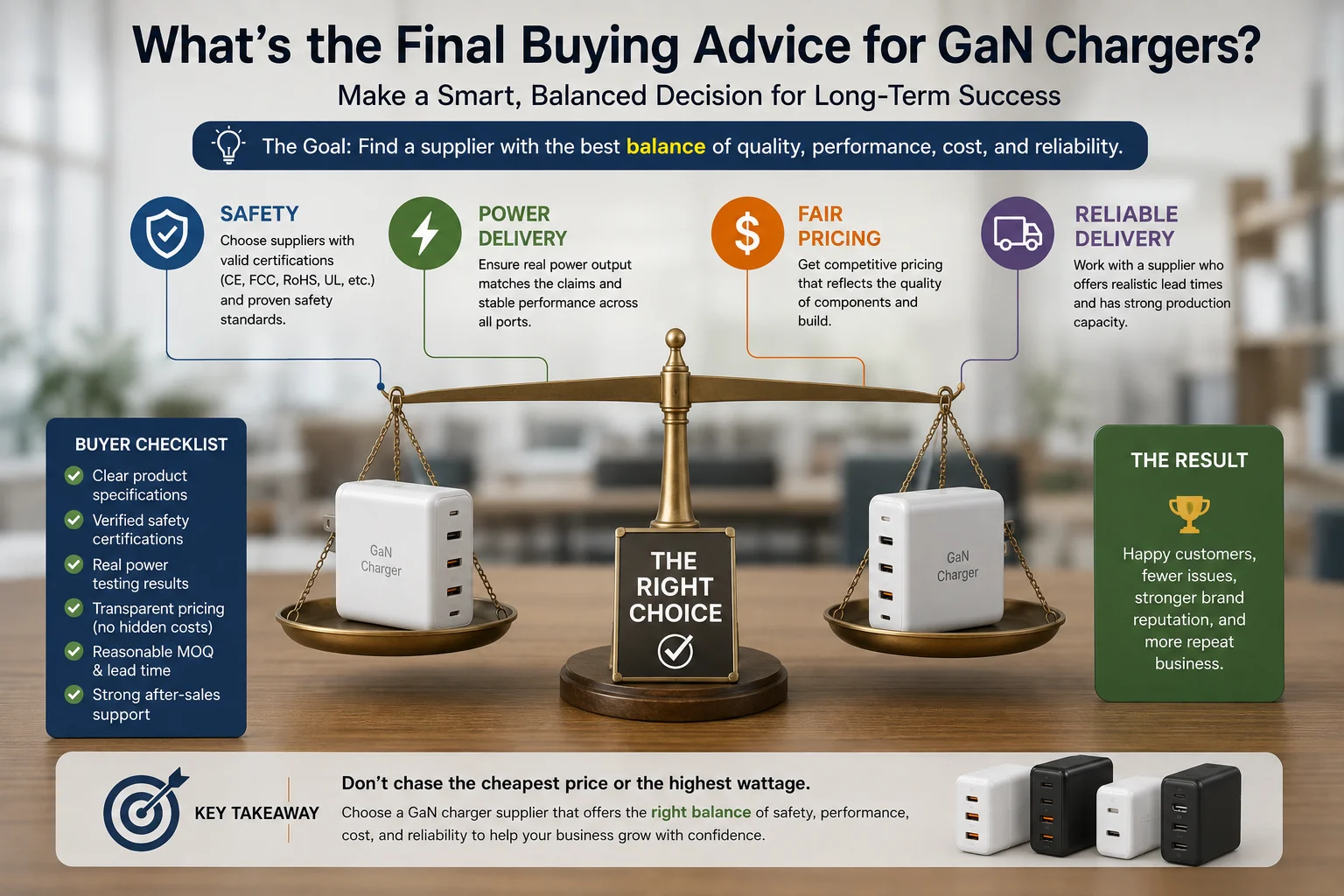
After thousands of conversations with buyers, my best advice is this: treat sourcing as a partnership, not a transaction. You are not just buying a box of chargers; you are buying a supplier's consistency, communication, and commitment to quality. A supplier who is transparent about their specifications, proud of their certifications, and realistic about their lead times is a partner who will help you succeed. A supplier who only talks about low prices is a risk.
Your Final Checklist Before Placing an Order:
- ### Define Your Need: Are you targeting travelers who need a multi-port 65W charger, or students who need an affordable 30W charger? Know your customer first.
- ### Verify Safety: Get copies of the CE, FCC, or UL/ETL certificates and check their validity. Do not skip this step.
- ### Test a Sample: Never place a bulk order without testing a sample yourself. Check its charging speed on different devices, feel how hot it gets, and inspect the build quality.
- ### Clarify All Specs: Confirm the wattage, port types, and especially the power distribution for multi-port models. Get it in writing on the Proforma Invoice (PI).
- ### Discuss the Long Term: Choose a partner who can handle your growth. Ensure they have the capacity and quality control processes to deliver consistently on repeat orders.
Finding the right GaN charger manufacturer is about finding a balance. Your goal is a product that is safe, effective, and fairly priced, delivered by a partner you can trust for years to come.
Conclusion
Sourcing GaN chargers is about more than price. Focus on safety certifications, real power output, quality components, and a supplier who acts as a true partner for your long-term growth.