Slow chargers waste time, hot chargers create worry, and bulky chargers make travel messy. I hear these pain points from buyers almost every week.
GaN chargers are better than silicon chargers because they can switch power faster, lose less energy, create less heat, and support higher power in a smaller body1. I still check design, certification, cable quality, and supplier testing, because GaN itself does not make a charger safe or good.
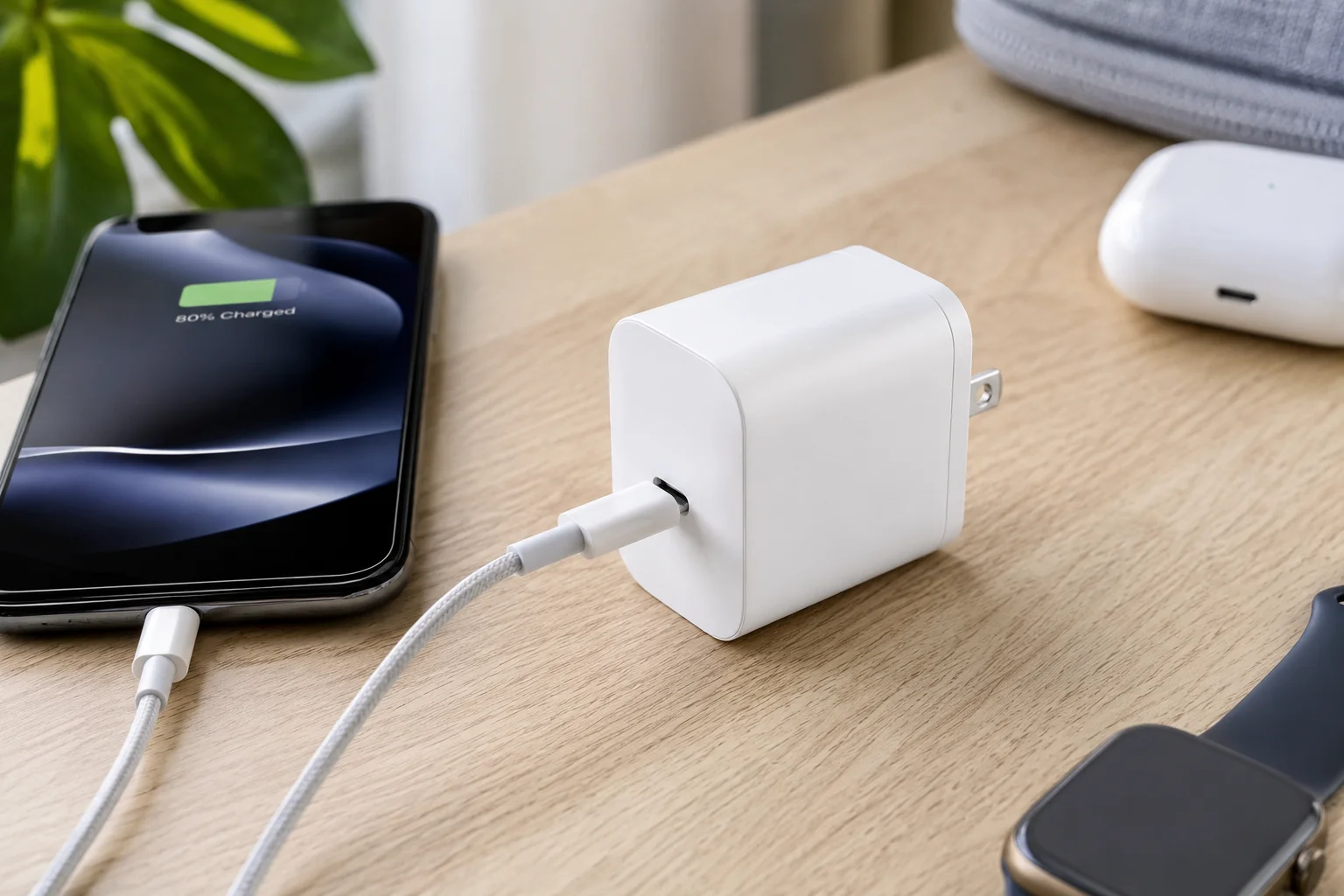
I have sold 3C products from Shenzhen for many years, and I have seen one clear change in charger buying. Buyers no longer ask only for “cheap 20W chargers.” They ask for compact 65W, 100W, and multi-port chargers that can charge phones, tablets, laptops, and earbuds at the same time2.
This is where GaN becomes interesting. It is not only a new word printed on packaging. It changes what a charger can do in size, heat, and power output. But I also tell buyers one thing very clearly. A GaN charger is not automatically a good charger. A bad design with GaN can still fail. A strong silicon charger can still be a safe and stable choice.
So I look at GaN chargers as a business decision, not only a technical topic. If I buy for retail, e-commerce, wholesale, or chain stores, I must think about price, MOQ, certifications, returns, customer use cases, and after-sales risk. That is the real reason this topic matters.
What Is a GaN Charger?
Many buyers see “GaN” on a product page and feel unsure. They worry it is only marketing, and that worry is reasonable.
A GaN charger uses gallium nitride power components instead of only traditional silicon parts. I describe it as a charger that can handle high-speed power conversion with better efficiency, smaller size, and lower heat when the full design is done well.
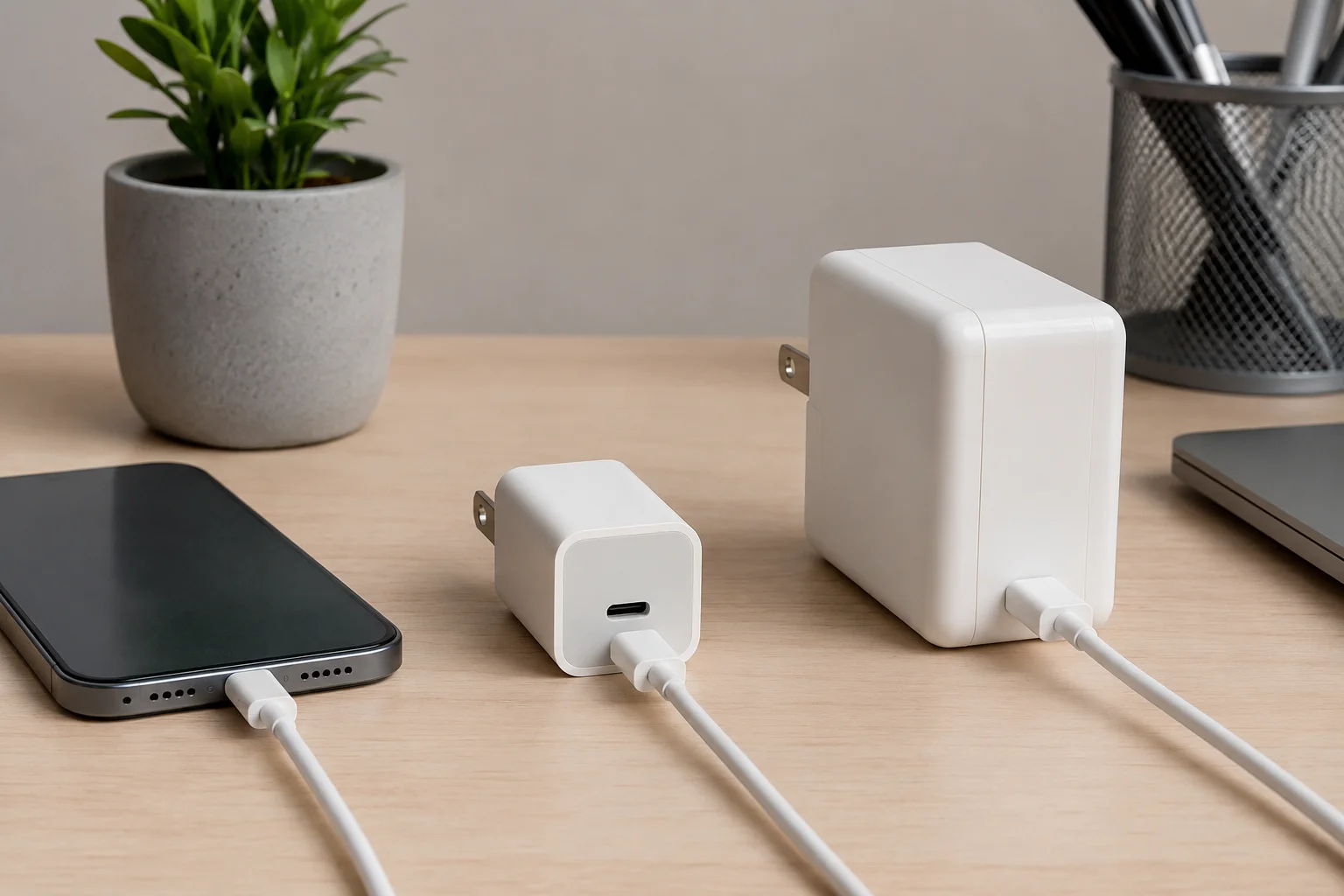
GaN means gallium nitride. I do not present it to buyers as magic. I present it as a better material for some power parts inside a charger. It helps the charger switch electricity at a higher frequency.3 This can reduce the size of some inner parts. It can also cut part of the energy loss.
When a client asks me, “Is GaN only a premium label?”, I usually answer with a practical table.
| Point I Check | What It Means for Buyers |
|---|---|
| Power output | I check if it supports 30W, 45W, 65W, 100W, or more |
| Protocol support | I check PD, PPS, QC, and other charging standards |
| Port layout | I check USB-C, USB-A, and total output when all ports work |
| Safety design | I check protection against over-current, over-voltage, short circuit, and heat |
| Certification | I check CE, FCC, UKCA, ETL, UL, CB, RoHS, or other market needs4 |
I have learned that buyers should not source GaN chargers by the word “GaN” alone. I ask for real output data, test reports, aging test records, and sample testing. GaN is the foundation. The full charger design is the final product.
How Do Traditional Silicon Chargers Work?
Some sellers make silicon chargers sound old and useless. I think this is too simple and can lead buyers to wrong stock choices.
A silicon charger uses silicon-based power components to convert wall power into safe low-voltage power for devices. I still see many stable silicon chargers in the market, but they are often larger and less efficient at higher power levels.
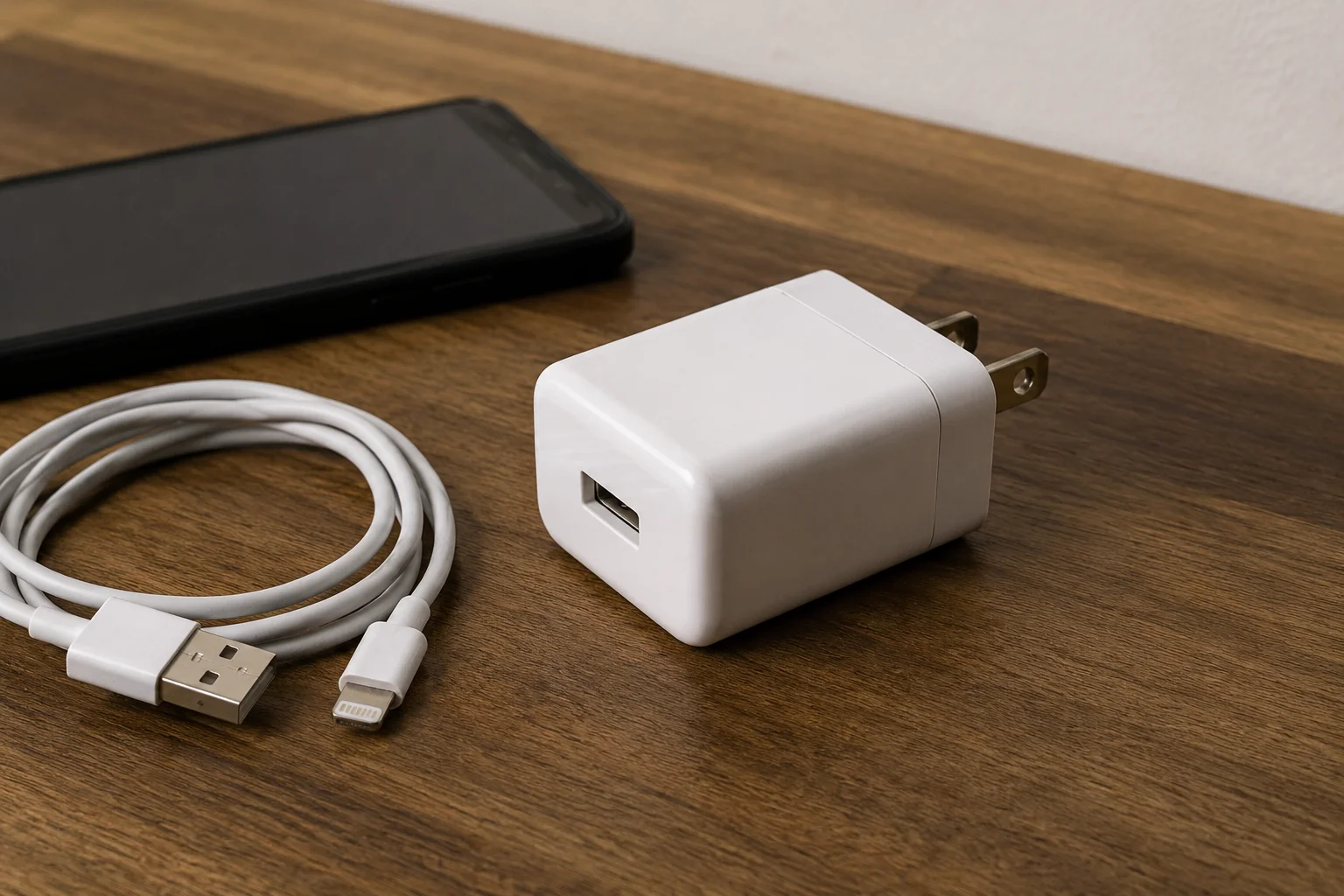
I still sell and see many silicon chargers that work well. For 5W, 10W, 12W, 18W, and some 20W models, silicon can be very cost-friendly. Many entry-level retail channels still use them because the price is low and demand is stable.
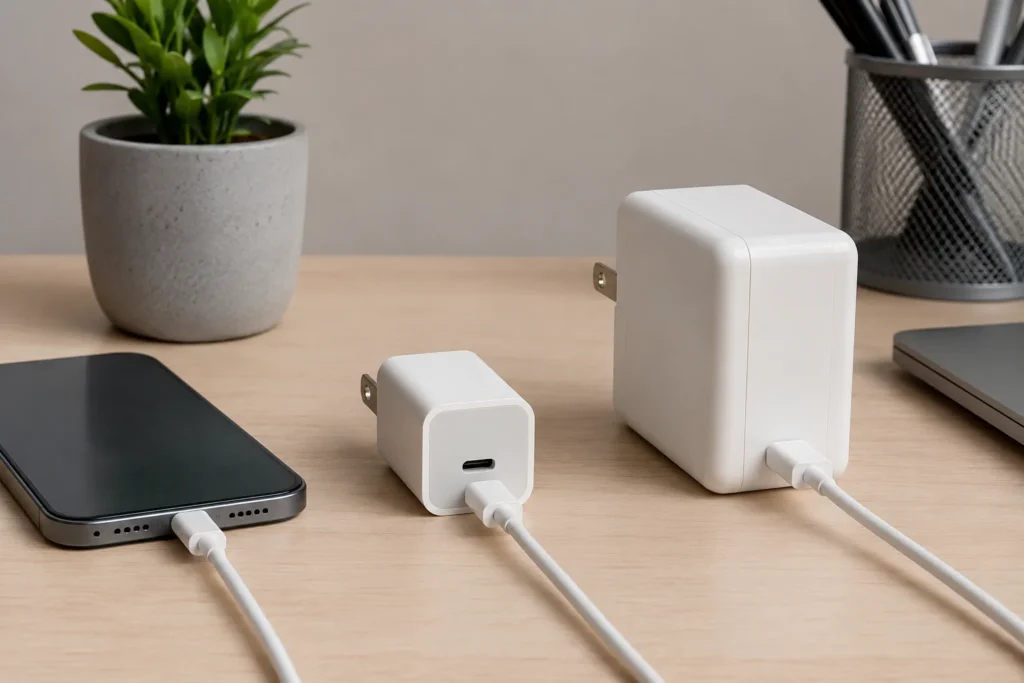
The main difference becomes more visible when power goes higher. A 65W or 100W silicon charger often needs a larger body to control heat and fit the internal parts.5 This is not always a problem. Some customers prefer low price over compact design. Some wholesale buyers also sell to markets where the end user only needs a basic charger.
I usually explain the choice this way.
| Charger Type | Strong Point | Trade-Off |
|---|---|---|
| Silicon charger | Lower cost and mature supply | Larger size at higher power |
| GaN charger | Smaller size and better efficiency | Higher cost and stricter supplier selection |
| Basic low-watt charger | Easy to sell in price-sensitive channels | Less attractive for premium device users |
| High-power charger | Better for laptops and travel | Needs stronger testing and certification |
I do not push every buyer to GaN. I first ask about sales channel, retail price, target users, and return tolerance. If a buyer sells cheap accessories in discount stores, silicon can still make sense. If a buyer sells premium travel chargers online, GaN often fits better.
Why Can GaN Chargers Be Smaller and Lighter?
Large chargers are hard to sell when customers want clean desks, light bags, and travel-friendly devices. This is a real retail problem.
GaN chargers can be smaller and lighter because gallium nitride supports faster power switching and better energy conversion. I still check the inner layout, transformer size, heat design, and plug structure before I trust the final size claim.
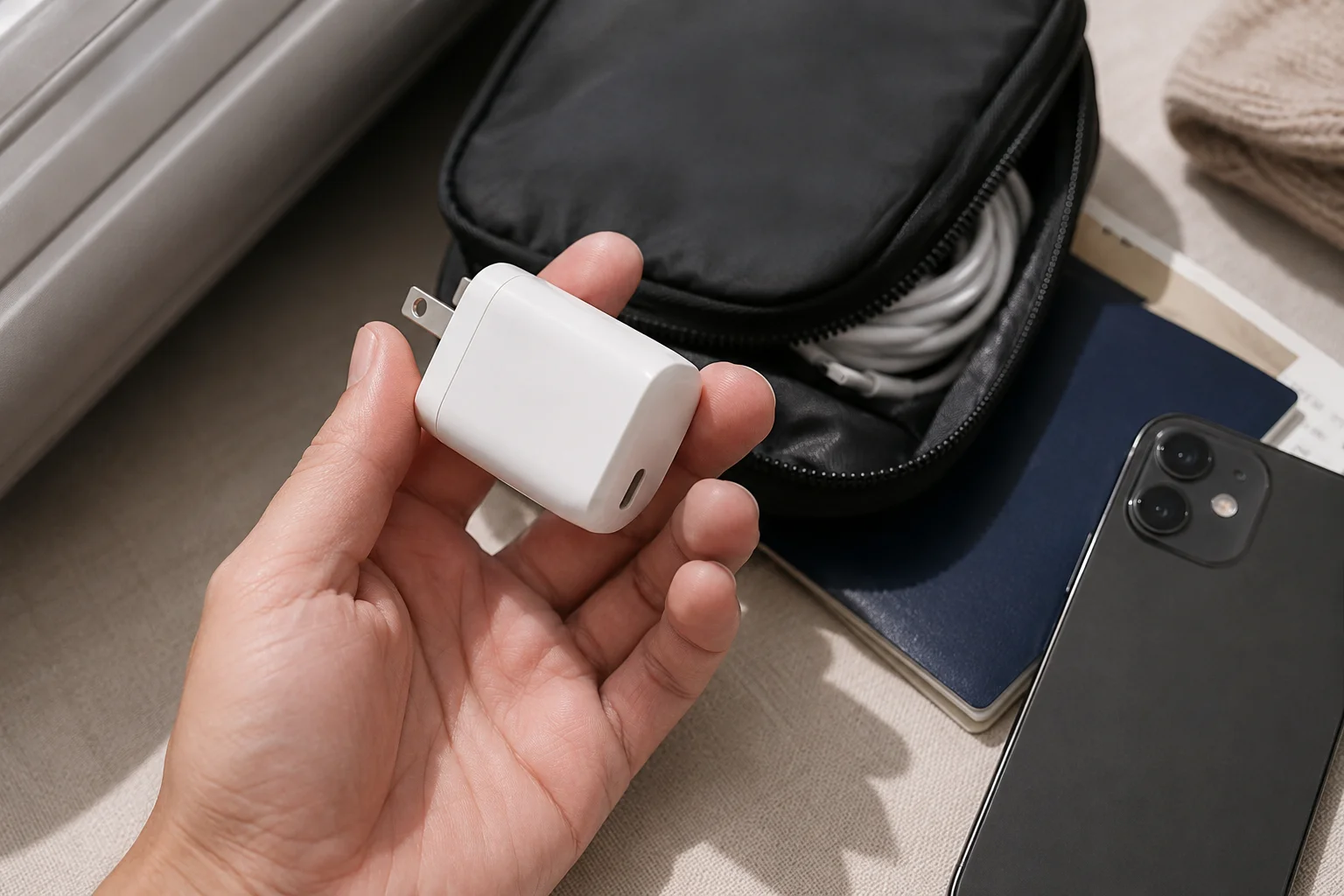
I have handled many buyer questions about compact 65W and 100W chargers. The first thing they ask is simple: “How can this small charger power a laptop?” I explain that GaN allows the circuit to work at a higher frequency. This can reduce the size of some magnetic and passive components.6 The charger can be smaller because the inner design does not need the same space as many older silicon designs.
But I do not treat small size as the only goal. A charger that is too small with poor heat space can create risk. The best GaN charger is compact, but not careless. I want a smart balance between size, heat, power, and durability.
| Buyer Goal | What I Check |
|---|---|
| Travel use | I check foldable plug, weight, and multi-voltage input |
| Laptop charging | I check real USB-C PD output and stable 65W or 100W load |
| Retail shelf appeal | I check packaging size, product look, and clear power marking |
| Low return rate | I check burn-in test, temperature rise, and port stability |
In my experience, smaller and lighter chargers sell better in e-commerce images. Customers can understand the benefit fast. They see one charger replacing two or three old chargers. That is a strong selling point.
How Do GaN Chargers Support Faster Charging and Higher Power Efficiency?
Customers complain when a charger says “fast” but charges slowly. This creates bad reviews, returns, and pressure on sellers.
GaN chargers support faster charging when the charger also supports correct fast charging protocols, such as USB-C PD and PPS. I check both the GaN hardware and the protocol list because efficiency alone does not guarantee fast charging.
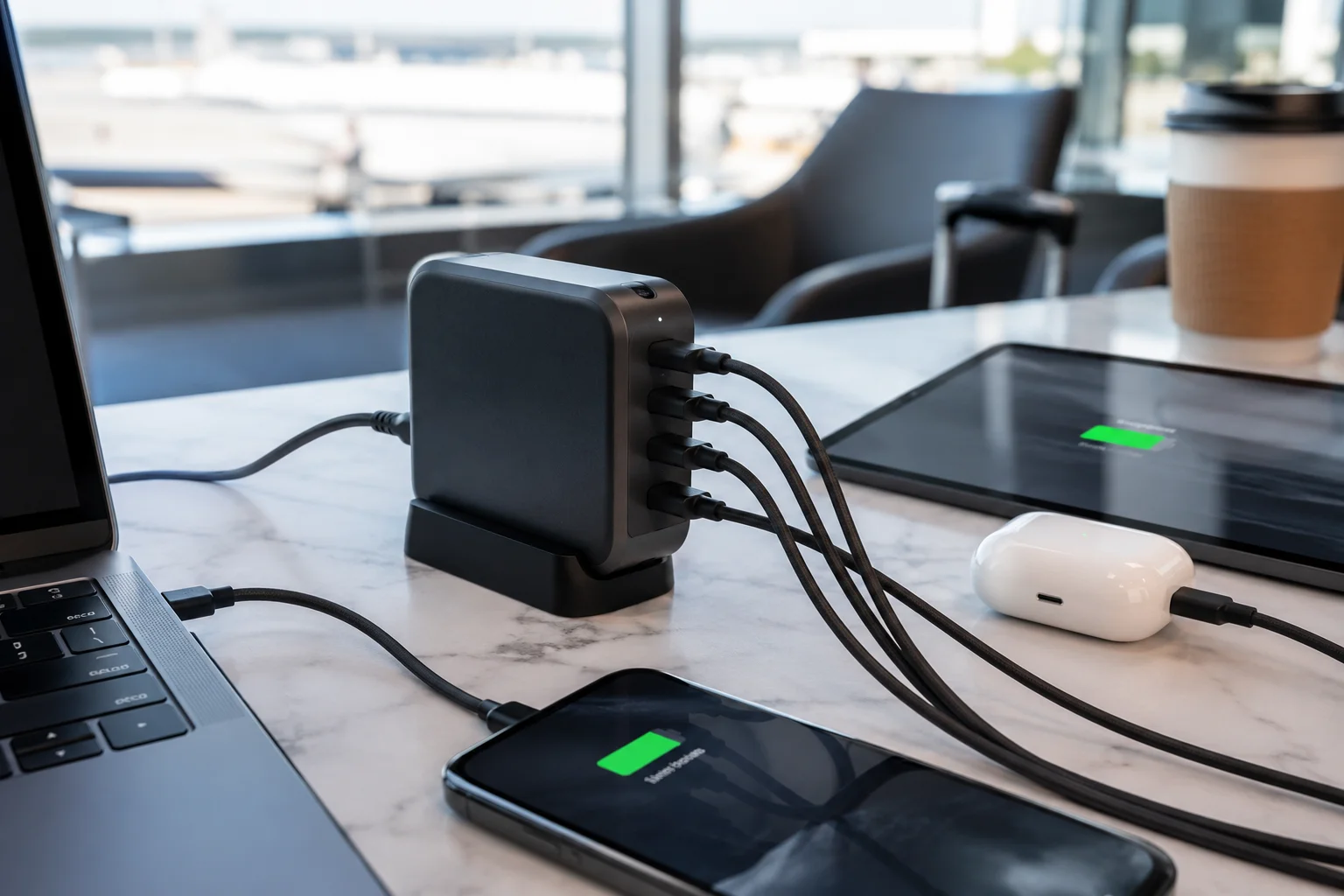
I often tell buyers that fast charging is a system. The charger, cable, and device must all support the right standard. A GaN charger may have high efficiency, but if it does not support the protocol needed by the phone or laptop, the charging speed will not meet customer expectations.
For example, many new phones need PD or PPS for best charging speed7. Many laptops need USB-C PD at 45W, 65W, 90W, or 100W. Some cables only support 3A, while others support 5A with an e-marker chip8. If the buyer ignores the cable, the charger may look weak even when the charger itself is fine.
| Item | Why I Check It |
|---|---|
| USB-C PD | I need it for many phones, tablets, and laptops |
| PPS | I need it for some phone models that adjust voltage in small steps |
| Total power | I check total output when several ports work together |
| Single-port max output | I check the real top power of one USB-C port |
| Cable rating | I check 60W, 100W, or 240W cable support |
Higher efficiency means less energy becomes waste heat.9 It also means better long-term performance when the design is good. For wholesale buyers, this matters because product complaints can eat margin fast. A few cents saved on poor protocol support can cost much more after shipping, reviews, and returns.
How Do GaN Chargers Control Heat and Support Safer Daily Use?
Heat scares customers. A warm charger is normal, but a very hot charger makes people lose trust fast.
GaN chargers can run cooler than many silicon chargers at similar power because they waste less energy.10 I still check temperature rise, safety protection, housing material, and certification because safe use depends on the full charger design.
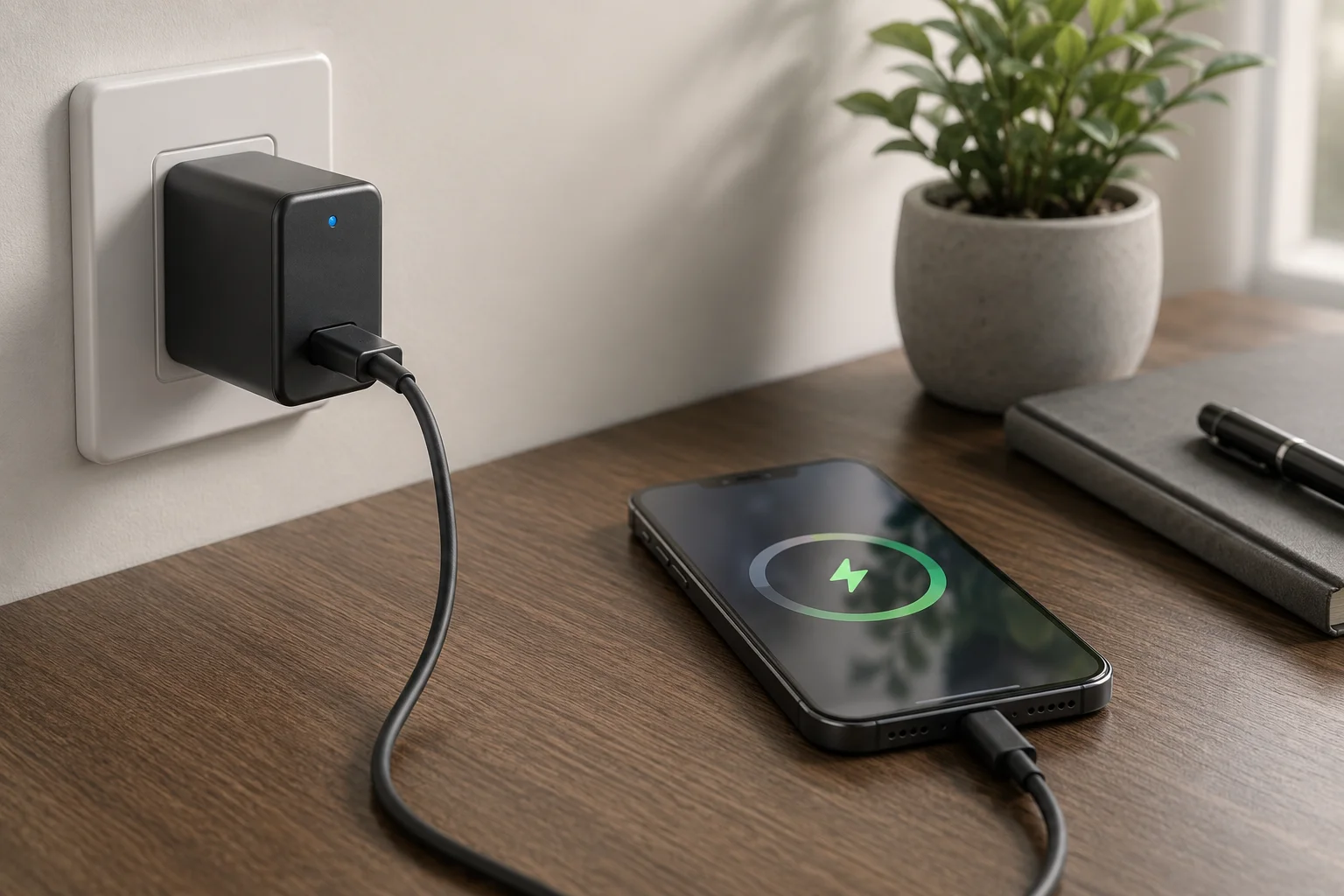
I always remind buyers that “cooler” does not mean “cold.” Any charger can become warm during high-power charging. A 100W charger working near full load will create heat. The key question is whether the heat stays within a safe and stable range.
Good GaN chargers use proper circuit design, safe PCB layout, quality capacitors, flame-retardant housing, and protection systems. I ask suppliers for temperature test data. I also like to test samples under real load. I check the body temperature after continuous use, not only after five minutes.
| Safety Point | What I Want to See |
|---|---|
| Over-current protection | I want the charger to stop unsafe current |
| Over-voltage protection | I want the charger to protect the device |
| Short-circuit protection | I want fast shutdown during faults |
| Over-temperature protection | I want stable control under heavy load |
| Flame-retardant housing | I want safer material for retail markets |
For Europe and the US, I pay close attention to certifications and market rules. CE and UKCA matter for many European buyers. FCC matters for the US market. UL, ETL, or CB can also be important based on channel needs. Some retail chains ask for stricter documents than small online sellers. I suggest buyers confirm this before placing large orders.
How Do GaN Chargers Fit Phones, Tablets, Laptops, and Travel?
Modern users carry many devices. If a charger cannot cover them well, the product loses daily value.
GaN chargers fit phones, tablets, laptops, and travel because they can offer high power and multiple ports in a compact size. I match wattage, port number, plug type, and protocol support to the buyer’s target customer.
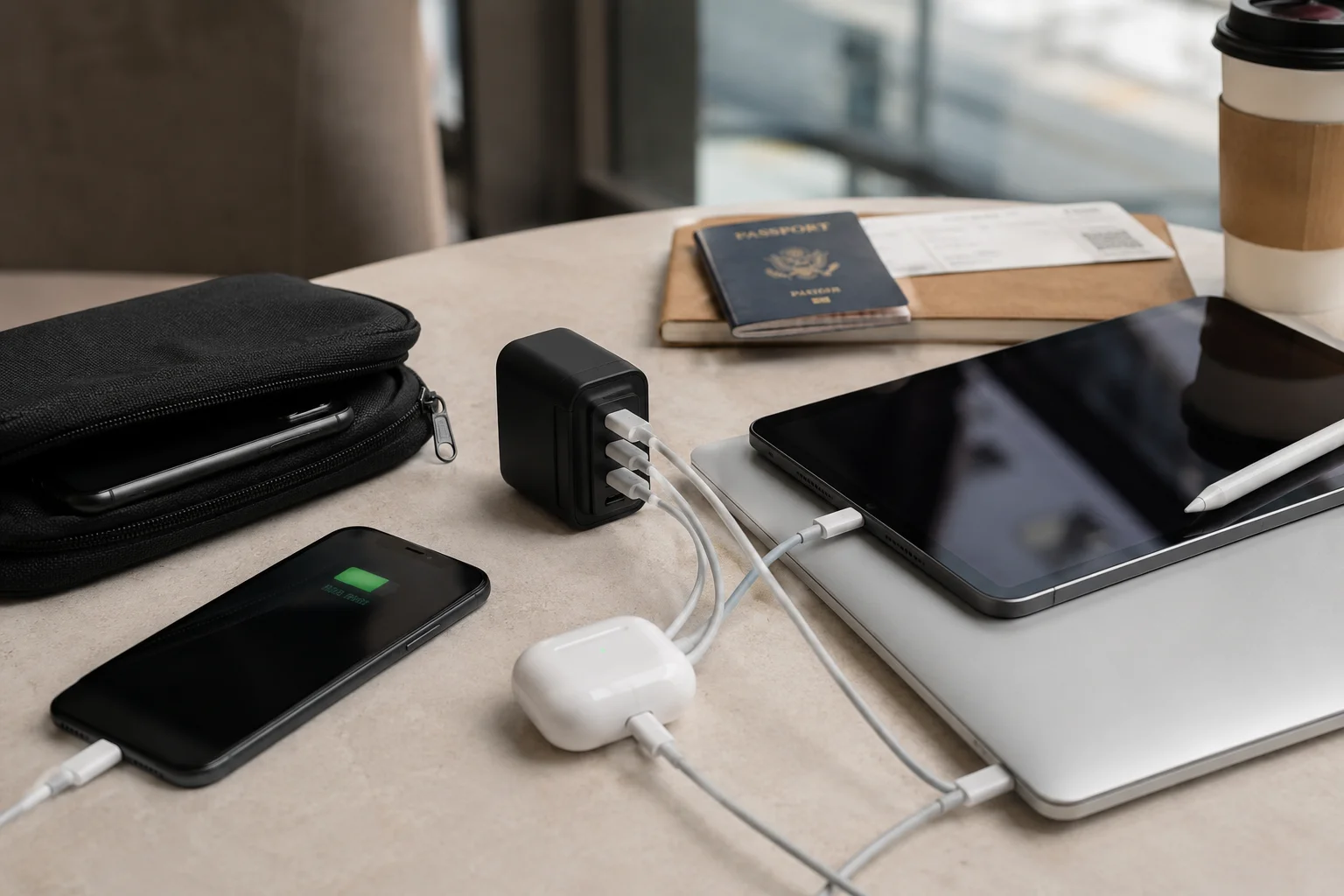
I often discuss use cases with buyers before I discuss price. A charger for phone users is different from a charger for laptop users. A charger for travel retail is different from a charger for office supply channels. This sounds basic, but many sourcing mistakes start here.
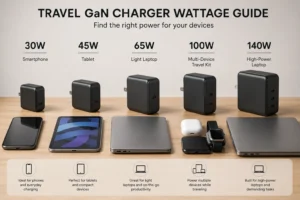
A 30W GaN charger is good for many phones and small tablets. A 45W model can fit tablets, handheld game devices, and some thin laptops. A 65W charger is one of the most popular choices because it can charge many laptops and phones.11 A 100W or higher model fits business users, creators, and people who want one charger for several devices.
| Product Type | Common Buyer Fit |
|---|---|
| 30W GaN charger | Phone sellers, e-commerce bundles, compact travel sets |
| 45W GaN charger | Tablet users and small laptop users |
| 65W GaN charger | Mainstream laptop and phone users |
| 100W GaN charger | Premium travel, office, and multi-device users |
| Multi-port GaN charger | Families, office desks, and frequent travelers |
Plug type also matters. US, EU, UK, and AU plugs require different tooling or different structures. Foldable plugs help travel use, but they also need good mechanical strength. For wholesale buyers, packaging is another part of the value. A clear box design can explain wattage, port sharing, and device support. This reduces confusion and lowers customer service pressure.
Are GaN Chargers Always Better Than Silicon Chargers?
Many buyers ask for the “best charger,” but I think that question is too broad. The wrong “best” choice can hurt profit.
GaN chargers are not always better than silicon chargers.12 I choose GaN for compact high-power needs, premium positioning, and multi-device charging. I choose silicon when price, simple output, and basic market demand are more important.
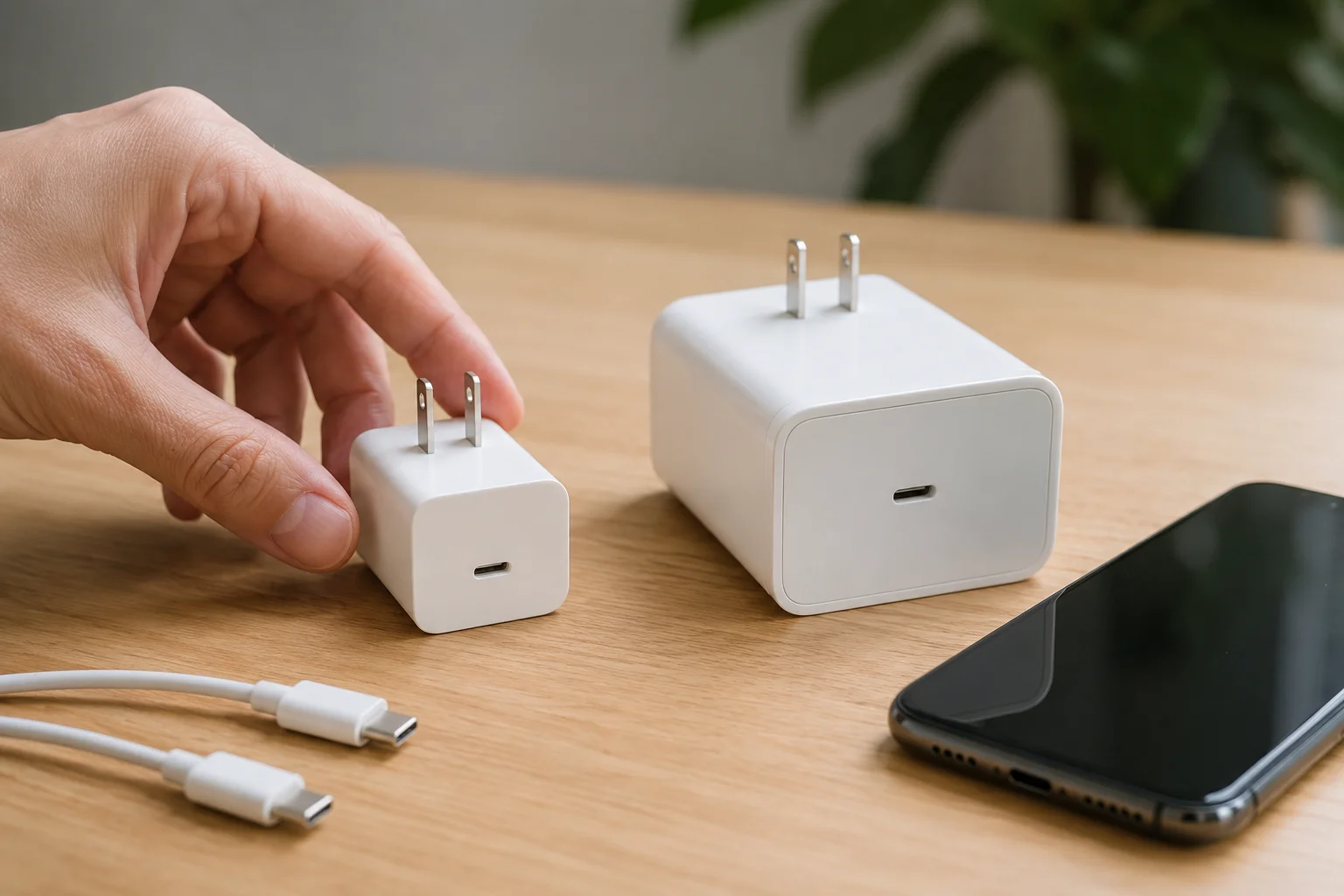
I do not believe every buyer needs GaN. This is the same idea I use in many sourcing talks. The best product is the one that fits the business risk, the sales channel, and the customer expectation.
If a buyer sells in a low-price wholesale market, a basic silicon charger may move faster. If a buyer sells on Amazon, Shopify, or in retail chains with premium shelves, GaN can support a stronger story. The buyer can show smaller size, higher output, and better travel value. But the buyer must also accept higher unit cost and stricter quality control.
| Business Situation | Better Fit |
|---|---|
| Lowest price is the main goal | Silicon charger |
| High-power laptop charging is needed | GaN charger |
| Premium retail packaging is important | GaN charger |
| Basic phone charging is enough | Silicon charger |
| Small size matters a lot | GaN charger |
| Very low MOQ test order is needed | Depends on ready stock |
I often see first-time importers make one mistake. They compare only unit price. They forget return cost, platform reviews, warranty claims, and slow-moving stock. A cheaper charger can be expensive if customers expect fast charging and do not get it. A GaN charger can also be expensive if the market only wants a low-price basic charger. I always bring the discussion back to the real end user.
What Should Buyers Check Before Purchasing GaN Chargers Wholesale?
Wholesale buyers can lose money fast if they buy only from photos. A nice shell and a GaN label are not enough.
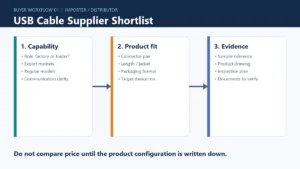
Before purchasing GaN chargers wholesale, I check certifications, real power output, charging protocols, temperature data, aging tests, MOQ, lead time, plug type, packaging, warranty terms, and supplier response speed. I always test samples before bulk orders.
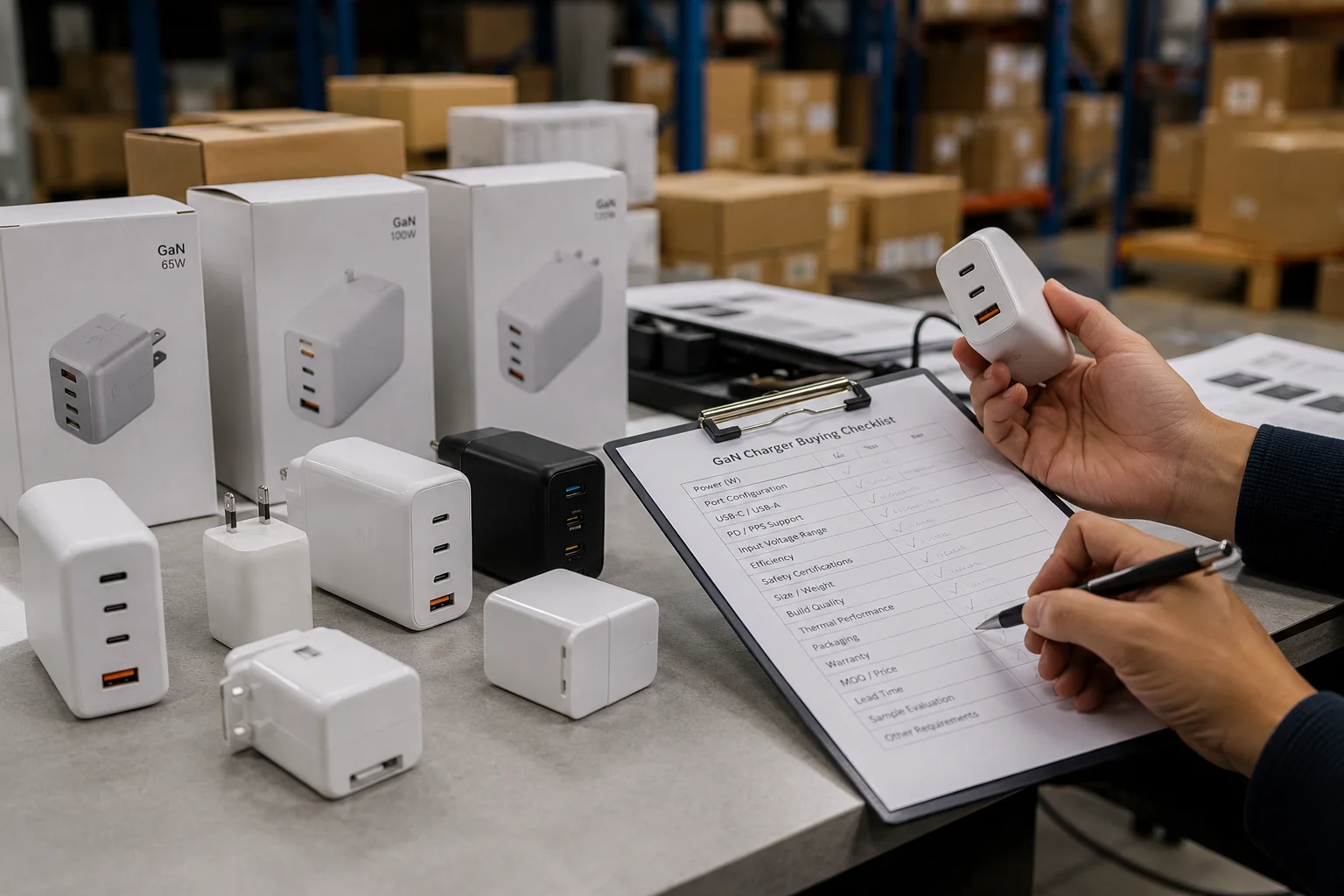
When a buyer asks me for GaN chargers, I do not start with the lowest price. I start with a checklist. This protects both sides. It also makes the first order easier to scale.
I ask about the target country first. The US, EU, UK, and other markets can need different certifications, plugs, labels, and packaging rules. Then I ask about the sales channel. Amazon sellers may need clean packaging, barcode labels, good manuals, and low defect rates. Retail chains may need stronger compliance documents and more stable carton information. Wholesalers may care more about mixed cartons, fast delivery, and price levels.
| Check Item | Why I Care |
|---|---|
| Certification | I need documents that match the target market |
| Real output test | I need proof that the charger delivers its claimed wattage |
| Protocol list | I need device compatibility and fewer complaints |
| Temperature test | I need safer long-hour use |
| Aging test | I need lower failure risk after delivery |
| MOQ | I need order size to match market testing plans |
| Lead time | I need stable delivery for seasonal sales |
| Warranty terms | I need clear after-sales responsibility |
| Customization | I need logo, packaging, color, and manual options if needed |
I also ask buyers not to over-customize too early. If the market is not proven, ready stock or light private label can reduce risk. If the buyer already has stable sales, custom packaging and stronger brand work can make sense. If the buyer needs a unique mold or special internal design, the cost and testing work will be much higher.
In my daily export work, the smoothest GaN charger orders usually come from buyers who know their channel, confirm documents early, test samples, and accept that quality control costs money. This is not hard. It only needs a clear process.
Conclusion
I choose GaN when buyers need compact, efficient, high-power chargers, but I still treat safety, certification, testing, and market fit as the real buying decision.
"GaN vs. Silicon in High-Frequency Power Transistors - Stanford", http://large.stanford.edu/courses/2025/ph240/jahan2/. A source can support this by explaining that GaN's wider bandgap and higher electron mobility allow transistors to switch at much higher frequencies with lower resistance than silicon, leading to improved efficiency and power density in converters. Evidence role: mechanism; source type: paper. Supports: The claim that Gallium Nitride (GaN) as a semiconductor material allows for higher switching frequencies, lower energy loss (higher efficiency), and thus less heat generation compared to traditional silicon.. ↩
"Charger Market to Surpass Valuation of US$ 42.8 Bn by 2030", https://www.transparencymarketresearch.com/charger-market.html. A market research report or an article from a technology news outlet can provide statistics or analysis showing the growth in sales and consumer interest for high-power, multi-device charging solutions. Evidence role: statistic; source type: other. Supports: The claim that there is growing consumer demand for chargers with higher wattage (e.g., 65W, 100W) and multiple ports.. Scope note: Market trend data may be specific to certain regions or sales channels (e.g., online retail vs. brick-and-mortar). ↩
"GaN vs. Silicon in High-Frequency Power Transistors - Stanford", http://large.stanford.edu/courses/2025/ph240/jahan2/. A university or engineering publication can explain that GaN's material properties, such as higher electron mobility and lower parasitic capacitances, enable transistors to turn on and off much more quickly than their silicon counterparts. Evidence role: mechanism; source type: education. Supports: The claim that Gallium Nitride (GaN) facilitates higher switching frequencies in power circuits.. ↩
"CE marking - Wikipedia", https://en.wikipedia.org/wiki/CE_marking. A government or regulatory body's website can explain that certifications like FCC (for the U.S.) and CE marking (for the European Economic Area) are legal prerequisites for market access, indicating compliance with health, safety, and environmental protection standards. Evidence role: definition; source type: government. Supports: The claim that various certifications like FCC and CE are required for selling electronic products in specific markets.. Scope note: The list of required certifications is complex and varies by product type and specific country, not just by broad region. ↩
"[PDF] An SiC Power Converter System – - Department of Energy", https://www.energy.gov/documents/ess-2007-peer-review-sic-power-converter-system-thermal-mgmt-and-high-temp-packaging. A technical analysis or product teardown from an engineering source can show that the lower efficiency of silicon at high frequencies necessitates larger heatsinks and bigger passive components, resulting in a lower overall power density. Evidence role: general_support; source type: research. Supports: The claim that high-wattage silicon-based chargers require a larger physical volume compared to GaN-based equivalents.. Scope note: The size difference can vary significantly based on the specific design and quality of the chargers being compared. ↩
"Switched-mode power supply - Wikipedia", https://en.wikipedia.org/wiki/Switched-mode_power_supply. A source on switched-mode power supply (SMPS) design can confirm that the required size of transformers and inductors is inversely proportional to the operating frequency, allowing for more compact designs at higher frequencies. Evidence role: mechanism; source type: paper. Supports: The claim that higher switching frequencies allow for smaller magnetic and passive components (like transformers, inductors, and capacitors).. ↩
"Quick Charge - Wikipedia", https://en.wikipedia.org/wiki/Quick_Charge. A source from the USB Implementers Forum or a technical article can confirm that the USB Power Delivery specification, including the optional Programmable Power Supply (PPS) protocol, is the standard used by many device manufacturers for fast charging. Evidence role: general_support; source type: institution. Supports: The claim that modern phones often use USB-PD and its PPS extension for optimal fast charging.. ↩
"What is an E-Marker in a USB Type-C Cable and How Does It Work?", https://www.totalphase.com/blog/2020/10/what-is-e-marker-how-does-it-work/?srsltid=AfmBOopemNGo9bzRwwZVVbEBmWs7WfpkiGhAHwE61aG3GMSYzvRKcQBL. A specification document or explainer from the USB Implementers Forum (USB-IF) can confirm that cables rated for more than 3A must be electronically marked to advertise their capabilities to the power source and sink. Evidence role: definition; source type: institution. Supports: The claim that USB-C cables need an integrated e-marker chip to handle currents above 3A (i.e., power above 60W).. ↩
"Waste Heat Recovery Basics - Department of Energy", https://www.energy.gov/cmei/ito/waste-heat-recovery-basics. A source can support this by explaining that a power converter's efficiency is the ratio of output power to input power; the difference between input and output power is primarily dissipated as heat. Evidence role: definition; source type: encyclopedia. Supports: The claim that higher power conversion efficiency results in less energy being lost as waste heat.. ↩
"How does fast charging with GaN compare to traditional ...", https://www.reddit.com/r/UsbCHardware/comments/1kaobrz/how_does_fast_charging_with_gan_compare_to/. A technical review or lab test from a reputable publication can provide thermal imaging data showing a GaN charger operating at a lower surface temperature than a comparable silicon charger under sustained load. Evidence role: case_reference; source type: other. Supports: The claim that GaN chargers tend to run cooler than silicon-based chargers at the same power level.. Scope note: The actual temperature depends heavily on the specific charger's design, enclosure, and ambient conditions, not just the semiconductor material. ↩
"What windows laptop has the largest power adapter. - Reddit", https://www.reddit.com/r/GamingLaptops/comments/116suto/what_windows_laptop_has_the_largest_power_adapter/. An article from a technology news outlet or a market analysis firm can support this by referencing sales data or by describing 65W as a 'sweet spot' capable of charging most ultrabooks and all smaller devices. Evidence role: statistic; source type: other. Supports: The claim that 65W chargers are a popular category in the market.. Scope note: Popularity can be subjective and may vary by region and over time as device power requirements change. ↩
"GaN vs. Silicon in High-Frequency Power Transistors - Stanford", http://large.stanford.edu/courses/2025/ph240/jahan2/. A source from an engineering publication or component manufacturer can explain that for low-power or highly cost-sensitive applications, the performance benefits of GaN may not justify its higher cost, making silicon a more practical choice. Evidence role: expert_consensus; source type: education. Supports: The claim that silicon remains a viable and sometimes preferable choice over GaN for certain applications.. ↩