Struggling to launch your own brand of chargers? The world of private labels seems like the perfect solution, but the details feel overwhelming and risky, leaving you unsure where to even begin.
Before placing your first private label GaN charger order, you must confirm more than just the logo and price. A complete checklist includes product specs, safety certifications, branding files, packaging details, MOQ, the sample approval process, lead time, and clear after-sales responsibilities with your supplier.
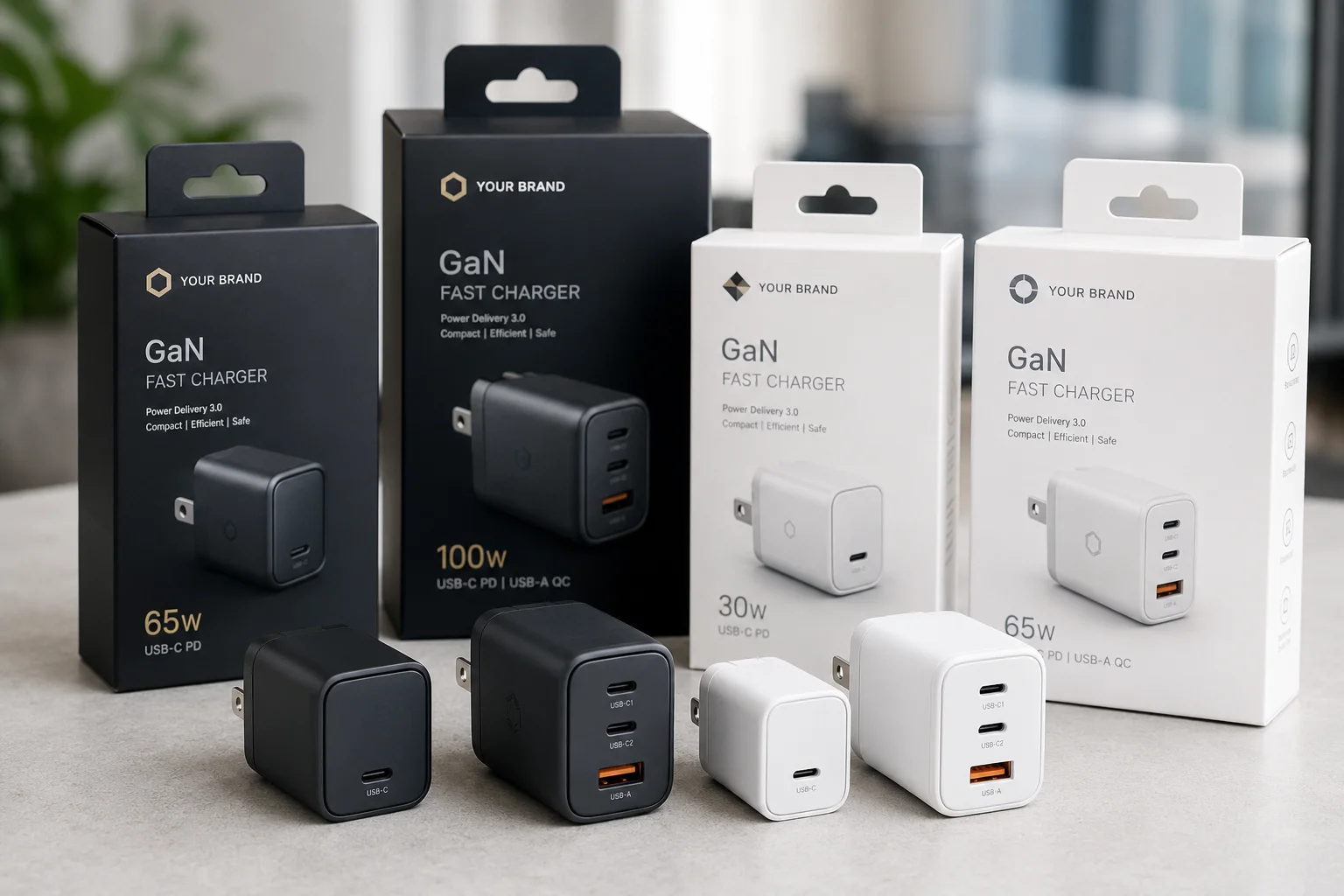
I've been exporting 3C accessories from Shenzhen for 15 years, and I've seen countless importers start their journey with GaN chargers. It's a hot market, for sure.1 Everyone has multiple devices—a phone, a laptop, earbuds, a watch—and nobody wants to carry a bag full of chargers. A single, powerful GaN charger is an easy sell. But this popularity also means the market is flooded with questionable products. The difference between a successful product line and a warehouse full of returns often comes down to the questions you ask before you send that first payment. This isn't just about finding a cheap factory; it's about finding a reliable partner who understands the technology and your market. Let's walk through the exact steps you need to take to do it right.
What Are Private Label GaN Chargers?
Want to build a brand but feel stuck selling generic items? Private labeling seems like the next step, but the process can feel confusing. You need a way to stand out.
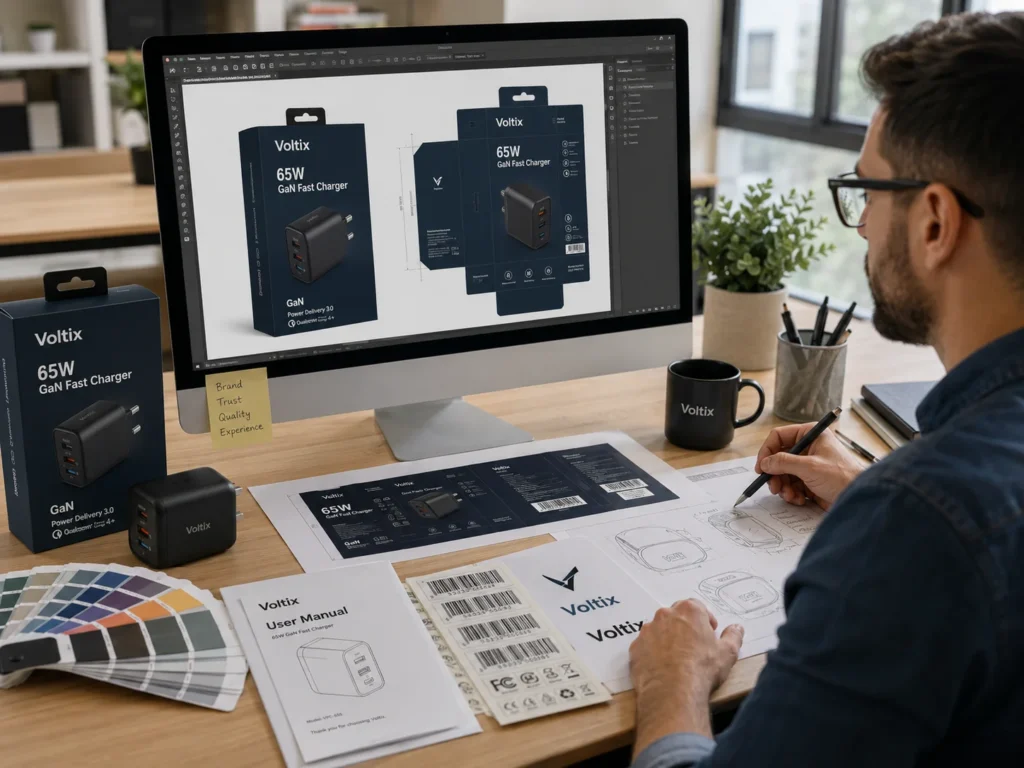
Private label GaN chargers are market-ready products from a manufacturer that you can customize with your own branding. This typically includes adding your logo to the product, and designing your own custom packaging, user manual, and barcodes for a proven, existing charger model.
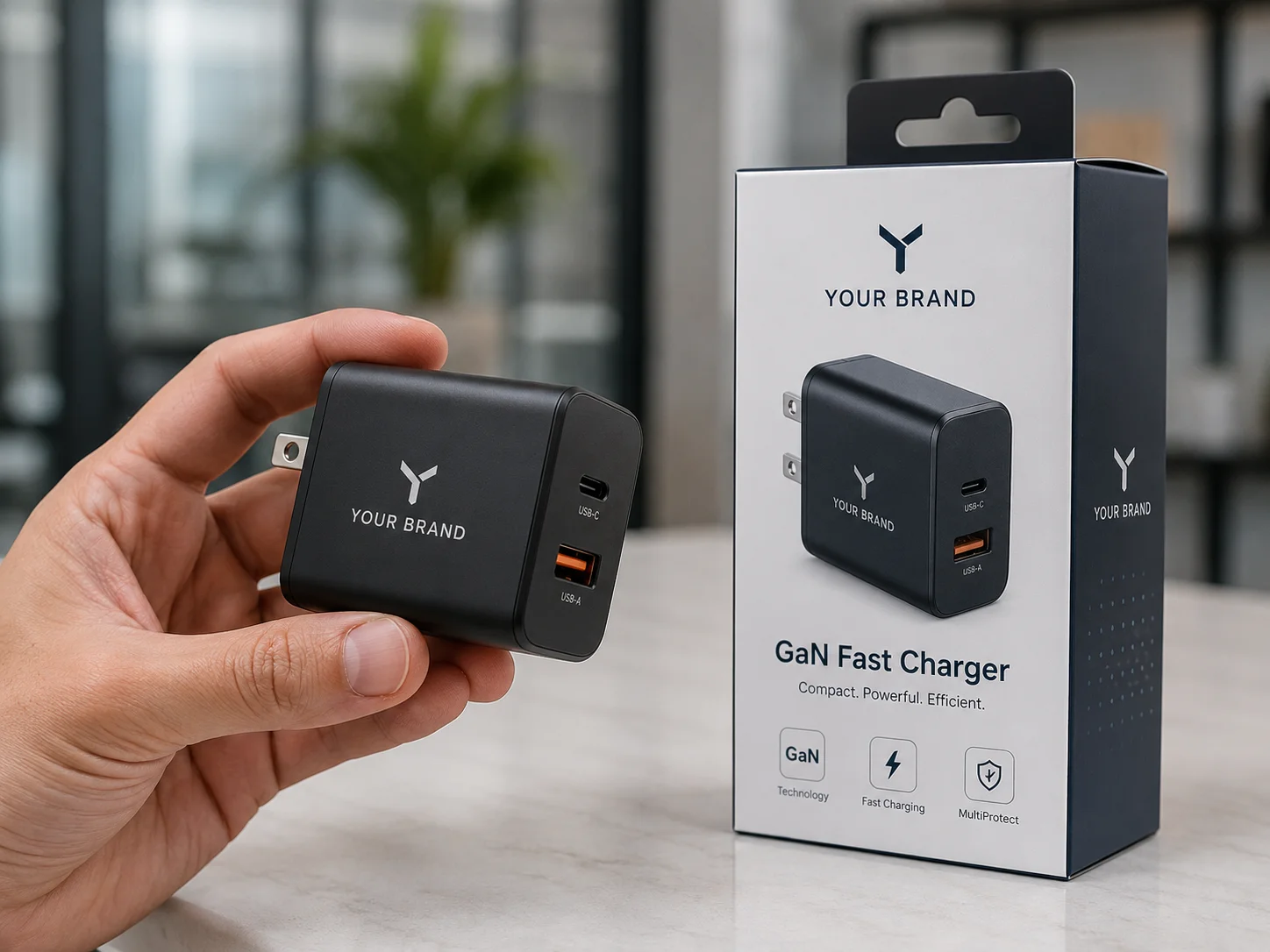
When I talk to new buyers, many think "private label" just means getting their logo printed on a product. It’s more than that. Think of it as a branding and marketing commitment. The core technology—the charger's internal circuit board (PCBA), the power output, the safety features—is already developed and tested by the factory. You are taking that solid foundation and building your brand's house on top of it. This means you are responsible for how the product looks and feels to your customer. This includes:
- The Product: Your logo is laser-etched or printed on the charger's shell.
- The Packaging: You design the retail box. This is your "silent salesman" on the shelf or on a webpage.
- The Manual: You create a user guide with your brand's tone, instructions, and support information.
- The Complete Experience: From the barcode on the box to the safety warnings in the manual, it all comes from your brand.
The core task here is to differentiate a product that you don't fully control from a hardware perspective. It's the first real step away from being just a reseller and toward becoming a brand that customers recognize and trust.
Why Do Importers Choose Private Label Instead of Generic Products?
Are you tired of competing on price alone with generic products? Your customers buy today and have no reason to come back to you tomorrow. This race to the bottom is exhausting and kills your profit.
Importers choose private label to build brand equity and escape the brutal price wars of generic goods. This strategy allows for a higher perceived value, better profit margins, and the potential for real customer loyalty. You control the marketing story and brand identity.
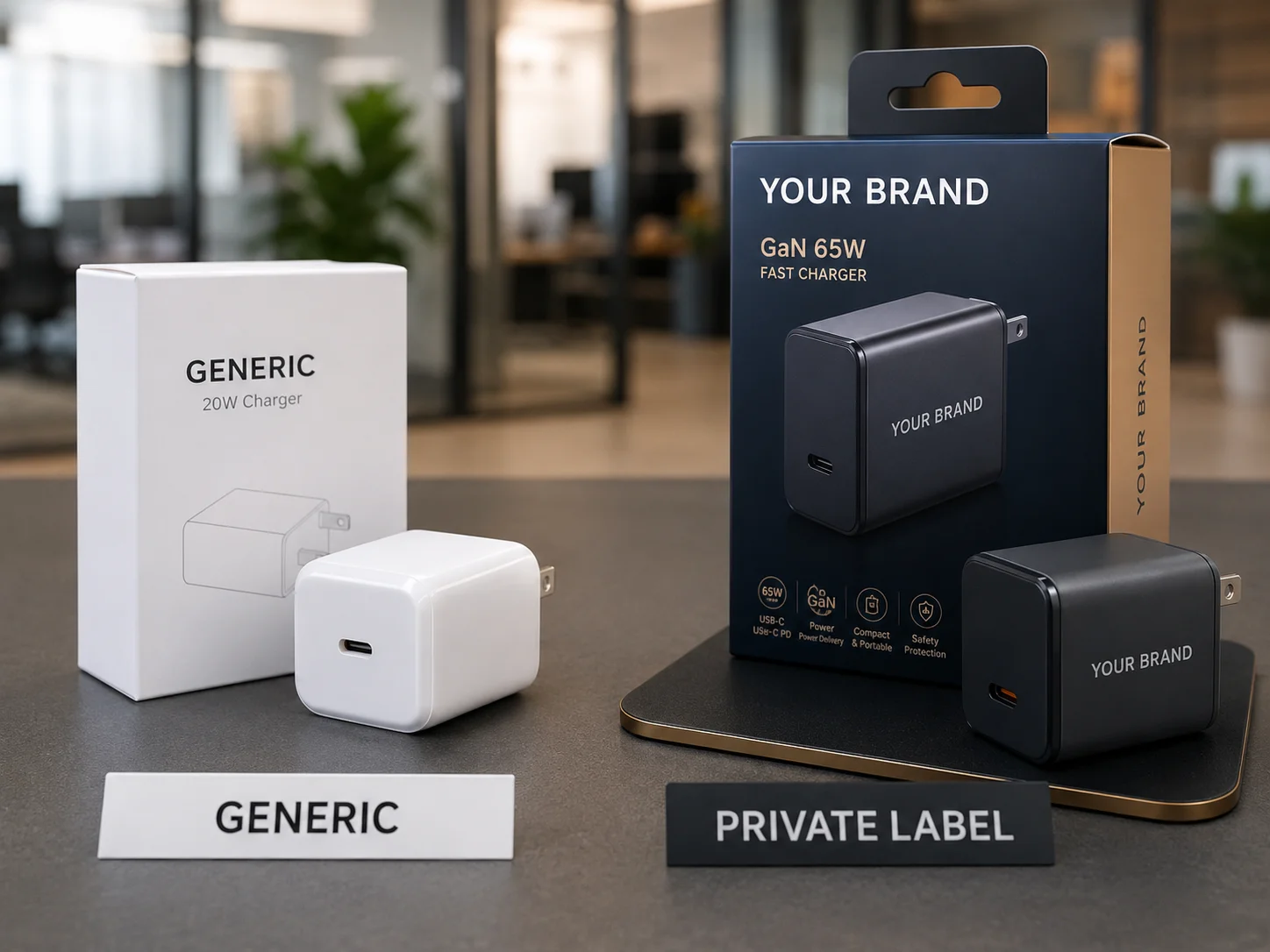
When you sell a generic, unbranded charger, the only question your customer asks is "How much does it cost?" When you sell a private label product, you give them a reason to ask other questions. "Do I trust this brand?" "Does this look like a quality product?" This is a massive advantage.
I often tell clients to think about it as a trade-off.
- Generic Wholesale: This is your market-testing tool. The MOQ is low, the lead time is fast, and the risk is minimal. You use it to find out what sells. The trade-off is you have zero brand control and you're in a price fight with everyone else selling the exact same thing.
- Private Label: This is your brand-building tool. You take a product that you know sells (based on your wholesale tests) and you make it your own. The MOQ is higher, and you have to invest in design, but the reward is a unique product that only you sell. You start building a following and can command a better price.
Choosing private label is a strategic business decision. It's the moment you decide to stop just moving boxes and start building an asset—your brand.
What Product Specs Should You Confirm First?
"I need your best price on a 65W GaN charger." I get this question dozens of times a week. It's not a wrong question, but it's dangerously incomplete. Answering it without more details is a recipe for failure.
Before discussing price, you must confirm three critical specs: Wattage (for your target audience), Ports (and how they share power), and Protocol support (like PD and PPS). These details determine if the charger actually works for your customer's devices and avoids costly returns.
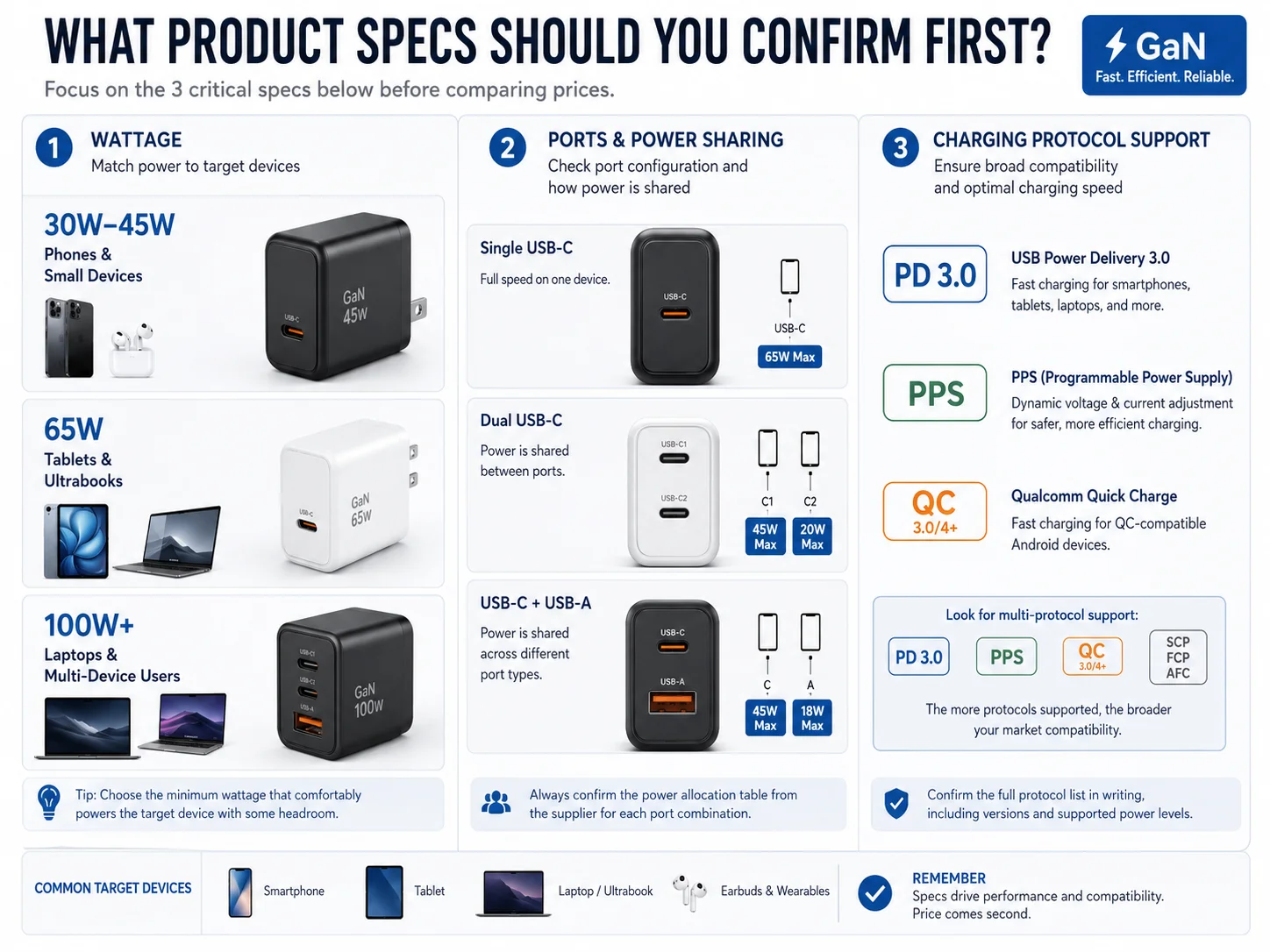
A charger is a technical product. If the specs don't match your customer's needs, it's useless. Let's break this down.
1. Wattage: Different Power, Different Business
Thinking 20W, 65W, and 100W are just different numbers is a common mistake. They represent entirely different customers and market segments.
| Wattage | Target Device | Typical Channel | Business Focus |
|---|---|---|---|
| 20W | iPhone, single phone | Convenience stores, accessory shops | High volume, low margin, intense competition |
| 30W-45W | Phone, iPad, small tablet | Online stores, retailers | Mid-range, good balance of power and price |
| 65W | Phone, tablet, most laptops | Amazon, e-commerce, computer shops | Mainstream "all-in-one" solution, best balance |
| 100W+ | Multiple devices, powerful laptops | Pro-user channels, brand websites | High-end, high margin, tech-savvy customers |
Don't just chase the highest number. Match the wattage to your sales channel.
2. Ports: More Ports, More Problems
A multi-port charger looks great on the box, but the real challenge is power distribution. It's not as simple as drilling more holes in the casing. You must ask your supplier:
- What is the max output when only one USB-C port is used?
- How is the power split when two C ports are used?
- What happens when a C port and an A port are used together?
- Does plugging in a second device cause the first one to disconnect and reconnect?
If a supplier can't give you a clear chart explaining these power splits, that's a huge red flag.
3. Protocols: PD and PPS Are Not Decorations
Fast charging isn't a single standard. The two most important protocols for US and EU markets are PD (Power Delivery)2 and PPS (Programmable Power Supply)3. PD is essential for fast charging Apple devices like iPhones and MacBooks. PPS is critical for Samsung's "Super Fast Charging." If a charger doesn't support the right protocols, it will only charge at slow speeds, and your customers will be angry.
What Branding and Packaging Details Are Needed?
Your logo is on the product, but does it look professional? A cheap-looking box, a confusing manual, or a blurry logo can destroy the brand value you are trying to build. First impressions matter.
For a successful private label launch, you need more than just a logo file. Prepare high-resolution brand assets, a clear packaging design with all necessary specs and markings, a professional user manual, and barcodes. These details communicate trust before the customer even uses the product.
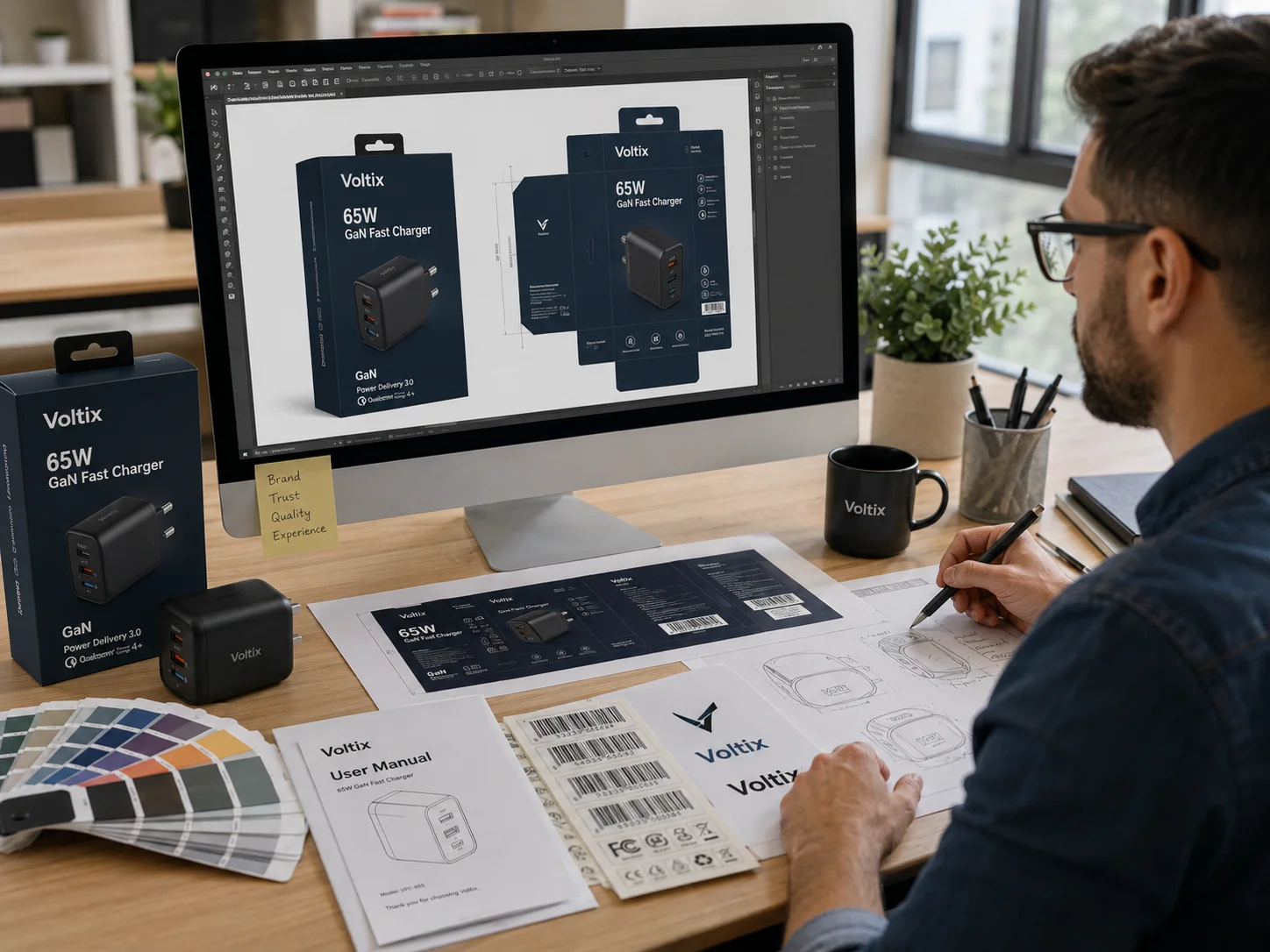
When a customer holds your product for the first time, the packaging is the first thing they experience. It sets their expectations. I've seen great products fail because of poor branding execution. Here is a checklist of assets you need to have ready for your supplier.
- Logo File: Don't send a JPG or PNG. You need a vector file, usually in
.ai(Adobe Illustrator) or.epsformat. This ensures the logo can be resized and printed clearly on both the product and the packaging without looking blurry or pixelated. - Packaging Artwork: This is your most important marketing tool. Your box design should clearly communicate the key selling points:
- User Manual: A well-written manual in your customers' language builds confidence. It should include setup instructions, clear power distribution charts for multi-port chargers, safety warnings, and your company's support information.
- Product Marking: The information printed or etched onto the charger itself is crucial. This "rating label" must be legible and accurate, matching the specs on the box and the official certification reports. It's not just for looks; it's often a legal requirement.
Which Certifications and Test Reports Should You Prepare?
A supplier tells you, "Yes, we have CE certification." You take their word for it, place a big order, and ship the goods. Then, a problem arises, and you discover that "certification" was for a different model or just a manipulated image.
Never just ask if a charger is certified. You must demand to see the full, unedited test report and the certificate. Then, you must verify that the model number, company name, and technical standards (e.g., CE, FCC, UKCA) match your exact product and target market.
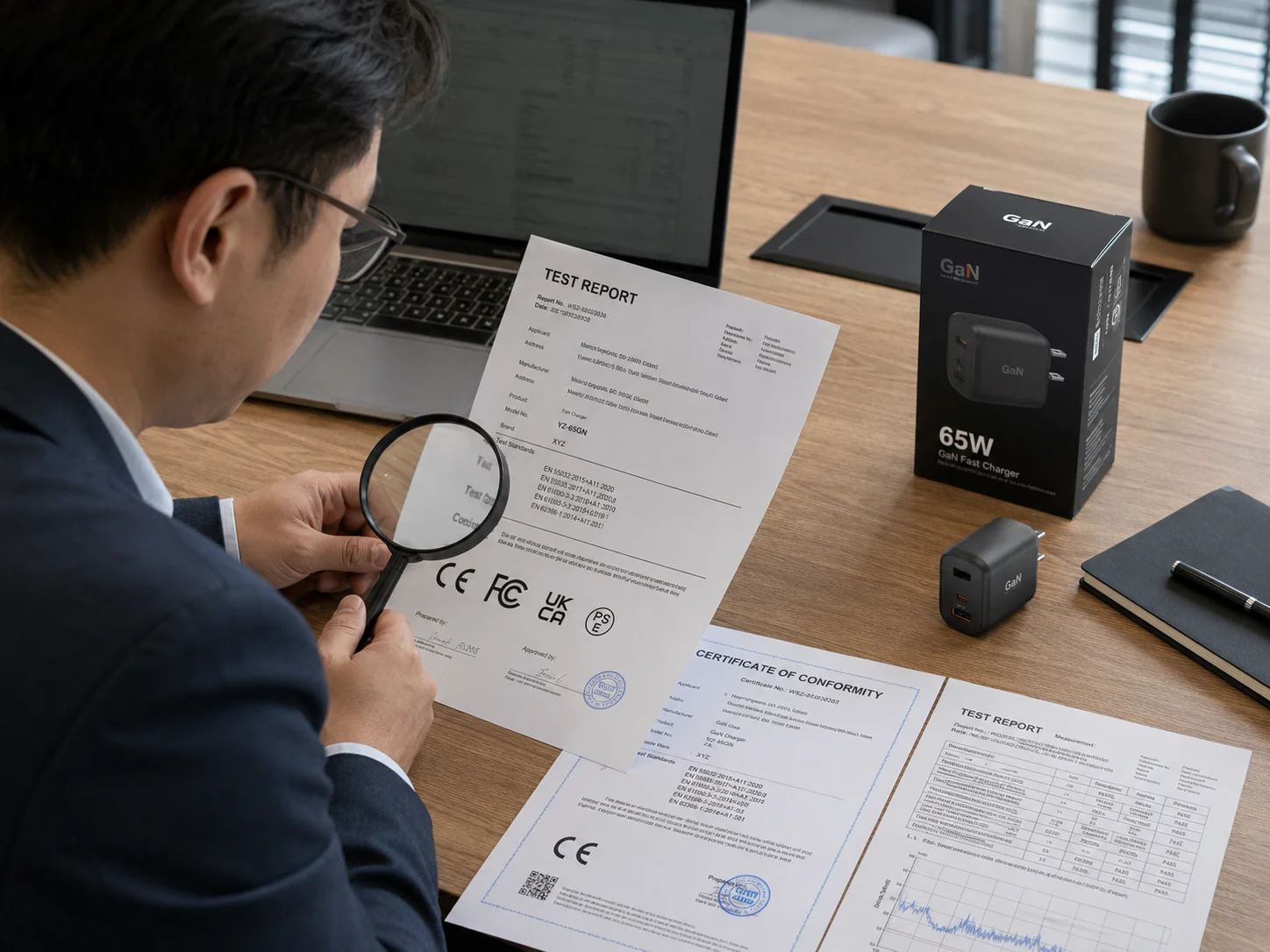
Chargers are not like phone cases or USB cables. They plug directly into high-voltage wall outlets. Safety and compliance are not optional—they are your number one priority. A single safety incident can destroy your brand and lead to huge liabilities.
Here’s what I tell my clients to check:
- Get the Full Report, Not Just the Certificate: A certificate is a one-page summary. The test report is a 50+ page document7 showing all the tests that were performed. A serious supplier will have both.
- Check the Model Number: Does the model number on the report exactly match the model number of the charger you are buying? If they offer you a report for model
XY-123but you are buyingXY-123A, the report is not valid for your product. - Check the Company Name: Does the certificate belong to the factory or trading company you are buying from? If it belongs to a third party, you need to understand the relationship.
- Check the Standards and Date: Is the report recent? Are the standards tested (e.g.,
[EN 62368-1](https://www.bls.gov/ooh/architecture-and-engineering/health-and-safety-engineers.htm)8) the latest ones required for your market?
Here are some common certifications you will encounter:
| Certification | Region(s) | What it Covers |
|---|---|---|
| CE | European Union (EU) | Safety (LVD), Electromagnetic Compatibility (EMC), Hazardous Substances (RoHS) |
| UKCA | Great Britain (UK) | UK equivalent of the CE mark |
| FCC | United States | Electromagnetic interference |
| ETL/UL9 | North America | Product safety and construction standards |
| ERP/DOE VI | EU / US | Energy efficiency standards for external power supplies |
Crucial Private Label Note: If the factory's standard product is certified, but you ask them to change the internal components or casing, that certification may no longer be valid. You must clarify if your private label version is covered by the existing reports or if new testing is required.
MOQ, Sample Approval, and Lead Time: What to Confirm Before Paying?
You've found a great product, the specs are perfect, and you've negotiated a fair price. You're ready to send the deposit. But wait. Small misunderstandings about logistics can cause major delays and blow up your budget.
Before any payment is made, get written confirmation of the Minimum Order Quantity (MOQ) for your specific private label design, the exact sample approval process, and the production lead time that starts after your final approval. This prevents future disputes.
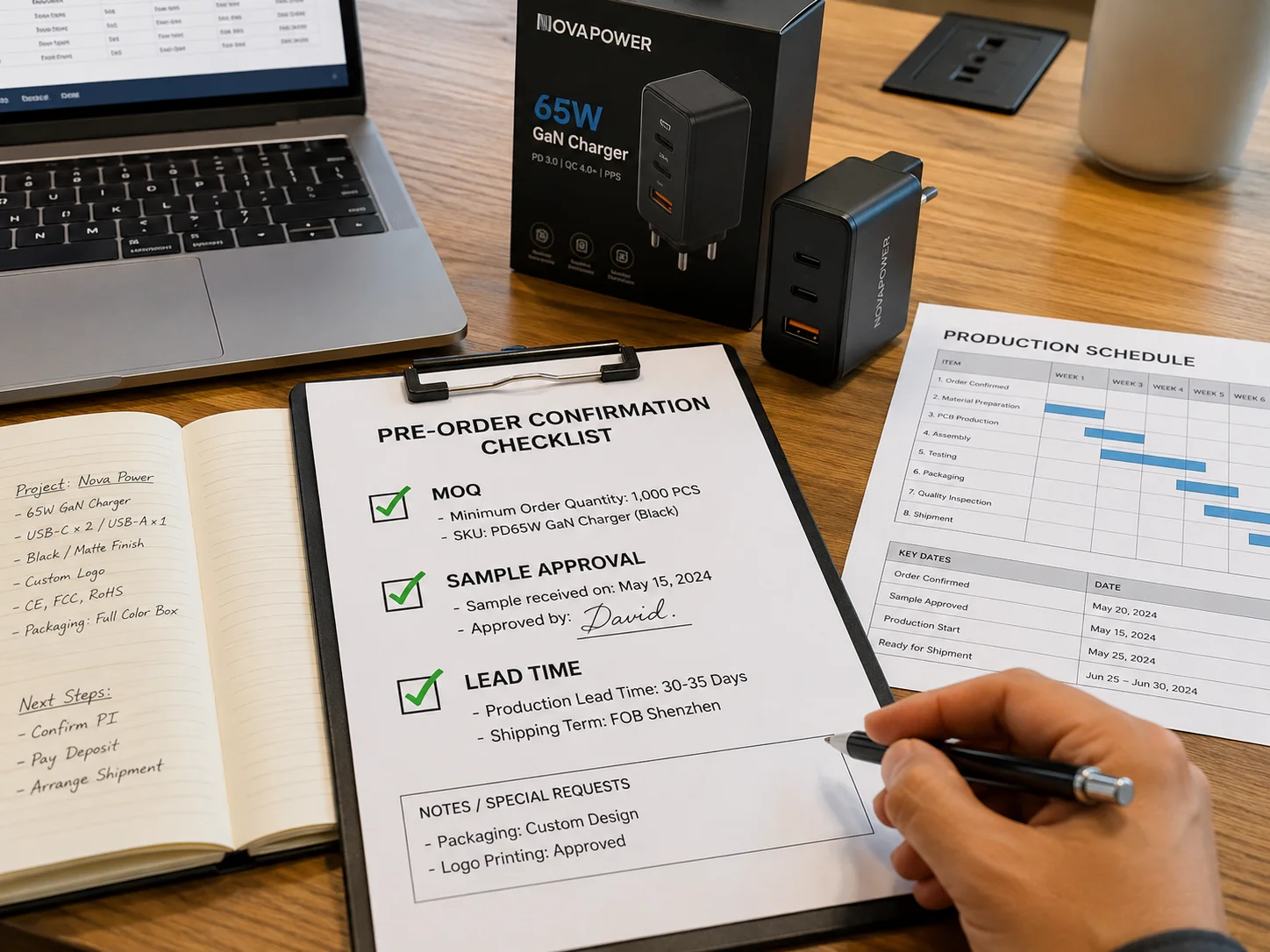
These business details are just as important as the product's technical specs. Let's go through the key points to lock down with your supplier before you commit.
1. Minimum Order Quantity (MOQ)
For private label orders, the MOQ is almost always higher than for standard, generic stock. Why? Because the factory has to set up custom printing for your boxes, manage your specific product version, and print your logos. These custom runs are less efficient than mass-producing their standard model. Ask directly: "What is the MOQ for my custom packaging and logo printing?" and "Is there a price difference if I order a larger quantity?"
2. Sample Approval Process
The pre-production sample is your final chance to catch any issues. Do not skip this step, and do not rush it. When you receive the sample, you must test it thoroughly.
- Real-World Testing: Does it fast charge your target devices? Test it with an iPhone, a Samsung phone, a MacBook, a Nintendo Switch, etc.
- Power Output: Use a USB power meter to verify the voltage and amperage.10 Does it actually deliver 65W?
- Heat Test: Leave it charging a laptop for an hour. Does it get uncomfortably hot? A little warmth is normal, but excessive heat is a danger sign.
- Fit and Finish: Does the packaging look perfect? Is the printing clear? Does the plug fit securely into an outlet?
Only after you are 100% satisfied should you give your formal approval in writing.
3. Production Lead Time
This is a common point of confusion. You need to ask, "When does the lead time clock start?" Is it from the day I pay the deposit? Or is it from the day I approve the final pre-production sample? In most cases, it's the latter. A typical response might be "25-30 days after sample confirmation." Getting this clarified in writing avoids a lot of stress later on.
What Are Common Mistakes Importers Make Before the First Order?
The dream of launching a successful private label product can quickly turn into a nightmare. Over my 15 years in this business, I've seen first-time importers make the same handful of costly but avoidable errors.
The most common mistakes are focusing only on price, blindly trusting a certificate picture without verification, not testing samples thoroughly with all target devices, and failing to clarify branding and packaging details upfront. These errors lead to bad products, customs issues, and angry customers.
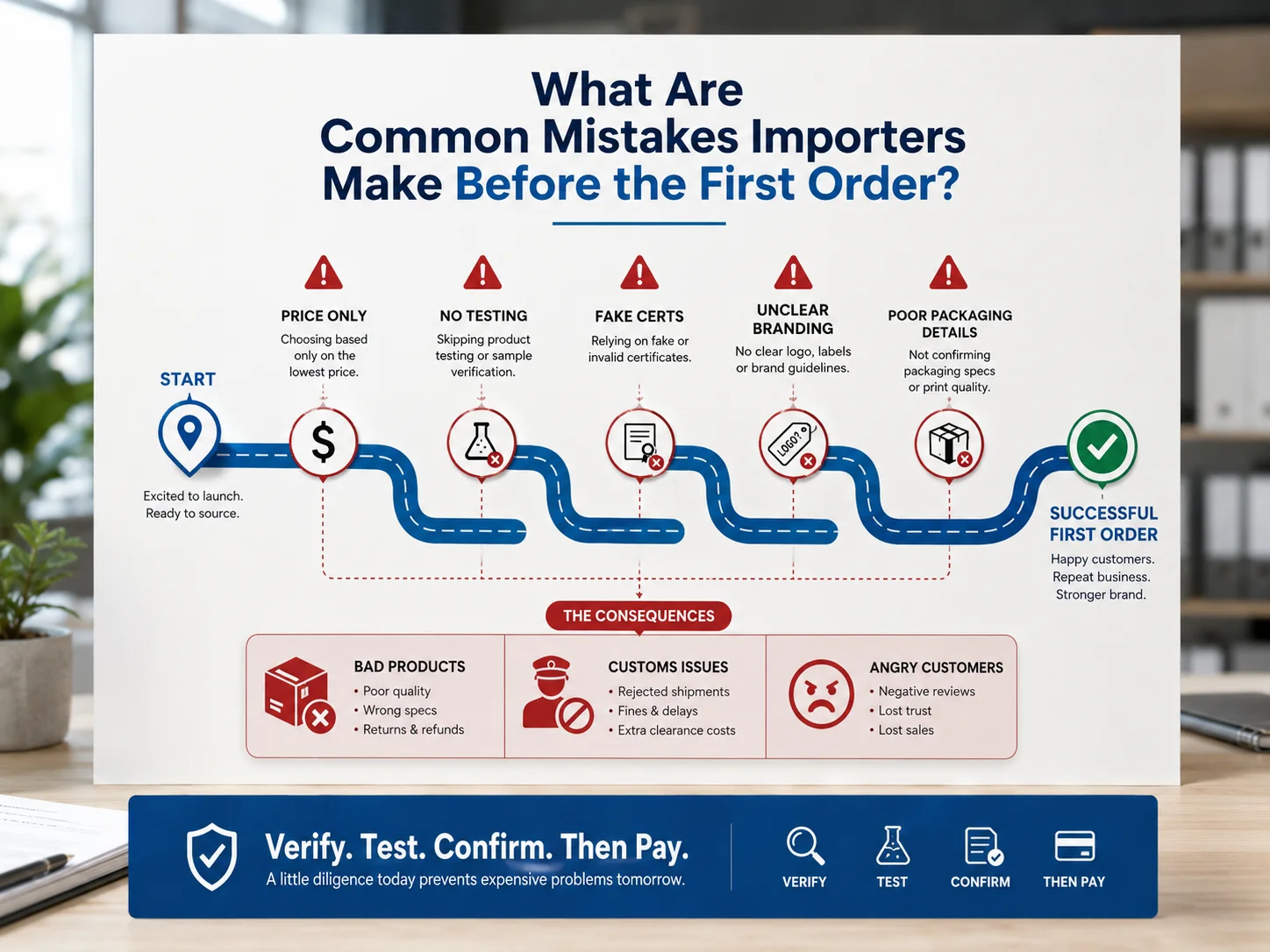
Think of this as a checklist of what not to do. If you can avoid these common traps, you are already far ahead of the competition.
Based on hundreds of conversations with buyers, here are the top mistakes I see:
- The "Best Price" Trap: Starting the conversation with "what is your lowest price?" signals to a supplier that you value price over quality, safety, and reliability. A good supplier is looking for a long-term partner, not a one-time transaction based on the cheapest possible components.
- Trusting a Screenshot: A supplier sends you a picture of a CE certificate. This means nothing. As we discussed, you must get the full report and verify that every detail matches the product you are buying. Lazy compliance checking is the fastest way to get your shipment seized by customs11 or to sell an unsafe product.
- The "Looks Good" Sample Approval: The sample arrives and it looks nice. The packaging is clean. You approve it. This is a huge mistake. You must functionally test the sample. Does it overheat? Does it actually deliver the advertised power? Does it work with the specific phones and laptops your customers use?
- Ignoring the Fine Print on the Charger: Many importers focus on the box but forget about the rating label—the small text printed on the charger itself. This text is a legal requirement in most markets. It must be 100% accurate and match the certifications, input/output specs, and model number.
- Assuming the Second Order is the Same: The first order is perfect. The second order arrives, and customers start complaining. What happened? The factory may have swapped in cheaper components to increase their margin. Before your first order, you must ask: "How do you ensure quality and component consistency on repeat orders?"
What Is the Final Buying Advice: Start Small, Test Carefully, and Build Long-Term?
You're ambitious and eager to launch a full line of custom chargers. You're thinking about unique colors, special designs, and the highest specifications. This is fantastic, but jumping in too deep, too fast is the biggest risk of all.
My best advice is to follow a staged approach. Start with standard, generic stock to test your market and gather data. Once you have a proven seller, move to private labeling. Only consider full OEM customization when you have significant volume and a deep understanding of your needs.
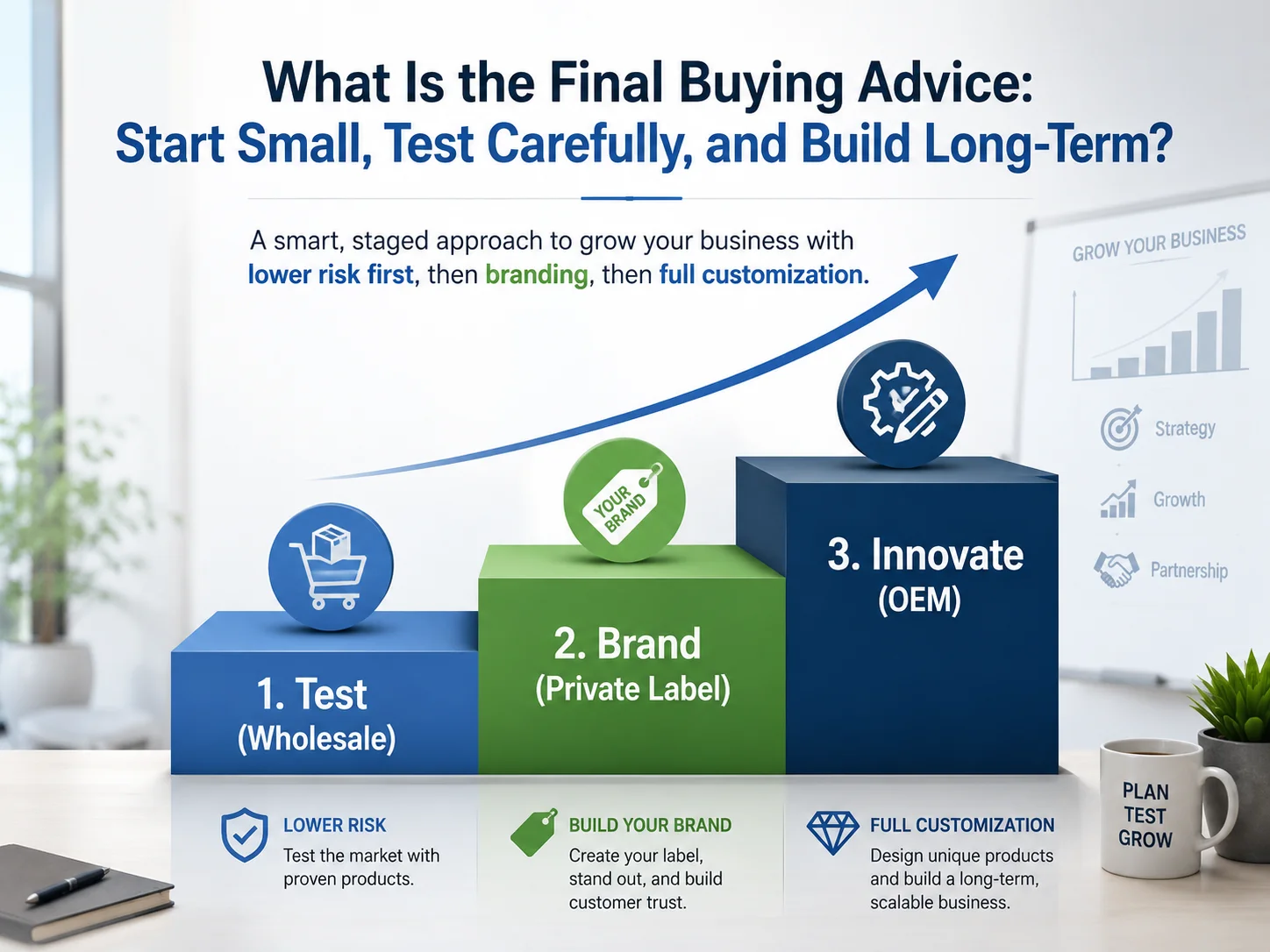
This is the path I advise for nearly all my new clients. It's a slower, more deliberate strategy, but it dramatically lowers your financial risk and increases your chances of long-term success.
Stage 1: Test with Standard Wholesale
Your goal here is not profit; it's market research. Buy a small quantity (low MOQ) of a few standard models from a reliable supplier.
- Try a 20W USB-C charger.
- Try a 65W 2C1A GaN charger.
- Try a 100W multi-port charger. See what your customers actually buy. You might be surprised. The market will give you honest feedback. Listen to it.
Stage 2: Build a Brand with Private Label
Now you have data. You know your customers love the 65W charger. Great. Now it's time to make it your own. Work with your supplier to private label that specific, proven model. Invest in great packaging and clear branding. Your goal now is to increase your margin and build a brand that customers remember. Because you're using a standard, mature product, the quality is stable and the risks are manageable.
Stage 3: Innovate with OEM
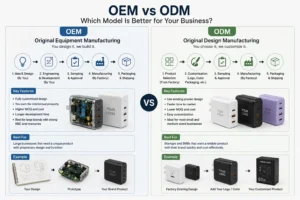
You've been selling your private label 65W charger for a year. Sales are strong and you're a recognized name in your niche. NOW you can consider OEM (Original Equipment Manufacturer)12. This is where you work with the factory to design a completely unique product—a special casing, a different port combination, a new feature. OEM is expensive, time-consuming, and has very high MOQs. It's only for scaled businesses that need a truly unique product to defend their market position.
Conclusion
Ultimately, sourcing GaN chargers is not about finding the cheapest price. It's about finding a reliable, safe, and consistent product that your customers will love, building your business one repeat order at a time.
"GaN powered Chargers Market Size, Share | Outlook 2035", https://www.marketresearchfuture.com/reports/gan-powered-chargers-market-11884. A market research report or industry analysis can provide statistics on the growth of the Gallium Nitride (GaN) charger market, often citing increased demand for smaller, more efficient power adapters for consumer electronics. Evidence role: statistic; source type: research. Supports: The source should provide data on the market size, compound annual growth rate (CAGR), or sales trends for GaN chargers or related power semiconductors.. ↩
"USB hardware - Wikipedia", https://en.wikipedia.org/wiki/USB_hardware. The USB Implementers Forum (USB-IF) defines USB Power Delivery (PD) as a specification that enables the maximum functionality of USB by providing more flexible power delivery along with data over a single cable, supporting up to 240W of power. Evidence role: definition; source type: institution. Supports: The source should define the USB Power Delivery (PD) specification and its role in enabling higher power charging for various devices.. ↩
"What is the difference between PD and PPS? : r/UsbCHardware", https://www.reddit.com/r/UsbCHardware/comments/12k2063/what_is_the_difference_between_pd_and_pps/. A technical resource from the USB-IF or an engineering publication can explain that Programmable Power Supply (PPS) is a protocol within the USB-PD 3.0 standard that allows for small, incremental changes in voltage and current, enabling more efficient charging and better thermal management, which is utilized by technologies like Samsung's Super Fast Charging. Evidence role: definition; source type: institution. Supports: The source should define the Programmable Power Supply (PPS) protocol as part of the USB-PD standard.. ↩
"Universal Product Code - Wikipedia", https://en.wikipedia.org/wiki/Universal_Product_Code. The global standards organization GS1 provides documentation defining Universal Product Codes (UPC) and International Article Numbers (EAN) as unique identifiers for trade items, which are essential for tracking products in retail supply chains and point-of-sale systems. Evidence role: definition; source type: institution. Supports: The source should define UPC and EAN barcodes and explain their function in retail.. ↩
"CE marking - Wikipedia", https://en.wikipedia.org/wiki/CE_marking. The European Commission's official website explains that the CE marking indicates that a product has been assessed by the manufacturer and deemed to meet EU safety, health, and environmental protection requirements, making it a legal prerequisite for placing many products on the market in the European Economic Area. Evidence role: definition; source type: government. Supports: The source should officially define the CE marking and its purpose within the EU.. ↩
"Licensing - Federal Communications Commission", https://www.fcc.gov/licensing. The U.S. Federal Communications Commission (FCC) website details that its equipment authorization program requires devices that emit radio frequency energy to be tested and certified to ensure they do not cause harmful interference to other devices and radio services, as specified in regulations like Title 47 CFR Part 15. Evidence role: definition; source type: government. Supports: The source should officially define the purpose of FCC certification for electronic devices.. ↩
"General Use Products: Certification and Testing | CPSC.gov", https://www.cpsc.gov/Business--Manufacturing/Testing-Certification/General-Use-Products-Certification-and-Testing. Examples from compliance testing laboratories show that full test reports for standards like EN 62368-1 (LVD) or FCC Part 15 (EMC) are comprehensive documents that detail test setups, procedures, results, and photographs, often spanning 50 to 100 pages or more. Evidence role: general_support; source type: research. Supports: The source should show or describe the contents of a full product safety test report.. Scope note: The exact length of a report varies by product, standard, and laboratory. ↩
"Health and Safety Engineers - Bureau of Labor Statistics", https://www.bls.gov/ooh/architecture-and-engineering/health-and-safety-engineers.htm. A publication from a standards body like the IEC or a compliance engineering firm can explain that IEC/EN 62368-1 is a modern, hazard-based safety standard for audio/video, information, and communication technology equipment, which has superseded the older IEC/EN 60950-1 and 60065 standards. Evidence role: definition; source type: institution. Supports: The source should define the EN 62368-1 standard and its scope.. ↩
"OSHA's Nationally Recognized Testing Laboratory (NRTL) ...", http://www.osha.gov/nationally-recognized-testing-laboratory-program. The U.S. Occupational Safety and Health Administration (OSHA) maintains a list of Nationally Recognized Testing Laboratories (NRTLs), which includes organizations like UL (Underwriters Laboratories) and ETL (Intertek). These labs are recognized as qualified to perform safety testing and certification on products to ensure they meet U.S. consensus-based standards. Evidence role: definition; source type: government. Supports: The source should explain the role of organizations like UL and ETL in product safety certification in the US.. ↩
"Why You NEED a Cheap USB Power Meter! And How to Use It",
. A technical guide or electronics wiki can describe a USB power meter as a small, inline device that measures the voltage (V) and current (A) passing through a USB connection in real-time, allowing users to verify a charger's power output (in watts) and check which charging protocols are active. Evidence role: definition; source type: encyclopedia. Supports: The source should define what a USB power meter is and its function.. ↩"CBP officers seize more than $150000 worth of fake electronics", https://www.cbp.gov/newsroom/local-media-release/cbp-officers-seize-more-150000-worth-fake-electronics. Official publications from government agencies like U.S. Customs and Border Protection (CBP) or the European Commission's Taxation and Customs Union state their authority to inspect, detain, and seize imported goods that do not comply with national laws and regulations, including product safety standards and certification requirements. Evidence role: general_support; source type: government. Supports: The source should confirm that customs authorities have the power to seize non-compliant goods.. ↩
"Original equipment manufacturer - Wikipedia", https://en.wikipedia.org/wiki/Original_equipment_manufacturer. A business encyclopedia or dictionary defines an Original Equipment Manufacturer (OEM) as a company that produces parts or equipment that may be marketed by another company. In common supply chain parlance, an OEM project involves a buyer contracting a factory to produce a product based on the buyer's unique design and specifications, as distinct from private labeling an existing product. Evidence role: definition; source type: encyclopedia. Supports: The source should provide a standard business definition of OEM.. ↩